The introduction of antibiotic dry cow treatment was an important advance in the prevention of mastitis in dairy cows (Dodd et al. Reference Dodd, Westgarth, Neave and Kingwill1969). The purpose of treating the udder with a long-acting antibiotic at drying off is to eliminate existing infection and to prevent new infection during the dry period (Smith et al. Reference Smith, Neave and Dodd1966). Dry cow treatment has led to significant advances in the control of udder pathogens (Berry et al. Reference Berry, Hogeveen and Hillerton2004; Bradley & Green, Reference Bradley and Green2004; Godden et al. Reference Godden, Fetrow, Bey, Stewart, Rapnicki, Farnsworth, Cook, Sanford, Dingwell and Leslie2004). Despite the wide use of dry cow antibiotic therapy, clinical mastitis caused by environmental pathogens is still common in early lactation (Bradley & Green, Reference Bradley and Green2001b). The same authors demonstrated that 52% of all clinical coliform mastitis in the first 100 d in milk occurred in quarters that were infected during the dry period (Bradley & Green, Reference Bradley and Green2000). In a study involving 480 lactating cows with 1920 udder quarters that had received antibiotic dry cow treatment at the end of the previous lactation, up to 60% of clinical mastitis cases in early lactation were the result of udder infections that originated in the previous dry period (Green et al. Reference Green, Green, Medley, Schukken and Bradley2002).
In another study, approximately half of the mastitis cases in early lactation were caused by environmental mastitis pathogens (Todhunter et al. Reference Todhunter, Smith and Hogan1995). These authors also noted that the bovine mammary gland had a higher predisposition to infection caused by environmental mastitis pathogens toward the end of the dry period.
A keratin plug normally forms in the bovine teat canal within a few days after the last milking and acts as a mechanical barrier to ascending pathogens, particularly environmental pathogens, which may cause intramammary infection (IMI) in dry cows (Comalli et al. Reference Comalli, Eberhart, Griel and Rothenbacher1984; Dingwell et al. Reference Dingwell, Kelton and Leslie2003). However, many high-producing dairy cows fail to form an adequate keratin plug or plug formation is delayed during the dry period. Williamson et al. (Reference Williamson, Woolford and Day1995) reported that an adequate natural keratin plug is produced in only about 50% of dried-off cows and plug formation does not occur in 5% of the dried-off cows. The keratin plug is critical for protection against IMI and the risk of IMI increases in cows with impaired plug integrity (Bramley & Dodd, Reference Bramley and Dodd1984; Capuco et al. Reference Capuco, Bright, Pankey, Wood, Miller and Bitman1992). Another risk factor for IMI in dry cows is a decrease in antibiotic efficacy toward the end of the dry period (Smith et al. Reference Smith, Neave, Dodd, Jones and Gnore1967a, Reference Smith, Neave and Jonesb; Oliver et al. Reference Oliver, Lewis, Dowlen and Maki1991). Most dry cow antibiotics provide protective concentrations for approximately 4–5 weeks, but not until the end of the 6–8-week dry period. The risk of IMI is increased 2–4 weeks before calving, which coincides with the production of colostrum (Neave et al. Reference Neave, Dodd and Henriques1950; Natzke, Reference Natzke1981). Furthermore, various stressors that affect a dairy cow during early lactation may influence the colonization of pathogens during the dry period, causing subclinical or clinical mastitis. A commercial internal teat sealant called OrbeSeal® (Pfizer Animal Health, Karlsruhe) was developed to support the function of the naturally occurring keratin plug and protect the mammary gland against new IMIs during the entire dry period. This product is the only licensed internal teat sealant in Germany at the moment and consists of a heavy alkaline bismuth nitrate in a paraffin base with no antibiotic. In this novel combined dry cow treatment, the internal teat sealant is administered into the teat cistern after the application of an antibiotic substance. The internal teat seal remains at the distal end of the teat and seals it for up to 100 d (Woolford et al. Reference Woolford, Williamson, Day and Copeman1998). After calving the sealant is stripped out by hand.
The purpose of this field study was to investigate whether the addition of a commercial internal teat sealant to routine dry cow treatment is beneficial for udder health.
Materials and Methods
Selection of herds and cows
Twelve free-stall Holstein dairy herds in Hessia, Germany that were members of the Hessian dairy recording system and had a minimum of 70 cows with an average milk yield of 8000 kg per standard lactation were included. A Hessian cow reached an average milk yield of 7769 kg per standard lactation in 2007 (HVL, 2008).
All cows that were dried off between July 2006 and October 2006 on the involved farms and that fulfilled the following criteria were included in the study. The cows did not have clinical mastitis and had not received any antibiotic treatment within 30 d of drying off. The projected dry period varied from 35 to 90 d. The lactation numbers varied from 2 to 8, and the dry cows were housed together in free-stalls or were kept on pasture during summer months. Three to 14 d before the expected calving date, the cows were moved to straw-bedded pens.
A total of 152 cows, which were dried off from July 2006 to October 2006 and calved from December 2006 to March 2007, were selected for the study.
Dry cow treatment
On the day of drying off, the entire udder was examined clinically. Duplicate quarter foremilk samples were collected aseptically according to the standards of the International Dairy Federation (IDF) for determination of somatic cell count (SCC) and bacteriological culture (IDF, 1981).
Within each of the 12 herds, the dry cows were assigned to one of the two treatment groups by an alternating procedure. Every second cow that entered the milking parlour was treated in all four quarters with a long-acting dry cow antibiotic combined with the application of an internal teat sealant (AB + OS; OrbeSeal®, Pfizer/ Karlsruhe). The other cow of the pair was dried off with a long-acting dry cow antibiotic of all four quarters (AB).
Antibiotic preparations used for dry cow treatment included Benestermycin® (300 000 IE benetamine penicillin + 100 000 IE penethamate hydriodide + 100 mg framecytin sulphate), Orbenin DC® (1·28 g benzathine cloxacillin) and Nafpenzal T® (benzylpenicillin + dihydrostreptomycin sulphate + nafcillin sodium monohydrate). Only one of these products was used within a herd, so that all cows within one herd received the same active ingredient. The farms applied those long-acting dry cow antibiotics they usually used in their dry-off routine.
Early post-calving examinations
During the first 5 d after calving, each cow underwent a California mastitis test (CMT; Bovivet® CMT, KRUUSE/Denmark). The results of the CMT were scored in negative (−), trace (+ −), weakly positive (+), clearly positive (+ +) and strongly positive (+ + +) reactions. A foremilk sample was collected aseptically from each quarter once between days 6 and 14 and once between days 35 and 56 for bacteriological culture and determination of SCC (IDF, 1981).
Clinical mastitis cases were monitored until 100 d after calving according to former studies (Woolford et al. Reference Woolford, Williamson, Day and Copeman1998; Bradley & Green, Reference Bradley and Green2000; Huxley et al. Reference Huxley, Green, Green and Bradley2002; Berry & Hillerton, Reference Berry and Hillerton2007; Newton et al. Reference Newton, Green, Benchaoui, Cracknell, Rowan and Bradley2008).
Clinical mastitis was diagnosed when visible changes in the milk (presence of sanies) occurred and was classified as follows: grade 0 (no clinical mastitis), grade 1 (clinical mastitis without generalized clinical signs), grade 2 (clinical mastitis with generalized clinical signs like fever, toxaemia and/or depression), grade 3 (peracute mastitis with severe illness or death).
Laboratory examinations
The quarter milk samples were stored at 6–8°C after collection and transported to the laboratory for further analysis on the same day. A somatic cell counter (Fossomatic 5000, Foss-Electric, Denmark) was used for the SCC determinations. Bacteriological culture and differentiation of the mastitis pathogens was carried out according to the IDF standards (1981). Milk samples were warmed to room temperature and 0·01 ml of milk was streaked onto bovine blood agar (Merck AG, Darmstadt, Germany) supplemented with 0·1% aesculin. Agar plates were incubated aerobically at 37 °C and examined after 24 and 48 h. For biochemical identification, isolates were subcultured on bovine blood agar.
Additional SCC determinations
All the cows underwent regular SCC determinations through the Hessian dairy recording system. For determination of the whole SCC of the cows a somatic cell counter (Fossomatic 5500) was used.
Statistical analysis
The statistical unit for the analysis was a pair of two quarters consisting of a quarter from group AB and a quarter from group AB + OS. In a first step, pairs of cows within the same herd, one from group AB and one from group AB + OS, with a comparable composite SCC in the latest test before drying off, lactation number and length of lactation at drying off were formed. In a second step, pairs of quarters between those cow pairs, one from a cow from group AB and one from a cow from group AB + OS, with comparable SCC and culture results at drying off were formed. So the matching process was carried out only between cows/quarters belonging to the same herd. Front quarters were only paired with front quarters and back quarters were only paired with back quarters. Furthermore only quarters were paired that have been treated with the same long-acting dry cow antibiotic substance (e.g. a quarter from group AB that was dried of with Benestermycin® was compared with a quarter from group AB + OS that was also dried off with Benestermycin® and the internal teat sealant OrbeSeal®).
The statistical software package BMDP/Dynamic, Release 7.0 (Dixon, Reference Dixon1993) was used for the analysis of the data. If the distribution of positive quantitative variables was skewed to the right, logarithmic transformation was used to generate a normal distribution, but antilogarithms were used for presentation of the results. For this reason, SCC data are transformed logarithmically in the analysis. A significance level of α = 0·05 was used. So a P-value less or equal to 0·05 was considered significant. The main dependent variables in the statistical analysis of the study were, CMT result on days 1–5 post-calving, SCC and culture results on days 6–14 post-calving and days 35–56 post-calving, SCC of composite samples taken in the first, second and third month post-calving and occurrence of clinical mastitis during the first 100 d of lactation.
A quarter that was affected by clinical mastitis more than once during the study period was counted as only one mastitis event.
Two-way analysis of variance with repeated measures with the factors time and treatment was used to analyse the independent variables ‘SCC test results of the Hessian dairy recording system’ and ‘SCC test results of quarter samples’. In an additional step, an analysis of covariance was used with further independent variables (e.g. lactation number). The Wilcoxon matched-pairs signed-ranks test was used to analyse CMT results, culture results of quarter foremilk samples and the occurrence of clinical mastitis. For the analysis of the culture results of milk samples, the clinical mastitis categories in groups AB and AB + OS at different sampling times were also considered using the same method with one-tailed alternative hypothesis stated.
Results
Database
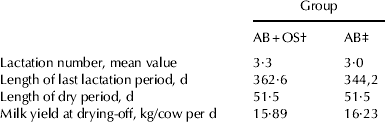
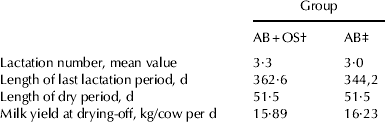
Of 152 cows that entered the study at drying off, 136 cows (544 quarters) remained in the study after calving. Three cows had a dry period shorter than 10 d, 3 cows calved after the end of the study period, and 1 cow was not pregnant. The remaining 9 cows died while dry or shortly after calving because of dystocia, milk fever or an injury. The two treatment groups did not differ with respect to lactation number and length, milk yield and length of the dry period (Table 1).
Lactation number and length of last lactation period, dry period and milk yield (means) of cows of groups AB and AB + OS. There were no significant differences (P > 0·05) between the two groups
† Dry cow treatment using an antibiotic (Benestermycin®, Orbenin Extra® or Nafpenzal®) and an internal teat seal (OrbeSeal®)
‡ Dry cow treatment using an antibiotic (Benestermycin®, Orbenin Extra® or Nafpenzal®)
CMT
514 quarters (257 in each group) from 129 cows remained for statistical analysis of the CMT results. A total of 30 quarters, including 15 that were paired with 15 affected quarters, were excluded from statistical analysis 1–5 d post-calving. Fifteen quarters were excluded because 6 cows had 1 blind teat each, 1 cow had grade 2 clinical mastitis (−4), 1 cow had grade 1 mastitis in 1 quarter and was treated with systemic antibiotics (−4n) and another cow had a mild grade 1 clinical mastitis in 1 quarter.
In group AB + OS significant more CMT-negative quarters could be observed than in group AB (200 vs. 172; P <0·001). CMT-positive quarters showed reactions ranging from + to +++.
Laboratory examinations
A total of 26 quarters, including 13 that were paired with the 13 affected quarters, were excluded from analysis, resulting in 518 quarters (259 in each group) from 65 cows. Thirteen quarters could not be evaluated because 6 cows had 1 blind teat each, 4 foremilk samples were contaminated, 2 cows with grade 2 clinical mastitis in 1 quarter were treated with an intramammary antibiotic, and 1 quarter yielded no milk.
The number of quarters that were eliminated from the SCC of quarter foremilk samples was nearly similar to those in the analysis of bacteriological culture results, but slightly lower because the SCC could be determined in samples that were contaminated or in samples from udders with an antibiotic therapy. Contamination is the microbial pollution of objects, samples for investigation and parts of the body with microorganisms from the animate and inanimate environment without any adhesion or proliferation of the microorganisms.
According the SCC quarter foremilk samples in both treatment groups there was a decrease (P <0·001) in the SCC from drying off to the two test periods at days 6–14 and days 35–56 (Table 2). There was no difference between the geometric means of the cell counts of the two groups (P = 0·36).
Somatic cell count of quarter foremilk samples at different time points in the study (geometric means±sd, number of cells/ml and geometric standard deviation (=dispersion factor); n, number of quarters)

† SCC numbers did not differ between groups (P = 0·37)
‡ Dry cow treatment using an antibiotic (Benestermycin®, Orbenin Extra® or Nafpenzal®) and an internal teat seal (OrbeSeal®)
§ Dry cow treatment using an antibiotic (Benestermycin®, Orbenin Extra® or Nafpenzal®)
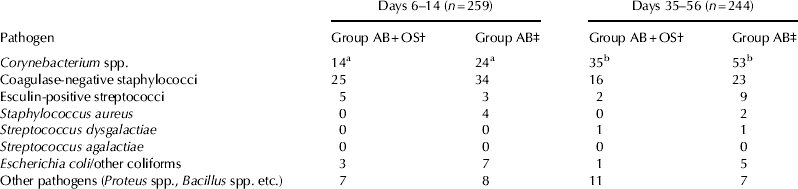
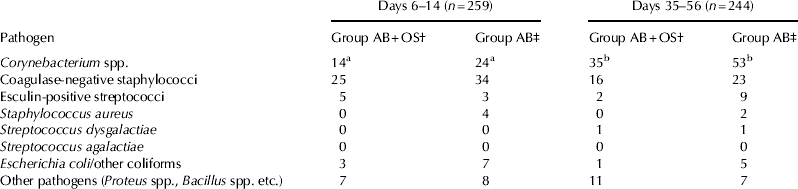
According the bacteriological culture 6–14 d post partum in group AB more quarter samples yielded growth of Corynebacterium spp. than samples in group AB + OS (24 vs. 14; P = 0·05). But there was no difference between the treatment groups with respect to positive cultures of other mastitis pathogens (Table 3).
Number of quarters with isolates of intramammary pathogens in groups AB and AB + OS between days 6 and 14 and days 35 and 56 of lactation
† Dry cow treatment using an antibiotic (Benestermycin®, Orbenin Extra® or Nafpenzal®) and an internal teat seal (OrbeSeal®)
‡ Dry cow treatment using an antibiotic (Benestermycin®, Orbenin Extra® or Nafpenzal®)
a,b Within rows numbers with the same superscript differ (a, P = 0·0471; b, P = 0·0161)
Regarding the bacteriological culture 35–56 d post partum a total of 56 quarters, including 28 that were paired with the 28 affected quarters, were excluded from analysis, resulting in 488 quarters (244 in each group) from 61 cows (Table 3). Twenty-eight quarters could not be evaluated because 6 cows had 1 blind teat each (−6n), 8 foremilk samples were contaminated (−8n), 3 cows were culled (arthritis, abomasal displacement; −12n) and 2 cows had received an antibiotic treatment because of a grade 2 clinical mastitis in one quarter (−2n). In group AB also more quarter samples significantly yielded growth of Corynebacterium spp. (53 vs. 35; P = 0·02). Additionally a difference between the two treatment groups could be observed in aesculin-positive streptococci (9 vs. 2; P = 0·02).
Additional SCC determination
The two treatment groups did not differ with respect to regular determination of SCC during the 3 months before calving and the 3 months after (P = 0·28). In both groups, there was a significant decrease in SCC from the last pre-calving test to the first post-calving test (P = 0·0001). Older cows had significantly higher SCC results than younger animals.
Clinical mastitis events
During the dry period, a total of 6 quarters (including 3 normal paired quarters) were excluded from analysis because of incomplete data sets, resulting in 538 quarters (269 in each group) in the analysis. During the dry period, there were no cases of clinical mastitis. After calving, a total of 40 quarters were affected by clinical mastitis, 25 in Group AB and 15 in group AB + OS (Table 4); this difference was significant (P = 0·03). There were 7 quarters with grade 2 clinical mastitis in group AB and 1 in group AB + OS. Grade 3 clinical mastitis did not occur. An investigation concerning the question which pathogen caused the mastitis was not conducted.
Number of quarters (%) affected by clinical mastitis in the first 100 d of lactation in two treatment groups (AB + OS/AB)

† Dry cow treatment using an antibiotic (Benestermycin®, Orbenin Extra® or Nafpenzal®) and an internal teat seal (OrbeSeal®)
‡ Dry cow treatment using an antibiotic (Benestermycin®, Orbenin Extra® or Nafpenzal®)
a P = 0·0257
Discussion
Compared with previous studies (Godden et al. Reference Godden, Rapnicki, Stewart, Fetrow, Johnson, Bey and Farnsworth2003; Berry & Hillerton, Reference Berry and Hillerton2007) the present field study used a larger number of herds, a longer investigation period and matched pairs of quarters within herds for statistical evaluation. The present study was designed as a follow-up to studies by Godden et al. (Reference Godden, Rapnicki, Stewart, Fetrow, Johnson, Bey and Farnsworth2003) and Berry & Hillerton (Reference Berry and Hillerton2007), who also compared conventional dry cow treatment with dry cow treatment that included an internal teat seal. Two commercial dairy herds in the USA were used in the former study and a research herd in the latter. The trial design as well as the statistical evaluation of the current field-study differs from these former studies. We used the internal teat sealant in a larger number of dairy farms under practical conditions to investigate its effect under different management conditions. In accordance with the field-study aspect of our investigation, the dry cow antibiotics routinely used in each herd were not changed, so that the farms used different antibiotic agents for drying off. Furthermore, compared with previous studies on the internal teat sealant in which udder health was monitored during the first week of lactation, we extended the period of monitoring and sampling to between 35 and 56 d in milk (DIM). Every cow was monitored concerning the occurrence of clinical mastitis cases until the 100 DIM according to former studies by Bradley & Green (Reference Bradley and Green2000), Huxley et al. (Reference Huxley, Green, Green and Bradley2002), Berry & Hillerton (Reference Berry and Hillerton2007) and Newton et al. (Reference Newton, Green, Benchaoui, Cracknell, Rowan and Bradley2008). Especially Bradley & Green (Reference Bradley and Green2000) showed that 52% of all clinical coliform mastitis cases in the first 100 d after calving have their origin in the dry period.
A further unique feature of the present study was the statistical analysis of data, which was based on matched pairs between udder quarters of cows that belonged to the same herd. This guaranteed the comparison of udder quarters that had received the same dry cow antibiotic agent.
The use of the internal teat sealant alone or in combination with dry cow antibiotics is a relatively new management technique in Germany. In previous studies (Berry & Hillerton, Reference Berry and Hillerton2002a; Belke et al. Reference Belke, Zschöck, Sobiraj, Wolter and Kloppert2004; Newton et al. Reference Newton, Green, Benchaoui, Cracknell, Rowan and Bradley2008) the rate of IMIs acquired during the dry period and/or the clinical mastitis rate was significantly lower in cows that were treated with antibiotics and the teat sealant compared with cows that did not receive dry cow treatment or were treated with antibiotics alone. The present study yielded results similar to those of Godden et al. (Reference Godden, Rapnicki, Stewart, Fetrow, Johnson, Bey and Farnsworth2003), but in contrast to that study, our treatment was applied at the cow level rather than the quarter level because within cows, all quarters received the same treatment.
Of the various factors that affect udder health, the herd effect plays an important role. Every farm has an individual strategy of managing its dairy herd in the field of feeding, housing and dry cow management, which has to be seen as a factor of influence on the state of health and here especially on the udder health of the cow. Green et al. (Reference Green, Bradley, Medley and Browne2007) showed that herd management factors (hygiene, dry cow therapy, management of the early and late dry period, calving area, etc.) were associated with an increased rate of clinical mastitis in the following lactation. To eliminate the herd effect on the outcome of our study, a so-called matched pairs design was used. Pairs of cows, consisting of one cow from each treatment group, were formed within herds on the basis of age, milk yield and SCC. Only cows were compared concerning the development of their udder health status in the test period that belonged to the same herd so that equal basic conditions for each cow pair could be guaranteed. Cow-individual factors—such as the cleanliness of teats—were not taken into consideration because the present study aimed at testing the additional effect of the internal teat seal under practical conditions unaffected by the hygiene standard of the farms. For analysis, pairs of quarters (1 quarter from each treatment group) were then formed on the basis of comparable cytobacteriological status at the day of dry-off. This allowed elimination of the confounders for herd effect and the effect of the particular dry cow antibiotic used because all cows within a herd were treated with the same antibiotic. The paired quarters from the paired cows were the cases to be analysed statistically. At the beginning of the study, the 2 treatment groups did not differ with respect to various variables relating to udder health (Table 1). The results of the cytobacteriological examinations of the quarter foremilk samples at the day of dry-off were used as parameter for finding quarter pairs with an equal starting situation at that time.
The numbers of quarters that could be evaluated at the different time points of evaluation varied. This was unavoidable and resulted from the elimination of cows from herds because of illness and accidents.
All cows underwent a CMT within the first 5 d after calving to monitor udder health. According to a study of Maunsell et al. (Reference Maunsell, Morin, Constable, Hurly and McCoy1999) results of the CMT with colostral quarter milk samples were associated significantly with the IMI status after calving. Sargeant et al. (Reference Sargeant, Leslie, Shirley, Pulkrabek and Lim2001) and Hamann et al. (Reference Hamann, Redetzky and Grabowski2004) describe CMT as a screening method to detect cows with IMI in the first days after calving. The sensitivity/specificity for detecting IMI with any pathogen were 46·5/61·0% (DIM 1) to 56·7/56·2% (DIM 3) (Sargeant et al. Reference Sargeant, Leslie, Shirley, Pulkrabek and Lim2001).
The collection of quarter foremilk samples was not started until day 6, when all the cows yielded normal milk rather than colostrum.
One aspect that has to be discussed in that context is the difference between the results of the CMT and the SCC of the quarter foremilk samples collected in the period 6–14 DIM, because differently from the CMT results in the period 1–5 d after calving, the SCC between 6 and 14 d post partum. The calving process and the metabolic changes associated with the start of lactation are potentially stressful and may predispose the cow to higher SCC in the first days after calving as well as clinical mastitis if invasion of mastitis pathogens has occurred during the dry period. While the internal teat sealant does not affect the immune system, it was designed to prevent or minimize bacterial invasion of the teat and thus leads to lower SCC in the first days after calving, resulting in significantly better CMT results, and reduces the incidence of clinical mastitis in early lactation. One can assume that after a cow underwent the phase of colostrum with its high potential for stress factors in connection with the calving process accompanied with metabolic changes the SCC gets normalized.
In the present study quarters that have received the internal teat sealant in combination with a dry cow antibiotic showed a significantly lower rate of clinical mastitis cases in the first 100 d of lactation. An investigation concerning the question of which pathogen caused the mastitis was not realized.
Quarter foremilk samples collected between days 6 and 14 and 35 and 56 from cows of group AB had significantly more positive cultures of Corynebacterium spp. than samples collected in group AB + OS. In the present study also other bacteria were reduced in group AB + OS, but because of too small sample sizes the differences between both groups were not significant.
However, the significance of Corynebacterium spp. as natural inhabitants of the teat canal in relation to clinical mastitis remains unclear. Le Van et al. (Reference Le Van, Eberhart and Kesler1985) showed that intramammary infection of one quarter with C. bovis, even when accompanied with an increased SCC, does not affect milk yield significantly. Other workers speculated that C. bovis has a protective effect against other mastitis pathogens (Rainard & Poutrel, Reference Rainard and Poutrel1988; Lam et al. Reference Lam, Schukken, van Vliet, Grommers, Tielen and Brand1997). Other studies revealed that quarters infected with Corynebacterium spp. at drying off that remain untreated are at increased risk of becoming infected with Streptococcus uberis during the dry period (Woolford et al. Reference Woolford, Williamson, Day, Lacy-Hulbert and Henderson2001; Berry & Hillerton, Reference Berry and Hillerton2002a, Reference Berry and Hillertonb). The occurrence of Str. uberis (as a main representative of the group of aesculin-positive streptococci) has been associated with new IMIs during the dry period (Bradley & Green, Reference Bradley and Green2004), especially on farms that use straw bedding. Str. uberis is commonly identified in milk samples (Bramley, Reference Bramley1982). Because clinical mastitis cases in the first 100 d of lactation can be traced back to IMIs during the dry period (Bradley & Green, Reference Bradley and Green2000) optimal dry cow management involving long-acting antibiotics and an internal teat sealant are likely to reduce the use of intramammary antibiotics during lactation. Mastitis during early lactation has considerable economic impact and may adversely affect fertility (Schrick et al. Reference Schrick, Hockett, Saxton, Lewis, Dowlen and Oliver2001). The use of an internal teat sealant is likely to have the greatest impact in herds with mastitis problems caused by environmental pathogens (mainly Str. uberis, Escherichia coli and other coliforms) and in cows kept on deep straw bedding. The internal teat sealant has also been shown to be effective in preventing mastitis during early lactation in cows with an extended dry period (Berry & Hillerton, Reference Berry and Hillerton2007).
Conclusion
The use of a commercial internal teal sealant combined with routine long-acting dry cow antibiotics helps to decrease IMIs caused by environmental pathogens during the dry period. This results in a reduction in the number of cows with clinical mastitis in early lactation and the use of antibiotics during lactation.
We thank all those who made this study possible. We also thank the participating farmers for their cooperation and Hans-Peter Jung, Walter Mihlan and Holger Emrich for excellent technical assistance. Thanks are also due to Katja Olf from the Laboratory of the Hessian Milk Recording System (Hessischer Verband für Leistungs- und Qualitätsprüfungen in der Tierzucht e.V.; HVL) for providing the SCC data and Pfizer Animal Health for financial support of this study.