1 Introduction
Technology has made [teaching] more interesting, and also more frustrating. It saves time, and it wastes time. It makes the students interested, and it also distracts the students in negative ways. (van Lier, Reference van Lier2004: 186)
This statement, obviously mimicking the opening section of Dickens’ Tale of Two Cities, reveals the double-edged sword that exists in technology use in language classrooms. On the one hand, this has been an exciting time for teachers and researchers who are concerned about incorporating technology into their second-language teaching practices, but on the other hand, many alarming issues and challenges have also been uncovered as teachers and learners have attempted to engage in learning with the help of various digital tools and technologies. The increasing number of publications that have appeared during recent years indicates a growth in mindful integration of new technologies in language classrooms, including the application of such technological tools as instant response systems (IRSs) like Clickers (Agbatogun, Reference Agbatogun2014; Rodriguez & Shepard, Reference Rodriguez and Shepard2013), learning management systems (LMS) like Blackboard and Moodle (Blin & Munro, Reference Blin and Munro2008; Hirschel, Reference Hirschel2012; Langdon & Taylor, Reference Langdon and Taylor2005), and mobile devices such as smartphones and tablets (Lys, Reference Lys2013; Yang & Xie, Reference Yang and Xie2013). Clearly, relevant to an understanding of technology-enhanced learning and teaching is the question of how to integrate technology in such a way that it maximizes learning opportunities and builds engaging learning experiences (TESOL International Association, 2004), rather than whether or not technology should be embraced at all.
To steer classroom technology use in positive directions is a responsibility that teachers nowadays are bound to take. They need to decide how to weave technology into everyday classroom activities (Garrett, Reference Garrett1991) and make “learning more meaningful, motivating, and rooted in the personal interests of students” (Warschauer & Cook, Reference Warschauer and Cook1999: 32). The role of technology in language learning and teacher education has been articulated and identified by technology standards in the United States first and beyond (Murphy-Judy & Youngs, Reference Murphy-Judy and Youngs2006). Thus, a general knowledge of the use and application of technology in foreign language classrooms has been considered a must for both pre-service and in-service teachers. Particularly important is the need to focus on the specific choice that the instructor makes for a certain purpose (Warschauer, Reference Warschauer1998, Reference Warschauer1999) and the value of examining teachers’ technology use in the particular context in which they work (Chao, Reference Chao2015). Abundant studies have addressed the teacher’s use of technological tools, providing concrete and specific examples of how one particular type of technology can support learning (e.g. Beatty & Ulasewicz, Reference Beatty and Ulasewicz2006; Chao, Reference Chao2006; Roush & Song, Reference Roush and Song2013). However, only a few put emphasis on a teachers’ pedagogical choices of a variety of technological tools and make an attempt to delineate the active role that teachers take to adjust their understanding of technology use (Bielefeldt, Reference Bielefeldt2012; Haines, Reference Haines2015; Pierson, Reference Pierson2001). After all, most of the teachers we know rarely use only one tool at a time, and they are far from passive about when and how to use technology in order to foster learning. The need to reflect this reality in research and to investigate how teachers actively promote language learning and learner agency through their orchestrated use of multiple sets of technology is clear.
One of the complexities of technology integration involves the connections of teachers’ professional and world knowledge as well as their understanding of content, teaching, and technology and the complex ways in which these are applied in multifaceted and dynamic classroom contexts (Koehler & Mishra, Reference Koehler and Mishra2009). Exploring this issue further requires a proper theoretical framework that addresses, rather than factors out, the broader social context in a technology-integrated classroom. Bearing this in mind, the current study pays special attention to “holistic and process-oriented” contexts (Levy, Reference Levy1999: 28) by examining a technology-enriched English as a foreign language (EFL) classroom in Taiwan through the lens of van Lier’s ecological perspective. The goal is to yield deeper and richer thinking and understanding of the interactions among students, teachers, and tasks afforded by digital technologies in a language classroom.
2 Theoretical framework
The ecological approach, in the words of van Lier (Reference van Lier2004: 11), aims to understand “what is it in this environment that makes things happen the way they do.” As an extension of the ideas of Vygotsky (Reference Vygotsky1978), ecological and sociocultural views show considerable affinities in that they highlight the role of context in which language learning emerges (Thoms, Reference Thoms2014). Focusing on the full complexity and interrelatedness of all the elements within an ecosystem (such as a classroom), the ecological approach makes an attempt to “bring SCT into a motivated, and well-articulated framework” (van Lier, Reference van Lier2004: 20) that accounts for language learning. Researchers taking an ecological stance tend to oppose the scientific thinking of picking out only one or two elements from a complex puzzle with the intention to study them in detail. They argue that the dynamism of the natural language teaching–learning process is doomed to be deconstructed in research with such a decontextualized paradigm, and they suggest taking the ecology of language learning into consideration (Kramsch & Steffensen, Reference Kramsch and Steffensen2008; Thoms, Reference Thoms2014; van Lier, Reference van Lier2000, Reference van Lier2004, Reference van Lier2010; Ziglari, Reference Ziglari2008).
One of the key notions in van Lier’s ecological perspective is his proposal of a change of second language acquisition (SLA) terminology from “input” to “affordance.” On the basis of the brain–computer metaphor, the use of the term “input” compares language to a fixed code and refers to the human brain as a machine that receives and processes the code. This implies that learning happens, exclusively, in the brain. However, the ecological notion of affordance, originally coined by Gibson (Reference Gibson1979: 128), means something that the “niche” makes available to organisms in order for the organism to perceive, use, and achieve a certain goal. As Gibson puts it, a leaf in the forest provides affordances for different organisms. To a caterpillar, it’s food; to a spider, it can be shade. In SLA, a niche can be considered an environment mediated by language, and the goal is to learn a language (Menezes Reference Menezes2011). How people relate themselves to the environment is fundamental to meaning-making, and the process has to be active and autonomous, altering with the changing but unique ways a person perceives and then acts upon the affordances around him or her. Just like a leaf provides different affordances for different organisms, computers (or technology) offer various affordances to language learners as well as teachers, depending on the agents’ perceptions and actions. In the classroom situation, learners and teachers may need to work together in order to perceive, take action, and bring about the best possible learning experience. In other words, both learner and teacher agency are needed.
Learner agency refers to the kind of capability that an individual possesses to take control, as well as to perceive and act upon certain affordances (Flowerdew & Miller, Reference Flowerdew and Miller2008; Gao, Reference Gao2010; Hall, Reference Hall2008; Mercer, Reference Mercer2011), often involving a community of practice. It is important to note that the concept of learner agency can be easily confused with that of learner autonomy. According to Holec (Reference Holec1981: 3), an autonomous learner possesses “the ability to take charge of [his] own learning.” In diverse activities, learners can be granted full autonomy, but this concept of learner autonomy is largely individual and independent with no consideration of an interactive, social dimension (Little, Reference Little2015). In an ecological approach, on the contrary, learner autonomy in the sense of agency is socially produced (Bakhtin, Reference Bakhtin1981), which means “having the authorship of one’s action, having the voice that speaks one’s words, and being emotionally connected to one’s actions and speech, within one’s community of practice” (van Lier, Reference van Lier2004: 8). Thus, a learner’s agency is best understood as a complex system composed of various constituent components including their belief systems, motivation, and abilities, as well as the actual and perceived affordances in specific settings (Mercer, Reference Mercer2011).
As our interest is in the role that teachers play in support of learner agency with technology, we look for studies that provide insight for this aspect. In applying the notion of ecology to computer-assisted second-language education, many authors have highlighted the centrality of the teacher’s role in assessing affordances provided by technological tools in both formal and informal learning contexts (John & Sutherland, Reference John and Sutherland2005; Kennewell, Reference Kennewell2001; Liou, Reference Liou2012; Rama, Black, van Es & Warschauer, Reference Rama, Black, van Es and Warschauer2012). For example, Haines (Reference Haines2015) indicates that the ability to identify affordances of new tools is an important aspect of teacher learning about the use of technology. Her 14-month study with two experienced foreign language teachers demonstrates that the kinds of affordances that teachers capture relate closely to their individual contexts and are developed over time in relation to the language-learning processes they prioritized. This study calls our attention to how teachers’ perception of affordance may support learner agency.
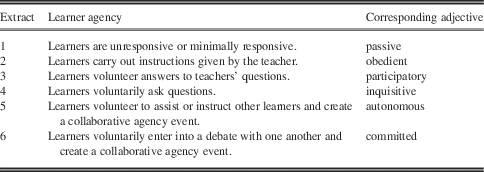
Another insightful study is van Lier’s (Reference van Lier2008a), which presents six extracts from diverse contexts (see Table 1). The purpose is to locate various levels of learner agency in classrooms.
Six extracts for analytical search for agency (van Lier, Reference van Lier2008a: 169)

From van Lier’s (Reference van Lier2010) point of view, learners in these extracts exert their agency in an ascending order of intensity. This diversity in the manifestation of agency on a continuum is instigated by the particular learning environment in which learners and teacher are situated. He then proposes three core characteristics of agency that are broadly compatible with the mainstream definitions. That is, agency involves self-regulation and initiative by the learner, interacts with the sociocultural context, and includes the awareness of responsibility. According to van Lier (Reference van Lier2004: 96), learners as agents first perceive affordances in the learning environment full of meaning potential and then engage in their chosen activities. The agent (or the learner) as an active perceiver possesses certain kinds of abilities to pick up the information he or she wants (Gibson & Pick, Reference Gibson and Pick2000). Learning requires active, perceiving agents engaging in activities, tasks, and projects rather than passive input receivers and output producers. In the process, new affordances are discovered and provide opportunities for further development (van Lier, Reference van Lier2008b).
Van Lier’s framework provides useful insight into how learner agency can be supported or identified in a classroom context. However, the teacher’s role as a key component of such a learning environment that fosters learner agency is surprisingly lacking in the discussion despite the fact that the teacher’s presence is obvious. Although van Lier did clarify that the emphasis on learner agency did not mean to diminish the need for teachers, failing to take the teacher’s role into consideration may leave the ecosystem of a language classroom incomplete. What is more, giving primacy to learner agency mediated by the sociocultural context may actually put emphasis on the crucial mediating function of a teacher and the technology that the teacher and the learner perceives to be useful and chooses to bring to the classroom in support of learning. As Motteram (Reference Motteram1997) states, computers and the Internet have a close association with agency. This association is built in two ways: through the interaction with the technology itself and through the interaction facilitated by the use of technology. Both could be difficult or impossible to establish in the classroom without a teacher’s effort in facilitating technology-based instruction (Benson, Reference Benson2001).
In search of a full understanding of how classroom ecology encourages learner agency, the present study looks into one teacher’s views and actions in detecting and employing affordances in her language classroom practice. An EFL classroom is selected intentionally as a specific niche where the participating teacher and her learners work together to achieve meaningful and agentive learning through class interactions and acting on the affordances available in their classroom. Through an ecological lens as well as the notions of ecology, affordances, and agency, this study aims to frame the examination of this technology-enhanced language classroom in terms of how learner agency is achieved and how the teacher’s pedagogical choices with the technology are conceptualized. Drawing on such a theoretical framework, the research question that guides the analysis of the classroom interactions in this study is: How does the teacher identify affordances in the classroom ecology and use them to support language learner agency?
3 Methodology
3.1 Research design
This study follows an in-depth single-case case study design, with the goal of illuminating a particular issue (Hood, Reference Hood2009). With a focused description of the teacher’s classroom practice and an in-depth analysis of her unique technology use, interaction with her students, and views toward teaching, this article attempts to shed light on the complex relationship among context, technological tools, and people.
3.2 The setting
The study site was a college English course offered by one of the top research universities in northern Taiwan. This first-year English course was compulsory for non-English majors from the College of Liberal Arts. The class met every Tuesday morning for three consecutive 50-minute periods. It was taught mainly in English, with Chinese being used only to clarify meaning or explain difficult vocabulary. Approximately two thirds of the class time was devoted to various readings (mostly news articles, but a few essays and literary works as well), and the remaining one third to speaking and listening practice.
There were 37 students (female: 20, male: 17) from different majors in the course. Eleven students were majoring in Chinese, ten in Japanese, seven in History, six in Library and Information Science, two in Anthropology, and one in Drama. Most of the students were freshmen with only two exceptions (one sophomore and one junior student). Their English proficiency levels ranged from upper-intermediate to advanced.
The traditional classroom seating could accommodate 60 students. A podium equipped with a desktop computer with Internet access and a monitor was permanently installed in front of the classroom. A blackboard and a projection screen were located on the wall behind the podium. The teacher used electronic equipment such as the computer and projector every class, but she rarely taught with chalk and the blackboard (actually not at all during the two-month observation of this study).
3.3 The participant
The instructor of the course, Lillian (a pseudonym), was an associate professor who had been teaching in the university for 15 years at the time of the study. With a PhD in English from an American university, she had taught various courses to English majors, including Contemporary American Literature, and English Writing for Academic Purposes. Lillian had not only been recognized by her peers as an exemplary teacher but had also won the Excellence in Teaching Award several times over the years. Most remarkably, as an experienced teacher, Lillian had strong enthusiasm for technology use, which made her always one of the early adopters of new teaching technology in her department.
The first researcher and Lillian met at a TESOL seminar at a local academic event. Lillian was one of the speakers invited to share her experience in teaching with a locally developed interactive response system called Zuvio. When Lillian was consulted about participating in this study, she immediately accepted the invitation as she considered this study an opportunity for her to reflect on her teaching beliefs and practice.
3.4 Data collection
The primary source of data collection was classroom observations in which the first researcher acted as a non-participant observer. Ten three-hour observations were conducted from October 28 to December 30, 2014. Field notes taken at the time made it possible to begin to understand the ecology of the classroom. The observation scheme was adapted from Nunan’s (Reference Nunan1992) Communicative Orientation to Language Teaching (COLT) Scheme, focusing on the teacher’s design and management of in-class activities with technology. (See Appendix: Classroom Observation Scheme.)
Supporting data was collected through interviews and an online discussion files review. A 10-minute post-observation interview was conducted with the participant right after each observation session in order to understand Lillian’s decision-making process. Electronic files that the teacher posted on the university-developed teaching platform (similar to Moodle) and the ZuvioIRS (similar to Clickers) were gathered and examined to form an expanding context to the language teaching. These multiple types of data sources enabled the researchers to obtain a broad perspective on the participant and her classroom as well as support triangulation, adding rigor to the research.
3.5 Data analysis
The data collected from the classroom included field notes, interview transcripts, and online discussion files. Both authors first analyzed the classroom observation notes and the interview transcripts individually to draw up possible themes and patterns emerging in the data. After that, they discussed and sorted out some discrepancies, and finalized two major categories: (1) affordance and (2) learner agency. Drawing on these two overarching concepts, both researchers re-read the data set to look for extracts that captured the essence of the teacher’s teaching practices with technology. Three extracts were then selected as vivid examples to depict a whole picture of the classroom ecology in a concise, logical, and non-repetitive way. The teacher’s practices in these extracts and her thinking behind them were then mapped onto van Lier’s (Reference van Lier2004) framework of affordance and agency in the learning environment. In the process, the teacher’s role of perceiving affordance and fostering learner agency stood out as an additional element in the refined framework. In the meantime, three key elements were identified: (1) the sense of teacher presence, (2) the perceivability of affordances, and (3) the manifestation of learner agency. Qualitative data from readily available online discussion files provided additional evidence to illustrate and support the findings.
4 Eyes on the classroom
4.1 Extract 1
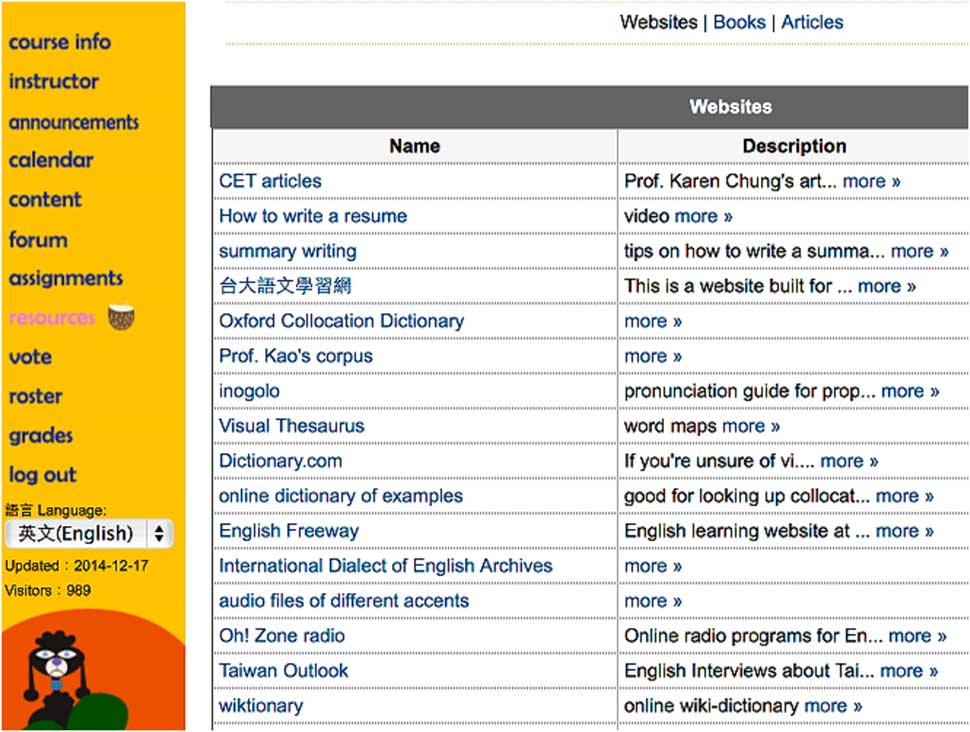
The bell rings. As a classroom routine, the first thing Lillian does is to check with the students for problems they encountered in their homework. One student reports that she came across a new word that sounded like /ˈpɑːrtəzn/ in the listening exercise but she could not figure out how to spell it. Instead of writing down the answer for the student directly, Lillian says, “That’s interesting. Let’s see if the computer could help us with that.” Then she mirrors her computer screen onto the projector and logs in to the teaching platform. A list of useful websites (36 in total) appears after she clicks the “resources” button (as in Figure 1). She chooses a hyperlink of an online dictionary, which immediately takes her to the Free Dictionary website. Then she starts to type in the letters “p”, “a”, “r”, “t”, “i”, and “z” one after another as she imitates the student’s pronunciation. She stops right there and a prompt comes up automatically with the exact word that the girl asked for, partizan. The students are amazed. “That was easy, right?” Lillian smiles, “You were almost there. You’ve sounded out the word. Then [you need to take] one more step: Try to spell it. Don’t worry about making mistakes. The search engine will help you out.”
Screenshot of the teaching platform – resources

4.2 Extract 2
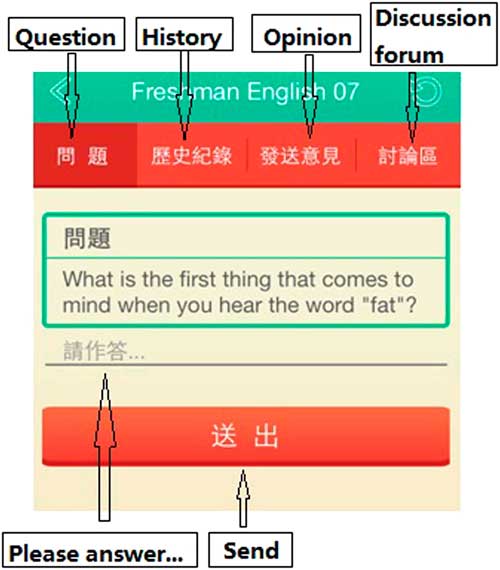
A few minutes before class, Lillian is busy doing something on the classroom computer without turning on the projector. “We’ll use Zuvio today. Please open the app on your mobile phone and log in.” The teaching assistant keeps giving out the same instruction as the other students enter the classroom. It’s time for class. “We’re going to do a quiz on Zuvio, if you call it so, a quiz of free association. You know what that is? Free association?” Lillian asks. The class looks puzzled. “This concept comes from psychoanalysis by Freud.” She continues, “When you see something or hear something, you immediately connect it to something else. This is related to your unconsciousness. For instance, if I say blackboard, you might think of teachers, chalk, classrooms, or whatever you find relevant. Follow your intuition. It will be timed, one minute, okay?” The students then see the question on their phones: “What is the first thing that comes to your mind when you hear the word ‘fat’?”Footnote 1 (See Figure 2.) They immediately start typing in answers. One minute later, a list of answers produced by the students is shown on the projection screen and the class bursts into laughter. The answers are various, including “greasy,” “cute,” “exercise,” “middle-aged guy,” “desserts,” “my best friend’s ex-boyfriend.” “Which one interests you the most?” Lillian asks. “The ex-boyfriend!” A girl pipes up. “Well, let’s see. It’s Emily’s answer, right? Emily, would you please explain for us?” Lillian says. Emily stands up and starts to tell a funny story about her best friend’s overweight ex-boyfriend: “My friend, her ex-boyfriend is an American. He …”. “I’m sorry but where did they meet?” A student interrupts her and asks for elaboration. “Oh, they met in Taipei as he was an exchange student in her program.” Emily continues with her story, and the rest of the class listens attentively. Everybody seems to be quite enjoying the moment. After that, Lillian suggests that the students categorize all the answers and find bias against “overweight.” At the end of the activity, Lillian introduces the in-class reading topic: stereotypes about overweight people.
Screenshot of the ZuvioIRS

4.3 Extract 3
Twenty minutes before the end of class, Lillian is wrapping up the lesson while talking about next week’s reading text: World War I brought fundamental changes to the world. “There are eight battles that are mentioned in the reading. You might find them unfamiliar,” Lillian says, and shows a list of battles on the projection screen. “Next time, when we read through the text together, each group will explain the whole story of one battle to help your classmates achieve better understanding. Now, start looking up the information of the battle from your smartphone. Or you may check out a tablet from me. I’ve brought tablet PCs for you guys. One per group.” As she finishes, the students stand up and get into groups quickly. Some students check out tablets from Lillian for the group. The rest of the group members all take out their cellphones. Once they’ve finished information searching individually, they start exchanging ideas with their teammates.
5 Teacher thinking behind the extracts
Although presented as instances of language learner agency fostered by teaching practice and technology, the three extracts must be understood as highly contextualized teaching–learning interaction. It is thus important to understand teacher thinking behind these extracts.
First of all, there is the teacher’s understanding of the students and the context. Understanding the uniqueness of a particular class is certainly fundamental for a teacher to learn before teaching (Tudor, Reference Tudor2003). The exploration of local cultures of learning (Cortazzi & Jin, Reference Cortazzi and Jin1996) and the evaluation of students’ actual capacity and performance as well as their perceptions, expectations, and potentialities (Kramsch & Steffensen, Reference Kramsch and Steffensen2008) serve as a source of reference for the teacher’s methodological decision-making. Indeed, Lillian describes her students as being “introverts, dependent on authority and often taking a closure-oriented interaction pattern with the teacher.” She believes the students need time and guidance before they would actually take action, either making their real voices heard or taking charge of their own learning. Responding to this unique learner character, Lillian’s strategy is to push her students out of their comfort zone, although at a pace that is gradual and with the intention to tolerate and accept her students’ habitual mode of learning as well as interacting with the technology. Having a rich amount of technological resources collected in the classroom management system at her disposal is certainly a help to her intention of providing proper guidance. The following section analyzes each extract respectively and elaborates on Lillian’s ways of acting on the affordances in the classroom ecology with the goal to foster learner agency.
Extract 1, finding a word in the online dictionary, illustrates not just Lillian’s action taken upon the student’s question but also her efforts to transfer students’ rather shallow kind of technology use in their daily life to a deeper and more independent learning experience that can be useful for lifelong learning. As a language teacher, Lillian appreciates the variety of possibilities that online resources could bring to the students, particularly in terms of enhancing their ability to engage in independent language learning and pursuing learning aligned with personal interests. However, she is also aware of the tendency in most of her students to underestimate just how powerful free-access resources such as an online dictionary can be. Lillian says:
They [the students] know the technology tool [i.e. the online free dictionary] already and use it quite often, but they simply fail to establish a conscious link between the technology and language learning. All I need is to wait for a proper time to impress them with the magic of online dictionaries. When the student brought up the question, “It’s time,” I said to myself.
In this sense, Lillian’s technological pedagogical content knowledge (Koehler & Mishra, Reference Koehler and Mishra2008, Reference Koehler and Mishra2009; Mishra & Koehler, Reference Mishra and Koehler2006) could be providing her with sensitivity to critical moments like this. With careful analysis of this extract, it becomes apparent that there is a content-related teaching need (finding vocabulary that the learner can already pronounce); there is pedagogy (the teacher’s recognizing the opportunity to teach and her actual demonstration); and there is technology (the online dictionary). Particularly important is Lillian’s identification of the opportunity (that her students need to learn a certain skill that will benefit their ongoing learning) and of the affordances of the technology tool (that there is more to an online dictionary than what her students know). Both urge her to take action accordingly. Thus, this extract clearly demonstrates the teacher’s spontaneous, thoughtful, and orchestrated use of various bodies of knowledge in the language classroom for the purpose of achieving a future-oriented goal: learner agency.
Experienced teachers like Lillian often find that no matter how quick and reliable an application is, learners do not necessarily take full advantage of its functions or actually use it for language learning. They often seem to be able to figure out how to use any new technological tool very quickly, but the need for teacher presence and support in terms of language learning is still vital (Lund, Reference Lund2013). It is at the moment when the learners reveal their difficulties that the teacher can demonstrate problem-solving skills with the help of technology. Particularly needed is the transfer of their habitual and often entertaining concept of technology use to a more enriching use of technology.
However, there are fine lines to draw between teacher roles as a facilitator, a dominator, and an outsider. Instead of assuming an authoritative position and giving out the “correct” answer right away, Lillian chose to demonstrate the use of the online dictionary as an independent learning tool. In her view:
Students lack the skill to navigate in a buzz of confusion and to trust and utilize the information they find. Once they’ve learned this skill, they are on the way to becoming life-long learners. And I will be more than happy to let them go. What I want to teach is not knowledge points. My strategy is to support self-directed learning as a language teacher as well as a language learner.
The ability to select appropriate technology and make optimal use of it allows Lillian to support and extend students’ learning both in school and beyond the school walls. Lillian tries her best to make her resources and strategies available for the students to learn and choose from. She even encourages students to discover new functions of existing technologies and to share these with their classmates. Through personalization and appropriation of technology, her students can more skillfully perceive affordances and gradually develop the skill to exercise their own agency (Morgan & Martin, Reference Morgan and Martin2014).
In Extract 2, the free-association activity, Lillian’s use of Zuvio actually matches well with van Lier’s conception of a well-constructed technology-enhanced activity, as it can be regarded as “intellectually stimulating and socially rewarding” (2004: 187). First of all, in terms of the socially rewarding aspect of this activity, the amusing nature of the prompt (i.e. the word fat) establishes the fun nature of this activity and immediately affords engagement and participation. Zuvio also makes it easier for students to participate, both physically and emotionally, than without such a tool. The students first use Zuvio to generate their own thoughts and then participate by simply sending off their answers to be projected on the classroom screen. Participating through this tool can feel emotionally easier than having these students speak out their views in public. Although the latter method would often lead to only one or two voices from more capable students, the former, using Zuvio, allows every single class member to perceive an equal and non-threatening opportunity to participate and thus makes it easier for them to exert their agency in class, as evidenced by the class members’ spontaneous questions raised at this moment. Furthermore, seeing the collected answers of the whole class projected on the screen, the students express a combined sense of amazement, amusement, and community, as suggested by their heightened and excited facial expressions and body movements. As Fies and Marshall (Reference Fies and Marshall2006) point out, the IRS affords opportunities to capitalize on and foster the strength of diversity in thought, and participation in playful exploration expands the space where learning occurs. Through the use of tools in this extract, Lillian is also communicating her own unique interpretations of language teaching and learning to her students: that as a teacher she genuinely wishes to listen to what the students have to say about the topic and that every one of their views is regarded as valuable.
As the initial fun and exaggerated association of the word fat gets blown up on the big projector screen, the effect is also an intellectually rewarding learning experience. Building on the initial excitement, the teacher spots a funny answer, or another affordance for learning, and invites the student who created it to elaborate. As the student freely discusses her views, the message is gradually clear to the students: that we all have an implicit bias that is seldom made known to others, but we may find it useful to examine our bias carefully, perhaps by using a magnifying tool similar to the big screen. Thus, Zuvio and the big screen highlight all of the students’ biases and create an enlightening twist that very appropriately leads to the follow-up face-to-face discussion. The affordance of Zuvio makes it possible for students to reveal their views and for the teacher and the class to appreciate and build on each other’s contributions. All of these lead to lively discussion, debate, and laughter in the classroom. It is under the positive classroom atmosphere collaboratively afforded by the prompt, the tool, and all the individuals involved that the teacher then focuses on the concept she wants the class to take home.
The current extract is the result of the teacher’s attempt to capitalize on the distinctive affordance perceived in the classroom technology and in the face-to-face interaction. It is worthwhile pointing out that Lillian’s use of these classroom tools did not come easily, as she explains:
I used Zuvio more often in the past few semesters. Sometimes, I felt it was not really necessary to use this tool. I guess I was not very successful using it in my previous classes. It was often reduced to only for asking questions. No follow-up activity was designed, and it made no contribution to the course goal. So I made a little change this semester. I decided to use it less and combine Zuvio activities with traditional ones. Zuvio values individual differences and stresses diversity among students, whereas traditional group activities work well for face-to-face interaction and negotiation in a smaller community. We need both in a classroom, and I’m trying to find the balance.
Lillian obviously puts in thought and reflection on her teaching with technology; she is willing to critically review it until she knows how to best support her goal. Her viewpoint resonates with Honigsfeld, Giouroukakis, Cohan and Walsh’s (Reference Honigsfeld, Giouroukakis, Cohan and Walsh2009: 217) stance in that she aims “not [to] use technology for the sake of simply using it, but rather to engage in critical analysis and reflection to identify which modes of technology most complement their teaching and student learning outcomes.” This thoughtful use of the technology clearly requires a continuous refining process by the teacher and is not likely to be expected to be an immediate success.
Drawing on Little (Reference Little1995), we believe this process of classroom communication through the use of technology helps promote agency in learning, most obviously because Lillian intentionally creates welcoming opportunities for the learners to contribute and participate. In addition to the extract, Lillian also routinely involved the students in classroom rule-setting and assessment. For example, with the support of Zuvio, Lillian sets up a poll for students to vote for the date of the midterm examination. She also empowers the students in evaluating their peers’ presentation performances. As such, Lillian treats students as partners in classroom management and activity arrangement. Student voice is valued and amplified, and learning becomes democratic. In her words:
I don’t want my students to feel obliged to follow my lead in the classroom. They should take more ownership of their learning. I notice that students act more actively when being invited to participate in the decision-making process.
In Extract 3, a collaborative investigation and presentation of the major battles in World War I, Lillian allows students to use mobile devices, such as their smartphones or tablets, to search for the information they need right in the classroom. Her attitudes toward mobile devices echo Koehler and Mishra’s (Reference Koehler and Mishra2009) position that teaching with technology is a practice of interaction between teachers’ perception toward technology and how they apply that perception in the unique contexts within their classrooms. As Lillian puts it:
Integrating tech is more than just a matter of having digital devices. A cell phone or an iPad can be distraction in the classroom, or it can be an instant connection to the vast amount of resources on the Internet. To me, they are the latter.
Unlike teachers who consider smartphones as being demonic, Lillian encourages, rather than forbids the use of mobile devices in her class. This is based on a careful weighing of the benefits and drawbacks of this tool in context. According to Lillian:
It’s the era of information explosion. Students will find many things online. How do they simplify the information that they find and get to the most important point? And how do they present that so that the listeners know what they are saying? And how do they connect that to the reading? This activity can be time-consuming. But if it helps achieve the objective of the lesson, it is worth the time.
Collaborative projects like that in Extract 3 have often been advocated in the literature as among the best ways to make use of the technology in education (e.g. Beach & Myers, Reference Beach and Myers2001; Chao, Reference Chao2006), although Lillian’s project is limited in that it does not require students to do much more than present what they found on the Internet to the class. Nevertheless, her students as language learners still need to critically review and select the core information for presentation, potentially requiring all four language skills and cultural understanding. There are challenges that the group needs to work collaboratively to overcome, and there is openness and ambiguity that both the learners and teacher need to live with. It also requires the teacher to relinquish her control, including allowing the use of mobile technology at the students’ discretion in the classroom. Under these circumstances, it takes courage for the teacher to assign such a project. In fact, Lillian believes that this project demonstrates her evolving ability to perceive and utilize affordances of mobile devices as she develops deeper understanding of the students, activity, material, and her course objectives. She adds:
Asking students to look up historical events in the reading and explain to their classmates is something new I am trying this semester. Formerly, I would explain these battles one by one for the students. Practice makes perfect. I almost became an expert in the First World War, but it didn’t leave any great impression on the students.
Assigning this project with the help of mobile devices and the Internet, Lillian intends to yield the floor to students so that they can steer their own learning. The activity is expected to blur the boundary between teacher and students, expert and novices, as the students get to play the teacher and expert role in presenting their designated battle. This rather new challenge can be real and difficult for all participants. Lillian, however, believes that a learning community can help: students in groups form miniature learning communities, and the whole class a big one. This opportunity to work as a member of a learning community on challenging projects is expected to awaken learners’ agency (Allwright & Hanks, Reference Allwright and Hanks2009) and is considered a worthwhile learning experience.
Overall, the three extracts suggest that at the heart of good teaching with technology is the harmonious and orchestrated relationship between and among various kinds of technology, the teacher’s pedagogical choices, and learner agency. This relationship really takes time to develop, as it is reciprocal with the affordance of various tools, and the perceiving agents (i.e. the teacher and students) always serving and inspiring each other in interdependent ways. On the one hand, technology opens up more pedagogical choices in the teaching of foreign languages. On the other, with technology being imported into education, pedagogical adjustments are needed to make affordances easier to perceive and take advantage of. The analysis of Lillian’s pedagogical choices reveals not only her evolving ability to connect technology affordances with classroom activities but also her willingness to encourage agency with her reflective use of the ever-evolving technology-mediated activities. Lillian’s experience shows that teachers’ commitment to learner agency could play a key role in enhancing learning among the “net generation.” Indeed, free and unlimited access to vast online resources provides strong support for self-directed learning, which is no longer constrained by time and distance (Warschauer & Healey, Reference Warschauer and Healey1998), but it also becomes more demanding for the learners to actively acquire the necessary skills in order to use new technologies effectively. For example, how to identify unique search terms to locate sources? How to compare results from preliminary searches? How to track information to a reasonable source, and recognize and consider the impact of bias in assessing the credibility of information? Addressing all these questions is worthy of the teacher’s and learners’ time and effort in the language classroom. Including these skills in the learning objectives may be a priority for language teachers who are willing to help the learners become their own agents and take advantage of the full potential of new technologies around them for the purpose of enhancing their language learning experiences.
6 Discussion
Inspired by van Lier’s (Reference van Lier2008a) study on classroom agency, the three extracts here can also be categorized based on how teacher–student interaction encourages agency. That is, the first online dictionary extract is an instance of individual student agency supported by the teacher. The second word-association extract using Zuvio is the complementarity between the teacher’s and students’ agency, while the third extract, a collaborative investigation of World War I battles using mobile devices, can be considered as group (class) agency encouraged by the teacher. It is important to point out that these categories do not suggest an ascending scale or continuum of student agency. Instead, all three can be afforded concurrently in a technology-enriched classroom.
At first glance, this finding seems to overemphasize the role of teachers and somewhat contradicts the findings made by van Lier (Reference van Lier2008a), who assigned a pivotal position to student agency. On second thought, however, in the extract that van Lier considered the highest level of learner agency, learners’ active participation would not likely be sustained without positive feedback from the teacher. Even more significant is the teacher’s efforts to steer the debate to a spirited and fruitful end by making thought-provoking comments. Therefore, it makes sense to emphasize both learner and teacher agency in the framework outlined in Section 2, not just the learner’s.
In addition, three key elements can be emphasized in the refined van Lier framework to illuminate levels of teacher and learner agency manifested in classroom ecology: the sense of teacher presence, the perceivability of affordances, and the manifestation of learner agency. The interaction of these three emerges as a rather interesting pattern after a closer scrutiny of the data, as depicted in Table 2.
Interaction among sense of teacher presence, perceivability of affordances, and manifestation of learner agency in the three extracts

In particular, Table 2 shows that the affordances of a technological tool vary in terms of the perceptions and goals of those who are involved in using it. Some affordances can be easily perceived, while others may not be that obvious. The teacher can choose to give a high or low sense of teacher presence in her effort to encourage agency in the classroom, and the manifestation of learner agency can be more individual or social in its orientation. For example, in Extract 1, the student exhibits a high level of agency by seeking help from the teacher on her own initiative. The teacher seizes that opportunity and demonstrates a less well-known function of a commonly used online dictionary in a direct way. As the teacher guides the whole class through the process of looking for solutions via free online dictionaries, she gives a high-level sense of teacher presence. This is based on her assumption that this specific affordance (i.e. having the dictionary suggest spelling) is important but difficult for students to perceive. The manifestation of learner agency can be more individual-oriented; that is, whether or not the students benefit from the instruction depends on their volition in using the technology in that specific way. The one who uses the online dictionary frequently afterwards will probably gain a personalized understanding of the affordance through his or her experiences, while other students may not find it useful. Extract 1 thus shows a high degree of teacher presence, difficulty perceiving affordance, and the fostering of more individual-oriented agency.
Extract 2 is an example of agency exercised by individuals as well as by a community mediated by Zuvio (Lantolf & Thorne, Reference Lantolf and Thorne2006). Comparatively speaking, it can be considered moderate among the three extracts whether in terms of teacher presence, perception of affordance, or social-individual learner agency. By taking advantage of Zuvio, individual learner agency is transformed into a converged agency that is shared by the whole class, which in turn leads to an interesting discussion fully engaging every student. In this extract, the position of the teacher gradually moves to the periphery. With a hint or two, she facilitates the discussion and allows the whole class to actively perceive the affordances as every individual contributes to the construction of the issue at hand.
Extract 3, on the other hand, is comparatively low in terms of teacher presence, easier for students to perceive the affordance of technology, and generates more social-oriented learner agency. It is the teacher who initiates the project, but then the student groups need to take over completely. Students know that they have to depend on the mobile devices for investigation, and they have to depend on each other as a group for the project. With the experience of using smartphones and tablets for a legitimate reason in a formal learning environment, individual students may generate a renewed view on the affordances of mobile devices in language learning. Their perception and willingness to engage in such a group project and to be supported by their peers would most likely help them take a step up the agentive ladder.
The three extracts from Lillian’s classroom represent multifarious ways in which teacher practice interacts with student agency in perceiving and utilizing technology affordances. Ziglari (Reference Ziglari2008) points out that learning to perceive affordance is a kind of perceptual learning, which involves lasting changes in one’s ability to respond to the environment. The value of an affordance is partly determined by how a participant perceives it, and this perception in turn affects his or her decision on whether to make use of it or not at any particular moment (Thoms, Reference Thoms2014). In the ecology of classroom instruction, investigating students’ and teachers’ technology tool selection and use appears to be paramount (Lund, Reference Lund2013).
7 Conclusion
This study draws on van Lier’s (Reference van Lier2004) ecological perspective and its advocacy of examining language teaching and learning under the conceptions of affordance and agency in a broader context. Featuring the agentive role that a student plays in the learning environment, his framework mainly focuses on the learner-centeredness of the classroom ecology. However, in the new era of education, as technology tools bring diversity to the classroom and create new facets of teaching and learning, teachers are expected to possess technological pedagogical content knowledge and to transform practice and draw out student agency. It seems urgent to swing the pendulum back a little, and to place the teacher’s role into the discussion again.
In order to understand the interplay among learner agency, teacher’s perception, and implementation of technology affordances, three extracts selected from an EFL classroom are examined in this study. The results reveal that the exercise of teacher agency leverages student agency in multiple dimensions, leading to a refined framework and an emphasis of the teacher’s role as well as three key features to be examined in the classroom. Knowing that the best-case scenario occurs when a teacher’s practice goes hand in hand with learner agency in the classroom, we would suggest that teachers always leave room for learner agency. It is also important for teachers to remember that learners are not always competent users of new technologies: they may not be aware of learning-related affordances and may not use the technology constructively (Hampel, Reference Hampel2006). Thus, teachers could pinpoint affordances so that learners will be aware of the various possibilities the technology provides and choose what they need. Meaningful activities can also be more fluidly designed in and out of the classroom to engage learners, allowing them to recognize the rich affordances around them. Ideally, teachers ought to shoulder the responsibility of orchestrating the affordances – the visual cues, the prompts, the questions, the digital infrastructure, the information sources available, and so forth – in an attempt to make it possible, but not trivial, for learners to bridge the learning gap and take the first steps on the road toward meaning-making (Kennewell, Reference Kennewell2001). Together, teachers and students can make collaborative contributions, create fulfilling experiences, and maximize meaning potential around the classroom ecology.
Although this study is limited in the small number of participants involved, and in not covering the students’ perspective, the result could serve as inspiration for future research on the meaningful integration of technology into the language classroom, particularly in terms of recognizing the interrelationship among technology affordances, teaching practices, and students’ agency from an ecological perspective. In addition, Lillian’s experiences and classroom practice are also useful for inspiring other language teachers who may have concerns about using technology. Indeed, although EFL teaching programs generally offer courses in technology use and integration to trainee teachers, there are still a number of in-service teachers who express a fear of technology or “digital anxiety” (Tapscott, Reference Tapscott1998). Given the circumstances, technology early-adopter teachers like Lillian are risk-takers and pioneers whose thinking can inspire others to change. Their perception of technology and pedagogical choices with technology based on long-term reflective exploration are thus worthy of continuous in-depth investigation for the goal of better integration of technology and language instruction.
Acknowledgements
This study was funded by a grant from the Zhejiang Association of Social Science Societies (Research Project No. 2017B11) awarded to the first author. We are grateful to the anonymous ReCALL reviewers for their constructive feedback on this article.
Appendix
Classroom observation scheme

About the authors
Qian Liu is a lecturer in the School of Foreign Languages, Hangzhou Normal University, and is currently pursuing a PhD in TESOL at National Chengchi University. Her primary research interests are multimodality and the use of technology in the language classroom.
Chin-chi Chao is an Associate Professor of the National Chengchi University. Her studies focus on sociocultural issues related to foreign language learning and teaching for the net generation, including creative language teaching practice and identity issues.