Introduction
In an aging population, the number of people diagnosed with dementia is consistently rising (ADI, 2014). Amongst the primary symptoms of this neurodegenerative disease are behavioral problems (Steinberg et al., Reference Steinberg2008), cognitive deficits (Dunn and Clare, Reference Dunn and Clare2007; Stopford et al., Reference Stopford, Thompson, Neary, Richardson and Snowden2012), and declining independence in complex instrumental and basic activities of daily living (IADLs/ADLs) such as telephoning, managing finances, and feeding (Giebel et al., Reference Giebel, Challis and Montaldi2014a; Reference Giebel2014b), all of which are linked to poor QoL (Beerens et al., Reference Beerens2014).
Depression is a common comorbid disorder of dementia, affecting between 6% and 61% of PwD (Bielinski and Lawlor, Reference Bielinski, Lawlor, Burns and Winblad2006; Snowden et al., Reference Snowden2015). Evidence on factors associated in dementia suggests that dependency with daily activities (Starkstein et al., Reference Starkstein, Jorge, Mizrahi and Robinson2005; Knapskog et al., Reference Knapskog, Barca and Engedal2013), poor cognition (Kosteniuk et al., Reference Kosteniuk2014), behavioral problems (Gruber-Baldini et al., Reference Gruber-Baldini, Zimmerman, Boustani, Watson, Williams and Reed2005; Van der Mussele et al., Reference Van der Mussele2013), poor QoL (Kosteniuk et al., Reference Kosteniuk2014), and high levels of pain (Chou, Reference Chou2007; Zwakhalen et al., Reference Zwakhalen, Koopmans, Geels, Berger and Hamers2009) have all been linked to depression. Further analysis using a multinational sample comprising eight European countries and reported at each of the three stages of dementia (mild, moderate, severe) could provide additional insights into the factors linked to depression. It is critical to understand these factors so as to address this relatively common mental health problem more effectively.
Interestingly, setting was found to be associated with lower depressive symptomatology in a recent analysis of people with severe dementia (Giebel et al., Reference Giebel2015). Although its causation was unclear, PwD living in LTC facilities were reported to experience less depressive symptomatology than those living in the community. One possible explanation the authors suggested were differences in proxy ratings since formal carers rated depressive symptomatology in PwD living in LTC, whereas family carers completed for those living at home. The paper conjectured that formal carers were less aware of the PwD’ emotional well-being due to spending less individual time with PwD. By contrast, family carers spend in general more time with their relative with dementia and thus may be better placed to identify depressive symptomatology. However, family carers may experience greater levels of stress when their relatives with dementia live at home due to caring responsibilities (Mioshi et al., Reference Mioshi2013), which has been linked to variations in depression ratings (Donaldson et al., Reference Donaldson, Tarrier and Burns1998). Although some literature has explored depression in dementia in either home care or LTC settings (Gruber-Baldini et al., Reference Gruber-Baldini, Zimmerman, Boustani, Watson, Williams and Reed2005; Kosteniuk et al., Reference Kosteniuk2014; Borza et al., Reference Borza, Engedal, Bergh, Barca, Benth and Selbaek2015), no previous study has compared differences in depression in dementia between those two settings.
There would appear to be a clear gap in the extant evidence based on how levels of depressive symptomatology vary between PwD living at home and those with LTC. With previous findings suggesting significant variations between settings (Giebel et al., Reference Giebel2015), it is important to gain a better understanding of the factors contributing to these variations. This study clearly differs from the previous analysis of depressive symtomatology in exploring the variations between different settings. This could inform the development of initiatives targeted at particular groups in both settings to reduce levels of depression more effectively. The aim of this paper is therefore to explore factors underlying depressive symptomatology in PwD in eight European countries either in receipt of home care or living in a LTC facility. A second aim was to investigate the prevalence of depressive symptomatology in mild, moderate, and severe dementia and in the eight countries separately. Considering that no previous study has compared the factors associated with depressive symptomatology in dementia in home care and LTC facilities, no hypotheses were made.
Methods
Participants
This study comprises a sub-set of the data from a European project (the 7th Framework European RightTimePlaceCare project) investigating the transition from home care to LTC in PwD at the margins of care. This project was undertaken in eight countries (England, Estonia, Finland, France, Germany, the Netherlands, Spain, Sweden) and collected data at baseline and three-month follow-up. The protocol and further details about the project are published elsewhere (Verbeek et al., Reference Verbeek2012).
The sample included PwD (65 years or older) who were either living at home, in receipt of home care but considered at risk of LTC admission within six months; or PwD who had moved into a LTC facility in the past three months. Other inclusion criteria were a diagnosis of dementia as diagnosed by an expert assessment (e.g. physician, psychiatrist or GP, or other professional depending on countries’ specific diagnostic procedures); a score of 24 or below on the Standardized Mini-Mental State Examination (S-MMSE); and an informal carer either living with or visiting the PwD at least fortnightly. Participants were recruited through at least three home care providers and ten LTC facilities per country to ensure within-country variation.
Materials
The interview schedule comprised several established measures addressed to both the PwD and the carer. The PwD completed two brief measures of general cognition, the S-MMSE (Folstein et al., Reference Folstein, Folstein and McHugh1975; Molloy and Standish, Reference Molloy and Standish1997), and the QoL in Alzheimer's Disease (QoL-AD-PwD) (Logsdon et al., Reference Logsdon, Gibbons, McCurry and Teri1999). The S-MMSE is based on the MMSE in that it includes questions on time orientation, repetition, and calculation. In this study, a total score between 20 and 24 indicates mild dementia; between 10 and 19 indicates moderate dementia; and between 0 and 9 indicates severe dementia. These cut-offs rely on previous work (Tombaugh and McIntyre, Reference Tombaugh and Mclntyre1992; NICE, 2006). The QoL-AD-PwD includes 13 questions on the satisfaction of the PwD with his/her current situation e.g. financial, marriage, energy levels, and memory. The total score ranges between 13 and 52, with a higher score indicating better QoL.
The carers were asked to complete several measures in relation to the PwD. The CSDD (Alexopoulus et al., Reference Alexopoulus, Abrams, Young and Shamoian1988) measures depressive symptomatology with scores ranging from 0 to 38. A higher score represents greater depressive symptomatology. For this study, we employed a cut-off of 10 and above to indicate depressive symptomatology, which we also employed in a previous analysis (Giebel et al., Reference Giebel2015) referring to available literature (Alexopoulus, Reference Alexopoulos1988). The Neuropsychiatric Inventory Questionnaire (NPI-Q) (Cummings et al., Reference Cummings, Mega, Gray, Rosenberg-Thompson, Carusi and Gornbein1994; Kaufer et al., Reference Kaufer2000) surveys 12 domains including hallucinations, depression, and euphoria, with a total score ranging from 0 to 36. A higher score indicates the presence of more severe neuropsychiatric symptoms. The QoL-AD was also completed by a carer (QoL-AD-C) to assess the QoL of the PwD by proxy. The Katz ADL scale (Katz et al., Reference Katz, Ford, Moskowitz, Jackson and Jaffee1963) rates the performance of the PwD on six basic daily activities (bathing, continence, dressing, feeding, toileting, and transfer out of bed or out of a chair). Each activity is rated as independent, partial, or fully dependent by using a dichotomous scoring system with “0” indicating dependence and “1” independence. Activities of bathing, dressing, and feeding are scored “0” for full dependence, whilst continence, toileting, and transfer are scored “0” for partial or full dependence. A maximum score of 6 represents greater independence. The Charlson Index of Comorbidity (Charlson et al., Reference Charlson, Pompei, Ales and MacKenzie1987) measures disease comorbidity, with scores ranging from 0 to 37, and a higher total score indicating a greater number of comorbid conditions. Presence of pain was measured using items from the Minimum Data Set Residents Assessment Instrument (MDS/RAI) (Hutchinson et al., Reference Hutchinson2010). In this study, presence of pain was defined as having experienced pain in the last seven days. Falls were recorded for the last 30 days in the home care group, and since admission in the LTC group. Carers also completed the Resource for Utilization in Dementia (RUD) questionnaire (Wimo et al., Reference Wimo, Wetterholm, Mastey, Winblad, Wimo, Jonsson, Karlsson and Winblad1998), which recorded the number of hours carers assisted with IADLs and ADLs and spent supervising the PwD, as well as the use of services.
Carers were also asked to complete measures on their own well-being through a measure of carer burden, the Zarit Burden Scale (Zarit et al., Reference Zarit, Reever and Bach-Peterson1980). Higher scores (range 0–88) are indicative of increased burden.
This study used baseline data only of PwD living in either setting, using data from cases with complete data on both S-MMSE and CSDD measures. Data on the cognition were important to categorize particpants into mild, moderate, and severe dementia. It was necessary to know the CSDD score as it was the designated outcome variable.
Procedure
Ethical approval to conduct the project in each of the eight participating countries was obtained in each national jurisdiction prior to data collection. Interviews were conducted in the home of the PwD or carer for those living in the community, or in the LTC facility. After written informed consent was obtained from the PwD and carers, researchers administered the two-hour long interview. For those PwD in the later stages of dementia who lacked capacity to consent, the carer was their representative. To ensure that all interviews were conducted similarly in each country, interviewers were qualified to at least degree level and participated in a training event to learn administration of the interview. This training session was based on a specially designed working manual. The interview schedule included demographic questions as well as the measures delineated above.
Data analysis
Demographic characteristics, scores on scales and the prevalence rates of depressive symptomatology were analyzed using frequency analysis. Significant variations between settings (home care and LTC) were analysed using χ 2-tests and independent t-tests. Bivariate correlation analysis was used to explore the associations between scoring above the cut-off for depressive symptomatology on the CSDD and demographic characteristics and scale performances. Those variables found to be significantly associated with scoring above the CSDD cut-off were entered into a logistic regression model for each setting, with depressive symptomatology as the dichotomous outcome variable. Categorical multimodal variables (country, dementia type) were transformed into sets of individual dichotomous variables suitable for inclusion in the logistic regression models. To avoid multicollinearity, those factors significantly correlated with each other were reduced to the variable with the greatest degree of significance to be entered into the regression models (such as different variables measuring ADL performance and support). In the logistic regression models, Nagelkerke R2 was used to analyze the proportion of variance of depressive symtomatology explained by the independent variables. Statistical significance was considered to be p < 0.05. For all analyses, SPSS Version 22 was employed.
Results
The RightTimePlaceCare project comprised a total sample of 2,014, with 1,223 PwD living in the community and 791 PwD living in LTC facilities at baseline. For this study, 957 PwD receiving home care and 581 PwD in LTC were included, data from 476 cases being excluded from the analysis due to missing S-MMSE and CSDD scores.
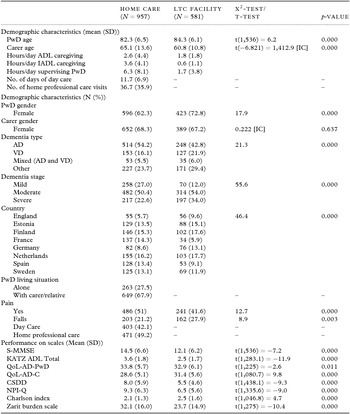
Table 1 shows the demographic characteristics of PwD and their carers, and their scores on scales, divided by setting. The most common dementia type was Alzheimer's disease, followed by vascular dementia, and most PwD were in the moderate stages of dementia. The fewest cases for the home care sample were collected in England, and for the LTC sample in France. A large proportion of PwD had suffered from pain in the past seven days, whilst between 20 and 30 percent of PwD had fallen either in the past 30 days or since LTC admission. In the home care sample, PwD were significantly younger and significantly more were female. In the home care sample, there were also significantly more people with Alzheimer's disease, in the mild stages of dementia, and with experiences of pain and falls.
Demographic characteristics and performance on scales of people with dementia and carers

AD = Alzheimer's disease; ADL = Activities of daily living; CSDD = Cornell Scale for Depression in Dementia; NPI-Q = Neuropsychiatric Inventory Questionnaire; PwD = People with Dementia; QoL-AD-C = Proxy-reported Quality of Life in Alzheimer's Disease; QoL-AD-PwD = Self-reported Quality of Life in Alzheimer's Disease; S-MMSE = Standardized Mini-Mental state Examination; VD = Vascular dementia.
Scores on all scales varied significantly between the two settings. Compared to the LTC sample, PwD receiving home care had significantly better cognition and self-rated QoL and were more independent. They also had worse proxy-rated QoL, higher levels of depressive symptomatology and neuropsychiatric behavior, and lower multimorbidity. Informal carers reported significantly higher levels of burden in the home care sample.
Depressive symptomatology
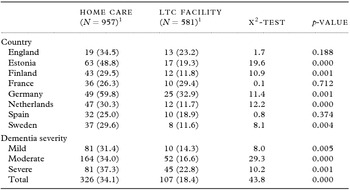
Table 2 shows the prevalence of depressive symptomatology in home care and LTC facility residents split by country and dementia severity. For home care, PwD in Germany showed the greatest prevalence of depressive symptomatology, whilst the fewest cases were recorded for Spain. In the LTC group, the highest and lowest prevalence of depressive symptomatology was reported in Germany and Sweden, respectively. Across both care settings, people with severe dementia had the highest prevalence. In comparing the prevalence between both settings, χ 2-tests showed significant variations within countries for Estonia, Finland, Germany, the Netherlands, and Sweden. Significant variations were also reported within each dementia severity and in the total sample.
Prevalence of depressive symptomatology in people with dementia by setting, country, and dementia severity

As described in the Methods section, we employed a cut-off of 10 and above on the CSDD to indicate depressive symptomatology.
1Values in N(%).
Factors associated with depressive symptomatology
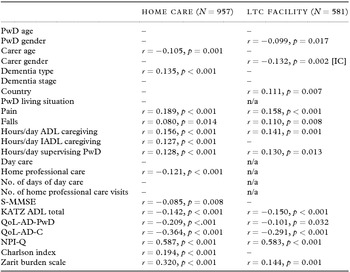
Table 3 shows the bivariate correlations between demographic characteristics and performance on scales with depressive symptomatology. Most factors were weakly correlated, except for neruopsychiatric symptoms. In the home care group, depressive symptomatology was significantly associated with younger carers; Alzheimer's disease; experience of pain; falls; greater amount of time carers spent carrying out ADLs, IADLs, or supervising the PwD; and not receiving home care. Poorer cognition and QoL, greater dependence, increased neuropsychiatric symptoms, greater comorbidity, and heightened carer burden were also significantly associated with depressive symptomatology.
Bivariate correlations with depressive symptomatology in dementia

ADL = Activities of daily living; NPI-Q = neuropsychiatric inventory questionnaire; PwD = people with dementia; QoL-AD-C = proxy-reported quality of life in Alzheimer's disease; QoL-AD-PwD = self-reported quality of life in Alzheimer's disease; S-MMSE = Standardized Mini-Mental state Examination.
For PwD living in a LTC facility, PwD and informal carers being male, experience of pain and falls, living in Germany, the amount of time per day carers spent on ADLs and supervising, greater dependence, poorer QoL, greater neuropsychiatric symptoms, and greater carer burden were all significantly associated with depressive symptomatology. Although the association between self-rated QoL and depressive symptomatology was significant, it was weak.
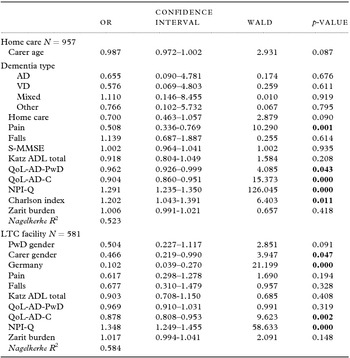
Table 4 shows the results of the logistic regression model predicting depressive symptomatology in the home care setting. To avoid multicollinearity, Katz ADL total was selected as the variable representing dependency, excluding hours of ADL/IADL caring or spent on supervision from the regression model. Five of the 15 variables entered into the regression models were found to be significant. Occurrence of pain, lower self- and proxy-rated QoL, higher rate of neuropsychiatric symptoms, and high comorbidity were factors significantly associated with depressive symptomatology. This model correctly predicted 81.8% of PwD reported to experience depressive symptomatology.
Logistic regression analyses of depressive symptomatology in dementia

Note: All p-values highlighted in bold indicate variables significantly associated with depressive symptomatology.
ADL = activities of daily living; NPI-Q = neuropsychiatric inventory questionnaire; PwD = people with dementia; QoL-AD-C = Proxy-reported quality of life in Alzheimer's disease; QoL-AD-PwD = Self-reported Quality of Life in Alzheimer's Disease; S-MMSE = Standardized Mini-Mental state Examination.
Table 4 also shows the results of the logistic regression model for depressive symptomatology in the LTC setting. Four of the 10 variables entered into the regression models were found to be significantly associated with depressive symptomatology. In particular, being a male carer, living in Germany, lower proxy-rated QoL, and higher levels of neuropsychiatric symptoms were found to be significant factors. This model correctly predicted 88.4% of PwD having depressive symptomatology.
Discussion
This paper suggests that different factors are associated with depressive symptomatology in community dwelling PwD and in LTC residents with dementia, and also identifies variation in its prevalence across residency types and country settings. Following on from a small analysis of people with severe dementia only (Giebel et al., Reference Giebel2015), this study provides insights into setting-specific variations and answer questions which arised in the previous study.
Looking at the variations in prevalence, in all countries and across all three cognitive stages of dementia, depressive symptomatology was (significantly) lower in LTC compared with home care, with France being the exception. This supports previous findings from research conducted solely with people with severe dementia (Giebel et al., Reference Giebel2015), prompting further investigation of variations in depression according to setting and dementia stage as detailed here. Some possible explanations for these differences could be that LTC residents had increased access to an active social life by engaging with other residents as opposed to living alone or with the spouse and having a limited social circle, and were therefore less depressed. Moreover, it is possible that family carers rated depressive symptomatology higher in the home care setting because of their distress about the diagnosis, which could be transferred onto the PwD. It is of interest to note inter-country variations. Germany had the highest proportion of PwD scoring above the CSDD cut-off, whilst Spain and Sweden showed the lowest rates in the home care and LTC settings respectively. The reasons for these inter-country variations might lie in different cultures, or arrangements for the organization of care, so that further research would be required to address this outcome. However, the exploration of factors associated with depressive symptomatology in this study may provide further insights into these variations.
Depressive symptomatology was associated with both shared and different factors in the two settings. In both home care and LTC, low proxy-rated QoL and greater neuropsychiatric behavior were amongst the most strongly associated with scoring above the cut-off. In particular, apathy (60.1%), agitation (45.0%), and depression (44.3%) were the most common behavioral problems in the home care setting, whilst depression (49.0%), irritability (42.7%), and anxiety and apathy (40.2%) were most frequent in the LTC setting. These associations corroborate previous evidence in both settings (Gruber-Baldini et al., Reference Gruber-Baldini, Zimmerman, Boustani, Watson, Williams and Reed2005; Hoe et al., Reference Hoe, Hancock, Livingston and Orrell2006; Majic et al., Reference Majic, Pluta, Mell, Treusch, Gutzmann and Rapp2012). Interestingly, self-rated QoL was found to be significant only for home care, which concurs with work by Kosteniuk and colleagues (Kosteniuk et al., Reference Kosteniuk2014), although they only evaluated rural memory clinic patients. In contrast, findings differ from those of a previous analysis of severe dementia, in which self-rated QoL was not significantly related to depressive symptomatology. However, Hoe and colleagues (Hoe et al., Reference Hoe, Hancock, Livingston and Orrell2006) found depressive symptomatology to be a significant predictor of self-rated QoL in PwD in nursing homes, although a lower cut-off of 8 on the CSDD was used. This may explain the discrepancy in findings.
Both pain and comorbidity were significantly associated with depressive symptomatology only in the home care setting. A previous analysis of people with severe dementia only failed to highlight this relationship (Giebel et al., Reference Giebel2015), indicating hereby the value of examining settings separately. Given that depression and pain activate similar regions in the brain (Robinson et al., Reference Robinson, Edwards, Iyengar, Bymaster, Clark and Katon2009), this association would have been expected in both settings. In contrast, Gruber-Baldini et al. (Reference Gruber-Baldini, Zimmerman, Boustani, Watson, Williams and Reed2005) using a lower cut-off of 7 on the CSDD, found pain to be a significant factor in depressive symptomatology in PwD in LTC settings. One possible reason for pain being a predictor solely in the home care setting is that LTC staff may possibly be better equipped at recognizing and treating pain than family carers. This is supported by the fact that significantly fewer PwD were reported to experience pain in LTC facilities in this sample, which could be a result of a better pain management regime or improved use of equipment (such as moving people in wheelchairs) in LTC facilities. Although PwD showed lower levels of comorbidity in the home care setting, comorbidity was significantly associated with depressive symptomatology in this setting, similar to previous evidence (Borza et al., Reference Borza, Engedal, Bergh, Barca, Benth and Selbaek2015), but not in the LTC sample. Obviously, chronic physical health conditions cannot be improved by moving from home care into LTC, which would explain why the level of comorbid status was not reduced in LTC. Considering the link between pain and comorbidity, it could be that comorbidities were not significant in LTC because these conditions were better managed through greater access to medical care, pain relief, environmental adaptations, and the design of LTC facilities. This suggests for a focus for primary care upon pain management and pain relief in the community, as well as psychotherapeutic and exercise approaches which are suggested for the treatment of pain and depression (Robinson et al., Reference Robinson, Edwards, Iyengar, Bymaster, Clark and Katon2009).
Unexpectedly, having a male informal carer was significantly associated with depressive symptomatology in the LTC setting. A larger proportion of female PwD living in LTC were found to be rated above the CSDD cut-off, which is consistent with the non-significant association in the regression model. However, the overall greater number of female compared to male LTC residents may have biased this result. Lacking a clear explanation of these gender variations, with the visiting time male carers spent in LTC facilities and the age of PwD not found to be associated with this relationship, further research is necessary to explore these differences in greater detail.
Besides the unexpected finding of the effect of carer gender, this is the first study to have shown an association between country of residency and depressive symptomatology. With regard to prevalence rates, Germany was found to have the largest proportion of people scoring above the cut-off on the CSDD. It is possible that service organization and cultural differences may explain why carers scored the CSDD higher than those in other countries. Alternatively, it is possible that the characteristics of PwD in the German sample varied in comparison to the other countries by means of more severe levels of comorbidity or reduced levels of independence. The findings are relevant both to the broader development of European health policy and the influence of variations in service mix in different countries upon the well-being of older people.
Limitations
This study is subject to certain limitations. One possible limitation is that the prevalence rates of depressive symptomatology were based on formal and informal carer ratings. Information relating to PwD depression diagnosis was not collected as part of the RightTimePlaceCare project and could therefore not be used. Nevertheless, many previous studies in this field have also utilized carer reports (Gruber-Baldini et al., Reference Gruber-Baldini, Zimmerman, Boustani, Watson, Williams and Reed2005; Kosteniuk et al., Reference Kosteniuk2014). Furthermore, it is noted that the NPI-Q includes one subscale on depression, which might also contribute to the observed link between the NPI-Q and the CSDD and might be a limitation of this study. However, the NPI-Q is a frequently used measure of psychopathology in dementia, comprising a wide range of psychiatric symptoms. In addition, the project did not randomly select participants due to the purposive sampling of those marginal to admission to LTC. Therefore, the samples may not be nationally representative, although each country recruited participants from at least ten LTC facilities and three community care organizations to allow within-sample variation.
Conclusions
This study further confirms lower levels of depressive symptomatology in dementia in LTC compared to home care, using a large international data sample and across all three cognitive stages of dementia. A range of different factors were associated with depressive symptomatology in each setting, whilst neuropsychiatric symptoms were related in both settings, which offers a pathway for directly targeting these factors according to location. One strategy might be to enhance access to healthcare services for PwD living at home so as to reduce pain and better manage chronic health conditions. In order to reduce depressive symptomatology further, there may be scope to examine cultural variations in future research, perhaps suggesting ways for countries with apparent high rates of depressive symptomatology to adapt methods employed in countries with lower rates. Following identification of the different underlying factors associated with depressive symptomatology in LTC and home care, the next steps is to find practical methods to address these higher rates in the community.
Conflict of interest
None.
Description of authors’ roles
C. Giebel and C. Sutcliffe were involved in the UK data collection and formulated the research question. C. Giebel also performed the statistical analyses and wrote the article. C. Sutciffe, H. Verbeek, A. Zabalegui, M. Soto, I.R. Hallberg, K. Saks, A. Renom-Guiteras, R. Suhonen, and D. Challis designed the study and were involved in the write up of the article by commenting on versions of the paper and approving the final draft.
Acknowledgments
This work as part of the RightTimePlaceCare project was supported by a grant from the European Commission within the Seventh Framework Programme [Contract number HEALTHF3–2010242153] funded for 42 months from 1 January 2010 to 30 June 2013.