Introduction
The Mental Capacity Act 2005 (MCA) (Department of Constitutional Affairs, 2005) was fully implemented in October 2007 in England and Wales. Similar legislation related to decision-making capacity (DMC) has been introduced in other countries (Shah and Dickenson, Reference Shah and Dickenson1999; McCullock, Reference McCullock2009). A brief summary of the main components of the MCA is given in Appendix 1 to enable readers outside England and Wales to understand the context of this study and to enable comparison with any existing capacity legislation in other countries.
Health and social care providers need to be familiar with the MCA, the associated legal structures and processes and put in place new mechanisms to ensure relevant staff are able adequately to undertake the critical functions of the MCA. The MCA, supported by a Code of Practice (Department of Constitutional Affairs, 2007), has been broadly welcomed by stakeholders. A range of supportive training materials have also been developed (Stanley et al., Reference Stanley2007a; Reference Stanley2007b; Reference Stanley2007c; Reference Stanley2007d; Reference Stanley2007e). Nevertheless, there are likely to be difficulties in implementing the MCA: some were initially identified and others may emerge after implementation. These potential difficulties include: implications for the workload of clinicians and the adequacy of resources to implement the MCA (Jones, Reference Jones2005; Shickle Reference Shickle2006); delays in developing training, policy and guidance for clinicians and Independent Mental Capacity Advocates (IMCAs) (Jones, Reference Jones2005; Cowan, Reference Cowan2007); availability of local training for health and social care professionals (Myron et al., Reference Myron, Gillespie, Swift and Williamson2008); availability of local policies on the implementation of the MCA and their clarity (Myron et al., Reference Myron, Gillespie, Swift and Williamson2008); variable knowledge of the definition of decision-making capacity (DMC) and factors that may trigger an assessment of DMC among health and social care professionals (Myron et al., Reference Myron, Gillespie, Swift and Williamson2008); potential for erroneous perception by carers that DMC is an “all or nothing phenomenon” and consequent misuse of the MCA (Jones, Reference Jones2005); potential for disagreements between doctors and IMCAs, donees and court-appointed deputies (White and Baldwin, Reference White and Baldwin2006); inability of carers to keep written records (Jones, Reference Jones2005); and, potential difficulties with the “Deprivation of Liberty” safeguards newly introduced into the MCA (Khan et al., Reference Khan, Bhatkal and Shah2007; Shah et al., Reference Shah, Heginbotham and Kinton2009a). The Code of Practice accompanying the MCA and the Equality Impact Assessment for the MCA (Ministry of Justice, 2007) recognizes that the application of the MCA can be influenced by culture, ethnicity, religion and language; these factors may contribute to difficulties in the application of the MCA in black and minority ethnic (BME) individuals (Shah and Heginbotham, Reference Shah and Heginbotham2008).
The government estimated that concerns about DMC may affect up to 2 million adults in England and Wales including 840,000 people with dementia (Ministry of Justice, 2007), although not everyone with dementia will lack DMC. In an English study of acute admissions to general medical wards, 31% of the patients lacked DMC pertaining to their main treatment or investigation, and of these only a quarter were recognized by clinicians (Raymont et al., Reference Raymont2004). A similar study of psychiatric inpatients revealed that 44% lacked DMC (Cairns et al., Reference Cairns2005). Another recent English study of psychiatric inpatients reported that 60% of inpatients lacked DMC to consent to their treatment (Owen et al., Reference Owen, Richardson, David, Szmukler, Hayward and Hotopf2008). An English study of DMC to consent to geriatric psychiatry inpatient admission revealed that 48% lacked DMC (Mukherjee and Shah, Reference Mukherjee and Shah2001). A recent systematic review concluded that up to 50% of psychiatric inpatients lacked DMC to consent to their admission (Okai et al., Reference Okai, Owen, McGuire, Singh, Churchill and Hotopf2007). The MCA is particularly likely to apply to people with severe and enduring mental illness, including those with dementia and other neuropsychiatric disorders (Mukherjee and Shah, Reference Mukherjee and Shah2001; Okai et al., Reference Okai, Owen, McGuire, Singh, Churchill and Hotopf2007). Therefore, the experience of clinicians working in Old Age Psychiatry, who are likely to have greater experience in the use of MCA, in the early implementation of the MCA was formally examined.
Methods
Timing and location
This study commenced in December 2007, approximately two months after the full implementation of the MCA, and was completed in June 2008. The study was confined to seven different Old Age Psychiatry services based at different sites and with different catchments areas within two large Mental Health Trusts in west London.
Data collection
Consultants in Old Age Psychiatry were asked to identify individual patients who had had at least one assessment of DMC for a specific issue. This approach was chosen rather than a consecutive series of patients because the MCA only requires assessment of DMC in patients where the clinician suspects that DMC is possibly lacking. Thus, not all patients in a consecutive series would have had an assessment of DMC and such patients would have been unsuitable for this study. From the patients having an assessment of DMC, the consultants were also asked to identify those who were considered to have made an unwise decision. Patients detained under the Mental Health Act were included in spite of the fact that assessments of DMC may not be required for some treatments imposed under the Mental Health Act. These patients were included for several reasons: the Mental Health Act does not cover all areas of decision-making (such as those relating to the treatment of physical disorders) and such decisions are likely to be covered by the MCA; there are specific circumstances when the Mental Health Act requires formal assessment of DMC; and, the amended Mental Health Act introduced in November 2008 stipulates that the criteria for the assessment of DMC under that Act should be the same as those stipulated in the MCA (Shah et al., Reference Shah, Heginbotham and Kinton2009b). The first author (AS), a consultant in Old Age Psychiatry, and a PhD student (NB) carefully conducted a detailed examination of the case-notes of patients who had had at least one assessment of DMC for a specific issue. A pre-designed form (available from the first author) was used to ascertain detailed information on several parameters including:
• demographic information including age, sex, Mental Health Act status, ethnicity, religion, fluency in English and diagnosis;
• the profession of the clinician assessing DMC;
• the issue for which DMC was assessed and the outcome;
• the criteria used for the assessment of DMC;
• the types of decisions considered to be unwise and the criteria used in deciding that the decision was unwise;
• measures taken to enable patients to make decisions;
• consideration of culture, ethnicity, religion and language in the assessment of DMC;
• the use (and type) of interpreters in the assessment of DMC in individuals not fluent in English;
• the criteria used in the determination of best interests;
• the criteria used in determining the least restrictive option;
• the criteria used for restraint;
• the experience of using second opinions, legal advice and referral to an IMCA in the process of assessing DMC.
Sample size
As this was a pilot and an exploratory study and the main aim was to identify the broad issues (rather than ascertain quantitative information on the issues examined), the planned total sample size was 40 patients (20 from the indigenous white British group and 20 from BME groups). It was also felt that saturation would be reached in identifying the main themes with this sample size for the qualitative analysis. The inclusion of BME subjects allowed detailed examination of issues relevant to culture, ethnicity, religion and language in the assessment of DMC.
Data analysis
Demographic and other categorical data were analyzed using descriptive statistics. Some of the information extracted from the case-notes was descriptive (e.g. “What concept or definition was used for unwise decisions?” and “What was the definition of best interests used?”). The first author (AS) manually examined and coded this descriptive data using a qualitative thematic approach, and these were subsequently verified by one of the other researchers (NB). This thematic approach considered the following themes:
• The criteria used for assessment of DMC.
• The concept and definition of unwise decisions.
• Types of measures taken to enable the patient to make a decision.
• The criteria used in the determination of best interests.
• The criteria used in determining the least restrictive option.
• The criteria used for restraint
Results
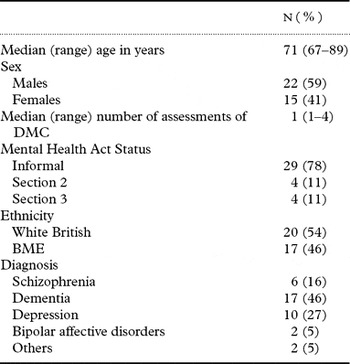
Case-notes of 37 patients, under the care of 11 consultants in Old Age Psychiatry, who had had an assessment of DMC on at least one specific issue were reviewed: 20 indigenous white British and 17 BME patients. These 37 patients had a total of 53 separate recorded assessments of DMC.
Demographic characteristics
Table 1 illustrates the demographic characteristics. The BME group consisted of individuals from 11 different ethnic backgrounds: Indian (N = 3), Pakistani (N = 1), Chinese (N = 1), Bangladeshi (N = 1), Nigerian (N = 1), Greek Cypriot (N = 1), African Caribbean (N = 1), Irish (N = 5), Polish (N = 1) and Afghani (N = 1). Religion was not recorded for 12 (32%) patients. Religious denomination in the remainder was: Christianity (N = 17), Hinduism (N = 1), Islam (N = 5), Judaism (N = 1) and own belief system (N = 1).
Demographic characteristics

DMC = decision-making capacity; BME = black and minority ethnic.
Assessment of DMC
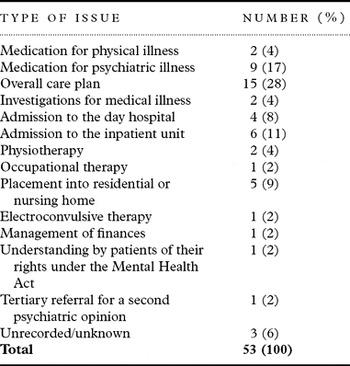
The number of assessments conducted by clinicians from different disciplines was: doctors, 44 (83%); nurses, 1 (2%); physiotherapists, 2 (4%); occupational therapist, 1 (2%); social worker, 2 (4%); and unknown discipline, 3 (6%). Table 2 illustrates the types of issues for which DMC was assessed. The outcome of the assessments was: 27 (51%) had DMC; 24 (45%) lacked DMC; and in 2 (4%) the outcome was unrecorded or unknown.
Types of issues for assessment of DMC

The qualitative thematic analysis revealed that in 47 (89%) assessments of DMC all four criteria described in the MCA were used and documented: understand the relevant information; retain that information; use or weigh up the information; and communicate the decision.
The documented strategies used by clinicians to facilitate the assessment of DMC included: conducting serial assessments; conducting the assessment in a calm environment; assessment being conducted by a clinician familiar with the patient; and adequate provision of time for the assessment. Sixty percent of assessments required more than two interviews.
The proportion of patients and carers informed of the assessment of DMC, as documented in the case-notes, was 28% (N = 28) and 40% (N = 21) respectively.
Determination of best interests
Decisions were made using the determination of best interests principles in 20 (83%) of the 24 assessments demonstrating lack of DMC. The qualitative thematic analysis revealed seven criteria used in the determination of best interests: lack of DMC; consideration of the wishes of the patient; consideration of the wishes of the carers; consultation with other professionals; consideration of the risks and benefits of the decision; consultation with advocates (not IMCAs); and consideration of previous treatment response. The two most frequently documented criteria were: consideration of the wishes of the patient and consideration of the wishes of the carers.
Least restrictive option and restraint
There was documentation of consideration of the least restrictive option in 17 (71%) of the 24 assessments demonstrating lack of DMC. There was documentation of consideration of the least restrictive option being proportionate to the risk of harm in 15 (88%) of these 17 assessments. The qualitative thematic analysis revealed four criteria used for the least restrictive option: least invasive; not admitted into hospital; not admitted into another 24-hour care facility; and to give oral medication. The use of restraint was documented in only 2 (8%) of the 24 assessments demonstrating lack of DMC.
Unwise decisions
Four (8%) of the 53 assessments for DMC were reported and documented to be for unwise decisions. The qualitative thematic analysis revealed six criteria used to define the concept of unwise decisions: lack of insight; having DMC; medical treatment being considered necessary by the clinician; the patient disagreed with the treatment; the patient did not consent to the treatment; and the decision made was not considered by the clinician to be in the best interests of the patient.
Culture, ethnicity, religion and language
There was documentation of consideration being given to culture and ethnicity, religion and language in 22 (42%), 19 (36%) and 27 (51%) of assessments respectively. Closer examination of these findings revealed that culture and ethnicity (82% in BME group and 13% in white British group; χ2 = 22.4, 1df, P<0.001), religion (68% in BME group and 13% in white British group; χ2 = 14.8, 1df, P<0.001) and language (77% in BME group and 32% in white British group; χ2 = 8.7, 1df, P = 0.003) were more likely to be taken into account in individuals from BME groups. However, there was no significant relationship between fluency in English and consideration being given to language in the assessment. Thirty-five (95%) individuals accounting for 48 (91%) of the assessments were said to be fluent in English. Only 26 (70%) individuals accounting for 38 (72%) assessments were said to have English as their first language. In two individuals, who were not fluent in English, interpreters (professional interpreters, N = 1 and bilingual clinicians interpreting, N = 2) were used for three of the five assessments.
Second opinions, legal advice and referrals to IMCAs
There was documentation in the case-notes of an offer of a second opinion in 2 (4%) of the 53 assessments which was utilized on both occasions. There was no documentation in any of the case-notes demonstrating a request for legal advice or referral to an IMCA.
Discussion
Some methodological issues require consideration. In this pilot and exploratory study, with the main aim of identifying the broad issues using qualitative methods, the overall sample size of 37 was considered satisfactory because it was felt that saturation would have been reached in identifying the main themes with this sample size. There may have been bias in the types of patients studied because the sample was identified and referred by consultants in Old Age Psychiatry to the researchers. Some consultants may have referred patients only where they were certain that there was good documentation of the assessment of DMC and determination of best interests. Additionally, awareness of this study among the consultants and the possibility that their patients may be included in this study may also have resulted in improved documentation of DMC and determination of best interests. Caution should be exercised in extrapolating the findings of this study, confined to two large Mental Health Trusts in one geographical area and the specialty of Old Age Psychiatry, to other localities and other specialties. The reliability and validity of data recorded in the case-notes and the method of data extraction is unclear, although this was improved by using a pre-designed standardized data extraction form. Also, there is evidence of reliable and successful extraction of data from case-notes in research and audit studies emerging from several of the participating Old Age Psychiatry units (Shah, Reference Shah1996; Redelinghuys and Shah, Reference Redelinghuys and Shah1997; Odutoye and Shah, Reference Odutoye and Shah1999; Haider and Shah, Reference Haider and Shah2004; Bhatkal and Shah, Reference Bhatkal and Shah2004).
In 90% of the assessments the specific four-fold test of DMC described in the MCA was used. Clinicians facilitated the assessment of DMC by using strategies that were consistent with those described in the Code of Practice accompanying the MCA and the available training materials (Stanley et al., Reference Stanley2007a; Reference Stanley2007b; Reference Stanley2007c; Reference Stanley2007d; Reference Stanley2007e). The observation that only a small number of patients and carers were informed of the assessment of DMC may simply reflect poor case-note documentation despite most patients and carers being informed. However, if this finding is genuine then it is of concern because the MCA emphasizes the engagement of patients and carers throughout the decision-making process. There is a need to encourage clinicians to give the information leaflets to patients and their carers developed by the Ministry of Justice for this purpose (http://www.justice.gov.uk/docs/mca-leaflet-english.pdf).
The MCA stipulates that an assessment of DMC should only be conducted if there is reason to believe that the subject may lack DMC on a specific issue. The clinician's threshold for suspecting lack of DMC may be lower in patients with dementia because there is a well-established strong association between the diagnosis of dementia and lack of DMC for specific issues (Marson et al., Reference Marson, McInturff, Hawkins, Bartolucci and Harrell1997a; Reference Marson, Hawkins, McInturff and Harrell1997b; Mukherjee and Shah, Reference Mukherjee and Shah2001). However, the finding that only half of the assessments demonstrated lack of DMC suggests that a significantly greater number of assessments than the number lacking DMC actually occur in clinical practice. Given the complexity of any assessment of DMC and the necessary documentation of this process required under the MCA, conducting and recording the assessments of individuals who were subsequently judged to have DMC clearly adds to the workload of clinicians.
The vast majority of assessments were conducted by consultants in Old Age Psychiatry and this is consistent with similar observations in a study of consultant psychiatrists in several specialties (Shah et al., Reference Shah2008). Nevertheless, this onus on consultants assessing DMC was surprising because of the emergence and implementation of “New Ways of Working” (Department of Health, 2005), whereby increasing numbers of psychiatric patients are initially assessed and subsequently managed by a range of multidisciplinary clinicians, and the recommendation in the MCA that the assessment of DMC should be conducted by an appropriate decision-maker from an appropriate discipline. This finding may reflect the complex circumstances of many psychiatric patients requiring a senior and experienced clinician to assess DMC. It may also reflect the traditional culture engendered by requirements under the Mental Health Act 1983 (MHA1983) that DMC should be assessed by the Responsible Medical Officer (usually the consultant psychiatrist) in patients whose treatment is subject to Part 4 of the MHA1983. This may, in part, also explain the anticipated (Jones, Reference Jones2005; Shickle Reference Shickle2006) and observed (Shah et al., Reference Shah2008) increase in the workload of clinicians, including consultant psychiatrists, following the implementation of the MCA. Moreover, this workload is likely to increase further when the “Deprivation of Liberty” safeguards introduced into the MCA are implemented in April 2009 (Shah et al., Reference Shah2008; Reference Shah, Heginbotham and Kinton2009a). This potential increase in the workload of clinicians requires careful ongoing monitoring because the accuracy and effectiveness of implementing the MCA is contingent upon sufficient staffing resources. As recommended in the MCA, if assessments of DMC were conducted by decision-makers from appropriate disciplines (and not just by Consultants), then it would reduce the workload of consultants. Thus, there is a need to develop strategies that will encourage professionals from a range of disciplines to undertake assessments of DMC to help reduce the workload of consultants.
The basic principles for the determination of best interests described in the MCA were used to facilitate decision-making in the vast majority of patients lacking DMC. The qualitative thematic analysis identified seven criteria used in the determination of best interests and these were consistent with those described in the MCA and the accompanying Code of Practice. The two most frequently documented criteria were: consideration of the wishes of the patient and consideration of the wishes of the carers.
These findings were also consistent with those observed in a study of consultant psychiatrists from several specialties (Shah et al., Reference Shah2008).
The observation that the least restrictive option was considered in the vast majority of assessments lacking DMC is consistent with the principles of determination of best interests described in the MCA and the accompanying Code of Practice. This was also observed in a study of consultant psychiatrists from several specialties (Shah et al., Reference Shah2008). The qualitative thematic analysis revealed four criteria for the least restrictive option: least invasive; not admitted into hospital; not admitted into another 24 care facility; and to give oral medication. Although the criteria for determining the least restrictive option are not described in the MCA and the accompanying Code of Practice, the criteria used by clinicians clearly have face validity.
The third statutory principle of the MCA (see Appendix 1) states that an individual cannot be considered to lack DMC simply because he/she makes an unwise decision. However, the MCA does not define the concept of unwise decision or the conditions under which an unwise decision may cause the clinician to suspect DMC is lacking, thus triggering an assessment of DMC. This absence of definition may explain the paucity of documentation of the concept of unwise decision in this study. In the few assessments where the concept of unwise decision was documented, varying combinations of the following criteria were used: lack of insight, having DMC, medical treatment being considered necessary by the clinician, the patient disagreed with the treatment, the patient did not consent to the treatment and the decision made was not considered by the clinician to be in the best interests of the patient. This illustrates that clinicians have an implicit understanding of what constitutes an unwise decision despite the absence of a definition in the MCA. However, the findings are complex and difficult to interpret on the basis of data obtained in this study alone. For instance, a patient lacking insight is also likely to to have difficulty in weighing up the information in making the decision for the third criteria of the four-fold specific test of DMC, yet clinicians have documented lack of insight with presence of DMC as a possible reason for considering a decision to be unwise.
Documentation was found that took in to account the culture, ethnicity, religion and language in 50% or less of the assessments. However, closer examination of these findings revealed that culture and ethnicity, religion and language were more likely to be considered in individuals from BME groups. This may have two explanations. First, it may be that these factors were only considered in BME patients. Second, these factors may have also been considered in the indigenous white British group but may simply be poorly documented because such consideration may not have modified the assessment of DMC in this group. Interpreters were used sparingly because most BME patients in this study were fluent in English.
There was documentation of only a small number of patients being offered a second opinion, and none were referred to an IMCA or for legal advice. Although these observations may have been an artifact of the methodological issues described above, there may also be other explanations. There may be an automatic requirement to refer patients detained under the MHA1983 to a Second Opinion Appointed Doctor, but this will only to apply a small number of detained patients. Although the IMCA may recommend a second opinion, this too is likely to apply to a small number of patients; and no patients were referred to an IMCA in this study. Also, there is no clear guidance in the MCA or the accompanying Code of Practice pertaining to seeking second opinions for patients lacking DMC. However, clinicians may find second opinions helpful in resolving disagreements with patients, carers, advocates and other professionals about DMC and determination of best interests.
As noted above, caution should be exercised in extrapolating the findings of this study, confined to two Mental Health Trusts in one geographical area and the specialty of Old Age Psychiatry, to other localities and other specialties. However, issues related to the assessment of DMC, determination best interests and the use of least restrictive principles are likely to be common to legislation on capacity or their use under common law in different jurisdictions nationally and internationally (e.g. McCullock, Reference McCullock2009). Thus, the findings would be of interest to colleagues in other countries. Findings relevant to ethnic minority groups would also be of interest to colleagues in other countries because: issues related to language, culture, ethnicity and religion in the context of assessment of DMC and determination of best interests may be similar in ethnic minority individuals in other countries; and the ethnic minority elderly population is increasing in other countries including Australia and the U.S.A. (Markson, Reference Markson2003; Shah and McKenzie, Reference Shah, MacKenzie, Bhugra and Bhui2007). It was encouraging that clinicians were using the criteria for the assessment of DMC and the determination of best interests described in the MCA, and that clinicians were developing the concepts of least restrictive option and unwise decision with face validity despite the absence of their definitions in the MCA. The findings also highlight concern about the workload of clinicians in implementing the MCA and the need for careful ongoing monitoring because the accuracy and effectiveness of implementing the MCA is contingent upon sufficient staffing resources.
Appendix 1. A summary of the aspects of the MCA relevant to the study
Several specific areas of the Mental Capacity Act (MCA) relevant to this research project are described below to enable colleagues from other countries to understand the research project more fully. A short summary for international readers is also available elsewhere for interested readers (Banner and Shah, Reference Banner and Shah2007).
Statutory principles
Those involved in the assessment of decision-making capacity (DMC) and the application of the MCA should always follow the five statutory principles:
• An individual must be assumed to have capacity unless lack of DMC has been formally established.
• An individual cannot be treated as unable to make a decision unless all practical steps to help the individual to do so have been undertaken.
• An individual cannot be treated to lack DMC simply because an unwise decision is made.
• Any act done or any decision made, under the MCA, must be in the best interest of the individual lacking DMC.
• Before an act is done, or a decision is made, consideration must be given to whether the purpose for which it is needed can be as effectively achieved in a way that is less restrictive of the individual's rights and freedom of action.
The third statutory principle stipulates that “A person is not to be treated as unable to make a decision merely because he makes an unwise decision”. This applies even if family members, friends or health care and social care staff are unhappy with the decision. The Code of Practice accompanying the MCA states that there may be concern if somebody repeatedly makes unwise decisions that put them at risk of harm or exploitation or makes a particular unwise decision that is obviously irrational or out of character. However, it also states that this does not necessarily mean that the subject lacks capacity, but there may be a need for further investigation. The concept of unwise decision is not defined in the MCA or the accompanying Code of Practice.
Assessment of decision-making capacity
The assessment of DMC to make a specific decision requires a two stage process under the MCA. This two stage process is as follows:
• Does the individual have an impairment of the mind or brain, or is there some sort of disturbance affecting the way their mind or brain works?
• If so, does the impairment or disturbance mean that the individual is unable to make a decision in question at the time it needs to be made?
The specific test of DMC is four-fold. An individual is judged to lack DMC to make a decision if s/he is unable to:
• Understand the information relevant to the decision.
• Retain the information.
• Use or weigh that information as part of the process of making the decision.
• Communicate his/her decision (whether by talking, using sign language or any other means).
The individual is considered to lack DMC to make a particular decision if any one of the four criteria is present. DMC is decision-specific and time-specific.
Best interests
The MCA stipulates that “An act done, or decision made, under the Act for or on behalf of a person who lacks capacity must be done, or made, in his best interests”. This applies to any decision-maker. The MCA does not formally define best interests, but describes a detailed list of factors that must be considered in the determination of the best interests of an individual lacking DMC:
• Determination of best interests cannot be based on an individual's age, appearance (including racial appearance or religious dress), condition or behavior.
• Careful consideration should be given to all circumstances pertaining to the individual lacking DMC.
• Every effort should be made to enable an individual lacking DMC to participate in making the decision including use of appropriate methods of communication (including professional interpreters) and using other people to facilitate the person to participate in the decision-making process.
• Consideration should be given to the possibility that the DMC may be regained (e.g. after treatment of a mental illness) and whether the decision-making can be postponed until the DMC is regained.
• Consideration should be given to the past and present wishes and feelings, beliefs and values of an individual lacking DMC. This includes any written statements made when the individual had DMC.
• Consideration should be given to the views of other people (close relatives, friends and others who take an interest in the person's welfare) who are close to an individual lacking DMC.
• Special conditions apply to decisions about life sustaining treatment, whereby the decision-maker should not be motivated by a desire to end life.
• Consideration should also be given to least restrictive alternatives that may be in the best interests of an individual lacking DMC. Least restrictive alternatives are not specifically defined in the MCA.
• The above list should be considered as a starting point as many other factors may need consideration in individual cases.
Restraint
The MCA states that restraint is used if someone uses force, or threatens to use force, to make an individual do something they are resisting or to restrict an individual's freedom of movement, irrespective of the individual resisting or not. If restraint is used the decision-maker must reasonably believe:
• An individual lacks capacity to consent to the act in question.
• Restraint is in the best interests of an individual lacking DMC.
• Restraint is necessary to prevent harm to an individual lacking DMC.
• The amount, type and duration of restraint are proportionate to the seriousness of the anticipated harm.
Restraint should involve the minimum force necessary and be used for the shortest duration possible.
Conflict of interest declaration
Professor Chris Heginbotham was the chief executive of the Mental Health Act Commission until 31 March 2008.
Description of authors' roles
CH and BF secured the research grant. AS drafted the protocol with input from all three authors. AS and NB collected and analyzed the data. AS wrote the paper with contributions from all three authors.
Acknowledgments
We would like to thank the participating consultant psychiatrists and their teams, patients and carers, and our departmental administrator, Marian Lawrenson, for their help with this study. This work was commissioned by the Department of Health. The helpful comments of the two anonymous reviewers were greatly appreciated.