Introduction
The need to store electricity is becoming increasingly critical to link energy supply to our energy demands as we shift from the use of fossil fuels to renewable energy sources such as solar and wind. Advances in the past two decades in electrochemical energy storage technologies such as Li-ion batteries have enabled the ubiquity of mobile electronic devices in our lives. The expansion of electrified transportation to driving ranges of ∼300 miles per recharge, as offered by vehicles based on internal combustion engines, and the use of intermittent solar and wind energy for stationary power applications call for storage technologies with much greater gravimetric energies than Li-ion batteries. Energy storage schemes that involve the transfer of multiple electrons during discharge such as lithium-airReference Lu, Gallant, Kwabi, Harding, Mitchell, Whittingham and Shao-Horn1 and zinc-air batteries,Reference Lee, Tai Kim, Cao, Choi, Liu, Lee and Cho2 as well as Li-S batteries (see the Nazar et al. article in this issue), can provide higher gravimetric energies than Li-ion batteries that are constrained largely to one-electron intercalation.Reference Lu, Gallant, Kwabi, Harding, Mitchell, Whittingham and Shao-Horn1–Reference Bruce, Freunberger, Hardwick and Tarascon3 Although the basic principle behind the operation of metal-air batteries (or more accurately metal-O2 since only the O2 drawn from the air is used; other reactive constituents [e.g., CO2] need to be excluded to a sufficient level) is well known, there are immense challenges to overcome in order to make these technologies practical and to do so with a battery that delivers the promised step-change in energy storage. In this article, we discuss some key materials challenges and highlight recent advances in Li-O2 battery research.
The operation of Li-O2 batteries is based on the conversion of stored chemical energy in lithium (fuel) and oxygen into electrical energy via the formation of reaction products containing lithium ions and reduced oxygen species.Reference Christensen, Albertus, Sanchez-Carrera, Lohmann, Kozinsky, Liedtke, Ahmed and Kojic4–Reference Shao, Park, Xiao, Zhang, Wang and Liu6 This scheme incorporates operational elements of a fuel cell (e.g., reduction of gaseous O2 from the environment during discharge) with that of a battery (storage of electrons and Li+ in the oxygen electrode), and therefore represents a departure from conventional constraints of Li-ion positive electrode development. Li-O2 batteries differ from Li-ion batteries in that rather than intercalating lithium into a host lattice containing transition metal ions (see the Introductory article in this issue), oxygen is reduced to solid Li2O2, filling the pore spaces of the oxygen electrode in nonaqueous electrolytes and soluble LiOH in aqueous electrolytes.
The replacement of intercalation cathodes containing heavy transition metal ions that typically undergo 1 electron redox reaction with O2 from air that undergoes 2 electron redox reactions offers the possibility of higher gravimetric energy. As the O2 is available from the air, the cost is potentially lower than Li-ion batteries. Using nonaqueous electrolytes and lithium as the negative electrode, Li-O2 batteries have an upper gravimetric energy limit of ∼3500  ${\rm{Wh/kg}}_{{\rm{Li}}_{\rm{2}} {\rm{O}}_{\rm{2}} }$Reference Bruce, Freunberger, Hardwick and Tarascon3,Reference Peng, Freunberger, Chen and Bruce7–Reference Wang, Xu, Xu, Zhang and Zhang10 (or ∼3500 Wh/kgcell considering the cell weight with lithium and oxygen only), where oxygen is reduced to form Li2O2 (2Li + O2 ↔ Li2O2; 2.96 V versus Li/Li+). In contrast, Li-O2 batteries that use aqueous electrolytes and lithium as the negative electrode, where LiOH is formed (2Li + 1/2O2 + H2O ↔ 2LiOH; 3.2 V versus Li/Li+11), have lower gravimetric energies, with upper limits of ∼700–1000 Wh/kgcell (considering the cell weight with lithium, oxygen, and seven to twelve-fold excess water).Reference Bruce, Freunberger, Hardwick and Tarascon3,Reference Hasegawa, Imanishi, Zhang, Xie, Hirano, Takeda and Yamamoto11,Reference Imanishi, Hasegawa, Zhang, Hirano, Takeda and Yamamoto12 If gravimetric energy densities are calculated based on lithium metal alone, then much higher numbers are obtained,Reference Bruce, Hardwick and Abraham5,Reference McCloskey, Bethune, Shelby, Girishkumar and Luntz13 but one cannot neglect the mass of O2 and water.
Despite the fact that the estimated upper limits of gravimetric energy for Li-O2 batteries vary depending on different assumptions used in the oxygen electrodeReference Lu, Gallant, Kwabi, Harding, Mitchell, Whittingham and Shao-Horn1 reported previously, they are at least ∼2–3 times higher than those of state-of-the-art Li-ion batteries.Reference Lu, Gallant, Kwabi, Harding, Mitchell, Whittingham and Shao-Horn1–Reference Bruce, Freunberger, Hardwick and Tarascon3 It is important to recall that in energy storage there is no equivalent of Moore’s Law that describes a doubling of performance every 18 months in microelectronic devices (e.g., floating point operations per second or data storage per chip footprint area). Additionally, these large gravimetric energy gains offered by Li-O2 chemistry can be fully realized only if lithium instead of conventional Li-ion negative electrode materials such as carbon is used due to the much greater gravimetric capacity of lithium (3861 mAh/gLi, Li+ + e– → Li) compared to carbon (372 mAh/gC, Li+ + C6 + e– → LiC6).Reference Ikeda, Hoch and Hausslein14 In this article, we will consider individually the challenges and opportunities for nonaqueous and aqueous Li-O2 batteries, with a particular focus on the current understanding of the reaction mechanisms and the materials used, which are issues that must be addressed in transforming these batteries from theory to practice.
Challenges and opportunities: Nonaqueous Li-O2 batteries
Notable progress has been made in the development of rechargeable nonaqueous Li-O2 batteries in the past five years. Work to date has enabled prototypical lab-scale demonstration of significant gravimetric energy density enhancements of Li-O2 positive electrodes (Figure 1a) compared to state-of-the-art lithium-ion electrodes such as LiCoO2,Reference Xia, Lu and Ceder15 LiFePO4,Reference Zhu and Wang16 and LiNi0.5Mn0.5O2.Reference Kang, Meng, Bréger, Grey and Ceder17 Reported gravimetric energy densities of cells based on oxygen electrodesReference Christensen, Albertus, Sanchez-Carrera, Lohmann, Kozinsky, Liedtke, Ahmed and Kojic4,Reference Oh and Nazar9,Reference Wang, Xu, Xu, Zhang and Zhang10 upon first discharge are ∼3 times higher than those based on Li-ion positive electrodes (∼600 Wh/kgcell),Reference Kang, Meng, Bréger, Grey and Ceder17,Reference Chen, Armand, Demailly, Dolhem, Poizot and Tarascon18 as shown in Figure 1b. It is important to note that the gravimetric energies for Li-O2 systems only include the weight of carbon, Li2O2, and a metallic lithium anode, which are necessary to fairly compare the potential of the oxygen electrode relative to conventional Li-ion positive electrodes. Packaged Li-O2 cell prototypes have not been widely developed, and the true gravimetric energy advantage of practical devices is not known. It is too early in the exploration of Li-O2 battery technology to make accurate predictions of practical energy storage. Since the nature of the electrodes or electrolytes that might be used in a practical system are unknown, their tolerance to constituents in the air other than O2 (e.g., CO2) and the nature of any O2 filtration approaches that might have to be taken to operate in air are also unknown. Additionally, if Li metal is used as the anode, the excess of Li that might be required in a new generation of protected Li anodes is as yet unknown. Such issues need to be investigated before hard-and-fast evidence-based estimates of practical performance can be made.
(a) Working principles of an Li-O2 cell and (b) gravimetric Ragone plot (power versus energy) of reported discharged Li-O2 cells containing various carbon cathodes: carbon nanotubes (CNTs),Reference Gallant, Mitchell, Kwabi, Zhou, Zuin, Thompson and Shao-Horn8 carbon nanofibers (CNFs),Reference Mitchell, Gallant, Thompson and Shao-Horn20 and freestanding hierarchically porous carbon (“graphene”).Reference Wang, Xu, Xu, Zhang and Zhang10 Cells based on conventional Li-ion positive electrodes, LiCoO2Reference Chen, Armand, Demailly, Dolhem, Poizot and Tarascon18 and LiNi0.5Mn0.5O2,Reference Kang, Meng, Bréger, Grey and Ceder17 coupled with Li anodes for direct comparison are shown. Note that for Li-O2 cells, the total mass of the cathode was used (carbon + Li2O2). Open orange circles are for CNTs discharged to a limited capacity of 1,000 mAh/gC, while closed orange circles are from CNT electrodes discharged to 5,000 mAh/gC.Reference Gallant, Kwabi, Mitchell, Zhou, Thompson and Shao-Horn19 The theoretical gravimetric energy of Li2O2 is calculated assuming a discharge voltage of 2.96 V versus Li and 1168 mAh/g Li2O2.

Unfortunately, rechargeable nonaqueous Li-O2 batteries currently suffer from low round-trip efficiency (energy delivered on discharge divided by energy consumed on charge), cycle life, and power capability,Reference Lu, Gallant, Kwabi, Harding, Mitchell, Whittingham and Shao-Horn1,Reference Bruce, Freunberger, Hardwick and Tarascon3–Reference Bruce, Hardwick and Abraham5,Reference Gallant, Kwabi, Mitchell, Zhou, Thompson and Shao-Horn19 which limits their practical use. These performance challenges result, in part, from a lack of fundamental understanding of the mechanisms of oxygen reduction and evolution reactions in the oxygen electrode. Challenges also include the chemical instability of active and inactive components, including the dimensional stability of metallic lithium during repeated oxidation and plating, the chemical stability of conventional current collector materials for the oxygen electrode (such as carbon), and nonaqueous electrolytes in the oxygen electrode. In the first part of this article, we discuss recent research findings that highlight the current understanding of oxygen reduction and evolution reactions in nonaqueous electrolytes and the state of the search for chemically stable nonaqueous electrolytes and porous cathode substrates.
Using vertically aligned carbon nanotubes (CNTs) as the oxygen electrode has provided valuable insights into the mechanism of oxygen reduction and evolution reactions, specifically Li2O2 growth and oxidation mechanisms and the relationship between Li2O2 morphology/chemistry and the voltage penalty, or overpotential, associated with Li2O2 growth and oxidation. Toroidal structures of Li2O2 (Figure 2a), with sizes of hundreds of nanometers, form upon discharge at high discharge potentials (greater than 2.7 VLi). The aspect ratio of the toroids are scaled with the toroidal diameter, while small Li2O2 particles (Figure 2b, <20 nm) are formed conformally on CNTs at discharge voltages lower than 2.7 VLi.Reference Wang, Xu, Xu, Zhang and Zhang10,Reference Mitchell, Gallant, Thompson and Shao-Horn20–Reference Xu, Wang, Xu, Zhang and Zhang22 Toroidal morphologies are characteristic of electrochemically formed Li2O2, and they have been observed in a broad range of non-carbonate electrolytes (ethers and dimethyl sulfoxide [DMSO]).Reference Wang, Xu, Xu, Zhang and Zhang10,Reference Xu, Wang, Xu, Zhang and Zhang22,Reference Mitchell, Gallant, Shao-Horn and Thompson23 Mitchell et al.Reference Mitchell, Gallant, Shao-Horn and Thompson23 have shown that these toroids are composed of thin plates of epitaxially oriented Li2O2, ∼10 nm in thickness with the  $\left( {001} \right)_{{\rm{Li}}_2 {\rm{O}}_2 } $ direction normal to the plate surface (Figure 2c–d). Recent surface-sensitive x-ray absorption near edge structure (XANES) findings suggest that although Li2O2 is invariably formed upon battery discharge, the electronic structure of the surfaces of the toroids have oxygen-rich LiO2-like species (Figure 2f), while the conformally coated particles retain a more stoichiometric Li2O2-related configuration. These findings are in agreement with recent theoretical calculations that reported the thermodynamically stable
 $\left( {001} \right)_{{\rm{Li}}_2 {\rm{O}}_2 } $ surface of Li2O2, which is the dominant surface termination of toroidal Li2O2 particles, should possess LiO2-like character.Reference Hummelshøj, Luntz and Nørskov24
Transmission electron microscopy (TEM) images of carbon nanotube (CNT) electrodes discharged at (a) 10 mA/g to 4000 mAh gC–1 showing Li2O2 toroids, (b) 2.4 V to 5,000 mAh gC–1, (c) electron diffraction patterns of toroidal Li2O2, and (d) high-resolution TEM imaging of [001]-oriented Li2O2 plates, with lower magnification in inset. Reproduced with permission from References 19 and 23. © 2013 American Chemical Society. (e) In situ surface-enhanced Raman spectra during oxygen reduction reaction (ORR) and oxygen evolution reaction (OER) on an Au electrode in O2-saturated electrolyte. The peaks are assigned as follows: (1) C–C stretch of CH3CN at 918 cm–1, (2) O–O stretch of LiO2 at 1137 cm–1, (3) O–O stretch of Li2O2 at 808 cm–1, and (4) Cl–O stretch of ClO4 at 931 cm–1. Adapted with permission from Reference 25. (f) Surface-sensitive x-ray absorption near-edge structure O–K edge data of toroids formed at 10 mA/g to 4,000 mAh gC–1 and particles formed at 2.4 V to 5,000 mAh gC–1 showing that particles closely resemble stoichiometric Li2O2, while toroids exhibit LiO2-like features. (g) Constant-current charging of Li2O2 discharged at 2.0, 2.4, 2.5, and 2.76 V versus Li/Li+ at 100 mA/gC, showing the evolution of charge potential (E) with charge capacity (Q), with particle charging occurring at a lower average voltage penalty than toroid oxidation. Reprinted with permission from References 19 and 23. © 2013 American Chemical Society.
The differences in the morphology and surface chemistry of Li2O2 particles may be explained by the following oxygen reduction elementary reaction stepsReference Peng, Freunberger, Hardwick, Chen, Giordani, Bardé, Novák, Graham, Tarascon and Bruce25 in nonaqueous electrolytes:
 $${{\rm{O}}_2} + {{\rm{e}}^ - } \to {{\rm{O}}_2}^ -$$
 $${\rm{L}}{{\rm{i}}^ + } + {{\rm{O}}_2}^ - \to {\rm{Li}}{{\rm{O}}_2}$$
 $$2{\rm{Li}}{{\rm{O}}_2} \to {\rm{L}}{{\rm{i}}_2}{{\rm{O}}_2} + {{\rm{O}}_2}$$
or
 $${\rm{L}}{{\rm{i}}^ + } + {\rm{Li}}{{\rm{O}}_2} + {{\rm{e}}^ - } \to {\rm{L}}{{\rm{i}}_2}{{\rm{O}}_2}$$
The appearance of LiO2 as an intermediate (Figure 2e), followed by a disproportionation or a second electron transfer reaction to form Li2O2, is supported in work by Peng et al.Reference Peng, Freunberger, Hardwick, Chen, Giordani, Bardé, Novák, Graham, Tarascon and Bruce25 using in situ surface-enhanced Raman spectroscopy (SERS). At high discharge potentials (low overpotentials), the growth of toroidal Li2O2 particles may involve the formation of soluble reaction intermediate species such as O2– and LiO2 and the growth of Li2O2 by chemical disproportion of LiO2.Reference Adams, Radtke, Black, Trudeau, Zaghib and Nazar26,Reference Zhai, Wang, Yang, Lau, Li, Amine and Curtiss27 These findings suggest that the increasing surface area associated with the increasing disc diameter during discharge promotes Li2O2 growth onto the disc surfaces, leading to the development of thick, toroidal particles. Lowering the discharge potential (increasing the overpotential) promotes the kinetics of the second electron transfer step such that soluble reaction intermediates are reduced to form Li2O2 conformally coated on CNTs before they diffuse.
Differences in the morphology and surface chemistry of Li2O2 toroids and conformally coated particles on CNTs appear to influence Li2O2 oxidation kinetics.Reference Gallant, Kwabi, Mitchell, Zhou, Thompson and Shao-Horn19 Upon charging at low rates, the oxidation of conformally coated Li2O2 particles on CNTs exhibit a solid-solution-like voltage profile, while oxidation of Li2O2 toroids yields two-phase oxidation with a higher voltage penalty (Figure 2g). Although the physical origin of this observed difference is not fully understood, it is hypothesizedReference Gallant, Kwabi, Mitchell, Zhou, Thompson and Shao-Horn19 that the oxidation kinetics of Li2O2 are dependent on surface termination. Thus, the oxidation of Li2O2 particles coated on CNTs with multiple facets can occur at different voltages, giving rise to the sloping voltage in contrast to toroidal particles with predominantly  ${\rm{Li}}_{\rm{2}} {\rm{O}}_{\rm{2}}$ surface terminations. This work highlights the need to understand how the surface chemistry and microstructure of discharged Li2O2 influence oxygen evolution reaction (OER) kinetics and opens up potential opportunities to explore nucleation and growth mechanisms of Li2O2 particles for high-energy and/or high-power Li-O2 batteries.
More interestingly, electron rather than lithium-ion transport limits the electrochemical oxidation kinetics of Li2O2 when the oxidation current is not limited by charge transfer kinetics under large overpotentials. This was shown in recent in situ transmission electron microscopy (TEM) imaging experiments with solid-state microbatteriesReference Zhong, Mitchell, Liu, Gallant, Thompson, Huang, Mao and Shao-Horn28 consisting of Si nanowires (NWs) coated with Li-ion-conducting solid electrolyte contacting Li2O2 particles. In particular, as shown in Figure 3, the oxidation of toroidal Li2O2 particles at very high overpotentials is initiated preferentially at the CNT/Li2O2 interface, as evidenced by the development of a light-contrast stripe beginning along the CNT axes (highlighted by the dashed red lines) of the CNT bundle contacting the Li2O2 particle. The formation of the light-contrast stripe in TEM can be explained by the thinning of Li2O2 particles at the Li2O2/CNT interface associated with electrochemical oxidation of Li2O2 (Li2O2 → 2Li+ + O2 + 2e–) and the concurrent release of O2, while lithium ions migrate through the solid electrolyte coating the Si NW, and electrons flow through CNTs to the Au substrate.
In situ transmission electron microscope (TEM) images showing oxidation of Li2O2 particles. (a) Schematic illustration of the in situ TEM microbattery superimposed over a low magnification TEM image of a solid electrolyte (SE)-coated Si nanowire contacting a single Li2O2 particle. (b) Higher magnification TEM image of the particles in (a) showing a multiwalled carbon nanotube (MWCNT) bundle contacting two physically separated Li2O2 particles labeled as Particle 1 and Particle 2, respectively. (c–g) Oxidation of Particles 1 and 2 during application of a 10 Vcell potential to the MWCNT/Li2O2 positive electrode against the Si nanowire (NW) negative electrode. CNT axes are delineated by the red, dashed lines. Reprinted with permission from Reference 28. © 2013 American Chemical Society.
The preferential oxidation at the MWCNT (multiwalled CNT)/Li2O2 interface, but not at the interface between Li2O2/solid electrolyte/Si, suggests that electrochemical oxidation kinetics of Li2O2 is electron-transport-limited instead of lithium-ion-transport-limited at very high overpotentials. These findings suggest that electrodes with large specific surface area to maximize the Li2O2/electrode interfacial area and high electronic conductivity to provide facile electron transport to reaction sites are desirable for the design of high rate rechargeable Li-O2 batteries.
Stability of inactive components in the oxygen electrode
Understanding the stability of inactive electrode components in Li-O2 batteries is an intensive area of research since their stability is a major factor determining rechargeability and cycle life.Reference McCloskey, Speidel, Scheffler, Miller, Viswanathan, Hummelshøj, Nørskov and Luntz29–Reference Mizuno, Nakanishi, Kotani, Yokoishi and Iba35 Differential electrochemical mass spectrometry (DEMS) experiments on isotopically labeled 13C cathodes have suggested that after discharge, a thin layer of Li2CO3 is present between Li2O2 and carbon.Reference McCloskey, Speidel, Scheffler, Miller, Viswanathan, Hummelshøj, Nørskov and Luntz29 This hypothesis is supported by XANES studiesReference Gallant, Mitchell, Kwabi, Zhou, Zuin, Thompson and Shao-Horn8 on discharged CNTs in Li-O2 batteries, which show that Li2CO3 is present at the interface between Li2O2 and the CNT walls on first discharge, and suggest that carbon is not chemically stable during the oxygen reduction reaction (ORR) and is potentially reactive against Li2O2 and ORR intermediates such as O2– and LiO2.
Recent in situ ambient pressure x-ray photoelectron spectroscopy (XPS) measurements further demonstrate the instability of carbon during ORRReference Itkis, Semenenko, Kataev, Belova, Neudachina, Sirotina, Hävecker, Teschner, Knop-Gericke, Dudin, Barinov, Goodilin, Shao-Horn and Yashina30 at the interface between graphene and a solid-state lithium ion conductor (with no nonaqueous electrolyte present). The formation of epoxy groups on the carbon surface and their conversion to carbonates in the presence of LiO2 was observed and provides direct evidence for carbon instability during battery discharge. Interestingly, studies by Thotiyl et al.Reference Ottakam Thotiyl, Freunberger, Peng and Bruce32 using acid treatment and Fenton’s reagent, which quantify the amounts of side-reaction products formed from decomposition of the electrolyte and the carbon electrode respectively, revealed that on discharge, it is the decomposition of the electrolyte not the carbon electrode that dominates, forming Li2CO3 and carboxylate species. The degree of electrolyte decomposition depends on the type of carbon used. This finding was further confirmed in a recent study by McCloskey et al.Reference McCloskey, Valery, Luntz, Gowda, Wallraff, Garcia, Mori and Krupp31 In addition to significant electrolyte decomposition during ORR, they also showed that the degree of parasitic reactions is sensitive to discharge rate (Figure 4b).Reference McCloskey, Valery, Luntz, Gowda, Wallraff, Garcia, Mori and Krupp31 Further studies are required to elucidate the reaction mechanism responsible for electrolyte decomposition with and without carbon as a function of discharge rate, carbon chemistry, and electrolyte solvent and salt.
(a) Discharge-charge curve showing evolution of reaction potential (U) with charge passed (Q) of a carbon paper-based cathode in 1 M LiTFSI (Li(CF3SO2)2N) in dimethoxyethane, along with reaction product quantification during oxygen reduction reaction and oxygen evolution reaction using iodometric titration and nuclear magnetic resonance techniques. Reaction product quantification shows that Li2O2 is the dominant product on discharge (along with carbonate species, R = Li or CH3), while CO2 and H2O are evolved during charge as a result of electrolyte decomposition. (b) Yield of Li2O2 ( $Y_{{\rm{Li}}_2 {\rm{O}}_{\rm{2}} }$) as a function of Li-O2 battery discharge rate (i) for the same cathode, showing greater chemical reactivity between Li2O2 and the electrolyte at lower rates. Reprinted with permission from Reference 31. © 2013 American Chemical Society.
Turning to charging, DEMS experiments with isotopic carbon labeling show that carbon is unstable during Li2O2 oxidation above 3.5 V versus Li/Li+: CO2 is evolved, with the carbon originating from the carbon support in the oxygen electrode (Figure 5a–b).Reference McCloskey, Speidel, Scheffler, Miller, Viswanathan, Hummelshøj, Nørskov and Luntz29 The analysis of 13C labeled cathodes at different states of charge with acid and Fenton’s reagent has revealed that the process is complex. First, while the electrolyte continues to decompose, carbon electrode decomposition to form Li2CO3 becomes significant and grows to dominate at higher states of charge. The fact that carbon decomposition commences at 3.5 V, where Li2O2 starts to oxidize significantly, and not at 4 V, where carbon oxidation is expected, indicates that the process of carbon decomposition involves Li2O2 or its intermediates of oxidation. In situ DEMS shows that Li2CO3 simultaneously forms by decomposition of both the carbon cathode and the electrolyte and decomposes on charging. As a result, the amount of O2 evolved on charge is not necessarily expected to be equal to that predicted by the amount of Li2O2 present at the end of discharge. An iodometric titration method has been developed to quantify the amount of Li2O2 present in the oxygen electrode and has confirmed this picture. When applied at different stages of discharge and chargeReference McCloskey, Valery, Luntz, Gowda, Wallraff, Garcia, Mori and Krupp31 and combined with DEMS measurements of O2 evolution and consumption, it has been shown the Li2O2 yield during charge is considerably less than 100%. This finding shows that not all Li2O2 present upon discharge evolves O2 on charge (i.e., it partially participates in decomposition reactions), and confirms that carbon is relatively more unstable during charge than discharge.
Quantification of carbon-containing by-products in carbon and TiC cathodes on discharge and charge, respectively. Data demonstrate significant side reactions both on discharge and charge at carbon electrodes. These are greatly suppressed at TiC cathodes. (a) Discharge-charge curve of a carbon cathode in 0.1 M LiClO4/dimethyl sulfoxide electrolyte on the first cycle. (b) Moles of CO2 evolved from the cathode stopped at certain points of discharge/charge indicated in (a) and then treated to decompose Li2CO3 and lithium carboxylates.Reference Ottakam Thotiyl, Freunberger, Peng and Bruce32 (c) The same procedure applied to TiC electrodes in the same electrolyte at the indicated numbers of discharge (1D, 5D, . . . ) and charge (1C, 5C, . . . ); shown are inorganic and organic carbonaceous products. (d) Evolution of percentage of carbonate products with cycle number at a carbon and TiC electrode, respectively.Reference Ottakam Thotiyl, Freunberger, Peng, Chen, Liu and Bruce34 Reprinted with permission from Reference 32. © 2013 American Chemical Society and Reference 34. © 2013 Nature Publishing Group.
In situ ambient pressure XPS measurements have shown highly reversible Li2O2 formation on a LixV2O5 surface in a solid-state cell,Reference Lu, Crumlin, Veith, Harding, Mutoro, Baggetto, Dudney, Liu and Shao-Horn33 thus highlighting the importance of the design of oxygen electrodes that are stable for Li-O2 batteries to allow for long cycle life. In light of the observed instability of carbon, replacing it with a nanoporous gold electrode was found to provide stable cycling of Li-O2 batteries.Reference Peng, Freunberger, Chen and Bruce7 As Au is heavy and expensive, TiC, TiN, Fe/N/C, N-doped carbon, and stainless steel have all been investigated as alternative materials to replace carbon.Reference Ottakam Thotiyl, Freunberger, Peng, Chen, Liu and Bruce34 Titration of each candidate cathode after each discharge/charge with acid and Fenton’s reagent revealed the amount of inorganic carbonates such as Li2CO3 and organic carboxylate species, respectively, that were formed (Figure 5c–d). In comparison to carbon, TiC showed encouraging performance and stability, which is attributed to a layer of TiOC formed on its surface.Reference Ottakam Thotiyl, Freunberger, Peng, Chen, Liu and Bruce34
Searching for stable electrolytes
Early studies of Li-O2 battery reactions employed carbonate-based electrolytes, where significant amounts of Li2CO3 and other organic side products were formed upon discharge.Reference Mizuno, Nakanishi, Kotani, Yokoishi and Iba35,Reference Xu, Viswanathan, Wang, Towne, Xiao, Nie, Hu and Zhang36 Since then, a number of experimentalReference McCloskey, Bethune, Shelby, Girishkumar and Luntz13 and computationalReference Bryantsev, Uddin, Giordani, Walker, Addison and Chase37 studies have shown that carbonates are highly susceptible to attack by the nucleophilic superoxide-related species (such as O2– and LiO2) formed during discharge. This highlights the importance of predisposition to superoxide attack as a key design criterion in selecting stable electrolyte solvents.Reference McCloskey, Bethune, Shelby, Girishkumar and Luntz13,Reference Peng, Freunberger, Hardwick, Chen, Giordani, Bardé, Novák, Graham, Tarascon and Bruce25,Reference Mizuno, Nakanishi, Kotani, Yokoishi and Iba35,Reference Sawyer and Roberts38–Reference Younesi, Hahlin, Björefors, Johansson and Edström40
Unlike carbonates, there are several classes of electrolytes that support formation of Li2O2 as the majority species during battery discharge (Figure 4a),Reference Peng, Freunberger, Chen and Bruce7,Reference Peng, Freunberger, Hardwick, Chen, Giordani, Bardé, Novák, Graham, Tarascon and Bruce25,Reference Herranz, Garsuch and Gasteiger41–Reference Allen, Hwang, Kautz, Mukerjee, Plichta, Hendrickson and Abraham51 albeit with varying degrees of side reactivity, as discussed later. This emphasizes the difficulty in finding electrolytes stable toward the strong nucleophiles O2–/LiO2 that are intermediates in Li2O2 formation, as well as toward Li2O2 itself.Reference Bryantsev, Uddin, Giordani, Walker, Addison and Chase37 In the search for stable electrolytes, several experimental and theoretical approaches are being pursued: (1) Modeling of the reactions between O2–/LiO2 and the solvent (e.g., by density functional theory),Reference Bryantsev, Uddin, Giordani, Walker, Addison and Chase37 (2) chemical screening using KO2,Reference Black, Oh, Lee, Yim, Adams and Nazar21,Reference Schwenke, Meini, Wu, Gasteiger and Piana52 (3) electrochemical measurements (e.g., cyclic voltammetry or rotating electrodes),Reference Herranz, Garsuch and Gasteiger41,Reference Aurbach, Daroux, Faguy and Yeager53–Reference Allen, Mukerjee, Plichta, Hendrickson and Abraham56 and (4) analysis of the reactions occurring at the cathode in a Li-O2 cell using a combination of spectroscopic methods (e.g., Fourier transform infrared [FTIR], powder x-ray diffraction, nuclear magnetic resonance, SERS, XPS, mass spectrometry, and Li2O2 titration).Reference Peng, Freunberger, Chen and Bruce7,Reference Walker, Giordani, Uddin, Bryantsev, Chase and Addison42–Reference Freunberger, Chen, Drewett, Hardwick, Bardé and Bruce44,Reference Jung, Hassoun, Park, Sun and Scrosati57–Reference Oh, Black, Pomerantseva, Lee and Nazar59
Ether electrolytes
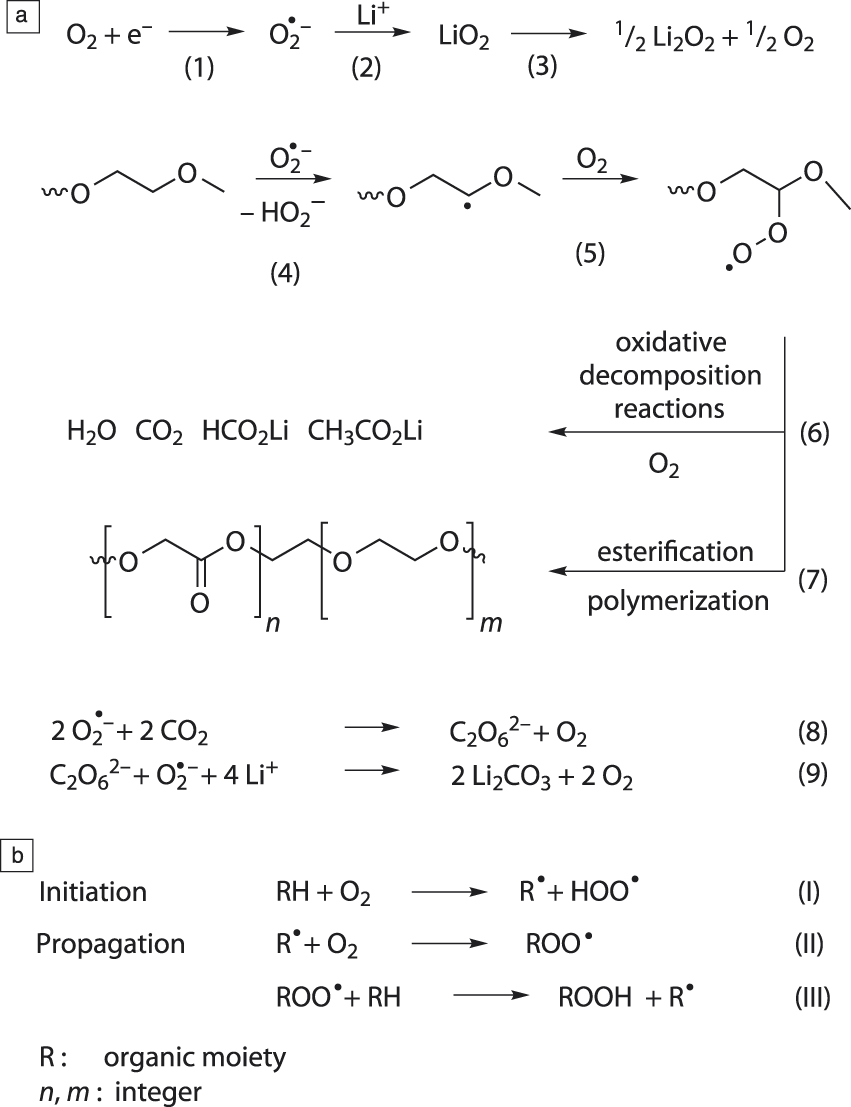
Recent extensive investigation of nonaqueous electrolytes for Li-O2 cells, based on ethers, amides, ionic liquids (ILs), and DMSO, have shown that they all predominantly support the formation of Li2O2 upon first discharge and its removal on recharge.Reference Ottakam Thotiyl, Freunberger, Peng and Bruce32,Reference Freunberger, Chen, Drewett, Hardwick, Bardé and Bruce44–Reference Leskes, Drewett, Hardwick, Bruce, Goward and Grey46 Ethers are attractive for the Li–O2 battery because they are safe, cheap, compatible with lithium metal anodes, more stable toward reduced O2 species compared with organic carbonates, and have relatively high oxidation windows (up to 4 V versus Li/Li+), and low volatilities (for longer-chain ethers). However, there is growing experimental and theoretical evidence that ether-based electrolytes are not suitable for Li-O2 cells.Reference McCloskey, Bethune, Shelby, Girishkumar and Luntz13,Reference McCloskey, Speidel, Scheffler, Miller, Viswanathan, Hummelshøj, Nørskov and Luntz29,Reference McCloskey, Valery, Luntz, Gowda, Wallraff, Garcia, Mori and Krupp31,Reference Freunberger, Chen, Drewett, Hardwick, Bardé and Bruce44,Reference Younesi, Hahlin, Treskow, Scheers, Johansson and Edstrom60–Reference Ryan, Trahey, Ingram and Burrell62 Ethers are known to form peroxides under ambient conditions by auto oxidation reactions.Reference Clover63 This instability toward auto oxidation has been identified as a possible pathway of initial attack of the solvent that gives rise to further decomposition reactions Figure 6b).Reference Bryantsev and Faglioni61
Possible reaction schemes for ether decomposition. (a) Proposed reaction scheme on discharge to explain decomposition of ether: electron reduction of O2 to superoxide (1), binding with Li+ (2), and disproportionation to Li2O2 (3) as the ideal sequence. Alternatively, superoxide may abstract a proton from the solvent (4) to give hydroperoxide (5), which may further react in a series of oxidative decomposition steps (6) or yield esters or polymeric compounds (7). Superoxide and CO2 from step (6) react to form Li2CO3 (8 and 9). (b) Alternative possible pathway with initial attack by autoxidation to give hydroperoxyl and alkyl radicals (I) and chain propagation by O2 addition and further proton abstraction (II and III). Note: The dot (•) denotes a free radical. (a) Reprinted with permission from Reference 44. © 2012 American Chemical Society. (b) Reprinted with permission from Reference 61. © 2011 American Chemical Society.
Amide electrolytes
Amides are a major class of solvent that are known to be highly stable against bases and nucleophilic attack and have been extensively used for O2 reduction studies.Reference Sawyer and Valentine64,Reference Peover and White65 Theoretical calculations and KO2 screening studies suggest high-energy barriers against nucleophilic substitution at the carbons due to unfavorable stability of the reaction products.Reference Bryantsev and Faglioni61 Calculations also show that amides are much more stable against auto oxidation than ethers; amides require a high activation energy for proton abstraction by O2–.Reference Bryantsev, Uddin, Giordani, Walker, Addison and Chase37 Dimethylformamide (DMF) and dimethylacetamide (DMA) have been investigated as the basis of electrolytes for Li-O2 batteries.Reference Walker, Giordani, Uddin, Bryantsev, Chase and Addison42,Reference Chen, Freunberger, Peng, Bardé and Bruce47 DMF shows greater stability than ethers, but some parasitic reactions occur, and significant capacity fading is observed.Reference Chen, Freunberger, Peng, Bardé and Bruce47 Cells with DMA electrolyte demonstrate better performance, up to 80 cycles with a reproducible voltage profile.Reference Walker, Giordani, Uddin, Bryantsev, Chase and Addison42
Ionic liquids and DMSO
Chemical screening by KO2 and voltammetric methods suggest that the stability of IL electrolytes is much greater than organic carbonate solvents.Reference Herranz, Garsuch and Gasteiger41,Reference Mizuno, Nakanishi, Shirasawa, Takechi, Shiga, Nishikoori and Iba48–Reference Allen, Hwang, Kautz, Mukerjee, Plichta, Hendrickson and Abraham51 However, due to the difficulty of purifying ILs, the impurities that remain may be the reason for the observed parasitic reactions that compromised cycleability.
Cells based on DMSO, which have been used to study O2 reduction in nonaqueous media in the past,Reference Merritt and Sawyer66 have shown sustained cycling, with the reversible formation/decomposition of Li2O2 at the cathode.Reference Peng, Freunberger, Chen and Bruce7,Reference Ottakam Thotiyl, Freunberger, Peng, Chen, Liu and Bruce34 FTIR analysis of the discharge product in a carbon cathode in 1M LiClO4 in DMSO confirms dominant formation of Li2O2, along with some Li2CO3 and HCOOLi.Reference Peng, Freunberger, Chen and Bruce7,Reference McCloskey, Valery, Luntz, Gowda, Wallraff, Garcia, Mori and Krupp31,Reference Ottakam Thotiyl, Freunberger, Peng, Chen, Liu and Bruce34,Reference Ryan, Trahey, Ingram and Burrell62
Further research on the stability of nonaqueous electrolytes and electrode materials in rechargeable Li-O2 batteries is much needed. Reactions do not proceed without side reactions; therefore, the question is not whether side reactions occur but what degree of stability is required. In this respect, two effects need to be considered: First, the extent of the side reactions, decomposition of solvent, salt, electrode, or binder to form solid, gaseous, or dissolved side products, which deplete the particular component and will lead to failure once a threshold of consumption is exceeded; and second, the nature of the side reaction products and their effects on the reversible electrochemistry. In this regard, the products of the parasitic reactions should not passivate the electrode significantly (e.g., the by-products should diffuse away from the surface). If they cannot, they have to be able to decompose easily on charge without introducing a significant overpotential; otherwise, a relatively small degree of decomposition can have a disproportionately large detrimental effect on the electrochemistry. This is what happens with carbon electrodes and many electrolytes, which form solid insulating Li2CO3 on the electrode surface, leading to severe polarization and premature cell death. It may be that the combination of DMSO with a nanoporous Au cathode produces side products other than Li2CO3, thus avoiding large polarization.
Challenges and opportunities: Aqueous lithium-oxygen batteries
In the second part of this article, we will discuss recent efforts in protected lithium metal as the negative electrode in aqueous Li-O2 batteries. Aqueous batteries have received significantly less attention than nonaqueous Li-O2 batteries due to the practical challenges involved with preventing a violent reaction between lithium and water. Developing lithium metal as the negative electrode that can cycle safely and stably has been a challenge for 40 years, owing to the dendrites that form on repeated lithium dissolution and lithium deposition. Dendrites can be fatal to battery performance since they pose the risk of growing into the cathode and causing a short circuit and battery failure. There are still no rechargeable lithium anode-based batteries on the market; all rechargeable Li-ion batteries have thus far contained the lithium inside another material such as aluminum (LiAl),Reference Jang, Neudecker and Dudney67,Reference Levi and Aurbach68 carbon (LiC6),Reference Xia, Lu and Ceder15,Reference Zhu and Wang16,Reference Visco, Katz, Chu and De Jonghe69 and, more recently, tinReference Xia, Lu and Ceder15,Reference Zhang, Li, Khan and Fedkiw70,Reference Rao, Francis and Christopher71 and silicon.Reference Megahed and Scrosati72
Zhang et al.Reference Zhang, Li, Khan and Fedkiw70 have reported lithium dendrite formation in a typical nonaqueous electrolyte containing polyethylene glycol dimethyl ether (PEGDME, Mw. 250) with Li(CF3SO2)2N (LiTFSI) for lithium-air rechargeable Li-O2 batteries. The Li/PEGDME-LiTFSI/Li cell showed short circuits after 21.4 h of polarization at 0.2 mA cm–2 and 4.0 h of polarization at 1.0 mA cm–2. A lithium metal alloy with aluminum solved the dendrite issue,Reference Rao, Francis and Christopher71 but alloy electrodes survive only a limited number of cycles owing to extreme changes in volume during operation.
To reduce lithium dendrite formation, solid electrolytes have been developed for electric vehicle applications.Reference Megahed and Scrosati72 Theoretical calculations suggest that a homogenous solid-state electrolyte with a modulus of 6 GPa would drastically reduce dendrite formation.Reference Monroe and Newman73 As the moduli of ceramic materials are generally higher than 6 GPa, little or no lithium dendrite formation between a ceramic lithium-ion conductor and lithium metal is expected. Visco et al.Reference Visco, Katz, Chu and De Jonghe69 and Stevens et al.Reference Stevens, Toussaint, Caillon, Viaud, Vinatier, Cantau, Fichet, Sarrazin and Mallouki74 first reported experimental evidence of the feasibility of protected lithium metal electrodes, with Li/Li3N/Li1+xAlxTi2–x(PO4)3 (LATP) and Li/Li3–xPO4–yNy/LATP, respectively. Li3N and Li3–xPO4–yNy are used to prevent direct contact of lithium metal with LATP, since LATP is electrochemically unstable at the potential of metallic lithium.Reference Hasegawa, Imanishi, Zhang, Xie, Hirano, Takeda and Yamamoto11,Reference Imanishi, Hasegawa, Zhang, Hirano, Takeda and Yamamoto12,Reference Capsoni, Bini, Ferrari, Quartarone and Mustarelli75 Aqueous Li-O2 batteries assembled with these lithium electrodes could be cycled at 1 mA cm–2 and room temperature without degradation of the cell performance for a short period of 10 min.Reference Visco, Katz, Chu and De Jonghe69,Reference Monroe and Newman73 Subsequently, other protected lithium anodes based on garnet-type solid electrolytesReference Murugan, Thangadurai and Weppner76 and polymer-ceramic composite membranesReference Kumar, Kumar, Leese, Fellner, Rodrigues and Abraham77 have been reported.
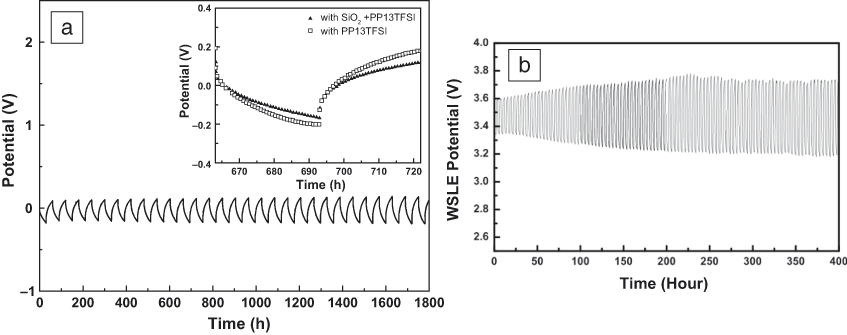
While ceramic conductors are stiff enough to prevent lithium dendrite growth, they do not easily make low-resistance contacts with other solid components and thus have high charge transfer resistance. Recent research efforts have been focused on using polymer-ceramic composite electrolytes to form a conformal interface and reduce interfacial resistance. Rosso et al. investigated the mechanism of lithium dendrite growth in Li/PEO-based-electrolyte/Li (PEO = polyethylene oxide),Reference Rosso, Gobron, Brissot, Chazalviel and Lascaud78,Reference Brissot, Rosso, Chazalviel and Lascaud79 where the onset of dendrite formation and the time to reach short-circuit times can be studied by direct in situ observation and simultaneous cell voltage monitoring. Table I summarizes the dendrite onset and short-circuit time for different compositions of PEO-based electrolytes. No dendrite formation was observed in a Li/PEO20LiTFSI/Li cell at a low current density of 0.03 mA cm–2 for 100 h at 80°C, while at a high current density of 0.7 mA cm–2, dendrites were observed after less than 1 h of deposition.Reference Brissot, Rosso, Chazalviel and Lascaud79 Such lithium dendrite formation onset times at high current density are too short to be used in practical applications. The use of ceramic or IL additives in polymer electrolytes comprises another strategy to suppress dendrite formation. The addition of nano-SiO2 and/or IL of N-methyl-N-propylpiperidinium TFSI (PP13TFSI)Reference Liu, Imanishi, Zhang, Hirano, Takeda, Yamamoto and Yang80,Reference Liu, Wang, Imanishi, Zhang, Hirano, Takeda, Yamamoto and Yang81 to polymer electrolytes has been shown to increase the onset time of dendrite formation from 10 h for Li/PEO18TFSI/Li to 21 h at 1.0 mA cm–2 at 60°C. Figure 7a shows the cycling performance of the lithium deposition and dissolution process in a Li/PEO18LiTFSI-SiO2-PP13TFSI/Li cell at 60°C, where the cell voltage showed no significant change during cycling, and no dendrite formation was detected at a current density of 0.3 mA cm–2 for 30 h.Reference Liu, Wang, Imanishi, Zhang, Hirano, Takeda, Yamamoto and Yang81
Dependence of lithium dendrite formation onset time (t o) and short-circuit time (t s) on electrolyte formulation, temperature, and current density.
Note: PVdF, polyvinylidene fluoride; HFP, hexafluorophosphate; EC, ethylene carbonate; PC, propylene carbonate; PEO, polyethylene oxide; LiTFSI, Li(CF3SO2)2N; PEGDME, polyethylene glycol dimethyl ether; PP13, N-methyl-N-propylpiperidinium.
(a) Cycling performance for the Li/PEO18LiTFSI-SiO2-PP13TFSI/Li cell at 0.3 mA cm–2 and 60°C. The inset shows a comparison of the 11th cycle for Li/PEO18LiTFSI-SiO2-PP13TFSI/Li and Li/PEO18LiTFSI-PP13TFSI/Li. Cycling performance of the Li/PEO18LiTFSI-1.44PP13TFSI/LATP/aqueous 1 M LiCl-0.004 M LiOH/Pt-air cell at 0.3 mA cm–2 and 60°C between (b) 0 h and 400 h. The water-stable lithium electrode (WSLE) voltage was measured by a Pt-air reference electrode. Discharge and charge period are both two hours. Cycle was repeated without interval. Microscopic observations of the cell indicated no dendrite formation after cycling. Note: PEO, polyethylene oxide; LiTFSI, Li(CF3SO2)2N; PP13, N-methyl-N-propylpiperidinium; LATP, Li1+xAlxTi2–x(PO4)3. (a) Reprinted with permission from Reference 81. © 2014 Elsevier. (b) Reprinted with permission from Reference 82. © 2014 The Electrochemical Society.
Based on these positive results, this composite polymer electrolyte of PEO18LiTFSI-SiO2-PP13TFSI was also assessed as the protected lithium-metal anode for rechargeable lithium-air batteries. Figure 7b shows reversible cycling of a Li/PEO18LiTFSI-PP13TFSI/LATP/aqueous 1 M LiCl-0.004 M LiOH/Pt, air cell at 0.3 mA cm–2 and 60°C,Reference Zhang, Imanishi, Hirano, Takeda and Yamamoto82 with LATP as the solid electrolyte. The inclusion of PP13TFSI IL is effective in reducing interfacial resistance between lithium and the electrolyte and facilitating highly reversible Li-O2 cycling.
While the early onset of lithium dendrite formation and low output power remain yet to be completely solved, recent research has shown that these challenges are closely related to the physical properties of the solid electrolyte used. Further materials development for the protection layer of lithium is therefore essential to achieve high power density at several mA cm–2 and extended deep cycling of the lithium electrode for Li-O2 batteries.
Summary
The need for storage technologies with much greater gravimetric energy than Li-ion batteries makes Li-O2 batteries an attractive energy storage option for applications that require high-energy density such as electric vehicles. Although notable progress has been made in the development of rechargeable, lab-scale nonaqueous Li-O2 cells, further investigation of the oxygen reduction reaction (ORR) and oxygen evolution reaction (OER) in nonaqueous electrolytes, and parasitic reaction mechanisms involving inactive components in the oxygen electrode is required in order to aid the rational design and development of kinetically facile and chemically stable electrode and electrolyte configurations.
As detailed in this review, researchers have just begun to connect the physical properties (morphology and surface versus bulk chemistry) of Li2O2 with the corresponding kinetics of Li2O2 formation and oxidation. Important topics warranting further investigation in this area include the detailed reaction and growth mechanisms of Li2O2 at high and low overpotentials; the electronic nature (surface and bulk) of electrochemically formed Li2O2; intrinsic Li2O2 oxidation pathways; and the influence of non-carbonate solvents on the nucleation and growth of Li2O2 and its oxidation.
As carbon is not stable in the oxygen electrode, improved morphological, chemical, and kinetic understanding of Li-O2 reactions in non-carbon electrodes will become increasingly relevant for the development of rechargeable Li-O2 batteries. The search for electrolytes that are chemically stable against the oxygen electrode is another major focus of research. The discovery that reduced oxygen species produced during ORR are also highly reactive against a broad range of electrolyte solvents has spurred detailed spectroscopic, spectrometric, and titration studies examining the interplay between electrolyte formulation and discharge reaction product. Combining these experimental approaches with theoretical calculations evaluating electrolyte susceptibility to attack by Li2O2 and/or ORR intermediates will be crucial to finding an electrolyte that is moderately stable during ORR, but also possesses a favorable synergy with the chosen electrode material such that parasitic reactions during OER are minimized.
Significant progress has been made toward finding materials that suppress lithium dendrite formation and also adequately protect the lithium metal anode from contact with reactive gases and water in both nonaqueous and aqueous Li-O2 battery environments. Representing a compromise between the favorable transport properties of liquid and the high mechanical stability of solid electrolytes, the use of polymers has emerged as a particularly promising strategy to protect lithium metal anodes. Further research into the possibility of incorporating nanostructured additives to improve power capabilities while maintaining chemical stability against lithium metal in full Li-O2 cells is a promising direction for future efforts in this field. The need for fundamentally understanding the relationship between electrode reaction mechanisms and parasitic processes occurring in rechargeable Li-O2 batteries presents an opportunity to combine cutting edge experimental and computational techniques with materials innovation in the areas outlined previously to enable the development of practical rechargeable Li-O2 batteries, which combine high rate capability with high round-trip efficiency and long cycle life.
Acknowledgments
Y.S-H., N.O.-V. and D.G.K. gratefully acknowledge the Robert Bosch Company for a Bosch Energy Research Network Grant, the CERC-CVC US China Clean Energy Research Center-Clean Vehicles Consortium of the Department of Energy (under award number DE—PI0000012), and the MRSEC program of the National Science Foundation for their generous support (under award number DMR—0819762). N.O.-V. acknowledges a Marie Curie International Outgoing Fellowship within the seventh European Community Framework Programme (2012). P.G.B. acknowledges the EPSRC for financial support, including the SUPERGEN program. S.A.F. acknowledges financial support by the Austrian Federal Ministry of Economy, Family and Youth and the Austrian National Foundation for Research, Technology and Development.