


A high prevalence of overweight and obesity is currently observed in all age groups around the world( Reference Branca, Nikogosian and Lobstein 1 ). It is of special interest that overweight and obesity are also observed in very young children, even in toddlers (age 12 to 36 months)( Reference de Onis, Blossner and Borghi 2 ). As childhood overweight and obesity are likely to impact on later child and adult BMI (tracking phenomenon of obesity)( Reference Gardner, Hosking and Metcalf 3 – Reference Monteiro and Victora 6 ), preventive efforts are already needed early in life.
Although most evidence on determinants of childhood overweight and obesity is available from pre-school ages onwards (>3 years old), there is evidence that regular physical activity protects against unhealthy weight gain in young children( Reference Monasta, Batty and Cattaneo 7 – Reference Janz, Kwon and Letuchy 9 ) and that increased television time( Reference Monasta, Batty and Cattaneo 7 ) and unhealthy food intake( Reference Monasta, Batty and Cattaneo 7 ) can contribute to weight gain in toddlers. Moreover, there is evidence that unhealthy lifestyle behaviours are prevalent in this age group( Reference Huybrechts, Matthys and Vereecken 10 – Reference Cardon and De Bourdeaudhuij 13 ) and that they are likely to track into later life( Reference Certain 12 , Reference Pate 14 ). Therefore, early childhood (between 0 and 5 years of age) is a critical period in life to establish a healthy lifestyle that will have long-lasting effects on later health.
Despite the potential and promising role of early childhood in the prevention of overweight and obesity, there is only a small body of evidence reporting on the effectiveness of interventions to prevent overweight and obesity in young children by promoting healthy eating, physical activity and/or reduce sedentary behaviour( Reference Hesketh and Campbell 15 ). Hesketh and Campbell( Reference Hesketh and Campbell 15 ) reviewed the literature on the prevention of obesity in children below the age of 5 years and found twenty-three studies which evaluated the effectiveness of interventions that focused (at least) on a healthy diet as well as increased physical activity or reduced sedentary behaviour. Of special interest is that this review only reported one study that investigated the effectiveness of a dietary- and activity-related intervention on weight outcomes in toddlers( Reference Harvey-Berino and Rourke 16 ).
Although the evidence available in the broader age range of 0 to 5 years old is limited, it is supportive for the assumption that parents and caregivers are receptive to overweight and obesity preventive efforts during early childhood( Reference Styles, Meier and Sutherland 17 ). Furthermore, it is commonly accepted, and in line with ecological models of behavioural change( Reference Sallis, Owen and Fisher 18 ), that the family and especially the parents should be involved as agents of change in the prevention of childhood overweight and obesity( Reference Golan 19 , Reference Golan and Crow 20 ). However, it is clear from the literature that there is still a lack of multi-topic, family-based interventions that have been implemented and evaluated for their effectiveness in changing behavioural determinants and preventing overweight and obesity during early childhood( Reference Hesketh and Campbell 15 , Reference Waters, de Silva-Sanigorski and Hall 21 ).
The aim of the present pilot trial was to address this gap in the literature by investigating the effect of a 1-year family-based healthy lifestyle intervention implemented through day-care centres on toddlers’ weight, dietary behaviour, physical activity and screen-time behaviour. It was hypothesized that the intervention would lead to healthier weight outcomes (i.e. more optimal BMI Z-scores), significant increases of health-promoting behaviours (consumption of fruit, vegetables, water and unsweetened milk; daily physical activity) and significant decreases of risk behaviours (consumption of soft drinks, sweetened milk, sweets and savoury snacks; daily screen-time).
Method
Participants
The present study was conducted in six different communities (i.e. a town or municipality) in Flanders, Belgium. The communities were selected from research regions that were stipulated by the Flemish Policy Research Centre for Welfare, Health and Family, which financed the research project. The selection of the six communities in the research regions was based on five socio-economic characteristics: (i) the number of births in underprivileged families; (ii) the proportion of pupils in primary school with a school delay; (iii) the rate of unemployment; (iv) the number of persons on welfare support; and (v) the number of underprivileged foreigners. High scores on these parameters indicated a lower socio-economic status (SES) of the community. A community was labelled as ‘low SES’ if it scored higher than the Flemish mean on three to five of the above-mentioned characteristics. A community was labelled as ‘medium SES’ if one or two scores were higher than the Flemish mean. A community was labelled as ‘high SES’ if it had no scores higher than the mean. Two communities with a low, two communities with a medium and two communities with a high SES were selected. From each pair-matched community, one community was randomly allocated to the intervention group. The other community was allocated to the control group( Reference De Coen, De Bourdeaudhuij and Vereecken 22 ).
In each community, all day-care centres were invited for participation. All day-care centres were officially recognized by the Flemish governmental agency ‘Child & Family’ (Kind & Gezin)( 23 ), which is accredited to provide recognition and subsidies to day-care centres in Belgium. A day-care centre in Flanders is a facility that is formally responsible for providing non-relative care for children between 0 and 3 years old. Formal child care is highly attended in Flanders( 23 ). A total of 137 day-care centres were contacted of which seventy were willing to participate in the study (51 %). Reasons for non-participation of the day-care centres were attributable to the age range of the children, closure of the day-care centre, change of management and previous bad experiences with research.
Within each day-care centre, parents of all children aged 9–24 months were invited to enrol their child in the study (n 404). The parents of 215 children (53 % of those invited) gave permission for their child to participate (ranges: 16–80 children/community; 4–21 day-care centres/community; 1–12 children/day-care centre). Twelve children were not present in day care on the measurement day. This resulted in a final sample of 203 children (50 % of those invited) who fulfilled the minimal criteria to be included in the study (i.e. objectively assessed weight and standing height at baseline). No BMI Z-score could be calculated for seven of these children, one child was excluded because of being underweight (initial BMI Z-score < −2) and four children were excluded for being obese (initial BMI Z-score > 3), resulting in a final sample of 191 children included in the analyses (47 % of those invited; intervention group: n 126 in thirty-five day-care centres; control group: n 65 in twenty-two day-care centres). Mean age of the final sample was 15·51 (sd 2·68) months and 54 % were boys. Of this sample, 156 children were re-examined 12 months later at follow-up (82 % of the baseline sample; intervention group: n 100; control group: n 56).
Parents provided written informed consent for all measurements at the start of the study. The study protocol was approved by the Ethical Committee of the University Hospital of Ghent University.
Measurements and procedures
After randomizing the communities into either the intervention or the control group, data collection took place at baseline (T0; prior to the intervention; autumn 2008) and 12 months later at follow-up (T1; after the intervention; autumn 2009) to control for seasonal effects. It was practically impossible to conduct the baseline measurements before randomization, as the present study was part of a larger government-funded research project that also included other research objectives. This also implied that local professionals and day-care centres in the communities were already aware of their group allocation at the start of the study.
After randomization, parents received a letter in which they were informed about the study but their group assignment was not revealed at that time. However, the day-care centres distributed the letters to the parents and they may have incorporated this information in their communication to the parents. Further, blinding of the parents in the intervention communities could not be obtained throughout the study as parents received specific materials as part of the intervention.
Before baseline measurements, identification numbers were given to the participants in a way that did not enable the identification of participants. Also, researchers did not have access to personal data of the participants, as day-care centres in Belgium are not allowed to provide them to others. Children's weight and standing height were measured barefooted and in light clothing in the day-care centre by two researchers who were not blind to participant assignment at baseline and follow-up. Weight was measured to the nearest 0·1 kg with digital scales (Seca Robusta 813; Seca, Hamburg, Germany) and standing height to the nearest millimetre using a mobile stadiometer (Seca 214). Weight and height were used to calculate BMI (kg/m2) and BMI Z-scores on the basis of the WHO 2007 reference data using the LMS method( 24 ). Sex- and age-specific BMI Z-scores provide a relative measure of adiposity adjusted for age and sex. The Z-score is the number of sd units that a person's BMI is deviated from a mean or reference value. If a child's BMI Z-score has not changed over time, his/her BMI deviates an equal number of sd units from the mean or reference value at all time points, despite the possible decrease in absolute BMI over time that is observed in 10–24-month-old children( 24 ). Children with a BMI Z-score > 2 were considered overweight( Reference de Onis and Lobstein 25 ).
Parents received a questionnaire through the day-care centre and were asked to complete it at home. The questionnaire included a validated twenty-four-item semi-quantitative FFQ( Reference Huybrechts, De Backer and De Bacquer 26 ) to assess the daily consumption of water, soft drinks, milk, fruit, vegetables, sweets and savoury snacks. The FFQ was relatively validated in a sample of 650 children, aged 2·5–6·5 years, using an estimated 3 d diet record as a reference. Reproducibility (n 124) was measured by repeated FFQ administrations five weeks apart. For most foods, a moderate level of relative validity was observed for estimated food group intake( Reference Huybrechts, De Backer and De Bacquer 26 ). The FFQ enabled to make a distinction between sweetened and unsweetened milk consumption. Sweetened milk included growing-up milk, dairy drinks, milk shakes and milk products flavoured with sweet additives (soya drinks, fresh cheese and yoghurt, and milk or soya desserts). Unsweetened milk included buttermilk, (semi)-skimmed or whole milk, natural soya drinks and unflavoured fresh cheese and yoghurt.
The parental questionnaire assessed screen-time behaviour by means of a closed-ended question asking parents to report the usual time per day their child watches television, videos and/or digital video disks during weekdays and weekend days, separately. Time spent in these screen-time behaviours was divided in eight response categories: (i) not at all; (ii) 0·5 h/d; (iii) 1 h/d; (iv) 2 h/d; (v) 3 h/d; (vi) 4 h/d; (vii) 5 h/d; and (viii) ≥6 h/d. Daily time spent in screen-time behaviour was calculated as follows: [(weekday × 5)+(weekend day × 2)]/7.
Daily physical activity was also assessed through the parental questionnaire by using a closed-ended question about the child's daily physical activity (e.g. walking, running, crawling, using a push-bike). Time spent in physical activity was divided in eight response categories: (i) not at all; (ii) 0·5 h/d; (iii) 1 h/d; (iv) 2 h/d; (v) 3 h/d; (vi) 4 h/d; (vii) 5 h/d; and (viii) ≥6 h/d. Parents were asked to indicate the time their child spent being physically active during weekdays and weekend days separately. Daily time spent in physical activity was calculated as follows: [(weekday × 5)+(weekend day × 2)]/7.
Demographic factors like birth date, sex and SES were also acquired through the parental questionnaire. SES was classified into two groups based on the mothers’ highest educational level: (i) those who completed elementary, vocational, technical or general secondary education (low SES); and (ii) those who completed higher education or university (high SES).
Intervention
A family-based healthy lifestyle intervention was developed and implemented through day-care centres. The intervention aimed at increasing daily consumption of water (instead of soft drinks), milk, fruit and vegetables, increasing daily physical activity and decreasing daily consumption of sweets and savoury snacks and daily screen-time behaviour.
In line with well-known health-promotion planning approaches( Reference Bartholomew, Parcel and Kok 27 ), changeable determinants of these target behaviours were selected. Based on the literature and behaviour change theories, it was decided that the intervention had to increase parental knowledge, awareness, self-efficacy, parental modelling of the expected behaviours and availability of the healthy foods in the home environment.
Specific behaviour-oriented theories were selected to develop the intervention: (i) theories of information processing( Reference Bartholomew, Parcel and Kok 27 ); (ii) the elaboration likelihood model( Reference Petty, Barden and Wheeler 28 ); and (iii) the precaution-adoption process model( Reference Weinstein 29 ). Theories of information processing suggest that information should be successfully transferred to the communication receiver when aiming to change behaviour( Reference Bartholomew, Parcel and Kok 27 ). The elaboration likelihood model suggests that skills and motivation are needed to obtain thoughtful information processing which is a perquisite for behavioural change( Reference Petty, Barden and Wheeler 28 ). The precaution-adoption process model is a stage theory that was developed to describe the process of behavioural change according to different steps that people go through before changing their behaviour( Reference Weinstein 29 ).
The behaviour-oriented theories informed the selection of methods to influence the determinants. Elaboration and chunking were the behavioural change methods derived from theories of information processing. Elaboration and persuasive communication were derived from the elaboration likelihood model and tailoring and consciousness raising were derived from the precaution-adoption process model( Reference Bartholomew, Parcel and Kok 27 ).
The selected methods were translated into different strategies which were aggregated in an intervention programme that consisted of two components: (i) guidelines and tips presented on a poster and (ii) a tailored feedback form for parents about their children's activity- and dietary-related behaviours.
The poster consisted of a colourful and animated A3 sheet with five stickers. Each sticker dealt with a targeted behaviour and provided parents with practical information and/or strategies. The stickers were distributed to the parents every two months and were gradually stuck on the poster by the parents. The stickers were always accompanied by a letter with information about the target behaviour. The tailored feedback was based on the activity- and dietary-related measures as reported by the parents in the baseline questionnaire. The poster and the tailored feedback were provided to the parents through the day-care centres. A more detailed description of the translation from theoretical methods to different intervention components and a more detailed description of the intervention materials and the corresponding implementation strategy can be found in Table 1.
Description of the intervention components, corresponding intervention materials and implementation strategy
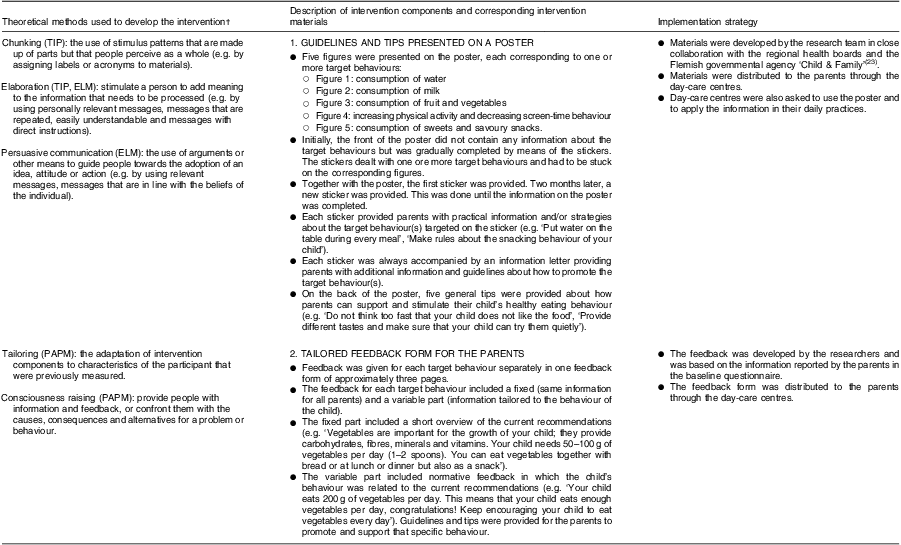
†Description of theoretical methods taken from Bartholomew et al.( Reference Bartholomew, Parcel and Kok 27 ); TIP = theories of information processing; ELM = elaboration likelihood model; PAPM = precaution-adoption process model.
Statistical analyses
Data were analysed using the statistical software package IBM SPSS Statistics version 19. Data distribution of quantitative variables was checked using the Shapiro–Wilk test. All behavioural data were skewed and were therefore transformed, with a log10 transformation best approximating a normal distribution. BMI Z-score at baseline was negatively skewed but logarithmic transformation (based on log10 (x + a) to deal with negative BMI Z-scores) did not improve normality, so non-transformed data were used. BMI Z-score at follow-up was normally distributed and was therefore not transformed.
Descriptive statistics were used to describe the study population using means and standard deviations. Independent-samples t tests and χ 2 tests were used to test differences between the control and intervention groups. Logistic regression analyses were conducted to examine if the dropout rate was associated with baseline characteristics of the participants (i.e. sex, weight status, SES, research condition).
To assess the effect of the intervention on BMI Z-score and behavioural outcomes, linear mixed models were applied with an additional random effect for day-care centre to consider the clustered study design in the analyses. The analyses were adjusted for SES, age of the child and BMI Z-score at baseline to control for the observed baseline imbalance in these variables between intervention and control groups.
Unless specified otherwise, non-transformed data are reported in the tables and the text. P values of ≤0·05 were considered statistically significant.
Results
Table 2 presents baseline data for the total sample included in the study and for the intervention and control groups separately. After 1 year of intervention, 21 % of the children in the baseline sample dropped out from the study in the intervention group (n 26) and 14 % dropped out in the control group (n 9). Dropout analysis showed that normal-weight children were just as likely to drop out from the study as overweight children (OR = 0·52; 95 % CI 0·16, 1·69). No significant difference was also found for sex, SES and research condition.
Participant characteristics at baseline in the total group and in the intervention and control groups separately: Belgian toddlers (n 203) aged 9–24 months
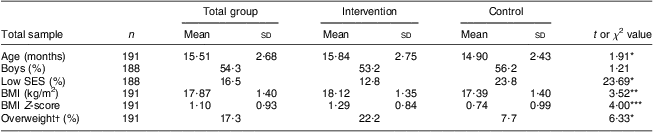
SES, socio-economic status.
Data are presented as means and standard deviations or as percentages.
Statistically significant difference between intervention and control group: *P ≤ 0·05, **P = 0·001, ***P < 0·001.
†BMI Z-score > 2.
A significant time-by-condition interaction effect indicated that the intervention had a positive effect on BMI Z-score. BMI Z-score decreased in both groups but decreased more in the intervention group compared with the control group (Table 3).
Effects of the healthy lifestyle intervention on BMI Z-score and lifestyle behaviours in Belgian toddlers (n 203) aged 9–24 months
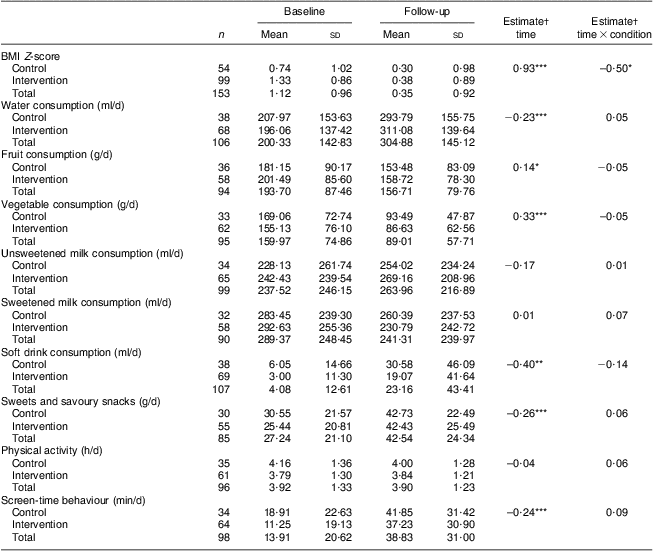
*P ≤ 0·05, **P = 0·01, ***P < 0·001.
†Effect estimates and P values obtained via mixed model analyses adjusting for socio-economic status, age of the child and BMI Z-score at baseline and correcting for clustered design (day-care centre).
The intervention was not effective in increasing parental-reported daily time spent in physical activity and in increasing daily consumption of water, unsweetened milk, fruit and vegetables. The intervention was also not effective in decreasing parental-reported daily time spent in screen-time behaviour and in decreasing daily consumption of soft drinks, sweetened milk, sweets and savoury snacks. Table 3 presents the pre- and post-intervention values of all activity- and dietary-related behaviours by condition, as well as effect estimates and P values of the time-by-condition interaction effects.
Significant main effects of time were found for all dietary-related behaviours, except for sweetened and unsweetened milk consumption (Table 3). In both the intervention and control groups, the parental-reported daily consumption of water, soft drinks, sweets and savoury snacks increased significantly over 1 year. The parental-reported daily consumption of fruit and vegetables decreased significantly over time in both groups. No significant main effect of time was found for daily physical activity levels but daily screen-time behaviour increased in both groups between the two measurements (Table 3).
Discussion
The main finding of the present study was that a family-based healthy lifestyle intervention focusing on dietary behaviour, physical activity and screen-time behaviour implemented through day-care centres resulted in healthier weight outcomes in a Belgian sample of 9–24-month-old toddlers. No significant intervention effects were found on the lifestyle behaviours targeted by the intervention but, over a period of 1 year, dietary-related behaviours developed in the unhealthy direction in both conditions. This indicates that development of an unhealthy lifestyle pattern contributing to the development of childhood obesity already starts at very young age.
In line with our hypothesis, the family-based healthy lifestyle intervention resulted in healthier weight outcomes in toddlers. Relative BMI decreased in both conditions but decreased more in children who received the healthy lifestyle intervention. This result is in line with those found by Harvey-Berino and Rourke( Reference Harvey-Berino and Rourke 16 ). These authors evaluated the effectiveness of a home-based multi-topic parental support programme focusing on general parenting skills. They found a decrease in weight-for-height Z-score in the toddlers whose parents received the intervention while the Z-scores increased in the control condition. To our knowledge, the study of Harvey-Berino and Rourke( Reference Harvey-Berino and Rourke 16 ) is the only one that previously evaluated the effects of an intervention on weight outcomes in toddlers by focusing on the same behaviours as the present study and focusing on parents as agents of behavioural change in very young children. Therefore, it is not possible to compare the results with other studies in this age group. However, we believe that the effectiveness of the present study is of special importance as it demonstrates that interventions during early life are promising in counteracting childhood overweight.
In contrast with what we hypothesized, no significant positive intervention effects were found on the lifestyle behaviours targeted by the intervention. This may be attributable to several factors. Possibly, the parental-report measures used were not sensitive enough to detect differential changes that occurred between the control and intervention groups and we are not aware of their ability to detect changes over time that are clinically meaningful in children younger than 2 years. However, these instruments are frequently used in young children and no other instruments were available for children below the age of 2 years at the time the study was conducted. The questions to assess children's physical activity and screen-time behaviour were quite generic and might not have been specific enough to detect and measure differences attributable to the intervention. It may also be possible that parents were not able to adequately recall their children's behaviour because the children spent most of the day at day care. All of these factors could have resulted in imprecise parental-reported measures at the two points in time, which may have increased the error associated with change and reduced the ability of the instruments to detect true changes. Therefore, the use of objective measures for physical activity and sedentary behaviour (e.g. accelerometers) and the use of more specific measures for dietary intake (e.g. employees of the day-care centre as a proxy reporter) are recommended in future studies evaluating the effectiveness of behavioural lifestyle interventions in toddlers. Another possible reason could also be that the individual lifestyle changes (e.g. changes in several dietary-related behaviours separately) were too small to show significant changes over time between the intervention and the control groups. Although we did not find significant intervention effects, the data suggested a greater increase in water and unsweetened milk consumption, a greater decrease in sweetened milk consumption, a lesser decrease in vegetable consumption and a lesser increase in soft drink consumption in the intervention group compared with the control group. However, these small but different lifestyle changes, in combination with physical activity (which tended to increase slightly in the intervention group and decrease in the control group), might all together be causing the greater reduction of relative BMI in the intervention group as compared with the control group. An alternative explanation is that reductions in BMI Z-score might be the result of changes in behaviours that were not captured by the methods used in the present study, such as total sedentary time, moderate-to-vigorous physical activity or portion sizes.
An interesting finding of the present study was the negative development of lifestyle behaviours observed in toddlers in both conditions. Except for the consumption of water and sweetened milk, all dietary-related behaviours evolved in the unhealthy direction over 1 year of time. This negative development of dietary-related behaviours coincided with the period in which the child starts eating the same foods as the rest of the family and in which the child is taking over the habits of the family, which will track into later life. Therefore, this observation indicates that the first two years of life are critical for establishing healthy lifestyle patterns and underlines the need for behavioural interventions during early childhood. In Belgium, parents are strongly supervised, advised and supported about their child's growth and development by a governmental agency during their child's first year of life. However, this consultative role decreases and parents receive less strong messages regarding healthy lifestyle behaviours as soon as the child is getting more independent (around the age of 18 months). Therefore, the negative development of lifestyle behaviours observed in the present study shows the importance of health-care professionals to strongly encourage and promote healthy infant feeding practices in line with national recommendations during the early childhood period. Furthermore, health-care professionals should not only focus on the behaviour of the child but should also focus on the establishment of health-promoting family habits which are the basis for a social environment in which children's healthy lifestyle behaviours can be developed and sustained.
The present study also found that toddlers’ screen-time behaviour increased significantly in both groups before the age of 2 years. This finding is in line with results found by Zimmerman et al.( Reference Zimmerman, Christakis and Meltzoff 30 ) who studied screen-time behaviour in the same age group. In line with the findings of the present study and because of the positive association observed between screen-time behaviour and childhood overweight and obesity, health-care providers should also include screen-time recommendations in their advice to parents of very young children and support them in setting limits to screen-time behaviour already at very young age( Reference Brown 31 ).
Although the present study found that toddlers’ physical activity levels remain stable over 1 year of time, it is recommended to measure physical activity levels in subsequent obesity preventive efforts. Previous studies have shown that physical activity at a very young age is associated with overweight and obesity and other health aspects in general( Reference Timmons, LeBlanc and Carson 32 ). Furthermore, low levels of physical activity were previously observed in young children( Reference Tucker and Gilliland 11 ) and tend to track into later childhood( Reference Pate 14 ). Results of the present pilot trial suggest that physical activity should be objectively assessed in future studies, which has already been found to be valid and feasible in this age group( Reference Trost, Fees and Haar 33 , Reference Van Cauwenberghe, Gubbels and De Bourdeaudhuij 34 ). In addition, there is currently a growing research interest in the independent association between physical activity and sedentary behaviour and health outcomes( Reference Owen, Healy and Matthews 35 ). This emphasizes the importance of assessing both physical activity and sedentary behaviour as separate constructs in following trials.
Strengths of the present study include the use of objectively assessed weight and height and the cluster-randomized design. Furthermore, the present study is one of the first to add to the small evidence base that is available in the literature on childhood obesity prevention in toddlers. A first limitation is the rather low participation rate at the level of the child-care centres and the individual retention rate at follow-up. However, comparable attrition rates were observed in the intervention and control groups after 1 year of intervention. Another limitation is the use of a parental-report questionnaire to assess children's lifestyle behaviours. Parental-report measures of these behaviours can be susceptible to social desirability and it might be possible that parents are not able to adequately recall their children's behaviour as children potentially spent most time during the day at the day-care centre. A third limitation is the fact that baseline differences were observed between the control and intervention groups in sociodemographic characteristics and body composition. We also acknowledge that regression to the mean may have taken place, which must be considered while interpreting the main results of the study. Finally, practical compromises had to be made and not all levels of blinding were possible. Baseline measurements took place after randomizing the communities in the intervention and control groups. Although group allocation was not revealed for the parents at baseline, it might be possible that day-care centres included this information in their communication with the parents. Blinding of the parents in the intervention group could not be obtained throughout the study as parents received specific materials as part of the intervention. Therefore, parental knowledge of group assignment may have influenced the completion of the parental-reported behavioural data. Also, the researchers who conducted the measurements were not blinded to group allocation, which may have unintentionally biased the measurement of children's weight and height.
Due to the small number of participants, this is considered a pilot study and should be seen as a rehearsal and informative for subsequent large-scale, fully powered trials. Future studies are recommended to use accelerometers as an objective measure for physical activity and sedentary behaviour and to include employees of the day-care centres to proxy-report the dietary intake of the children during their time spent in day care. In addition, future intervention research should not only focus on the child's behaviour but also on the development of healthy family habits, which too are essential for the establishment of children's early healthy lifestyle behaviours.
Conclusion
The present study showed that a family-based healthy lifestyle intervention implemented through day-care centres can lead to healthier weight outcomes in toddlers. No behavioural intervention effects were identified but the study instruments used might have been inadequate to evaluate intervention effects on lifestyle behaviours in toddlers. It might also be possible that the observed individual lifestyle changes were too small to show positive behavioural intervention effects. However, the combination of these small lifestyle changes might have caused the expected changes in objectively assessed weight outcomes, which is encouraging for further overweight and obesity preventive research in toddlers.
The study also showed that an unhealthy lifestyle pattern is already developed during children's first two years of life. This underlines the importance of behavioural interventions during early childhood to establish a healthy lifestyle that will have lasting effects on children's health in later life.
There remains a current need for interventions to be implemented and evaluated to determine their effectiveness on changing behavioural determinants and preventing childhood obesity in toddlers.
Acknowledgements
Sources of funding: The work was supported by the Ministry of the Flemish Community (Department of Economics, Science and Innovation; Department of Welfare, Public Health and Family). The work was performed by the Centre of Expertise for Welfare, Public Health and Family, which is a consortium of researchers from the Catholic University of Leuven, Ghent University, Vrije Universiteit Brussel and KH Kempen. Conflicts of interest: The authors report no conflicts of interest. Authors’ contributions: The work presented here was carried out in collaboration between all authors. V.V., V.D.C., I.D.B. and L.M. defined the research theme, designed the methods, carried out the analyses and interpreted the results. V.V., V.D.C., I.D.B., L.M., I.H. and M.V.W. discussed analyses, interpretation and presentation. All authors have contributed to, seen and approved the manuscript. Acknowledgements: The authors would like to thank all participating day-care centres and all participating parents and their children.



