INTRODUCTION
Over the last few decades high-throughput screening (HTS) has become one of, if not the most important strategy for the discovery of new drug leads. HTS can be undertaken on a number of levels, ranging from individual proteins through unicellular systems, e.g. yeast, to multicellular organisms such as zebrafish embryos and nematode worms. Each has their benefits and in this review we will discuss the utility of yeast-based approaches in HTS, with special focus on their potential to be used in the search for much needed novel anti-parasitics, including those for so-called Neglected Tropical Diseases (NTDs) such as leishmaniasis and other kinetoplastid infections, Human African Trypanosomiasis (Sleeping Sickness) and Chagas Disease (WHO, 2012a).
HIGH-THROUGHPUT SCREENING – A BRIEF OVERVIEW
One of the major technological advances arising from the advent of genomics and combinatorial chemistry approaches to drug discovery was the development of HTS. This is a process in which large numbers of compounds are rapidly (⩾100 000/day) tested for biological activity. In general HTS assay formats can be divided into two types, in vitro biochemical and cell-based assays. The former are generally simpler and more specific whilst the latter more challenging but give greater content and context (An and Tolliday, Reference An and Tolliday2010).
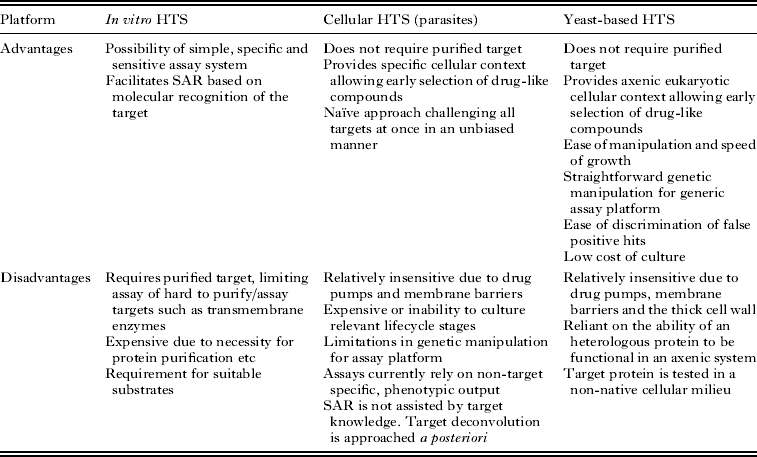
For automated HTS, in vitro biochemical assays must negate the need for substrate-product separation and produce a readily detectable and quantifiable signal (fluorescence, radiochemical etc). This requires purified, active and soluble protein. In contrast, cell-based platforms do not require purified target protein and can be engineered to produce a simple, measurable readout of cellular processes for HTS (Barberis et al. Reference Barberis, Gunde, Berset, Audetat and Luthi2005). Furthermore, in these formats the activity of any compound against a specific target is analysed in a cellular context that more closely resembles the in vivo scenario, for example the requirement of an inhibitor to cross the plasma membrane and reach an intracellular target. Finally, a well controlled cell-based HTS can identify those compounds that are generically cytotoxic or may exhibit problems with stability or solubility in vivo. As such, and compared with in vitro biochemical assay platforms, cell-based assays have the potential to identify compounds with drug-like properties which are ready for further development. See Table 1 for a summary of the advantages and disadvantages for each approach.
The advantages and disadvantages of the screening platforms employed for anti-parasitic drug discovery.

To replicate physiological conditions as accurately as possible cell-based assays should ideally be performed using the target cell of interest, for example protozoan pathogens for NTDs or mammalian cells for anti-cancer agents (Simon and Bedalov, Reference Simon and Bedalov2004). However, protozoan parasites can be both difficult and expensive to culture and genetically manipulate compared to model eukaryotes (Limenitakis and Soldati-Favre, Reference Limenitakis and Soldati-Favre2011). Mammalian cells can pose similar problems and, in addition, the redundancy of processes can confound the read-out of HTS for a specific inhibitor (Barberis et al. Reference Barberis, Gunde, Berset, Audetat and Luthi2005). Yeast, Schizosaccharomyces pombe and particularly Saccharomyces cerevisiae, have been established as simple, tractable, highly characterized model eukaryotes (Castrillo and Oliver, Reference Castrillo and Oliver2011). As well as being accessible through a highly developed genetic tool kit, yeast are also relatively fast growing in simple, low-cost (liquid or solid) media with a doubling time of approximately 90 minutes. These features make both of these model species ideal candidates to be employed in HTS for anti-fungals (Hughes, Reference Hughes2002). However, many functions of yeast, protozoan and human cells are conserved, allowing straightforward orthologous expression, complementation by replacement and functional analyses in a simplified system. In addition, processes not found in yeast can be constituted in a heterologous cell by taking advantage of these model systems’ wide variety of genetic tools (Munder and Hinnen, Reference Munder and Hinnen1999). Both of these approaches have been successfully utilized in drug discovery programmes and here we will examine the strengths and limitations of yeast as a screening tool, with particular emphasis on their use for NTD drug discovery (Table 1).
YEAST AS A SUBSTITUTION PLATFORM
Many yeast cell-based assay platforms rely on the substitution of an essential yeast gene with an orthologue from the system of interest (Fig. 1) to constitute a simple growth assay for inhibition. The generation of such hybrid yeast relies on the conservation of protein function between distantly related eukaryotes. This approach has been widely used in the study of parasite (Klein et al. Reference Klein, Favreau, Alexander-Bowman, Nulf, Vanover, Winterrowd, Yarlett, Martinez, Keithly, Zantello, Thomas and Geary1997; Sibley et al. Reference Sibley, Brophy, Cheesman, Hamilton, Hankins, Wooden and Kilbey1997; Bilsland et al. Reference Bilsland, Pir, Gutteridge, Johns, King and Oliver2011) and mammalian proteins (Munder and Hinnen, Reference Munder and Hinnen1999) through the constitution of phenotypic screening assays. One recent example involved the development of an HTS assay to identify inhibitors of the human acetyl-CoA carboxylase 2 (AAC2) with a view to discovering potential agents for the treatment of obesity (Marjanovic et al. Reference Marjanovic, Chalupska, Patenode, Coster, Arnold, Ye, Anesi, Lu, Okun, Tkachenko, Haselkorn and Gornicki2010). In this example, the S. cerevisiae AAC was replaced using homologous recombination by orthologous human AAC 1 and 2, as well as by the corresponding wheat and protozoan (Toxoplasma gondii) AACs. Selection of complemented yeast cells was facilitated by placing the inserted AAC under the control of a GAL10 promoter, thereby making the yeast galactose-dependent. Following validation using known AAC inhibitors these yeast strains, dependent on human AAC1 and 2, were screened with 34 000 compounds from three libraries in a 96-well plate format where growth was monitored by measuring turbidity at 580–620 nm. The hit rate of this primary screen varied from 0·02% to 3·5% depending on the library source. Some of these were non-selective for AAC2 whilst, importantly, others were shown to be generically toxic in a screen employing wild-type yeast. These counter-screens are vital to maximize target specificity. In addition, Marjanovic et al. employed a secondary enzymatic screen to further validate the specificity and selectivity of their hits and identify a small subset of AAC2 specific inhibitors that conform to Lipinski's rule of five criteria for drug-like characteristics (Lipinski et al. Reference Lipinski, Lombardo, Dominy and Feeney2001).
Substitution platform. In these cases the yeast open reading frame (black) is replaced with a foreign open reading frame (red) encoding an orthologous protein. This can be easily achieved by either direct substitution via homologous recombination incorporating a selectable marker/inducible promoter (A) or, for example, by plasmid shuffle in a knockout yeast line reliant on expression of an essential protein from a uracil selectable plasmid (B). In the presence of 5FOA the ura marker will be selected against allowing a plasmid encoding a functional orthologue of the essential protein to replace it. In both of these cases, for an HTS platform to be constructed, the yeast-encoded protein must be essential and a functional orthologue must be present in the system of interest. A counter-screen, for example against wild type yeast or, better, yeast complemented with the native protein, is essential to identify off target effects causing generic cytotoxicity.
This simple approach of screening for phenotypic changes in a complemented S. cerevisiae strain has also been used to identify a novel human K+ channel inhibitor (Zaks-Makhina et al. Reference Zaks-Makhina, Kim, Aizenman and Levitan2004). An HTS assay was designed where the K+-dependent growth phenotype of K+ channel mutants was rescued by mammalian Kir2.1 channel expression. In a 96-well plate format, using turbidity as a growth measure, Zaks-Makhina and colleagues screened a 10 000 compound library selecting those that inhibited Kir2.1-dependent yeast growth at low but not high K+. This assay allowed the identification of compounds showing non-specific toxicity, as evidenced by inhibition in the presence of both low and high K+. Through this process, 42 compounds with inhibition >50% and toxicity <20% were selected. As in the example above, a secondary screen was then undertaken to analyse specificity for Kir2.1 over other human and plant K+ channels. Inhibition of K+ channels by one of the selected compounds was demonstrated in mammalian cells and this inhibitor was also shown to confer neuroprotection in cultured neuronal cells. This combination of screens, from a large primary effort to a neuronal assay via biochemical and cellular assay, demonstrated the step-wise process that can be employed for lead identification. Starting from a large library, it is possible using a yeast-based approach to quickly identify robust, contextualized hits that can then be rapidly triaged using other, perhaps more labour-intensive, assays.
YEAST AS A LETHAL EXPRESSION PLATFORM
Not all mammalian and protozoan proteins and pathways have functional equivalents in yeast. However, in some cases heterologous expression of these completely foreign proteins in yeast induces measurable phenotypes which can be measured in HTS (Munder and Hinnen, Reference Munder and Hinnen1999; Simon and Bedalov, Reference Simon and Bedalov2004). For example, over-expression of influenza virus ion-channel forming protein M2 in S. cerevisiae results in growth impairment. Inhibition of M2 rescues this phenotype and this positive readout growth assay has been used in a 96-well plate based assay to identify a novel inhibitor from a library screen that demonstrated anti-viral activity in cell culture (Kurtz et al. Reference Kurtz, Luo, Hahnenberger, Brooks, Gecha, Ingalls, Numata and Krystal1995).
Similarly, using the fission yeast S. pombe, the pro-apoptotic HIV-1 protein Vpr has been formatted into 96- and 384-well yeast-based screens (Benko et al. Reference Benko, Elder, Liang and Zhao2010). As for the M2 assay, toxic expression was controlled via an inducible promoter and restoration of growth was measured using optical density in a very simple ‘mix-and-measure’ primary assay requiring no complicated preparation, centrifugation, filtration or extraction (Kurtz et al. Reference Kurtz, Luo, Hahnenberger, Brooks, Gecha, Ingalls, Numata and Krystal1995; Benko et al. Reference Benko, Elder, Liang and Zhao2010). Significantly, these yeast constructs were also suitable for the necessary secondary assays. Initially an agar plate-based, semi-quantitative colony-forming test showing dose-dependent effects, and subsequently a fluorescence-based LIVE/DEAD yeast viability assay was utilized as an indicator of the desired anti-apoptotic effect. Whilst agar plate-based systems do not easily lend themselves to high-volume applications, the fluorometric readout of the latter assay could potentially be formatted for HTS. By the cut-off criteria set by the research team, a screen of a small 2000 compound library gave a single hit from the primary screen. This drug, benfotiamine, showed a dose response effect and suppressed apoptosis in secondary assays, however further analyses are required to fully verify the mode of action (Benko et al. Reference Benko, Elder, Liang and Zhao2010).
The two examples above were studies focused on the discovery of anti-viral agents against influenza and HIV respectively. However, the majority of screening programmes employing yeast-based approaches have been directed at human cellular processes (Simon and Bedalov, Reference Simon and Bedalov2004; Barberis et al. Reference Barberis, Gunde, Berset, Audetat and Luthi2005). For example, phosphatidylinositol 3-kinase (PI3K) pathway mediates cell transduction via the generation of the second messenger phosphatidyl-3,4,5-trisphosphate and inappropriate activation of this pathway is associated with oncogenesis (Wu, Reference Wu2010). Over-expression of PI3K in S. cerevisiae is lethal and, as in the viral examples above, this phenotype was used in an agar plate-based rescue screen – this time against 9600 natural product extracts (Fernandez-Acero et al. Reference Fernandez-Acero, Rodriguez-Escudero, Vicente, Monteiro, Tormo, Cantizani, Molina and Cid2012). Amongst the barriers to the deployment of yeast in HTS is the presence of extremely effective drug efflux systems (Barberis et al. Reference Barberis, Gunde, Berset, Audetat and Luthi2005). Interestingly Fernandez-Acero and colleagues exploited the genetic tractability of yeast to improve the sensitivity of their platform. Deletion of the efflux pump Snq2 enhanced sensitivity 2-fold in the semi-quantitative assay developed, demonstrating the potential of engineering yeast to optimize their use in HTS. Furthermore, Fernandez-Acero et al. found that non-lethal disruption of the plasma membrane through the addition of small quantities (0·0003%) of sodium dodecyl sulphate to the media had a similar ‘sensitizing’ effect, although the general utility of such chemical approaches in HTS is unclear.
Clearly, the measurement of growth on agar plates (Fernandez-Acero et al. Reference Fernandez-Acero, Rodriguez-Escudero, Vicente, Monteiro, Tormo, Cantizani, Molina and Cid2012) can only be semi-quantitative and most studies measure turbidity of liquid culture in a microtitre plate via optical density. For example, rescue of toxic expression of human p38α, a kinase with major implications in oncogenesis and inflammatory disease (Muller and Knapp, Reference Muller and Knapp2010), in S. cerevisae was quantified in this way and used in a phenotypic rescue HTS to identify 2 compounds, from a library of 40 000, that restored growth. Both of these inhibited activity in in vitro and in mammalian cell secondary assays (Friedmann et al. Reference Friedmann, Shriki, Bennett, Golos, Diskin, Marbach, Bengal and Engelberg2006).
In a rather different approach, a heat-sensitive yeast mutant (fmc1Δ) has been used to screen 12 000 compounds for entities that reversed an inability to grow with glycerol as the sole carbon source. This relates to a defect in the ATP synthase assembly and as such serves as an effective model for certain mitochondrial diseases e.g. NARP (neuropathy, ataxia and retinitis pigmentosa) (Couplan et al. Reference Couplan, Aiyar, Kucharczyk, Kabala, Ezkurdia, Gagneur, St Onge, Salin, Soubigou, Le Cann, Steinmetz, di Rago and Blondel2011). In their assay platform Couplan and colleagues used filters spotted with each compound to identify those that induced an enhanced halo of growth when placed on solid glycerol medium spread with the yeast strain of interest. This approach was modelled on one developed for yeast-based screening for inhibitors of prion toxicity (Bach et al. Reference Bach, Talarek, Andrieu, Vierfond, Mettey, Galons, Dormont, Meijer, Cullin and Blondel2003, Reference Bach, Tribouillard, Talarek, Desban, Gug, Galons and Blondel2006). However, here the researchers utilized a yeast prion model which, due to a stop codon read through phenotype, are able to metabolize exogenous adenine. Inhibitors of the formation of the toxic prion protein (PrPSc, insoluble Sup35p in yeast) lead to the yeast being unable to metabolize adenine and the colonies on the solid media obtained a dark red colour distinguishable from the usual white appearance. Again, these approaches, monitoring growth on solid-media, appear unlikely to lend themselves to true (ultra) HTS for 100 s of thousands of compounds.
These data (Bach et al. Reference Bach, Talarek, Andrieu, Vierfond, Mettey, Galons, Dormont, Meijer, Cullin and Blondel2003, Reference Bach, Tribouillard, Talarek, Desban, Gug, Galons and Blondel2006; Couplan et al. Reference Couplan, Aiyar, Kucharczyk, Kabala, Ezkurdia, Gagneur, St Onge, Salin, Soubigou, Le Cann, Steinmetz, di Rago and Blondel2011) show that for some processes, the conservation between yeast and the target organism is close enough to allow direct, informative screening against the model system. In addition, it is important to recognize that in all these cases of phenotypic rescue the possibility of generically toxic false positives is removed greatly simplifying the generation and interpretation of data.
YEAST AS A TRANSACTIVATION PLATFORM
In all cases discussed so far the HTS read-out has relied on phenotypic changes, either positive or negative growth, directly resulting from inhibition of a specific function mediated by a specific protein. However, the genetic tractability of yeast allows cells to be engineered so that the HTS read-out is the result of transactivation of another process. A good, and extensive, example of this is provided by the work of the Hoffman laboratory (Boston College) towards the identification of inhibitors of mammalian phosphodiesterases (PDEs) (Demirbas et al. Reference Demirbas, Ceyhan, Wyman, Hoffman and Hoffmann2011). Tissue-specific PDEs (in mammals approximately 100 isoforms encoded by 21 genes) convert cAMP to 5′AMP and cGMP to 5′GMP, serving to regulate the levels of these cyclic secondary messengers which influence a wide variety of cellular processes in a tissue specific manner. Selective inhibition of PDE enzymes has therapeutic potential for a wide range of diseases (Bender and Beavo, Reference Bender and Beavo2006; Conti and Beavo, Reference Conti and Beavo2007). The basis of the assay designed by Hoffman and colleagues is fission yeast, S. pombe, which unlike S. cerevisiae can tolerate loss of function mutations of its adenylyl cyclase. These yeast-based assay lines were also engineered to express controllably the selectable marker ura4. In the absence of adenylyl cyclase and PDE (Csg2 in yeast) exogenous cAMP or cGMP activates Protein Kinase A (PKA) and ura4 expression is repressed. Under these conditions the yeast are able to grow in the presence of 5-fluoroorotic acid (5FOA), which is converted to toxic fluoroorotidine monophosphate in the presence of URA4 (Fig. 2). However, expression of either yeast PDE (Csg2) or heterologous (e.g. human) PDE leads to the conversion of cAMP to 5′AMP or cGMP to 5′GMP, expression from ura4 and 5FOA sensitivity (5FOAS) (Demirbas et al. Reference Demirbas, Ceyhan, Wyman, Hoffman and Hoffmann2011). This system provides an elegant positive selection platform for PDE inhibitors, with inhibition of the enzyme conferring 5FOA resistance (5FOAR) on the yeast (Fig. 2). This robust assay system, measuring growth by optical density in 384-well plates, has been utilized for HTS of compound libraries against several human PDEs. A small subset of compounds (3120, including known PDE inhibitors) were screened against human PDE2A, PDE4A and PDE4B and yeast Cgs2 (Ivey et al. Reference Ivey, Wang, Demirbas, Allain and Hoffman2008). In addition to the known inhibitor controls, several specific inhibitors were identified, with the assay having a hit rate of 0·8% to 3·2%. In a secondary screen, a subset of these compounds demonstrated the ability to raise the level of cellular cAMP, indicating PDE inhibition (Ivey et al. Reference Ivey, Wang, Demirbas, Allain and Hoffman2008). PDE7 has been similarly screened, this time with a library of nearly 50 000 compounds (Alaamery et al. Reference Alaamery, Wyman, Ivey, Allain, Demirbas, Wang, Ceyhan and Hoffman2010). This HTS identified two compound classes conferring the highest growth, i.e. PDE inhibition and rescue. A subset of these demonstrated PDE7 selectivity and activity in an in vitro secondary screen. Importantly, one of these potently suppressed TNFα release by LPS-stimulated model macrophage cells indicating a possible anti-inflammatory effect of PDE7 inhibition (Alaamery et al. Reference Alaamery, Wyman, Ivey, Allain, Demirbas, Wang, Ceyhan and Hoffman2010). More recently, a 200 000 member compound collection was screened against PDE11 expressing yeast (Ceyhan et al. Reference Ceyhan, Birsoy and Hoffman2012). Using data from previous screening campaigns to remove non-specific hits, 39 compounds were selected for secondary selectivity and dose-dependency assays; this identified four compounds as potent and highly selective. One of these compounds induced high cAMP levels in a mammalian cell-based assay and the same compound induced cortisol production (associated with PDE11 inactivation) in these cells (Ceyhan et al. Reference Ceyhan, Birsoy and Hoffman2012). Collectively these studies present the largest body of work in the literature describing the use of yeast for cell-based, target-directed HTS. Furthermore, other studies have employed a similar transactivation platform for HTS. Like Hoffman and colleagues, Grozinger et al. utilized 5FOAS/5FOAR selection in a screen for inhibitors of ura3 repression by the yeast transcriptional repressor Sir2p, a NAD-dependent deactylase. However, this study used a negative growth screen in which hits from a small 1600 compound collection were scored for their ability to confer 5FOAS, i.e. inhibit Sir2p, to S. cerevisiae (Grozinger et al. Reference Grozinger, Chao, Blackwell, Moazed and Schreiber2001). General cytotoxicity was established against yeast grown without FOA and three compounds were further assessed for their ability to selectively inhibit the activity of the human orthologue, SIRT2.
Transactivation platform. Expression of the fbp1-ura4 reporter in the yeast screening strain is repressed by Protein Kinase A, which is activated by the addition of cAMP (or cGMP) to the media. Hydrolysis of cAMP (or cGMP) by either yeast or human (or protozoan) PDE allows ura4 expression leading to a FOAS growth phenotype (upper frame). PDE inhibition causes cAMP (or cGMP) to accumulate repressing ura4 expression leading to a 5FOAR phenotype (lower frame). This positive growth readout negates the need for a yeast cytoxicity control as compounds inhibiting growth through off target effects will not be rescued by PDE inhibition.
A direct screen for inhibitors of mammalian protein function, using an alternative transactivation system, is illustrated by a HTS against human β-secretase expressed in S. cerevisiae (Middendorp et al. Reference Middendorp, Ortler, Neumann, Paganetti, Luthi and Barberis2004). This enzyme drives the production of the Aβ peptides thought to be associated with Alzheimer's disease and therefore inhibitors could have significant medicinal value. Screening was undertaken using a modified yeast strain in which invertase is engineered to only be active and released upon cleavage by human β-secretase (an enzyme not found in yeast). Without intervention the yeast cannot grow in histidine-depleted media with sucrose, as released invertase cleaves sucrose to form glucose which represses the expression of a HIS3 selectable marker. However, on β-secretase inhibition invertase is not released and the cells are rescued in this positive screen (Middendorp et al. Reference Middendorp, Ortler, Neumann, Paganetti, Luthi and Barberis2004). Similarly, again in brewers’ yeast, an orphan human G-protein-coupled receptor (GPCR) was coupled to histidine prototrophy. In this case, stimulation of the GPCR facilitated growth in the absence of histidine and a positive read-out assay was then formatted to identify peptide agonists (Klein et al. Reference Klein, Favreau, Alexander-Bowman, Nulf, Vanover, Winterrowd, Yarlett, Martinez, Keithly, Zantello, Thomas and Geary1997).
Two-hybrid screens also fall into this transactivator class of platform, and although they have not been extensively employed in HTS, they have been used to identify modulators of protein-protein interactions. The interaction of human calcium channel subunits α1B and β3 has been coupled to a marker conferring cycloheximide sensitivity (Young et al. Reference Young, Lin, Sun, Lee, Modi, Hellings, Husbands, Ozenberger and Franco1998). A screen of >150 000 compounds identified 10 compounds that rescued growth of the α1B and β3 strain, but not a control strain in the presence of cycloheximide. These were subsequently assessed for their ability to modulate calcium channels. Whilst in this screen of calcium channels Young et al. monitored growth on agar plates, all the other screens using transactivation systems discussed here employed turbidity measurements which is a more quantitative approach that allows the robustness of the assay to be assessed accurately as discussed below.
YEAST-BASED SCREENING FOR ANTI-PARASITICS
NTDs are caused by a diverse group of 17 infections, 11 of which are caused by protozoan or helminth parasites (WHO, 2012a). They are almost exclusively diseases of poverty, affecting a staggering 2·7 billion people who live on less than $2/day. NTDs are endemic in tropical and sub-tropical regions of the developing world, with Africa, Asia and Latin America carrying 90% of the disease burden. In the absence of vaccines many of these parasitic diseases lack adequate therapeutic regimes, with many of the few current drugs being not widely available, costly, and/or exhibiting unacceptable side effects (WHO, 2012a). Recently, public-private initiatives have lead to increased focus on NTDs and a renewed drive to discover new and better therapeutic agents (Allarakhia and Ajuwon, Reference Allarakhia and Ajuwon2012; WHO, 2012b). Both in vitro biochemical (Frearson et al. Reference Frearson, Brand, McElroy, Cleghorn, Smid, Stojanovski, Price, Guther, Torrie, Robinson, Hallyburton, Mpamhanga, Brannigan, Wilkinson, Hodgkinson, Hui, Qiu, Raimi, van Aalten, Brenk, Gilbert, Read, Fairlamb, Ferguson, Smith and Wyatt2010) and parasite cell-based (Siqueira-Neto et al. Reference Siqueira-Neto, Moon, Jang, Yang, Lee, Moon, Chatelain, Genovesio, Cechetto and Freitas-Junior2012) screening technologies have been deployed in this effort. However, both have limitations and cost implications as discussed above (Table 1). To overcome these and accelerate the process of NTD drug discovery the use of yeast as a screening vehicle may become more prevalent. Examples of all the strategies described above are possible although all the reported approaches, described below, rely on using yeast as a substitution platform.
In 1997, Klein et al. described an HTS assay utilizing a S. cerevisae ornithine decarboxylase (ODC) mutant complemented by expression of ODC from the nematode worm Haemonchus contortus, a major parasite of ruminants (Klein et al. Reference Klein, Favreau, Alexander-Bowman, Nulf, Vanover, Winterrowd, Yarlett, Martinez, Keithly, Zantello, Thomas and Geary1997). ODC is a key regulatory enzyme in the biosynthesis of polyamines (PA) in eukaryotes, which has been established as an anti-protozoal target with the inhibitor difluoromethylornithine (DFMO; eflornithine) a key treatment for Human African Trypanosomiasis (Heby et al. Reference Heby, Persson and Rentala2007). In contrast to the ODC mutant parent strain, an H. contortus ODC-complemented yeast line was able to grow in the absence of exogenous PA (Klein et al. Reference Klein, Favreau, Alexander-Bowman, Nulf, Vanover, Winterrowd, Yarlett, Martinez, Keithly, Zantello, Thomas and Geary1997). This complemented yeast cell line was utilized in a 96-well plate-based assay to screen 90 000 compounds for their ability to inhibit cell growth (quantified using Alamar Blue) in the absence of PA. The approximate 1% hits of this primary screen were subsequently retested against the same yeast line grown in the presence of PA, when ODC is redundant. This counter-screen identified those compounds that demonstrated general toxicity leaving a single, target-specific hit, stilbamidine isethionate. However, this compound showed no activity against the helminth ODC in vitro and was hypothesized to inhibit yeast S-adenosylmethionine decarboxylase (SAMdc), an enzyme required for spermidine and spermine synthesis (Klein et al. Reference Klein, Favreau, Alexander-Bowman, Nulf, Vanover, Winterrowd, Yarlett, Martinez, Keithly, Zantello, Thomas and Geary1997). This exemplifies, in this simple eukaryotic model, the issue of process redundancy discussed above in relation to more complex mammalian cell-based screening.
Until very recently this was the only published yeast-based HTS for anti-parasitics, although the potential of these platforms for this purpose has been recognized with respect to the protozoal acetyl-CoA carboxylase (Marjanovic et al. Reference Marjanovic, Chalupska, Patenode, Coster, Arnold, Ye, Anesi, Lu, Okun, Tkachenko, Haselkorn and Gornicki2010). However, drug sensitivity yeast mutants have been used to identify the primary targets and possible toxic effects of the anti-malarials quinine (Khozoie et al. Reference Khozoie, Pleass and Avery2009), St. John's Wort (McCue and Phang, Reference McCue and Phang2008) and artemisinin (Li et al. Reference Li, Mo, Shen, Sun, Wang, Lu, Gitschier and Zhou2005). In addition, the use of S. cerevisiae as a vehicle for anti-protozoal drug discovery has been explored with drug targets from the causative agent of malaria Plasmodium falciparum. P. falciparum dihydrofolate reductase (DHFR, essential for thymidine, histidine and methionine synthesis) and topoisomerase II (decatenation of DNA) have both been used to complement corresponding yeast mutants (Sibley et al. Reference Sibley, Brophy, Cheesman, Hamilton, Hankins, Wooden and Kilbey1997). This work was recently further developed by Bilsland et al. in an exploration of mutant S. cerevisiae complemented with DHFR from P. falciparum, Plasmodium vivax, Leishmania major (a causative agent of leishmaniasis), Trypanosoma brucei brucei (an animal pathogen serving as a model for Human African Trypanosomiasis), T. cruzi (Chagas Disease), Schistosoma mansoni (schistosomiasis) and Homo sapiens (Bilsland et al. Reference Bilsland, Pir, Gutteridge, Johns, King and Oliver2011). In an agar plate-based assay, the well characterized antimalarial pyrimethamine was able to inhibit the growth of yeast complemented with Plasmodium DHFR as expected. Notably, complementation with drug-resistant Plasmodium DHFR conferred pyrimethamine resistance thus confirming target specificity. All of the other complemented strains demonstrated lower sensitivity to the drug, although sensitivity became more evident on suppression of DHFR expression. Deletion of the major multidrug export pump encoded by PDR5 also increased the sensitivity of the T. brucei DHFR strain to pyrimethamine. This platform was further developed and utilized in HTS applications for specific inhibitors of parasite DHFR, N-myristoyltransferase (NMT) and phosphoglycerate kinase (PGK) (Bilsland et al. Reference Bilsland, Sparks, Williams, Moss, de Clare, Pir, Rowland, Aubrey, Pateman, Young, Carrington, King and Oliver2013). Here DHFR, NMT and PGK mutant S. cerevisiae were complemented by expression of the fluorescently-tagged parasite orthologues. By using fluorescent protein tags with non-overlapping spectra the assay was multiplexed, allowing for multiple readings to be taken from a single well. This platform was then used, utilizing an automated 384-well protocol, to screen the Maybridge Hitfinder Library (14 400 chemically diverse compounds) to identify parasite-specific hits (i.e. those not affecting yeast dependent on expression of the human orthologue). Of the 36 specific hits identified against the kinetoplastid protozoan enzymes (T. b. brucei, T. cruzi, L. major), 18 were cytotoxic for T. b. brucei in cell culture.
S. cerevisiae have also been employed in the study of the Leishmania inositol phosphorylceramide (IPC) synthase, a putative anti-protozoal drug target (Denny et al. Reference Denny, Shams-Eldin, Price, Smith and Schwarz2006; Mina et al. Reference Mina, Pan, Wansadhipathi, Bruce, Shams-Eldin, Schwarz, Steel and Denny2009). Exploiting public-private partnership we have developed and deployed a robust yeast-based, 1536-well formatted assay for ultra (u)HTS (Norcliffe et al. unpublished). The uHTS campaign involved the screening of the GSK compound collection, 1·8 million compounds, and is, to the best of our knowledge, the largest yeast-based screen reported to date. IPC synthase is a membrane-bound enzyme with six trans-membrane domains that drives the formation of IPC, a non-mammalian phosphosphingolipid and a major component of the parasite plasma membrane. Preliminary studies had led to the development of a 96-well plate-based enzyme assay system that was utilized to define the mode of action of the Leishmania IPC synthase (Mina et al. Reference Mina, Mosely, Ali, Shams-Eldin, Schwarz, Steel and Denny2010) and investigate its substrate binding requirements (Mina et al. Reference Mina, Mosely, Ali, Denny and Steel2011). However, the complexity of this microsomal assay, with a requirement to separate lipid substrate and product, precluded its employment as a true HTS platform. To facilitate a high volume approach a yeast-based assay was formatted in S. cerevisiae, utilizing the ability of the protozoan enzyme to complement for the absence of its functional orthologue AUR1p (Nagiec et al. Reference Nagiec, Nagiec, Baltisberger, Wells, Lester and Dickson1997), in which growth could be coupled with a fluorometric output enabling on- and off-target effects to be discriminated. The primary screen was successfully executed with, following initial dose response secondary assays, >500 potent and selective hits identified (0·03% hit rate). Secondary screening is currently underway and the full results of this yeast-based uHTS will be reported in due course.
These results demonstrated the ability to engineer yeast to optimize a robust assay platform and exemplify the utility of this model eukaryote as a vehicle for drug analyses and screening in NTDs, for example with respect to the kinetoplastid protozoa. Consequently, the potential for yeast-based screens to assist in the search for new solutions for NTDs is now well established. Whilst only the substitution approach, in which orthologous enzymes are explored, has been used to date it can only be expected that, with time, the other approaches will become viable. Whilst the development of lethal expression systems for NTD pathogen target screening probably requires further functional analyses of protein function in many of these organisms, the application of transactivation approaches looks much closer. For example, co-expression of human cytomegalovirus (HCMV) protease with an engineered Trp1p enzyme has been used to identify HCMV protease inhibitors that prevent cleavage of Trp1p to stimulate growth in media lacking trytophan (Cottier et al. Reference Cottier, Barberis and Luthi2006). However, these transactivation technologies could readily to applied to parasite systems provided the knowledge base is there to indicate target protein function, interactions etc. In this respect, building directly on the work of the Hofmann group described above, protozoan PDE orthologues are widely characterized and shown to be essential, putative drug targets in several pathogenic species (Seebeck et al. Reference Seebeck, Sterk and Ke2011). Consequently there is every prospect of formatting these into the various assay platforms discussed to facilitate the search for novel, selective inhibitors which will act as lead compounds for anti-parasitic drug discovery.
DISCUSSION AND CONCLUSIONS
As evidenced by the results summarized above, yeast-based screening methodologies offer considerable benefits for HTS (Table 1). Cell-based, yet target-directed assays can be readily developed and their eukaryotic nature confers a relevant cellular context not available in highly tractable bacterial systems. Where determined and stated the Z-factors of yeast cell-based, target-directed screens lie well above the generally accepted threshold (0·5) for an excellent, robust assay (Benko et al. Reference Benko, Elder, Liang and Zhao2010; Demirbas et al. Reference Demirbas, Ceyhan, Wyman, Hoffman and Hoffmann2011; Fernandez-Acero et al. Reference Fernandez-Acero, Rodriguez-Escudero, Vicente, Monteiro, Tormo, Cantizani, Molina and Cid2012). Most of these screens are relatively simple, using ‘mix and measure’ approaches with measurement achieved by monitoring yeast growth in liquid media via optical density. Higher content readouts are possible using colour or fluorometric responses and these will continue to add value in the future (Bilsland et al. Reference Bilsland, Sparks, Williams, Moss, de Clare, Pir, Rowland, Aubrey, Pateman, Young, Carrington, King and Oliver2013). Importantly, miniaturization is possible with a number of the assays being run in 384-well plate format (Benko et al. Reference Benko, Elder, Liang and Zhao2010; Demirbas et al. Reference Demirbas, Ceyhan, Wyman, Hoffman and Hoffmann2011; Bilsland et al. Reference Bilsland, Sparks, Williams, Moss, de Clare, Pir, Rowland, Aubrey, Pateman, Young, Carrington, King and Oliver2013); however, further miniaturization to a 1536-well format is desirable for uHTS. Therefore, as discussed, yeast can serve as a cheap, flexible and robust assay platform suitable for miniaturization to facilitate HTS and uHTS. Importantly, as outlined above, all yeast-based HTS must employ panels of counter-screens and secondary assays to rule out off-target effects. In particular, those platforms relying on growth inhibition read-outs are prone to identify off-target hits and the Molecular Mode of Action (MMoA) must be corroborated (Marjanovic et al. Reference Marjanovic, Chalupska, Patenode, Coster, Arnold, Ye, Anesi, Lu, Okun, Tkachenko, Haselkorn and Gornicki2010).
The ability to screen specifically for target inhibition in a well controlled cellular context, whilst reducing the challenge caused from confounding effects due to pathway redundancies, is further enhanced by the relatively rapid growth of yeast compared with higher eukaryotic cells. As described various assay platforms can be envisaged and the ability to screen ‘hard to purify’ or ‘hard to assay’ proteins (e.g. transmembrane enzymes involved in lipid biosynthesis) can be enhanced. However, as with all HTS assay platforms, yeast has limitations. Not least the ability to constitute or substitute heterologous protein function in another organism. In addition, the thick yeast cell wall may serve as a barrier to compounds in a screen and highly expressed efflux pumps may exclude these (Table 1). Whilst both of these can reduce the sensitivity of a given assay, it is evident that engineering the yeast to lack efflux pumps is a viable strategy to increase sensitivity (Bilsland et al. Reference Bilsland, Pir, Gutteridge, Johns, King and Oliver2011; Fernandez-Acero et al. Reference Fernandez-Acero, Rodriguez-Escudero, Vicente, Monteiro, Tormo, Cantizani, Molina and Cid2012).
In summary, it is clear that yeast can serve as a vehicle for HTS of human, viral and protozoan or helminth parasite proteins. In particular, yeast systems appear ideally suited for HTS and much needed drug discovery for the parasites that underlie many of NTDs. Given the robust and reproducible nature of these assay systems, and the facility to further engineer yeast strains to provide greater sensitivity, the use of such platforms is likely to become more commonplace.
AKNOWLEDGEMENTS
We would like to acknowledge the support of the Open Lab Foundation (PWD and PGS). These sponsors also provided financial support.
FINANCIAL SUPPORT
JLN is supported by a Durham Doctoral Fellowship.