




No CrossRef data available.
Article contents
Patterns of cercarial production from Diplostomum spathaceum: terminal investment or bet hedging?
Published online by Cambridge University Press: 10 June 2004
Abstract
In the production of the infective cercariae of trematodes, the terminal investment hypothesis of life-history theory predicts that the rate of host exploitation and cercarial production should increase during the period of cercarial shedding since the reproductive value of the parasite decreases during this period. In contrast, a bet hedging hypothesis that focuses on the success of transmission when host contact rate is variable predicts that cercarial production should decrease in an attempt to keep the host alive for longer and thus would increase the probability of successful transmission. We examined these two hypotheses under laboratory conditions and recorded the production of Diplostomum spathaceum cercariae from naturally infected snail hosts, Lymnaea stagnalis. The average number of cercariae produced per day decreased as the snail host approached death counter to the terminal investment hypothesis. The finding supports the prediction of the bet hedging hypothesis and implies that the pattern of cercarial production may be explained by reduced virulence of the parasite within the snails to ensure extended total production time of cercariae. Nevertheless, survival of infected snails was still lower than uninfected snails suggesting that ultimately the infection still increased snail mortality rate. Cercarial production varied between days but was not cyclic, probably because of the physiology of the sporocysts within snails. Fewer cercariae were released at night, which may increase transmission efficiency to diurnally-active fish hosts. The mechanisms associated with daily cercarial production are discussed.
Keywords
Information
- Type
- Research Article
- Information
- Copyright
- © 2004 Cambridge University Press
INTRODUCTION
Successful transmission between definitive hosts is a major determinant of parasite fitness (Anderson & May, 1991; Hudson et al. 2002) and since macroparasites tend not to reproduce within their definitive hosts like microparasites they have developed a range of adaptations to assist successful transmission (Combes, 2001). One of these has been the evolution of complex life-cycles where species like trematodes, infect a series of hosts, often with reproduction in more than one host (Parker et al. 2003). An important and distinctive feature in these trematode life-cycles is the production of free-living cercaria larvae within the intermediate mollusc host (Fried & Graczyk, 1997). The form and function of cercariae, as well as the numbers produced and the pattern of shedding may vary greatly between species depending on the detailed mechanisms in the transmission process and the life-history characteristics of the parasite (see reviews by Combes et al. 1994; Haas, 1994).
According to life-history theory, we can consider cercariae as reproductive units. As such, the reproductive value of a parasite is at a maximum just prior to the production of cercariae, and this value then falls with subsequent cercariae production (Williams, 1966; Stearns, 1992; Jokela et al. 1999). This hypothesis predicts that the parasite should increase host exploitation as cercarial production proceeds such that we should observe an increase in the rate of cercarial production during the course of the infection (Williams, 1966). The consequent decline in host condition increases the probability of the host dying from other causes, which should reinforce this such that the parasite uses all the remaining host resources and ultimately kills the host before its natural death (Williams, 1966; Jokela et al. 1999). In life-history theory, this is known as ‘classical reproductive effort’ or ‘terminal investment’ hypothesis (e.g. Clutton-Brock, 1984; Candolin, 2000; Ericsson et al. 2001; Weladji et al. 2002). In support of this hypothesis, decreased survival of molluscs has been associated with trematode parasitism and has been reported particularly when environmental conditions have been harsh (Meuleman, 1972; Becker, 1980; Lauckner, 1986; Jokela et al. 1999). An alternative hypothesis is that the parasites are not necessarily maximizing the number of infective stages but maximizing the probability of transmission. Since this depends on the unpredictable arrival of the next host species, we can predict from the ‘bet hedging’ hypothesis that cercarial production should fall with age of infection in an attempt to keep the host alive for longer (Fenton & Hudson, 2002).
In this study we tested between these two hypotheses by examining the patterns of cercarial shedding of Diplostomum spathaceum from the first intermediate snail host Lymnaea stagnalis. D. spathaceum is a typical trematode undergoing asexual reproduction within the snail host and producing large numbers of cercariae into the water column that subsequently infect the second intermediate host, fish (e.g. Chappell, Hardie & Secombes, 1994). L. stagnalis is a common freshwater species in Finland having a life-span of 1–2 years, usually with two distinct age cohorts (Väyrynen et al. 2000). We followed the cercarial production from naturally infected snails, belonging to the same age cohort, under constant laboratory conditions until the death of the hosts. We also examined how cercarial production fluctuated between and within days.
MATERIALS AND METHODS
Lymnaea stagnalis snails were collected from earth ponds at a commercial fish farm in Central Finland in late May 1999 and again in late July 1999. Snails were brought to the laboratory and individuals producing D. spathaceum cercariae were separated from uninfected snails. Cercarial production was followed from 21 infected individuals of the same size cohort collected in late July 1999. Each snail was placed into a container with 1·7 litres of filtered ground water at room temperature under natural light regime and fed lettuce ad libitum. Every day, each snail was transferred to a new container with clean ground water and the number of cercariae produced in the previous 24 h was estimated from a 4 ml subsample. We tested the reliability of the sampling procedure by comparing the between-day variation in cercarial numbers of the 21 snails with between-sample variation in separate data in which three 4 ml samples were taken daily from 14 snails for 10–14 days. The experiment was run until all snails had died, which turned out to be 67 days.
Patterns of cercarial production were analysed from individual snails using serial autocorrelation analysis by first removing trend from the data using 2nd order polynomial functions and then examining the residuals. Autocorrelation values were calculated for up to a lag of 5 days using SPSS statistical package.
The survival of the 21 infected snails was compared with 104 uninfected individuals of the same size cohort. The uninfected snails were kept in similar laboratory conditions and fed lettuce ad libitum. Survival rate of the snails was calculated for 10-day periods [7 periods for infected snails, 28 periods for uninfected snails (see Results section)] as si=(ni−di)/ni, where ni is the number of snails alive in the beginning of a period and di is the number dying during the period (see Kenward, 1987). The average survival rate of the uninfected and infected snails was then compared using the Student's t-test.
Diurnal rhythm in cercarial shedding was followed in mid-July from 17 infected snails, collected from the fish farm in late May 1999. Snails were kept under standard laboratory conditions at room temperature under natural light regime for 24 days prior to the surveillance and were fed lettuce ad libitum. Each snail was placed in 2 dl of filtered ground water and the number of cercariae produced counted from a 4 ml subsample every 2 h for 24 h as described previously. The experiment was repeated in mid-August using 6 infected snails, collected in late July 1999, and kept under identical laboratory conditions under natural light regime for 14 days prior to the experiment. Each snail was maintained in 6 dl of ground water and the number of cercariae produced recorded by taking one 10 ml sample from each snail every hour for 24 h as described previously.
RESULTS
The average coefficient of variation (CV) within the sets of 3 samples (n=168) was 13·1% of the average between-day CV of the 21 snails and was significantly lower compared to between-day CV (t-test: t187=12·61, P<0·001). This indicated that 1 sample was sufficient to capture the pattern of cercarial production in this experiment. The average daily production of cercariae from individual snails varied between 7279±583 and 37418±6035 (mean±S.E.). The mean number of cercariae produced from the snails, and the corresponding variation between individuals, decreased as the snails approached death, although there was an increase in the variance during the last few days (Fig. 1).

Fig. 1. The mean number of Diplostomum spathaceum cercariae produced (A) and the corresponding coefficient of variation (B) from 21 naturally infected Lymnaea stagnalis snails collected in late July 1999 as a function of days before the death of the host. The fitted lines are: (A) y=axb, where a=5305·9 and b=0·3946; (B) y=a1x2+a2x+b, where a1=6·7468, a2=−394·09 and b=10990.
Four snails were excluded from the autocorrelation analysis because of short production period leaving 17 individuals for the analysis. Nine of the 17 snails (52·9%) showed significant autocorrelations in cercarial production. However, only 3 of these snails produced significant negative autocorrelations indicating a tendency for the cercarial production to oscillate. Moreover, there was no apparent lag that was significant so there was no clear evidence of oscillations in the production of cercariae (Table 1).
Table 1. Result of the autocorrelation analysis on the Diplostomum spathaceum cercariae production data from 17 naturally infected Lymnaea stagnalis snails kept in laboratory conditions (Maximum lag of 5 days was used in the analysis. N.S., statistically non-significant.)

The last infected snail died on day 67 of the experiment (Fig. 2). Uninfected snails also suffered from high mortality in the beginning of the study but snail mortality decreased, and the last uninfected individual died on day 279 (Fig. 2). The average survival rate of the infected snails was significantly lower compared to uninfected individuals (t-test; t33=−2·501, P<0·05).

Fig. 2. The survival time of Lymnaea stagnalis snails infected with Diplostomum spathaceum (n=21) compared to uninfected individuals (n=104) kept under standardized laboratory conditions.
Cercarial shedding changed significantly within the 24-h period in both sets of snails monitored (repeated measures ANOVA: F11=10·12, P<0·001; F24=4·67, P<0·001, for the snails collected in May and July, respectively; Fig. 3). Further analysis indicated that cercarial release per hour was significantly lower during night in the snails collected in May (paired samples t-test between day and night: t16=4·76, P<0·001; Fig. 3). A similar trend was also observed in the snails collected in July but this was not significant at the 5% level (paired samples t-test: t5=2·23, P=0·076; Fig. 3) essentially because the numbers released increased during the last hours of darkness.

Fig. 3. The number of cercariae released per hour (mean±S.E.) from Diplostomum spathaceum infected snails (A) in mid-July 1999 (n=17) and (B) in mid-August 1999 (n=6) during a 24-h period. The dashed lines indicate dark period of the day, 22-04 and 21-05 in July and in August, respectively. Note that in (B) one value is given for the cercarial release per hour between 22 and 02.
DISCUSSION
General life-history theory suggests that cercariae are equal to reproductive units of the parasite and therefore, if there was a selective advantage to maximize production of infective stages, the parasite should increase the exploitation of the host as the parasite reproductive value decreases (Williams, 1966; Stearns, 1992; Jokela et al. 1999). Alternatively, if the parasite was maximizing the period of release to maximize the opportunity of transmission to the next stage, then it should reduce the production of transmission stages with the period of infection (Fenton & Hudson, 2002). In this study we observed that the mean number of cercariae produced from the snails decreased as the death of the host was approached. This was counter to the terminal investment hypothesis but was in line with the bet hedging hypothesis. Nevertheless, we should consider that the parasite could increase the relative exploitation rate of the host without an increase in cercarial production if the absolute amount of resources available for the parasite had declined. For example, although we supplied food for snails in excess, a host in poor condition and close to death may show reduced activity (Boissier, Rivera & Moné, 2003) and may therefore have difficulties in locating or assimilating otherwise abundant food. This would also decrease the amount of resources available for the parasite. The amount of available energy may also decrease the variation in the numbers of cercariae produced from individual snails as all snails showed low average production with low variance between individuals when death was approached. However, the variance seemed to increase during the final days probably because of few random peaks contrasting the low average production level.
Although cercarial production decreased as the snail hosts approached death, the parasites still increased snail mortality rate. The effect of trematode parasites on the survival of mollusc hosts is well documented (e.g. Meuleman, 1972; Becker, 1980; Jokela et al. 1999), but the effects of D. spathaceum on the snail host have received relatively little attention (see Chappell et al. 1994). The degree of host exploitation by trematodes may depend on the type of transmission, as species shedding cercariae are more harmful to the hosts compared to species encysting within the host (Jokela et al. 1999). While our results indicate that D. spathaceum may impose a serious reduction in host survival, the laboratory conditions may have also induced additional stress that interacted with the infection status and increased mortality rate (e.g. Jokela et al. 1999). Ideally these laboratory data should be supported by long-term field experiments (see Goater et al. 1989).
We observed that cercarial production had no predictable pattern between days. This is not surprising since to ensure successful transmission, the production would have to coincide to some extent with the presence of the desired host (Fenton & Hudson, 2002). However, changes in fish host abundance would more likely to be found within days than between days (see below). The variation in the production between days may be associated with the physiology of cercarial production and the pattern of release from the sporocysts (Fried, 1997). When the parasite sporocysts have completely monopolised the snail, which is the case with old, fully developed infections studied here, the growth of the sporocysts may be restricted by the lack of space. Developing spatial pressure would cause the sporocysts eventually to erupt releasing high amounts of cercariae, which may be followed by a growth phase during which the production remains on a lower level. The growth rate of the sporocysts may again be related to factors such as the nutritional status of the host (see above).
We also observed that the cercarial release of D. spathaceum decreased during the night. Parasites may use a range of strategies to maximize transmission efficiency in an environment where the presence of the desired host is uncertain or temporally aggregated and in such a way ‘hedge their bets’ (Fenton & Hudson, 2002). The age-dependent nature of both survival and infectivity of D. spathaceum cercariae implies that there is little bet hedging associated with cercariae quality (Karvonen et al. 2003). Alternatively, the observed higher release of cercariae during daytime, when most of the fish hosts are active (Helfman, 1986; Wootton, 1990; Wieser, 1991) and more likely to be exposed to cercariae, may in fact increase the parasite transmission efficiency. Several studies have reported diurnal patterns in schistosomes where the production of cercariae is consistently rhythmic, and is synchronized with the presence of the desired host (Théron, 1984; review in Combes et al. 1994). Lower production during the night when probability of contact with fish host is low may also save resources otherwise taken from the host and prolong the total time of cercarial production as the survival of the host snail is increased. This may also be seen as a bet hedging strategy of the parasite if transmission to the next hosts is enhanced through extended time of cercarial production (see McCarthy, Fitzpatrick & Irwin, 2002). However, Shostak & Esch (1990) discussed the possible evolutionary role of diurnal shedding patterns and suggested that caution should be paid in interpreting the results as several trematodes show diurnal cycles connected mainly with light-dark rhythm (e.g. Rees, 1948; Asch, 1972; Lewis, Welsford & Uglem, 1989) possibly without any adaptive significance. Such rhythmic production may be induced for example by differences in the activity of the host snail if cercariae could response to host movements. Therefore, we need more detailed investigations to determine precisely the strategy employed by D. spathaceum.
In conclusion we found that cercarial production of D. spathaceum from the snail hosts decreased as hosts approached death, which is not consistent with the terminal investment hypothesis. It does conform to the bet hedging hypothesis of maximizing the period of transmission and maximizing the likelihood of contacting the next host. Furthermore, individual snails exhibited no pattern in the production of cercariae between days, which suggests that peaks of different magnitude are produced in relatively random manner, and probably arise through the intimate interactions between the parasite and the snail. Random production by individual snails may result as constant total output of cercariae from the snail population and ensure steady average infection rate to the fish second intermediate host. This, along with the long life-expectancy of metacercariae in the fish host (Chappell et al. 1994), may lead to high infection prevalence and accumulation of the parasites with host age, which is frequently observed in natural fish populations (e.g. Pennycuick, 1971; Wootten, 1974; Burrough, 1978; Valtonen & Gibson, 1997).
We thank persons assisting in the laboratory, and Jukka Jokela, Otto Seppälä, Harri Högmander and two anonymous referees for valuable comments on the manuscript. The study was financed by the Biological Interactions Graduate School, the Finnish Cultural Foundation and the SUNARE Project of The Academy of Finland.
References
REFERENCES
ANDERSON, R. M. &
MAY, R. M.
(
1991).
Infectious Diseases of Humans: Dynamics and Control.
Oxford University Press,
Oxford.
ASCH, H. L.
(
1972).
Rhythmic emergence of Schistosoma mansoni cercariae from Biomphalaria glabrata: control by illumination.
Experimental Parasitology
31, 350–355.CrossRefGoogle Scholar
BECKER, W.
(
1980).
Metabolic interrelations of parasitic trematodes and molluscs: especially Schistosoma mansoni in Biompholaria glabrata.
Zeitschrift für Parasitenkunde
63, 101–111.CrossRefGoogle Scholar
BOISSIER, J.,
RIVERA, E. R. &
MONÉ, H.
(
2003).
Altered behavior of the snail Biomphalaria glabrata as a result of infection with Schistosoma mansoni.
Journal of Parasitology
89, 429–433.CrossRefGoogle Scholar
BURROUGH, R. J.
(
1978).
The population biology of two species of eyefluke, Diplostomum spathaceum and Tylodelphys clavata, in roach and rudd.
Journal of Fish Biology
13, 19–32.CrossRefGoogle Scholar
CANDOLIN, U.
(
2000).
Increased signalling effort when survival prospects decrease: male–male competition ensures honesty.
Animal Behaviour
60, 417–422.CrossRefGoogle Scholar
CHAPPELL, L. H.,
HARDIE, L. J. &
SECOMBES, C. J.
(
1994).
Diplostomiasis: the disease and host–parasite interactions. In
Parasitic Diseases of Fish
(
ed. Pike, A. W. &
Lewis, J. W.
), pp. 59–86.
Samara Publishing Limited,
Dyfed.
CLUTTON-BROCK, T. H.
(
1984).
Reproductive effort and terminal investment in iteroparous animals.
American Naturalist
123, 212–229.CrossRefGoogle Scholar
COMBES, C.
(
2001).
Parasitism. The Ecology and Evolution of Intimate Interactions. Chicago University Press, Chicago.
COMBES, C.,
FOURNIER, A.,
MONÉ, H. &
THÉRON, A.
(
1994).
Behaviours in trematode cercariae that enhance parasite transmission: patterns and processes.
Parasitology
109 (Suppl.), S3–S13.CrossRefGoogle Scholar
ERICSSON, G.,
WALLIN, K.,
BALL, J. P. &
BROBERG, M.
(
2001).
Age-related reproductive effort and senescence in free-ranging moose, Alces alces.
Ecology
82, 1613–1620.CrossRefGoogle Scholar
FENTON, A. &
HUDSON, P. J.
(
2002).
Optimal infection strategies: should macroparasites hedge their bets?
Oikos
96, 92–101.Google Scholar
FRIED, B.
(
1997).
An overview of the biology of trematodes. In
Advances in Trematode Biology
(
ed. Fried, B. &
Graczyk, T. K.
), pp. 1–10.
CRC Press LLC, USA.
FRIED, B. &
GRACZYK, T. K.
(
1997).
Advances in Trematode Biology.
CRC Press LLC, USA.
GOATER, T. M.,
SHOSTAK, A. W.,
WILLIAMS, J. A. &
ESCH, G. W.
(
1989).
A mark-recapture study of the trematoda parasitism in overwintered Helisoma anceps (Pulmonata), with reference to Halipes occidualis (Hemiuridae).
Journal of Parasitology
75, 553–560.CrossRefGoogle Scholar
HAAS, W.
(
1994).
Physiological analyses of host-finding behaviour in trematode cercariae: adaptations for transmission success.
Parasitology
109 (Suppl.), S15–S29.CrossRefGoogle Scholar
HELFMAN, G. S.
(
1986).
Fish behaviour by day, night and twilight. In
The Behaviour of Teleost Fishes
(
ed. Pitcher, T. J.
), pp. 366–387.
Croom Helm,
London.CrossRef
HUDSON, P. J.,
RIZZOLI, A.,
GRENFELL, B. T.,
HEESTERBEEK, H. &
DOBSON, A. P.
(
2002).
The Ecology of Wildlife Diseases.
Oxford University Press,
Oxford.
JOKELA, J.,
LIVELY, C. M.,
TASKINEN, J. &
PETERS, A. D.
(
1999).
Effect of starvation on parasite-induced mortality in a freshwater snail (Potamopyrgus antipodarum).
Oecologia
119, 320–325.CrossRefGoogle Scholar
KARVONEN, A.,
PAUKKU, S.,
VALTONEN, E. T. &
HUDSON, P. J.
(
2003).
Transmission, infectivity and survival of Diplostomum spathaceum cercariae.
Parasitology
127, 217–224.CrossRefGoogle Scholar
KENWARD, R.
(
1987).
Wildlife Radio Tagging. Equipment, Field Techniques and Data Analysis. Academic Press, London.
LAUCKNER, G.
(
1986).
Ecological effects of larval trematode infestation on littoral marine invertebrate populations. In Parasitology – Quo Vadit?
(
ed. Howell, M. J.
), pp. 391–397.
Proceedings of The 6th International Congress of Parasitology,
Brisbane.
LEWIS, M. C.,
WELSFORD, I. G. &
UGLEM, G. L.
(
1989).
Cercarial emergence of Proterometra macrostoma and P. edneyi (Digenea: Azygiidae): contrasting response to light:dark cycling.
Parasitology
99, 215–223.Google Scholar
McCARTHY, H. O.,
FITZPATRICK, S. &
IRWIN, S. W. B.
(
2002).
Life history and life cycles: production and behaviour of trematode cercariae in relation to host exploitation and next-host characteristics.
Journal of Parasitology
88, 910–918.CrossRefGoogle Scholar
MEULEMAN, E. A.
(
1972).
Host–parasite interrelationships between the freshwater pulmonate Biomphalaria pfeifferi and the trematode Schistosoma mansoni.
Netherlands Journal of Zoology
22, 355–427.Google Scholar
PARKER, G. A.,
CHUBB, J. C.,
BALL, M. A. &
ROBERTS, G. N.
(
2003).
Evolution of complex life cycles in helminth parasites.
Nature, London
425, 480–484.CrossRefGoogle Scholar
PENNYCUICK, L.
(
1971).
Differences in the parasite infections in three-spined sticklebacks (Gasterosteus aculeatus L.) of different sex, age and size.
Parasitology
63, 407–418.Google Scholar
REES, G.
(
1948).
A study of the effect of light, temperature and salinity on the emergence of Cercaria purpurae Lebour from Nucella lapillus (L.).
Parasitology
38, 228–242.CrossRefGoogle Scholar
SHOSTAK, A. W. &
ESCH, G. W.
(
1990).
Photocycle-dependent emergence by cercariae of Halipegus occidualis from Helisoma anceps, with special reference to cercarial emergence patterns as adaptations for transmission.
Journal of Parasitology
76, 790–795.CrossRefGoogle Scholar
STEARNS, S. C.
(
1992).
The Evolution of Life Histories.
Oxford University Press,
Oxford.
THÉRON, A.
(
1984).
Early and late shedding patterns of Schistosoma mansoni cercariae: ecological significance in transmission to human and murine hosts.
Journal of Parasitology
70, 652–655.CrossRefGoogle Scholar
VALTONEN, E. T. &
GIBSON, D. I.
(
1997).
Aspects of the biology of diplostomid metacercarial (Digenea) populations occurring in fishes in different localities in northern Finland.
Annales Zoologici Fennici
34, 47–59.Google Scholar
VÄYRYNEN, T.,
SIDDALL, R.,
VALTONEN, E. T. &
TASKINEN, J.
(
2000).
Patterns of trematode parasitism in lymnaeid snails from northern and central Finland.
Annales Zoologici Fennici
37, 189–199.Google Scholar
WELADJI, R. B.,
MYSTERUD, A.,
HOLLAND, Ø. &
LENVIK, D.
(
2002).
Age-related reproductive effort in reindeer (Rangifer tarandus): evidence of senescence.
Oecologia
131, 79–82.CrossRefGoogle Scholar
WIESER, W.
(
1991).
Physiological energetics and ecophysiology. In
Cyprinid Fishes. Systematics, Biology and Exploitation
(
ed. Winfield, I. J. &
Nelson, J. S.
), pp. 426–455.
Chapman and Hall,
London.CrossRef
WILLIAMS, G. C.
(
1966).
Natural selection, the costs of reproduction, and a refinement of Lack's principle.
American Naturalist
100, 687–690.CrossRefGoogle Scholar
WOOTTEN, R.
(
1974).
Observations on strigeid metacercariae in the eyes of fish from Hanningfield Reservoir, Essex, England.
Journal of Helminthology
48, 73–83.CrossRefGoogle Scholar
WOOTTON, R. J.
(
1990).
The Ecology of Teleost Fishes.
Chapman and Hall,
London.

Fig. 1. The mean number of Diplostomum spathaceum cercariae produced (A) and the corresponding coefficient of variation (B) from 21 naturally infected Lymnaea stagnalis snails collected in late July 1999 as a function of days before the death of the host. The fitted lines are: (A) y=axb, where a=5305·9 and b=0·3946; (B) y=a1x2+a2x+b, where a1=6·7468, a2=−394·09 and b=10990.

Table 1. Result of the autocorrelation analysis on the Diplostomum spathaceum cercariae production data from 17 naturally infected Lymnaea stagnalis snails kept in laboratory conditions
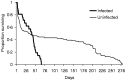
Fig. 2. The survival time of Lymnaea stagnalis snails infected with Diplostomum spathaceum (n=21) compared to uninfected individuals (n=104) kept under standardized laboratory conditions.
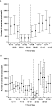
Fig. 3. The number of cercariae released per hour (mean±S.E.) from Diplostomum spathaceum infected snails (A) in mid-July 1999 (n=17) and (B) in mid-August 1999 (n=6) during a 24-h period. The dashed lines indicate dark period of the day, 22-04 and 21-05 in July and in August, respectively. Note that in (B) one value is given for the cercarial release per hour between 22 and 02.
 You have
Access
- 61
- Cited by