I. INTRODUCTION
The U.S. Department of Energy (DOE) Transportation Energy Data Book: Edition 24 shows that in 2002 ∼130 billion gallons of gasoline was used nationwide by light-duty passenger cars, minivans, and sport utility vehicle segment. Some estimates indicate that ∼4-5 Quads (1 Quad = 1015 Btu) of the energy in this fuel ended up as waste thermal energy in vehicle exhaust streams. The same reference indicates another ∼30 billion gallons of diesel fuel was used nationwide by heavy-duty vehicles in 2002, of which ∼1.4 Quads of the energy in this fuel ended up as waste thermal energy in heavy-vehicle exhaust streams. In 2008, ∼4.7 Quads (∼20%) of transportation sector fuel energy was used to operate heavy-duty, Class 8 vehicles; with ∼1.6 Quads of this energy ending up in heavy vehicle high-temperature exhaust flows. The DOE Office of Vehicle Technologies is sponsoring research to develop advanced, high-temperature n-type and p-type skutterudite thermoelectric (TE) materials to harness this exhaust flow energy enabling higher energy efficiency in heavy-duty and light-duty vehicle engines. The work leverages recent advanced TE materials research in skutterudites, quantum well, and nanostructured materials to recover and convert this waste thermal energy into high-grade electrical energy onboard the vehicle. Advanced TE materials are critical to achieving project performance goals and introducing other potential future applications of TE power generation and advanced cooling in vehicle systems. The temperature range of interest in automotive waste heat recovery applications is typically 350–820 K. The efficiency of a TE material is determined by its dimensionless figure of merit ZT, which depends on the electronic and thermal properties of the compound as defined by the following equation.
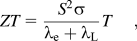
where S is the Seebeck coefficient, σ is the electrical conductivity, λe is the electronic thermal conductivity, λL is the lattice thermal conductivity, and T is the absolute temperature. Researchers have reported advanced TE materials demonstrating ZT values of 1.6–2.4, with at least some of this data occurring at temperatures of 673–973 K.Reference Androulakis, Hsu, Pcionek, Kong, Uher, D’Angelo, Downey, Hogan and Kanatzidis1–Reference Venkatasubramanian, Siivola, Colpitts and O’Quinn15 It is possible to expect advanced TE power conversion efficiencies of 12–15% with TE materials having this ZT at these high temperatures, which are two to three times the values using conventional TE materials (i.e., lead telluride and silicon germanium).
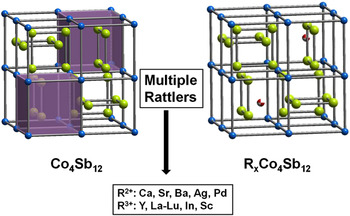
Skutterudites belong to the Im-3 space group having a cubic crystal structure as shown in Fig. 1. The structure consists of two voids, which are large enough to accommodate various elements of comparable radii with the voids. Elements that can be inserted in the voids are given in the list provided in Fig. 1. Any inserted element has a particular resonance frequency associated with it that can be excited by thermal phonons of the proper wave length traveling through the crystal. The complete wave length spectrum of thermal phonons is responsible for producing the observed lattice thermal conductivity in any material. The elements inserted into the crystal voids interact with and resonate with particular wavelengths of the spectrum, thereby causing them to resonate or “rattle” at that particular wave length and, ultimately, scatter the thermal phonon rather than allowing it to transmit through the crystal. This effect is responsible for the dramatic reduction of thermal conductivity of the filled skutterudites when compared to the unfilled one. The more elements that can be put inside the crystal voids, the more wavelengths or range of wavelengths can be impacted and scattered, further reducing the lattice thermal conductivity. This ultimately increases the ZT [Eq. (1)] of skutterudite materials, which already have predominantly high power factors. In 2006, He et al.Reference He, Chen, Rosenfeld and Subramanian16 reported TE properties of InxCo4Sb12 with ZT values >1 at 600 K. Subsequently Subramanian et al.Reference Subramanian, He and Krajewski17 discovered even higher ZTs (>1.2 at 600 K) in double-filled skutterudite compositions containing In and a rare earth including Ce. Recent work by Li et al.Reference Li, Tang, Zhang and Uher18 has shown ZT values of 1.43 at 800 K for In0.2Ce0.15Co4Sb12 fabricated using melt-quench-anneal-spark plasma sintering methods; however, no structural properties were presented in that work. This research was focused on investigating and developing n-type filled skutterudites, the fillers being mainly In and rare earth atoms like Ce and Yb. The compositions studied in this work were In0.2Co4Sb12, In0.15Ce0.1Co4Sb12, In0.2Ce0.15Co4Sb12, In0.2Ce0.17Co4Sb12, In0.2Ce0.1Yb0.05Co4Sb12, and In0.2Ce0.05Yb0.1Co4Sb12.
Skutterudite crystal structure and potential rattler elements for thermal conductivity suppression.

It is recognized that TE properties (Seebeck coefficient, electrical resistivity, and thermal conductivity) and structural properties [Young’s modulus, Poisson’s ratio, coefficient of thermal expansion (CTE)] are critical to transitioning these promising materials into operating devices. Consequently, this work simultaneously characterized both the TE and structural properties for these new (In,Ce)-based skutterudite materials. In addition to the new structural property data on these materials, this work also has characterized the thermal cycling behavior of these new materials in the temperature range from 323–673 K for the first time. This article presents and discusses the temperature-dependent TE and structural properties showing comparisons with other TE materials being considered for transportation energy recovery applications. In addition to their very good TE properties, these bulk materials exhibit good structural properties and stable thermal cycling characteristics, which will allow effective transition into operating TE devices.
II. EXPERIMENTAL
The research initially focused on n-type In0.2Co4Sb12, In0.15Ce0.1Co4Sb12, In0.2Ce0.17Co4Sb12, and In0.2Ce0.15Co4Sb12 materials and then progressed to In0.2Ce0.1Yb0.05Co4Sb12 and In0.2Ce0.05Yb0.1Co4Sb12. All of these (In,Ce)-based skutterudites are bulk materials, making them much easier to integrate into TE devices and, therefore, easier to commercialize in operating TE devices and systems. All the compositions are synthesized by the conventional solid-state reaction method. In, Co, and Sb were mixed together in stoichiometric ratio in a mortar and ground in air. The In-Co-Sb mixture was reacted in a 5% H2/N2 gas environment. The sample was heated slowly and calcined in a furnace at temperatures up to 675 °C for ∼40 h. Thus formed In-Co-Sb sample was combined with Ce/Yb that was weighed, mixed, and ground to form the proper compound stoichiometry in an Ar-filled glove box. The In-Ce-Co-Sb sample was reacted in a hydrogen 5% H2/N2 environment at up to 675 °C for 24 h using predetermined heating and cooling ramp rates. The resulting sample was ground again, ball milled, and sintered in a furnace at 675 °C. The phase formation was followed at each step by powder x-ray diffraction (XRD) taken on Rigaku Miniflex-II (The Woodlands, TX) by using CuKα radiation with graphite monochromator. The Seebeck coefficient and electrical resistivity measurements were carried out on ZEM-3 (The Woodlands, TX) (within an error limit of 5%) and the thermal diffusivity measurements (within an error limit of 10%) were carried out on Netzsch micro flash instrument (Burlington, MA). Specific heat measurements were performed using a Perkin Elmer Pyris 1 differential scanning calorimeter (Waltham, MA).
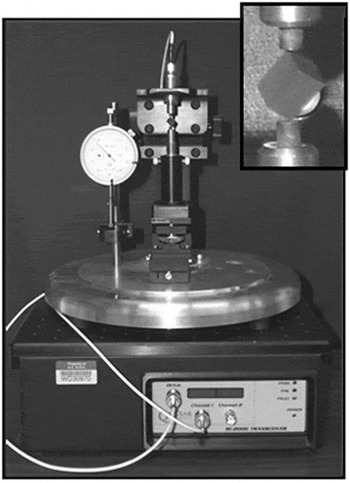
Structural properties (Young’s modulus, E; shear modulus, G; and Poisson’s ratio, ν) of the these TE material compositions also were measured using resonant ultrasound spectroscopy (RUS) techniques described by Migliori and SarraoReference Migliori and Sarrao19 and the typical equipment is shown in Fig. 2. The skutterudite compounds investigated in this work are isotropic materials because of their basic cubic structure and therefore the structural properties, E, G, and ν are related by the well-known relationship:
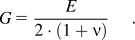
Resonant ultrasound spectroscopy equipment for structural property measurement used at Pacific Northwest National Laboratory. The typical sample mount between measurement transducers is shown.

The RUS technique described by Migliori and SarraoReference Migliori and Sarrao19 inputs a vibrational signal to a rectangular parallelepiped sample as shown in Fig. 2 (See typical sample set up in picture insert) and evaluates the output frequency spectrum from the sample to determine elastic coefficients, C11 and C44, through inverse analysis techniques. These elastic coefficients are then used to determine G, E, and ν using:

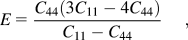
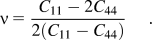
This work then used Eqs. (3)–(5) to determine the values that are presented and discussed in Table II. The uncertainties in the elastic modulus, Poisson’s ratio, and density in Table II were determined to be 4%, 6.5%, and 5% respectively.
The CTE was also determined in this work using a Perkin Elmer Dynamic Mechanical Analyzer Model 7e (Waltham, MA) run with a quartz probe in a quartz sample tube. The CTE was measured by determining the expansion of a rectangular parallelepiped sample of known dimensions from 298–673 K. The expansion versus temperature of these TE samples was basically linear throughout this temperature range, therefore the slope being the measure of CTE was constant over this temperature range. The values reported in Table II are consequently the measured CTE over the temperature range from 298–673 K.
These structural properties, G, E, ν, and CTE are important in successfully transitioning these and any TE materials into operating devices because they govern and dictate the TE material and device component structural stress levels that develop in operating devices under the temperature differentials they experience in energy recovery applications. The material properties are crucial and necessary inputs to structural finite element analyses (FEA) that quantify high structural stress levels in a device design before it is fabricated. Furthermore, these properties and FEA analyses are crucial to identifying material and device design parameters and characteristics that minimize these structural stress levels and lead to successful devices that can survive the structural stresses that inevitably develop.
III. RESULTS AND DISCUSSION
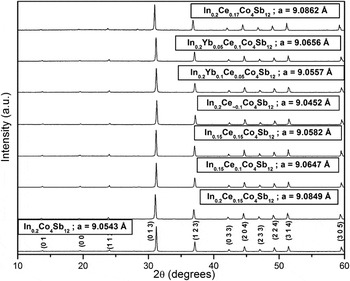
XRD patterns of the n-type skutterudites compounds shown in Fig. 3 were indexed on the basis of Im-3 cubic space group indicating that these multi-filled (i.e., “multiple rattler”) skutterudite materials are single-phase compounds. The lattice parameter calculated by linear least-square fitting methods is given in the inset for the various material compositions analyzed in Fig. 3. The lattice parameters are found to be increasing as more heavy filler atoms are added into the skutterudite crystal voids.
XRD patterns for the various n-type (In,Ce)-based Co4Sb12 skutterudites discussed.

The temperature-dependent behavior of these various n-type materials is critical to: (i) determining the average ZT, which is the most important parameter in TE device design and (ii) providing important evaluations of material segmenting options and opportunities when designing devices across large temperature differentials associated with waste energy recovery applications. This second point is especially critical in automotive energy recovery systems because temperature dependencies can be so sharp that attempting to design and operate a TE device with just one of these n-type materials in a TE element, even though it has a high peak ZT, may not lead to high device performance because it is the average ZT across the entire temperature differential (TE device and elements) that dictates device design optimization and performance. It is therefore often necessary to segment these advanced materials with other lower temperature materials (i.e., bismuth tellurides) to truly exploit their superior ZT characteristics in particular temperature ranges. The ZT versus temperature allows one to make the proper TE device design evaluations.
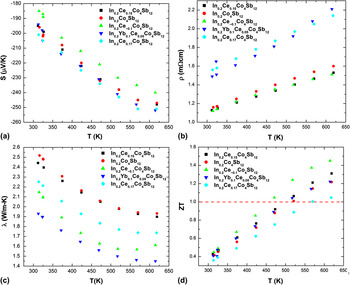
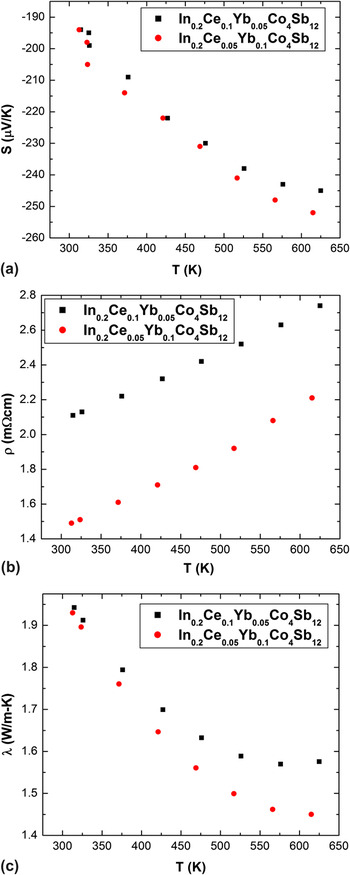
The Seebeck coefficient, electrical resistivity, thermal conductivity, and ZT plots for all the compositions are shown in Figs. 4(a)–4(d) respectively. Figure 4(d) shows comprehensive ZT versus temperature plot for the n-type materials investigated, which allows quick comparisons of the n-type ZT values achieved and their different temperature dependencies. The compound showing the highest ZT in this work was determined to have an approximate composition of In0.2Ce∼0.1Co4Sb12 using x-ray Fluorescence and solution chemistry techniques. The peak ZT values of these different n-type (In,Ce)-based skutterudites were measured in the range from 1.2 at 620 K to 1.45 at 675 K. Some additional samples of the In0.2Ce0.15Co4Sb12 compounds have shown peak ZT values of 1.5–1.6 at 475–525 K and work is continuing to verify and reproduce these results. The ZT results shown in Fig. 4(d) are consistent with those reported in similar (In,Ce)-based skutterudite materials,Reference Li, Tang, Zhang and Uher20, Reference Graff, Peng, He, Su, Alboni, Zhu and Tritt21 except the peak ZT behavior in these materials occurs at low temperatures of ∼620 K. The In0.2Co4Sb12 compounds also exhibited good ZT values, achieving a ZT of 1.2 at 625 K. The Seebeck coefficient and electrical resistivity plots for the two triple-filled n-type skutterudite compounds In0.2Ce0.1Yb0.05Co4Sb12 and In0.2Ce0.05Yb0.1Co4Sb12 are shown in Figs. 5(a) and 5(b), respectively. The Seebeck coefficients of these two compounds were very similar in behavior and magnitude, but there was a marked difference in the electrical resistivity, with the In0.2Ce0.05Yb0.1Co4Sb12 compound having a much lower electrical resistivity. The thermal conductivity data given in Fig. 5(c) shows that In0.2Ce0.05Yb0.1Co4Sb12 compound has a lower thermal conductivity value than In0.2Ce0.1Yb0.05Co4Sb12 compound. Both of these effects led to significantly higher ZT values for the In0.2Ce0.05Yb0.1Co4Sb12 compound shown in Fig. 4(d), with the ZT surpassing 1.2 at ∼625 K. The ZT of the In0.2Ce0.1Yb0.05Co4Sb12 was only ∼0.86 at 623 K, so this composition was not vigorously pursued or passed on to structural measurements.
Temperature-dependent (a) Seebeck coefficient, (b) electrical resistivity, (c) thermal conductivity, and (d) ZT of various n-type (In,Ce)-based skutterudite compounds.

Temperature-dependent (a) Seebeck coefficient, (b) electrical resistivity, and (c) thermal conductivity of the triple-filled skutterudites.

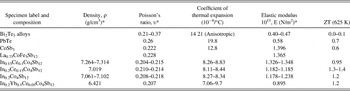
Table I shows the measured structural properties, Young’s modulus, E, and Poisson’s ratio (υ), at room temperature, and CTE (at 298–673 K) for the n-type CoSb3, In0.15Ce0.1Co4Sb12, In0.2Ce0.15Co4Sb12, In0.2Co4Sb12, and In0.2Ce0.05Yb0.1Co4Sb12 compounds investigated. Table I also shows the measured ZT of these samples at 625 K and some typical data for other TE materials from the literature. The ZT values for the In-Ce and In-Ce-Yb compounds represent a range of “ZT∼1” materials with the optimum performance appearing in the In0.2Ce∼0.1Co4Sb12 composition, that material achieving an ultimate ZT∼1.45 at 625 K. The CTE measurements in Table I are generally taken across a temperature range from 298–673 K (referenced to 298 K) and showed generally constant behavior across that range. Table I also shows comparisons to the structural and TE properties of common, more conventional TE materials, such as bismuth telluride (Bi2Te3) alloys and lead telluride (PbTe) alloys, and the base Co4Sb12 skutterudite material. The Young’s modulus, CTE, and Poisson’s ratio of In0.2Ce0.15Co4Sb12, In0.2Co4Sb12, and In0.2Ce0.05Yb0.1Co4Sb12 compositions (the best performing n-type TE materials) were slightly lower than that for the base Co4Sb12 skutterudite material. The CTE of these materials was also lower than the base Co4Sb12 skutterudite material. The structural property similarities and differences of the new (In,Ce)-based skutterudite materials compared to the base Co4Sb12 skutterudite material provide important information on how TE device designs may be affected and modified when using these (In,Ce)-based Co4Sb12 materials rather than Co4Sb12 materials or PbTe materials. For example, the lower CTE of the (In,Ce)-based materials would dictate different interface and diffusion barrier materials in a TE device design to control thermally induced structural stresses. It is important to know how these structural properties compare with more conventional TE materials, such as bismuth telluride (Bi2Te3) alloys, because these skutterudite materials could ultimately be combined with (Bi2Te3) alloys in segmented-element device designs that are optimized for large temperature differentials. The E and CTE comparison with (Bi2Te3) alloys is particularly important in this regard. Comparisons with PbTe alloys allows one to evaluate how these new (In,Ce)-based skutterudites may work and how device designs should be modified in applications where PbTe alloys have dominated in the past. These structural properties are critical to performing crucial TE device structural analyses that enable successful transition into operating TE devices that survive and perform in their anticipated high-temperature environments in waste heat recovery applications.
Structural and thermoelectric properties for various n-type skutterudites.

Ranges in values listed are for two to three samples of that material from a given fabrication batch or fabrication bar. *Measurements at room temperature.
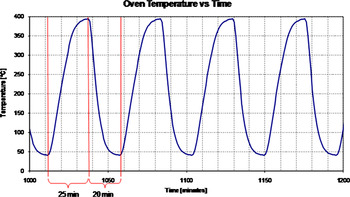
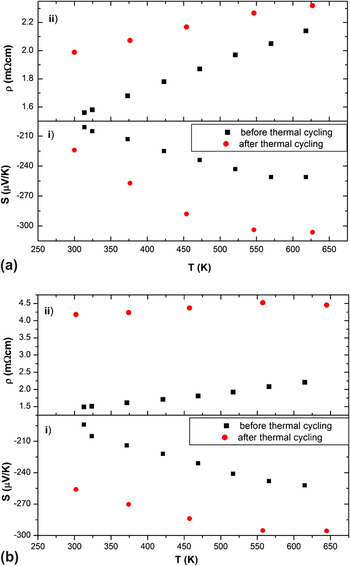
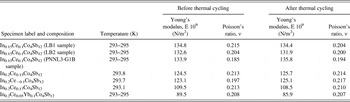
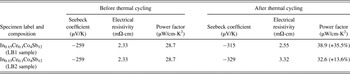
Research and development work included performing thermal cycling on several of the n-type (In,Ce)-based Co4Sb12 materials from 323–673 K (200 cycles), and then rechecking the structural properties for any significant changes that would indicate microcrack initiation or growth.Reference Ren, Case, Sootsman, Kanatzidis, Kong, Uher, Lara-Curzio and Trejo22–Reference Case25 The thermal cycling profile used is shown in Fig. 6. It is relevant to various military and automotive waste heat recovery applications and originates from recently completed work in this area. Table II shows the impacts of the thermal cycling on the structural properties (E, ν) of several of the n-type compositions. In general, the thermal cycling impact did not appreciably change either the Young’s modulus or the Poisson’s ratio in these materials, which indicates that no microcrack initiation or growth is occurring in these advanced n-type skutterudite materials.Reference Ren, Case, Sootsman, Kanatzidis, Kong, Uher, Lara-Curzio and Trejo22–Reference Case25 Their thermal cycling capabilities show important stability characteristics that are crucial to effectively transitioning these n-type (In,Ce)-based skutterudites into TE devices for waste energy recovery applications as these applications necessarily will require systems to cycle up and down in temperature repeatedly during their intended lifetimes. XRD also was performed on the samples after thermal cycling and was found to be essentially the same as before indicating the stability of the structure even after number of thermal cycles. This work also investigated the thermal cycling impacts on the TE properties of these n-type (In,Ce)-based Co4Sb12 compounds. TE property results were obtained in two of the In0.15Ce0.1Co4Sb12 compounds in Table II after thermal cycling. Table III shows that the power factor (S2/σ) at 510 K increased significantly in these two skutterudite compounds after thermal cycling. It basically increased because the Seebeck coefficient increased dramatically, while the electrical resistivity increased but it was overwhelmed by the Seebeck coefficient increase as shown in Table III. The TE properties of In0.2Ce0.17Co4Sb12, In0.2Ce0.15Co4Sb12 and In0.2Ce0.05Yb0.1Co4Sb12 compounds also were remeasured after thermal cycling. In0.2Ce0.17Co4Sb12 showed 36% increase in power factor at 525 K, whereas In0.2Ce0.05Yb0.1Co4Sb12 showed 36% decrease in power factor at 525 K. The Seebeck and electrical resistivity properties are shown in Figs. 7(a) and 7(b) for these double- and triple-filled skutterudites compounds, respectively. In0.2Ce0.15Co4Sb12 compounds showed similar increase in Seebeck coefficient. The power factor increase is certainly a desirable characteristic and is shown here to indicate the effect discovered in these materials.

Comparison of i) Seebeck coefficient and ii) electrical resistivity properties before and after thermal cycling of (a) double-filled In0.2Ce0.17Co4Sb12 skutterudite compound and (b) triple-filled In0.2Yb0.1Ce0.05Co4Sb12 skutterudite compound.

Thermal cycling impacts on n-type InxCeyCo4Sb12 and In0.2Ce0.05Yb0.1Co4Sb12 room temperature structural properties (thermal cycling 323–673 K, 200 cycles).

PNNL3-G1B, LB1, and LB2 are codes for three different samples cut from the same fabrication bar.
Power factor (S2σ) in n-type In0.15Ce0.1Co4Sb12 Compounds before and after thermal cycling at 510 K.

LB1 and LB2 are codes for two different samples cut from the same fabrication bar.
A recent study on the theoretical filling fraction limit indicates that an increase in ionic radius of the filler atoms induces more strain to the crystal lattice and thereby rendering it unstable.Reference Shi, Zhang, Chen, Yang and Uher26 In this study, we have tried three different filler atoms with a maximum total limit of 35 mol% forming a single phase compound and hence believe this to be the filling fraction limit in this case. In both the cases, the Seebeck coefficient is found to increase by nearly the same value after the thermal cycling, whereas the electrical resistivity increases enormously in the case of triple-filled skutterudites when compared to the double-filled compound. This causes the power factor to actually decrease significantly in the triple-filled skutterudites. The thermal cycling results demonstrate the practical limit of adding too many skutterudite filler elements, which ends up creating metastable compounds (i.e., states) that are not stable upon thermal cycling. This shows that thermal cycling plays a distinctive and differentiating role in determining which skutterudite filler atoms and how many different ones one can use. Further research is required to quantify the effect of thermal cycling on the material thermal conductivity and ZT values and also to quantify this thermal cycling effect in other materials discussed herein and across a wider, statistically significant number of samples.
IV. CONCLUSIONS
Advanced TE energy recovery systems require high-performance TE materials to satisfy higher performance requirements. Several n-type (In,Ce)-based Co4Sb12 skutterudite compounds were investigated and fabricated in this work to address new requirements. The temperature-dependent TE properties of n-type In0.15Ce0.1Co4Sb12, In0.2Ce0.15Co4Sb12, In0.2Co4Sb12, In0.2Ce0.17Co4Sb12, and In0.2Ce0.05Yb0.1Co4Sb12 compounds were measured from 300 to ∼625 K. In0.2Ce0.15Co4Sb12, In0.2Co4Sb12, and In0.2Ce0.05Yb0.1Co4Sb12 compounds showed the best TE property performance, with In0.2Co4Sb12, and In0.2Ce0.05Yb0.1Co4Sb12 exhibiting ZT values as high as 1.2 at 620 K and In0.2Ce∼0.1Co4Sb12 showing ZT values of 1.45 at 675 K. The Young’s modulus and Poisson’s ratio of In0.2Ce0.15Co4Sb12, In0.2Co4Sb12, and In0.2Ce0.05Yb0.1Co4Sb12 compositions (best performing n-type TE materials) were lower than that for the base Co4Sb12 skutterudite material. However, these compounds exhibited higher Young’s modulus and lower Poisson’s ratio than more conventional TE materials, such as Bi2Te3 alloys and PbTe alloys. The CTE of these materials at 298–673 K also was measured, which revealed they have lower CTE than the base Co4Sb12 skutterudite material. Thermal cycling from 323 to 673 K (200 cycles) did not appreciably change either the Young’s modulus or the Poisson’s ratio in these materials, which indicate that no microcrack initiation or growth is occurring in these advanced n-type skutterudite materials. Their thermal cycling capability shows important stability characteristics that are crucial to effectively transitioning these n-type (In,Ce)-based skutterudites into TE devices for waste energy recovery applications. In the case of n-type In0.15Ce0.1Co4Sb12 and In0.2Ce0.17Co4Sb12 materials, it was discovered that thermal cycling from 323 to 673 K (200 cycles) actually increased the power factors by 13.6–36% at 510–525 K. In0.2Ce0.15Co4Sb12 compounds also showed significant increases in Seebeck coefficient. Additional research is required on these materials and other In,Ce-based compounds in this family discussed herein to determine repeatability of this thermal cycling effect on power factor across a wider, statistically significant number of samples and to determine the thermal cycling effect on thermal conductivity (and therefore the ZT) of these materials.
ACKNOWLEDGMENTS
The authors sincerely thank the U.S. Department of Energy (DOE), Office of Vehicle Technology (OVT), Jerry Gibbs, Propulsion Materials Technology Manager, DOE-OVT, and John Fairbanks, Thermoelectric Technology Manager, DOE-OVT, for their support of this research and development.