Elucidating the fact that committee consideration is the most common source of legislative demise in Congress, Woodrow Wilson aptly noted that “[t]he fate of bills committed [referred to committee] is generally not uncertain” (Reference Wilson1885, 63). “As a rule,” continued Wilson, “a bill committed is a bill doomed. When it goes from the clerk's desk to a committee-room it crosses a parliamentary bridge of sighs to dim dungeons of silence whence it will never return. The means and time of death are unknown, but its friends never see it again” (ibid.). Scholars have since identified neglect as the means by which most bills meet such a mortiferous fate, and the winnowing stage of the legislative process as the time at which it occurs.
Winnowing—the prefloor legislative process by which Congress determines which bills are selected to receive formal committee consideration—plays an essential role in congressional agenda setting because it influences every subsequent stage of policymaking (Krutz Reference Krutz2005, 314). Of the thousands of bills introduced in every congressional session, only a select few receive committee attention. Agenda setting allows legislators the opportunity both to define problems and establish policy alternatives (Baumgartner and Jones Reference Baumgartner and Jones1993; Kingdon Reference Kingdon1995). Particularly for minority representatives, agenda setting provides legislators a unique opportunity to exert individual influence over the policymaking process, since it is through bill sponsorship that minority legislators are the least constrained by seniority, committee position, and demands of party loyalty (Swers Reference Swers2002, 127). Thus, it is at this critical agenda-setting stage of the legislative process where the link between descriptive and substantive representation may be the most remarkable (Bratton and Haynie Reference Bratton and Haynie1999; Swers Reference Swers2002).
A nuanced understanding of the winnowing process is, as Krutz states, “undeniably essential” (Reference Krutz2005, 314). Congressional scholars, however, tend to overlook winnowing, focusing instead on later stages of lawmaking, such as floor debate and roll call voting (Krutz Reference Krutz2005, 315). Consequently, detailed analyses of subtler factors that might influence the small percentage of bills that move forward past this critical stage of the legislative process have been all but ignored. One such factor is gender. To be sure, scholars have sought a better understanding of how gender influences legislative behavior, particularly by examining the legislative effectiveness of female legislators (Anzia and Berry Reference Anzia and Berry2011; Jeydel and Taylor Reference Jeydel and Taylor2003; Volden and Wiseman Reference Volden and Wiseman2009; Volden, Wiseman, and Witter Reference Volden, Wiseman and Wittmer2013a, Reference Volden, Wiseman and Wittmer2013b). Volden, Wiseman, and Wittmer's research demonstrates that female members introduce more bills and ceteris paribus are generally more effective than their male counterparts; their overall finding about gender and legislative effectiveness is, however, driven primarily by women in the minority party (Volden, Wiseman, and Wittmer Reference Volden, Wiseman and Wittmer2013a, 331). They discover that the committee system eradicates any legislative advantage majority party women may have sought by introducing 17% more bills than majority party men (Volden, Wiseman, and Wittmer Reference Volden, Wiseman and Wittmer2013a, 336). In another study, Volden, Wiseman, and Wittmer's findings reiterate the fact that it is at the committee stage where institutional biases may have the greatest effect on the survival of female sponsored legislation (Reference Volden, Wiseman and Wittmer2013b, 21). Because winnowing is a critical agenda-setting process that impacts subsequent stages of the legislative process, the exigency of understanding the effects of gender on a bill's likelihood of legislative survival cannot be understated.
This study seeks to explicate the role that gender plays in the winnowing process by examining all bills introduced in the House during the 111th and 112th Congresses that were referred to the Committees on Education and the Workforce, Financial Services, Foreign Affairs, and Small Business. In addition, I assess the partisan and gender diversity of cosponsors for female sponsored bills, the gender composition of committees, and the presence of discernable patterns in the number and types of bills successfully winnowed in committees chaired by women. This study provides novel insight into winnowing in general and the effects of gender on the winnowing process in particular.
WOMEN AND POLITICS: THE THEORY OF DIFFERENCE
While the number of women serving in the U.S. Congress has increased markedly over the last few decades, improving the diversity in descriptive representation, much debate surrounds the substantive impact these women have had on both the legislative process and public policy. Due to the paucity of female representatives in the national legislature, early scholarly work devoted to women and politics focused primarily on the impact of women in state legislatures (Bratton and Haynie Reference Bratton and Haynie1999; Carey, Niemi, and Powell Reference Carey, Niemi, Powell, Thomas and Wilcox1998; Kathlene Reference Kathlene1994; Reingold Reference Reingold1996; Rosenthal Reference Rosenthal1998; Saint-Germain Reference Saint-Germain1989; Tolleson-Rinehart Reference Tolleson-Rinehart and Debra1991; Thomas Reference Thomas1991). Cognizant of the analytical hazards of drawing conclusions about the federal lawmaking process from state legislatures, the theoretical implications contained within this body of literature are, however, instructive for understanding gender differences in legislative behavior generally. There is a great deal of evidence suggesting that female legislators are different from their male counterparts in both their representative styles and in their legislative activities. For example, research has shown that female legislators tend to be more liberal than male legislators (Carey, Niemi, and Powell Reference Carey, Niemi, Powell, Thomas and Wilcox1998; Poggione Reference Poggione2004; Thomas Reference Thomas1994), are more likely to view representing women's interests as an integral part of their job (Reingold Reference Reingold1992; Thomas Reference Thomas1994), and are more likely to sponsor bills with greater frequency that pertain to issues such as health care, education, children and families, and women's rights (Berkman and O'Connor Reference Berkman and O'Connor1993; Burrell Reference Burrell1994; Saint-Germain Reference Saint-Germain1989; Sanbonmatsu Reference Sanbonmatsu2003; Swers Reference Swers2001; Thomas Reference Thomas1991). Studies additionally reveal that women legislators are more likely than men to specialize in policy areas, to conceptualize public policy problems more broadly, and, subsequently, to seek novel types of solutions to such policy concerns (Epstein, Niemi, and Powell Reference Epstein, Niemi, Powell, Thomas and Wilcox2005; Kathlene Reference Kathlene, Thomas and Wilcox2005; Thomas and Wilcox Reference Thomas, Wilcox, Thomas and Wilcox2005).
In attempting to discern why these perceived gender differences exist, Swers posits that it may be due to gender-role socialization. Because women are inculcated to accept primary responsibility for the care of young children and elderly relatives, women tend to focus on relations to others and on contextual factors when solving problems; this encourages the adoption of different styles of political behavior, such as working across party lines and brokering compromises (Swers Reference Swers2002, 4). Swers also notes that it is possible that voters expect female legislators to act this way, which obliges congresswomen to respond to constituent expectations about how women should conduct themselves politically (Reference Swers2002, 5–6).
Regardless of why these perceived differences exist, considerations of gender are vital to understanding the substantive impact women have on policymaking within the U.S. Congress. The fact that women legislators are more liberal, view representing women's interests as an integral part of their job, sponsor more bills pertaining to certain issues, and more broadly conceptualize (and seek novel solutions to) policy problems is inconsequential if they are constrained in their ability to translate such inimitable views and representative concerns into enforceable public policies. If female lawmakers are unable to influence the policymaking process in Congress because their bills consistently fail to receive any committee attention, then policymaking in the United States is deleteriously skewed toward outcomes that are more in line with the economic and social interests of male lawmakers. Thus, the diversity and quality of substantive representation in the United States may suffer.
INSTITUTIONAL FACTORS
Access to committee seats and leadership positions both limit the range of policies that legislators can influence and constrain their likelihood of successfully doing so (Swers Reference Swers2002, 10–11). Committee assignments are a function of party membership, leadership preferences, and other institutional constraints, including seniority (Arnold and King Reference Arnold, King and Rosenthal2002, 310). Congresswomen must, therefore, work effectively within the institutional confines in order to successfully articulate their policy interests or shape legislative outcomes. Despite their recent numerical and positional gains within the U.S. Congress, female legislators may still be disadvantaged in committee hearings, unable to participate equally, and, consequently, less effective at influencing the outcomes of public policy (Kelly and Duerst-Lahti Reference Kelly, Duerst-Lahti, Duerst-Lahti and Kelly.1995; Kathlene Reference Kathlene1994, 572–73). This has important implications for understanding the effects of gender on the winnowing process. As Krutz notes, in order for a bill to be successful, “‘you have to make a case for your bill and make noise. If you don't, your bill will go unnoticed’” (Reference Krutz2005, 317). Female sponsors must not only work hard to overcome the unavoidable presumption of bill failure that all legislators face, they must also work hard to be presumed competent, knowledgeable, and persuasive (Hawkesworth Reference Hawkesworth2003; Kenney Reference Kenney1996; Thomas Reference Thomas1994). Given that women participate less, are frequently interrupted, and often experience overt hostility in committees, female bill sponsors may have to work even harder to make the necessary “noise” to get their bills noticed. Conversely, if male bill sponsors are automatically perceived as effectively persuasive and knowledgeable leaders and are more verbally aggressive in committees, it may be the case that their bills have a better chance of getting noticed and receiving committee attention. Even if congresswomen do strive to outperform their male colleagues by garnering more bipartisan support for, or securing a greater number of cosponsors on, their bills, it is unclear as to whether or not these efforts will be rewarded. Thus, the winnowing process may be inadvertently biased by the gendered nature of the political institution, which leads to the first critical hypothesis of this study.
H1:
Bills sponsored by congressmen are more likely to receive formal committee consideration than those sponsored by congresswomen.
Other institutional factors, such as whether or not a sponsor is a member of the majority party or serves as a majority party leader, have been found to affect the winnowing process (Krutz Reference Krutz2005). As such, the gender of individuals in powerful committee positions, particularly the committee chair, may also have a substantial effect on whether or not a bill is selected to receive consideration. Seniority is arguably the most important factor determining committee rank (Krutz Reference Krutz2005, 318; Tobin and Shaffer Reference Tobin and Shaffer1986). Since most women currently serving in Congress were elected in 1992 or later, women, as a collective, lack seniority (Swers Reference Swers2002, 128–29). Due to lack of seniority, women's access to leadership positions within committees has been limited but not entirely absent. From 1923 through the present Congress, women have chaired 43 standing, joint, and select House committees but have never held the most coveted chairmanship positions—Ways and Means, Energy and Commerce, and Appropriations Committees. Aside from the Select Committee on the House Beauty Shop, the committee most frequently chaired by a congresswoman is the former Labor Committee, now the Committee on Education and the Workforce. Needless to say, the formal institutional power associated with committee chairmanships has all but eluded female legislators.
Research suggests that women may not use or perceive positions of power in the same way as their male counterparts even if they are successful at obtaining them (Blair and Stanley Reference Blair and Stanley1991; Dodson and Carroll Reference Dodson and Carroll1991; Duerst-Lahti and Johnson Reference Duerst-Lahti and Johnson1990). Studies involving women's legislative and leadership styles suggest that women pursue more cooperative legislative strategies, are more oriented toward consensus, and prefer less hierarchical, more participatory approaches than their male counterparts (Carey, Niemi, and Powell Reference Carey, Niemi, Powell, Thomas and Wilcox1998; Jewell and Whicker Reference Jewell and Whicker1995; Reingold Reference Reingold1996; Rosenthal Reference Rosenthal1998, Reference Rosenthal2000, Reference Rosenthal and Rosenthal2002; Thomas Reference Thomas1991; Tolleson-Rinehart Reference Tolleson-Rinehart and Debra1991). While female committee chairs may appear more democratic or facilitative in their leadership styles than their male counterparts, the effect that this approach has on the winnowing process is uncertain. In deciding which bills will receive attention out of the hundreds introduced within their committee's jurisdiction, due to their penchant for inclusivity, female chairs may be more lenient in advocating legislative progression of a bill past the winnowing stage. Alternatively, recognizing that their leadership styles may result in more time-consuming deliberations, female chairs may be prone to grant fewer bills committee attention. Regardless, in consideration of women's different legislative and leadership styles, a reasonable supposition is that the gender of the committee chair may result in different winnowing outcomes.
H2:
Bills are more likely to receive formal committee consideration if referred to a committee chaired by a woman.
GENDER COMPOSITION OF COMMITTEES
Since committees act as the central locus of policy development in Congress, the identity of committee members has a significant impact on the content of policy outcomes (Swers Reference Swers2002, 95). Scholars often utilize Kanter's (Reference Kanter1977) critical mass theory to help explain the behavior of minority office holders (Bratton Reference Bratton2002, Reference Bratton2005; Moeller Reference Moeller2010; Murphy Reference Murphy, Härnqvist and Burgen1997; Saint-Germain Reference Saint-Germain1989; Swers Reference Swers2001; Thomas Reference Thomas1991, Reference Thomas1994). More recently, Moeller's examination of the impact of women on the House Judiciary Committee suggests that as the number of women on the committee grows, some women's issues, namely gender and sexual orientation discrimination as well as family issues bills, appear to be more frequently considered, while parental leave and welfare bills are not similarly affected (Moeller Reference Moeller2010, 12).
The inability to identify an exact proportional critical mass of women legislators needed to create the tipping point to ensure that the priorities of female lawmakers are reflected in policy outcomes (see Bratton Reference Bratton2005; Reingold Reference Reingold2000; Saint-Germain Reference Saint-Germain1989; Thomas Reference Thomas1991, Reference Thomas1994; Wolbrecht Reference Wolbrecht2000) certainly limits the overall predictive applicability of the theory. In fact, some scholars have found that women are more likely to aggressively advocate for women's interests when they are vastly underrepresented in the legislature (Bratton Reference Bratton2005; Crowley Reference Crowley2004;). Research suggests, however, that the mere presence of minorities in government can alter public policies by changing the behavior of nonminority-elected officials (Bratton Reference Bratton2005; Hawkesworth Reference Hawkesworth2003; Preuhs Reference Preuhs2006; Rosenthal Reference Rosenthal2000). The question then becomes, does the presence and overall proportion of women on congressional committees have any impact on the winnowing process? Thus, the third hypothesis is as follows:
H3:
Bills referred to committees with more female committee members are more likely to receive formal committee consideration.
BILL SPONSORS & COSPONSORS
Legislators have complete control over the number and content of the bills they sponsor (Swers Reference Swers2002, 33). It is through bill sponsorship that women are the least constrained by seniority, committee position, and demands of party loyalty (ibid., 127). In examining the number of House bills sponsored by women relative to men from 1984 to 2004, Anzia and Berry found that “[o]n average, women sponsor about three more bills per congress, which is a difference of roughly 17% relative to the member average of 18 bills” (Reference Anzia and Berry2011, 490). Volden, Wiseman, and Wittmer's (Reference Volden, Wiseman and Wittmer2013a) study similarly found that both majority and minority party women introduced more bills than their male counterparts across the 93rd through 110th Congresses. Anzia and Berry's (Reference Anzia and Berry2011) study also found that female lawmakers are more active cosponsors. According to their study, congresswomen cosponsor about 26 more bills per Congress than congressmen and garner cosponsorship support from a greater number of their peers (Anzia and Berry Reference Anzia and Berry2011, 490). This gender difference in cosponsorhsip may be indicative of what Volden, Wiseman, and Wittmer (Reference Volden, Wiseman and Wittmer2013a) characterize as “feminized” strategies of cooperation, conciliation, and consensus building (2013a), suggesting that women may possess stronger collaborative networks with their colleagues than their male counterparts (Anzia and Berry Reference Anzia and Berry2011).
Cosponsorship is a vital electoral tool because the number and political identity of cosponsors serves as an internal legislative signal to the agenda setters—the majority party and committee leaders—concerning the nature and depth of support for a particular bill (Swers Reference Swers2005, 410; see also Kessler and Krehbiel Reference Kessler and Krehbiel1996; Koger Reference Koger2003; Krutz Reference Krutz2005; Wilson and Young Reference Wilson and Young1997). In fact, the number and partisan distribution of cosponsors can impact whether or not a bill receives committee consideration (Krutz Reference Krutz2005; Swers Reference Swers2005). Evidence suggests that bill sponsors purposefully seek out particular legislators, such as members of the committee of jurisdiction, committee leaders, or members of the opposing party, to cosponsor their bill in order to bolster its legitimacy in the eyes of those charged with deciding whether or not it will receive consideration in committee (Swers Reference Swers2005). Further evidence suggests that members are more inclined to sign onto bills whose cosponsors have ideological views or social identities similar to their own (Balla and Nemacheck Reference Balla and Nemacheck2000; Koger Reference Koger2003; Swers Reference Swers2002; Wolbrecht Reference Wolbrecht2000, Reference Wolbrecht and Rosenthal2002). For example, both Democratic and Republican women are more likely to take the lead in cosponsoring legislation on gender gap issues when they are in the majority party (Swers Reference Swers2005). African American representatives are more likely to cosponsor legislation containing content of particular import to racial minorities (Cannon Reference Cannon1999). If the sheer number, partisan distribution, and social identity of a bill's cosponsors increase its legitimacy and impact the likelihood of it receiving committee attention, the gender distribution of a bill's cosponsor may also be of consequence. A large number of female cosponsors may serve as an internal legislative signal that any real or perceived “gender gap” in support for a particular bill may be more easily overcome (See Eichenberg Reference Eichenberg2003; Page and Shapiro Reference Page and Shapiro1992; Shapiro and Mahajan Reference Shapiro and Mahajan1986). Two corollary hypotheses are thereby posed:
H4:
Bills sponsored by congresswomen will garner a greater number of female cosponsors.
H5:
Bills with a greater number of female cosponsors are more likely to receive formal committee consideration.
WOMEN‘S ISSUES
There is a vast body of literature specifically devoted to what scholars have categorized as “women's issue” legislation. Generally speaking, women's issues have been defined as those concerning women, children, and families. Yet, no consensus exists as to what, exactly, constitutes women's issues. Recently, scholars have begun to question traditional conceptualizations of women's issues. Volden, Wiseman, and Wittmer (Reference Volden, Wiseman and Wittmer2013b, 2) question the methodological approach utilized by most scholars in attempting to classify women's issues—determining ex ante which issues are of particular interest to women—because, they opine, it generates definitional inconsistencies. Rather than beginning with a presumed definition of what women's issues are, they instead “label an issue as a women's issue if women are more likely than men to raise the issue or if women raise the issue in a greater volume than do men” (ibid., 7). By endogenously defining women's issues, Volden, Wiseman, and Wittmer's (Reference Volden, Wiseman and Wittmer2013b, 14) study finds that “the types of bills to which female legislators are paying the most attention seem to comport, at least roughly, with the ways that scholars of descriptive and substantive representation conventionally characterize women's issues.” They ultimately conclude that previous scholarship on women's issues “has not been dramatically off course” (ibid., 15). Regardless of the precise definition employed to categorize women's issues, research indicates that female lawmakers are more likely to actively advocate for the advancement of certain issue-specific policy initiatives, even when controlling for ideological and partisan factors (Balla and Nemacheck 1999; Barnello and Bratton Reference Barnello and Bratton2007; Bratton Reference Bratton2005; Bratton and Haynie Reference Bratton and Haynie1999; Burrell Reference Burrell1994; Carroll Reference Carroll and Carroll2001; Dolan Reference Dolan1998; Dolan and Ford Reference Dolan and Ford1995; Gerrity, Osborn and Mendez Reference Gerrity, Osborn and Mendez2007; MacDonald and O'Brien Reference MacDonald and O'Brien2011; Poggione Reference Poggione2004; Reingold Reference Reingold1992, Reference Reingold2000; Saint-Germain Reference Saint-Germain1989; Swers Reference Swers1998, Reference Swers2001, Reference Swers2002; Thomas Reference Thomas1991, Reference Thomas1994; Thomas and Welch Reference Thomas and Welch1991, Reference Thomas, Welch and Carroll2001; Wolbrecht Reference Wolbrecht2000, Reference Wolbrecht and Rosenthal2002).
Women legislators not only give higher priority than male legislators to issues such as women's rights, education, health care, families and children, the environment, and gun control, but they are also willing to devote considerable effort in committee and on the floor to securing passage of progressive legislation in these areas (Dodson and Carroll Reference Dodson and Carroll1991; Thomas Reference Thomas1994). As Krutz (Reference Krutz2005, 324) notes, “[t]he degree and intensity of a sponsor in pushing their bill is important in determining which bills move forward. In other words, if you work hard, you can get results.” Women legislators’ commitment to, and ardent advocacy for, policy changes in issue areas that may be of personal as well as political significance may provide the degree and intensity needed to move bills forward in the legislative process, which leads to the final hypotheses of this study:
H6:
Women's issue bills are more likely to receive formal committee consideration when referred to a committee chaired by a woman.
H7:
Women's issue bills are more likely to receive formal committee consideration when referred to committees with more female committee members.
RESEARCH DESIGN AND MEASURES
Unit of Analysis
The unit of analysis in this study is the bill. I examine all bills introduced in the House of Representatives during the 111th and 112th Congresses using Scott Adler and John Wilkerson's Congressional Bills Project dataset merged with data collected from other sources (see Table A1 in Online Appendix A). My sample is the 2210 bills that were referred to the following committees: Education and the Workforce (formerly Education and Labor), Financial Services, Foreign Affairs, and Small Business. Following Krutz (Reference Krutz2005) and Wilson and Young (Reference Wilson and Young1997), for bills that were multiply referred, I employed only the committee of first referral for purposes of categorization.
The four committees were selected to leverage winnowing effects due to changes in the gender of the committee chair as well as differences in substantive issue type. A woman, Nydia Velazquez (D-NY), served as chair of the House Committee on Small Business during the 111th Congress; Sam Graves (R-MO) assumed the committee chairmanship for the 112th Congress. Conversely, Howard Berman (D-CA) served as chair of the House Foreign Affairs Committee during the 111th Congress, with Ileane Ros-Lehtinen (R-FL), a woman, assuming chairmanship during the 112th Congress. With regard to substantive issue type, the Committees on Education and the Workforce and Financial Services were chosen to capture Volden, Wiseman, and Wittmer's (Reference Volden, Wiseman and Wittmer2013b) conceptualization of, and findings about, the differences between “men's issues” and “women's issues.” Bills pertaining to education and labor, two issue areas Volden, Wiseman, and Wittmer (Reference Volden, Wiseman and Wittmer2013b) identify as “women's issues,” are most likely to fall under the jurisdiction of the Committee on Education and the Workforce. Bills pertaining to macroeconomics, trade, and banking, three issue areas Volden Wiseman, and Wittmer (Reference Volden, Wiseman and Wittmer2013b) identify as “men's issues,” are most likely to fall under the jurisdiction of the Committee on Financial Services. Since the House Foreign Affairs and Small Business Committees see a change in both party and gender of the committee chair, the Committees on Education and the Workforce and Financial Services, chaired by men in both the 111th and 112th Congresses, serve as a comparative baseline for any observed variance in winnowing outcomes.
I analyze the 111th and 112th Congresses for two reasons. First, a record number of 93 women (17.2% of the total membership) served in the 111th Congress, with 76 women serving in the House (Manning Reference Manning2010, 5). Comparably, 91 women (16.8% of the total membership) served in the 112th Congress, only two fewer than at the end of the 111th Congress (Manning Reference Manning2011). Second, the Democratic Party, under the leadership of Nancy Pelosi, held a majority in the House during the 111th Congress, while the Republican Party, under the leadership of John Boehner, held a majority in the House during the 112th Congress. Since the majority party wields significant influence over every stage of the legislative process, the change in party leadership between the 111th and 112th Congresses serves as a type of natural experiment, with membership in the majority party acting as the treatment group.
Dependent Variable
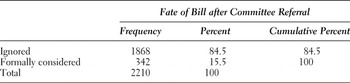
The dependent variable is the fate of the bill after referral to a House Committee, coded dichotomously as either formally considered (1), meaning that the bill saw any activity beyond referral, most notably in the form of a committee or subcommittee hearing, or ignored (0). Of the 2210 bills analyzed in this study, 15.5% (342) received consideration (see Table 1).
Gender and winnowing

Independent Variables
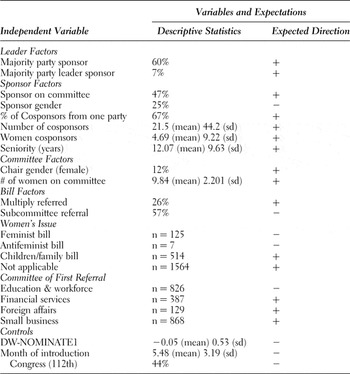
Table 2 shows descriptive statistics for the independent variables utilized in this study as well as the hypothesized direction of their coefficients, given the theoretical discussions above (see Table A1 in Online Appendix A for additional information about the independent variables).
Gender and winnowing

Note: N = 2210. No data were lost due to missingness, as all 2210 bills referred to the four committees under consideration during the 111th and 112th Congresses are included in the analysis.
Leader Factors
Following Krutz's example, two variables are utilized in this study to account for institutional factors, majority party sponsor and majority party leader sponsor. I control for legislators’ ideology by utilizing the first dimension DW-NOMINATE score for the sponsor of the bill.
Sponsor Factors
In addition to including the number of cosponsors variable, the percent of cosponsors in one party variable, ranging from 50 (half cosponsors from each party) to 100 (all cosponsors in one party), captures the partisan diversity of the cosponsors on a given bill. In order to capture the gender diversity of the cosponsors on a given bill, I similarly included a women cosponsors variable. There were no cosponsors on 20.3% of the bills analyzed in this study. Sponsor on committee measures whether (coded 1) or not (coded 0) the sponsor of the bill sits on the committee of first referral. Seniority represents the cumulative number of years the sponsor has served at the time of the bill's introduction. Sponsor gender is coded 0 if the sponsor of the bill is male and 1 if the sponsor of the bill is female.
Committee Factors
Chair Gender is coded 0 if the chair of the committee of first referral is male and 1 if female. The variable number of women on committee captures the gender diversity of committee membership. Cognizant of the fact that membership in the House can change throughout the course of a congressional session due to political appointment, resignation, or death, thereby potentially effecting the composition of committees, I investigated changes in membership of the 111th and 112th Congresses. I found that female representatives are generally replaced by female representatives and male representatives are generally replaced by male representatives. Therefore, while the individual member may be different, the change in membership does not affect the gender composition of committees because the number of male and female committee members, respectively, remains constant. Of the four committees included in this study, none were affected by the few instances where the gender of the successor did not match the vacator's.
Bill Factors
Multiply referred is coded 1 if the bill was referred to more than one committee upon introduction and 0 if otherwise. Similarly, subcommittee referral is coded 1 if the bill was referred to any subcommittee and 0 if not. Building on past work (Gelb and Palley Reference Gelb and Palley1996; Swers Reference Swers2002; Tamerius Reference Tamerius, Duerst-Lahti and Kelly1995; Wolbrecht Reference Wolbrecht and Rosenthal2002), women's issue is a variable I created to measure the fate of issue specific legislation through the winnowing process. To examine the agreement between observers on the assignment of categories in this variable, two raters independently coded 50 bills randomly chosen across issue areas. The results of the interrater reliability analysis was Cohen's Kappa = 0.629 with p < 0.001, or an 88% agreement. This measure of agreement, while statistically significant is, by conventional standards, only marginally convincing (Landis and Koch Reference Landis and Koch1977). As a result, the codebook was adjusted accordingly to ameliorate cases of disagreement. Employing this coding scheme (see Online Appendix B), all bills included in the study were assigned one of the following four categories depending on the description of the bill included in the bill summary: (1) feminist bill, (2) antifeminist bill, (3) children/family bill, and (4) not applicable. I also included a control variable for timing, month, an important control since bills introduced earlier in a Congressional session have a better chance of legislative success than bills introduced later (Krutz Reference Krutz2005, 321). Table 2 displays descriptive statistics for the abovementioned variables.
FINDINGS
Of the 2210 bills analyzed, 25.5% (563) were sponsored by congresswomen. A total of 82 individual congresswomen were responsible for introducing the 563 female-sponsored bills included in this study. On average, female representatives sponsored approximately 7 bills across the 111th and 112th Congresses, while male representatives sponsored approximately 5 bills each (See Figures C1 and C2 in Online Appendix C). Of the total number of bills sponsored by female representatives in both the 111th and 112th Congresses, 13.7% received formal committee consideration versus 16.1% for male sponsored bills (χ 2 = 1.868, p >.05). While not a statistically significant relationship, the tendency for bills sponsored by congressmen to survive the winnowing process at rates slightly greater than those sponsored by congresswomen lends preliminary support to H 1 . (See Figure C3 in Online Appendix C).
To further isolate the effect of gender on winnowing, I compared the success rate of bills sponsored by Democratic men and women to those sponsored by Republican men and women (See Table C1 in Online Appendix C). The need to control for the effect of party is important, given that there are more Democratic women serving in Congress than Republican women. During the 111th Congress, for example, of the 76 women in the House, 59 were Democrats and 17 were Republicans (Manning Reference Manning2010, 5). During the 112th Congress, of the 74 women in the House, 50 were Democrats and 24 were Republicans (Manning Reference Manning2011, 6). The overall success rate of bills sponsored by female Democrats is lower than male and female Republicans as well as male Democrats. Bills sponsored by Republican women, on the other hand, were most successful in getting their bills past the winnowing stage (See Figure C4 in Online Appendix C). Most notably, bills sponsored by Republican women during the Republican-controlled 112th Congress had a 49.1% chance of receiving committee attention, the highest, and only statistically significant, relationship between Congress, party, and sponsor gender (χ 2 = 5.774, p <.05) (See Figure C5 in Online Appendix C). Even in the Democratically-controlled 111th Congress, Republican women's bills fared slightly better than bills sponsored by Republican men (See Figure C6 in Online Appendix C). This suggests that there exists an interactive relationship between sponsor gender and sponsor party on the likelihood of bills surviving the winnowing process. Consequently, several interaction effects were included in the ensuing analyses.
In line with H 2 , bills referred to a committee with a female chair were 8.2% more likely to receive formal committee consideration (χ 2 = 12.143, p <.05). When considering the Congresses separately, bills referred to a committee with a female chair had a greater chance of being formally considered in both the 111th and 112th, although the difference is most stark in the Democratically-held 111th Congress (See Figures C7 and C8 in Online Appendix C). When broken down by committee (See Table C2 in Online Appendix C), the data suggest that changes in the gender of the committee chair may affect the likelihood of a bill receiving attention. This is most notable in the Foreign Affairs Committee, which was chaired by Howard Berman (D-CA) during the 111th Congress. When Ileane Ros-Lehtinen (R-FL) assumed the chairmanship during the 112th Congress, the percent of bills that successfully progressed through the winnowing stage in this particular committee increased from 8 to 18. Similar, yet less drastic results are evinced by a slight decrease in the percent of bills that were successfully winnowed in the Committee on Small Business when the chairmanship was assumed by a male legislator in the 112th Congress. Several unanticipated findings related to the gender of the committee chair emerge from the data, the first of which indicates that bills sponsored by a member of the minority party appear more likely to receive formal consideration in committees with a woman serving as chair. Of the 889 bills sponsored by minority party members, 13.7% of those that were referred to a committee chaired by a woman received attention, while only 5.8% of minority party sponsored bills received any attention in committees with male chairs (χ 2 = 8.910, p <.05). (See Figure C9 in Online Appendix C.) In addition to minority party sponsors, female bill sponsors also appear more likely to see their bills receive committee consideration in committees chaired by women. Of the bills sponsored by female representatives 37.9% received consideration in committees chaired by a woman, as opposed to the 10.5% of female sponsored bills that received consideration in committees chaired by a man (χ 2 = 37.093, p <.05). (See Figure C10 in Online Appendix C.)
The gender composition of committees across Congresses does not greatly vary, making it difficult to draw meaningful conclusions with regards to H 3 . The largest proportion of women on any committee included in this study is 23%, while the smallest is 13% (See Table C2 in Online Appendix C). The Committee on Financial Services saw a 5% decrease in the overall proportion of women serving between the 111th and 112th Congresses and an 11% increase in the number of bills successfully winnowed. One explanation for this is that, since bills falling under this committee's jurisdiction primarily pertain to “men's issues,” we should not expect to find, as the literature suggests, female lawmakers aggressively advocating for the success of issue-specific legislation. Thus, even though the gender of the chair of the Committee on Financial Services remained constant, any claim of causality between the decrease in the number of female committee members and the increase in number of bills successfully winnowed would be tenuous.
Female sponsored legislation garnered an average of 5.7 women cosponsors (SD 9.75) and 16.63 male cosponsors (SD 35.92). Male-sponsored legislation garnered an average of 4.34 women cosponsors (SD 9) and 16.87 male cosponsors (SD 37.11) (See Table C3 in Online Appendix C.) A multivariate general linear model (GLM) was utilized to ascertain the significance of the effect of sponsor gender on the variance of cosponsor means (See Table C4 in Online Appendix C.) The statistically significant F-value for female cosponsors indicates that the independent variable, sponsor gender, has influence on the average number of female cosponsors a bill receives. Thus, the null of H 4 can be rejected. The logistic regression results presented below will establish, however, that while the number of female cosponsors may slightly improve the likelihood of bill will receiving committee attention, it does not do so in a statistically significant way; H 5 is consequently not supported by the data.
To further examine whether female-sponsored bills differ from male-sponsored bills in the partisan or gender distribution of cosponsors, I compared the means of cosponsors broken down by Congress, sponsor party, and sponsor gender (See Table C5 in Online Appendix C.) The results show that Republican women, regardless of whether they are members of the minority or majority party, consistently garner, on average, a larger number of cosponsors across both party and gender for their bills than do their Republican male counterparts. Democratic women, on the other hand, garnered, on average, a similar (if not slightly lower) number of cosponsors across both party and gender for their bills as their Democratic male counterparts; this holds true whether or not they are the majority or minority party. The data further demonstrate that bills sponsored by Republican women, whether in the majority or minority party, were, on average, cosponsored by a greater number of male lawmakers than bills sponsored by Republican men, Democratic men, and Democratic women. Two GLMs were calculated to test both the main and interaction effects of Congress, sponsor party, and sponsor gender on the variance of cosponsor means across party and gender. Both GLMs were found to be significant overall for female and male cosponsors and Democrat and Republican cosponsors, respectively (See Tables C6 and C7 in Online Appendix C.) The results show that Congress, sponsor party, sponsor gender, and the interactions between Congress and sponsor party and between sponsor party and sponsor gender are all significant for Republican cosponsors, controlling for other effects in the model. The only significant predictor of Democratic cosponsors is sponsor party. (See Table C6 in Online Appendix C.) The statistically significant interaction between sponsor party and sponsor gender for Republican cosponsors indicates that the effect of a bill sponsor's party on the average number of Republican cosponsors a bill receives is significantly different for bills sponsored by congressmen and those sponsored by congresswomen. Additionally, the results reveal that both sponsor party and sponsor gender have a statistically significant effect on the average number of female and male cosponsors a bill receives, controlling for other effects in the model. (See Table C7 in Online Appendix C.) The interaction between sponsor party and sponsor gender was found to be significant for only male cosponsors, meaning that the influence of a bill sponsor's party on the number of male cosponsors it attracts differs significantly for bills sponsored by men and women.
An examination of how women's issue legislation fared in each of the four committees provides some support for H 6 . (See Table C8 in Online Appendix C.) When a female legislator assumed the chairmanship of the Foreign Affairs Committee during the 112th Congress, the number of both feminist and children/family bills that received formal consideration increased by 22%. In the Committee on Small Business, when the Chairmanship was assumed by a male legislator during the 112th Congress, the number of feminist bills that received formal consideration decreased by 29%. Paradoxically, the proportion of women serving on the Small Business Committee increased by 7% during the 112th Congress, suggesting that women's issue bills may not be more likely to survive the winnowing process when referred to committees with more female committee members, counter to what was posited by H 7 . This perceived effect of the gender of the committee chair could, instead, be an effect of the change in the party of committee chair, necessitating that comparisons be drawn to the other two committees under scrutiny in this study. Holding the gender of the committee chair constant across the 111th and 112th Congresses, as is done in the Committees on Education and Workforce and Financial Services, there is much less variance in the number of women's issue bills that receive formal committee consideration; this suggests that the variance is due to gender difference of committee chairs and not partisan differences.
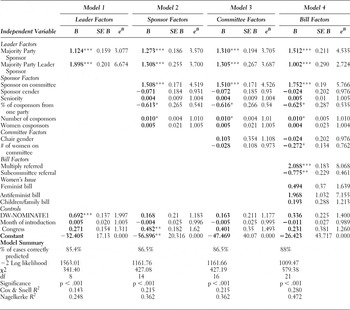
Table 3 presents the results of four binary logistic regression models, showing the predicted probability of a bill surviving the winnowing process as a function of the aforementioned leader factors, sponsor factors, committee factors, and bill factors, respectively. Each model is statistically significantly better than the null model, and the increase in the percent of cases correctly predicted and the diminishing −2 likelihood across models indicates that the addition of variables improves how well the overall model explains variations in the outcome of interest. The results generally comport with the hypothesized direction of coefficients. There is an obvious and consistently large effect of party on a bill's likelihood of receiving formal committee consideration. Majority party leaders and majority party members are much more likely to see their bills move forward than those sponsored by minority party members. Several sponsor factors also decidedly affect a bill's likelihood of receiving formal committee attention. The odds of a bill sponsor successfully ushering his/her bill through the winnowing process are 352% higher if he/she sits on the committee of first referral, for example. As expected, and in line with H 1 , the consistently negative coefficient for sponsor gender across models indicates that that female-sponsored legislation is less likely than male-sponsored legislation to receive formal committee consideration, but not significantly so. The odds of a bill receiving formal committee consideration are 2.4% lower if the bill's sponsor is a congresswoman as opposed to a congressman. The results illustrate that female committee chairs do positively affect the likelihood of a bill progressing through the legislative process, consistent with H2, but similar to the effect of sponsor gender, chair gender does not reach statistical significance. The odds of a bill receiving formal committee consideration are 27.2% higher if referred to a committee with a female chair. The size of the coefficient associated with chair gender increases slightly when controlling for women's issue legislation, suggesting that the effect of female committee chairs on a bill's likelihood of success is mediated by the type of bill under consideration, as suggested by H 6 . The findings regarding the number of women serving on a committee run counter to what was hypothesized in H 3 . While I expected that the number of women serving on a bill's committee of first referral would improve its chances of surviving the winnowing process, the negative, statistically significant coefficient for number of women on committee indicates that greater numbers of women serving on a bill's committee of first referral have a slight reductive effect on the likelihood that a bill will receive any attention. This result is most likely driven by the 11% increase in the number of bills successfully winnowed in the Committee on Financial Services from the 111th to 112th Congresses discussed earlier. As previously noted, having more women cosponsors does increase the likelihood that a bill will receive committee attention, but the effect is extremely small and not statistically significant, confirming the earlier conclusion that the null of H 5 cannot be rejected.
Gender and winnowing, logistic regression results1

Notes: N = 2210. Omitted from the table is the control variable for committee of first referral. Financial services served as the reference category in all models.
1 The dependent variable is coded 1 if the bill received formal committee attention and 0 if not.
***p < .001, **p < .01, *p < .05.
I ran four additional binary logistic regression models in order to test for any interaction effects between party and sponsor gender, majority party sponsor and sponsor gender, majority party sponsor and chair gender, as well as between sponsor gender and chair gender. (See Table D1 in Online Appendix D.) Statistically significant interaction effects were found to exist between party and sponsor gender and between majority party sponsor and chair gender. The results of Model 5A suggest that the effect of a bill sponsor's gender differs between Republicans and Democrats. The coefficient for sponsor gender in this model is the effect of sponsor gender when party is equal to zero (Democrat). Thus, for Republican bill sponsors, a shift in sponsor gender from male (0) to female (1) yields a change in the log-odds of 0.294. For Democratic bill sponsors, a shift in sponsor gender yields a change in the log-odds of –0.648. The interpretation of log-odds is not particularly intuitive however, and because odds-ratio interpretation of logit coefficients cannot be used for interaction terms (Norton, Wang, and Ai Reference Norton, Wang and Ai2004), it is necessary to compute and analyze marginal effects. (See Tables D2–D5 in Online Appendix D.) Holding all continuous covariates in Model 5A at their means, the odds of a bill being successfully winnowed for a Democratic male sponsor is 0.65, while the odds for Democratic female sponsors is 0.18. (See Table D2 in Online Appendix D.) Thus the marginal effect of sponsor gender for Democrats is –0.47. Similarly, the marginal effect of sponsor gender for Republican bill sponsors is –0.41. The marginal effect of sponsor gender is negative for both Democrats and Republicans but is slightly larger for Democrats. This finding provides further empirical support for H 1 . Model 5C suggests that the effect of chair gender differs between majority- and minority-party–sponsored legislation. Turning directly to the marginal effects, the odds of a minority-party–sponsored bill receiving formal attention in a committee chaired by a man is 0.14 and 0.25 in a committee chaired by a woman. (See Table D3 in Online Appendix D.) The marginal effect of chair gender for minority party bill sponsors is, therefore, 0.11. The marginal effect of chair gender for majority party bill sponsors is −0.095. Hence, the marginal effect of chair gender is slightly larger for minority party sponsors and negative for majority party sponsors. This finding comports to what was previously revealed regarding the higher success rate of minority-sponsored bills receiving attention in committees chaired by women.
DISCUSSION AND CONCLUSION
This study examined the effects of gender on determining which small proportion of bills receive committee attention from the thousands that are introduced in the U.S. House of Representatives every legislative session. Female representatives are utilizing their scarce resources of time, staff, and political capital on attempting to influence the agenda setting process by sponsoring more bills on average than male representatives. At first glance, the overall success rate of legislation sponsored by Republican women makes it appear as though their bills have a greater likelihood of receiving formal committee consideration. However, after controlling for the effects of leader factors, sponsor factors, committee factors, and bill factors, it becomes apparent that the marginal effect of a bill sponsor's gender being female is negative for both Democrats and Republicans. Thus, regardless of party, bills sponsored by congresswomen are meeting legislative demise in committee at rates slightly higher than bills sponsored by their male colleagues.
The increased likelihood that minority-sponsored legislation will receive attention when referred to a committee chaired by a woman proffers support for the conclusion that women in positions of power pursue more cooperative legislative strategies and prefer less hierarchical, more participatory approaches than their male counterparts. On the other hand, scant evidence exists to bolster the supposition that female lawmakers, as a whole, engage in “feminized” strategies of cooperation, conciliation, and consensus building, at least when it comes to garnering greater bipartisan cosponsor support for their bills. Interestingly, across both Congresses, bills sponsored by female Republican lawmakers attracted nearly twice as many male cosponsors than bills sponsored by female Democratic lawmakers. One explanation for this difference could be that Republican women lawmakers recognize that their double minority status in the House requires them to gain support from those legislators in institutional positions most able to assist in successfully ushering their bills through the legislative process, namely male lawmakers.
There are evident limitations to this study that make several of the findings merely suggestive and not generalizable. Since the gender composition of the committees included in this study does not vary significantly across Congresses, meaningful conclusions regarding the success of bills, particularly women's issue bills, referred to committees with more female members could not be substantiated. Similarly, while some important differences between male and female committee chairs emerged, most notably the success of minority-party–sponsored legislation, only two congresswomen serve as chairs of the committees analyzed during the time period studied, making it difficult to confidently conclude that the observed differences are truly a result of gender. These limitations are, however, due to the fact that women remain a minority, in the House in general and in committees specifically, despite the increase in the number of women serving in the U.S. Congress over the last few decades. In addition, congresswomen continue to be denied the formal institutional power associated with chairmanships of committees responsible for producing substantively significant legislation, making it difficult to study any real or perceived differences in legislative strategies between male and female committee chairs.
My initial effort here opens doors for future inquiry into the effects of gender on the winnowing process. If more women are appointed chairs of powerful House committees, a greater number, or even different substantive types of bills, such as those sponsored by minority party members, may consistently be more likely to receive formal committee consideration. This will become easier to study in future Congresses, as women continue to make numerical gains in the House of Representatives. A greater number of substantively diverse bills receiving attention in Congressional committees due to an increased number of female committee chairs could result in an unprecedented expansion of the institutional agenda. This opens the possibility that public policy outcomes in the U.S. may begin to reflect the economic and social interests of a more heterogeneous segment of the American population. The fact that a greater number of women serve in Congress today means little if institutional constraints, particularly at the committee level, continue to stifle the legislative progression of female-sponsored bills. If female lawmakers continue to be unable to effectively influence the policymaking process because their bills consistently fail to receive formal consideration in committee, then the quality and diversity of substantive representation will undeniably suffer.
SUPPLEMENTARY MATERIAL
To view supplementary material for this article, please visit http://dx.doi.org/10.1017/S1743923X16000507