Tailored communications are a promising means to improve health outcomes. Personalisation can range from targeting, utilising population-level characteristics (e.g., gender) (Borland, Balmford, & Benda, Reference Borland, Balmford and Benda2013), to tailoring, using individual-level characteristics (e.g., self-efficacy) (Naughton et al., Reference Naughton, Jamison, Boase, Sloan, Gilbert and Prevost2014). Meta-analyses find that tailoring improves health-messaging interventions over generic or targeted communication (Noar, Benac, & Harris, Reference Noar, Benac and Harris2007) and that tailoring and targeting together are most effective (Head, Noar, & Iannarino, Reference Head, Noar and Iannarino2013).
Given that self-relevant information automatically engages attention (Bargh, Reference Bargh1982) and increases information-processing motivation (Petty, Barden, & Wheeler, Reference Petty, Barden, Wheeler, DiClemente and Crosby2009), the effectiveness of tailoring is expected by social psychological theories emphasising the centrality of self in motivating behaviour (Rimer & Kreuter, Reference Rimer and Kreuter2006). Tailored messages elicit neural activity in self-processing regions, and this self-related activity predicts smoking cessation success (Falk, Berkman, Whalen, & Lieberman, Reference Falk, Berkman, Whalen and Lieberman2011).
Self-relevance can improve health communication (Ajzen, Reference Ajzen1991; Fishbein & Ajzen, Reference Fishbein and Ajzen1975; Strecher & Rosenstock, Reference Strecher, Rosenstock, Baum, Newman, Weinman, West and McManus1997), but no studies have used messages authored by participants themselves, here referred to as ‘deeply tailored’. The self-authored content may also be more effective because of participants’ increased autonomy (Self-Determination Theory; Deci, Eghrarl, Patrick, & Leone, Reference Deci, Eghrarl, Patrick and Leone1994). Autonomy increases the achievement of goals, such as healthy eating (Campbell et al., Reference Campbell, DeVellis, Strecher, Ammerman, DeVellis and Sandler1994), and could also be effective in smoking cessation. Thus, our hypothesis is that self-authored messages – by definition highly personalised – will cause more behaviour change than generic messages, and that greater depth of personalisation will increase efficacy.
We tested this hypothesis in a pilot study using a text-messaging cigarette-smoking cessation intervention. Based on the prediction that increasing self-relevance through personalisation will facilitate behaviour change, we hypothesised that self-authored messages would decrease cigarette consumption more than generic messages and that self-authored messages involving implementation intentions (Gollwitzer & Sheeran, Reference Gollwitzer and Sheeran1999), which require additional depth-of-processing, may further increase efficacy. Our study is unique, because participants themselves compose the intervention messages, allowing for deeper personalisation.
Method
Participants
Participants (N = 74) were smokers (M = 12.79 cigarettes/day, SD = 6.81) desiring to quit (≥8 contemplation ladder score; Biener & Abrams, Reference Biener and Abrams1991). Participants were recruited via public ads, phone-screened, and excluded if they did not have an SMS-capable phone or speak English, or were currently diagnosed with a substance use, psychiatric, or neurological disorder. Seven participants withdrew and five were excluded: one because of message delivery error and four for inability to generate 30 messages. The final sample was N = 62 (19 female, 1 other) aged 25–66 (M = 42.41, SD = 11.49).
Baseline
Participants attended an initial session on their quit date and provided informed consent. Measures of smoking included exhaled carbon monoxide (CO) (Bedfont Scientific, MicroSmokerlyzer), and salivary (NicAlert Saliva Screen) and urinary cotinine levels (NicAlert Urine Screen). However, there was a little variance in the raw scores of the saliva and urine cotinine measures, so we report only the most sensitive biological marker, exhaled CO.
Participants were randomised to one of two experimental conditions – self-authorship with implementation intentions (SA+ii, N = 23) and self-authorship only (SA, N = 20) – or active control (N = 19). Participants composed 30–60 brief (160-character limit) motivational messages they believed would help during cessation. The control and SA participants composed messages that they ‘would find personally helpful’ during cessation without additional instruction about message form or structure. SA+ii participants were further instructed to form implementation intentions (an obstacle, if, linked with a specific plan, then) and provided examples, but not the specific message content. Creating implementation intentions requires deeper self-processing, because participants must introspect about possible barriers to cessation and generate feasible plans to overcome them.
Participants completed questionnaires about demographics, tobacco use, craving and smoking-related individual differences. Only the Shiffman–Jarvik Withdrawal Scale (Shiffman & Jarvik, Reference Shiffman and Jarvik1976) (SJWS, a = 0.91) and the Fagerstrom Test of Nicotine Dependence (Heatherton, Kozlowski, Frecker, & Fagerstrom, Reference Heatherton, Kozlowski, Frecker and Fagerstrom1991) (FTND, a = 0.51) are relevant to our hypotheses here.
Intervention
We used text-messaging, because it is effective for cessation and readily scalable. Participants began receiving texts one day post-baseline. Six messages/day were sent for 30 days through an automated text-message service, QuitJuice (2011), on a fixed schedule between wake and bedtimes. Participants in the SA and SA+ii groups received their self-authored messages, whereas control participants received treatment-as-usual expert-authored messages (e.g., Most smokers experience shortness of breath while attempting to do an activity) Participants responded to each on a 1–5 ‘helpfulness’ scale.
Endpoint
Participants returned to the lab within 3 days of intervention completion for a reassessment of biological and self-report measures.
Results
A time (within)×group (between) ANOVA tested the main hypotheses. The main effect of time on exhaled CO revealed that participants decreased cigarette consumption pre- to post-intervention, F(1,59) = 4.43, p = 0.04. This reduction was also reflected in self-reported cigarettes/day, F(1,52) = 30.18, p<0.001. Despite small-to-medium effect sizes, the main effect of group (d = 0.26) and the group-by-time interaction (d = 0.43) were not significant. However, there was large CO variance in the SA group (SD = 9.30, versus 5.39 and 5.80 in the SA+ii and control groups), and a direct comparison between the SA+ii and control groups reveals a significant difference (t(40) = 2.08, d = 0.58). Self-reported cigarettes/day did not show higher variance in the SA group (SD = 5.27, versus 6.35 and 4.16 in the SA+ii and control groups).
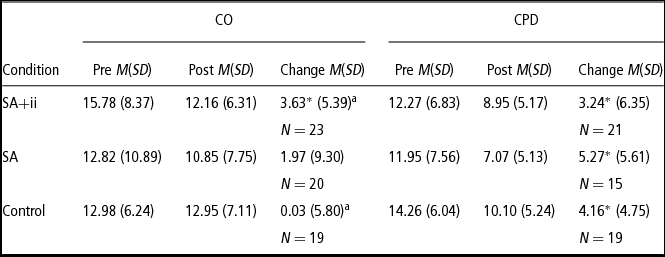
Change over time varies dependent upon baseline smoking. Including baseline CO as a covariate in the CO model, the effect of time (F(1,58) = 13.74, p<0.001) remains and there is still no group-by-time effect. The baseline CO-by-time interaction is significant, F(1,58) = 35.87, p<0.001: People with higher baseline CO show greater CO reduction over time. Similarly, including baseline self-reported cigarettes/day as a covariate in the cigarettes/day model, the effect of time remains F(1,51) = 5.60, p = 0.02 and there is no group-by-time interaction. The baseline cigarettes/day-by-time interaction is significant, F(1,51) = 43.14, p<0.001: People with higher baseline cigarettes/day show greater reductions in cigarettes/day over time. The means and standard deviations for CO and cigarettes/day by time and condition are shown in Table 1.
Summary of means and standard deviations for exhaled CO and CPD as a function of experimental condition

Note. CO = Exhaled carbon monoxide, parts per million; CPD = Cigarettes smoked per day.
a Group means differ with p<0.05.
* Significant pre–post-change.
A group-by-time ANOVA indicated reduced symptom severity overall on the SJWS, F(1,59) = 42.62, p<0.001, with a marginal group-by-time interaction, F(2,59) = 3.11, p = 0.052. Follow-up comparisons revealed greater decreases in withdrawal symptoms in the SA (M = 1.06, SD = 0.99) as compared to the SA+ii group (M = 0.41, SD = 0.88; F(1,59) = 6.14, p = 0.02). Control (M = 0.65, SD = 0.62) did not differ significantly from either experimental group. No correlations were found between change in CO or cigarettes/day and withdrawal symptoms, suggesting that individuals with greater change in CO and smoking did not systematically experience less withdrawal.
Changes in withdrawal were driven by a subset of the subscales. The craving (F(1,59) = 57.55, p<0.001) and physical symptom (F(1,59) = 13.85, p<0.001) subscales decreased pre to post for all groups. Psychological symptoms decreased pre to post, F(1,59) = 21.12, p<0.001, with differences by group, F(2,59) = 4.43, p<0.02. A follow-up contrast revealed that the difference was between the experimental groups F(1,59) = 8.81, p = 0.004 with neither differing significantly from control. The appetitive and stimulation subscales did not decrease over time. FTND scores revealed a marginally significant decrease, F(1,59) = 3.65, p = 0.06, with no difference by group.
Discussion
This study tested the efficacy of three levels of text message personalisation decreasing smoking among adults. Participants received daily texts containing the generic or self-authored content for cessation. As expected, smoking (exhaled CO) decreased significantly across all groups. Overall, the data do not provide strong evidence that deep tailoring with implementation intentions is superior to ‘shallow’ tailoring via unstructured self-authored messages or even generic untailored messages for boosting the efficacy of SMS-based cessation support. Instead, it appears that each treatment reduces smoking equally.
This is the first study to examine SA as a form of deep tailoring for cessation. Our hypothesis that deep tailoring would improve the efficacy of text-message-based cessation support is not supported. Power analysis of the group-by-time interaction indicates that the required sample size for that effect (80% power) is 213. The effect may therefore be too small to warrant further investigation. In contrast, the overall decrease in tobacco consumption suggests that investigation into SMS-based smoking interventions should continue. Participant feedback was generally favourable, despite some individuals’ difficulty in generating the content. Future studies may benefit from inclusion of qualitative measures to refine SMS-based interventions.
This pilot had several limitations. Exhaled CO indicates only 24–48-hour past smoking, limiting our ability to test whether participants ceased smoking entirely at any point during the study, or whether there are group differences in latency to return to smoking. Future studies will use more sensitive measures and conduct longer term follow up to determine the durability of smoking decreases. Use of e-cigarettes or nicotine replacement therapies was not explicitly forbidden, and we do not have data on whether replacements were used. Future studies will assess these variables.
Interestingly, though all groups reported smoking fewer cigarettes/day, this was reflected in exhaled CO in the SA+ii group only. This could reflect group differences in smoking behaviours such as depth of inhalation. Another possibility is that self-reported smoking behaviour may reflect perceived intervention efficacy rather than actual smoking behaviour. Nonetheless, texting-based interventions decrease smoking and may decrease psychological symptoms of withdrawal, and may therefore be a cost-effective, easily scalable means of delivering health content. Much research is needed to identify ways to bolster intervention efficacy.
Acknowledgements
The authors are grateful to Ilsé Anáhí and Steven Ibara for their help with data collection and Jeremy Williams for designing the Quitjuice program used for text-message delivery.
Financial Support
This work was supported by the National Institutes of Health (AG048840, CA175241, DA035763 to ETB) and through pilot funds from the Michigan Center for Excellence in Cancer Communications Research (CA101451 to ETB; PI: Strecher).
Conflict of Interest
None.
Ethical Standards
The authors assert that all procedures contributing to this work comply with the ethical standards of the relevant national and institutional committees on human experimentation and with the Helsinki Declaration of 1975, as revised in 2008.