Research in psycholinguistics requires that the features of experimental stimuli be identified correctly and manipulated systematically in order to avoid potentially biased results. Cognitive research designs, as in studies of semantic memory (Smith, Reference Smith and Estes1978; Tulving, Reference Tulving, Tulving and Donaldson1972), require that selection of verbal and visual stimuli be controlled in order to define the research question with precision and clarity. One method of doing so involves the use of normative studies, such as those examining frequency of word use (Alameda & Cuetos, Reference Alameda and Cuetos1995; Alonso, Fernandez, & Díez, Reference Alonso, Fernandez and Díez2011; Duchon, Perea, Sebastián-Gallés, Martí, & Carreiras, Reference Duchon, Perea, Sebastián-Gallés, Martí and Carreiras2013; Justicia, Reference Justicia1995; Manzano, Piñeiro, & Pereira, Reference Manzano, Piñeiro and Pereira1997), which plays a vital role in word recall. In studies of lexical relations, however, Word Association Norms are typically used (Alario & Ferrand, Reference Alario and Ferrand1998; Deyne & Storms, Reference Deyne and Storms2008; Fernandez, Díez, & Alonso, Reference Fernandez, Díez and Alonso2010; Macizo, Gómez-Ariza, & Bajo, Reference Macizo, Gómez-Ariza and Bajo2000; Schulte, Borgwaldt, & Jauch, Reference Schulte, Borgwaldt and Jauch2012).
Word Association Norms (WANs) are databases, usually comprising two essential elements: stimulus words (SWs) and response words (RWs). WANs are generally created through free association tasks (Coronges, Stacy, & Valente, Reference Coronges, Stacy and Valente2007; Deyne & Storms, Reference Deyne and Storms2008; Salles, Holderbaum, & Machado, Reference Salles, Holderbaum and Machado2009), in which participants are asked to indicate, either orally or in writing, the first word that comes to mind when they read or hear a stimulus word (e.g., dog–cat). WANs have several objectives: to determine what lexical relations are most frequently produced by speakers of a given language variety; to measure the strength of association between words; and to ascertain whether or not two words are directly related. They can also be used to explore the different relations that are produced at different ages (Hirsh & Tree, Reference Hirsh and Tree2001). WAN databases facilitate the process of selecting lexical stimuli in research by providing indices and measures of word sets, including the associative strength of the first associate, the number of associates, and the number of idiosyncratic responses (Callejas, Correa, & Lupiáñez, Reference Callejas, Correa and Lupiáñez2003; Macizo, Gómez-Ariza, & Bajo, Reference Macizo, Gómez-Ariza and Bajo2000; Nelson & Bajo, Reference Nelson and Bajo1985). WANs are often employed in the design of semantic memory experiments, such as those involving lexical decision or naming tasks, to ascertain which words have activating or inhibiting effects (Alario, Segui, & Ferrand, Reference Alario, Segui and Ferrand2000; Ferrand & New, Reference Ferrand and New2003; Hutchinson, Balota, Cortese, & Watson, Reference Hutchinson, Balota, Cortese and Watson2008; Perea & Rosa, Reference Perea and Rosa2002). WANs are also used in studies of false recall and false recognition, in which lists of associated words are compiled to explore false memory generation (Cadavid, Beato, & Fernández, Reference Cadavid, Beato and Fernández2012; Gallo & Roediger, Reference Gallo and Roediger2002; Roediger & McDermott, Reference Roediger and McDermott1995). The frequency of a response word given for particular stimulus word indicates the associative strength of the two words in semantic memory (Nelson, McEvoy, & Dennis, Reference Nelson, McEvoy and Dennis2000; Salles et al., Reference Salles, Holderbaum, Becker, Rodrigues, Liedtke, Zibetti and Piccoli2008). By analyzing word associations, researchers obtain representative and reliable numerical data on the relations between words for speakers of the same language variety, which can be used to measure lexical effects such as priming. Lexical priming is generally defined as an effect whereby a word (e.g., “bee”) is processed faster if the preceding word is semantically and/or associatively related (e.g., “honey”) than if it is unrelated (Alario et al., Reference Alario, Segui and Ferrand2000; Ferrand & New, Reference Ferrand and New2003; Hutchinson et al., Reference Hutchinson, Balota, Cortese and Watson2008; Meyer & Schvaneveldt, Reference Meyer and Schvaneveldt1971; Perea & Rosa, Reference Perea and Rosa2002). Accordingly, priming effects depend on stored information about the relation between two words.
Stimulus words for priming tasks are generally drawn from WAN corpora so that stimulus selection is systematic and based on associative frequencies in a sample that speaks the same linguistic variety. The criterion of associative strength will depend on the specific research goals (Alario et al., Reference Alario, Segui and Ferrand2000; Perea & Rosa, Reference Perea and Rosa2002). Selecting related or unrelated word pairs using WANs is one of the best ways to predict facilitation or inhibition effects in a population that speaks the same language variety. WANs also allow researchers to explore the type of lexical relation between stimulus words (SWs) and response words (RWs), and to measure specific effects: semantic, associative, or combined (Alario et al., Reference Alario, Segui and Ferrand2000). This sort of task has been applied to populations of adults (Lucas, Reference Lucas2000; McRae & Boisvert, Reference McRae and Boisvert1998; Meyer & Schvaneveldt, Reference Meyer and Schvaneveldt1971), school-age children (Nation & Snowling, Reference Nation and Snowling1999; Schvaneveldt, Ackerman, & Semlear, Reference Schvaneveldt, Ackerman and Semlear1977), and even clinical populations with amnesia (Schacter, Reference Schacter1985; Shimamura & Squir, Reference Shimamura and Squire1984) or neurological disorders such as multiple sclerosis, which can lead to impairments in language processing (Hagoort, Brown, & Swaab, Reference Hagoort, Brown and Swaab1996; Ukkonen, Vahvelainen, Hämäläinen, Dastidar, & Elovaara, Reference Ukkonen, Vahvelainen, Hämäläinen, Dastidar and Elovaara2009). Recent experimental adaptations have provided evidence that lexical relations are formed in the second year of life (Arias-Trejo & Plunkett, Reference Arias-Trejo and Plunkett2009; Rämä, Sirri, & Serres, Reference Rämä, Sirri and Sarres2013).
English-language WANs have long been used to examine lexical effects. Kent and Rosanoff (Reference Kent and Rosanoff1910) were the first to attempt an English WAN; they used a list of 100 stimulus words on a sample of 100 adults. Other authors, including Palermo and Jenkins (Reference Palermo and Jenkins1964), later created larger WAN databases. Of the English-language WANs most widely used, three in particular are worth noting: The Edinburgh Associative Thesaurus (Kiss, Armstrong, Milroy, & Piper, Reference Kiss, Armstrong, Milroy and Piper1973) includes 8,400 stimulus words used with 100 participants; the Birkbeck Word Association Norms (Moss & Older, Reference Moss and Older1996) has 2,464 stimulus words that were presented to British adults; and the University of South Florida Association Norms (Nelson, McEvoy, & Schreiber, Reference Nelson, McEvoy and Schreiber2004), the largest WAN database in the English language, which includes 5,019 stimulus words and responses collected over more than 20 years. WAN databases have also been compiled in other languages, including German (Walde, Borgwaldt, & Jauch, Reference Walde, Borgwaldt and Jauch2008), Dutch (Deyne & Storms, Reference Deyne and Storms2008), and French (Alario & Ferrand, Reference Alario and Ferrand1998).
In Spanish, there is a WAN database of 5,819 stimulus words from the European Spanish dialect (Fernández et al., Reference Fernandez, Díez and Alonso2010) that were gathered from several sources, including 247 frequent words corresponding to the standardized drawings of Snodgrass and Vanderwart (Reference Snodgrass and Vanderwart1980); 664 from false recall norms created by Fernández et al., (Reference Fernandez, Díez and Alonso2010); 1,372 from a normative study by Algarabel, Sanmartín, García, and Espert (Reference Algarabel, Sanmartín, García and Espert1986); and 3,536 from various normative studies in Spanish and participants’ responses to associative norms presented in various studies (Fernández, Diez, Alonso, & Beato, Reference Fernández, Diez, Alonso and Beato2004; Fernández et al., Reference Fernandez, Díez and Alonso2010). Fernández et al. (Reference Fernandez, Díez and Alonso2010) report norms based on analysis of stimulus and response words, direct and backward associative strength, number of associates, and blank responses. Their database is available online and allows users to search for relationships in both directions: stimulus word → response word, and vice versa. There is also a Spanish-language corpus (Macizo et al., Reference Macizo, Gómez-Ariza and Bajo2000) that presents associative data for 58 words collected from a sample of 100 school children 8 to 13 years old. Macizo and his collaborators (2000) compared their results to word-association data in adults (Algarabel, Ruíz, & Sanmartín, Reference Algarabel, Ruíz and Sanmartín1988), taking into account associative strength, number of associates, and idiosyncratic responses, among other measures. They concluded that developmental age influences the organization of associative knowledge.
WANs reflect the language and culture of participants in the sample. Thus, norms obtained in one language cannot be directly extrapolated to another. Even within the same language, the features of a given stimulus may vary from one culture to the next due to factors such as frequency of use, word or spelling variants, pragmatic questions, and other considerations. As numerous authors have concluded (Macizo et al, Reference Macizo, Gómez-Ariza and Bajo2000; Manzano et al., 1997; Sanfeliu & Fernández, Reference Sanfeliu and Fernández1996), there is therefore a need to study different varieties of the same language within specific cultures.
Some normative studies have been conducted in Mexican Spanish. Aveleyra, Gómez, Ostrosky-Solís, Rigalt, and Cruz (Reference Aveleyra, Gómez, Ostrosky-Solís, Rigalt and Cruz1996), for example, aimed to standardize a set of visual stimuli to be used in semantic memory research. To date, however, there are no WANs for Mexican Spanish, restricting word selection to norms created for European Spanish. Given the lack of Association Norms in Mexican Spanish, the main objective of this study is to create such a database.
Method
Participants
Participants in this study included 578 healthy adults (339 women) who met the following inclusion criteria: 18–28 years of age (M = 21.67), and completion of at least 11 years of schooling with concentration in one of the following four areas of study: Area I: Physics/Computer Science/Mathematics; Area II: Biological and Health Sciences; Area III: Social Sciences; and Area IV: Arts and Humanities. Educational backgrounds were balanced to avoid bias associated with a particular area of knowledge. All participants were monolingual speakers of Mexican Spanish.
Stimuli
We selected 234 stimulus words, all concrete nouns, from the MacArthur Inventarios del Desarrollo de Habilidades Comunicativas, Palabras y Oraciones [MacArthur Communicative Development Inventories, Words and Sentences] (Jackson-Maldonado et al., Reference Jackson-Maldonado, Thal, Marchman, Newton, Fenson and Conboy2003), which assesses language development in children 18 to 30 months old who are learning Mexican Spanish. The words were selected from this source so the data obtained from the WANs could later be used to test the formation of lexical relations in children of the same age. Recent studies (Arias-Trejo & Plunkett, Reference Arias-Trejo and Plunkett2009; Rämä, Sirri, & Serres, Reference Rämä, Sirri and Sarres2013; Torkildsen, Syversen, Simonsen, Moen, & Lindgren, Reference Torkildsen, Syversen, Simonsen, Moen and Lindgren2007) have reported on the formation of lexical relations in this same age range in English, French, and Norwegian. The selection of word pairs (prime-target) used in these studies were taken from WANs (Alario & Ferrand, Reference Alario and Ferrand1998; Moss & Older, Reference Moss and Older1996); however, the fact that WANs do not necessarily include stimulus words that infants will know limits their use in research on early lexical effects. With this in mind, the present study employed stimulus words that could be used in future research on both children and adults. The WANs reported in this study will, among other uses, provide a corpus from which researchers can select pairs of related words, all identified as belonging to early vocabulary.
The total list of 234 stimulus words (SW) was randomly divided into two parts (versions A and B) so that participants would not become tired while completing the test. The stimulus words’ arrangement in the two lists was later revised so that two words from the same category (e.g., dog-horse) could not appear consecutively, which might have influenced participants’ responses. Each list included 120 words: 117 SWs and the same 3 familiarization words (not later analyzed) – tazón [bowl], bocina [speaker], cucaracha [cockroach] – presented at the beginning of each list to familiarize participants with the task and the computer.
Procedure
A graphical user interface using the MySQL data management system was developed to apply the WAN test, compile and analyze the data, and present the results. Following a pilot study, the interface was installed on laptops so the test could be administered at participants’ universities.
The WAN test was administered individually on laptops in a noise-free, isolated room (e.g., a classroom or library Footnote i ). The experimenter read detailed instructions aloud to the participant and answered any questions. Then the computerized testing session began. First, the following basic instructions appeared on the screen to remind the participant about the testing procedure: “A continuación te presentamos una lista de palabras, abajo de cada palabra debes escribir la primera palabra que venga a tu mente. Es necesario que respondas lo más rápido posible y sólo escribas una palabra en el cuadro. Para pasar a la siguiente palabra presiona la tecla ‘Enter’. Una vez que presiones ‘Enter’ no podrás regresar a la palabra anterior. Recuerda que no hay respuestas correctas o incorrectas. Presiona la tecla ‘Enter’ para iniciar” [“A list of words will be presented. Under each word, write the first word that comes to mind. Please respond as quickly as possible and write only one word in each blank. To continue to the next word, press the ‘Enter’ key. Once you press ‘Enter,’ you will not be able to go back to the previous word. Remember that there are no right or wrong answers. Press ‘Enter’ to begin.”]. Once the participant pressed ‘Enter’, SWs from the test started to appear one by one (always beginning with the 3 familiarization words). Participants were given a maximum of 10 seconds for each response. The 10-second limit was chosen based on a pilot study that determined average response times in 10 participants who met the same inclusion criteria as the study’s final sample. If participants did not, as instructed, press ‘Enter’ to continue to the next word, the system automatically stored what they had entered in the blank and proceeded to the next SW. If a participant wrote nothing at all in the blank, the system likewise continued to the next SW after 10 seconds. Once the next word was presented, the participant could not return to previous words. Each test lasted approximately 20 minutes.
Results
A total of 67,743 response words (RWs) were collected from 585 applications of the test (Version A = 304, B = 281). Seven tests, in which participants responded to fewer than 60% of SWs (70 of the 117 SWs per list), were eliminated, leaving a total of 67,622 RWs (99.82%) for quantitative analysis. The average blank response rate for individual SWs was 3.07 %. Responses consisting of a nonsensical series of letters (e.g.,“djgfsd”) were also eliminated. RWs in English were eliminated if they merely copied or translated the stimulus word (e.g., vestido–dress), but if they referred to another word, they were left as written (e.g., computadora [computer]–mouse). Participants responded with English words to 0.22% of the SWs presented.
The response words (RWs) were stored in a database. Spelling and accent marks were later standardized, using the Diccionario de la Real Academia Española (RAE) and the Diccionario del Español de México (DEM). Any extraneous characters distorting the meaning of a response were eliminated (e.g., vestido– largopp → largo [dress–longpp → long]). Also, to avoid dividing associative strengths among variations of the same word (e.g., juguete [toy]–niño [boy], niña [girl], niños [boys/children], niñas [girls] → niño [boy/child]), words were grouped according to the criteria suggested by Goikoetxea (Reference Goikoetxea2000): grammatical variations by gender were combined under the masculine form (e.g., pelota [ball]–niño [boy], niña [girl] → niño [boy/child]), and variations in number were combined under the singular form (e.g., pelota [ball]–niños [boys/children], niñas [girls] → niño [boy/child]), unless the proportion of feminine or plural responses was significantly higher than the proportion of masculine or singular responses. The feminine form prevailed in 3 cases: falda–niña [skirt–girl]; muñeca–niña [doll–girl]; aretes–niña [earrings–girl], and the plural form in the following cases: lentes–ojos [lenses–eyes]; plumones–colores [markers–colors]; patines–ruedas [skates–wheels]; crayolas–colores [crayons–colors]; dientes–blancos [teeth–white]; and botas–zapatos [boots–shoes]. Variations in tense were grouped with the infinitive (e.g., pelota [ball]–jugaba [he/she played], jugar [to play] → jugar [to play]); however, where a verb could not be distinguished from a noun or an adjective (e.g., juego [I play vs. game]). Finally, response words with the same root were combined (e.g., abeja [bee]–piquete [sting], picadura [sting] → picadura [sting]), opting for the variation most frequently used according to Diccionario del Español de México [Spanish Dictionary of Mexico] (DEM) and Real Academia Española (RAE) (2001) [Spanish Royal Academy].
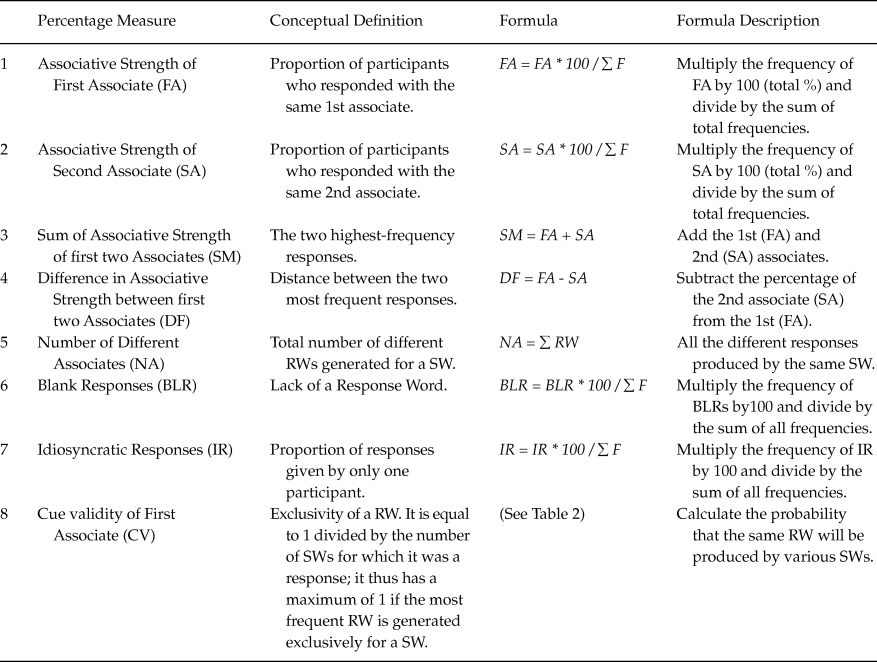
For each SW, we calculated the response frequency and eight different measures often reported in the literature to provide information about various factors, including the degree of association between SW and RW. These measures include Associative Strength of the First Associate (FA); Associative Strength of the Second Associate (SA); Sum of Associative Strength of first two Associates (SM); Difference in Associative Strength between the first two Associates (DF); Number of Different Associates (NA); Blank Responses (BLR); Idiosyncratic Responses (IR); and Cue Validity of the First Associate (CV). These measures were suggested in studies by Callejas et al. (Reference Callejas, Correa and Lupiáñez2003); Macizo, Gómez-Ariza, and Bajo (Reference Macizo, Gómez-Ariza and Bajo2000); and Nelson and Bajo (Reference Nelson and Bajo1985), except for cue validity of the first associate (CV), which came from McRae, Cree, Seidenberg, and McNorgan (Reference McRae, Cree, Seidenberg and McNorgan2005). Table 1 presents conceptual and operational definitions of each measure. These measures make it easier to consult and intrepret data, given that the number of RWs per SW differed after the sorting criteria were applied. They will also make it possible to systematically select verbal stimuli in future studies. Appendix 1 displays results for all 234 SWs, in alphabetical order, on these eight measures.
Conceptual and Operational Description of Percentage Measures

Contrasting Examples of Cue Validity (CV) Measure
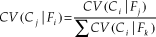
 $$CV{\rm{(}}{C_j}|{F_i}{\rm{)}}\, = \,{{CV({C_i}|{F_j})} \over {\sum {CV({C_i}|{F_k})} }}$$

Note: The above formula was modified from the one originally proposed by McRae, Cree, Seidenberg & McNorgan (Reference McRae, Cree, Seidenberg and McNorgan2005).
The Associative Strength of First Associate measure was used to classify RWs, in keeping with the proposal of Salles et al. (Reference Salles, Holderbaum, Becker, Rodrigues, Liedtke, Zibetti and Piccoli2008). Those authors proposed three numerical ranges to classify associative strength: an associate is considered weak if it receives less than 10% of total responses; medium between 10 and 24.99%; and strong with 25% or more. Of the WANs presented here, we found 113 strong First Associates (range = 25–75.66 %), 119 medium First Associates (range = 10.10–24.9%), and 2 weak First Associates: botas–zapatos [boots–shoes]; and ventana–aire [window–air] (range = 7.63–8.67 %). Some examples of word pairs with strong associatiation include cuna–bebé [crib– baby], abeja–miel [bee–honey], suéter–frío [sweater–cold]; examples of medium association include sol–calor [sun–heat], puerta–abrir [door–open], and uvas–vino [grapes–wine].
The average Number of Associates (NA) is the total number of different responses generated by each of the 234 SWs. The mean NA per SW was 56.97 (range = 25–98). The SW that generated the fewest different responses was carriola [baby carriage] (n = 25), while computadora [computer] generated the most (n = 98).
Finally, a descriptive analysis of the Cue Validity of First Associate (CV) measure revealed that 112 (48 %) of 234 SWs had a CV of 1.0. That is, the RW produced as First Associate was a response exclusively to that word (e.g., the RW miel [honey] was the First Associate only when the SW was abeja [bee]). The remaining 122 SWs had CVs between 0.09 and 0.50, indicating that certain responses were produced as First Associates for multiple SWs (e.g., dormir [sleep] is the first associate for the SWs cama [bed], pijama [pajamas], and almohada [pillow]). Using these data, researchers will be able to select word pairs as a function of their associative strength or internal consistency.
Discussion
The objective of the present study was to create a database of Word Association Norms (WANs) for Mexican Spanish. For that purpose, 234 words were selected, all of which are acquired early in lexical development, because one of the future goals of this research is to examine these associations in a population of Spanish-speaking children. Next, a graphical user interface was designed so the WANs could be administered to 578 young adults (each responding to 117 stimulus words), controlling for level of education and field of study. Participants read a stimulus word on a screen and then produced a word in response within 10 seconds. The population’s demographic variables were taken into consideration. Analyses of the results according to gender and area of study are not presented here, but the online program that is a product of this research can be used for such analysis. Users can also search online to find the type of lexical relation connecting a given word pair (e.g., thematic, taxonomic).
After all the response words (RWs) were generated from stimulus words (SWs), a process of sorting and combining RWs left 578 test results of the 585 originally applied, with a total of 67,622 RWs for quantitative analysis, from which eight measures were calculated (see Table 1). One of these was the associative strength within word pairs (SW-RW). The goal of this analysis was to create a systematic, representative measure with which to select verbal stimuli for research on the effects of word-word relationships among speakers of Mexican Spanish. Furthermore, measuring the total number of different response words and the Cue Validity of the First Associate highlighted the consistency and uniqueness of the mental relationships participants formed. The normative data in this study were developed to provide an objective tool for the study of lexical effects through the consistency of responses to a set of stimulus words. In addition, since word selection was restricted by the criterion of early acquisition, the associations obtained here could be employed in future research on early sensitivity to lexical relations. Although the ideal would be to compile WANs from a sample of children, the database created in this study is an important first step. Future studies could collect Word Association Norms in populations of children or bilinguals, assessing directly the responses of children or the effects of lexical competition in people who speaks more than one language.
In spite of the limitations of this study, the WAN database constitutes a valuable source of information regarding a corpus of words and offers data that are necessary and representative about the relationships among a set of words in one variety of Spanish. This corpus will be highly useful to researchers exploring a range of topics, from semantic memory (Smith, Reference Smith and Estes1978; Tulving, Reference Tulving, Tulving and Donaldson1972), to priming effects (Alario et al., Reference Alario, Segui and Ferrand2000; Ferrand & New, Reference Ferrand and New2003; Hutchinson et al., Reference Hutchinson, Balota, Cortese and Watson2008; Lucas, Reference Lucas2000; Perea & Rosa, Reference Perea and Rosa2002), lexical networks, mathematical models of lexical relationships (Steyvers & Tenenbaum, Reference Steyvers and Tenenbaum2005; Steyvers & Griffiths, Reference Steyvers, Griffiths, Landauer, McNamara, Dennis and Kintsch2003), in populations with normal development or with deficits or disorders affecting linguistic processing (Hagoort, Brown, & Swaab, Reference Hagoort, Brown and Swaab1996; Ukkonen et al., Reference Ukkonen, Vahvelainen, Hämäläinen, Dastidar and Elovaara2009).
The complete corpus Base de Datos: Normas de Asociación de Palabras para el Español de México (Arias-Trejo & Barrón-Martínez, Reference Arias-Trejo and Barrón-Martínez2014) is available online Footnote 1 , or upon request by email from the authors. The corpus, with its set of 234 stimulus words and their respective response words, as well as percentage data on the eight measures (by sex, area of knowledge, or both).
This research was funded by two grants awarded to N. Arias-Trejo: CONACyT-167900 Mecanismos en la formación y modulación de redes semánticas durante la infancia y la etapa adulta, and PAPIIT-IN309214 Desarrollo del lenguaje en niños con síndrome de Down: la comprensión temprana.
Appendix Summary of the Response Words (RWs) obtained for the 234 Stimulus Words (SWs), FA%: Associative Strength of 1st Associate, SA %: Associative Strength of 2nd Associate, SM %: Sum of Associative Strengths of first two Associates, DFA %: Difference in Associative Strength between 1st and 2nd Associates, AN: Number of Different Associates, BLR %: Blank Responses, IR %: Idiosyncratic Responses, CV: Cue validity of 1st Associate