Introduction
The second half of the nineteenth century was crucial for the development and understanding of human evolution and prehistory, including the elaboration of cultural sequences for European prehistory from the Palaeolithic onwards. That process started much earlier with Christian Thomsen in Denmark (Daniel, Reference Daniel1976; Trigger, Reference Trigger1989), quickly spreading to most of northern and central Europe. It was at this time that human evolution and the presence of early humans was finally accepted, overcoming the dominant conservative paradigm championing a short chronology based on Biblical time. Discoveries and scientific innovations were fundamental for that revolution and the acceptance of deep time; publications included, among others, Lyell's Principles of Geology (Reference Lyell1830) leading to the acceptance of the concept of Uniformitarianism, the discovery of fossil Neanderthal remains in Forbes Quarry in Gibraltar in 1856 (Menez, Reference Menez2018), the first publication of the discovery of Neanderthal fossils in Germany (Schaaffhausen, Reference Schaaffhausen1858), and the publication of Darwin's Origin of Species (Reference Darwin1859).
With the acknowledgement of deep time and early hominins, prehistoric archaeology jumped ahead, and excavations to recover and reconstruct that early past rapidly increased. The work of many scholars was fundamental during this phase, including that of archaeologists and physical anthropologists such as Schmerling (1791–1841) in Belgium, Boucher de Perthes (1757–1844) in France, and Buckland (1784–1856) and MacEnery (1796–1841) in England. Perhaps one of the most relevant figures in this process was William Pengelly because he was able to show the association of early humans in Britain with Pleistocene fauna in his work at various caves in Devon, the best known being Windmill Hill Cave (Brixham) and Kent's Cavern (Torquay), investigated in 1858–59 and 1865–80, respectively (Daniel, Reference Daniel1981: 53; W., 1897: 5; Walker, Reference Walker2015: 29). This scientific advance was based on Pengelly's introduction of a new excavation technique (Davis, Reference Davisn.d.; Dawkins, Reference Dawkins1894). This innovation, applied at Kent's Cavern in 1865, comprised not only the individual excavation of each geological layer but also recording the location of every artefact. Pengelly divided his excavation into blocks, called ‘yards’, three feet long, one foot wide, and one foot thick (Walker, Reference Walker2015).
Up to the 1850s, the artefacts and fossils were the centre of the archaeologists’ attention, with excavations generally focusing on gathering artefacts without any particular concern for their provenance. While this was not particularly important on open air sites with single archaeological horizons, it had a major impact in prehistoric cave sites, frequently leading to long sequences being mixed up due to the lack of contextual information recorded during excavation. It was precisely during this period that many findings were made on sites with Palaeolithic sequences and new fossils, such as those of Neanderthal and Gibraltar mentioned earlier. The second half of the nineteenth century was a key turning point in prehistoric archaeology, not only because of such discoveries, but also because of methodological innovations mostly in England but also in the Middle East on sites dating to more recent prehistoric periods.
In Portugal, prehistoric archaeology was virtually non-existent before 1850. The foundation in 1849 of the Sociedade Archeologica Lusitana (Cardoso, Reference Cardoso2018a) and the remodelling of the Geological Commission (Comissão Geológica de Portugal) in 1857 (Antunes, Reference Antunes and Antunes1986; Cardoso, Reference Cardoso2015) brought about major changes. The former was responsible for early large-scale archaeological projects in Portugal, at the Roman site of Troia in the Sado estuary south of Lisbon (Cardoso, Reference Cardoso2018a), while the latter was responsible for the excavation of several prehistoric caves in the Portuguese Estremadura as well as in the Muge Mesolithic shellmiddens (Bicho et al., Reference Bicho, Detry, Price and Cunha2015; Cardoso, Reference Cardoso and Franco2018b).
In the second half of the nineteenth century, archaeological research in Portugal, particularly that of Nery Delgado, who was a member of the Geological Commission, followed very closely the objectives of researchers and institutions of other European regions, namely attempting to document the existence of ‘Tertiary Man’ (Daniel, Reference Daniel1976: 98), and confirming the antiquity of Palaeolithic human fossils (Cardoso, Reference Cardoso2000, Reference Cardoso2013; Bicho & Cardoso, Reference Bicho and Cardoso2018). It is in this context that Nery Delgado undertook the excavation of various cave sites located some 70–100 km north of Lisbon in the Cesaredas Plateau, near the town of Óbidos. Nery Delgado, like Pengelly in the UK, used new methods in his excavations, including a grid, which is still standard practice today. Our article describes the application of these methods at the cave site of Casa da Moura in 1879–1880.
Nery Delgado (Joaquim Filipe Nery d´Encarnação Delgado, 1835–1908)
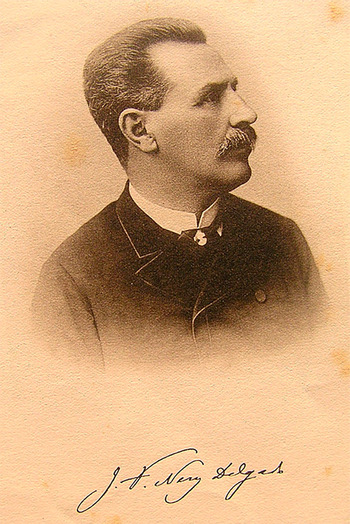
Nery Delgado (Figure 1) was a well-known Portuguese military engineer, geologist, and archaeologist who actively corresponded with his peers at a national and international level (Cardoso & Melo, Reference Cardoso and Melo2001) and made important contributions to international geological congresses (Carneiro et al., Reference Carneiro, Mota and Leitão2014).
Joaquim Filipe Nery Delgado (1835–1908) (João Cardoso personal archive).

Nery Delgado began his career at the Military School and then the Polytechnic School, graduating in Military Engineering from the Military Academy of Portugal in 1855. He was named deputy of the Second Geological Commission of Portugal when it was founded in 1857, where he showed remarkable activity, taking over its direction in 1882 after the death of Carlos Ribeiro. Delgado was repeatedly promoted in his military career, until he reached the rank of Division General (Lt-General). He continued research in geology until his death in 1908, following a double pneumonia contracted during fieldwork.
As a prominent member of the Royal Academy of Sciences in Lisbon, and of many other scientific societies, he soon became known internationally for the high quality of his scientific work in the field of geology and archaeology, especially on the geology of his country. This activity resulted in the edition of the Geological Map of Portugal, at a scale of 1/500 000, published in 1876, with a second edition two years later. The first draft of this map, coloured by hand, was presented at the Universal Exhibition in Paris in 1867, where it received an award. In addition to the country's geological mapping, he actively contributed to the stratigraphic and palaeontological characterization of Palaeozoic formations in Portugal, studying in particular the Ordovician bilobites of the Beiras group and those related to the Palaeozoic of the Alentejo in southern Portugal.
His contribution to European archaeological studies was equally unique, although he did not consider himself an archaeologist. Nery Delgado, alongside Carlos Ribeiro (1813–1882) and Francisco Pereira da Costa (1809–1889), who were responsible for the Second Geological Commission of Portugal (and the organizations that succeeded it), embody the development and coming of age in Portugal of prehistoric archaeology as scientifically sound and closely linked to geological studies, especially in the fields of stratigraphy and palaeontology. The latter's methods were instrumental in this development, as is clear in Delgado's early publications. Indeed, in Portugal, the spirit that animated the pioneers of the Second Geological Commission did not differ much from that of colleagues beyond the Pyrenees. Nery Delgado and his collaborators were aware of the progress made outside Portugal in the archaeology of early humankind. Their studies, following those in other European countries where prehistoric research had started earlier and was more developed, showed that it was possible to gain knowledge of the human past based on material culture buried in the vast archives of caves and open-air sites. These sites were interpreted, as they are today, on the basis of on stratigraphy and typology, revealing the remarkable modernity of the so-called ‘Golden Age’ of Portuguese archaeology.
The Casa da Moura Site in its Historical Context
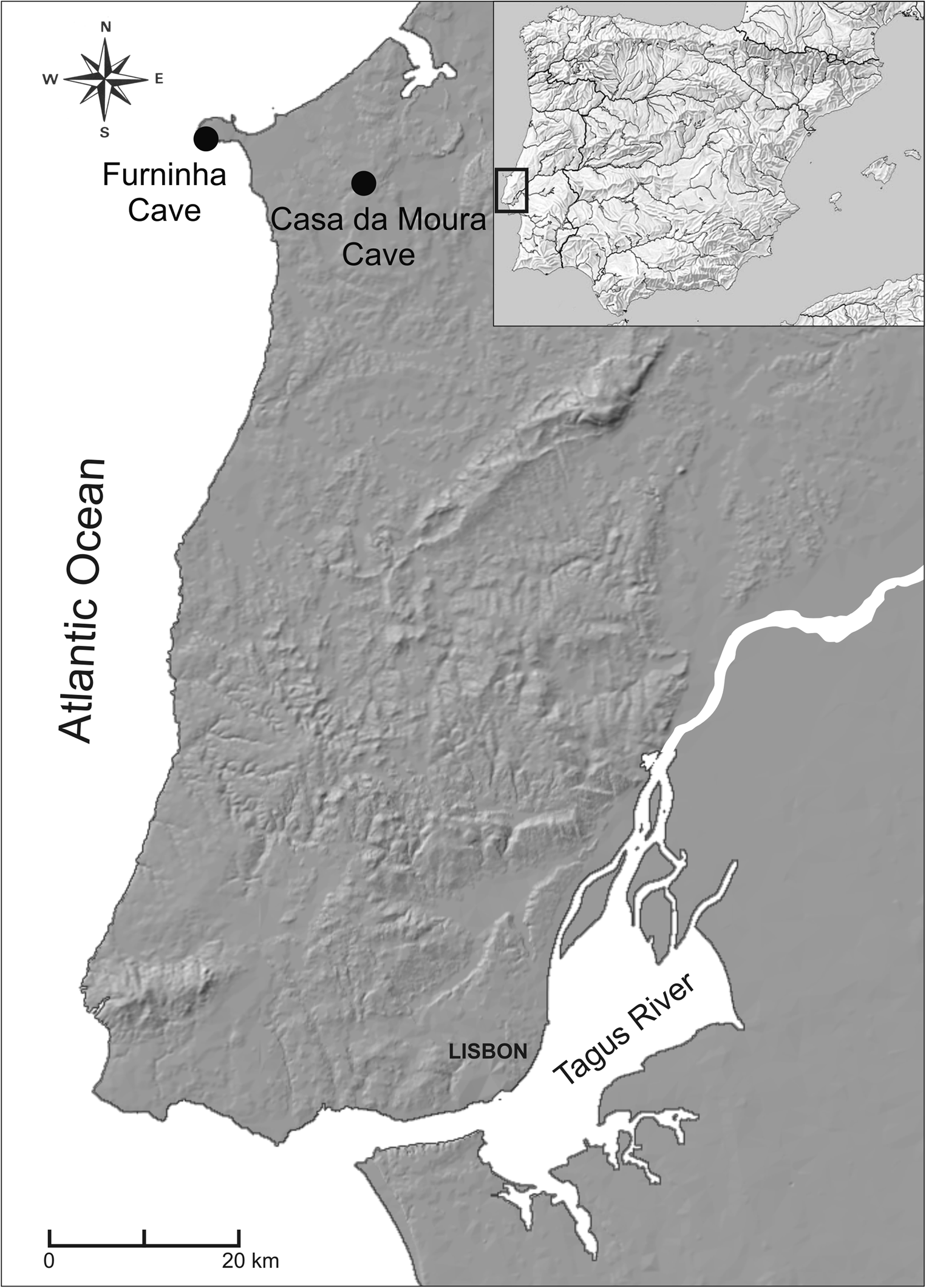
The Casa da Moura cave is located in the municipality of Óbidos in central Portugal (Figure 2). It is an opening in the Lower Jurassic limestone of the Cesareda plateau, a geomorphological unit with an elongated outline following a general northeast-southwest orientation that forms part of the northern foothills of the Montejunto mountain range. The cave lies, at about 160 m asl, on the northern edge of the plateau, some 25 m away from an escarpment delimitating that plateau. Its entrance, a short sinkhole, overlooks a vast landscape to the north.
Location of the Casa da Moura and Furninha caves.

From a speleological point of view, the cave's entrance is a narrow, almost vertical chimney, with a maximum width of 3 m and a height of about 4 m. It gives access to an irregular, somewhat sub-triangular chamber, separated from an inner chamber by a large block fallen from the roof. The two chambers are connected by two narrow side corridors running along the fallen block; these passages were marked in the plan drawn up at the time of Nery Delgado's work but published only now. The two chambers are also connected by an upper gallery. The floor of the first chamber, where the bedrock is presently completely exposed, dips towards the interior of the rocky massif, following the general orientation of the low and irregular roof. By contrast, in the second chamber, the dome-shaped ceiling is about 6 m high. This roof has a narrow vertical slit that connects with the surface (the so-called ‘ear of the Casa da Moura’). The second chamber narrows and slopes down to end in a vertical well, only recently recognized and of no archaeological interest.
Casa da Moura was first explored by Nery Delgado in 1865, at the same time as Pengelly was working at Kent's Cavern. Delgado's work resulted in a monograph published in 1867, the first-ever such publication in the Iberian Peninsula concerning archaeological work in a prehistoric cave. The excavation's primary purpose was to explore the Pleistocene deposit identified in the cave's first chamber (Delgado, Reference Delgado1867). This was dictated by a significant preoccupation of the geologists of the time, i.e. demonstrating the antiquity of the human species in the caves of western Europe through its coexistence with now extinct species of mammals. This is illustrated by the title of the monograph: Da existência do Homem no nosso solo em tempos mui remotos provada pelo estudo das cavernas. Primeiro opúsculo. Notícia acerca das grutas da Cesareda [On the existence of Man on our land in very remote times, proven through the study of caverns. First booklet. Note on the Cesareda caves].
This work was developed to pursue the objectives of the second Geological Commission of Portugal, working between 1857 and 1868 (Cardoso, Reference Cardoso and Franco2018b). The 1865–1866 fieldwork focused on a trench running the full width of the first chamber, uncovering a 2–4 m-long sequence with two major units, of which the bottom metre was of Pleistocene age (Cardoso, Reference Cardoso and Ramalho2008: 66). In Delgado's Reference Delgado1867 report, only one human skull was listed; its mandible, recovered from the interface between the Pleistocene and more recent deposits, may have originally come from the Pleistocene deposit or, alternatively, could have been buried in it. These remains were taken for study by the physical anthropologist Gisela Asmus to Germany, but they were never returned according to the late Octavio da Veiga Ferreira (1917–1997). Unfortunately, unless the original skull is found, its age cannot be ascertained. If of Pleistocene age, it would be the oldest example of an early Anatomically Modern Human ever found in the world, predating the findings from Cro-Magnon (Zilhão, Reference Zilhão1997). The antiquity of this fossil was, however, questioned at the time of its discovery. In 1874, Boyd Dawkins made the following comment: ‘A human skull with lower jaw was dug out the deepest part, but, since the matrix has been disturbed, it had probably been interred after the accumulation of the deposit’ (Dawkins, Reference Dawkins1874: 145).
In 1880, the fifteenth International Congress of Anthropology and Prehistoric Archaeology was held in Lisbon. This was the most important world archaeological meeting at the time (Gonçalves, Reference Gonçalves1980; Cardoso, Reference Cardoso2013). Portugal wanted to show the very significant prehistoric finds unearthed in the country, including the Mesolithic Muge shellmiddens, the flint ‘artefacts’ documenting the presence of the ‘Tertiary Man’ in Portugal, and the discoveries of lithic industries associated with Pleistocene and Holocene fauna and human remains in various caves in Estremadura, including the Casa da Moura. Naturally, the Geological Commission intended to show all the materials that had been excavated in those sites but, due to governmental decisions including the demise of the Second Geological Commission in 1869, the materials from Casa da Moura were not available for show at the congress (Cardoso, Reference Cardoso2020). As a result, the direction of the Geological Survey (i.e. Carlos Ribeiro and Nery Delgado) decided to return to the cave and recover new materials to show to the participants of the congress. Many of the most influential European prehistorians, including Cartailhac, Choffat, Evans, de Mortillet, de Quatrefages, Shaaffhausen, and Virchow would attend the meeting. It was therefore important to rapidly expand the collections that could be exhibited at this major international convention to highlight the activity taking place in Portugal. To this end, excavations began simultaneously in the Furninha and Casa da Moura caves in the last few months of 1879, creating the opportunity to clarify the nature of their Pleistocene deposits as well as other issues, namely the exploration of the upper deposit, still insufficiently studied.
The Casa da Moura campaign of 1879–1880 led to the full excavation of what was left of the lower deposit, dating to the Pleistocene period and in which human remains were scarce and possibly intrusive, and of the upper deposit described as ‘upper rubble’ with Neolithic/Chalcolithic burials. Unlike the previous campaign of 1865–1866, the objectives of the 1879–1880 season gave great importance to the exploration of the top layer, a poorly consolidated, blackish-brown sediment with abundant human remains and Neolithic and Chalcolithic artefacts, whose presence had previously been neglected.
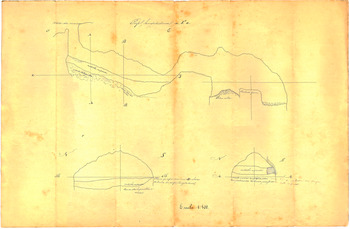
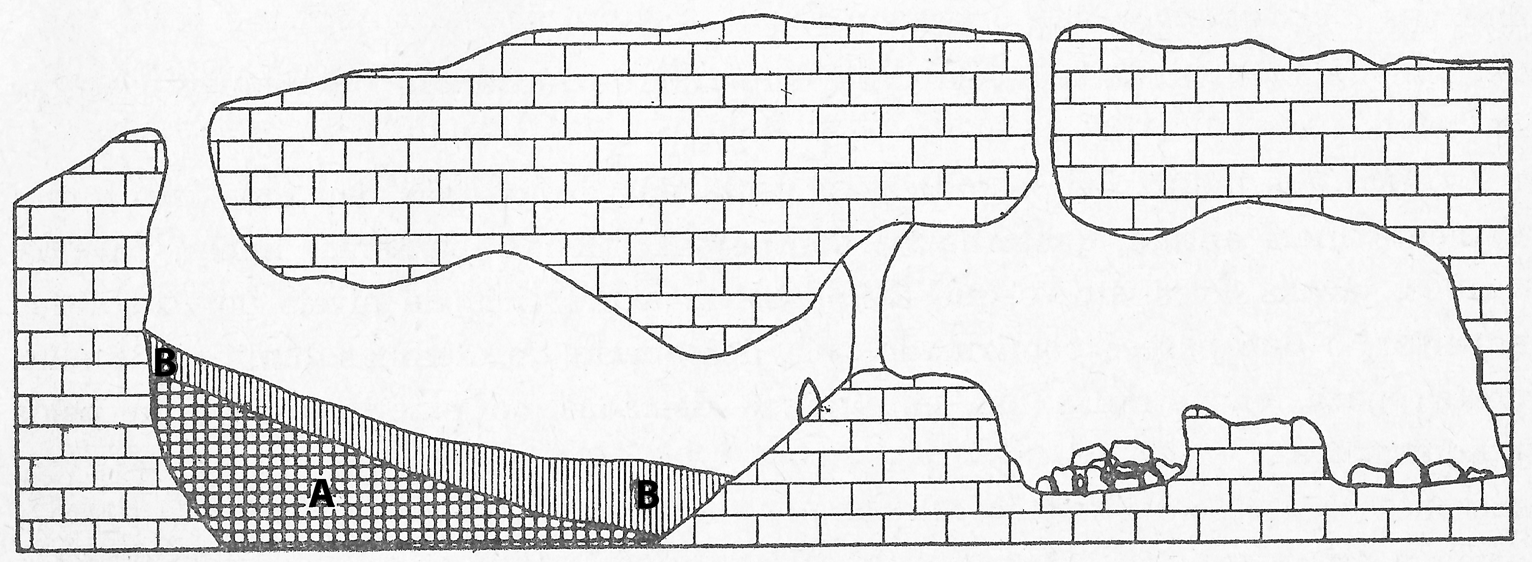
The 1879–1880 excavation of Casa da Moura was carried out in the cave's first chamber, deepening and widening the trench excavated in the 1860s. The stratigraphy in the first chamber, the one with the highest potential (Figures 3 and 4; Delgado, Reference Delgado1867), confirms the results obtained in 1865–66. Two main deposits were encountered: a top layer, dubbed ‘upper rubble’, was a brownish-black sediment with abundant human remains and archaeological material of Neolithic and more recent date belonging to a collective burial site; and an earlier deposit, separated from the previous layer by an important set of stalagmitic crusts, inter-stratified with a reddish sandy-clay. This latter lay directly on a stalagmitic mantle over the bedrock and was characterized by abundant rabbit and bird remains associated with some Palaeolithic stone and bone tools (Cardoso & Gomes, Reference Cardoso and Gomes1994; Zilhão, Reference Zilhão1997). At the time, these artefacts were not separated from the more recent archaeological remains. This sequence was later confirmed by the excavation of a small remnant of the deposit near the entrance of the cave, which had been left untouched (Straus et al., Reference Straus, Altuna, Jakes and Kunst1988).
Casa da Moura. Longitudinal section of the cave, showing the extent of the two almost completely excavated deposits, along with two cross-sections showing the thickness of the deposits. Original survey by Miguel Pedroso, reviewed by Nery Delgado (João Cardoso personal archive).

Profile of Casa da Moura based on the drawing illustrated in Figure 3. A: Pleistocene deposit; B top layer with Neolithic and later human burials. Drawing by João Cardoso.

The operation met with success, as attested by the reports (Relatório) of the Comissão dos Trabalhos Geológicos for the financial year 1879–1880 (published 1881) and 1881–1882. The later report illustrates the importance of that work: ‘Another Cesareda cave, known as Casa da Moura, which, as mentioned in the previous report, yielded an outstanding assemblage, especially human remains and Neolithic industries, was also thoroughly studied by the same Section Assistant and the recovered exemplars were duly classified and catalogued’ (authors’ translation of Relatório, 1882: 15). The results from the excavation of both caves were briefly but quickly published in June 1880, on completion of the excavations (Delgado, Reference Delgado1880). Two almost complete skulls from Casa da Moura (Oliveira, Reference Oliveira1884) and the detailed results obtained at Furninha at the same time were presented to the International Congress in Lisbon in the same year (Delgado, Reference Delgado1884). This gave rise to a heated debate, especially concerning anthropophagy (the consumption of human remains), firmly endorsed by Nery Delgado (Delgado, Reference Delgado1884).
Despite the large quantity and diversity of the archaeological remains recovered, only a few specimens were presented at the time (Cartailhac, Reference Cartailhac1886), and almost the entire collection remained unpublished until 2002 (Carreira & Cardoso, Reference Carreira and Cardoso2002) when the remains kept at the Geological Museum of the National Laboratory of Energy and Geology (LNEG) and the National Museum of Archaeology were described.
The Excavation and Methodological Innovations
It was frequent in Portugal during the nineteenth century and up to the mid-twentieth century to have labourers carrying out the excavation with only sporadic visits by those responsible. It was during these visits that the excavation strategy and methods were devised. This was the case at Casa da Moura and of Nery Delgado, who entrusted the work to Miguel Pedroso, a field assistant (colector) of the Geological Commission, as attested by letters sent by Pedroso to Nery Delgado and to the administrative officer of the Commission, Carlos Calderon (see Cardoso, Reference Cardoso2020 for a full transcription of all the letters exchanged between Miguel Pedroso, Nery Delgado, and Carlos Calderon).
These letters provide essential information on the progress of the work, and the difficulties encountered, illustrating that Nery Delgado's role was mostly to provide written guidance for the implementation of the excavation. More importantly for our discussion are indications of the innovative methods deployed by Nery Delgado during the excavation. It was this set of letters, recovered by Octavio da Veiga Ferreira in 1975/76 from the Geological Museum waste as they were being thrown away, together with documents concerning the 1879–1880 campaigns at the Casa da Moura cave, that enabled us to reconstruct the work carried out at Casa da Moura in 1880 during the months leading up to the 1880 International Congress.
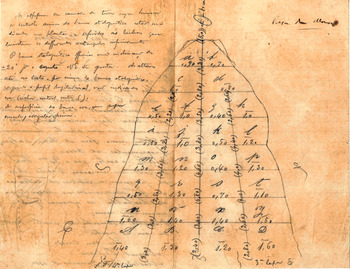
In the 1865–1866 campaign, the excavation was already rigorously conducted, with records of the depth of each finding, as stated by Nery Delgado: ‘By excavating the rubble, layer after layer, it was easy enough for us to recover all these objects, always knowing at which depth they had been found throughout the cave’ (Authors’ translation of Delgado, Reference Delgado1867: 46). This was taken even further in the 1879–1880 campaign, for which the documents demostrate the scientific quality, highly innovative for the time, of the excavation. In particular, a letter dated 2 January 1880, sent by the excavator, Miguel Pedroso, to Nery Delgado when the excavation was already well underway, contains the ground plan of the first chamber of the cave, with the following indication: ‘Remetto o desenho da gruta devedida em 28 partes’ [I am sending the drawing of the cave, divided into 28 parts]. The back of this letter shows a very detailed pencil drawing of the cave's main chamber (Figure 5), with measurements of the sides of the grid. An observation written in pencil by Nery Delgado, next to the ground plan view and postdating it, clarifies the meaning of the measurements included in the drawing:
‘A espessura da camada de terra negra humosa e entulho acima do banco stalagmitico estão indicados na planta, e referidos às linhas que limitam os differentes rectangulos inferiormente.
O banco stalagmitico offerecia uma inclinação de ± 20° para o canto N.E. da gruta. As alturas até ao tecto, por cima do banco stalagmitico, segundo o perfil longitudinal, vão indicados na linha central entre (). A superficie do banco era, como sempre succede irregularissima.’ (in Cardoso, Reference Cardoso2020: 135)
[‘The thickness of the layer of black humic soil and rubble above the stalagmitic crust are indicated in the plan, in relation to the lines delimiting the lower side of the various rectangles.
The stalagmitic crust had a dip of ± 20° towards the N.E. corner of the cave. The height of the roof, along the longitudinal profile, is indicated on the central line in () The surface of the crust was very irregular, as always.’] (translation of the letter published in Portuguese in Cardoso, Reference Cardoso2020: 135)
Casa da Moura. Pencil drawn plan of the cave, on the back of a letter dated 2 January 1880 addressed to Carlos Calderon. The twenty-eight sectors in the first chamber of the cave are indicated. Note the cave entrance, through a vertical well, situated at the top of the central axis of the drawing; the precise distances of each grid sector; indications of the third lapa (chamber) to the north, and fourth lapa, to the south (lower right and left sections of the diagram, respectively), on both sides of the large block fallen from the roof (in the lower section of the drawing to the right and left), which separated the first chamber from the second (João Cardoso personal archive).

We therefore conclude that Nery Delgado instructed Miguel Pedroso to make a detailed drawing, including variations in the thickness of the archaeological layers corresponding to the Neolithic and Chalcolithic burials, as observed in each excavated grid sector, as well as variations in the height of the cave roof. These data were gathered directly by Pedroso during excavation, making him the author of one of the most important documents of the early days of Portuguese archaeology, highlighting the valuable role field assistants played in the gathering of scientific knowledge, often forgotten or underestimated (Carneiro, Reference Carneiro2005). The twenty-eight grid sectors identified in the plan by capital and small letters, according to a predefined orthogonal grid, are similar in size, as can be seen from the numbers written on the plan; these sectors were excavated in successive predefined artificial levels.
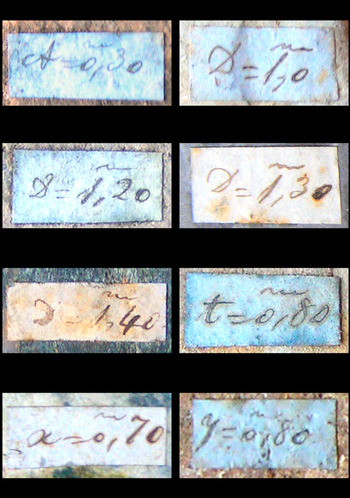
It is not easy for us to appreciate how harsh working conditions were, bearing in mind the rudimentary means available at the time, when the lighting of the cave was provided only by torches and candles. This grid, whose existence is only now confirmed by the newly-recovered documents, had been previously suspected to have existed on the basis of information present on the labels associated with the finds (Cardoso, Reference Cardoso and Ramalho2008: 66). The collection from the 1879–1880 work deposited at the Geological Museum shows this type of label on the back of some pieces: a capital or small letter, followed by a measurement in metres (ranging from 0.20 m to 2.0 m). A second label, if present, refers to a date corresponding to the time of recovery (Figure 6).
Examples of Casa da Moura original labels from 1879–1880, showing a letter and a number, corresponding to grid location and depth. By permission of the Geological Museum of the National Laboratory of Energy and Geology (LNEG; photographs by João Cardoso).

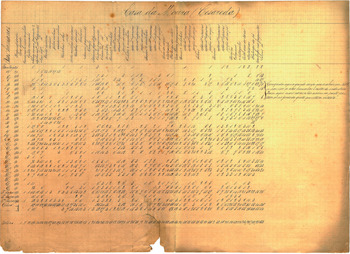
That the sectors recorded in the preserved ground plan were dug separately, sector by sector, is confirmed independently by the inventory of archaeological and anthropological remains listed in a set of fifty-four notebooks, where the depth of the finds was also logged. All entries were written by Nery Delgado, to varying degrees of detail. The first five notebooks contain observations and notes related to the excavation, probably in preparation for writing a second monograph that Delgado apparently intended to write but never completed.
The remaining notebooks contain a systematic inventory of all finds with information on the excavated grid sectors and the respective recovery depths. This was a painstaking task conducted over a long period and with extreme thoroughness, revealing the scientific standing of its author. This record provides the location of the most important archaeological items found at the time. The bioanthropological background of the author is also shown in this inventory since it summarizes the results obtained from the human bone fragments by location and depth.
Publications started to appear soon after the 1880 international congress in Lisbon (Bensaúde, Reference Bensaúde1884; Cartailhac, Reference Cartailhac1886). Only more recently have the bioanthropological remains been published, and dated to the Early Neolithic and up to the Bronze Age (Carreira & Cardoso, Reference Carreira and Cardoso2002; Antunes et al., Reference Antunes, Cardoso and Cunha2009; Carvalho & Cardoso, Reference Carvalho and Cardoso2011). The faunal remains were published in 1993 (Cardoso, Reference Cardoso1993), while the Palaeolithic artefacts were the object of a detailed revision (Zilhão, Reference Zilhão1997).
The conservation and storage of the artefacts, fauna, and human remains have an interesting history. There are a few archaeological pieces from the 1865–1866 excavations in the Portuguese National Museum of Archaeology in Lisbon (Cardoso & Carreira, Reference Cardoso and Carreira1996). The human remains recovered in 1865–1866 were kept at the Polytechnic School in Lisbon but were destroyed in a fire in 1978, except for the skull taken to Germany, as mentioned above. The assemblages (archaeological and human bones) from the 1879–1880 excavations were kept in the Geological Museum in Lisbon, the direct successor of the Geological Commission Museum, where they remain today.
As was common at the time, museums exchanged archaeological items. The Ashmolean Museum, in Oxford, and the British Museum received such artefacts from the Casa da Moura site, sent respectively to John Evans and Henry Hoyle Howorth in 1889 and 1890 (Cardoso & Melo, Reference Cardoso and Melo2001).
The documentation now published clearly shows the methodological innovations of the fieldwork developed by Nery Delgado. These innovations, exceptional for the time, included the meticulous plan of the area excavated at Casa da Moura, based on a detailed grid imposed on the surface of the cavern. In addition, Nery Delgado gathered accurate information on the thickness of the deposits and the elevation of the cave chamber in each excavation block. Finally, the 3D provenance of all artefacts, fauna, and human remains was recorded and related to the plan of the cave as well as to each excavated natural and artificial layer (Figure 7).
Original inventory of the human remains listed according to provenance (João Cardoso personal archive).

Some of the items kept in the Geological Museum in Lisbon still retain their labels, with information on provenance and depth. This information makes it possible to reconstruct the spatial and vertical distribution of the material excavated almost 150 years ago, almost as accurately as if a modern total station had been used.
The work carried out by Nery Delgado in 1879–1880 at the Casa da Moura cave, assisted by Miguel Pedroso, shows that the excavation, but also the study and inventory of the archaeological, anthropological, and faunal remains, were conducted to a high scientific standard. This seminal work was served by a critical spirit, methodological approach, and innovative character, a rather exceptional feat at the time.
Final Considerations
The objective of the present study is to highlight the innovative methodology adopted by Nery Delgado in the 1879–1880 excavation of the Casa da Moura cave. The documents now published reflect the pioneering spirit of this Portuguese geologist and archaeologist in the application of a method still in use today: the implementation of an excavation grid, setting up an orthogonal reference system that makes it possible to record the position of any item.
Nery Delgado's archaeological work at Casa da Moura, begun in 1865–1866 and continued in 1879–1880, was the first excavation of a cave with prehistoric occupation ever carried out in the Iberian Peninsula. The main objective of the 1865–1866 campaign was to document the association of stone tools with Pleistocene faunas. The excavation was carried out by a field assistant, Miguel Pedroso, who was instructed by Nery Delgado to establish a grid, which he successfully adapted to the geometry of the cavity. Setting up this reference system on the ground involved following an axis of symmetry defined by a line dividing the cave's gallery into two roughly equal parts, from which a system of parallel orthogonal lines was developed, resulting in the definition of the basic excavation areas identified by a letter. These areas were excavated according to predefined artificial levels, which feature on labels containing a number in metres.
This was not without precedent: William Pengelly had already adopted a similar system, based on sediment blocks named ‘yards’, at Kent's Cavern in 1865, resulting in the vertical overlap of successive yards (Davis, Reference Davisn.d.; McFarlane & Lundberg, Reference McFarlane and Lundberg2005; Walker, Reference Walker2015).
Compared to William Pengelly's methodology, the main difference was that the reference system adopted by Nery Delgado was easier to use, involving a more regular grid, identifying roughly sub-quadrangular basic units with areas readily adjustable to the pre-existing geometry of the cave. Indeed, the strict and elongated excavation units defined by Pengelly were difficult to apply in the excavation of a cave and could be advantageously replaced, in practical terms, by isometric volumes such as those adopted by Nery Delgado, and still used today on many archaeological excavations. Since there is no indication in any of Delgado's works and letters that he was aware of Pengelly's methods, it is likely that the two developed their methods independently.
The field methods used in Iberia at the time were lagging behind those of other regions in Europe, particularly northern Europe. Spain was even less advanced than Portugal, probably because the Portuguese government took an interest in prehistoric archaeology at the time, through the Geological Commission and the various official institutions of the second half of the nineteenth century.
Delgado's original contribution to the methodology of archaeological fieldwork, using a grid, artificial excavation spits, the 3D provenance of artefacts and human remains, and systematic inventories of the assemblages by sector and according to the depth of the excavation as it progressed, clearly places him among the pioneers of contemporary archaeology. He is one of the most remarkable nineteenth-century European archaeologists, only now rescued from oblivion.
Acknowledgements
We wish to thank José Carlos Henrique for the preliminary transcription of the documentation on which this article is based and for his dedication in undertaking such an arduous task, completed with his customary commitment and interest. We are grateful to Miguel Ramalho and José António Anacleto for obtaining the photographs of exemplars from Casa da Moura kept at the National Laboratory of Energy and Geology (LNEG)'s Geological Museum; to Ana Carneiro for providing information of the collectors’ correspondence that are kept at LNEG's archives; to João Zilhão, for his interest in this study and for providing bibliographic information on William Pengelly's excavation of Kent´s Cavern; and to Armando Lucena for an earlier English version of the Portuguese manuscript. Finally, we wish to thank Milena Carvalho for help with revising the English manuscript as well as to Madeleine Hummler for a full English review of the accepted paper.