When most people contemplate the contributions of Ed Zigler, intellectual disabilities (ID) do not jump to mind. Ed's work on Head Start, his championing of paid family leave and the School of the 21st Century, as well as his studies on the effects of early child care, self-image, psychopathology, and other areas would – to most – be more salient. However, for those who knew Ed and his personal history, studies of persons with ID would definitely be listed among his many accomplishments. Children with ID were the group with which Ed started his professional careers in the mid 1950s (Burack & Luthar, Reference Burack and Luthar2019) and Ed's touchstone vignettes – the stories that motivated his research – often concerned the plight of these children, many of whom then lived in institutional settings.
Ed's combined status as a prominent researcher and national policy advocate also made him a controversial figure in the world of ID. In contrast to virtually all other disability researchers, Ed was both a part of and transcended the world of ID. Most prominently, Ed belonged to the larger world of child and family advocacy – of the endless struggle to, in Martin Luther King's words, “bend the arc of justice” of our nation's treatment of children and their families. At the same time, for decades Ed oversaw an active research program in ID, wrote prolifically about children with ID and their surrounding environments, and participated in the disability research and policy world. His many students, post-docs, and colleagues – and now their students – benefit to this day from Ed's dual role in disabilities and in our larger society.
Apart from his unique status, Ed was known in disabilities as the main proponent of the developmental approach to ID (then called “mental retardation”). To simplify slightly, Ed believed that children with ID developed in the same manner as children who were typically developing – only more slowly. He also believed that children with ID reacted in the same ways as other children to deprivation in their surrounding environments, to a lack of time, attention, and love from significant others. From his early work on children living in institutions (Stevenson & Zigler, Reference Stevenson and Zigler1957) and for decades thereafter, Ed was interested in how surrounding environments influenced these children's behavioral reactions.
To understand Ed's developmental approach and how it broadened and influenced others, one needs to delineate two issues. The first relates to the population itself. How do children with ID get that way and how have researchers followed up on Ed's original insights? Here referred to as “organismic” concerns, questions about the causes of ID both predated Ed and continue to this day. The second, more contextual issue relates to the nature and effects of one's environment. For over 30 years, Ed and his colleagues measured the environment's effects on behavior.
Throughout this article, I begin with Ed's perspectives and findings, then discuss how they have influenced today's research. After describing both organismic and contextual issues, I reflect on emerging themes such as gene–brain–behavior connections, interventions for persons with ID and their families, and ties to the wider field of disability research, practice, and policy. From the researchers influenced by his ideas and findings, to current research topics, and to future research and policies, Ed's work in ID has produced a legacy that will continue for years to come.
Organismic Concerns: Appreciating the Two-Group Approach and its Current Outgrowths
To understand the organismic side of Ed Zigler's developmental approach to ID, one must go back almost 90 years (e.g., Lewis, Reference Lewis1933; Penrose, Reference Penrose1938). Since that time, a long line of researchers has commented on differences between individuals showing severe versus mild levels of ID (Burack, Reference Burack, Hodapp, Burack and Zigler1990). More recently, Ed became the most prominent proponent of this “two-group approach” to ID. That approach, which he described in his sole Science article (Zigler, Reference Zigler1967) – of which Ed was justifiably proud – has received support at various points over the past 50 years.
The two-group approach
Definition and description
The two-group approach hypothesizes that the population of persons with ID can be divided into two distinct groups.
The first group, historically thought to account for 75% of all individuals with ID, comprises persons for whom no clear organic cause can be detected. To this day, we do not know why these individuals show ID. Both then and now, the best guess as to the cause of this group's ID involves some combination of genetic inheritance and inadequate environment. Historically, genetic influences are described by Gottesman's (Reference Gottesman and Ellis1963) theory of “polygenic inheritance” – the idea that one's level of overall IQ is partially dependent on which specific versions (alleles) of many different genes one inherited (see Zigler & Hodapp, Reference Zigler and Hodapp1986, Chapter 4). Ed always enjoyed the idea that, in considering effects on a person's level of IQ, most behavioral geneticists partitioned the gene–environment split as roughly 50% genes and 50% environment (Plomin & Deary, Reference Plomin and Deary2015). Variously referred to as unspecific, nonspecific and nonorganic ID; familial, cultural–familial, or sociocultural–familial ID; and ID due to environmental deprivation, the exact term implicitly reveals a particular researcher's view as to the cause or causes of ID in these individuals.
The second group, earlier thought to comprise 25% of all persons with ID, concerned persons showing one or more clear “organic” cause(s) of their ID. These organic causes were many, and across prenatal, perinatal, and postnatal periods. Prenatally, a person could have one of 1,000+ genetic conditions of ID (Vissers, Gilissen, & Veltman, Reference Vissers, Gilissen and Veltman2016) – conditions such as Down syndrome, fragile X syndrome, Williams syndrome; also qualifying are fetal alcohol syndrome and other conditions that occur prenatally, but are not genetic. Anoxia during birth constitutes one of several perinatal causes (occurring at or near birth), whereas postnatal causes include meningitis, brain trauma, and other debilitating brain problems occurring during the childhood years. In each case, an explicit cause could be identified for the person's ID.
Beyond causes per se, the two groups differed on other key characteristics. Those with cultural–familial ID (the term used here) showed disabilities on the mild part of the IQ continuum of ID, with most displaying intelligence levels in the IQ 50–70 range. Individuals with cultural–familial ID also more often grew up in homes of lower socioeconomic status and had parents or other family members who were themselves of lower than average IQ.
It is also important to highlight characteristics not shown by persons with cultural–familial ID. For example, most such individuals do not show other, associated health or functional problems, have life expectancies roughly equivalent to those of the general population, and otherwise appear to be “normal.” In the Cloak of Competence, Edgerton (Reference Edgerton1967) described how, as adults, these individuals often “passed” or blended into the larger society, with their life success less related to IQ and more to nonintellectual characteristics such as personality and getting along with others (Granat & Granat, Reference Granat and Granat1978). Finally, due to the depressed IQs in many minority groups, higher percentages of the cultural–familial group include persons from African American and other minority groups. In understanding the cause of ID in the cultural–familial group, one thus needs to simultaneously consider the effects of multiple factors: polygenic inheritance, low socioeconomic status and poverty, complicated gene–environment interactions over development, and potential IQ bias due to race, class, or environmental exposure.
In contrast to the cultural–familial group, most persons with organic ID were thought to have IQs below 50, with many showing one or more associated medical or physical disabilities. These individuals often do not appear “normal” – having particular facial features, health problems, motor impairments, or other co-occurring conditions. Compared with the general population (and even with those with cultural–familial ID), their life spans are generally shorter, especially among those in the severe (IQ 25–39) or profound (IQ <25) ID range and those who are nonambulatory (Eyman & Miller, Reference Eyman, Miller and Meyers1978; Tyrer, Smith, McGrother, & Taub, Reference Tyrer, Smith, McGrother and Taub2007). Most importantly, these individuals have a clear, organic cause for their ID.
Research support, old and new
Three convergent findings, each 20–30 years apart, support this basic differentiation of cultural–familial and organic ID.
First, early findings suggested violations to the Gaussian bell curve of IQ in the numbers of people at various IQ levels. In the early 1960s, Dingman and Tarjan (Reference Dingman and Tarjan1960) compared the frequency of persons with ID relative to the theoretical Gaussian distribution of IQ (mean = 100; standard deviation = 15) and concluded that “too many” people had IQs many standard deviations below the mean. By Gaussian expectations, those persons with IQs four or more standard deviations below the population mean (with IQs of 40 or below) should constitute only 0.0000089 (or 0.00089%) of the population. Even today, across the entire US population (roughly 330 million), only 2,937 should have IQs of 40 or below and fewer than 100 should have IQs of 25 or below. However, many more persons with ID exist who have such IQs. In his Science article (Zigler, Reference Zigler1967), Ed proposed that this IQ curve actually comprises two superimposed curves – one consisting of the typical population (including the cultural–familial group) and the other of those with organic forms of ID.
A second source of supporting evidence arose years later, when Ed and I set out to examine the percentages of individuals with the two types of ID at different IQ levels (Zigler & Hodapp, Reference Zigler and Hodapp1986). According to the two-group approach, higher proportions of individuals with mild levels of ID (i.e., IQ 50–70) should have unknown etiology and lesser percentages should have known etiologies. Conversely, at lower IQ levels (IQ <50), persons with identified causes of ID should predominate, with smaller percentages having unknown causes. Fortunately, already by the early to mid 1980s, several Scandinavian researchers had performed large-scale epidemiological studies from which relevant data could be gleaned. Even allowing for variations in study design and in criteria for diagnosing “organic” ID, the basic pattern held. Comparing the percentages of persons with unknown versus known causes at mild (IQ 50–70) and severe (IQ <50) ID levels, opposite patterns prevailed. Among those with mild ID (IQ 50–70), approximately 60% had unknown causes and 40% known; at more severe levels (IQ <50), roughly 25% had unknown causes and 75% had one of the many identified pre-, peri-, or postnatal causes (Zigler & Hodapp, Reference Zigler and Hodapp1986, Table 5.4; also see Stromme & Hagberg, Reference Stromme and Hagberg2000).
Third, the two-group approach has been recently supported by a massively large, international study. Recall that, as a potential – and partial – explanation for the cause of cultural–familial ID, one is more likely to have a genetic predisposition for a lower IQ. Referred to as polygenic inheritance, the idea is that many genes, working together, account for approximately 50% of the variation in general intelligence (i.e., the “g” factor of IQ). If so, then persons with IQs from 50 to 70 should more often have parents and other family members who also have lower IQs, as offspring (both they and their siblings) have received this constellation of “low IQ” genes from their parents. In contrast, when their brother or sister has a clear organic condition (which mostly occurs at IQ <50), siblings should be unaffected as the siblings themselves do not have that condition. Siblings of more severely impaired individuals should thus show the typical, Gaussian curve of IQ, with a mean of 100 and a standard deviation of 15.
A study of army recruits in two countries found exactly this pattern. Reichenberg et al. (Reference Reichenberg, Cederlof, McMillan, Trzaskowski, Kapara, Fruchter and Lichtenstein2016) examined over 1,000,000 recruits, all of whom took an IQ test to enter the armies of Sweden (data from 1968–2010) or Israel (1960–2005). Researchers dovetailed those IQ scores with whether the recruit had a sibling with either severe or mild ID. The four curves – two from each country's data – are striking (see Figure 1). For both the Swedish and Israeli samples, when their brothers or sisters had mild ID, the recruits themselves received IQ scores predominantly in the lower ranges; on 9-point stanine distributions, approximately 20% apiece scored 1, 2, or 3 (average stanine score = 5, equal to IQ 100). In contrast, those recruits whose brothers or sisters had more severe ID received IQ scores that mirrored the population bell curve, with most people receiving scores of 5, slightly fewer receiving scores of 4 and 6, fewer still of 3 and 7, and so on (also see Broman, Nichols, Shaughnessy, & Kennedy, Reference Broman, Nichols, Shaughnessy and Kennedy1987). Reichenberg et al. (Reference Reichenberg, Cederlof, McMillan, Trzaskowski, Kapara, Fruchter and Lichtenstein2016) concluded “…more severe ID is a distinct condition, qualitatively different from the preponderance of ID which, in turn, represents the low extreme of the normal distribution of IQ” (p. 1098).
IQ score distribution for Swedish (top) and Israeli (bottom) army recruits who have siblings with mild ID (left) or more severe ID (right) (Reichenberg et al., Reference Reichenberg, Cederlof, McMillan, Trzaskowski, Kapara, Fruchter and Lichtenstein2016, figs. 1, 3; reprinted with permission).

Characteristics of similar development
Before discussing recent outgrowths of the two-group approach, it is worth noting that Ed always felt that the developmental approach mostly applied to this cultural–familial group. He was ambivalent about the organic group. To quote from another of Ed's seminal articles, “if the etiology of the phenotypic intelligence (as measured by IQ) of two groups differs, it is far from logical to assert that the course of development is the same, or that even similar contents of their behaviors are mediated by exactly the same processes” (Zigler, Reference Zigler1969, p. 533). At least initially, Ed applied his developmental approach solely to those with cultural–familial ID.
To examine whether development was identical in children with ID (either type) and typically developing children, Ed and his colleagues proposed the similar-sequence and similar-structure hypotheses. Both ideas arise from Piaget's stage sequence of development. The similar-sequence hypothesis predicts that, like typical children, those with ID (or at least with cultural–familial ID) should develop in the same, universal order of development, through larger Piagetian stages and even more specific substages within each major period (e.g., Uzgiris & Hunt's [Reference Uzgiris and Hunt1975] stages of sensorimotor development). With the sole exception of certain children with severe seizure disorders (for whom test results may be less valid), children with ID (both cultural–familial ID and organic forms) do develop, in order, through these Piagetian stages and substages (Weisz & Zigler, Reference Weisz and Zigler1979).
Going beyond sequential ordering, the similar-structure hypothesis predicts that developments will be in sync with one with another. Following Piaget's construct of unified stages, children with ID (like typically developing children) should develop in the same “all of a piece” fashion. In this case, findings have revealed that those with cultural–familial ID did develop in this unified fashion, whereas those with organic forms of ID did not (Weiss, Weisz, & Bromfield, Reference Weiss, Weisz and Bromfield1986; Weisz & Yeates, Reference Weisz and Yeates1981; Weisz, Yeates, & Zigler, Reference Weisz, Yeates, Zigler, Zigler and Balla1982). As Ed hinted in his “far from logical” comment, for those children with organic forms of ID, similar contents of their behaviors may not have been “mediated by exactly the same processes” (Zigler, Reference Zigler1969, p. 533).
Recent outgrowths
In considering the many outgrowths of the organismic aspects of Ed's ID work, one again needs to separate the cultural–familial ID from the organic ID groups.
Cultural–familial ID
Considered in the direct sense of sustained research attention, few developmental or psychological studies have focused on the cultural–familial group. Several reasons likely account for this state of affairs.
Among the most important may be a change in zeitgeist over the decades. When Ed most wrote about the two-group approach – during the late 1960s and into the 1970s – interest peaked concerning whether nature or nurture determined one's level of intelligence. In a paper entitled “The environmental mystique” (Zigler, Reference Zigler1970), Ed decried an overemphasis on the importance of environment as a cause of cultural–familial ID; a flavor of this debate can be found in our 1986 book (Zigler & Hodapp, Reference Zigler and Hodapp1986, Chapter 4, “Mental retardation and the nature–nurture controversy”). Over the past few decades, the virulence of the nature–nurture debate has probably lessened.
Equally important may be the many difficult issues inherent in studying the cultural–familial group. Even locating these children is difficult as they have no clear organic cause for their ID, often attend school in integrated classrooms, and are often confused with children who have specific learning disorders (MacMillan, Gresham, & Bocian, Reference MacMillan, Gresham and Bocian1998). In adulthood, many individuals in the IQ 50–70 range are not formally identified as having ID, especially if they can hold a job, get married, and otherwise blend into overall society (Granat & Granat, Reference Granat and Granat1978). With the over-representation within this group of African Americans and other minority groups, issues of IQ test bias also persist. Considered together, these complications may have led researchers to avoid sustained study of this group.
More indirectly, however, persons with cultural–familial ID have been featured in two types of research. First, in recent years, geneticists have linked lower IQ to increasing numbers of small, heretofore undetectable, genetic problems. Identifying such genetic anomalies has been advanced by two genetic techniques – chromosome microarray testing (CMA) and next generation sequencing (NGS). As noted by Reference Dykens, Glidden, Abbeduto, McIntyre and Tasse2021, “CMA technology identifies mutations based on a selected, limited number of positions within genes. In contrast, NGS can detect changes in every letter of a gene's code so that mutations in any part of the gene can be identified.” Although details become technical, both tests are increasingly available and inexpensive (under $100). Using such techniques, some individuals from the cultural–familial group – previously thought to have no organic cause for their ID – now show genetic anomalies. In one study, Karam et al. (Reference Karam, Riegel, Segal, Félix, Barros, Santos and Black2015) reported that approximately 20% of individuals who had previously shown no clear cause for their ID had one or more micro-genetic anomalies. Although findings from CMA, NGS, or other genetic techniques seem unlikely to eliminate the cultural–familial group totally, this group is probably less prevalent than previously thought. In contrast to the historic 75% to 25% ratio of cultural–familial versus organic ID, most current ID researchers would ascribe the division as closer to a 50:50 split.
A second movement, also genetically based, examines genes associated with IQ. Recall that roughly 50% of the variance in intelligence (as measured by IQ) is due to genetic causes and 50% to environmental causes. Until recently, such conclusions have been based on statistical analyses derived from large-scale twin, adoption, and other behavior–genetic studies. However, owing to recent advances, behavioral researchers and laboratory geneticists are currently identifying the specific genes that influence IQ (Iarocci & Petril, Reference Iarocci, Petril, Burack, Hodapp, Iarocci and Zigler2012). Although many separate genes have now been identified (Benyamin et al., Reference Benyamin, Pourcain, Davis, Davies, Hansell, Brion and Haworth2014), the main takeaway message is that “heritability is caused by many genes of small effect” (Plomin & Deary, Reference Plomin and Deary2015, p. 98). By itself, each gene may be responsible for only 0.2% (0.002) or less of the variance in IQ scores. By including thousands or even millions of people in studies, behavior geneticists are increasingly identifying these many genes that, together, sum to the 50% of variation in IQ due to polygenic inheritance. The polygenic hypothesis, which in Ed's time was hypothesized or (at best) indirectly examined, can now be examined directly. Today's researchers have transformed the theoretical into the practical, the hypothetical into specific findings.
Organic ID
The organic side of the two-group approach has led to multiple outgrowths, most of which are vibrant to this day. Before describing Ed's contributions – as well as those of his many students – that carry this work forward, it is important to briefly discuss several strands that were emerging in the early to mid 1980s. Such emerging strands led to a focus on particular conditions within the larger organic group.
To begin, during the late 1970s and throughout the 1980s, Dante Cicchetti and colleagues were studying various developmental aspects of children with Down syndrome. As a group with a clear organic cause, Down syndrome should not constitute a group encompassed under Ed's developmental approach. However, in an influential chapter in a book edited by Ed and David Balla (Zigler & Balla, Reference Zigler and Balla1982), Cicchetti and Pogge-Hesse (Reference Cicchetti, Pogge-Hesse, Zigler and Balla1982) argued strongly for a more “liberal” developmental approach (see also Cicchetti & Beeghly, Reference Cicchetti and Beeghly1990). Referring to Heinz Werner and other classic developmentalists, Cicchetti and Pogge-Hesse (Reference Cicchetti, Pogge-Hesse, Zigler and Balla1982) argued that developmental patterns seen in children with Down syndrome were instructive and that a developmental approach need not be confined to whether such children developed the same as typically developing children. Referring to children with Down syndrome and other organic causes of ID as “natural experiments,” Cicchetti and Ganiban (Reference Cicchetti, Ganiban, Hodapp, Burack and Zigler1990) proposed that the study of Down syndrome “…can inform us about what stages, sequences, and structures are logically necessary and what alternate pathways of ontogenesis are possible, and can provide us with evidence about which factors contributing to the developmental process are most critical” (p. 173). During this time, in studies of males with fragile X syndrome, Elisabeth Dykens, Jim Leckman, and I showed etiology-related patterns of strengths and weaknesses in both intellectual (i.e., K-ABC) and adaptive (i.e., Vineland) functioning that differed from patterns shown by typically developing children (Dykens, Hodapp, & Leckman, Reference Dykens, Hodapp, Leckman and Kazdin1994).
Such studies culminated in a paper by Burack, Hodapp, and Zigler (Reference Burack, Hodapp and Zigler1988) that proposed to differentiate those with organic ID. We proposed, for example, that children with Down syndrome might differ from those with fragile X syndrome, who instead may differ from those with any of the 1,000+ other genetic causes of ID. Initially, our submitted manuscript received what might charitably be considered mixed reviews. Citing Gibson's (Reference Gibson1978) landmark summary of behavioral studies in Down syndrome, one reviewer at a leading ID journal rejected our paper outright, noting “I already have a copy of Gibson on my shelf.”
Regardless of this single reviewer, the paper was published in the Journal of Child Psychology and Psychiatry (Burack et al., Reference Burack, Hodapp and Zigler1988) and developmentally oriented researchers continued to advocate for a more etiologically informed approach to behavioral studies. Addressing the ID research field itself, Elisabeth Dykens and I used C. P. Snow's metaphor of the “two cultures” to highlight discrepant research approaches to ID behavioral research (Hodapp & Dykens, Reference Hodapp and Dykens1994). We noted that researchers in more biomedical fields (genetics, pediatrics, neurology, psychiatry) generally examined groups with a particular genetic condition, whereas those in ID and special education – and with the singular exception of Down syndrome – mostly examined together individuals with specific levels of functioning (mild, moderate, severe, or profound ID). Our paper called for a bridging of these two cultures – a bringing together of ID behavioral researchers (who have their expertise in measuring various aspects of behavior and development) and biomedical researchers (who have expertise in different genetic etiologies).
Across a series of papers spanning from the 1990s until today, several of us described this etiology-based approach and studied specific behavioral aspects of different genetic groups. Dykens (Reference Dykens1995) highlighted the probabilistic (as opposed to deterministic) nature of behavioral phenotypes, noting that the term behavioral phenotypes refers to “the heightened probability or likelihood that people with a given syndrome will exhibit certain behavioral and developmental sequelae relative to those without the syndrome” (p. 523). I explored how, in most syndromes, two or more genetic conditions might lead to a single outcome (Hodapp, Reference Hodapp1997) or, as clinical geneticist John Opitz concluded, “the causes are many, but the final developmental outcomes are few” (Opitz, Reference Opitz1985, p. 9). Burack, Russo, Green, Landry, and Iarocci (Reference Burack, Russo, Green, Landry, Iarocci and Cicchetti2016) described technological advances in genetics, neuropsychology, and experimental and observational methodologies. Dykens and Hodapp (Reference Dykens and Hodapp1997) described the clinical implications of higher propensities toward certain emotional problems in particular genetic syndromes, such as the high prevalence rates of obsessive–compulsive disorder in Prader–Willi syndrome (Dykens, Leckman, & Cassidy, Reference Dykens, Leckman and Cassidy1996) and of fears–anxiety in Williams syndrome (Dykens, Reference Dykens2003). Hodapp and Fidler (Reference Hodapp and Fidler1999) explored the implications for special education of an etiology-based approach, while Hodapp and Dykens (Reference Hodapp and Dykens2001) elaborated on how our understandings of different etiological groups are informed by different research designs.
At the same time as those of us directly influenced by Ed did our work, other researchers were also pushing forward on etiology-based approaches. Most prominent were the works of UK-based researchers such as Udwin, Yule, and Martin (Reference Udwin, Yule and Martin1987) and Flynt and Yule (Reference Flynt, Yule, Rutter, Taylor and Hersov1994), along with several Australian researchers (e.g., Einfeld, Tonge, & Florio, Reference Einfeld, Tonge and Florio1997; Tonge & Einfeld, Reference Tonge and Einfeld2003). Some of these researchers published on etiology-based approaches more generally, others on the behavioral characteristics of those with a specific genetic disorder. Several UK workers also established the Society for the Study of Behavioural Phenotypes, which continues to this day (https://ssbp.org.uk). Across the past three decades, we now have sustained, long-running behavioral research programs on individuals with fragile X syndrome (Randi Hagerman, Allan Reiss, Len Abbeduto, and Don Bailey), Prader–Willi syndrome (Tony Holland, Chris Oliver, and Elisabeth Dykens), and Williams syndrome (Ursula Bellugi, Carolyn Mervis, Helen Tager-Flusberg, and Elisabeth Dykens), among others. True to each professional's training and interests, individual researchers have examined one or a few specific etiological groups, at specific ages during childhood or adulthood, and focused on certain aspects of cognitive, linguistic, adaptive, maladaptive, or other areas of behavioral functioning, as well as on etiology-related physical characteristics (e.g., facial features), pediatric and adult health concerns, physical aging, and mortality.
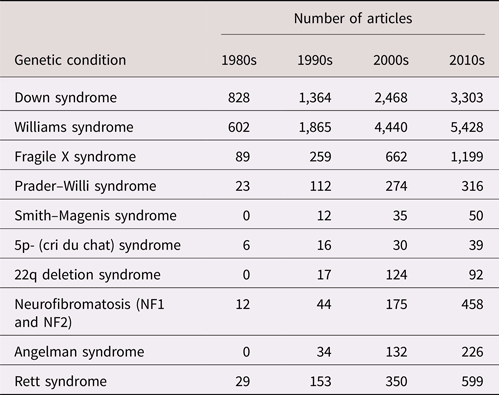
Considered from a larger perspective, the growth of this more differentiated organic group can be illustrated in many ways, but one easy way concerns quantity. In a PsychInfo tally limited to peer-reviewed articles, Table 1 presents the numbers of articles published per decade on 10 genetic ID conditions: Down syndrome, Williams syndrome, fragile X syndrome, Prader–Willi syndrome, Smith–Magenis syndrome, 5p-syndrome (originally “cri du chat” syndrome), 22q deletion syndrome (velo-facial-cardio syndrome), neurofibromatosis (NF1 and NF2), Angelman syndrome, and Rett syndrome. While admittedly more research has appeared on these 10 conditions than on most others, it is still instructive to see decade by decade changes from the 1980s (1980–1989) to the 2010's (2010–2019).
Using the PsychInfo search engine, numbers of peer-reviewed articles on seven genetic disorders during the 1980s, 1990s, 2000s, and 2010s

All searches were performed in early June 2020 (some 2019 articles may not yet be reported). Searches are of peer-reviewed publications over four decade-long periods (1980–1989, 1990–1999, 2000–2009, 2010–2019), using “Subject” as the search parameter. For conditions with multiple names, search terms included all terms. Thus, for 22q deletion syndrome, the search included “22q-” OR “velo-cardio-facial syndrome” OR “22q deletion syndrome”
In examining this table, several conclusions can be drawn. Across all 10 conditions, fairly steep increases appear in the numbers of articles across the decades. From less than 100 articles apiece for all but Down syndrome and Williams syndrome in the 1980s, over the subsequent three decades, research attention to most etiological groups has increased dramatically, sometimes even 10-fold or more. Even articles on Down syndrome increased from less than 1,000 during the 1980s to over 3,000 in the decade from 2010 to 2019. However, between-group discrepancies are also noteworthy, including the meteoric rise in articles on Williams syndrome (likely due to that syndrome's notable linguistic characteristics) and the rarity of articles on most other conditions. To this day, few published articles exist on most behavioral aspects of Smith–Magenis, 5p- (cri du chat), or 22q deletion (velo-cardio-facial) syndromes. Most likely, even fewer behavioral articles exist on the vast majority of the remaining 1,000+ genetic ID syndromes that do not appear in the table.
Several other limitations must also be noted. Apart from the wide variety of information available about several of these conditions, many studies would probably not be considered “developmental” per se. Most involve cross-sectional analyses that compare one particular etiological group to either another etiology (e.g., Williams syndrome vs. Down syndrome) or to a “mixed group” of persons with ID. Although informative concerning whether a particular etiological group differs from others with ID more generally or from another etiological group, such studies do not by themselves address the issue of development in a specific etiological group.
Recent years have, however, seen a gradual increase in etiological studies that focus on development. Specifically, one of my former students, Debbie Fidler, and her group have begun to examine how young children come to develop several etiology-related behaviors (Fidler, Reference Fidler2011). These researchers have examined the early development of young children with Down syndrome (Fidler, Most, Booth-LaForce, & Kelly, Reference Fidler, Most, Booth-LaForce and Kelly2008; Fidler et al., Reference Fidler, Schworer, Prince, Will, Needham and Daunhauer2019) and Williams syndrome (Hepburn, Fidler, Hahn, & Philofsky, Reference Hepburn, Fidler, Hahn and Philofsky2011). In both groups, one begins to see the origins of what later become full-blown etiology-related behaviors. Involving detailed, longitudinal examinations of infants and young children with each condition, these studies also lead naturally to interventions and treatments.
An additional issue involves the degrees to which the “etiology story” has been accepted by different fields. Over the years, the larger ID field – characterized by such journals as the American Journal on Intellectual and Developmental Disabilities and the Journal of Intellectual Disability Research – has become increasingly open to etiology-based articles. Both journals now feature a mixture of etiology-based articles and those in which research participants are grouped by their level of impairment (with persons of different etiologies grouped together): we have come a long way from the days of “I already have Gibson on my shelf.” Such is not the case, however, in the field of special education. To this day in most special education journals (e.g., Exceptional Children and Journal of Special Education), only a few articles examine children with specific genetic conditions. Although efforts continue to change this state of affairs (Hodapp & Fisher, Reference Hodapp, Fisher, Bouregy, Grigorenko, Latham and Tan2017) and a few counterexamples do exist (e.g., Lemons et al., Reference Lemons, King, Davidson, Puranik, Al Otaiba and Fidler2018), most research articles in special education routinely categorize children as having either “severe–low incidence” disabilities or “high incidence” disabilities, with little effort to characterize either group.
Finally, even now, most etiology-based behavioral studies focus on a small number of syndromes. As shown in Table 1, by far the largest numbers of behavioral articles are focused on Down syndrome, Williams syndrome, and fragile X syndrome, with even Prader–Willi syndrome having relatively few peer-reviewed articles (316 from 2010–2019). Even without composing an alternative table including all 1,000+ genetic conditions, this pattern would be identical. Although Bishop's (Reference Bishop2010) analysis of 35 disability conditions highlighted inverse relations of the amount of research activity to the severity of a condition, this finding seems less clear cut when examining behavioral research on genetic ID syndromes. Moreover, when Elisabeth Dykens, Brenda Finucane, and I first summarized the field of behavioral phenotypes (Dykens, Hodapp, & Finucane, Reference Dykens, Hodapp and Finucane2000), we devoted one chapter apiece to Down syndrome, Williams syndrome, fragile X syndrome, and Prader–Willi syndrome. In an additional chapter called “Five other intriguing syndromes,” we provided shorter discussions of velo-cardio-facial syndrome (22q deletion syndrome), Rubenstein–Taybi syndrome, Smith–Magenis syndrome, Angelman syndrome, and 5p- (cri du chat) syndrome. Were we to recreate that review 20 years later, our task would be both different and the same. On the one hand, we would have more findings to review in the “main” (three) conditions and maybe would include a middle set of reviews on Prader–Willi syndrome, Rett syndrome, Angelman syndrome, and neurofibromatosis (NF1 and NF2). On the other hand, for each of the 1,000+ remaining ID conditions, we would have few studies to review. In some ways, we have made great progress; in other ways, progress seems limited.
Environmental–Contextual Concerns: The Whole Child and a More Elaborated Environment
To many in the ID world, Ed Zigler was equally known for his focus on personality–motivational aspects of children with ID. As a young post-doc in the mid 1980s, I found this portion of Ed's ID work most discrepant from my own training in developmental psychology as it emphasized findings derived from a series of experimental research tasks. As I quickly learned, however, Ed's concern was not with the tasks themselves, but with the ways in which such tasks tapped into specific personality–motivational constructs. In presenting this work, I first briefly describe Ed's personality–motivational constructs and his view of environmental effects before reflecting on the more ecological–transactional perspectives that inform present and future ID studies.
Reactions to the environment: Appreciating the “whole child”
In considering Ed's approach to the “whole child” with ID, it seems necessary to note some historical changes. Nowadays, everyone favors a “whole child” approach. Parents, early interventionists, special education teachers, occupational therapists, physical therapists, speech language pathologists, pediatricians, and other service providers all endorse considering the whole child. No one, it seems, ascribes to the view that the sole child characteristic of importance involves cognition, language, fine- or gross-motor abilities, or general health. Everyone values considering together all aspects of the child. During the 1960s, however, this wider perspective was not so universally endorsed. Many ID researchers emphasized the causes of ID and focused mostly on cognitive–linguistic functioning.
Within this context, Ed's whole child approach must be considered new at the time. In considering how children with ID behave, Ed argued that one must understand the reaction of the child to his or her surrounding environment. In many cases, that environment consisted of institutions, which were only then beginning to come under increased scrutiny (e.g., Blatt & Kaplan, Reference Blatt and Kaplan1974). In a set of studies from the 1950s to the 1990s, Ed attempted to understand such noncognitive functioning by adapting constructs from experimental psychology and testing these constructs in laboratory experiments. In doing so, he highlighted the idea that children with ID suffered from social deprivation and many failure experiences.
As this work evolved, Ed and his colleagues proposed a set of motivation–personality constructs. These constructs involved the following.
(a) Positive reaction tendency. Due to social deprivation, children with ID show a heightened motivation to interact with a supportive adult. Illustrated by persisting in playing a game-like task with a supportive adult, children rated as having higher levels of pre-institutional social deprivation (Zigler, Reference Zigler1961) showed greater responsiveness. Similarly, children with greater levels of pre-institutional social deprivation showed more social responsiveness than did those with lesser levels, who in turn had higher levels of responsiveness than children being raised at home (Harter & Zigler, Reference Harter and Zigler1968).
(b) Negative reaction tendency. A contradictory response, also arising from social deprivation, involved an initial wariness or reluctance to interact with others. This tendency was examined by breaking the experimental task into halves, with the first half of the task more likely to show wariness and the second showing more engagement by the child (by participating in the task for a longer period of time). Weaver, Balla, and Zigler (Reference Weaver, Balla and Zigler1971) suggested that institutionalized children learned, during the first half of the task, that the examiner was unlike other strange adults who, though seemingly friendly, might initiate shots or physical exams. In contrast, in this case the examiner had no ulterior motive and was simply focused on social play. Gradually understanding this tendency, children with ID interacted longer with the adult during the second – as opposed to the first – half of the experimental task.
(c) Expectancy of success. Compared with typically developing children, those with ID fail more often at difficult tasks. Then, when presented with the choice of which problems to tackle, these children will often “aim low” and not take a risk for higher rewards, especially if that risk involves a greater possibility of failure. In other words, these children showed lower levels of risk taking, even when presented with a chance for a greater reward (Kreitler & Zigler, Reference Kreitler and Zigler1990).
(d) Outer-directedness. Children who fail more often also come to distrust their own solutions to problems, looking instead for guides to solutions from the immediate environment. Compared with children who are of the same mental age but developing typically, children with ID are more outer-directed in their problem-solving styles and, like typically developing children, children with ID become more outer-directed following failure (as opposed to successful) experiences. However, while children with ID (vs. without) showed more outer-directed problem-solving styles overall, the two groups did not differ when easy tasks were presented before harder tasks (Bybee & Zigler, Reference Bybee and Zigler1992).
Although this list barely hints at the many studies and findings of Ed and his colleagues (for reviews, see Zigler, Reference Zigler, Adams and Boardman1971; Zigler & Bennett-Gates, Reference Zigler and Bennett-Gates1999), it nevertheless illustrates several themes. First, to Ed, environments mattered. In contrast to those trying to employ environmental manipulations to change a child's IQ, Ed looked mainly at environmental effects on motivation and problem-solving styles. Second, Ed felt that such environments could be examined experimentally. Relying on his training in experimental psychology, Ed and his colleagues developed a set of experimental procedures, each tapping into a specific personality–motivational construct. Third, Ed felt that many of these problem-solving styles could be modified, often with fairly simple changes in the environment. For example, as shown in Bybee and Zigler (Reference Bybee and Zigler1992), the increased levels of outer-directedness found among children with (vs. without) ID could be minimized simply by presenting easy problems before harder problems.
Assessing the environment: From old to new
In considering the outgrowths of Ed's whole child approach, one sees several analogous movements from his specific constructs as well as a more general legacy. In the following, I discuss each in turn.
Studies of personality–motivational constructs
Considered in its strictest sense, Ed's specific personality–motivational constructs have not been followed by many ID researchers. Although Ed and his colleagues (myself included) produced an easy-to-use questionnaire tapping into his personality–motivational constructs in the early 2000s (Zigler, Bennett-Gates, Hodapp, & Heinrich, Reference Zigler, Bennett-Gates, Hodapp and Heinrich2002), the constructs have generally not been adopted by others.
However, while specific constructs and measures may not have caught on, in a more general sense, the importance of motivation has been accepted and even championed. Probably the best-known finding arose from studies of children with Down syndrome. In studies of preschool (3–5 years old) and school-aged (5–12 years old) children, two sets of researchers found that children with Down syndrome looked to others to avoid performing difficult intellectual tasks (Kasari & Freeman, Reference Kasari and Freeman2001; Pitcairn & Wishart, Reference Pitcairn and Wishart1994). Dubbed by Pitcairn and Wishart as employing “party tricks,” children with Down syndrome attempt to divert the examiner's attention, to smile or laugh, or in other ways socially redirect the conversation so that they do not have to persist at a difficult task. Although not quite Ed's construct of outer-directedness, such studies follow from Ed's ideas about problem-solving styles and the importance of addressing problem-solving as a way to help children with ID to function in the world. Applied specifically to children with Down syndrome, motivational patterns have been included as one element in more fine-grained, etiology-informed intervention approaches (Fidler & Nadel, Reference Fidler and Nadel2007; Hodapp & Fisher, Reference Hodapp, Fisher, Bouregy, Grigorenko, Latham and Tan2017). Motivation and problem-solving styles remain important in research on children and adults with ID (e.g., Switzky, Reference Switzky2004).
In appreciating certain newer outgrowths, it is also necessary to highlight two aspects of Ed's whole child approach. First, Ed's approach prioritized examining the effects of – not the nature of – the environment. While Ed did use his pre-institutional social deprivation measure to assess the effects of environmental deprivation (Zigler, Butterfield, & Goff, Reference Zigler, Butterfield and Goff1962), that measure was fairly indirect. Second, Ed's approach was mostly limited to children's reactions to certain aspects of the environment, notably social isolation and failure. Both aspects also capitalized on Ed's earlier experiences studying children who resided in institutions and, as a Yale professor during the 1960s, his familiarity with Sally Provence and her studies on institutionalized infants (Provence & Lipton, Reference Provence and Lipton1962). Increasingly over the years, however, children with ID no longer resided in institutions, but in their family homes (Braddock, Emerson, Felce, & Stancliffe, Reference Braddock, Emerson, Felce and Stancliffe2001).
Newer, more developmental perspectives of the environment
As much as he relied on his own studies and experiences, Ed was also influenced by newer movements in the field. A hard-core developmental psychologist who worked on many developmental issues, Ed encouraged a wider, more expansive view of development. He included Cicchetti and Pogge-Hesse's (Reference Cicchetti, Pogge-Hesse, Zigler and Balla1982) more “liberal” developmental approach in his own 1982 book (Zigler & Balla, Reference Zigler and Balla1982) and was open to new developmental thinking and applications. In this vein, Ed realized that similar sequences and structures represented but one aspect of developmental approaches and that other environmental concerns also entered into studies of human development.
For these reasons, Ed joined me, Jake Burack, and several of his younger colleagues in the gradual inclusion of environmental factors within the developmental approach to ID. In subsequent explications of that approach, these environmental discussions gradually expanded. In a book published in 1986, Ed and I devoted less than 10 pages to mother–child interaction and families (Zigler & Hodapp, Reference Zigler and Hodapp1986, pp. 153–160). In 1990, Hodapp, Burack, and Zigler (Reference Hodapp, Burack and Zigler1990) featured a chapter by Sameroff (Reference Sameroff, Hodapp, Burack and Zigler1990) on “neo-environmental perspectives on developmental theory.” By 1998, Burack, Hodapp, and Zigler (Reference Burack, Hodapp and Zigler1998) devoted a five-chapter section to the environment (Part IV, “Environment and family”), which was followed in 2011 by a six-chapter section called “Families and context” (Burack, Hodapp, Iarocci, & Zigler, Reference Burack, Hodapp, Iarocci and Zigler2011).
Such environmental explications were also developmentally based, explicitly applying the latest in developmental perspectives to the ID population. We thus see applications to children with ID in studies of bidirectional interactions between mothers and their children (Fidler, Reference Fidler, Burack, Hodapp, Iarocci and Zigler2012; Hauser-Cram, Howell-Moneta, & Young, Reference Hauser-Cram, Howell-Moneta, Young, Burack, Hodapp, Iarocci and Zigler2012) and of family systems and wellbeing (Glidden, Reference Glidden, Burack, Hodapp, Iarocci and Zigler2012). Such approaches also expanded to include siblings and others in the child's family (Hodapp, Glidden, & Kaiser, Reference Hodapp, Glidden and Kaiser2005) and to become more life span in orientation. Specifically, due to the long-term research programs of Marsha Seltzer (now Mailick) (e.g., Esbensen, Seltzer, & Krauss, Reference Esbensen, Seltzer, Krauss, Burack, Hodapp, Iarocci and Zigler2012) and Tamar Heller (e.g., Heller, Reference Heller2019), persons with ID and their families began receiving sustained research attention during the adult years. The interactions of families with both child and adult service systems also received attention (Burke, Patton, & Lee, Reference Burke, Patton and Lee2016). Joined with advances in hierarchical linear modeling and in understanding moderators and mediators, developmentally based studies of persons with ID increasingly examine the interactional, transactional, and ecological models first proposed by Bell, (Reference Bell1968), Sameroff & Chandler (Reference Sameroff, Chandler, Horowitz, Hetherington, Scarr-Salapatek and Siegel1975), and Bronfenbrenner.
Although much remains to be learned about how developmentally oriented environments operate in terms of persons with ID, a few examples are nevertheless instructive. Let us consider the longitudinal study of interactions between mothers and their children with Down syndrome conducted by Harris, Kasari, and Sigman (Reference Harris, Kasari and Sigman1996). From this study arose the idea that specific maternal interactional behaviors – in this case the mother commenting on the child's focus of attention – speed the child's linguistic development more than a directive, overinvolved maternal style. Such findings – and the very idea of “following the child's lead” – continue to be refined to this day (D'Souza, D'Souza, Jones, & Karmiloff-Smith, Reference D'Souza, D'Souza, Jones and Karmiloff-Smith2020). Similarly, many studies have appeared on parenting children with ID (Hodapp, Casale, & Sanderson, Reference Hodapp, Casale, Sanderson and Bornstein2019) and on family functioning during adulthood (Glidden, Floyd, Hastings, & Mailick, Reference Glidden, Floyd, Hastings, Mailick, Glidden, Abbeduto, McIntyre and Tassein press). Although one could argue whether Ed's developmental approach directly or indirectly influenced all of this research, such studies are consistent with the transactional and ecological perspectives of an expanded developmental approach.
Future Directions
I end this article with unfinished business – those areas of the developmental approach that require greater attention in future years.
Uniting organismic and environmental–contextual influences
In reviewing Ed's developmental approach to ID from the early 1960s until today, a tension persists between the organismic and the contextual. On the one hand, Ed's two-group approach, as well as its recent extensions into behavioral phenotypes, focuses heavily on the causes of ID. On the other, analyses of environmental effects do not always prioritize such organismic issues. While Ed did, in most studies, limit subject groups to those with cultural–familial ID (e.g., Alexander, Huganir, & Zigler, Reference Alexander, Huganir and Zigler1985), his interests occasionally focused on the personality–motivational characteristics of those with organic ID versus those with cultural–familial ID (e.g., Zigler, Reference Zigler1962).
This tension highlights a more general issue – depending on what it is that one is considering, sometimes etiology matters, sometimes it does not. In essence, etiological groups are simultaneously both different and the same, either comparing one etiological group with another (e.g., Williams syndrome vs. Down syndrome) or comparing persons with a particular etiology with those with cultural–familial ID or to a “mixed” ID group.
A few examples serve to illustrate this same-and-different finding. Persons with Down syndrome differ from those with Williams syndrome in terms of language–communicative abilities (Abbeduto, Arias-Trejop, Thurman, Ramos-Sanchez, & del Hoyo Soriano, Reference Abbeduto, Arias-Trejop, Thurman, Ramos-Sanchez, del Hoyo Soriano, Burack, Edgin and Abbedutoin press), fears–anxieties (Dykens, Reference Dykens2003), and their different propensities to acquire Alzheimer dementia by their early 50s (Zigman, Reference Zigman2013). In addition, although parents of both groups express concerns that their offspring will be bullied or taken advantage of (Fisher, Moskowitz, & Hodapp, Reference Fisher, Moskowitz and Hodapp2013), parents of those with Williams syndrome, due to their pronounced hypersociability, show greater concern over social vulnerability (Thurman & Fisher, Reference Thurman and Fisher2015). However, in other ways, these two etiological groups may be similar or even identical. As both groups have ID (at roughly comparable levels), each will have similar school experiences, have similar (though not identical) physical or medical sequelae, and will intersect with the special education system during the school years and the state-run disability service system during adulthood. Parents in both groups may experience higher levels of stress and positive reactions (Hodapp et al., Reference Hodapp, Casale, Sanderson and Bornstein2019), and both must learn about their child's particular condition, health issues, parent groups, and the child and adult service systems. The two groups are simultaneously the same and different.
Across these and other etiological groups, both organismic and contextual forces also operate simultaneously. Young children with Down syndrome generally display extra (beyond overall mental age) problems in grammar and expressive communication and may, to some extent, compensate socially by calling on others to help circumvent their linguistic–communicative deficits (Kasari & Freeman, Reference Kasari and Freeman2001). In turn, the interactive behaviors of parents and other interactors either reinforce or lessen these tendencies over time (Fidler, Reference Fidler2011). Similarly, in considering decision making during adulthood, the incessant drives for social connections in Williams syndrome and for food in Prader–Willi syndrome make it difficult for either group to implement even well-trained decisions in real-world settings (Goscicki, Josol, Fisher, Dykens, & Hodapp, Reference Goscicki, Josol, Fisher, Dykens, Hodapp, Khemka and Hicksonin press). However, for most ID conditions, we know only generally about the complex interplay of etiology-related characteristics and surrounding environments, as both change and evolve over time.
Gene–brain–behavior connections and the principle of multi-disciplinarity
Over the decades of research on different genetic syndromes, much fanfare has arisen about so-called gene–brain–behavior connections. This tripartite term has become almost a truism in etiologically based behavioral research, with many etiological groups proposed as “model” systems.
This focus on gene–brain–behavior connections has both negative and positive features. On the downside, the term must become more than a slogan. One needs to specify which particular brain structures or functions are affected, in which ways, with which particular influences on specific behaviors. More positively, however, gene–brain–behavior connections highlight interdisciplinary approaches to research studies that occur increasingly often. In the original “two cultures” paper, Hodapp and Dykens (Reference Hodapp and Dykens1994) decried the ways in which biomedical researchers operated apart from those in the psychological tradition, even as both examined the behaviors of persons with particular genetic conditions. More recently, we are heartened that these two cultures have mostly come together (Hodapp & Dykens, Reference Hodapp and Dykens2012) and that many studies combine the work of professionals in genetics, family studies, pediatrics and health, and developmental and clinical psychology. Although we have a long way to go – and one should not minimize barriers to cross-disciplinary collaboration (Dykens, Reference Dykens2013) – great progress seems evident.
On a more practical level, interdisciplinarity seems increasingly necessary for many groups with ID. Again using Williams syndrome and Down syndrome as examples, both groups show high levels of certain physical–medical problems, many of which tie to specific behavioral functioning. In Williams syndrome, a propensity to show hyperacusis seems tied to fears of sirens, thunder, and other loud noises (Dykens, Reference Dykens2003; Gothelf, Farber, Raveh, Apter, & Attias, Reference Gothelf, Farber, Raveh, Apter and Attias2006). In Down syndrome, the propensity for individuals to have large and thick tongues may relate to their articulation problems (Bunton & Leddy, Reference Bunton and Leddy2011), while hearing problems relate to difficulties in language functioning, during both childhood (Kreicher, Weir, Nguyen, & Meyer, Reference Kreicher, Weir, Nguyen and Meyer2018) and adulthood (Lin et al., Reference Lin, Lin, Hsu, Chen, Lin, Wu and Chu2015). As we document ties between physical–health concerns and development, we require the knowledge, methods, and perspectives of geneticists, biomedical workers, and behavioral researchers all working together.
Ties to intervention
More detailed, developmentally based knowledge also potentially informs intervention efforts. However, these interventions, premised on etiology-based strengths and weaknesses, need to be rigorously tested. Only randomized control trials will determine whether such etiology-informed interventions better promote development compared with other, more generic intervention approaches.
At present, few etiology-informed interventions come close to clearing this high bar. Granted, etiology-informed interventions exist. Consider, for example, the various booklets and articles related to special education interventions for children with Down syndrome, Williams syndrome, fragile X syndrome, and Prader–Willi syndrome (cf., Hodapp & Fisher, Reference Hodapp, Fisher, Bouregy, Grigorenko, Latham and Tan2017). All employ etiology-based strengths and weaknesses in ways that would seem effective. Similarly, Bezzina, Rice, Howlin, Tonge, and Einfeld (Reference Bezzina, Rice, Howlin, Tonge and Einfeld2017) have developed etiology-related modules (including parent tip sheets, practitioner resource sheets, and strategies tables for each group) to help address maladaptive behaviors in children with Down syndrome, fetal alcohol syndrome, fragile X syndrome, Prader–Willi syndrome, and Williams syndrome. Yet, so far, none of these interventions has been rigorously examined.
Beyond needing rigorous examinations of intervention effects, an additional issue concerns overcoming the ways in which many etiology-based deficits occur simultaneously. Down syndrome – the group for which etiology-based interventions are probably most advanced – illustrates the problem. To oversimplify slightly, children with Down syndrome show articulation problems, an overly social orientation (often impeding self-solutions), strengths in certain aspects of visual (vs. auditory) processing, and greater-than-mental-age deficits in grammar, expressive language, motor abilities, and executive functioning, especially working memory, planning, and goal-directed behavior (Hodapp & Fidler, Reference Hodapp, Fidler, Glidden, Abbeduto, McIntyre and Tassein press). To date, intervention work focuses on working memory (Bennett, Holmes, & Buckley, Reference Bennett, Holmes and Buckley2013; Pulina, Carretti, Lanfranchi, & Mammarella, Reference Pulina, Carretti, Lanfranchi and Mammarella2015), reading (Lemons et al., Reference Lemons, King, Davidson, Puranik, Fulmer, Mrachko and Fidler2015), social communication and language (Yoder & Warren, Reference Yoder and Warren2002), and early ambulation (Ulrich, Lloyd, Tiernan, Looper, & Angulo-Barroso, Reference Ulrich, Lloyd, Tiernan, Looper and Angulo-Barroso2008). Such interventions, however, must be adapted to address multiple problems simultaneously. In adapting early reading interventions for children with Down syndrome, for example, one must decrease working memory load, increase the intensity of direct instruction, and incorporate strategies to support task persistence (Lemons et al., Reference Lemons, King, Davidson, Puranik, Fulmer, Mrachko and Fidler2015). As one develops interventions for different outcomes and groups, each intervention will come with its own complexity, mostly due to the simultaneous presence of multiple areas of difficulty in specific etiological groups.
Ties of developmental knowledge to more practical concerns
A final necessary expansion relates to Bronfenbrenner's, (Reference Bronfenbrenner1979) ecology of human development, here related to the ecologies faced by children with ID conditions. Again, the issue of same and different applies, with many environments similar, some different.
To give a flavor of these similarities and differences, consider the basic issue of attaining services. Although health, schooling, and other services are needed by all children, the larger ecologies of persons with and without ID differ, as do existing services for one versus another etiological group. In the USA and most other industrialized societies, a complicated service system exists for individuals with ID and their families (Burke, Reference Burke2018). This lifelong system runs the gamut from early intervention services, to health, schooling and allied services, to camps, respite care, parent groups, peer support (during childhood and adulthood), legal services, transition services, post-secondary education programs, and a variety of services during adulthood. Certain of these services target families and offspring with disabilities of all types – for example, early intervention or special education services or healthcare.
In contrast, other services relate solely to groups with a particular syndrome. In the USA, there exist two main parent groups for Down syndrome (National Down Syndrome Society and National Down Syndrome Congress), as well as national groups for families of offspring with Prader–Willi syndrome (Prader–Willi Syndrome Association USA), Williams syndrome (Williams Syndrome Association), and other conditions. Similarly, whereas hospital departments in developmental pediatrics focus on the health of children with all disabilities, etiology-specific clinics exist for children with Down syndrome (e.g., roughly 50 across the USA) and fragile X syndrome (~20) (Smith, McCann, Dykens, & Hodapp, Reference Smith, McCann, Dykens and Hodapp2020). Obviously, these few clinics, usually located in major medical centers, cannot address the needs of all children with these conditions (see Bezzina et al., Reference Bezzina, Rice, Howlin, Tonge and Einfeld2017). In addition, with a few notable exceptions in Down syndrome (Chicoine, McGuire, Hebein, & Gilly, Reference Chicoine, McGuire, Hebein and Gilly1995), most such clinics are not available for adults. Even with increasing efforts to increase the numbers/sophistication of US disability-related information and referral services (Hodapp et al., Reference Hodapp, Rosemergy, Garcia, Meskis, Hart and McMillan2018), these resources remain unknown to the general public, even as they constitute important components of the ecology of life span development for those with ID.
Such a wider perspective of children's ecology in turn leads to important research and policy implications. From a research perspective, this wider view allows studies of environments that are more disability-specific and etiology-specific. Currently, for example, we know only a little about the effects of parent groups on parental coping (Solomon, Pistrang, & Barker, Reference Solomon, Pistrang and Barker2001) and even less about groups for parents of children with specific etiologies (e.g., Down syndrome, Prader–Willi syndrome). We know some about parents’ interactions with the school system and how those interactions are similar to and different from parent–school interactions of children without ID (Burke, Reference Burke2010). At the same time, however, we know only generally about the effects of parent–school connections on parental stress (Burke & Hodapp, Reference Burke and Hodapp2014) or about the use of outside advocates to help parents attain school-based special education services (Goldman, Reference Goldman2020). A more disability-oriented ecology of human development also allows for studies of changing ecologies over time and of child–environment transactions for children with ID, including different types of ID.
Such disability-oriented conceptualizations of human ecology will also lead to expanded policy initiatives. Consider, for example, the health care given to persons with ID. Children (and adults) with ID, including those with specific ID conditions, experience what Krahn, Hammond, and Turner (Reference Krahn, Hammond and Turner2006) have characterized as a cascade of disparities. Compared with same-aged children in the general population, these children are less healthy, receive check-ups less often, and are less likely to engage in physical or dietary practices that might promote good health. In addition, these children less often receive primary and specialist healthcare and more often receive care from healthcare providers who are untrained in treating them. Although true of the ID population more generally, some of these health conditions are specific to those with certain ID etiologies; note, for example, the high rates of health problems among children with Down syndrome or Williams syndrome. Ed himself sensed the problem of health and healthcare disparities, as shown in a review of dental and vision healthcare disparities among children with ID (Owens, Kerker, Zigler, & Horwitz, Reference Owens, Kerker, Zigler and Horwitz2006).
To address these glaring healthcare disparities, now seems the time to enshrine into US federal law that persons with disabilities constitute a “medically underserved population.” By attaining this official designation, extra federal attention and resources will be provided to the ID population, thereby helping to alleviate their many health and healthcare disparities (Smith et al., Reference Smith, McCann, Dykens and Hodapp2020). Similar to Ed's daycare, family leave, and school reform efforts for all children, such disability-related initiatives – once enacted – will help children and adults with ID, thus further expanding Ed's legacy and contributions.
Concluding Reflections
Ed Zigler passionately believed in understanding and helping children with ID. For a decade-long period as a young professional at Yale, I experienced first-hand that passion, that single-minded commitment to children and their families, including those with ID. I also experienced, and value to this day, Ed's openness to new ideas, to data-informed arguments and policy, and to mentoring so many young, inexperienced professionals as they helped carry forward his mantles in research, theory, and advocacy.
Ultimately, Ed Zigler's legacy has many parts. A central part of that legacy involves Ed's commitment to children with ID, their families, and those who studied and advocated for them. In this vein, it seems fitting to end with the words of Senator Ted Kennedy, one of many towering figures that Ed collaborated with over the decades. Though spoken in another context, the sentiment serves as my personal thank you and as a reminder of Ed's timeless contributions.
“For all those whose cares have been our concern, the work goes on, the cause endures, the hope still lives, and the dream shall never die” – Ted Kennedy
Acknowledgments
Along with my thanks to Ed Zigler, I would like to thank Elisabeth Dykens, Jake Burack, and all of my students and colleagues over the years for their contributions to this approach. Thanks as well to Elisabeth Dykens for her comments on an earlier version of this manuscript.
Financial Statement
This research received no specific grant from any funding agency, commercial or not-for-profit sectors.
Conflicts of Interest
None.