The international community has looked upon the phenomenal process of urbanization and urban spatial restructuring in China with both awe and suspicion. While some interpret Chinese advances in infrastructure as evidence of the country's coming of age, others emphasize the “dominance of the state” at the expense of individuals and major groups in society.Footnote 1 The pace and scale of urban growth, infrastructure construction and spatial restructuring have become, in the aggregate, a metaphor for China's economic miracle. For individual cities, urban landscapes serve as manifestations of ambition and evidence of a promising future. Nearly every Chinese city has a museum devoted to urban planning, typically showcasing the city's spatial and territorial ambitions for the next ten to thirty years. Reading the urban strategic plans for any sized Chinese city can be an exercise in repetition: nearly every one aspires to be a “global hub,” a “cultural, economic and political centre,” and an attractive environment for foreign and domestic investment. The similarity of these ambitions, however, belies deep divergence in growth strategies and changes to urban landscapes. Presumably, all local governments want to remake the urban landscape to be better suited to both anchoring economic investment and displaying a modern and capacious administration. Yet, while some cities are successful in implementing projects that relocate enterprises and residents, establish special function economic zones and create landscapes generally free of illegal construction and slums, other cities have poor records of implementing their own urban planning projects and their landscapes reflect that lack of control.
This article draws on a paired comparison of two similar cities in a single region – the north-eastern rust belt – to argue that patterns of urban land politics are products of the different political economies created by changes in the post-Mao urban hierarchy and the sequencing of opening and reform. Dalian 大连 in Liaoning province, like many cities that benefited from early access to foreign capital as a result of preferential policies bestowed by Beijing, designated a development zone outside the urban core to rebalance the concentration of economic power in favour of pro-reform coalitions while leaving the urban core, the pre-reform power base, undisturbed during the early stages of reform and opening. The city of Harbin 哈尔滨 in Heilongjiang, which did not enjoy open privileges until the mid-1990s, instead pursued the decentralization of authority over policies such as housing, enterprise reform and the growth of private entrepreneurship, distributing urban land control to assuage the losers of economic reforms and spur growth. The different reform-era urban political economies – resulting from changes to the urban hierarchy and the distribution of preferential policies from Beijing – have produced different approaches to urban territory and patterns of land control in these initially similar cities.
Municipal States and Urban Politics in China
Territory – politicized space over which groups struggle for control, occupation and access – is an important locus of political conflict in China.Footnote 2 Urban land may simply be a commodity, but territorial politics emerge when various factions struggle for political control of land. Confrontation between citizens and local authorities over land has been one of the most visible flashpoints of state–society conflict in rural and urban China alike. In rural areas, the requisition of collectively-owned (jiti 集体) farmland has fanned conflict between peasants and local governments.Footnote 3 In urban China, both the international media and scholars have turned their attention towards grand projects of urban renewal and transformation and the dislocations and historical destruction that accompany them.Footnote 4 Moreover, the combination of local government reliance on land-leasing for revenues and real estate speculation has driven up housing and property values across urban China, creating both a potential social crisis as many are squeezed out of the housing market and a potential economic crisis in the form of an asset bubble.Footnote 5
You-Tien Hsing has characterized the urban politics of the 1990s in China as “competition for urban land control.” Hsing envisions municipal state agents pitted against collective and state-owned factory managers and other quasi-state actors who have de facto rights to urban land based on long-term usage in a struggle for control of land resources within the urban core: “China's urban politics unfolds as an intra-state struggle over land by these two sets of statist actors.”Footnote 6 However, not all cities appear mired in the kind of intra-state conflict that she emphasizes. Moreover, participants outside of the state – urban residents, private economic actors, informal sector workers who occupy dilapidated or unmanaged spaces, and so forth – may mount significant challenges to the local state's pursuit of territorial control. Why are some local governments successful in outmanoeuvring competitors for land control when others are not, and under what conditions do other urban groups exercise meaningful control over the urban landscape? To this end, we may understand variation in the local state's ability to monopolize the allocation of urban property rights as territorial consolidation and territorial fragmentation. A local state has consolidated its control over the territory within its purview when it is the sole arbiter of the rights to the use, transfer and income generated from urban land. Territorial fragmentation characterizes cities in which multiple and competing claims to urban land, from groups both in and outside of the state, thwart the municipal state's efforts at spatial restructuring. This article expands on Hsing's formulation to address this inter-urban variation. More specifically, I propose a comparative political economy of land politics that links differences in economic development strategies to patterns of urban territorial control.Footnote 7
What follows details how different political economies of growth and reform took shape in initially similar cities as they sought to pursue growth given different resources and constraints. While much has been made of decentralization and urban China as a “laboratory for reform,” the distribution and timing of preferential policies from Beijing allowed some cities access to foreign capital before or as they undertook politically difficult reforms, while others undertook reforms under resource constraints. These changes to the post-Mao urban hierarchy have created fundamentally different rules of state–market relations across urban China, as this article shows in regard to growth and territorial strategies. In both Dalian and Harbin, the management of land was integral to growth and reform strategies, but according to different logic. Dalian neglected the traditional urban core to build a new base of economic vitality and political support in the development zone, then later simultaneously recapitalized on downtown land while implementing enterprise reforms. Harbin, facing capital shortages, treated urban territory as a resource for distribution to real and potential losers of reform, steadily relinquishing control to residents, enterprises and even lower levels of the municipal government. The management of intra-local competition established patterns of territoriality that continue to mark urban landscapes and structure urban politics today.
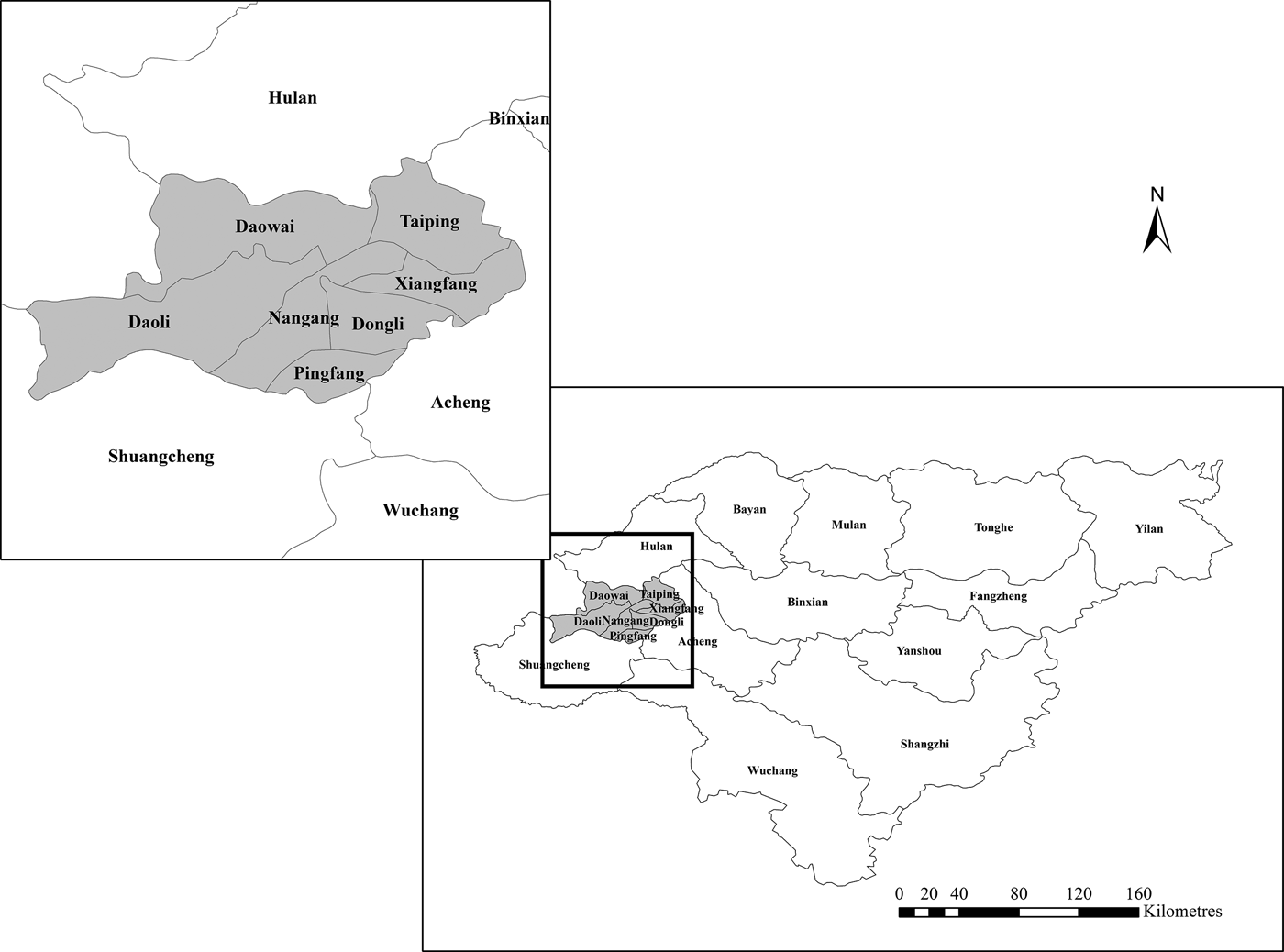
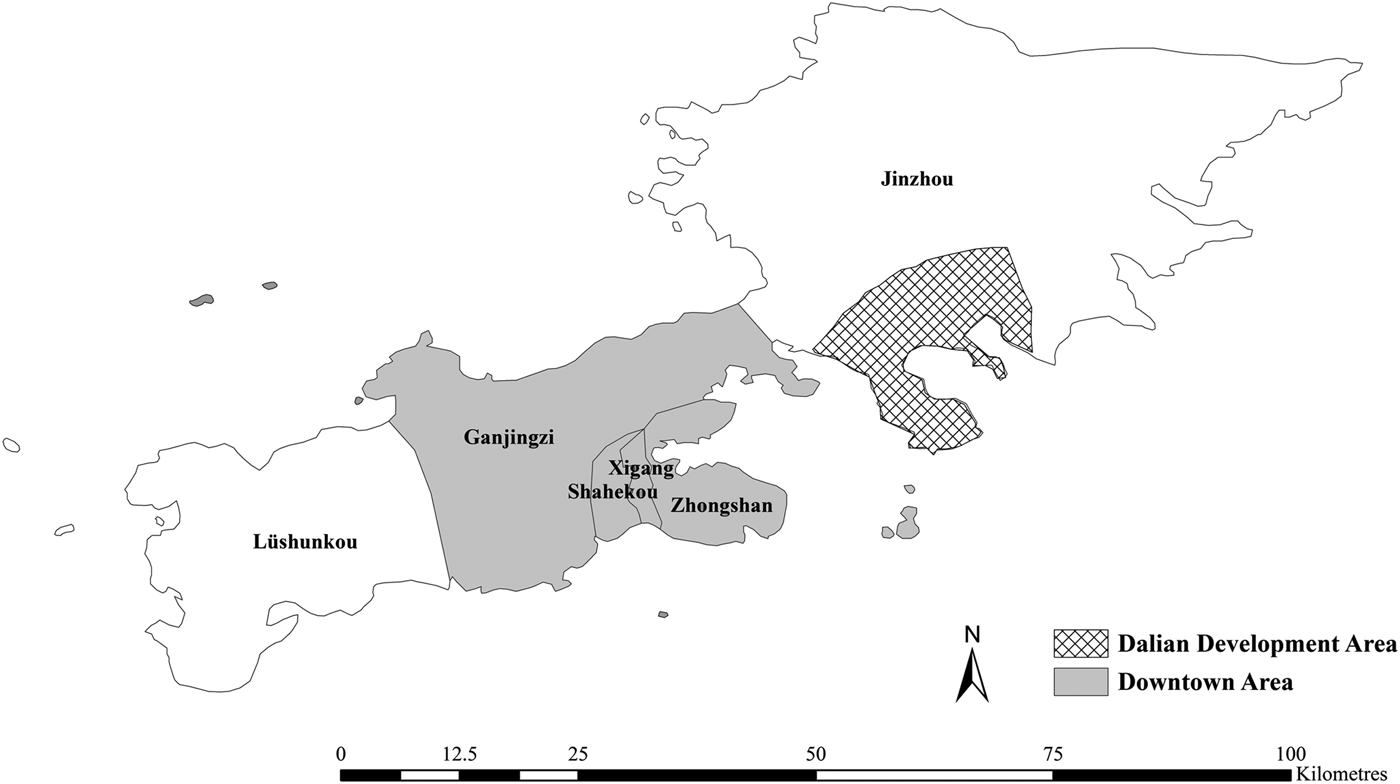
Some clarification about methods, sources and definitions is in order before proceeding. First, I analyse the relationship between land politics and political economy at the municipal as opposed to the provincial level for two primary reasons. First, because financial revenues generated through land development (in the form of both taxes and land-lease fees) accrue to local governments, decisions about specific sites of urban redevelopment and expansion are generally initiated and implemented at the local level. Second, preferential policies that determine the sequencing and extent of reform and opening are also bestowed on cities rather than provinces. Given that the opening of land-leasing markets was national policy in the late 1980s and early 1990s, and also that there is a lack of variation in provincial-level policies towards land and housing, the comparison of cities is most appropriate.Footnote 8 The fact that Harbin is a provincial capital and Dalian is not may complicate the comparison. Some scholars have suggested that power in provincial capitals leans heavily towards the state and away from social actors, and therefore those cities should be analysed as a separate category.Footnote 9 However, in this comparison the provincial capital proves to be the less capacious when it comes to managing land politics, so the relevance of political economy and the sequencing of reforms seems robust to differences in administrative hierarchy in this case. When considering urban politics in China, the boundaries of the “municipality” is all but clear, since cities encompass urban districts as well as counties and sub-urban cities.Footnote 10 In this article, I discuss land politics only in the urban districts (shiqu 市区) of Harbin and Dalian, and therefore exclude the counties and subsidiary cities under the administrative purview of these municipalities. In both cities, expansion in the form of development zones and “new cities” (xinqu 新区) has brought the conversion of counties into urban districts (i.e. Dalian's Jinzhou 金州 county became Jinzhou district in 1987, and Hulan 呼兰 county split into Hulan and Songbei 松北 urban districts in Harbin in 2004 with the development of the Jiangbei 江北 new area). I refer to the urban districts that existed at the beginning of the reform era as the “urban core,” as opposed to new districts and development zones established during urban expansion since the early 1980s. See Figures 1 and 2 for maps of each city.
Harbin City and Urban Core Districts, 2000Footnote 11

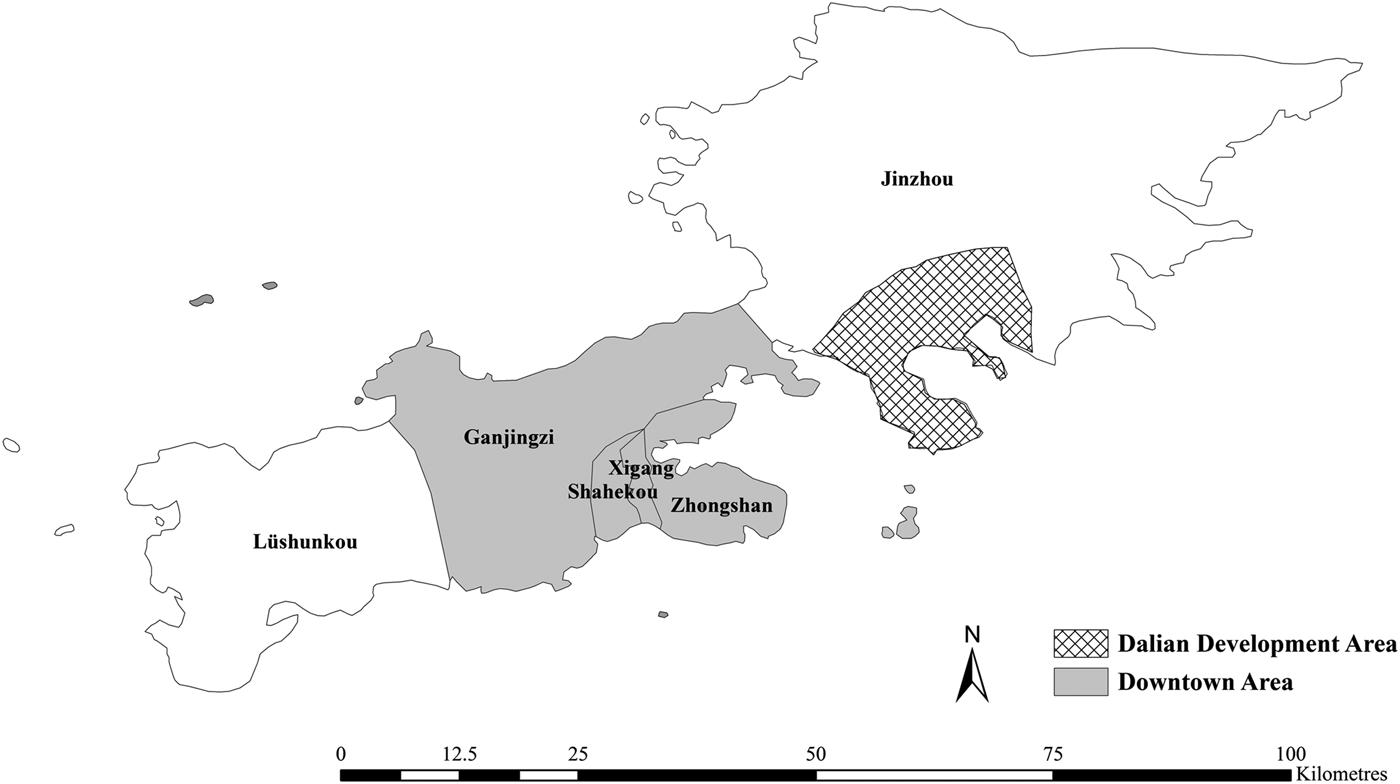
Dalian's Urban Core and the Development Area, 2008
This article relies on data gathered during 12 months of fieldwork in 2007 and 2008. Sources include written materials gathered from local libraries, the Harbin Municipal Archives, and materials on urban planning and land policies kindly shared by local officials and researchers, and on file with the author. My observations also rely on formal but unstructured interviews conducted with roughly two sets of local actors: urban planners and academics, groups that frequently overlap in Chinese cities; and second, local government economic officials, chiefly from municipal land resource bureaus, municipal bureaus of industry and commerce, and local branches of the development and reform commission. Ever subject to the limits of access when conducting research on topics as politically sensitive as land conflict in urban China, the scope of interviewees is less comprehensive and the data relayed in them subject to greater scrutiny. However, I purposefully combine impressionistic data relayed in interviews with a heavy reliance on written sources and documentation to create as reliable a narrative as possible of urban change within these two cities.
Two Cities, One Region: Dalian and Harbin
North-eastern China, China's “old industrial base,” provides an ideal laboratory in which to investigate the phenomena of post-socialist urban reform and territoriality. The region – consisting of Heilongjiang, Liaoning and Jilin provinces – entered the Maoist era with a strong industrial base established during the construction of the Chinese Eastern Railway and the Japanese occupation. After 1949, the region continued to be home to China's industrial base, as urban areas received large amounts of state investment for the construction of state-owned enterprises focused on heavy industrial production. Cities in the north-east thus share a similar set of legacies from the command economy: vast numbers of formal sector workers and the attendant social welfare burdens; local economies dominated by state-owned enterprises; a relative lack of diaspora connections compared to the coastal south-east; and strong institutions designed for collective production and consumption.Footnote 12
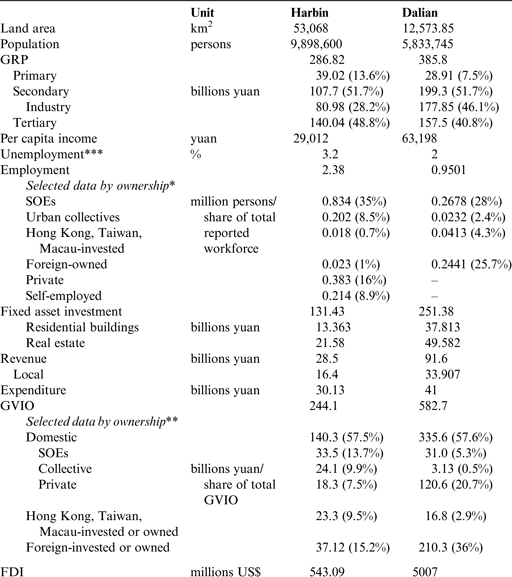
In the reform era, the once-privileged provinces of the north-east have suffered a “drastic reversal of fortune” as they are home to the greatest “institutional liabilities and legacies of the command economy” and have seen precious little of the dynamism that characterizes regional economies elsewhere.Footnote 13 Yet, the fortunes of reform have favoured Dalian and Harbin very differently (see Table 1). Dalian has managed to “reterritorialize” itself out of the rustbelt and into the global economy;Footnote 14 Harbin, on the other hand, is said to have “dropped off the central government's radar screen” after 1979.Footnote 15 These differences in political economy, rooted in the distribution of preferential policies from Beijing, are attended by differences in demonstrated control over the urban landscape.
Basic Demographic and Economic Indicators, Harbin and Dalian, 2008
Notes:
All data from year end 2008 and for entire municipalities, i.e. including subsidiary counties and cities. I display 2008 data in order to match the timing of the qualitative descriptions of the cities. *Because of incongruous reporting of data across cities, it is not possible to compare the labour force breakdown directly by ownership in 2008. These data are selected shares by ownership, and therefore do not add to 100%. **These data are selected shares by ownership, and therefore do not add to 100%.
Sources:
All data, unless otherwise indicated, from Harbin Statistical Yearbook 2009 and Dalian Statistical Yearbook 2009. ***From China Labour Statistical Yearbook 2008, 153. Accessed through China Academic Journals.
In the early 1990s, Dalian began to attract the attention and envy of many cities as it amassed prestigious awards and titles related to its achievements in the urban environment: “Environmental Protection Model City” in 1992; one of China's “Ten Most Beautiful” in 1992; and the first city in China and second in Asia to be included in the UN “Global 500” for liveable environments in 1995.Footnote 16 Dalian's urban landscape evinces a palpable presence of state control and urban management to the visitor, mostly free of informal markets, dilapidated housing and visible signs of urban blight or poverty, especially in urban core commercial areas and the city's new industrial districts. Dalian officials, as reflected in everything from municipal publications to a museum devoted to showcasing the construction of “Modern Dalian,” are extremely proud of the city's appearance. Long-time Dalian mayor, Bo Xilai 薄熙来, celebrated in an interview that real estate prices in downtown Dalian had increased 500 per cent between 1994 and 1999, a development that certainly benefited municipal authorities who leased downtown land to developers.Footnote 17
In contrast, the urban landscape in Harbin confronts the visitor with a visual melange of the results of the reform era. Harbiners often refer to the three core urban districts of the city, Daoli 道里, Nangang 南岗 and Daowai 道外, as “heaven” (tiandi 天地), “purgatory” (lianyu 炼狱), and “hell” or “the inferno” (diyu 地狱), respectively. Daoli district is home to much of the city's characteristic Russian architecture, the commercial and retail centre of the city, and a great deal of new development projects that capitalize on prime real estate prices through high overhead commercial centres or high-rise residential buildings. Many of the city's universities as well as its embryonic Central Business District are located in Nangang district, whose main arteries display department stores and modern residential compounds next door to informal street markets, pre-reform housing units and buildings associated with now-closed factories with the character for “demolition” (chai 拆) displayed prominently on every surface. During my ten-month tenure in the city, many of these areas slated for demolition remained untouched by bulldozers and continued to be occupied by former residents, despite being without heat, during China's harshest winter. Daowai district, called “the inferno” not only as a reference to hell, but also because of the frequency of conflagrations when residents heat wooden homes by fire, typifies post-industrial urban blight: abandoned buildings, haphazard new construction, few signs of disposable income, few large parks and green areas, and so forth. Yet, residents seem in no hurry to flee their neighbourhoods for higher ground. Street-level commerce is visibly vibrant, real estate prices (even for quite old structures) are as high as in other parts of the city, and relations among neighbours appear mutually dependent.Footnote 18
Harbin has mounted two unsuccessful attempts to expand outside the urban core: a new district north of the Songhua 松花 river and a “high technology development zone” to the west. These new areas are known as, respectively, “Ghost Town” (guicheng 鬼城) and “Corruption Street” (fubai de yitiaojie 腐败的一条街). Land for the Songbei new zone was requisitioned in the mid-1990s, but development did not begin until after 2000.Footnote 19 In the district's early period, many wealthy Harbiners purchased apartments in Songbei as investments. However, they have not been able to rent out their properties and have not moved in themselves because of the lack of convenient transportation and commercial and retail development in the area.Footnote 20 The development zone to the west is home to the Heilongjiang provincial government complex as well as some of the most expensive and exclusive restaurants in the city. After the city received national-level and provincial-level funding for transportation and infrastructure development in the area between 1994 and 2001, much of the newly valuable land was leased to high-end restaurants and residential developments, hence the moniker “Corruption Street.”Footnote 21
Harbin and Dalian cities, despite initially similar urban landscapes and socio-economic structures, have developed remarkably different urban political economies since 1978. Dalian received open status early in the reform period, pushing the local economy towards export orientation and providing access to foreign capital. Reforms to the state sector were undertaken in a climate of competition, both with foreign firms and among domestic firms seeking foreign capital to upgrade and survive. Harbin, like other regional cities without extensive access to foreign capital and investment, attempted to grow through streamlining the public economy and nurturing small-scale entrepreneurship. The municipal government was challenged to execute politically difficult enterprise reforms in a climate of scarcity and fear of social instability. The two cities also represent very different outcomes with regard to the local state's control over territory. Dalian is a case of territorial consolidation: the local state has established itself as the sole authority over the use, occupation and allocation of urban territory. Harbin, conversely, is a case of “territorial fragmentation,” since various groups outside and inside the local state stake claims to urban spaces and thwart municipal efforts at spatial restructuring. The next two sections detail how a globally-oriented political economy augmented the local state's control over land in Dalian, and how a political economy of survival eroded that control in Harbin.
Territorial Consolidation in Dalian
With its coastal location at the tip of the Liaodong 辽东 peninsula, Dalian was well positioned in the 1980s to benefit from opening to international trade and investment through the coastal development policy.Footnote 22 Like cities all over China that would later adopt development zones as the centrepiece of their growth strategies, Dalian pursued a territorial strategy of spatially segregating the activities of the new economy from those of the old, creating competition both between the globalist and socialist constituencies and also among state firms. Through development zoning first and then introducing reforms to the state sector through forced enterprise relocation outside of the urban core, the Dalian municipal state recalibrated the spatial distribution of power in the city and managed urban interests in a way that established the state as arbiter, rather than target, of political conflict.
Development zoning
Dalian's initiation into the “winners' circle” of the reform era began when it was designated as one of 14 coastal open cities in May 1984. This designation meant that decision-making power regarding foreign capital in the form of foreign-invested enterprises (FIEs) or foreign direct investment (FDI) was handed over to the municipal authorities. The city's authorities looked outside the core urban districts for the physical space to anchor new forms of economic activity. Even before Beijing conferred special status upon Dalian, the city's 1980 master plan (zongti guihua 总体规划) included preliminary designation of a development zone (kaifaqu 开发区) in what was Maqiaozi 马桥子 village in then suburban Jinzhou county, a full 35 kilometres from the city centre in Zhongshan 中山区 and Xigang 西岗区 districts (See Figure 2).Footnote 23
Although the strategy of designating a specific space for foreign-oriented development may strike any present observer of urban China as unexciting, in 1984, directing new investment an hour's driving distance from a traditional urban centre was novel. The Dalian Economic Development and Technology Zone (or Dalian Development Area, DDA) was the very first such space in China.Footnote 24 The DDA offered a number of formal benefits to foreign firms to entice them to either invest in local enterprises or relocate to the DDA, including a lower tax rate and no real estate taxes for the first three years of the investment period.Footnote 25 The strategy of development zoning gained greater momentum in the early 1990s after Deng Xiaoping's southern tour. In October 1992, the Dalian Tax-Free Zone (baoshui qu 保税区) was established adjacent to the DDA in Jinzhou district 金州区, China's “first domestically located, foreign-run (jingnei guanwai 境内关外) economic area.”Footnote 26 Space was also designated for high-technology parks around the DDA and to the south-west of the city centre. Of the 17 smaller development zones established between 1992 and 1999 (15 in 1992 alone) throughout the city, only one of the zones is located within the three core urban districts (Zhongshan, Xigang and Shahekou 沙河口区).
These spatial strategies held certain advantages for investing firms, advantages economists associate with clustering and agglomeration: access to transport, concentration of skilled labour, opportunities for technology transfer, dense warehousing networks, and so forth.Footnote 27 As spatial zoning for development and clustering has gained currency in international development circles – partially based on the Chinese experience – observers have focused mostly on the benefits to enterprises and less on the political benefits enjoyed by local governments. In Dalian, these special designations allowed the state itself to preside over the spatial distribution of growth and investment and provided a space in which to experiment under conditions of economic and political uncertainty. Municipal publications from the 1980s and 1990s highlight the establishment of the DDA and show pride that the zone was the first of its kind in China. However, explanations of the rationale for establishing the zone outside the city make no mention of the economic benefits of clustering, and instead invoke reasons such as the avoidance of problems associated with the urban core, and establishing a new place to absorb migrant labour. In a flagship national urban planning magazine, members of the urban planning bureau explained the benefits of Dalian's novel development zoning strategy:
The new area has an extraordinary number of benefits. Principally, it avoids the downtown area's “urban heart disease.” Population density [in the urban core] is already declining (although it was already lower than the national standard). The migrant populations would threaten the low population density, so it is best to attract them to the new urban area.Footnote 28
Dalian has indeed long been a leading destination for rural-to-urban and inter-urban migration; according to official data, Dalian has by far the largest “floating population” in the north-east. The official migration rate between 1980 and 1989 averaged a 12 per cent increase per annum.Footnote 29 A 1988 Public Security Bureau survey puts an estimate of the “floating population” (i.e. unofficial migrants without Dalian hukou 户口) at 388,000 people, over 80 per cent of whom resided outside the urban core.Footnote 30 More recent census data on migration confirms that the DDA continues to be the main destination for arrivals from outside the city. Jinzhou and Ganjingzi 甘井子区 districts housed 26 and 30 per cent, respectively, of Dalian city migrants living outside their place of registration, and each held 33 per cent – two-thirds in total – of migrants from outside the province.Footnote 31 Popular conceptions of the differences between the “new” and “old” city underscore the importance of the population distribution. Officials in the DDA insisted that it is like an “immigrant city,” its population “young, open-minded, and part of China's transformation.”Footnote 32 People in the Dalian urban core harbour resentment towards the DDA and the people who live and work there, arguing that the city is biased towards the new areas and that Dalian's new wealth only benefits people not originally from Dalian. Rather than blaming the state or city authorities for their bad fortune, the “losers” of reform direct their frustration against another population in the city.
Sequencing of reforms
By the early 1990s, the DDA was the liveliest point of the Dalian economy and the locus of market-based productivity. Mary Gallagher has argued that the sequencing of reform and opening at the national level has both bolstered the CCP's grip on power as well as encouraged further economic liberalization. Early FDI liberalization fragmented elements of society and pitted regions against each other in competing for scarce capital flows, recasting the ideological debate over privatization as “one of Chinese industrial survival amid ever-increasing foreign competition.”Footnote 33 The strategy of development zoning introduced these competitive pressures within the city of Dalian, pitting a moribund state sector in the urban core against a vibrant development zone outside of the city and rendering potential claimants to urban territory and the workers beneath them dependent on the municipal government for survival.
The politically and economically difficult enterprise reforms were undertaken later in the 1990s, as enterprises were forced to relocate from the urban core into new development zones and specially designated industrial zones as part of the city's massive enterprise relocation (banqi 般企) campaign. In 1992, a turning point was reached after which the urban core became a target for redevelopment rather than an area to be avoided in favour of the periphery. The relocation campaign was carried out jointly by the municipal bureau of industry and commerce (MBIC), urban planning and land resource management bureaus, and the Dalian municipal housing authority, which held authority over approximately 83 per cent of residential housing in the urban core.Footnote 34 Between 1994 and 2001, in a campaign to beautify and spatially reconfigure the city headed by Bo Xilai, these institutions relocated 115 enterprises from Zhongshan and Xigang districts alone, freeing up over three million square metres of land.Footnote 35
Relocation targeted enterprises desperate for capital infusion; municipal authorities would guarantee capital infusions for the enterprises in exchange for turning over downtown land. The typical process involved leasing development zone land at a very low cost to an enterprise (an MBIC official in an interview insisted that land was essentially “given away”), and then leasing out the enterprise's former downtown space with a promise that some of the capital acquired would be released to the moved enterprise for facility upgrading and technological investments.Footnote 36 Critically, city officials would also assist with locating foreign joint venture partners for enterprises that agreed to move, enabling the city simultaneously to reclaim downtown land from enterprises and execute management and ownership restructuring. For example, the Bohai Beer Factory, which occupied 30,000 square metres in Zhongshan district, was designated for relocation in 1995. The MBIC negotiated its acquisition by a Hong Kong investment firm, and also turned over half of the land-lease fee to the factory when the land management bureau secured the original site for a Korean commercial venture (a large mall).Footnote 37 When Sanyo located production facilities in the DDA in 1996, the DDA assisted with the creation of a large conglomeration firm in which Sanyo was partnered with 16 SOEs relocated from the downtown core. These SOEs were competing with each other to suffer the least number of layoffs.Footnote 38 Municipal authorities, then, concurrently reclaimed factory-occupied land and executed enterprise restructuring.
Securing the acquiescence of factory managers who were dealing with underperforming enterprises and painful downsizing in any case was not especially challenging. The thorny parts of the relocation campaign – and the ones rarely discussed in public celebrations of the remaking of the city – concern the housing compounds that had dominated urban core neighbourhoods and the workers who occupied them.Footnote 39 In interviews, officials and urban planners referenced opposition to the relocation work of the 1990s. One urban planner recalled many petitions and attempts at protest in 1994 and 1995, but said that because the local Party organizations, residents' committees and work units themselves were not behind the residents, their efforts at collective organization failed.Footnote 40 Another official clearly stated the dilemma facing residents: they stood to lose both their homes and their jobs should they choose to resist relocation. Enterprises often laid off a substantial portion of their work force when they moved and underwent restructuring. Since the work units and factory managers were supportive of relocation plans, residents and workers were actually competing with each other to accept the compensation and relocation arrangements.Footnote 41
The relocation campaign began alongside Bo Xilai's assumption of the city's leadership in 1993 – he had served in various Party positions in Jinzhou and the DDA since 1984 – and campaigns to “beautify the city” and transform Dalian into a “commerce and trade, finance, tourism, and informational city.”Footnote 42 Foreshadowing the kind of campaigns Bo would later become infamous for in attempting to transform and re-brand Chongqing, substantial propaganda accompanied efforts and economic and spatial reconfiguration in Dalian. The urban planning and land resource management bureau chief at the time recalls Bo's efforts at softening the term “demolition” (chai 拆): “Bo Xilai himself said that the green of Dalian will emerge from ‘chai’ and ‘ba’(扒) [stripping away]. Don't look down on the word ‘chai,’ because this is really tearing down people's closed hearts and old ideas.”Footnote 43 The combination of entwining employment prospects with relocation acquiescence, the offer of substantial compensation packages for residents by leasing out land, and ideological campaigns to pressure compliance foreclosed any viable attempts at collectively resisting eviction and relocation.
The Dalian municipal authorities' political economic strategy of global orientation was accompanied by a territorial strategy of expansion and segregation. The creation of the extra-urban development zone established competition among state firms for municipal government assistance rather than competition between those firms and the local state for land control. Moreover, the emergent axis of urban politics in Dalian is the reformist, global constituencies in the DDA on the one hand, and the waning and descendant former power brokers on the other. The result of both of these types of competition is a strong municipal state that acts as arbiter rather than participant in urban politics and maintains a near monopoly on the use and designation of urban land.
Territorial Fragmentation in Harbin
City officials in Harbin have encountered significant resistance to their plans for urban renovation and relocation, and plans for urban expansion have fallen prey to mismanagement and intra-local territorial conflict. Harbin's urban landscape is more of a pastiche of power bases than a canvass onto which the local state projects political power and generates wealth. These power bases consist of firm or residential occupants who perceive themselves as de facto – if not de jure – claimants to property rights over urban land that the city has sought to appropriate or reallocate. Unlike its regional counterpart, Harbin had nearly no access to foreign capital early in the reform era and therefore reforms to the public sector were introduced in a climate of resource scarcity. As officials in Harbin weathered the economic reforms of the 1980s and 1990s under these different political economic conditions, the municipal state steadily relinquished control over the urban landscape as a political and economic strategy in its dealings with public sector enterprises, laid-off workers and the entrepreneurial sector. In this section, I take up each of these arenas in turn.
Public sector enterprises
While Dalian officials during the 1980s turned outwards, skirting potentially messy programmes of reform and contests over urban property with centrally located SOEs, Harbin city officials steadily reinvested, politically and economically, in large state-owned enterprises. City officials did introduce reforms to the state sector, but those reforms were efforts at enterprise conglomeration, consolidation and upgrading, i.e. revitalizing threatened enterprises by diversifying the economic activities within their purview and further decentralizing authority over their operations. This political economic strategy produced a concomitant territorial strategy of distributing and decentralizing control over urban land.
Harbin's 1985 master plan sought to limit industrial “sprawl” and rationalize layout by concentrating infrastructure investments in extant compounds, mostly located in clusters created early in the Maoist era for heavy enterprises and within the city's six core urban districts. Harbin's four largest industrial compounds were slated to receive investment to “rehabilitate” facilities and housing.Footnote 44 Plans expressly avoided the acquisition of new urban land and confined new industrial construction to existing compounds. During the 1980s, Harbin only officially acquired four plots of new land for urban construction, all of which surrounded major industrial compounds within Daoli and Nangang districts.Footnote 45 As early as 1986, the city's highest officials were wrestling with actors from the formal state sector over land control. A 1986 project to build a new transport tunnel through Nangang and Xiangfang 香坊区 districts interfered with the land operated by a local factory, whose manager asked for over 8 million yuan in compensation. The factory's compliance required the intervention of the mayor himself, who went to the factory manager with the money and personally counted out each bill to reach a “mutual understanding” with the manager.Footnote 46 This strategy of devolving economic and territorial power to enterprises empowered a plurality of urban interests vis-à-vis Harbin's municipal authorities. As enterprises in Dalian were becoming dependent on city authorities for funding and survival, Harbin authorities were becoming dependent on enterprise managers for their acquiescence in basic urban plans.
Laid-off workers: housing and redistribution
Layoffs and factory closures, particularly in the late 1980s and through to the late 1990s, created potentially destabilizing sets of “losers” to market reforms, and the use of urban land and control of territory constituted a key resource for redistribution to these groups.Footnote 47 Harbin in the 1980s became nationally famous for rehabilitating dilapidated housing compounds that formed part of major industrial clusters, but not for relocating residents.
Urban China experienced a push towards housing construction in the late 1970s and early 1980s with multi-level investment from central and local governments, investors, enterprises and individuals.Footnote 48 In Harbin, new funds for housing were dispersed directly to enterprises.Footnote 49 In conjunction with the municipal construction bureau, the enterprises used the money to renovate work unit housing and to build new housing within compounds. The flagship projects were the renovation of Harbin's two most famous slums, the “36” and “18 corner” slums, both of which were in the 1950s turned into work unit housing compounds attached to machinery plants under the Harbin MBIC. These plants were some of Harbin's first to undergo privatization and layoffs in the 1990s.Footnote 50 One Harbin urban planner in charge of such a project in Nangang district in the late 1980s viewed renovating housing as a form of “insurance” for soon-to-be laid-off workers. These workers would gain ownership of their apartments which they could then rent out at a higher price or perhaps feel more willing to take entrepreneurial risks because their housing was secure.Footnote 51 Investing in the housing compounds of threatened enterprises was a territorial strategy, resulting from Harbin's political economy of survival, of assuaging potentially contentious “losers” of reforms.
Harbin's general approach to urban territory was one of decentralization, permitting neighbourhoods and enterprises to draw up and implement their own local plans (xiangxi guihua 详细规划), albeit with approval of the city's urban planning bureau. An essay by a prominent urban planner in Harbin reflects on the process of planning in the 1980s:
Harbin has had a difficult time incorporating widely accepted and national standards of good living environments. For example, average living space per person is much lower than in the rest of the country, but neighbourhoods and surroundings are much more convenient. Harbiners do not want to demolish large parts of the old city to build green space, and new space for commerce and the tertiary industry has developed somewhat organically in the downtown area without a great deal of demolition and reconstruction.Footnote 52
The planner concludes that local discretion over the built environment is a condition particular to Harbin and one that has benefited the distinctive quality of Harbin's urban form. In short, while Dalian was centralizing territorial control, Harbin was distributing that control in exchange for cooperation with reforms to the state-run economic sector.
Emergent private industry: informal property rights and the informal sector
As formal sector workers experienced layoffs and wage cuts, or anticipated the inevitability, many turned to petty commerce and street-level services as a means of livelihood. The spaces in which these activities emerged in Harbin were those that boasted a rich tradition of private and commercial activity prior to nationalization in 1956. Daoli district, the centre of the Russian émigré bourgeoisie in the 1920s, became the epicentre of commercial and service development during the reform era. Daowai district houses the Muslim quarter surrounding the city's largest mosque and was settled very densely by Chinese labourers in the early 20th century. Both districts claim a long tradition of vibrant private enterprise, and the commercial impulse was quick to return under conditions of liberalization.Footnote 53
The growth (or return) of commercial streets and bourgeois clusters was far from spontaneous. The Harbin MBIC was instrumental in fostering an advantageous environment, institutionally and spatially, for these small commercial endeavours. As early as 1980, the MBIC encouraged experimentation with private business and put forth instructions to ease the registration process for urban private enterprises. By 1981, the city had registered over 12,000 private enterprises, 21 times the number registered at the end of 1978.Footnote 54 Critically, the onus of encouraging, registering and approving private enterprise rested with lower levels of government. The blossoming of commercial activity – shoe repair, craftsmanship, barber shops, food stalls, teahouses, bakeries and the like – emerged under the purview of street offices (jiedao banshichu 街道办事处) that were extensively integrated with local communities. The municipal branch of the MBIC and its local arms acted as advocates for urban private enterprise, designating spaces for operations and turning a blind eye to these activities when they contradicted other local governmental policies.Footnote 55
Owing to conflicts between the land management bureau and lower levels of government seeking to protect the embryonic private sector, the municipal government, against the wishes of the land bureau, decreed in November 1989 that all new construction projects, whether industrial or residential, must allot a minimum of 7 per cent of space to commercial purposes.Footnote 56 Thus emerged a new territorial strategy of clustering the small-scale private sector in designated areas rather than allowing informal appropriations of space. In 1991, commercial streets were officially designated in places where they already informally operating. Central Boulevard 中央大街 boasted 139 independent commercial enterprises by the end of 1991, Fendou Road 奋斗路 had over 300, and Jingyu Street 静宇路 over 400, most of which were small businesses run by petty entrepreneurs.Footnote 57 By 1995, the number of these markets had grown considerably. There were 30 more such designated areas, and the city of Harbin boasted three of the nation's 50 largest industrial product markets.Footnote 58 These markets were not only a substantial source of income and economic activity for the city, but also provided employment for many former public sector workers. By 1998, the city hosted 621 official locations with nearly 78,000 registered businesses, employing over 127,000 people, 60 per cent of whom were laid-off industrial workers.Footnote 59
The privatizations of the late 1990s further diversified control over land in the urban core in two important ways. First, as in many Chinese cities, the sale of public assets, particularly of small and medium SOEs, to private entrepreneurs in the late 1990s entailed rapid commodification of the land occupied by those enterprises. Privatizations were carried out in a climate of particular desperation in Harbin. As a result, many SOE land assets were acquired at much lower rates than they were likely worth. In addition, new owners of former SOE land assets frequently leased land use on secondary markets without ever paying the local government for use rights, either paying sub-market rent to the local government without paying land appreciation tax, or simply illegally leasing land for commercial purposes.Footnote 60 The second way in which these privatizations contributed to the erosion of state control over land concerns the simultaneous implementation of housing privatization and SOE restructuring. In part because of the enterprise reforms in the late 1990s but also in part to stimulate an ailing economy following the Asian financial crisis, housing previously owned and managed by work units was privatized all over China in 1998. In Harbin, the implementation of housing privatization during a politically difficult time of layoffs and strikes, in combination with the fiscal difficulties of SOEs and the local state, led to the sale of public housing at high losses for the state. This entrenched workers in their long-term homes and neighbourhoods and denied local government prime urban real estate for years to come.Footnote 61 For example, municipal officials not only sold SOE housing in Xiangfang and Pingfang 平房区 districts at highly subsidized rates, but also invested further funds in upgrading those housing compounds.Footnote 62 These were the same industrial compounds that experienced substantial worker unrest, particularly joint strikes and marches among a number of small and medium SOEs, in January 1997.Footnote 63
By the late 1990s, land control had become one of the most politically salient issues in Harbin, taking a close second place to labour problems even during the most intense strike wave of the decade in 1997.Footnote 64 Harbin's economic policies generated territorial strategies that emboldened quasi-state actors in enterprises and encouraged new claimants to downtown land in the form of a new class of urban entrepreneurs. In addition to struggles with firms and residents, various arms of the municipal administration dealt differently with their constituencies in struggles over land control, precluding the municipal state from exercising the kind of unified control over territory that its counterpart in Dalian did. Once relinquished, territorial control becomes difficult to re-assert; in an institutional climate in which property rights over land are highly ambiguous, informal control constitutes a powerful claim to ownership.Footnote 65 Moreover, entrepreneurs and residents who occupy the same space for long periods of time find it easier to articulate a collective interest over their continued right to that space.Footnote 66 In this sense, informal control over territory becomes self-perpetuating: once a municipal state becomes mired in territorial fragmentation, the path becomes difficult to reverse.
Conclusion
Urban landscapes in China are canvases onto which governments project political power, and land is the primary commodity through which urban governments generate revenue. Ambiguity in national institutions governing property rights, however, leaves substantial manoeuvre space at the local level, producing variation in local state control over land.Footnote 67 Therefore, the level of territorial control a local state exercises offers insight into local state capacity and state–market relations. Based on a comparison of two cities that faced similar initial constraints yet, because of preferential policies and the sequencing of reforms, adopted different courses of managing urban territory, this article has established a framework for a comparative political economy of land control. Patterns of land politics in Dalian and Harbin suggest that early access to preferential policies empowered the local state vis-à-vis groups in society, while the lack of access forced local governments to grant concessions to urban constituencies. It is in the wealthier, more globalized city that territorial power and political power are more concentrated in the hands of the local state.
This finding is surprising in light of expectations for the relative power of states and markets in China. At the beginning of the reform era, as much as now, many assumed that reforms would relax state control over urban life and urban landscapes, as if the freedom of the market would supplant state management of Chinese cities. With regard to urban land politics, these assumptions have taken the form of arguments that new features of urban landscapes in Chinese cities are somehow “organic” results of marketization, absent of the state engineering that marked the pre-reform era, or that greater degrees of market reforms would correlate with freer urban land markets and greater pluralities of landed interests.Footnote 68 But, precisely by linking varying political economies of reform with the territorial strategies they produced, this comparison of two regional cities demonstrates how foreign opening and economic reform amplified local state power, while reforms under scarcity generated power-sharing concessions.
While there are limits to the ability to generalize from two cases, this comparison suggests two additional preliminary conclusions for land politics in China. Ambiguity over land rights in rural China has received a great deal of scholarly attention, but less so the same fact inside China's cities, at least from a political economy perspective.Footnote 69 This lacuna is regrettable considering the clear importance of real estate investment, housing provision and demolition and relocation in urban China. One preliminary conclusion from this comparison is that urban China is likely home to a multitude of informal property rights regimes that have developed concurrently with reform and opening policies over the last three decades. Instead of being a function of changes in central policy towards urban land – or perhaps more precisely because of the ambiguity of these policies – property rights claims at local levels are possibly endogenous, i.e. they emerge as a result of de facto practices like informal investments or agreements over land control rather than as a result of any process of de jure institutional change.Footnote 70 If so, future research on land politics may benefit from more detailed, empirical comparisons of cities in addition to tracking the evolution of central policy and the politics of rural land conversion.
Yet, that different informal property rights regimes have emerged endogenously in different cities should not prevent us from attempting to theorize what kinds of regimes emerge under which political economic conditions. I have emphasized here the causal importance not of socialist legacies or central policy in driving different political economies of land control, but instead the role of changes to the post-Mao urban hierarchy and the sequencing of reform and opening at the local level. Such a finding suggests that urban China is unlikely to converge on any single model of land politics or urban property rights in the near future, but rather will be home to multiple different models that tend to be self-reinforcing. This continued divergence in land control regimes will complicate the ability of the central government in Beijing to achieve uniform results in a number of recent policy goals, such as the provision of subsidized housing, reining in the conversion of agricultural land, and cooling housing and real estate markets.