The opéra comique Pépito, with libretto by Léon Battu and Jules Moineaux and music by Jacques Offenbach, premiered in Paris at the Théâtre des Variétés on 28 October 1853. Set in Spain (specifically the Basque village of Elizondo), it tells a simple story involving three characters: Manuelita, Miguel and Vertigo. The following is a synopsis of the action:
Manuelita spends her time thinking about and longing for her fiancé Pepito, a soldier who has been gone for three years, whose return she would like to hasten by buying out the remaining four years of his service with her savings. A neighbour, a fellow innkeeper, a grotesque ‘Figaro’ type, wastes his time wooing her. But young Miguel, a childhood friend of Manuelita's, appears and also falls in love with the pretty innkeeper. He manages little by little through tenderness and devotion, which he pushes to the point of wanting to take Pepito's place in the army, to win Manuelita's heart, and she ends up being happy to learn that her unfaithful fiancé is getting married, so she can in the end give her hand to Miguel.Footnote 1
However, if the plot is simple, the music Offenbach wrote is anything but, consisting of an elaborate overture and nine substantial musical numbers (later reduced to eight).Footnote 2 This is not surprising in itself, but what is surprising is that the venue of the first performance was the Théâtre des Variétés, not the Opéra-Comique or the Théâtre Lyrique. What was it doing at the Variétés? Therein lies the tale of a successful attempt to circumvent the rules concerning genre that were supposed to be enforced by the theatrical bureaucracy of the newly established Second Empire.
Pépito was not Offenbach's first dramatic work, but it was his first significant dramatic work to appear on a commercial Parisian stage. It was also his first to be published, and it marks the real beginning of his career as a dramatic composer. Mentioned in passing in most Offenbach biographies, it deserves greater study for a number of historical and musical reasons that I explore in this article. First, I argue that its production at the Théâtre des Variétés is an example of what Mark Everist has called ‘the politics of genre’, in this case the attempts by managers of Parisian boulevard theatres to circumvent the hierarchical system of genre imposed on them by the government, perhaps even to change it.Footnote 3 Offenbach, who had good reason in 1853 to be resentful of the system, may have been directly complicit in this in two ways. First, he offered an opéra comique to a theatre that was legally not allowed to perform the genre; and second, he contributed a musical element – ‘local colour’ – to the political strategy by which the manager of the Variétés sneaked the opéra comique past the authorities (a strategy that also included avoiding the label opéra comique). This leads to my second consideration. The subterfuge did not work: everyone recognised that Pépito was an opéra comique, even though it was not advertised as such and was performed in the wrong theatre. I argue that this happened because critics and audiences at the Variétés recognised an opéra comique largely through the character of its music. This leads to a discussion of the score and the musical competence of the original cast and orchestra of the Variétés, which in turn allows for a partial reconstruction of the actual sound of the first performance of Pépito. Finally, I consider the later history of Pépito and suggest in a postscript that a faint memory of Offenbach's Spanish opéra comique may have resurfaced twenty-two years later when Georges Bizet, who became part of Offenbach's circle in the late 1850s, was composing his own Spanish opéra comique, Carmen.
Politics and genre in Second Empire Paris
Autumn 1853 was the twentieth anniversary of Offenbach's arrival in Paris. In those twenty years, he had established a reputation as a cello virtuoso and had become a published composer of salon music. Neither of these things had made him rich, since the only real way to make a lot of money in the music business in Paris was to become a successful composer of operas or opéras comiques. This was Offenbach's true ambition and in this he had by 1853 only a record of failure, one-time performances and promises of performances that were not kept.Footnote 4 Added to this was the refusal of Émile Perrin, manager of the Opéra-Comique, to accept his works. And though he did in 1853 finally have a steady job as chef d'orchestre of the Théâtre Français, he soon discovered that this job not only did not pay well enough but was also beset by all sorts of frustrations. In addition, he was married with two children to support. His family in Cologne was gone: both parents were dead and three of his sisters had moved to Galveston, Texas, leaving only one sister in Cologne.Footnote 5 Things were not going well. So Offenbach, exhibiting a consistent character trait, decided to take the initiative. Seeing no hope for his career through the normal channels, he managed to convince Marie-Aimé Carpier, the manager of the Théâtre des Variétés, to mount a production of a new opéra comique. If the Salle Favart (the name of the theatre that housed the Opéra-Comique) would not open its doors to him, he would batter them down via a big success at another theatre. That the Variétés was legally restrained from producing his work seems not to have bothered him (or the manager of the theatre), although by rights it should have done. Actually, Pépito fits into a progression of attempts by the manager of the Variétés to chip away at the restrictions on genre imposed on his theatre by the government.
The Théâtre des Variétés and opéra comique
Established in 1777, the Théâtre des Variétés had moved in 1807 to the building at 7 boulevard de Montmartre where it stands today basically unchanged on the outside. In that same year Emperor Napoleon I issued decrees regulating the theatres of Paris. The purpose of the decrees was to reduce the number of theatres and to establish a hierarchy among them; each was to be confined to its own particular sphere (thereby restricting competition). The decree of 25 April 1807 divided them into grands théâtres and théâtres secondaires.Footnote 6 The repertories that the theatres were allowed to present and the type of music that could accompany each repertory were strictly defined, and all theatres were given a licence, or cahier des charges, that governed their operations. This basic division remained in force until 1864 when another Napoleon (Napoleon III) abrogated it.
The state-supported grands théâtres had the sole right to present the most prestigious works. Classic French drama and comedy (and works written in that manner) were the purview of the Théâtre Français. Operas with recitatives and serious ballets were restricted to the Théâtre de l'Opéra. Operas with spoken dialogue could be performed only at the Opéra-Comique, and the Opera Buffa, later the Théâtre Italien, had the sole right to produce operas in Italian.
The five théâtres secondaires listed in the decree comprised the Théâtre du Vaudeville, Théâtre des Variétés, Théâtre de la Porte Saint-Martin, Théâtre de la Gaîté and Théâtre des Variétés étrangères.Footnote 7 Their repertories were also strictly defined in a way that prevented them from competing with the grands théâtres and with each other; such repertories consisted of light comedies, generally called vaudevilles, and pantomimes, and an occasional serious play. It was assumed that these theatres would use music in their productions, and they all employed orchestras of around twenty-five players (many fewer than the orchestras of the grands théâtres) and troupes of singer-actors (who unlike the singers in the grands théâtres were not classically trained). The type of music that could be employed for these interpolations was entirely different from the music in the grands théâtres. It was, by law, restricted to airs connus (timbres: well-known tunes). The songs therefore had to be contrafacta, employing new words written to pre-existing melodies; the general term for such lyrics was couplets. But the definition of air connu was flexible. It could refer to real popular tunes, of which there were thousands, but the decree also allowed the secondary theatres to make use of music that had originally appeared in the grands théâtres after five years had passed. Further, an occasional newly composed song or two, usually by the music director of the theatre, could be inserted. Still, it was clear that the secondary theatres were forbidden to produce anything resembling an opera or an opéra comique. Instead, the music of their productions was a mixture of disparate elements put together without any apparent governing musical logic.Footnote 8 The heyday of the vaudeville was the era of the July Monarchy (1830–48); thousands were written and produced during that time.Footnote 9 So by 1853, the genre was well established, and the audiences of the secondary theatres had a very good idea of what was to be in store for them each evening: une pièce en prose mêlée de couplets.Footnote 10
Although the 1807 decree had restricted the Variétés to a repertory comprising ‘short plays of a naughty or vulgar nature, or set in a village, sometimes with songs, also based on well-known tunes’,Footnote 11 by the 1850s the repertory had expanded beyond this. David Hillery's study of the repertory of the theatre in 1852 shows it to have been made up of vaudevilles dealing with various situations; an evening's performance might consist of three of them and no individual work had a run of more than a month or so.Footnote 12
The theatre had many owners over the years. In 1853, it was owned by John Bowes (1811–85), one of the richest men in England.Footnote 13 But although Bowes owned the theatre, he had no intention of actually managing it. For that, he appointed a manager, that is, he rented the theatre to a chosen individual for a specific yearly amount and the manager then ran the theatre for his own benefit. In May 1851, Bowes rented the theatre to Marie-Aimé Carpier (1814–92) for an annual rent of 100,000 francs plus an up-front payment of 50,000 fr. The deal was approved by the Minister of the Interior at the beginning of June 1851.
Carpier took over the theatre in summer, a bad time for business. To attract audiences, he began to tinker immediately with his cahier des charges. For instance, in July 1851, he engaged a Spanish dance troupe, which caused a scandal but brought in customers.Footnote 14 They were followed by Chinese acrobats, a Hungarian orchestra and John Devani, a celebrated contortionist. In these instances, Carpier sought and was granted official permission to go beyond his cahier des charges, showing that the authorities (in this case of the Second Republic) could be flexible in interpreting the rules.Footnote 15
On 6 January 1852, Carpier went further and put on La quittance de minuit, called a comédie mêlée de chants, but really an opéra comique, since the music was entirely new and by one composer, Adolphe Varney, chef d'orchestre of the Théâtre Lyrique. This does not appear to have provoked any official reaction; in any case, La quittance de minuit ran only for a few performances.Footnote 16 Perhaps emboldened, Carpier then took another step away from his cahier des charges with what could be called a ‘pseudo-opéra comique’, a reworking of Les trois sultanes, a comedy in verse by Charles-Simon Favart (1710–92),Footnote 17 with new music to be supplied by Jules Creste (1825–84)Footnote 18 and Pierre-Julien Nargeot (1799–1891, the music director of the Variétés). He further engaged two opera singers, Delphine Ugalde (1829–1910), who had just left the Opéra-Comique and Elizabeth Gabrielle Larcena (1832–1907), who was performing at the Théâtre Lyrique. Because the text was in verse and the work had become part of the repertory of the Théâtre Français in 1803, a performance at the Variétés violated Carpier's cahier des charges and involved him in negotiations with the authorities.Footnote 19
The Second Empire of Napoleon III had been established in December 1852, and jurisdiction over the theatres was divided between the Imperial Ministry of the Interior (the secondary theatres) and the Ministry of State (the grands théâtres). In 1853, the Minister of the Interior was Jean-Gilbert Victor Fialin, comte de Persigny, and the Minister of State was Achille Fould. Carpier dealt directly with Persigny, who in turn consulted Fould. The gist of what happened has been summarised by Everist.Footnote 20 The result was that both ministers allowed Les trois sultanes to be performed, in spite of having reservations about its genre and its use of music and dance. In doing so, they both ignored a vigorous complaint from Perrin of the Opéra-Comique – who had learned about the extent of the new music for the work – that Carpier was encroaching on the privileges of his theatre.Footnote 21 Les trois sultanes premiered on 23 July 1853 and went on to a respectable run of 31 performances from 26 July to 2 September 1853. Carpier had therefore succeeded in producing a pseudo-opéra comique at the Variétés in defiance of his cahier des charges and the authorities had allowed this to stand. He took the next step with a work that was an original opéra comique: Offenbach's Pépito. Yet Pépito, which followed Les trois sultanes by two months, leaves no elaborate paper trail in the archives, no request from Carpier to go beyond his cahier des charges, no ministerial review and exchange of letters, and only the mildest of official reactions.Footnote 22
Pépito at the Variétés: bureaucracy in action and inaction
The decision to accept and produce Pépito had to have been made before or during the run of Les trois sultanes, since the livret de censure was submitted to the censors on 25 August 1853, and rehearsals were in progress by 28 August.Footnote 23 The instigator was almost certainly Offenbach. Sometimes theatre managers solicited works, but most often works were submitted to them, and Carpier had an unfortunate habit of accepting everything that was submitted. Maybe Offenbach knew that. Maybe Offenbach also knew that Carpier had managed to sneak Les trois sultanes past the authorities.
In fact, Carpier did try to disguise the genre of Pépito. In the livret de censure, the piece is called a comédie en un acte mêlée de chant and in the affiches that announced the performances, Pépito was designated a pièce mêlée de chant (these were standard designations of vaudevilles), while Le nouvelliste listed it as ‘v. 1 a’ (vaudeville, 1 acte).Footnote 24 The censors also thought it was a vaudeville, but nobody else was fooled. All reviewers recognised that Pépito was an opéra comique.Footnote 25 Louis Desnoyers even characterised the disjunction between the official description and the reality as ‘hypocrisy’.Footnote 26 Unlike the case of Les trois sultanes, there was no ambiguity about genre here. The Théâtre des Variétés was clearly violating its cahier des charges. Did Carpier really think that the authorities would be so blind as to let him get away with this? The evidence suggests that they were not blind, but that they chose in this case not to see.
Pépito had its first performance at the Variétés on 28 October 1853. On 3 November 1853 (a week after the first performance), Fould sent the following letter to Persigny:
Paris, 3 November 1853
Mr. Minister and Dear Colleague:
I am informed that at this moment the Théâtre des Variétés is presenting, under the title of Pépito, play with songs, a sung theatre work composed entirely of new music, which, in removing itself from the genre specifically attributed to this vaudeville theatre, has the inconvenience of impinging on the domain of the Opéra-Comique.
As the maintenance of genres to an equal degree is important for the prosperity of all the theatres of Paris, whether they are dependent on your Ministry or are within my jurisdiction, I would be grateful for my part if you would have the goodness, in the name of this common interest, to ensure that theatre managers are in the future held to the limits of their licences, as a reciprocal guarantee to all of these theatrical enterprises.Footnote 27
Fould writes as if he had only just learned of Pépito's existence. This is strange. The work had been in the news and in rehearsal for months. There was ample time for Perrin to have penned another letter about it, but if that letter existed, Fould makes no mention of it and further interferes after, not before, the first performance. Nor does he make any mention of previous correspondence with Persigny. This is the opposite of the documentary trail left by Les trois sultanes and looks indeed as if the procedure Carpier had employed for Les trois sultanes (to ask for permission to produce it in advance) had not been followed in this case.
It is important also to note that Fould, while identifying Pépito as a clear violation of the cahier des charges of the Variétés, does not request that the work be withdrawn. Instead, he asks that such works be banned in the future. And indeed there is no evidence that the work was withdrawn under pressure as has been stated in the literature.Footnote 28 Pépito went on to have a run of twenty-six performances, only five fewer than Les trois sultanes. What appears to be a tepid letter from Fould and the apparent documentary silence regarding the work together suggest that perhaps something else was going on. Something was. Carpier, who must have known about the fuss Perrin had made about Les trois sultanes, had devised a strategy to outmanœuvre him this time by going over his head – way over his head, to no less a personage than Emperor Napoleon III and his new wife, Empress Eugénie. The venue was to be the Château de Compiègne where the imperial couple were to host numerous guests in October 1853.
On 10 October 1853, Le nouvelliste reported that:
This week, probably on Wednesday, the artists of the Variétés will present at the château de Compiègne before Their Majesties, the first performance of a little opéra comique, libretto by M. Léon Battu, music by M. Offenbach. This work with three characters will be played by Leclère, Biéval and Mlle Larcena.Footnote 29
Similar announcements appeared in L'indépendance belge on 16 October 1853 and in the Illustrated London News on 22 October. This means that Carpier had managed to get Pépito added to the schedule of entertainments planned for Compiègne. Or maybe Offenbach, who was an inveterate networker, arranged for the performance, perhaps with the help of Charles Auguste de Morny (1811–65), half-brother of Napoleon III, who became one of Offenbach's major patrons and was present at Compiègne in October 1853.Footnote 30 The argument for a command performance could have been the Spanish setting, which might have pleased Napoleon III's new wife, who was Spanish.Footnote 31 Offenbach also had Spanish connections through his wife's family and although they could hardly have risen to the notice of the high-born Eugenia de Montijo, the connection might still have been exploited to interest her in the work.Footnote 32 Further, Carpier could be fairly sure that both Fould and Persigny would be in the audience for this performance. The aim of the tactic was clear: a work with imperial approval could hardly be banned just because the manager of the Opéra-Comique complained about it. And Offenbach added more ammunition in the form of ‘local colour’, music with a Spanish accent to match the Spanish-accented French spoken by the Empress and intended to remind her directly of her native land.Footnote 33 Offenbach emphasised this further by making the local colour the very first thing that the audience heard. I make this suggestion because the original performing parts for Pépito show that the decision to add local colour was a late one, made after all the parts had been copied, which had to be well after the rehearsals had begun and indeed must have been close to the date of the projected first performance at Compiègne in October 1853.Footnote 34 It is therefore legitimate to ask why Offenbach changed his mind about this musical element.
Local colour in Pépito: exoticism or politics?
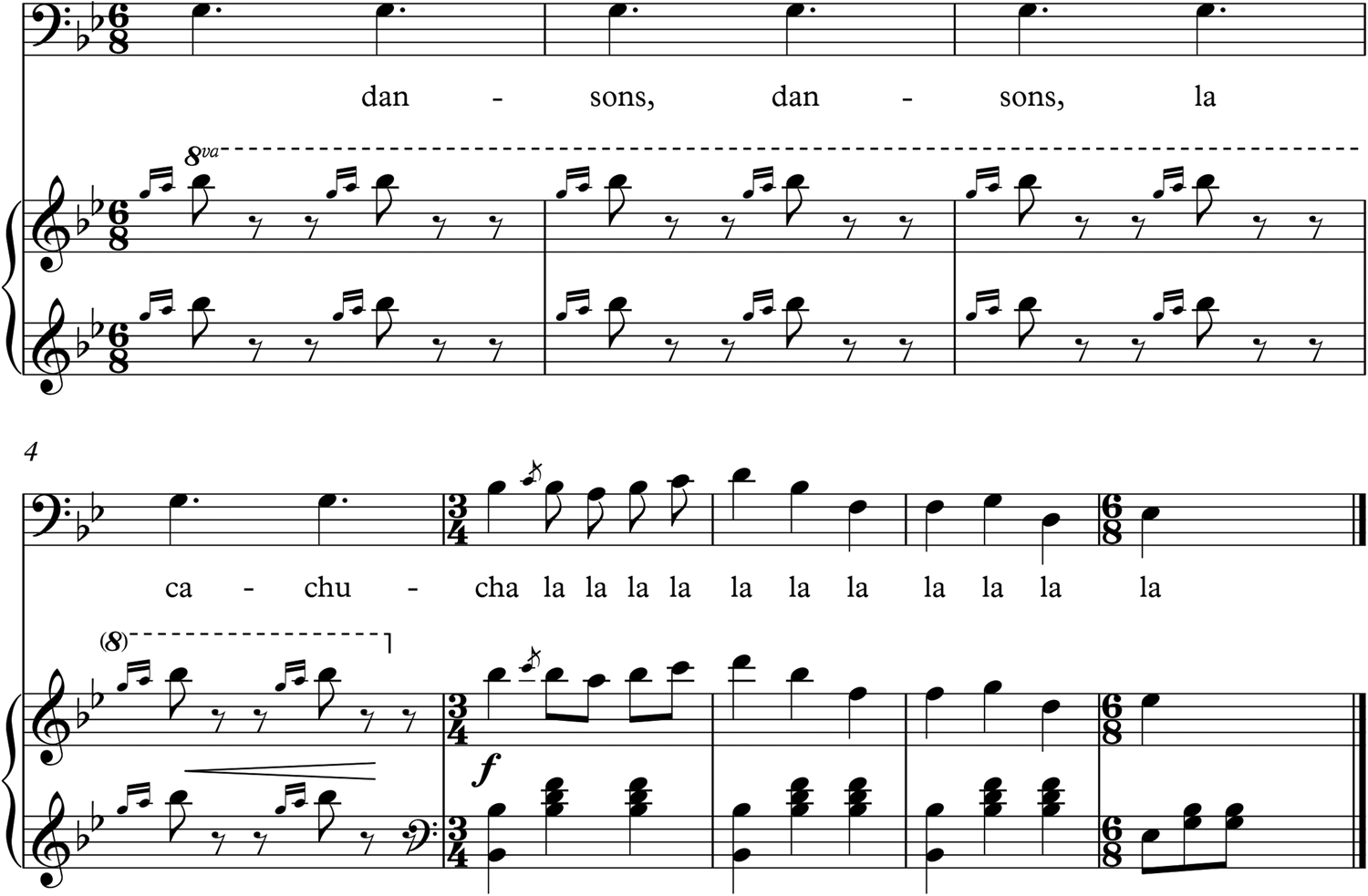
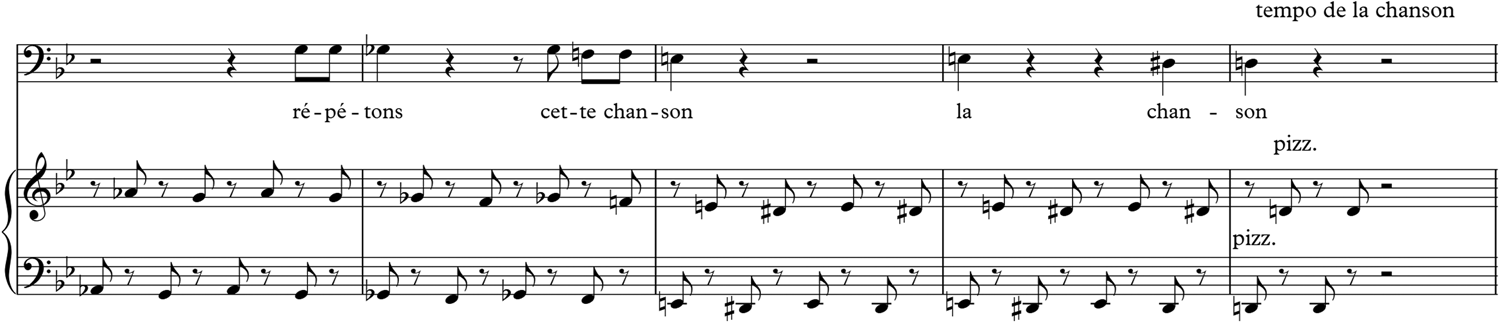
The local colour in Pépito falls under the general definition of ‘exoticism’ in Western music, defined by Ralph P. Locke as: ‘The evocation of a place, people or social milieu that is (or perceived or imagined to be) profoundly different from accepted local norms’ by utilising ‘distinctive repeated rhythmic or melodic patterns (sometime deriving from dances of the “other” country or group, and musical instruments (especially percussion) or performing techniques (e.g. pizzicato, double stops, vocal portamento)’.Footnote 35 In this case, the exotic milieu was Spain, which had long fascinated French writers and composers.Footnote 36 The musical markers of Spanishness are well known: guitar-like figures, dance rhythms, mixture of major and minor scales and use of exotic instruments (tambour de basque, castanets). But in the first version of Pépito, the local colour was confined to Vertigo's aria, Number 2, which contains a Sérénade with the clear markers of Spanish music (minor key, pizzicato strings, guitar-like vocal figuration, castanets) and even the direct quotation of a well-known Spanish dance tune, ‘La cachucha’, which intrudes strikingly when Vertigo mentions that dance (Exx. 1 and 2).Footnote 37
Serenade, beginning, piano-vocal score.Footnote 38

‘La cachucha’, piano-vocal score.

It made sense to associate Spanish music with Vertigo. Not for nothing did the censors recognise that the character Vertigo was a ‘grotesque Figaro’, a jack of all trades, all of them listed at the beginning of Number 2, although it might be noted that one trade not mentioned is barbier (barber):
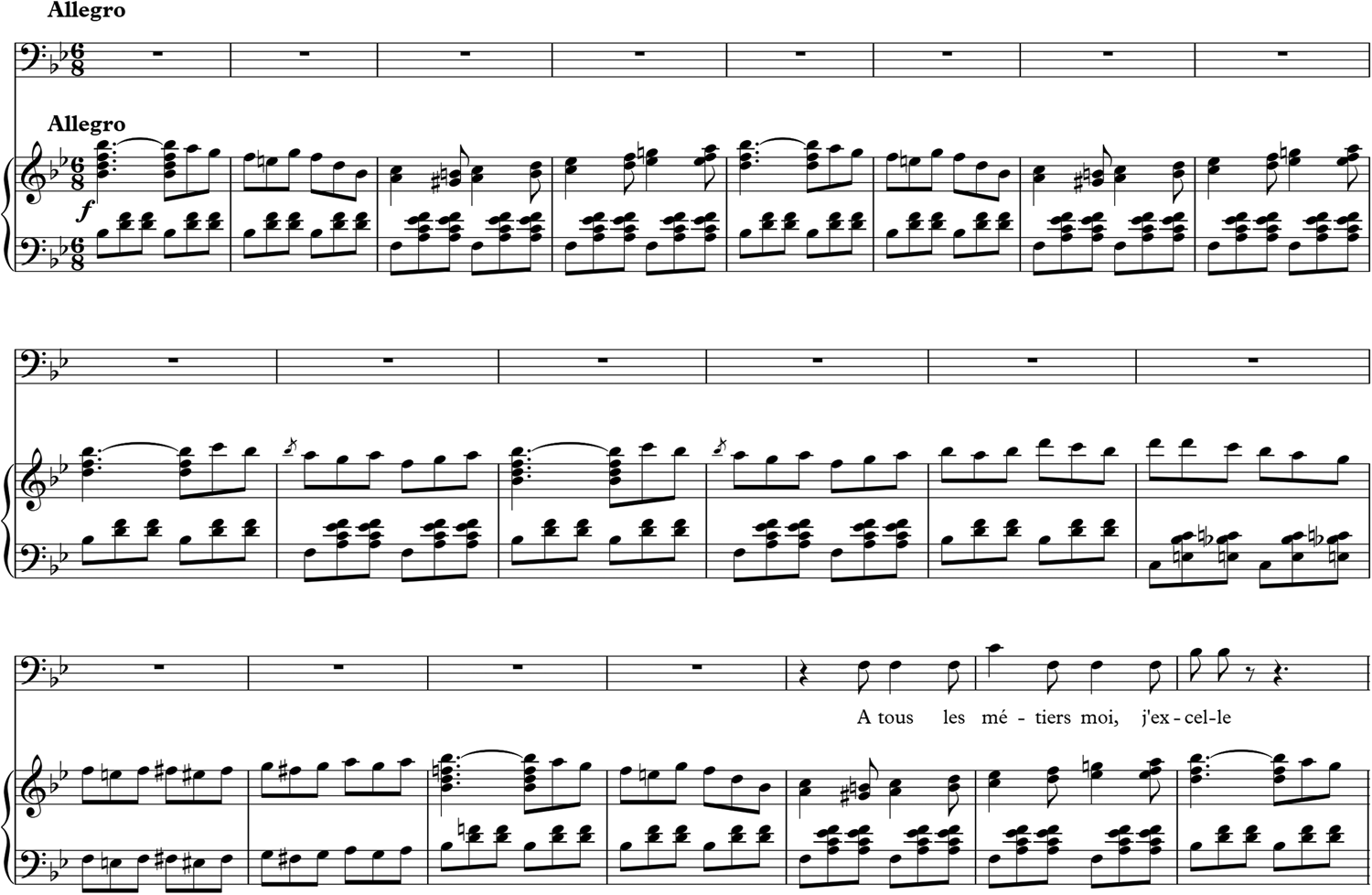
En tous les métiers, moi, j'excelle! / A tous les emplois je suis bon / Et voilà pourquoi l'on m'appelle / Le grand factotum du canton. / Magister, aubergiste, / Tailleur et perruquier, / Oculiste, dentiste, / Facteur, ménétrier, / Serpent, apothicaire / Et maréchal-ferrant … / Quel autre, pour lui plaire / En pourrait dire autant?
(I excel in all trades! / I am good for every job / And this is the reason they call me / The grand factotum of the province. / Teacher, innkeeper / Tailor and wig maker / Oculist, dentist / Postman, carpenter / Performer on the Serpent,Footnote 39 apothecary / And blacksmith … / Who else, to please himself / Would be able to say as much?)
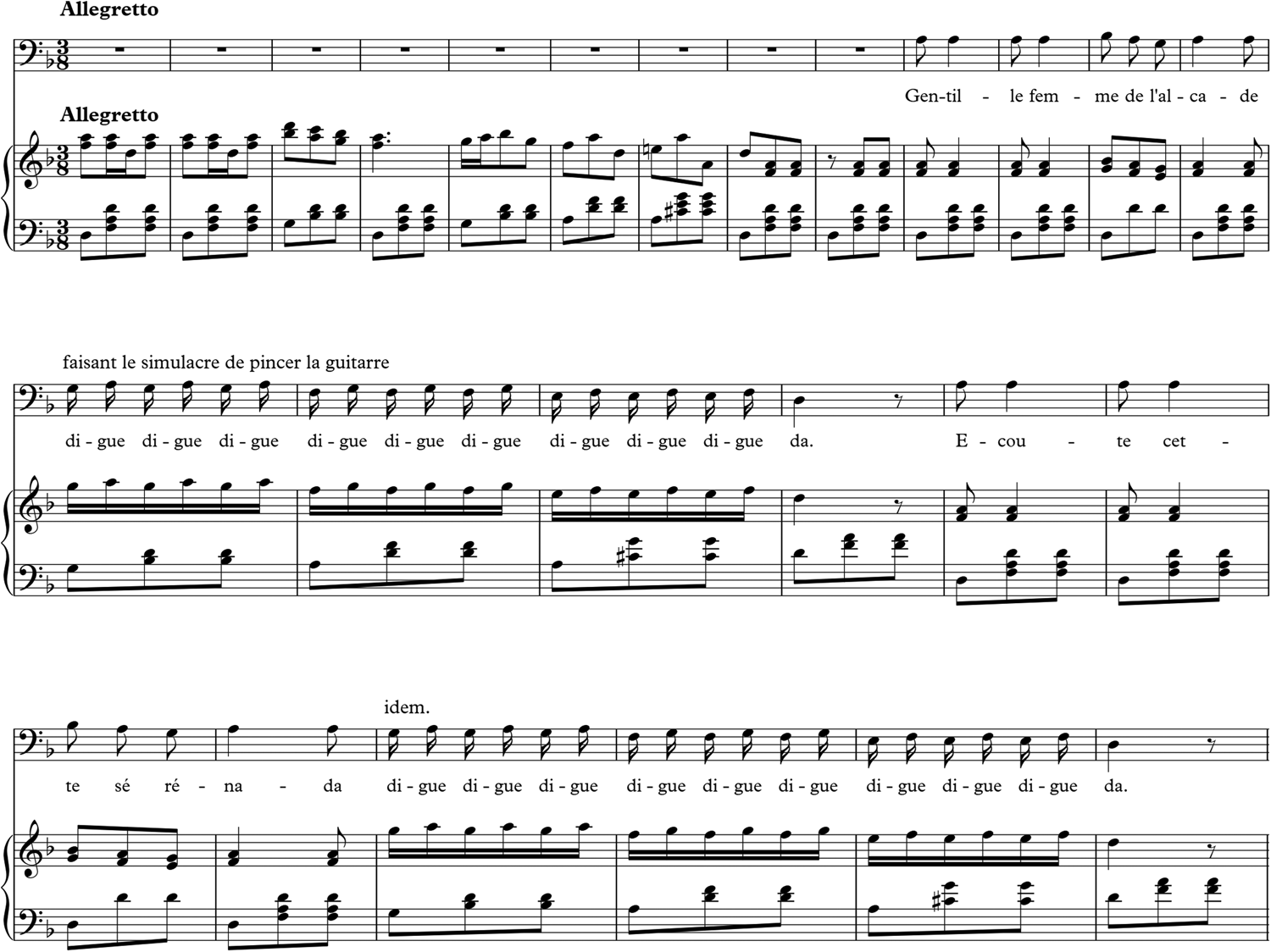
Accordingly, Offenbach provided music that was a parody (recognised by most of the reviewers) of ‘Largo al factotum’ from Il barbiere di Siviglia. This is clear from the beginning, which, while not quoting Rossini directly, manages to recreate the lively spirit of the original aria (Ex. 3).
Beginning of Number 2, piano-vocal score.

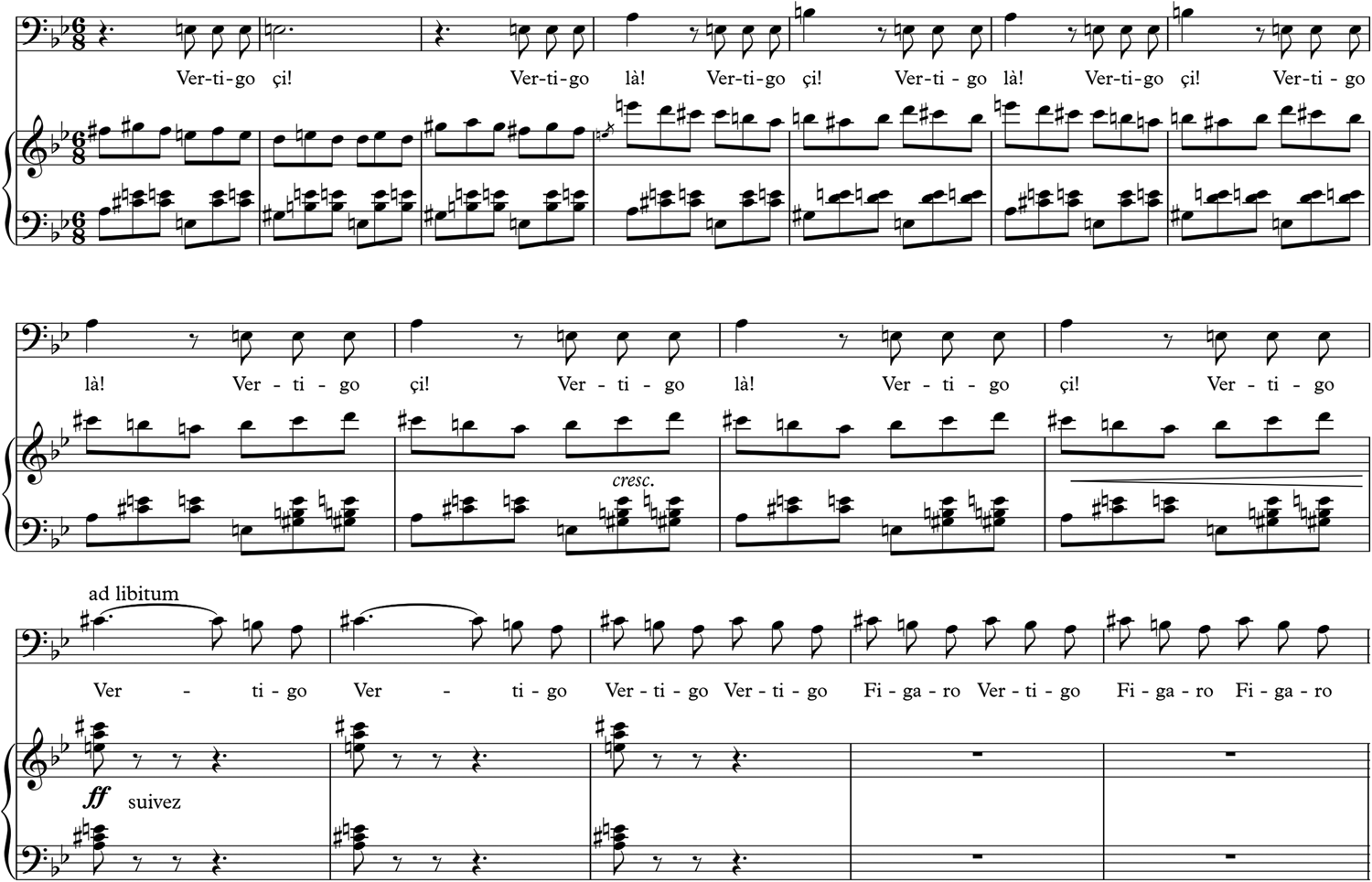
And just to make sure that nobody missed the reference, Offenbach also included the direct quote of a memorable passage in the Rossini aria, and to make doubly sure, the repetitions of ‘Vertigo’ become ‘Figaro’, making the quotation literal (Ex. 4).Footnote 40
Vertigo/Figaro, piano-vocal score.

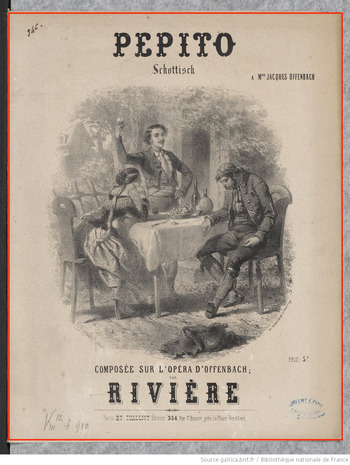
At this point the music stops, and Vertigo, speaking directly to the audience, says that even though he is not Figaro, he is perfectly capable of singing a serenade as well as Figaro could.Footnote 41 He then sings the Sérénade and the parody picks up again after he has finished. There were no more recognisable Spanish elements in the music of Pépito. Offenbach seems not to have felt the need to evoke the Spanish setting, already obvious to the audience in the sets, the costumes (see Fig. 1) and the names of the characters, through music. Then he changed his mind.
BnF, Département de Musique, VM12 F-910: Pépito, Schottisch composé sur l'opéra d'Offenbach par Rivière. Title page depicting the cast.

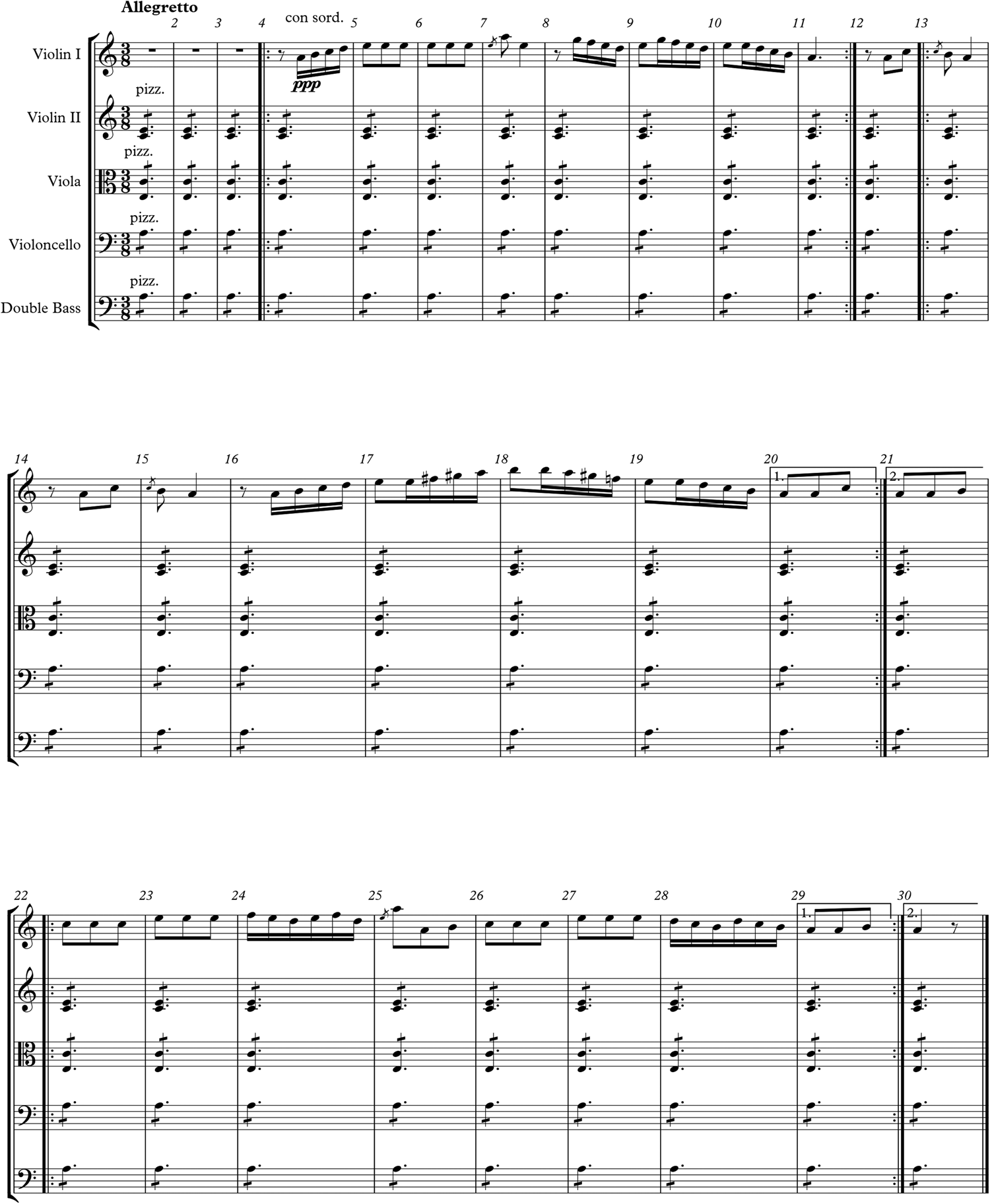
At some point in the rehearsal process, but after the répétiteur and orchestral parts had been copied, Offenbach decided to add more local colour and to associate it with Miguel and Manuelita. The additions are largely in his hand and appear on what were originally blank staves or as insertions in the parts. They consist of a new transition to and replacement for the original duet Number 7 for Manuelita and Miguel in A♭ major, which had no Spanish elements.Footnote 42 This is crossed out in the parts. Offenbach then wrote a transition (labelled 6ter, i.e., the second inserted number after Number 6) and a new duet Number 7 with new lyrics. It is in the transition (which is supposed to be played under dialogue) and in the new duet that the Spanish elements appear. They consist of a Spanish-sounding melody that the reviewers called a bolero. In fact it does not contain the standard bolero rhythm but is in a quick triple meter, evokes the guitar with pizzicato strings and presents a melody in a minor key with a mixture of harmonic and melodic minor scales (Ex. 5).
6ter.

It is this which might have been fashioned to attract the attention of Empress Eugénie. Most of her biographers agree that Eugénie had no interest in serious music but did like dance music that recalled her native country. Pauline von Metternich-Sandor describes an outing with Empress Eugénie to a mountaintop near Biarritz in 1859:
When everybody had finished eating, Basque musicians were heard and their tambourines resounded joyously on this beautiful plateau, which already had a magnificent view. Then, Empress Eugénie, hearing a fandango, could not resist the desire to dance to this beguiling music, and taking a pair of castanets from one of the Basque musicians Her Majesty performed, with a grace and elegance the like of which I have never seen, this dance from her native country!Footnote 43
This seems very much the type of music that Offenbach presented in his newly composed 6ter. Perhaps some listeners even thought of it as being a fandango.
Number 6ter segues into the new duet that begins in the same key. It continues the guitar-like pizzicatos, adds a tambour de basque and introduces a new element, a quotation from Manuel Garcia's most famous song, ‘Yo que soy contrabandista’. Offenbach quotes it in A major in the duet and also smooths out Garcia's wildness and quirky 7+7 bar phrasing into a sedate 8+8 bar phrase (Ex. 6).
Garcia and Offenbach.

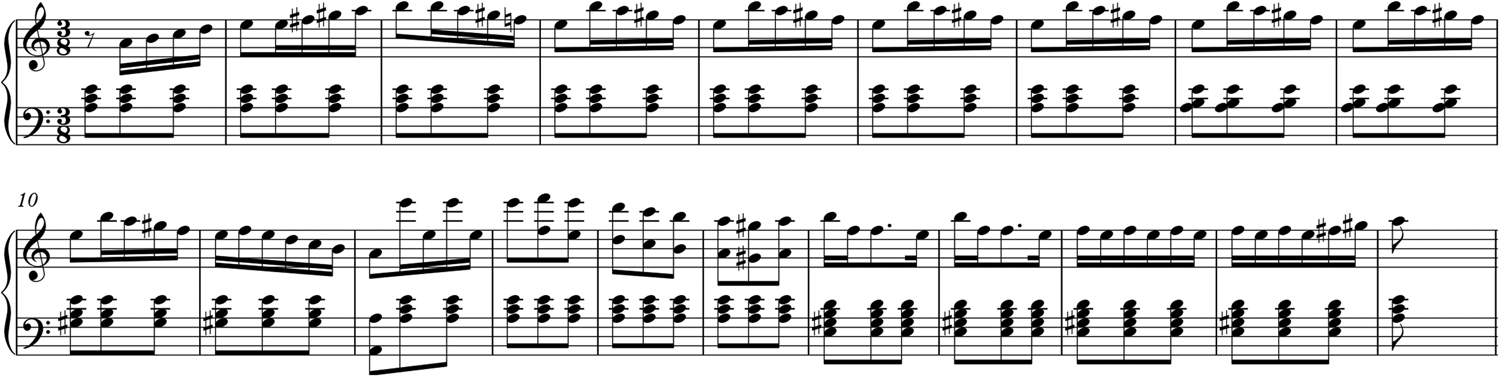
Although these Spanish elements are only a small part of the music of Pépito, Offenbach made sure that they would characterise the whole work in the minds of the audience by insisting on them in the Overture.Footnote 44 Number 6ter and the Garcia quotation are the main themes of the Overture, to which he adds castanets and obsessively repeats the ‘Spanish’ augmented second between the seventh and sixth degrees of the harmonic minor scale and the ‘Phrygian’ (half-step) approach to the fifth degree (Ex. 7).Footnote 45 He even presents the quotation from ‘Yo que soy contabandista’ in Garcia's original key of C major (later played in A major).Footnote 46
Excerpt from the Overture, piano-vocal score.

Thus, the first thing that the audience heard was an extended, even extreme, example of local colour, and they heard a lot of it (the Overture is 384 bars long, not counting the repeats). This actually creates a disjunction, for once the work begins, we discover that we are not in ‘exotic’ Spain, such as Seville in the south, but are rather in the north, without an ‘exotic’ character (sultry gypsy, hot-blooded smuggler) in sight. This emphasis and the lateness of the decision to include local colour add some support to the political interpretation of its presence in Pépito as a tactic to ensure the sympathy of the Empress. If there was a fear that Eugénie might miss the Spanish elements when they appeared in the work itself (after all, 6ter was to be played under dialogue and is marked ppp in the muted first violins), Offenbach made sure that her ears would be saturated with Spanish music at the very beginning.
A performance at Compiègne?
The imperial couple arrived at Compiègne on 12 October 1853 and departed on the 28th. The Variétés troupe performed at Compiègne on 22 October 1853, but Pépito was not part of the programme then, so it must have been a special production.Footnote 47 But did a performance really take place? According to the Paris correspondent of L'indépendance belge, writing on 4 November 1853 (while the work was running at the Variétés), it did, but according to Charles d'Argé writing about Pépito in the Gazette des beaux arts, the planned performance at Compiègne was actually cancelled after Perrin complained about it. There are problems with both reports. L'indépendance belge uses the Compiègne performance as an excuse to tell an anecdote about Offenbach's reputation as a jettatore, caster of the evil eye, even having Offenbach make a joke about it with regard to Pépito, and while it is hard to see why the correspondent would make this up, maybe he did.Footnote 48 D'Argé admits that his story is hearsay and says that as a result of the cancellation, Pépito was ‘forced’ to premiere at the Variétés. In fact, that premiere had been planned from the start.Footnote 49
Regardless, the tactic worked. Fould did not request that the work be withdrawn and Persigny did not force it to be withdrawn. After that, the loophole closed, at least for the Variétés, which produced mostly vaudevilles up to the abrogation of the licensing system.Footnote 50 Carpier had played the politics of genre and won a few battles, but had lost the war. His gamble to transform the Variétés into a théâtre lyrique failed. In November 1853, during the run of Pépito, Bowes fired Carpier.
Pépito: the musical representation of genre
The music
All reviewers of the first performance of Pépito called it an opéra comique even though it was not advertised as one. How did they know this and what did they mean by it? It cannot have been because there was dialogue with interspersed music; this was standard in vaudevilles. It was not the action, which could pass as a vaudeville. It was, of course, the music. Everything about it was totally different from what would have been expected in a vaudeville at the Variétés. V. Darthenay, writing in Le charivari, makes this clear:
Pépito would be nothing more than a charming vaudeville if its authors had employed all the popular tunes of the last fifty years, but, thanks to the original music by M. Jacques Offenbach, Pépito is a charming little opéra comique.Footnote 51
Auguste Lireux, the theatre critic of Le constitutionnel, was so aware that Pépito was different from the vaudevilles he was used to encountering at the Variétés that he refused to review it and instead presented a perceptive and detailed review of the music, purportedly by an anonymous amateur musician-friend.Footnote 52 Several critics, among them Jules Lovy and Adolphe Adam, mentioned that the pre-1807 repertory of the Variétés had included opéras comiques and suggested that the theatre was trying to return to that era.Footnote 53
The music was not only original, but also far more complicated than what was usually heard at the Variétés. Jules Janin was overwhelmed:
This little drama with three characters is well adapted for singing and for pure singing, the composer has gone all out! Thus, couplets, duets, romances, songs, trios! If there isn't a quartet, that is really because there are only three to sing this agreeable score.Footnote 54
Not everybody was happy about this. Mathurin-Joseph Brisset complained in La gazette de France of the ‘super-abundance of all kinds of notes that rise from the orchestra in order to smother the singing’.Footnote 55 Édouard Thierry in Gazette nationale ou Le moniteur universel noted that the work lasted for an hour and a half and would benefit from substantial cuts in the music, advice which Offenbach followed, excising large chunks of the score after the first performance (see following).Footnote 56
The work at its the first performance consisted of an overture and nine separate vocal numbers with a few interspersed short instrumental interludes:
Overture: A major
1. Romance: Manuelita, E♭ major
2. Air Bouffe: Vertigo, B♭ major with an inserted Sérénade in d minor
3. Couplets: Manuelita, F major
-
3 bis: Instrumental, C major–D majorFootnote 57
-
4. Duet: Miguel/Manuelita, G major–A♭ major–G major
5. Trio and Drinking Song: Vertigo, Miguel, Manuelita, C majorFootnote 58
-
5 bis: Instrumental, G majorFootnote 59
-
6. Romance: Miguel, g minor–G major
-
6 bis: Instrumental, G majorFootnote 60
-
6ter: Instrumental, a minorFootnote 61
-
7. Duet: Miguel, Manuelita, a minor–A major
-
7 bis: Instrumental, C majorFootnote 62
-
8. Duet: Vertigo, Manuelita, G majorFootnote 63
9. Finale: F majorFootnote 64
The most extensive number was the Trio (Number 5) with its embedded Drinking Song, which became the hit of the production. This complicated ensemble, consisting of 703 bars of music with many sections, yet returning at the end to the tonic C major, was unlike anything that had been heard at the Variétés for a long time, if ever.Footnote 65 Further, there is nothing particularly funny about the essential action. Miguel, who is something of a rake, has been told falsely by Vertigo that Manuelita will be an easy conquest, like the girls he knew in Madrid. Most of the second half of the ensemble is taken up with his attempt at seduction, which rises to the level of physical harassment (he attempts to grab and kiss her), all of it firmly rebuked. Ashamed, Miguel retreats, and at the end of the ensemble discovers that he is really in love with Manuelita. The drunken Vertigo supplies some comic relief but that does not cancel out the seriousness of what is happening.
All this must have come as something of a shock to the audience. Pépito was not the only item on the programme at the Variétés on 28 October: it was preceded by a reprise of a recent vaudeville, Un homme de cinquante ans, by Gaston de Montheau, first performed at the Variétés on 9 July 1852, and followed by a reprise of an old vaudeville, La neige, ou L’éginard de campagne, Tableau villageois en un acte, by Mélesville and Carmouche, first performed at the Variétés on 26 December 1823. These two works are perfect examples of the type of vaudeville that was featured at the Variétés in the 1850s. The first is set in the present and tells a story about a newly married couple who are growing apart but are drawn together by their friend, who, at the advanced age of fifty, knows something about the world. The other is an example of the type of vaudeville described in the 1807 decree, a tableau villageois. Musically, both works are perfect examples of the vaudeville genre. Un homme de cinquante ans has twenty-one musical numbers (plus an overture), all of them using ‘well-known tunes’. There are 583 bars of music, nearly 200 fewer than the total for Number 5 in Offenbach's work. No number in the vaudeville is longer than sixty-five bars.Footnote 66 An audience expecting something like this would surely have been overwhelmed by the music of Pépito. In addition, two other elements differentiated Pépito from standard vaudevilles: the voice quality of the singers and the orchestration.
The singers
Pépito has just three characters: Vertigo, Miguel and Manuelita (Pépito never appears). Only one member of the cast was a regular at the Variétés: Jean-Baptiste Leclère (1802–62) in the role of Vertigo was one of the comic stars of the theatre that he had joined in 1848. Reviewers were amazed that he was capable of singing the music that Offenbach wrote for him, that is, he sounded like an operatic baritone. This says something about the voice he used when he sang the airs connus in the vaudevilles that were his stock and trade.
The other two performers were recent students at the Conservatoire who were appearing in opéras comiques at the Théâtre Lyrique. Charles Louis Lourdel, called Biéval (1829–83) in the role of Miguel was a light tenor who entered the Conservatoire in 1849 and left in 1851, studying voice with Louis-Antoine-Eléonor Ponchard and opéra comique (déclamation lyrique and acting) with Théodore-François Moreau-Sainti. Ponchard consistently classified his voice as mesquine (insignificant), but he did better in opéra comique.Footnote 67 In 1851 he received a second accessit in opéra comique Footnote 68 and moved to the Théâtre Lyrique, where he sang some leading roles. A number of reviewers of Pépito considered his voice to be weak, but others praised his singing.
Elisabeth Gabrielle Larcena (1832–1907), who took the role of Manuelita, could perform in Pépito because she was on hiatus, waiting for her contract at the Opéra-Comique to begin in January 1854.Footnote 69 Larcena attended the Conservatoire in 1847–52, studying voice with Manuel Garcia fils and Michel Giuliani, and opéra comique with Laurent Joseph Morin. Her yearly evaluations were generally favourable.Footnote 70 In 1850 she received an accessit in opéra comique.Footnote 71 When she left the Conservatoire, she was hired by the Théâtre Lyrique. Pierre-Ange Fiorentino in 1852 recognised that Larcena was a mezzo-soprano trying to become a soprano by increasing her upper register (in June 1850 it was noted that she was moving from a contralto to a mezzo-soprano, and Giuliani later described her as a mezzo-soprano).Footnote 72 Fiorentino points out the dangers to her voice that could ensue if this was not done carefully. Larcena's later career suggests that Fiorentino may have been correct in his fears. At the Théâtre Lyrique she sang soprano roles. Offenbach clearly considered her to be a high soprano. In Pépito, he has her hold a b2 and sing c3. When she moved to the Opéra-Comique in 1854, she took soprano roles. But I can find no references to Larcena as a singer after 1854. It may indeed be that her voice gave out and she decided to abandon her career.
In short, the audience heard what we might call ‘a musical-comedy voice’ (Leclère), a light, weak operatic tenor (Biéval) and an operatic soprano who was straining to reach her high notes (Larcena). Fig. 1 shows Larcena, Biéval and Leclère in a scene from the work.
The orchestration
The orchestra of the Variétés was small, around twenty-five to twenty-eight members. Its make-up can be deduced from various sources: two flutes (one of which doubled as piccolo), two clarinets, one oboe, one bassoon, two horns, two cornets, one percussionist, nine to ten violins (first and second), three to four violas, two to three cellos and two to three basses. This line-up caused Offenbach some difficulties. The Variétés had no trombone in its orchestra, a drawback in a work in which one of the characters is supposed to play the serpent. In spite of that, Offenbach inserted a trombone joke into the score: in the Finale, at the point where Vertigo says that he will play his serpent at the wedding, the famous trombone call of Robert le diable is heard in the orchestra, assigned to the cornets. The lack of percussionists also forced Offenbach to improvise, since his orchestration calls for more than one percussion instrument to be played at the same time. Hence, the castanet part is given to one of the cornet players, while the triangle part is buried in the folder for one of the desks of second violins.
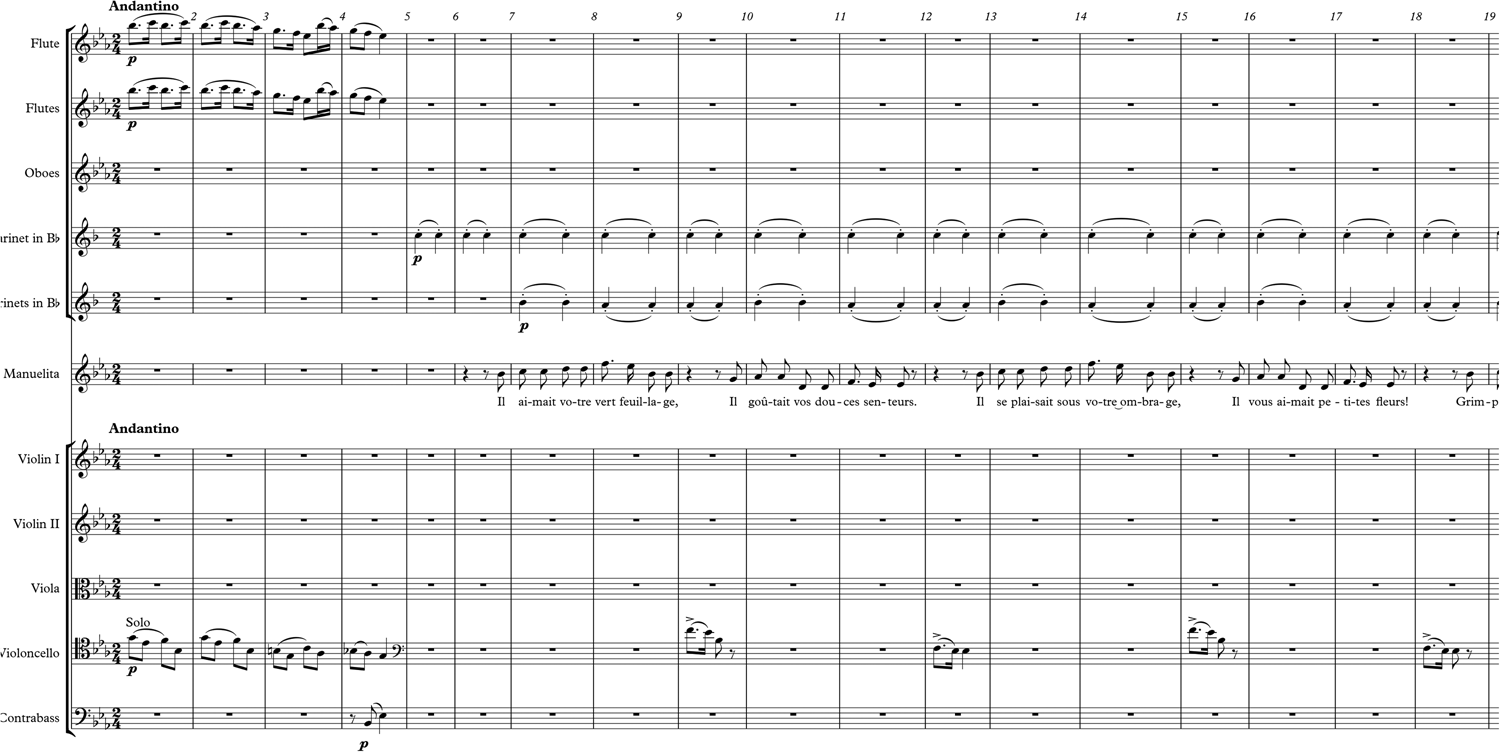
One thing Offenbach did not have to worry about was the competence of the orchestra. It is possible to discover the names of its members in the 1850s.Footnote 73 A number of the performers can be found in Pierre Constant's lists of the lauréats of the Conservatoire; they had probably all been students there. Offenbach could be sure they were capable of playing his music, and his orchestration is full of imaginative effects, such as the flute solo accompanied by solo cello, followed by pulsating clarinets and voice answered by the cello at the beginning of Number 1 – and heard immediately after the intensely Spanish Overture (Ex. 8).
Pépito, Number 1, beginning.

Offenbach even has the violins do unusual things, such as using mutes and playing natural harmonics.Footnote 74 All this could be expected in an opéra comique but not in a vaudeville, where elaborate orchestration of the accompaniment of the airs connus would only interfere with the perception of the couplets. Number 2 of Un homme de cinquante ans, for example, is typical of the way airs connus were orchestrated at the Variétés. Only strings are used. The first violin doubles the voice and the harmonisation is strained at certain points (Ex. 9).
Un homme de cinquante ans, Number 2.

Offenbach's orchestration must have been a welcome change for the members of the orchestra, something that Adolphe Adam noticed:
The orchestra of the Variétés which has the bad habit of accompanying the vaudevilles too loudly, rose to the occasion and played with great delicacy the various dynamic markings of this music, the execution of which was very meticulous.Footnote 75
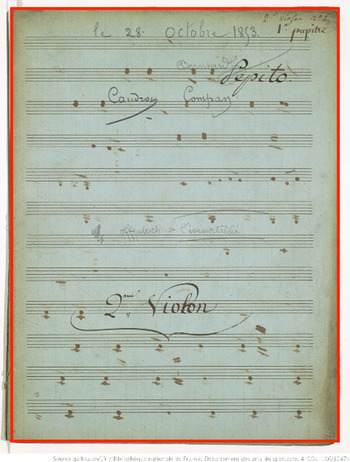
A member of the second violin section could not restrain his enthusiasm and inscribed Offenbach à l'immortalité on the title page of his part (Fig. 2).
BnF, Département des Arts du Spectacle, fonds Théâtre des Variétés, 4-COL-106(1247): Pépito Violin 2, 1 pupitre, title page

All these elements (complexity, operatic voices, elaborate orchestration) explain why nobody had any trouble recognising that Pépito was an opéra comique masquerading as a vaudeville. The only jarring note, and a prediction of what was to come, was the parody of Rossini in Number 2.
Aftermath of Pépito
Pépito ran for twenty-six non-consecutive performances from 28 October to 2 December 1853.Footnote 76 For the Variétés this was not a great success but it was not a failure either. Clearly it was not the big hit that Offenbach had been hoping for, but he had some reason to be satisfied. The reviews were generally favourable and he also made a little money out of it.Footnote 77
Pépito was also the first dramatic work by Offenbach to be published, by Chaillot in December 1853, as separate numbers in piano-vocal score, as a complete piano-vocal score and as a set of orchestral parts.Footnote 78 The Variétés performing parts could not have been used for the latter but they probably were the source of the copies that constituted the Stichvorlage. Offenbach even supplied an entirely new second oboe part that reflects the final form of the work and contains a note to the ‘engraver’.Footnote 79 As Jean-Claude Yon points out, the publication facilitated Offenbach's entry into the Société des Auteurs et Compositeurs Dramatiques, which was essential to his further career.Footnote 80
Pépito did not fade away after its run at the Variétés. On 28 March 1854, Offenbach gave a private performance of the work in his apartment, performing the role of Vertigo himself. His guests were all given a printed programme announcing a ‘32ème théâtre-lyrique’.Footnote 81 In 1855, perhaps having learned something about navigating the theatrical bureaucracy from watching Carpier sneak an opéra comique past the authorities, Offenbach established the Théâtre des Bouffes-Parisiens.Footnote 82 Pépito was revived there in 1856, 1857 and 1858. In June–July 1857 it was performed in London during Offenbach's visit there. In 1858, it became the second Offenbach work to be performed, in German translation, at the Carltheater in Vienna,Footnote 83 and it was later performed in a different translation in Berlin in 1859.Footnote 84 In a Gustave Doré lithograph published in Le monde illustré in 1861, Pépito figures among the works that had poured from Offenbach's pen between 1853 and 1861.Footnote 85
In 1864, the hierarchical system of genre that the first production of Pépito had defied collapsed under the sustained attacks of Offenbach and others, at which point Offenbach returned to the Variétés with a new genre, the opéra bouffe La belle Hélène.Footnote 86 Pépito had its part to play in this historical narrative, but by 1864 Pépito itself had disappeared. It is not included among the works listed in the obituaries of Offenbach in the French newspapers in October 1880. No excerpt from Pépito was included in the Offenbach memorial concert organised by Le figaro at the Variétés on 18 November 1880, nor does it appear in the long list of Offenbach's works in the illustration by Édouard Detaille on the commemorative programme of that evening.
In the late 1890s, Pépito was ‘rediscovered’. In 1898, Léon Grus published the vocal parts and dialogue (without accompaniment)Footnote 87 and the orchestral parts.Footnote 88 This may have been in anticipation of a scheduled 1899 performance at the Théâtre Athénée Saint-Germain. That performance never took place,Footnote 89 but on 27 January 1902, Gil Blas announced an upcoming performance at the Théâtre des Capucines on 31 January. Pépito ran there for 163 nights (31 January–13 July 1902), slightly more than six times the original run in 1853. The work continues to be occasionally performed to this day.Footnote 90
Postscript: a residual memory of Pépito? Elizondo, José, Carmen
Offenbach's Spanish opéra comique is set specifically in the village of Elizondo in the northeast corner of Spain, very close to the French border in the province of Navarre. Today Elizondo would be a strange place to choose to represent Spain; in fact, if you asked current residents if they considered themselves to be Spanish, I am not sure what answer you would get, as Elizondo is in the Basque country. Why choose a Basque village for a Spanish opéra comique? The reason appears to lie in Offenbach's family situation. In 1844, Offenbach had married Marie Manuela Herminie de Alcain, whose mother was French, but whose father was Spanish. More accurately, he was Basque, having been born in the city of San Sebastian. When Offenbach married Herminie, he acquired a passel of Alcain in-laws, some of whom were in Paris, but most of whom were in San Sebastian. In particular, he acquired a brother-in-law: Herminie's brother, Pepito. The title of Offenbach's opéra comique clearly seems to refer to this brother-in-law. There are also direct references to San Sebastian and other Alcains in the libretto. Offenbach's in-laws must be the subject of another study,Footnote 91 but here I wish only to point out that even though everybody called Herminie's brother Pepito, that cannot have been his legal name: Pepito is a diminutive of Pepe, which is a nickname for Jose. Indeed, Herminie's brother's real name was José Bernardo de Alcain, as attested by the acte de naissance registering his birth in Bordeaux on 25 June 1828.Footnote 92 In 1853, José Bernardo was in Paris running the Alcain family business and helping the Offenbachs financially. Naming the opéra comique after him does not seem to have been a coincidence.Footnote 93 But this reminded me of another fictional José who came from Elizondo, Don José Lizarrabengoa of Mérimée's novella Carmen, which was issued in a new edition in 1852.Footnote 94
Pépito and Carmen
There are a number of curious parallels between the novella and the opéra comique. First, Pépito (real name José) is a soldier stationed in the south of Spain (although it is Cadiz, not Seville). Second, when speaking of her absent fiancé, Manuelita says the following to Vertigo:
The day he was called up, he gave me this little cassia blossom that he had just picked in the mountains, promising to love me for ever. The poor flower has faded since on my heart, but inside, love has remained as fresh as the first day.Footnote 95
Those who know Carmen may remember that a cassia blossom ‘qui, sèche, gardait toujours sa bonne odeur’ (‘which, dried, kept its sweet scent’) has a certain role to play in the story.Footnote 96 Finally, Pépito is in the end unfaithful to Manuelita, but at least he marries the woman of his new affections and remains a soldier. In other words, Pépito shows what might have happened to Merimée's Don José if he had not met Carmen. Is this a coincidence? Maybe. And maybe the following is also a coincidence.
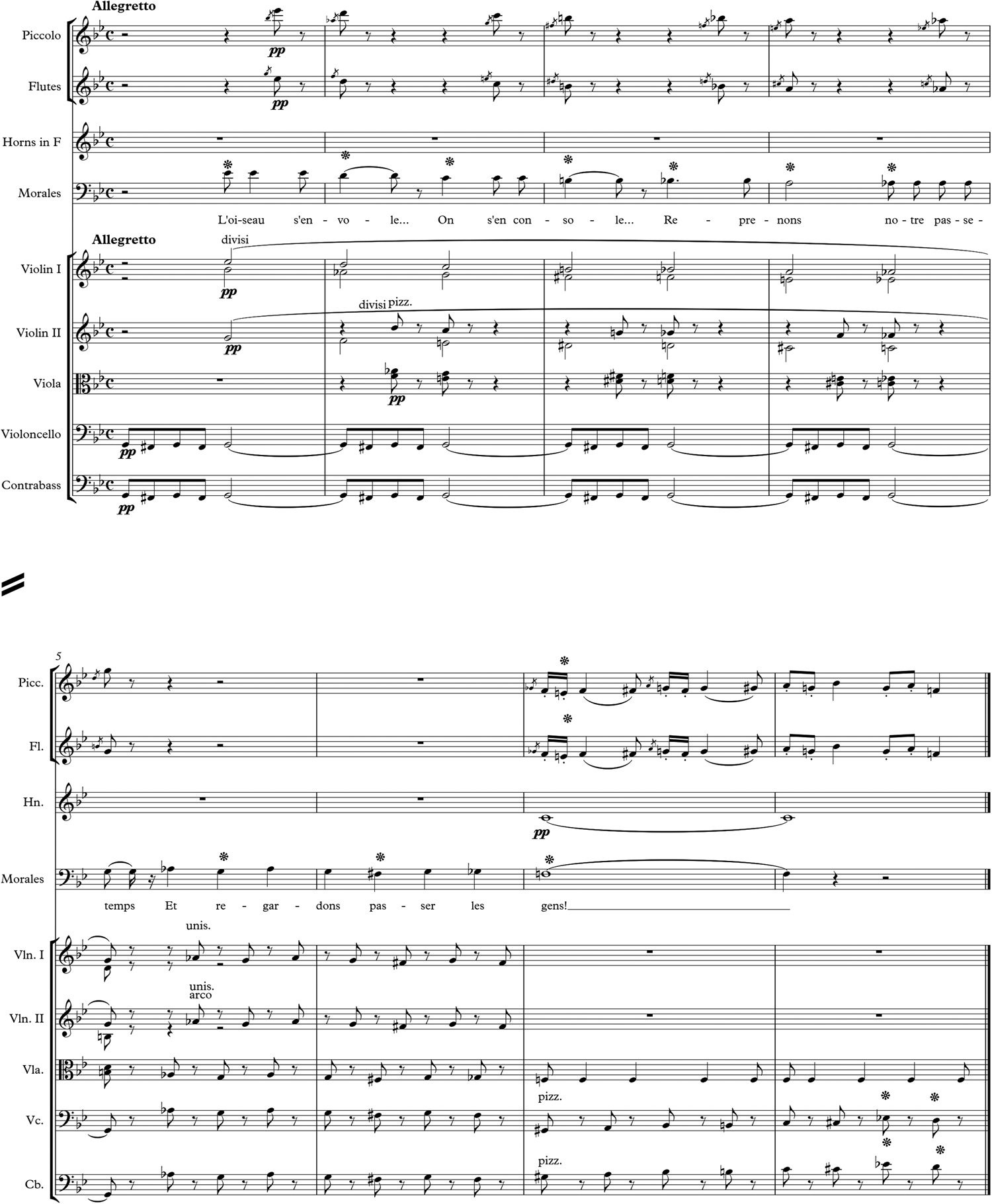
When listening to Pépito, I was struck by a particular passage in Number 5: a few bars of transition to a recapitulation of the Drinking Song reminded me of a passage from Bizet's Carmen (Exx. 10 and 11). Looking more closely, I saw that these few bars conclude a semi-chromatic descent from e♭ to d in each work, and that the recapitulation then begins in the dominant, accompanied by pizzicato strings (Exx. 12a, 12b).
Pépito Number 5 transition, piano-vocal score.

Carmen, Number 1 transition, piano-vocal score.

Pépito transition in score: moves from A♭ major to V of G major (chromatic descent indicated by asterisks).

Carmen transition in score: moves from g minor to V of B♭ major (chromatic descent indicated by asterisks).

Looking even more closely, I saw that both passages come after an attempted seduction. In Pépito, Miguel has begun his attempt to seduce Manuelita, whose recollection of Pépito initiates the transition. In Carmen, the transition comes after the soldiers’ failed attempt to seduce (rape?) Micaela, and they resign themselves to watching the passers-by. In other words, the two passages occur at similar structural points. This suggests to me that the similarity in the music may not be a coincidence. But it may also not have been deliberate; it is almost as if Bizet had a residual memory of the passage that popped into his head as he composed his ensemble. Had he ever seen Pépito?
Bizet was a student at the Conservatoire, first in piano, then in composition, from 1849 to 1857. He was therefore a colleague of Larcena's and Lourdel's. He was also living in what is now the 9th arrondissement, as were Larcena and the Offenbachs.Footnote 97 Had he already made Offenbach's acquaintance by 1853? Did he go to the Variétés to see his former student colleagues in the first performance of Pépito? There is no evidence of this. But it is certain that Bizet entered Offenbach's circle in late 1856, when he and Charles Lecocq jointly won the competition for a new opéra comique that Offenbach had announced with great fanfare in July 1856. Bizet's setting of Le docteur Miracle was performed at the Théâtre des Bouffes-Parisiens on 9 April 1857.Footnote 98 One of the librettists of Le docteur Miracle was Léon Battu, also one of the librettists of Pépito. Further, Pépito was revived at the Bouffes-Parisiens 1856 and 1857. Bizet could have had ample opportunity to see it then. Maybe he had even looked at the published vocal score (after all, Offenbach was running the competition). There, he would have seen the local colour, particularly the emphasis on the augmented second of the harmonic minor scale,Footnote 99 and perhaps also the quote from ‘Yo que soy contrabandista’. Maybe he also noticed that in Iradier's ‘El Arreglito’, which became the Habañera, the male character in the dialogue is called Pepito.Footnote 100 And just maybe, strange as it may seem, a twenty-year-old memory came to him as he composed his own opéra comique about a Basque from Elizondo.Footnote 101
 , C major; bars 428–60, Modified Reprise of the Drinking Song; bars 461–542, Transition (no tempo indication), 2/4, E major (no change of signature)–G major–modulating suddenly to E♭ (V of A♭ major); bars 543–650, Ensemble, Allegro moderato, 2/4, A♭ major; bars 651–71, Transition, Andante,
 , diminished seventh modulating to G major (V of C major); bars 672–703, Ensemble, Andantino très doux,
 , C major.