“With the southern states of the Union I have only a superficial acquaintance,” Alexis de Tocqueville wrote his brother Édouard on January 20, 1832. “To know them as well as the North, I would have had to remain another six months.”Footnote 1 Exactly one month later, on February 20, 1832, Tocqueville departed for France; he had traveled in the South for six weeks of his nine-plus months in America, almost two weeks fewer than he had stayed in just one city, New York.Footnote 2 Except for another two weeks in Canada, from August 20 to September 2, 1831, Tocqueville spent the balance of his visit in the northern states.Footnote 3
Tocqueville's restricted itinerary—he and Gustave de Beaumont had been recalled to France earlier than expectedFootnote 4—prevented him from conducting “an intensive examination of the South.”Footnote 5 His visit to America was “brief enough to begin with,” his biographer André Jardin writes, and “the South especially was sacrificed.”Footnote 6 Except more than the South was sacrificed. Tocqueville's only western travels were by steamboat to Detroit, Sault Ste. Marie, and Green Bay, and a weeklong overland trip to Saginaw, Michigan. He did not visit Ohio, apart from three days in Cincinnati; he did not see Indiana, except looking north and west from his steamboat going down the Ohio River; and he did not travel to Missouri or Illinois. Neither did he tour the vast area composed of western North Carolina, western Virginia, western Maryland, and eastern portions of Kentucky and Tennessee—most of Appalachia.Footnote 7
Tocqueville conceded the partial quality of his study. “Generally speaking,” he informed Édouard in his letter of January 20 from Washington, “one needs two years to form a complete and exact picture of the United States.”Footnote 8 Nonetheless, he hoped that with “numerous [supplementary] documents,” enough notes to fill fourteen books, the 200-plus conversations he had had with Americans, and his own “musings,” he would be able to “write something tolerable about the United States.”Footnote 9
Eighteen months after returning to ParisFootnote 10 and with the help of “summaries of over 200 books and documents, including Justice Joseph Story's Commentaries on the Constitution of the United States; Thomas Jefferson's Notes on the State of Virginia, and The Federalist; the assistance of two young Americans;Footnote 11 and comments on the manuscript by Gustave de Beaumont, Louis de Kergorlay (a close friend since childhood), Comte Hervé de Tocqueville (his father), his two (older) brothers, and others, Tocqueville drafted the first part of De la démocratie en Amérique in less than a year.Footnote 12 French, British, and American readers received the subsequent bookFootnote 13 with enthusiasm and critical appreciation.Footnote 14 Five years later, Tocqueville published the second volume of Democracy in America.
More than a few scholars have since held Democracy in America to be the “greatest book ever written … about America.”Footnote 15 With Tocqueville's extensive knowledge of American society, his unusual ability to aggregate and synthesize information, his remarkable powers of abstraction, his extraordinary ambition as a theorist of democracy and comparative political development, and his great skill as a stylist,Footnote 16 generations of political scientists and other scholars have been persuaded.Footnote 17
That the relative brevity of Tocqueville's visit to the United States (and Canada) would influence his perception of America and affect what lessons he drew from his visit is to be expected.Footnote 18 This logic applies with even greater force to his circumscribed exposure to the South, a feature of his travels that has important and overlooked consequences.Footnote 19 The argument here is that Tocqueville's abbreviated exposure to and his selective study of the South and near West fundamentally influenced his understanding and analyses of democracy and the equality of conditions in America. Specifically, Tocqueville ignored the presence of the poorer, often landless whitesFootnote 20 of the rural South and the near West.
This neglect, in turn, crucially affects his overall interpretations and the general lessons he sought to draw from his study and apply to France and other democratizing nations. Specifically, he hoped to induce in Europe and his home country four institutions that in America have successfully induced mœurs that have successfully combatted the restlessness, envy, and political ignorance typical of democratic societies. Because of Tocqueville's misreading of American society, however, I question the accuracy of these lessons as well as their transportability.
This inattention to the white poor in Democracy stands in relief against Tocqueville's thoroughgoing focus on Americans’ Puritan roots. He ascribed (European) Americans’ habits to their “wholly Puritan origin.”Footnote 21 This Puritan “point of departure”Footnote 22 was “the germ” of his analysis and “the key to virtually the entire work.” “There is not a single event, which the point of departure cannot readily explain,” he stated.Footnote 23 And yet in multiple passages in Democracy as well as in his letters and notes, Tocqueville recognized and commented on the existence and distinct mœurs of the white poor.
Tocqueville touched on the existence another American origin in a handful of sentences on the founding of Virginia and in a footnote, however.Footnote 24 He described the first Virginians as “restless and turbulent” gold seekers and, in the note, depicted Virginia's “early days” as being (partly) populated by “former servants, bankrupt swindlers, debauchees, and other people of the sort.”Footnote 25 Yet this is the extent of Tocqueville's comments on America's “oldest colony,” even though over half of the Europeans emigrating to British North America in the seventeenth and eighteenth centuries arrived as unfree laborers—that is, as indentured servants, transported felons, political prisoners, and abductees. Most were taken to Virginia and Maryland and sold to tobacco growers,Footnote 26 when in 1613 the Virginia Company proprietors discovered the profitability of tobacco cultivation after not finding gold and failing in other enterprises.Footnote 27
If slavery was the most glaring product of this other “point of departure,”Footnote 28 the immigration of impoverished whites and the exile (or banishment) of convicted felons was the other outcome (where arrival of indentured servants gradually declined following Independence and declined again after the turn of the nineteenth centuryFootnote 29 and where convict transportation essentially stopped after beginning of American-British hostilities in 1775).Footnote 30 The mass migration of impoverished and lower-class British, Scots, Irish, Germans, and others to North America in the seventeenth and eighteenth centuries constituted the basis of the population of propertyless whites.Footnote 31 The South thereby “housed two ‘potentially explosive’ underclasses,” Eugene Genovese writes, “one terribly and relentlessly oppressed and the other tangentially oppressed.”Footnote 32
Tocqueville's inattention to the white poor has had significant consequences. One is that his analysis misdescribes southern society; this flawed description of the South misleads the reader with respect to important facets of the South and early western United States. A second is that he implied the presence of a crucial tension that necessarily exists between his analysis of America's “wholly Puritan origin” and his writings in scattered passages in Democracy, his letters, and his notes of Americans’ seminal non-Puritan mœurs: their low regard for education, their crude manners, and their great passion for material well-being. But Tocqueville did not address this inconsistency in his analysis. A third effect of Tocqueville's mischaracterization of the white poor is that he misapprehended which lessons could be taken from his study of American society. Specifically, the extent to which the non-Puritan habits of the South and western United States typify the whole of American society had the effect of undermining the capacities of the four institutions he explicitly identified as being able to moderate democracy and promote liberal government. Not only did Tocqueville get America wrong in important ways, his (skewed) lessons from America did not carry over to French society.
Tocqueville's restricted Southern travels and his inattention to the white poor have not gone unnoticed. Schleifer comments upon Tocqueville's inability to study the South in depth, but he makes the point in a four-word aside.Footnote 33 Jardin, too, notes the brevity of Tocqueville's travels in the South and the inadequacy of his account of southern aristocracy. Jardin disposes of the subject in a few sentences, however, and quickly moves on to other topics.Footnote 34 Both scholars treat Tocqueville's limited engagement with the southern states as though it can be bracketed or set aside for their larger purposes: to describe how Tocqueville researched and drafted Democracy and to write a biography of Tocqueville, respectively. The historian James Crouthamel finds Tocqueville's analysis of the South to be a “pastiche” of ideas and impressions,Footnote 35 most of which the French aristocrat formed before his western and southern tour. Crouthamel argues that this fact explains why Tocqueville proposed several “questionable” notions, such as “all southern whites owned slaves” or “Kentucky was the South in microcosm.”Footnote 36
If historians have been somewhat critical of Democracy,Footnote 37 political scientists have essentially accepted Tocqueville at his word. Harvey Mansfield and Delba Winthrop describe Democracy as being “rich with detail, descriptive and predictive of America in particular and democracy in general,” for example, and Jon Elster writes of the “concrete and down-to-earth nature of the first volume.”Footnote 38 Neither Mansfield and Winthrop nor Elster, who are among the most eminent of Tocqueville scholars, qualify their remarks. The political scientists who do take issue with Democracy interrogate Tocqueville's political philosophy with respect to such concepts as democracy,Footnote 39 liberalism,Footnote 40 and the principles of U.S. government.Footnote 41 The dominant view among political scientists and most other scholars is that the intellectual scope, acute insights, and sheer brilliance of Tocqueville's analyses more than compensate for any factual errors, misjudgments, and idiosyncrasies.Footnote 42 In the Introduction to Democracy, Tocqueville asked his readers for their forbearance—to take the book in the spirit in which it was written.Footnote 43 With few exceptions, political scientists have obliged.
The intention here is to consider Tocqueville's scholarship through another lens so as to reappraise his history and analysis of the United States. Accordingly, the sections that follow rely mostly on Tocqueville's own writings: the two volumes of Democracy, his extensive correspondence, and his voluminous travel notes. Further, I draw on documents from colonial America and the early United States and on U.S. census data. I also depend on the extensive scholarship in political science and history on Tocqueville, Democracy in America, Britain's North American colonies, and the early United States. Finally, I consult the reports of other Europeans who visited North America around the time of Tocqueville's travels.
The first part of this article provides the necessary background for this study. It reviews the history of Tocqueville's travels in the interior South and backwoods (and “backwoods” was how contemporary easterners referred to the people and lands of the interior South and western United States, those on the periphery of the more settled parts of the country). It then discusses what other scholars have written on Tocqueville's travels in North America, what they have commented on how Tocqueville conducted his research, and what they have said about his tendency for abstraction and generalization.
The second section—the first of the three “consequences” discussed above—addresses how Tocqueville's lack of exposure to the South and near West affects how he describes and interprets American society. It considers four instances where Tocqueville mischaracterized the early United States in light of what is known from U.S. Censuses, state constitutions, and historical scholarship: (a) the incidence of slave ownership, (b) the prevalence of tenant farming, (c) the participation of poor white men in state politics, and (d) the colonial history of Virginia. In each instance, Tocqueville effectively ignored the white poor, in contrast to his explicit recognition of African Americans, American Indians, and the role of women.Footnote 44
To be clear, this is not a matter of “blaming” Tocqueville or “finding fault.” Rather, my purpose is to illuminate an important and overlooked feature of Tocqueville's description and analysis of the United States—the fact that he saw and experienced little of the South and the near West—and to argue that this oversight has important implications.
The third section draws on Tocqueville's own writings so as to establish that despite the limited attention he pays to the southern and western states, he nonetheless identified a culture with habits and values that exists at odds with America's dominant, Puritan-influenced mœurs. Tocqueville found that many Americans disrespect formal education, many exhibit (and tolerate) poor manners, and almost all reveal a rapacious avidity.Footnote 45 The passion for material gain produces a profound anxiety among Americans, moreover, one that provokes a deep unease about their relative material standing, notwithstanding the fact that they live in a democratic society without hereditary inequality. But by not integrating these observations into his generalizations of American society, Tocqueville implicitly discounted the effect this less “civilized,” rawer culture has on his overall analyses and interpretations of the United States.
The fourth and last section discusses how Tocqueville resolved the inconsistency in his writing between his emphasis on the Puritan point of departure and his recognition of the prevalence of non-Puritan social and mental habits. Tocqueville argued that the institutions and mœurs of the southern and western states were unrepresentative of the United States for the purposes of his study.Footnote 46 “I am speaking of those Americans who live in regions where slavery does not exist,” he wrote. “Only they can give a complete picture of a democratic society.”Footnote 47 Any comparative lessons of America's mœurs and institutions were to be derived exclusively from the study of other more densely settled, more economically vigorous, and slave-free northern states.Footnote 48
Yet this approach contravenes Tocqueville's own pronounced intention to represent the United States as accurately and comprehensively as possible.Footnote 49 Not only does it cast the completeness of his portrayal of the United States into doubt, contrary to his stated aims, but it also affects the lessons Tocqueville extracts from his study and intends to apply to France. For if the widespread presence of non-Puritan mœurs in America constitutes a significant feature of the equality of conditions and democratic society,Footnote 50 then the institutions Tocqueville identified as enabling democracy to function may, in fact, be incapable of accomplishing what he believed and expected they could.
1. Background: The Roads Not Taken, the People Not Met
After seven months in the northern states, including a fortnight in the northwestern wilderness and another two weeks in Canada, Tocqueville began his trip south. He started from Cincinnati, where he and Beaumont boarded a steamboat (Dec. 4, 1831) heading down the Ohio River to Louisville (Dec. 6). From Louisville, Tocqueville went overland to Memphis, via Nashville.Footnote 51 En route, he spent three nights at an inn (or tavern) in Sandy Bridge to recover from a fever. He then spent a week in Memphis (then a village) before taking a steamboat to New Orleans. He arrived in New Orleans on January 1, 1832, and two days later left by steamboat for Mobile. From Mobile, he took a series of carriage rides across the thinly populated South up to Norfolk. At Norfolk, he boarded another steamboat to take him up the Chesapeake Bay and the Potomac River to Washington.Footnote 52 The trip from New Orleans to the nation's capital took Tocqueville only fourteen days, two weeks exactly.Footnote 53
Tocqueville rarely strayed from the main thoroughfares, such as they were in the early 1830s. Even his stay in Sandy Bridge (now the town of Hollow Rock) occurred only as a result of the Ohio River freezing over, forcing Tocqueville, Beaumont, and other steamboat passengers to disembark at Westport, Kentucky (22 miles northeast of Louisville), and proceed by foot—what Beaumont describes as a forced march—to Louisville.Footnote 54 From there, they took a carriage across Kentucky and Tennessee to Memphis. The week in Memphis was likewise the unanticipated by-product of this same extraordinary cold snap,Footnote 55 one that prevented steamships from going either up or down the ice-bound upper Mississippi—or, for that matter, the Ohio, Tennessee, Cumberland, and Missouri Rivers. Not until Christmas Day was Tocqueville able continue his trip south, boarding a steamboat whose captain agreed to discontinue his voyage upriver, reverse course, and return to New Orleans.Footnote 56
Tocqueville spoke with few planters, never conducted a thorough visit of a plantation, and did not become acquainted with the southern aristocracy.Footnote 57 Fifty leagues (or 150 miles) short of New Orleans, he visited a Louisiana sugar plantation while the steamboat refueled, but he did not talk to the slaves or overseers.Footnote 58 He never visited a cotton or tobacco plantation,Footnote 59 and he never witnessed a slave auction.Footnote 60 Tocqueville did interview two planters before leaving for the South: Mr. ClayFootnote 61 in Philadelphia (from Georgia) and James Brown in Boston (a judge and former senator from Louisiana).Footnote 62 And he spoke extensively with South Carolina Rep. Joel Poinsett about “slavery, tariffs, and the nullification movement” as they traveled together from an inn near Columbia, SC, up to Washington, DC.Footnote 63 Only four times did Tocqueville come into close contact with African Americans: several inmates at the new Cherry Hill prison in Philadelphia,Footnote 64 a mentally disturbed man in a Baltimore almshouse, two slaves at the tavern in Sandy Bridge,Footnote 65 and the butler at the French consul's home in New Orleans.Footnote 66
Contrary to his original plans, he did not stop in Charleston, SC, even though Charleston was probably America's finest and most admired city at the time.Footnote 67 He did not pay a call on an elderly James Madison at Montpelier. Neither did he visit Thomas Jefferson's University of VirginiaFootnote 68 nor any other American university. Nor did he study the economics of slavery or talk with slaves to learn what they thought,Footnote 69 in contrast to his sympathetic and extensive engagement with American Indians.Footnote 70 In comparison, the British writer and social analyst Harriet Martineau was able to do all of the above during her two-year visit to America (September 1834 to August 1836).Footnote 71
The circumscribed quality of Tocqueville's visit is also evident from the kinds of people with whom he socialized and from whom he gathered information, an aspect of his travels facilitated by the seventy letters of introduction he and Beaumont had with them.Footnote 72 “Our letters of introduction and the publicity surrounding our mission have opened all doors,” Tocqueville reported of the warm and enthusiastic treatments they received from their American hosts, thanks to the glowing news accounts and favorable word of mouth. “We are showered with attention.”Footnote 73
The great majority of the hundreds of (almost all) men whose (usually lengthy) conversations Tocqueville recorded in his notes were citizens of high social standing, considerable wealth, and/or prominent political positionFootnote 74—those whom he identified as “the best-informed people.”Footnote 75 The initial impressions Tocqueville gathered from his conversations at society balls, over formal dinners, in small informal gatherings, and on other occasions were often definitive. He usually asked his interviewees the same questions, such as of the effects of slavery on American society or of the threats to the stability of the American republic.Footnote 76 And the notes from those conversations frequently appeared “almost verbatim in Democracy” and in his letters.Footnote 77 “There is an obvious secondhandness” to Democracy, Robert Nisbet observes.Footnote 78
As a result, Tocqueville acquired a skewed account of American society—as would any short-term foreign visitor, to be sure. If he was a “master at the art of condensing thought,” he was also committed to certain issues, as George Pierson points out. And he often held established positions on those same issues. “He himself came to resort more and more to sweeping statements and all-inclusive final phrases,” Pierson remarks.Footnote 79 Indicatively, Tocqueville commented that “there is in the way things are run [in the South] something feverish, disordered, revolutionary and passionate, which does not give the same sense of strength and durability” as the North, when he was in Baltimore—that is, before he had visited any of the southern states (besides parts of Maryland).Footnote 80 His “tendency,” Pierson adds, “was to explain too much by too little, to substitute a universal man for particular men.” All too quickly and all too often, Tocqueville's thoughts “spun out into pure theory” and his deductions lost “all connection with fact and reality.”Footnote 81
Schleifer, too, finds that Tocqueville was inclined to analyze in too tidy parallels and too easy contrasts, to contradict himself with his many generalizations, and “to overshoot the factual basis for some of his ideas.”Footnote 82 With his need to draw abstractions and engage in bold theorizing,Footnote 83 Elster remarks, Tocqueville often “seemed to have thought before he looked.”Footnote 84 Rarely did he test his empirical generalizations, philosophical abstractions, or “what he heard” against the evidence of “what he saw at first hand.”Footnote 85
2. The South Miscalibrated, the United States Misdescribed
What most struck Tocqueville in his North American travels—and he was ever aware of how what he saw and learned in America compared with France and the Old World—was “the equality of conditions.”Footnote 86 “Among them one finds neither commoners nor nobles; prejudices of birth have always been … alien to them.”Footnote 87 Americans “do not always agree about the best means of government or the most suitable forms of government, but they do agree about the general principles that ought to rule human societies,” Tocqueville states in his long chapter on “Three Races That Inhabit the United States.”Footnote 88 “From Maine to Florida [then a U.S. territory], from Missouri to the Atlantic Ocean, everyone believes that all legitimate power originates with the people. Everyone shares the same ideas about liberty and equality. Everyone professes the same opinions about the press, the right of association, juries, and the responsibilities of government agents.”Footnote 89 This uniformity is the result of the fact the North American colonies were “founded by men who either started out as equals or became equals by living in them.”Footnote 90 Americans, he states, “constitute a single people.”Footnote 91
“There is but one society,” Tocqueville declared, “whether “rich or poor, humble or brilliant, trading or agricultural” and it is “everywhere composed of the same elements. The plane of a uniform civilization has passed over it. The man whom you left in the streets of New York, you find again in almost impenetrable solitudes; same clothes, same attitude, same language, same habits, same pleasures.”Footnote 92 The explanation of this sameness was the “fortunate circumstances” that “instilled in [Americans’ “fathers”] a love of equality and liberty.” And it was “God himself who, by giving them a boundless continent, granted them the means to remain equal and free for a long time to come.”Footnote 93
In contrast to France, Tocqueville regarded the United States as a paragon of social equality and an exemplar of (relative) material equality. Americans’ “fortunes are equal” and “almost all … are comfortably well-off”;Footnote 94 all their “needs are easily satisfied.”Footnote 95 Yet on its own terms America was a highly unequal society—unequal not only for women, African Americans, and American Indians, but also for male European Americans.Footnote 96 This inequality among white men is evident in the incidence of slave ownership, the prevalence of tenant farming, the limits on political participation, and the history of colonial Virginia. In each instance, the historical record is at odds with Tocqueville's own account of the near equality of (white) Americans.Footnote 97
Slave Society
Tocqueville treats America as a society divided between the northern, free states and the aristocratic, slaveholding South. The Ohio River alone separated “freedom and servitude”Footnote 98:
On the left bank of the river, the population is sparse. From time to time, a group of slaves can be seen ambling in their carefree way through half-cleared fields. The virgin forest never disappears for long. Society seems to slumber. Man appears idle, whereas nature is the very image of activity and life.
By contrast, the confused hum emanating from the right bank proclaims from afar the presence of industry. Rich harvests fill the fields. Elegant homes hint at the taste and fastidiousness of the farmers. Prosperity is apparent everywhere. Man seems rich and content: he is at work.Footnote 99
The state of Ohio, although younger than Kentucky by ten years, had the larger, more prosperous, and more industrious population (and composed mostly former New Englanders), whereas Kentucky had been part of Virginia and was a slave state.Footnote 100 Ohio had six slaves (five female, one male) in a total state population of 936,000 in 1830, and Indiana—further down the Ohio River—had three slaves (all female) in its population of 343,000.Footnote 101
“The right [north] bank of the Ohio is a scene of animation and industry,” Tocqueville elaborated in a letter to his father, “work is honored and no one owns slaves. But cross the river and you suddenly find yourself in another universe. Gone is the spirit of enterprise. Work is considered not only onerous but shameful; whoever engages in it degrades himself.” The southern man seeks “not so much fortune as excitement and pleasure,” and spends his days “hunting, horseback riding, or doing nothing.” He “has the tastes of idle men” and exhibits “feudal mores.”Footnote 102
The root cause of this dissolution is plainly obvious for Tocqueville: slavery. “Slavery introduces idleness into society,” he explained, “and, with it, ignorance and pride, poverty and luxury. It saps the powers of mind and lulls human activity to sleep.”Footnote 103 In consequence, “the southerner is born into a sort of domestic dictatorship.… The southerner's upbringing all but insures that he will be arrogant, quick-tempered, irascible, violent, ardent in his desires, and impatient of obstacles.”Footnote 104 Tocqueville saw the effect of slavery pervading the southern states, commenting, “no [white] family in the South is so poor that it has no slaves.”Footnote 105
The facts of Southern history indicate otherwise. Only one in three southern households (36 percent) owned slaves in 1830.Footnote 106 The slave population came to fewer than one of five persons (18 percent) in Carroll County, Tennessee, where Sandy Bridge was located, and to barely more than one-fifth (21 percent) of Tennessee's population.Footnote 107 And Kentucky had only a slightly higher proportion of slaves than Tennessee (24 percent of the state's population of 688,000).Footnote 108 Most white households did not include slaves, even as there were considerable differences among the southern states. North Carolina's population was one-third slave (246,000) and two-thirds free (492,000), for instance; Virginia's population of 1.2 million people was 39 percent slave; and South Carolina's slave population (315,000) exceeded its free population (266,000).Footnote 109
Slave ownership within the states did not change much over the course of the antebellum era. Census records of 1860 show that 31 percent of southern households owned slaves (compared to 36 percent in 1830), and the proportions of slaves in Kentucky and Tennessee in 1860 remained almost identical to those of 1830. Nearly one out of every two households had slaves in some states (46 percent in South Carolina, 49 percent in Mississippi), whereas relatively few households owned slaves in others (12 percent in Maryland, 13 percent in Missouri).Footnote 110
Tocqueville might have contended that the fact that two-thirds of households in the antebellum South did not have their own slaves is insignificant, even if trivially true, because the white male heads of household fully expected to become slave-owners. “No citizen [is] so poor that he did not gaze with hope and longing upon the pleasures of the rich,”Footnote 111 he wrote (where the “pleasures” presumably include owning slaves).Footnote 112 This may have been the case, particularly as it pertains to the public statements by non-slave-owning poorer whites. But it is equally plausible that those European Americans who did not own slaves privately doubted they would ever own slaves. In the words of one historian of the antebellum South, “the vast majority of poor whites recognized the near-impossibility of eventually owning slaves.”Footnote 113 But it is hard to imagine them publicly admitting their resignation to this reality.
The incidence of tenant farming likewise presents a different image of rural America.
Tenant Farming
There is no systematic national data on leasing farms and tenancy for the early and mid-nineteenth centuryFootnote 114 because the U.S. Census did not begin to collect data on tenant farmersFootnote 115 until 1880.Footnote 116 There are separate studies of tenant farming in particular counties and regions, however, as well as general studies of agriculture that include discussions of landlessness and tenancy. This body of research indicates that large proportions of American farmers were tenants or other landless farmworkers. Tocqueville, though, denies the existence of tenant farming.Footnote 117
Many landowners bought more land or owned more farms than they could themselves use, so they leased their land to get a return on their investment (or speculation). Some tenants paid rent in kind (between one-third and two-thirds of the crop), and others were able to retain most or all of their farm products in return for completing certain tasks, such as clearing land, fencing livestock boundaries, or helping with building improvements.Footnote 118 The precise arrangements for landlords and tenants depended on the quality of the land, the relative price of renting versus owning land, the relative price of hiring farm workers versus tenancy,Footnote 119 and farmers’ access to capital. Tenant farmers were often younger men who rented land and saved their money until such time as they could buy their own farms. They were also often men of “circumstances” and “good capacities,” who, if they had marketable skills or other occupational options, could have achieve relatively secure positions.Footnote 120 “Renting was frequently judged to be a better use of labor and capital than purchasing a small, cheap farm of low productivity,” one historian observes.Footnote 121 More generally, tenant farming allowed landless European Americans to participate in a system whereby they could gradually acquire sufficient capital to buy their own farms and become established property owners.Footnote 122
In eastern Pennsylvania, for instance, Paul Clemens and Lucy Simler find that tenancy mostly disappeared by the early-mid nineteenth century. Farm owners recruited landless farm workers to replace their tenants, such that by 1820 there were about 100 laborers in Chester County for every 100 householders.Footnote 123 Thus by the early nineteenth century, tenant farming was no longer a step along the path of upward mobility; “at best,” Clemens and Simler conclude, “the economy promised the laborer regular employment and a living, but little more.”Footnote 124
Tenant farming in the South had a different flavor. Excluded from the position of overseeing slaves and from much of the agricultural work in the southern United States, “poor whites had very few options for long-term agricultural work,” Keri Merritt reports, which left “a sizeable percentage of landless whites with no other choice but to tenant, sharecrop, or work as wage laborers.”Footnote 125 In rural northern Georgia, as many as four out of ten households were either tenant farmers or subsistence farmers, Steven Hahn finds. Landlessness “was widespread” in the antebellum era, Hahn remarks, “but it was often disguised” by kinship and by a life cycle that enabled tenants to eventually acquire freehold independence “relatively late” in their years.Footnote 126 Both sharecropping and tenant farming “seemed to have been relatively common” in the antebellum South,Footnote 127 and the “truly, cyclically poor” comprised a full one-third of the South's white population in 1860. It took the 1862 Homestead Act, only passed after secession, to break the cycle of landlessness among the white poor.Footnote 128
The near West was much the same. As of 1835 most of the farms in northern Ohio were held by tenants, an agricultural historian reports, and tenant farming was widespread “in Indiana, Illinois, and southern Wisconsin.”Footnote 129 Similarly, tenants and non-land-owning farmers came to about 30–40 percent of households in Upper Sugar Creek, Illinois, John Mack Faragher discovers, with absentee landlords owning approximately 30 percent of the land.Footnote 130 Like Clemens and Simler, Faragher finds tenancy to be a short-term phenomenon amid the turnover within the community: about three-quarters of non-landowners—squatters, tenants, and renters—simply moved on from Upper Sugar Creek, migrating further west.Footnote 131 Like Hahn, too, Faragher finds tenancy to be complicated by family relations.
What these several studies make clear is the great variation in farm tenancy among unpropertied whites, depending on the kind of agriculture, the region, and the local economy. The “landless” category spanned a multitude of situations that ranged from dependent destitute men (and women and families) and propertyless itinerants who might work for short periods at a time (“vagabonds,” those who had had few life options and minimal agency) on the one extreme, to skilled workers and capable farmers (those who could choose where they wanted to work, for how long, and under what conditions) on the other extreme.Footnote 132
There is also strong circumstantial evidence of the prevalence of tenant farming and the existence of a large minority of landless whites.Footnote 133 More than 40 percent of adult white males did not own any land in mid-1790s western Pennsylvania, for example. In Kentucky in 1800, 45 percent of white men did not own any land, while the top 1 percent of Kentuckians owned 10,000-plus acres of land—about one-third of the state's taxable land.Footnote 134 And the top 2 percent of Americans in 1860 owned 40 percent of all land in the United States, while the bottom third of white Americans had “little more than clothing and perhaps some petty cash” and, worse, were chronically unable to save money, Lee Soltow reports.Footnote 135
The first U.S. Census figures of 1880 on tenant farming are suggestive. Of the 8.6 million U.S. farmers at the time (where “farmers” includes farm operators, farm managers, and farm workers), 1.0 million, or 12 percent, were tenant farmers, with over half of them (550,000) living in the South.Footnote 136 Of the 10.0 million farmers in the United States in 1890, 1.3 million were tenant farmers (13 percent), of whom 700,000 lived in the South. And in 1900, 1.2 million of the 2.0 million tenant farmers in the United States lived in the South.Footnote 137
The 1900 census, the first to collect data on the demographics of tenant farmers, reveals that 75 percent of the 2.0 million total tenant farmers were white (“white” included “Mexican”) and that slightly more than one of four of tenant farmers were non-white (28 percent, or 560,000).Footnote 138 Almost half (45 percent) of white tenant farmers lived in the southern states, moreover, where they constituted 55 percent (680,000) of the 1.2 million tenant farmers living in the South. In contrast, non-white (i.e., African American) tenant farmers came to just over a third (36 percent) of the total number of U.S. tenant farmersFootnote 139 and slightly less than half of southern tenant farmers, if more proportionally (45 percent, or 550,000).Footnote 140
For Tocqueville to write that “there are no tenant farmers, as such” in America thus seems puzzling and facially insupportable.Footnote 141 It is not the case that “every man owns the field he cultivates” because “land costs little” and because “anyone can easily become a land owner.”Footnote 142 Now it may be that with the words “as such,” Tocqueville meant to signal a distinction between American tenant farmers and feudal tenants in France and the Old World. Americans “do not possess the idea” of “peasant,” he pointed out, and U.S. tenant farmers were clearly not the same as European peasants or serfs.Footnote 143 But even this scenario does not explain why Tocqueville claimed that all Americans owned their own land and why he neglected to compare tenant farming in America to that in France in view of the fact that both agricultural systems committed landless men (often with their families) to work under the authority of landowners for extended periods of time.Footnote 144
Others have commented on Tocqueville's oversight in broader terms. “The non-slaveowning poor white class was nonexistent to Tocqueville,” Crouthamel writes.Footnote 145 Arthur Kaledin similarly finds that “many did not appear in the social landscape [Tocqueville] sketched” and that “laboring people, the poor, the black man, the red man, and all those wounded by the social pathologies and the economic dislocations of an aggressively competitive society. Except for the Negro and the Indian[,] he paid hardly any attention to the nonbelongers.”Footnote 146 Kaledin also points out that Tocqueville, upon being informed of the presence of 2,000 prostitutes working in Boston, chose not to comment on this (unseemly) reality in Democracy.Footnote 147 His text contains no references to prostitution;Footnote 148 does not mention the mill workers of Lowell, Massachusetts; and does not acknowledge the working conditions of girls and women employed in other towns and in other industries.Footnote 149
In an exception to this omission, Tocqueville at one point described the “lower classes” of Philadelphia and New York as “constitut[ing] a rabble even more dangerous than that of Europe.” This “rabble,” who consist of freed African Americans and “hordes of Europeans driven to the shores of the New World every day by misfortune and mischief,” have the worst vices of Europe and, at the same time, no countervailing “interests that could combat the influence of those vices.” Furthermore, they are “quick to take advantage of all the passions simmering within” their new country.Footnote 150
The footnote is an exception. Tocqueville did not write of the men and women who worked in other cities besides Philadelphia and New York (Baltimore? Boston?) or report on those who had to sell their labor to landowners, industrial employers, and other bosses. Neither did he comment on their colonial predecessors of this “rabble”: the people who were driven to American shores in the seventeenth and eighteenth centuries to work as unfree laborers for multiyear periods (as discussed above). On the contrary, “the myth that almost all eighteenth-century American freemen owned land persisted well into the twentieth century,” Simler writes.Footnote 151
But Simler's characterization also applies to the nineteenth century; then, too, the public records rarely identified tenants, and the historical research routinely neglected tenancy. Just as Simler finds that new research has “serendipitously” revealed “the existence of large tenant populations in many areas of mainland British America,”Footnote 152 so has subsequent research on the nineteenth-century United States disclosed the widespread presence and variable quality of tenant farming, both before and after the Civil War.
Political Inequality Among White Men
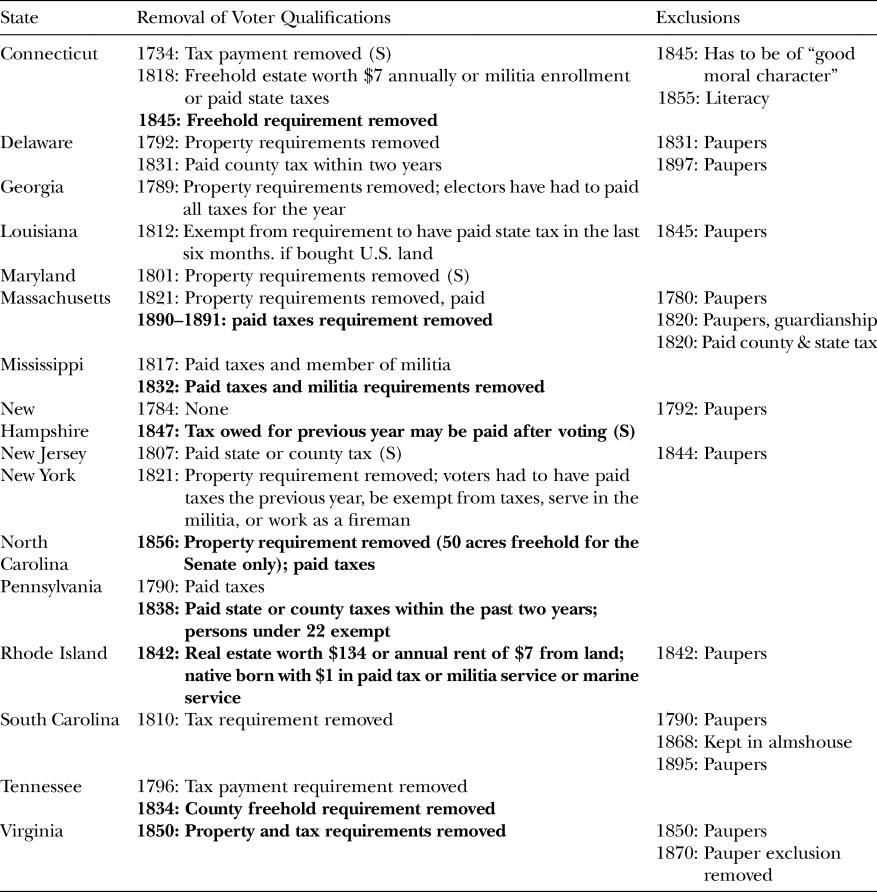
The white poor were also discriminated against politically. As of 1831, several states continued to restrict suffrage on the basis of property ownership, as Tocqueville reported in Democracy,Footnote 153 while other states reduced their suffrage requirements on white males over the course of the early nineteenth century.Footnote 154 Of the twenty-four states at the time, ten (Alabama, Delaware, Georgia, Illinois, Indiana, Kentucky, Maryland, Pennsylvania, Tennessee, and Vermont) had no constitutional or statutory restrictions on suffrage for adult white males, consistent with Tocqueville's emphasis and the ethos of Jacksonian democracy, while fourteen states restricted white male suffrage to some degree, however slight.Footnote 155 Some states explicitly denied the vote to paupers, and others mandated that voters had to have paid state taxes the previous year, thereby formally barring paupers, itinerants, and those with minimal land and/or personal property from exercising their vote. Two of these fourteen states removed their land and/or wealth requirements soon after Tocqueville's visit (Mississippi and Tennessee), while a handful of states retained property restrictions on suffrage—beyond the paid-tax requirement and banning paupers from the polls—well beyond the Jackson presidency: North Carolina (only for voting for state senators), Rhode Island, and Virginia.Footnote 156 The restrictions on suffrage in the states also applied to the federal government, moreover, because the suffrage requirements for electing members of the U.S. House of Representatives were the same as those for electing members of the lower chamber of the state legislatures.Footnote 157
Other research complicates this history. Because of the low threshold of the tax-payment requirement, because of the lax scrutiny of voting qualifications, and because of the fact that many war veterans voted irrespective of the formal rules,Footnote 158 several scholars point out the existence of “almost universal suffrage” in the early nineteenth century.Footnote 159 They observe that “local authorities … did little to prevent the exercise of the suffrage franchise by almost any member of the adult male population”Footnote 160 and “that overall the United States was already a functioning mass democracy for white males” by 1828 and the rise of Andrew Jackson.Footnote 161 By 1809, Massachusetts already enjoyed “a condition bordering on universal suffrage,” Chilton Williamson finds,Footnote 162 and Donald Ratcliffe quotes a Connecticut legislator as saying that the state's property requirements “should be abolished because they were treated as meaningless in many towns.”Footnote 163 For Ratcliffe, the Democratic Party's radical ideology in support of democratic reforms in state constitutions between the early 1830s and early 1850s addressed an “existing situation” which, “in practice … did not seriously disenfranchise any adult white males.”Footnote 164
Instead, the new constitutions effectively “enshrined the practice of the last forty years.”Footnote 165 From Washington's reelection in 1792 through the 1830s, high percentages of adult males were routinely eligible to vote and elections featured high voter turnouts. Jackson's election to the presidency was therefore not because of the influence of the western states, and the Jacksonian Era did not represent any great departure from the past. The de jure universal suffrage achieved by 1851 simply marked the law catching up with the democratic reforms already in place in the state constitutions and with on-the-ground realities of universal white male suffrage in most of the states.
A closer look at state suffrage in the late eighteenth and first half of the nineteenth centuries reveals a more variegated picture, though. Even if the size of the qualified electorate at the end of the 1780s ranged from 60 to 90 percent of European American men “with most states towards the upper end,”Footnote 166 according to Robert Dinkin, the size of the qualified electorate was (obviously) not the same as turnout. And if “at least 80 percent of adult white males could vote” in 1792Footnote 167 and if “the secret ballot was the norm in the early republic,”Footnote 168 it is also true that many men did not turn out to vote, that a number of states of the late 1780s disenfranchised up to one out of every five white males, and that many states either had less-than-secret ballots or viva voce. Statewide voter turnout may have exceeded 60 percent in Massachusetts, New Hampshire, and New Jersey between 1808 and 1816 with the onset of two-party competition, and voter turnout may have “reached heights of over 80 percent between 1808 and 1812” in “some Maryland counties.”Footnote 169 Yet the turnout figures in a handful states are not the same as the overall turnout numbers in the states, of course, and the voting returns from some counties are not those from all of a state's counties.Footnote 170
The South proved especially resistant to the Jacksonian and antebellum democratic reforms. One historian of the antebellum era reaches the exact opposite conclusion from that of Ratcliffe by focusing on the practical effects of state electoral politics. The Jacksonian Era electoral reforms “did little to alter the traditional alliance between wealth and political power in the South,” Charles Bolton reports from his study of early and mid-nineteenth century North Carolina and Mississippi.Footnote 171 The white poor had little time, education, or motive—because of their “apathy”—to “take part in political activities.” Should the landless and poorer whites still choose to participate, “the party system blocked their full participation” through its restrictions on the selection of party delegates, control of party proceedings, and orchestration of party meetings.Footnote 172
Bolton thereby indicates the regional differences among state politics. In the South, small, powerful groups of wealthy landowners (“oligarchical despots”)Footnote 173 controlled the electoral system and suppressed the white poor vote by levying poll taxes, imposing property qualifications for suffrage, mandating residency requirements, and using election-day intimidation.Footnote 174 The control of the southern planters extended to the (archaic) viva voce voting system existing in many of the southern states.Footnote 175 Not only did the Jacksonian reforms do “very little to change the balance of power in southern politics,” Bolton finds,Footnote 176 but also hundreds of thousands of the white poor were “cut off from politics altogether.”Footnote 177 And if some regions had high turnouts in state and national elections (about 70 percent among white males between 1838 and 1855 in the parts of North Carolina and Mississippi that Bolton studies), turnout figures masked the degree to which the white poor were marginalized from Southern politics.Footnote 178
The master class may have paid “lip service to democracy,” Merritt reports, but “for a majority of the truly poor, political power was never within reach.”Footnote 179 As another scholar puts it, “the South was nothing close to a democracy.”Footnote 180 Southern leaders opposed universal suffrageFootnote 181 and sought to keep “power in the South,” in the words of one planter, “where it ought to be always, in the hands of the men of property and education.”Footnote 182 So even as the United States as a whole was becoming more democratic in the antebellum era, the southern planters retained their tight reins on democratic reforms and other changes in representative government. Universal adult white male suffrage was not the “norm in America” by “the 1830s,”Footnote 183 even if the data seem favorable in light of contemporary politics (see Table 1).
Attainment of Universal Adult White Male Suffrage

Notes: Alabama, Arkansas, Illinois, Indiana, Kentucky, Maine, Missouri, Ohio, Vermont, already had universal suffrage upon being admitted as states. S = statute
Adapted from Francis Newton Thorpe, ed., The Federal and State Constitutions: Colonial Charters and Other Organic Laws of the States, Territories, and Colonies Now or Heretofore Forming The United States of America, 7 vols. (Washington, DC: U.S. GPO, 1909); Alexander Keyssar, The Right to Vote: The Contested History of Democracy in the United States (New York: Basic Books, 2000), Tables A.2 and A.9, 330–334.
Tocqueville comments on the unevenness of suffrage across the states only in a note, however (perhaps because of the great contrast the United States posed to France, where only a minuscule few could pay the 200 francs necessary to vote).Footnote 184 But the effect of this oversight, especially in conjunction with Tocqueville's repeated emphasis on the political equality of Americans and triumph of universal suffrage,Footnote 185 is to obscure the facts that some of the states retained significant property requirements on white male voters and that several of states, particularly those of the Deep South, practiced a different kind of politics.
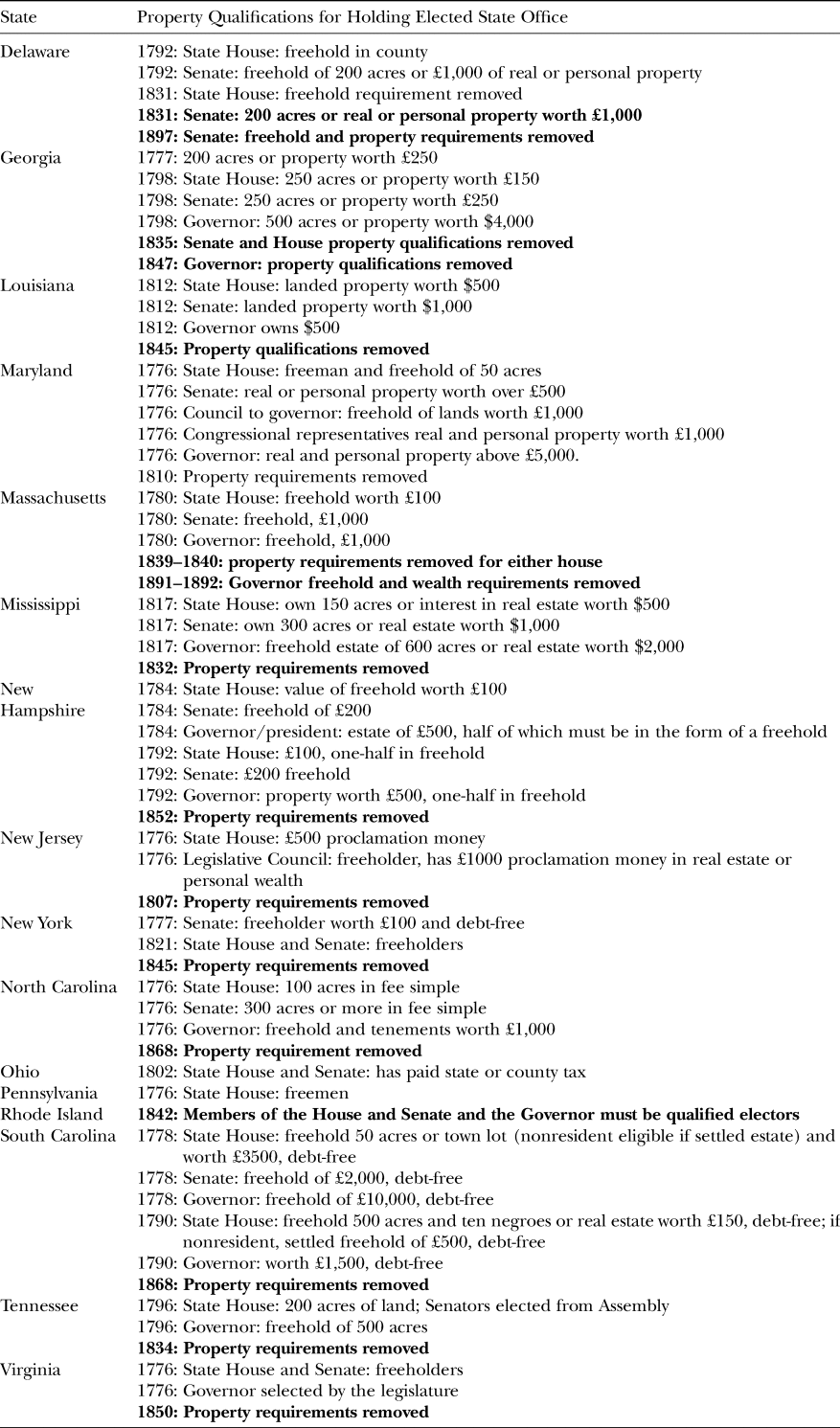
There are other indicators of the extent of democratization, too, ones that receive less attention.Footnote 186 Chief among them is the determination of who is eligible to be elected to public office. While almost all scholarship focuses on political participation in terms of the electorate,Footnote 187 several of the American states also restricted political participation by imposing property qualifications on candidates for state offices. By 1831 ten states had removed property qualifications for candidates for the state legislature or governorship (a number that includes Virginia and New York, with their requirements that elected state officials be freeholders). But fourteen states imposed more stringent requirements on elected officeholders than they did on their electors, and these states kept their requirements in place for longer periods of time (see Table 2).
Requirements for Elected State Office

Adapted from Thorpe, The Federal and State Constitutions. All are state constitutional provisions.
Tocqueville does not discuss the states’ imposition of property qualifications on elected politicians.Footnote 188 He accepts that the United States has universal suffrage, for all practical purposes, and assumes that there are no limits on the access of white men to public office. Because of what Tocqueville sees as the deficient quality of elected officials, in fact, he recommends that the qualifications on public officeholders be made more restrictive.Footnote 189
Early Virginia
A fourth aspect of Tocqueville's mischaracterization of the South is his treatment of Virginia history. In contrast to his extensive discussions of the habits and institutions of the northeastern states, Tocqueville's account of colonial Virginia—“home to the first English colony”—consists of only a few sentences.Footnote 190 He wrote of the “gold-seekers … sent to Virginia.” These were “men without resources or discipline whose restless, turbulent spirit caused trouble in its early days and rendered its progress uncertain.”Footnote 191 In a footnote Tocqueville elaborated on the history of “former servants, bankrupt swindlers, debauchees, and other people of the sort” who immigrated to Virginia, people who were “more likely to pillage and destroy than to consolidate the new settlement.” These were mostly “young people from troubled families,” he found, “whose parents shipped them off to colonial America.”Footnote 192
Virginia was a slave society in Tocqueville's telling—a “capital fact” that “exert[s] an immense influence on the character, laws, and entire future of the South.”Footnote 193 Although Tocqueville viewed slavery as undemocratic and backwards looking, he saw it as being appropriate for the cultivation of crops that “require constant attention” (in contrast to the labor systems in areas that grow grain). “The white man cannot, without getting ill or dying, do what the black does easily,” he claimed.Footnote 194 Hence the adoption of this dishonorable and corrosive labor system by the states that grow “tobacco, cotton, and especially sugar cane,”Footnote 195 such as Maryland, North and South Carolina, Kentucky, Tennessee, Louisiana, Alabama, Mississippi, Arkansas, and (in the near future) Texas.Footnote 196
This telescoped history of Virginia is misleading, however. The demand in Virginia and other colonies for year-round farm labor for growing tobacco and other crops, clearing land—since without the addition of large amounts of fertilizer, tobacco depleted the land in two to three years—and performing other tasks did not necessarily demand African American slaves. The labor could be done by bonded white servants or black slaves (propertied colonials had difficulty making American Indians their slaves). During most of the colonial era, the traffic in indentured servants and exiled convicts in fact competed “with the slave trade.”Footnote 197 The demand for labor in the early and mid-seventeenth century was “largely color-blind,”Footnote 198 with colonial landowners and other masters using black slaves or white indentured servants according to what needed to be done, relative price, and availability. Not until the 1680s did the colonies start a “massive shift from indentured to slave labor,”Footnote 199 and not until 1690 did the number of transported slaves exceed that of indentured servants.Footnote 200
Furthermore, once indentured servantsFootnote 201 completed their terms, few had the means to acquire land or property.Footnote 202 Many did not even survive—about 30–40 percent of servants died during their terms of indenture—and others ran away.Footnote 203 Few former servants had the resources to buy land and enter mainstream society after their terms of indenture—estimates are one in five, at bestFootnote 204—so they worked as tenant farmers or wage laborers, became itinerants, or took up other marginal occupations. Still others emigrated into the backwoods; signed up as seamen for merchant ships and privateers; returned to England, Scotland, Ireland, or Germany; or agreed to additional terms of indenture. Almost all remained poor, and most were either illiterate or functionally illiterate.
Neither was slavery introduced as soon as the colony was created.Footnote 205 The importation of African slaves, beginning in 1619, was preceded in 1607 by the use of exiled convicts and indentured servants.Footnote 206 The first Africans transported to North America were used as indentured servants, moreover, not as slaves.
Slavery may have been a major cause of a degraded southern culture, in Tocqueville's assessment—although he agreed with Montesquieu that climate played a roleFootnote 207—but he left unexamined why institutionalized slavery coincided with the negligible education and low literacy of non-slave-owning whites. Neither did Tocqueville question the relationship between slave ownership and the existence of a slave society, nor did he explain how the circumstances and conditions of non-slave-owning whites may have influenced American mœurs as a whole.
In short, the history of colonial Virginia and of the American colonies more generally indicates that the study of the South cannot be detached from the history of slavery or from that of immigration, importation, and settlement of bonded laborers—what Eric Foner refers to as the “third class” of the founding eraFootnote 208—and from the later immigration of impoverished Europeans (German and Irish, especially). The study of chattel slavery, slave ownership, and African Americans is intermingled with the history of the non-slave-owning, poorer whites of the southern and western states—and both are integral to a study of the founding, liberalism, and American federalism.Footnote 209
Neither can the South be separated from the North for the purpose of an examination of national policymaking. Few bills became law without the concurrence of Southern politicians. The history of the admission of new states is a case in point, where Congress balanced the incorporation of free states into the union with that of slave states. Conversely, the Homestead Act, which was chronically opposed by southern politicians but long favored by the white poor, could not finally be passed until 1862.Footnote 210
Trade relations and commercial interests similarly connected wealthy and influential Americans of the North and the South, as did marriage and kinship ties. Conversely, many of the white poor emigrated north and west into Ohio, Indiana, and Illinois or relocated west and south into Missouri, Arkansas, and Texas, as European Americans spread throughout the states and territories. To restrict the study of the United States to that of the northern states and the influence of Puritanism ultimately compromised Tocqueville's efforts to provide an accurate and comprehensive account of the mœurs and institutions of American society.
The cumulative effect of these distortions of the historical record, together with Tocqueville's reliance on Story's Commentaries, the Federalist Papers, Jefferson's Notes on the States of Virginia, and other select sources, is to impart Democracy with “a strongly Federalist cast.”Footnote 211 This is despite the fact that Tocqueville was writing during the Jackson presidency—he described Jackson as “a man of violent character and middling ability”Footnote 212—and that he was describing a political society dominated by the Democratic Party.
Tocqueville recognized that “it would be absurd to want to pass judgment on a whole people after spending a week or ten days among them.”Footnote 213 But after six short weeks spent in the South, almost all of it on steamboats or in enclosed carriages, he did almost exactly this. He stated that “the entire white race” in the South “constituted an aristocratic body headed by a number of privileged individuals whose wealth was permanent and leisure hereditary.”Footnote 214 He denied the existence of tenant farming in America and ignored the widespread presence of landless whites. He asserted that “every state of the union adopted universal suffrage … in Louisiana as well as New England [sic], in Georgia as well as Canada [sic].”Footnote 215 Last, he argued that the founding of Virginia was coterminous with the establishment of slavery and that the principal defects of American society were the result of slavery,Footnote 216 while he confined a discussion of indentured servants, later impoverished immigrants, and other poor whites to his notes.Footnote 217
In sum, and in consideration of Tocqueville's treatments of slavery and equality, tenant farming, universal suffrage and political representation, and early Virginia, more than a “single fact” goes astray—a possibility Tocqueville warned the reader of in his “Introduction.”Footnote 218 This is not to claim that he had “the preponderance of facts” wrong.Footnote 219 It is rather to point out the implication of Tocqueville's descriptions and analyses: that this economically, politically, and socially subordinate population—“men with neither education nor means, men driven from the land of their birth by poverty or misconduct,”Footnote 220 as Tocqueville described the first inhabitants of the other, non-northeastern colonies—did not matter. Presumably, they were able to merge into mainstream society or they exerted minimal effects on the equality of conditions and spread of democracy.
The irony is that Tocqueville touched this other political culture in numerous passages in Democracy, as well as in his correspondence and notes. Except he did not connect the two: He separated his (partial) awareness of the mœurs and institutions of the white poor of the interior South and western United States from his interpretation and generalization of the United States as a fundamentally Puritan society.
3. Non-Puritan America
The Point of Departure
Tocqueville's predominant emphasis was on America's Puritan origins. The United States is a Puritan society “founded by men who either started out as equals, or became equals by living in them.” America consisted of “a single people” who have “neither commoners nor nobles,”Footnote 221 where the first Americans were “already completely civilized”;Footnote 222 they were “born equal rather than becom[ing] so.”Footnote 223
The Puritan immigrants “possessed a proportionately greater quantity of enlightenment than any European nation,” Tocqueville observed, and they “brought with them” to New England “admirable elements of order and morality.” They migrated to and settled what had been a “barbarous” and “neglected” land so they could “live … as they wished and pray to God in liberty” (as opposed to the “adventurers without families” who founded Virginia). The Puritans—as Tocqueville understood them and generalized—“did not travel to the New World in the hope of improving their situation or enhancing their wealth.” Rather, “they tore themselves away from the pleasures of home in obedience to a purely intellectual need. They braved the inevitable miseries of exile because they wished to ensure the victory of an idea.”Footnote 224 As a result, they succeeded in creating a society characterized by political equality and equal social conditions,Footnote 225 one where people—African Americans and Indians excepted—recognized each other as fellow citizens and did not defer to each other.Footnote 226
By importing the “equality of conditions and of intelligence into the land they settled,” the Puritans “bequeathed to their descendants the habits, ideas, and mores most apt to give rise to a flourishing republic.”Footnote 227 These habits, ideas, and mœurs “spread initially to nearby states” and soon “made their way to the farthest reaches of the confederation.” They “ultimately … penetrated throughout the entire American continent”Footnote 228 such that there is no “single county mired in ignorance.”Footnote 229 “Like a bonfire on a hilltop, which, having spread its warmth to its immediate vicinity,” the Puritan civilization “tinge[d] even the distant horizon with its glow.”Footnote 230 The Puritan founding thereby allowed “politics and religion” to be “in harmony”; it enabled “the spirit of religion”—Tocqueville's italics—to be conjoined with “the spirit of liberty.”Footnote 231
Because of “what this original fact has produced,”Footnote 232 Tocqueville found that “the entire destiny of America [was] embodied in the first Puritan to land on its shores, just as the entire human race was embodied in the first man.”Footnote 233 Indeed, “by the time the peoples of Europe landed on the shores of the New World, the traits of their national characters were already fully formed.”Footnote 234 The Puritan origin led to an America of morally upstanding, self-disciplined, and hard-working yeoman farmers and townspeople. It created citizens who patriotically “obey[] justice, or the law” and who “place great confidence in their country's laws.”Footnote 235 It gave rise to a nation that encouraged religion, valued honest dealings, and honored contracts. And it promoted the formation of a confederation of states, where “one is much like another.”Footnote 236 “Not only do the various states share almost the same interest, origin, and language, but they are also civilized to the same degree, so that it is usually easy for them to come to agreement.”Footnote 237 And “their mores, ideas, and needs are homogenous,”Footnote 238 consistent with America's “wholly Puritan origin.”Footnote 239
Tocqueville's emphasis on the Puritan point of departure coincides with his relative deemphasis of the Revolutionary Period. Tocqueville admittedly referred to Jefferson on several occasions in instances (more than any other founder), and he mentioned the Federalist throughout both volumes.Footnote 240 He also discussed the federal system of democratic government established by the “remarkable men” of the founding eraFootnote 241 and commented at length on Americans’ regard for the law and the judiciary, their respect of individual rights, and their reverence for the Constitution as the basis of national government.Footnote 242 Yet the Declaration of Independence, natural rights, natural law, and John Locke went unmentioned.Footnote 243
“Americans,” Tocqueville explained, “had no need to draw their philosophical method out of books; they discovered it in themselves.”Footnote 244 They did not need Locke, Hume, Descartes, or Voltaire. It was religion that gave birth to the Anglo-American societies,”Footnote 245 where religion “is inextricably intertwined with all [of the Americans’] national habits,” Tocqueville found. “Only a very enlightened people could have created the federal constitution of the United States,” he remarked, “and only a very enlightened people singularly accustomed to representative forms is capable of operating such a complicated machine and maintaining within their separate spheres the various powers, which otherwise would not fail to clash violently with one another.”Footnote 246 In sum, “what makes the Americans of the United States the only Americans capable of supporting the empire of democracy is … their mores.”Footnote 247
Not Puritan
Tocqueville's focus on Americans’ Puritan mœurs and his assertion of the uniformity of the states conflicted, though, with his observations of the South, the backwoods, and the United States as a whole.
Tocqueville viewed the value that the Puritans bestowed on education as characteristic of all of the United States.Footnote 248 “Primary education is within the reach of everyone,” he wrote, and “almost all Americans … can easily acquire the rudiments of knowledge.”Footnote 249 He then qualified his statement, however, by warning that his analysis did not apply to “the men of the South”—those who “are poorer, less persevering, [and] less well educated.” Not only are there “no schools” in the South, “half or two-thirds” cannot read.”Footnote 250 And in fact, there were no public schools in Alabama, Mississippi, Louisiana, Missouri, and Virginia as of 1830, and Kentucky, Tennessee, South Carolina, and Georgia had few public schools.Footnote 251 There was effectively no public-school system in the South before Reconstruction.Footnote 252
Tocqueville further observed that the white residents of the interior South and near West had different social habits than the Puritans. Isolated from each other, the rural white southerners and backwoods residents lacked strong social bonds of mutual obligationFootnote 253—contrary to the prevailing role Tocqueville ascribed to associations (see below).Footnote 254 Their social bonds were “less widespread and less powerful,”Footnote 255 and a “mixture of civilization and barbarism” typified these Americans, “refined institutions” coincident with “brutish manners.”Footnote 256 As a result, “society” in the near West was “still but a swarm of adventurers and speculators,”Footnote 257 with “the principles of morality, religion, and liberty … blended in a less congenial way.”Footnote 258 With “manners in the wilderness [being] too rough, and enlightenment too rare,” these (other) Americans “almost always take the law into their own hands” and “murders” were common. And no one sees “the point of putting teeth into the law.”Footnote 259
Worse, these undesirable traits are replicated in government. Tocqueville lamented the quality “of the men to whom public authority has been entrusted.” “Talent and virtue in government” were uncommon in the South and backwoods, and public officials abdicated their responsibility to apply and enforce the law.Footnote 260 With the newer states placing few limits on democratic participation, moreover, there was little guarantee of the quality of those seeking and holding public office, and men ill-suited to governing, such as Davy Crockett and Sam Houston, got elected to office.Footnote 261
If the Americans of the southern and western states were typified by their “less congenial” mœurs, then by Tocqueville's reckoning, Americans of fifteen of the twenty-four states of 1831—to take the “southern” states as those lying south of the Mason-Dixon Line and the “western” states as those west of the Appalachians—could be characterized by their low regard for formal education, their “too rough” manners, their “brutish” behavior—coarse, violent, and inclined to drinking, gambling, and speculationFootnote 262—and the poor quality of the politicians they elected into state and federal offices.
The trait of Americans that Tocqueville regarded as being most contrary to Puritan mœurs, however, was their unabashed and unconstrained pursuit of “commerce.”Footnote 263 Whereas Puritans regarded “material wealth and moral gratifications” with “almost equal ardor,”Footnote 264 and whereas they looked beyond their immediate material advantage,Footnote 265 Americans—and Tocqueville did not differentiate Puritans from other Americans on this point—“love only what is useful to [their] well-being.”Footnote 266 For all of Americans’ “civilization and enlightenment,” Tocqueville described their passion for material gain as exceeding their passion for life itself.Footnote 267
This love has four main components.Footnote 268 One is Americans’ all-consuming desire for riches (a pursuit of wealth that is predicted both by the commercial basis of Virginia society and by the equality of conditions in democracies, such that men have no other way to mark their “equality” except by acquiring wealth). “Of all the passions that equality brings into being or encourages,” Tocqueville wrote, the “striking and indelible feature of every democratic age” is “the passion for well-being.” This “passion [is] stronger than the love of life” in the United States, and it “constantly spurs [the American] on.”Footnote 269 The American “enjoys unparalleled opportunities to make or increase his fortune. The possibilities open to greed are endlessly breathtaking.”Footnote 270
Not only did those who amass modest fortunes conceive “a taste” for material gratifications, they were not “content” with what they had and were “forever seeking to pursue or hold on to pleasures that are as precious as they are incomplete and fleeting.”Footnote 271 As Americans’ material fortunes rose, so, too, did their material desires grow. “They covetously ogle whatever goods money can buy long before they can afford them,” and even the poor hoped for “the pleasures of the rich” and savored “in advance goods that fate obstinately refused to grant him.” Conversely, those with large fortunes desperately sought to keep them. “Citizens” in better times acquire “certain needs that stay with them,” so when they can no longer “satisfy them” they “anxiously search for some roundabout way of achieving the same satisfaction.”Footnote 272 The poor want to become rich, and the rich fear losing their wealth.
Neither did Tocqueville find that wealthy Americans had the “proud distain for material well-being”Footnote 273 that he identified the aristocrats of monarchical societies as having (however mistakenly), nor did Americans display much taste for literature, abstract science, or other intellectual pursuits.Footnote 274 On the contrary, he found their minds “constantly distracted from the pleasures of the imagination” and “engaged solely by the pursuit of wealth.”Footnote 275 Americans, like “all great peoples,” had “but one [persistent] thought, which is advancing to the acquisition of riches,” which was the “sole goal of [their] efforts.” Rich and poor alike were “attached to the gratifications of material life,” and this love had “become the national and dominant taste.” Conversely, they “scorn[ed]” the “heroic” life.Footnote 276
A second aspect of Americans’ avidity was the “secret restlessness” it provoked.Footnote 277 For all of their seeming happiness,Footnote 278 Americans were “remarkably agitated.”Footnote 279 With their “limited time to find, possess, and enjoy” the material goods of this world, their hearts were “always in a hurry.”Footnote 280 They were a “restless, reasoning, adventurous” people who had “the ardour of passion” for riches and who therefore engaged in a calculated and constant search “for the shortest routes to nearby pleasures.”Footnote 281 The “torment[]” that comes from “a vague fear of not having chosen the shortest way” of acquiring wealthFootnote 282 “fills [the American] with anxieties, fears and regrets and keeps his soul in a state of constant trepidation that impels him again and again and again to change plans and places.”Footnote 283
With material wealth constituting the only measure of Americans’ well-being, their social status became hostage to their fluctuating fortunes. They were burdened by “the constant tension that exists between the instincts to which equality gives rise and the means it provides for their satisfaction.”Footnote 284 Tocqueville thought that this ceaseless unrest made them “grave and almost sad[,] even in their pleasures,” and caused their faces to be “habitually veiled by a … cloud.” And as the degree of equality increased, their “desire for equality”—that is, their quest for more wealth—“becomes ever more insatiable.” But “no equality instituted by men will be enough for them,” and even the smallest inequality became difficult to bear.Footnote 285 Envy reigned.Footnote 286
A third aspect of Americans’ greed was their willingness to “traffic[] in everything, not excepting morality and religion.”Footnote 287 The longer he was in America, Tocqueville wrote one month after arriving in New York, the “clearer it seems that they seek the value of all things of this world in answer to only one question: ‘How much money will it fetch?’”Footnote 288 Two months later, when Tocqueville traveled in the northwestern wilderness, he reported, “we were ourselves daily victims of [the American pioneers’] extreme avidity for gain.” His hosts did not outright steal (“they [were] too enlightened to commit such an imprudence”), but never did he find “an inn-keeper of a large city [to] overcharge with more impudence than these inhabitants of the wilderness among whom I thought to find primitive honesty and the simplicity of patriarchal customs.”Footnote 289 Later, in December 1830 while he was waiting in Memphis for the ice to break, Tocqueville remarked on “the large number of business failures and bankruptcies that occur in the various states of the Union” and pointed out, “above all[,] the public's culpable indifference to the issue.”Footnote 290
Americans’ love for their material well-being caused them to be not what they appear to be. “When you see [their] purity of morals, the simplicity of manners, the diligent work habits, and the disciplined religious habits, you are tempted to believe that Americans are a virtuous people,” Tocqueville stated, “but when you realize that the entire society is consumed by commercial fever, appetite for gain, respect for money, and ubiquitous bad faith in business dealings, you quickly conclude that this supposed virtue is nothing more than the absence of certain vices, and if the range of human passions here seems limited, it is because all the passions are subsumed in one, namely the love of riches.”Footnote 291 Whereas Americans considered their ceaseless quest for riches to be a “noble and estimable ambition,” Tocqueville commented, the pre-Revolutionary French knew it as “servile greed.”Footnote 292
A fourth aspect of Americans’ avidity was the contradiction between their personal insecurity (because of the necessarily relative nature of their material well-being) and the supposed equality of conditions (because Americans regarded their fellow citizens as equals).Footnote 293 The equality of conditions in America thereby both conflicted with and obscured the substantive differences in absolute wealth among Americans—however small in size—and it masked the emotional pain of Americans’ privately experienced unequal social status. This personally felt inequality caused them to have “tumultuous li[ves] of constant worry.”Footnote 294
Tocqueville wrote of this contradiction in an early letter home.Footnote 295 “You ought to know that in this republican land, people are far more impressed by nobility, titles, crosses, and all the gewgaws of Europe than in France,” he wrote to Abbé Louis Lesueur on May 28, 1831. “Where laws are concerned, the greatest equality prevails. One might get the impression that such equality informs manners and mores as well,” he confided to the older man. “But make no mistake, the Devil lurks underneath, and in the deepest recesses of the soul pride has a secure home.”Footnote 296 But nowhere else in his letters, in his notes, or in Democracy, did Tocqueville comment on this incongruence.
Other foreign visitors were more outspoken about their observations. For Max Berger, a historian of how British tourists reacted upon visiting the nineteenth-century United States, “American society, at least in its private relations, seemed very clearly to belie the ‘lip service’ paid to equality.”Footnote 297 “The great mass of English visitors,” Berger wrote, “was convinced that there was a fundamental conflict between the aristocratic pretensions of high society” and the equality displayed in public life. Americans loved to “claim kinship with an ancient and honorable family” and secretly desired aristocratic titles, he continued. Many conjured “coats of arms whose flamboyance would put British coats of arms to shame” and they would shamelessly “scramble for titles whenever class institutions were absent. Everyone seemed to be a captain, a colonel, or a judge.” “No people,” Berger found, “bent the knee lower at the shrine of hereditary rank.”Footnote 298
Tocqueville thus presented a picture of a society at once consumed by and troubled by the passion for equality. In their pursuit of riches and in contrast to their presumed Puritan mœurs, Americans displayed a “ubiquitous bad faith” in commercial affairs.Footnote 299 Their “horizons” seemed to be but dimly illuminated by distant Puritan bonfires.
The result is that Tocqueville's celebration of the United States’ Puritan point of departure and the uniformity of American society (where Puritanism is “almost as much a political theory as it was a religious doctrine”Footnote 300) conflicts with his reports of the clearly non-Puritan mœurs of the southern and western states—as well as with the widespread presence of evangelical Christianity.Footnote 301 He discovered that many Americans devalue formal education (contra the Puritans emphasis on the cultivation of the mind); he found that many tolerate coarse manners and violent behavior (contra the Puritans’ religious morality); and he observed that they all share a monomania for acquiring wealth (contra the Puritans’ balancing of material pursuits and religious concerns). Tocqueville's recognition of Americans’ differing “habits, ideas, and mores”Footnote 302 thereby counters his claim that they shared “the same interest, origin, and language.” By his own evidence, Americans were assuredly not “civilized to the same degree.”Footnote 303
Other foreign visitors to the early nineteenth-century United States responded in kind. They appreciated Americans’ democratic values, their energy and industry, their practicality, and their patriotism, but they also remarked on the poor education and crude manners of the (white) residents of the southern and western states, and they were astonished by the degree of Americans’ cupidity. These other European travelers similarly found the United States to be culturally, politically, and regionally differentiated.Footnote 304
The implications this dual reading of American society—Puritan and uniform, on one hand, and non-Puritan and diverse, on the other—are twofold. One is that Tocqueville's portrayal of American society is critically incomplete and one-dimensional in its neglect of the white poor residing in southern and western United States. The early nineteenth-century states were far from homogeneous in their “mores, ideas, and needs,”Footnote 305 and they held differing interests with respect to the tariff, slavery, western expansion, internal improvements, and other issues. But Tocqueville did not integrate his passing comments on Americans’ non-Puritan traits into his general analyses of the United States and its democratic social state.
The other implication of this uneven analysis is that Tocqueville effectively undermined the conclusions he sought to draw from his study. His inconsistent and discrepant understanding of American society underweighted the importance and legacies of Americans’ other point of departure originating in the Chesapeake colonies. Colonial Virginia was not settled for the achievement of religious freedom or for the establishment of liberal colonial government, but for its profit-making potential—consistent with gold-seeking, the cultivation of tobacco, and the promotion of the slave trade, but contrary to the Puritan founding.Footnote 306 Between the commercial origin of the other point of departure and Americans’ pursuit of material gain—intrinsic to democratic society, as Tocqueville saw it—the United States was dominated by a pervasive materialism, one that erodes Tocqueville's presentations of Americans as morally upright and independently minded.
4. Lessons from American Democracy and the Equality of Conditions
Objectives and Remedies
Tocqueville went to America to “look for lessons” from “which we might profit.” Writing “in the grip of a kind of religious terror occasioned [by] … this irresistible revolution, which for centuries now has surmounted every obstacle and continues to advance amid the ruins it has created,”Footnote 307 Tocqueville was concerned about the future of France and uncertain of his own place in French society.Footnote 308 Although the social revolution in France was “a fait accompli,”Footnote 309 the Bourbon Restoration, the regime changes of the 1820s, and the 1830 July Revolution revealed the “haphazard” path of democratization.Footnote 310 He “wanted to become familiar with democracy,” then, “if only to find out what we had to hope from it, or to fear”;Footnote 311 he wanted to study the spread of democracy and the equalization of conditions in the country where the social revolution was most advanced.Footnote 312 Such a study would allow him to discern the effects of political equality and the equality of conditions on France and other European nations and be able to distinguish those effects from the United States’ unique features, such as the great size and natural resources of the North American continent, its British heritage, and slavery.Footnote 313
By learning of the effects of democratization and the equalization of conditions, Tocqueville could determine how “to educate democracy—if possible to revive its beliefs; to purify its mores; to regulate its impulses; to substitute, little by little, knowledge of affairs for inexperience and understanding of true interests for blind instinct; to adapt government to its time and place; [and] to alter it to fit circumstances and individuals.”Footnote 314 Tocqueville wanted French leaders to be able to promote a healthier future society, to create a more informed citizenry, and to facilitate the establishment of more appropriate institutions of government.Footnote 315 This was “the primary duty imposed on the leaders of society today”Footnote 316—not unlike the original purpose of political science when it was established in the late nineteenth century. This was Tocqueville's “new political science” for a “totally new” world,”Footnote 317 one that was empirically rigorous, comparative, normative, and applied.Footnote 318
Tocqueville reasoned that if the “democratic institutions” of the United States were “prudently introduced into society … people could become accustomed to them little by little and gradually absorb them into their opinions.” Americans were not “different from men elsewhere,” and they showed “the same penchants as all other democratic peoples.” Their habits and customs could therefore be transferred to and “survive in places other than America.”Footnote 319 Crucially, he believed that France could profit from applying the same institutional remedies that bestowed Americans with the habits to “combat [the] weaknesses of the human heart and to correct [the] natural defects of democracy.”Footnote 320
For each of these reasons, Tocqueville had to get it right. His wide-ranging travels in North America, his many interviews, his exhaustive note taking, and once back in France, his additional readings and his further conversations with Americans all speak to his efforts to form a “complete and exact picture of the United States.”Footnote 321 He sought to represent the essential features of democratization and the equalization of conditions—good and bad—as fully as possible.Footnote 322
Tocqueville recognized the daunting task facing him. In a letter to Charles Stöffels, he admitted that “for the immense majority of questions to which we need answers, all we have are likelihoods, approximations.”Footnote 323 He confided later to Édouard that “attempting to embrace the whole [of America] would be folly. I am incapable of aiming for universal exactitude”; “I haven't seen enough to justify such pretensions.”Footnote 324 Notwithstanding “the elusiveness of demonstrable truth,” it was “better … to strike out vigorously in the wrong direction than to stand paralyzed by indecision or to act feebly.”Footnote 325 As it was, he “already [knew] much more about this country than is ever taught in France.”Footnote 326
Strike out vigorously he did, impelled by his intellectual ambition, sociological curiosity, and staunch patriotism. Perhaps because of the two-plus years elapsed since he admitted his uncertainty, perhaps because of the intense months he devoted to drafting Volume 1 of Democracy, or perhaps because of the effort he invested in his literary style,Footnote 327 Tocqueville overcame his doubts and forged ahead.
His doubts did not entirely go away. Tocqueville conceded that because of the “special nature of the country” American laws might be ill-suited to France and other European nations. He admitted that he was only “ventur[ing] opinions,” since hard “evidence” of the transportability of America's democratic institutions was “lacking.” He was “by no means unaware of the influence exerted by a country's nature and antecedent facts on its political constitution” and therefore hesitated to recommend that other democracies “mimic the mores of the Americans.”Footnote 328 He suggested that readers consider America merely as an example of how “laws and above all mores could allow a democratic people to remain free.”Footnote 329
Yet the institutions Tocqueville identified as being able to “temper the majority” and “maintain the republic”Footnote 330—the press, associations, the legal profession, and the relations between the sexes—were not those he recommended applying to France and possibly elsewhere.
The press exerted “political effect[s]” that helped it “indirectly to preserve public tranquility.”Footnote 331 The press was “the democratic instrument of liberty,” Tocqueville wrote, and it was “far more precious in democratic nations than in all the rest. It alone cures most of the ills that equality can produce,” and “democratic countries cannot” function “without freedom of the press.”Footnote 332
The press operated in tandem with “thousands” of associations in America to protect citizens’ independence and counteract the dangers of tyranny.Footnote 333 Associations enabled citizens to act collectively and the press led “large numbers” to voluntarily join with others; neither was possible without the other.Footnote 334 “The newspaper brings [men] together,” Tocqueville wrote, “and they continue to need the newspaper in order to stay together.”Footnote 335 Combined, they allowed Americans to overcome the attenuated bonds among democratic citizens.
Associations were thus equal partners in overcoming the attenuated bonds of democratic citizens: “nowhere,” Tocqueville wrote, “are associations more necessary to prevent either the despotism of parties or the arbitrariness of the prince than in countries whose social state is democratic.”Footnote 336 They allowed Americans “to remain civilized” and for the peoples of other societies “to become so.”Footnote 337 Nothing, Tocqueville submitted, was “more worthy of our attention than America's intellectual and moral associations.”Footnote 338
But neither the press nor the fact of associations sufficed for Tocqueville's purposes. Tocqueville attributed the press's independence to Americans’ “accept[ance] of the dogma of popular sovereignty,”Footnote 339 rather than to governmental actions or constitutional design. He admired the press only with reluctance and he regarded it as a necessary evil in democracies—compromised in its operations, “destructive” in its tastes, and as flawed as it was beneficial.Footnote 340 Associations, for their part, arose organically and not from governmental promotion or protection. They emerged “when Americans have a feeling or idea they wish to bring to the world's attention,” in which case “they will immediately seek out others who share that feeling or idea and, if successful in finding them, join forces.” Americans in this way “cease to be isolated individuals and become a power to be reckoned with…; a power that speaks, and to which people listen.”Footnote 341
The third of Tocqueville's well-known institutions is the legal profession, “the most powerful, if not the only, counterweight to democracy.”Footnote 342 Lawyers’ specialized knowledge gave them “a distinctive” and “superior” “rank in society,”Footnote 343 and it bestowed on them “certain habits of order, a taste for forms, and a sort of instinctive love of regular sequence in ideas.”Footnote 344 They combined an appreciation “for what is old with a liking for what is regular and legal.”Footnote 345 They possessed an affinity for “a life of order.” And they had “some of the tastes and habits of aristocracy,”Footnote 346 with “a certain contempt for the judgment of the multitude.” Their legal training and professional orientation led them to oppose “the revolutionary spirit and the unthinking passions of democracy.”Footnote 347 Lawyers “constitute the most powerful barriers against the excesses of democracy” in America.Footnote 348
Yet lawyers’ vital role in American society was the artefact of English custom (where lawyers were allied with the aristocracy)Footnote 349 in Tocqueville's analysis, and not the result of public policy or constitutional design. Lawyers may have had aristocratic, anti-democratic tendencies,Footnote 350 but they “fl[y] no banner of [their] own” and they “bend[] to the exigencies of the times and surrender[] to every movement of the social body.”Footnote 351 Their malleability and power made them flimsy barriers against democratic excess.
A fourth institution identified by Tocqueville was the relationship between the sexes. Women “often display a manly intelligence” and “virile” energy, and men respect them for their intelligence, courage, and reasoning ability and treat them as equals.Footnote 352 Although he thought that women had distinct “pathways” in America and although they were confined to the domestic sphere, they exerted their “right to choose their husbands freely.” Furthermore, women were not coerced into going beyond their established roles and were not “forced to do hard labor or engage in any of the arduous activities that require the development of physical strength.”Footnote 353 Nor did women in America “confuse lines of authority within the family.” They “regard conjugal authority” as a “usurpation” or a “degrad[ation] of their rights,” Tocqueville found; they accepted their lot.Footnote 354 “If someone were to ask me what I think is primarily responsible for the singular prosperity and growing power of this people,” he famously speculated, “I would answer that it is the superiority of their women.”Footnote 355
But Tocqueville did not consider the beneficial relationship between the sexes in America to be transportable. Rather, he saw the empowered role of women in America as the product of the equality of conditions.Footnote 356 Women accompanied their husbands in the expansion of their desires, he found, and they joined their men as they “work [their] way … from poverty to opulence.” And when their fortunes “tumble[d] back down again,” women accordingly suppress[ed] their desires.Footnote 357 Women may have been indispensable to facilitating Americans’ prosperity and to tempering men's worst impulses, but Tocqueville did not regard the enlightened relationship between the sexes and the empowered role of women in America as being able, by themselves, to preserve democratic freedoms or protect liberal values.
The freedom of the press, the role of associations, the influence of lawyers, and the relationships between the sexes may have been influential institutions within American society in Tocqueville's analysis, but they were not the products of deliberately “applied remedies.”Footnote 358 They were therefore not transferable to France and the Old World.
Late in Volume 1, Tocqueville identified four institutions that have been able to check Americans’ “restlessness” and “envy” and that have “succeeded” in mitigating the “mixture of presumption and ignorance” they display and keeping their democracy free. He found that Americans “applied remedies that had previously occurred to no one else,”Footnote 359 and he believed that these remedies might be fruitfully applied to French society.Footnote 360
One is the network of “diverse municipal laws” that existed throughout the United States. Tocqueville used Massachusetts as an example to argue that “the political organization of towns and counties” within the states enabled “local institutions” to exert a happy and “prodigious” effect on society.Footnote 361 With “almost as many independent officials as there are offices” and with “administrative power” across the states “scattered among a multitude of hands,”Footnote 362 the extensive set of local laws fractures and channels citizens’ “restless ambitions.” It helped to suppress the excesses of democracy.Footnote 363
A second institution that quelled “envious sentiments” was the propagation of “the idea of rights.” Tocqueville remarked how “the common man” in America “has an exalted idea of political rights because he has such rights.”Footnote 364 Political rights, property rights, and other rights “filter down to the humblest citizens”; people of all classes consequently “place great confidence in their country's laws.”Footnote 365 They accepted differences in property and fortune as inherent in individuals’ own rights and as due to them under the protection under the law.Footnote 366
A third is Americans’ “religious morality,” which steadied the “constant flux of the political world.” Tocqueville observed how town officials and justices of the peace “regulate the details of social existence and issue orders dealing with … the morality of citizens,” as well as with “matters of public health [and] law and order.”Footnote 367 He gave examples of such regulation in a lengthy note: the many provisions in Massachusetts and New York state laws that enforced Sunday religious observance (i.e., “blue laws”).Footnote 368 He observed that because of these customs—“one of [the] things that the foreigner in America finds most striking”Footnote 369—the social life “all but comes to a halt” on Saturday evenings “in one large American city.” These practices, codified into law, quieted the “bustle of industry,” subdued the “accents of pleasure,” and suppressed “the incessant hubbub” of the feverish pace of city life.Footnote 370
A fourth is Americans’ “habitual involvement in public affairs,” which served to cool “the heat of popular desires.”Footnote 371 Near-universal suffrage and an active community life regularly and habitually involved Americans in politics and government.Footnote 372 Their extensive political activities “help to moderate the violence of political association”Footnote 373 and teach them how to be citizens. A prime example of men's “habitual involvement in public affairs” was the jury system,Footnote 374 which taught Americans “some of the habits of mind of the judge”—precisely the habits “that best prepare a people to be free.”Footnote 375 “The jury instilled in all classes a respect for judicial decisions and the idea of law,”Footnote 376 Tocqueville adjudged, and it “imbu[ed] even the lowermost ranks of society … with the legal spirit.”Footnote 377 The jury system thereby “exert[ed] an important influence on national character, particularly when it “is extended” beyond criminal cases to civil cases.Footnote 378 Like other forms of local political participation, it was “the most effective means of teaching the people how to rule.”Footnote 379
The above institutions manifest what Tocqueville saw as Americans’ “great and successful efforts” to preserve liberty and suppress the excesses of democracy.Footnote 380 Even the Americans “liv[ing] in the states of the West” had “the civilization of their fathers … conjoined with ideas and customs from the savage life.”Footnote 381 Tocqueville's backwoodsman likewise knew “the past, is curious about the future, and argues about the present”; he was “a highly civilized man” who, like Frederick Jackson Turner's frontiersman, had “chosen to live for a time in the forest.”Footnote 382 The European Americans of the “states along the Gulf of Mexico” and in the “outer reaches of the confederated states,”Footnote 383 too, “understand[ ] the customs of the political world.” They are “aware of administrative rules and familiar with the workings of the law,” and “learn[] about the law by participating in the making of it.”Footnote 384 These practices engendered a “state of enlightenment … among the Anglo-Americans,” one in which “no one has remained ignorant.”Footnote 385
These above institutions were designed to “correct [the] natural defects of democracy,” and it is these “successful remedies”—the promotion of local policies and governments, the inculcation of the idea of rights, the sanctioning of religious morality, and the broadening and reinforcement of political experiences among the French public—that patriotic French leaders may have been able to use to educate a democratizing France.
But even these latter institutions may have been less successful at inducing desirable public habits and social norms than Tocqueville anticipated.
Second-Guessing Tocqueville
With the disregard many Americans had towards education, their acceptance of coarse manners, and their fervent and omnipresent pursuit of material riches, it is improbable that the institutions that Tocqueville identified would produce the results he (however cautiously) anticipated. In other words, Tocqueville allowed that “the importance of mores is a common truth,” borne out by his study and experience, and that they are “central to all my thinking … and in the end all my ideas come back” to their “importance.”Footnote 386 Yet with his circumscribed and imbalanced exposure to “the practical experience, habits, and opinions—in a word, to the mores—of the Americans,”Footnote 387 Americans’ mœurs may not actually be quite as he describes. The four beneficial institutions he identified may not have, in fact, produced the results he thought they had with respect to the “practical experience, habits, and opinions” of Americans.
Municipal laws in some of the states may have been able to regulate and shape Americans’ mœurs and thereby inculcate liberal values, but Tocqueville did not explain how such laws were able to check to the revealed mœurs of a democratic and heterogeneous America mostly situated south and west of New England. As of 1831, Arkansas, Florida, and Michigan were U.S. territories, and soon to be admitted as states. Congress had yet to organize two-thirds of the Louisiana Territory into districts and territories. And the United States possessed Oregon Country, an area consisting of the present states of Oregon, Washington, Idaho, and parts of Wyoming and Montana. The geographical reality of the United States at the time thus challenged Tocqueville's focus on the New England model of municipal governance.
It is not clear why France, with its more centralized political authority and feudal heritage, would have been able to reform its municipal laws in imitation of the network of local laws in the United States. Nor did Tocqueville establish how the recognition and propagation of individual rights in the United States would be capable of defusing Americans’ love of riches and countering their other unsociable habits. On the contrary, Americans were likely to increasingly interpret their personal desires in the terms of property rights or other individual rights. There is also good reason to believe that lawyers, with the supple power they wielded in American society and their disposition to argue for and defend individual rights,Footnote 388 would facilitate Americans’ material ambitions. They would likely themselves join in such pursuits.Footnote 389
With a lesser role to be played by the French aristocracy in the foreseeable future and the uneven democratization of French society, according to Tocqueville, it is hardly obvious, too, how French leaders could have effected the promotion of individual rights. While French lawyers may have been allied with the advocates of democratization (he called them the French aristocracy's “most dangerous enemy”),Footnote 390 it is improbable that they would have been able to stanch the ubiquitous demands for material gratification, mitigate feelings of envy, or check other popular desires of the French people.
As for educating civic life by instilling religious morality, Tocqueville did not account for how religious morality would suffice to suppress the volatility of Americans’ hopes and fears with respect to their single-minded cupidity. The proliferation of Christian sects in America, the impetuosity of many believers,Footnote 391 and the religious madness “scattered throughout American society”Footnote 392 all served to weaken the effectiveness of religious morality. Not only was “religious morality less powerful” in the western United States,Footnote 393 but the “commonness” of “various forms of religious madness” was also more prevalent.Footnote 394 If, as Tocqueville observed, the “passions, needs, upbringing, and circumstances” of Americans were wholly focused “on this earth” and if Americans infrequently, “fleeting[ly,] and distracted[ly]” “glance[d] heavenward,”Footnote 395 then it is hard to imagine religious morality being sufficient to either curtail their greed or lessen their dread of becoming less “equal.”
Tocqueville's recommendation to instill religious morality was on firmer ground in France, given the dominant role of the Roman Catholic Church. French leaders, in concert with the Catholic Church, may have been able to effect local and national policy remedies and may thereby have been able keep the attention of the French directed—at least partially—to heavenly rewards. They may have been able to inculcate religious morality and affirm liberal values and thereby been able stabilize their lives amid the “constant flux of the political world.”Footnote 396
Tocqueville's contention that Americans’ widespread practical experience in politics would be sufficient to counter their theoretic ignorance is also uncertain, given the “inexperience and unbridled ways” of many Americans.Footnote 397 The fact that Tocqueville explicitly warned of the “haphazardly” exercised “powers of society in the West”Footnote 398 and the fact that he ignored the non-aristocratic white South suggests that westerners and southerners would have been less sociable and less susceptible to the influence of others than he otherwise indicated. It is hardly assured that Americans would have been “habitual[ly]” involved in public affairs or actively participate in public affairs; the political experiences of many Americans may not be enough to douse the “heat of popular desires.”Footnote 399 Such doubts only become stronger in consideration of the all-but-certain admission of new states far from the “great cities” of Philadelphia, New York, and Boston.Footnote 400
France, here, was scarcely a better bet, however. Without Americans’ extensive experience in local political habits (where Tocqueville wrote that “every … citizen can vote, hold office, and serve on a jury”)Footnote 401 and with France's more centralized political authority, it seems unlikely that French leaders would have been able to prevent the excesses that attended the democratic social state and thereby been able to preserve liberal values. He offered little evidence France could have instituted the regular and localized practices able to arrest the rise of the intense popular desires that accompany democratization and dampen the rising passion for material well-being.
In sum, Tocqueville's own writings provide insufficient evidence that these four beneficial institutions would have been able to successfully “educate democracy” and bring “civilization and light” to French society—much less to the United States itself.Footnote 402 For if Americans were less educated in the South and the west and if Tocqueville underestimated the size and influence of the southern and western states in Democracy, then many of the rural poor, frontier residents, and other “strangers to the most basic elements of human knowledge”—as he described the residents of the states along the Gulf of MexicoFootnote 403—were in all probability much less amenable to moral education and the cultivation of liberal values than the inhabitants of older, northeastern states.
In other words, the glass may be as empty as it is full. The first European Americans were not “already completely civilized” or “born equal.” A majority of Europeans came to America as unfree workers, the result of the United States’ other, earlier point of departure.Footnote 404 And a large minority had no “civilization of their fathers” to inherit.
Tocqueville was nonetheless optimistic. He believed Americans were “capable of sacrificing certain of [their] private interests” and, as a result, able to “save” their fellow citizens.Footnote 405 Yet his own analysis suggests otherwise. For if the social revolution eradicated social caste and unmoored citizens’ social status and if avarice was at once endemic to democratic societies and coeval with America's other point of departure, then it is unlikely that Americans would have been willing to sacrifice their desires for riches for the sake of others. It is unlikely that these four successful institutions would have been sufficient to “regulate [Americans’] impulses” and supplant their “blind instinct” with “true interests.”Footnote 406
The level of liquid in the glass may have been even lower in France. The peasants and other inhabitants of “the most enlightened and populous cantons of France”—people Tocqueville described as “ignorant” and as less “enlightened” and less “intellectual” than (even) backwoods AmericansFootnote 407—would have, with democratization and the equalization of conditions, likely also discounted the importance of education, behaved uncivilly, and demonstrated similar avidity. They too, would have become ever more envious, anxious about their now-unanchored social status, and resisted the institutional solutions proposed or imposed by their political leaders. The religious morality instilled by the Catholic Church would have likely proved insufficient.
5. Conclusion
Tocqueville's brief exposure to the southern and western United States, coupled with his affinity for abstraction and transnational comparison, led him to overlook the longstanding, widespread presence of the white poor in America and caused him to downplay the significance of their attendant mœurs. This subaltern population was by and large not Puritan in origin, and its culture did not derive from the Puritan point of departure; instead, its roots were in colonial Virginia and its neighboring colonies. Unlike the Puritans, these European émigrés did not bring with them “admirable elements of order and morality” and did not settle in the Chesapeake colonies to “live … as they wished and pray to God in liberty.”Footnote 408 Neither did they tear “themselves away from the pleasures of home in obedience to a purely intellectual need” or to seek “the victory of an idea.”Footnote 409 For many Americans, then, the “spirit of religion” was patently not conjoined with “the spirit of liberty.”Footnote 410 Rather, the pursuit of wealth in the labor-starved southern and mid-Atlantic colonies led to a white hierarchy, one both intraracial and interracial in kind. And by the early 1830s, virtually all Americans heeded the imperatives of material acquisition.
Tocqueville's relative neglect of this population and silence on its political and social marginalizationFootnote 411 led him to misdescribe American history and to misinterpret the quality of democracy and equalization of conditions in the United States. Tocqueville emphasized the dominance of the social and mental habits of the free, northern states in America, even as he presented evidence that indicates that Puritan mœurs were by no means uniformly prevalent within a diverse and heterogeneous American society. The result is that Tocqueville depicted an essentially Puritan America of democratic government, social equality, and economic vitality at the same time that he described southern and western Americans as being poorly educated, ill-mannered, and uncouth. And essentially all Americans were avaricious, restless, and anxious, amoral in their greed, and privately envious. He presented an America at odds with itself.
These mischaracterizations and inconsistencies consequently affected the lessons that Tocqueville sought to draw from his ambitious and purposeful study and that he hoped to apply to France and other democratizing European nations. These misrepresentations and inaccuracies call into question Tocqueville's judgment that the municipal laws, political rights, religious values, and extensive political experience of Americans would have actually been able to counter the “weaknesses of the human heart” and mitigate the “natural defects of democracy.” The lessons he gleaned did not even apply to the whole of the United States, especially in the Age of Jackson, and they provided unreliable guidance to French leaders with respect to their possible efforts to inculcate liberal values within French society.