In the Soviet Union work itself is given a voice. To present it verbally is part of a man's ability to perform the work.
—Walter Benjamin, “The Work of Art in the Age of Mechanical Reproduction”Footnote 1In the gallery of mutilations and deprivations, however, the mutes have a special place.
—Peter Brooks, The Melodramatic Imagination Footnote 2A television documentary on speech therapy is visible on the screen. A logopedist (speech-defect expert) coaches a young man to overcome his stutter through hypnosis. “You will speak loudly and clearly, freely and easily, unafraid of your voice and your speech,” she instructs. The boy hesitates but finally musters the words: “I can speak.” Thus Andrei Tarkovsky begins Zerkalo [Mirror], his poetic film about personal memory and cultural trauma (conceived in 1964 and completed in 1974).Footnote 3 The symbolism of this scene was impossible for Tarkovsky's Soviet intelligentsia audience to miss. The stutterer coming to speech allegorized the artist coming to free expression in Russia after Stalin, struggling to adapt to alternating intervals of liberating “thaw” and oppressive “freeze,” fluency and silence, in the period of de-Stalinization that Nikita Khrushchev's secret speech at the 20th Party Congress of 1956 set into motion. The crisis of the solo stutterer's speech in the film stood in for the larger emerging crisis of how to represent socialist reality, a world that once had been captured solely by socialist realism—that is, until Khrushchev deprived Stalinism of its status as real socialism and thus invalidated the basis of socialist realism.
The politically loosened period that ensued witnessed a flourishing of experimentation in aesthetic forms that sought to stage and transcend previous experiences of suppression under the Soviet state. The “renaissance of pantomime as a self-sufficient art,” as one of its preeminent practitioners, Aleksandr Rumnev (1899–1965), called it, concisely exemplified this cultural impulse.Footnote 4 After decades of official discredit during Stalin's tenure, the art form took a cue from Marcel Marceau's 1961 visit to Moscow. Soon pantomime was holding Soviet audiences spellbound everywhere (in the hyperbolic words of one witness), and scores of barely rehearsed silent actors flocked to the capital's newly opened dramatic departments, studios, and theatres that specialized in pantomime.Footnote 5
The reemergence of pantomime symbolized a loosening of the state's hold on artistic speech. Formerly, pantomime had been dismissed as formalist in its failure to conform to the requirements of realist representation; its plots could too easily turn opaque and transform chronological narrative into a series of abstracted gestures.Footnote 6 As a result, many of the reviews of nonverbal plays suggested an anxious position vis-à-vis realism and its supposedly transparent language. Pantomime was ripe for accusations of political ambiguity. The state was never sure whether to interpret it as a degraded translation of verifiable spoken language or a devious undermining of official rhetoric. According to one mime, it was a “protest against totalitarianism,” a physical expression of “Aesopian speech” founded on the principle that “freedom of the body meant freedom of the soul.”Footnote 7 For this reason, even as they allowed it, party members remained suspicious (and rightly so) that hidden, rebellious meaning inhered in the movements of soundless bodies.
Contemporary theatre outside Russia was no stranger to silence. Many avant-garde playwrights were extending the genre's more familiar flirtations with wordlessness—the supplementary stage direction, the inaudible whisper, the pregnant pause—into a new postverbal terrain. Dramatists such as Antonin Artaud, Eugène Ionesco, and Samuel Beckett mobilized the figure of the deaf-mute and her taciturn cousins and turned simultaneously toward silent performance and pantomime to signify their “revolting against the tyranny of words” and shopworn ideological slogans. Only by means of the truer, more immediate language of gesture, they reasoned, might theatrical expression be revitalized.Footnote 8 An apt example is found in the play Mother Courage and Her Children, written by Bertolt Brecht in 1939 and staged in Moscow in 1964, which featured the eponymous heroine's traumatized daughter, Kattrin, who went mute after witnessing the brutality of war.Footnote 9 These Western artists inherited a symbolist suspicion of language; but at midcentury, in the shadow of modernity's consummate violences, they labored under a different creative imperative to do things without words. They understood silence as the proper response to recent world history and deemed negative testimony the only ethical alternative to narrating the horrors of the not-so-distant past.Footnote 10
Though Russian mimes tended not to offer (or more accurately, were not able to offer) such solemn characterizations of their theatrical practice to the public, we can easily sense their apprehensions about the aesthetic language available to them. They shared an unease about language and an ideological exhaustion with Soviet society at large in the wake of Stalinism, a political style that had staked its legitimacy and sustained its terror in and through speech.Footnote 11 A Soviet citizen could risk his or her profession if not life by voicing the wrong political opinion, telling a joke that was questionable, refusing to inform on comrades or family members, or writing against the grain of socialist realism, whether defiantly or unwittingly.
This being said, it is a common storyline of cold war historiography that the citizens of the Soviet Union suffered in silence under Stalin's totalitarianism and recovered from their reticence only after his death and the ensuing power struggle came to a close in the mid-1950s. Under the embarrassingly loquacious leadership of the new party secretary Khrushchev, the Soviet people were finally (relatively) free to speak and exploded in a collective verbal effervescence that would shortly be stamped out again in the era of stagnation—or so the story goes. This narrative, which is so obviously structured on a repressive hypothesis, remains particularly incurious about how silence—intentional or otherwise—operated in the midst of a supposedly effusive culture. Pantomime is one point at which this tidy ideological tale begins to unravel.
In the discussion that follows I explore some pockets of quietude in the post-Stalinist Soviet Union during the 1950s to the 1970s. I look at how artistic speech was politically impeded and how politically impeded speech was artistically represented in Russian culture during this time by focusing on silence in two related phenomena: the repopularization of theatrical pantomime, a dramatic form that thematizes absent speech, and the reinvigoration of the clinical-pedagogical discipline of “defectology” (defectologiia), which studies speech pathology and attempts to cure “deaf-mutes”Footnote 12 of their silence. I posit a connection between these two cultural developments in their shared expression of collective anxieties about the possibility of Soviet subjectivity premised on “perfect” speech. Because the political power of silence was constructed in tandem with Russian norms regarding vocality, I find that its cultural resonance should be sought in dialogue with a history of defectology, a history of a compulsory coming to voice.
My argument attempts to unlock a set of ideological distinctions in modes of speechlessness that were present in the Soviet context, for which binaries of intentional–incidental, unnatural–natural, meaningful–meaningless, artistic–unartistic, and able–disabled were key. I apply pressure to the opposition between silence and muteness as it was foregrounded in pantomime and as it informed broader ideological formations in the Soviet Union. In these spaces, silence was a speech act, “significant rather than accidental” whether it was coerced or willed, and as such, it was “an eminently political act.”Footnote 13 Artists may have chosen silence as a tactic of evasion or resistance, or it may have been chosen for them by the state. In contrast, muteness was regarded by artists and experts as a biological pathology and therefore outside the realm of intention; they saw it as a style of speechlessness without aesthetic or political significance. “Muteness occurs as a consequence of deafness,” explained defectologists, which made deafness “a problem because of the way it inhibits speech.”Footnote 14 I reject the inevitable equations of deafness with silence and muteness with impotence, not only because the Soviet deaf could often speak and were even trained to participate in spoken conversation by their oralist education but also (and especially) because the state and its actors as well as its defectors—to convey their own communicative efficacy—actively had to produce the notion that the “defective” population lacked a voice. I hope to upset these presumptions about silence and speech through which the normative subject of late socialism was forged.
“Sooner Silent Than Mute”: The Pantomime of the Unimpaired
Ekaterina Furtseva (1910–74), the politically fickle minister of culture who presided over part of the artistic explosion of the thaw, was so smitten with Marcel Marceau that she invited him to Moscow in the early 1960s to create a school of pantomime in the French style for the Soviet Union. Marceau declined, quipping cleverly that he “did not want to create ‘Marcism’ in Russia.”Footnote 15 Even without Marceau's assistance, Soviet mimes, true to Marxist form, insisted on inventing their own nationally and historically specific aesthetics.
A brief list of the leading post-Stalinist pantomime troupes and theatres in Moscow and Leningrad includes the first national studio, Lensovet, under Rudol'f Slavskii, which spawned the clown-mime theatre Litsedei [Play-Actors] and the still-popular theatre of Viacheslav Polunin; the Experimental Theatre-Studio of Pantomime, or EKTEMIM, under the direction of Rumnev; Nash dom [Our House], the student theatre of Moscow State University led by Aliks Axel'rod, Mark Rozovskii, and Il'ia Rutberg (the latter directs the world's only academic department of pantomime today); the student theatre of the I. V. Kurchatov Institute of Atomic Energy; and the Moscow Theatre of Plastic Drama OKTAEDR [Octahedron] under the direction of Gedrius Matskiavichus.Footnote 16 Pantomime owes its reappearance to the first annual International Pantomime Competition at the 1957 International Youth Festival in Moscow, and it was from the outset a young and multinational movement. It flourished among fledging actors in the Baltic theatre scene, such as Robert Ligers's Riga Pantomime and the Lithuanian Modris Tenison's troupe. It also thrived in other non-Russian republics and satellite states, such as the well-respected companies of Amiran Shalikashvili in Tbilisi, Georgia; Henryk Tomaszewski in Wrocław, Poland; Vladimir Kolesov's studio Rukh of Minsk, Belarus; and Ladislav Fialka's Pantomime on the Balustrade of Prague, Czechoslovakia.
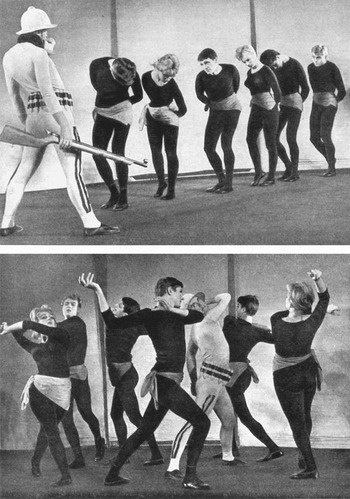
A typical troupe consisted of a small collective of professionally trained, predominantly male actors, often clad in black leotards (occasionally accented by a thematic or period detail, depending on the play). The content of their performances varied greatly, but a representative sample might entail a short narrative scene dramatized through stylized gestures and based on a literary text, the miming of an enduring existential question that had contemporary ideological relevance, or a response to topical political issues enacted in the “poster” genre (e.g., anticolonial rebellion in Africa [see Fig. 1], popular upheavals in Chile, or the embourgeoisement of Komsomol morality). These wordless plays were frequently (but not necessarily) accompanied by a musical score.
Group scenes from the 1962 anticolonial poster-play Africa by the Experimental Theatre-Studio of Pantomime (EKTEMIM) under the direction of Aleksandr Rumnev: (top) the enslavement of the Africans by a European colonizer; (bottom) forced labor. Unattributed photographs from Rumnev, O pantomime: Teatr, kino [On Pantomime: Theatre, Film] (Moscow: Iskusstvo, 1964), following p. 208.

Silent Soviet actors at this time posited a socialist genealogy for post-Stalinist dramatic practice. They traced their dramatic roots to earlier experiments in revolutionary theatre, thereby deflecting assumptions that their art merely mimicked the popular mimicry of the West.Footnote 17 They recuperated the commedia dell'arte character Pierrot as the quintessential proletarian figure and proclaimed Charlie Chaplin as his successor for the cinematic age.Footnote 18 To summarize Rumnev's position, pantomime was not a recent bourgeois innovation but one of the oldest, most national, and most democratic forms of performance. Rumnev regarded it as a last bastion of the early humanist folk art of the public square that had had a long history of silently speaking truth to power under oppressive regimes of the past and had been remediated in the socialist era.Footnote 19
Not only was pantomime not bourgeois in its modern iteration, Soviet pantomimists asserted, but it was and had always been the dramatic mode of the oppressed—or rather the tool of the vanguard to speak on behalf of the voiceless subaltern. In this sense, it enacted the ultimate socialist-realist goal of effecting in its viewer the evolutionary move from revolutionary spontaneity to consciousness; that is, socialist progress not through the “[resolution of] class conflict” but through the transition in the socialist individual and in the collective from “sporadic, uncoordinated, even anarchic” to “controlled, disciplined, and … politically aware” activity.Footnote 20 Because of pantomime's consciousness-raising capabilities, its practitioners aligned its objectives with socialist history more generally. To put it in an appropriately sloganized way, pantomimic ontogeny recapitulated political phylogeny.
Critics applauded pantomime as practiced by Rumnev's renowned Experimental Theatre-Studio of Pantomime and its sister studios for its aesthetic innovations and aspirations as a global art form on two counts: as a specifically socialist Gesamtkunstwerk that married the skills of spoken theatre with the expressive techniques of the body (gymnastics, acrobatics, clowning, etc.)Footnote 21 and as a universally meaningful mode of artistic communication, a truly democratic art that could be understood across geopolitical boundaries by anybody with an able body. As Rumnev remarked about EKTEMIM:
With its art, sooner silent than mute, the theatre wants to answer the ethical and aesthetic demands of the broadest circle of viewers independent of ethnic, geographical, or social barriers. It dreams about the creation of pantomimes, consonant with the socialist epoch, reflecting the ideology of the simple people, their everyday actions, feelings and thoughts, concerns and interest, their labor, their interactions, their hopes, their dreams; the theatre is determined to stand in the lines of the active struggles for the assurance of fairness, honor, peace, and friendship on earth.Footnote 22
To Rumnev, pantomime succeeded as a universal language because it used “mimicry” and “gesture” to reach an “emotional culmination” that was inaccessible to oral speech alone. Meaning was immanent in the pantomiming body, and silence restored an original completeness to the communicative act that language (in its increasingly degraded state) lacked. The silence of avant-garde artists was thus a form of speech as political defection whose recognizability as such relied on foregrounding the ability to choose silence—to be “sooner silent than mute.” In the worst case, these able actors ran the risk that deliberate silence might be misread as a failure of communicative intention—that is, as the political impotence that had been the lot of many artists under the previous regime.
The risk silent Soviet actors assumed routes back to a more fundamental threat of failure in pantomimic communication—that the mime might not make the signifier (the body) adequate for what was being signified.Footnote 23 In other words, the artistic message can fail if the mime's body fails first. Il'ia Rutberg of Moscow State's Our House studio supplies an illustrative scenario of failed pantomime for our consideration.
Let's imagine a pantomime in which there is no stylization of movement, where everyone walks as usual, wears a hat as usual, and generally does everything as usual. Only they don't speak.
And why don't they speak?
To that simple question we have no answer.
Silent action, in which all of the characters act as they do in life, only they are silent or explain themselves with signs, will look strange, unnatural, will remind us of the world of deaf-mutes or of television with the sound turned off.
Thus it happens in bad, impotent pantomime.Footnote 24
The inadequate mime in this case is, to reverse Rumnev's handy phrase, sooner mute than silent; his speechlessness looks “strange, unnatural,” incapable. His artistic impotence reminds us of the deaf-mute. So does the deaf-mute remind us of the bad mime? And what does the deaf-mute look like when miming badly? Where would deaf-muteness end and bad miming begin? The mute body, it seems, is already too overdetermined with meaning to become a vessel of transparent communication in the symbolic economy of pantomime. The body language of the mute mime does not transcend speech but unsuccessfully tries to approximate it and in so doing reveals its inadequacy or “unnatural” lack. According to this binary logic, in the context of post-Stalinist culture, silence is political, muteness is pathological. And indeed, speechlessness as pathology was simultaneously reemerging in Russia as a subject of institutional study: defectology.
Pathological Silence and Defective Performance
As part of a broader revival of disciplines that the state had deemed ideologically suspect under Stalin, the field of defectology reappeared at this time. Defectology is roughly the Russian equivalent of American “special education,” a departmental umbrella for subfields of pedagogical and rehabilitative study concerned primarily with cognitive disability and sensory impairment, such as surdopedagogy (deaf education), and logopedagogy (speech therapy). Subdivisions of defectology deal with the social-scientific problem of impeded speech; it is an expert clinical field designed to manage the silence of individuals as a treatable problem that is closely tied to sociocultural phenomena. In contrast to the Western “medical model” of disability—which is typically conceived against the social model in what some disability scholars and activists recognize as a false dichotomy—the Soviet clinic understood defect as both: as a biological expression of socioeconomic conditions, or, if you prefer, as a socioeconomic model of pathology. This model gave rise to a different idea of “cure,” one that was ostensibly concerned with fixing the individual as part of the social collective.Footnote 25 Like those in the field of disability studies who work to challenge the medical model of late-capitalist Anglo-American formations of disability or deafness, I hope my discussion of the specifically Soviet construction of individual “defect” will show how different ideologies (here capitalist and socialist) are crafted around different notions of ideal embodiment and productive citizenship. I retain the word “defect” and substantivize it as “defective” to describe the object of defectology; so too does linguist and cultural analyst Irina Sandomirskaja, who notes that “the discipline under such a fearful name [developed] the ideas of educating a new Soviet human subject out of a ‘defective’ child (another fearful term).”Footnote 26 Like Sandomirskaja, then, I use the terms of this expert discourse with extreme apprehension while recognizing the “fearful” things it reveals about Soviet ideology.
The most well-established branch of defectology, deaf education, was standardized by the revolutionary government before it was quashed under Stalin in the 1930s.Footnote 27 As with its pre-Stalinist predecessor, the new wave of surdopedagogy that began in the late 1950s strove to mainstream the deaf child into proper adulthood as a productive citizen within the hearing world. Soviet deaf education at this time was based on the “[dominance of] the written/spoken language, mainly … the spoken language”: classes were conducted orally, and the mark of the successful student was vocality.Footnote 28 This generation of audiologists favored mirror exercises, which taught the deaf child to “read lips and speak intelligibly.”Footnote 29 They taught deaf students to supplement oral speech only by gently gesticulating a sign language that was patterned after spoken Russian (finger spelling or “gesture”) and to avoid the grammatically distinct (or “strong”) sign language that the Russian deaf community used and comprehended most easily.Footnote 30 Like the pantomiming actor, the clinician trained his speaking/hearing-impaired pupil in “mimicry” (facial movement) and “gesture” (sign).
Official mainstreaming produced a predictable set of ambivalent effects—a phenomenon Susan Burch has elsewhere dubbed “the irony of acculturation”Footnote 31—whereby the assimilationist agenda of deaf education made possible the emergence of a Soviet deaf cultural identity that was further nourished by state-sponsored subcultural institutions.Footnote 32 (Indeed, future deaf-rights advocates emerged from the ranks of defectologists.) Soviet deaf culture enjoyed something like a “golden age” at this time, especially in its long-standing tradition of theatrical performance. Avant-garde acting troupes drew heavily from and in some cases collaborated with their deaf-mute peers, whose everyday signing they perceived to be a close cousin of dramatic pantomime. Foremost among these groups was the Moscow Theatre of Mimicry and Gesture (TMG) of the All-Russian Society of the Deaf (ASD [in Russian, VOG]). TMG became the world's “first modern deaf professional theater with a full-time company” in 1962.”Footnote 33 Before and especially after that, amateur deaf theatres thrived under the auspices of local deaf organizations. Dramatic participation thus brought national and even international visibility to a population that had been either unattended or violently undermined in preceding decades. With the professionalization of TMG, it became apparent that defectives were not just the passive objects of the state's clinical gaze but were active agents of Soviet cultural production.
Still, deaf culture, set off by the stigma of defect, was not suddenly and holistically embraced by the nondeaf or nondisabled members of Soviet society who appropriated its artistic forms. The onus of social integration was on the deaf community, as evidenced by the oralism of defectology. There is little or no mention of deaf pantomime in the historical monographs or contemporary theatre journal articles on the subject of pantomime, despite the fact that its practice remained comparatively unbroken during the period when nondeaf pantomime was not permitted. Perhaps more problematic than this omission is the fact that, from the postwar period through the 1970s, deaf actors were mostly segregated from their unimpaired counterparts behind a wall of sound. The privilege of pure silence in performance was entrusted only to nondeaf (and sometimes mixed) troupes, and all-deaf troupes adopted a “ventriloquist” style whereby they mouthed verbal scripts accompanied by a speaking “translator” or “actor-announcer” for the hearing audience. Rather than representing the new freedom from “totalitarian” artistic oppression, as did the silent pantomime of the theatre of unimpaired actors, this “lip-syncing” style risked connoting the opposite. Indeed, American actors from the National Theatre of the Deaf read the Russian method as closer to puppetry than to pantomime, a loaded interpretation in the context of the cold war.Footnote 34
This approach was intended for an “outside” audience; it was directed first to a nondeaf or nonsigning viewer and consequently prioritized speech over sign. The signing in such performances “is forced to conform to the rhythms and pacing of speech.” Inside productions, on the other hand, “privileged the theatrical experience of Deaf spectators, prioritizing [sign language] translation of the text and asking the spoken performance to submit to the demands of its visual counterpart.”Footnote 35 TMG directed its energies “outside” on multiple counts. In fact, “the majority of the deaf audience poorly understood [their] plays” because they supplemented vocal speech with a weak sign language that was “foreign” to the deaf audience and differed from the “language used by the deaf in their everyday interaction.”Footnote 36 What sign language did appear was misconstrued by the hearing audience as an approximation of pantomime, despite the fact that TMG could boast but one silent pantomime in the troupe's entire repertoire in the early 1960s.Footnote 37 For the most part they revived dramatic classics by Shakespeare and Schiller—a tendency for which the ASD monthly magazine Deaf Life castigated them because of its lack of topicality and artistic freshness.
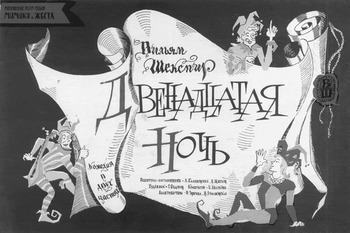
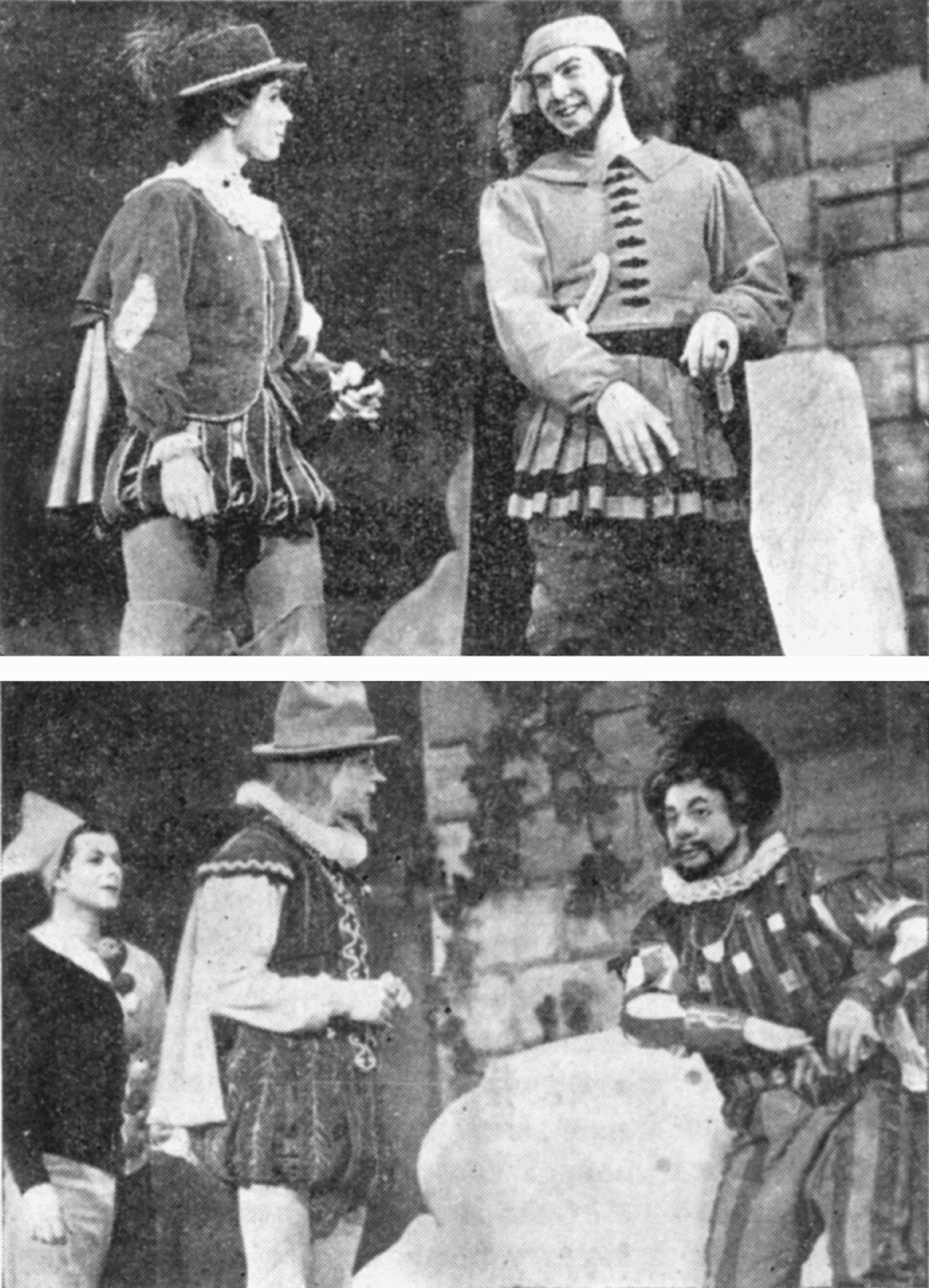
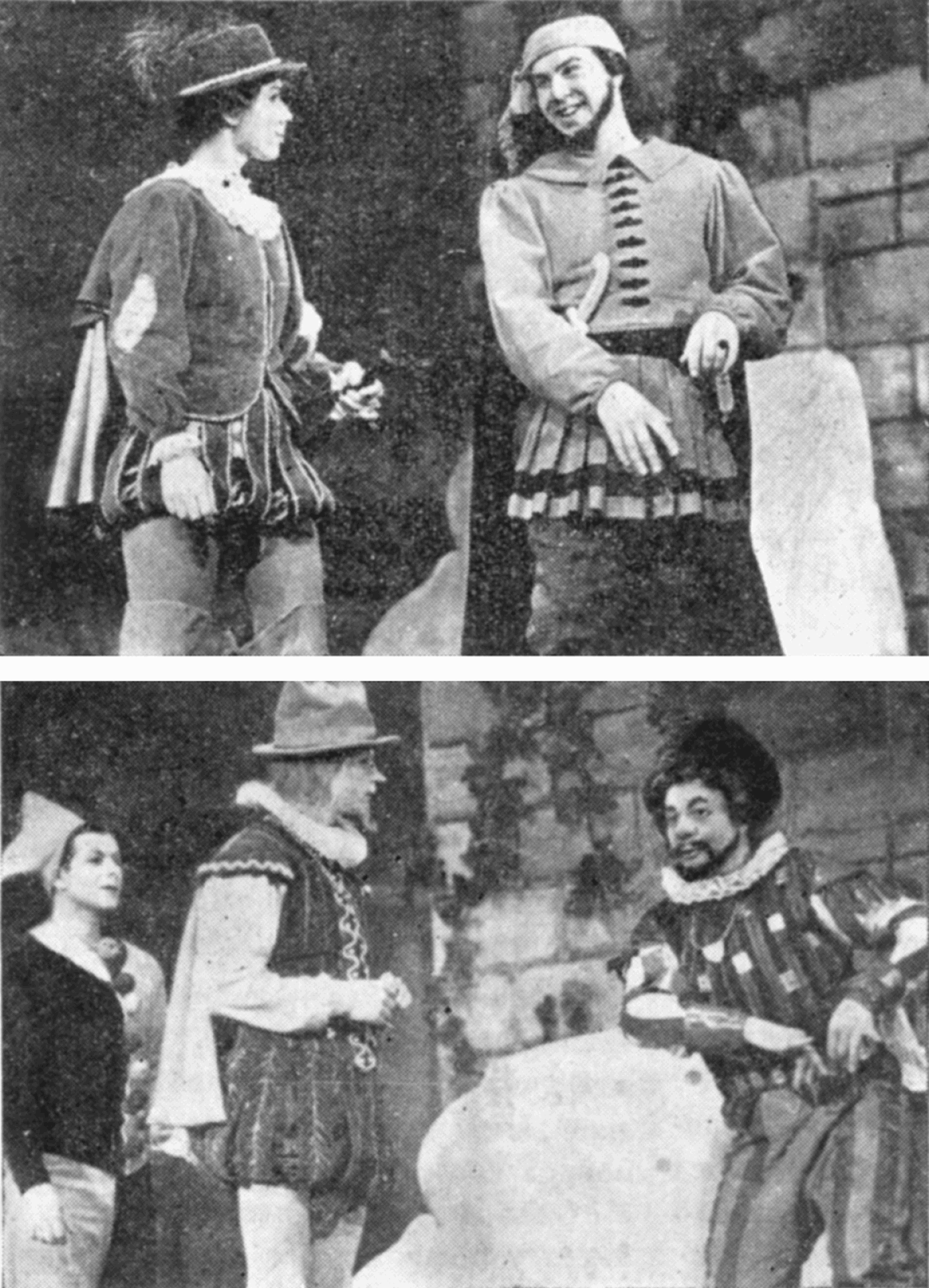
Though deaf theatre adhered to the scripts of conversational drama, distinguishing itself mostly by its unique performance technique, the discussion of one exemplary play and the history of its reception imparts a clearer picture of deaf theatre as such. TMG's Twelfth Night premiered in the opening season (see Figs. 2 and 3) and was staged more than two hundred times out of the theatre's roughly two thousand productions up to 1972.Footnote 38 Domestic and international audiences in the early to mid-1960s were impressed with the deaf rendition of Shakespeare's comedy, especially as the actors captured the wit of the original without pronouncing a single word onstage.Footnote 39 But offstage, in the first row, actor-announcers faithfully recited the script, providing a soundtrack to which the deaf actors lip-synced and signed.Footnote 40 By the late 1960s and early 1970s, critics were losing patience with TMG's repetitive repertory, singling out Twelfth Night for special censure.Footnote 41 This play, like other Shakespearean pieces, was not only out of touch, they argued, but its excessive dialogue made it an ill fit for the theatre of the deaf. One member of the Twelfth Night audience suggested that “the announcer's text here was wholly unnecessary” and that the deaf theatre would do better to rely on sign and pantomime alone.Footnote 42
An advertisement for the Theatre of Mimicry and Gesture's 1964 production of Shakespeare's Twelfth Night, directed by L. Kalinovskii and V. Shcheglov. Reprinted with permission from Zhizn’ glukhikh [Deaf Life] 11 (1964): back cover.

Two stage photographs taken by A. Motylev of the Theatre of Mimicry and Gesture's opening-season production of Twelfth Night: (top) Viola and Antonio; (bottom, left to right) Feste, Aguecheek, and Sir Toby Belch. Reprinted with permission from Zhizn’ glukhikh [Deaf Life] 8 (1963): 13.
If the plays themselves were stale and out of sync with the socialist times, a main source of fascination for the hearing audience was watching the deaf actors synchronize their mouths with the acousmatic voices (those “heard without [their sources] being seen”)Footnote 43 and, to quote one critic, making “every play become a ‘talkie’” to achieve the “total impression” of “the actors themselves speaking, just as in a dubbed film”—a metaphor the deaf press also used.Footnote 44 Reviewers were obsessed with the spectacle of deaf actors finding their rhythm and projecting the successful illusion that they could hear. One reviewer wrote: “Seated in the auditorium, one cannot even imagine what difficult work it is for these actors who cannot hear music but sing and dance by force of their inherent inborn rhythm and plasticity.”Footnote 45 He was particularly impressed by a musical play about the theatre in which a young (hearing) girl learns to sing and dance, because of which, the commentator noted, it became impossible to remember that the actress playing the part could not herself hear: she had undetectably performed nondefective subjectivity.Footnote 46 This focus on synchronicity came at the expense of intelligibility for the deaf community. As one deaf activist hypothesized, the use of strong sign in a TMG play would have “immediately destroyed the synchronicity of the play of the deaf actor and the actor-announcer, [who was] singing couplets (naturally for the hearing audience). And it is exactly this synchronicity that the theatre so aims for … how can that be?”Footnote 47 If not designed for the entertainment of and comprehension by deaf audiences, what was the goal of this theatre?
In effect, deaf stage performance functioned as an extension of surdopedagogical practice—that is, a defectological technique of the self, or a “deformance,” to borrow Susan M. Schweik's term for “dramaturgies of impairment adjustment involving the carefully orchestrated and paternalistic public exposure of the [defective] … always about to be reformed.”Footnote 48 Indeed, from its inception defectology employed drama as a form of therapy to remedy belated language acquisition or fix incorrect speech.Footnote 49 Beyond its clinical application, theatre, like state cinema, offered one of “the most tangible [incarnations] of the [Soviet] civilizing process” as a “[technique] for disciplining the body, giving the real body of the actor to the utopian project of a new ‘social-biological type’ of Soviet man.”Footnote 50 Drama demonstrated models of corporal and oral movement to be emulated by the Soviet citizen, defective and nondefective alike.
But deaf-mute theatre bared the device of artistic performance as political pedagogy, since spectacles performed by defectological subjects rehearsed and exhibited the clinical demands for perfectly embodied speech—for “speaking intelligibly and lip reading” flawlessly—behind which hovered the imperative to pass as unimpaired. To this end, reviews of TMG always included an extended passage of (self-)criticism (TMG actors and directors often wrote reviews of their own performances), pointing out the imperfections of enunciation and “unintelligible articulation” of the performers.Footnote 51 This was true for both mainstream theatre journals of the hearing world (such as Teatr [Theatre]) and periodicals devoted to deaf culture and defectology (such as Zhizn’ glukhikh [Deaf Life]).Footnote 52 As a case in point, for the Lenin Jubilee of 1970, TMG staged a thirty-year-old play depicting the new Soviet man, but one critic writing for Deaf Life asserted that both the actors and the director fell short of the dramatic ideal in their “superfluous bustling” and incomprehensible mimicry, on account of which they could not convey “revolutionary intellect and conviction.”Footnote 53 But pages before this artistic critique, the reader of Deaf Life encountered an article authored by the audiological consultant to the theatrical troupe, in which he described correct “actorly speech” and prescribed it as exemplary for the theatregoing speech-impaired subject.Footnote 54 Attendant to this, the daily training of TMG actors entailed afternoon meetings with the logopedist to practice “oral acoustic speech.”Footnote 55 Vocality and its visual complements required perfection because, in the words of one deaf director, “the theatre [was] one of the most powerful means of communist education” for the “popular masses,” which included, of course, the deaf.Footnote 56
If defective performers always had room for improvement, the unsung hero of deaf-mute theatre was the actor-announcer, the ventriloquist to the deaf dummy, a virtuoso orator whose mastery of dubbing would often do double service when it was divided among multiple lip-syncing performers onstage at once. The actor-announcer assumed the audiologist's role in the auditorium by supplying perfect speech for the actors to mouth. And in a lesser sense, so did the hearing audience, encouraged as it was to stare and scrutinize the fidelity of the actor's body to the announcer's voice.
The theatrical performance and within it the performance of political subjectivity—that is, performance and performativity—are the very things at stake in these spectacular enactments of positive and negative speech. The defective female actor, like the gender illusionist in Judith Butler's seminal essays, reveals (or, when she is successful, obscures) how normative identities are “instituted through a stylized repetition of acts” that over time are made to appear natural in their seemingly seamless continuity.Footnote 57 When the defective performer found her rhythm and danced or synchronized her body with the disembodied voice of the hearing announcer, she temporarily inhabited ideal Soviet subjectivity through this trompe l'oeil. When she slipped, visually stuttered, or fell out of verbal or physical sequence, she became defective again to the viewer. Compelled to perform perfect speech (by the audience, the audiologist, the theatre director, et al.), the deaf-mute actor was deprived of the ability to represent the very “defect” that foreclosed her entry into the Soviet Union's “normal” symbolic order. She performed her failure in the very act of trying to overcome it. This demand that deaf actors pass as nondefective and enact “authentic” speech was compounded by the already-tainted status of theatrical speech (per J. L. Austin) as parasitic upon proper speech, excluded from the latter and instead “linked with the perverted, the artificial, the unnatural, the abnormal, the decadent, the effete, the diseased”—and, I add here, the defective.Footnote 58 The very defect of drama meant that defectives could never truly perform ideal Soviet identity, or that in performing the ideal they would disappear.
The pantomime of the unimpaired artist unconsciously rested on this arrangement; his or her silence was buffered by the assumption that his or her own speaking self was completely achieved, as the foil of the failed mime/deaf-mute reveals. Unimpaired mimes believed the tools of their art included and exceeded the techniques of conventional conversational theatre. This excess came into greatest relief against the perceived somatic-cum-artistic deficiency of mute actors, who, it follows, were always engaged in a de facto pantomime, since proper conversational drama was never an option for them. (Likewise, although unimpaired theatre's homonymic systems of mimicry and gesture were the supplements of an always inadequate spoken language in the speaking/hearing world, they were surely not regarded as commensurate with the modes of communication used by deaf actors, theatrical and otherwise.) In effect, the hearing actor required the scene of defective speech in order to be meaningfully silent himself, so that his silence was understood not as mute pathology but as artistic and political metaphor.
The Coloniality of Language: Mimicry and the Deaf Self
The metaphorization of disability by the nondisabled is a transhistorically and transculturally prolific practice that has already been thoroughly documented by those who work in the field of disability studies.Footnote 59 In this specific case, objectifying deaf-muteness, emptying the category of lived particularity for the sake of an ableist trope, rendered Soviet defective subjects unable to represent themselves. The imperative for mute actors to speak (so that others might be silent) was but one instantiation of what some Western scholars of deafness characterize as the broader oralist colonization of the deaf community in cultural as well as “economic, welfare, [and] linguistic” terms.Footnote 60 Harlan L. Lane has most prominently asserted that there was a connection between oralist oppression and racist colonialism, observing that audist or hearing-centric society and its audiological establishment subjected the deaf individual to paternalist ethnocentricism and correspondingly subjected the deaf body to colonization by the state.Footnote 61 His proposition merits consideration here because the Soviet Union produced its defective citizens with methods like those used by the colonial state.
Of course, as Mark Sherry advises, “neither disability nor [colonialism or] postcolonialism should be understood simply as a metaphor for the other experience.”Footnote 62 Nor is it my intention to collapse the distinction between their associated oppressions—especially since some Soviet pantomimes refuse to lend themselves to such lazy analogic thinking.Footnote 63 Avoiding Lane's logic of substitution, I take seriously the claim that oralism is a form of cultural domination that reifies uneven power relations through hierarchies of language and speech. These hierarchies, moreover, are epistemologically and experientially entangled with the scaffolding of colonialist configurations of power based on race. (Homi K. Bhabha, for one, points to the linguistic and specifically aural cast of constructions of national self and colonial other.)Footnote 64 Underscoring these overlaps but refusing their integration, I use the term “colonial” to refer to the linked but partial workings of a particular logic of differential power predicated on certain ideals of linguistic subjectivity.
In a tentative linguistic-colonial paradigm, the oppression of the Russian deaf community was achieved with a familiar set of strategies employed by the oppressor group: “the physical subjugation of a disempowered people, the imposition of alien language and mores, and the regulation of education in behalf of the colonizer's goals.”Footnote 65 Spelled out more explicitly in the field of pedagogy, this meant in the American as well as the Soviet school “the incarceration of deaf children in institutions, the denial of [deaf sign language] as a language, the imposition of medical aids … , mainstreaming in education, punishment of deaf children for manual signing.”Footnote 66 These oralist practices put a “civilizing burden” on the defectological specialist to bring the “intellectually deficient” deaf student to “true [spoken] language” and thereby return him or her to society. When that failed, hearing educators blamed the deaf students themselves for their inability to become educated in audist schools. “Their pupils [were] intellectually deficient, the educators claim[ed], because they lack[ed] true language.”Footnote 67 In such a way deaf students in the Soviet Union were constructed as irredeemably defective, yet were paradoxically compelled to continue correcting their incorrigible deficiency lest they remain unfit for the communist future.Footnote 68 Galina Zaitseva, a leading deaf activist in post-Soviet Russia until her death in 2005, believed that “sign language was completely absent from Soviet surdopedagogy for many years” because of “the racist ideas of the ignorant Communist leader,” Joseph Stalin, along with the oralist state during and after his tenure, which “took a great toll on the whole field of Deaf education and the study of sign language in the former Soviet Union … the consequences of [which] have not been overcome completely even today.”Footnote 69
Drawing on the work of deaf scholar and activist Paddy Ladd, we might detect the Russian deaf theatre actor's internalization of his colonization by the dominant hearing culture in his adoption of the ventriloquist technique. Herein “[t]he Deaf gaze is clearly [directed] outward toward majority culture, indicating an inability to conceive of their own lives as valid cultural material for art.”Footnote 70 Zaitseva believed this to hold true for the Russian stage as well; she contended that the artistic choices the deaf theatre made reflected the enduring cultural colonization of the Russian deaf community.
For many years deaf people were compelled (by parents and pedagogues) to satisfy certain standards established by the hearing (the mastery of oral speech and so on). Anxious about their deafness, experiencing the feeling of their own inferiority, deaf people for a long time assumed that their lives did not deserve to be the object of theatrical art.Footnote 71
More than this, we have seen how deaf dramatic activity was an instrument in the defectologist's arsenal, designed to fix the sick speech of the defective or, if we permit the metaphor, to “civilize” the inferior or “barbarian” subject of audist colonialism.
Deaf theatre, in other words, was a form of “colonial mimicry: a performance of everyday life in which colonized persons adopt … the culture of their colonizers,”Footnote 72 which is motivated, as Bhabha tells us, by “the [colonizer's] desire for a reformed, recognizable Other, as a subject of a difference that is almost the same, but not quite.”Footnote 73 I appreciate Bhabha's choice of words here because it brings into better focus the significant difference between the two modalities of miming at issue in my analysis: the unimpaired pantomimist, who presumes him or herself a full mimetic subject; and the defective mimic, whose presence is a semblance that is inappropriate and partial. (Bhabha neatly captures this binary in “the difference between being English and being Anglicized.”)Footnote 74 The deaf-mute actor as colonial mime in the post-Stalinist scenario is enjoined to “speak” even though his speech is always marked as imperfect and not his own. This is the function of deformance as “the gift that keeps on giving deformity, perpetuating the model of the deformed object as a permanent other, even as he or she is to be continually subject to reform.”Footnote 75 The failure of the “deformer” as a full Soviet subject is thus strategically ensured and indeed constitutive of his defective subjectivity, thereby reinforcing audist distributions of political power within Soviet society.
This conclusion raises these questions: Beyond the consolidation of audist hegemony, who benefited from maintaining a population of “almost the same, but not quite” subjects incessantly engaged in their own self-correction? Why did the Soviet state need its defective citizens?
Perfect Speech, Perfect State
In the “highly bureaucratised society” of socialist Russia, where “submission to ‘normality’ was raised to the principle of government,”Footnote 76 “normal” subjectivity was socially and politically conferred through state-sanctioned speech—what historian Stephen Kotkin has famously called “speaking Bolshevik.” In this sense, the Soviet Union was an imagined linguistic community of speakers as well as readers, constituted across ethnic difference through performative utterance and comprising a new race of same-speaking Soviet persons: Homo Sovieticus. One had to “speak Bolshevik”—that is, “[adopt] the official method of speaking about [oneself] … as if one believed” in order to make legible his or her citizenship within Soviet civilization.Footnote 77 Though official language would take a turn toward the purely pro forma in the post-Stalinist period, as anthropologist Alexei Yurchak has convincingly argued, the imperative to properly “do” Soviet identity through state-approved performative speech acts remained resolutely in place and even intensified in some respects.Footnote 78 The post-Stalinist state focused on the form over the content of speech—a shift with important consequences for the defective speaker, whose shortcoming was explicitly construed as a matter of form. The defective offered an embodied example of speaking/doing Soviet identity wrongly, by virtue of which he or she served as a negative model of speaking Bolshevik for everyone else.
Before continuing, I call attention to my intervention in the use of the concept of “speaking Bolshevik,” which to date has been primarily relegated to a discussion of how newly christened Soviet nationals became Soviet by writing themselves into the official symbolic system. “Speaking Bolshevik” was a verbal endeavor and thus also a vocal one. Countless rhetorical primers support this position, such as Iskusstvo lektora ([The Art of the Lecturer], 1959), an official handbook that was hardly original or singular in its argument, whose global approach to embodied speaking addresses the formal qualities (including sound) and social consequences of public oratory. The book is interesting because of its overt prescription of a certain standard style or “norm” of physical–oral comportment for effective Soviet speech and because of its emphasis on “the external side of speech”; “euphony and pronunciation,” which it construed as of “great importance in lecture, propagandistic work”; and Soviet life more broadly.Footnote 79
Perfected speech, the book puts forth, is a politically correct act that makes apparent the synchronicity of the lecturer's abilities with the sympathies of the audience. When the speaker does not engage his or her listeners, the lecturer is urged to work fastidiously on his or her speech imperfections by means of vocal exercises that might just as easily be drawn from an audiologist's textbook as a linguistic or rhetorical guide. (One finds, for instance, instructions on how to articulate, intelligibly and aesthetically, various vowel and consonant clusters.)Footnote 80 In this way, The Art of the Lecturer reveals how any imperfect speaker was seen as “defective” to some degree, constructed as a potential or partial subject of defectological pedagogy. Moreover, it makes clear that what is at stake in oral defectiveness is the efficacy of the Soviet project in and between the individual bodies of the socialist collective—the ability of the individual speaker to be a politically coherent actor and the ability of the political actor to align him- or herself with the collective of socialist listeners. As the epilogue forcefully proclaims:
The lecturer fulfills a lofty humanistic and patriotic mission. He carries the great truth into the thick of the people—the truth of Marxism–Leninism. He summons people to labor and to heroic deeds in the name of the people… . The virtuous Soviet lecturer [remembers] … that he is entrusted with the noblest task—to develop, cultivate, inspire man—the builder of the new communist society.Footnote 81
Perfecting one's voice was but part of the grander political project of perfecting embodiment in the Soviet context—especially during and after Stalinism, with the addition of sound to film, the ascendance of radio, and the introduction of television. The vocal was arguably more important than the visual during the 1930s, when “hearing, thanks to radio, [dominated] over sight: the ear [dictated] to the eye what it should see.”Footnote 82 The post-Stalinist period, on the other hand, was characterized less by the competition between or dialectical struggle of sensory-stimulating media than by their instantaneous synchronization. Late Soviet television seamlessly stitched together sound and image for its viewers, whereas a rather leery crowd of cultural critics watched on as the aural and visual components of cinema came together in the 1930s. According to film scholar Lilya Kaganovsky, the Russian Formalists in particular bristled against “the new technology of synchronized sound.” They feared it would shift “the site for the production of meaning” by “doing away with [the spectator's] ‘internal speech,’” or unspoken thought, “and putting in its place a voice that issued directly from the screen,” thereby “[hailing] the spectator directly, casting the Soviet subject in the role of its addressee.”Footnote 83 Outer speech, the speech of ideology “linked to the authoritarian voice of Soviet realism,” drowned out inner speech, eliminating the possibility that the inner speech of the individual and the outer speech of the state would not coincide.Footnote 84 The complete Soviet subject was all surface and spoke only in an external, audible voice; in so doing he or she demonstrated total synchronicity with society. Internal artistic speech, conceptualized but not vocalized, like pantomime or deaf sign language onstage, threatened to throw this one-to-one ratio of thought and utterance, individual and society, off kilter.
Returning to deaf-mute actors, we find that, paradoxically, defectives constituted at once the worst and the best Soviet citizens under late socialism.Footnote 85 Even as they embodied the “bad example” of “speaking Bolshevik” described above, and though they formally failed the test of “external speech,” defectives also exhibited the ideal response toward their imperfect political subjectivity: one of ongoing self-correction. In this, the activity of a minority of defectives allegorized the task of existential reform that all Soviet citizens faced as they remodeled themselves into a new style of socialist being—a task for which the state deployed the clinic for defectives and the cinema and theatre for defective and “normal” society. In this we can construct a chiasmic model of defectivity as simultaneously universalist and minoritarian.Footnote 86All socialist citizens are to some degree defective and must correct their speech and movement; there is also a minority of defectives—the speaking and hearing impaired—who require clinical attention to do the same.
This collective transformation of individuals was the motor for Marxist–Leninist history. Soviet man was supposed to evolve in lockstep with socialist society's evolution to communism, which, once perfected, would allow the state to wither away. The fewer defects there were and the more perfect the Soviet man was, the fewer defects there would be in the system and the closer to perfect communism Soviet society would come. After Stalin, this approach to perfection was fast-tracked; in 1961, Khrushchev announced at the 22nd Party Congress that Soviet citizens had finally made the historical leap from socialism to communism. The macrological social and political perfection of Soviet society would, of course, refract into the individual bodies and minds of its composite members. The new party program adopted at that congress ambitiously announced that “at the current stage of building communist society … the possibilities steadily increase of cultivating the new man, who harmoniously combines in himself spiritual wealth, moral purity and physical perfection.”Footnote 87 While the state, from the start, had certainly expressed utopian hopes for fit-bodied citizens—demanding corporal “readiness for work, defense of the Motherland from external threat, rehabilitation and comprehensive physical development”—it had never before used the language of “perfection,” which would become standard fare thereafter. This rhetorical shift attested to the formation of a new ideal of Soviet citizen.Footnote 88
Thus it matters that the word “defect” referred to people as well as to the products of imperfect labor that the state was also trying to eradicate. Tellingly, official campaigns against both kinds of defect were framed in a language of temporality or tempo and rhythm: whether that meant keeping time with choreography in a musical production or keeping pace with socialist production in quantity and quality.Footnote 89 In official deaf clinical and cultural discourse, the bivalency of defekt—a term that disrupts a Russian text by its foreign origin (as Lenin himself remarked)—reveals the inextricability of two scales of self-correction: one on the level of the individual, another on the level of the population. Many issues of Deaf Life, for instance, focus on the small-scale amending of speech and hearing defects among individual deaf workers and then describe, through textual and visual supplements, the deaf proletarian class at work in factories eliminating defects in socialist production—a “systemic” problem against which the party routinely crusaded in the late 1950s through the early 1970s. Defective bodies make defective goods, the aggregate magazine implies. And with the post-Stalinist shift in emphasis from quantity to quality in manufacturing, from hard to soft industry, from factory to consumer, the defective product threatened the socialist home and correspondingly needed to be removed from the domestic sphere in miniature as well as from the domestic economy at large.
We are now equipped to contend with the following questions: How can the state's professed desire for perfected citizens be reconciled with its continual production of defective ones? And if the state was truly interested in seeing only ideal bodies, why should defective actors be asked to make a spectacle of their flaws through performances of colonial mimicry? In response, I conclude that while defectives at times depended on state support to survive, so too did the Soviet state depend on its defectives. As we have come to understand, defect marked the site of intervention on the part of the party-state. The persistent presence and incremental overcoming of defects in production and in persons was the incentive for the state to intensify goals for national labor and individual self-correction. By visibly demonstrating the failure of certain bodies—even under declared communism—the party and its apparatus could claim its relevance and, more than that, its indispensability in upholding the interests of the Soviet people. Defect was, in effect, what the state required to justify its own continued existence as the Soviet Union inched increasingly closer toward a stateless communist utopia.
Audible speech best attested to this beneficial relationship between party-state and citizen. For this reason, both silence and muteness, even in their difference, provoked suspicion, and silent and mute subjects alike were compelled to channel the collective “external voice” of Soviet ideology. “Ventriloquism” prevailed, but with unintended consequences. By attempting to extract the semblance of speech from deaf-mute actors, the Soviet state accessed a perverse representation of its own desire to shape the speech of its citizens. While this total ventriloquism contributed to the outward normalization of late-Soviet language, it also opened up space for the emergence of counterhegemonic practices. I end my essay on this positive note of resistance.
Subversive Diversions of Defective Silence
So far I have recounted a top–down story of the experience of “defective” individuals under the Soviet state and the discipline of defectology. By its telling, I hope I have demonstrated how the technology of the state and the technology of the self were explicitly one, not for the perfection of the individual for or by the state but for the perfection of the collective in concert with the perfection of the state. In this approach I included deaf institutions, like the ASD magazine Deaf Life and TMG, the theatre of the deaf, which provided a forum for cultural expression but whose survival was contingent on an apparently close alignment with the party-state by means of “speaking Bolshevik.”
Of course, with the performative turn in state-sanctioned speech after Stalin (as Yurchak has described it), Soviet citizens were increasingly “speaking Bolshevik” without identifying with the constative aspect of their speech. Often enough mouthing the party line could partially liberate an individual from living in strict accordance with it. There is no reason not to number deaf actors among the ranks of the politically nimble. Moreover, recalling Bhabha's depiction of mimicry as a “double articulation” that is capable of encoding both political repression and performative subversion when it “problematizes the signs of … cultural priority,” we have reason to suspect that so-called defectives did not always enact perfect compliance with their official representation.Footnote 90
Such hunches about deaf ideological and artistic dissent are borne out by Deaf Life, which contained occasional traces of contestation both within the deaf community and between the deaf and hearing or professional communities over the way deaf people portrayed themselves in society and the way they were portrayed to nondeaf members of society. Polemics in the periodical over the aesthetics of mimicry and gesture in a predominantly hearing public sphere testified to the existence of a Soviet deaf culture that was heterogeneous and critically active. More tellingly, the magazine became a space for spirited debate over the shape of deaf drama in the late 1950s and 1960s (coincident with the establishment of TMG). Readers of all backgrounds chimed in, encouraged by TMG's director to regard themselves as “full-fledged builders of the theatre” and of communism generally (echoing the party's new “Moral Code for the Builders of Communism”).Footnote 91 Several even voiced hesitation about the ventriloquist style. “This mechanical transmission of the text” had “gotten old,” they complained; it “shackle[d] the performer [and] deafen[ed] the artistry in him.”Footnote 92
Collectively, readers advocated “new forms in the theatrical art of the deaf-mute” that would attend to the specificity of deaf experience. Footnote 93 There was no obvious consensus on what this thing—variously called a “theatre of silence” or the “art of eloquent quiet”—would be.Footnote 94 Some argued for “big” or formally “pure pantomime” or some combination of pantomime and the tools of silent film, alternately assimilating or disowning the influence of Marcel Marceau.Footnote 95 Deaf and nondeaf contributors alike opined that the hearing impaired were “half-mime” anyway, “pantomimists by nature” because mimicry and pantomime were of a piece. Significantly, others dissented.Footnote 96 Putting this questionable equation aside, we should still identify the implications of swapping ventriloquism for the pantomime that characterized prewar deaf theatre, as happened on multiple occasions in the 1970s.Footnote 97
As Jacques Derrida has pointed out, part of the mime's appeal lies in his or her unique positioning with respect to the performative nature of identity, enabling him or her to expose the precariousness of the templatic self, of which his or own self is alleged to be a failed or faded copy.Footnote 98 The mime who does not imitate the “reality” of the mimetic subject (here, the speaking/hearing Soviet ideal) or who imitates the ideal but with a difference is capable of interrupting “all of the temporal and spatial distinctions upon which mimetic doctrine has been constructed: imitated and imitator, referent and sign, signified and signifier.” In these instances, “we are faced then with mimicry imitating nothing; faced, so to speak, with a double that doubles no simple, a double that nothing anticipates.”Footnote 99 What results is something akin to Tobin Siebers's “embodiment as mimesis,” an approach to representation as a political and aesthetic problem that does not reduce the body to an effect of discourse but lets the body stand for its own irreducibility.Footnote 100
This impulse stands behind the dream of a sui generis theatre of the deaf for the deaf, one that would not, in the words of one reader, try to make “everything on the stage ‘the same as it is with the hearing.’”Footnote 101 Such a performance style operates against the “defective” theatre by disavowing the contradictory desire of the deaf actor to copy something he or she can never be. Furthermore, it refuses to apprehend the deaf actor as an already inferior original by rejecting the conception of the mute as a natural mime.
The post-Stalinist pantomime debates opened a space for cultural contestation that partly pushed late and post-Soviet deaf movements to rethink “stage speak,” recognize Russian Sign as a full language, and promote a bilingual manual–oral approach to education. In their search for a “new form,” deaf subjects chipped away at the complex oralism at the core of late-Soviet ideology and of surdopedagogy as one of its most potent expressions. In so doing, they disrupted compulsory mimesis as a project of state power. Deaf theatre offered more than a mere venue for the correction of dumb and docile bodies; it provided the backdrop against which a multiplicity of subject positions, some of which were robustly proud and resistant, emerged among those unspeaking/unspeakable others who occasionally refused to sing and dance to the rhythm of socialist revolution.