Introduction
Palliative care (PC) constitutes interdisciplinary care for individuals with serious illness and their families that is appropriate at any stage of a serious illness and helps patients and families manage the side effects and symptoms related to illness and its treatment. PC works actively to maintain an individual's (and family members’) quality of life throughout the course of illness. Identifying patient preferences constitutes a key element of PC. Patient preferences are often elicited as part of goals of care conversations, which help to facilitate advance care planning. Individuals with cognitive impairment should be considered good candidates for early screening for PC needs as they are at heightened risk for future decisional incapacity (Manly et al., Reference Manly, Tang and Schupf2008) and would benefit from goals of care conversations.
An estimated 5–29% of community-based older adults have mild cognitive impairment (Ritchie, Reference Ritchie2004), and the majority of older adults with dementia are still living in the community (Lepore et al., Reference Lepore, Ferrell and Wiener2017). The number of community-based older adults with mild cognitive impairment represents a significant public health crisis, and we must ensure that their needs, which include end-of-life planning and PC needs, are properly addressed. Making referrals for PC interventions when needed, which include eliciting preferences for end-of-life care, may preserve quality of life and valued decisions throughout an individual's illness trajectory. PC can take multiple forms, including specialty palliative care (specialists boarded in palliative medicine collaborate with multiple disciplines to address symptoms) and primary palliative care (a variety of healthcare professionals have basic competencies to engage in PC interventions, such as goals of care conversations, pain management, and depression screening). Given that most older adults with dementia diagnoses remain in the community and never transition to nursing homes or assisted living facilities (Lepore et al., Reference Lepore, Ferrell and Wiener2017), it is essential that aging services located in community-based settings help to meet the needs of older adults with cognitive impairment or dementia across the lifespan.
PC screening may be especially relevant for older adults with cognitive impairment in the community. Cognitive impairment, especially when comorbid with physical frailty, is associated with multiple adverse outcomes such as declines in both basic activities of daily living (ADL) and instrumental ADL functioning and greater risk of disability and hospitalization (Tinetti et al., Reference Tinetti, Speechley and Ginter1988; Dodge et al., Reference Dodge, Kadowaki and Hayakawa2005; Ahn et al., Reference Ahn, Kim and Kim2009). Furthermore, even for adults without frank dementia, subtle declines in cognitive functioning have been associated with negative outcomes. For example, one large-scale cohort study found associations between cognitive decline and decreases in psychological well-being (Wilson et al., Reference Wilson, Boyle and Segawa2013). Screening for unmet PC needs and subsequent early referrals to PC for community-based older adults with cognitive impairment may help prevent or manage some of these adverse outcomes.
Screening for cognitive impairment in diverse community populations can be a challenge. First, cognitive impairment is a fairly broad term. The impairment can be focused, such as a primary impairment in memory with other functions relatively spared or a general worsening of cognitive functioning in multiple domains. Impairment severity ranges from mild to severe and can be measured both subjectively (e.g., patient or observer report) and objectively (e.g., neuropsychological measures). Second, while cognitive impairment is a risk factor for progression to frank dementia, many individuals do not experience change or worsening in their symptoms for years or even decades (Mitchell and Shiri-Feshki, Reference Mitchell and Shiri-Feshki2009). Thus, accurately characterizing cognitive impairment in a community setting can be challenging, but it is critical in order to intervene in a timely way to mitigate adverse outcomes. It remains unclear which impairments and at which severities are most at-risk and in need of PC interventions.
This study sought to determine the relationship between cognitive functioning and PC needs in a diverse community-based sample of older adults attending congregate meal sites in New York City (NYC). Older adults attending congregate meal sites include large numbers of seniors from ethnic and racial minority groups, as well as seniors with serious medical burden (Porter and Cahill, Reference Porter and Cahill2015). NYC-based senior centers aim to reach diverse, underserved older adults with the greatest social and socioeconomic needs, particularly older adults with low income, limited English proficiency, frailty, and/or disabilities. Given the literature on the additional vulnerabilities of older adults with cognitive impairment, we hypothesized that individuals with lower cognitive functioning would be more likely to have unmet PC needs.
Methods
The current study was conducted as part of the Trio For Successful Aging (TRIO) Program, a partnership between the Institute of Geriatric Psychiatry in the Department of Psychiatry and the Division of Geriatrics and Palliative Medicine, both located at Weill Cornell Medicine, and the New York City Department for the Aging (DFTA). TRIO seeks to bring mental health and support services to community-based older adults as a way to support independence and quality of life of individuals receiving TRIO services. For more details about TRIO, see the prior article written in 2018 (Kozlov et al., Reference Kozlov, Cai and Sirey2018). As part of TRIO, multi-dimensional needs assessments are routinely conducted with consenting older adults who attend the sites and TRIO enrichment programming.
Participants consisted of adults ages 60 years and above receiving services at one of five senior centers located in two NYC boroughs: Brooklyn and Staten Island, New York. TRIO staff asked older adults if they would be willing to participate in a 40-min needs assessment. Assessments were conducted in English, Cantonese, or Spanish by multilingual staff. The needs assessment underwent back-translation procedures to ensure content was identical in all languages. Participation was voluntary, and participants received a tote bag as a token of appreciation. The local institutional review board approved the project, and all participants provided oral consent.
Measures
The Montreal Cognitive Assessment (MoCA) was used to assess participants’ cognitive function and was the primary independent variable. The MoCA (Nasreddine et al., Reference Nasreddine, Phillips and Bédirian2005) is a widely used cognitive screening tool that measures a variety of cognitive abilities, including visuospatial and executive function, naming, memory, attention, language, abstraction, and orientation. While the original paper proposed using a cutoff score of 26 as an indicator of cognitive impairment, recent studies suggest that this may not be an appropriate score for use in a diverse community sample. Given the recent research on MoCA cut scores in diverse community samples,9,10,11 we treated the MoCA both continuously and employed previously established cut scores to divide the sample into three groups: <16, which represented individuals with probable cognitive impairment; 16–25, which represented possible cognitive impairment; and >26, which represented individuals who were probably cognitively intact.
Unmet PC needs, including whether participants had engaged in Advanced Care Planning (ACP), were assessed using a 22-item PC screening tool designed for use in nonclinical settings (Ghesquiere et al., Reference Ghesquiere, Gardner and McAfee2018). A summary score on this instrument served as the primary dependent variable (Ghesquiere et al., Reference Ghesquiere, Gardner and McAfee2018). Participants are asked whether they experienced a given concern “never,” “sometimes,” or “all the time.” The tool includes three domains: physical symptoms, emotional concerns, and goals of care. Sample items currently are you experiencing “feeling overwhelmed about any medical treatment,” “not being able to stop or control worrying,” and “shortness of breath.” The screening tool was developed to be used categorically: individuals screen positive if they reported experiencing two or more items within a domain “all the time” in at least two domains (Ghesquiere et al., Reference Ghesquiere, Gardner and McAfee2018).
Additional covariates included a 22-item Medical Conditions Checklist, age, education measured categorically, and living status (living alone vs. living with others).
Statistical analysis
We examined whether there was a relationship between cognitive functioning, as measured by the MoCA (independent variable), and unmet PC needs, as measured by the PC screening tool (dependent variable). The MoCA was examined in its original continuous form and as a classification factor with three levels (scores ≤16, 16–25, and >25). The continuous variable had a standard adjustment for education level (add one point for those with education less than high school), and that adjusted score was used to construct the 3-level version.
We began with an a priori model with PC needs as the dependent variable that included independent variables gender (male and female) and living status (living alone vs. not alone) as fixed classification factors and age and total number of medical burdens as covariates, as well as MoCA in either continuous or categorical form. These are independent predictors that have previously been shown to be related to unmet PC needs (Kozlov et al., Reference Kozlov, Cai and Sirey2018). Depression and anxiety, which might otherwise have been included, were excluded from the model because they are assessed in the PC unmet needs scale; education was not included because the MoCA variable is adjusted for education level. In addition to years of age, we also examined the model in terms of commonly used categories young-old (less than or equal to 75) and old-old (over 75).
The focus in the models is the relationship between MoCA and PC needs. In continuous form, MoCA was examined in linear, quadratic, and semi-parametric form; when specified categorically, we examined prespecified contrasts between levels (lowest vs. two highest and middle vs. low and high; secondary, two lower levels vs. highest).
Potential moderators included gender, living alone status, age (years), education, and medical burden. We carried out a full examination of interactions of MoCA with the other independent variables. With MoCA in continuous form, this involved the examined homogeneity of regressions of PC needs on MoCA by levels of a classification factor or the cross product with a covariate, adjusting for the other variables, each in separate models (the test of the interaction is the test of homogeneity of the pair of regressions); in categorical form, it involved the examination of the interaction of the MoCA classification factor with a second classification factor or of homogeneity of regressions of needs on the other covariate by the three levels of MoCA. As a sensitivity analysis, we examined a model that included education, even though corrected for in the MoCA score.
Analysis was by general linear models and semi-parametric models. Assumptions for parametric analysis were met. These models are also highly robust to any potential deviations from normality.
Results
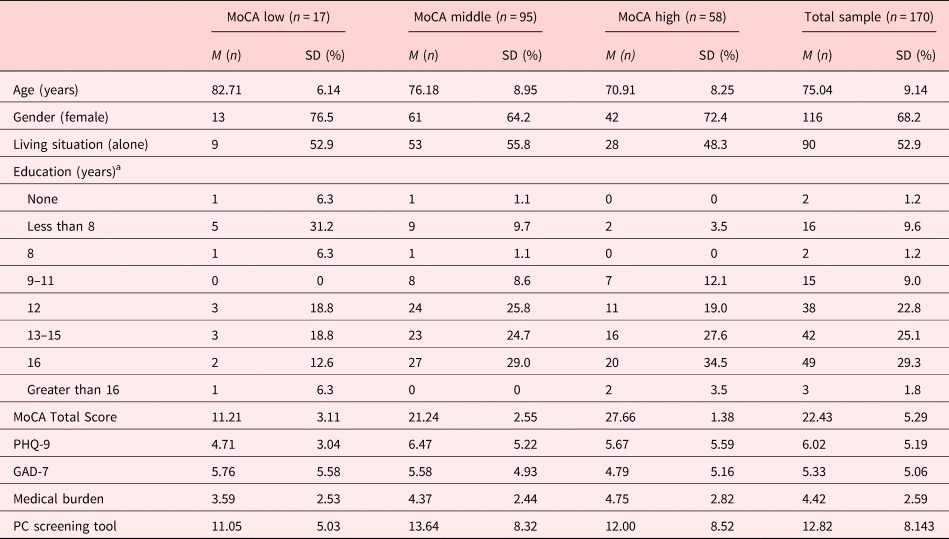
Table 1 shows the socio-demographic, health, and psychological variables overall and by the three levels of the MoCA variable. Briefly, our sample was 68% female with a mean age of 75 (SD = 9.14). About half of the sample lived alone, and the mean number of medical conditions (e.g., diabetes, asthma, stroke, etc.) was 4.42 (SD = 2.59) out of 22. The average MoCA score was 22.43 (SD = 5.29). Looking at the sample broken into three groups based on their MoCA score, the three subsamples differed based on age (P < 0.0001) and education (P = 0.003).
Characteristics of the sample (n = 170)

MoCA, Montreal Cognitive Assessment; PHQ-9, Patient Health Questionnaire (9 items); GAD-7, General Anxiety Disorder Scale (7 items).
a Three participants did not report the level of education.
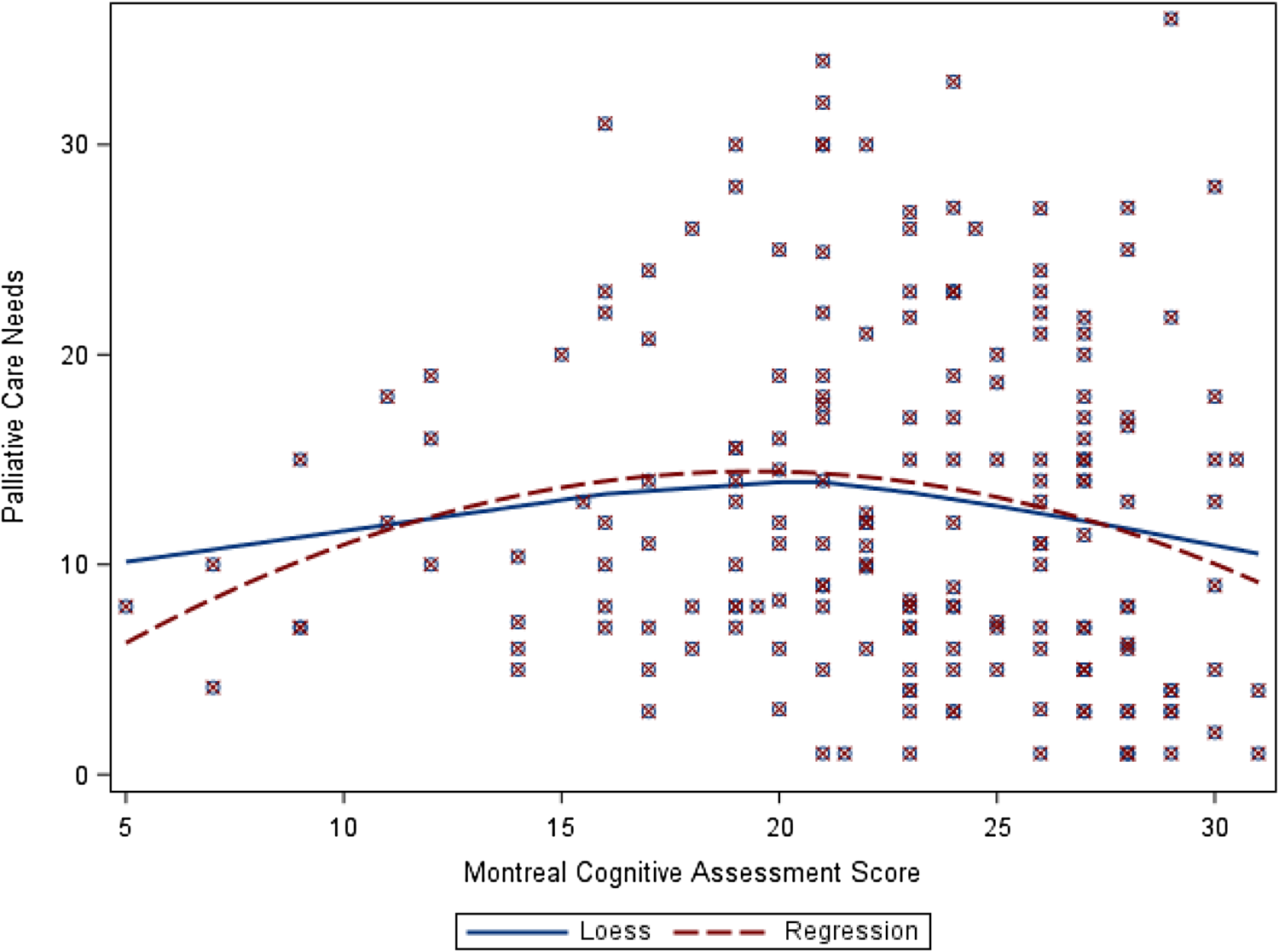
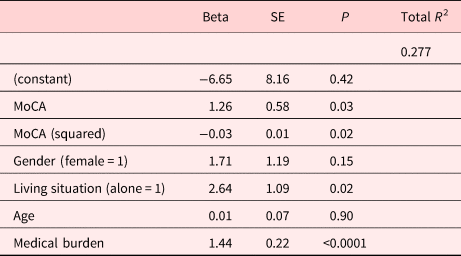
The results of our model with MoCA as a continuous variable, with the both linear and quadratic specification, are presented in Table 2 and shown graphically in Figure 1. The quadratic term indicates a nonlinear effect in the data (B = −0.03, P = 0.019), which can be seen visually in Figure 1. Participants with either low or high MoCA scores reported lower PC needs than participants with average MoCA scores, mean difference of the contrast (low and high vs. middle) = 2.15, P = 0.08. Similarly, participants with who lived alone (B = 2.64, P = 0.02) and participants who reported higher medical burden (B = 1.444, P < 0.0001) were more likely to report unmet PC needs. The relationship of other variables to PC screening is also shown in the table. There were no meaningful interactions with other independent variables in the model.
Relationship between PC needs and MoCA scores.

Full model R 2 and regression coefficients illustrating the effects of cognition, gender, living situation, age, and medical burden on PC needs (n = 170)

Note: Gender and living alone are classification factors. MoCA, MoCA (squared), age, and medical burden are covariates.
MoCA scores were calculated using the education correction, but as a sensitivity analysis, we examined a model adding and adjusting for education. This model similarly reveals a quadratic relationship between MoCA scores and PC needs (P = 0.025).
Discussion
To our knowledge, this is the first study to investigate the relationship between cognitive impairment and PC needs in a community-based sample. This study of a heterogeneous sample of community-based older adults found a quadratic effect between MoCA scores and unmet PC needs. Specifically, those with very low and very high MoCA scores were less likely to report unmet needs than those with mid-range MoCA scores. As we identified in a prior study, over a quarter of older adults in our population screened positive for unmet PC needs (Kozlov et al., Reference Kozlov, Cai and Sirey2018). Having less education, higher rates of medical co-morbidities, and living alone were associated with an increased odds of reporting unmet PC needs (Kozlov et al., Reference Kozlov, Cai and Sirey2018). These variables were thus controlled or adjusted for in our study. We have several hypotheses for why we did not find the predicted linear relationship, but instead found a quadratic relationship between unmet PC needs and cognitive impairment, all of which would need additional research to substantiate.
Participants with the lowest MoCA scores seem to be driving the quadratic relationship. When individuals with scores of 11 and under were removed from the model, the quadratic effect was no longer significant. We opted to keep these participants in the main analyses, however, in order to represent the full community sample and the complete spectrum of cognitive functioning in community-based older adults. One possible explanation for the quadratic effect is that individuals with very low MoCA scores are less aware of their unmet PC needs, or potentially are receiving additional care, services, and support and, thus, have fewer unmet needs than those with moderate scores. Individuals with the highest MoCA scores may be more keenly aware of their various health and ACP needs and thus report more unmet PC needs on the PC screener tool. This theory would warrant additional research involving caregiver informants to help ensure that data collected from cognitively impaired participants are valid. More research is required to better understand the quadratic relationship this study found between unmet PC needs and MoCA scores.
This study tested multiple models which consistently found no linear relationship between the MoCA and unmet PC needs tool. One possible explanation for the lack of hypothesized linear association is that we surveyed older adults who regularly attend congregate meal sites which represents a relatively high level of physical functioning, independent living, and some amount of regular socialization. Prior research has documented that socialization is a protective factor against cognitive impairment and the risk factors associated with cognitive decline (Arkin, Reference Arkin2007; Small, Reference Small2008; Jedrziewski et al., Reference Jedrziewski, Ewbank and Wang2014). It is possible that our sample was biased to select older adults with cognitive decline who are less impacted by their cognitive impairment than other older adults.
Limitations
One limitation of the study, which may also possibly explain the lack our results, is that the PC needs assessment measure may not be particularly sensitive to older adults with cognitive impairment and thus is not capturing the needs of older adults with the lowest MoCA scores. There are unique challenges associated with cognitive impairment, and the PC needs assessment employed in the current study was not developed with this particular population in mind, rather it was developed for the general aging population. Future iterations of the tool may benefit from a closer inspection of the needs older adults with cognitive impairment may have, such as concerns about not being able to make decisions for oneself in the future and difficulty remembering medical appointments. More research is needed to develop screening tools with acceptable sensitivity and specificity that can both detect and exclude unmet PC needs among older adults with dementia and cognitive impairment.
Additionally, our measure of cognitive functioning (i.e., the MoCA) was developed and validated as a screen for cognitive impairment rather than a definitive assessment of cognitive abilities. While our sample was heterogeneous with respect to MoCA scores, the generalizability of MoCA scores in diverse populations has been called into question in recent research (Carson et al., Reference Carson, Leach and Murphy2017; Milani et al., Reference Milani, Marsiske and Cottler2018). We did not consider MoCA subscores due to the lack of robust evidence of their predictive validity (Cecato et al., Reference Cecato, Martinelli and Izbicki2016); however, it is possible that subscores on the MoCA may highlight the specific cognitive abilities associated with PC needs and/or necessary for ACP. That is, that our measure of cognitive functioning was not specific enough to the facet of cognition (e.g., executive functioning) that may have an effect on overall PC and ACP needs.
Conclusion
More research is needed to better understand the unique PC needs of older adults with cognitive impairment living in the community. This study demonstrated a quadratic effect between cognitive function, as measured by a commonly employed screener, i.e., the MoCA and unmet PC needs, as determined by a newly developed tool meant to assess PC needs in community-based adults controlling for gender, living alone status, and age (years). More research is needed to further understand and contextualize the results of this study. Given the high levels of unmet PC needs and the large percentages of community-based older adults with mild cognitive impairment, routine screening of both domains should be implemented in as many community-based settings as possible including senior centers, congregate meal sites, and healthcare clinics.