I
In 2006, I was approached to write a play marking the twenty-fifth anniversary of my alma mater, Raffles Junior College. I swiftly declined: I explained that I was so perverse I would end up spinning a tale of the school's Stamford Raffles bust coming to life, doomed to drag its pedestal behind it like a giant slug.
Nevertheless, this planted a seed of curiosity in my brain. What would a contemporary dramatisation of the life of Raffles be like? A cursory Google search further provoked my interest: while textbooks had lionised him as the heroic founder of Singapore, I had known little of his mania and his cruelty, nor of the great tragedies that befell him: the deaths of his first wife and children, the loss of his possessions in the wreck of the Fame, his dismissal and his demise at the age of forty-four.
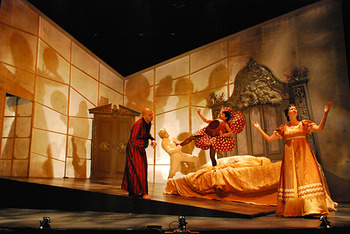
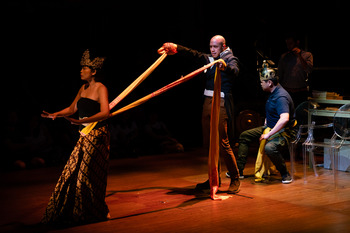
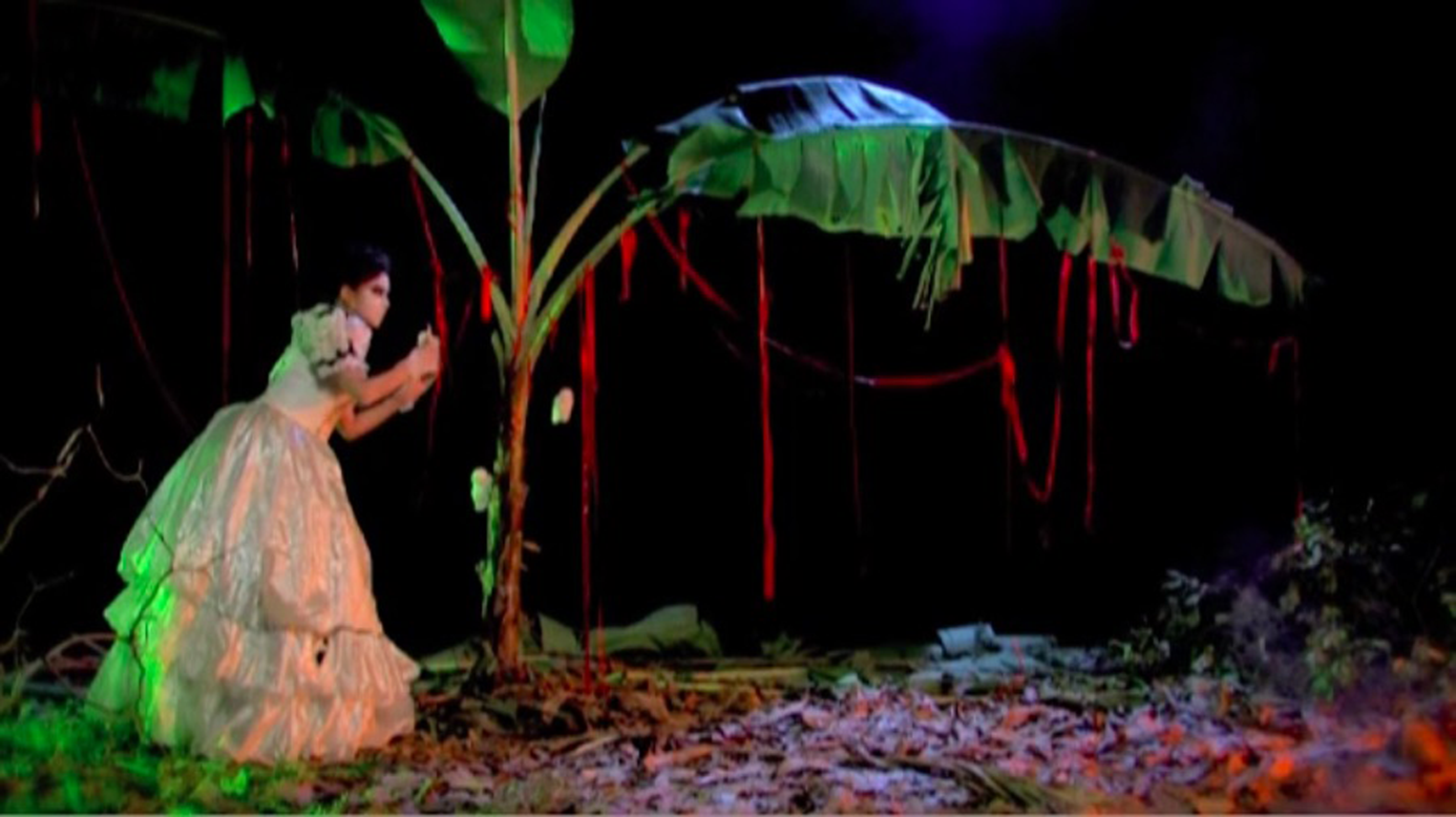
This inspired me to write The Last Temptation of Stamford Raffles (fig. 1), a phantasmagorical biography of our chief colonist, staged by Wild Rice in 2008. The tale unfolds on Raffles’ deathbed, as he is assailed by memories and hallucinations in the final twelve hours of his life. A giant Rafflesia blossom invades his home; a white statue exhorts him to join him in leading twenty-first century Singapore; the ghost of his former companion John Leyden spouts poetry at him, and his first wife Olivia Raffles manifests as a pontianak (a female vampire in Malay lore) — all while his second wife Sophia Raffles frantically records his biography. The play concludes as Raffles accepts his doom, walking clear-eyed into the mouth of the Rafflesia, which swallows him whole. The statue then replaces him in bed, collapsed in a deathlike stupor.
Ng Yi-Sheng, The Last Temptation of Stamford Raffles, staged by Wild Rice, 2008 (courtesy of Wild Rice)

Though eccentric, this performance is by no means atypical of contemporary portrayals of Singapore's 1819 colonisation. My research has uncovered over fifty creative renditions of this highly charged historic moment, including works of fiction, poetry, drama, comics, visual art and film.Footnote 1 The vast majority engage with the myth of Raffles’ greatness: they perpetuate it or, more often, critique it, employing subversive tactics to undermine his dignity.
In this essay, I shall attempt to make sense of this body of work, highlighting thematic affinities and tracing the evolution of cultural attitudes and artistic strategies. In this way, I hope to provide an insight into Singapore's complex relationship with its legacy of British colonialism: the fact that for almost a century and a half, this island was subjugated under the political dominion of the United Kingdom. As we shall see, some artists depict this history in terms of enlightenment and civilisation; some in terms of racialised oppression, violence and injustice; and some with a light-hearted, deeply irreverent ambivalence.
II
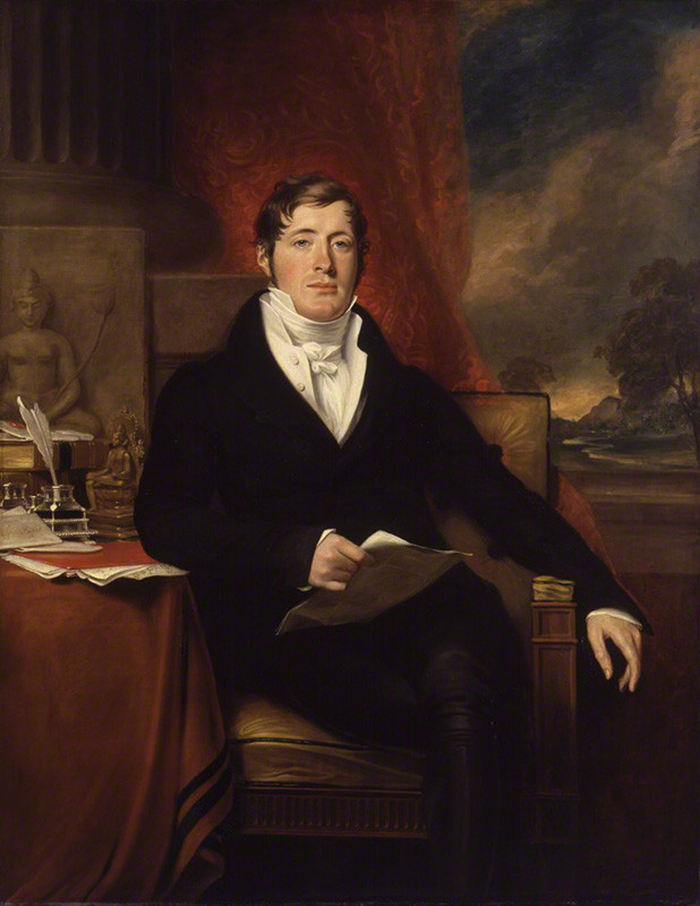
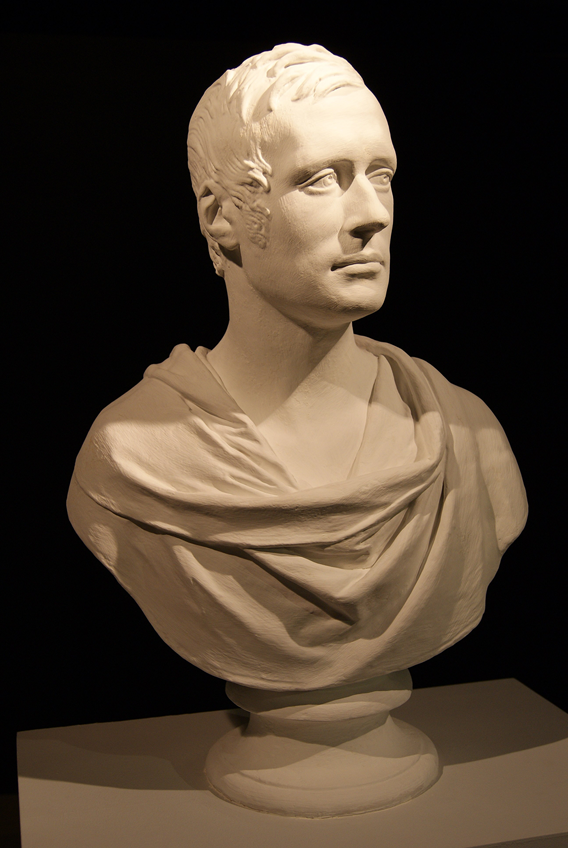
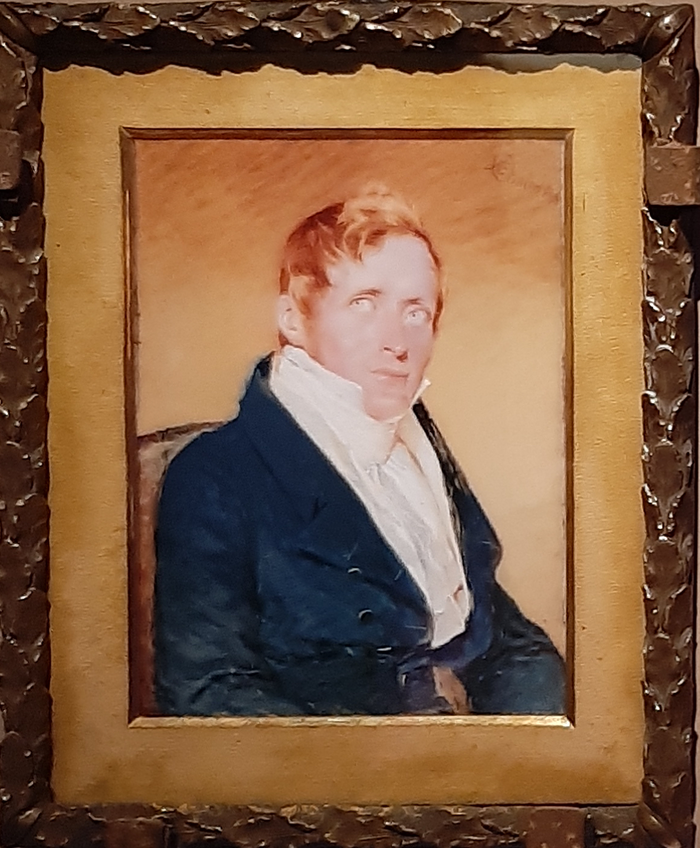
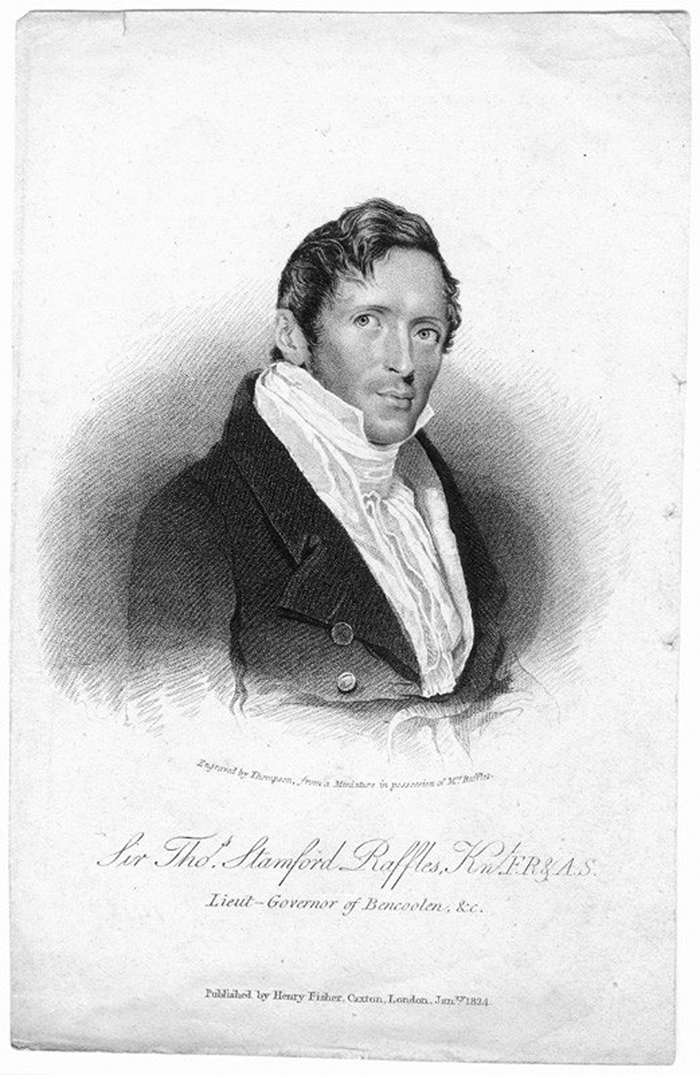
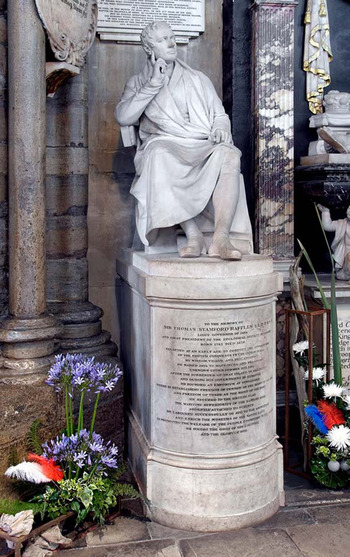
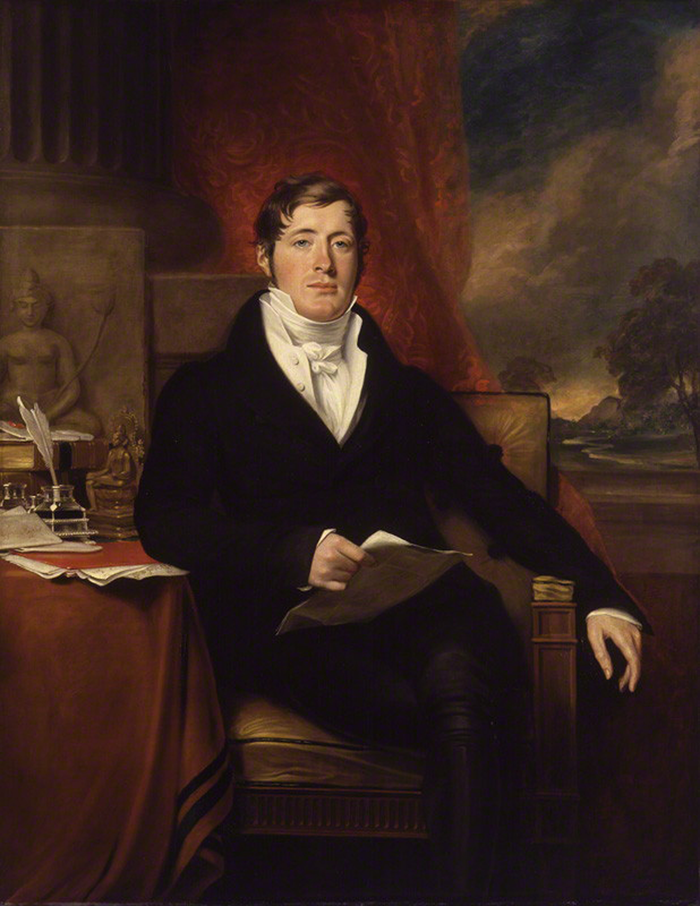
One of the earliest and most influential icons of the Raffles myth predates the settlement of Singapore. The 1817 portrait by George Francis Joseph (fig. 2) — copied by John Adamson in 1912 for the National Museum of Singapore — has become, directly or indirectly, the standard reference for all representations of the man. Here, he appears the very picture of colonial authority, gazing directly at the viewer, broad-shouldered in his jacket and Regency cravat, surrounded by the accoutrements of an enlightened, cosmopolitan scholar: documents, quills, Buddhist statuary from Java, a fluted column and landscape painting from Europe. Other early portraits of Raffles exist (figs. 3 to 7), but in them he appears rather less imposing, glancing away from the viewer, tilting his head, or, in the case of Francis Chantrey's bust, clad in ethnically ambiguous drapery. It seems no coincidence that these images languish in comparative obscurity: perpetuators of the Raffles myth had use only for the most majestic of his portraits.
Sir Thomas Stamford Bingley Raffles, portrait by George Francis Joseph, 1817, National Portrait Gallery, London (Wikimedia Commons).Footnote 6
Sir Thomas Stamford Raffles, portrait by James Lonsdale, 1817, Zoological Society of London (courtesy of ZSL Archives).Footnote 7

Bust of Sir Stamford Raffles (replica of a lost original), by Francis Chantrey, 1817, National Library, Singapore (Wikimedia Commons)Footnote 8

Miniature portrait of Sir Stamford Raffles, by Alfred Edward Chalon, c.1817, Raffles Family Collection (Wikimedia Commons)Footnote 9

Thomas Stamford Raffles. Engraving by James Thomson based on a lost miniature, 1824, National Portrait Gallery, London (Wikimedia Commons)Footnote 10

Memorial statue to Sir Stamford Raffles, by Francis Chantrey, 1832, Westminster Abbey (courtesy of Dean & Chapter of Westminster)Footnote 11

But when did the Raffles myth begin? Given the fact that he left the East India Company in disgrace, one might have expected there to have been a significant lull between his death and his apotheosis. In fact, artistic tributes were forthcoming within his lifetime, and immediately after. In 1825, a certain Mr. Glover presented Sophia Raffles with an illustrated poem titled ‘Loss of the Fame’;Footnote 2 though it narrates the tragic loss of Raffles’ possessions on a ship called The Fame, it lauds him as a ‘virtuous Chief’, struggling valiantly against a storm. In the wake of his death in 1826, British settlers in Singapore formed a Raffles Club in his memory.Footnote 3 A proposal was even made to open a reading room called the Raffles Library.Footnote 4
The most canonical literary work in praise of Raffles emerged in 1849: the Hikayat Abdullah, a memoir by Munsyi Abdullah bin Abdul al Kadir, who served as his Malay teacher and scribe. Now regarded as a seminal work in modern Malay literature, this text describes the early years of British colonisation, including the most detailed surviving account of Raffles’ arrival in Singapore. He expresses largely positive sentiments towards the British, going so far as to note a daytime shower as a good omen during the 1819 Treaty of Singapore.Footnote 5 Raffles himself receives the highest of accolades: Abdullah declares ‘Even should I die and return to this world in another life I should never again meet such a man.’Footnote 12 Notably, two of the four poems included in the memoir are dedicated to Raffles and his wife.Footnote 13
Before we take Abdullah's words at face value, we would do well to recall that colonists too had a hand in the Hikayat Abdullah: missionary and printer Alfred North had urged him to compose the memoir and later published it, its full publication in 1874 contained multiple amendments suggested by other colonists.Footnote 14 Ultimately, it was transformed into a tool of the colonial administration: from 1888 to the 1960s, it was a compulsory text in government schools for the teaching of Malay language and literature.Footnote 15
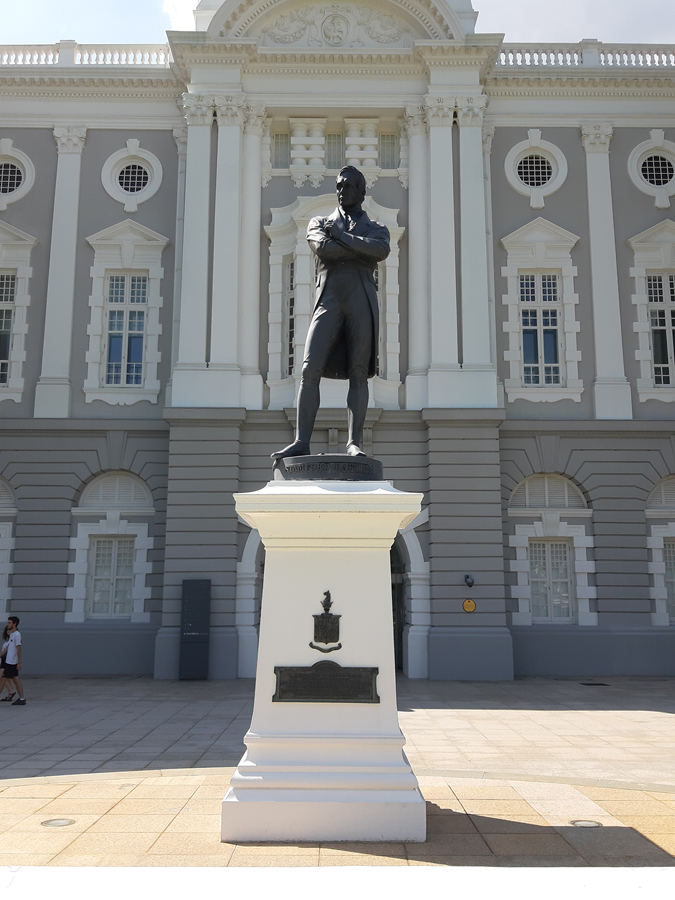
The most recognisable icon of the Raffles myth, however, would be Thomas Woolner's bronze statue of Sir Stamford Raffles, unveiled at the Padang in Singapore on 27 June 1887 as part of Queen Victoria's Golden Jubilee celebrations (fig. 8). It aggrandises Raffles still further: he now stands eight feet tall on a pedestal, arms complacently folded, head lifted, with one foot thrust forward to signify his mastery over the new land.Footnote 16
Statue of Sir Stamford Raffles, by Thomas Woolner, 1887, Victoria Concert Hall (photo by the author)

The colonial administration took some pains to ensure that the statue was treated with respect, suggesting its importance as a metaphor of British authority. At its original site at the Padang, it was occasionally hit by stray footballs and used as an elevated seat for spectators of games;Footnote 17 the Raffles bronze was therefore shifted to the Victoria Memorial Hall as part of the centenary celebrations of 1919, and surrounded by Doric columns, a marble-lined pool, fountain jets and vases of flowers.
Nor was Raffles glorified only in Singapore. In 1898, a version of the Joseph portrait appeared in a series of cigarette cards printed by British cigarette manufacturers Wills, titled ‘Builders of Empire’;Footnote 18 in 1929, another such set titled ‘Builders of the British Empire’ was printed by J.A. Pattreiouex Ltd.Footnote 19 A similar image of him may also be glimpsed in Fred Taylor's 1927 poster diptych ‘Builders of Empire’, commissioned by the Empire Marketing Board to promote intra-Empire trade.Footnote 20 This formed part of a greater series of posters titled ‘The Empire is Still in Building’ — a none-too-subtle exhortation to ordinary Britons to expand their country's global power. Perhaps the most imperious image of all, however, may be Spencer Pryse's 1924 illustration ‘Singapore: Stamford Raffles’ Farewell’. Here, Raffles stands garlanded before a circle of native Malays, who kneel before him, heads bowed as if in worship.Footnote 21 The work appears in The Pageant of Empire, a souvenir volume from an outdoor performance held at Wembley Stadium the same year, in which Raffles appeared with other colonists such as Walter Raleigh and Captain Cook, each flanked by the natives of the territories they had annexed.Footnote 22
III
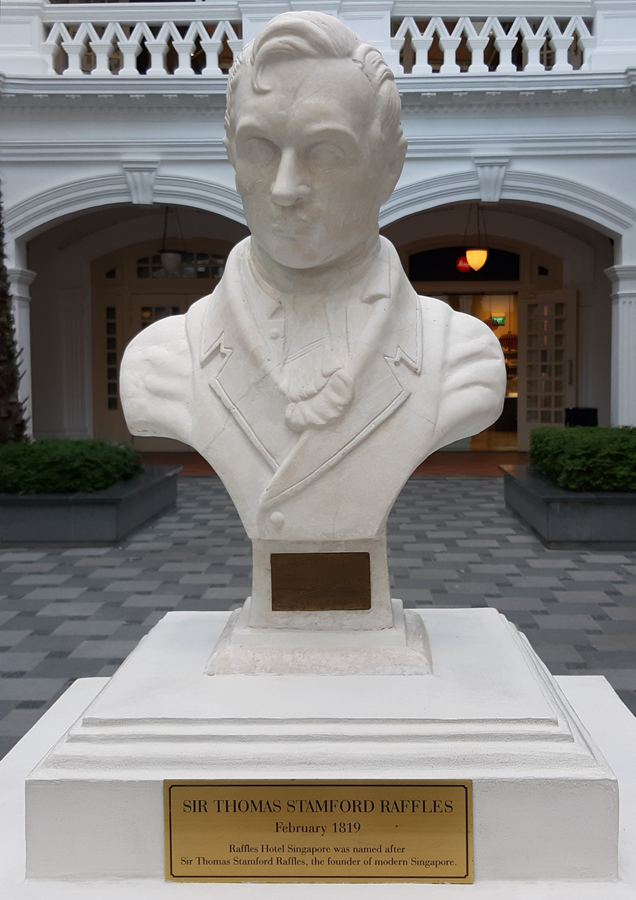
Decades later, as Malayan independence loomed on the horizon, the British colonial administration renewed its efforts to preserve the Raffles myth. The Raffles statue was once again put on display, having survived the Second World War in museum storage, though its accompanying columns had been damaged by bombs.Footnote 23 Around 1950, a bust of Raffles was created for display at the Raffles Hotel (fig. 9),Footnote 24 and at least two re-enactments of Raffles’ landing in Singapore were held, in 1950Footnote 25 and 1953.Footnote 26 Back on home turf, the first biographical novel based on Raffles’ life was published in London in 1957: Nina Epton's The Golden Sword.Footnote 27
Raffles bust at Raffles Hotel, by S.C. Siew and Selangor Pewter Co., 1950 (photo by the author)

However, the most enduring Raffles-themed work of the independence era was written not by a Briton, but by an Asian resident of Singapore. In the 1960s, Edward Wilson JesudasonFootnote 28 penned ‘Auspicium Melioris Aevi’, an anthem for Raffles Institution that painted Raffles almost as a saviour figure:
The lyrics are replete with colonial references: not only Raffles, but the gryphon and eagle of his family crest, and the classical imagery of Prometheus. Yet its allegiance is not to the British Empire, but to Singapore, a fact that allowed the work to survive decolonisation. Then and now, Raffles Institution had a reputation as a school for intellectual elites; as a result, generations of influential Singaporeans have spent their teens chanting these words, absorbing colonial fetishism in the name of nationalism.
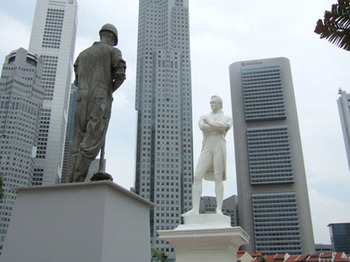
Statue of Sir Stamford Raffles by Singapore Tourism Board, 1972 (Wikimedia Commons)Footnote 35

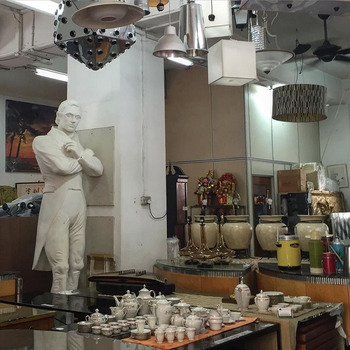
Plaster Raffles statue on sale at Hock Siong & Co. used furniture store, provenance unknown (courtesy of Mayo Martin)Footnote 36

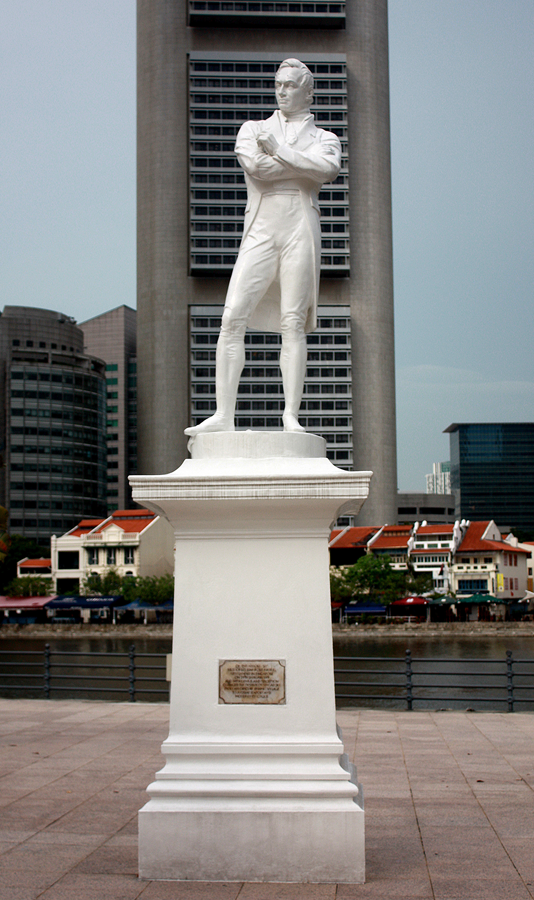
In a similar fashion, Singapore's post-independence leadership has embraced the iconography of Raffles.Footnote 30 Upon the advice of economist Albert Winsemius, Prime Minister Lee Kuan Yew allowed the Raffles statue to remain in place even after decolonisation, so as to assure investors that the nation harboured no resentment towards the West.Footnote 31 In 1972, the Singapore Tourism Board even erected a second version of the statue at the site where Raffles disembarked on the river, sculpted not in black bronze, but in the gleaming modern medium of white polymarble (fig. 10). Private businesses followed suit: since then, similar statues of Raffles have appeared at Parkview SquareFootnote 32 and Hock Siong & Co. (fig. 11). Individual artists, too, are finding inspiration in such statues, as seen in Wang Mo Ping's 2019 painting 开拓 (Deploitation).Footnote 33
Raffles has even made guest appearances at state events, with re-enactors marching in the National Day Parade (NDP) as early as 1968.Footnote 34 Possibly his most glamorous NDP portrayal came in 1996, in a mass drama narrating two hundred years of Singapore's history, written by poet Edwin Thumboo and featuring a cast of 4,000 volunteers.Footnote 37 Raffles opened the performance as he entered the field of the National Stadium, perched on a float in the shape of a ship, his face projected on a screen for the crowd of thousands. In 2017, Singapore International Festival of Arts director Gaurav Kripalani even spoke of commissioning a Raffles-themed musical, though this plan never came to fruition.Footnote 38
Singapore evidently suffers from a prolonged case of colonial hangover, with generations of artists and institutions reproducing Raffles in rose-tinted portraits. Yet let us not overlook the fact that British authors, too, have played a role in perpetuating the Raffles myth. Consider West End composers Hereward Brown and Ian Senior's 1979 musical The Lion of Singapore, Janet Appleyard's 1992 children's picture book Raffles Finds a Friend and its five sequels, Richard Mann's 1996 novel Restless Warrior, Rosie Milne's 2015 novel Olivia and Sophia, and John D. Greenwood's 2018 novel Singapore Saga Vol. 1: Forbidden Hill. Footnote 39 All these works depict Raffles as a largely benevolent leader, with little or no apology for the depredations of colonialism. A deeply ingrained nostalgia for the colonial era remains, shared by creators of art in both the former colony of Singapore and the former colonial power of the United Kingdom.
IV
William Farquhar
Today, even aficionados of Singaporean theatre have little recollection of Ronald Alcantra's 1977 play An Eclipse Leaves No Shadows.Footnote 40 Yet this one-act historical drama deserves an honoured place in our archives: based on my research, it appears to be the first artwork to directly challenge the Raffles myth.
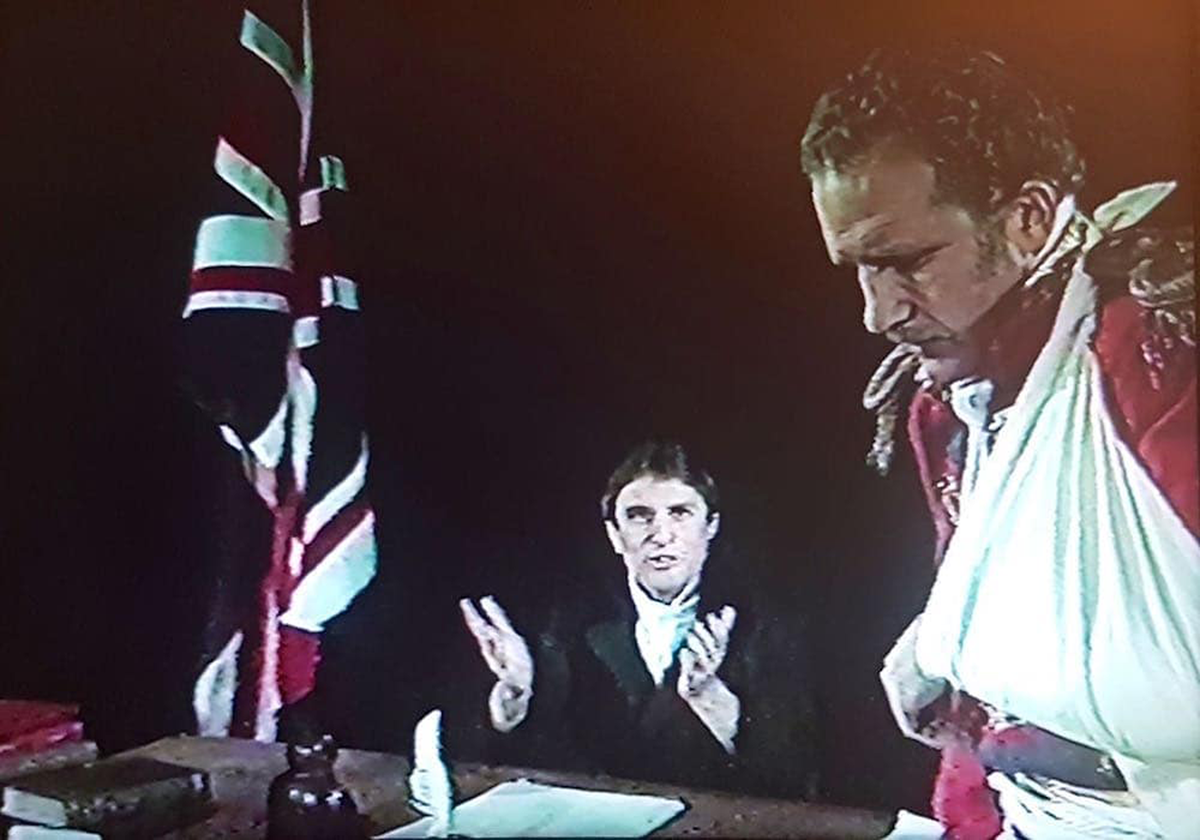
An Eclipse Leaves No Shadows first came to light as the winning script of the Ministry of Culture Playwriting Competition 1977. It was later performed as a radio play in 1979, then adapted for Singapore TV in 1988 (fig. 12). Set during Raffles’ second visit to Singapore in 1823, it shows his clash with William Farquhar, with both vying for the title of ‘founder of Singapore’. We witness the moment of Farquhar's stabbing by Syed Yasin, a merchant who has run amok, and Raffles’ shocking decision to have the assailant's corpse paraded through the streets.
An Eclipse Leaves No Shadows, by Ronald Alcantra; still from TV production by the Singapore Broadcasting Corporation and the Stage Club, 1988 (reproduced with permission from the Stage Club)

While Farquhar comes across as a capable administrator, Raffles is portrayed as a bully, a racist and a madman. He summarily imposes British laws and values on the Malay populace, shuns Farquhar due to the fact that he has married a local Eurasian and is rendered nearly senseless by recurring headaches. In the final scene, we witness his dismissal of Farquhar from his position as Resident, while the two consider their future legacies:
RAFFLES: Though our aims may seem insignificant now perhaps they may some day herald the beginning of a nation from the very swamps from which we have built them ….
FARQUHAR: Of course, your prophecy would preclude me and no doubt expunge my name from the pages of Singapore's history.
RAFFLES: Good heavens, no! Being caught in events one does not dictate them. One merely plays a role and hopes the historians will be kind.
FARQUHAR: I do not foresee any kindly historian.Footnote 41
The curtain then falls on Farquhar, eclipsed by the shadow of Raffles’ future statue, yet furiously vowing to rise from the ashes of obscurity. And indeed, this promise would be fulfilled by later artworks which acknowledged and highlighted Farquhar's contributions.
In 1996, Roger Jenkins published From the Belly of the Carp, a series of poetic monologues delivered by diverse figures from Singapore's history.Footnote 42 In ‘Colonel William Farquhar’, we see Farquhar beholding Raffles’ statue, mocking the man's imperiousness and defending his own legacy. In spite of his role as a British colonial administrator, he identifies himself with an ‘army of others’, the Asian immigrant labourers whose descendants would become Singapore's citizens.
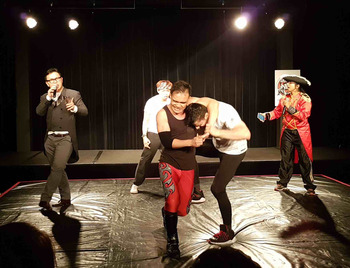
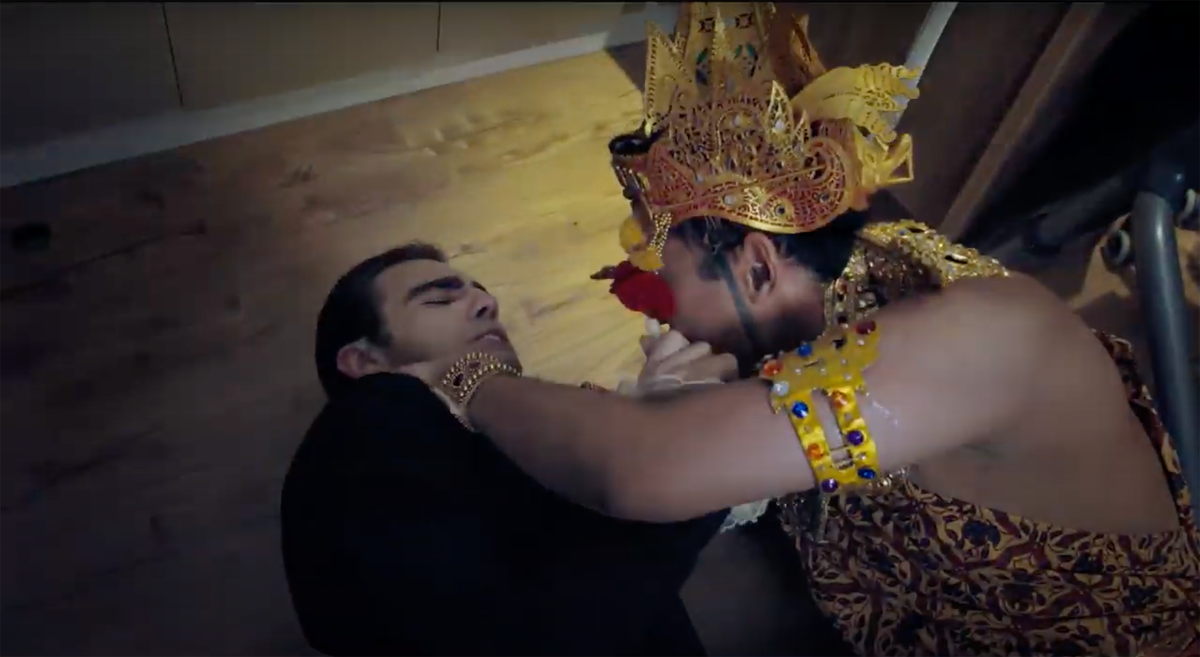
More recently, Farquhar's and Raffles’ battle of words has transformed to one involving actual body blows. In 2017, the two were featured in The Sing Lit Body Slam (fig. 13), the world's first poetry recital-cum-wrestling match, co-organised by Sing Lit Station and Grapple MAX Dojo. Each founder was portrayed simultaneously by a poet and a wrestler, trading insults and chokeholds while a beer-sodden audience cheered them on. In the over-the-top tradition of pro wrestling, Farquhar is characterised as a noble, heroic administrator, while Raffles comes across as an irresponsible boss and a cowardly fighter, fleeing from grapples to go on vacation to Bali.
Sing Lit Body Slam, 2017: Farquhar (wrestler Greg Glorious and poet Rajita Ray) places Raffles (wrestler Jeff Ederer and poet Joshua Ip) in a headlock (photo by the author)

These works praise Farquhar as a man of the people, with a far closer connection to the land than the high-handed Raffles. Both Eclipse and Sing Lit Body Slam make much of the fact that he wears a sarong and is married to a Eurasian wife from Melaka — aspects of his life which elicit racist gossip from Raffles and the other colonists. Curiously, the authors place little blame on Farquhar for his role in furthering British imperialism. Compared to the much-lauded Raffles, he is quite evidently seen as the lesser of two evils.
Sang Nila Utama
Besides Farquhar, there is another major contender for the title of Singapore's founder: Sang Nila Utama, the Sumatran prince who named and settled this island in 1299. We see the fact referenced in the opening rap of Dick Lee's pop song ‘Rasa Sayang’, a 1989 remix of a Malay folksong of the same title:
Though Raffles is affectionately praised, his status is downgraded to barely more than a footnote in our national history. Lee instead draws a direct line of connection between precolonial to postcolonial Singapore: the same lion Nila Utama beholds in the late thirteenth century makes his home in the Singapore Zoo, which opened only in 1973.
Video still from Utama: Every Name in History is I, by Ho Tzu Nyen (courtesy of the artist Zulkifle Mahmod, who plays Nila Utama, and briefly plays the role of Raffles)

Video still from Raffles vs. Utama: Dawn of Singapore, film by Marcus Goh, 2018 (courtesy of the artist)Footnote 46

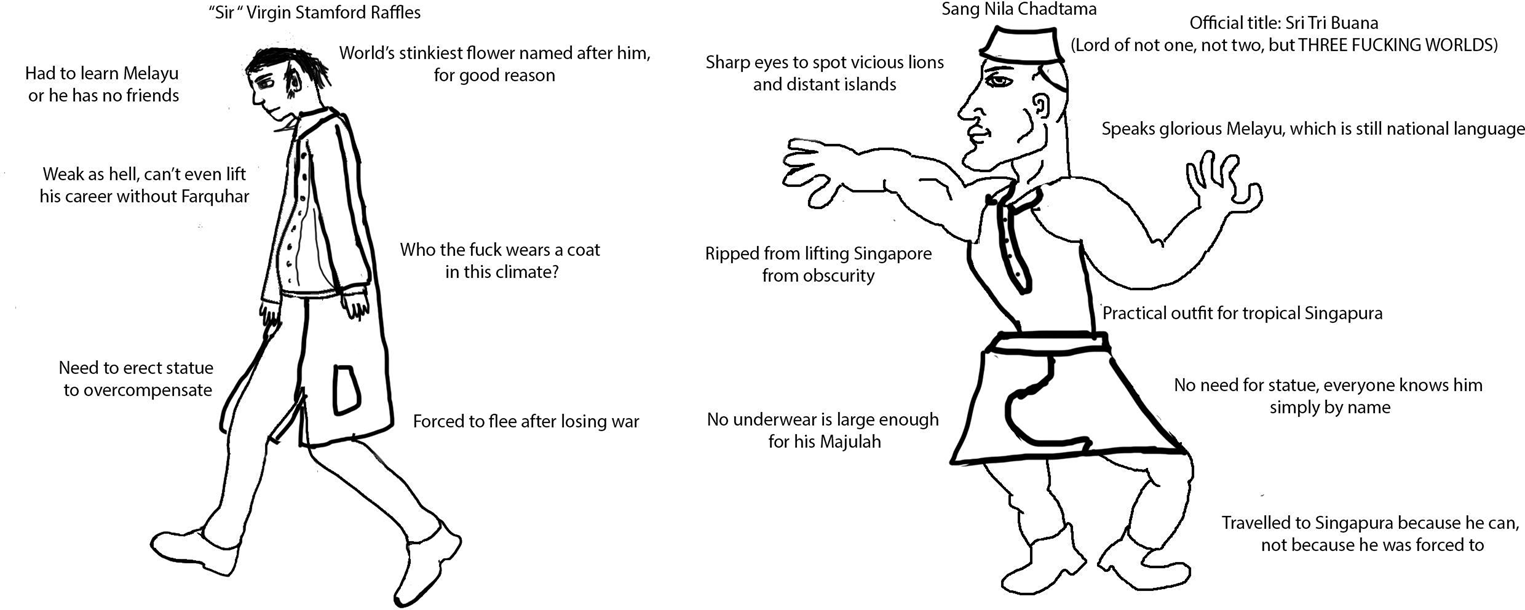
Commander Comparison, viral comic by Louis Png, 2018 (courtesy of the artist)Footnote 47

Untitled animated gif, by Benjamin Chee, 2018 (courtesy of the artist)Footnote 50

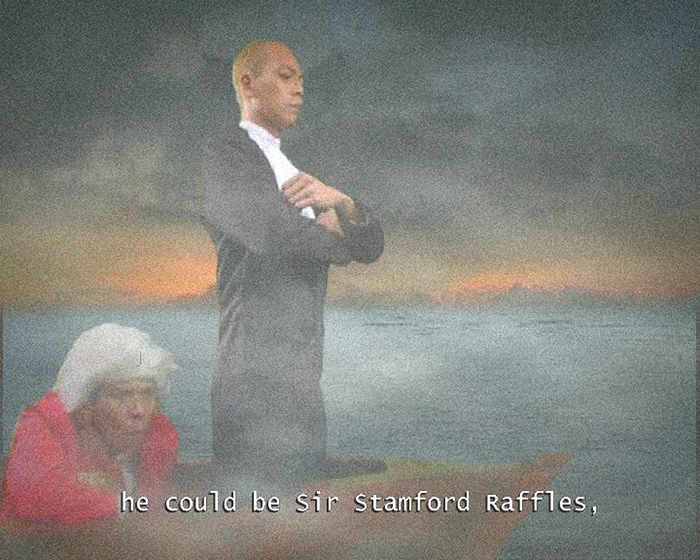
Raffles plays a similarly diminished role in Daren Shiau's 1999 novel Heartland. Interspersed amidst the contemporary narrative are six chapters on Singaporean history: five of these focus on the royal line of Sang Nila Utama and the Malay rulers of Singapore, beginning with Alexander the Great, while only one dwells on the actions of Raffles.Footnote 45 Likewise, Ho Tzu Nyen's 2003 video installation Utama: Every Name in History is I (fig. 14) presents Raffles as a mere echo of Nila Utama, whose very name denotes his status as the first to discover the land.
Lately, artists have placed Raffles and Utama in direct confrontation. Marcus Goh's 2017 short film Raffles v. Utama: Dawn of Singapore shows the spirits of the two founders wrestling over their legacy during the Festival of Hungry Ghosts (fig. 15). Louis Png's 2018 viral online comic Commander Comparison even judges the two based on perceived sexual attractiveness, sneering that Raffles ‘Need[s] to erect statue to overcompensate’ (fig. 16). Yet the two are not always adversaries: Benjamin Chee's 2018 animated gif shows an imaginary video game in which the two are allied, fighting off Javanese and Dutch invaders together (fig. 17).Footnote 48
There is a tinge of anti-colonial sentiment to some of these works: Heartland, for instance, reveals the degradation of Malay sovereignty when it notes that the hereditary Sultan of Singapore has been reduced to working as a taxi driver.Footnote 49 However, once again, the artists do not explicitly decry British domination. In fact, they arguably normalise it, presenting colonial Singapore as a successor state to Singapura, and Raffles as Sang Nila Utama's less glorious heir.
Lee Kuan Yew
But, what of the man who might be called the founder of independent Singapore: Lee Kuan Yew? Given his role as leader of the nationalist movement against British colonial rule, it would not be unreasonable to portray him at odds with Raffles. However, I have found no artworks that envisage them as foes; instead, the two men are pictured more as one another's doubles.
This is all but spelt out in Robert Yeo's 1992 play The Eye of History. Footnote 51 Its first act features three Singaporean workers of different races installing Raffles’ polymarble statue. The following exchange takes place:
CHINESE: Oh, this is the statue of Raffles ah?
INDIAN: You mean you donno?
CHINESE: No, I think—
INDIAN: You think what?
CHINESE: I think statue of Lee Kuan Yew.
INDIAN: Joker you.Footnote 52
The second and third acts, set in 1981, show Raffles paying a visit to Lee at the Istana. In spite of Lee's famously irascible personality, he adopts a largely submissive attitude towards his guest, offering him wine and agreeing to consider making Raffles’ birthday, 5 July, a national holiday. Raffles himself, too, seems comfortable in Lee's Singapore: though he complains about a dearth of architectural conservation, he wears batik, goes shopping at Metro and Isetan, and praises Lee as ‘a leader who takes a long and enlightened view of history’.Footnote 53 History itself comes up for debate: Munsyi Abdullah and his translator A.H. Hill make appearances, with the former informing Lee that ‘there are very few statues of the great men who have contributed to the making of Singapore’ besides Raffles,Footnote 54 and the latter correcting Abdullah's errors in the Hikayat Abdullah. Yet there are no acrimonious clashes. Raffles and Lee are kindred spirits.
The idea is taken one step further in XPOWERMENT!, a satirical 2014 performance staged by the spoken word troupe Sekaliwags. Part of the piece is a mock National Education sketch, in which the audience is taken back in time to the year 1819. This, we are told, is the year Sang Nila Utama arrived in Singapore. The shipwrecked prince meets a nameless white knight mounted on a tiger, slaying Japanese soldiers and drug addicts: a seamless amalgam of both Raffles and Lee. The following conversation ensues:
And the knight raised his sword pressing coincidentally close to Sang Nila's pulmonary vein and hissed,
Would you say it was a PRAGMATIC DECISION TO STAY HERE IN THIS LOVELY VILLAGE?
Sang Nila Utama said,
uhh … yes?
And the knight cried out,
A FELLOW FOLLOWER OF PRAGMATISM! You can be our island's first national hero. So it won't look like I get all the credit! You and me Sang Ni —
— actually it's ‘Utama’ —
With the golden rule of pragmatism,
We'll build a nation, so strong and free ….
TOGETHER.Footnote 55
Thus, Utama and Raffles are co-opted into a narrative sanctioned by Singapore's post-independence regime. Artists may interrogate history, proposing alternative founders of the land, yet these heroes are all too easily absorbed into hegemonic discourse. To praise Farquhar or Nila Utama is no revolt: it is simply homage to another great man of history.
V
Surveying these artistic depictions of 1819, one is struck by how few explicitly condemn colonialism. Critiques of Raffles are common; denunciations of the entire British colonial project are not.
Nevertheless, works in this vein exist, especially in the field of Malay literature. Perhaps the most fascinating is Suratman Markasan's ‘Balada Seorang Lelaki di depan Patung Raffles’ (The Ballad of a Man before the Statue of Raffles), composed in 1979 and published in a newspaper in 1980.Footnote 56 This five-part narrative poem follows a madman over five days as he hurls invective at the Raffles statue, blaming it for his misfortunes, as onlookers chuckle and a police sergeant monitors him suspiciously.
Though the poem draws heavily on colonial history, its setting is thoroughly contemporary: ‘Stop at Two’ campaign posters hang in the background as the madman threatens Raffles with punitive actions from the United Nations and Ayatollah Khomeini. Its most ingenious moment comes at its close, when the madman, dressed in white for Friday, decides to stop hating Raffles and begins to hug and kiss the statue, to the sergeant's alarm — a parodic imitation of the white-clad People's Action Party's reverence for Raffles.
Suratman hints that Singapore's post-independence government is continuing the work of colonialism: that ‘Raffles, Farquhar, Crawfurd, Walter Raleigh/and the current world leaders and statesmen/are no different’.Footnote 58 Yet he is guarded in his accusations, putting these words in the mouth of a lunatic, who has the moral licence to say the unsayable.
Folk singer and songwriter Art Fazil has no such qualms.Footnote 59 In 1993, he released the Malay language song ‘1819’ as part of his album Rausyanfikir II. In the song's early verses, he admonishes those who ceded the island to the British: Sultan Hussein and Temenggong Abdul Rahman. In later verses, he directs his anger at those whom he feels have perpetuated Malay oppression: the descendants of Chinese immigrants, as well as the post-independence government, which decimated Malay communities by bulldozing kampungs:
The poet Mohamed Latiff Mohamed is just as bitter in his 2007 publication Bila Rama-Rama Patah Sayapnya (When a Butterfly Broke its Wing). In his poem ‘Raffles’, he pictures the arrival of the acquisitive colonist, driven by the desire for ‘a utopia/to be owned/to be possessed’.Footnote 61 His real scorn, however, is not for the colonist but for the colonised: the Malays who welcome Raffles with kompang (Malay hand drums), revealing that ‘this place he landed in/was full of fools nary of dignity’. He returns to this theme in ‘Dalam Bahtera yang Berbeza’ (In Different Vessels), where he warns a young man to turn away from liberal philosophy, citing ‘the eclipse of Temasik at Raffles’ whim’ as proof that all Western influence is toxic.Footnote 62
The world of Malay letters also gives us the only Singaporean novel to date that chronicles the early colonial era. Isa Kamari's 2011 Malay novel Duka Tuan Bertakhta (His Majesty's Sorrow), translated as 1819, has a narrative spanning from 1819 to 1866, and portrays the British as almost cartoonishly evil: Raffles’ membership in the Freemasons is depicted as participation in a cult,Footnote 63 and Governor of the Straits Settlements George Bonham deliberately demolishes the Singapore Stone to erase Malay history. The Malay court is shown as morally bankrupt, led by the opium-addicted Sultan Hussein and covertly manipulated by the half-Indian spy Abdul Kadir, who also conducts an affair with the royal consort Tengku Perabu. Nor is there a credible resistance: the silat master Wak Cantuk initially plans a rebellion, but ultimately runs amok and murders the woman he loves. The moral centres of the story are comparatively powerless figures: the scribe Munsyi Abdullah and the holy man Habib Nuh.
One cannot ignore the conservative streak that runs through all these works: in rejecting colonialism, the writers not only glorify Malay heritage and Islam, they also cast aspersions on Western liberalism and non-Malays. There are, however, gentler anti-colonial voices. Alfian Sa'at's 2009 English poem ‘A Diorama’Footnote 65 and Wong Yoon Wah's 2014 Chinese poem ‘重返新加坡河’ (Return to Singapore River) both portray the moment of the 1819 treaty with its tensions and imbalances of power, but contain only hints at the innate violence of the event: Wong, for instance, describes how ‘rifle-wielding soldiers stand outside’, how as ‘Major Farquhar's dog lets out a yap/a crocodile drags it into the waters and swallows it whole’.Footnote 66
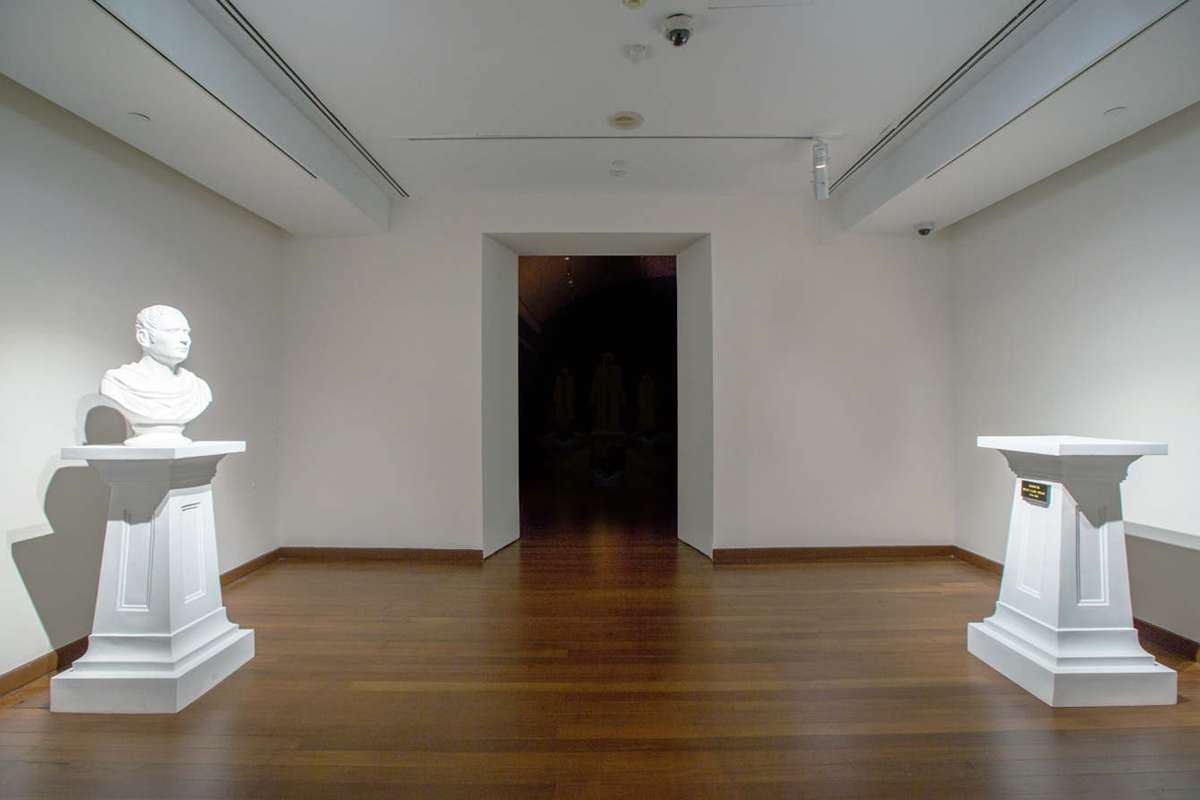
In the realm of visual art, we see similar subtlety in Fyerool Darma's 2016 installation work, The Most Mild-Mannered Men (fig. 18). Two plinths face one another, one bearing a slightly fattened bust of Raffles, the other simply a plaque reading the name of the Sultan: ‘Hussein Mu'azzam Shah, 1776–1835’. This is not a celebration of a native hero: it is a monument to one of history's great losers, a man whose face cannot even be found in our archives.
The Most Mild Mannered Men, installation by Fyerool Darma, 2016 (courtesy of the artist)Footnote 64

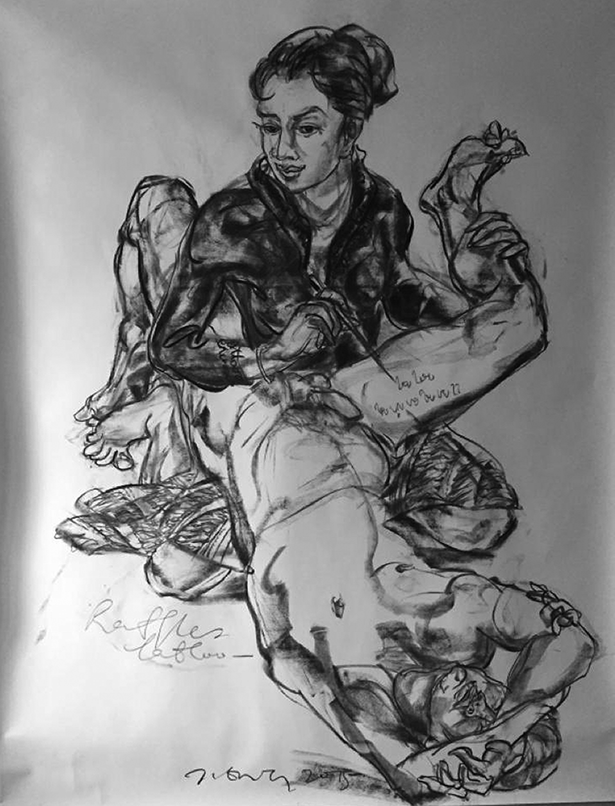
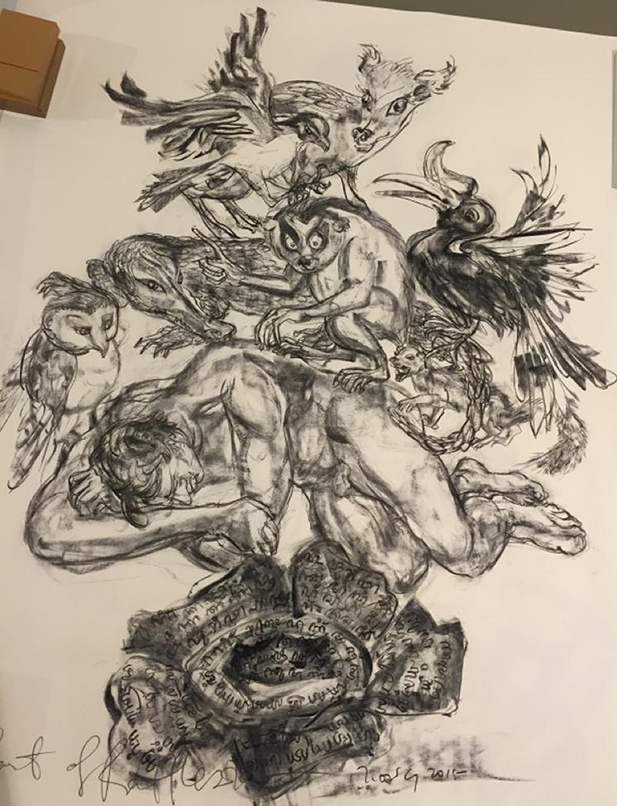
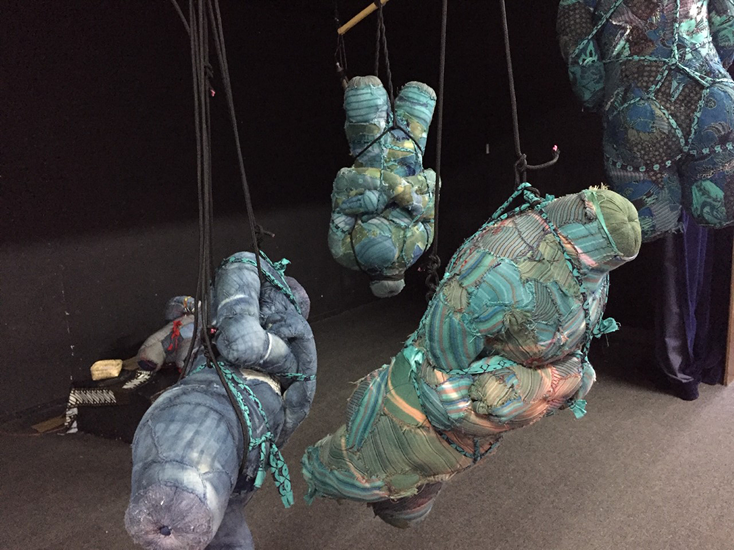
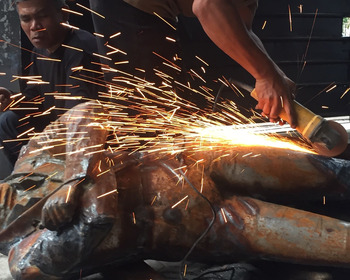
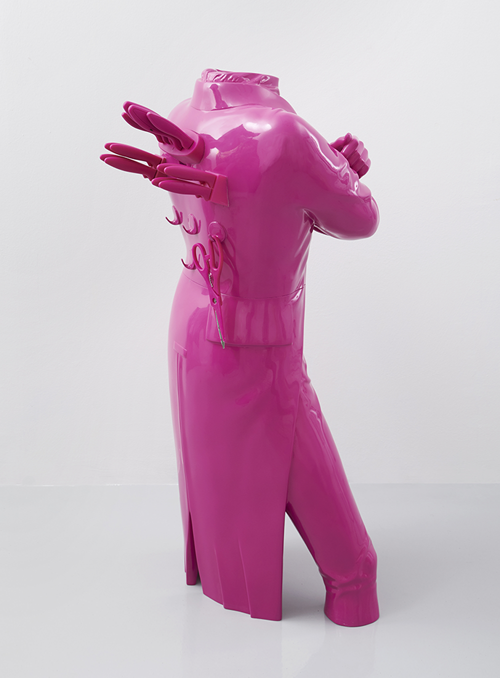
Jimmy Ong, on the other hand, combines anti-colonial rage with a touch of camp humour. In 2015, he began creating a series of charcoal drawings depicting Raffles atoning for the sins of colonialism: in Raffles Tattoo (fig. 19), he is stripped naked and tattooed by a Javanese woman; in Scent of Rafflesia (fig. 20), he is chastised by indigenous animals he catalogued. In 2016, Ong extended this project into the realm of sculpture, employing Indonesian seamstresses to sadistically pierce headless, legless Raffles mannequins with needles as they covered them with fabric, then suspending them from ropes in an installation in a work, Seamstresses’ Raffleses (fig. 21). In 2018, he presented Open Love Letters, a performance installation in which he had a Raffles statue sawn in half, later using it as a charcoal grill to make biscuits (fig. 22). In 2019, he began manufacturing utilitarian furnishings in the shape of Raffles, including a knife rack titled Raffuse Bins/Knives Block (fig. 23).
Raffles Tattoo, by Jimmy Ong, 2015 (courtesy of the artist)

Scent of Rafflesia, by Jimmy Ong, 2015 (courtesy of the artist)

Seamstresses’ Raffleses, by Jimmy Ong and collaborators, created 2016, on display 2018 (courtesy of the artist)

Sawing open a Raffles statue for Open Love Letters, by Jimmy Ong, 2018 (courtesy of the artist)

Raffuse Bins/Knives Block, by Jimmy Ong, 2019 (photo by Teck Lim, reproduced courtesy of the artist)

Yet all this sadism comes with pathos. As a Singaporean artist based in the rapidly gentrifying city of Yogyakarta, Ong realises that he, too, could be charged with colonisation. ‘Raffles [is] also an avatar for me,’ he admits. ‘I'm like the new colonialist, western educated, richer than most artists here.’Footnote 67
Perhaps Singaporean artists could do more to highlight the abuses of British colonialism. A stellar example of such an effort is Alfian Sa'at and Neo Hai Bin's 2019 documentary theatre production Merdeka / 獨立 / சுதநததிரம், created in response to controversies over the Singapore Bicentennial (fig. 24). The piece exposes Raffles’ cruelty as a conqueror of Java, a duplicitous negotiator with Sultan Hussein and a draconian administrator in his punishment of Syed Yasin. However, creating such work can involve a violent process of self-interrogation, as was made evident in Civilised, a 2019 play by Haresh Sharma (fig. 25).Footnote 68 This work features Raffles, his wife Sophia, Farquhar and Sultan Hussein gathering at a Bicentennial Ball, setting aside their disagreements to punish one of their subjects, a boy named Nadim,Footnote 69 when he speaks up against them. Yet this is only one scene of a much longer play that rages against a global history of colonisation, from Columbus’ enslavement of Native Americans to contemporary China's persecution of Uighurs and annexation of Pacific islands. The actors routinely break the fourth wall, attempting to decolonise the play by reverting to indigenous languages such as Malay, only to find themselves faced with existential contradictions. How can they claim to have escaped the imperial legacy, when one of their primary sources for anti-colonial discourse is a British newspaper, The Guardian?
Merdeka / 獨立 / சுதநததிரம், by Alfian Sa'at and Neo Hai Bin, 2019 (courtesy of Wild Rice)

Civilised, by Haresh Sharma, 2019 (photo by Tucky's Photography, reproduced courtesy of The Necesssary Stage)

Singaporean artists cannot avoid the fact that we are products, and in many cases beneficiaries of British colonisation. To attack the entire colonial legacy is thus, in a sense, to attack ourselves. This may be a more painful project than most artists are willing to embrace.
VI
By now, it must be clear that not all subversions of Raffles are critiques of colonialism. Many are simply carnivalesque satires of society, with him as a convenient symbol of the elite. For instance, since the mid-1980s, Raffles Institution students have been mocked by rival schools, particularly Anglo-Chinese School, through a parody of their school anthem, ‘Auspicium Melioris Aevi’.Footnote 70 They picture the founder, not as a hero, but a clumsy oaf:
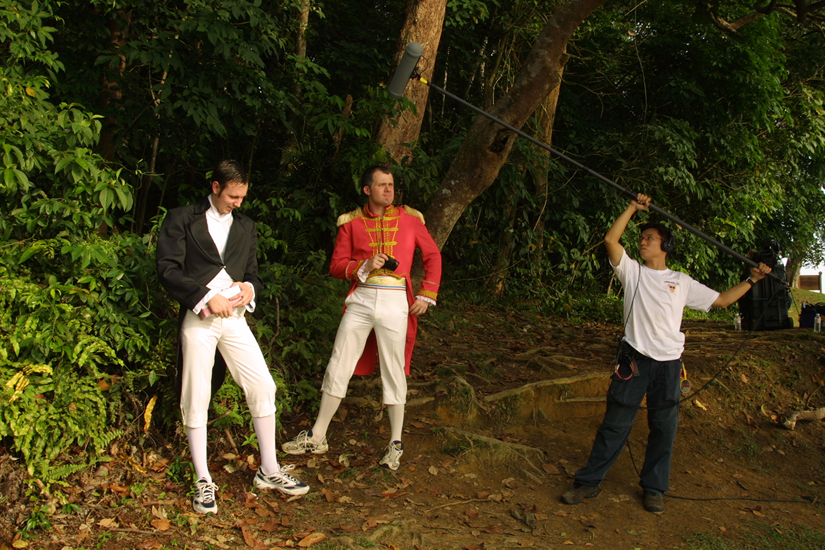
Raffles is just as buffoonish in Colin Goh and Woo Yen Yen's 2002 comedy film Talking Cock: The Movie (fig. 26) — his only portrayal on the silver screen to date. He names Singapore through a foolish misunderstanding, after he hears a Malay woman scream ‘Singh kapuk!’ (The Sikh man has stolen something!), and envisions a future mental institution bearing his name: Raffles Institution. Even the Singapore Tourism Board has begun to present him irreverently: its 2017 advertising campaign Let the Stars Guide You depicts him as a tourist, searching out Singapore's best holiday experiences.Footnote 71
Behind the scenes photo from Talking Cock: The Movie, by Colin Goh & Woo Yen Yen, 2002 (courtesy of Colin Goh)

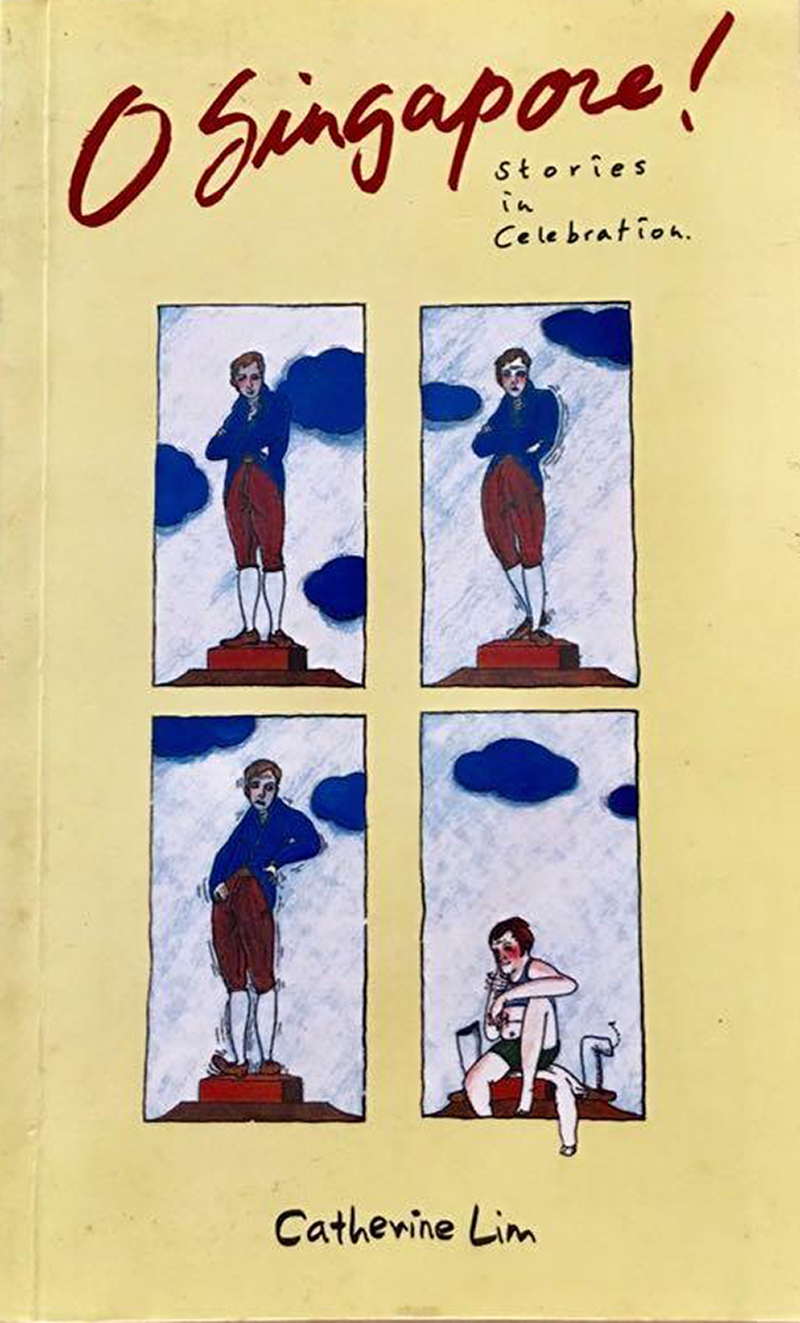
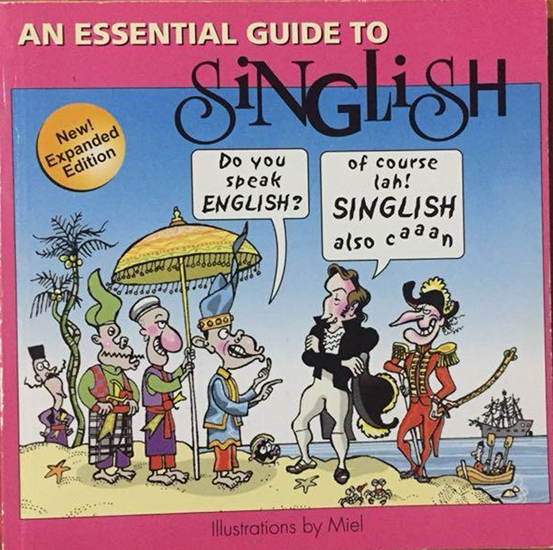
However, there is a nationalistic edge to some such renditions: they render Raffles more Singaporean than British. Shirley Eu's illustration for the cover of Catherine Lim's 1989 publication O Singapore! pictures him tiring of his lofty pose, stripping down to a singlet and picking his nose, seated with one leg raised in a posture once associated with trishaw riders (fig. 27). Prudencio Miel's 2003 illustration for An Essential Guide to Singlish has him speaking Singlish (fig. 28).
Cover illustration for Catherine Lim, O Singapore! drawn by Shirley Eu (Singapore: Times Books International, 1989)

Cover illustration for An Essential Guide to Singlish, drawn by Prudencio Miel (Singapore: Gartbooks, 2003)

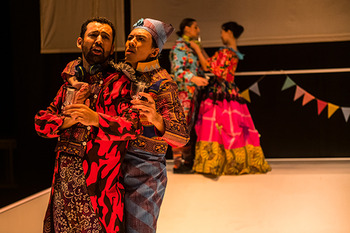
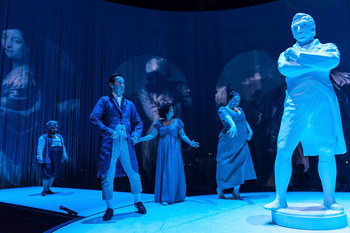
In a sense, the figure of Raffles is becoming decolonised. One sign of this is the fact that he is increasingly portrayed by Asian actors, as in the case of my play The Last Temptation of Stamford Raffles, the Sekaliwags’ XPOWERMENT!, Sing Lit Body Slam and Civilised. Brian Gothong Tan's 2016 multimedia performance Tropical Traumas (fig. 29) plays an especially complex game of racial identity: a Mexican man in a turban and baju and a Chinese man in Regency attire both play Raffles, suggesting a conflation of multiple eras of Singaporean history: the Malay Sultanate, British colonialism, post-independence Chinese majority rule and the twenty-first century wave of globalised immigration.
Tropical Traumas, multimedia performance by Brian Gothong Tan, 2016. Raffles is played by Felipe Cervera and Koh Boon Pin (two men on the right); his wife Sophia is played by Karen Tan and Edith Podesta (two women in the centre). Photo by the author.

Untitled (Raffles), part of Artists Investigating Monuments (A.I.M.) by Lee Wen, 2000 (courtesy of Satoko Lee)Footnote 73

Foreign Talent, by Vertical Submarine, 2007 (courtesy of Vertical Submarine: Justin Loke and Joshua Yang)Footnote 78

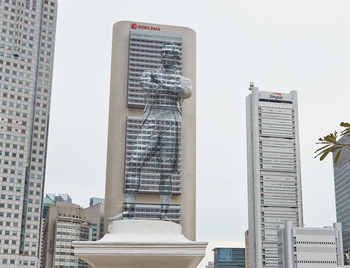
Raffles’ “Disappearance”, by Mr Teng Kai Wei, in partnership with the Singapore Bicentennial Office, 2019 (courtesy of the Singapore Bicentennial Office)

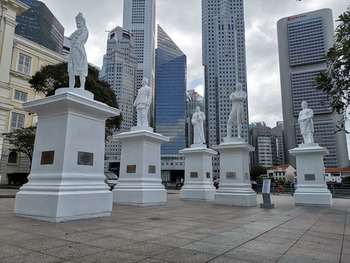
The Arrivals, by Hong Hai Environmental Art, commissioned by the Singapore Bicentennial Office, 2019 (courtesy of the Singapore Bicentennial Office)

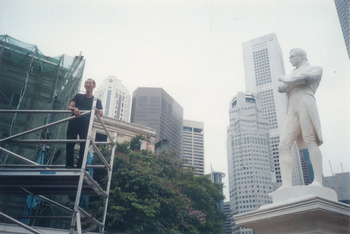
Conversely, visual artists have repeatedly striven to raise the common man to match Raffles’ stature. In 2000 conceptual artist Lee Wen was the first to do this, literally, with Untitled (Raffles), building a scaffolding on the Raffles Landing Site so that ordinary people could observe the Raffles statue at eye level (fig. 30). Vertical Submarine followed suit in 2007 with Foreign Talent: a statue of a contemporary construction worker, facing the Raffles statue, positing that the exploited migrant workers of today are just as fundamental to Singapore's development as any colonist (fig. 31). In 2017, the history-themed social media group 1819 went so far as to propose a tongue-in-cheek online campaign titled ‘Screw Raffles, let's replace his statue with a samsui woman one’.Footnote 72 The Singapore Bicentennial almost made this proposal a reality: on 2 January 2019, they papered over the Raffles statue so that it would appear invisible from certain angles in an installation titled Raffles’ “Disappearance” (fig. 32). Two days later, they replaced this with The Arrivals, which consisted of the addition of four more statues to accompany the colonist: not only our precolonial founder Sang Nila Utama, but also the author Munsyi Abdullah and the merchants Tan Tock Seng and Naraina Pillai (fig. 33).
Writers, too, are narrating early colonialism not only from the perspectives of colonists, but through the eyes of commoners. One early instance of this is Charles Mandel's 1998 horror thriller Days of Sir Raffles, which imagines Raffles awakening an ancient curse when he steals an ancient mask from a shrine in Fort Canning. Despite the title and premise, the story's true protagonists are Raffles’ assistants: a Chinese cook named Cheah Koo and an Orang Laut named Wa Hakim, and their descendants who seek to lift the curse in the twentieth century.Footnote 74
This pattern of de-centring has become almost de rigeur in the 2010s. Lesley-Anne and Monica Lim's 2014 children's book, Danger Dan Spooks the Peculiar Peranakan Pirate, has its protagonists time travelling to Singapore in 1819, but they spend their time not with colonists, but among Chinese pirates.Footnote 75 Theophilus Kwek's 2016 poem ‘Farquhar’ highlights the Resident's role in commissioning natural history paintings, but concludes with the voices of the unnamed Chinese painters who created these works.Footnote 76 John D. Greenwood's 2017 historical novel Singapore Saga, Vol 1: Forbidden Hill also focuses on multiple perspectives in its narrative of Singapore's colonisation: not only British settlers, but indigenous residents and Asian immigrants, such as the fisherman Badang bin Aman, the boatmaker Musa bin Hassan, the brickmaker Arjun Nath, and the merchant Tang Che Sang.Footnote 77
Munsyi Abdullah is a particularly resonant figure for writers, as we have seen from his appearances in Robert Yeo's The Eye of History, where he is Raffles’ slavish devotee; and Isa Kamari's Duka Tuan Bertakhta, where he acts as the troubled conscience of the Malay race. He appears again in the works of Ng Kim Chew, a Malaysian author who writes in Mandarin. In the 1996 short story ‘阿拉的旨意’ (Allah's Will), a Chinese Communist is mysteriously reborn in pre-colonial times and takes on Abdullah's persona;Footnote 79 in the 2002 story ‘我的朋友雅度啦’ (My Friend, Abdullah), a Chinese businessman converts to Islam for financial benefit, yet is ultimately possessed by Abdullah's spirit while in a Confucian temple.Footnote 80 Caught between cultures and systems of power, Abdullah thus becomes an apt icon for postcolonial bewilderment.
However, Abdullah takes on a very different role in History, Whose Story?, a short play created by Haresh Sharma for school performances in 2000. We witness a series of rapid-fire historical vignettes: Sang Nila Utama arrives on the island, Parameswara murders his host, Hang Tuah slays his friend Hang Jebat, then Raffles appears, puffed up with self-importance.
Hello people of Sing-ga-pur-ra. I am Sir Thomas Stamford Bingley Raffles, and I speak very good English because I'm from England. Have you been to England? Have you heard of Shakespeare?
[in Malay] He say what.
[in Malay] I also donno.
They speak a funny language. I must learn that funny language. Yes, I must.Footnote 81
Abdullah is introduced not as Raffles’ employee, but as his language teacher and friend. As the two bid farewell at the play's end, it is clear that the two are equals, and that the cycle of feudal violence is ended.
Abdullah is thus portrayed as Raffles’ redeemer: the man who civilised the conqueror. This is a distortion of history, certainly. But, as the play reminds us, ‘history is about stories’:Footnote 83 its accounts are endlessly debatable, and each one version varies according to whose story is being told. In the face of such subjectivity, why not embrace a retelling that empowers the colonised over the colonist?
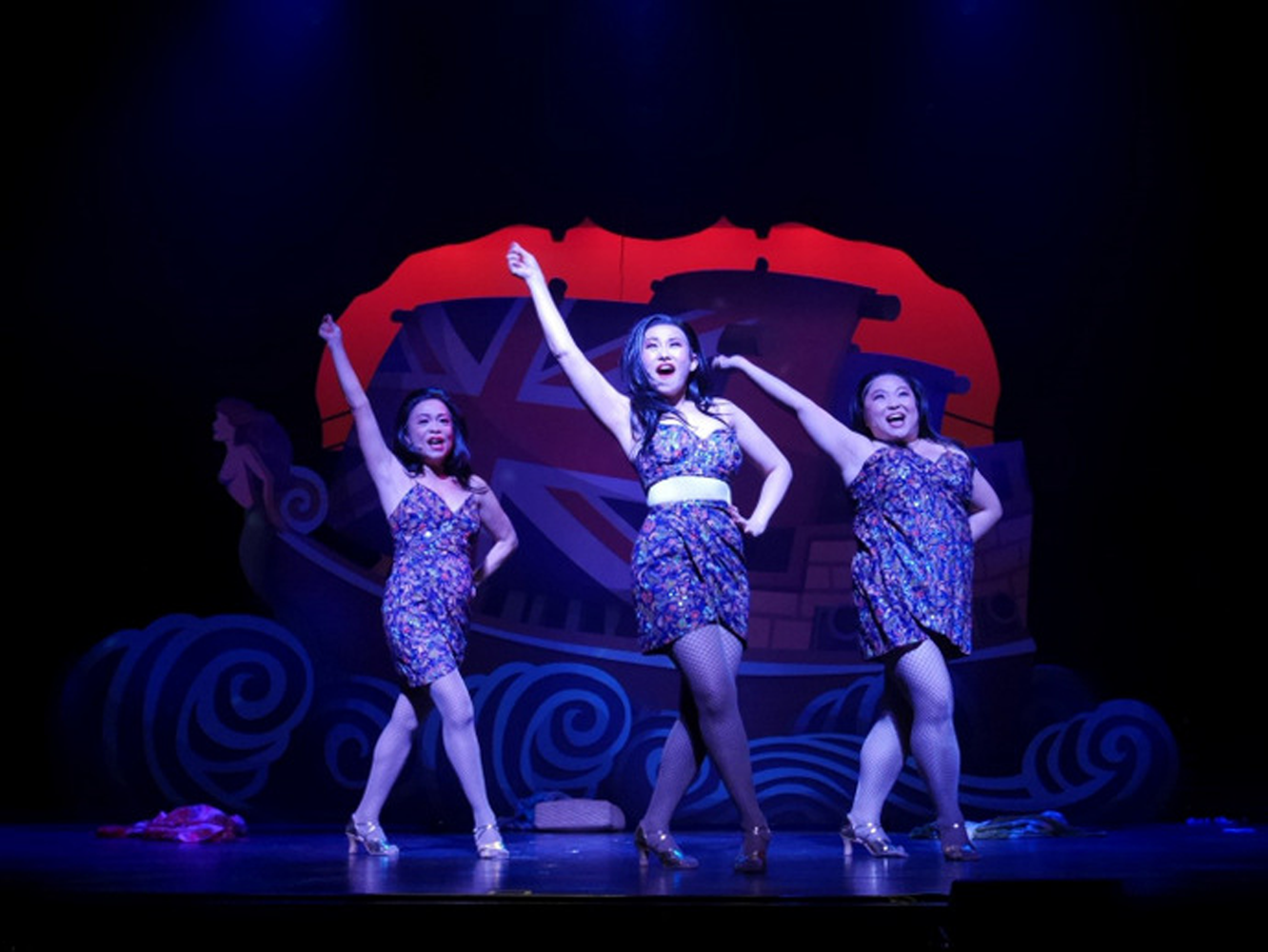
Selena Tan's ‘Be My Ang Moh’, a song and sketch from The Dim Sum Dollies’ History of Singapore Part 1, first performed in 2007, reprised 2015.Footnote 85

Still from Sophia, video installation by Loo Zihan, 2007 (courtesy of the artist)Footnote 86

Farquhar and Nonio Clement in Singapore, by Haresh Sharma, 2011 (courtesy of The Necessary Stage)Footnote 87

Naturally, this fascination with the common man has also led to artworks dwelling on the common woman. Selena Tan delivers a particularly innovative send-up of colonisation in her 2007 comedy revue, The History of Singapore, performed by her three-woman troupe The Dim Sum Dollies. In her portrayal of 1819, three women observe Raffles at a distance, tittering over the handsomeness of white men. They then don sarongs, becoming Singapore's first Sarong Party Girls, and sing a ditty titled ‘Be My Ang Moh’ (fig. 34). This is subversion of colonial rhetoric which describes invaders arriving on ‘virgin’ land, to ‘rape’ an indigenous culture. In Tan's retelling, colonisation is indeed a sexualised affair, but one that involves female agency. White men are not worshipped, but objectified, as is evident when the women croon, ‘His eyes are as blue as the sea/His hair is as gold as a monkey.’Footnote 84
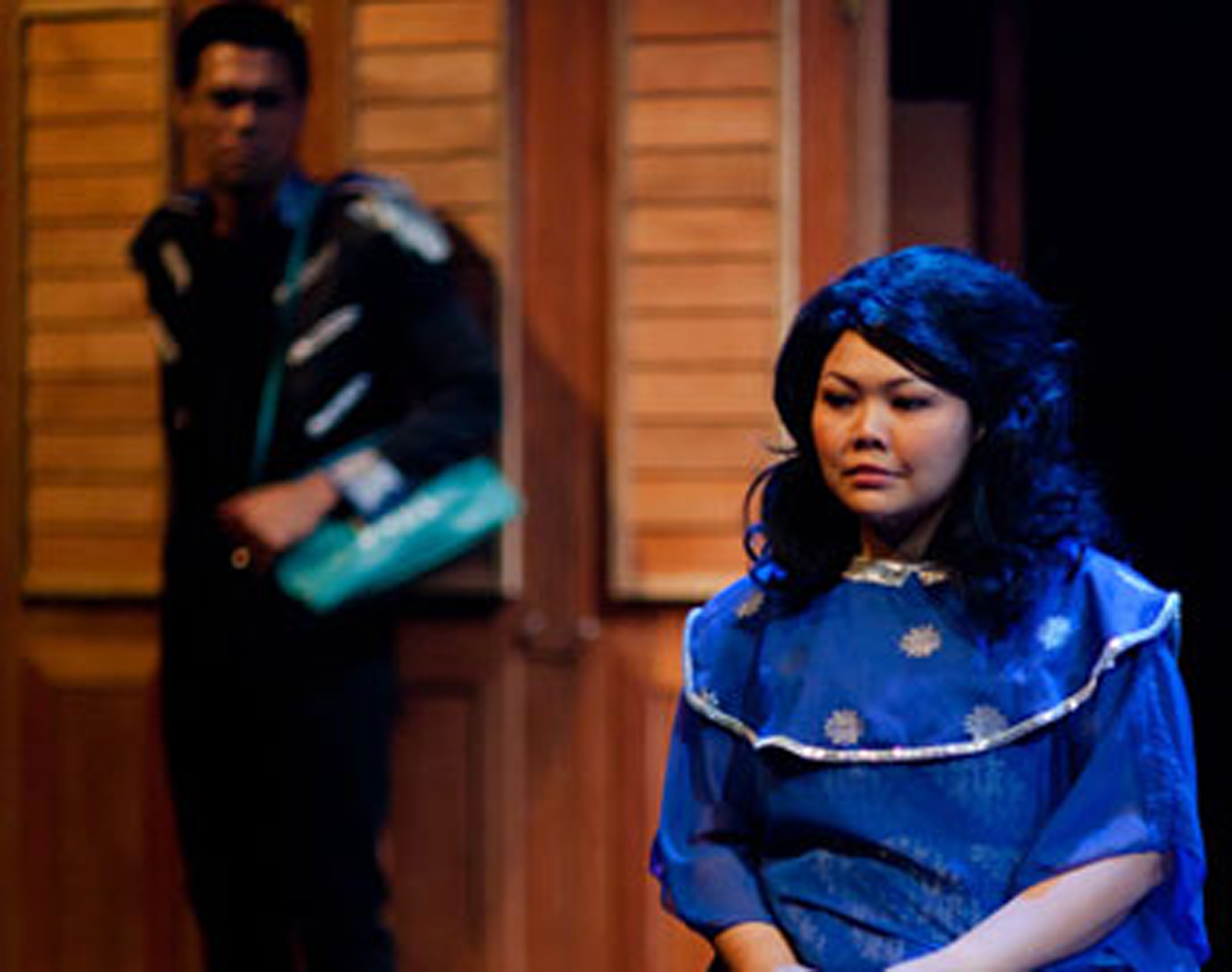
Female-centred works, however, have mainly centred on the wives of colonists. Sophia Raffles is a crucial character in the video work of Loo Zihan: in the two-channel work Sophia (2007), he shows her ritually mourning the death of her children in a jungle, while the ghostly figure of the pontianak haunts her (fig. 35); in Aemer (2010), an actress portrays her wandering across a beach, while a voiceover reads excerpts from her anthropological and personal writings, intercut with the actress’ own tales of personal trauma. Her heartbreak is similarly foregrounded in Rosie Milne's 2015 novel Olivia and Sophia, which takes the form of diary entries by Raffles’ two wives, and Theophilus Kwek's 2016 poem ‘Sophia’, which speaks of Singapore's founding in terms of longing and regret.Footnote 88
Perhaps the most comprehensive female-centred rendering of 1819, however, is Haresh Sharma's 2011 play Singapore. Again, this play contains a number of historical vignettes, yet Sang Nila Utama and Raffles are absent from the cast list. Instead, our precolonial founder and occasional narrator is the Chinese princess Hang Li Po, wife of Sultan Mansur Shah of Melaka and legendary ancestor of the Chinese Peranakans. When the time comes for Raffles to sign the Treaty of Singapore, Sophia appears in his stead, brusquely announcing, ‘He's on MC.’ The key colonists of the story are Farquhar and his common law Eurasian wife, Nonio Clement, who is shown helping her husband with his clumsy Malay at every step (fig. 36). We witness her anguish when he decides to return to Scotland without her, and at that moment, she too stakes a claim to her legacy.
NONIO: You may be dismissed, but you will still live in the annals of history. If you leave me, I will be obliterated. I will cease to exist.
FARQ: No. You will always be in our hearts – not just mine, but our children, and the people here.
NONIO: I don't just want to be in your heart. I was with you when Raffles handed Singapura to you. I was with you when you went out to speak to the locals. I was with you when you negotiated with the Sultan. I don't want to be in your heart. I want to be remembered, and acknowledged, alongside you, as the first lady of Singapore.Footnote 89
Even the voice of the anti-colonial resistance is feminine: an unnamed Indian widow appears to protest the signing of the treaty and goes on to join politics, founding the Women's Party, or WP. Interestingly, these characters do not remain static: in the final act, we see them play out imagined futures. Hang Li Po curses her offspring to be hybrids and bastards, then leaves the Sultan; Farquhar meets Nonio at Changi Airport in a final attempt to bring her to Scotland; Sophia becomes a human rights activist and becomes romantically linked to the Indian widow.Footnote 90
There exists one final, fascinating strategy in the decentring of Raffles from 1819: one that has little to do with the tales of men, great and small. It is the invocation of the majesty of nature, compared to which all human endeavours are nothing. This is best illustrated in Kent Chan's 2014 video work To the Eastwards, which pictures Raffles awaking in a jungle, eventually joining Farquhar, Sultan Hussein and his subjects in a tableau of the signing of the Treaty of Singapore (fig. 37). None of the three men is portrayed as nobler than the other. All are equally diminished by the wilderness that surrounds them, and which continues to exist to this day. The work hints that our obsession with history is petty. Nature is vast and eternal, and recognises no governments. From the perspective of the rainforest, Singapore was never founded, and never will be.
Still from To the Eastward (the Lines Divide), video installation by Kent Chan, 2014.

VII
Singapore remains haunted by the spectre of colonialism. A century and a half of British rule has left us with a mainstream, state-sanctioned discourse that praises Raffles and his fellow early colonists. This has yielded a plethora of artworks by Singaporeans and foreigners that celebrate 1819 as the birth of our modern city-state, from the twin Raffles statues of Thomas Woolner and the Singapore Tourism Board to Jesudason's Raffles Institution anthem, ‘Auspicium Melioris Aevi’.
However, numerous voices have challenged this narrative. Some object to the veneration of Raffles himself, either due to his significant flaws and failures, as in the case of Alcantra in his play An Eclipse Leaves No Shadows, or because they refuse to credit the founding of Singapore to the actions of a single man, as in the case of Vertical Submarine with their installation Foreign Talent. A few have spoken out against the entire British colonial project and its legacy in post-independence Singapore: we see this especially in the Malay literary community, in works such as Suratman Markasan's poem ‘Balada Seorang Lelaki di Depan Patung Raffles’, Art Fazil's song ‘1819’ and Isa Kamari's novel Duka Tuan Bertakhta. These dissenting artists have generated work illuminating the lives of less iconic faces of the past: Sang Nila Utama, William Farquhar, Sultan Hussein, Munsyi Abdullah, Sophia Raffles, Nonio Clement, and many more.
However, there is currently little desire to completely obliterate Raffles. Instead, artists appear to prefer playful initiatives that dispel the colonial mystique that surrounds him. Witness the subversions of Lee Wen's Untitled (Raffles), Colin Goh and Woo Yen Yen's film Talking Cock: The Movie and the Dim Sum Dollies’ The History of Singapore. The object of these artists is neither to praise Raffles, nor to bury him; instead, they would have him descend from his plinth and live as our equal.
Raffles himself, as well as the year 1819, are no longer distant historical objects, but living entities, kept alive among us by their constant invocation, whether for glorification or mockery. Raffles functions as an allegory for contemporary political leadership; his rivals and subjects as representations of today's oppressed. William Faulkner's gloomy words come to mind: ‘The past is never dead. It's not even past.’Footnote 91 Yet there is a rejoinder to this, in the spirit of Singapore's subversive artists. If it isn't past, that means we have the power to change the story.