Even though endotracheal tube (ETT) size selection is often the result of clinical judgement, factors such as age, gender, height, body mass index (BMI), and anticipated bronchoscopies are often considered before insertion.Reference D’Anza, Knight and Greene1–Reference Karmakar, Pate and Solowski3 The objective of this study was to explore whether gender differences exist in ventilator-associated event (VAE) development based on larger ETT selection. The surveillance paradigms for VAEs are established by the Centers for Disease Control and Prevention.4 They denote 3 categories of increasing progression in mechanically ventilated patients from a ventilator-associated condition (VAC), to an infection-related ventilator-associated complication (IVAC), and finally to possible ventilator-associated pneumonia (PVAP). Our a priori hypothesis for this study was that an 8.0-mm ETT is associated with less risk of VAEs because a larger diameter is optimal for pulmonary hygiene.
Methods
The study was approved by our university’s biomedical institutional review board (protocol no. 200301R002). After approval, VAEs records were gathered from May 2013 to December 2017 and were collected by the infection prevention department as part of daily VAE surveillence. Using both our clinical database and retrospective chart review, we gathered specific patient characteristics, medication administration, and ventilator data. Controls consisted of patients intubated for ≥3 ventilator days and matched 1:1 based on age, gender, and unit while intubated during the hospital encounter, use of vasopressors during intubation, and total ventilator days. Patients with chronic tracheostomies were removed from the analysis.
To determine the association between ETT size and VAEs, Pearson χ2 tests were conducted, and odds ratios (ORs) with 95% confidence intervals (CIs) were reported for each gender. We conducted a post hoc analysis using a t test or the Mann-Whitney U test where appropriate. All analyses were performed using R version 3.6.1 software (R Foundation for Statistical Computing, Vienna, Austria) with an α level of 0.05.
Results
Within both the male and female populations, the results of the χ2 tests indicated a statistically significant relationship between ETT and VAE development, χ2 = 20.05 (P = .000) and χ2 = 10.17 (P = .001), respectively. Among male patients, 64 of 160 VAEs and 104 of 160 controls were intubated with 8.0-mm ETTs (OR, 0.39; 95% CI, 0.22–0.58). Conversely, among female patients, 34 of 89 VAES and 15 of 89 controls were intubated with 8.0-mm ETTs (OR, 3.03; 95% CI, 1.44–6.62). According to these preliminary results, male patients intubated with 8.0-mm ETTs were less likely to develop VAEs, and female patients intubated with the same size were at greater risk.
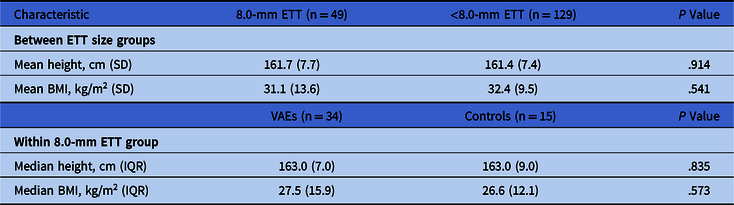
In our post hoc analysis, we did not find any widespread indications among female patients that warranted a larger ETT size, such as aggressive airway clearance, hemorrhage, or bronchiectasis. Likewise, we did not detect any statistical differences between female height and BMI between ETT size groups or within female patients intubated with 8.0-mm ETTs only (Table 1). Given the mean biometric values, we assumed that most 8.0-mm ETTs were inappropriately selected by BMI and placed in smaller airways. Also, we determined from this analysis that female patients in the VAE group were not taller, which might have justified a larger diameter ETT.
Patient Size and Endotracheal Tube (ETT) Diameter Choices in Female Patients

Note. VAE, ventilator-associated events; BMI, body mass index; SD, standard deviation; IQR, interquartile range.
Discussion
Our findings are difficult to explain, but we propose some potential mechanisms for higher rates of VAE development among female patients intubated with 8.0-mm ETTs. When endotracheal cuffs are inflated, channels are created that allow the leakage of fluids. Larger diameter tubes tend to have more longitudinal folds than smaller sized tubes,Reference Hwang, Park, Han, Park, Park and Kim5 which could increase the likelihood of microaspiration. Furthermore, larger-diameter ETTs tend to be longer (up to 2 cm) and could present problems for patients with shorter airways.Reference Coordes, Rademacher and Knopke6 For example, tubes that are inserted too distally (ie, <4 cm above the carina) and need to be repositioned multiple times may intensify the cuff folds.Reference Hamilton and Grap7 Another consideration is that malposition of the ETT, which in 1 study was more frequent in female patients,Reference Rigini, Boaz and Ezri8 might be exacerbated by movement (eg, head flexion) if not corrected and allowed to reside too close to the carina. Additionally, the suboptimal depth of the ETT may introduce a larger surface area of biofilm deeper into the patient’s airway.Reference Gacouin, Barbarot and Camus9 Lastly, carinal impingement or endobronchial migration of ETTs could lead to hypoxemia, atelectasis, bronchospasm, or barotrauma,Reference Gabrielli, Layon, Yu, Civetta, Taylor and Kirby10 which have potential to inadvertently trigger VAC criteria.
We retrospectively examined our own intubation practices by reviewing bronchoscopy and chest x-ray reports of our female patients with VAEs. From this audit, we were able to identify many instances in which the ETT was initially inserted too close to the carina and subsequently repositioned multiple times prior to the VAE. Furthermore, some radiology reports suggest that 2 cm above the carina is acceptable positioning of the ETT. In 1 instance, an ETT tip extended in the right mainstem bronchus was adjusted to only 1 cm above the carina. Although we cannot definitively attribute ETT size as the culprit in VAE development based on these findings, it does shed some light on proper sizing of ETTs based on patient characteristics and optimal positioning of the ETT tip.
This single-center retrospective study should be validated by further studies. We did not explore the intubation practices among physicians from different services, ETT brands, cuff types, or suboptimal intubation conditions. Small sample size limited our investigation of risk by VAE type; however, all patients met VAC criteria, which suggests a period of stability or improvement followed by a period of respiratory deterioration.
Acknowledgments
We gratefully acknowledge the residents, fellows, and medical students on the original project team and our infection preventionists.
Financial support
No financial support was provided relevant to this article.
Conflicts of interest
All authors report no conflicts of interest relevant to this article.