The following essay explores how Charles Dickens's approach to representing history in A Tale of Two Cities (1859), his historical novel of the French Revolution, is influenced by the Phantasmagoria and other related nineteenth-century optical technologies. The Phantasmagoria was an optical ghost show popularized in Paris in the 1790s by the Belgian physicist-turned-showman Etienne Gaspard Robertson.Footnote 1 In a darkened room, images of ghosts and other frightening creatures were projected onto a screen by a projectionist operating a hidden magic lantern. By mounting the lantern on rollers, so that it could roll toward and away from the screen, spectral forms seemed to surge into the audience. Trick slides created the visual effect of projected forms in a state of perpetual transformation. While it advertised “apparitions of Specters, Ghosts and Revenants, such as have appeared in all times, in all places and to all people,”Footnote 2 Robertson's Phantasmagoria also regularly projected images of revolutionary figures such as Danton, Marat, and Robespierre. Tom Gunning, Terry Castle, and Max Milner have read the Phantasmagoria as a drama of perception that plays out the dialectical relation between Enlightenment rationality and superstition.Footnote 3 As the choice to exhibit slides of revolutionaries makes clear, Robertson's Phantasmagoria also played out a historical drama for its audiences. Robertson exploited the affective charge of the recent history of the French Revolution to create an aura of terror. At the same time, the Phantasmagoria's rendering of this history through ghosts and optical tricks commented on the uncanny nature of historical memory and experience.
I argue that Dickens's approach to historical fiction in A Tale of Two Cities is informed by the Phantasmagoria's medium-specific effects and its association with history and historical memory. A Tale of Two Cities has never fit comfortably within the paradigm of the nineteenth-century historical novel first developed by Georg Lukács and more recently elaborated by Fredric Jameson.Footnote 4 Grounded in his reading of the novels of Walter Scott, Lukács argued that historical fiction represents mass experience through the construction of “world-historical individuals” whose character epitomizes dialectical historical situations, “render[ing] visible the generally progressive features of the whole of society, of the whole age.”Footnote 5 Although Dickens carries on the legacy of Scott's historical novels, he also breaks with it considerably in A Tale of Two Cities. While Scott relies on character as his primary representational technology for historical change, Dickens casts doubt on the stability of character altogether. Dickens also views history as inextricable from, and unable to exist without, human perception. This approach to representing history is influenced by the visual effects of the Phantasmagoria. Dickens renders historical temporality and historical character through a phenomenological model of experience that he associates with Robertson's Phantasmagoria and the dialectic of discontinuity and continuity embodied in its motion effects.
To demonstrate the influence of the Phantasmagoria on Dickens's techniques of historical fiction, I first look to Dickens's writing on the Phantasmagoria. An essay Dickens published in Household Words in 1854, entitled “Robertson, An Artist in Ghosts,” argues that Robertson's Phantasmagoria operates by exploiting the historical trauma of its audiences. Living through revolutionary history makes people see ghosts, Dickens proposes, a claim that forms the basis of Dickens's own representation of the French Revolution in A Tale of Two Cities. Second, I show how Dickens's representation of historical temporality is shaped by the Phantasmagoria's dialectical relationship between discontinuity and continuity. In two descriptions of carriage processions, a subject that was often used to allegorize historical and national procession, Dickens represents historical time as a “flow” produced by the juxtaposition of images, referencing one of the medium-specific effects of the Phantasmagoria. Third, I explore how Dickens approaches the interface between historical individuals and collective historical experience by representing the dissolution and dematerialization of character into phantasmagorical specters.
Dickens and Robertson: Artists in Ghosts
Dickens's lifelong love of stage magic, magic lanterns, and other optical entertainments influenced not only the imagistic and metaphoric registers of his novels but his formal and narrative practices. For example, Helen Groth has explored the influence of magic lantern projections on the Christmas story “The Haunted Man,” and Joss Marsh has argued that the “dissolving view,” a lantern projection technique that dissolved one image into another, both inspired Dickens's representation of the ghostly visions in A Christmas Carol (1843) and supplied a framework of visual transformation for the narrative arc of Scrooge's spiritual conversion.Footnote 6 Groth and Marsh understandably concern themselves with Dickens's ghost stories, which represent an apparitional domain with clear similarities to the supernatural imaginary of the Phantasmagoria and gothic lantern slides. However, Dickens's realist novels equally draw on the visual effects of the lantern projection to represent the conditions of reality, rather than a supernatural realm. During dusky winter afternoons, the Clennam home in Little Dorrit (1857) is filled with “shadows [like those] from a great magic lantern,” while in David Copperfield (1850) the protagonist encounters a woman he remembers only dimly, “as if I had seen her in a pale magic lantern.”Footnote 7 In Our Mutual Friend (1865), Dickens's last completed novel, the illiterate Lizzie Hexam reads “pictures in the fire” to her younger brother as they sit before the fireplace of their dark shanty.Footnote 8 Lizzie's ability to “read” the firelight evokes Victorian storytelling lantern slides, which used an oxyhydrogen lamp to tell stories in pictures made of light.
In A Tale of Two Cities, Dickens makes a historical and conceptual association between the French Revolution and the Phantasmagoria. While the novel is saturated with references to Victorian projected and moving images, among other optical illusions of light and shadow, the Phantasmagoria is the dominant media metaphor. It corresponds to the same historical moment as the French Revolution; occupies, in Tom Gunning's terms, “the threshold between Enlightenment and Terror”; and makes use of effects that conjure the experience of the Reign of Terror. Dickens saw in the Phantasmagoria a set of approaches for evoking the historical past that could be imported to and remediated by historical fiction.Footnote 9 For Dickens, who once described himself as “a resurrectionist in search of a subject,”Footnote 10 the Phantasmagoria and the historical novel were both technologies of resurrection—approaches to reanimating the past and making it experientially present for a viewing, or reading, subject. His writings on Etienne Gaspard Robertson, the Phantasmagoria's showman and entrepreneur, were published a few years before A Tale of Two Cities and show his curiosity about how the aesthetic force of the illusions—what Dickens calls Robertson's “ghosts”—came from his ability to simulate the traumatic historical memories of his audiences.
Robertson might have been described as a resurrectionist in search of a medium. A Belgian painter and physicist active in France in the late 1790s, Robertson (born Robert) conceived his gothic vision of exhibiting spectral moving images in a dark theater after the French government turned down his proposal for an Archimedean mirror that would direct sunrays onto invading ships from the British Royal Navy and burn them up on the spot. Faced with his failure to weaponize the mirror in service of fiery mass destruction, Robertson reimagined it as a tool of resurrection through his patent for an improved magic lantern he called the Fantascope. The magic lantern is a form of slide projector, first invented in the seventeenth century, capable of projecting painted images onto a wall or screen. Inside the lantern are a candle and a convex mirror; at the front, a tube with convex lenses at each end holds a small image painted on glass. Robertson's Fantascope innovated on this apparatus by mounting the projector on rollers that allowed it to be moved forward and backward, creating the effect of painted images surging and retreating (fig. 1). Trick slides with levers and pulleys created quick visual juxtapositions in the projected images that reinforced their apparent automaticity.
Engraving of the Phantasmagoria. Created by Etienne Gaspard Robertson, ca. 1831–1833. From Mémoires récréatifs, scientifiques et anecdotiques du physicien-aéronaute E. G. Robertson: connu par ses expériences de fantasmagorie, et par ses ascensions aérostatiques dans les principales villes de l'Europe, ex-professeur de physique (Paris: Librairie encyclopédique de Roret, 1840).

Although Robertson never claimed to be a resurrectionist or that his ghosts were real, the Fantascope and its projections were designed to challenge the rationality of his audiences. For instance, the Fantascope was rear-projecting, meaning that both Robertson and his apparatus were located behind the screen on which the slides were projected, invisible to the audience. This setup served to decontextualize the images from the apparatus that produced them, heightening their apparent status as spectral beings imbued with volitional capacity.Footnote 11 The images on the slides themselves also contributed to this effect. Vignettes like the Three Graces turning into skeletons, Orpheus and Eurydice, and the Bloody Nun all represented a world beyond death. These technological and visual effects conspired to evoke the notion of resurrection, even if such supernaturalism was explicitly disavowed.Footnote 12 As one contemporary reviewer raved as well as warned: “A decimvir of the republic has said that the dead return no more, but go to Robertson's exhibition and you will soon be convinced of the contrary, for you will see the dead returning to life in crowds.”Footnote 13
Robertson's Phantasmagoria premiered in Paris in 1798, at the tail end of the Terror. If his Archimedean mirror was a technology imagined for France's war with Britain, a product of its moment's political turbulence, the Fantascope was Robertson's homage to the French Revolution. As the French writer Sebastian Mercier, who was imprisoned in the Bastille during the Terror, wrote of Robertson's show: “The ghosts and specters that were conjured in the theatres and that we took pleasure in contemplating were the reflection of revolutionary days.”Footnote 14 Mercier might have been referring to Robertson's trick of “conjuring” revolutionary martyrs through the lantern; one of Robertson's regular illusions was to show the head of Danton projected onto smoke.Footnote 15 But the notion of the Phantasmagoria as a séance capable of reverse-engineering history was tenacious. Robertson was even run out of Paris, under suspicion of Royalist sympathies, and his show shut down by police, after a man in attendance at his exhibition reportedly demanded to see an apparition of Louis XVI.Footnote 16
Like the Phantasmagoria, nineteenth-century historical writing was also imagined to have the capacity to resurrect the past, albeit from a considerably safer metaphoric distance. “We want to get to know what existence held for peoples and individuals before our times,” the French historian Prosper de Barante wrote in 1824. “We insist that they should be summoned up and brought living before our eyes.”Footnote 17 This account of what Stephen Bann calls the Romantic “desire for history” uses the language of conjuration and resurrection, positioning the historian as a showman capable of “summoning” the phantasmagorical ghosts of the past to deliver historical evidence for the reader. In Britain, Thomas Carlyle turned to the Phantasmagoria in his History of the French Revolution to describe the experience and witnessing of violent uprising as well as the spectacle of history itself: historical events are “Phantasmagories” and “Spectral Realities.”Footnote 18
In an 1855 profile of Robertson published in Household Words, Dickens marshals a similarly phantasmagorical understanding of history to describe the illusion behind that construction. In its title, he calls Robertson an “Artist in Ghosts,” a moniker that not only riffs on Dickens's notion of the literary resurrectionist but evokes Carlyle's concept of historians as “Artists in History.”Footnote 19 Echoing other popular writings on the Phantasmagoria, Dickens describes it as a visual remediation of the revolutionary Terror—a “reign of terror” on its audiences, in his words.Footnote 20 But Dickens goes further in conceptualizing the Phantasmagoria's relationship to history by arguing that it does not simply echo the Terror through the affective terror it induces, but uses visual suggestion to evoke and manipulate the historical memory of a Parisian audience traumatized by its recent experience of bloody rebellion and insurgency. Like Prosper de Barante's notion of historical narrative, the Phantasmagoria can summon the past and bring it to life before the eyes of its audience.
For Dickens, the art of Phantasmagoria lies less in the showman's tools—his slides and projector—than in its ability to manipulate the credulity of spectators. “It was very easy to excite the wonder” of postrevolutionary Parisians, he wrote,
. . . even without any great dexterity or conjurer's tools of a refined description. Crowds were flocking daily to the gardens of the Palais Royal to gape at the shadow of a chimney, which, at a certain hour of the day, resembled the figure of Louis the Sixteenth. Thousands believed that the shadow of the king upon whom they had trampled haunted the Parisians by appearing daily in the garden. A commissary of police, by the help of a few masons, at last caused the demolition of the august shade in the presence of a concourse of astonished people. It does not take much to produce a ghost.Footnote 21
This passage satirizes the superstition of Robertson's audiences and their susceptibility to supernatural belief, playing on a popular trope of discourses surrounding the Phantasmagoria: that its visual effects are so powerfully convincing that viewers believe they are real.Footnote 22 However, Dickens is ultimately less interested in the question of whether the ghost of Louis XVI is of supernatural or natural origin than he is in its source in historical memory. He views revolutionary history as a kind of secular haunting that leaves behind a phantasmal residue in the minds of those who experienced it. Dickens echoes Marx's claim about Louis-Napoléon Bonaparte's coup d’état that seemed to resurrect France's postrevolutionary capitulation to another dictator in 1799, this time as farce: “The tradition of all the dead generations,” he wrote, “weighs like a nightmare on the brain of the living.”Footnote 23 Writing about that original moment of postrevolutionary anxiety, Dickens imagines that the psychological weight of the overthrown monarch creates afterimages in optical projections, the crowds that flock to the gardens in dumbstruck horror mirroring the violent, agitated crowds of revolutionaries just a few years before. “It does not take much to produce a ghost,” Dickens explains, because the lived experience of history makes people susceptible to seeing them.
Written four years before A Tale of Two Cities began serialization, “Robertson, Artist in Ghosts” can be understood as a blueprint for Dickens's phantasmagorical approach to historical fiction. A Tale depicts its characters, historical actors in the drama of the revolution, as subject to the states of haunting that his essay on Robertson links to the Phantasmagoria. Its narrator seeks to place the reader, as witness to the same historical events, within the same perceptual state. Instead of analogizing the Phantasmagoria as a “reign of terror,” the novel reverses the analogy: the lived experience of the revolution is like being a spectator at the Phantasmagoria. Dickens achieves this by referring to and remediating specific visual effects of the Phantasmagoria that would have been recognizable to a Victorian readership saturated in optical novelties, spectacles, and entertainments.
One of the most memorable examples of the novel's remediation of a phantasmagorical effect anchors the subplot concerning Jerry Cruncher, a porter for Tellson's Bank in London. Cruncher moonlights as a resurrection man, and his little son follows him to the cemetery one night to find out what his father and his father's friends do after dark. The son panics and runs home after seeing his father pry open a coffin, because “he had a strong idea that the coffin he had seen was running after him,” hovering in the night shadows: “he pictured it as hopping on behind him, bolt upright, upon its narrow end, always on the point of overtaking him.”Footnote 24 The imagery of chase and the terrifying ubiquity of the coffin call upon the Phantasmagoria's gothic effects to describe the boy's terrified imagination projected onto the darkness of night. It also extends the metaphorical connection between resurrection and phantasmagoria.
The coffin's ability to chase the boy specifically recalls the Phantasmagoria's most characteristic effect of motion. By rolling the projector away from the screen, the projectionist could strategically enlarge the image, a trick that, when combined with the darkness of the room, produced the effect of specters surging into the audience and created an uncanny sensation of direct confrontation with the image.Footnote 25 “In the remote distance,” as Robertson described the motion effect from the audience's perspective, “a mysterious point seemed suddenly to appear: a figure, first small, took shape, then approached in slow steps, and at each step seemed to enlarge.”Footnote 26 Complete darkness was key to the success of this effect. The screen, covered by a curtain until the lights were extinguished, was made of translucent fabric to camouflage it within the room, and lampblack surrounded the figures on Robertson's hand-painted slides in order to eliminate any visible border that might betray its location in space.Footnote 27 Similarly, when the boy imagines that the coffin is always right behind him, the moving image betrays this same ability to disorient the viewer's sense of space in the dark. In an eerie extension of the Fantascope's powers of projection, the image of the coffin is transposed onto the night itself.
The resurrection men storyline touches on the novel's favorite metaphor of resurrection, one that recurs as a way of conceptualizing revolutionary history. History that is forgotten and repressed can, in this novel, be “recalled to life.” Dickens uses the phrase “recalled to life” repeatedly in reference to Dr. Manette, the French-born doctor, to describe his liberation from prison upon the storming of the Bastille. The same phrase also comes to figure the situation of Charles Darnay, a Frenchman condemned by the revelation (“recalling”) of a set of documents that tie him to aristocratic malfeasance. That the documents were composed by Manette and liberated—against his will—from his former prison cell reinforces the novel's understanding of revolutionary actions as the resurrection of what history has suppressed. The multivalent meanings of “recalled”—to recall is to enable something to be returned but also to remember, even to effect return through the act of remembering—tie these metaphorical resurrections not just to history but also to historical memory and perception. Characters “recall themselves,” remembering who and where they are, as Manette does when he shakes himself out of his recursive fugue states that begin during his prison sentence. As a structure of meaning, Dickens's use of “recalled to life” reimagines the scene of the Parisians “produc[ing] a ghost” through their own distorted subjectivity: while they understand Louis XVI to be recalled to life in the sense of a resurrection, they have in fact recalled (remembered) the king when looking at a shadow.
Dickens references the Phantasmagoria's technological resurrections in order to represent the historical past as something that returns like a ghost to haunt the present. The first encounter between Dr. Manette and his daughter, Lucie, when he is released from the seventeen-year imprisonment, is represented as a kind of spectral theater. Lucie exclaims, “I am going to see his Ghost! It will be his Ghost—not him!” before their meeting, while the family banker, Mr. Lorry, imagines himself exhuming Manette from the coffin where he has been buried alive (28). These fantasies contribute to the novel's metaphorical treatment of Manette as confined to a kind of purgatory, neither completely alive nor exactly dead. As one “recalled to life,” he is split in two and prone to schizoid recursive behaviors, a condition that references the ghosts and specters of the Phantasmagoria and their apparent ontological half-life. Other textual clues hint further at the technological metaphor. Lucie and her father communicate through facial expressions that pass “like a moving light” (45), while Lorry and the innkeeper, standing by the door, are variously named by the narrator as “spectators” or “beholders.” This theatrical situation evokes optical spectacles like the Phantasmagoria, where an audience spectates at moving images composed of light. It most closely resembles a theater technique derived from the Phantasmagoria called “Pepper's Ghost” that projected spectral images of hidden actors onto the stage. Fittingly, “Pepper's Ghost” premiered at the Royal Polytechnic Institution in 1862 through a dramatization of Dickens's ghost story “The Haunted Man.”
The reader of A Tale of Two Cities is in the position of “watching” characters in the act of both participating in and spectating at something like a Phantasmagoria. At times Dickens seeks to distance the reader from the Phantasmagoria playing out for the characters, while at others he remediates phantasmagorical effects to produce in the reader a sense of historical immediacy—of bearing witness to, of experiencing and undergoing, a state of historical transformation. This desire to create a state of historical immediacy for the reader reflects the priorities of nineteenth-century history-writing, as in Prosper de Barante's desire for history as a presentation of ghostly witnesses. Dickens understands historical memory and experience to be structured by a form of psychological projection that mirrors the technological projection through which the Phantasmagoria's illusions are produced. Apparitions, whether they have their source in imagination or technology, enable a return of the repressed—a “recalling to life”—and, in so doing, they manifest what is real but not empirically visible in a given situation.
Phantasmagorical Temporality: The “Bright Continuous Flow”
A Tale of Two Cities relies on an unusual temporal structure to convey the experience of historical change. Throughout the novel, Dickens seeks to expose the discontinuities that underlie history's apparently continuous thread through juxtapositions of images that register the transformation of monarchy into republic: the rule of icy aristocrats contrasted with the rebellion of hot-blooded peasants, the fancy carriages of noblemen set against the tumbrils that will carry them to the guillotine. While this motif, introduced in the novel's famous opening (contrasting “the best of times” and “the worst of times”), has often been read as binary and dualistic, it is actually synthetic: it evokes the uncanny historical condition of one thing becoming another, of opposites collapsing into a state of change.Footnote 28 “It was the best of times, it was the worst of times, it was the age of wisdom, it was the age of foolishness” (5): the juxtapositions flow into one another, evoking the dissolution of boundaries between states rather than their dualistic separation. For Dickens, temporal juxtapositions reinforce a logic of continuity as structured by discontinuity. In writing revolutionary history, Dickens focuses on historical change as composed of radical disruptions that nevertheless yield a temporal flow. The following section will explore this structure through readings of two descriptive sequences that rely on temporal juxtaposition.
What my readings aim to show is how this temporal structure mimics the internal motion effects of the Phantasmagoria and seizes on the discourses surrounding the Phantasmagoria's ability to depict metamorphic transformation. Robertson's Phantasmagoria experimented with two kinds of motion effects: the surging and retreating motion created by rolling the projector toward and away from the screen, discussed in the previous section; and metamorphic effects created by trick slides. The use of trick slides contributed to what Terry Castle has described as the Phantasmagoria's “crazy, rapid succession” of images that depicted forms and figures in a state of continuing metamorphosis.Footnote 29 Dickens transposes Robertson's ambition to create a spectacle of uncanny visual transformation into his depiction of revolution as a violent, protracted state of historical and political transformation: revolution as historical metamorphosis.
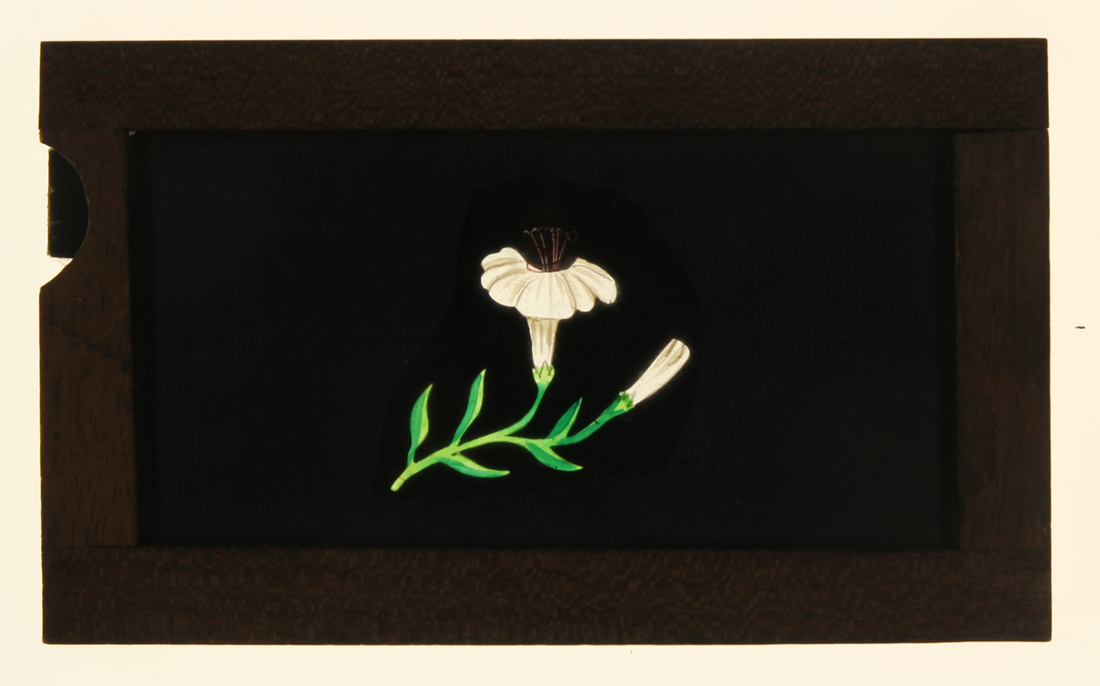
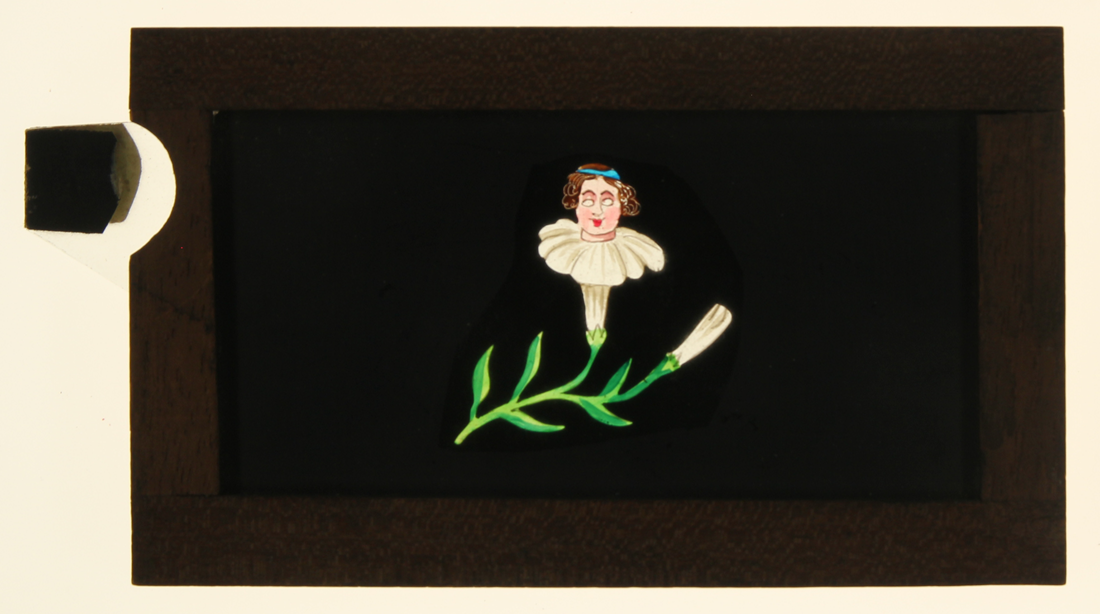
To understand the phantasmagorical influence on this temporal structure, it is important to look closely at the trick slides that produced the metamorphic effects that interest Dickens. The trick slides of early Phantasmagoria shows were primarily what are called “slipping slides.” These are composed of the usual slide, a piece of painted glass in a wooden frame, with a lever attached to a secondary piece of glass that sits behind it. The secondary slide can be painted in one of two ways: with a visual component that complements the primary slide, or in all black to cancel out a visual component of the primary slide. When the lever is pushed or pulled, the projected image transforms. The rudimentary motion effect created by slipping slides might best be described as juxtapositional. For example, figures 2 and 3 show two stages of a slipping slide: a flower on the stem, and a flower on the stem with the head of a woman inside. The image of the head is painted on the secondary slide, hidden in figure 2 beneath the black-painted primary slide. When the showman activates the slipping slide, the implication is that a blossoming flower sprouts the head of a woman. Actually, the transformation looks something more like this: through the pull of the lever, the image of a woman's head is pulled into the mouth of the flower from the right. Most slipping slides are not capable of effectively representing progressive movement or change. Rather, they evoke or allegorize progressive change through juxtaposition and substitution. The Phantasmagoria's effect of metamorphosis relied on the viewer to synthesize a rapid succession of discontinuous images into a continuous movement. The viewer registers an image of a flower replaced by an image of a flower with the head of a woman, and reads this as the head of the woman “appearing in” the flower.
First phase of “Woman's Head Appears from Flower,” single slipping slide, n.d. Courtesy of the Bill Douglas Cinema Museum, University of Exeter.

Second phase of “Woman's Head Appears from Flower,” single slipping slide, n.d. Courtesy of the Bill Douglas Cinema Museum, University of Exeter.

In what follows, I will focus on two descriptions of processions of carriages in A Tale of Two Cities that show how the novel's temporal structure of history as flow transposes the visual effects of the phantasmagoria. In nineteenth-century visual media, processions typically represent historical and national continuity. For example, fold-out panoramic prints of the royal procession at Queen Victoria's coronation in 1838 used the unbroken line of carriages and marching soldiers to reinforce the integrity of the monarchic line of succession.Footnote 30 By contrast, Dickens uses the visual succession of carriages to emphasize historical contingency and rupture. The following passage, from the final chapter of the novel, subverts the procession's symbolic valence of historical preservation and inevitability by underscoring the transmutation of monarchic carriages into revolutionary tumbrils:
Six tumbrils roll along the streets. Change these back again to what they were, thou powerful enchanter, Time, and they shall be seen to be the carriages of absolute monarchs, the equipages of feudal nobles, the toilettes of flaring Jezebels, the churches that are not my father's house but dens of thieves, the huts of millions of starving peasants! (385)
Here, the narrator pauses in a description of a street scene to offer a historical palimpsest: a view of the tumbrils that implies the wood itself is hacked from the accoutrements of the monarchic era, the carriages and churches and huts that both represented and upheld the old order. The rolling tumbrils evoke the ineluctable forward momentum of history as they proceed to the guillotine, but another temporality is conveyed through the image of the tumbrils metamorphosing, like Cinderella's carriage, back into their past forms. This metamorphosis recalls the visual transformations of the Phantasmagoria. The syntactical unfurling of the tumbrils’ former states through the form of the list mimics the visual reconciliation of juxtaposed images in the Phantasmagoria and the turning of disparate forms into a unified sequence.Footnote 31
The influence of Phantasmagoria on Dickens's prose style has often been overlooked by scholars in favor of other medium-specific influences. For example, Juliet John and Carolyn Williams have read visual and spectacular instances of narrative discontinuity in Victorian fiction as an imitation of the techniques of stage melodrama.Footnote 32 John describes Dickens's characteristic listlike syntactical structure as a “metonymic chain of stylized animation” that is influenced by the static tableaux of melodramatic theater.Footnote 33 The tendency toward bold, static images in melodramatic theater produced what William Hazlitt described as “a perpetual succession of striking pictures,” a structure that John reads into Dickens's descriptive prose, arguing that it produces a paradoxical “fluidity.”Footnote 34 While melodramatic theater has a profound influence on Dickens's visual imagination, the syntactical “fluidity” that John identifies, in which “stasis can never be other than metamorphosis,” was also associated throughout the nineteenth century with the rapidly changing spectral images of the Phantasmagoria.Footnote 35 John analogizes this Dickensian descriptive structure as “photographic stills shown in rapid succession to create the illusion of a moving image,” but the similarities between precinematic optical illusions and Dickens's prose description are more than an analogy. They are another more direct site of influence for this particular effect of historical change.Footnote 36
The procession of the tumbrils is an example of a passage that associates the structure of “fluidity” with the visual sequences of the Phantasmagoria rather than those of stage melodrama. The invocation of time as a “powerful enchanter” that has the power to reverse-engineer history references a real figure like Robertson, the Phantasmagoria showman associated with the power to resurrect the historical (and especially prerevolutionary) past. If this view of the procession of the tumbrils signals the breakdown of monarchic succession and the disruptive nature of revolutionary history, it also offers another model of history in the metamorphic visual flow of the Phantasmagoria's images, which renders juxtaposed forms—like the two versions of the flower in figures 2 and 3—as an unbroken sequence through the illusion of continuity. Through the thwarted identification of history with the orderly, continuous procession, this passage invites the reader to contemplate revolutionary history as a state of metamorphic change.
Phantasmagoria, with its crude slipping slides and rapidly changing image sequences, was not capable of the kinds of continuity illusions John refers to when she references “photographic illusions shown in rapid succession.” In the nineteenth century, scientists argued that this illusion—known as “persistence of vision”—was created when rapidly changing images tricked the eye into seeing an unbroken visual sequence. Moving-image media actually predate photography; they have their origin in optical toys created in the 1830s.Footnote 37 In the late 1850s, while Dickens was writing A Tale of Two Cities, the market for optical toys based on the principle of persistence of vision had grown, but none were capable of blending persistence of vision with projection. Moving-image toys primarily fell into the category of what Erkki Huhtamo has called “peep media,” requiring the viewer to peer into an apparatus through an aperture in order to view the moving image.Footnote 38 For example, the zoetrope was a popular mid-nineteenth-century optical toy composed of a spinning circular drum interspersed with apertures. Strips of paper illustrated with a sequence of forms in progressive stages of motion are placed inside of the drum. When it is spun, a small number of viewers can peer through the apertures to see the illustrated forms as an animated sequence.
Patents from the early 1860s that sought to hybridize moving-image toys with the magic lantern demonstrate that optical inventors shared Dickens's association between projected moving images and the representation of historical and temporal transformation. In 1864 the French inventor Louis-Arthur Ducos du Hauron patented a device for photographic reproduction that would register “all the transformations which it undergoes during the predetermined time” and an adapted magic lantern that would project such moving images.Footnote 39 He claimed these projections would “condense into a few moments a scene which in reality took place over a considerable period of time,” slow transformations down “whose speed sometimes makes them impossible to see”; and “reverse the order in which a scene or phenomenon takes place.”Footnote 40 Ducos du Hauron also argued that this device would be particularly appropriate for reproducing “the passing of a procession” in full motion.Footnote 41 This mid-Victorian fantasy of fast-forward, slow motion, and rewind reveals how aware precinematic optical inventors were of the possible connections between projected moving images and new modes of visualizing change in time. Moving image projections might capture not only what Walter Benjamin called the optical unconscious but also something like a historical unconscious: the ineffable processes of temporal change.
A second processional scene from A Tale of Two Cities shows how Dickens blends the phantasmagorical imagery of the past with a modern awareness of persistence of vision illusions to advance a metonymic representation of historical transformation. A pivotal chapter early in the novel dramatizes the seething class tensions between the aristocracy and the working poor. In the chapter, the aristocrat Monsieur le Marquis kills a peasant boy with his carriage. His callous treatment of the boy's death ends with him cavalierly driving on:
He was driven on, and other carriages came whirling by in quick succession; the Minister, the State-Projector, the Farmer-General, the Doctor, the Lawyer, the Ecclesiastic, the Grand Opera, the Comedy, the whole Fancy Ball in a bright continuous flow, came whirling by. The rats had crept out of their holes to look on, and they remained looking on for hours; soldiers and police often passing between them and the spectacle, and making a barrier behind which they slunk, and through which they peeped. The father had long ago taken up his bundle and hidden himself away with it, when the women who had tended the bundle while it lay on the base of the fountain, sat there watching the running of the water and the rolling of the Fancy Ball—when one woman who had stood conspicuous, knitting, still knitted with the steadfastness of Fate. The water of the fountain ran, the swift river ran, the day ran into evening, so much life in the city ran into death according to rule, time and tide waited for no man, the rats were sleeping close together in their dark holes again, the Fancy Ball was lighted up at supper, all things ran their course. (117)
Here, as in the passage of the tumbrils, Dickens mimics the Phantasmagoria's metamorphic sequences to render a procession as a “quick succession” of images. The procession is a “spectacle” watched by a crowd of peasants, soldiers, and police, and the repetition of “came whirling by” foregrounds that this is a moving spectacle, one based in a “flow” of images. Like the procession of tumbrils, this procession is a moment of narrative discontinuity and suspension, qualities that are often associated with the melodramatic tableau. The placement of this highly dramatic passage at the end of a chapter certainly quotes the tableau, as does the effect it creates of heightened meaning and dramatic suspense. As Carolyn Williams puts it, tableaux are “entangled within action that is yet unfolding and not already known,” creating moments of recognition as well as “suspensefully poised anxiety and premonition.”Footnote 42 This passage is similarly pregnant with foreshadowing of the imminent overturning of French governance and society with the outbreak of revolution, a moment of suspension before the chaos of civil insurrection. However, unlike in melodramatic theater, a set of distinctly optical effects are built into the passage's tableaulike pictorialism and theatricality.
The procession of the Fancy Ball is rendered by Dickens as an optical spectacle. The “bright continuous flow” that is created from the rapid procession of the carriages evokes both the light-based image sequences achieved through a magic lantern and the dematerialized visual stream of images associated with persistence of vision illusions. In particular, the rendering of carriages as a “flow” references panoramic magic lantern slides—horizontal slides, usually twelve to fourteen images long, moved slowly across the lantern's light source.Footnote 43 Panoramic slides usually feature a single image, such as a landscape, that unfolds progressively on the screen, or a succession of images such as a procession of carriages, a parade, or a series of figures chasing one another. The “peeping” of the peasants between the rows of soldiers and police stationed between them, which allows them to experience the “bright continuous flow,” references the mode of spectatorship associated with persistence of vision toys. The “barrier” through which the peasants “peep” evokes the circular drum of the zoetrope, a barrier spaced out with apertures for peeping at an animated spectacle. In this reading, the “bright continuous flow” is located not in the carriages themselves but in the interface between the carriages and the perception of the viewers who watch them drive by. The transformation of the carriages into a “flow” registers the speed of the procession and the way the viewer perceives a rapid sequence of images as a visual stream. This dematerializing procedure of carriages into flow is reflected in the typography: the stylized eighteenth-century capitalizations that identify the carriages metonymically by their owners—“the Minister, the State-Projector, the Farmer-General, the Doctor”—are melted down into a whirl and flow of description. The contours of the Fancy Ball and all its titled aristocrats and gentry seem to dissolve as they speed by, as though the very boundaries delineating them were lost. Here again, Dickens is attentive to how an illusion of continuity is produced by discontinuous images.
If the “bright continuous flow” is an optical and phantasmagorical spectacle, it is also a metonymy of historical revolution. The “quick succession” of carriages that creates the “flow” references France's hereditary monarchy and the republic that will quickly succeed the line of Bourbon kings. Thus, the succession of images that evokes the Phantasmagoria and persistence of vision technologies is used to foreshadow historical and political succession. Aptly, the typography mimics the succession of uppercase aristocratic carriages (“the Minister, the State-Projector, the Farmer-General”) by the lowercase peasants, described as “rats,” who creep, look, slink and peep as the “spectacle” passes them by. It is a typographic “succession” of the lowercased lower classes to the mantle of aristocratic rule as well as a typographic decapitation, punning on the imminent guillotining of the nobles. The doubling of the flow of the carriages with the flow of water in “the running of the water and the rolling of the Fancy Ball” sets off a series of images of temporal change that flow from one to another in Dickens's characteristic listlike sequence—the water runs, the river runs, life runs into death, time and tide wait for no man. By the end of the passage, the “bright continuous flow” not only figures historical transformation but time itself.
Dickens's focus on the carriages suggests that the passage is commenting on the genre in which he is writing: historical fiction. Walter Scott's Waverley (1814), the exemplary historical novel of the nineteenth century, establishes the carriage ride as a metaphor for historical fiction. The narrator famously interjects:
I do not invite my fair readers . . . into a flying chariot drawn by hippogriffs, or moved by enchantment. Mine is a humble English post-chaise, drawn upon four wheels, and keeping his Majesty's highway. Such as dislike the vehicle may leave it at the next halt, and wait for the conveyance of Prince Hussein's tapestry, or Malek the Weaver's flying sentrybox.Footnote 44
If historical fiction is a carriage ride, it defines itself against the more exotic magic carpet rides offered by the romance novel. Each vehicular medium is associated with an approach to narrative probability; the historical novel is a mode of transport that, in James Chandler's words, “stays close to the ground and makes no explanatory leaps.”Footnote 45 A Tale of Two Cities offers a variety of conveyances to figure historical narration, including its own humble post-chaise in the form of the Dover mail coach that travels between London and Paris in one of the novel's opening chapters, and figures the narrative's mobility between the two cities of its title. However, even as Dickens's carriages allude to Scott's, they also break the model of readership implied by Scott's carriage ride. History does not express itself as the unbroken view of landscapes from beyond a carriage window but as the view of a series of carriages themselves. While Scott allegorizes historical fiction as a means of transporting the reader into the past, Dickens views it as a visual spectacle that passes before the reader. In rendering history as a phantasmagorical spectacle, Dickens incorporates the aura of “enchantment” that Scott insists on excluding.
Since Georg Lukács's The Historical Novel (1962), A Tale of Two Cities has been held up against the model of Scott's historical novels and found wanting. Lukács took Scott as his paragon of the historical novelist for what he describes as Scott's “organic” integration of characters and plots with world-historical situations, a method of representation that breaks down, he argues, after the bourgeois revolutions of 1848. A Tale of Two Cities is a particularly egregious example of Dickens's “petty bourgeois humanism”: it seeks to separate out the sphere of humanity and morality from that of social relations and historical development, and uses the French Revolution as “romantic background” for the family drama at the center of the plot.Footnote 46 Although A Tale of Two Cities has long been read by scholars as insufficiently historical, Lukács is not interested in this novel as a specific case or as a fully realized history so much as in the ways in which the bourgeois tendency of Victorian-era historical fiction makes it fundamentally incapable of and unsuited to a structural representation of history and historical change. Fredric Jameson makes a similar argument about realism more broadly: while it is profoundly historical, its commitment to the present as such makes it unsuited to the task of representing historical revolution.Footnote 47 For Jameson, realism cannot confront the structural forces that connect the present to the past and future, what he calls “the ontology of the present as a swiftly running stream.”Footnote 48
Tracking Dickens's construction of a phantasmagorical temporality through his images of procession helps clarify his place within the tradition of nineteenth-century historical fiction. On one hand, his construction of a phantasmagorical temporality challenges the view of Victorian realism and historical representation advanced by Lukács and Jameson. In both the examples of the tumbrils and the Fancy Ball, Dickens is precisely interested in “the ontology of the present as a swiftly running stream.” The “bright continuous flow” figures the historical present as a stream of visual images that connects past, present, and future. The valence of the visual sequence as “stream” is even reinforced by its analogy to running water. As a metonym for history, the “flow” offers a view of how structural forces underlying the present—class inequality and economic violence—are related to the past and make future outcomes inevitable, by representing revolution as an impending metamorphosis of the present. Similarly, the stream of images of the tumbrils’ past states shows the present as a metamorphosis of the past. Both passages use the procession's symbolic valence of historical continuity to show the dialectical relationship between continuity and discontinuity in history. The phantasmagorical motif reveals the novel's attention to the interpenetration of structural forces and singular events, and of history and the present.
On the other hand, Dickens's approach to the present as a stream distinguishes itself from Scott's through his depiction of history as phantasmagorical spectacle. Dickens does not place the reader within the unfolding present of history, as Scott does when he offers the reader a carriage ride through time and space. Rather, the reader is a spectator who, in observing the phantasmagorical tumbrils and the “bright continuous flow” of carriages, contemplates the phenomena of historical time and change. Narratives of historical continuity do not have objective existence but are illusions created through the perception of change in time. Dickens's turn to the Phantasmagoria and its related optical illusions reveals a different view of historical representation than Scott's. For Dickens, history is indescribable without an account of perception; and he draws his own account of perception from optical spectacle and its modes of spectatorship.
Phantasmagorical Character: “Crowds of the Wicked and the Wretched”
The metamorphic and spectral imagery that structures Dickens's representation of historical transformation extends to his characters. As historical actors, the characters who compose the central plot of the novel are unstable, changeable, and even fungible. Lucie Manette (later Darnay), Alexander Manette, Charles Darnay, Sidney Carton, and John Barsad all have double lives, marked not only by blended nationality, residency, or allegiance but also by split or dissociative personhood. Doctor Manette, locked in 105 North Tower, becomes the Shoemaker, and throughout the novel he suffers from recurrences of this alter ego taking possession of his mind. While the young Marquis Saint Evrémonde escapes his position as French nobleman to become the expatriate Charles Darnay, Solomon Pross, the long-lost brother of Lucie's nurse, returns as the spy and traitor John Barsad. Characters are also figuratively represented as ontologically split, as in the characters who are “recalled to life”—metaphorically buried and exhumed, or executed and resurrected. Finally, characters are almost radically exchangeable for one another. When Darnay is put on trial at the Old Bailey for treason in the novel's early chapters, suspected of spying for France, it is because he has been mistaken for the real spy Barsad. When he is put on trial by the revolutionary tribunal at the novel's climax, he is saved from the guillotine because Carton takes his place. In his relationship to Lucie, Darnay is also a surrogate for Manette, Lucie's father, a fact that becomes central to the Oedipal drama of Lucie and Darnay's marriage (“‘If I had never seen Charles, my father,’ Lucie insists, ‘I should have been quite happy with you’”).
Lukács argued that Dickens failed to meaningfully integrate these characters within the context of the French Revolution in the manner of world-historical individuals. However, he missed the ways in which the deindividuated structure of character throughout the novel is radically interpenetrated with history. Frances Ferguson and Daniel Stout have written about the deindividuation of character in A Tale of Two Cities as Dickens's response to the political ideology of the French Revolution.Footnote 49 In particular, they see Dickens's approach to character as shaped by the philosophical and political doctrines of the revolution that elevate the general over the particular and the corporate over the individual. For Ferguson, the novel attempts to come to terms with a modern logic of terrorism that demands a rethinking of the theory of moral action centered on a concept of individuality. The interchangeability of characters throughout the novel signals the ways in which terror “erodes the distinctions between individuals and always adds someone else or some others into its bargains.”Footnote 50 Stout argues that Dickens's deindividuated characters reflect his treatment of democratic individualism as a depersonalized, corporate vision of personhood and agency. The revolution, for Dickens, is “a mass event in which individuals wash up as mere flotsam.”Footnote 51 I want to propose that the trope of deindividuation can be traced not only to Dickens's response to revolutionary ideology and politics but also to his project of theorizing history itself. For Dickens, historical change is a phantasmagorical process that showcases the instability and immateriality of individual identities. A dematerializing and massifying force, history strips characters of their individuality and dissolves them into a crowd.Footnote 52
Take Charles Darnay, arguably the novel's nearest example of a world-historical character. As a French aristocrat who disavows his own class position and is living in self-imposed exile in London, Darnay embodies the between-worlds position that Lukács associates with historical characters.Footnote 53 The reader's first glimpse of him comes when he is a prisoner in London, on trial for his life at the Old Bailey on suspicion of spying for the French government:
Over the prisoner's head, there was a mirror, to throw the light down upon him. Crowds of the wicked and the wretched had been reflected in it, and had passed from its surface and this earth's together. Haunted in a most ghastly manner that abominable place would have been, if the glass could ever have rendered back its reflexions, as the ocean is one day to give up its dead. (66)
This is a strangely dissociative first description of one of the novel's primary characters. The narrative visualizes Darnay as an object of vision, mediated: he stands beneath a mirror that acts as a spotlight for the audience to watch him, transforming him into an image. Like the Fancy Ball, Darnay is represented in terms of how he is seen—he becomes an image for the reader through his construction as an image for an audience within the diegesis. But at the same time as the mirror illuminates him, it deindividualizes him, reflecting him back not as himself but as one of the “crowds of the wicked and the wretched” that have stood in his place.
Key to this description is the function of the mirror as a projection technology. Like the convex mirror in the interior of a Phantasmagoria lantern such as Robertson's Fantascope, this spotlight mirror not only reflects light but is associated with the production of ghosts. The fanciful description of the glass “render[ing] back its reflexions, as the ocean is one day to give up its dead” compares the possibility of a mirror that could unleash its spectral images of the resurrected dead on the Day of Judgment. Dickens refers to the supernatural effect most associated with Robertson's projections: of the dead apparently “returning to life in crowds.” Phantasmagoria is not the only media reference in this passage. The mirror that captures its reflections evokes the daguerreotype, an early photographic medium that was popularly known as the “mirror with a memory” for its mimetic accuracy and glassy, reflective surface.Footnote 54 It is significant, however, that Dickens does not emphasize the power of a reflection to materialize or preserve an image. He focuses instead on the reflection as an optical illusion that creates an image that is immaterial, ephemeral, and ghostly.Footnote 55 Moreover, in this mirror, the capacities of reflection and projection are inexorably tied to each other.
If the mirror transforms Darnay into an illusion for the benefit of the audience, it also figuratively produces him as a phantasmagorical image. The narrative repeatedly suggests that we should understand the scene as ghostly and populated by figures that are neither dead nor alive. The Old Bailey is described as a purgatory, a “deadly inn-yard, from which pale travellers set out continually, in carts and coaches, on a violent passage into the other world” (63). Darnay is one of these “pale travellers” hurtling toward death. In fact, this is precisely the attraction that audiences have flocked to the Old Bailey to enjoy. The gruesome nature of the proposed sentence (hanging and quartering) makes the prisoner's expected passage to the other world especially spectacular, so that even before the trial begins he has been “mentally hanged, beheaded, and quartered, by everybody there” (66). The narrator clarifies that “the form that was doomed to be so shamefully mangled, was the sight” that the audience is so eager to have a glimpse of (65). Given that the title of the chapter is “A Sight,” this clarification is instructive: the sight is not Darnay but the proleptic image of Darnay after his execution. The present and proleptic images seem to merge together in the act of spectating. Viewed as an image by the audience, Darnay is both himself and his mangled corpse. This optical structure recalls the recursive motion of slipping slides and their juxtapositional images: king and skeleton, man and corpse. What distinguishes Darnay as an image or “sight” for spectators is his apparent state of ontological suspension—he is neither exactly alive nor exactly dead. The attraction of seeing a body metamorphose through its violent destruction plays out projectively in the minds of viewers and through the fantasy of the mirror's memories. This audience views Darnay precisely as one of the “crowd of the wicked and the wretched”: the mirror both projects, and reflects, how viewers constitute Darnay as a “sight.” If the trial is coded as a piece of theater, then these signs indicate we are in the theater of the Phantasmagoria, one where audiences come to watch the gothic transformation of images of living men into skeleton and ghosts.
The mirror's phantasmagorical image, at once reflection and projection, acts as a sort of historical prophecy in retrospect. It foreshadows Darnay's near-death by guillotine at the end of the novel, menaced by the “crowds” of peasants brought back to life from their feudal imprisonment as vicious revolutionaries. But it is also prophetic in a second way: it heralds, not only the antagonism of the man versus the crowd, but the crowd as a violent successor to the individual. According to John Plotz, the nineteenth-century crowd invited phantasmagorical fantasies of the loss of individuality. In William Wordsworth's Prelude, for example, London crowds produce anxieties about ghosts and waking dreams, and create “a sense of permanently muddled boundaries between self and world.”Footnote 56 Darnay's transformation into a “crowd of the wicked and the wretched” points to the massification of the revolutionary order that, in Dickens's conception, produces states of collective consciousness and will. Recall Dickens's disparagement of the hysterical crowd at the Palais-Royal, believing they have seen a ghost, in his account of Robertson's Phantasmagoria. Both the Phantasmagoria and the revolution are capable of transforming otherwise discriminating individuals into passively believing crowds and of inducing states of hypnosis or trance that disempower rational judgment.
A Tale of Two Cities seeks to represent a history of mass experience that undercuts the agency of the individual and in which the character as individual is an ineffective technology for historical representation. The mirror projects Darnay as part of a spectral mass, signaling his interchangeability with and indistinguishability from any other man who has stood in his place, a judgment borne out by the callous spectators who view him merely as “the form” to be “mangled.” Revolutionary subjects, like Darnay, are anonymous, plural, diffuse. This view is affirmed by end of the trial sequence, when Stryver, Darnay's counsel, wins the case on the basis of his apparent resemblance to Sidney Carton. Even though the prime witness has identified Darnay as a spy, Stryver wins over the jury by asking the witness to “look well upon that gentleman, my learned friend over there [Carton],” and to consider whether the two men are not so alike as to be nearly interchangeable (77). Darnay is exonerated based on a visual illusion of likeness. These terms fulfill the vision in the mirror: that the trial is a Phantasmagoria in which persons and identities are protean and interchangeable. Like the phantasmagorical image, the argument that wins the case does not verify or authenticate Darnay's identity as individual; it dismantles and dissolves it. Stryver's claim “recall[s]” Darnay “to life”—he returns from the purgatory of the trial to the world of the living. But the logic behind the claim suggests that Phantasmagoria is not confined to a “theater” such as the Old Bailey or even to moments of existential precarity. Rather, in A Tale of Two Cities, Phantasmagoria is a condition of historical reality.
By analyzing Dickens's use of phantasmagorical and optical imagery, we can better understand his approach to historical representation. A Tale of Two Cities resists dominant theories of nineteenth-century historical representation because it does not approach the task of representing history through the dialectical-materialist framework that Lukács has associated with Walter Scott, in which processes of historical change can be embodied in individual characters, actions, and events. Rather, Dickens employs images drawn from optical entertainments to describe historical change as a process that reveals the fundamental immateriality and instability of individual characters, actions, and events. By portraying historical change through a dialectic of continuity and discontinuity reminiscent of the technological optics of Phantasmagoria and moving-image illusions, Dickens offers a darker and stranger view of history than Scott or Lukács: one in which historical continuity is not a given narrative but a perceptual illusion that narrative can create.