The interpersonal dimension of psychopathy, which captures narcissistic features including grandiosity and self-absorption, has gained recent empirical attention because of its association with aggressive behavior. Whereas the affective features of psychopathy—callous–unemotional (CU) traits (lack of empathy and guilt, and uncaring attitudes)—are believed to be important markers to developmental precursors to psychopathy and are associated with high levels of aggression and violence (Frick & White, Reference Frick and White2008), recent research suggests that psychopathy-linked narcissism may underlie a specific type of aggression: that done without provocation (i.e., proactive or “cold-blooded” aggression; Barry et al., Reference Barry, Thompson, Barry, Lochman, Adler and Hill2007). This finding, however, is counterintuitive to research documenting strong emotional reactions to provocation among narcissistic individuals (Twenge & Campbell, Reference Twenge and Campbell2003). To reconcile these findings, one hypothesis is that people with narcissistic traits employ various means to get what they want, and how they respond emotionally may facilitate different strategies toward achieving their goals. The literature suggests significant heterogeneity to the construct of narcissism. In the current study, we investigated whether youth scoring high on narcissism can be disaggregated into subtypes according to their patterns of emotional responding and whether these patterns relate to the types of aggression that they display (e.g., Pincus & Lukowitsky, Reference Pincus and Lukowitsky2010; Thomaes, Bushman, Orobio de Castro, & Stegge, Reference Thomaes, Bushman, Orobio De Castro and Stegge2009).
Developmental Issues
Narcissism is a dimensional trait that manifests at its extremes as narcissistic personality disorder. Individuals with narcissistic personality disorder are characterized by a pervasive pattern of grandiosity and a chronic need for admiration. Although the diagnosis of personality disorders prior to adulthood is often discouraged, since such traits are still developing in youth and may not be highly stable over time, studies suggest that narcissism is identifiable from the age of 8 when most children develop the ability for abstract reasoning, which allows them to form self-esteem and be aware of their self-views, as well as internalize how others perceive of them (see Thomaes, Bushman, Orobio De Castro, & Stegge, Reference Thomaes, Bushman, Orobio De Castro and Stegge2009).
Some preliminary work suggests that observational measures of narcissism in preschoolers identify children at risk for developing narcissistic traits in adolescence and young adulthood (Carlson & Gjerde, Reference Carlson and Gjerde2009). At least some research suggests that narcissism increases in adolescence (e.g., Carlson & Gjerde, Reference Carlson and Gjerde2009; Twenge, Konrath, Foster, Campbell, & Bushman, Reference Twenge, Konrath, Foster, Campbell and Bushman2008), leading some to label it as a developmental period of “narcissistic vulnerability” (Bleiberg, Reference Bleiberg1994; cf. Foster, Campbell, & Twenge, Reference Foster, Campbell and Twenge2003). The emergence of narcissistic traits in early childhood and/or adolescence may reflect periods of vulnerability during which an existing diathesis (Livesly, Jang, Jackson, & Vernon, 1993) interacts with dysfunctional parenting practices (e.g., permissiveness and overindulgence, coldness and emotional neglect; see Thomaes, Bushman, Orobio De Castro, & Stegge, Reference Thomaes, Bushman, Orobio De Castro and Stegge2009) that are elicited by enhanced, albeit normative, autonomy seeking by youth during these specific developmental periods. Altogether, the developmental origins and course are poorly understood, and much further research is needed to fully understand how and why narcissism develops. However, it may be that different temperaments (e.g., approach motivations) result in different types of narcissism that can be distinguished by their adaptability (Fossati, Borroni, Eisenberg, & Maffei, Reference Fossati, Borroni, Eisenberg and Maffei2010; Foster, Misra, & Reidy, Reference Foster, Misra and Reidy2009; Foster & Trimm, Reference Foster and Trimm2008).
Psychopathy-Linked Narcissism
Psychopathy-linked narcissism, which is assessed by the Antisocial Process Screening Device (APSD; Frick & Hare, Reference Frick and Hare2001), is found to be relatively stable during childhood (Barry, Barry, Deming, & Lochman, Reference Barry, Barry, Deming and Lochman2008). Psychopathy-linked narcissism taps the overt behaviors (i.e., bragging, inflated self-view, manipulating others, charming, and conning) associated with grandiosity and is distinct from the more adaptive and attitudinal features of narcissism that are captured by the Narcissistic Personality Inventory and its developmental offshoots (see Barry, Wallace, & Guelker, Reference Barry, Wallace, Guelker, Barry, Kerig, Stellwagen and Barry2011). Barry et al. (Reference Barry, Wallace, Guelker, Barry, Kerig, Stellwagen and Barry2011) suggest that psychopathy-linked narcissism is the most closely aligned with “vulnerable narcissism” (Wink, Reference Wink1991), given findings that it was positively associated with parent-reported conduct problems (r = .22, p < .05), and it was negatively associated with self-esteem and social skills, albeit nonsignificantly. Given our focus on the maladaptive outcome of aggression within an incarcerated sample of boys, this study examined psychopathy-linked narcissism instead of the adaptive and less vulnerable measures of narcissism. The maladaptive components of the Narcissistic Personality Inventory, which seem similar to the traits described for psychopathy-linked narcissism, such as exploiting others, personal vanity, and showing off (i.e., exhibitionism), were related to both unprovoked (i.e., proactive) and provoked (i.e., reactive) aggression in a sample of high school students (Fossati et al., Reference Fossati, Borroni, Eisenberg and Maffei2010).
Narcissism and Aggression Types
Consistent with conceptualizations of narcissism and its development, Baumeister, Smart, and Boden (Reference Baumeister, Smart and Boden1996) suggest that reactive aggression, which can be elicited in response to some real or perceived provocation, is most likely to occur in people who are high on narcissism when their inflated self-views and unstable beliefs in their own superiority are threatened. Some studies support this assertion. For example, in their landmark study Bushman and Baumeister (Reference Bushman and Baumeister2002) found that individuals high on narcissism tended to react aggressively in response to insulting or esteem-threatening evaluations received from others within a laboratory paradigm. Another study with young adolescents found a similar pattern of reactive aggression against a mock opponent for those scoring high on narcissism, within a competitive reaction time task involving a shame manipulation (Thomaes, Bushman, Stegge, & Olthof, Reference Thomaes, Bushman, Stegge and Olthof2008).
Youth with narcissistic features also appear to use proactive aggression, which is purposeful and typically in pursuit of an instrumental goal (i.e., gaining some desired object or social status), to achieve dominance over others, and to “construct, promote, and/or reinforce their grandiose self-image” (Barry et al., Reference Barry, Thompson, Barry, Lochman, Adler and Hill2007; Kerig & Stellwagen, Reference Kerig and Stellwagen2010; Salmivalli, Reference Salmivalli2001; Washburn, McMahon, King, Reinecke, & Silver, Reference Washburn, McMahon, King, Reinecke and Silver2004, p. 256); this may be particularly true in adolescence where dominance motivations may be especially important (Fossati et al., Reference Fossati, Borroni, Eisenberg and Maffei2010). Further, individuals high on narcissism, particularly overt traits of grandiosity and social charm (traits associated with psychopathy-linked narcissism), are more likely to focus on positive outcomes of their aggression (Foster et al., Reference Foster, Misra and Reidy2009; Foster & Trimm, Reference Foster and Trimm2008), a cognitive style that is also distinctly associated with proactive aggression (Dodge, Lochman, Harnish, Bates, & Pettit, Reference Dodge, Lochman, Harnish, Bates and Pettit1997). Thus, people who are high on narcissism may not require provocation to act aggressively and may use either form of aggression for different purposes and within different situations (Washburn et al., Reference Washburn, McMahon, King, Reinecke and Silver2004).
Narcissism and Distinct Patterns of Emotional Responding
The investment in self-interests that youth with narcissistic traits evince may also impact on their ability to take in (or use) important information from their environment. Children scoring high on psychopathy-linked narcissism are emotionally deficient in attending to a novel, nonsignaled stimulus (Isen et al., Reference Isen, Raine, Baker, Dawson, Bezdjian and Lozano2010), which may lead to information-processing deficits that make aggression more likely. That is, such individuals may act immorally at times because they fail to attend to the emotional information that would typically inform their social interactions with others (Glenn, Raine, & Schug, Reference Glenn, Raine and Schug2009). This tendency to neglect new and possibly important information within emotionally neutral contexts may reflect an overfocus on their own self-interests.
In contrast, within situations involving aversive cues, individuals high on narcissism may react with strong emotions. Emmons (Reference Emmons1987) described a link between narcissism and strong emotional reactions and lability. Research shows that people with narcissistic traits pay a great deal of attention to negative stimuli (Isen et al., Reference Isen, Raine, Baker, Dawson, Bezdjian and Lozano2010; Kelsey, Ornduff, McCann, & Reiff, Reference Kelsey, Ornduff, McCann and Reiff2001). For example, one study found that when anticipating an aversive stimulus, men who were high on narcissistic traits experienced higher sympathetic arousal to the heart than did those who were low on narcissism (Kelsey et al., Reference Kelsey, Ornduff, McCann and Reiff2001). This study also found a concomitant decrease in heart rate during these tasks, which the authors attributed to hyperactivation of the systems responsible for selective attention to potential threat stimuli (Kelsey et al., Reference Kelsey, Ornduff, McCann and Reiff2001). These findings suggest that individuals with narcissistic traits may differ from others on measures of attention or attention modulation to emotional stimuli. As Thomaes, Bushman, Orobio de Castro, and Stegge (Reference Thomaes, Bushman, Orobio De Castro and Stegge2009) suggest, people with narcissistic traits may be continually processing and filtering incoming stimuli for aversive social cues, while at the same time failing to attend to other relevant social cues.
The different types of narcissism may be important for understanding the divergent patterns of emotional responding found in narcissistic individuals (Thomaes, Bushman, Orobio de Castro, & Stegge, Reference Thomaes, Bushman, Orobio De Castro and Stegge2009; Wink, Reference Wink1991). In a recent review, Pincus and Lukowitsky (Reference Pincus and Lukowitsky2010) distinguished between an adaptive, emotionally stable and resilient type of narcissism compared with an emotionally labile type characterized by emotional dysregulation and a tendency toward negative affectivity. More stable emotional responding may reflect suppressed respiratory sinus arrhythmia (RSA; tapping the parasympathetic nervous system) activity, which has been linked with good coping skills under stressful situations (Grossman & Taylor, Reference Grossman and Taylor2007), greater social functioning (Fox & Field, Reference Fox and Field1989), and more appropriate emotional responses to negative and positive emotion-eliciting tasks (Calkins, Reference Calkins1997). In contrast, youth who display heightened sympathetic and parasympathetic (i.e., RSA) activity under stress tend to show poor outcomes, such as aggression and conduct problems (e.g., El-Sheikh et al., Reference El-Sheikh, Kouros, Erath, Cummings, Keller and Staton2009). It is important to examine both branches of the autonomic nervous system. Both RSA and skin conductance are controlled in part by the autonomic nervous system. Skin conductance reflects measurable changes in the salinity of the skin owing to perspiration, which is controlled solely by the sympathetic nervous system. RSA is the variation in heart rate at the respiratory frequency and is indicative of greater vagal or parasympathetic activity in the heart (Berntson et al., Reference Berntson, Bigger, Eckberg, Grossman, Kaufmann and Malik1997). Hence, there may be different types of people with narcissistic traits identifiable by their emotional profiles.
Patterns of Emotional Responding Distinguish Aggression Types Among Narcissistic Youth
Furthermore, the emotional profiles evident in people with narcissistic traits could relate to their propensity to engage in different types of aggressive behaviors. That is, proactive and reactive types of aggression have been linked to distinct emotional profiles (Scarpa, Haden, & Tanaka, Reference Scarpa, Haden and Tanaka2010). Proactive aggression is associated with low physiological reactivity in competitive situations (Hubbard et al., Reference Hubbard, Smithmyer, Ramsden, Parker, Flanagan and Dearing2002). In contrast, reactive aggression tends to be explosive and resulting from high levels of emotional reactivity (Hubbard et al., Reference Hubbard, Smithmyer, Ramsden, Parker, Flanagan and Dearing2002; Kempes, Matthys, van Engeland, & de Vries, Reference Kempes, Matthys, van Engeland and de Vries2005). There is little research to date examining whether varied emotional profiles in narcissistic individuals relate to different expressions of aggression. Aggression in individuals high on psychopathy-linked narcissism may be underpinned by a complex emotional profile that is distinct from the low emotional reactivity that characterizes children with CU traits (Muñoz, Frick, Kimonis, & Aucoin, Reference Muñoz, Frick, Kimonis and Aucoin2008). It is interesting that despite being at least moderately associated, narcissism and CU traits may be underpinned by different emotional reactions. Thus, aggression may originate from different processes for these two dimensions of psychopathy. Although we have some understanding of the emotional reactions of people with narcissistic traits, we do not know whether this could explain their use of aggression, both as a means to dominate others and as a response to provocation.
The Present Study
The present study addressed this important gap in the literature by examining the emotional correlates to narcissism and the link between patterns of emotional responding and reactive and proactive forms of aggression in youth high on psychopathy-linked narcissism. Our first aim was to examine the emotional underpinnings of psychopathy-linked narcissism, separate from other dimensions of psychopathy, using a multimethod assessment that includes autonomic measures tapping both halves of the autonomic nervous system (sympathetic and parasympathetic), instead of solely focusing on the sympathetic arm (Isen et al., Reference Isen, Raine, Baker, Dawson, Bezdjian and Lozano2010; Kelsey et al., Reference Kelsey, Ornduff, McCann and Reiff2001). We hypothesized that adolescents scoring high on psychopathy-linked narcissism would show greater attention (i.e., hypervigilance) to stimuli with negative emotional valence (i.e., expressions of distress/disapproval), greater autonomic reactivity (heightened heart rate and skin conductance), and lesser suppression of RSA during a stressful, competitive game, compared with those scoring low.
Our second aim was to test whether psychopathy-linked narcissism relates to both reactive and proactive forms of aggression in adolescent offenders. Prior research has used various informant rating scales to assess how dimensions of psychopathy relate to subtypes of aggression, such as combined parent and teacher report (Barry et al., Reference Barry, Thompson, Barry, Lochman, Adler and Hill2007), teacher report (Kerig & Stellwagen, 2009), and teacher and peer report (Washburn et al., Reference Washburn, McMahon, King, Reinecke and Silver2004). In the present study, we include a laboratory-based measure of aggression (i.e., a computerized provocation task), in addition to self-report measures. Consistent with prior findings, we predicted that psychopathy-linked narcissism would be positively associated with self-reported and objective laboratory measures of proactive and reactive aggression.
Our third aim was to test the link between emotional responding and different types of aggression for subtypes of youth high on narcissistic traits. We predicted that youth who are high on psychopathy-linked narcissism would be more likely to engage in proactive aggression if they show a hyporesponsive emotional profile. In contrast, if these youth show heightened emotional reactivity, we predicted that they would be more likely to engage in reactive aggression. We examined these questions in a detained sample of boys, a population in which the constructs of psychophysiology and psychopathy-linked narcissism have not been extensively studied (see Barry et al., Reference Barry, Thompson, Barry, Lochman, Adler and Hill2007).
Method
Participants and procedures
Participants were recruited at over a 90% participation rate from a county juvenile detention center in the southeastern United States. Youth were individually administered a demographic interview, the Peabody Picture Vocabulary Test, Third Edition (Dunn & Dunn, Reference Dunn and Dunn1997), and a computerized emotional processing task. Physiological activity at rest and during a computerized provocation task was measured. Later, youth completed a battery of self-report questionnaires in small groups. Due to low reading abilities, study measures were read to all participants. Ethical approval for this study was granted by a university institutional review board. Parents gave consent and youth gave assent for participation.
The final sample included 85 detained 13- to 18-year-old boys (M age = 15.5; SD = 1.28), excluding those with verbal ability scores below 66 on the Peabody Picture Vocabulary Test (n = 12) and those who fell three standard deviations below the group mean on the provocation task (n = 4), since it was unclear whether they understood the task. This sample was drawn from the same population studied by Kimonis et al. (Reference Kimonis, Frick, Skeem, Marsee, Cruise and Muñoz2008), who examined moderators between CU traits and emotional processing. The majority (68.2%) of the sample self-identified as African American, 22.1% as Caucasian, 4.7% as Hispanic, 2.3% as Native American, and 2.3% as Other. Based on their institutional records, the indexed offenses of the youth included violent (30.6%), property (41.2%), status (8.2%), drug (11.8%), and other types (8.2%; e.g., weapon possession or resisting an officer). Over half of the sample (51.8%) was previously arrested for a violent offense, and an additional six youth were detained for their first violent index offense (58.8% of the sample with any record of violence). This group did not differ from the youth without a history of violent arrest/ adjudication on the main study variables.Footnote 1
Measures
Narcissism/impulsivity
The APSD (Frick & Hare, Reference Frick and Hare2001) is a 20-item self-report scale designed to assess traits often associated with psychopathy in youth. Youth rated each statement on a 3-point Likert scale from 0 (not at all true) to 2 (definitely true). Factor analytic studies have identified three dimensions analogous to those dimensions of psychopathy reported in adult samples (Cooke & Michie, Reference Cooke and Michie2001). The three factors include narcissism, impulsivity, and CU traits (Frick, Bodin, & Barry, Reference Frick, Bodin and Barry2000). The narcissism and impulsivity subscales that were used in the current study, and these self-report measures, have shown acceptable reliability and stability over time (Muñoz & Frick, Reference Muñoz and Frick2007). Muñoz and Frick (Reference Muñoz and Frick2007) found that self-report of narcissism showed the strongest correlations with antisocial behavior when compared to CU traits and impulsivity. Internal consistency was adequate for the narcissism subscale in the current study (Cronbach α = 0.71) but less adequate for the impulsivity subscale (Cronbach α = 0.57). The mean levels of narcissism (M = 4.21, SD = 2.83) and impulsivity (M = 4.53, SD = 2.03) found in the present study are similar to that reported in previous research (Barry & Wallace, Reference Barry and Wallace2010; Roose, Bijttebier, Claes, & Lilienfeld, Reference Roose, Bijttebier, Claes and Lilienfeld2011).
CU traits
The self-report Inventory of Callous–Unemotional Traits (Frick, Reference Frick2004) was used instead of the CU subscale of the APSD because of its greater coverage of CU traits and improved psychometric properties. The construct validity of the Inventory of Callous–Unemotional Traits was supported in a large community sample (n = 1,443) of 13- to 18-year-old nonreferred German adolescents (Essau, Sasagawa, & Frick, Reference Essau, Sasagawa and Frick2006), as well as an American sample (n = 248) of juvenile offenders between the ages of 12 and 20 (Kimonis et al., Reference Kimonis, Frick, Skeem, Marsee, Cruise and Muñoz2008). These studies found expected associations with aggression, delinquency, personality traits (e.g., sensation seeking, Big Five dimensions), emotional reactivity, and psychosocial impairment. As in the present study (Cronbach α = 0.73), both studies reported adequate internal consistency (Cronbach α of 0.77 and 0.81). The mean level of CU traits (M = 22.47, SD = 7.15) in the present sample was also similar to that reported in Essau et al. (Reference Essau, Sasagawa and Frick2006) and more recently in Roose, Bijttebier, Decoene, Claes, and Frick (Reference Roose, Bijttebier, Decoene, Claes and Frick2010).
Self-reported aggression
The Peer Conflict Scale (Marsee, Kimonis, & Frick, Reference Marsee, Kimonis and Frick2004) was developed to measure four dimensions of aggression (i.e., reactive, proactive, physical, and relational aggression). The youth is asked to describe how well each statement describes him or her on a 4-point Likert scale from 0 (not at all true) to 3 (definitely true). The factor structure of the Peer Conflict Scale was tested in a sample of juvenile justice-involved adolescents (Marsee et al., in press) and in a nonreferred sample of students in the fourth through seventh grades (Crapanzano, Frick, & Terranova, Reference Crapanzano, Frick and Terranova2010). In both samples, confirmatory factor analysis showed that a four-factor model fit the data better than alternative models. Further, the reactive and proactive aggression subscales have shown differential correlations with important external criteria (Marsee & Frick, Reference Marsee and Frick2007; Marsee, Weems, & Taylor, Reference Marsee, Weems and Taylor2008). The proactive and reactive physical aggression scales (10 items each) were used in the current study and demonstrated good internal consistency (Cronbach α of 0.75 for proactive aggression and 0.85 for reactive aggression). The mean reported reactive physical aggression (M = 10.20, SD = 6.47) was higher than proactive physical aggression (M = 2.44, SD = 3.15), which is similar to that reported in previous research (e.g., Crapanzano et al., Reference Crapanzano, Frick and Terranova2010).
Laboratory aggression
The Competitive Reaction Time Task (CRTT; Waschbusch et al., Reference Waschbusch, Pelham, Jennings, Greiner, Tarter and Moss2002) is a computer game similar to provocation tasks used in previous research. Past research using this task has shown that boys with and without disruptive behavior disorders show important differences in their level of aggressive responding to provocation trials (Waschbusch et al., Reference Waschbusch, Pelham, Jennings, Greiner, Tarter and Moss2002). Further details about the task can be found in Muñoz et al. (Reference Muñoz, Frick, Kimonis and Aucoin2008). Participants were told that they were playing a computer game against a boy at another detention center, although they were not playing against anyone. They were told that they would earn points by pressing the space bar faster than their opponent. If they won, they could remove points from and send a message to their opponent. Participants earned points by competing and not by removing points. Provocation trials occurred when participants were told their opponent pressed the space bar faster and also removed points and sent a taunting voice message. The computer was preprogrammed to deliver eight high and eight low provocation loss trials.
A proxy of proactive aggression (Muñoz et al., Reference Muñoz, Frick, Kimonis and Aucoin2008) was taken from the first three win trials when the opponent had not yet had the opportunity to take any points, which ranged from 0 to 100. Very little research has been conducted on laboratory aggression tasks that allow for aggression from participants without provocation from an opponent. However, one study with children and adolescents shows that proactive aggression on a laboratory task, where the participant has not been provoked and can gain from the aggression, was related to low physiological reactivity while performing the aggressive act and to low levels of anger as would be expected (Hubbard, McAuliffe, Morrow, & Romano, Reference Hubbard, McAuliffe, Morrow and Romano2010). Another study using undergraduates showed that unprovoked aggression in a reaction time paradigm was related to low anxious arousal (Krahé et al., Reference Krahé, Möller, Huesmann, Kirwil, Felber and Berger2011). Throughout, we refer to our laboratory measure as “preemptive aggression.”
Points taken by the participant immediately following high provocation trials, where an aversive verbal message was played and between 80 and 100 points were taken by the opponent, were used as an objective measure of reactive aggression (Waschbusch et al., Reference Waschbusch, Pelham, Jennings, Greiner, Tarter and Moss2002; this ranged from 35 to 100). On a posttask evaluation, no participant both (a) failed to show any aggressive responding and (b) stated their suspicion that there was no opponent. After the participant was released from the detention center, a letter thanking him for his participation and debriefing him about the deception used for the provocation was sent to the participant's home. This debriefing was done following release from the detention center to avoid the possibility of sharing this information with other potential participants.
Patterns of emotional arousal: Emotional pictures dot-probe task
The emotional pictures dot-probe task (Kimonis, Frick, Fazekas et al., Reference Kimonis, Frick, Fazekas and Loney2006) is a variant of the traditional word version of the task that has been used extensively in the anxiety literature (MacLeod, Mathews, & Tata, Reference MacLeod, Mathews and Tata1986). The dot-probe task is a spatially oriented, motivated attention task that is administered via computer to capture the preattentive mechanism that automatically directs attention toward biologically relevant aversive stimuli (Ohman, Reference Öhman, Lewis and Haviland1993), providing an indirect index of emotional reactivity. The emotional pictures dot probe task used in the current study was developed using primarily slides taken from the International Affective Picture System (Lang, Bradley, & Cuthbert, Reference Lang, Bradley and Cuthbert1998). These slides were carefully selected to tap distress/disapproval (e.g., crying child), positive (e.g., puppies), and neutral (e.g., fork) emotional content only and were validated in previous studies with children and adolescents (Blair, Reference Blair1999; McManis, Bradley, Berg, Cuthbert, & Lang, Reference McManis, Bradley, Berg, Cuthbert and Lang2001).
The emotional pictures dot probe task consists of one block of practice stimuli (16 picture pairs) followed by four test blocks of picture pairs, each containing 24 picture pairs. Each picture pair presentation consists of three sequential and nonoverlapping components: a 500-ms fixation cross appearing in the center of the screen, a 250-ms simultaneous presentation of two picture stimuli that are centered and located immediately above and below the location of the fixation cross, and an asterisk (i.e., dot probe) appearing in either the top or the bottom picture location immediately after the offset of the picture. The objective of the task is to select a key on the keyboard that corresponds to the location on the screen (up or down) where the dot probe appears as quickly as possible. The time between when the probe appears and when the youth presses the corresponding key to its location is recorded in milliseconds and used for the calculation of facilitation indices (described below). If the spatial location of the probe corresponds to the same spatial location where the participant's attention is allocated, then the participant's response to the probes’ location will be faster. If no key is pressed within 5000 ms, the response is recorded as incorrect. Consistent with past uses of the task (Vasey, Daleidon, Williams, & Brown, Reference Vasey, Daleidon, Williams and Brown1995; Vasey, El-Hag, & Daleidon, Reference Vasey, El-Hag and Daleidon1996), incorrect responses were not included in the calculation of facilitation indices since they reflect that the participant was not paying attention to a specific stimulus pair. Response times less than 100 ms were not included in calculations because they were considered to be outliers resulting from program error.
The picture pairs represented one of three potential picture pairings: neutral–neutral, distress–neutral, and positive–neutral. The number and location of picture stimuli were counterbalanced across test trials in order to assure an equal number of emotional and neutral stimuli appearing in both top and bottom locations of the screen across the four blocks of test stimuli. In addition, there were an equal number of emotional and neutral stimuli that were replaced versus not replaced by a dot probe stimulus. The primary dependent measure for the current study is an attentional facilitation index, which was calculated using the following formula (MacLeod & Mathews, Reference MacLeod and Mathews1988): facilitation = 1/2 × (neutral only/probe up – distress up/probe up) + (neutral only/probe down – distress down/probe down). This index is calculated by subtracting the participant's average response time to probes, replacing distress stimuli from their average response time to probes and replacing neutral stimuli in the various neutral–neutral picture pairings. This formula controls for potential location effects (participant's tendency to attend to either the top or bottom location of the screen) by summing latencies for top and bottom picture locations and taking their average. The facilitation index for positive emotion slides was calculated in the same way and was included to compare participants on their processing of two distinct types of emotional stimuli. Higher scores reflect faster attentional orienting to emotional pictures compared to neutral pictures (e.g., Kimonis, Frick, Muñoz, & Aucoin, Reference Kimonis, Frick, Muñoz and Aucoin2007). Facilitation scores falling more than three standard deviations above or below the mean were eliminated from analyses (n = 2 distress; n = 2 positive pictures). The facilitation to distress pictures, measured in milliseconds, demonstrated adequate internal consistency in the current study (Cronbach α = 0.74).
Patterns of emotional arousal: Autonomic measures
Autonomic measures of emotional arousal and reactivity to the competitive task were also collected. After a 10-min stabilization period, baseline autonomic activity was measured for 3 min. RSA was derived using the data from the electrocardiogram (ECG) and a respiration belt. Power spectral analysis was performed on each minute of heart period data to derive RSA measures for the respiratory frequency band (0.24–1.04 Hz). The ECG was recorded via three electrodes placed in a modified Lead II configuration over the distal right collarbone, lower left rib, and lower right rib (ground). Electrodermal activity (EDA) was recorded in micro-Siemens via electrodes placed on two fingers of the nondominant hand. The ECG and the EDA were recorded using Thought Technology's ProComp Infinity encoder connected to a Pentium 4 laptop computer equipped with Biograph Infinity software (version 2.0.1). Sampling for ECG was set at 2048 Hz for data processing and EDA was set at 256 Hz. Editing the ECG files consisted of visually scanning the data for outlier points with respect to adjacent data and marking the time range for exclusion in heart rate variability analyses. The measures of emotional reactivity were change scores from baseline to task levels of heart rate, RSA (high scores indicated high suppression of RSA), and skin conductance. We elected to use delta changeFootnote 2 in cardiovascular reactivity scores for three primary reasons. First, they are easily interpreted. Second, they have been found to be reliable across time and have been found to be as reliable as residualized change scores (Llabre, Spitzer, Saab, Ironson, & Schneiderman, Reference Llabre, Spitzer, Saab, Ironson and Schneiderman1991). Third, they can be compared to reactivity reported in other studies (Boyce et al., Reference Boyce, Quas, Alkon, Smider, Essex and Kupfer2001).
Results
Supporting the validity of the provocation task, paired-samples t tests revealed that autonomic activity on all indices increased from the baseline period to the competitive reaction time task (CRTT). Baseline and phasic skin conductance level differed significantly, t (82) = –10.43, p < .001, partial η2 = 0.57. Baseline and phasic heart rate and RSA also differed significantly, t (84) = –3.79, p < .001, partial η2 = 0.15; t (72) = –7.30, p < .001, partial η2 = 0.43, respectively.
Is narcissism associated with emotional reactivity?
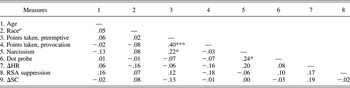
We examined patterns of emotional reactivity/attention to emotional stimuli associated with narcissism. Zero-order correlations reported in Table 1 show that narcissism was not significantly associated with any of the autonomic reactivity measures. However, narcissism was significantly and positively associated with attentional facilitation to distress pictures (r = .24, p < .05), such that attentional engagement to pictures of persons or animals nonverbally communicating distress or disapproval increases as levels of narcissism increase.
Correlations among main study variables

Note: HR, heart rate; RSA, respiratory sinus arrhythmia; SC, skin conductance.
aSpearman correlations (Caucasian = 1, other = 0).
*p < .05. **p < .01. ***p < .001.
Is narcissism associated with proactive and reactive aggression, after controlling for the shared variance with other associated measures?
Narcissism was positively and significantly related to preemptive aggressive behavior during the competitive game but not to reactive aggression (see Table 1). To assess the association with self-reported measures, negative binomial regression analyses were conducted. Negative binomial regression was selected because of its capability of handling severely positively skewed data that is overdisbursed. The goodness of fit was good as indicated by deviance scores below 1. Narcissism, entered into the model as the only predictor, significantly predicted self-reported proactive aggression, Wald χ2 (1) = 22.00, p < .001, β = 0.23, SE = 0.05, and reactive aggression, Wald χ2 (1) = 6.29, p < .05, β = 0.10, SE = 0.04.
Negative binomial regression analyses were conducted to assess the unique contribution of narcissism, controlling for impulsivity and CU traits, in predicting the two types of self-reported aggression. The goodness of fit in both models was good as indicated by deviance scores below 1. The omnibus test was significant for self-reported proactive aggression, likelihood ratio (df = 3) = 29.01, p < .001, and reactive aggression, likelihood ratio (df = 3) = 9.98, p < .05. Consistent with predictions, narcissism contributed unique variance to the statistical prediction of proactive aggression, Wald χ2 (1) = 11.79, p < .001, β = 0.18, SE = 0.05, beyond other psychopathy dimensions; however, contrary to predictions, it did not significantly predict self-reported reactive aggression, Wald χ2 (1) = 1.89, p = ns. None of the predictors significantly predicted self-reported reactive aggression, using this analysis, which accounts for problems with overdispersion.
To test whether narcissism is a unique predictor of aggressive behavior during the CRTT task, hierarchical multiple regression analyses were conducted. Due to the relations among the variables examined in these equations, variance inflation factor (VIF) collinearity statistics were examined (Stevens, Reference Stevens1992). VIF statistics between 4 and 10 tend to indicate collinearity may be present. Across the regression models, none of the VIFs were substantially greater than 1 (overall mean VIF = 1.25), indicating that multicollinearity effects were not present.
Impulsivity and CU traits were entered into the first step of the model as covariates, and psychopathy-linked narcissism was entered into the second step of the model. Narcissism contributed unique variance to the statistical prediction of preemptive aggressive behavior during the game beyond other psychopathy dimensions, ΔR 2 = 0.12, F (1, 81) = 11.63, p < .001. However, it did not significantly and incrementally predict reactive aggression during the game, ΔR 2 = 0.01, F (1, 81) = 0.42, p = ns. Overall, psychopathy-linked narcissism was found to significantly and uniquely predict unprovoked aggression, using both self-report and performance on a laboratory task.
Are distinct patterns of emotional responding related to aggression types among youth with narcissistic traits?
Next, we tested the hypothesis that particular patterns of autonomic reactivity would be associated with aggression for those high and low on narcissism. Cluster analysis was used to create profiles of autonomic reactivity. Hierarchical clustering was used with weighted average linkage using Sleipner and the method suggested by Bergman and Magnusson (Reference Bergman and Magnusson1997). The choice of the number of clusters to retain was informed by increases in the merging coefficients and the explained variance. Hierarchical agglomerative methods have been criticized for clustering cases without the ability to move them as iterations continue. However, after the clustering process generated a suitable number of clusters, we used the cluster solutions as starting values in k means relocation cluster analysis (Bergman & Magnusson, Reference Bergman and Magnusson1997). We made the choice to relocate cases to maximize our explained error sum of squares and minimize heterogeneity within our clusters.
Only youth with complete psychophysiological data (n = 70) were clustered. Multivariate and univariate outliers were removed (n = 4). Four clusters emerged and explained 58% of the total error sum of squares. When we calculated the average of the squared averaged distances for each cluster, only one cluster (1.06) was slightly over the accepted value of 1. There was one outlying cluster with five cases with a large average of the squared averaged distances, and this cluster was not used in subsequent analyses. The three resulting groups were labeled as follows: (a) “coactivators” (n = 21), which showed increased sympathetic (M = 1.36, SD = 0.71) and parasympathetic activity (M = –3.57, SD = 1.41); (b) “sympathetic activators” (n = 16), which showed greatly increased sympathetic activity (M = 3.34, SD = 1.09) but only slightly increased parasympathetic activity (M = –1.13, SD = 0.93); and (c) “low activators” (n = 24), which showed very little change in sympathetic (M = 0.79, SD = 0.64) and parasympathetic activity (M = –0.49, SD = 1.03). Heart rate increased more for the coactivators (M = 1.75, SD = 3.19) than for sympathetic activators (M = –0.57, SD = 3.34) and low activators (M = 1.29, SD = 2.87). To test the interaction between reactivity and narcissism in predicting aggression, we performed a median split on narcissism to aid analysis and interpretation.
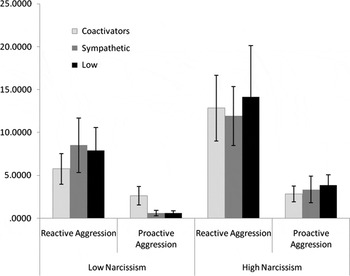
Negative binomial regressions were performed to test the main effects of the between-subjects factor of narcissism and the between-subjects factor of psychophysiology clusters and their interaction. The goodness of fit in both models, predicting self-reported proactive and reactive aggression, was good, with a deviance score below 1. The omnibus test was significant for proactive aggression, likelihood ratio (5) = 19.68, p < .001, but not for reactive aggression, likelihood ratio (5) = 5.28, p = ns. The interaction was significant for proactive aggression, Wald χ2 (2) = 6.38, p < .05. Post hoc t tests revealed that the difference between low and high narcissism groups was significant in the low activators group (see Figure 1). At low activation, youth high on narcissism (n = 12) reported greater proactive aggression than those low on narcissism (n = 12), t (12.94) = –4.06, p < .001.
Self-report aggression means for physiological cluster profiles and narcissism groups.

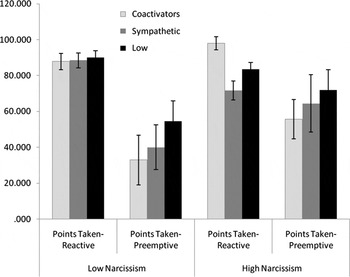
A 2 (Narcissism Groups) × 3 (Cluster Groups) between-subjects analysis of variance was performed, predicting aggression during the game; separate analyses were performed for reactive and preemptive aggression. The model predicting preemptive aggression did not yield a significant interaction, F (2, 55) = 0.04, p = ns, partial η2 = 0.00. The model predicting reactive aggression on the CRTT yielded a significant interaction, F (2, 55) = 4.77, p < .05, partial η2 = 0.15. Post hoc t tests revealed a difference between high and low narcissism for the coactivator group (see Figure 2). For coactivators, youth high on narcissism (n = 13) responded with greater aggression when highly provoked than those low on narcissism (n = 8), t (7.42) = –2.62, p < .05.
Laboratory aggression means for physiological cluster profiles and narcissism groups.

In sum, for the least physiologically reactive group, psychopathy-linked narcissism was linked to greater reported cold-blooded/planned aggressive behavior. For the most physiologically reactive group, psychopathy-linked narcissism was related to aggressive behavior that was defensive and reactive on the laboratory task.
Discussion
There are three important findings from the present study. First, using a multimethod approach, we found that psychopathy-linked narcissism was related to aggressive behavior that is calculated, exploitative, and in pursuit of desired goals or belongings, such as gaining or reinforcing one's superior status over others. Further, narcissism was the only dimension of psychopathy that significantly predicted proactive forms of aggression, after controlling for other dimensions. Second, this link may be explained by a distinct pattern of emotional reactivity and particularly hypervigilance toward social cues communicating distress and disapproval among youth high on psychopathy-linked narcissism. Third, our findings suggest there are two kinds of narcissistic people: those that are emotionally stable and aggress proactively and those that are emotionally labile and aggress reactively.
Psychopathy-linked narcissism is uniquely associated with proactive aggression
Our findings highlight the unique importance of psychopathy-linked narcissism for identifying youth who may be at greatest risk for aggression that is unprovoked, planned, and aimed at achieving a goal such as dominance over others. This link is supported by research demonstrating that the interpersonal factor of psychopathy, characterized by narcissism and manipulation, is related to social dominance (Hall, Benning, & Patrick, Reference Hall, Benning and Patrick2004), a relationship that was recently replicated for the same psychopathy-linked narcissism measure used in the present study (Sadeh, Verona, Javdani, & Olson, Reference Sadeh, Verona, Javdani and Olson2009). Research demonstrates a relation between narcissistic features and bullying (Salmivalli, Reference Salmivalli2001), as well as between proactive aggression and psychopathy-linked narcissism (Barry et al., Reference Barry, Thompson, Barry, Lochman, Adler and Hill2007). In a more recent study, Kerig and Stellwagen (Reference Kerig and Stellwagen2010) also found that teacher-reported psychopathy-linked narcissism was the strongest predictor of proactive aggression. The robust evidence for a link between narcissism and proactive aggression is consistent with research suggesting that psychopathy-linked narcissism is related to reward sensitivity in personality measures (Roose et al., Reference Roose, Bijttebier, Claes and Lilienfeld2011). For narcissistic youth, proactive aggression may serve to reinforce their grandiose self-images and show their opponent “who is on top” (Fossati et al., Reference Fossati, Borroni, Eisenberg and Maffei2010). It is likely that individuals displaying charming, manipulative, and deceptive behaviors will be more successful at using instrumental aggression to obtain rewards, further reinforcing such behavior and providing them with an advantage over others (Glenn & Raine, Reference Glenn and Raine2009).
Patterns of emotional responding distinguish aggression types among youth high on psychopathy-linked narcissism
The aggressive behavior that was perpetrated under calm conditions (i.e., proactive) was greatest for those who showed low physiological reactivity to provocation and high narcissistic traits. In the present study, youth reported the greatest use of proactive aggression when they were high on narcissism and displayed stable low autonomic reactivity during a challenging game. Their pattern of low parasympathetic and sympathetic reactivity has been reported in prior studies with externalizing youth (Boyce et al., Reference Boyce, Quas, Alkon, Smider, Essex and Kupfer2001; Fung et al., Reference Fung, Raine, Loeber, Lynam, Steinhauer and Venables2005) and is similar to the emotional underreactivity observed in youth high on CU traits (Kimonis et al., Reference Kimonis, Frick, Skeem, Marsee, Cruise and Muñoz2008; Muñoz et al., Reference Muñoz, Frick, Kimonis and Aucoin2008). This may suggest that people with narcissistic traits experience greater difficulty regulating their emotions in response to stress, since changing (rather than stable) physiological arousal adapts one to stressful environments (Beauchaine, Gatzke-Kopp, & Mead, Reference Beauchaine, Gatzke-Kopp and Mead2007). Moreover, this pattern of reactivity may explain their tendency to displace aggression to innocent victims after a frustrating or ego-disruptive experience (Twenge & Campbell, Reference Twenge and Campbell2003) and may constitute the mechanism by which these youth engage in the greatest levels of proactive aggression.
Psychopathy-linked narcissism is associated with distinct patterns of emotional responding
Aggression in narcissistic people is often the result of anger following experiences of negative feedback or rejection by others (Twenge & Campbell, Reference Twenge and Campbell2003). That anger and aggression may be specifically targeted at those directly involved in the rejection (Baumeister, Bushman, & Campbell, Reference Baumeister, Bushman and Campbell2000; Stucke & Sporer, Reference Stucke and Sporer2002; Thomaes et al., Reference Thomaes, Bushman, Stegge and Olthof2008) or may be displaced to innocent victims not involved in the initial provocation (Martinez, Zeichner, Reidy, & Miller, Reference Martinez, Zeichner, Reidy and Miller2008). Using a neurocognitive measure of attentional bias (i.e., the dot probe task), youth with high levels of psychopathy-linked narcissism displayed heightened attention to emotions that communicate distress and disapproval. This finding is consistent with a hostile attribution bias that is specific to socially threatening cues that could disrupt and damage their inflated egos (Twenge & Campbell, Reference Twenge and Campbell2003), as well as with desciptions of the “hypervigilant” or “hypersensitive” (covert) narcissist (Gabbard, Reference Gabbard1989; Hendin & Cheek, Reference Hendin and Cheek1997; Wink, Reference Wink1991). Whereas research shows that adolescents generally tend to show enhanced emotional processing of social cues compared with adults (Killgore & Yurgelun-Todd, Reference Killgore and Yurgelun-Todd2004), our measure of attentional engagement was able to distinguish those youth high on psychopathy-linked narcissism who showed particularly heightened attention to cues reflecting ego threat or social rejection (i.e., unhappy or discontented expressions). Kelsey et al. (Reference Kelsey, Ornduff, McCann and Reiff2001) theorized that this hypervigilance toward emotional negativity in the environment could lead to greater physiological reactivity when distressed.
Using the same neurocognitive task as that used in the present investigation, prior research with this detained sample of boys found that CU traits were associated with reduced attention to distressing emotional cues (Kimonis et al., Reference Kimonis, Frick, Skeem, Marsee, Cruise and Muñoz2008). These contrasting patterns of emotional responding suggest that distinct developmental mechanisms likely underlie patterns of antisocial behavior among youth high on narcissistic versus CU traits. Whereas youth high on CU traits are theorized to engage in antisocial behavior because they lack an appropriate level of negative arousal in response to threats of punishment (Frick & Viding, Reference Frick and Viding2009), our results suggest that different developmental processes may underlie antisocial behavior for youth high on narcissism.
Consistent with findings reported by El-Sheikh and colleagues (2009), the largest group in our sample comprised boys who responded with reciprocal activation of the autonomic nervous system. That is, they suppressed parasympathetic activity and increased sympathetic activity, and they were generally lower in aggression regardless of the level of psychopathy-linked narcissism. Increases in sympathetic activity (albeit measured in the skin rather than the heart in the present study) generally speed up the rate of the heart, and increases in the parasympathetic nervous system generally slow the rate of the heart (Berntson et al., Reference Berntson, Bigger, Eckberg, Grossman, Kaufmann and Malik1997). Increasing both branches of the autonomic nervous system is akin to applying the brake and the accelerator simultaneously (Berntson et al., Reference Berntson, Bigger, Eckberg, Grossman, Kaufmann and Malik1997). A third of our sample showed this coactivation pattern of responding, and children who show this coactivation have been shown to evince conduct problem behaviors (e.g., El-Sheikh et al., Reference El-Sheikh, Kouros, Erath, Cummings, Keller and Staton2009). In the present study, psychopathy-linked narcissism was uniquely associated with removing a large number of points from one's opponent when provoked, for those who displayed an enhanced stress response to the competitive game. Such provoked aggression may elicit greater anger and emotional turmoil for people high on narcissistic traits, which may be difficult to regulate. Thus, our findings that the coactivation group was most aggressive during the laboratory task fit with the maladaptive behaviors that El-Sheikh and colleagues (2009) observed in their community samples of boys and girls.
There were no differences between youth high and low on narcissism within the sympathetic activation group, who showed reciprocal activation. Thus, coactivation may be key to maladaptive behavior. The coactivation of the autonomic nervous system observed, along with an aggressive responding to provocation, seems to coincide with a form of narcissism that is related to competitiveness (Zeigler-Hill, Clark, & Pickard, Reference Zeigler-Hill, Clark and Pickard2008) and emotion dysregulation, such as that associated with vulnerable and introverted narcissism. In contrast, the low autonomic arousal evinced by some with narcissism may be indicative of a more grandiose, emotionally resilient form of narcissism, since these people are less concerned with others’ evaluations (Atlas & Them, Reference Atlas and Them2008) and more concerned with gaining rewards (Foster et al., Reference Foster, Misra and Reidy2009; Foster & Trimm, Reference Foster and Trimm2008; see Pincus & Lukowitsky, Reference Pincus and Lukowitsky2010). More research is needed since, in prior research, parasympathetic activity more reliably identified people with emotional and behavior problems than did sympathetic activity (Scarpa et al., Reference Scarpa, Haden and Tanaka2010). In the present study, coactivators showed the strongest reactivity in parasympathetic activation. Thus, it may be that parasympathetic activity is more strongly related to the problems in behavioral and emotional regulation that typify youth who are highly aggressive (Scarpa et al., Reference Scarpa, Haden and Tanaka2010).
Developmental considerations
Our findings have important implications for understanding the development of narcissism and the subsequent development of aggressive behavior. Research on the developmental origins of narcissistic traits is in its infancy, and Barry and Wallace (Reference Barry and Wallace2010) make it clear that it is important to distinguish normative and nonnormative variants of narcissistic traits in adolescence. However, they also note that the relative stability of these traits in general, and for psychopathy-linked narcissism in particular, suggest that they are not simply developmentally transient characteristics of adolescence. As with other forms of psychopathology, there are likely to be multiple interacting determinants to the development of the narcissistic behaviors (Thomaes, Bushman, Orobio De Castro, & Stegge, Reference Thomaes, Bushman, Orobio De Castro and Stegge2009), including temperament, peers, and parents. Sensitivity to having problems with peers may be one factor (Barry & Malkin, Reference Barry and Malkin2010), and the findings from the present study suggest that arousal in response to peer taunts could be central to explaining hostile forms of aggression.
Limitations
Note that our measure of narcissism was taken from a subscale of a broader measure of psychopathic traits. Thus, we could not explore several key dimensions specific to a more traditional conceptualization of narcissism (e.g., exploitativeness and sense of entitlement) that may also be important for understanding aggression (Reidy, Zeichner, Foster, & Martinez, Reference Reidy, Zeichner, Foster and Martinez2008). The literature on narcissism is burgeoning, and evidence exists to argue for different types of narcissistic people (Wink, Reference Wink1991; Thomaes, Bushman, Orobio de Castro, & Stegge, Reference Thomaes, Bushman, Orobio De Castro and Stegge2009). We focus here on the behaviors (e.g., bragging and manipulating) that characterize narcissism rather than the attitudinal factors indicative of narcissistic personality (for a discussion, see Barry & Wallace, Reference Barry and Wallace2010). However, recent research (Foster et al., Reference Foster, Misra and Reidy2009; Foster & Trimm, Reference Foster and Trimm2008; Roose et al., Reference Roose, Bijttebier, Claes and Lilienfeld2011) examining the temperamental factors associated with psychopathy-linked narcissism finds that, similar to such attitudinal factors, it is also related to an approach motivation, which may explain its association with behaviors in pursuit of a (sometimes aggressive) goal. This is consistent with theories suggesting that a disinhibited temperament may be an important predisposing factor for the development of narcissistic traits (Thomaes, Bushman, Orobio de Castro, & Stegge, Reference Thomaes, Bushman, Orobio De Castro and Stegge2009).
Finally, the present study examined patterns of emotional processing and aggression in relation to psychopathy-linked narcissism within a detained sample of boys. As a result, our novel findings must be replicated within broader community-based and female samples to ensure their generalizability. However, our study of a deeper end sample of antisocial youth allowed us to investigate important gaps in the literature with a population for whom traits of psychopathy-linked narcissism and aggression are expected to be overrepresented, permitting greater variability in these traits than would be found in community populations.
Implications
Within the context of these limitations, there are a number of important implications of this research. Barry, Frick, and Killian (Reference Barry, Frick and Killian2003) propose that interventions that teach narcissistic youth how to replace unconditional and excessive praise with more sustainable and realistic sources of self-esteem may be most effective at reducing problem behaviors. Thomaes, Bushman, Orobio de Castro, Cohen, and Denissen's (Reference Thomaes, Bushman, Orobio de Castro, Cohen and Denissen2009) short-term in-class intervention demonstrates the usefulness of having youth consider aspects of their “self” that can be self-validated rather than relying on others. Although intervention was not a focus of the present study, our findings imply that narcissistic youth may learn to cope with negative feedback by experiencing it without the increase in arousal that is present for other youth. That is, interventions that focus on minimizing the physiological response to ego threat may assist youth with narcissistic traits in effectively regulating their emotions. For example, the Coping Power Program (Lochman, Reference Lochman1992; Lochman & Wells, Reference Lochman and Wells2004) specifically focuses on helping aggressive children to deal with their intense anger, such as controlling their arousal to provocation. Reward-oriented approaches may be effective for those who are generally grandiose and low in emotional reactivity (see Caldwell, McCormick, Umstead, & Van Rybroek, Reference Caldwell, McCormick, Umstead and Van Rybroek2007; Caldwell, Skeem, Salekin, & Van Rybroek, Reference Caldwell, Skeem, Salekin and Van Rybroek2006). Thus, targeted interventions that are individualized to the specific needs of the narcissistic child may be most effective at preventing aggressive and antisocial behaviors (Frick, Reference Frick2009). With some preliminary evidence for a contribution of emotional reactivity to different types of aggression in narcissistic youth, interventions may be improved by gaining a greater understanding of the emotional conditions under which people can preemptively aggress toward others or respond to a provocation with aggression.