Introduction
It has been previously suggested that the symptoms of attention deficit hyperactivity disorder (ADHD) ameliorate with increasing age and are mainly absent in adulthood. For example, based on a mathematical model, Hill & Schoener (Reference Hill and Schoener1996) proposed that the rate of ADHD reduces by 50% every 5 years beginning at the age of 9 years. If this were correct it would render the disorder almost non-existent in adulthood. However, a recent meta-analysis of prospective studies suggests diagnostic retention in 15% of 25-year-olds, with up to 65% continuing to be symptomatic but not meeting full diagnostic criteria (Faraone et al. Reference Faraone, Biederman and Mick2006). Thus there is increasing evidence that ADHD can persist into adolescence and early adult life (e.g. Mannuzza et al. Reference Mannuzza, Klein and Moulton2003). Nevertheless, relatively little is known about ADHD in middle adulthood.
Studies of symptom trajectories in children with ADHD followed up during adolescence or early adulthood suggest that inattention symptoms remit at a slower rate than hyperactive or impulsive symptoms (Hart et al. Reference Hart, Lahey, Loeber, Appelgate and Frick1995; Biederman et al. Reference Biederman, Mick and Faraone2000) and prevalence studies show that the inattentive subtype is more common than hyperactive subtype in adulthood (Wilens et al. Reference Wilens, Biederman, Faraone, Martelon, Westerberg and Spencer2009). Nevertheless, decreases in symptoms do not necessarily result in normalization (Fischer et al. Reference Fischer, Barkley, Fletcher and Smallish1993) and the rate of remission of functional impairment is far lower than symptomatic or syndromatic remission (Biederman et al. Reference Biederman, Mick and Faraone2000). Furthermore, a range of co-morbid conditions including mood and anxiety disorders has been reported to continue from childhood (Biederman et al. Reference Biederman, Newcorn and Sprich1991) into adulthood (Marks et al. Reference Marks, Newcorn and Halperin2001). However, it is unclear whether mood and anxiety symptoms improve as the severity of ADHD reduces, or worsen with increased chronicity of the disorder.
There are a number of studies examining ADHD from childhood into adolescence and young adulthood, but there are currently no longitudinal studies looking at ADHD from childhood into late adulthood. A pragmatic (preliminary) alternative is to examine age-related differences in the symptoms of ADHD in a relatively large group of adults, accepting the potential confound of cohort effects, as unfortunately a matched control group were not available for comparison on the measures.
When considering age-related changes, it is important to be aware that in healthy ageing across the lifespan there are various patterns that normally arise in ADHD-related behavioural and cognitive functioning. In a large community-based sample of over 9000 participants aged 7–29 years (of whom 90.8% did not have ADHD), the symptoms of ADHD showed minimal change over this 22-year period, although there was a trend for symptoms to reduce both in the ADHD sample and the total sample (Ramtekkar et al. Reference Ramtekkar, Reiersen, Todorov and Todd2010). The behavioural pattern for middle-aged adults is less clear, but may follow a similar trajectory.
With regard to specific cognitive functioning changes over the lifespan in the normal population, there is evidence that processing speed and other control processes improve from infancy to young adulthood and then decline from the twenties to old age (Salthouse, Reference Salthouse1996). This is likely to correspond to a rapid rise in grey matter volume followed by a slower decline through both synaptic pruning and neuronal atrophy (West, Reference West1996; Craik & Bialystok, Reference Craik and Bialystok2006). The prefrontal cortex is the last area of the brain to mature in children (Diamond, Reference Diamond, Stuss and Knight2002) and the first to be affected in ageing (West, Reference West1996). However, other cognitive processes, particularly those involving representations, such as language, or ‘crystalized intelligence’, such as declarative knowledge, seem to be well maintained through adult years into older adulthood (e.g. Hedden et al. Reference Hedden, Lautenschlager and Park2005). Therefore in the absence of an age-matched healthy control group, when using neuropsychological measures, it is crucial to use age-matched norms that take into account these normal age-related changes in an attempt to determine those changes that are specific to the adult ADHD population.
Similarly, with regard to psychopathology in the normal population, there is some variability of presentation of disorders across the lifespan within the normal population. The median age of onset of anxiety disorders is around 11 years, with a lifetime risk of 31.5%. However, mood disorders typically have a later onset (median age of 30 years) and a lifetime risk of 28% (Kessler et al. Reference Kessler, Berglund, Demler, Jin, Merikangas and Walters2005). Ideally, the development of psychopathology within the general population would be taken into account to some extent by having an age-matched control group, but in the absence of such a comparison group, it is useful to cross-refer to these median ages when considering the age-related changes in co-morbidity in the adult ADHD sample.
In order to further understand specific age-related changes of the adult ADHD population, we measured age-related differences in behavioural and neuropsychological ADHD symptoms, and severity of co-morbid depression and anxiety within a clinically referred ADHD population in early and middle adulthood (aged 16–50 years). On the basis of previous symptom-trajectory and prospective studies in children, we hypothesized that ADHD would continue to change in adulthood, and specifically that attentional difficulties would persist, whereas impulsivity and hyperactivity problems would diminish with age. We further hypothesized that co-morbid mood and anxiety symptoms would increase with age, due to prolonged functional impairment associated with lifelong ADHD.
Method
Design
A cross-sectional design was used involving between-subject comparison of groups divided according to decade of life at assessment and also further within-subject analyses.
Participants
The participants were a clinical sample of 439 adults diagnosed with ADHD at a specialist clinic with ages ranging from 16 to 50 years. Diagnoses were made by a consultant psychiatrist on the basis of a full psychiatric interview guided by the Conners' Adult ADHD Diagnostic Interview for DSM-IV (Epstein et al. Reference Epstein, Johnson and Conner2000), rating scales of childhood and current behaviour completed by an informant and the participant, a neuropsychological assessment, and consideration of school reports (where possible). The majority of diagnoses (81%) were being made for the first time in adulthood. For those who had received a diagnosis in childhood (19%), if they were still prescribed stimulant medication for ADHD, they were asked to abstain for 48 h prior to the assessment. It is unlikely that those with a previous diagnosis will have previously undertaken the same assessment as they were being assessed at the only national service, which offers the full diagnostic work-up only once.
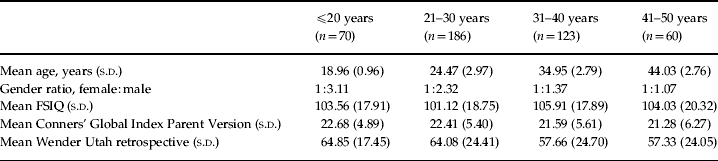
The characteristics of the groups are presented in Table 1. The full-scale intelligence quotient (IQ) score was measured using either a short-form of the Wechsler Adult Intelligence Scale, third edition UK (Wechsler, Reference Wechsler1997) or the Wechsler Abbreviated Scale of Intelligence (Wechsler, Reference Wechsler1999). Severity of childhood ADHD was assessed using retrospective ratings of symptoms according to the Conners' Global Index Parent Version (Conners et al. Reference Conners, Parker, Sitarenios and Epstein1998) and the Wender Utah scale (Ward et al. Reference Ward, Wender and Reimherr1993). These were completed prior to the assessment by an informant, usually a parent, who knew the participant in childhood.
Background characteristics of participants by age group

s.d., Standard deviation; FSIQ, full-scale intelligence quotient.
The mean age of each age group generally fell in the middle of the age band, with the exception of the youngest age group. This group's age range was skewed towards the top of the age band because the service only catered for adults and adolescents who were no longer attending school.
The gender ratio changed according to the age group, with over three males for every one female in the youngest age group, decreasing to almost an even male:female ratio in the older age group, However there were no main effects of gender on the dependent variables when exploratory analyses were conducted.
One-way analysis of variance (ANOVA) showed no significant differences between groups with regard to full-scale IQ scores, with all groups' mean IQs falling in the average range.
There was also no significant difference between the groups with regard to childhood ADHD symptoms as measured by retrospective ratings scales but it should be noted that although it did not reach statistical significance, the two older age groups' mean scores on the Wender Utah scale were approximately seven points lower than those of the two younger age groups. In order to take into account the possibility of these older groups having a less severe form of ADHD in childhood, all analyses in the results section were repeated co-varying for Wender Utah score, but this did not affect the findings.
Procedure
Prior to their assessment, participants were required to complete ratings scales regarding their current ADHD symptoms and mood and anxiety symptoms. An informant who knew the patient for at least 6 months was also asked to complete the current ADHD symptom scale. Participants were assessed using a fixed battery of neuropsychological tests as part of their diagnostic assessment.
Measures
Behavioural symptom ratings
Behavioural ADHD symptoms were assessed using the Barkley Scale (Barkley, Reference Barkley1998). This measure provides the 18 DSM-IV ADHD diagnostic criteria and the participant is required to rate whether they experience each symptom (0, not at all; 1, occasionally; 2, sometimes; 3, very often). This was administered in two versions: (a) current symptoms over the previous 6 months rated by the participant (self-rating) and (b) current symptoms over the previous 6 months rated by an informant who knew the participant well (informant-rating). A total score was calculated by summing all item scores. Inattention, hyperactive and impulsive scores were also calculated by summing the scores for the respective nine inattentive, six hyperactive and three impulsive items.
Neuropsychological function
The neuropsychological measures were chosen to assess different aspects of attention, response inhibition and executive function as follows:
-
(1) Selective attention: scaled score from ‘Telephone search task’ of Test of Everyday Attention (Robertson et al. Reference Robertson, Ward, Ridgeway and Nimmo-Smith1994). This measure assesses the capacity for selective or focused attention. It involves searching a telephone directory page for certain symbols at speed. The summary score represents the time taken to search the page for symbols divided by the number of symbols correctly identified.
-
(2) Divided attention: scaled score from ‘Telephone search whilst counting task’ of Test of Everyday Attention (Robertson et al. Reference Robertson, Ward, Ridgeway and Nimmo-Smith1994). This measure assesses divided attention, or the ability to perform two tasks simultaneously. It involves completing the ‘Telephone search task’ as described above, whilst simultaneously counting strings of auditory tones. The summary score represents the dual task decrement, which is calculated by subtracting the ‘Telephone search’ test summary score from the parallel score achieved with the additional divided attention task demands.
-
(3) Shifting attention: accuracy and timing scaled scores from ‘Visual elevator task’ of Test of Everyday Attention (Robertson et al. Reference Robertson, Ward, Ridgeway and Nimmo-Smith1994). This measure assesses the ability to switch attention, the ability to change a train of thought. It involves counting a series of pictures of elevator doors and changing the direction of counting whenever an arrow appears. Scores represent the accuracy and timing (seconds per switch) of performance.
-
(4) Sustained attention: errors of omission score from Continuous Performance Test (CPT; Cornblatt & Erlenmeyer-Kimling, Reference Cornblatt and Erlenmeyer-Kimling1985). This measure assesses the ability to sustain concentration and vigilance. It involves the presentation of playing card stimuli on a computer screen and responding when two successive stimuli are identical. The scores represent the number of omissions (i.e. the number of times the participant has not responded to the presentation of two successive identical stimuli).
-
(5) Response inhibition: mean reaction time score and errors score from Matching Familiar Figures (Cairnes & Cammock, Reference Cairnes and Cammock1978). This measure assesses impulsiveness versus reflectiveness in cognitive style. It involves identifying target pictures among five distracters with both speed and accuracy. The scores represent the length of time it takes to recognize the target picture and how many errors are made until the correct targets have been identified.
In order to account for the effects of normal ageing, all scores provided are Z scores calculated either from published age-scaled scores provided in the manual (for Test of Everyday Attention measures 1–3) or locally available normative data from previous studies (Young & Toone, Reference Young and Toone2000; Young & Gudjonsson, Reference Young and Gudjonsson2005) (for CPT and Matching Familiar Figures).
Co-morbid psychological symptoms
Co-morbid psychological symptoms were assessed using the Hospital Anxiety and Depression Scale (Zigmond & Snaith, Reference Zigmond and Snaith1983), which provides separate anxiety and depression total scores.
Analysis
Three methods of analysis were used. First, one-way ANOVAs were performed to examine the main effect of age group on each of the dependent variables with regard to behavioural symptom ratings, neuropsychological function, and co-morbid symptoms respectively and to determine in which decades the main changes were occurring. If a main effect of age group was detected, this was examined using post-hoc least significant difference (LSD) tests in order to determine where the differences between age groups arose. Second, correlational analyses were performed to investigate the strength of the relationship between age and each of the dependent variables. Finally, linear regression analyses were conducted in order to determine the extent to which age and dependent variables predict self- and informant-rated behavioural symptom ratings. Whilst these three approaches to the analysis are very similar, they offer the opportunity to explore the data in slightly different ways. By using ANOVA with age groups by decade, it is possible to determine when in the time course particular changes arise and identify issues that are clinically relevant to certain age groups. The correlational analysis provides information regarding the strength of the relationship between age and the variables, whereas the linear regression allows identification of significant predictors of symptoms. The Bonferroni correction was used to account for multiple analyses within each analysis type.
Results
One-way ANOVA results
In order to determine whether there are differences in behavioural symptom ratings, neuropsychological function and co-morbidities across age groups, one-way ANOVAs were conducted. Where there was a main effect of age group, post-hoc LSD tests were used to examine the specific differences between age groups by decade.
Behavioural symptom ratings
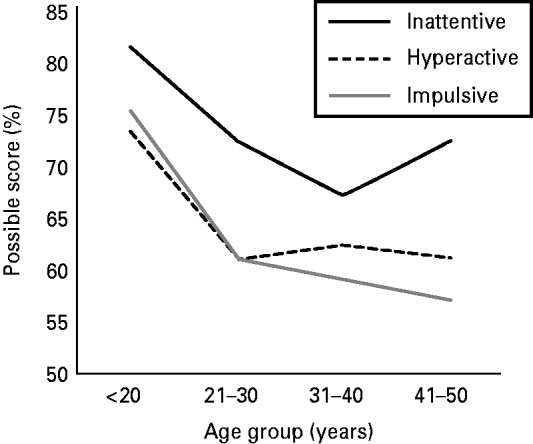
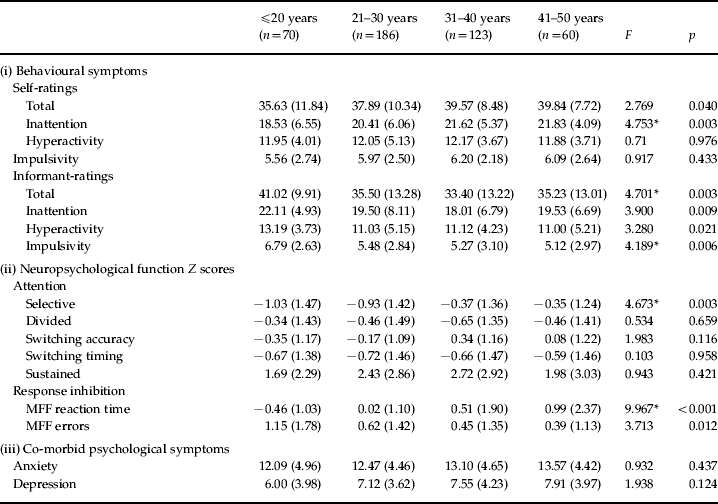
Table 2 shows that there was a significant main effect of age group for the total score for informant-ratings of behavioural symptoms and a trend towards significance for self-ratings. However, this reflected an increase in symptoms with age according to self-ratings (see Fig. 1), but a decrease in symptoms with age according to informant-ratings (see Fig. 2).
Self-ratings of behavioural symptoms. Inattentive, hyperactive, impulsive.

Informant-ratings of behavioural symptoms. Inattentive, hyperactive, impulsive.

Results according to age group for behavioural symptom ratings, neuropsychological function and co-morbid psychological symptoms

Data are given as mean (standard deviation).
MFF, Matching Familiar Figures.
* p<0.01.
Figs 1 and 2 show that when examining scores as a percentage of the possible total for each core symptom, inattentive symptoms were the most prominent according to both self- and informant-ratings. The self-rated symptoms significantly worsened with increasing age group for inattentive symptoms, but not hyperactivity or impulsivity. Post-hoc LSD tests showed a significant increase in self-rated inattentive symptoms between the 20–29 years age group and the 30–39 years age group (p=0.044).
In contrast, a pattern of decreasing severity was found for informant-ratings of impulsivity. Post-hoc LSD tests showed a significant decrease in informant-rated impulsivity between the ⩽20 years and the 41–50 years age groups (p=0.050). There was also a strong trend for hyperactivity, with most of the decline occurring in early adulthood. The main effect of age almost reached significance for informant-rated inattention and although this score decreased across age groups until the fourth decade, it increased again for the 41–50 years age group.
Neuropsychological function
From the neuropsychological measures of attentional functioning, there was only a main effect of age group on selective attention scaled scores. Post-hoc LSD tests showed a significant difference between the 21–30 and 31–40 years age groups (p=0.030). There was a main effect of age group on the response inhibition variable of reaction time and a trend towards significance for the errors score of the Matching Familiar Figures test.
Co-morbid symptoms
There was no main effect of age group on anxiety and depression scores. However, there seemed to be a non-significant pattern for both ratings to increase with age. This was explored further using correlational analysis and it was found that whilst there was no significant relationship between anxiety symptoms and age, there was a correlation between severity of depressive symptoms and age (R=0.247, p<0.001). This indicates that depressive symptoms increase in severity with increasing age.
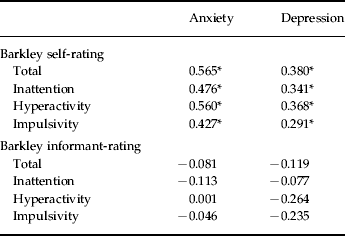
In order to determine whether there was a relationship between co-morbid symptom ratings and (1) behavioural ratings of ADHD symptoms and (2) neuropsychological function, further correlational analyses were performed. Both anxiety and depression scores were found to have highly significant correlations with all self-ratings with mild to moderate strength (see Table 3). In contrast, there were no significant correlations between informant-ratings of behavioural symptoms and anxiety and depression scores.
Pearson's correlations between anxiety and depression scores and behavioural symptom self-ratings

* p<0.05.
Correlational analysis results
Behavioural symptom ratings
A correlational analysis allowed further exploration of the relationship between ADHD symptoms and age. There were no significant relationships between self-ratings of current symptoms and age. However, there were mild to moderate negative correlations between informant-ratings of current symptoms and age, indicating symptom improvement with increasing age of participants (Barkley total score, R=−0.222, p<0.001; inattention, R=−0.227, p<0.001; hyperactivity, R=−0.144, p<0.01; impulsivity, R=−0.201, p<0.001).
Neuropsychological function
Pearson's product moment correlations were also performed in order to evaluate the relationship between neuropsychological function and age. There was a significant positive correlation between selective attention and age (R=0.176, p<0.001), indicating improvement in selective attention performance with increasing age. There was also a significant correlation between response inhibition reaction time and age (R=0.282, p<0.001), indicating a slowing of reaction time with increasing age. No other correlations between neuropsychological function variables and age were significant.
Co-morbid symptoms
There were also no significant correlations between anxiety and depression scores and neuropsychological function, with the exception of a mild positive correlation between depression and sustained attention score (R=0.187, p=0.001). This indicates that with increasing severity of depression there is a corresponding deterioration in sustained attention performance.
Regression analysis
Finally, standard multiple regression was used to examine the unique variance from each of the variables (age, neuropsychological function, co-morbidity) in predicting the self- and informant-rated behavioural symptom total scores. For the self-rated behavioural total score, the model explained 19.9% of the variance and the only variable which made a significant unique contribution was the depression score (standardized β=0.289). However, for the informant-rated behavioural total score, the model explained 15.3% of the variance and both age (standardized β=−0.186) and depression made a significant unique contribution (standardized β=0.167).
Discussion
We investigated age-related differences in behavioural ADHD symptoms, neuropsychological function, and co-morbid anxiety and depression symptoms in an adult ADHD clinical population.
We found a significant association between increasing age and improvement in ADHD presentation as indicated by both informant-ratings of behavioural symptoms and to a certain degree on tests of neuropsychological function. However, the subjective experience of inattentive symptoms worsened with increasing age, as did severity of co-morbid symptoms, and these were related to each other. There was also a significant relationship between severity of depression and sustained attentional abilities.
Our finding that severity of behavioural symptoms in ADHD, as measured using informant-ratings, improves with increasing age is consistent with studies of children (e.g. Cohen et al. Reference Cohen, Cohen and Brook1993) and young adults (Young & Gudjonsson, Reference Young and Gudjonsson2008). Also, this improvement was particularly prominent for the impulsivity symptoms, as indicated by informant-ratings and better performance on a response inhibition task. The age-related change was less pronounced for the hyperactivity symptoms, which have been reported to show the greatest change through childhood to adolescence (Biederman et al. Reference Biederman, Mick and Faraone2000). Therefore, by adulthood, overactive behaviour may have already dissipated significantly, leaving little room for further improvement. Alternatively, it could be that adults with ADHD have developed adaptive strategies to cope with hyperactive symptoms, resulting in ratings reflecting them as less problematic.
In contrast with informant-ratings, self-ratings of behavioural symptoms did not improve with age and, contrary to expectations, a significant deterioration across age groups was identified in self-rated inattentive symptoms, and these were rated as causing greater difficulties than impulsive or hyperactive symptoms. This suggests that individuals with ADHD subjectively experience a similar degree of behavioural symptoms regardless of their age and that older people find them as impairing as younger people within the adult ADHD clinical population. This is an important consideration, given that a high proportion of the sample had been diagnosed ‘de novo’ in adulthood and it has previously been reported that motivation to receive a diagnosis is often high (Van der Linden et al. Reference Van der Linden, Young, Ryan and Toone2000), possibly leading some individuals to over-report symptoms. This may have been more pronounced for the older age groups, as the discrepancy between their self- and informant-ratings seemed to widen with age. Previous research has shown a more reliable correspondence between informant-rated than self-rated behavioural symptoms and neuropsychological performance (Young & Gudjonsson, Reference Young and Gudjonsson2005). Indeed, in the current study, the finding of an increase in inattentive symptoms is contradicted by the finding that performance on a selective attention neuropsychological test improves with age, although performance on all other attentional tasks did not show age-related change.
Nevertheless, it should be acknowledged that the informant's knowledge of the individual with ADHD's behaviour may also vary across the lifespan. The vast majority of the informants were parents for this study, as participants were requested to have measures completed by someone who knew them well in childhood. Parents may be less aware of the behavioural symptoms of their child in adulthood, particularly those that are less observable such as inattentive difficulties, and they may have less awareness of what is developmentally appropriate for young adults and beyond. It would have been useful to also include measures completed by spouses or close friends in order to determine the reliability of parental informant-ratings, and also the nature of any discrepancies with self-reports.
However, consistent with the informant-ratings of behavioural improvement with age, there was a trend towards better response inhibition or cognitive impulsivity, with both a slowing in response time and a trend towards a reduction in the number of errors. The finding that neuropsychological function improves over time through middle adulthood for adults with ADHD is important, as the trajectory in normal ageing for performance on attentional and executive functioning tasks is a deterioration from the third decade onwards (Craik & Bialystock, Reference Craik and Bialystok2006). Therefore the adult ADHD clinical sample is likely to be showing a greater absolute improvement in function, i.e. in raw scores, given that their scores are already converted into age-matched Z scores.
The relationship between co-morbid affective symptoms and age has relevance both for interpreting self-rated measures and for intervention. It is possible that the trend towards a worsening of self-rated inattentive behavioural symptoms with age is due to low mood exacerbating existing attentional difficulties. There was a relationship between depression score and sustained attentional performance, which is consistent with CPT studies of affective disorders (e.g. Koetsier et al. Reference Koetsier, Volkers, Tulen, Passchier, van den Broek and Bruijn2002). Hopwood & Morey (Reference Hopwood and Morey2008) suggest that emotional problems may suppress the relationship between performance on the CPT and other indicators of ADHD, as identified in previous literature that questions the validity of the CPT in adult ADHD assessment (e.g. McGough & Barkley, Reference McGough and Barkley2004).
There may also be a negative reporting bias associated with depression which affects the accuracy of self-ratings (Zuroff et al. Reference Zuroff, Colussy and Wielgus1983); therefore it would seem prudent to interpret self-rated adult ADHD scales with caution and not in isolation. Nevertheless, given that the majority of the participants in the sample were receiving a diagnosis of ADHD for the first time in adulthood, it seems that the longer the disorder is left untreated, the worse the co-morbid mood symptoms. It is likely that individuals with lifelong untreated ADHD will have been exposed to a greater number of life events such as academic and occupational failures and relationship problems that may precipitate a depressive disorder that warrants intervention. It is also possible that the depression scale was not as suitable for younger populations and less sensitive to mood difficulties in this age group.
Since the proportion of females increased in the older age groups, this may have additionally affected mood ratings, given that women are more likely to become depressed than men in the general population (Weissman & Klerman, Reference Weissman and Klerman1977). However, consistent with the current findings, Biederman et al. (Reference Biederman, Faraone, Monuteaux, Bober and Cadogen2004) found no significant gender differences in psychopathology in an adult ADHD population. It therefore seems more likely that co-morbid affective problems affect both males and females with ADHD and should be thoroughly investigated at assessment.
A major disadvantage of using a cross-sectional rather than a prospective design is that it does not allow the exploration of progression of symptoms over time for individuals and therefore ignores potential heterogeneity by including both ‘remitters’ and ‘persisters’. In a follow-up study of children with ADHD, Halperin et al. (Reference Halperin, Trampush, Miller, Marks and Newcorn2008) examined whether any difference was present between the neuropsychological profiles of ‘remitters’ and ‘persisters’ and found that children whose ADHD persisted into young adulthood had more severe executive deficits than those who remitted. It is possible that in the current study there are only limited differences between groups because the older groups have a more severe form of ADHD that has persisted further into the lifespan whereas the younger group has a form of ADHD that may remit or diminish to a lower level before they reach the same stage.
Another consideration in the use of a cross-sectional design is that several groups with different profiles of previous treatment will be included. A large number of participants in the sample are ‘de novo’ patients with ADHD only being recently recognized; others will have been diagnosed with ADHD in childhood and discontinued treatment in late adolescence despite persistence of symptoms (McCarthy et al. Reference McCarthy, Asherson, Coghill, Hollis, Murray, Potts, Sayal, de Soysa, Taylor, William and Wong2009; Wong et al. Reference Wong, Asherson, Bilbow, Clifford, Coghill and DeSoysa2009). Some will have received treatment in childhood and continued engagement through transition into adulthood. Differences between these groups have not been fully investigated. Able et al. (Reference Able, Johnston, Adler and Swindle2007) found large demographic differences between adults with previously diagnosed and undiagnosed ADHD, with undiagnosed adults having lower levels of educational attainment and a lower average income compared with those diagnosed with ADHD. It could be the case that impairment differs according to treatment and the presence of long-term undiagnosed ADHD increases problems, as effective strategies to mediate problems are not implemented. The profiles of participants, in terms of previous treatment, should therefore be considered in future studies looking at long-term impairment.
Another significant limitation is the lack of an age-matched healthy comparison group that had been assessed using the same behavioural, cognitive and affective measures. Whilst age-matched norms were used to attempt to take into account the effects of normal ageing for the neuropsychological assessment data, these data were not from the same sample of healthy controls across all tests and this will inevitably have introduced further variability. The inclusion of a healthy control group would allow a clearer understanding of the age-related changes in behaviour, cognitive functioning and co-morbidity that are specific to ADHD rather than typical of the general population.
A further limitation is the implicit assumption that ADHD ‘looks the same’ across development and that adult symptoms can be measured using childhood diagnostic criteria (Faraone, Reference Faraone2000). Therefore, the use of a rating scale based on childhood ADHD DSM-IV criteria to measure symptom change may not be sufficiently sensitive to detect differences in adulthood ADHD. Future research should also include a measure of functional impairment to determine whether this identifies further alterations in presentation regardless of DSM-IV symptom change.
Whilst attempts were made to compensate for possible reliability issues using self-rated behavioural symptoms by supplementing them with informant-ratings and objective neuropsychological tests, co-morbid anxiety and depression symptoms were assessed only using a self-rated measure. Using a more comprehensive method such as a semi-structured interview schedule may have highlighted additional changes in co-morbidity with age, particularly regarding personality traits and disorders, which are commonly associated with adulthood ADHD (May & Bos, Reference May and Bos2000).
In conclusion, this large cross-sectional study of clinically referred adults with ADHD showed improvement with age in behavioural ADHD symptoms as rated by informants and neuropsychological function, with regard to selective attention and response inhibition. This is relatively consistent with the trajectory observed in children and adolescents with ADHD and suggests a continuation of remission of the disorder. However, the subjective experience of symptoms, particularly inattention, was not shown to improve, and co-morbid symptoms increased in severity with age. Further prospective studies need to be conducted in order to establish whether these age-related differences are replicated using a within-subject design.
Acknowledgements
Funding was received from NIHR.
Declaration of Interest
J.B., S.Y. and P.A. have all spoken at meetings sponsored by Eli Lilly. S.Y. and P.A. have spoken at meetings sponsored by Janssen-Cilag. S.Y. has received unrestricted research funds from Eli Lilly and P.A. has received unrestricted research funds from Janssen-Cilag.