Obsessive-compulsive disorder (OCD) is characterised by obsessions and/or compulsions that are aimed at reducing distress (American Psychiatric Association, 2013). OCD is associated with functional limitations across many important areas, including work, education, and social and family settings (Bobes et al., Reference Bobes, Gonzalez, Bascaran, Arango, Saiz and Bousono2001; Fontenelle et al., Reference Fontenelle, Fontenelle, Borges, Prazeres, Range, Mendlowicz and Versiani2010; Subramaniam, Abdin, Vaingankar, & Chong, Reference Subramaniam, Abdin, Vaingankar and Chong2012).
One way in which OCD can be experienced involves scrupulosity, where the person has religious obsessions concerning fear of committing sin (past, present or future), fear of being punished by God, or fear of being sent to hell, or has unwanted disturbing mental images of a disrespectful or blasphemous nature (Abramowitz, Huppert, Cohen, Tolin, & Cahill, Reference Abramowitz, Huppert, Cohen, Tolin and Cahill2002). Individuals with scrupulosity are often extremely concerned that their actions or unintentional thoughts will increase the probability and risk of God's wrath (Nelson, Abramowitz, Whiteside, & Deacon, Reference Nelson, Abramowitz, Whiteside and Deacon2006). The belief that thoughts are morally equivalent to actions is known as Moral Thought Action Fusion (MTAF; Shafran, Thordarson, & Rachman, Reference Shafran, Thordarson and Rachman1996), and is common among those with scrupulosity. The subjective feeling of guilt and sin among scrupulous persons may reflect a belief that God is closely engaged in the individual's deeds and thoughts, known as the micromanaging view of God (Deacon, Vincent, & Zhang, Reference Deacon, Vincent and Zhang2013). It has been suggested that having a micromanaging view of God may lead to compulsive behaviours, such as excessive prayer or regular confession (Miller & Hedges, Reference Miller and Hedges2008).
Exposure with response prevention (ERP) is one of the most beneficial treatments for OCD (Koran, Hanna, Hollander, Nestadt, & Simpson, Reference Koran, Hanna, Hollander, Nestadt and Simpson2007; NICE, 2006). ERP involves repeated exposure to specific thoughts and actions while refraining from performing compulsive rituals, as a way to reduce the number and severity of OC symptoms (Foa et al., Reference Foa, Liebowitz, Kozak, Davies, Campeas, Franklin and Schmidt2007; McKay, Reference McKay2006; Rowa, Antony, & Swinson, Reference Rowa, Antony, Swinson, Purdon, Antony and Summerfeldt2007). Scrupulosity has a very strong cognitive component, and is closely related to religious and moral belief systems, and to religious observances (Deacon et al., Reference Deacon, Vincent and Zhang2013; Mahintorabi, Jones, Harris, & Zahiroddin, Reference Mahintorabi, Jones, Harris and Zahiroddin2015). As such, for those who are highly religious, scrupulous symptoms may be difficult to distinguish from usual religious observance, and this may delay identification of scrupulosity as a problem (Yaryura-Tobias & Neziroglu, Reference Yaryura-Tobias, Neziroglu, Yaryura-Tobias and Neziroglu1997; Yorulmaz, Karanci, & Tekok-Kilic, Reference Yorulmaz, Karanci and Tekok-Kilic2002). Further, effective interventions for scrupulosity may need to address the meaning of these symptoms for individuals. Additionally, previous research has revealed that the first and main source of guidance for scrupulous people will often be religious authorities, such as Christian clergy, Jewish rabbis, Muslim imams and faith-based healers, rather than health professionals (Al-Solaim & Loewenthal, Reference Al-Solaim and Loewenthal2011; Greenberg & Shefler, Reference Greenberg and Shefler2008; Huppert & Siev, Reference Huppert and Siev2010; Wills & DePaulo, Reference Wills, DePaulo, Snyder and Forsyth1991). Thus, familiarising mental health professionals with religious beliefs and practices has been suggested as a means of achieving better treatment outcomes for scrupulous individuals (Akuchekian, Jamshidian, Maracy, Almasi, & Davarpanah Jazi, Reference Akuchekian, Jamshidian, Maracy, Almasi and Davarpanah Jazi2011).
In order to assess Christian clergy's knowledge of OCD and the advice provided by clergy to congregation members with OCD, Deacon et al. (Reference Deacon, Vincent and Zhang2013) recruited a sample of Christian clergy members in the United States and investigated their scrupulosity-pertinent beliefs, such as MTAF and view of God, and the advice that they reported they would offer a congregation member with these symptoms. Deacon et al. hypothesised that clergy from more conservative denominations would report a more negative view of God, have higher MTAF, and would give more ERP-inconsistent advice to a hypothetical parishioner with scrupulosity compared to clergy from less conservative denominations. Deacon et al. found that clergy from a conservative Lutheran Church reported higher MTAF than less conservative evangelical Lutheran clergy, and that the MTAF scores for conservative clergy were similar to those obtained from OCD samples (Rassin, Merckelbach, Muris, & Schmidt, Reference Rassin, Merckelbach, Muris and Schmidt2001; Storch, Abramowitz, & Keeley, Reference Storch, Abramowitz and Keeley2009). Conservative clergy also reported higher levels of belief in a micromanaging view of God, and their responses to scrupulous parishioners were more likely to be inconsistent with ERP treatment for OCD, recommending that the parishioner engage in deeper study of religious canon and carry out more intensive prayers. Deacon et al. argued that responses such as these may exacerbate OCD symptoms.
The findings of Deacon et al.’s (Reference Deacon, Vincent and Zhang2013) study suggest that some clergy who are authorities from whom parishioners seek advice may be unaware of scrupulosity as a symptom of OCD and may also be unaware of the availability of effective psychological treatments for OCD, such as ERP. The advice provided by religious authorities may therefore inadvertently delay access by parishioners to effective OCD treatment. Thus, Deacon et al. suggested that educating religious personnel about symptom expression of OCD, especially scrupulosity, may be a useful strategy for reducing delay between symptom presentation and provision of professional treatment for OCD. However, the generalisability of the findings to members of other major religious groups, such as Islam and Judaism, is not yet known. As religious Muslims regularly listen to imams preach during religious ceremonies each Friday (Khutbah) and imams influence the personal, social, and political points of view of their listeners (Albayrak, Reference Albayrak2012), it is likely that similar effects would be observed among Muslim samples.
Results of a study by Mahintorabi et al. (Reference Mahintorabi, Jones, Harris and Zahiroddin2015) showed a large and significant difference in the delay between the time that highly religious Muslim women with OCD washing subtype (OCD-W) noticed their OCD symptoms and the time they sought professional help compared with low religious Muslim women with OCD-W. Moreover, highly religious Muslim women with OCD-W reported higher severity of symptoms at the time they were referred to a mental health professional compared with low religious Muslim women with OCD-W. As noted above, members of religious groups may first seek help or advice about their OCD symptoms from religious authorities (Al-Solaim & Loewenthal, Reference Al-Solaim and Loewenthal2011; Deacon et al., Reference Deacon, Vincent and Zhang2013), and religious authorities may unintentionally provide suggestions that are inconsistent with current best practice for the treatment of OCD (Deacon et al., Reference Deacon, Vincent and Zhang2013). This interpretation is consistent with the findings of Mahintorabi, Jones, and Harris (Reference Mahintorabi, Jones and Harris2017) concerning the longer delay to seek professional help and the higher severity of symptoms among HR Muslim participants with OCD-W compared with LR Muslim participants with OCD-W.
To date there have been no studies investigating Muslim imams’ attitudes and advice to mosque-goers with OCD religious symptoms such as scrupulosity. The present study seeks to investigate the beliefs and behaviour of Muslim imams based in Australia and Iran from the two most important denominations in Islam, the Shia and Sunni sects, towards scrupulosity. Worldwide, Sunnis comprise 87–90% of Muslims and Shias comprise 10–13% of Muslims (Pew Research Center, 2009), and Iran has the largest Shia population internationally, with 37–40% of the world's Shia population living there (Pew Research Center, 2009). Sunni Muslims are known to be more conservative than Shia Muslims, maintaining Islamic practices unchanged from the Quran and the Sunnah (Nasr, Reference Nasr2007; Parrinder, Reference Parrinder1983), while among Shia Muslims, laws and rituals are more responsive to specific contexts.
This study extends the work of Deacon et al. (Reference Deacon, Vincent and Zhang2013), which focused on both conservative and liberal Christian clergy in the United States, by comparing samples of conservative and liberal Muslim imams. An online survey was used to seek information about experiences of scrupulosity among Muslim imams. Based on the findings of Deacon et al. (Reference Deacon, Vincent and Zhang2013), it was expected that Sunni imams would report higher MTAF and have a more negative, harsh, punishing, micromanaging view of God compared with Shia imams; Sunni imams would be more likely to respond to a vignette concerning mosque-goers with scrupulosity symptoms in ERP-inconsistent ways compared with Shia imams; in both groups, it was expected that MTAF and negative view of God would be positively associated with ERP-inconsistent responses to scrupulous mosque-goers. Imams’ familiarity and experience with scrupulosity, ERP and other psychological treatments for OCD were also investigated.
Method
Participants
Imam participants were recruited from online directories of Islamic centres for Shia and Sunni Muslims in Australia and Iran (e.g., Canberra Islamic Centre, the National Centre of Excellence for Islamic Studies [NCEIS], and Hozeh and University Cooperation Office). The final sample comprised 64 male imams with a mean age of 38.8 years (range: 25–69 years) from the Shia sect living in Iran (n = 32) or the Sunni sect living in Australia (n = 32), representing a response rate of 36%.
Measures
Demographic information
The demographic questions concerned sex, age, nationality, years of education, country of current residence, number of years working as an imam, and approximate number of attendees at the Friday prayer or daily prayer services held by the imam in the mosque.
Thought Action Fusion Scale (TAFS)
The TAFS (Shafran et al., Reference Shafran, Thordarson and Rachman1996) is a 19-item, self-report measure. Respondents use a Likert-type scale ranging from 0 (disagree strongly) to 4 (agree strongly) to indicate their agreement with a series of statements about (a) thoughts being morally equivalent to behaviours (MTAF; 12 items), and (b) the likelihood that thinking about harm that occur to oneself or others increases the likelihood of harm (likelihood TAF [LTAF]; 7 items). An example item from the MTAF is ‘Having violent thoughts is almost as unacceptable to me as violent acts’. An example item from the LTAF is ‘If I think of a relative/friend falling ill this increases the risk that he/she will fall ill’.
The TAFS includes two items with religious themes: (a) ‘Having obscene thoughts in a place of worship is unacceptable to me’ (item 16); (b) ‘Having a blasphemous thought is almost as sinful to me as a blasphemous action’ (item 18). Consistent with Deacon et al. (Reference Deacon, Vincent and Zhang2013), five additional items with religious themes were added to the TAFS to assess scrupulosity-specific TAF in greater depth. These items were (1) ‘If I have a blasphemous thought, God will punish me as severely as if I had done a blasphemous action’, (2) ‘Having obscene sexual thoughts is as unacceptable to God as engaging in obscene sexual activity’, (3) ‘If I have sinful thoughts in a place of worship, God will view me as harshly as if I had engaged in sinful behaviours’, (4) ‘When I think about violent action, God will view me as harshly as if I had committed a violent action’, and (5) ‘In God's eyes, wishing harm on someone is almost as bad as doing harm’. The seven items with a religious theme comprised the Religious TAF (RTAF) subscale and was included to assess scrupulosity-related MTAF.
The TAF total scale (Cronbach's alpha = .93), MTAF subscale (Cronbach's alpha = .97), LTAF subscale (Cronbach's alpha = .83) and RTAF (Cronbach's alpha = .93) have been shown to have good internal consistency in a previous study (Deacon et al., Reference Deacon, Vincent and Zhang2013), and the internal consistency of the TAFS in the current study was adequate, with internal consistency scores of Cronbach's alpha =.87, .77, .89, and .86 for the TAF total scale, MTAF subscale, LTAF subscale, and RTAF subscale respectively.
View of God Inventory (VOGI)
The VOGI (Ironson et al., Reference Ironson, Stuetzle, Ironson, Balbin, Kremer, George and Fletcher2011) comprises 12 statements, 6 assessing Positive View of God (PVOG; sample item: ‘I see God as merciful’) and 6 items assessing Negative View of God (NVOG; sample item: ‘I see God as a harsh judge’). Respondents indicate their agreement with the statements using a Likert-type scale ranging from 0 (strongly disagree) to 4 (strongly agree). The PVOG and the NVOG have been shown to have adequate internal consistency in a previous study (Cronbach's alpha = .86 and .78 for the PVOG and NVOG respectively; Ironson et al., Reference Ironson, Stuetzle, Ironson, Balbin, Kremer, George and Fletcher2011). In the current study the internal consistency for the PVOG (Cronbach's alpha = .74) and the NVOG (Cronbach's alpha = .88) was adequate to good. Consistent with Deacon et al. (Reference Deacon, Vincent and Zhang2013), four items were added to the VOGI to assess the micromanaging view of God (MVOG): (a) ‘I believe that every action I take has significance in God's eyes’, (b) ‘Even brief, minor sins will be taken seriously by God’, (c) ‘I believe that God is aware of every action that I take’, and (d) ‘I believe that God is deeply concerned with even my small actions’. The internal consistency for this scale in the current study was adequate (Cronbach's alpha = .84).
Case vignette
A case vignette was developed based on that used by Deacon et al. (Reference Deacon, Vincent and Zhang2013) and modified to reflect Islamic rituals. It included the following information:
A devout attendee at your place of worship comes to you for help, fearing that she may be going crazy. She states that during the prayer, she can't get unwanted thoughts of cursing God out of her mind. These thoughts cause a great deal of anxiety. Although she used to read the Quran three times daily, she has since stopped because she gets unwanted thoughts of desecrating the pages. The majority of her free time used to be spent on religious activities; however, she cannot do them now without having unwanted blasphemous phrases such as ‘the devil will defeat God’ enter her mind. She feels guilty about her decreasing religious involvement and worries that God is angry with her. She spends between 6 and 8 hours a day engaged in ritualistic prayers during which she asks God to forgive her and not to punish her harshly. More and more of her time has been consumed with analysing the content and sinfulness of her thoughts, such that she now has difficulty concentrating on her job or any other tasks.
Imams were asked to rate their likelihood of engaging in each of 16 actions to assist the individual described in the vignette. Four items concerned referring the help seeker to a mental health professional (e.g., ‘I would recommend that she visit a mental health professional affiliated with our religious denomination’). Four items were concerned with advice consistent with an ERP approach to scrupulosity (e.g., ‘I would reassure her that God will not punish her for unwanted sinful thoughts over which she has little control’). The remaining eight items concerned advice that is inconsistent with the ERP approach, including encouraging more intensive prayer and asking for God's forgiveness, engaging in deeper study of religious doctrine, warning the help seeker that God expects purity in both thought and actions, and warning that sinful thoughts risk God's punishment (Deacon et al., Reference Deacon, Vincent and Zhang2013).
In Deacon et al.’s (Reference Deacon, Vincent and Zhang2013) study, the ERP-inconsistent responses scale demonstrated adequate internal consistency (Cronbach's alpha = .73); however, the ERP-consistent responses scale together with the four treatment referral items failed to form an adequately reliable subscale (Cronbach's alpha = .24). In the current study, the internal consistency measures were consistent with Deacon et al.’s study, with Cronbach's alpha = .71 for the ERP-inconsistent responses scale and Cronbach's alpha = .41 for the ERP-consistent responses. Thus, the items concerning ERP-consistent responses and the items concerning referral to a mental health professional were analysed individually.
Questions concerning experience with scrupulosity, ERP or other psychological treatments for OCD, and about being approached for help for scrupulosity
Finally, six questions were included concerning participants’ experience with scrupulosity, familiarity with scrupulosity as a mental health problem, familiarity with ERP or other psychological treatments for OCD, and experience of being approached for help by mosque-goers concerning scrupulosity. If participants indicated that they had been asked for advice about scrupulosity, additional questions were asked as follows: (a) ‘Approximately how many mosque-goers have approached you for help with scrupulosity?’ (b) ‘What percentage of mosque-goers who approached you for help with scrupulosity did you refer to a mental health professional?’ and (c) ‘Considering ONLY those mosque-goers whom you referred to a mental health professional, in what percentage of cases did you intentionally refer them to a mental health professional who provided ERP (also known as Exposure Therapy)?’ (Deacon et al., Reference Deacon, Vincent and Zhang2013), and (d) ‘What were their symptoms when they approached you for help with scrupulosity?’ The additional item was added in the present study to overcome a limitation identified by Deacon et al. (Reference Deacon, Vincent and Zhang2013).
Procedure
The study was approved by the University of Sydney Human Research Ethics Committee and data collection was conducted over six months in 2013. Sixty emails were sent in total, 50 to coordinators of Islamic centres in Australia and 10 to coordinators in Iran; 13 of the emails were returned due to failure of the delivery system. Forty-seven coordinators replied and stated that they would distribute the emails through their contact lists of imams. One hundred and seventy-eight imams (83% males; n = 147) received invitation emails from coordinators. Of these, n = 98 (55%) were sent to Sunni imams in Australia. All emails were sent to potential participants by coordinators and the email included information about the study and a link to the online survey hosted on Google Drive. Participants were advised that completion and submission of the survey was understood to imply consent. The online survey presented information in the following order: demographic questions, VOGI, TAFS, familiarity with scrupulosity, and the case vignette. The survey took a maximum of 30 minutes to complete. Participants were not compensated for participating in the study.
Results
Characteristics of the Sample
There were no significant differences between Shia imams and Sunni imams in age, t(62) = 1.91, p = .06, number of years of education, t(62) = -1.61, p = .11, number of years working as an imam, t(62) = 1.79, p = .08, or the estimated number of attendees at services conducted by the imam, t(62) = -0.75, p = .46 (see Table 1).
Demographic Characteristics of the Sample (n = 64)

Note: *p < .05.
All participants who completed the online survey in Iran were originally from Iran; however, imams in Australia were originally from Afghanistan and Iraq (15.6% each), Bangladesh, Lebanon and Turkey (12.5%), Egypt, Pakistan and India (9.4% each) and Sri Lanka (3.1%).
Thought Action Fusion Scale and View of God Inventory
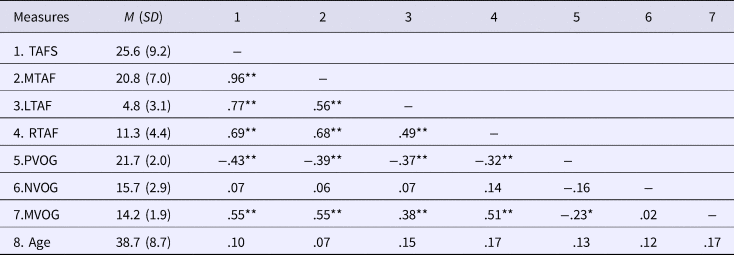
The sample means and standard deviations for the VOGI and TAFS and correlations between these measures are presented in Table 2. The RTAF, MTAF and LTAF subscales were significantly correlated with each other. The MTAF, RTAF and LTAF subscales were also significantly correlated with the PVOG and MVOG subscales. None of the TAF subscales were correlated with the NVOG subscale, and there were no significant associations between age and any of the TAF or VOGI scales (see Table 2).
Means, Standard Deviations, and Zero-Order Correlations Between Belief Measures

Note: TAFS = Thought Action Fusion Scale Total Score; MTAF = Thought Action Fusion Scale Moral subscale; LTAF = Thought Action Fusion Scale Likelihood of Harm subscale; RTAF = Thought Action Fusion Scale Religious subscale; PVOG = Positive View of God subscale of the View of God Inventory; NVOG = Negative Positive View of God subscale of the View of God Inventory; MVOG = Micromanaging View of God; Age = age in years.
*p < .05, **p < .01.
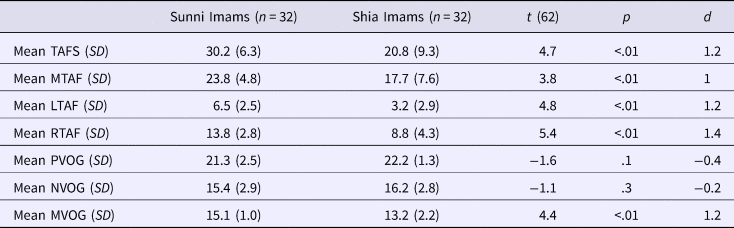
Independent sample t tests were used to compare imam groups on the VOGI and the TAFS (see Table 3). There was no significant difference between the Sunni and Shia imam groups on PVOG or NVOG (ps > .05). Sunni imams had significantly higher scores than Shia imams on the LTAF, t(62) = 4.8, p < .01; RTAF, t(62) = 5.4, p < .01; MTAF, t(62) = 3.8, p < .01; and MVOG scales, t(62) = 4.4, p < .01. The significant differences represent large effect sizes (Cohen, Reference Cohen1988; see Table 3).
Means, standard deviations, t tests, and effect sizes (d) for Sunni imams and Shia imams on Thought Action Fusion and View of God Scales

Note: TAFS = Thought Action Fusion Scale Total Score; MTAF = Thought Action Fusion Scale Moral subscale; LTAF = Thought Action Fusion Scale Likelihood of Harm subscale; RTAF = Thought Action Fusion Scale Religious subscale; PVOG = Positive View of God subscale of the View of God Inventory; NVOG = Negative Positive View of God subscale of the View of God Inventory; MVOG = Micromanaging View of God.
Responses to the Vignette
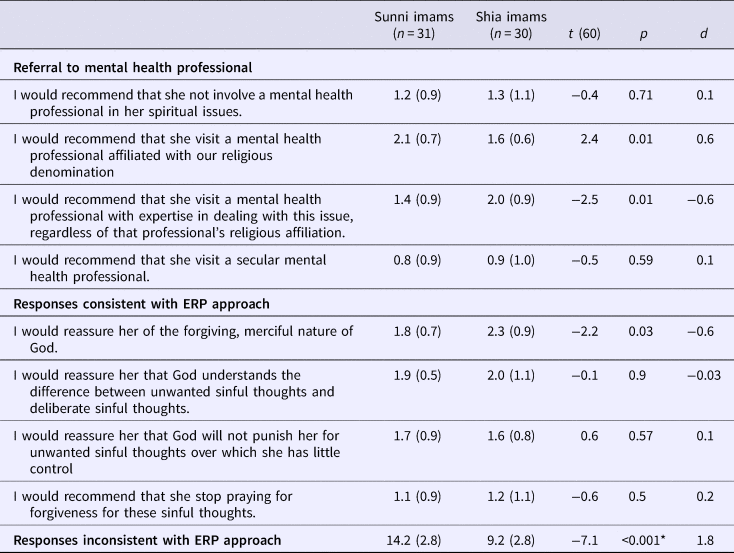
Means and standard deviations for the responses to the case vignette are presented in Table 4. The type 1 error rate was set at α = .006 to account for multiple comparisions. The only significant difference between Sunni imams and Shia imams was on the ERP-inconsistent responses scale, t(62) = 7.04, p < .001, d = 1.8. Sunni imams were more likely than Shia imams to recommend actions inconsistent with the ERP approach to scrupulosity (see Table 4).
Means, standard deviations, t tests, and effect sizes for Sunni Imams and Shia Imams comparing responses to the case vignette.

Note: * α = .006.
Association Between Belief Measures and Responses to the Case Vignette
Bivariate correlations were computed to investigate the association between belief measures and scores on the ERP-inconsistent responses scale. There were significant positive correlations between the ERP-inconsistent responses scale and the MTAF (r = .26, p < .05), LTAF (r = .45, p < .001), RTAF (r = .4, p < .005) and the MVOG (r = .34, p < .05), but no significant correlation between the ERP-inconsistent responses scale and NVOG (r = .03, p = .79) or PVOG (r = -.11, p = .37).
Multiple regression was used to examine RTAF, LTAF and MVOG as predictors of ERP-inconsistent recommendations. The MTAF was excluded because it was highly correlated with the RTAF and LTAF. According to Maxwell (Reference Maxwell2000), a ratio of 20 participants to one predictor is sufficient for running multiple regression. Results of the regression analysis revealed that each of predictors explained a considerable share of the variance in ERP-inconsistent actions: RTAF, F(1, 62) = 10.76, p = .002, adjusted R 2 = .13; LTAF, F(1, 62) = 15.32, p = .000, adjusted R 2 = .19; and MVOG, F(1, 62) = 7.83, p = .007, adjusted R 2 = 0.1. The results of this analysis are presented in Table 5.
Multiple regression predicting ERP-inconsistent responses to case vignette from RTAF, LTAF and MVOG

Note: RTAF = Thought Action Fusion Scale Religious subscale; LTAF = Thought Action Fusion Scale Likelihood of Harm subscale; MVOG = Micromanaging View of God.
*p < .05.
Imams’ Familiarity With Scrupulosity and OCD
Thirty-one participants (48%) reported familiarity with scrupulosity as a mental health problem. Seventeen of these (26%) said that they were aware of psychological treatments for scrupulosity, although only eight (12%) were familiar with ERP specifically. More than a third of all participants (n = 24; 37%) reported having been approached by mosque-goers for help with scrupulosity. These individuals reported assisting an average of 3.8 (SD = 0.48) mosque-goers with scrupulosity, and reported referring 9% (SD = 21.38) to a mental health professional. Only one imam reported having referred mosque-goers for ERP specifically. The scrupulous symptoms among mosque-goers were doubts about washing rituals or being impure before prayer, doubt about incompleteness or inappropriateness of performed religious rituals then repeating rituals so as to be accepted by God, performing excessive prayer for seeking God's forgiveness, and having blasphemous thoughts about God and Prophet Mohammad.
Discussion
This study examined view of God, TAF, and responses to a vignette about a mosque-goer with scrupulosity in a sample of Shia imams from Iran and Sunni imams from Australia. As hypothesised, moral TAF was significantly higher among the more conservative Sunni imams compared with Shia imams, although the positive view of God as benevolent and merciful was not significantly different between these groups. Sunni imams were also more likely to endorse beliefs in a micromanaging God compared to Shia imams, and this is consistent with the results of Deacon and colleagues (Reference Deacon, Vincent and Zhang2013), who compared Christian Lutheran clergy from groups that varied in level of conservative religious views.
All of the Shia imams in the present study were born in and lived in Iran, whereas the Sunni imams had a range of countries of birth and were living in Australia at the time of the survey. Therefore, the differences between the Shia and Sunni imams may be due to a range of factors other than denomination, such as country of birth, country of residence or migration experience, limiting the generalisability of our findings to other Sunni and Shia samples and pointing to the need for replication. However, according to the Australian Bureau of Statistics, Sunni Muslims comprise the majority of Muslims in Australia compared with Shia Muslims (Hassan, Reference Hassan2015). In contrast, between 89–94% of Muslims in Iran are Shia and 5–9% Sunni (United States Department of State, 2017). Due to the very different distributions of Sunni and Shia between Australia and Iran, the different pattern of respondents by sect in these countries is not surprising.
Purity of thought has been emphasised in Islamic doctrine (Altin & Gencoz, Reference Altin and Gencoz2011). For example, the Quran states ‘whatever is in the heavens and whatever is in the earth is Allah's; and whether you manifest what is in your mind or hide it, Allah will call you to account according to it; then He will forgive whom He pleases and chastise whom He pleases, and Allah has power over all things’ (Quran, 2:284). The confound between sect and country of residence means that it is not possible to conclusively attribute differences between groups to sect or country of residence. However, the findings of the current study showed that Sunni Imams living in Australia were more likely to endorse beliefs about God and morality that are related to scrupulosity in highly religious people compared to Shia Imams living in Iran (Abramowitz, Reference Abramowitz, Abramowitz, McKay and Taylor2008; Deacon et al., Reference Deacon, Vincent and Zhang2013; Miller & Hedges, Reference Miller and Hedges2008).
It was also predicted that Sunni imams would be more likely than Shia imams to respond to the vignette about a hypothetical mosque-goer with symptoms of scrupulosity with ERP-inconsistent advice, and the findings supported this. The Sunni imams recommended praying to God for forgiveness of sinful thoughts, warning of God's expectations for purity in thought and deed and advising regular revealing of sinful thoughts. These practices have the potential to reinforce religious OCD symptoms (Huppert & Siev, Reference Huppert and Siev2010).
Overall, these findings are consistent with those of Deacon and colleagues (Reference Deacon, Vincent and Zhang2013) and suggest that religious authorities from more conservative denominations are more likely to consider scrupulosity as a spiritual problem rather than an indicator of mental illness and therefore not encourage help seekers to ask for professional mental health treatment (Deacon, et al., Reference Deacon, Vincent and Zhang2013). Sunni imams were significantly less likely than Shia imams to recommend referral to a mental health professional not affiliated with their own denomination, and Shia imams were more likely to provide reassurance to the mosque-goers regarding God's forgiving and merciful nature.
It was also hypothesised that imams with higher moral TAF would provide more ERP-inconsistent recommendations to scrupulous mosque-attendees. Belief in a micromanaging God, moral TAF, religious TAF, and likelihood of harm TAF were all significantly correlated with ERP-inconsistent responses. The moral TAFS and the religious TAFS assessed concerns about the fear of punishment by God and the immorality of intolerable thoughts for them, while the micromanaging view of God scale evaluated God's appraisal of the individual's thoughts and deeds without considering the actual costs. Consequently, it is likely that the ERP-inconsistent advice of Sunni imams to scrupulous mosque-goers was due to the imam's concern for the spiritual wellbeing of the individual (Deacon et al., Reference Deacon, Vincent and Zhang2013).
Findings from the present study are consistent with previous research suggesting that scrupulosity is elevated in devout people affiliated with Muslim sects in which the sinful character of improper thoughts are highlighted (Yorulmaz, Gencoz, & Woody, Reference Yorulmaz, Gencoz and Woody2009; Yorulmaz, Karanci, Bastug, Kisa, & Goka, Reference Yorulmaz, Karanci, Bastug, Kisa and Goka2008; Yorulmaz, Yilmaz, & Gencoz, Reference Yorulmaz, Yilmaz and Gencoz2004). The most frequent scrupulous symptoms of mosque-goers reported by imams were excessive doubt and concerns about correctly performing religious rituals or being impure and excessive washing before prayer. These symptoms are consistent with religious OCD symptoms reported among religious Muslims with scrupulosity in other studies (Al-Solaim & Loewenthal, Reference Al-Solaim and Loewenthal2011; Ghassemzadeh, Khamseh, & Ebrahimkhani, Reference Ghassemzadeh, Khamseh, Ebrahimkhani and Ling2005; Okasha, Saad, Khalil, El Dawla, & Yehia, Reference Okasha, Saad, Khalil, El Dawla and Yehia1994), suggesting that those imams who said that they had been asked for advice by mosque-goers are accurately identifying scrupulous OCD symptoms.
The findings also revealed that more than half of the Muslim imams who completed the survey were unfamiliar with scrupulosity as a symptom of mental illness, and the majority were unfamiliar with ERP as a psychotherapy approach to treat scrupulosity. Imams in this sample reported that they referred less than one-third of all scrupulous help seekers to a mental health professional for professional treatment. This suggests that culturally appropriate health promotion to inform Imams about scrupulosity and about evidence-based treatment for OCD may reduce delays between mosque-goers seeking advice about their symptoms from imams and seeking professional help.
This study has a number of limitations. One of the most significant issues that limits the generalisability of results was the possible confound between country of recruitment and Muslim sect. However, the pattern of findings was largely consistent with those of Deacon et al. (Reference Deacon, Vincent and Zhang2013), where all of the respondents were located in the United States. Further, none of the imams who responded were female, and this is consistent with the gender distribution among imams, few of whom are female. The online survey methodology would have biased the sample towards imams for whom using computers was more convenient. Importantly, since less than a quarter of participants had been approached for help by mosque-goers with scrupulosity, responses of most imams to the vignette were theoretical and may not represent actual behaviour.
Despite these recognised limitations this study extends previous research by providing the first empirical investigation of imams’ attitudes and behaviours related to scrupulosity. Moreover, recruitment of Sunni and Shia imams from two sects extends the findings of previous research where Muslim sects were combined (Al-Solaim & Loewenthal, Reference Al-Solaim and Loewenthal2011; Shooka, al-Haddad, & Raees, Reference Shooka, al-Haddad and Raees1998). The present findings may have practical implications in providing information to assist cooperation between imams and health practitioners. It is proposed that increasing communication between religious authorities and mental health professionals can be advantageous for both groups (Deacon et al., Reference Deacon, Vincent and Zhang2013), and effective interventions for scrupulosity may be advanced by clinicians and researchers who develop a better understanding of the basis of these concerns. The development of novel cognitive components, such as those that target scrupulosity and TAF could be assisted through consultation with religious authorities. Finally, improved communication with religious authorities about the nature of OCD is likely to be beneficial.