Background
Functional neurological disorder (FND), also known as conversion disorder, refers to a spectrum of neurological symptoms which have no known conventional neurological cause and are assumed psychological in origin (American Psychiatric Association, 2013). A wide range of symptoms and signs are reported, the commonest are seizures, sensory symptoms (e.g. numbness or visual impairment) or motor symptoms (e.g. limb weakness, tremor, dystonia or gait disorders). FND may begin suddenly, progress quickly, increase with attention or excessive fatigue and disappear with distraction (Espay et al., Reference Espay, Aybek, Carson, Edwards, Goldstein, Hallett, Lafaver, Curt Lafrance, Lang, Nicholson, Nielsen, Reuber, Voon, Stone and Morgante2018).
Establishing a population prevalence of FND is difficult due to changes in its terminology, diagnostic criteria and the need for neurological examination prior to diagnosis. Evidence suggests its incidence is 4–5 per 100 000 of the population per year (Binzer et al., Reference Binzer, Andersen and Kullgren1997; Akagi and House, Reference Akagi, House, Halligan, Bass and Marshall2001). A large study of neurology outpatients in Scotland found functional symptoms were the second most common disorder after headache, affecting 16% of patients (Stone et al., Reference Stone, Carson, Duncan, Roberts, Warlow, Hibberd, Coleman, Cull, Murray, Pelosi, Cavanagh, Matthews, Goldbeck, Smyth, Walker and Sharpe2010a), a finding recently replicated in an Australian neurology practice (Ahmad and Ahmad, Reference Ahmad and Ahmad2016).
Previous studies have shown higher rates of females with FND, usually in the range of 60–80% (McCormack et al., Reference Mccormack, Moriarty, Mellers, Shotbolt, Pastena, Landes, Goldstein, Fleminger and David2014; Carson and Lehn, Reference Carson, Lehn, Hallett, Stone and Carson2016; Villain et al., Reference Villain, Mesrati, Naccache, Marie, Roze, Bertrand and Garcin2017), lower socio-economic status (SES) (Binzer et al., Reference Binzer, Andersen and Kullgren1997), lower educational attainment (Stone et al., Reference Stone, Sharpe and Binzer2004; Deka et al., Reference Deka, Chaudhury, Bora and Kalita2007) as well as lower mood and higher anxiety (Binzer et al., Reference Binzer, Andersen and Kullgren1997; Stone et al., Reference Stone, Warlow and Sharpe2010b), although the evidence on this is mixed (van der Hoeven et al., Reference Van Der Hoeven, Broersma, Pijnenborg, Koops, Van Laar, Stone and Van Beilen2015). Views regarding the connection between ethnicity and FND have been expressed over the years, usually along the lines that somatic manifestations of distress occur more in those from non-Western backgrounds (Lambo, Reference Lambo1956; Kleinman, Reference Kleinman1980; Kleinman, Reference Kleinman1982), although comparing rates is difficult due to the disparity in sampling methods and measures used as well as the diagnostic criteria employed (Brown and Lewis-Fernández, Reference Brown and Lewis-Fernández2011).
Childhood sexual and physical abuse rates are higher in FND compared with neurological disorders or healthy controls (Roelofs et al., Reference Roelofs, Spinhoven, Sandijck, Moene and Hoogduin2005b; Sharpe and Faye, Reference Sharpe and Faye2006; Ludwig et al., Reference Ludwig, Pasman, Nicholson, Aybek, David, Tuck, Kanaan, Roelofs, Carson and Stone2018). Studies in neurology settings report lower abuse rates compared with studies in psychiatry settings (Ludwig et al., Reference Ludwig, Pasman, Nicholson, Aybek, David, Tuck, Kanaan, Roelofs, Carson and Stone2018). Estimating the rates of abuse is challenging and depends on the type of measures used and the skill of the interviewer, amongst other factors.
Patients with functional symptoms had the same rate of paid employment as patients with symptoms that were ‘largely’ or ‘completely’ explained by organic conditions, however amongst unemployed patients, patients with functional symptoms were more often unemployed due to ill health and were more likely to receive incapacity benefit and disability living allowance (Carson et al., Reference Carson, Stone, Hibberd, Murray, Duncan, Coleman, Warlow, Roberts, Pelosi, Cavanagh, Matthews, Goldbeck, Hansen and Sharpe2011). The higher rate of benefits is likely explained by the increased physical and mental ill health experienced by functional cases in this study. Functional disorders occur in all areas of medicine and often result in chronic and severe symptoms with attendant high health and social care costs. Bermingham et al. (Reference Bermingham, Cohen, Hague and Parsonage2010) reported that the incremental cost incurred by somatising patients is £3 billion per year, accounting for 10% of total NHS expenditure.
Most studies on motor FND (mFND) have originated in neurology clinics, and are characterised by low sample sizes and lack control groups (Factor et al., Reference Factor, Podskalny and Molho1995; Binzer et al., Reference Binzer, Andersen and Kullgren1997; Crimlisk et al., Reference Crimlisk, Bhatia, Cope, David, Marsden and Ron1998; Schrag et al., Reference Schrag, Trimble, Quinn and Bhatia2004; Ertan et al., Reference Ertan, Derya, Özekmekçi, Kiziltan, Ertan, Yalçinkaya and Özkara2009; van der Hoeven et al., Reference Van Der Hoeven, Broersma, Pijnenborg, Koops, Van Laar, Stone and Van Beilen2015; Garcin, Reference Garcin2018). This could lead to overestimates of abuse risk and co-morbid psychiatric disorders and underestimates of physical illness comorbidities.
This study addresses the imbalance in knowledge on mFND patients within psychiatric settings. We aimed to establish the socio-demographic, health and clinical characteristics, and possible symptom precipitants of mFND patients referred to a large psychiatric NHS Trust and compare outcomes to an otherwise random sample of psychiatric patients derived from the same database but matched for time of presentation.
Methods
Design and source of clinical data
This was a case–control study of mFND patients in contact with secondary mental health services in South London and Maudsley (SLaM) Foundation Trust between 1 January 2006 and 31 December 2016. Data were obtained from the SLaM Biomedical Research Centre's (BRC) ‘Clinical Records Interactive Search’ (CRIS) database. The database contains anonymised electronic health records from SLaM, the largest provider of secondary mental health care in Europe. CRIS holds records on over 250 000 anonymised individuals referred to SLaM services (Perera et al., Reference Perera, Broadbent, Callard, Chang, Downs, Dutta, Fernandes, Hayes, Henderson, Jackson, Jewell, Kadra, Little, Pritchard, Shetty, Tulloch and Stewart2016). This is a single online system where daily activities, medication, diagnoses, correspondence, health scores and all patient information is recorded. Relevant records can be retrieved using search terms of the database's structured fields such as diagnoses or from searches of free text fields (e.g. clinical notes and correspondence).
Study setting and participants
SLaM provides inpatient and community services for a catchment population of over 1.5 million people living in southeast London and also receives national referrals for FND. All participants were receiving mental healthcare in SLaM.
mFND cases included all patients aged over-18 with a primary or secondary diagnosis of ‘Conversion disorder with motor symptom or deficit’ (ICD-10 code: F44.4). Patients with any F44 diagnosis and evidence of functional motor symptoms in unstructured case notes or correspondence were also included as were patients with a confirmed mFND diagnosis in their case notes. See ‘online Supplementary Materials’ for a comprehensive list of the search strategies.
Our control group comprised contemporaneous SLaM patients who received any non-functional (i.e. non-F44) psychiatric diagnosis on the succeeding day the mFND patient received their diagnosis. Patients aged under-18 and those with a neurodegenerative disease of old age or an intellectual disability (F70–F79) diagnosis were excluded. We used a random number generator from the website, random.org to select controls from the search list and adopted a case–control ratio of 1:2.
Ethical approval
CRIS has received ethical approval from the Oxfordshire Research Ethics Committee C (08/H0606/71+5) as an anonymised dataset for mental health research. Ethical approval as an anonymised database for secondary analysis was granted in 2008, and renewed for a further 5 years in 2013. This study was approved by a patient-led NIHR BRC CRIS oversight committee (CRIS 14-101).
Outcome measures
Data were extracted from structured fields in CRIS (e.g. dates and diagnoses) and unstructured clinical notes and correspondence. Socio-demographic characteristics included date of birth, gender, ethnicity, marital status, receipt of welfare benefits, housing status, employment and pre-morbid employment status and type. Clinical data included age at psychiatric symptom onset, the nature of cases’ motor symptoms, smoking status, psychiatric inpatient history and comorbid physical health conditions.
Information about experiences of physical or sexual childhood or adult abuse exposure was collected from free text notes. Where no mention of abuse was mentioned, this was coded as ‘not known’ and removed from frequency calculations. The rate of unknown information is reported.
Any available information on possible symptom precipitants was collected from CRIS's unstructured text. All references in patients’ clinical records to possible precipitants were noted, which comprised any noted life event, at any stage of their life. This information was taken from referral letters, clinicians’ notes and case reviews. No exclusion criteria were applied and categorisation of events occurred after data collection. Events were then classified as those occurring in early life and events occurring after the age of 18. Our method is similar to the qualitative classification method utilised with the same database by Bell et al. (Reference Bell, Marshall, Kanji, Wilkinson, Halligan and Deeley2018).
Statistical analysis
SPSS for Windows (SPSS v21.0, Chicago, Illinois, USA) and Microsoft Excel (Microsoft Office Professional Plus 2010, Version 14.0.7015.1000) were used to analyse data. Socio-demographic and clinical characteristics were analysed using descriptive statistics. Proportions were used to describe categorical data, and means and standard deviations for continuous variables. Odds ratios (OR) with 95% confidence intervals (CI) compared unadjusted event rates. Two binary logistic regression analyses were performed to compare socio-demographic characteristics of mFND patients with control patients and precipitating events, respectively.
Results
Socio-demographic characteristics
Our search returned 322 mFND and 644 control patients
The control group comprised patients with mood disorders (22.7%), mental and behavioural disorders due to psychoactive substances (17.4%), schizophrenia, schizotypal and delusional disorders (14%), factors influencing health status and contact in health services (Z00–Z99) (13.8%), unspecified mental disorders (F99) (11.3%), neurotic, stress and somatoform disorders (10.9%), behavioural syndromes associated with physiological disturbances (2.6%), behavioural and emotional disorders with onset in childhood and adolescence (2.2%), disorders of personality and behaviour (1.9%) and other disorders (3.2%).
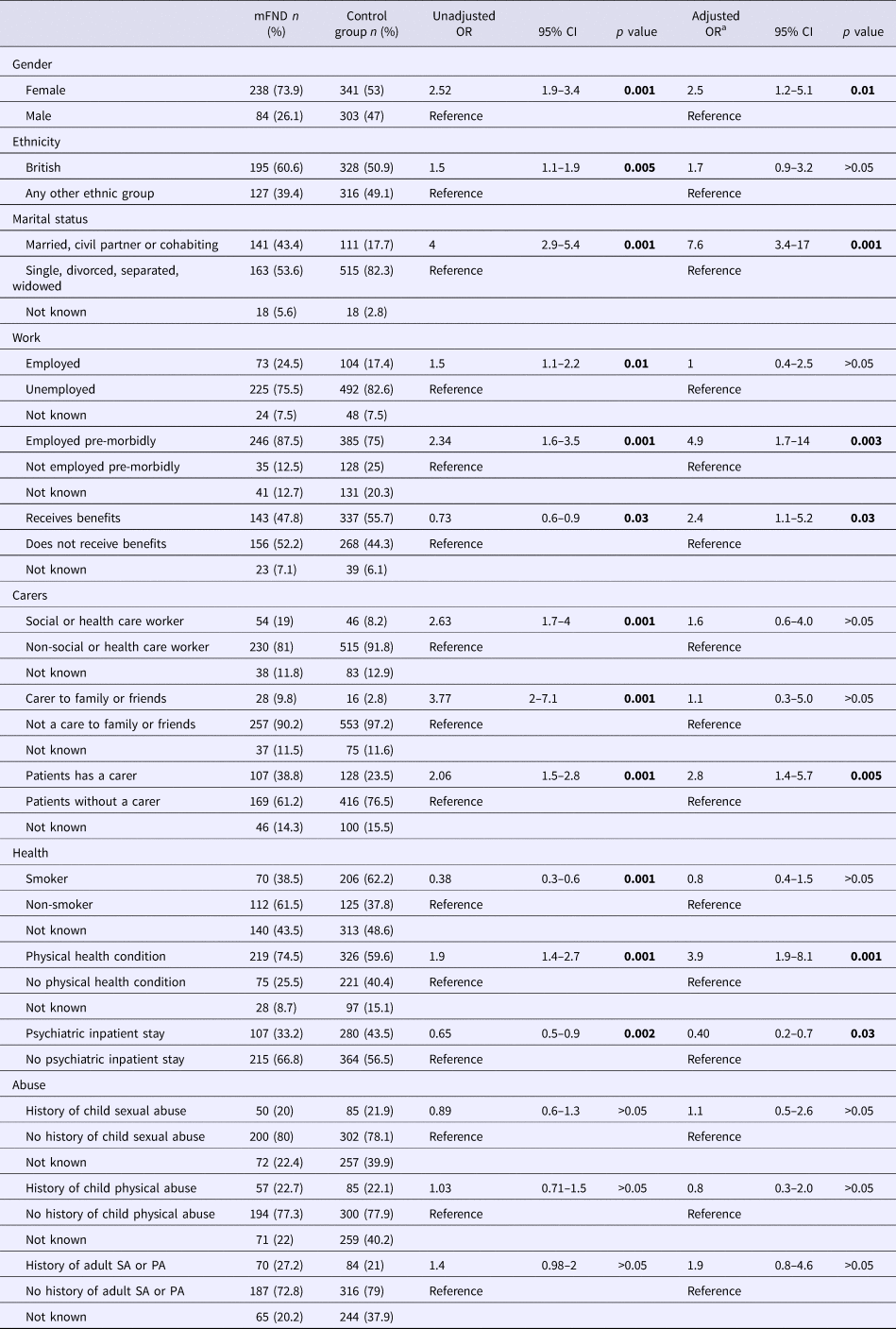
The socio-demographic and clinical characteristics of the mFND patients are described in Table 1. There were 238 females (73.9%) and 84 males (26%) in the mFND group, a significantly higher proportion of females compared with control patients (OR 2.52, 95% CI 1.9–3.4, p = 0.001).
Binary logistic regression analysis of socio-demographic factors associated with a motor FND (F44.4) diagnosis compared with psychiatry control group

SA, sexual abuse; PA, physical abuse. p values in bold indicate that the odds ratio (OR) is statistically significant.
a Adjusted for gender, age, ethnicity, marital status, employment status, pre-morbid employment status, benefit receipt, social or health care worker status, caring for family or friends, having a carer, smoking status, the presence of a physical health condition, stay in a psychiatry inpatient setting, history of child sexual abuse, history of child physical abuse, history of adult sexual or physical abuse.
The mean age of mFND patients was 46.1 years (s.d. = 13.4) v. 47.6 years (s.d. = 16.2) for controls (not significantly different). The mean age at which mFND patients first began experiencing psychiatric symptoms was 33.2 years (s.d. 14.6), similar to that of control patients (32.5 years, s.d. 17.8).
British patients constituted 60.6% of the mFND group, compared with 50.9% in the control group (OR 1.5, 95% CI 1.1–1.9, p = 0.001). mFND patients were more likely to be married, in a civil partnership or cohabiting (43.4%) compared with 17.7% in the control group (OR 4, 95% CI 2.9–5.4, p = 0.001).
mFND patients were more likely to be employed than control patients (24.5% v. 17.4%, OR 1.5, 95% CI 1.1–2.2, p = 0.02). Employment was stratified by gender, but no differences between groups emerged. Control patients were more likely to receive welfare benefits (55.7%) compared with mFND patients (47.8%) (OR 0.73, 95% CI 0.55–0.96, p = 0.03). Of patients receiving benefits, mFND patients were more likely to receive disability living allowance compared with controls (χ2 = 17.7, df = 1, p = 0.001).
In total, 19% of mFND and 8% of control patients were employed or had been employed in care-giving roles in health, social care, child care or mental health sectors (OR 2.63, 95% CI 1.73–4, p = 0.001).
Patients were grouped according to whether they were carers to a family member or friend, either formally or informally. mFND patients were significantly more likely to act as carers (9.8%) than control patients (2.8%) (OR 3.77, 95% CI 2–7.1, p = 0.001). The significant difference was maintained in both males and females after stratification by gender.
In total, 38.8% of mFND patients themselves had a carer compared with 23.5% of control group participants (OR 2.06, 95% CI 1.5–2.8, p = 0.001). The significant difference was maintained when data were stratified by gender.
Health
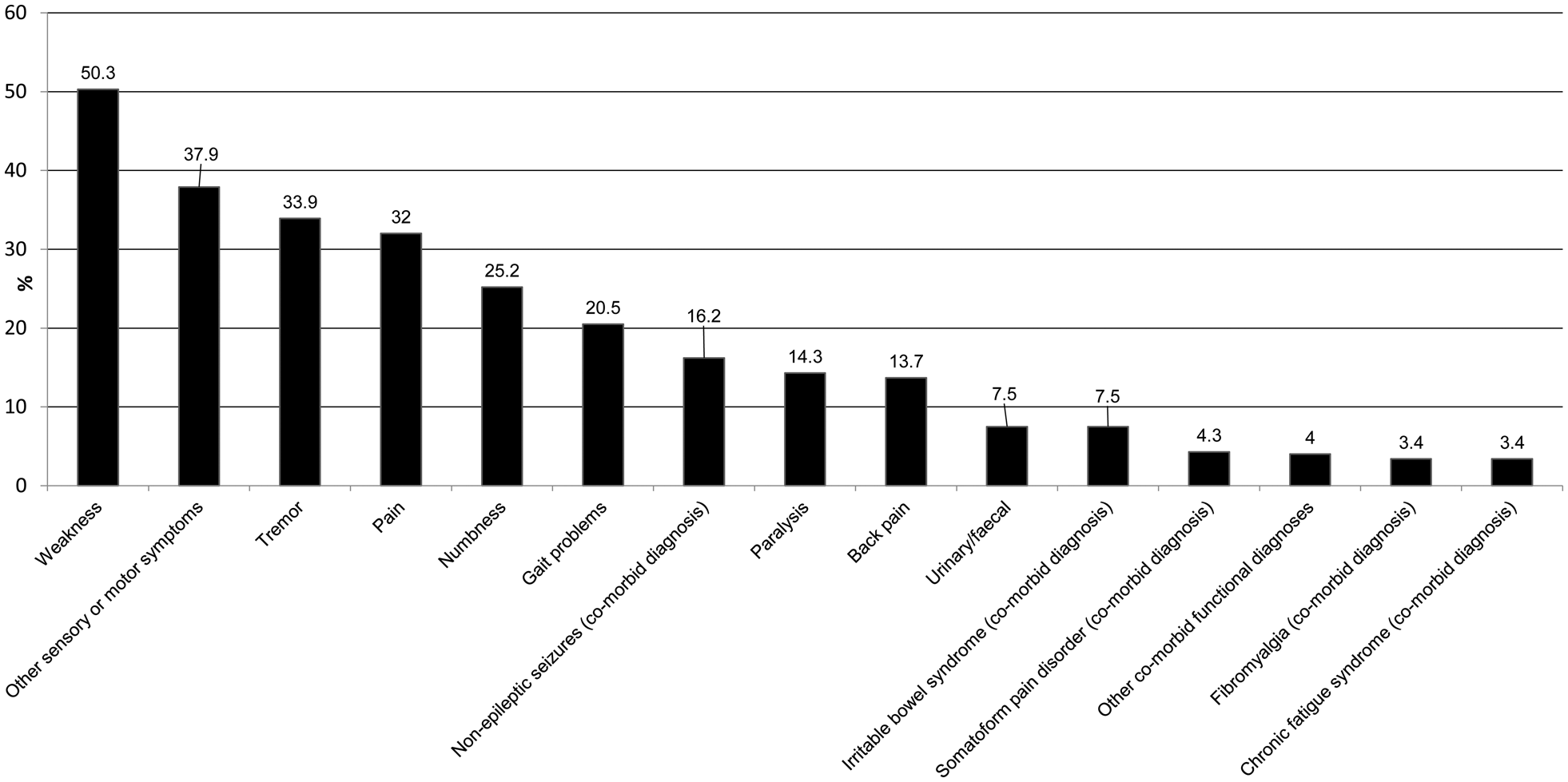
The type of motor and sensory symptoms affecting mFND patients was categorised. Most participants had more than one symptom, with the mean number of functional motor and sensory symptoms equalling 2.42 (s.d. 1.1). The most commonly reported symptom was ‘weakness’ of any type accounting for 50.3% of all reported symptoms, followed by ‘other’ motor or sensory symptoms (37.9%) such as visual disturbances, facial droop, etc., and ‘tremor’ which includes ‘tremor, spasms, jerks and tics’ (33.9%). Figure 1 outlines the rate of motor, sensory and other co-morbid functional symptoms.
Proportion of functional motor and sensory symptoms and comorbid functional disorders in mFND patients.

A third (33.8%) of all mFND patients had a comorbid functional diagnosis. The most common syndromes were non-epileptic seizures (16.2% of all mFND patients), irritable bowel syndrome (7.5%) and somatoform pain disorder (4.3%). Four per cent of patients had co-morbid functional diagnoses classified as ‘other’. These include depersonalisation disorder, psychogenic polydipsia, dissociative amnesia, foreign accent syndrome, somatoform disorder and dissociative identity disorder. Figure 1 outlines co-morbid functional diagnoses. There were significantly more co-morbid functional diagnoses in the mFND group (33.8%) than the 1.9% in the control group (OR 26, 95% CI 14–48.2, p = 0.001).
In total, 38.5% of mFND patients smoked cigarettes at the time of data collection, significantly fewer than controls at 62.6% (see Table 1). A significantly higher proportion of mFND patients had a co-morbid physical health condition compared with control patients (74.5% v. 59.6%, OR 1.9, 95% CI 1.4–2.7, p = 0.001), with ‘diseases of the nervous system’ the most common illness in mFND patients, accounting for 22.2% of all reported illness.
More control than mFND patients had at least one psychiatric inpatient admission (43.5% v. 33.2%). Control patients spent more days in inpatient settings with a mean of 143.3 days (s.d. 209, median 67, IQR 155) compared with mFND patients’ mean of 130.3 days (s.d. 124) (median 112 days, IQR 89, U = 11 944.5, p = 0.007). We assessed whether there were reports of mental health problems in patients’ family members. There was a positive history in 52.1% of mFND patients and 60% of control patients, with no statistical difference. Amongst mFND patients, the most common relative reported to have a mental health problem were patients’ mothers (accounting for 30.4% of all relatives), followed by fathers (18.2%) and patients’ sons (6.1%). Similar patterns were observed in the control group and there were no statistical differences between groups.
Abuse
We examined clinical records for experience of childhood sexual abuse (CSA), childhood physical abuse (CPA) and physical or sexual abuse in adulthood. No information was available on the presence or absence of CSA in 22.4% of mFND patients and 39.9% of control group patients. The rate of CSA in the mFND group was 20%, similar to the 21.9% rate in the control group (OR 0.9, 95% CI 0.6–1.3, p > 0.05). When stratified by gender, the CSA rate in female mFND patients was 22.8% and 30.3% in female control patients. CSA rates in male mFND patients were 11.3% and 11.2% in male control patients. Using OR, comparing female abuse rates in both groups to females not experiencing abuse, there was no statistical difference, with the same finding amongst males.
Information on the presence or absence of CPA was lacking in 22% of mFND patients and 40.2% of control patients. There was no difference in the rate of CPA in the mFND group (22.7%) compared with the control group at 21.8%. When stratified by gender, 24.3% of female mFND patients experienced CPA compared with 27.1% of female control patients. The rate in male mFND patients was 17.7% and 15.8% in control patients.
No information was available on adult physical or sexual abuse in 20.2% of mFND patients and 37.9% of control group patients. The rate of adult physical or sexual abuse in mFND patients was 27.2% which did not significantly differ from the rate in the control group of 21%. All comparisons are outlined in Table 1.
Predictors of mFND
To assess the socio-demographic variables that might predict an mFND diagnosis, we conducted a binary logistic regression analysis performed amongst all patients with a diagnosis of mFND. mFND was the dependent variable and our independent variables are outlined in Table 1. The overall prediction was 57.1% in this model. The Cox and Snell pseudo R 2 was 0.45, indicating that the fit of the model to the data was moderate.
In the adjusted model, factors that predict an mFND diagnosis include being female (OR 2.5, 95% CI 1.2–5.1, p = 0.01), married (OR 7.6, 95% CI 3.4−17, p = 0.001), pre-morbidly employed (OR 4.9, 95% CI 1.7–14, p = 0.003), receiving benefits (OR 2.4, 95% CI 1.1–5.2, p = 0.03), having a carer (OR 2.8, 95% CI 1.4–5.7, p = 0.005), having a physical health condition (OR 3.9, 95% CI 1.9–8.1, p = 0.001) and being less likely to have a psychiatric admission (OR 0.4, 95% CI 0.2–0.7, p = 0.03). Britishness, being employed, a social or health care worker, carer to family member, smoking status and history of CSA, CPA and experience of sexual or physical abuse in adulthood were not significant predictors of mFND status in the adjusted model.
Life experiences
While sexual and physical abuse rates did not differ between groups, we conducted an examination of other potential precipitants.
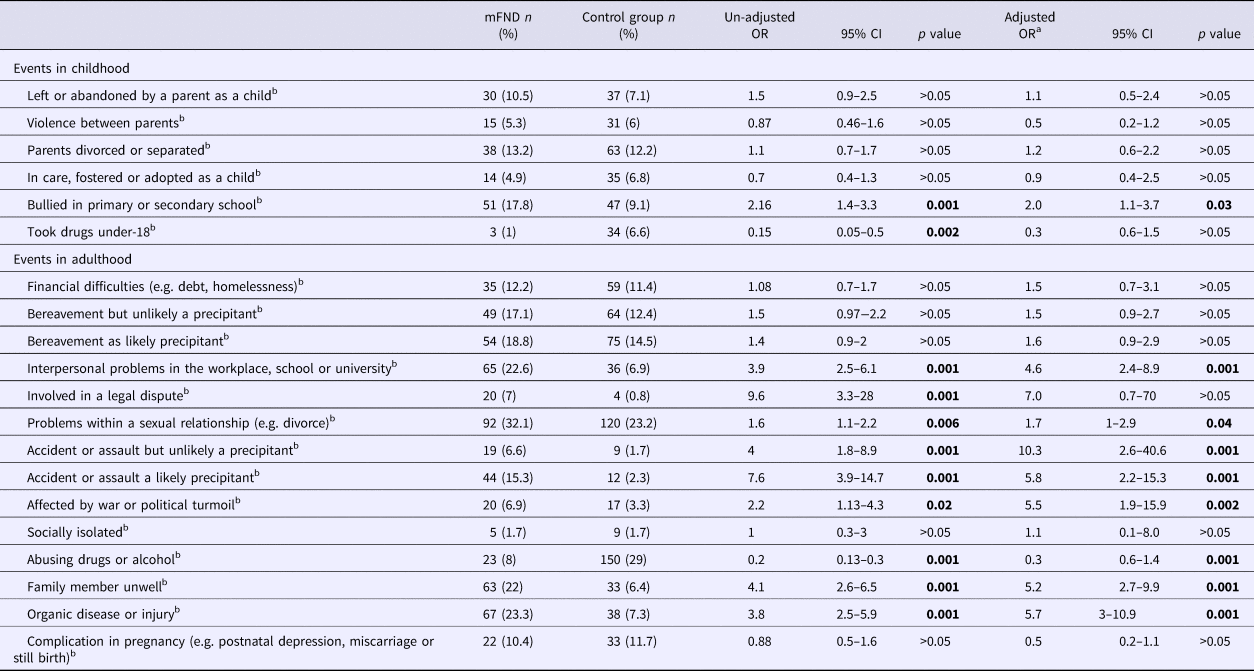
The classification of events in childhood and adulthood is outlined in Table 2. In the unadjusted analysis, a significantly lower proportion of mFND patients reported taking drugs under the age of 18 (1% v. 6.6%, p = 0.002), and a higher proportion of mFND patients experienced bullying before the age of 18 compared with the control group (17.8% v. 9.1%, p = 0.001). Following stratification by gender, this significant difference remained for both men and women.
Binary logistic regression of possible precipitant events occurring in childhood or adulthood associated with motor FND (F44.4) diagnosis compared with psychiatry control group

p values in bold indicate that the odds ratio (OR) is statistically significant.
a Adjusted for gender, age and life events.
b Reference: patients not experiencing the event.
For events in adulthood, the unadjusted analysis found mFND patients experienced significantly higher rates of workplace, school or university problems compared with the control group (22.6% v. 6.9%, p = 0.001), were more likely to be involved in a legal dispute (7% v. 0.8%, p = 0.001), to report problems within a sexual relationship (32.1% v. 23.2%, p = 0.006), to have experienced an accident or assault (15.3% v. 2.3%, p = 0.001), to be affected by war or political upheaval (6.9% v. 3.3%, p = 0.02), to have an unwell family member (22% v. 6.4%, p = 0.001) and to have had an organic illness or injury precipitating their symptom onset (23.3% v. 7.3%, p = 0.001). mFND patients were significantly less likely to report abusing drugs or alcohol compared with the control group (8% v. 29%, p = 0.001).
A binary logistic regression analysis accounting for gender, age and all other life events produced similar OR; however, the adjusted model found no difference in proportions of those taking drugs aged under-18, or those involved in legal disputes.
Discussion
Main findings
Research on mFND patients is limited. To our knowledge, the current study is the largest of its kind in this patient group. We identified 322 mFND patients from a mental health service case register of 250 000 patient records. The associations between mFND and life events, demographic, social, occupational and health characteristics were investigated and compared with a large unselected contemporaneous sample of patients with other mental health disorders.
It is well-established that mFND has a female preponderance (Binzer et al., Reference Binzer, Andersen and Kullgren1997; Stone et al., Reference Stone, Carson, Duncan, Coleman, Roberts, Warlow, Hibberd, Murray, Cull, Pelosi, Cavanagh, Matthews, Goldbeck, Smyth, Walker, Macmahon and Sharpe2009; Stone et al., Reference Stone, Carson, Duncan, Roberts, Warlow, Hibberd, Coleman, Cull, Murray, Pelosi, Cavanagh, Matthews, Goldbeck, Smyth, Walker and Sharpe2010a; McCormack et al., Reference Mccormack, Moriarty, Mellers, Shotbolt, Pastena, Landes, Goldstein, Fleminger and David2014), again confirmed in our study. Women may be more likely to perceive and label noxious bodily sensations as a result of heightened body vigilance (Warner, Reference Warner1995), societal gender differences may persuade more women to communicate bodily distress (Mechanic, Reference Mechanic1972) or seek help for somatic symptoms from medical experts (Nathanson, Reference Nathanson1977). There may be underlying genetic vulnerabilities, personality predispositions (McCrae et al., Reference Mccrae, Costa, Ostendorf, Angleitner, Hřebíčková, Avia, Sanz, Sánchez-Bernardos, Kusdil, Woodfield, Saunders and Smith2000) and hormonal differences could mediate responses to stressful life events leaving women more vulnerable to symptom development (Li and Graham, Reference Li and Graham2017). Alternatively, clinicians may be more likely to diagnose FND in women or specifically ask about experiences of trauma or abuse due to cultural and historical stereotypes of ‘hysteria’ as a specifically female malady.
Evidence on level of education and SES in mFND is mixed. Some studies report no difference in SES or education between cases and neurological or healthy controls (Roelofs et al., Reference Roelofs, Spinhoven, Sandijck, Moene and Hoogduin2005a; Stone et al., Reference Stone, Warlow and Sharpe2010b; van der Hoeven et al., Reference Van Der Hoeven, Broersma, Pijnenborg, Koops, Van Laar, Stone and Van Beilen2015), with others reporting lower education in mFND patients (Stefansson et al., Reference Stefansson, Messina and Meyerowitz1976; Binzer et al., Reference Binzer, Andersen and Kullgren1997). We do not have a measure of SES but proxy measures show increased SES in mFND patients compared with controls. Contrary to some stereotypes, mFND patients were less likely to receive benefits, were more likely to be employed pre-morbidly and were more likely to be married, even when gender was controlled. The argument that less educated patients might use functional symptoms as a coping mechanism is not borne out in this study. These findings (and others) emerged because of what we contend to be a fair comparison with other psychiatric service users where employment is expected to be lower, and receipt of benefits, higher than the national average.
Employment in care-giving positions within health and social care industries amongst mFND patients is worth noting. Studies in movement disorders clinics have found no difference between mFND patients and controls (Kenney et al., Reference Kenney, Diamond, Mejia, Davidson, Hunter and Jankovic2007; Perry et al., Reference Perry, Holmes, Gruber-Baldini, Anderson, Shulman, Weiner and Reich2017), although McCormack et al. (Reference Mccormack, Moriarty, Mellers, Shotbolt, Pastena, Landes, Goldstein, Fleminger and David2014) report high rates of this employment. One theory is that working in healthcare roles or observing unwell family members allows the modelling of neurological symptoms (Shill and Gerber, Reference Shill and Gerber2006; Hotopf et al., Reference Hotopf, Wilson-Jones, Mayou, Wadsworth and Wessely2018).
Our adjusted regression analysis did not find any difference in paid care work between mFND and control patients. Gender is likely to partly account for the relationship between employment in the health and social care industry and mFND status. Employment data support this as healthcare workers account for 6% of the UK's economy; and four-fifths are women (Yar et al., Reference Yar, Dix and Bajekal2006). Similar trends in gender are seen in the status of non-paid carers. Census data from the Office for National Statistics (2011) found 58% of all carers are female. A combination of age and gender likely predicts carer status as in the general population, the peak age of caring is between 50 and 64 years of age, but one in four women aged 50–64 have caring responsibilities compared with one in six men of the same age.
In our study, weakness, or the loss of motor function, was the most common functional motor symptom. Studies from movement clinics report tremor as the most prevalent functional symptom (Hinson and Haren, Reference Hinson and Haren2006; Kranick et al., Reference Kranick, Ekanayake, Martinez, Ameli, Hallett and Voon2011; van der Hoeven et al., Reference Van Der Hoeven, Broersma, Pijnenborg, Koops, Van Laar, Stone and Van Beilen2015; Park, Reference Park2018), reflecting a possible referral bias to those clinics. Weakness has been described as the most common functional symptom in an acute stroke centre (Gargalas et al., Reference Gargalas, Weeks, Khan-Bourne, Shotbolt, Simblett, Ashraf, Doyle, Bancroft and David2015), a tertiary psychiatric inpatient setting (McCormack et al., Reference Mccormack, Moriarty, Mellers, Shotbolt, Pastena, Landes, Goldstein, Fleminger and David2014) and a neurological clinic (Crimlisk et al., Reference Crimlisk, Bhatia, Cope, David, Marsden and Ron1998). While weakness was common, in our study most patients had more than one functional symptom, a finding reported elsewhere (Stone et al., Reference Stone, Warlow and Sharpe2010b). Our cross-sectional design restricted us from establishing the evolution or prognosis of symptoms but it is likely symptoms do not remain static and can worsen or improve with time.
We found mFND patients were less likely to have a hospital admission compared with controls. While we do not know why patients were admitted or if admissions were voluntary or involuntary, it is likely that the majority of mFND admissions were to the Lishman Unit, a specialist rehabilitation centre. Amongst control patients, those with an admission history were most commonly schizophrenia, schizotypal and delusion disorder and affective disorder patients, meaning they likely had qualitatively different kinds of admissions. In our unadjusted analysis, mFND patients were less likely to smoke than controls. We hypothesised that this might be due to the high proportion of schizophrenia patients in our control group. In a sensitivity analysis, we removed patients with a schizophrenia diagnosis from the control group but the significant difference in smoking remained. In our adjusted model however, the difference disappeared, a finding similar to a general practice survey comparing patients with persistent medically unexplained symptoms to those with medical diagnoses (Dirkzwager and Verhaak, Reference Dirkzwager and Verhaak2007). Nonetheless, while smoking rates are certainly no higher than other psychiatric groups, the rate of smoking of 38.5% in mFND patients is substantially higher than the population prevalence in English adults of 19% (Health and Social Care Information Centre, 2015). This may be surprising in a group which one could argue may be more health-anxious or body-focused. Smoking might help reduce patients’ anxiety or emerge due to distorted health behaviour beliefs. Future studies examining patients’ knowledge of general health advice might help explain this and other health behaviours.
Life events
We found no significant differences in rates of childhood sexual or physical abuse or adulthood sexual or physical abuse between groups.
The 20% rate of CSA is slightly lower than previously reported in functional disorders in psychiatric settings, which range from 24% to 26.3% (Roelofs et al., Reference Roelofs, Keijsers, Hoogduin, Näring and Moene2002; Sar et al., Reference Sar, Akyuz, Kundakc, Kiziltan and Dogan2004; Akyuz et al., Reference Akyuz, Gokalp, Erdiman, Oflaz and Karsidag2017) (this excludes studies which select only non-epileptic seizure patients). Similarly, our CPA rate of 22.7% is moderately lower than previously reported rates in psychiatric settings, which varies between 23% and 28% (Roelofs et al., Reference Roelofs, Keijsers, Hoogduin, Näring and Moene2002; McCormack et al., Reference Mccormack, Moriarty, Mellers, Shotbolt, Pastena, Landes, Goldstein, Fleminger and David2014; Farooq and Yousaf, Reference Farooq and Yousaf2016; Nicholson et al., Reference Nicholson, Aybek, Craig, Harris, Wojcik, David and Kanaan2016). Our rates are also lower than those reported in a recent meta-analysis which reported CSA and CPA rates of 24% and 30%, respectively, although this includes heterogeneous functional symptoms and service settings (Ludwig et al., Reference Ludwig, Pasman, Nicholson, Aybek, David, Tuck, Kanaan, Roelofs, Carson and Stone2018).
The somewhat lower childhood abuse rates reported in our study may be an underestimation due to the observational, retrospective method and lack of structured interviewing, as studies utilising interview techniques report higher CSA rates in FND (Ludwig et al., Reference Ludwig, Pasman, Nicholson, Aybek, David, Tuck, Kanaan, Roelofs, Carson and Stone2018). In our study, no mention of abuse in clinical records was classified as missing data but this may mask 5–10% of the true event rate. There were higher levels of missing data on abuse in control group patients compared with mFND patients, suggesting clinicians may be more likely to ask about trauma and childhood history in mFND patients.
This potential lack of methodological sensitivity would be expected to affect both groups equally. When stratified by gender, rates of childhood sexual and physical abuse are higher amongst females in both groups compared with their male counterparts, suggesting risk of childhood abuse is higher amongst females, but not a specific risk amongst female mFND patients. That abuse rates did not differ between mFND and control patients is an important finding which contradicts some theories of FND aetiology. There is evidence that in case–control studies, rate differences are attenuated when psychiatric controls rather than neurological or healthy controls are used (Ludwig et al., Reference Ludwig, Pasman, Nicholson, Aybek, David, Tuck, Kanaan, Roelofs, Carson and Stone2018). Perhaps more pertinent is that abuse is prevalent in the general public with retrospective surveys estimating CSA rates in English women of 11–17% (Gorey and Leslie, Reference Gorey and Leslie1997; Molnar et al., Reference Molnar, Buka and Kessler2001; Bebbington et al., Reference Bebbington, Jonas, Brugha, Meltzer, Jenkins, Cooper, King and Mcmanus2011; Office for National Statistics, 2016). Abuse experiences are likely to increase risk for psychiatric morbidity generally and form a component of some patients’ mFND development, but our findings suggest they should not be regarded as specific to the disorder or be used as a diagnostic indicator.
Perhaps more promising in the identification of specific risks in mFND aetiology are the findings on life events prior to symptom onset. Premorbid life experiences appear to be linked to disrupted or problematic inter-personal relationships; a finding echoed elsewhere where mFND patients had higher rates of family conflict (Stone et al., Reference Stone, Sharpe and Binzer2004; Akyuz et al., Reference Akyuz, Gokalp, Erdiman, Oflaz and Karsidag2017). In some cases, functional symptoms may be a means, to help shape, negotiate or re-define problematic social interactions (see Nicholson et al., Reference Nicholson, Aybek, Craig, Harris, Wojcik, David and Kanaan2016). Evidence exists for reduced or impaired emotional processing in FND (Waller and Scheidt, Reference Waller and Scheidt2006; Demartini et al., Reference Demartini, Petrochilos, Ricciardi, Price, Edwards and Joyce2014) and this might disrupt the development of early inter-personal skills. The causal pathway is unlikely to be linear as the existence of functional symptoms may themselves exacerbate or undermine personal interactions and relationships. Where such a process plays a role in symptom development, patients might benefit if the management of inter-personal conflicts and the bolstering of inter-personal skills were incorporated into psychotherapeutic approaches for the condition.
Strengths and limitations
The strength of this study is its large sample size. The study uses an innovative source to access a larger sample of patients than would be possible to recruit in clinical research. Full electronic health records retrieved through the CRIS database enabled access to detailed information about mFND patients and their contact with psychiatric services. The use of a psychiatric control group allowed for the empirical test of differences in patient profiles and characteristics. Our sample is more representative of the population of patients seen in routine clinical care than would be the case in a typical clinical trial.
Part of our search strategy involved a search of free-text clinical notes. Given the ubiquity of synonyms associated with a functional diagnosis, it is possible our search terms were not exhaustive and more mFND patients were present in the database than were detected in our study. Secondly, while our sample can be taken as encompassing a representative greater London NHS psychiatric catchment-area population, it also included referrals to a tertiary neuropsychiatry service placing limitations on our ability to generalise findings to services without specialist neuropsychiatry input and to other NHS Trusts outside London. It is likely our mFND patients include more severely affected patients and of course our study only represents mFND patients who have had at least some contact with psychiatric clinical services. Thirdly, clinicians’ own biases or preferences in clinical formulations and note writing will have shaped the free-text clinical records, although this bias is unlikely to be systematic or to affect our between-group comparisons. Furthermore, we have emphasised factual information, albeit uncorroborated over clinical interpretation. Finally, it was not possible to blind the researcher to case–control status, so we cannot discount the possibility of observer bias in data extraction.
In conclusion, mFND patients have distinct demographic characteristics when compared with psychiatry controls attending the same NHS Trust. While some of our findings are unsurprising, such as the female preponderance and chronicity, reliance on carers and associations with life stress, others are not necessarily in line with the clinical stereotypes of the mFND patient. For example, there was no increase of CSA; ethnic background and nationality were less diverse, there were fewer hospital admissions and there were higher levels of employment. By establishing the socio-demographic and life experience profile of this understudied patient group, we hope to stimulate novel psychosocial interventions.
Supplementary material
The supplementary material for this article can be found at https://doi.org/10.1017/S0033291719000266.
Author ORCIDs
N. O'Connell, 0000-0002-5143-1797; T. R. Nicholson, 0000-0002-2350-2332; S. Wessely, 0000-0002-6743-9929; A. S. David, 0000-0003-0967-774X
Acknowledgements
We thank the NIHR BRC for their support in this project, particularly Megan Pritchard, Amelia Jewel and Debbie Cummings at the BRC Nucleus for their advice and expertise.
Financial support
This paper represents independent research funded by the National Institute for Health Research (NIHR) Biomedical Research Centre at South London and Maudsley NHS Foundation Trust and King's College London. The views expressed are those of the authors and not necessarily those of the NHS, the NIHR or the Department of Health and Social Care.
Conflict of interest
None.
Ethical standards
The authors assert that all procedures contributing to this work comply with the ethical standards of the relevant national and institutional committees on human experimentation and with the Helsinki Declaration of 1975, as revised in 2008. The authors assert that all procedures contributing to this work comply with the ethical standards of the relevant national and institutional guides on the care and use of laboratory animals.