Survival following the Norwood operation for hypoplastic left heart syndrome and related single right ventricle anomalies has improved considerably over the past several decades with advances in surgical techniques and perioperative care;Reference McHugh, Hillman, Gurka and Gutgesell 1 , Reference Graham, Bradley and Atz 2 however, many of these infants experience a complicated postoperative course and prolonged length of hospital stay, accounting for significant resource utilisation.Reference Dean, Hillman, McHugh and Gutgesell 3 In fact, a recent analysis found the diagnosis of hypoplastic left heart syndrome to be associated with the highest hospital charges of any birth defect. 4
The current healthcare environment places emphasis on both improving outcomes and reducing the cost of care.Reference Porter 5 Although it is known that patients undergoing the Norwood operation account for significant resource utilisation, the specific factors accounting for high costs of care remain unclear.Reference Jantzen, He and Jacobs 6 Postoperative complications have been demonstrated to influence hospital costs across a variety of surgical populations including children undergoing congenital heart surgery;Reference Pasquali, He and Jacobs 7 , Reference Benavidez, Connor, Gauvreau and Jenkins 8 however, detailed information regarding the impact of complications, independent of other baseline co-morbidities, in patients undergoing the Norwood operation is lacking. Previous studies, particularly those involving administrative data sets, have lacked granular data regarding the occurrence of specific complications in this patient population.Reference Dean, Hillman, McHugh and Gutgesell 3 , Reference Pasquali, Peterson and Jacobs 9 – Reference Pasquali, Sun and d’Almada 11
The purpose of this study was to investigate the relationship between postoperative complications and hospital costs following the Norwood operation. This was achieved using a novel technique of linking prospectively collected clinical outcomes and complications data from the Pediatric Heart Network Single Ventricle Reconstruction trial with cost data from the Children’s Hospital Association Case Mix database.
Methods
Data sources
The Pediatric Heart Network, funded by the National Heart, Lung, and Blood Institute, recently conducted the Single Ventricle Reconstruction trial. Details of the trial design (ClinicalTrials.gov number NCT00115934) have been published previously.Reference Ohye, Gaynor and Ghanayem 12 In brief, 555 infants undergoing the Norwood procedure for hypoplastic left heart syndrome or related single, morphological right ventricle anomalies from 2005 to 2008 were randomised to receive either a modified Blalock–Taussig shunt or a right ventricle-to-pulmonary artery shunt for provision of pulmonary blood flow. Randomisation occurred at 15 medium- and high-volume congenital heart surgery centres in North America.
The Children’s Hospital Association Case Mix database is an administrative data set containing resource utilisation data from 90 United States children’s hospitals. De-identified data are submitted by participating hospitals. Data quality is ensured through a joint effort between the Children’s Hospital Association and participating hospitals. This study was evaluated by the Medical University of South Carolina Institutional Review Board and did not meet qualifications for human subjects research.
Linkage
Prospectively collected clinical outcomes and complications data from the Single Ventricle Reconstruction trial were merged at the patient level with cost data from the Case Mix database for hospitals included in both data sets during the study period. A previously validated methodReference Pasquali, Jacobs and Shook 13 of probabilistic matching of the following indirect identifiers was used to link records: centre, gender, date of admission (±1 day), date of discharge (±1 day), and date of birth (±1 day).
Study population
Any patient enrolled in the Single Ventricle Reconstruction trial undergoing the Norwood operation was eligible for inclusion. Patients undergoing Stage II palliation or heart transplantation during the same hospital admission were excluded from the analysis, as this study focussed on the post-Norwood hospitalisation.
Data collection
Detailed information regarding preoperative patient characteristics, surgical management, and postoperative course and outcomes following the Norwood operation, as previously described, were obtained from the Single Ventricle Reconstruction trial data.Reference Ohye, Gaynor and Ghanayem 12 As described by Virzi et alReference Virzi, Pemberton and Ohye 14 complications in the Single Ventricle Reconstruction trial were assessed via a novel adverse event reporting strategy defined by the Pediatric Heart Network. The five Sentinel Serious Adverse Events in the Single Ventricle Reconstruction trial are listed in Supplementary table 1 and included the following: acute shunt failure requiring intervention, cardiac arrest requiring cardiopulmonary resuscitation and medications, cardiopulmonary insufficiency requiring extracorporeal membrane oxygenation, unplanned cardiovascular re-operation, and necrotising enterocolitis requiring laparotomy. Other complications recorded in the Single Ventricle Reconstruction trial as noted in Supplementary table 1 were also included in our analysis of complications for the purposes of this study; these included cardiac, vascular, respiratory, neurological, gastrointestinal, infectious, renal, and haematological complications.
Total hospital charges and payor type were obtained from the Case Mix database. Charges were converted to estimated costs using hospital-specific cost-to-charge ratios, adjusted for geographic region using the Centers for Medicare and Medicaid Services price wage index for the hospital’s location, and inflated to 2008 dollars using the medical component of the consumer price index.
Analysis
Study variables and complications were described using standard summary statistics. Continuous variables were summarised as median and interquartile range and categorical variables were depicted as frequencies and percentages. The distribution of complications across the study population was described, as well as outcomes in those with versus without a complication. The specific types of complications associated with increased hospital costs were also examined. For this portion of the analysis, patients were grouped into tertiles according to total cost (<$80,000, $80,000–$200,000, and >$200,000), and the frequency of complications across these cost tertiles was described.
The relationship between complications and cost, adjusting for baseline patient characteristics, was further evaluated using generalised linear mixed effects models. Cost was log transformed due to the skewed distribution, and a random intercept for each hospital was utilised to account for within-centre clustering. The model was adjusted for patient baseline characteristics found to be associated with cost (p<0.1) in bivariate analyses, including preoperative intubation, pre-Norwood pulmonary artery banding, pre-Norwood atrial septectomy, presence of aberrant right subclavian artery, number of pre-Norwood surgeries, number of pre-Norwood complications, payor type, use of regional cerebral perfusion, cardiopulmonary bypass time, deep hypothermic circulatory arrest time, use of ultrafiltration, and presence of an open sternum. Both costs associated with any versus no complications as well as costs associated with the number of complications were modelled. Estimates were back-transformed to the original cost scale for ease of interpretability. All the analyses were performed using SAS version 9.3 (SAS Institute Incorporated, Cary, North Carolina, United States of America). A p-value <0.05 was considered to be statistically significant.
Results
Study population
A total of 10 out of 15 centres participating in the Single Ventricle Reconstruction trial submitted data to the Case Mix Database during the trial period. From these 10 centres, 344 of 353 patients were matched between databases, resulting in a 97.5% linkage rate.
Patient characteristics
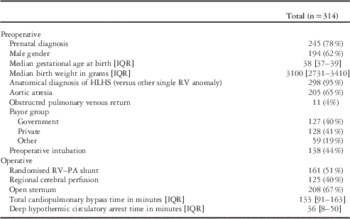
Study population characteristics are displayed in Table 1. Overall, 78% of the patients had a prenatal diagnosis, and 62% of the patients were male. The median gestational age was 38 weeks, and the median birth weight was 3100 g. In the cohort, 95% carried an anatomical diagnosis of hypoplastic left heart syndrome, 65% with aortic atresia, and 4% had obstructed pulmonary venous return. Operative characteristics included randomisation to a right ventricle-to-pulmonary artery shunt in 51%, use of regional cerebral perfusion in 40%, and open sternum in 67% of the cases.
Study population characteristics.

HLHS=hypoplastic left heart syndrome; IQR=interquartile range; PA=pulmonary artery; RV=right ventricle
Postoperative complications
There were a total of 1066 postoperative complications identified. Figure 1 illustrates the distribution of complications per patient. Overall, 82% of the patients suffered at least one complication and 28% experienced four or more complications. The median number of complications per patient was 2, with a range from 0 to 33.
Distribution of the number of post-Norwood complications. The Y-axis shows the number of patients, and the X-axis shows the number of complications.

In order to describe the specific types of complications associated with increased hospital costs, patients were grouped into tertiles according to total cost (<$80,000, $80,000–$200,000, and >$200,000). The most common complications occurring in those classified within the high-cost tertile included cardiopulmonary resuscitation (37%), chronic respiratory failure (37%), sepsis (33%), arrhythmia (32%), and need for extracorporeal membrane oxygenation (24%).
Unadjusted associations of postoperative complications with clinical outcomes are displayed in Table 2. Patients with complications had a longer postoperative length of stay (25 versus 12 days, p<0.001), more total post-Norwood ventilator days (7 versus 5 days, p<0.001), and higher in-hospital mortality (17.6 versus 3.4%, p=0.006) compared with those patients with no complications.
The association of postoperative complications with clinical outcomes.

IQR=interquartile range
Costs associated with postoperative complications in adjusted analysis
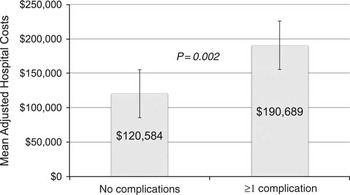
Figure 2 displays the impact of complications on total hospital costs, adjusting for important baseline patient characteristics associated with cost in this cohort. Adjusted mean hospital costs in those with a complication were $190,689 (95% CI $111,344–$326,577) versus $120,584 (95% CI $69,246–$209,983) in those without complications (p=0.002). Of note, those who died before hospital discharge were also significantly more likely to have higher costs (p<0.0001).
Association of complications and mean adjusted hospital costs following the Norwood operation. Hospital costs were adjusted for significant baseline patient characteristics. The X-axis separates patients into those with no complications versus those with at least one postoperative complication. The mean adjusted hospital costs are displayed on the Y-axis.

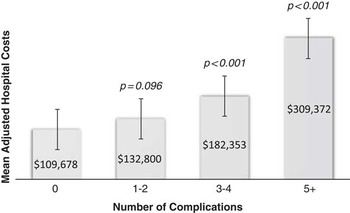
Figure 3 depicts the relationship between adjusted hospital costs and the number of postoperative complications after the Norwood procedure. Adjusted mean hospital costs increased with the total number of complications, although costs were not significantly higher until at least three complications had occurred. The mean hospital cost for patients with five or more postoperative complications was $309,372.
Mean adjusted hospital costs increase with complications rates following the Norwood operation. Total hospital costs were adjusted for baseline patient characteristics. Patients were grouped by the number of post-Norwood complications on the X-axis, and the mean adjusted hospital costs are displayed on the Y-axis.

Discussion
This multicentre analysis, leveraging a unique merged data set of prospectively collected clinical trial data and cost information from an administrative data set, describes the relationship between postoperative complications and hospital costs following the Norwood operation. We found that postoperative complications are common following the Norwood operation and associated with worse clinical outcomes and higher costs. These data suggest that efforts to reduce complications in this population may lead to both improved outcomes and cost savings.
This study utilised a unique data set of merged clinical trial and administrative data, successfully linking 97.5% of eligible records. This approach takes advantage of the strengths of both types of data sets – the prospectively collected detailed clinical information contained in the trial data set and the cost information in the administrative data set – and allows analyses not otherwise possible with the individual data sets alone. In paediatrics, the Children’s Oncology Group has previously demonstrated success with this technique by merging Children’s Oncology Group clinical trial data sets with the Pediatric Health Information System Database. The merged data set was utilised to examine toxicity monitoring and describe resource utilisation associated with chemotherapy and the treatment of paediatric cancer.Reference Aplenc, Fisher and Huang 15 – Reference Miller, Troxel and Li 17
In the paediatric cardiac disease population, these methods have also been utilised to link clinical registry data (from the Society of Thoracic Surgeons Congenital Heart Surgery Database) with administrative data (from the Pediatric Health Information System Database) to perform various analyses including several comparative effectiveness studies and analyses of the relationship between quality and costs of care;Reference Pasquali, He and Jacobs 7 , Reference Pasquali, Jacobs and Shook 13 , Reference Pasquali, Jacobs and He 18 however, this study is the first to demonstrate that patients in a congenital heart surgery trial can be successfully linked to an administrative data set to describe resource utilisation along with clinical outcomes. This methodology is important as it allows investigators to leverage and utilise existing data sources to both answer important questions and to do this in an efficient manner. This is particularly important in the present era of declining research funding, and similar concepts have also been expanded to support merging and analysis of other types of data sets, as well as the use of existing registry data to support clinical trials.Reference Frobert, Lagerqvist and Olivecrona 19 In a recent editorial, Lauer and D’AgostinoReference Lauer and D’Agostino 20 proposed that this type of “randomised registry trial” design used in studies such as the Thrombus Aspiration in ST-Elevation Myocardial Infarction trialReference Frobert, Lagerqvist and Olivecrona 19 may offer a method to resolve the current cost and time limitations in modern clinical trial designs.
Previous studies have demonstrated that patients with hypoplastic left heart syndrome and related single right ventricle anomalies account for the highest tier of resource utilisation across all birth defects and among those with CHD. 4 , Reference Pasquali, Jacobs and He 18 , Reference Kogon, Kanter, Alsoufi, Maher and Oster 21 Using merged data from the Society of Thoracic Surgeons and Pediatric Health Information Databases, Pasquali et alReference Pasquali, Jacobs and He 18 reported on hospital costs for patients undergoing nine common benchmark congenital heart surgeries at 27 US children’s hospitals from 2006 to 2010, and patients undergoing the Norwood operation accounted for the highest total hospital costs (median $165,168). In addition, in an analysis of 1941 patients at 48 centers using the University HealthSystem Consortium data set, Dean et alReference Dean, Hillman, McHugh and Gutgesell 3 demonstrated that median hospital costs for this patient population appeared to be increasing over the time period of 1998–2007 (from $65,041 to $113,827) in parallel with increases in survival and hospital length of stay.
Our study adds to the growing body of literature across children and adults undergoing a variety of surgical procedures examining factors associated with increased hospital costs. We found that postoperative complications are common following the Norwood operation, with 82% of patients experiencing at least one of the complications captured in the Single Ventricle Reconstruction trial data set and more than a quarter experiencing four or more complications. Similar to studies in other patient populations,Reference Pasquali, Ohye and Lu 22 ,23 we found that complications were associated with worse clinical outcomes including prolonged length of stay. Interestingly, there was no statistically significant increase in cost until at least three complications were present.
The results of our study also support a previous investigation utilising merged Society of Thoracic Surgeons and Pediatric Health Information System data, which reported that post-Norwood complications were associated with ~$119,303 as excess costs per surgical case, with major postoperative complications estimated to result in $210,865 as excess costs.Reference Pasquali, He and Jacobs 7
In the current healthcare environment, there is a focus on both optimising clinical outcomes and minimising costs of care.Reference Porter 5 The results of our study and other recent analyses suggest that efforts geared towards reducing postoperative complications may hold the potential to achieve both these objectives; however, further studies are necessary to elucidate care practices that may be associated with fewer complications. A previous Single Ventricle Reconstruction trial analysisReference Pasquali, Ohye and Lu 22 identified considerable variation in perioperative management across centres for patients undergoing the Norwood operation. In addition, it has also been shown that both complication rates and costs are variable across centres;Reference Pasquali, Jacobs and He 18 however, detailed information regarding the relationships between specific centre-level practices, complication rates, and costs have not been described. Such analyses could contribute to multicentre collaborative quality improvement in this area.
Limitations
This analysis was limited to patient data from medium- and high-volume centres participating in both the Pediatric Heart Network Single Ventricle Reconstruction trial and the Children’s Hospital Association Case Mix database during the study period. Therefore, these results may not be generalisable to all patients undergoing the Norwood operation. Further, we focussed on evaluating postoperative complications; however, complications and hospital length of stay are often intertwined, and the independent impact on cost is difficult to ascertain. In addition, it is not possible within our data set to assess which complications may be “preventable”, and, although the trial data set captured an extensive list of complications, not every possible complication was likely captured or was able to be evaluated in this study. Hospital costs in the overall population with single ventricle defects may have been underestimated as patients receiving Stage II palliation or a heart transplantation during the same hospitalisation were excluded for the purposes of this study. Finally, this analysis only examined inpatient costs during the Norwood hospitalisation, and further studies evaluating costs across multiple hospitalisations, staged surgeries, and outpatient care for hypoplastic left heart syndrome will be necessary to determine longitudinal costs for this population.
Conclusions
This study demonstrates the feasibility of linkages between clinical trial data and administrative data in the field of congenital heart surgery, allowing efficient analysis of both clinical outcomes and costs of care. The results of our analysis demonstrate that postoperative complications are common following the Norwood operation and are associated with worse clinical outcomes and higher costs. This suggests that initiatives to reduce postoperative complications in this population may lead to both improved clinical outcomes and cost savings. Further investigation is necessary to determine whether there are specific complications that drive the known cost variation across centres performing the Norwood operation, and to better understand specific practices that may be associated with fewer complications. These data could inform collaborative efforts to improve outcomes and reduce costs across hospitals in this patient population.
Acknowledgement
None.
Financial Support
The present study was conducted under a Scholar Award from the Pediatric Heart Network supported by the National Heart, Lung, and Blood Institute of the National Institutes of Health under Award Number U10HL068270. The content is solely the responsibility of the authors and does not necessarily represent the official views of the National Institutes of Health.
Conflicts of Interest
None.
Ethical Standards
The authors assert that all procedures contributing to this retrospective study comply with ethical standards. These data were not considered human subjects research by the Medical University of South Carolina Institutional Review Board.
Supplementary Material
For supplementary material referred to in this article, please visit http://dx.doi./org/10.1017/S1047951115002498