Introduction
Ficus L. comprises about 750 species worldwide, of which 51 are found in the central African region (Berg & Corner, Reference Berg and Corner2005). Some members of the genus have been identified as keystone species in tropical rain forests across Asia and the Americas (Leighton & Leighton, Reference Leighton, Leighton, Sutton, Whitmore and Chadwick1983; Terborgh, Reference Terborgh and Soulé1986; Lambert & Marshall, Reference Lambert and Marshall1991; Sreekar et al., Reference Sreekar, Le and Harrison2010). However, there is very little evidence that Ficus species play a similar role in the forests of Africa (Gautier-Hion & Michaloud, Reference Gautier-Hion and Michaloud1989).
Taxonomic studies of Ficus in the central African region were carried out by the late Cees Berg and his collaborators (Berg et al., Reference Berg, Hijman, Weerdenburg and Leroy1984, Reference Berg, Hijman, Weerdenburg, Sabatié and Hallé1985; Berg, Reference Berg1990; Berg & Wiebes, Reference Berg and Wiebes1992). However, their descriptions of some species contain question marks or statements such as “colour not known from fresh material”, because of the limited herbarium material that they had at their disposal. In addition, several species were not illustrated in the main floristic accounts for the region, that is, Flore du Cameroun and Flore du Gabon. These taxonomic studies also have, as one would expect, many unresolved species-level questions that often reflect difficulties in separating ecological from genetically determined variation. To contribute to the understanding of taxonomy and ecology of Ficus in the central African region, we present habit and habitat information for individual species; provide new diagnostic characteristics for some species; and give identification tools in the form of a key and illustrations for all species we have found in the Sangha Trinational. This will allow future researchers to investigate the role of Ficus species in one of the few protected forests with a full complement of flora and fauna in the second largest block of tropical forest in the world.
Material and Methods
Study area
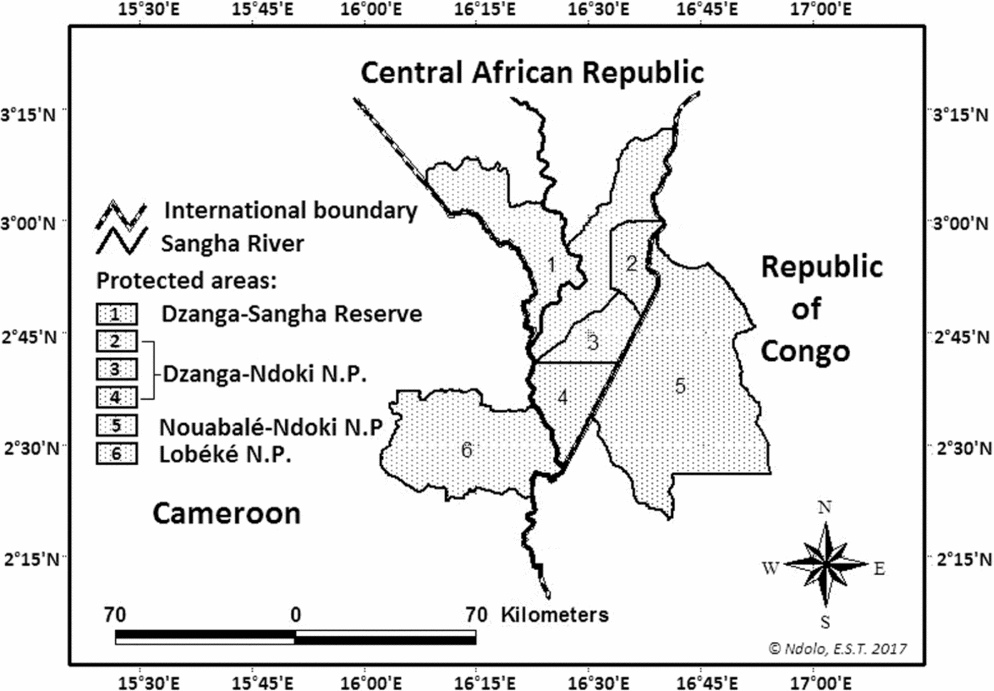
The study site is the Sangha Trinational, which is a network of protected areas in the north-west of the Congo River Basin, where the three countries Cameroon, the Central African Republic and the Republic of the Congo meet at the Sangha River. The Sangha Trinational is called ‘Trinational de la Sangha’ in French and is referred to by the acronym ‘TNS’. It covers three contiguous national parks and has an area of 746,309 hectares. These are Lobéké National Park (Cameroon), Dzanga-Ndoki National Park (Central African Republic) and Nouabalé-Ndoki National Park (Republic of the Congo). The area also includes a Forest Reserve and a buffer zone (see Fig. 1 for map).
Map of the Sangha Trinational in central Africa.

Methods
This study represents a compilation of research in the Sangha Trinational by the authors, each of whom has spent more than ten years at the study site. The work is based on herbarium specimens that were collected in the study area and identified at different periods from 1992 to 2013. The collections were made, as part of a general inventory of all flowering plants (Harris, Reference Harris2002), during primate feeding ecology studies (Ndolo Ebika, Reference Ndolo Ebika2010) and ecological studies focusing on Ficus (Ndolo Ebika et al., Reference Ndolo Ebika, Morgan, Sanz and Harris2015). We identified our specimens by using collections from different herbaria (BM, E, K, L and P) and key references for central Africa (Berg et al., Reference Berg, Hijman, Weerdenburg and Leroy1984, Reference Berg, Hijman, Weerdenburg, Sabatié and Hallé1985; Berg, Reference Berg1990; Berg & Wiebes, Reference Berg and Wiebes1992). Specimens of most species collected in the area were shown to Cees Berg in 1993, but all identifications were made by Ndolo Ebika and Harris. Herbarium specimens were deposited at the National Herbarium in Brazzaville (IEC) and the Royal Botanic Garden Edinburgh (E). Some additional duplicates were distributed to Naturalis (WAG) and Kew (K).
Results
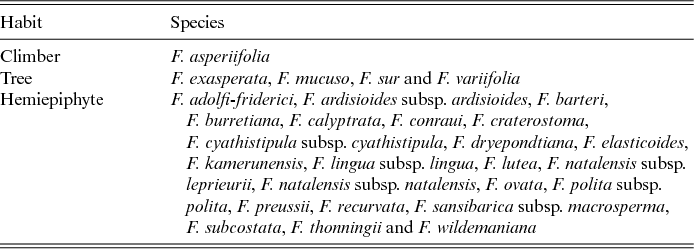
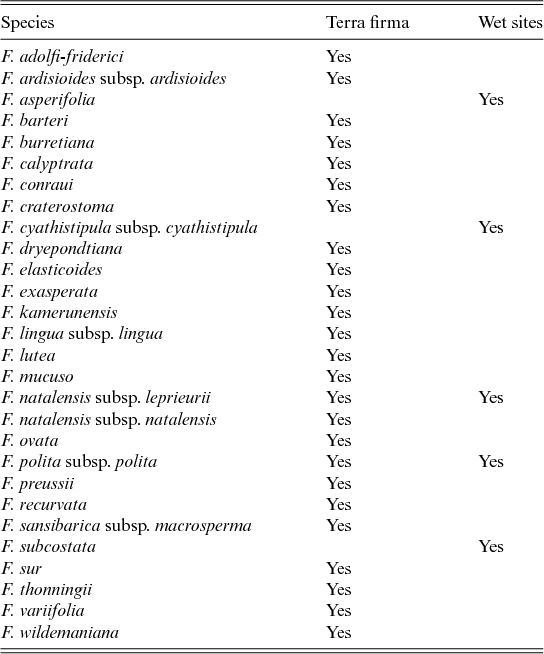
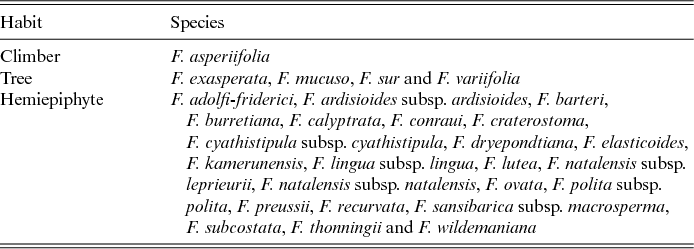
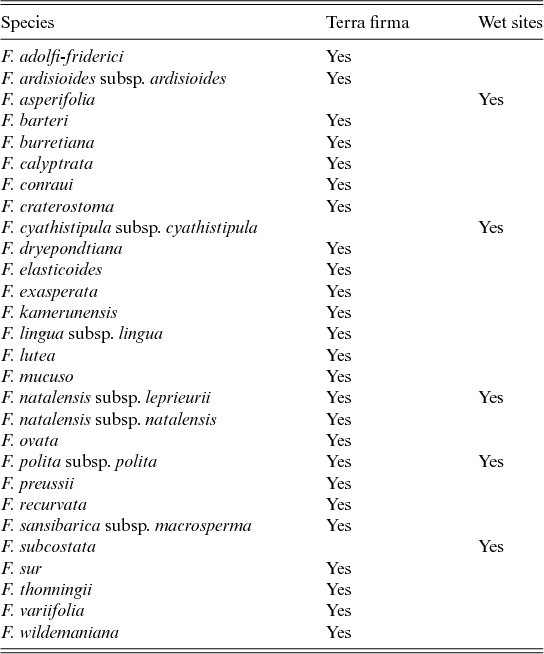
In the Sangha Trinational, we recorded 27 species of Ficus, one of the species with two subspecies. Three habits (tree, hemiepiphyte and climber; Table 1) are reported for the genus in the study site. An important division of habitat in the Sangha Trinational is the separation of terra firma forest from seasonally or permanently flooded forest. Most Ficus species occur in terra firma forest (Table 2). Three of these, all of them trees (Ficus exasperata, F. mucuso and F. sur) are restricted to disturbed sites; one other tree species (F. variifolia) appears to be restricted to undisturbed sites. The remaining terra firma species occur in both disturbed and undisturbed forests (see Table 2).
Habits of Ficus species from the Sangha Trinational
Habitats of Ficus species from the Sangha Trinational
In this article, the identification of Ficus species is based on morphological characters including habit, glandular spots, figs (location, number and colour at a given stage), basal and ostiolar bracts, ostiole shape, stipules, leaf shape and venation. A subset of this list (colour and smell) is available for fresh material only.
Glandular spots
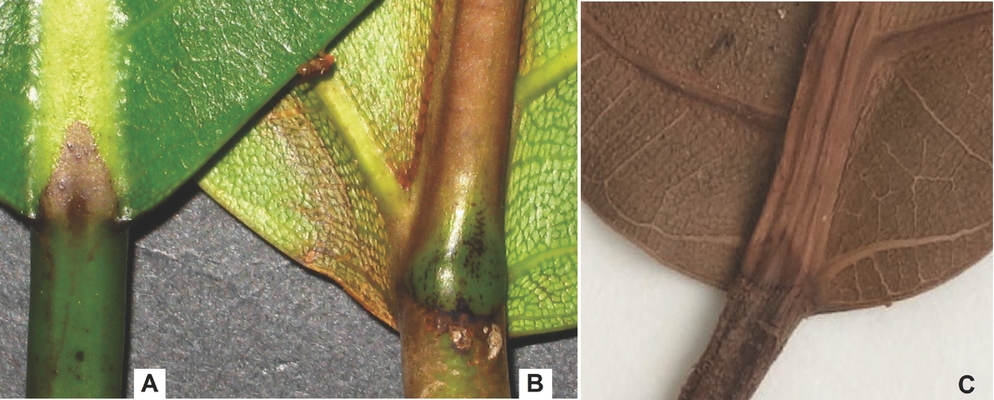
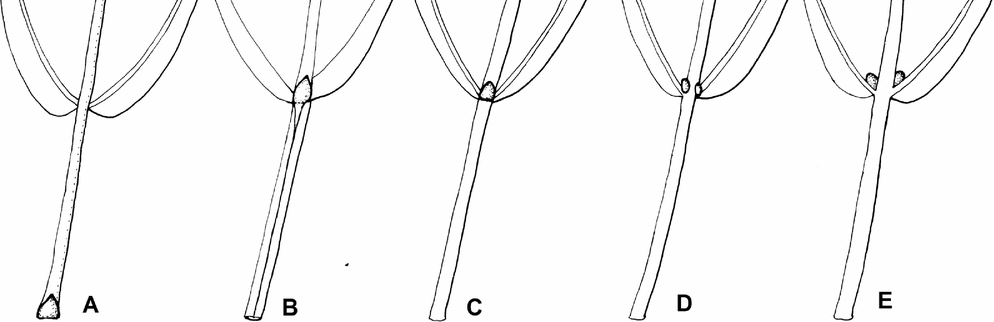
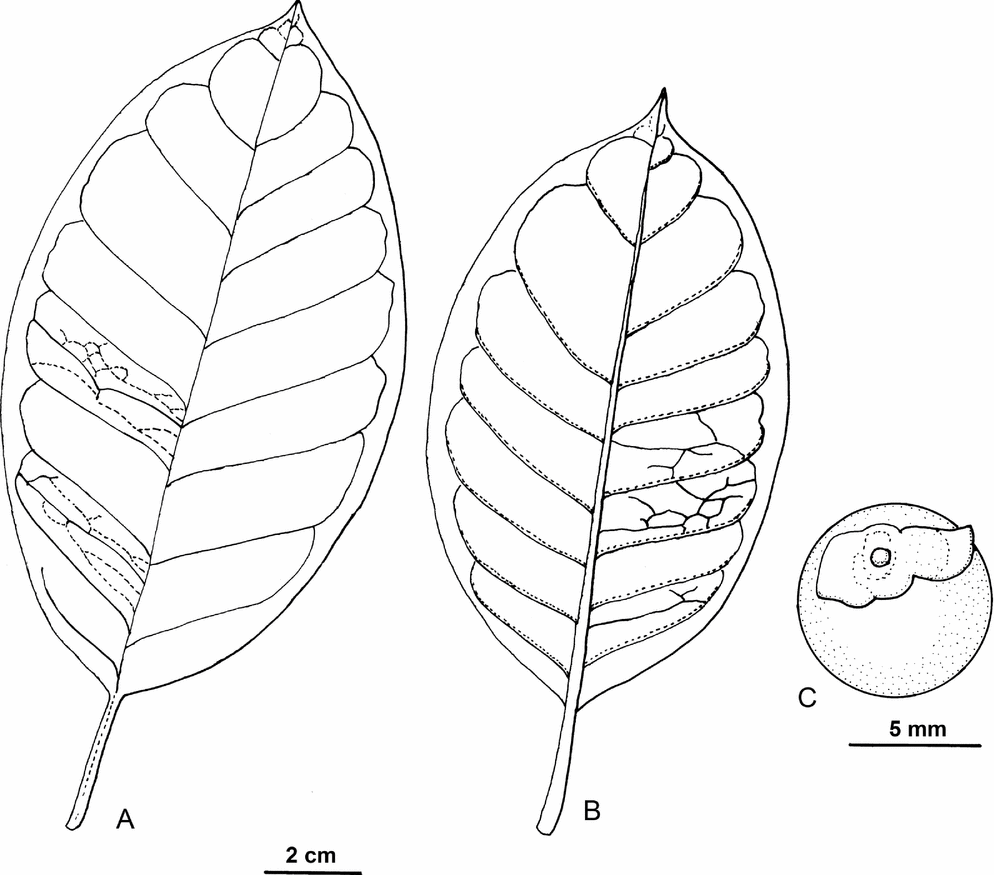
Glandular spots are shiny, oil-like marks sometimes present on the petiole, at the base of the midrib or in the axils of the basal pair of lateral veins. These spots are either solitary or in pairs. They are obvious on fresh material but less conspicuous on dried specimens (Fig. 2), therefore it is important to record such spots in the field. Glandular spots are inconspicuous or absent on Ficus adolfi-friderici, F. burretiana and F. variifolia.
Difference in the appearance of glandular spots between fresh and dried material. A, A single spot at the base of the midrib on the upper surface; B and C, a single spot at the base of the midrib on the lower surface. (A–C, Ficus lutea, Ndolo Ebika, S.T. 308.)
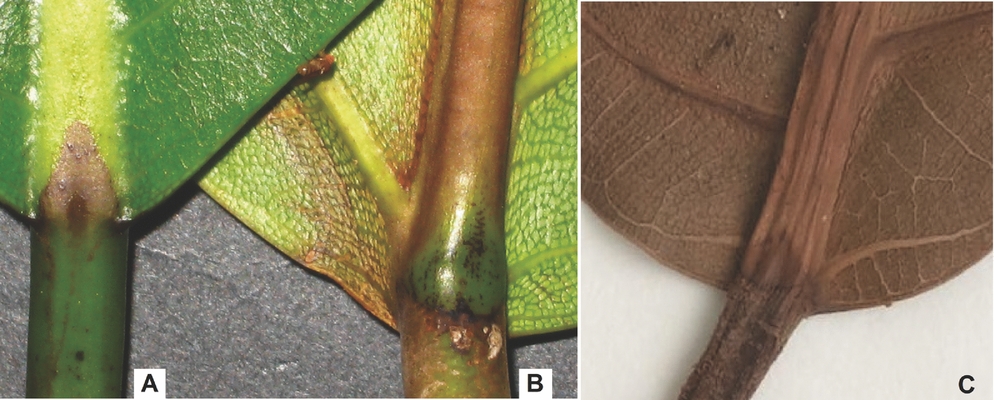
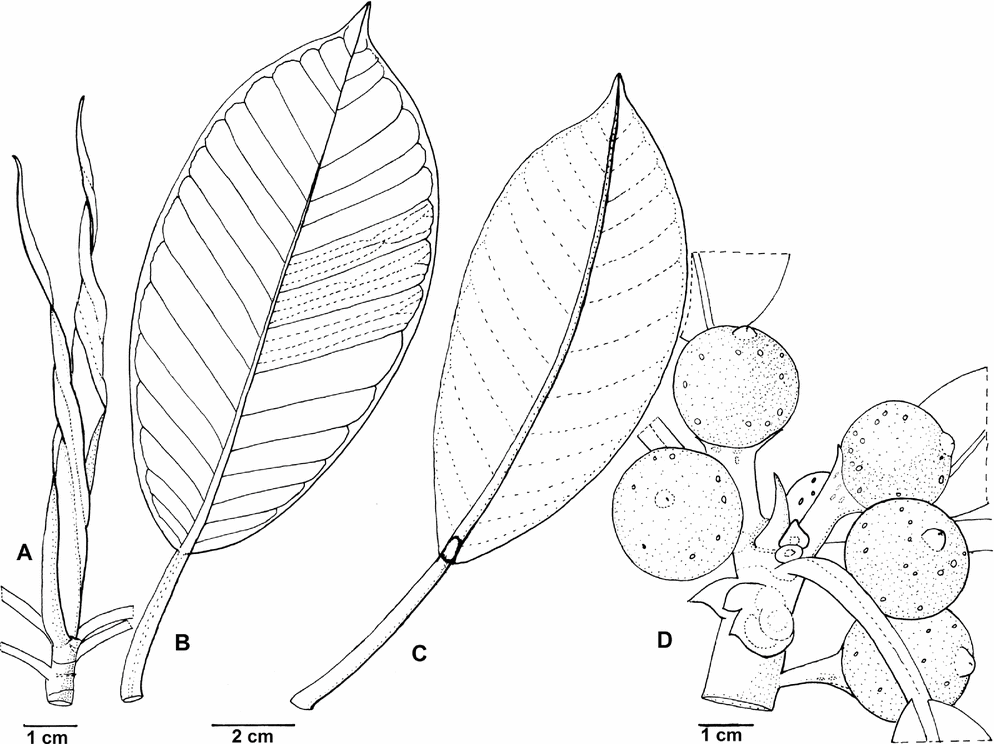
A solitary glandular spot is located at the base of the midrib on the lower surface of the lamina (Fig. 3) on most hemiepiphytic Ficus species that start their life as epiphytes (Berg & Wiebes, Reference Berg and Wiebes1992). However, there are some exceptions, namely Ficus recurvata and F. lutea. In Ficus recurvata, the spot is at the base of the lower surface of the petiole (Fig. 2A). Ficus lutea has a spot at the base of the midrib on the upper surface of the lamina (Fig. 2B) in addition to the one on the lower surface (Fig. 2C).
Location and number of glandular spots. A, A single spot at the base of the petiole on the lower surface; B, a single spot at the base of the midrib on the upper surface; C, a single spot at the base of the midrib on the lower surface; D, a pair of the spots at the junction of the midrib with the basal pair of the lateral veins on the lower surface; E, the axils of the basal pair of lateral veins on the lower surface.

Paired glandular spots are usually located in the axils of the basal pair of lateral veins on the lower surface (Fig. 3E). This is the case for two Ficus trees (F. mucuso and F. sur) and one climber (F. asperifolia). Occasionally in Ficus polita subsp. polita, the pair of glandular spots is located at the junction of the midrib with the basal pair of lateral veins on the lower surface (Fig. 3D).
Location of figs
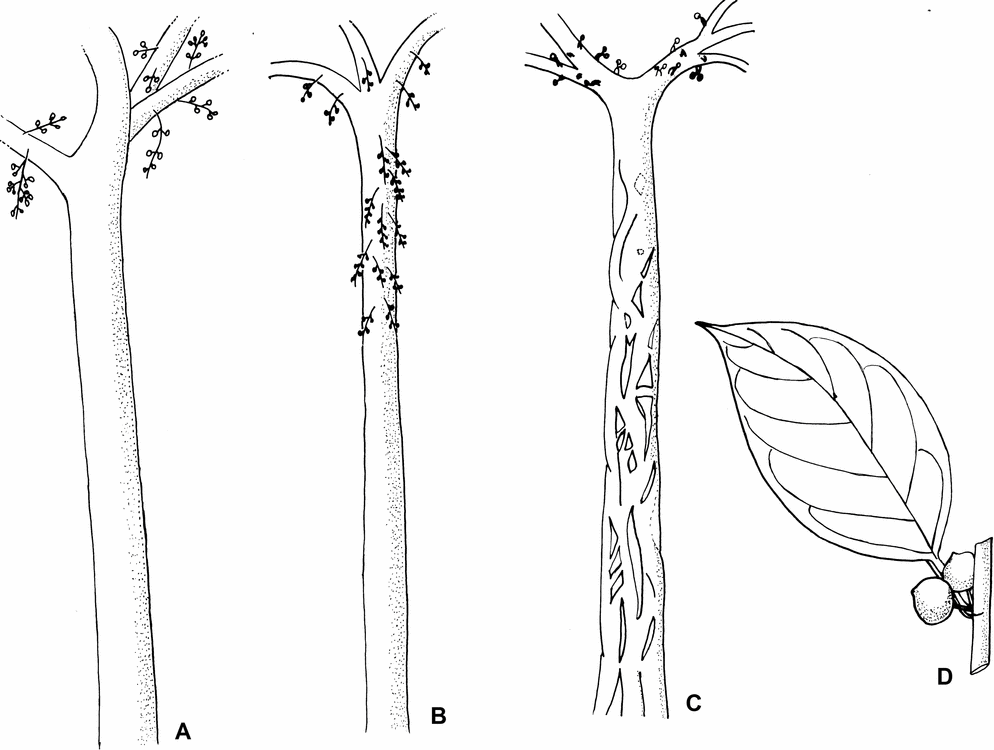
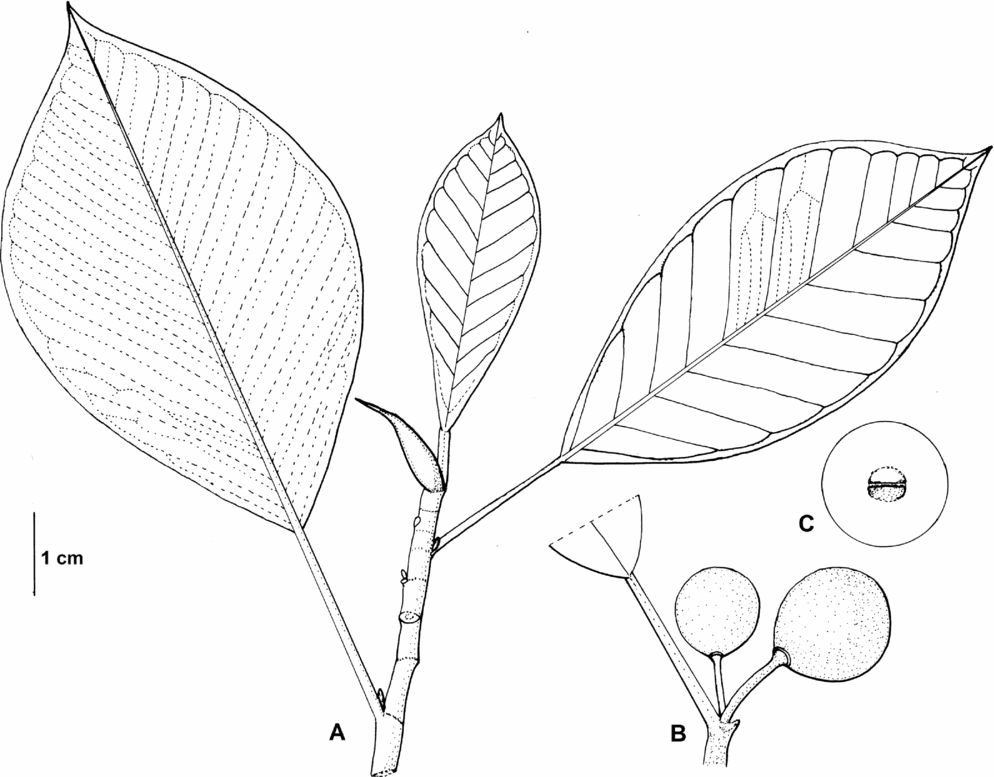
There are four main locations where figs can be found in the species from this study area: at the base of the trunk, on the upper part of the trunk, on the main branches or in the leaf axils (Fig. 4). On the upper part of the trunk, figs can be born on special branches (as in Ficus sur, Fig. 4B) or occasionally on spurs that are very short shoots bearing figs (in F. polita subsp. polita, Fig. 4C). On the main branches, figs can be born on special branchlets (Ficus mucuso, Fig. 4A; F. sur, Fig. 4B) or on spurs (F. polita subsp. polita and F. sansibarica subsp. macrosperma, Fig. 4C). The leaf axil fig position (Fig. 4D) is the most common location for many Ficus species treated in this article, representing approximately 85% of the total number of species. In Ficus exasperata, figs appear to be on twigs where there are no leaves, but the position corresponds to the axils of fallen leaves.
Location of figs. A, On special branchlets on the main branches; B, on special branchlets on the upper part of the trunk and on the main branches; C, on spurs on the main branches; D, in the leaf axil.

Bracts and ostiole
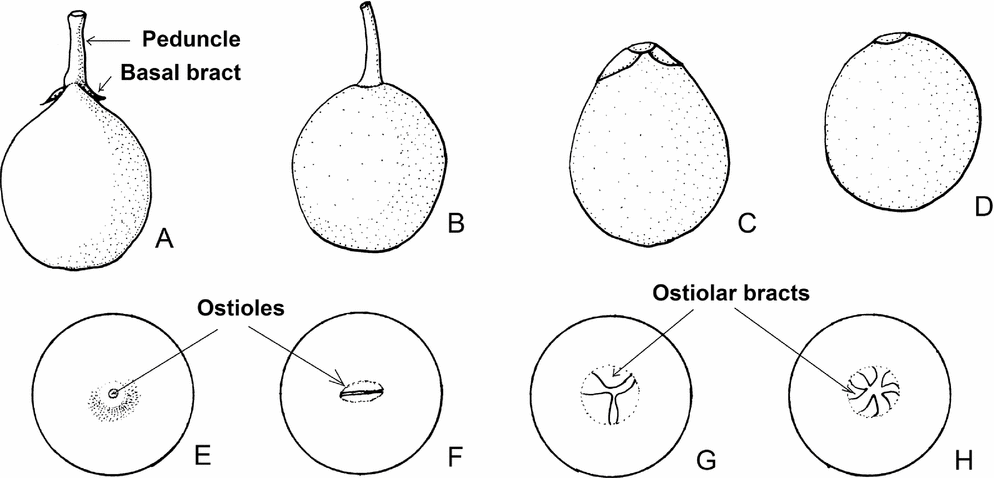
Bracts of figs are appendages located either at the base of the receptacle (basal bracts, Fig. 5A,C) or at the orifice of the receptacle (ostiole), where they are called ostiolar bracts (Fig. 5G,H). Basal bracts are persistent if they do not fall off when the fig is mature, otherwise they are caducous. Presence or absence and number of bracts are of taxonomic importance. For example, Ficus burretiana and F. elasticoides look the same in terms of leaf shape but basal bracts are caducous in the former species and persistent in the latter. The ostiole plays an important role in pollination, because it serves as an entrance for the pollinators (fig wasps). In species in which the ostiole does not have any bracts, it can be a pore (hollow-shaped, Fig. 5E) or a slit (a narrow incision with two lips, Fig. 5F).
Bracts and ostiole. A, A pedunculate fig with two persistent basal bracts; B, a pedunculate fig without basal bracts (they are caducous); C, a sessile fig with two persistent basal bracts; D, a sessile fig without basal bracts; E, ostiole a round pore; F, ostiole a slit; G, ostiole circular with three ostiolar bracts; H, ostiole circular with five ostiolar bracts.

Colour of figs
Figs’ colours play an important role in determining and attracting a range of vertebrate frugivores that can act as seed dispersers (Lomáscolo et al., Reference Lomáscolo, Speranza and Kimball2008). Some Ficus species do not change their colour when ripe, whereas others do. An example of a species that does not change colour is Ficus recurvata, although mature figs of F. recurvata differ from unripe ones in being softer and emitting a distinctive smell. In species that change colour (e.g. Ficus mucuso), the fig is initially green, becoming yellow and then orange when ripe. As in the previous case, this category of figs will also soften and give off a characteristic smell when ripe, in addition to changing colour.
Key to sections and species of Ficus in the Sangha Trinational
1a. Trees, shrubs or lianas_______________(sect. Oreosycea, Sycidium, Sycomorus) 2
1b. Hemiepiphytes____________________6 (sect. Galogychia – 22 spp. in area) 6
2a. Glandular spot, 1, at the base of the midrib below; lenticels present on the upper part of internodes_______________(sect. Oreosycea – 1 sp. in area) 1. F. variifolia
2b. Glandular spots, 2, in the axils of basal pair of veins; no lenticels on the upper part of internodes_______________________________3 (sect. Sycidium, Sycomorus)
3a. Stipule semiamplexicaul; figs in pairs in the leaf axils___________________________(sect. Sycidium – 2 spp. in area) 4
3b. Stipule fully amplexicaul; figs usually on special leafless branches__________________________________________(sect. Sycomorus – 2 spp. in area) 5
4a. Liana; lamina elliptic, toothed at margin; glandular spots in the axils of the basal pair of the veins and in the axils of the lateral and other veins__________________________________________2. F. asperifolia
4b. Tree; lamina ovate to broadly elliptic, crenulated at margin; glandular spots only in the axils of the basal pairs of veins__________________3. F. exasperata
5a. Petiole hairy; lamina ovate, scabrous, ciliated at margin; midrib and lateral veins hairy__________________________________________4. F. mucuso
5b. Petiole glabrous or sparsely hairy; lamina broadly elliptic or oblanceolate, smooth, toothed at margin; midrib and lateral veins glabrous________5. F. sur
6a. Lamina cordate (including minutely cordate) at base__________________7
6b. Lamina not cordate at base___________________________22
7a. Lamina less than 3 cm long_________________________6. F. lingua subsp. lingua
7b. Lamina more than 3 cm long___________________________8
8a. Lamina oblong__________________________________________9
8b. Lamina not oblong__________________________________________11
9a. Figs pedunculate on spurs on main branches____________7. F. dryepondtiana
9b. Figs sessile in the leaf axils_________________________10
10a. Lateral veins in 5–8 pairs, figs more than 1.5 cm in diameter___8. F. subcostata
10b. Lateral veins in 12–18 pairs, figs less than 1 cm in diameter__9. F. kamerunensis
11a. Lateral veins in fewer than 10 pairs_______________________12
11b. Lateral veins in at least 10 pairs____________________________________15
12a. Apex of lamina rounded; figs less than 2 cm in diameter________10. F. calyptrata
12b. Apex of lamina acuminate; figs at least 2 cm in diameter______________13
13a. Figs on spurs on main branches_____________________________11. F. polita subsp. polita
13b. Figs in the leaf axils__________________________________________14
14a. Lamina broadly elliptic; figs shortly pedunculate, ovoid to oblong_12. F. ovata
14b. Lamina oblanceolate; figs sessile, globose___________________13. F. preussii
15a. Lower surface of the lamina and venation hairy_________________________16
15b. Lower surface of the lamina and venation glabrous_________________________18
16a. Glandular spot at base of petiole on the lower surface; figs pedunculate__________________________________________14. F. recurvata
16b. Glandular spot at base of midrib on the lower surface; figs sessile or subsessile (shortly pedunculate)__________________________________________17
17a. Lamina broadly elliptic; figs shortly pedunculate_____________________12. F. ovata
17b. Lamina lanceolate, oblanceolate or elliptic; figs sessile___________________________15. F. lutea
18a. Lamina leathery, up to 53 cm (or more) in length; figs sessile___________________16. F. wildemaniana
18b. Lamina papery, 13 cm in length maximum; figs pedunculate_____________________19
19a. Margin of the lamina revolute, tertiary venation not crowded______________________________ 17a. F. natalensis subsp. leprieurii
19b. Margin of the lamina not revolute, tertiary venation crowded_______________20
20a. Midrib not reaching the apex of the lamina; lamina obtriangular; figs sessile___________________________________18. F. craterostoma
20b. Midrib reaching the apex of the lamina or not occasionally doing so; lamina elliptic or oblanceolate sometimes obtriangular; figs pedunculate______________21
21a. Figs less than 8 mm in diameter, peduncle 6 mm long____________19. F. thonningii
21b. Figs more than 8 mm in diameter, peduncle 3–5 mm long__________________________________________ 17b. F. natalensis subsp. natalensis
22a. Midrib not reaching apex of lamina________________________23
22b. Midrib reaching apex of lamina_______________________________25
23a. Lamina less than 3 cm long and 1.5 cm wide; figs less than 5 mm in diameter when fresh (sessile)____________________________________6. F. lingua subsp. lingua
23b. Lamina more than 3 cm long and 1.5 cm wide; figs more than 5 mm in diameter when fresh (sessile or pedunculate)_____________________________24
24a. Lamina obtriangular–oblong; figs sessile__________________________________________18. F. craterostoma
24b. Lamina elliptic to obtriangular–ovate; figs pedunculate__________________________________________17a. F. natalensis subsp. leprieurii
25a. Lateral veins in fewer than 8 pairs________________________________26
25b. Lateral veins in 8 or more pairs____________________________30
26a. Figs on spurs on main branches___________________________________27
26b. Figs in the leaf axils__________________________________________28
27a. Lamina elliptic or oblanceolate____________20. F. sansibarica subsp. macrosperma
27b. Lamina ovate or broadly elliptic____________________11. F. polita subsp. polita
28a. Figs sessile, oblong__________________________________15. F. lutea
28b. Figs pedunculate, globose_______________________________29
29a. Stipules persistent; figs more than 1 cm in diameter when dry__________________________________________21. F. cyathistipula subsp. cyathistipula
29b. Stipules caducous; figs less than 1 cm in diameter when dry__________________________________________22. F. ardisioides subsp. ardisioides
30a. Lamina oblong__________________________________31
30b. Lamina elliptic____________________________________32
31a. Lateral veins in 9–12 pairs; figs pedunculate__________________________________________23. F. barteri
31b. Lateral veins in 12–18 pairs; figs sessile________________________________9. F. kamerunensis
32a. Figs sessile__________________________________________33
32b. Figs pedunculate__________________________________________35
33a. Petiole more than 4 mm wide; figs more than 2 cm in diameter__________________________________________16. F. wildemaniana
33b. Petiole less than 4 mm wide; figs up to 2 cm in diameter___________________34
34a. Lateral veins in 8–14 pairs; figs hairy, 2–2.2 cm in diameter___________24. F. conraui
34b. Lateral veins in 9 pairs; figs glabrous, 0.6–0.8 cm in diameter__________________________________________25. F. adolfi-friderici
35a. Apex of lamina with distinct acumen, more than 1 cm long; lamina more than 10 cm long__________________________________________23. F. barteri
35b. Apex of lamina without distinct acumen, if present less than 1 cm long; lamina less than 10 cm long__________________________________________36
36a. Lamina oblanceolate to narrowly elliptic____17b. F. natalensis subsp. natalensis
36b. Lamina broadly elliptic__________________________________________37
37a. Lamina more than 4 cm wide; glandular spot at base of midrib on lower surface of lamina; figs more than 1.3 cm in diameter____________________________26. F. elasticoides
37b. Lamina up to 4 cm wide; glandular spots absent; figs less than 1.2 cm in diameter______________________________________27. F. burretiana
Section Oreosycea Berg et al., Fl. Cam. 28: 144 (Reference Berg, Hijman, Weerdenburg, Sabatié and Hallé1985); Berg & Wiebes 15 (Reference Berg and Wiebes1992).
Tree or shrub. Lenticels on the upper part of the internodes. Lamina scabrous to smooth above, margin entire, lobed pinnate to split; basal pairs of veins strongly or weakly obvious; tertiary venation parallel to slightly reticulate. Glandular spot(s) at the base of the midrib. Stipule fully amplexicaul and free. Figs pedunculate, in pairs in the leaf axils. Basal bracts 3, often in whorls, rarely penducular or lateral. Ostiole rounded, with 3 bracts. Interfloral bracts absent. Male flowers with 1 bract, perianth tubular, bilobed, 1–3 stamens. Gall flowers and seed flowers distinct, perianth tubular, 2- or 3-lobed, glabrous. Stigmas 2.
In Africa, the section Oreosycea has two species: Ficus variifolia and F. dicranostyla (not treated in this article). These two species are morphologically close to each other, but the former occurs in forest areas where it is represented by big trees with buttresses whereas the latter is found in savannah and has individuals that are shrubs or small trees (usually no more than 20 m tall). In Madagascar and Comoros, there are other species belonging to the section Oreosycea, such as Ficus assimilis, which resemble the two species found in Africa.
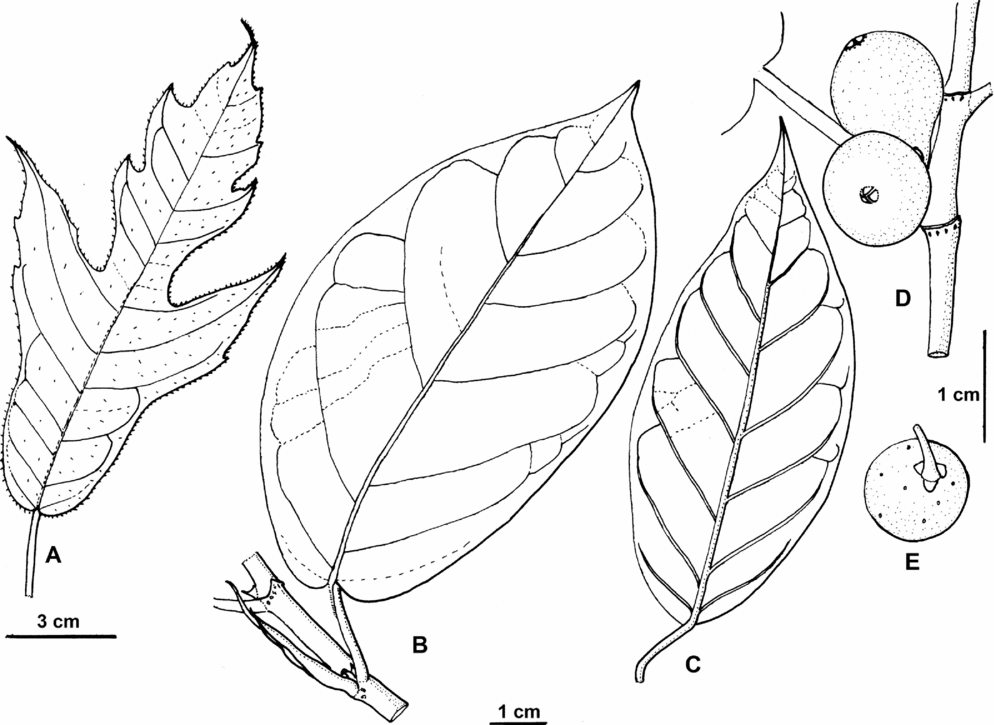
1. Ficus variifolia Warb., Fig. 6.
Berg et al., Fl. Gabon 26: 143 (Reference Berg, Hijman, Weerdenburg and Leroy1984); Berg & Wiebes 85 (Reference Berg and Wiebes1992); Gillet & Doucet 18 (suppl.) (Reference Gillet and Doucet2012); Ndolo Ebika 58 (Reference Ndolo Ebika2010).
Ficus variifolia Warb. A, Lobed leaf from the young shoot; B, twig with a leaf and two stipules still attached; C, leaf seen from the lower surface; D, twig with axillary figs; E, fig seen from below. (A–D, Ndolo Ebika, S.T. 309.)

Tree 25 m high. Base with buttress. Latex white on leafy twigs but colourless on the trunk. Lenticels present on the upper part of internodes. Stipules oblong, 2.8–3 × 0.5–0.6 cm, soon caducous, glabrous, pale green. Leaves entire (young shoots often with lobed and hairy leaves), alternate. Petiole scabrous, 0.9–2.3 × 0.1 cm, channelled above. Lamina elliptic, 5.5–13.5 × 2.8–6.6 cm, scabrous; base cordate or rounded; apex acuminate (0.5–1.5 cm long). Lateral veins in 8–15 pairs (including 1 or 2 basal pairs), looping at 3 mm from the margin. Glandular spots absent. Figs in the leaf axils, in pairs, pedunculate, globose, 1 cm in diameter when fresh, 0.6–0.7 cm when dry, yellow to brown with green dots when ripe. Peduncle shortly hairy, 3–6 mm long. Basal bracts 3, persistent. Ostiolar bracts 3. Ostiole prominent, circular.
Habitat
Mixed-species terra firma forest.
Specimen. Ndolo Ebika, S.T. 309.
Section Sycidium Berg et al., Fl. Cam. 28: 120 (Reference Berg, Hijman, Weerdenburg, Sabatié and Hallé1985); Berg & Weibes 15 (Reference Berg and Wiebes1992).
Trees, large and small, lianas. Lamina like sandpaper above, toothed or lobed; basal pairs of veins obvious; tertiary venation reticulate. Glandular spots in the axils of the basal pair. Stipule semiamplexicaul. Figs pedunculate, in pairs in leaf axils, under the leaves or on short shoot. Basal bracts often lacking, presence of bracts on the peduncle (peduncular bracts) and also on the fig (lateral bracts). Ostiolar bracts numerous. Receptacles each containing either male flowers and gall flowers, or seed flowers only. Male and female flowers may be on different individuals.
Fig species belonging to the section Sycidium include Ficus asperifolia (occurring in wet places in forest areas), F. capreifolia Delile (not treated in this article), F. exasperata (on terra firma) and F. pygmaea Welw. ex Hiern (not treated).
2. Ficus asperifolia Miq., Fig. 7.
Berg et al., Fl. Cam. 28: 124 (Reference Berg, Hijman, Weerdenburg, Sabatié and Hallé1985); Berg & Wiebes 68 (Reference Berg and Wiebes1992); Gillet & Doucet 18 (suppl.) (Reference Gillet and Doucet2012); Harris 141 (Reference Harris2002).
Ficus asperifolia Miq. A, Leafy twig; B, section of the bottom part of the leaf with glandular spots in the axils of the basal pair and other lateral veins; C, section of the upper part of the lamina; D, hairy and paired figs in the leaf axils; E, glabrous and solitary fig in the leaf axils. (A, B and D, Ndolo Ebika, S.T. 942; C and E, Ndolo Ebika, S.T. 1387, from photograph, no specimen).

Liana 1 m high. Latex yellowish. Stipules caducous. Leaves toothed, alternate. Petiole scabrous, 1 cm long. Lamina asymmetric, elliptic, 20.5 × 8.6 cm, scabrous beneath; base asymmetric, rounded; apex acuminate, up to 1.8 cm long. Lateral veins in 8 pairs. Tertiary veins parallel (to more or less perpendicular) to the lateral veins. Glandular spots in the axils of the basal pair of veins and in the axils of the lateral and other veins. Figs in the leaf axils, solitary or in pairs, pedunculate, (sub)globose, 1.2–2 cm in diameter, hairy or glabrous, green and sometimes with brown spots when unripe, yellow when ripe, smooth when dry. Peduncle up to 6 mm long. Basal bracts 3. Ostiolar bracts 7. Ostiole circular.
Habitat
Seasonally flooded forest, and occasionally secondary forest growing on old fields.
Specimens. Harris, D.J. 893, 1110, 1716, 1736; Ndolo Ebika, S.T. 942, 1387.
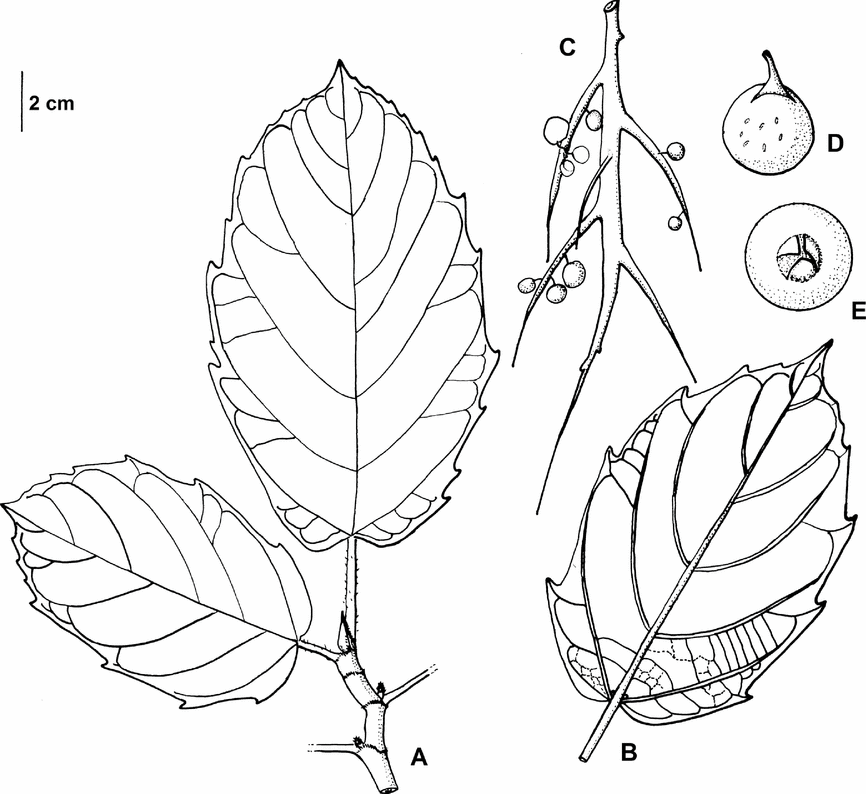
3. Ficus exasperata Vahl, Fig. 8.
Berg & Wiebes 65 (Reference Berg and Wiebes1992); Gillet & Doucet 18 (suppl.) (Reference Gillet and Doucet2012); Moutsamboté et al. 284 (Reference Moutsamboté, Yumoto, Mitani, Nishihara, Suzuki and Kuroda1994).
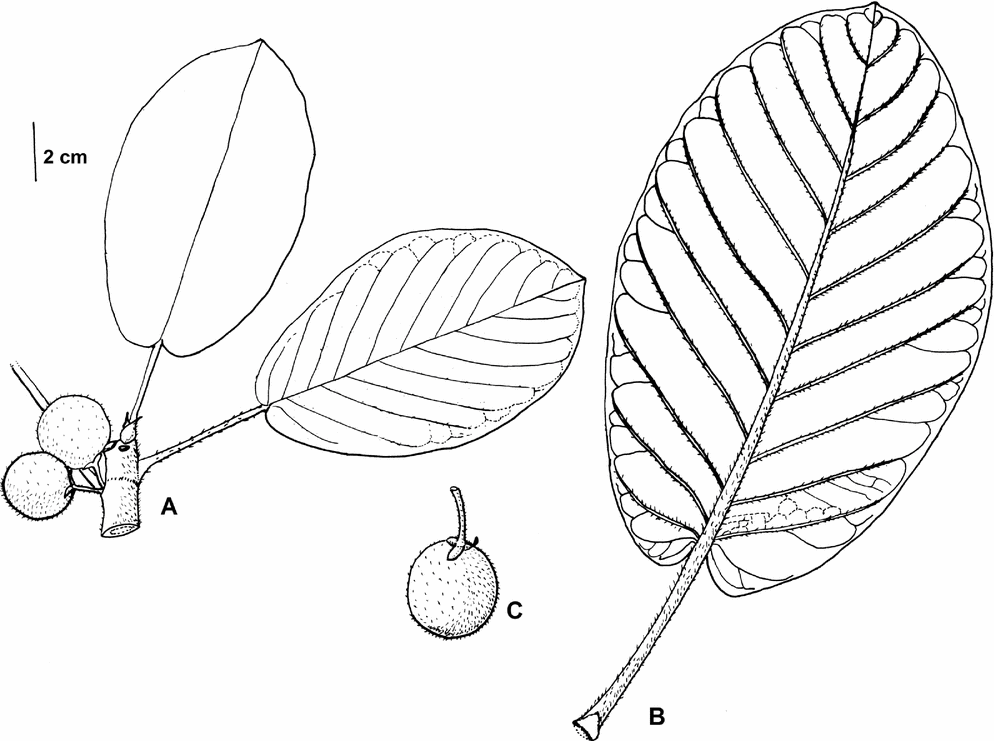
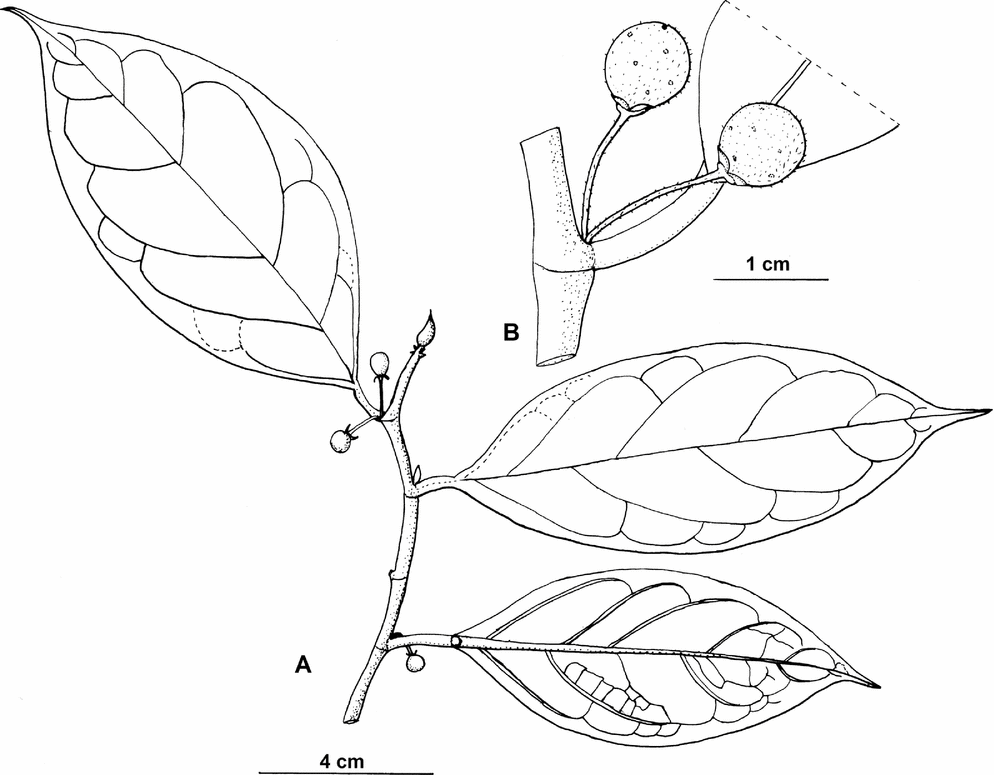
Ficus exasperata Vahl. A, Twig with leaves and figs; B, lower surface of the leaf; C, figs. (A–C, Ndolo Ebika, S.T. 826.)

Tree 10 m high; diameter at breast height, 20 cm. Stipule caducous. Leaves crenulated, opposite to alternate. Petiole unequal on the same node, 0.6–7 cm long. Lamina ovate to broadly elliptic, 7–15.5 × 4–8 cm, scabrous (sandpapery in texture) on both surfaces; base slightly cordate to rounded. Lateral veins in 5–7 pairs, including the basal pair, which reaches the margin at or above half of the length of the lamina. Tertiary veins perpendicular to the midrib and to the lateral veins. Glandular spots only in the axils of the basal pairs of veins. Figs just under the leaves inserted above the scars of petioles of recently fallen leaves, in pairs, pedunculate, globose, 1.3–1.7 cm in diameter, greenish when unripe, yellow then red when ripe. Peduncle 6–9 mm long. Basal bracts caducous. Ostiolar bracts more than 3. Ostiole circular.
Habitat
Villages, roadsides, old fields, logged forest.
Specimens. Fay, M.J. 8701; Harris, D.J. 9291, 9393; Ndolo Ebika, S.T. 826; Nzolani Silaho, F.O. 455.
Section Sycomorus Berg et al., Fl. Cam. 28: 128 (Reference Berg, Hijman, Weerdenburg, Sabatié and Hallé1985); Berg & Wiebes 15 (Reference Berg and Wiebes1992).
Tree without aerial roots. Lamina scabrous or smooth above, margin usually ± toothed; basal pairs of veins strongly obvious; tertiary venation parallel to slightly reticulate. Glandular spots in the axils of the basal pair of veins. Stipule fully amplexicaul and free. Figs pedunculate, solitary in leaf axil or on leafless twigs ± branched on the trunk and/or the main branches. Basal bracts 3 and in whorls, often lacking. Ostiole rounded, covered by several bracts appearing raised when dry. Interfloral bracts absent among female flowers. Male flowers surrounded by 2 (or 3) bracteoles, perianth tubular, bilobed, 1–3 stamens. Gall flowers and seed flowers distinct, perianth 2–6 tepals, free or partially fused.
Five species belong to the section Sycomorus: Ficus mucuso, F. sur, F. sycomorus L. subsp. gnaphalocarpa (Miq.) C.C.Berg, F. vogeliana (Miq.) Miq., all having figs on special leafless twigs, and F. vallis-choudae Delile, which has solitary figs in the leaf axils. Of these five species, only the first two are treated in this article.
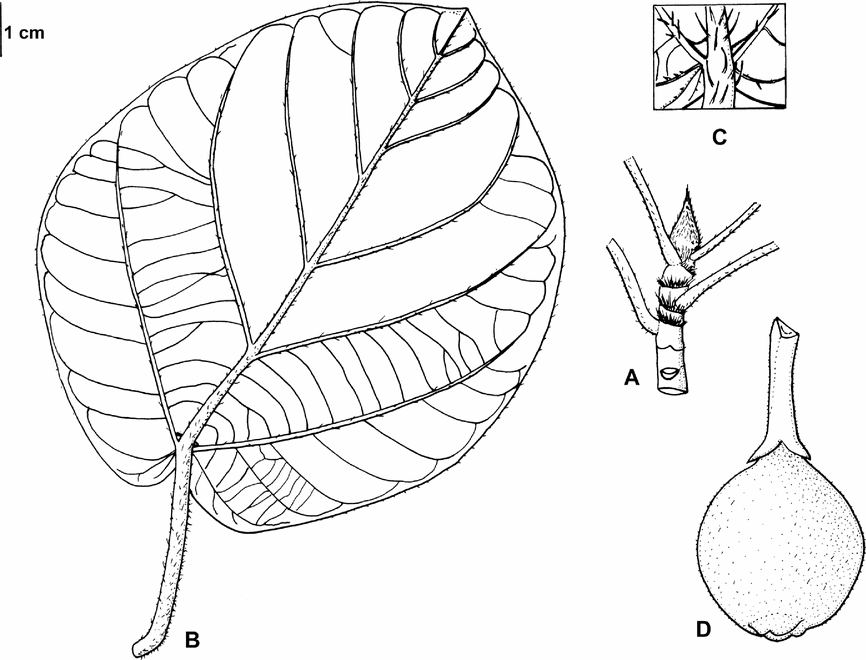
4. Ficus mucuso Welw. ex Ficalho, Fig. 9.
Berg & Wiebes 76 (Reference Berg and Wiebes1992); Gillet & Doucet 18 (suppl.) (Reference Gillet and Doucet2012); Harris & Wortley 78 (Reference Harris and Wortley2008).
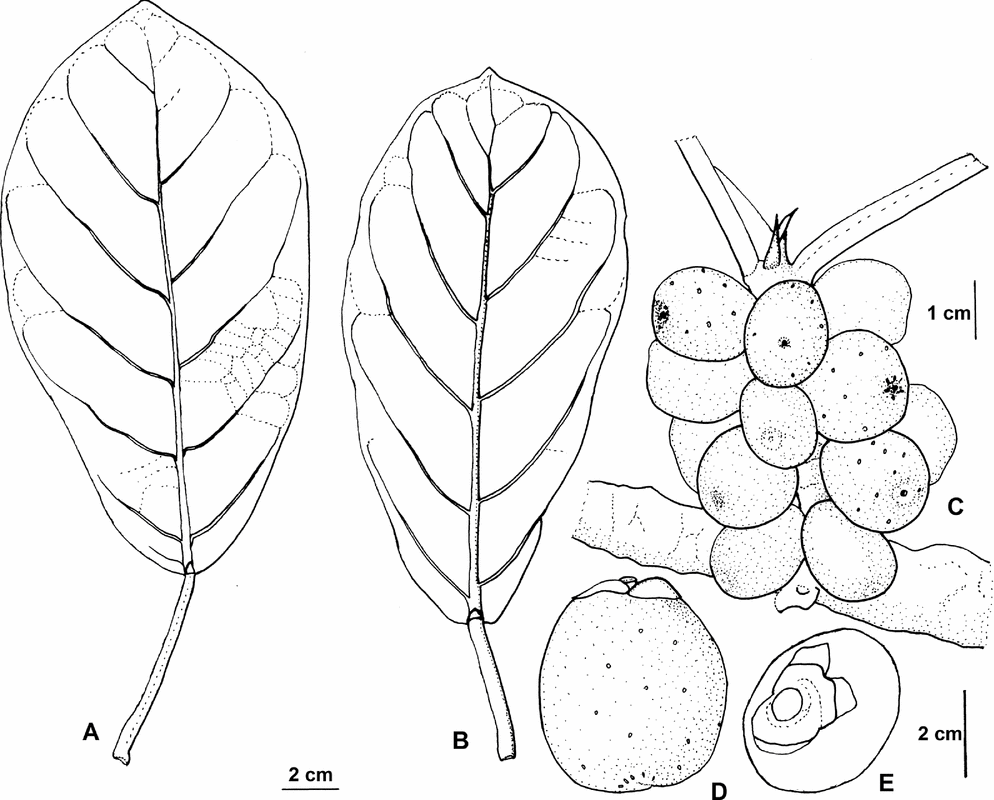
Ficus mucuso Welw. ex Ficalho. A, Section of a leafy twig; B, leaf seen from the lower surface; C, enlarged section of the base of the leaf, showing long and short hairs and the spots in the axils of the two basal lateral veins; D, fig. (A–D, Ndolo Ebika, S.T. 919.)

Tree 20 m high; diameter at breast height, 80 cm. Latex yellowish. Stipules caducous with a ring of hairs remaining at the location of the fallen stipules. Terminal bud persistent, hairy. Petiole with long and short hairs, 2.5–10.5 cm long. Lamina ovate, 9–15.5 × 9–12 cm, scabrous (sandpapery in texture) above; margin of the lamina ciliated. Midrib and lateral veins with long and short hairs. Lateral veins in 4–7 pairs. Tertiary veins parallel between them and nearly perpendicular to the lateral veins. Figs borne on special hanging branches on the main branches of the tree, pedunculate, globose, 3–3.2 cm in diameter, green when unripe, yellow then red when ripe, shortly hairy. Peduncle shortly hairy, 1.7–2.5 cm long. Basal bracts 3, persistent or caducous. Ostiolar bracts more than 3. Ostiole with more than 3 prominent bumps.
Habitat
Villages, roadsides, logged forest.
Specimens. Fay, M. 8565; Harris, D.J. 1215, 5204; Ndolo Ebika, S.T. 919; Nzolani Silaho, F.O. 564.
Deciduous. We have not yet found this species in undisturbed forest.
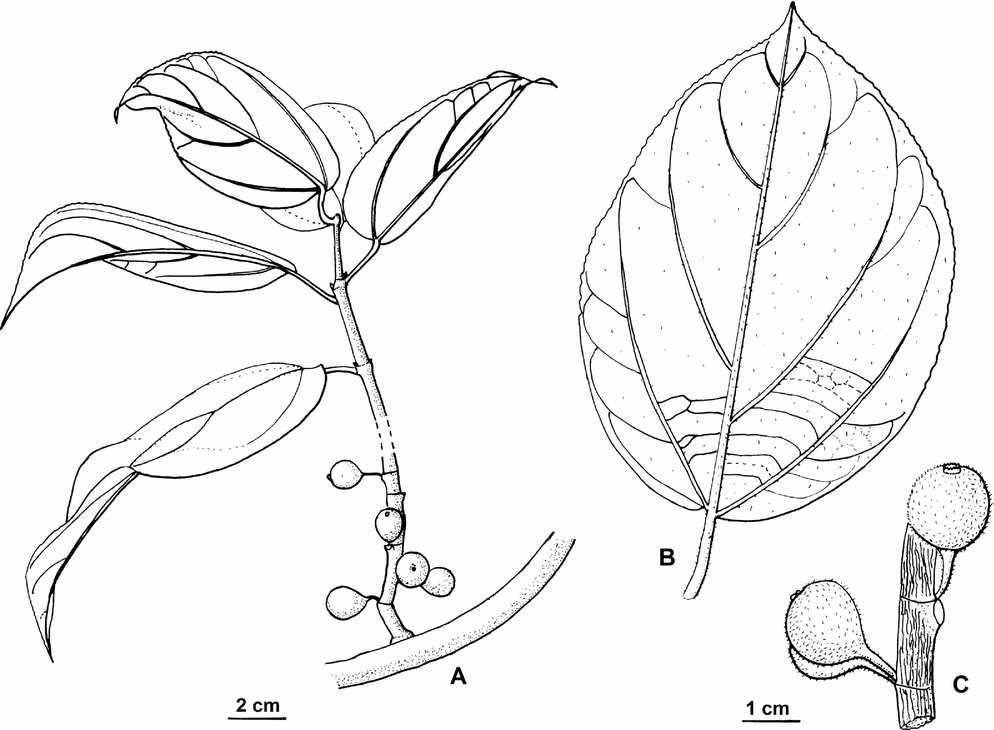
5. Ficus sur Forssk., Fig. 10.
Berg & Wiebes 77 (Reference Berg and Wiebes1992); Gillet & Doucet 18 (suppl.) (Reference Gillet and Doucet2012); Harris 145 (Reference Harris2002); Harris & Wortley 81 (Reference Harris and Wortley2008).
Ficus sur Forssk. A, Leafy twig; B, leaf seen from the lower surface; C, special branchlet bearing the figs; D, fig seen from the side; E, ostiole. (A–E, Ndolo Ebika, S.T. 1.)

Tree 15 m high. Latex white. Stipules caducous, leaving hairy scars on the stem. Terminal bud persistent, hairy. Leaves toothed, alternate. Petiole with sparse white hairs or glabrous, 1.4–14 × 0.2–0.3 cm. Lamina broadly elliptic or oblanceolate, 9.5–25 × 5–13 cm; base cordate or rounded; apex acuminate (up to 5 mm long) to rounded. Midrib glabrous. Lateral veins in 5–9 pairs (including the basal pair), hairy or glabrous. Glandular spots in the axils of the basal pair of the lateral veins on the lower surface. Figs borne on special pendent branches up to 60 cm long on the trunk and main branches of the tree, pedunculate, globose, up 3 cm in diameter when fresh, 1–2 cm in diameter when dry, green with white spots when unripe, red when ripe, hairy or glabrous. Peduncle 0.6–1.5 cm long. Basal bracts 3, persistent. Ostiolar bracts 3. Ostiole circular.
Habitat
Secondary forest, village.
Specimens. Fay, M.J. 8334, 8622, 8736; Harris, D.J. 492, 532, 5952; Ndolo Ebika, S.T. 1, 1035.
We have not yet found this species in undisturbed forest.
Section Galoglychia Berg et al. Fl. Cam. 28: 156 (Reference Berg, Hijman, Weerdenburg, Sabatié and Hallé1985)
Hemiepiphyte, with adventive and aerial roots. Lamina margin entire, sometimes lobed; basal pairs of veins obvious or not; tertiary venation often reticulate. Glandular spot: only one at the base of the midrib. Stipule fully amplexicaul and free. Figs pedunculate or sessile, in pairs in leaf axils or just below the leaves, or on spurs below leaves on main branches and trunk. Basal bracts usually 2, sometimes 3. Ostiole split, with 2 bracts. Male flowers 1 stamen. Gall flowers and seed flowers distinct or hardly distinct, perianth 2–4 tepals free or fused at the base.
Of the 65 species found in Africa, 45 are in Cameroon and 31 in Gabon. Of these 65, 22 are treated in this article.
6. Ficus lingua De Wild. & T.Durand subsp. lingua, Fig. 11.
Berg & Wiebes 120 (Reference Berg and Wiebes1992); Harris & Wortley 76 (Reference Harris and Wortley2008).
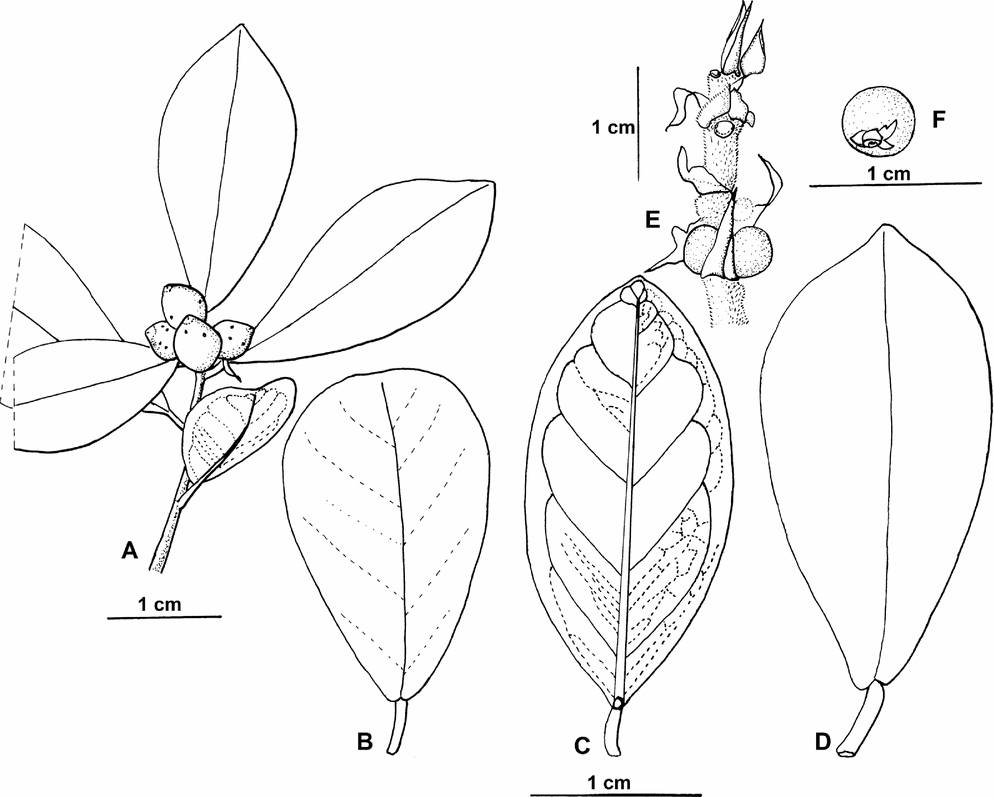
Ficus lingua De Wild. & T.Durand subsp. lingua. A, Twig with leaves and figs; B–D, variation in leaf shape and size; E, twig with stipules and figs; F, fig. (A–E, Ndolo Ebika, S.T. 1172.)

Hemiepiphyte. Latex white. Stipules persistent, 3 × 2 mm. Leaves entire, alternate. Petiole 0.2–0.5 cm long. Lamina elliptic, oblanceolate or obtriangular, 1.1–3 × 0.5–1.5 cm; base cuneate or minutely cordate; apex rounded or obtuse. Midrib reaching or not reaching the apex of the lamina. Lateral veins in 5–8 pairs. Glandular spots at the base of the midrib on the lower surface. Figs in the leaf axils, in pairs, sessile, 5 mm in diameter, green with yellowish spots when unripe, yellow with orange spots when ripe. Basal bracts 3, persistent. Ostiolar bracts absent. Ostiole an elongated slit.
Habitat
Mixed species terra firma forest; Gilbertiodendron dewevrei (De Wild.) J.Léonard forest on terra firma.
Specimens. Harris, D.J. 4921, 5387; Ndolo Ebika, S.T. 1125, 1172.
7. Ficus dryepondtiana Gentil ex De Wild., Fig. 12.
Berg et al. Fl. Cam. 28: 222 (Reference Berg, Hijman, Weerdenburg, Sabatié and Hallé1985); Berg & Wiebes 163 (Reference Berg and Wiebes1992); Harris 142 (Reference Harris2002); Ndolo Ebika 49 (Reference Ndolo Ebika2010).
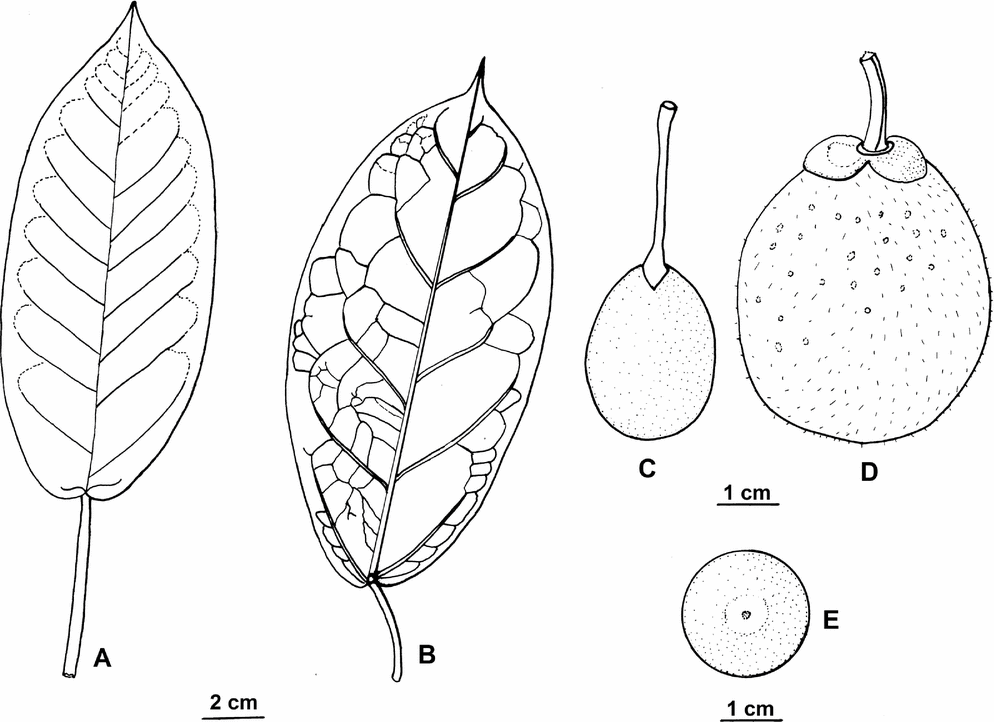
Ficus dryepondtiana Gentil ex De Wild. A, Leaf, upper surface; B, leaf, lower surface; C and D, figs; E, ostiole. (A, C and E, Ndolo Ebika, S.T. 360; D, Harris 1297.)

Hemiepiphyte 12 m high. Latex yellowish and translucent. Stipules 2.8 cm long, caducous. Leaves entire, spirally arranged. Petiole glabrous, 3–9 × 0.1–0.2 cm, channelled above. Lamina oblong to broadly elliptic, 8.2–22 × 3.5–9 cm, glabrous; base cordate; apex acuminate, 0.6–1.8 cm long. Lateral veins in 7–14 pairs including the basal pair, looping at 2–5 mm from the margin. Glandular spot at the base of the midrib. Figs on spurs on main branches, in groups of at least 4, pedunculate, oblong (3.5 × 2.5 cm) to subglobose (4 cm in diameter) when fresh, 2–2.5 cm in diameter when dry, hairy or glabrous, green when unripe, yellow with red spots when ripe; fig wall white, 3–8 mm thick. Peduncle 1.5–3.5 cm long. Basal bracts 2, caducous, leaving an oblique scar at the base of the fig. Ostiolar bracts absent. Ostiole an elongated slit and located in a depression.
Habitat
Mixed-species terra firma forest.
Specimens. Harris, D.J. 1297; Ndolo Ebika, S.T. 360.
Deciduous. Young leaves pale yellow.
8. Ficus subcostata De Wild., Fig. 13.
Berg et al. Fl. Cam. 28: 252 (Reference Berg, Hijman, Weerdenburg, Sabatié and Hallé1985); Harris 144 (Reference Harris2002) (although specimen cited by Harris, Reference Harris2002, is not this species).
Ficus subcostata De Wild. A, Leafy twig; B, figs. (A and B, Ndolo Ebika, S.T. 1386, from photograph, no specimen.)

Hemiepiphyte up to 4 m high. Branches producing aerial roots at the internodes. Stipule 2.5–4.5 × 0.5–1 cm, caducous on old wood. Leaves entire, alternate. Petiole 1.5–2.7 × 0.2–0.3 cm. Lamina leathery, oblong, 10–26.5 × 3.4–8.8 cm; base cordate; acumen 0.8–1 cm long; margin of the lamina revolute. Median midrib yellowish to reddish on the lower surface when fresh. Lateral veins in 5–8 pairs, looping from 2–5 mm from the margin. Tertiary and quaternary veins faintly reticulate, scale-like. Glandular spot at the base of the midrib on the lower surface. Figs in the leaf axils, in pairs, sessile, globose, 1.5–2.3 cm in diameter, when unripe green with prominent pale green spots. Basal bracts 2 and 2 mm long, persistent. Ostiolar bracts absent. Ostiole an elongated slit.
Habitat
Riparian forest.
Specimens. Ndolo Ebika, S.T. 1386, 1518.
9. Ficus kamerunensis Warb. ex Mildbr. & Burret, Fig. 14.
Berg et al. Fl. Gabon 26: 165 (Reference Berg, Hijman, Weerdenburg and Leroy1984); Harris & Wortley 76 (Reference Harris and Wortley2008); Ndolo Ebika, 52 (Reference Ndolo Ebika2010).
Ficus kamerunensis Warb. ex Mildbr. & Burret. A and B, Leaves, upper and lower surfaces respectively; C, twig with figs; D, fig seen from below; E, fig seen from the side. (A–D, Ndolo Ebika, S.T. 345.)

Hemiepiphyte 12 m high. Latex white. Stipules more or less triangular, 0.8–1 × 0.4 cm, soon caducous. Leaves entire, alternate. Petiole glabrous, 1–3 × 0.1 cm, slightly channelled above. Lamina oblong, 5.5–14 × 2–4 cm, glabrous; base rounded or slightly cordate; apex slightly rounded to shortly acuminate (c.4 mm long). Lateral veins in 12–18 pairs, parallel and almost perpendicular to the midrib, looping at 2 mm from the margin. Tertiary veins parallel to the lateral. Glandular spot at the base of the midrib. Figs in leaf axils, solitary or grouped together onto a compact mass, sessile, globose, 4–9 mm in diameter, green when unripe and yellow with orange spots when ripe. Basal bracts 2, fused into a crown. Ostiolar bracts absent. Ostiole an elongated slit.
Habitat
Mixed-species terra firma forest, Gilbertiodendron dewevrei forest on terra firma.
Specimens. Harris, D.J. 4559, 7745, 9411; Ndolo Ebika, S.T. 345, 1186.
A deciduous Ficus species. Young leaves red, yellowish then pale green.
10. Ficus calyptrata Vahl, Fig. 15.
Berg & Wiebes 116 (Reference Berg and Wiebes1992); Gillet & Doucet 18 (suppl.) (Reference Gillet and Doucet2012); Harris & Wortley 74 (Reference Harris and Wortley2008); Ndolo Ebika 47 (Reference Ndolo Ebika2010).
Ficus mallotoides Mildbr. & Hutch., Berg & Wiebes 116 (Reference Berg and Wiebes1992).
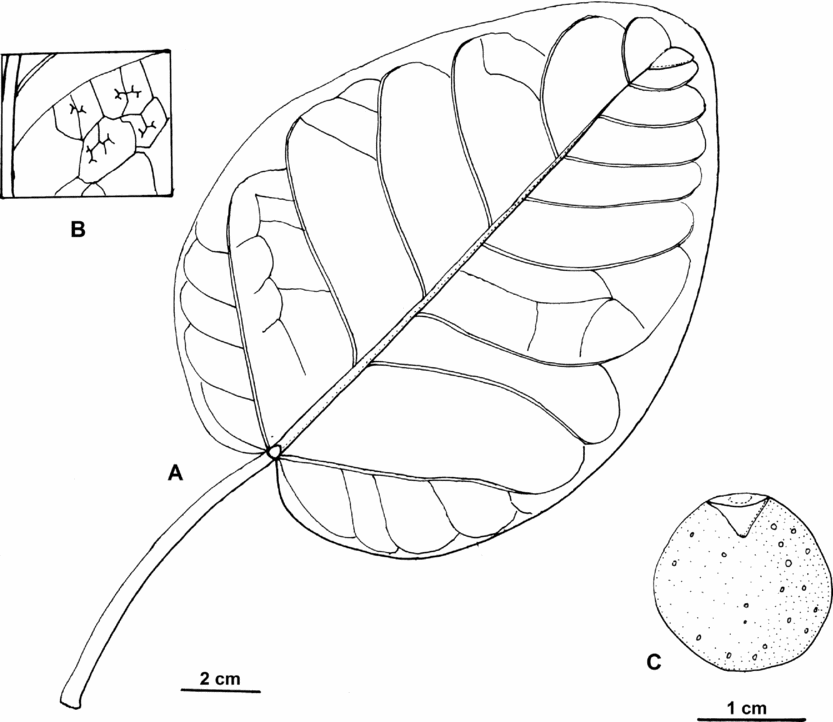
Ficus calyptrata Vahl. A, Leaf seen from the lower surface; B, portion of the lower surface of the lamina, showing the quaternary veins ending in open branches; C, fig. (A–C, from unnumbered photograph by Ndolo Ebika.)

Hemiepiphyte 20 m high. Latex white. Stipules lanceolate, 1.5–1.8 cm long and 1 cm wide at the base, hairy inside, persistent to caducous. Leaves entire, spirally arranged. Petiole glabrous, 3.4–8.5 × 0.3–0.5 cm. Lamina ovate, 8.2–20.5 × 7.8–14.7 cm; base cordate; apex rounded to slightly acuminate. Lateral veins in 6–9 pairs including the basal pair, looping at 4 mm from the margin. Tertiary veins reticulate. Quaternary veins branched, ending in a Y shape inside the network of the tertiary veins. Glandular spot at the base of the midrib. Figs in the leaf axils, in pairs or more than two, sessile, (sub)globose, 1–1.7 cm in diameter, yellowish when unripe and orange, red with orange or darker red spots when ripe, shortly hairy. Basal bracts 2, persistent. Ostiolar bracts absent. Ostiole an elongated slit.
Habitat
Mixed-species terra firma forest, Gilbertiodendron dewevrei forest on terra firma. Edge of marshy clearing and riparian forest.
Specimens. Harris, D.J. 4861, 7529, 9299.
Deciduous. Figs often seen when the canopy is totally without leaves and also during the appearance of young leaves.
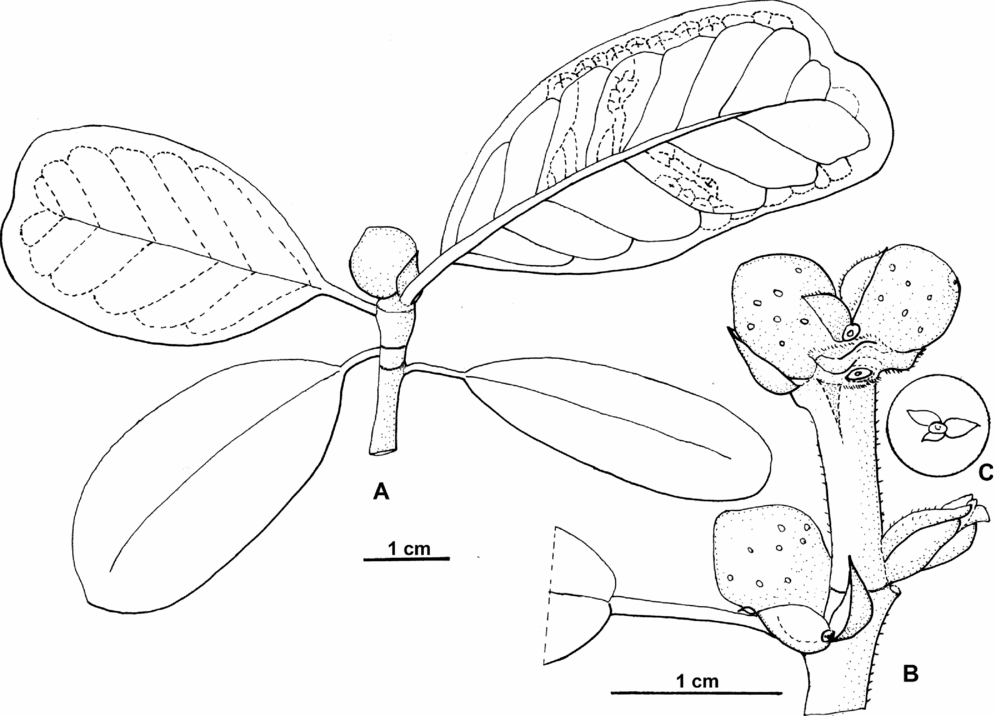
11. Ficus polita Vahl subsp. polita, Fig. 16.
Berg & Wiebes 159 (Reference Berg and Wiebes1992); Gillet & Doucet 18 (suppl.) (Reference Gillet and Doucet2012); Harris & Wortley 79 (Reference Harris and Wortley2008); Ndolo Ebika 55 (Reference Ndolo Ebika2010).
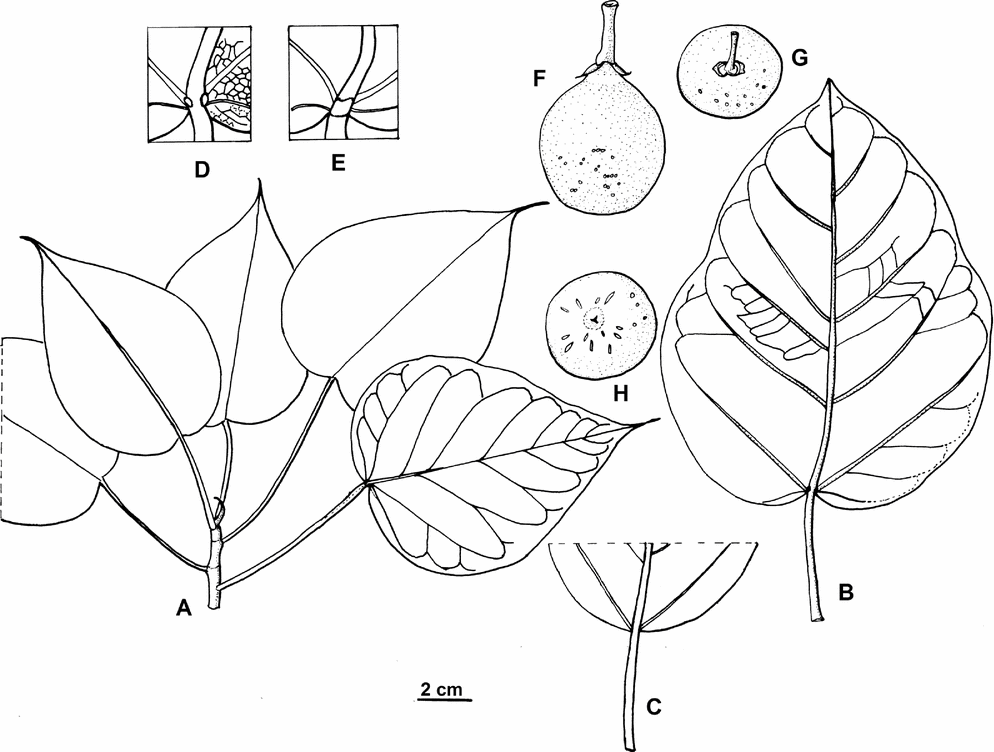
Ficus polita Vahl subsp. polita. A, Leafy twig; B, leaf, lower surface; C, section of the lower surface of the leaf; D, enlarged section of the base of the lower surface of the lamina, showing two glandular spots at the junction of the midrib and the basal pair of lateral veins. The section also shows fine network formed by quaternary veins; E, enlarged section of the base of the lamina with a glandular spot at the base of the midrib on the lower surface; F, fig seen from the side; G, fig seen from below; H, ostiole. (A and G, Ndolo Ebika, S.T. 536; B–F and H, Ndolo Ebika, S.T. 105.)

Hemiepiphyte becoming a free-standing strangler up to 20 m high. Base with buttresses. Latex white. Stipules caducous. Leaves entire, spirally arranged. Petiole glabrous, 2.8–9 × 0.2–0.4 cm. Lamina ovate or broadly elliptic, 8–21.5 × 4.6–11.8 cm, glabrous; base cordate or rounded; apex shortly acuminate (0.5–1.5 cm long). Lateral veins in 5–8 pairs (including the basal pair), looping at 3 mm from the margin. Tertiary veins parallel between them and almost perpendicular to the lateral veins. Quaternary veins forming a very tight network. Glandular spots either in pairs or single at the base of the midrib on the lower surface of the lamina. Figs on spurs on the trunk and on the main branches, in groups of up to 6, pedunculate, globose, 3.5–6 cm in diameter when fresh, 2–2.5 cm and wrinkled when dry, remaining green or yellowish with greenish spots when ripe, cuneate at the base. Peduncle shortly hairy, 1–4.5 × 0.8 cm. Basal bracts 2. Ostiolar bracts absent. Ostiole an elongated slit and located in a depression.
Habitat
Mixed-species terra firma forest, Gilbertiodendron dewevrei forest on terra firma, one individual on cleared land in village beside river.
Specimens. Harris, D.J. 1429, 1886, 5359, 8022; Ndolo Ebika, S.T. 105, 536, 823, 837.
Deciduous, with stipules falling off just before leaves appear.
12. Ficus ovata Vahl, Fig. 17.
Berg & Wiebes 165 (Reference Berg and Wiebes1992); Gillet & Doucet 18 (suppl.) (Reference Gillet and Doucet2012); Harris & Wortley 79 (Reference Harris and Wortley2008).
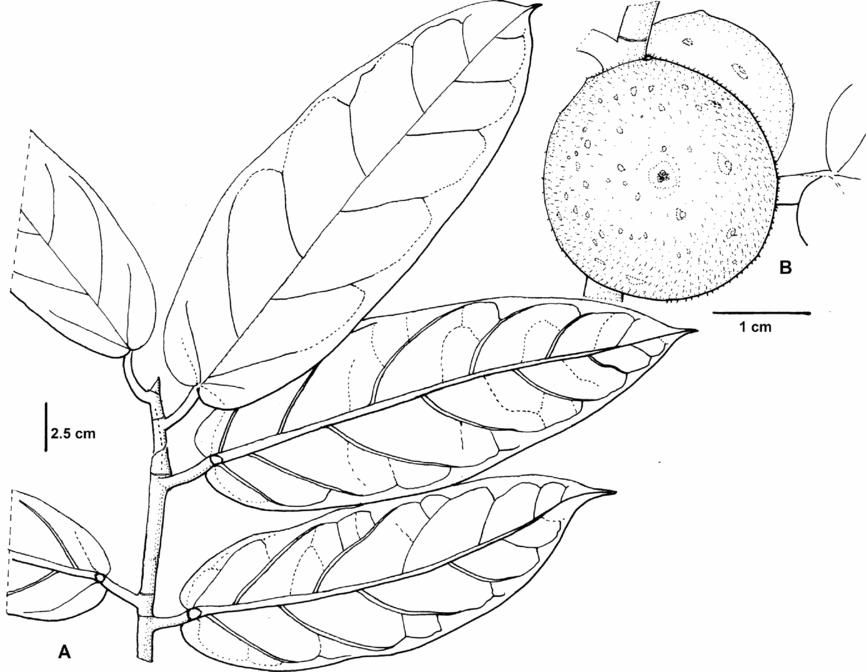
Ficus ovata Vahl. A, Leaf, lower surface; B, fig. (A and B, Ndolo Ebika, S.T. 581.)

Hemiepiphyte 15 m high, with white latex. Stipules caducous. Leaves entire, alternate. Petiole 4.5–6.5 cm long, hairy. Lamina broadly elliptic, 15.5–21.5 × 10–12.5 cm, glabrous above, hairy beneath; base cordate or rounded; apex with acumen up to 1.5 cm long. Lateral veins in 9–12 pairs (including 1 basal pair), looping at 3 mm from the margin. Figs in leaf axils, shortly pedunculate, oblong, 3.8 × 2 cm, hairy, green with whitish spots. Peduncle 5 mm long. Basal bracts 3. Ostiolar bracts absent. Ostiole an elongated slit.
Habitat
Mixed-species terra firma forest.
Specimens. Fay, J.M. 8732; Harris, D.J. 3628; Ndolo Ebika, S.T. 581, 1196.
13. Ficus preussii Warb., Fig. 18.
Berg et al., Fl. Gabon 26: 229 (Reference Berg, Hijman, Weerdenburg and Leroy1984); Berg et al., Fl. Cam. 28: 242 (Reference Berg, Hijman, Weerdenburg, Sabatié and Hallé1985); Ndolo Ebika 57 (Reference Ndolo Ebika2010).
Ficus preussii Warb. A, Leafy twig with persistent stipules; B, twig with a fig. (A and B, Ndolo Ebika, S.T. 325.)

Hemiepiphyte 10 m high. Latex white. Stipules persistent, 2.9–4 × 0.8–1 cm. Leaves entire, spirally arranged. Petiole glabrous, 1.3–4.8 × 0.4–0.6 cm, red once the periderm has flaked off when dry. Lamina oblanceolate, 11.3–34 × 4.8–12.8 cm, glabrous, leathery; base cordate; apex acuminate. Lateral veins in 5–7 pairs (including the basal pair), looping at 2 mm from the margin. Figs in the leaf axils, in pairs, sessile, globose, 5–6 cm in diameter when fresh, 3–5 cm when dry, hairy, green with prominent yellow spots. Basal bracts 2 (3?). Ostiolar bracts absent. Ostiole an elongated slit.
Habitat
Mixed-species terra firma forest, Gilbertiodendron dewevrei forest on terra firma.
Specimens. Harris, D.J. 5537, 7743, 7744, 7747; Ndolo Ebika, S.T. 325.
According to the description in Berg & Wiebes (Reference Berg and Wiebes1992: 142, 150), Ficus preussii Warb. is close to F. subsagittifolia Mildbr. ex C.C.Berg in shape. The diagnostic characters of the two species are as follows. Ficus preussii: petiole 2.5–8.5 cm long; lateral veins in 6–8 (or 9) pairs; figs globose with yellow spots, 2.5–5 cm in diameter when fresh and 2–3 cm when dry, apex up to 5 mm protruding. Ficus subsagittifolia: petiole 1–5.5 cm long; lateral veins in 9–15 pairs; figs ± depressed-globose with white spots, 2.5–3.5 cm when dry, wall often wrinkled, apex plane.
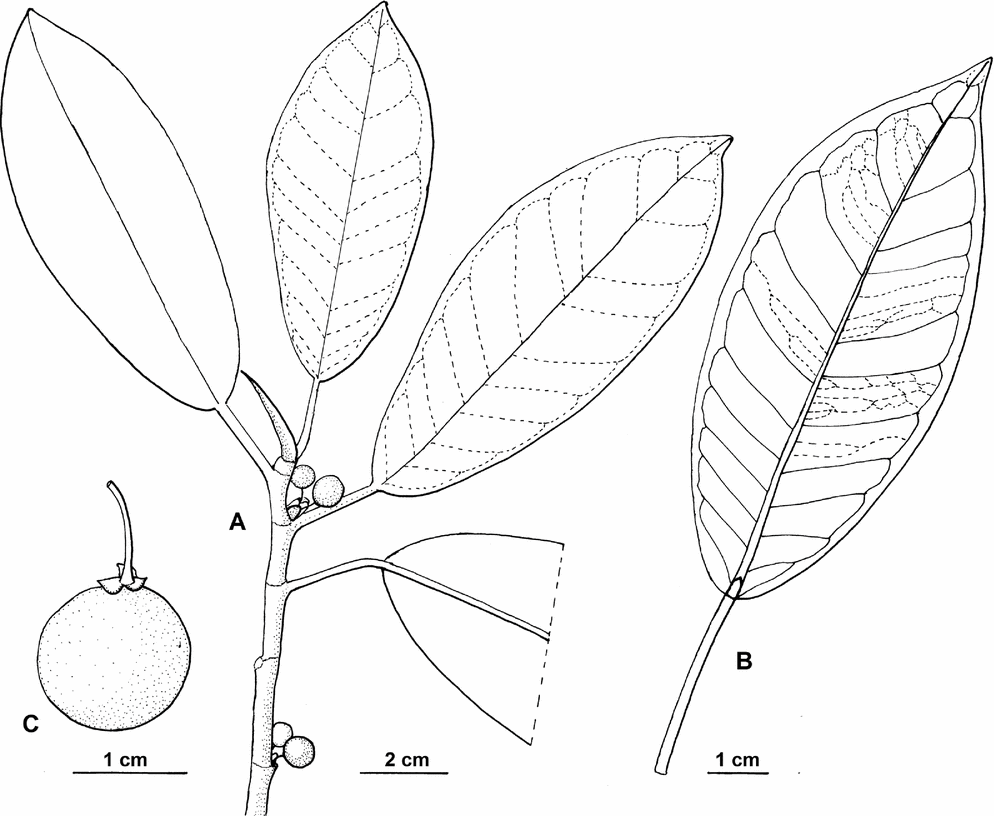
14. Ficus recurvata De Wild., Fig. 19.
Berg & Wiebes 103 (Reference Berg and Wiebes1992); Harris & Wortley 80 (Reference Harris and Wortley2008); Gillet & Doucet 18 (suppl.) (Reference Gillet and Doucet2012); Moutsamboté et al. 284 (Reference Moutsamboté, Yumoto, Mitani, Nishihara, Suzuki and Kuroda1994); Ndolo Ebika 57 (Reference Ndolo Ebika2010).
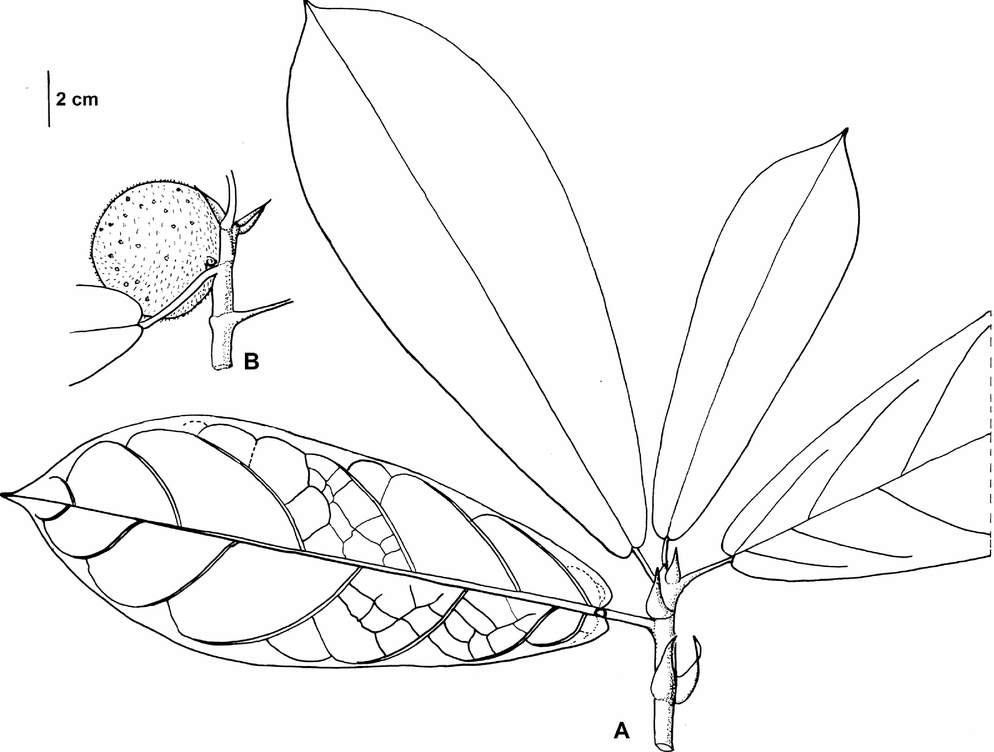
Ficus recurvata De Wild. A, Leafy twig with axillary figs; B, leaf, lower surface with a glandular spot at the base of the petiole; C, fig. (A–C, Ndolo Ebika, S.T. 13.)

Hemiepiphyte becoming a free-standing strangler 20 m high. Base with buttresses extending at ground level on snake-like roots. Slash brownish with white latex. Stipules caducous. Leaves entire, spirally arranged at the end of twigs. Petiole 4.5–11 × 0.3–0.4 cm, hairy, sometimes glabrous in old leaves. Lamina broadly elliptic, 10.5–22 × 7.5–13 cm, hairy on both surfaces but becoming glabrous above on old leaves; base cordate; apex rounded. Lateral veins in approximately 11 pairs including 2 basal pairs, looping at 1 mm from the margin. Tertiary veins parallel between them and almost perpendicular to the laterals. Glandular spot at the base of the petiole on the lower surface. Figs in leaf axils, in pairs, pedunculate, globose, 2–3 cm in diameter, hairy or glabrous. Peduncle hairy, 1.5–2.2 × 0.2 cm. Basal bracts 3 (4). Ostiolar bracts absent. Ostiole an elongated slit.
Habitat
Mixed-species terra firma forest, Gilbertiodendron dewevrei forest on terra firma.
Specimens. Fangounda, J. 509; Fay, M.J. 8633; Harris, D.J. 4792, 5876, 6546, 8428; Ndolo Ebika, S.T. 13, 17, 1173.
Deciduous, with stipules falling off just before leaves appear.
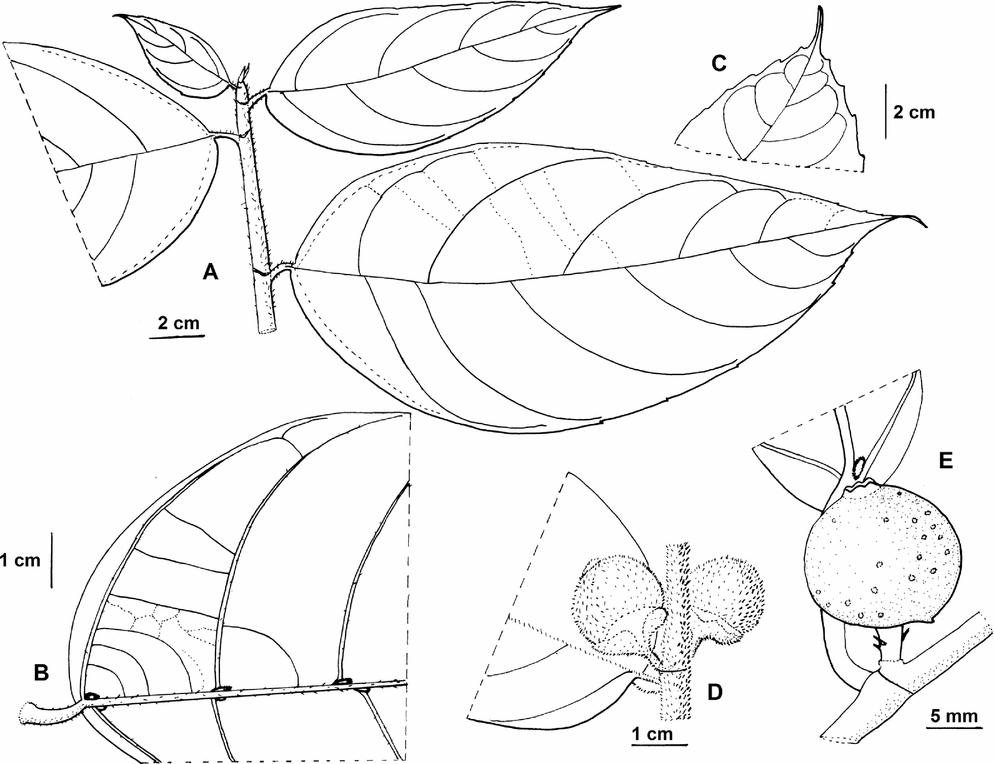
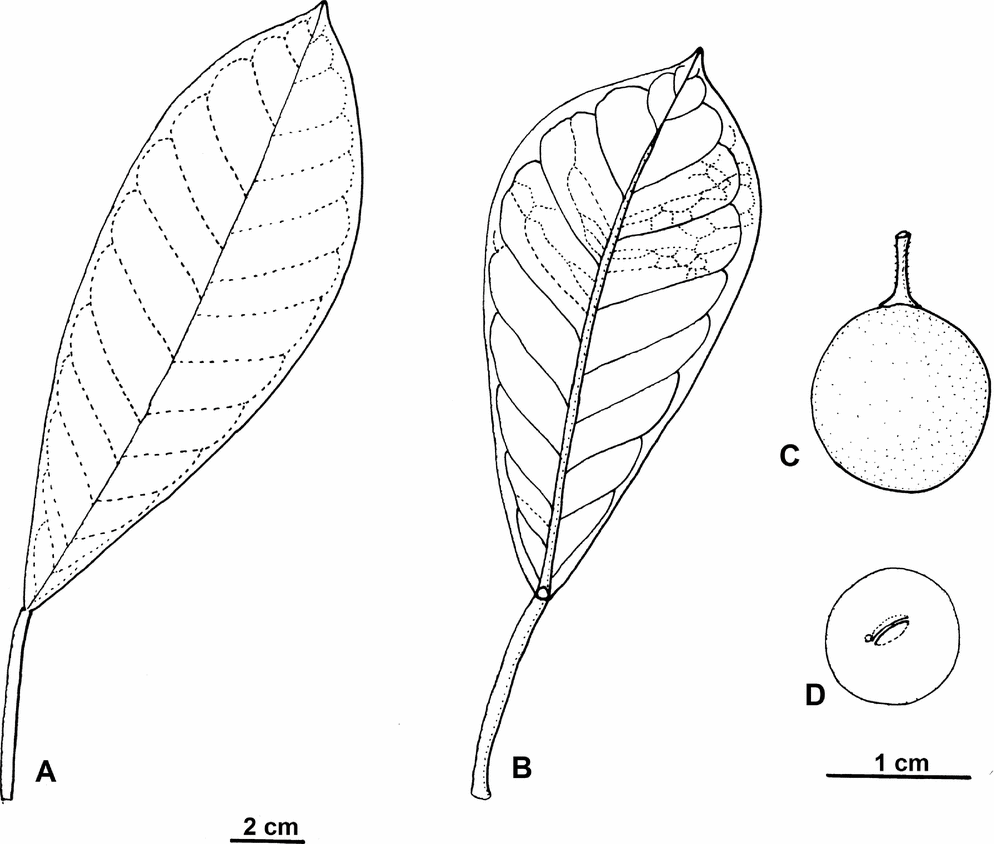
15. Ficus lutea Vahl, Figs 2 and 20.
Berg & Wiebes 99 (Reference Berg and Wiebes1992); Harris 143 (Reference Harris2002); Harris & Wortley 77 (Reference Harris and Wortley2008); Ndolo Ebika 53 (Reference Ndolo Ebika2010).
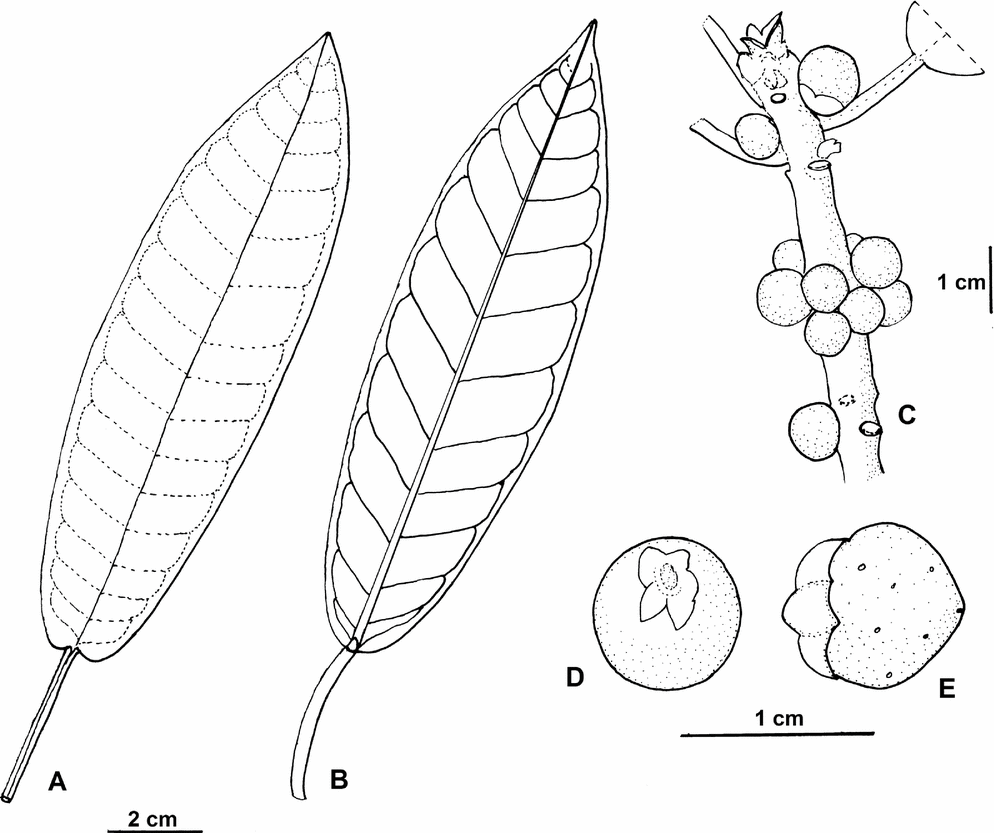
Ficus lutea Vahl. A, Leaf from above with a glandular spot at the base of the midrib; B, leaf seen from below with a glandular spot at the base of the midrib; C, twig with figs; D, fig seen from the side; E, fig seen from below. (A–D, Ndolo Ebika, S.T. 308.)

Hemiepiphyte becoming a free-standing strangler 20 m high. Base with buttresses extending at ground level on snake-like roots. Latex white. Stipules triangular, 4.5 × 1 cm, soon caducous, reddish on the outer surface and pale yellow on the inner surface. Leaves entire, spirally arranged. Petiole hairy to glabrous, 2.5–12 × 0.3–0.4 cm. Lamina lanceolate, elliptic or oblanceolate, 10.5–27.5 × 6.5–12 cm, leathery, glabrous; base rounded, cuneate or cordate; apex rounded to acute. Midrib sometimes not reaching the apex. Lateral veins prominent below, yellowish, in 7–13 pairs, looping at 2 mm from the margin. Tertiary veins reticulate. Glandular spot at the base of midrib on both surfaces: triangular and pinkish above; green and shiny beneath. Figs in leaf axils, in pairs, sessile, hairy or glabrous, oblong, 2 cm high and 1.5–2 cm wide when fresh, 0.6–1.9 cm in diameter when dry, green when unripe, yellow and then red when ripe. Basal bracts 4, fused. Ostiolar bracts absent. Ostiole a round pore.
Habitat
Mixed-species terra firma forest, Gilbertiodendron dewevrei forest on terra firma.
Specimens. Harris, D.J. 1529, 5301, 5331; Ndolo Ebika, S.T. 308, 967.
Deciduous, with stipules falling off just before leaves appear.
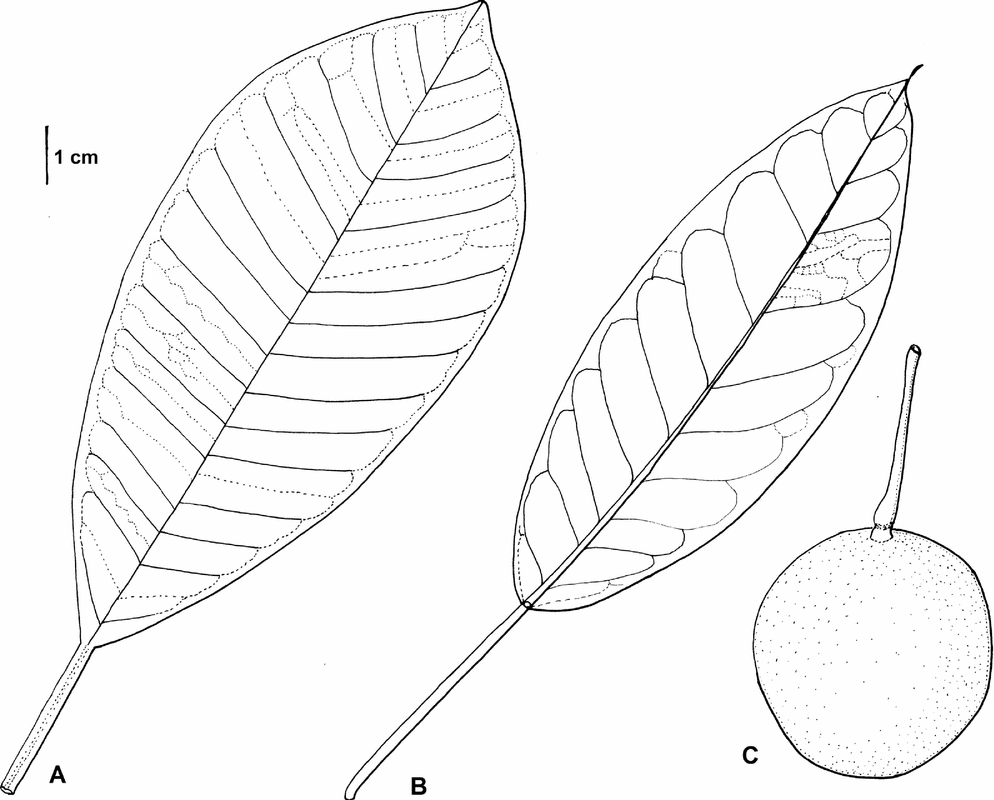
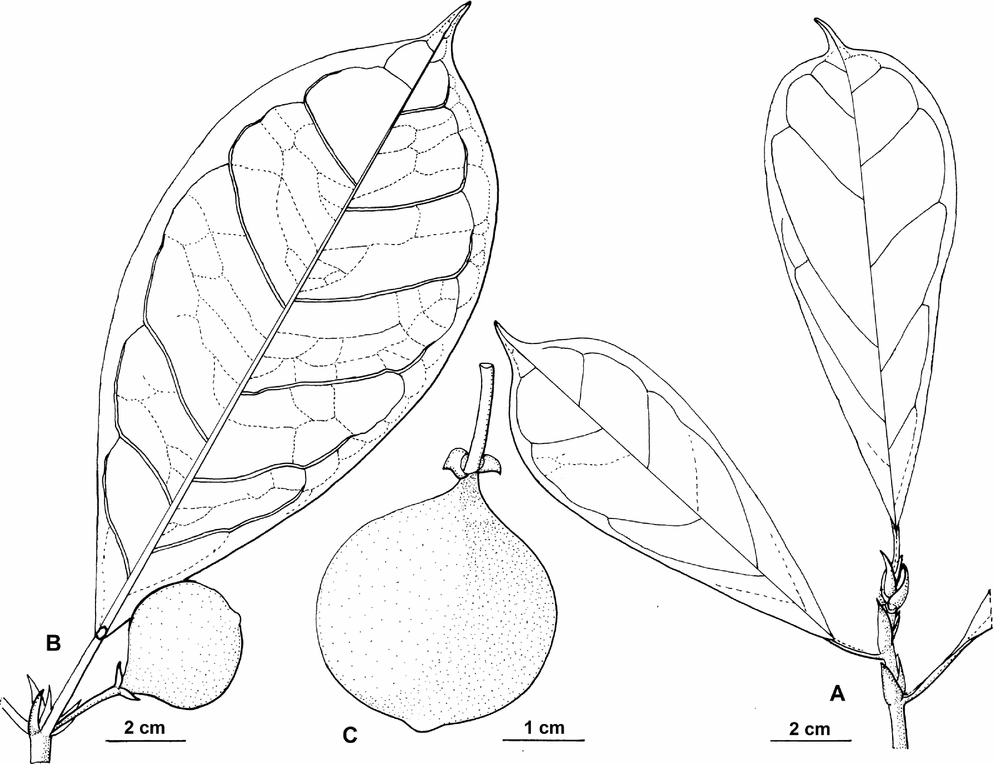
16. Ficus wildemaniana Warb., Fig. 21.
Berg & Wiebes 150 (Reference Berg and Wiebes1992); Harris 145 (Reference Harris2002); Harris & Wortley 82 (Reference Harris and Wortley2008); Gillet & Doucet 18 (suppl.) (Reference Gillet and Doucet2012); Ndolo Ebika 61 (Reference Ndolo Ebika2010).
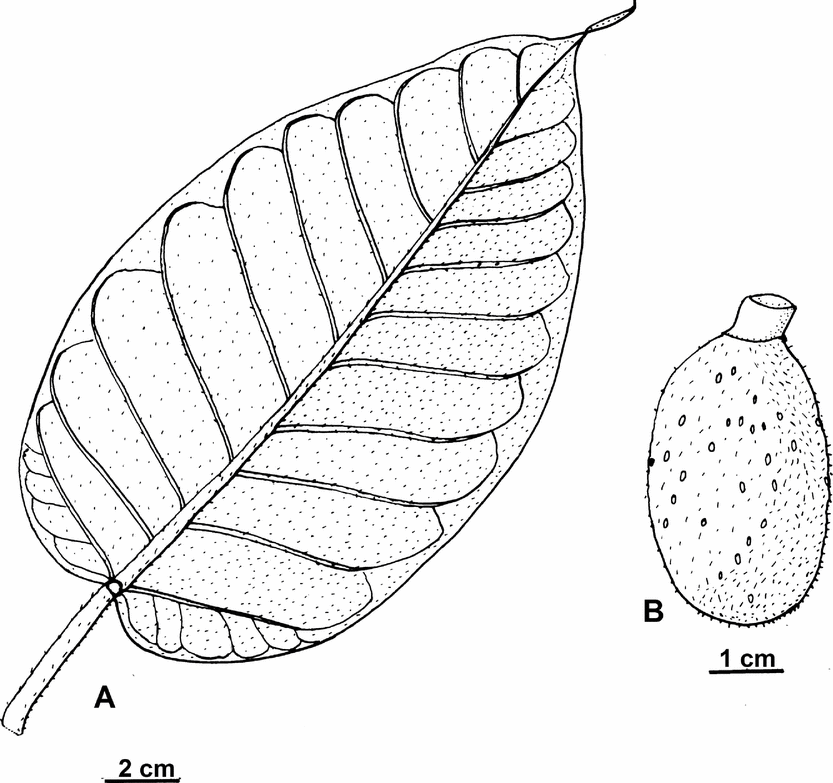
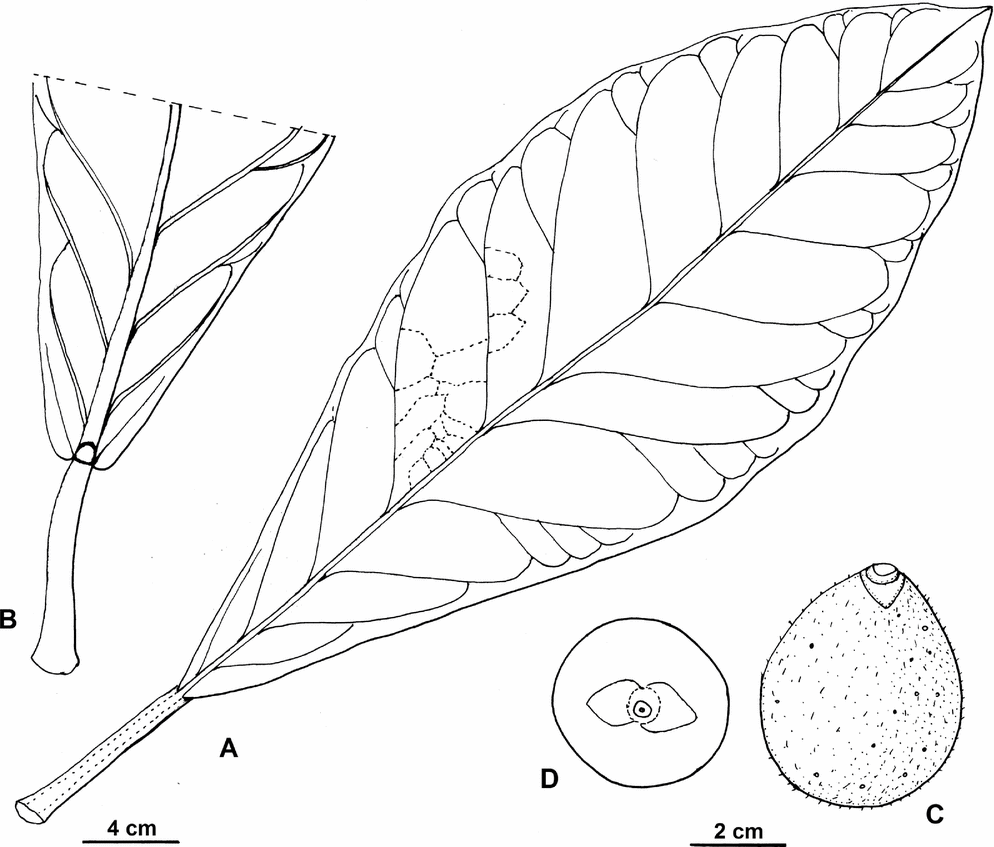
Ficus wildemaniana Warb. A, Leaf, upper surface; B, section of the bottom part of the leaf seen from below; C, fig seen from the side; D, fig seen from below. (A–D, Ndolo Ebika, S.T. 12.)

Hemiepiphyte becoming a free-standing strangler 10 m high. Latex white oxidising to yellowish. Stipules triangular, 7–11 × 3–3.5 cm, dark red on the outer side, whitish with red spots on the inner surface, glabrous, soon caducous. Leaves entire, spirally arranged at the end of twigs. Petiole 0.5–8 × 0.4–1.3 cm, glabrous. Lamina elliptic, 11.3–53 × 4–16.5 cm, glabrous, leathery; base cuneate or cordate; apex shortly acuminate. Lateral veins in 8–14 pairs. Glandular spot at the base of the midrib on the lower surface. Figs in the leaf axils, in pairs, sessile, subglobose, 1.5–5.2 cm in diameter, hairy, dark green with red spots when unripe, red when ripe, wrinkled when dry. Basal bracts 2, persistent. Ostiolar bracts absent. Ostiole a round pore.
Habitat
Mixed-species terra firma forest, Gilbertiodendron dewevrei forest on terra firma.
Specimens. Fay, M.J. 8559; Harris, D.J. 1982, 4284, 6108, 7531, 7674, 7723; Ndolo Ebika, S.T. 12, 14, 88, 855, 1187.
A deciduous Ficus species with stipules falling off just before leaves appear. Young leaves red, yellowish then pale green.
17a. Ficus natalensis Hochst. subsp. leprieurii (Miq.) C.C.Berg, Fig. 22.
Berg & Wiebes 122 (Reference Berg and Wiebes1992); Harris 143 (Reference Harris2002); Harris & Wortley 78 (Reference Harris and Wortley2008).
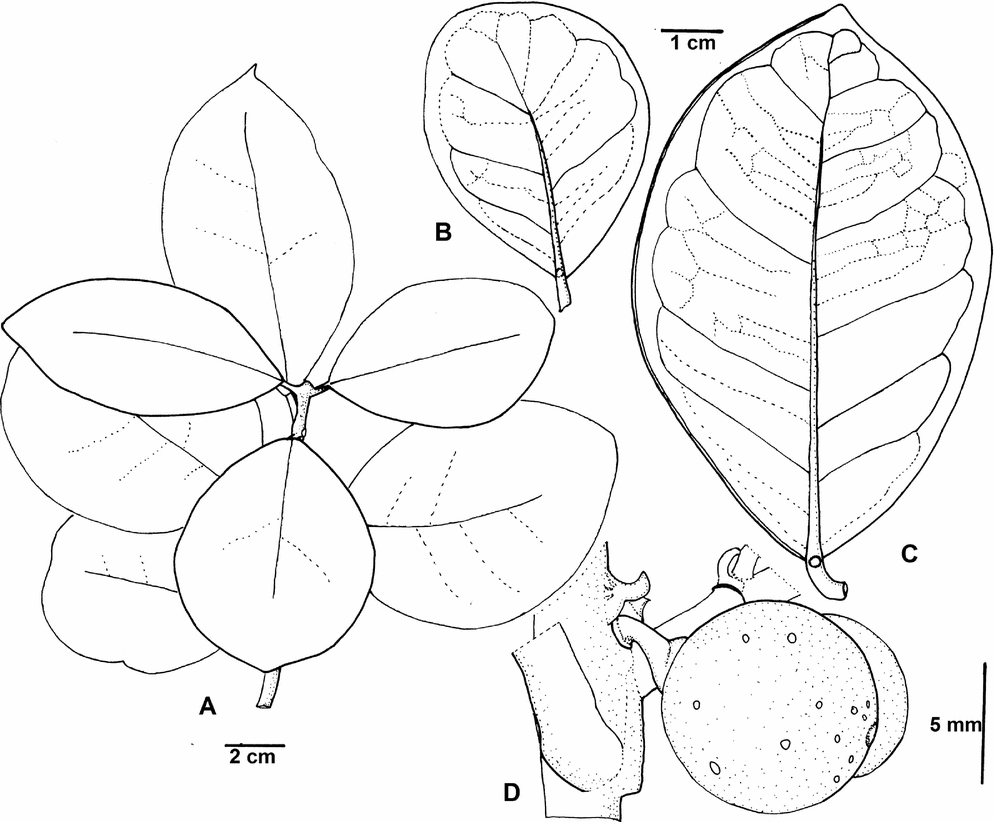
Ficus natalensis Hochst. subsp. leprieurii (Miq.) C.C.Berg. A, Leafy twig; B and C, variation in shape and size of leaves; D, twig with figs. (A–D, Ndolo Ebika, S.T. 1093.)

Hemiepiphyte up to 12 m high. Latex white. Stipules caducous. Leaves opposite, in whorls or pseudowhorls of 3, sometimes alternate. Petiole 0.5–2 cm long. Lamina broadly elliptic or obtriangular, 3–11 × 2–5.5 cm; base rounded or minutely cordate; apex rounded or obtuse; margin revolute. Midrib not reaching the apex of the lamina. Lateral veins in 5–9 pairs, nearly perpendicular to the midrib, looping at 3 mm from the margin. Tertiary veins parallel and branched between the lateral veins. Glandular spot at the base of the midrib. Figs in leaf axils, in pairs, pedunculate, globose, 6–8 mm in diameter, yellow with orange spots when unripe, red when ripe, wrinkled when dry. Peduncle 0.4–0.7 cm long. Basal bracts caducous. Ostiolar bracts absent. Ostiole a round pore.
Habitat
Mixed-species terra firma forest, swamp, riparian forest.
Specimens. Harris, D.J. 286, 892, 4943; Ndolo Ebika, S.T. 1093.
Ficus natalensis subsp. leprieurii differs from F. natalensis subsp. natalensis in having a revolute margin, a wider and less crowded space between adjacent lateral veins and an angle of 70–90° between the midrib and lateral veins.
17b. Ficus natalensis Hochst. subsp. natalensis, Fig. 23.
Berg & Wiebes 121 (Reference Berg and Wiebes1992); Ndolo Ebika 53 (Reference Ndolo Ebika2010).
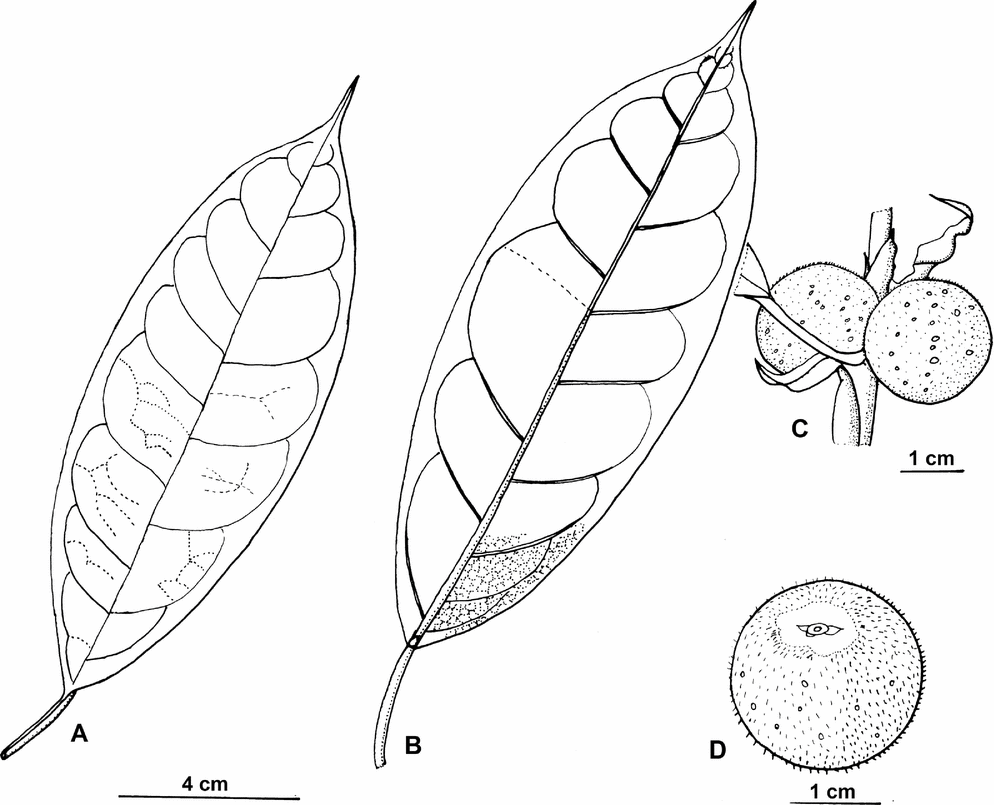
Ficus natalensis Hochst. subsp. natalensis. A and B, Leaves, upper and lower surfaces, respectively; C, fig; D, ostiole.

Hemiepiphyte 25 m high. Latex white. Stipules caducous. Leaves spirally arranged. Petiole glabrous, 1.6–3 × 0.2 cm, channelled above. Lamina elliptic, oblanceolate, sometimes obtriangular, 6.8–11 × 2.2–5.5 cm; base cuneate or minutely cordate; apex rounded to acute. Midrib sometimes not reaching the apex of the lamina. Lateral veins in 9–13 pairs, looping at c.2 mm from the margin. Glandular spot at the base of the midrib on the lower surface. Figs in the leaf axils, solitary or in pairs, pedunculate, globose, 1.2–1.8 cm in diameter, green when unripe, yellow with a few yellowish spots when ripe. Peduncle 0.3–0.5 cm long. Basal bracts 3, soon caducous. Ostiolar bracts absent. Ostiole an elongated slit.
Habitat
Mixed-species terra firma forest; Gilbertiodendron dewevrei forest on terra firma.
Specimens. Ndolo Ebika, S.T. 80, 285, 476, 816, 839, 850, 1119.
Ficus natalensis subsp. natalensis differs from F. natalensis subsp. leprieurii in not having a revolute margin, having a narrower and more crowded space between adjacent lateral veins, and having an angle of 20–70° between the midrib and lateral veins.
18. Ficus craterostoma Warb. ex Mildbr. & Burret, Fig. 24.
Berg et al., Fl. Gabon 26: 170 (Reference Berg, Hijman, Weerdenburg and Leroy1984); Gillet & Doucet 18 (suppl.) (Reference Gillet and Doucet2012); Ndolo Ebika 48 (Reference Ndolo Ebika2010).
Ficus craterostoma Warb. ex Mildbr. & Burret. A, Leafy twig with a fig; B, twig with axillary figs and calyptrate bud covers; C, fig seen from below. (A–C, Ndolo Ebika, S.T. 312.)

Hemiepiphyte 20 m high. Latex white. Stipules persistent, hairy. Leaves entire, spirally arranged. Petiole glabrous, 1–1.8 × 0.1 cm. Lamina obtriangular to elliptic, 3.8–8.9 × 2.5–3.2 cm; base cuneate; apex emarginate or acute. Midrib not reaching the apex of the lamina. Lateral veins in 8–14 pairs, looping at 2–3 mm from the margin. Glandular spots absent. Figs in leaf axils, sessile, in pairs, subglobose, up to 0.6 cm in diameter, wrinkled when dry, shortly hairy, green when unripe with yellow spots. Basal bracts 3, shortly hairy, 8 mm long. Ostiolar bracts absent. Ostiole a prominent and elongated slit.
Habitat
Mixed-species terra firma forest.
Specimens. Ndolo Ebika, S.T. 312, 1125.
Deciduous. Young leaves reddish, pink and yellowish.
19. Ficus thonningii Blume, Fig. 25.
Berg & Wiebes 127 (Reference Berg and Wiebes1992); Gillet & Doucet 18 (suppl.) (Reference Gillet and Doucet2012); Harris 145 (Reference Harris2002); Moutsamboté et al. 284 (Reference Moutsamboté, Yumoto, Mitani, Nishihara, Suzuki and Kuroda1994).
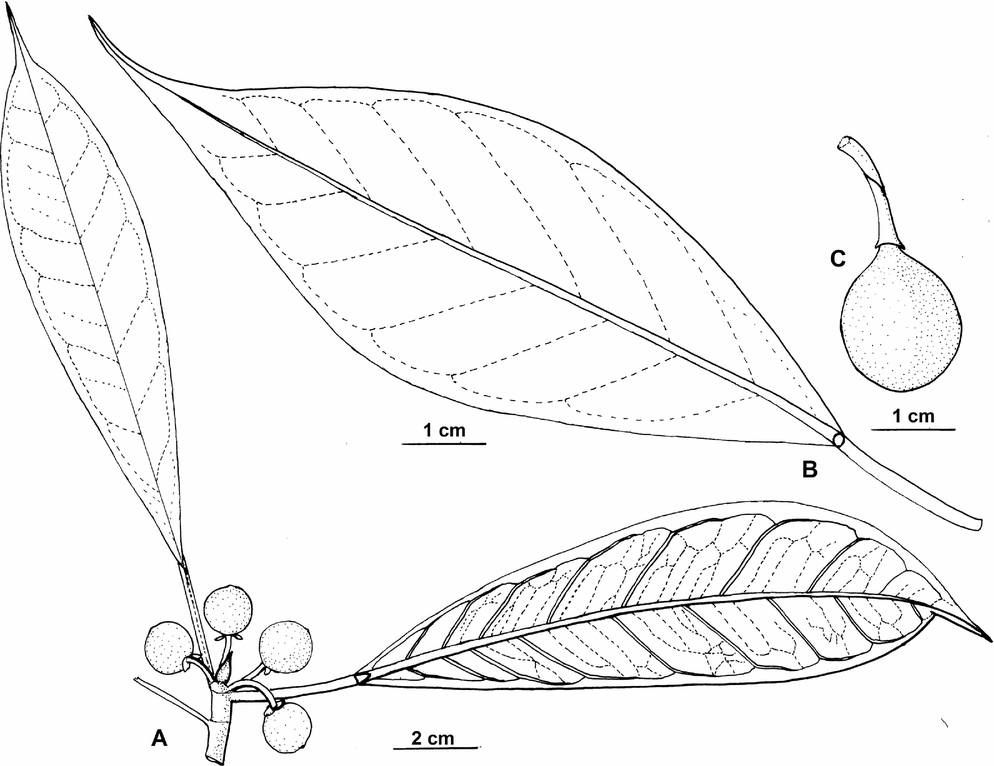
Ficus thonningii Blume. A, Leafy twig with axillary figs; B, leaf, lower surface; C, fig. (A–C, Ndolo Ebika, S.T. 819.)

Hemiepiphyte up to 15 m high. Latex white. Stipules caducous. Terminal bud persistent, glabrous. Leaves entire, spirally arranged. Petiole 1.5–3.5 cm long, channelled above. Lamina elliptic, 7–13 × 3–4.7 cm; base rounded or cordate; apex shortly acuminate. Lateral veins in 10–15 pairs. Tertiary veins reticulate. Quaternary veins ending in terminal open branches. Glandular spot at the base of the midrib on the lower surface. Figs in leaf axils, in pairs or up to 4 together, pedunculate, globose, 7 mm in diameter, yellowish when ripe. Peduncle 6 mm long. Basal bracts 3, persistent. Ostiolar bracts absent. Ostiole a round pore.
Habitat
Mixed-species terra firma forest.
Specimens. Fay, J.M. 8609; Ndolo Ebika, S.T. 819.
20. Ficus sansibarica subsp. macrosperma (Warb. ex Mildbr. & Burret) C.C.Berg, Fig. 26.
Berg 94 (Reference Berg1988); Berg & Wiebes 162 (Reference Berg and Wiebes1992); Harris & Wortley 80 (Reference Harris and Wortley2008).
Ficus macrosperma Warb. ex Mildbr. & Burret, Berg & Wiebes 162 (Reference Berg and Wiebes1992).
Ficus sansibarica subsp. macrosperma (Warb. ex Mildbr. & Burret) C.C.Berg. A, Leaf, upper surface; B, leaf, lower surface; C, fig. (A, Ndolo Ebika, S.T. 421; B and C, Ndolo Ebika, S.T. 851.)

Hemiepiphyte 20 m high. Latex white. Stipule linear, 5.7 × 0.7 cm, soon caducous. Leaves entire, spirally arranged. Petiole 1.3–4.5 × 0.2 cm long. Lamina elliptic or oblanceolate, 6.5–15.5 × 3–6.4 cm; base rounded; apex rounded or acuminate. Lateral veins in 7–14 pairs, looping at 2 mm from the margin. Glandular spots at the base of the midrib on the lower surface. Figs on spurs on the main branches, in pairs or in groups of more than 4, pedunculate, globose, 4–6 cm when fresh, 3–3.5 cm when dry, remaining green when ripe, hairy. Peduncle hairy, 2–3.5 cm long. Basal bracts caducous. Ostiolar bracts absent. Ostiole a round pore.
Habitat
Mixed-species terra firma forest.
Specimens. Harris, D.J. 3601, 4791; Ndolo Ebika, S.T. 421, 851.
Deciduous, with stipules falling off just before leaves appear.
21. Ficus cyathistipula Warb. subsp. cyathistipula, Fig. 27.
Berg & Wiebes 143 (Reference Berg and Wiebes1992); Harris 142 (Reference Harris2002); Harris & Wortley 75 (Reference Harris and Wortley2008).
Ficus cyathistipula Warb. subsp. cyathistipula. A, Leafy twig; B, fig in the leaf axils; C, fig. (A, Harris 1151; B and C, Harris 7748.)

Hemiepiphyte. Stipules forming a sheath around the twig, 1.2–2.2 cm long, persistent. Leaves entire, alternate. Petiole 0.8–4 cm long, slightly channelled above. Lamina elliptic to oblanceolate, 6.5–18 × 2.7–8 cm, leathery; base acute; apex acuminate, 0.5–1.3 cm long, straight to curved on one side. Lateral veins in 5–7 pairs, looping 1–5 mm from the leaf margin. Tertiary veins reticulate. Quaternary veins scaliform. Glandular spot at the base of the midrib. Figs in leaf axils, solitary, pedunculate, globose, 2.6–3.5 cm in diameter, cuneate (3 mm long) at the base, green, soft and spongy. Peduncle 1.6–1.9 cm long. Basal bracts 2, persistent. Ostiolar bracts absent. Ostiole a prominent round pore.
Habitat
Riparian forest with Uapaca heudelotii Baill. and Irvingia smithii Hook.f.
Specimens. Harris, D.J. 1151, 7748, 7876.
Young leaves pinkish.
22. Ficus ardisioides Warb. subsp. ardisioides, Fig. 28.
Berg & Wiebes 141 (Reference Berg and Wiebes1992); Ndolo Ebika 46 (Reference Ndolo Ebika2010).
Ficus ardisioides Warb. subsp. ardisioides. A, Leafy twig; B, figs in the leaf axils. (A and B, Ndolo Ebika, S.T. 358.)

Hemiepiphyte 8 m high. Sap clear, oxidising to yellow. Stipules caducous. Leaves entire, alternate. Petiole glabrous, 1.2 × 0.3 cm. Lamina variable in shape: asymmetric, broadly elliptic or subovate, 9.3–15 × 4.2–6.1 cm, leathery; base unequal or cuneate; apex acuminate. Lateral veins in 5 or 6 pairs. Tertiary veins less conspicuous below, reticulate with greenish spots in each network. Glandular spot at the base of the midrib. Figs in leaf axils, in pairs or triplets, shortly hairy, pedunculate, globose, 7 mm in diameter when fresh, 5 mm and smooth when dry, yellow with red spots when ripe. Peduncle 1.3 cm long. Basal bracts 2. Ostiolar bracts absent. Ostiole an elongated slit.
Habitat
Mixed-species terra firma forest.
Specimen. Ndolo Ebika, S.T. 358.
23. Ficus barteri Sprague, Fig. 29.
Berg et al., Fl. Cam. 28: 190 (Reference Berg, Hijman, Weerdenburg, Sabatié and Hallé1985); Gillet & Doucet 18 (suppl.) (Reference Gillet and Doucet2012); Harris & Wortley 73 (Reference Harris and Wortley2008); Moutsamboté et al. 284 (Reference Moutsamboté, Yumoto, Mitani, Nishihara, Suzuki and Kuroda1994).
Ficus barteri Sprague. A, leafy twig with axillar figs; B, leaf, lower surface; C, fig. (A, Harris 1848; B and C, Ndolo Ebika, S.T. 473.)

Hemiepiphyte. Latex white. Stipules caducous. Leaves entire, spirally arranged. Petiole glabrous, 2.2–3 cm long, slightly channelled above. Lamina narrowly elliptic-oblong to elliptic, 10–16 × 2.5–6 cm, leathery; base cuneate; apex acuminate, 1–1.5 cm long. Lateral veins in 9–12 pairs, looping at 2–3 mm from the margin. Tertiary veins parallel to the lateral and reticulate. Glandular spot at the base of the midrib. Figs in the leaf axils, in pairs, pedunculate, globose, 1.1–1.5 cm in diameter, yellow with red dots when ripe, smooth when dry. Peduncle 0.8–1.5 cm long. Basal bracts 2, 2 mm long and 4 mm wide at base, persistent or caducous leaving circular ring. Ostiolar bracts absent. Ostiole a prominent, elongated slit.
Habitat
Mixed-species terra firma forest, riparian forest with Uapaca heudelotii and Irvingia smithii.
Specimens. Harris, D.J. 1848, 5133; Ndolo Ebika, S.T. 473.
24. Ficus conraui Warb., Fig. 30.
Berg & Wiebes 139 (Reference Berg and Wiebes1992); Harris & Wortley 74 (Reference Harris and Wortley2008).
Ficus conraui Warb. A and B, Leaves, upper and lower surfaces, respectively; C, portion of a twig with persistent stipules and axillary figs; D, fig seen from below. (A–D, Ndolo Ebika, S.T. 849.)

Hemiepiphyte. Latex white. Stipules triangular, 2 × 0.7 cm, persistent. Leaves entire, spirally arranged. Petiole 2–4 cm long. Lamina elliptic, 11–25 × 3.5–8.7 cm, leathery; base cuneate or rounded; apex acuminate, 1.5–2.4 cm long. Lateral veins in 8–14 pairs, more or less perpendicular to the midrib, looping at 4–6 mm from the margin. Tertiary veins parallel to the lateral veins. Quaternary veins forming a small network. Figs in leaf axils, in pairs, sessile, hairy, globose, 2–2.2 cm in diameter, green with pale green spots, remaining green when ripe. Basal bracts 3, persistent. Ostiolar bracts absent. Ostiole a round pore.
Habitat
Mixed-species terra firma forest.
Specimens. Harris, D.J. 4738; Ndolo Ebika, S.T. 849.
25. Ficus adolfi-friderici Mildbr., Fig. 31.
Berg & Wiebes 137 (Reference Berg and Wiebes1992); Ndolo Ebika 45 (Reference Ndolo Ebika2010).
Ficus adolfi-friderici Mildbr. A and B, leaves, upper and lower surfaces, respectively; C, fig. (A–C, Ndolo Ebika, S.T. 208.)

Hemiepiphyte. Latex white. Stipules 5–8.5 × 1.1–1.5 cm, milky white, shiny on the inner surface, soon caducous. Leaves entire, spirally arranged. Petiole channelled above, 1.7–3.5 × 0.2–0.3 cm, glabrous. Lamina elliptic, 7.3–17.5 × 4.5–9 cm, leathery; base rounded; apex shortly acuminate. Lateral veins in 9 pairs. Glandular spots absent. Figs in leaf axils, sessile, glabrous, subglobose, 8 mm in diameter when fresh, 6 mm and smooth when dry, yellow when ripe. Basal bracts 2, persistent. Ostiolar bracts absent. Ostiole an elongated slit.
Habitat
Mixed-species terra firma forest.
Specimen. Ndolo Ebika, S.T. 208.
Deciduous, with stipules falling off just before leaves appear. Young leaves pale green to yellowish.
26. Ficus elasticoides De Wild., Fig. 32.
Berg & Wiebes 133 (Reference Berg and Wiebes1992); Gillet & Doucet 18 (suppl.) (Reference Gillet and Doucet2012); Harris & Wortley 75 (Reference Harris and Wortley2008); Moutsamboté et al. 284 (Reference Moutsamboté, Yumoto, Mitani, Nishihara, Suzuki and Kuroda1994); Ndolo Ebika 51 (Reference Ndolo Ebika2010).
Ficus elasticoides De Wild. A, A young twig with two stipules; B and C, leaves, upper and lower surfaces, respectively; D, twig with axillary figs. (A–D, Ndolo Ebika, S.T. 11.)

Hemiepiphyte becoming a free-standing strangler 25 m high. Base often with small buttresses. Latex white oxidising to yellowish. Stipule reddish on the outer surface and whitish on the inner, 4–10 × 0.4–1.5 cm, soon caducous. Leaves entire, spirally arranged. Petiole glabrous, 2–6.2 cm long, 4 mm broad. Lamina elliptic, 8.2–22 × 4.7–9.5 cm; base rounded to cuneate; apex acuminate, 6–8 mm long. Lateral veins in 16–21 pairs, looping at 2 mm from the margin. Tertiary veins parallel to the lateral and sometimes poorly distinguished from the laterals. Glandular spot at the base of the midrib below, sometimes inconspicuous. Figs in the leaf axils, in pairs, pedunculate, globose, 3 cm in diameter when fresh and 1.4–2.5 cm when dry, green when unripe and yellowish to reddish with yellow spots when ripe. Peduncle 0.8–1.2 × 0.4 cm long. Basal bracts 3, persistent. Ostiolar bracts absent. Ostiole a prominent elongated slit.
Habitat
Mixed-species terra firma forest, Gilbertiodendron dewevrei forest on terra firma.
Specimens. Harris, D.J. 4612, 4778, 5837, 6101, 6692; Moukassa, G. 1579; Ndolo Ebika, S.T. 11, 297; Nzolani Silaho, F.O. 3305, 3464.
Deciduous, with stipules falling off just before the leaves appear. Young leaves pale green.
27. Ficus burretiana Mildbr. & Hutch., Fig. 33.
Berg & Wiebes 134 (Reference Berg and Wiebes1992); Ndolo Ebika 46 (Reference Ndolo Ebika2010).
Ficus burretiana Mildbr. & Hutch. A, Leafy twig; B, figs in the leaf axils; C, ostiole. (A–C, Ndolo Ebika, S.T. 456).

Hemiepiphyte becoming free-standing strangler, 25 m high. Base with buttresses. Latex white. Stipules caducous. Leaves entire, alternate to spirally arranged. Petiole glabrous, 1–3.5 × 0.1 cm long, slightly channelled above. Lamina elliptic, 5–8.5 × 2.4–4 cm, glabrous; base rounded to cuneate, slightly cordate or faintly asymmetric; apex shortly acuminate; margin sometimes pale yellow when dry. Lateral veins in 11 or 12 pairs, looping at 1 mm from the margin. Tertiary veins parallel to the lateral. Glandular spots absent. Figs in leaf axils, in pairs, pedunculate, globose, 0.6–1.2 cm in diameter, wrinkled when dry, green when unripe and yellowish when ripe. Peduncle 0.4–1.2 cm long. Basal bracts 2, caducous. Ostiolar bracts absent. Ostiole an elongated slit.
Habitat
Mixed-species terra firma forest, Gilbertiodendron dewevrei forest on terra firma.
Specimens. Fay, J.M. 8637; Harris, D.J. 714, 7007; Ndolo Ebika, S.T. 20, 125, 293, 456, 1171; Nzolani Silaho, F.O. 2618.
Deciduous. Ficus burretiana looks like F. elasticoides in shape and venation but the leaves and figs are smaller and there are no glandular spots at all.
Discussion
Compared with other speciose genera of vascular plants in the Sangha Trinational study area, the number of species is much higher in Ficus (27 spp.) than the others: Drypetes (20 spp.), Psychotria (18 spp.) and Aframomum (14 spp.). From our targeted herbarium specimen collection, observation of primates feeding on Ficus, and our plot-based sampling (not reported here), it is clear that, at this study site, individual Ficus species are very rare in the forest – sufficiently rare for most species not to have been recorded in plots. In addition, although very rare locally, the species of Ficus at our study site are distributed widely across central Africa. This phenomenon of extreme rarity at a given site combined with a wide geographical range has been clearly demonstrated to be a pantropical phenomenon in Ficus by Harrison (Reference Harrison2005) and requires further study to be fully understood.
It is unclear how many more species of Ficus remain to be collected in the Sangha Trinational, although we expect no more than ten. This is because it appeared to us that the concentrated collecting effort that went into actively looking for new species of Ficus resulted in a slow and steady accumulation that has started to slow down, and therefore the species accumulation curve can be assumed to be approaching an asymptote. To understand the distribution of Ficus species in the study site, we need to move from inventory and herbarium specimen collection to concentrate on quantitative sampling of the genus.
When comparing the number of species in our study site with those in other African forests, we found only one lowland forest site with a similar number of Ficus species. This was the Ituri Forest (Democratic Republic of the Congo), also with 27 species (Makana et al., Reference Makana, Hart, Liengola, Ewango, Hart, Condit, Losos and Leigh2004). This figure of 27 species from these two sites probably reflects the geographically focused research in these forests rather than an excessive diversity compared with other sites. It may be that a similar level of species diversity occurs across the whole of the Congo Basin forest block. A total of 45 species of Ficus is recorded from Gabon (267,667 km2) (Sosef et al., Reference Sosef, Wieringa, Jongkind, Achoundong, Issembe, Bedigian, Berg, Breteler, Cheek, Degreef, Faden, Goldblatt, Maesen, van der Ngok Banak, Niangadouma, Nzabi, Nziengui, Rogers, Stévart, Valkenburg, Walters and de Wilde2005).
Compared with other tropical forests, we find that Brunei (5765 km2) has 63 species of Ficus (Coode, Reference Coode1996); Ducke Reserve, Brazil, has 19 species (Ribeiroi et al., Reference Ribeiroi, Hopkins, Vicentini, Sothers, Costa, Brito, Souza, Martins, Assunção, Perieira, Silva, Mesquita and Procópio1999); Barro Colorado Island, Panama, has 17 species (Croat, Reference Croat1978); and Iquitos, Peru, has 30 species (Vásquez Martínez, Reference Vásquez Martínez1997). These figures suggest to us that species diversity for Ficus is probably higher in Asian than in African or tropical American forests.
This is the first time to our knowledge that forest species of Ficus have been reported as restricted to vegetation disturbed by humans while not occurring in adjacent undisturbed forest. It is interesting to note that all three species restricted to this habitat (Ficus exasperata, F. mucuso and F. sur) are true trees and not hemiepiphytic species. Of the total of approximately 450 tree species occurring in the area (Harris & Wortley, Reference Harris and Wortley2008), only a very few are restricted to areas disturbed by humans. These obligate ruderals include Musanga cecropioides R.Br. ex Tedlie and an as-yet unidentified species of Anthocliesta. It is noteworthy that these non-Ficus ruderals are not so clearly restricted to vegetation suffering disturbance by humans elsewhere in their range. It appears that this obligate nature of habitat preference for these three Ficus species is also site-specific.
The three habits (tree, climber and hemiepiphyte) recorded in this area are a subset of the six main types of habit (tree, shrub, hemiepiphyte, climber, creeping shrub and rheophytic shrub) described for Ficus by Berg & Corner (Reference Berg and Corner2005).
The taxonomy of Ficus in Africa appears to us to require further study despite the great advances made by Cees Berg. We say this because of the large number of infraspecific taxa and the variation in characters that are more consistent in other genera. An example of such variation that we have observed in the Sangha Trinational is in specimens that we have identified as Ficus polita subsp. polita, which can be separated into two groups. Specimens from the Sangha River (Harris 1429, 1886; Harris & Moutsamboté 9725; Ndolo Ebika 536) seem to have more elongate tips to the leaves than terra firma specimens (Harris & Fay 105, 5539; Harris 8022; Ndolo Ebika 823, 837).
We predict that further ecological and taxonomic study of Ficus will reveal significant differences in niches occupied by species in this fascinating genus.
Acknowledgements
The preparation of this article was carried out under Darwin Initiative Fellowship EIDPS032, which was funded by the UK government. Claire Banks is thanked for her advice on botanical illustration, and Kim Howell provided instruction to the first author on manuscript preparation. An anonymous reviewer provided sound structural advice as well as detailed comment on semiamplexicaul stipules in Ficus thonningii, which were greatly appreciated.