Introduction
The traditional mission of US Land-Grant universities dictates that scientists conduct research of direct relevance to people and communities. To accomplish this task, it is important for the public to take an active role in setting research priorities, participating in actual research projects and providing feedback about the consequences of research outputs. Some scholars and activists argue that citizen involvement can contribute to the ‘democratization’ of university science and technology decision-makingReference Lacy and Glenna1, Reference Kleinman2. When citizens are involved in the research process, research results are more likely to be relevant, accepted and put into action. Examples of citizen involvement include consensus conferences, science shops (i.e., entities that conduct independent, participatory research in response to concerns expressed by civil society), participatory action research and community–based researchReference Lacy and Glenna1. Other scholars have focused specifically on the need for more democratic participation in the public agricultural research enterpriseReference Middendorf and Busch3–Reference Ostrom and Jackson-Smith7. They argue that farmers, the primary beneficiaries of most research conducted in colleges of agriculture at Land-Grant universities, should be actively engaged in the research process. Participatory plant breeding (PPB), the focus of this paper, is one example of how scientists and farmers are attempting to democratize public agricultural research.
PPB uses both scientists' and farmers' knowledge to develop crop varieties suited to particular agro-ecological zones. In PPB projects, scientists and farmers work together to set breeding objectives, generate genetic variability, make selections, evaluate experimental varieties and generate and disseminate seeds. Agricultural scientists interested in these types of participatory research approaches certainly want farmers involved in their programs. However, less is known about why farmers, especially in more developed agricultural areas such as the United States and Europe, want to work with scientists in participatory research projects. What distinguishes those farmers who indeed want to work with university scientists? For example, are small-scale farmers, who are often the targeted beneficiaries of participatory breeding projects in developing countries, more interested than large-scale farmers? Are ‘alternative’ farmers more interested than ‘conventional’ farmers? Are farmers with pre-existing Land-Grant University ties more interested than farmers who have had little or no contact with public agricultural scientists and extension specialists? These and related questions form the basis of the analysis presented in this paper.
Specifically, we analyze data from a survey of Washington wheat growers to better understand (a) whether or not farmers want to work with scientists in participatory breeding programs and (b) the determinants of interest in PPB. We consider six sets of potential determinants of interest: farmer characteristics (e.g., gender, age, education), farm characteristics (e.g., farm size, wheat acreage, farm organization), production practices (e.g., number of wheat varieties planted, seed saving, interest in certified organic production), marketing strategies (e.g., niche marketing, marketing clubs), experience working with university researchers and extension specialists, and opinions about university research and extension. Most PPB programs in developed countries have been initiated at the request of relatively small-scale organic farmers involved in organizations with ties to research universities. However, other types of farmers might also be interested in PPB. We hope this study will help broaden our understanding of whether and why farmers in developed countries are interested in working with university scientists in PPB programs.
From Formal to Participatory Plant Breeding
Formal plant breeding is conducted by professional scientists employed primarily by public agricultural research institutions or the private sector. These scientists set breeding goals, make crosses, test for desired traits, select superior lines and release new varieties without the organized participation of farmers. While most professional plant breeders make an effort to understand farmers' needs, they rarely include farmers in the day-to-day decision-making of formal breeding programs. Formal plant breeding rests on the assumptions that farmers are not capable of making crosses and keeping track of progeny linesReference Fitzgerald8 and professional plant breeders are better equipped to use complex selection systems to select superior varietiesReference Witcombe, Joshi, Gyawali, Musa, Johansen, Virk and Sthapit9. Plant breeders may also believe using farmers' management practices complicates experimental design and analysisReference Haugerud and Collinson10. Formal plant breeding became the norm in many countries because of increased scientific understanding of genetic principles, the industrialization of agriculture and investment in national agricultural research programs.
While it is true plant breeders have training in selection theory and experimental design, farmers also have valuable knowledge about environmental conditions and the characteristics that make a variety successful in their region. Many farmers already do their own research in testing and adapting new ideas and technologiesReference Conroy, Sutherland, Martin, Grant and Sear11. Farmers in marginal agricultural environments often maintain and improve varieties developed over centuries of on-farm selection. Making use of both farmer and researcher knowledge can increase the relevance and efficiency of breeding programs. Therefore, over the past two decades, participatory approaches have gained popularity within formal international plant breeding programs.
PPB seeks to ‘reverse the historical trend of separation between farmers and plant breeders, bringing them together in the process of developing new crop varieties or improving existing ones’Reference Cleveland, Soleri, Cleveland and Soleri12. PPB arose out of the realization that many farmers in marginal production areas were not benefiting from conventional plant breeding programs. While modern varieties developed by conventional breeders have been widely adopted, they are grown primarily in areas of high agricultural potential. These varieties were selected in such high-potential environments and are well adapted to these systems. As a result, the adoption of modern varieties has been very low in complex, diverse and risk-prone environmentsReference Ceccarelli and Grando13. PPB emphasizes collaboration and knowledge sharing between farmers and scientists as essential for identifying and improving suitable varieties for these marginal environmentsReference Murphy, Lammer, Lyon, Carter and Jones14. Although PPB usually refers to farmer participation in selecting from diverse plant populations, farmer participation can take other forms including helping to set research priorities and breeding goals, engaging in on-farm field trials and providing feedback on released varieties. Different farmers may wish to participate in different stages of the process depending on their interests and time availability.
Because PPB was originally developed for farmers on marginal land in developing countriesReference Duvick, Sligh and Lauffer15, some question if it is relevant to agricultural systems in favorable environmentsReference Sperling, Ashby, Smith, Weltzien and McGuire16, Reference Witcombe17. The farms associated with these systems tend to be large-scale, capital-intensive and oriented toward commodity markets. The use of high-yielding modern varieties is the norm, and little if any of the farm output is for the farmers' own consumption. The use of farm inputs such as fertilizers and pesticides makes growing conditions similar from farm-to-farm and region-to-region, so a few varieties may perform well over a wide spectrum of environmental conditions. However, restricting genetic diversity to only a few varieties increases the vulnerability of agricultural systems to disease or pest epidemics and environmental stress. A single production practice or crop variety will not be universally effectiveReference Brummer, Lauffer and Sligh18.
While formal plant breeding programs have produced very successful varieties for developed agricultural systems, this does not mean these systems would not benefit from increased participation of farmers in the process of crop improvement. Highly productive areas have the potential for greater diversity in crop species and varietal diversity within speciesReference Witcombe17. This diversity can include both specific adaptation to the biological and physical environment, and suitability for specific markets and end-usesReference Chiffoleau and Desclaux19. Breeding crops adapted to specific farming systems and ecological zones is important for the sustainability of these systems and will require decentralized and participatory breeding programs to address the needs of a diverse landscape. Moreover, farmers have become increasingly interested in reducing the use of inputs (for both environmental and economic reasons) and finding alternatives to the conventional commodity system.
There are many examples of small-scale farmers in developing countriesReference Ceccarelli and Grando13, Reference Gyawali, Sunwar, Subedi, Tripathi, Joshi and Witcombe20–Reference Sperling, Loevinsohn and Ntabomvura24 and alternative agriculturalists in developed agricultural systemsReference Sligh and Lauffer25–Reference Desclaux and Hédont27 engaging in PPB programs. A case study of participatory wheat breeding in southern France, for example, found PPB was primarily of interest to organic farmers and had become a political strategy for farmers' associations that felt conventional breeding programs were not able to meet the needs of more sustainable agricultural systems. PPB was seen as a means for farmers to regain independence in their choice of varietiesReference Chiffoleau and Desclaux19. Less represented in the literature are examples of PPB projects focused on larger-scale conventional farms in developed countries. Our study focuses on conventional Washington wheat growers, a majority of whom have been satisfied with university breeding programs. We hope this study will help broaden our understanding of why farmers in these systems might be interested in PPB approaches. Moreover, we offer the first analysis (to our knowledge) of some of the determinants of farmer interest in PPB in developed agricultural systems.
Wheat Production and Breeding in Washington State
According to the 2002 Census of Agriculture, Washington has 3414 farms producing wheat for grain on 2,355,451 acres (953,217 ha)28. Most wheat growers are located in the eastern two-thirds of the state. The value of wheat production in the state was $456,316,000 in 200529. In terms of production value, wheat is the fifth most important agricultural commodity in the state. Washington wheat growers produce 6.6% of all US wheat. Whitman County (the location of WSU) produces more wheat than any other county in the US29.
There is a high degree of differentiation and strict quality standards for each market class of wheat. Common market classes in eastern Washington are hard red (used for bread and Asian noodles) and soft white (used for pastries, crackers and other baked goods). Hard white wheat (used for wholewheat bread and noodle products) is a newer market segment beginning to attract growers' interest. Based on roundtable discussions with wheat growers, it appears interest in alternative marketing strategies is driven by the expectation for a higher economic return from niche or specialty markets compared to the conventional commodity market.
Many farmers know environmental conditions influence quality. Moreover, they know matching varieties and market classes to particular environmental conditions can improve both quality and consistency. The lower rainfall zones (150–400 mm per year) of eastern Washington produce high quality bread wheat, while the higher rainfall zones (up to 600 mm per year) produce excellent pastry wheat. These geographic advantages are lost if multiple wheat varieties from multiple locations within the state are mixed in the commodity system. Thus, some farmers are interested in ‘identity-preserved marketing’ whereby specific varieties are grown for quality and sold at a premium.
Because of the wide range of environmental conditions in eastern Washington, scientists associated with the WSU winter wheat breeding program believe participatory methods could be appropriate for developing new varieties. While there are breeding nurseries and varietal evaluation trials throughout eastern Washington, the diversity of environments makes it very difficult for the program to develop varieties specifically for all farming systems and microclimates. Thus, in 2003, WSU scientists began working closely with a farmer in the dryland wheat–fallow cropping system. They have since expanded their program to include three other farmers. Genetically diverse populations of wheat have been developed using an evolutionary participatory approach, which combines natural selection and site-specific farmer selectionReference Murphy, Lammer, Lyon, Carter and Jones14.
In an effort to reach more interested farmers, scientists associated with WSU's winter and spring wheat breeding programs decided to conduct a mail survey of wheat growers in the state. The survey (discussed in more detail below) was designed to improve the relevance of the breeding program through a better understanding of farmer production practices, priorities and attitudes.
Methods
A mail survey of Washington wheat growers was conducted from January through March 2006. The survey was designed and sponsored by the winter and spring wheat breeding programs in the Department of Crop and Soil Sciences and faculty in the Department of Community and Rural Sociology at WSU. The survey was conducted with the cooperation of the WSU's Social and Economic Sciences Research Center.
Survey questions were developed after eliciting farmer input. Questions dealt with many of the issues that surfaced during roundtable discussions with farmers in five eastern Washington counties. The survey's objective was to better understand how farmers make decisions about new technologies, production practices and marketing strategies. The survey included questions about experiences with WSU representatives, opinions about WSU's wheat breeding programs, desirable traits for new wheat varieties, wheat marketing strategies, perceived farming challenges and factors contributing to successful wheat farming. Other questions addressed genetically-modified (GM) wheat, organic farming, the development of perennial wheat and interest in breeding wheat varieties in collaboration with WSU breeders. The hope was to use the survey's findings to improve the relevance of WSU's wheat breeding programs.
The sampling frame for the study was the Washington Association of Wheat Growers (WAWG) membership list. The WAWG list is representative of commercial farmers who grow wheat as their primary crop. Small-scale and certified organic growers may be underrepresented in WAWG because of preferences for grower associations that better serve their information and networking needs. Nonetheless, because scientists associated with the WSU wheat breeding program work closely with commercial wheat farmers in eastern Washington, the WAWG list was deemed an appropriate sampling frame for this particular study. Moreover, use of the WAWG list provided the opportunity to investigate PPB interest among a popu-lation of growers who are not typically the focus of PPB research.
With permission from the WAWG Board of Directors, questionnaires titled ‘Wheat Production in Washington: Your Experiences with WSU and Input for Future Directions’, cover letters, and business reply envelopes were mailed to all 1374 WAWG members on 14 February 2006. Survey procedures followed the Tailored Design MethodReference Dillman30. Reminder postcards were sent out on 21 February 2006. Two weeks later (7 March 2006), second copies of the questionnaire were sent to non-respondents. Three hundred and seven (307) individuals were excluded because of ineligibility, bad addresses, and other reasons. The result was a corrected sample of 1067 growers. Of these, 553 wheat growers returned completed questionnaires. The completion rate for the survey was 51.8%, which is quite high for this type of farmer survey.
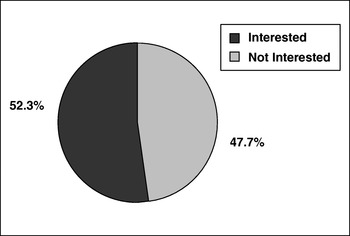
In this paper, our dependent variable is interest in PPB. It was measured by the following survey question: ‘How interested are you in working directly with a WSU scientist in a participatory wheat breeding program within the next 1–3 years?’ A box appeared next to the question with the following information: ‘Participatory wheat breeding uses both breeder and farmer expertise to develop varieties particularly suited to a specific set of environmental challenges.’ Answer categories included ‘very interested,’ ‘somewhat interested’ ‘somewhat uninterested,’ and ‘very uninterested’. We created a dichotomous variable by grouping the first two categories (into ‘interested’) and the last two categories (into ‘not interested’). Four hundred and ninety-three (493) respondents provided valid answers to the question. Results indicate that 258 growers (52.3% of respondents) are interested in working with a WSU scientist in a participatory wheat-breeding program, while 235 growers (47.7%) are not interested (see Fig. 1).
Interest in working with Washington State University (WSU) scientists in participatory wheat breeding programs, Washington wheat growers, 2006.

The primary objective of the analysis presented below is to explore the relationship between our dependent variable (interest in PPB) and six sets of independent variables. Our independent variable groups include farmer characteristics, farm characteristics, production variables, wheat marketing variables, variables measuring experience with WSU researchers and extension specialists and variables measuring opinions about WSU research and extension. All of the independent variables presented in the tables were measured by direct survey questions. The continuous variables (such as age, years in farming, total acres farmed, etc.) have been recoded as categorical variables for the purposes of analysis. We conducted Pearson chi-square tests to determine whether growers interested in PPB and growers not interested in PPB differ significantly in various characteristics. The Pearson chi-square test is designed to test for independence between two nominal variables. The null hypothesis is that the two variables are statistically independent. The test is based on a comparison between the observed and expected frequencies in the cells of a cross-classification table.
Findings
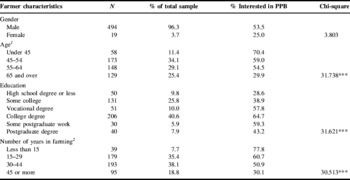
Table 1 presents percentage distributions for farmers' interest in PPB by four farmer characteristics: gender, age, education and years in farming. There are statistically significant differences in PPB interest for three of the four demographic variables. Younger farmers, as well as individuals with less farming experience, are more interested in PPB. Note, however, that these are not mutually exclusive groups because of the high correlation (r=0.81) between age and number of years in farming.
Percentage distribution of interest in PPB by farmer characteristics, Washington wheat growers, 2006.

1 The average age of survey respondents was 57.5 years.
2 The average number of years in farming was 32.0 years.
* P⩽0.05; **P⩽0.01; ***P⩽0.001 (Pearson chi-square test).
The data in Table 1 indicate a negative (and nearly linear) relationship between PPB interest and both age and number of years in farming. This could be due to a number of factors. Younger and newer farmers may be more willing to start a long-term project with the prospect of significant benefits down the road. For example, they may be looking for alternatives to conventional commodity production out of concern for the long-term economic and environmental viability of their operations. Younger and newer farmers may also be experimenting with different production practices and varieties as they get to know the specific conditions on their farms. Older and more experienced farmers, in contrast, may already know the types of varieties and production methods that work well on their farms and, consequently, may not be as interested in making significant changes to their operations.
The data in Table 1 also suggest that interest in PPB varies significantly by farmers' level of education. Respondents with high school degrees (or less) are the least interested in PPB, while respondents with vocational degrees, college degrees and some postgraduate education exhibit the greatest PPB interest. One possible explanation for these findings is that more educated farmers are more aware of WSU research or plant breeding in general. Many farmers in Washington are WSU graduates, which could influence their interest in working with WSU scientists. Interestingly, only 43% of respondents with postgraduate degrees are interested in PPB.
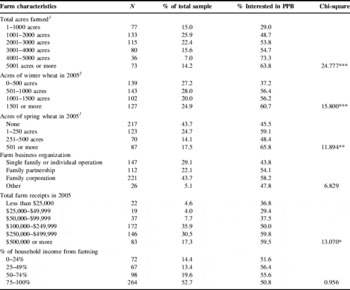
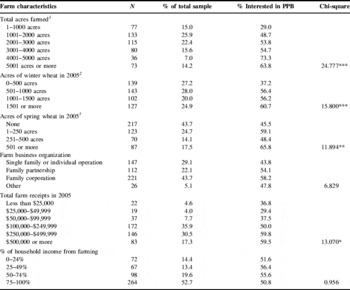
Table 2 presents percentage distributions for farmers' interest in PPB by farm size, winter and spring wheat acreage, farm business organization, total farm receipts and percentage of household income from farming. Chi-square results indicate a statistically significant relationship between PPB interest and farm size, but not farm business organization or the percentage of household income from farming. The most intriguing finding is that farmers' interest in PPB increases with farm size, regardless of whether measured in terms of total acres farmed, wheat acres, or farm receipts. This finding does not support the common perception that smaller growers are the ones most interested in participatory researchReference Sligh and Lauffer25–Reference Desclaux and Hédont27. There are several possible explanations for our finding that larger-scale farmers seem to be more interested in PPB. First, farmers with more acreage may be more likely to have some marginal land, for which they want to work with scientists to develop special varieties. Secondly, large-scale farmers (compared to small-scale farmers) may have access to more resources and laborers, resulting in their ability to devote more time to participatory breeding projects. Thirdly, it is possible that some larger-scale farmers were able to expand their operations because of successful experimentation with new practices. These farmers may look favorably upon opportunities to experiment further.
Percentage distribution of interest in PPB by farm characteristics, Washington wheat growers, 2006.
1 The average total acreage was 3145 acres.
2 The average winter wheat acreage was 1183 acres.
3 The average spring wheat acreage was 280 acres.
* P⩽0.05; **P⩽0.01; ***P⩽0.001 (Pearson chi-square test).
Another interesting finding from Table 2 is the lack of a statistically significant relationship between PPB interest and the percentage of household income from farming. Farmers who rely on farm receipts for their entire income and those with off-farm income sources appear to be equally interested in participatory breeding programs. Off-farm income might provide a financial cushion to allow farmers to assume the risks of a participatory breeding program. However, farmers with off-farm jobs may face time constraints that could negatively affect their ability to participate in plant breeding activities. In contrast, farmers who rely solely on farming for their household income might have the incentive and flexibility (especially in terms of labor time) to develop varieties for specific environmental conditions on their farms.
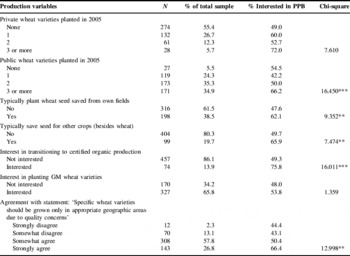
Table 3 presents percentage distributions for farmers' interest in PPB by various production variables. We find statistically significant chi-square results for all but two of the variables included in the table. Respondents who planted three or more public wheat varieties were more likely to be interested in PPB. Perhaps these growers are more aware of differences in variety performance across different sections of their farms. Growers who agree that ‘specific wheat varieties should be grown only in appropriate geographic locations due to quality concerns’ are more likely to exhibit PPB interest. This lends additional support to the hypothesis that farmers with PPB interest are more aware of the environmental effects on varietal performance and the need for wheat varieties adapted to specific agro-ecological zones.
Percentage distribution of interest in PPB by production variables, Washington wheat growers, 2006.

* P⩽0.05; **P⩽0.01; ***P⩽0.001 (Pearson chi-square test).
The data in Table 3 also suggest farmers who are interested in alternative production methods are more inclined to want to breed new varieties in partnership with scientists. First, farmers who save seed from wheat and other crops are more likely than farmers who do not engage in seed saving to be interested in PPB. Farmers save seed for many reasons, including the desire to be self-sufficient or to avoid the cost of purchasing seed each year. Since farmers would have control of the varieties developed through PPB, it is not surprising that farmers who want to control their own seed supply seem to be very interested in PPB. Secondly, there is a statistically significant relationship between PPB interest and interest in transitioning to certified organic production. This is not altogether surprising because the growers who originally worked with the WSU winter wheat breeding program were organic producers. These growers may be turning to organic production as a means to reduce their dependence on external inputs (including seeds) or to sell high-quality wheat in alternative markets. Moreover, some growers may be interested in PPB as a result of their perception that varieties developed on-farm would perform better than existing varieties in organic systems. In fact, this perception has motivated organic farmers in Europe and the US to initiate PPB activities.
The data in Table 3 also suggest interest in planting GM wheat varieties is not related to interest in participatory breeding. Wheat growers may consider both participatory breeding and the development of GM varieties as strategies for improving plant varieties. This interpretation contradicts findings from case studies of participatory breeding in the US and Europe where growers were interested in participatory breeding as a method of ensuring control over seed supplies and preventing GM ‘contamination’ of seed stocksReference Chiffoleau and Desclaux19, Reference Sligh and Lauffer25–Reference Desclaux and Hédont27.
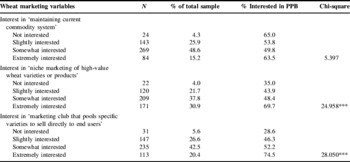
Table 4 presents percentage distributions for farmers' interest in PPB by three wheat-marketing variables. Specifically, respondents were asked to indicate their level of interest in three wheat-marketing strategies: maintaining the current commodity system, niche marketing of high-value wheat varieties and establishing marketing clubs to pool varieties for sale to end users. We find no statistically significant difference in PPB interest for farmers with different levels of interest in maintaining the current commodity system. In fact, 65% of the respondents with no interest in maintaining the commodity system and nearly 64% of those with extreme interest in maintaining the system are interested in participating in breeding programs. It is likely farmers who are interested in keeping the current commodity system, but also interested in participating in breeding programs, are concerned with reducing input costs. These farmers may see the development of their own wheat varieties as a way of reducing costs through varietal adaptation to specific environmental conditions. For example, if a farmer chooses to conduct selection with reduced herbicides or pesticides, the variety developed will most likely have improved tolerance to weed pressure and resistance to diseases or insects. Thus, over time, selection for low-input systems can lower input costs for the same yield and quality goals.
Percentage distribution of interest in PPB by wheat marketing variables, Washington wheat growers, 2006.

* P⩽0.05; **P⩽0.01; ***P⩽0.001 (Pearson chi-square test).
The data in Table 4 also indicate a positive (and somewhat linear) relationship between PPB interest and interest in the two ‘alternative’ marketing strategies: niche marketing and marketing clubs. There are several reasons why growers interested in alternative marketing strategies might be more interested in PPB. Growers may want to develop a specialty product that could be niche-marketed. Moreover, they may be interested in improving grain quality for direct marketing to end-users who value nutritional value and food product quality over yield and protein content. They may also see PPB as a means to diversify and lower input costs.
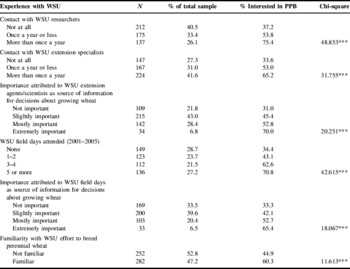
Table 5 presents percentage distributions for farmers' interest in PPB by several variables measuring farmers' experiences with WSU researchers/extension specialists and their programs. We find statistically significant chi-square results for all six variables included in the table. Not surprisingly, respondents who reported having had the most contact with WSU researchers and extension specialists expressed the greatest interest in working with WSU scientists in participatory breeding programs. Similarly, respondents who had attended one or more WSU field days were more interested in PPB compared to respondents who had not attended any field days. PPB interest also appears to be related positively to the degree of importance attributed to WSU extension specialists, researchers and field days as sources of information for decisions about growing wheat.
Percentage distribution of interest in PPB by variables measuring experience with WSU, Washington wheat growers, 2006.

* P⩽0.05; **P⩽0.01; ***P⩽0.001 (Pearson chi-square test).
The data in Table 5 also indicate PPB interest is greater among farmers familiar with the WSU effort to breed perennial wheat compared to farmers unfamiliar with this effort. The objective of the perennial wheat-breeding project is to develop wheat plants that produce grain for multiple years. Although perennial wheat is still in the experimental stages, preliminary results have been presented at many wheat grower meetings. It is likely growers with an interest in the latest activities of the WSU wheat breeding programs (i.e., growers who attend grower meetings and other gatherings focused on WSU research programs) tend to express greater interest in new participatory breeding efforts.
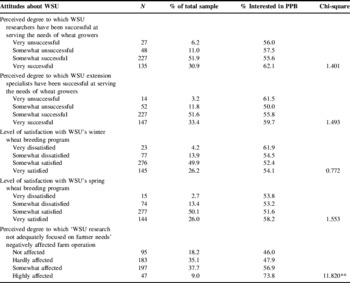
Table 6 presents percentage distributions for farmers' interest in PPB by several variables measuring farmers' opinions about WSU research and extension programs. PPB interest does not appear to be related to the perceived degree to which WSU researchers and extension specialists have been successful at serving the needs of wheat growers. However, there is a positive relationship between PPB interest and the degree to which growers perceived that ‘WSU research not adequately focused on farmer needs’ negatively affected their farm operations. In other words, growers who reported being ‘highly affected’ by a lack of relevant WSU research were the most likely to be interested in working with scientists to develop new wheat varieties. This finding supports one of the key goals of PPB: to reach farmers who have not benefited from formal plant breeding programs. However, because the survey question pertained to ‘WSU research’ (in general) rather than the development of wheat varieties (in particular), we must exercise caution in interpretation. Interestingly, we do not find statistically significant relationships between growers' PPB interest and their level of satisfaction with WSU's winter and spring wheat breeding programs. Growers who feel negatively affected by lack of attention by WSU researchers could certainly benefit from participation in research specifically tailored to meet their needs for certain varietal characteristics. These growers may also be interested in participating in priority setting or discussions about the overall goals of breeding and research programs.
Percentage distribution of interest in PPB by variables measuring attitudes about WSU, Washington wheat growers, 2006.

* P⩽0.05; **P⩽0.01; ***P⩽0.001 (Pearson chi-square test).
Summary and Conclusion
The objective of our study was to broaden our understanding of whether and why farmers in developed countries are interested in working with university scientists in participatory breeding programs. Based on our analysis of data from a survey of wheat growers in Washington, we found approximately 52% of growers were interested in participating in university breeding programs. This finding suggests that it is not just social scientists, activists and (some) scientists who want to democratize university science and technology decision-making. A majority of farmers—at least in Washington State—also want a more participatory public agricultural research system. They themselves want to be actively engaged in the research process.
Many factors appear to be associated with growers' desire to work with professional breeders. Younger, college educated farmers with fewer years of farming experience were more interested in PPB compared to farmers with more years of farming experience and either no advanced degree or a post-graduate degree. Our data also indicated PPB interest was related positively to farm size (whether measured in terms of total acres farmed, total wheat acres, or total farm receipts) and the number of wheat varieties planted. Growers' use of and interest in alternative production and marketing practices (e.g., seed saving, organic farming, niche marketing and marketing clubs) were also related significantly to interest in participatory breeding. We found statistically significant chi-square results for all of our measures of growers' prior experience with WSU (e.g., contact with researchers and extension specialists, number of field days attended, familiarity with WSU's effort to breed perennial wheat). Finally, our data indicated growers who reported being ‘highly affected’ by inadequate attention from WSU researchers were the most likely to be interested in working with scientists to develop new wheat varieties.
Until we conduct further roundtable discussions and interviews with growers, we can only offer preliminary interpretations of our findings and generalizations about which farmers are most likely to be interested in PPB. It is essential to keep in mind that farmers are an extremely diverse group. Different farmers will have different reasons for wanting to work with university plant breeders. Moreover, most farmers will pursue multiple strategies to ensure the success of their operation. PPB is likely to be one project among many contributing to the farm operation. We believe PPB is sufficiently adaptable to allow farmers to use it to achieve multiple goals. We hope PPB in Washington State and elsewhere will help farmers gain greater control of the development of varieties to meet their specific needs and desires. Increased farmer involvement in plant breeding has the potential to contribute to the democratization of research and technology development at public agricultural research institutions.
Acknowledgements
Funding for this research was provided by the Department of Crop and Soil Sciences (WSU), the Department of Community and Rural Sociology (WSU), the Washington Wheat Commission and graduate research fellowships provided by the National Science Foundation and the Land Institute. The authors thank the WAWG staff and board, as well as the farmers who participated in the mail survey and roundtable discussions. Invaluable survey assistance was provided by Rose Krebill-Prather at Washington State University's Social and Economic Sciences Research Center (SESRC). The authors also thank Stephen Jones, Ray Jussaume, Leland Glenna and two anonymous reviewers for their input and comments on this manuscript. All opinions, findings, conclusions and recommendations expressed in this paper are those of the authors and do not necessarily reflect the views of the funding agents and individuals listed above.