1. Introduction
The value to the global community of reducing carbon emissions to mitigate climate change is increasingly being recognized and defined. Recently established markets for carbon emission reduction services are rapidly growing and predicted to continue doing so. Agricultural producers have the potential to make a significant contribution towards reducing carbon emissions, by making changes in their land management practices to increase the capture, or sequestration of carbon emissions. The extent to which payments for environmental services, such as climate change mitigation, can contribute towards agricultural development and poverty reduction is an important issue for developing countries (Pagiola et al., Reference Pagiola, Arcenas and Platais2005; Zilberman et al., Reference Zilberman, Lipper and McCarthy2008). Soil carbon sequestration provides an interesting opportunity in this context, since agricultural productivity co-benefits are generally associated with increases in soil carbon.
Improving the agricultural productivity of low income farmers is an important means of reducing poverty in developing countries. Improving the quality of soils on agricultural lands is a key part of improving the agricultural productivity of poor farmers, who are often producing on degraded lands with little external inputs (Lal, Reference Lal2004; Foley et al., Reference Foley2005; Perez et al., Reference Perez, Roncoli, Neely and Steiner2007). Low levels of soil organic matter (SOM) are often a problem, leading to low fertility and water use efficiency (Antle and Diagana, Reference Antle and Diagana2003; Lal, Reference Lal2004; Pretty et al., Reference Pretty, Noble, Bossio, Dixon, Hine, Penning deVries and Morison2006). Improving SOM levels through changes in agricultural production practices is thought to be an important means of improving overall resource use efficiency and productivity in developing countries (Lal, Reference Lal2004; Hobbs, Reference Hobbs2007). It also results in an increase in the capture or sequestration of carbon in soils, which is one means of reducing net carbon emissions. There are a variety of ways in which SOM can be increased, one of which is the adoption of a system of production known as conservation agriculture. Conservation agriculture involves a reduction, or elimination of tillage and an increase in the coverage of the soil, compared with conventional agricultural practices. Conservation agriculture has been promoted in developing countries in recent years as a potentially promising technology for improving the productivity and sustainability of agricultural production systems (Lal, Reference Lal2004; Pretty et al., Reference Pretty, Noble, Bossio, Dixon, Hine, Penning deVries and Morison2006; Hobbs, Reference Hobbs2007). Payments for the carbon sequestration benefits of the system provide a potential opportunity to support the adoption of the system and make a significant contribution to agricultural development and climate change mitigation.
In this paper we develop a farm level model of the decision to adopt conservation agriculture, as an example to illustrate the issues that arise for farmers, particularly the poor, in adopting a technology that generates soil carbon sequestration co-benefits. A central feature in our analysis is the increased agricultural yield risk associated with the transition to a new farming system (FAO, 2001a; Bishop-Sambrook et al., Reference Bishop-Sambrook, Kienzle, Mariki, Owenya and Ribeiro2004; Hobbs, Reference Hobbs2007) – a feature of soil carbon sequestration systems that has recently been highlighted as an important area of research (Diagana et al., Reference Diagana, Antle, Stoorvogel and Gray2007). Risk has been shown to play a significant role in a wide range of agricultural technology decisions (Just, Reference Just1974; Feder, Reference Feder1980; Feder and O'Mara, Reference Feder and O'Mara1981; Feder et al., Reference Feder, Just and Zilberman1985). Attention to uncertainty is particularly important because the poor, who have limited access to insurance, are especially ill-equipped to cope with risk (Feder et al., Reference Feder, Just and Zilberman1985; Fafchamps, Reference Fafchamps1999). Indeed, even when risk is only heightened for limited periods, poor farmers are often reluctant to make changes in their farming practices that could affect their food security (Alderman and Paxson, Reference Alderman and Paxson1992; Shively, Reference Shively1997).
Our model highlights two distinct impacts of carbon sequestration adoption on agricultural productivity – the technology impacts of adopting a new farming system, which temporarily increase yield risk; and the productivity impacts of changes in soil carbon, which generally increase agricultural output. Our analysis of equilibrium soil carbon levels finds the intuitive result that increases in the price paid for carbon sequestered in the soil lead to higher soil carbon levels. Since the negative consequences of the technology effect are experienced immediately while the benefits from the productivity effect are realized later, increases in the discount rate lead to lower levels of soil carbon. The impact of increases in the price of agricultural output and risk aversion are ambiguous, depending on the relative strength of the productivity and technology effects of adoption.
The paper is organized as follows: in section 2 we describe the technical potential of conservation agriculture as a potential source of soil carbon sequestration supply. We also assess the private benefits from adopting conservation agriculture, including the potential demand for soil carbon sequestration services as well as the private costs and returns to agricultural production. In section 3 we present a household dynamic optimization model of the decision to adopt conservation agriculture and supply soil carbon sequestration. In section 4 we conclude with a discussion of the implications of our results for the design of payment mechanisms to induce low income farmers to participate in carbon markets.
2. Technical background
Conservation agriculture and soil carbon sequestration
Conservation agriculture is a term that covers a broad range of agricultural practices. The two key features of a conservation agriculture system are a reduction or elimination of tillage, and an increase in the coverage on the soil surface (FAO, 2001a). These practices increase SOM, and reduce soil degradation from decomposition and mineralization. Together, they result in an increase of soil organic carbon (SOC). The adoption of conservation agricultural practices increases the amount of carbon being introduced into the soil through surface organic materials, and decreases the amount of carbon that is removed from the soil by protecting the land surface from weather events and the avoidance of tillage that leads to atmospheric carbon releases.
Increasing soil organic carbon is a form of carbon sequestration, defined as the capture and secure storage of carbon that would otherwise be emitted or remain in the atmosphere (Watson et al., Reference Watson, Noble, Bolin, Ravindranath, Verardo and Dokken2000). Conservation agriculture is but one of several land management options for sequestering carbon in soils. Simply increasing the application of inorganic or organic fertilizer, or changing from agricultural to grassland or agro-forestry land uses, increasing the length of fallow periods, and refraining from converting lands to agricultural production are all examples of land use management changes that can increase soil carbon sequestration (Lal et al., Reference Lal, Kimble, Follet and Cole1998; Ringius, Reference Ringius2002; FAO, 2004a).
In this article we focus on conservation agriculture as a potential source of carbon sequestration since it is a relatively productive means of sequestering soil carbon and because it is a farming system accessible to a wide range of developing country farmers that offers the potential of increasing food security. Conservation agriculture adoption does not require a change of land use out of agricultural crop production and requires relatively little external inputs. Both of these features are important in considering appropriate strategies for poor farmers in developing countries where agricultural markets and financial services are not well-functioning. Growing food for own consumption is a widely practiced strategy amongst poor farmers to reduce the risk of food insecurity. Poor farmers generally have small holdings, and thus a limited capacity to shift land use towards non-crop alternatives. For a range of agro-ecological conditions and farming systems in developing countries, conservation agriculture has been shown to provide benefits for poor farmers who adopt (Pretty et al., Reference Pretty, Noble, Bossio, Dixon, Hine, Penning deVries and Morison2006; Hobbs, Reference Hobbs2007).
The costs and potential benefits of sequestering carbon
In this section, we start with a brief description of the costs of adopting conservation agriculture in a developing country context. Next we look at the returns side, starting with the potential returns to agricultural production and then to soil carbon sequestration from adopting the new system.
Costs of adoption
The adoption of conservation agriculture changes the agricultural technologies and input mix employed in agricultural production. Changes occur in labor, capital, energy, pesticide, herbicide and fertilizer use (FAO, 2001a). The magnitude and even the sign of input cost changes depend, in part, on the agricultural practices that prevailed before the switch. Switching out of a capital intensive production system is quite different than switching out of a low input, low productivity system, which is most likely to be the case for poor agricultural producers and thus our focus here. Agro-ecological conditions also play an important role in determining the size of these cost differences, as climate, soil type, topology, and the level of soil degradation all influence potential crop types and agricultural input requirements. A net reduction in input costs is often cited as an attractive feature of conservation agriculture, but in the short run, during the transition between agricultural systems, these costs can increase (Hobbs, Reference Hobbs2007).
A reduction in labor requirements is one of the most important aspects of changing to conservation agriculture for poor agricultural producers in developing countries (Bishop-Sambrook et al., Reference Bishop-Sambrook, Kienzle, Mariki, Owenya and Ribeiro2004). In the case of Brazil, which has over 14 million hectares in conservation agriculture, decreases in labor use on the order of 10–60 per cent per hectare per year were observed, depending on the crop and region (Pieri et al., Reference Pieri, Evers, Landers, O'Connell and Terry2002; ACTN, 2004). Studies in developing countries have found substantial cost savings in labor with conservation agriculture adoption, although in several examples labor input rose during a transition phase of one to three years (Ekboir et al., Reference Ekboir, Boa and Dankyi2002; Bishop-Sambrook et al., Reference Bishop-Sambrook, Kienzle, Mariki, Owenya and Ribeiro2004).
Insect control tends to be equally important in conventional and conservation agricultural systems, although some evidence indicates that pest pressures are reduced under the latter systems, resulting in lower pesticide expenditures (FAO, 2001a; Ekboir et al., Reference Ekboir, Boa and Dankyi2002). The two practices differ in their use of herbicides. Herbicides may be used to combat weeds that are no longer controlled through tillage, and conservation agriculture adoption can therefore necessitate an increase in herbicide use, particularly during the transition phase. The extent of this increase depends on initial weed levels, how much weeding is performed by hand, and how well other weed management techniques such as maintaining soil cover and the use of crop rotations are implemented. There is evidence that herbicide use will decline over time, perhaps eventually falling to levels below conventional agriculture (FAO, 2001a; Friedrich, Reference Friedrich2005).
The adoption of conservation agricultural practices requires some capital investment, and this is often cited as a factor preventing low income agricultural producers from taking up the system (Pieri et al., Reference Pieri, Evers, Landers, O'Connell and Terry2002; ACTN, 2002; Bishop-Sambrook et al., Reference Bishop-Sambrook, Kienzle, Mariki, Owenya and Ribeiro2004; Hobbs, Reference Hobbs2007). Capital costs associated with the adoption of conservation agriculture from a low input subsistence system include purchase or rental of mechanized and non-mechanized planters that can seed through soil mulch, although in some cases, particularly in Africa, the planting tools of the traditional farming system have been used (Ekboir et al., Reference Ekboir, Boa and Dankyi2002).
During the transition phase, fertilizer use in conservation agriculture may increase, depending on the degree to which green manure crops are used effectively in the rotation (ACTN, 2002). However, increases in the soil fertility associated with conservation agriculture can result in a decreased need for fertilizer inputs over the long run. For example, fertilizer applications were cut by 30 per cent in the case of maize and 50 per cent for soybeans in one long-term study of conservation agriculture adoption in Brazil (ACTN, 2002). On the other hand, fertilizer use has been found to increase in such systems in developed countries (Uri, Reference Uri1997). Furthermore, the application of fertilizer in conservation agricultural systems requires greater management skills, suggesting that the costs of fertilizer per application may also rise with the adoption of these systems (ACTN, 2004).
As the adoption of conservation agricultural practices yields cost savings on some inputs and cost increases on others, the net effect is unclear, and depends to a large degree on site specific characteristics. Evidence on the relative cost of conservation agriculture production in developing countries is sparse, while that from the US and Canada give mixed results. Some studies have found evidence of small long-run cost saving (Crosson, Reference Crosson1981; Uri, Reference Uri1997), while others have found the adoption of conservation practices to be cost-increasing (Zentner et al., Reference Zentner, Tessier, Peru, Dyck and Campbell1991; Stonehouse and Bohl, Reference Stonehouse and Bohl1993). Of course, increased input costs alone may not pose a serious obstacle to adoption if they are offset by equally large increases in returns. High adoption rates in some areas, such as Latin America, suggest that, at least for part of the world, these net costs are at most small relative to the benefits of switching to a conservation agriculture system.
Agricultural benefits from conservation agriculture adoption
In this section we focus on the benefits to farmers of conservation agriculture adoption in the form of improved levels and stability of agricultural yields, focusing particularly on dryland areas. Current farming systems in the drylands of developing countries often rely on mining soil resources, depleting organic carbon and other nutrients, resulting in productivity losses and unsustainable systems (Lal, Reference Lal2004; Perez et al., Reference Perez, Roncoli, Neely and Steiner2007). These farming systems are characterized by highly degraded soils, low agricultural productivity, and high rates of poverty (FAO, 2004a). Only a limited range of options exists for improving livelihoods of farm households in these areas, and improving agricultural productivity is an important means of doing so.
Conservation agriculture practices that generate soil carbon sequestration also impact agricultural productivity by improving both biological and chemical components of the soil. Soil carbon sequestration is associated with increased levels of SOM which has a direct impact on soil fertility (FAO, 2001b). Organic matter, and the biological activity that it generates, have a major influence on the physical and chemical properties of soils (Robert, Reference Robert1996). Aggregation and stability of soil structure increase with organic matter content. These, in turn, increase the infiltration rate and available water capacity of the soil, as well as resistance against erosion by water and wind (Reicosky, Reference Reicosky2004). Soil organic matter also improves the cation exchange capacity (CEC) of the soil and increases the availability of essential plant nutrients.Footnote 1
Despite some careful empirical work examining the relationship between soil erosion (related to soil carbon levels) and agricultural productivity (e.g. Wiebe, Reference Weibe2003), considerable uncertainty remains about the precise relationship between the two. In dryland areas, where the benefits from increasing water holding capacity, greater nutrient availability, and improving soil textures are largest, the yield effects from increasing SOM can be quite significant (Robert, Reference Robert1996; FAO, 2001b; Tieszen et al., Reference Tieszen, Tappan and Touré2004).
The mechanism by which carbon sequestration through the adoption of conservation agriculture affects agricultural productivity can be best understood by examining two distinct elements of the process. The first is the set of human actions that need to be taken to generate sequestration, including all the production activities that must be altered to switch to a conservation agricultural system. We refer to the impact from this element as the ‘technology’ effect, as it is a direct result of adopting new agricultural practices, or technologies. The second is the result of the biophysical change in the level of SOM and its impact on agricultural productivity that is generated as a result of the adoption of sequestering land use practices. We refer to the impact from this element as the ‘productivity’ effect, as higher level of soil organic carbon is associated with more productive soils for the reasons described above.
As noted earlier, farmers undergo a transition period in the adoption of conservation agriculture. During this period of transition (approximately 1–5 years), the soil ecosystem adjusts from one equilibrium to another. Soil-borne pests and pathogens may create new problems in the process of changing the biological equilibrium (FAO, 2004b; Hobbs, Reference Hobbs2007). Weed control in the first 1–2 years of adoption can be a significant problem, requiring increased use of herbicides and/or increased labor for weeding (FAO, 2001b). Average agricultural yields generally remain unaffected, but yields can be more susceptible to pest and diseases, with a consequent increase in yield volatility (FAO, 2004b; Hobbs, Reference Hobbs2007). This susceptibility is a direct result of the instability of the soil ecosystem. Once the ecosystem has reached its new post-adoption equilibrium, this heightened level of susceptibility ceases to exist. In short, the adoption of sequestration activities does not affect average agricultural yields but does increase pressure to respond to different pest or disease problems for a brief period following adoption.
The increase in soil carbon content in contrast, affects both average yield and its volatility. Increases in the level of soil carbon tend to increase average yields, albeit at a decreasing rate. Increases in the level of soil carbon also decrease the susceptibility of yield, primarily to weather shocks, also at a decreasing rate. Thus, the addition of carbon to the soil essentially pays a ‘double dividend’ with regard to agricultural yields: average yields increase and yield volatility decreases.
Combining both the ‘technology’ and the ‘productivity’ effect reveals the net impact of carbon sequestration on agricultural yields. In the initial phase after adoption, average agricultural yields rise slowly as a result of increased soil carbon levels, but may become more volatile as a result of the recent disruption to the soil ecosystem, and as farmers become familiar with the new production system. In the subsequent phase, the ‘technology’ effect dissipates and average yield increases while the volatility of yield decreases and input use (fertilizer and pesticides) also decreases. The degree to which volatility effects are important will depend, in part, on farmers’ risk preferences, the length of the transition phase, and vulnerabilities to weather and pest shocks.
Returns to soil carbon sequestration
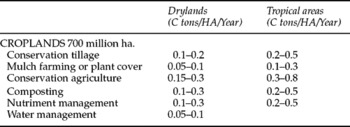
Farm level returns to the provision of soil carbon sequestration associated with conservation agriculture adoption is determined by the amount of sequestration farmers can provide, as well as the prices that buyers are willing to pay for the service. While the total amount of carbon that can be sequestered from improved soil management globally is quite large, the amount which can be generated per hectare per year, is relatively small, particularly in comparison to sequestration from increasing above-ground biomass (Lal, Reference Lal1999). The potential rate of carbon sequestration is sensitive to agro-ecological conditions, with higher rates in humid temperate areas than semi-arid and tropical areas (Lal, Reference Lal1999; Pretty and Ball, Reference Pretty and Ball2001). As seen in table 1, the adoption of conservation agriculture techniques, which involve reduced tillage and coverage of at least 30 per cent of the soil surface, can be expected to generate 0.30–0.80 tons of carbon/hectare/year in tropical areas while drylands can be expected to supply 0.15–0.30 tons of carbon/hectare/year.Footnote 2
Land management practices and carbon yields (derived from Lal, Reference Lal1999)

Payments for carbon sequestration services are being made through a variety of exchanges, including both regulatory and voluntary markets, and growth in trading is rapidly expanding (World Bank, 2007). Exchanges vary in the activities they allow as sources of carbon emission reductions, and how they are accounted for and traded. Until now, regulatory driven exchanges, such as the Clean Development Mechanism of the Kyoto Protocol, restrict the use of soil carbon sequestration as a source of emissions reductions, greatly reducing demand. In voluntary and public sector payment programs, credits for emission reductions from sequestration in general, and soil carbon sequestration specifically, are more commonly found. However this constitutes a significantly smaller share of the overall carbon market.
The prices that are being paid for carbon emission reduction credits vary by source of demand and type of offset. Prices for emission reductions from sequestration are generally lower than from other emission reduction sources. The Chicago Climate Exchange, a voluntary exchange that allows sequestration, started at a low of $1.73 per metric ton carbon dioxide equivalent in January 2006, ending up at around $3.7 in early 2007 (World Bank, 2007). The BioCarbon Fund of the World Bank has set an indicative price between $3–$4 per metric ton of carbon dioxide equivalent (Biocarbon Fund, 2004). Transaction costs for monitoring and verification through soil mapping and sampling can also be substantial. Mooney et al. (Reference Mooney, Brown and Shoch2004) estimated per hectare costs of monitoring for a 1,000 hectare project at between $5 to $8 hectare, using data from soil carbon projects in the US. At regional scales, remote sensing technologies can reduce these costs, although they still require field work for ground truthing (Perez et al., Reference Perez, Roncoli, Neely and Steiner2007).
At present, the demand for carbon emission reductions from soil carbon sequestration is limited, with relatively low prices and high transactions costs. While payments alone may be insufficient to induce farmers to supply soil carbon sequestration services, the agricultural co-benefits associated with sequestration make adoption attractive for some. The key question facing each farmer is whether carbon payments are large enough to outweigh the upfront costs of transitioning to a new agricultural system. Should, as is expected, regulatory markets treat emissions reductions from soil carbon sources more favorably or transactions costs fall as more experience with sequestration projects is gained, returns to soil carbon sequestration will increase, as will the scope for wider participation among farmers.
3. Modeling soil carbon sequestration decisions
A household model of soil carbon sequestration supply with risk
In this section, we develop a basic model of optimal soil carbon sequestration supply from the adoption of conservation agriculture for small farmers. The distinction of ‘small’ is meant to convey the importance of production stochasticity and producer risk preferences. Specifically, we assume that farmers maximize their expected utility from profits, EU(π), rather than profits directly. Profits in this case are generated from both agricultural output and payments for sequestering carbon in the soil, where U′(π) > 0 and Uʺ(π) < 0. As such, the farmer's land can be viewed as a multiple-use resource, the optimal management of which will require the farmer to consider the returns to each activity and the (possibly) competing demands that they place on the land (Zivin et al., Reference Zivin, Hueth and Zilberman2000).
Suppose that agricultural yield in any given period is equal to f(S, C(t)) + 2g(S, C(t))θ, where θ is a stochastic weather variable with an expected value of 0 (Just and Pope, Reference Just and Pope1978). S is a composite measure of exogenous land quality which includes soil type, land slope, local temperature, and rainfall conditions, and C(t) is the amount of carbon in the soil in period t.Footnote 3 Expected yield f is assumed to be increasing in all variables at a decreasing rate (i.e. fS > 0, fSS < 0, fC > 0, fCC < 0). The function g can be thought of as a measure of sensitivity to weather. Weather sensitivity is assumed to be decreasing in land quality and soil carbon levels at an increasing rate (i.e. gS < 0, gSS > 0, gC < 0, gCC > 0). Let pa represent the market price per unit of agricultural output. For simplicity, we will also assume that this price represents the per unit value of agricultural output consumed by the farmer, which is tantamount to assuming that all farmers have market access and that food production levels always exceed the subsistence demands of the household. We will discuss the implications of relaxing this assumption when we analyze the properties of equilibrium carbon sequestration levels. Profits from agricultural production can be expressed as πa = paf(S, C(t)) − 2pag(S, C(t))σ2Θ. Taking a second-order Taylor-series approximation of EU(πa) yields the following expression

where r is the Arrow–Pratt measure of risk aversion. Utility from agricultural production is increasing in average yield and decreasing in the variability of yields. This type of utility function is frequently used in finance (Markowitz, Reference Markowitz1987) and can be viewed as a special case of the more general class of mean-standard deviation utility functions. The properties of these utility functions and their consistency with expected utility theory are discussed in great detail elsewhere (Meyer, Reference Meyer1987).
In addition to revenue from agricultural output, farmers can earn money for sequestering carbon in the soil. Let pc denote the price per unit carbon sequestered.Footnote 4 Note that only incremental carbon units above baseline are eligible for payment. Thus, farmer revenue from sequestering carbon can be expressed as  , where
 and C(0) represents baseline carbon levels established as part of the carbon payment program.Footnote 5 Carbon augmentation is achieved through investment in sequestering activities,Φ(t), such that
 . The amount of soil carbon growth as a result of sequestration activities depends on land quality, where h Φ > 0, h ΦΦ < 0, hS > 0, hSS < 0. The cost of sequestration has two parts. First, there is a direct per unit cost of sequestration activities, which we will denote q.Footnote 6 This cost should be viewed as the per-period costs – the management, labor, and input costs – of operating a farming system of sequestration intensity Φ.Footnote 7 Second, the undertaking of sequestration activities temporarily raises the yield variability during the transition phase. Adopting sequestering practices may generate yield volatility in two ways: by disturbing the previous soil ecosystem equilibrium, which, in turn, makes agricultural yields more susceptible to weather shocks or because of imperfect adoption of the new system due to incomplete information, lack of inputs, and the farmers’ process of learning the new technology. When the soil ecosystem equilibrium is restored, this volatility effect disappears. For simplicity, we model this volatility impact as a one period shock to agricultural yield variability immediately following a change in sequestration activities, denoted mΦ, where m represents the volatility costs per unit of sequestration.Footnote 8 Thus, the new expression for crop yield susceptibility to weather shocks is mΦ times the pre-sequestration yield volatility measure g().
Expected utility for the farmer from engaging in both agricultural production and carbon sequestration in the soil can now be expressed as follows

The objective of the farmer is to choose sequestration activities to maximize expected utility subject to the equation of motion for soil carbon growth.

where C 0 is the initial carbon stock level. Letting δ denote the discount rate, this objective can be expressed by the following current-value Hamiltonian

The first-order conditions for this maximization problem can be expressed as



where the assumption that soil carbon has no value beyond its price from the sequestration program and its contribution to agricultural productivity suggests the following transversality condition: limt→∞μ(t)C(t) = 0. Equation (4) states that the disutility from an increase in the volatility of yields as a result of sequestration activities plus the direct cost of sequestration activities equals the marginal productivity of sequestration in terms of carbon production times the shadow value of soil carbon. The interpretation of equation (5) is that the change in the shadow value of carbon in the soil is equal to the discounted value of carbon content in the soil from the previous period minus the impact of a change in carbon on expected utility (the expression in brackets). This latter carbon effect includes the impact soil carbon has on average yields, the volatility of yields, and the revenue a farmer receives directly from carbon payments. Equation (6) is simply a restatement of the equation of motion for soil carbon.
Model dynamics and steady-state analysis
In this section, we will derive the steady-state solution for the farmer's problem and then examine the properties of this equilibrium. Before proceeding, we first analyze the equilibrium paths of sequestration activities and soil carbon levels. The latter is simply (6) above. The sequestration path is obtained by taking a time derivative of (4) and substituting this expression and (6) into (5). Considerable manipulation yields the following

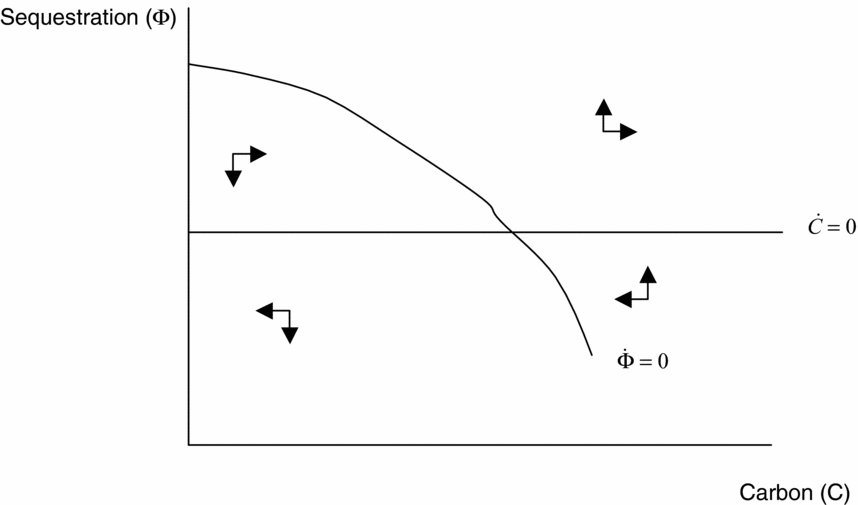
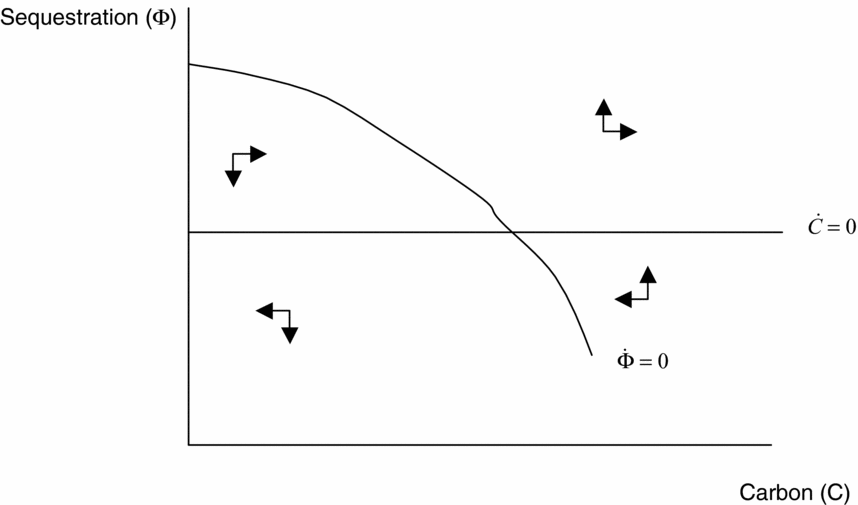
Figure 1 contains a phase-plane diagram, which illustrates the path dynamics. The carbon isocline indicates that sequestration is independent of carbon levels. Determining the slope of the sequestration isocline requires an additional assumption. When the weather sensitivity function, g, is not too convex, sequestration levels are more likely to be decreasing in carbon levels along the sequestration isocline, thus suggesting a downward-sloping isocline.Footnote 9 In terms of the directionals in each isosector, it is clear that  , but the sign of
 is less clear. As such, we need to make an additional curvature assumption – that our agricultural production function is not excessively concave.Footnote 10 Under these conditions, the directionals are as drawn in figure 1 and the steady-state equilibrium (Φ*, C *)is a saddle point defined by convergent isosectors II and IV and divergent isosectors I and III. All points in isosectors II and IV will converge to the steady-state solution as t → ∞. Rather intuitively, when soil carbon levels are initially low, the shadow value of soil carbon is high, since small increases in carbon can lead to large economic benefits, leading farmers to engage in high levels of carbon sequestration. When soil carbon levels are initially high, the marginal benefit of adding more carbon is low – the shadow value is low – so farmers engage in low levels of sequestration. Our restrictions on the second derivatives of f and g are important to ensure that the rate of change in these marginal benefits is not sufficiently large that individuals will defect from the convergent path as they approach the steady-state equilibrium from either above or below.
Phase-plane diagram in sequestration-carbon space
The steady-state solution corresponds to the case where  . Thus, setting (6) and (7) equal to 0 and combining provides a concise expression describing the steady-state equilibrium

In steady-state equilibrium, the discount rate is equal to the marginal utility gained from an additional unit of carbon (which includes benefits from carbon payments as well as agricultural yield impacts) times the marginal productivity of sequestration in producing soil carbon divided by the marginal disutility from engaging in sequestration, i.e. the costs of sequestration. In other words, the opportunity cost of capital equals the economic return on sequestration – a result frequently referred to as the Golden Rule of Capital Accumulation. If this were not true, farmers could reallocate their portfolio of activities and increase their utility.
Comparative statics and implications for the poor
For simplicity, let U denote EU(π) as defined by equation (2), with UC representing the productivity effect and U Φ representing the technology effect from sequestration. Consider first the marginal effect of changing the price per unit of carbon sequestered. Totally differentiating (8) and applying the implicit function theorem yields
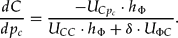
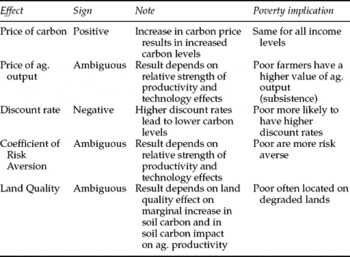
The denominator of this expression can be manipulated such that its sign depends on whether the elasticity of the marginal benefit from an additional unit of soil carbon is larger or smaller than the elasticity of the marginal cost of sequestration on the marginal benefit from an additional unit of soil carbon per unit of sequestration. The second-order restrictions on the maximization problem ensure that this expression will be negative for all interior solutions. Thus, the latter effect is larger than the former. The bracketed expression in the numerator is clearly positive, thereby making the sign of (9) positive. Rather intuitively, increases in the price of carbon yield higher levels of soil carbon sequestration. Assuming that all agents will be offered the same carbon payment, this effect should affect rich and poor farmers in a similar manner.
Now, consider the marginal effect of changing the price of agricultural output on equilibrium carbon sequestration levels. Again, totally differentiating (8) and applying the implicit function theorem yields

As in (9) above, the sign of the denominator is negative. The sign of the numerator is ambiguous. Higher output prices make the augmentation of soil carbon more attractive because it increases agricultural yield and decreases long-term yield volatility, but less attractive because the sequestration activities that must be undertaken to increase soil carbon levels increase short-term yield volatility. The ultimate impact of an increase in agricultural output prices on equilibrium soil carbon levels will depend on the magnitude of the positive ‘productivity’ effect relative to the magnitude of the negative ‘technology’ effect. The discount rate also plays an important role, as the technology effect occurs at the moment that sequestration activities are altered, while yield impacts accrue over time.
Earlier, we stated that the assumption of a fixed market price for agricultural output was equivalent to assuming that food production levels always exceed the subsistence demands for the household. If, as we might expect, this assumption is not true for poor farmers, then it must be true that the value that they place on agricultural output is higher than the market price. Otherwise, they would be selling at least some fraction of their output in the market.Footnote 11 Thus, we can think of the poor farmer as one who implicitly faces a higher price for (i.e. places a higher value on) agricultural output. The implications of this for equilibrium soil carbon levels will depend on the sign of (10). If, ceteris paribus, the yield effect prevails, poor farmers will sequester more carbon than wealthier farmers. If the technology effect dominates, poor farmers will sequester less carbon.
We can also examine the impact of the discount rate on equilibrium soil carbon levels. This impact can be characterized as follows
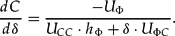
The denominator, as before, is negative and the numerator is positive. Increases in the discount rate unambiguously decrease the amount of carbon sequestered in the soil. This result is rather intuitive as the negative impacts from disturbing the agricultural ecosystem – the technology effect – accrue in the short term while the positive benefits from an increase in agricultural yield and a decrease in yield volatility accrue over a longer time horizon. If discount rates are decreasing in wealth (Lawrance, Reference Lawrance1991; Ogaki and Atkeson, Reference Ogaki and Atkeson1997), then poor farmers will sequester less carbon than rich ones. In our setting, these high discount rates among the poor could be motivated by a host of factors, including credit constraints, insecure land tenure, or shortened planning horizons due to survival concerns.Footnote 12
Next, we consider the impact of a marginal change in the coefficient of risk aversion on equilibrium soil carbon levels. Again, totally differentiating (8) and applying the implicit function theorem yields

The denominator is negative and the sign of the numerator is ambiguous. As for the impact of agricultural output prices, increase in the degree to which a farmer is risk averse has two opposing effects. Increasing soil carbon levels becomes more attractive due to the long-term benefits associated with decreased yield volatility. On the other hand, the sequestration activities that must be undertaken to increase soil carbon levels increase volatility in the short-run, creating a disincentive to sequester for more risk-averse farmers. In general, risk aversion is assumed to decrease with wealth (Hennesey, Reference Hennessy1997; Bar-Shira et al., Reference Bar-Shira, Just and Zilberman1997). Thus, poor farmers will tend to sequester more carbon than wealthier farmers when the soil carbon effect on volatility dominates the sequestration activity effect on volatility. When the technology effect dominates, poor farmers will sequester less. Again, the discount rate will play an important role, as the timing of these two effects is not the same.
Finally, we can examine the impact of land quality on equilibrium soil carbon levels. This impact can be characterized as follows

Changes in land quality will have an ambiguous impact on equilibrium soil carbon levels. The impact depends fundamentally on how the marginal benefit from an additional unit of soil carbon changes with land quality and on how the marginal benefit from additional sequestration activities changes with land quality, fS, fCS, gS, gCS as embodied in UCS and U ΦS versus h ΦS, respectively. The literature seems to suggest that both of these functions are increasing at low levels of land quality and decreasing at high levels (Antle, Reference Antle2002). In other words, as one moves from low quality land to slightly improved land, the marginal benefit from soil carbon increases, as does the marginal productivity of sequestration activities. As one moves from high quality land to even higher quality land, the marginal benefit from an additional unit of soil carbon is declining, as is the marginal productivity of sequestration activities. A graphical representation of these marginal impacts with land quality on the x-axis would reveal an s-shaped curve, revealing increasing returns to scale at low levels of soil quality and decreasing returns to scale at high levels of soil quality.
Given these relationships, it is straightforward to verify that at low levels of land quality, improvements in land quality will yield higher levels of soil carbon sequestration. At very high levels of land quality, improvements in land quality yield sufficiently small impacts on agricultural yields and the productivity of sequestration activities (i.e. sufficiently negative marginal impacts) so as to decrease equilibrium levels of soil carbon. At intermediate land quality levels, improvements in land quality will again yield higher levels of soil carbon sequestration, albeit with an impact not nearly as large as that for farmers on low quality land. The implications of these results for the poor depend on the types of lands that the poor tend to inhabit. Those who live on land of intermediate quality will sequester the most carbon. Those on very low or very high quality lands will sequester the least. A negative relationship between poverty and land quality is frequently found in micro-level empirical studies (Lipper, Reference Lipper2001). Except in cases of extremely poor land quality, poor producers are thus likely to be on lands suitable for soil carbon sequestration.
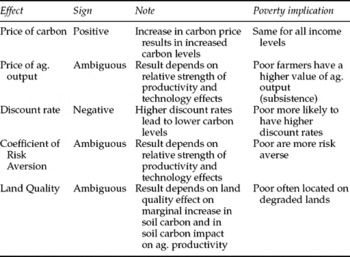
The results of the comparative static analysis and their implications for the participation of poor agricultural producers in the adoption of soil carbon sequestering land use practices are summarized in table 2.
Summary of comparative statics on equilibrium carbon levels
4. Discussion: poverty, risk, and soil carbon sequestration supply
Our analysis has indicated that under current market conditions the returns to soil carbon sequestration  are likely to be small, due to a combination of low prices for emission reduction credits as well as low sequestration productivity rates from soil carbon. Using the indicative numbers presented in section 2, assuming that a farmer could sequester between 0.37 to 3.7 metric tons of carbon dioxide equivalent per hectare per year, and they receive a price somewhere between $3 and $4/metric ton, returns to soil carbon may range anywhere from $0.90 to almost $15 per hectare, per year. In many cases this is likely to be only a small fraction of income from the land. Indeed, one study from Senegal estimated the returns to soil carbon sequestration to lie somewhere between 0.2 and 4 per cent of household income (FAO, 2004a). Thus, the presence of agricultural co-benefits is likely to be an important determinant of the supply response of poor farmers to payments for soil carbon sequestration.
Low returns to soil carbon sequestration per hectare also call into question the efficiency of individual payments. Reaching small farmers with carbon payments entails high per unit transactions costs, reducing the already low returns to soil carbon. Designing group-based schemes where payments are used to overcome the barriers to the adoption of farming systems, such as conservation agriculture, that generate both sequestration and agricultural benefits may be a more effective way of using carbon funds in this situation.
The results from the household model give insight to the critical determinants of conservation agriculture adoption – and the potential barriers to the poor. They indicate that higher carbon prices and lower discount rates unambiguously increase the supply of soil carbon sequestration. They also indicate that the relative strength of what we have called the ‘technology’ and ‘productivity’ effects of adopting conservation agriculture is the key determinant of the impacts of changes in agricultural output prices, risk aversion, and land quality on the decision to adopt conservation agriculture and supply soil carbon sequestration. Enhancing the strength of the productivity effect, and, in particular for poor producers, reducing the negative impacts of the technology effect are critical to induce the adoption of conservation agriculture and the supply of soil carbon sequestration.
The productivity effect is an outcome of biophysical relationships between various components of conservation agriculture technology interacting with the soil and agro-ecosystem. Identifying the biophysical conditions where increasing soil carbon is most likely to generate improvements in agricultural productivity and stabilization of crop yields and using it to target activities is one way to increase the productivity effect.
The negative impacts of the technology effect on adoption stem from the possibility of higher yield volatility during a transition phase. This volatility can be expected to have a strong negative impact on the adoption behavior of the poor, who generally have higher levels of risk aversion, as well as higher discount rates. Our analysis suggests that fixed payments for soil carbon sequestration – while insufficient to stimulate conservation agriculture adoption in the absence of agricultural co-benefits – could induce some farmers to supply carbon by reducing the costs of adopting the new system. An annual payment alone, however, will be insufficient to achieve optimal sequestration as the agricultural productivity risk associated with transitioning to conservation agriculture will inhibit poor farmers from participating in the carbon market. Structuring carbon payments to provide insurance against yield volatility for adopters, particularly during the transition phase, could induce poor farmers to participate. Optimality would require both insurance against the productivity risk as well as an annual carbon payment equal to the external benefits from sequestration. Of course structuring insurance contracts is not simple and problems with moral hazard and adverse selection can significantly compromise the effectiveness of insurance schemes (Skees et al., Reference Skees, Hazell and Miranda1999; McCarthy, Reference McCarthy2005).
Reducing the uncertainty associated with the transition to new agricultural system by improved information transmission can also foster adoption (Antle and Crissman, 1990). While some portion of the uncertainty may be unavoidable, better information about the generally more sophisticated farm management requirements for conservation agriculture systems could reduce the range of potential yield realizations (Hobbs, Reference Hobbs2007). Thus, using payments for soil carbon sequestration to fund an effective extension system to improve farm level management capacity can be another important means of removing barriers to the adoption of technology that generates positive social and private benefits.
The analysis presented here indicates that payments for soil carbon sequestration are unlikely to be sufficient to induce changes in farmers’ practices in developing countries that do not involve positive agricultural co-benefits. A potentially important option is the adoption of conservation agriculture, which has been shown to generate both improved agricultural productivity as well as soil carbon sequestration. Payments for soil carbon sequestration services can help in overcoming barriers to the adoption of this technology. Risk and uncertainty is a major barrier facing many farmers, particularly the poor, in adopting conservation agriculture. Our results suggest that pooling soil carbon sequestration payments and devising other group schemes to help farmers share risk offer the potential of providing an effective way of stimulating agricultural development and poverty reduction through climate change mitigation initiatives.