1 Introduction
Epistemic complement-taking phrases are subject + verb constructions like I suppose in (1) that introduce a complement clause and provide information about the speaker's degree of commitment to an utterance (Thompson & Mulac Reference Thompson, Mulac, Traugott and Heine1991b; Thompson Reference Thompson2002; Kärkkäinen Reference Kärkkäinen2003):
(1) I suppose that you tell a good story, a good version of yourself. (S1B-001(A):291)Footnote 2
Central to these constructions is a departure from the verb's original meaning of, for example, cognition (2) to an encoding of epistemic, evidential and evaluative meanings. In this study we explore what – loosely in line with Thompson (Reference Thompson2002), Boye & Harder (Reference Boye and Harder2007) and Brinton (Reference Brinton2008: 220) – we term e/e complement-taking predicate phrases (e/e ctps); that is, constructions including subject + verb combinations where the e/e verb (e.g. believe, feel, guess, suppose) can supply epistemic and evidential information to the utterance (3–6).
(2) Can you think of something . . . that would be non-concrete that isn't an emotional state? (S1B-020(A):22)
(3) I think they're very unrealistic standards. (S1A-010(A):297)
(4) Yeah, well, I feel strongly that linguistics has a lot to offer the world and I tell you, um, that, yeah, that language is about how people see the world. (S1A-097(B):305)
(5) I believe he started wandering in Glebe which is fairly hip nowadays in a sort of Balmain kind of way. (S1A-099(B):128)
(6) About five chocolates. Oh, Joy reckons they're the best chocolates she's ever eaten. (S1A-009(A):45)
Frequently used e/e ctps have undergone a process of conventionalisation (variably viewed as grammaticalisation or pragmaticalisation; see section 2.2), whereby the subject + e/e verb constructions have been reanalysed by speakers as formulaic stance markers that can introduce an embedded clause without the complementiser that (Thompson & Mulac Reference Thompson, Mulac, Traugott and Heine1991b, Reference Thompson and Mulac1991a; Aijmer Reference Aijmer, Swan and Westvik1997; Diessel & Tomasello Reference Diessel and Tomasello2001: 111; Thompson Reference Thompson2002; Torres Cacoullos & Walker Reference Torres Cacoullos and Walker2009; Kaltenböck Reference Kaltenböck, Aarts, Close, Leech and Wallis2013). The most frequently used of these formulaic e/e ctps – consistently I think across regional and historical varieties of English – have grammaticalised further, to act like epistemic markers in other languages.Footnote 3 This is demonstrated by their ability to occur in a syntactically parenthetical location in an utterance, as ‘epistemic parentheticals’ (Thompson & Mulac Reference Thompson, Mulac, Traugott and Heine1991b: 317).Footnote 4 Consider examples (7) to (9):
(7) So we got video of that and we've got I think some of New Zealand. (S1A-013(B):315)
(8) He's going to Hong Kong, I think. (S1A-010(B):40)
(9) We're just shit lucky, I guess. (S1A-077(B):235)
The generalisation of meaning from mental processes (e.g. calculation) to epistemicity is also attested for reckon. Originally meaning ‘to count’ and – by extension – ‘to estimate’ (10), the meaning of reckon firstly became ‘more intellectual’ (akin to ‘judge/consider’), then generalised to express an attitude or viewpoint and finally began to encode modality, indicating the degree of the speaker's commitment to the utterance (Burridge Reference Burridge and Enfield2002: 225), as in (11).Footnote 5
(10) Motion around the epicycle was reckoned by the ancients as angular departure of the radius of the epicycle to the planet from an extension of the radius joining the centre of the deferent to the centre of the epicycle. (J07 1649)
(11) I reckon they'll win, there's no doubt about that. (S1A-006(A):2)
Along with think, believe and guess, reckon is often mentioned in the literature as the most widely used e/e complement-taking predicate across varieties of English (Van Bogaert Reference Van Bogaert2010: 415; Kaltenböck Reference Kaltenböck, Aarts, Close, Leech and Wallis2013: 290). However – with the exception of Wierzbicka's (Reference Wierzbicka2003: 43) observations – the Australian English (AusE) use of reckon as a stance marker has hitherto avoided attention in the peer-reviewed literature. Yet the contexts in which it appears can be related to those of think, guess and suppose. In Burridge's words (Reference Burridge and Enfield2002: 225): ‘Parenthetical I reckon can be compared with epistemic particles like maybe and epistemic phrases like I think and I guess’ (also see Mullan Reference Mullan2010: 51). The parallel discourse functions of I think and I reckon – used by the same speaker consecutively in a single conversational turn in what Tagliamonte (Reference Tagliamonte2006: 96) deems a ‘super-token’ – are illustrated in (12).
(12) Well, it's what I reckon so it's what I think! (UWA Corpus of English in Australia)
The question remains whether the empirical data support the contention that AusE reckon is comparable (in meaning, structure and use) to think and suppose. Beyond Australia, reckon (meaning ‘to guess’ or ‘to suppose’) is fairly frequent in British English (Van Bogaert Reference Van Bogaert2010: 402) and is listed as used by the Lumbee Indians in Southern North Carolina (and ascribed to Southern United States usage in general) (Dannenberg, Locklear, Schilling-Estes & Wolfram Reference Dannenberg, Locklear, Schilling-Estes and Wolfram1996). Reckon's colloquial character, together with its rather negative social evaluation (e.g. Wierzbicka Reference Wierzbicka1985: 161 labels it ‘working class’; Cappelli Reference Cappelli2007: 274 and 276 deems it ‘low-class’ and ‘regional’), is likely to have contributed to its virtual absence in the published research on AusE e/e verbs. However, as Cappelli (Reference Cappelli2007: 273) puts it, ‘in certain cases, reckon is construed in a similar way to think, guess or suppose’ giving rise to semantic overlap and making it a worthy contender in the system.
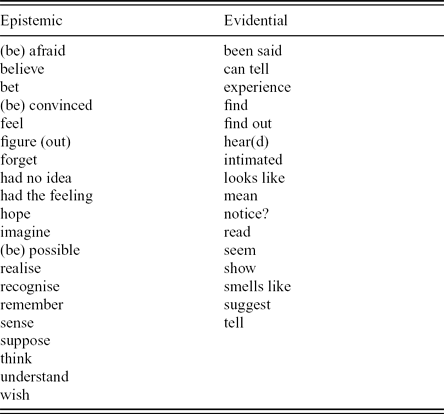
Epistemic and evidential complement-taking predicates (adapted from Thompson Reference Thompson2002: 138)

This article offers the first systematic, quantitative analysis of epistemic/evidential verbs in AusE. Our aim is to establish whether the distributional tendencies noted for other varieties of English (e.g. the pre-eminence of think) can also be attested for AusE. Moreover, we explore whether AusE epistemic/evidential constructions have grammaticalised to the same degree as noted for other Englishes around the world.
2 Variation and change in English complement clauses
2.1 The main contenders
Thompson & Mulac's (Reference Thompson and Mulac1991a, Reference Thompson, Mulac, Traugott and Heine1991b) pioneering study of epistemic phrases in (American) English focused exclusively on think and guess and their structural behaviour as epistemic verbs. Thompson (Reference Thompson2002) later expanded her analysis to include other epistemic, evidential and evaluative ctps in order to account for the types of occurrences noted in ‘the English adult data’ (2002: 143), in line with Diessel & Tomasello's (Reference Diessel and Tomasello2001) research on ctp acquisition by young children. Regardless of their shared semantic content, the e/e complement-taking predicates analysed by Thompson (Reference Thompson2002) differ in their overall frequency of occurrence. For example, think (and guess) are the most widely used epistemic phrases in Thompson & Mulac's (Reference Thompson, Mulac, Traugott and Heine1991b: 320) corpus of conversational American English, with no other epistemic parenthetical verb used more than three times in their data. Table 1 reproduces – in reduced form – Thompson's (Reference Thompson2002: 138) list of proposed e/e complement-taking predicates. When e/e complement-taking predicates are combined with a subject, we refer to these as e/e complement-taking predicate phrases (e/e ctps). Evaluative complement-taking predicates and the construction wonder Q (as in I wonder whether we'll meet again) are not included in table 1 given our focus (but see Thompson Reference Thompson2002: 138 for a list of these). Note that reckon does not feature in Thompson's (Reference Thompson2002) table.
With regard to Thompson & Mulac's (Reference Thompson, Mulac, Traugott and Heine1991b: 320) findings, the question remains as to which of the e/e complement-taking predicates listed in table 1 are especially prominent in AusE and what their grammatical conditioning is. We return to this issue in section 3.
2.2 Grammaticalisation, subjectification, pragmaticalisation
In line with the claim that language change is crucially influenced by general frequency effects (Hook Reference Hook, Traugott and Heine1991; Thompson & Mulac Reference Thompson, Mulac, Traugott and Heine1991b: 317; Bybee & Thompson Reference Bybee and Thompson1997), we propose that the e/e ctps that occur most frequently without complementiser that may be reanalysed by speakers as epistemic phrases and have gained syntactic freedom such that they can now occur in other positions, just like epistemic adverbs (e.g. maybe and perhaps) do in English (Kearns Reference Kearns2007: 476).Footnote 6 As noted earlier, Thompson (Reference Thompson2002) refers to these constructions as epistemic parentheticals.
The grammaticalisation of e/e ctps into formulaic epistemic/evidential (e/e) parentheticals exhibits the following principal features (Thompson & Mulac Reference Thompson, Mulac, Traugott and Heine1991b; Diessel & Tomasello Reference Diessel and Tomasello2001: 106–7):Footnote 7
i. e/e parentheticals are short and formulaic (indicating they are stored as holistic expressions).
ii. The subject of e/e parentheticals is either unexpressed or is a first- or second-person pronoun.
iii. The main clause verb is in the present indicative active.
iv. That complementiser is absent as the embedded clause is non-embedded (formally and conceptually).
v. The order of the e/e parenthetical is variable: it may occur initially, medially or finally.
Grammaticalisation plays a key role in the study of e/e ctps as it accounts for the shift from lexical to grammatical function, while at the same time allowing for the retention of the semantics of the previous lexical meaning that gives rise to layering (Heine, Claudi & Hünnemeyer Reference Heine, Claudi and Hünnemeyer1991: 20; Lichtenberk Reference Lichtenberk, Traugott and Heine1991: 37; Bybee, Perkins & Pagliuca Reference Bybee, Perkins and Pagliuca1994: 21; Hopper & Traugott Reference Hopper and Traugott2003: 124). Here, we understand grammaticalization as ‘the process by which a frequently-used sequence of words or morphemes becomes automated as a single processing unit’ (Bybee Reference Bybee, Joseph and Landa2003: 603). Moreover, the grammaticalization process may include a move from objective to subjective meanings, as has been proposed for the development of epistemic parentheticals. Previous research has explored the development of constructions such as I think into encoders of epistemic stance (Thompson & Mulac Reference Thompson, Mulac, Traugott and Heine1991b; Traugott Reference Traugott, Stein and Wright1995: 38–9) in an attempt to understand how modality and subjectification work in grammaticalisation. Perhaps the clearest explanation for this process has been offered by Traugott (Reference Traugott, Stein and Wright1995: 32), who claims that:
Subjectification in grammaticalisation is . . . the development of a grammatically identifiable expression of speaker belief or speaker attitude to what is said. It is a gradient phenomenon, whereby forms and constructions that at first express primarily concrete, lexical and objective meanings come through repeated use in local syntactic contexts to serve increasingly abstract, pragmatic, interpersonal, and speaker-based functions.
The evolution of meaning from a source gram expressing cognition (e.g. think) or calculation (e.g. reckon) to the encoding of epistemicity and evidentiality illustrates the shift from the concrete, lexical and objective to the abstract, pragmatic, interpersonal and subjective. Indeed, Traugott (Reference Traugott, Stein and Wright1995: 48) outlines six processes germane to subjectification, four of which are relevant to our analysis. These highlight a move from: (1) propositional function to discourse function; (2) objective meaning to subjective meaning; (3) non-epistemic modality to epistemic modality; and (4) syntactic subject to speaking subject (see below).
The development of e/e ctps into e/e parentheticals is also understood as an instance of pragmaticalisation or pragmaticisation. For example, Aijmer (Reference Aijmer, Swan and Westvik1997: 2) argues that ‘discourse markers such as you know, you see, etc., are typically “pragmaticalized” since they involve the speaker's attitude to the hearer’. The emergence of the conventionalised phrase I think as a ‘modal particle’ is characterised by Aijmer (Reference Aijmer, Swan and Westvik1997: 7) as involving three stages. Stage 1 includes syntactically complex e/e ctps (e.g. I think that Bill is at home). In Stage 2, the complementiser that is omitted (e.g. I think Bill is at home), while in Stage 3 I think is used parenthetically (e.g. Bill is at home, I think). Importantly, as early as in Stage 1, think is bleached of its original meaning. This is exemplified by the fact that the tag question in I think Bill is at home, don't I? is unacceptable (Aijmer Reference Aijmer, Swan and Westvik1997: 8). This change is in line with one of Traugott's (Reference Traugott, Stein and Wright1995: 48) six subjectification processes; namely, the move from syntactic subject (I) to speaking subject (Bill) (cf. Halliday Reference Halliday2004: 626–30; Mullan Reference Mullan2010: 100).Footnote 8
Epistemic phrases are used to express the degree of speaker commitment to the proposition given in the remainder of the utterance (Thompson & Mulac Reference Thompson, Mulac, Traugott and Heine1991b; Kärkkäinen Reference Kärkkäinen2003). Cappelli (Reference Cappelli2007: 9) suggests that the verbs in these epistemic phrases are most regularly referred to in the literature as ‘verbs of belief’, ‘epistemic verbs’, ‘verbs of thinking’, ‘cognitive verbs’, ‘attitude predicates’ or ‘predicates of propositional attitude’. Thompson (Reference Thompson2002) widens the semantic scope of constructions occurring readily without that suggesting that these are formulaic fragments of an e/e nature used by speakers to express their stance towards the content of an embedded clause. Of particular importance to the current study, Thompson (Reference Thompson2002: 137) states that, while there is an ‘overwhelming skewing in favor of epistemic meanings’, there is a high probability that ctps will alternatively perform an evidential function. As we show in section 4, this division of labour is most clearly present in ctps with reckon.
Bearing in mind that the current study is the first one of its kind for AusE, our analysis is twofold. We firstly examine the system of verbs encoding e/e nuances in AusE in an attempt to explore how the most frequent e/e ctps pattern vis-à-vis linguistic factors (section 3). Secondly, we explore the linguistic factors constraining the use of the most frequent first-person e/e ctps in AusE (e.g. I think, I believe, I guess, I suppose, I reckon) so as to establish their degree of grammaticalisation (section 4). Along with testing whether the usage patterns for the most frequent e/e ctps in varieties of English – including American English think and guess (Thompson & Mulac Reference Thompson, Mulac, Traugott and Heine1991b) – echo those of AusE e/e ctps, we attempt to establish if AusE reckon – a hitherto unexplored e/e verb – can be identified by the same patterns of grammaticalisation found in studies of other e/e ctps. We empirically test the extent to which the most frequent first-person e/e ctps have grammaticalised into e/e parentheticals.
3 e/e verbs in AusE: a variationist approach
3.1 Data
The data used are transcribed educated AusE speech stemming from the spoken portion of the International Corpus of English – Australia (ICE-AUS). The ICE-AUS is a one-million-word component of the International Corpus of English and contains 500 samples of 2,000 words each, including 200 of spoken language and 300 of written language collected between 1991 and 1995 at Macquarie University, in Sydney, Australia. The spoken section of the ICE-AUS on which our analysis is based contains speech of varying degrees of formality, including ‘public’ and ‘private’ dialogue and monologue. We consider all four types in our analysis.
3.2 Variable context
A crucial step in conducting variationist analysis is that of ‘circumscribing the variable context’ (Poplack & Tagliamonte Reference Poplack and Tagliamonte1989: 60); that is, determining where the linguistic variable actually varies (Tagliamonte Reference Tagliamonte2012: 10). Patterns in the data are viewed as parallel occurrences and these occurrences may be defined with respect to formal or functional criteria. In this study, we formally define two main variable contexts.
Firstly, to empirically establish the overall distribution and linguistic factors constraining the occurrence of the most frequent e/e ctps in the corpus, we explore finite, indicative, active, declarative and interrogative, that or zero-marked complements of main clause present- and past-tense e/e verbs preceded by a lexical or pronominal subject in the first, second or third person singular and plural. Consider the examples in (13a–d):
- (13)
(a) Don't you think people just take nature for granted? (S1A-090(A):79)
(b) Ian reckons that we prob'ly need at least a dozen holes from which a certain percentage have water. (S1b-073(A):180)
(c) I came out all my all my shirts like shrunk because I didn't realise that drying certain things would make them shrink. (S1A-030(A):277)
(d) Oh goodo, oh it's really funny because this lady Helen she's about I don't know seventy and um she feels that it's her it's her duty to be on the door every night but um yeah it can be a bit of a nuisance sometimes. (S1A-074(A):125)
Secondly, to determine the degree to which the most frequent e/e verbs have grammaticalised in AusE, we define our variable context as finite, indicative, active, declarative, that or zero-marked complements of main clause present-tense e/e verbs preceded by a pronominal subject in the first person singular, as in (14a-e).
- (14)
(a) Well I guess they come in all shapes and sizes. (S1A-081(A):142)
(b) I will do an hour's work I think. (S1A-018(A):284)
(c) And I believe that today we are on the verge of a breakthrough in the Medicare negotiations. (S2B-004(D):49)Footnote 9
(d) Well obviously from my position I hope the computer's a hundred percent correct tonight. (S1B-032(D):40)
(e) Well I reckon out here needs painting first. (S1A-049(A):196)
The latter variable context is (formally) defined so as to include what previous research has labelled related expressions or a whole class of complement-taking mental predicates including I think, I suppose, I imagine and the like (Van Bogaert Reference Van Bogaert2010). Importantly, recent (corpus-based) investigation has also focused on variation within specific categories of what are variously called complement-taking mental verbs or comment clauses such as I would think, I should have imagined, I just think, I'm thinking, among others (Van Bogaert Reference Van Bogaert2010; Kaltenböck Reference Kaltenböck, Aarts, Close, Leech and Wallis2013). Here, we focus on variation across different types of first-person e/e ctps (at the Meso level in Van Bogaert Reference Van Bogaert2010: 419) but acknowledge that future variationist research will need to explore patterns of variation within each of the most widely explored categories of epistemic verbs, including – among others – variants of I think, I guess and I reckon.
3.3 Exclusions
Our extraction of relevant e/e ctps from the spoken portion of the International Corpus of English – Australia (ICE-AUS) was in line with the variable contexts circumscribed above. For the purposes of the multivariate analysis, we excluded e/e ctps in combination with auxiliaries such as seem (15), instances where the subject of the e/e verb could not be determined (16a-b) and tokens where the complement introduced by the e/e verb was incomplete (17) or absent (18). Also excluded were quotative uses of think (19) as these show retention of the original semantics of cogitation (cf. Aijmer Reference Aijmer, Swan and Westvik1997: 12) and are always introduced by zero complementiser.Footnote 10
(15) I seem to think it was too. (S1A-006(B):44)
- (16)
(a) Reckon we could all live in one room? (P13:2373)
(b) See I don't finish uni ’til five. (S1A-009(B):303)
(17) And I don't find that the– (S1A-092(A):108)
(18) I reckon. (S1A-020(B):451)
(19) I mean I had a really good time and we were just like partied all the time and stuff but it was just towards the end of the week I thought, ‘I'm ready to go home now. I wanna see my Mum and Dad’. (S1A-037(A):120)
3.4 Coding of tokens
Irrespective of decisions made before the relevant statistical analyses presented in sections 4 and 5, all extracted tokens were coded in line with the linguistic factors outlined below. An explanation of the factor groups ultimately included in the multivariate analyses is offered in sections 4.2 and 5.2.
3.4.1 Grammatical person
In (American) English the majority of e/e ctps occur with first-person subjects (Thompson Reference Thompson2002; Hundt & Szmrecsanyi Reference Hundt and Szmrecsanyi2012). Thompson (Reference Thompson2002: 138) interprets this as suggesting that the primary function of e/e ctps in adult conversation is ‘to frame a clause in subjective epistemic terms’. This subjectivity then becomes a driving force in the grammaticalisation of e/e ctps into e/e parentheticals. To empirically establish the distribution and patterning of first-, second- and third-person subjects with epistemic/evidential complement-taking predicates in AusE, we firstly extract and analyse all e/e ctps, regardless of subject person, focusing specifically on first-person subjects in the second portion of the analysis (see section 5).
3.4.2 Subject type
Pronominal first-person subjects constitute a crucial component of grammaticalised e/e parentheticals. However, to empirically determine how AusE e/e ctps pattern in relation to different subject types, we firstly analyse both pronominal and lexical subjects, focusing on (first-person) pronominal subjects in the latter part of our treatment (see section 5).
- (20)
(a) We believe that the scheme's working and I'll talk a bit more about how we evaluated it a couple of years ago. (S2A-043(A):73)
(b) Many couplesfind that the cost of fighting over who gets what in the courts is far too high both emotionally and financially. (S2B-040(G):267)
3.4.3 Polarity and construction type
Accounting for how polarity and construction type interact with e/e ctps is important in that it allows for the establishment of the degree of speaker commitment and/or certainty. As Israel (Reference Israel, Horn and Ward2004: 709) puts it: ‘Neg-raised sentences (such as I don't think you should do that) are typically felt as weaker and more tentative than their otherwise synonymous counterparts with lower clause negation (I think you shouldn't do that), and the phenomenon appears to be motivated in large part by the need to hedge or mitigate the expression of a negative judgement.’ Torres Caucollos & Walker (Reference Torres Cacoullos and Walker2009: 25) point out that negation in the main clause correlates highly with five verbs in their study, three of which are e/e verbs: believe, find and think. We extract and analyse e/e ctps of differing polarity and construction types, exemplified in (21a-d).
- (21)
(a) Positive polarity
Well, current estimates suggest that by 2001 Australia's foreign debt could be around four hundred billion dollars. (S1B-033:86)
(b) Negative polarity
My mum doesn't think you're quite that nice. (S1A-018(B):310)
(c) Interrogative construction
And how much do you reckon you would have lost? (S2b-028(A):111)
(d) Negative polarity in interrogative construction
Oh the on the actual day of the service don't ya reckon we'll be just so busy trying to get them all confident for the ten fifteen service? (S1A-077(B):257)
3.4.4 Syntactic position
Determining whether e/e ctps occur clause-initially or in non-initial position is essential in establishing their degree of grammaticalisation. The looser the syntactic behaviour of e/e ctps, the more grammaticalised they are (Thompson & Mulac Reference Thompson, Mulac, Traugott and Heine1991b; Diessel & Tomasello Reference Diessel and Tomasello2001: 106–7). We extract and code e/e ctps located clause-initially, clause-medially and clause-finally (22a-c).Footnote 11
- (22)
(a) I don't know the relationship but I believe that's correct. (S1B-069(B):169)
(b) This is where the gold and silver, I feel, will be handed out. (S2A-001(A):35)
(c) Well, he seemed as if he was a little bit down, I suppose. (S1A-049(B):17)
3.4.5 Presence/absence of complementiser that
The presence or absence of complementiser that also plays a crucial role in the grammaticalisation of e/e ctps: the reanalysis of main subject + verb construction as a unitary e/e parenthetical is strongly concomitant with the absence of that (Thompson & Mulac Reference Thompson and Mulac1991a: 242 and 249). Indeed, Thompson & Mulac (Reference Thompson and Mulac1991a: 244) show that think and guess (in the present tense) ‘occur significantly more frequently [at 91% and 99%, respectively] without that than any other verb in the database’. The authors attribute this to the ‘mild degree of speaker commitment’ expressed by think and guess and it is argued that ‘it is significant that the verbs occurring most frequently without that are epistemic’ (Thompson & Mulac Reference Thompson and Mulac1991a: 245). They further hypothesise that (i) ‘those subjects and verbs occurring most frequently without that are precisely those which occur most frequently as EPARs [Epistemic Parentheticals]’ and (ii) ‘the meanings of the verbs most frequently used as EPs [Epistemic Phrases; complement introducing epistemic phrases] are those associated with belief and mode of knowing’ (1991b: 317). Rates of that and zero complementiser also vary across English-speaking regions, with New Zealand and AusE favouring zero more often than American and British English (Kearns Reference Kearns2007). We extract and code all e/e ctps appearing with (23a) and without complementiser that (23b).
- (23)
(a) While locals are quick to tell you Bass Strait crayfish are the sweetest in the world, Tiger reckons that the harvest from the farms that edge the northern seashore is pretty good too. (S2B-031(D):232)
(b) But I know they'd been finding it a bit much because it was they work all year at least one night a week down in the room. (S1A-016(A):229)
3.4.6 Tense
The present tense is the unmarked form in the majority of the e/e ctps analysed across varieties of English (Van Herk Reference Van Herk2012: 294–5). However, highly frequent e/e parentheticals such as I think have expanded such that they are now in variation with related expressions including the past tense in constructions like I thought (Wierzbicka Reference Wierzbicka2006; Van Bogaert Reference Van Bogaert2010). To establish how tense patterns in relation to e/e ctps in AusE, we extract and code all e/e ctps for present and past tense, as in (24a) and (24b) respectively.Footnote 12
- (24)
(a) But using longer wavelengths infra-red the Milky Way looks like this and you notice that it's not so patchy. (S2A-055:146)
(b) With like the conversations that you two had when I was there I sort of figured out she was leaning toward like she wanted to be part of that group. (S1A-010(B):91).
3.4.7 Main clause adverbials
Torres Cacoullos & Walker (Reference Torres Cacoullos and Walker2009: 33) contend that adverbials in the main clause – specifically between the pronoun or NP subject and the verb – favour that occurrence (25a). As part of the second envelope of variation defined for this research we are interested in determining the extent to which AusE e/e ctps have grammaticalised. The absence of adverbials in the main clause – given the claimed relationship with that occurrence – will suggest a more formulaic nature for these constructions (25b).
- (25)
(a) You sat in on one or two of these groups and then came away absolutely convinced that you are ah hopelessly co-dependent yourself. (S1B-025(A):221)
(b) The industry is convinced international recognition of Australian quality will double the farm gate value of horticulture to six billion dollars by the year two thousand. (S2B-015(A):155)
4 The system of e/e ctps in AusE
4.1 Overall distribution
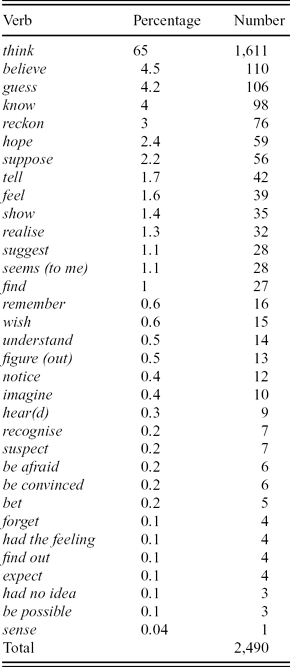
As a result of the exclusions outlined above (section 3.3), 2,490 tokens were analysed. Table 2 shows the overall usage frequency of all the e/e ctps considered. In addition to the forms presented in table 1, we also extracted and coded the e/e ctps expect and suspect, in line with previous research (e.g. Kaltenböck Reference Kaltenböck, Aarts, Close, Leech and Wallis2013).
Overall distribution of epistemic/evidential complement-taking predicates in the spoken portion of the ICE-AUS
The five most frequent epistemic/evidential complement-taking predicates in the corpus make up roughly 80% of the data, while the remaining 28 represent only 20% of the total tokens extracted. In AusE, variation in the expression of epistemicity and evidentiality via ctps is thus restricted to a cohort of frequently used forms, consisting of think, believe, guess, know and reckon. Unsurprisingly, think is by far the most widely used e/e verb, accounting for 65% (1,611/2,490) of the verbs in our data set and is only followed by believe which accounts for a much smaller portion of the data (4.5% [110/2,490]). The relatively high ranking of believe with respect to other e/e verbs in our AusE data set is in line with findings for British English, where believe is widespread, especially in formal contexts (Thompson & Mulac Reference Thompson and Mulac1991a: 245 footnote 10; Van Bogaert Reference Van Bogaert2006: 143; Kärkkäinen Reference Kärkkäinen, Kaltenböck, Mihatsch and Schneider2010: 212). However, this alignment with British English is unsupported with respect to guess and suppose. Our data show that guess – most frequent in American English where it is second only to think (Kärkkäinen Reference Kärkkäinen and Englebretson2007: 183) – is preferred over suppose, which is usually associated with informal British English speech (Van Bogaert Reference Van Bogaert2006: 143; Kärkkäinen Reference Kärkkäinen, Kaltenböck, Mihatsch and Schneider2010: 212). The difference between these two forms is notable, with guess occurring at 4.2% (106/2,490) and suppose lagging behind at 2.2% (56/2,490). Importantly, think, believe, guess and reckon are consistently mentioned in the literature as the most widely used e/e ctps across varieties of English, and these are semantically similar in expressing some degree of certainty towards the proposition at hand (while know expresses high commitment to the proposition). We thus focus on these four frequent e/e verbs for the multivariate analysis that ensues (section 4.2).
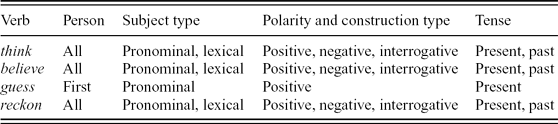
Before proceeding further, though, it needs to be determined whether – despite their relative higher frequency of use with respect to other e/e verbs in the corpus – think, believe, guess and reckon can be considered to vary to the same extent across the relevant linguistic contexts. Table 3 shows a breakdown of how these fare when different relevant linguistic factors are considered (see section 3.4). All observations are based on distributional trends gleaned from the data.
Distributional trends of think, believe, guess and reckon in the data set
Table 3 shows that think, believe and reckon vary identically when considered vis-à-vis the linguistic factors of grammatical person, subject type, polarity/construction type and tense. Ranked third in the relative usage frequencies presented in table 2, guess is nonetheless restricted in its occurrence: it only features with first-person pronominal subjects, in positive polarity contexts and with the present tense. Due to this invariance, multivariate analysis cannot be carried out with guess in the first stage of our treatment (but see section 5).
Based on the above considerations, the first portion of the multivariate analysis explores some of the linguistic constraints applicable to think, believe and reckon and within the first envelope of variation; that is, finite, indicative, active, declarative and interrogative, that- or zero-marked complements of main clause present- and past-tense e/e verbs preceded by a lexical or pronominal subject in the first, second or third person singular and plural. Only think and reckon appear in combined negative polarity and interrogative constructions, as in (26), and their usage frequency is low (1 reckon and 10 think tokens). For this reason, combined negative polarity and interrogative constructions tokens were re-coded together as ‘other’ for the purposes of the multivariate analysis presented in section 4.2 (see further below).
(26) Oh the on the actual day of the service don't ya reckon we'll be just so busy trying to get them all confident for the ten fifteen service? (S1A-077(B):257)
The aim of the first multivariate analysis using Goldvarb X (Sankoff, Tagliamonte & Smith Reference Tagliamonte and Smith2005) is to determine how think, believe and reckon generally behave when different linguistic variables are brought to bear.
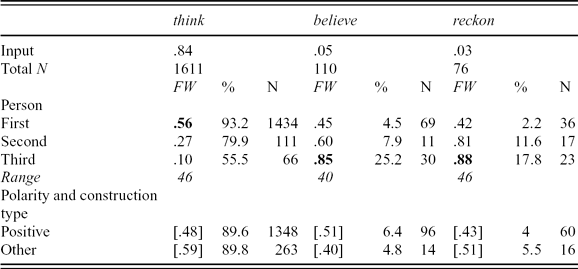
Contribution of grammatical factors to the use of think, believe and reckon in AusE (heaviest significant factor weights in bold; non-significant factors in square brackets)
4.2 Constraints on e/e ctps in AusE
Table 4 reports the results of three consistent variable rule analyses of the contribution of linguistic factors to the use of think, believe and reckon. Three lines of evidence (Poplack & Tagliamonte Reference Poplack and Tagliamonte2001: 92; Tagliamonte Reference Tagliamonte, Chambers, Trudgill and Schilling-Estes2002: 731) are essential in interpreting the results of a multivariate analysis: statistical significance (at p≤0.05), effect magnitude (i.e. which factor groups or independent variables display the largest/smallest range) and constraint hierarchy: ‘the hierarchy from more to less of the categories within a factor group’ (Tagliamonte Reference Tagliamonte2006: 237). The factor weights (FW in table 4) indicate the likelihood that think, believe and reckon will feature in a particular context: factor weights at and above .50 favour their occurrence while values below .50 do not.
A central requirement of variationist analysis is that factor groups be orthogonal; that is, that they occur freely rather than as subcategories of one another (Guy Reference Guy, Ferrara, Brown, Walters and Baugh1988: 126). However, a close look at the data analysed in this section reveals important interactions that ought to be accounted for. For example, first- and second-person subjects are never realised as full noun phrases and – with the exception of rhetorical questions of the type Do I believe that the Greens will win the election? (unattested in the corpus) – they are restricted to positive and negative polarity contexts. In fact, third-person subjects are the sole category showing variable behaviour in this domain (63% pronominal [75/119] versus 37% lexical [44/119]). Tense shows an important skewing in favour of the present tense, with the past tense representing a mere 1.4% (25/1,797) of the data. Given this, we are unable to test for subject type and tense with the current configuration but instead consider how AusE think, believe and reckon vary across grammatical person (including first, second and third grammatical subjects) and polarity/construction type. The results are presented in table 4.
Looking first at the input values for the three e/e verbs analysed, it is clear that think is by far the most frequent, with a corrected mean of .84. Believe and reckon are both dwarfed by think, with corrected means of .05 and .03, respectively. However, think's high input value is a consequence of the preponderance of first-person subjects occurring with this e/e verb. A run excluding first-person think tokens shows a much lower corrected mean of .65 for think. We deal with the relevance of first-person subjects in section 5.
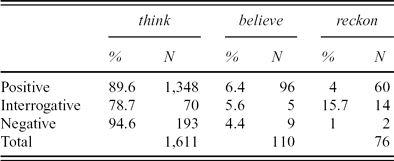
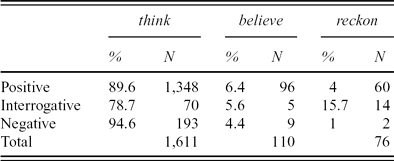
Think, believe and reckon are significantly constrained by grammatical person (p = 0.000) and the effect magnitudes for these three verbs are strikingly similar across statistical analyses (with ranges of 46, 40 and 46, respectively). Grammatical person is therefore a well-established linguistic constraint on the AusE e/e verbs analysed thus far. However, the constraint hierarchy within the grammatical person factor group itself sets think apart from the other two e/e verbs analysed. Whereas think is significantly favoured with first-person grammatical subjects, believe and reckon are preferred with third-person (.85 and .88) and – to a lesser extent – second-person subjects (.60 and .81). Polarity/construction type is not significant in this analysis but a look at the constraint hierarchy within this factor group reveals further crucial differences between think, believe and reckon. Specifically, while think and reckon are most strongly preferred in negative polarity contexts and interrogative constructions, believe is favoured with positive polarity. A detailed breakdown of the data configured vis-à-vis the categories of polarity and construction type appears in table 5.
Think, believe and reckon across polarity and construction types in AusE
Ginger Meggs by Chatfield (The West Australian, 24–25 March 2012, with permission from the author, ©Jason Chatfield)
Focusing our attention on think and reckon, the favouring effect of negative polarity (and the significant favouring effect of first-person subjects) on AusE think is related to the culturally appropriate need to mitigate the force of the proposition introduced by the verb. The favouring effect of first-person subjects and negative polarity on AusE think usage is squarely in line with Israel's (Reference Israel, Horn and Ward2004: 709) contention that ‘Neg-raised sentences are typically felt as weaker and more tentative than their otherwise synonymous counterparts with lower clause negation.’ Importantly, the favouring effect of negation on think usage is not unique to AusE: Torres Cacoullos & Walker (Reference Torres Cacoullos and Walker2009: 25) note that negation in the main clause correlates highly with epistemic think, believe and find in their Canadian English data, too.
Unlike think, reckon is favoured in interrogative polarity contexts and by third-person subjects, showing a pattern quite distinct from that of think. A cross-tabulation between grammatical person and polarity reveals important interactions between these factors: first-person reckon tokens occur in positive polarity contexts, second-person subjects correlate with interrogative constructions and third-person subjects categorically feature in positive polarity contexts (see figure 1). We deal with first-person occurrences later in section 5 and tackle third- and second-person reckon usage next.
The significant favouring effect of third-person subjects on reckon usage suggests that – among other functions – AusE reckon is deployed as a sort of hearsay evidential (cf. Kärkkäinen Reference Kärkkäinen2003: 37). This is illustrated in figure 1 from a cartoon called ‘Ginger Meggs’ featured in The Weekend West – the weekend issue of Perth-based daily The West Australian – on 24–25 March 2012. The cartoon depicts an overly excited Ginger Meggs arriving at Shark Bay beach and pre-empting any refusal to swim on the part of his friend Benny by saying ‘My friend Flynn told me about it’ before introducing an e/e verb headed by reckon with a third-person grammatical subject: ‘He reckons it's the best beach in Australia.’ The evidential nuance of reckon is clear in this example; Ginger Meggs knows that Shark Bay is indeed a great beach because he heard friend Flynn tell him about it. The use of reckon with a third-person grammatical subject allows Ginger Meggs to express Flynn's opinion. Leech & Svartvik (Reference Leech and Svartvik1994: 151) note that ‘there is a slight difference between “opinion” and “belief”: an opinion is usually something that someone arrives at on the basis of observation and judgement’. Anecdotally, native speakers of AusE report that think is used to express ‘certainty’ while reckon encodes ‘opinion’. The evidential value of AusE reckon relates strongly to its ability to refer to facts or viewpoints arrived at after some observation or, as in this case, in reporting someone else's words – where the words themselves act as the relevant evidence. A nuanced analysis of the evidential value of AusE reckon is beyond the scope of this article; further research is needed.
The findings presented thus far provide insights into the system of e/e verbs in AusE. However, the analysis masks variation within a tightly coherent system of first-person e/e ctps which have further grammaticalised in AusE to become pragmatically richer than the general system of e/e verbs in other Englishes. A more narrowly circumscribed context is described in the following section.
5 First-person e/e ctps in AusE
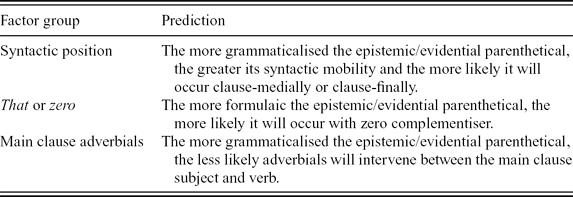
The second part of our analysis focuses on what we call first-person e/e ctps in order to determine the extent of I think, I guess, I believe and I reckon grammaticalisation in AusE; that is, the extent to which these first-person e/e ctps have become epistemic/evidential parentheticals. The envelope of variation considered in this section is tightly delimited: we study finite, indicative, active, declarative, that or zero-marked complements of main clause present-tense e/e verbs preceded by a pronominal subject in the first person singular. In line with this variable context, our coding protocol included three factor groups: syntactic position (clause initial and non-clause initial), presence or absence of complementiser that, and presence or absence of main clause adverbials (e.g. I actually think this is brilliant). Table 6 summarises the predictions made for AusE first-person e/e ctps based on the relevant literature reviewed in section 3.
Predictions in the grammaticalisation of first-person epistemic/evidential complement-taking predicates in AusE
5.1 Overall distribution
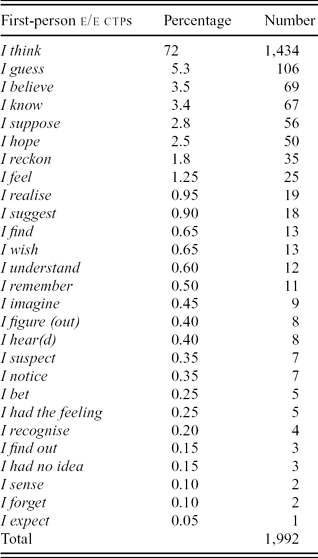
A total of 1,992 tokens were analysed. Table 7 shows the overall usage frequency of the entire first-person e/e ctps considered.
Overall distribution of first-person epistemic/evidential complement-taking predicate phrases in the spoken portion of the ICE-AUS
Table 7 shows that, in line with previous research (e.g. Van Bogaert Reference Van Bogaert2010: 402; Kaltenböck Reference Kaltenböck, Aarts, Close, Leech and Wallis2013), I think is by far the most widely used first-person epistemic/evidential complement-taking predicate: it represents 72% of the total (1,434/1,992). Interestingly, I guess comes in second, accounting for 5.3% of the data (106/1,992). I know, I believe, I suppose and I hope follow with overall usage frequencies of 3.5%, 3.4%, 2.8% and 2.5%. The last two most widely used first-person e/e ctps are I reckon and I feel, with frequencies of 1.8% (for I reckon) and 1.25% (for I feel). With the exception of I expect, I suspect, I understand and I imagine – which represent a mere 1.4% (29/1992) of our data – the ten most widely used first-person e/e ctps listed in table 7 agree with Van Bogaert's (Reference Van Bogaert2010) and Kaltenböck's (Reference Kaltenböck, Aarts, Close, Leech and Wallis2013) findings for the British National Corpus and the Diachronic Corpus of Present-Day Spoken English, respectively.Footnote 13 Perhaps the most salient difference between our AusE results and Van Bogaert's and Kaltenböck's is in the higher ranking of I guess in AusE as opposed to British English. I guess ranks eighth (of nine) in Kaltenböck's research and seventh (of nine) in Van Bogaert's (Reference Van Bogaert2010) treatment. In AusE, it takes central stage occurring only after I think. In line with other Englishes, I think has encroached on the system of AusE e/e verbs: a single lexical type represents 72% of the data! It remains to be seen how the most frequent first-person e/e ctps are constrained by grammatical factors.
5.2 Constraints on first-person e/e ctps: grammaticalisation?
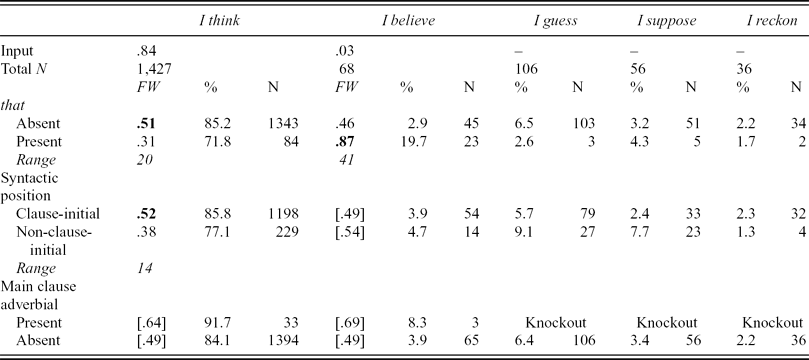
To establish the degree of grammaticalisation of the most frequent first-person e/e ctps in our data, we perform multivariate analyses using Goldvarb X (Sankoff et al. Reference Sankoff, Tagliamonte and Smith2005). We explore the impact of syntactic position (clause-initial, non-clause-initial), presence or absence of complementiser that, and presence or absence of main clause adverbials on the use of the most widely attested first-person e/e ctps in our data set and in the literature, including I think, I believe, I guess, I suppose and I reckon. The results of the relevant analyses are presented in table 8.
Contribution of grammatical factors to the use of I think, I believe, I guess, I suppose and I reckon in AusE (heaviest significant factor weights in bold; non-significant factors in square brackets)
With respect to the grammatical factors considered in this section, syntactic position and presence or absence of that interact in important ways. Specifically, clause-medial and clause-final first-person e/e ctps cannot occur in the presence of that. Given this, we analyse syntactic position and presence/absence of that separately for each first-person complement-taking predicate, but conflate the results for each of these in a single row.
The results presented in table 8 include the outcome of the statistical analysis for I think and I believe and an indication of the overall distributional frequencies for I guess, I suppose and I reckon. We explain why the analysis is presented in this way further on. The inclusion of all data in a single configuration is expected to assist the reader in comparing results. The cell count for the ‘present’ category within ‘main clause adverbial’ in relation to I believe is clearly low (N = 3), which explains the non-significance of this factor group. However, given our attention to the ranking of constraints within factor groups, this cell is included in table 8 for comparison.
The presence/absence of that and syntactic position are significant constraints on the use of I think in AusE, with ranges of 20 and 14 each. Absence of complementiser that (.51) and clause-initial syntactic position (.52) are most favourable to I think occurrence. The main clause adverbial factor group is not significant in the analysis but a look at the ranking of constraints within this factor group reveals that I think is favoured by the presence of adverbials between the subject and the verb of the main clause. Only absence of that is borne out by the data; syntactic position and the presence of adverbials in the main clause require further explanation. We provide one shortly.
Presence/absence of that is the sole factor significantly constraining the use of I believe in AusE. A comparison between the range of 41 obtained for I believe and the much lower range of 20 for I think suggests that presence/absence of that is a major grammatical constraint on I believe in AusE. Contrary to I think, it is the presence of complementiser that that most significantly favours I believe. A factor weight of .87 evinces this favouring effect. The favouring effect of that on I believe goes hand in hand with the contention that I believe (and believe in general) is used most in formal contexts (Thompson & Mulac Reference Thompson and Mulac1991a: 245 footnote 10; Van Bogaert Reference Van Bogaert2006: 143; Kärkkäinen Reference Kärkkäinen, Kaltenböck, Mihatsch and Schneider2010: 212). In fact, Finegan & Biber (Reference Finegan, Biber, Aarts and Meyer1995) show that texts of increased formality (e.g. medical writings and sermons) feature a preference for that and that such has been the trend since 1650 (see also Van Herk Reference Van Herk2012: 292). Additionally, our findings for I believe are in line with Torres Cacoullos & Walker's (Reference Torres Cacoullos and Walker2009: 26) observation that the presence of an adverbial following the subject in the main clause favours that (e.g. I actually believe that this is brilliant).
Returning to I think, we hypothesised at the start of the section that the more grammaticalised the e/e ctps, the greater their syntactic mobility. However, clause-initial position significantly favours I think with a (relatively low) factor weight of .52. Despite this, a look at the overall distribution of I think in clause-initial and non-clause-initial position shows that both syntactic positions are generously represented: relative to I believe, I suppose, I guess and I reckon, 85.8% of I think tokens occur clause-initially and 77.1% elsewhere. With respect to the hypothesis that the more formulaic the e/e parenthetical, the less likely adverbials will intervene, we find that – as with I believe – presence of main clause adverbials ranks first in the relevant group. However, a closer look at the adverbs featuring in main clauses with I think reveals that 30% of the total 33 tokens [10/33] is represented by a single lexical type: the degree adverb just, as in (27):
(27) And he wouldn't give me an answer. And I just think he was being a deadshit. (S1A-048(A):151)
The question that arises is why, if according to findings by Torres Cacoullos & Walker (Reference Torres Cacoullos and Walker2009: 26) that is favoured in the presence of an adverbial following the subject in the main clause, AusE I think is significantly favoured in the absence of that? We suggest that I just think has developed as a formulaic construction in AusE and that, as such, the adverb just does not exert the same influence on that occurrence as other adverbs which are not likewise integrated into the construction. The idea that I just think is developing as a variant of I think is not novel. Kaltenböck (Reference Kaltenböck, Aarts, Close, Leech and Wallis2013: 287) contends that the loss of epistemic modality associated with a more fully grammaticalised I think is compensated for by the emergence of ‘formal variants’ such as I'm thinking and I just think, which – Kaltenböck proposes – ‘are increasingly used as comment clauses with modal meaning’. Further research is needed to investigate the extent of this proposed variation. For the time being, it should suffice to say that an examination of the types of adverbs occurring in the main clause can offer important insights into the encroachment of I think and any potential variants.
Multivariate analysis could not be performed with I guess, I suppose and I reckon given that none of these first-person e/e ctps appear with main clause adverbials, an interesting finding which we explore below. Due to this invariance, and because of the non-orthogonality of the factors of syntactic position and presence/absence of that, we were unable to run the statistical analysis. However, a look at overall frequency distribution for I guess, I suppose and I reckon across the three factor groups considered is in order.
I guess is unlikely to occur in the presence of that and is most frequently found in non-clause-initial position. Main clause adverbials are categorically absent in our data set with I guess. These findings – coupled with its high usage frequency – indicate that AusE I guess is fully grammaticalised as an e/e parenthetical. Moreover, its categorical occurrence with the first-person-singular pronoun I strengthens I guess's standing as a highly subjective marker of epistemic modality.
As mentioned earlier, suppose and reckon are argued to be semantically similar. However, a look at our results indicates that I suppose is favoured in the presence of that and in non-clause initial position, two trends unattested for I reckon in our data. In line with I reckon, however, I suppose categorically occurs in the absence of main clause adverbials. Although future research should further investigate these differences, our distributional results show that these forms are not necessarily identical. Indeed, I reckon is almost non-existent in the presence of complementiser that and – like I guess and I suppose – occurs categorically without main clause adverbials. The absence of complementiser that and main clause adverbials indicates that I reckon is entrenched as an encoder of speaker subjectivity. Our results suggest that AusE reckon performs a variety of uses including an evidential function with third-person subjects and an epistemic nuance with first-person subjects. Thompson & Mulac (Reference Thompson and Mulac1991a) argue that epistemic uses are less likely to occur with that and that the absence of the complementiser that brings the subject of the main clause ‘closer’ to the propositional content of the complement, or embedded, clause. This results in the subject of the complement clause being the topic of the discourse, and suggests that the speaker or writer is endorsing the content of the embedded clause, a clear instance of subjectification. Such claims should nevertheless be taken with care. The low overall frequency of these forms in the current data set and the lack of statistically sound results prevent us from drawing any strong conclusions.
6 Discussion and conclusions
Distributionally, our findings indicate that, with the exception of reckon ctps, AusE is in line with other Englishes in the preponderance of epistemic e/e ctps (Thompson Reference Thompson2002: 138) and in its overwhelming preference for think. Adhering to the variationist principle of accountability, and within the envelopes of variation defined for the research, we accounted for all relevant e/e ctps in the data, focusing for the statistical analyses on the most widely used in the database and in the published literature. We also pointed out the high usage frequency of guess in our AusE corpora and contended that such a finding was at odds with the relative frequencies noted for British English but closely in line with American English.Footnote 14
As far as constraints for the first portion of our analysis (cf. section 4) are concerned, grammatical person places the strongest conditioning on the occurrence of think, believe and reckon. As expected, think is favoured with first-person subjects while – unexpectedly – believe and reckon are preferred with third- and second-person subjects. Polarity also sets these frequent verbs apart: while think and reckon are most strongly preferred in negative polarity contexts and interrogative constructions, believe is favoured in positive polarity contexts. We have hinted that the favouring effect of negative polarity on the use of think is tightly connected to the culturally appropriate need to mitigate the force of the proposition introduced by the verb. For AusE in particular, the need to avoid presenting ‘opinions as facts’ is highlighted by Mullan (Reference Mullan2010: 37), who also argues that – based on her conversational data – ‘the core meaning . . . for the expression I think includes [an] aspect of disclaiming knowledge of the upcoming proposition’, a constraint unattested for the French speakers in her sample. In light of this finding and as observed earlier, an utterance such as I don't think you should do that is interpreted as less forceful than I think you shouldn't do that. Our findings ultimately relate to the degree of (un)certainty expressed by think. Although not fully explored here, the favouring effect of negative polarity on think (but crucially not on other e/e ctps, including those with reckon) suggests that reckon expresses softer assertion of belief – and thus more mitigation – than (positive polarity) think.
Concerning AusE reckon, the statistical analysis shows important interactions between grammatical person and polarity: first-person reckon tokens occur in positive polarity contexts, second-person subjects correlate with interrogative contexts and third-person subjects categorically feature in positive polarity contexts. Such a distribution suggests that AusE reckon is multifunctional, encoding epistemic modality (with the first and second person) and evidentiality (with the third). Indeed, based on our findings we have proposed that – when in the company of third-person subjects – AusE reckon is used in a way akin to hearsay evidentials of the type (s)he said (that) (see Kärkkäinen Reference Kärkkäinen2003: 37) and to introduce statements based on direct observation. In situations such as the one illustrated in figure 1 above, the speaker who uses reckon reports another person's attitude to a proposition based on the said person's spoken words heard by the speaker previous to the interaction at hand. In such circumstances, AusE reckon is not used as a quotative verb directly introducing constructed dialogue (She said, ‘I love it’) or introducing reported speech (She said [that] she loved it). Instead, it appears to introduce the opinion of a third party based on the third party's own words which the speaker themselves heard or read prior to the interaction at hand.Footnote 15 The relationship between evidentiality and epistemicity is conceptualised by Brinton (Reference Brinton1996: 243) as the cline offered in figure 2.
Brinton's (Reference Brinton1996: 243) proposed stages in the development of first-person ‘epistemic parentheticals’

Brinton's cline thus accommodates the various uses of AusE reckon, from a form encoding calculation and estimation to evidential and epistemic marking (figure 1).
Turning now to first-person e/e ctps (cf. section 5), I think and I guess show many of the features expected in the grammaticalisation of e/e ctps, namely, absence of that and syntactic mobility. We have also argued that the favouring effect of main clause adverbials on I think was due to the occurrence of the adverb just. Moreover, we proposed that the new parenthetical construction I just think is emerging as a variant of heavily bleached I think, which we established as a widely used epistemic/evidential parenthetical in AusE. The favouring effect of clause-initial position on I think occurrence is a likely consequence of the emergence of I just think as an independent construction given that this construction cannot occur clause-medially or clause-finally. Another possible explanation for the favouring effect of clause-initial position relates to the various functions of I think. For example, in her (conversational analytic) study of how opinions are expressed in French and AusE, Mullan (Reference Mullan2010) finds that AusE I think is predominantly used to express what she labels an ‘organisational function’. Interestingly, the organisational function of AusE I think occurs in turn-initial position, which roughly corresponds to our clause-initial category. Both Mullan (Reference Mullan2010) and the current study suggest that AusE I think is most favoured in initial position. Until future research determines otherwise, it seems fair to speculate that our data include a preponderance of one particular function and that such a skewing has a bearing on our results regarding the syntactic position of I think.
In relation to the question of whether AusE reckon may be identified by the same grammaticalisation patterns found in studies of e/e verbs in other English varieties, we have argued for the multifunctionality of reckon in AusE noting that I reckon is used to express epistemic stance, in a way akin to I think and I suppose. The favouring effect of interrogative constructions and second-person subjects on reckon usage (see section 4) indicates that, among other uses, AusE reckon is an epistemic marker. Recall that one of the hallmarks in the grammaticalisation of e/e ctps into formulaic e/e parentheticals is that the subject of the said parenthetical be an unexpressed subject or a first- or second-person pronoun (Thompson & Mulac Reference Thompson, Mulac, Traugott and Heine1991b; Diessel & Tomasello Reference Diessel and Tomasello2001: 106–107). Despite this, important differences emerge regarding the distributional patterns for these epistemic constructions in our data. Perhaps the most obvious difference relates to the relative frequency of I reckon in relation to I think: the former is dwarfed by the latter. Language change is crucially influenced by general frequency effects (Hook Reference Hook, Traugott and Heine1991; Bybee & Thompson Reference Bybee and Thompson1997). AusE I reckon is the seventh most frequent construction in the data and is equal to I think in its collocation with zero complementiser and its clause-initial position. However, in contrast to I think, our data show that main clause adverbials are inadmissible with I reckon. The lack of adverbial modification in I reckon constructions goes hand-in-hand with the proposal that absence of main clause adverbials disfavours that complementiser (Torres Cacoullos & Walker Reference Torres Cacoullos and Walker2009: 33). Indeed, frequency of use and absence of main clause adverbials in I reckon, I guess and I suppose constructions seem to point to the same direction: unlike I think, the constructions I reckon, I guess and I suppose have not developed further means to encode epistemicity as they are capable of expressing such meanings on their own.
7 Limitations and further research
This study has focused on the structural factors influencing variation in the system of e/e ctps in AusE. Our aim was to gauge the extent to which grammaticalisation is operative. However, social factors play an irrevocable role in language variation and change, and the system of e/e ctps is no exception (see, e.g., Precht Reference Precht2008: 98 on the more frequent use of mental verbs such as think and know by women versus a preference for I guess by men in informal American conversation).
In the system of AusE e/e ctps, too, the social side of variation should prove a fruitful area for further exploration. For example, the different instantiations of reckon may be subject to negative social evaluation (and varying stylistic constraints) and examining speaker attitudes can throw light on the social conditioning of the form and its development. Example (28) exemplifies the stigma surrounding reckon. The potential for further empirical research is immense.
(28) I try to use reckon in its most accurate sense [arithmetic or navigational], but I suspect I fail when I am reverting to my Aussie colloquial speech, when I might lapse into ‘D'ya reckon?’ if I am attempting to sound like a fellow tribe member to valued bogans outside the cave.Footnote 16 (UWA Corpus of English in Australia)