Introduction
People experience positive and negative events throughout their lives. These events range from short-term daily hassles to chronic events that have enduring effects on psychological wellbeing. Regardless of type, life events that affect an individual's wellbeing and cause changes in usual activities can be considered as stressful life events (Dohrenwend Reference Dohrenwend2006; Holmes and Rahe Reference Holmes and Rahe1967). Evidence from previous studies has consistently indicated that negative life events are risk factors for negative mental health outcomes, such as depression (Drieling, van Calker and Hecht Reference Drieling, van Calker and Hecht2006; Muscatell et al. Reference Muscatell, Slavich, Monreo and Gotlib2009). For example, it is known that assisting patients with dementia cause care-givers to experience a decrease in quality of life and an increase in depression (Brodaty and Donkin Reference Brodaty and Donkin2009; Takahashi, Tanaka and Miyaoka Reference Takahashi, Tanaka and Miyaoka2006).
Dementia is diagnosed using several methods, including a patient's medical history (e.g. neurological and neuropsychological examinations) and standardised classification systems (e.g. the American Psychiatric Association's Diagnostic and Statistical Manual of Mental Disorders or the World Health Organization's International Classification of Disease). For example, the fifth edition of the Diagnostic and Statistical Manual of Mental Disorders (American Psychiatric Association 2013) now classifies dementia under neurocognitive disorders (NCDs) with ‘major’ and ‘minor’ categories. Here, dementia constitutes a large amount of all major NCDs (Simpson Reference Simpson2014).
Dementia is characterised by cognitive decline, which is a result of neuropathological changes in the brain. Progression of these changes reveals different aetiological subtypes of dementia. The most common subtype is Alzheimer's disease, which accounts for 40–60 per cent of all dementia cases (Brunnström et al. Reference Brunnström, Gustafson, Passant and Englund2009). Vascular dementia, fronto-temporal dementia, dementia with Lewy bodies, Parkinson's disease, Huntington's disease, Creutzfeldt-Jakob disease, toxic causes, autoimmune diseases or inflammatory disorders constitute the remaining subtypes (De Souza et al. Reference De Souza, Sarazin, Goetz, Dubois, Giannakopoulos and Hof2009: 8). As the disease progresses, both global cognitive decline and neuropsychiatric symptoms begin to appear, and the patient loses his or her independence in activities of daily living (McKhann et al. Reference McKhann, Knopman, Chertkow, Hyman, Jack, Kawas, Klunk, Koroshetz, Manly, Mayeux, Mohs, Morris, Rossor, Scheltens, Carrillo, Thies, Weintraub and Phelps2011). Caring for a patient with cognitive and neuropsychiatric impairments is a chronic stressful life event, and care-givers of dementia patients carry a heavy psychological burden (Etters, Goodall and Harrison Reference Etters, Goodall and Harrison2008; Zarit, Reever and Bach-Peterson Reference Zarit, Reever and Bach-Peterson1980). However, the extent to which care-givers are affected by the stressful aspects of care-giving may depend on a variety of factors (Möller-Leimkühler and Wiesheu Reference Möller-Leimkühler and Wiesheu2012). For example, patient-related factors, such as patients’ behavioural problems, daily living activities and neuropsychiatric scores, are related to care-giver burden (Chappell and Penning Reference Chappell and Penning1996). On the other hand, care-giver-related factors, such as care-givers’ socio-demographic status and ability to cope with care-giving demand, are also related to care-giver burden (Haley et al. Reference Haley, Gitlin, Wisniewski, Feeney-Mahney, Coon, Winter, Corcoran, Schinfeld and Ory2004; Kim et al. Reference Kim, Chang, Rose and Kim2012; Papastavrou et al. Reference Papastavrou, Kalokerinou, Papacostas, Tsangari and Sourtzi2007).
It is important to understand how some care-givers are able to maintain their wellbeing, while others develop psychological problems in response to the same stressful event. Coping strategies used to deal with stressors may contribute to this explanation as previous studies have shown that strategies utilised by dementia care-givers are associated with both negative and positive care-giver outcomes (Brown et al. Reference Brown, Sloman, Brown and Mitchell1995; Haley et al. Reference Haley, Levine, Brown and Bartolucci1987). More specifically, while the adoption of emotion-focused coping strategies are related to higher levels of depression (Iavarone et al. Reference Iavarone, Ziello, Pastore, Fasanaro and Poderico2014; Neundorfer Reference Neundorfer1991; Sun Reference Sun2014), use of problem-focused strategies are related to lower levels of depression (Kneebone and Martin Reference Kneebone and Martin2003; Papastavrou et al. Reference Papastavrou, Kalokerinou, Papacostas, Tsangari and Sourtzi2007).
A growing body of research suggests that coping models of cognitive emotion regulation strategies may accurately predict depression (Garnefski et al. Reference Garnefski, Teerds, Kraaij, Legerstee and van den Kommer2004; Xiao et al. Reference Xiao, Yao, Zhu, Abela, Chen, Duan and Zhao2011). Cognitive emotion regulation strategies may be thought of as conscious, mental processes to cope with psychological distress. These strategies can be measured through the Cognitive Emotion Regulation Questionnaire (CERQ), developed by Garnefski, Kraaij and Spinoven (Reference Garnefski, Kraaij and Spinhoven2001).
A number of recent studies have shown that cognitive emotion regulation strategies have a direct relationship with depression (Schroevers, Kraaij and Garnefski Reference Schroevers, Kraaij and Garnefski2008). Ruminating, self-blaming, blaming others and catastrophising are strongly associated with higher levels of depression (Garnefski et al. Reference Garnefski, Koopman, Kraaij and Cate2009; Min et al. Reference Min, Yu, Lee and Chae2013; Öngen Reference Öngen2010), while use of adaptive strategies, such as positive reappraisal and positive refocusing, are associated with lower levels of depression (Garnefski et al. Reference Garnefski, Teerds, Kraaij, Legerstee and van den Kommer2004). Garnefski et al. (Reference Garnefski, Teerds, Kraaij, Legerstee and van den Kommer2004) also found that 43.3 per cent of the variance in symptoms of depression in adults can be explained by cognitive emotional regulation strategy use.
While strategies that individuals use to cope with distress are directly related to depression, other variables may also contribute to this relationship. For example, the degree of available social support contributes to a person's ability to cope with stress (Kim Reference Kim2013). On the other hand, a lack of social support leads to feelings of loneliness, helplessness and social isolation. Thus, social support appears to be a predictor of wellbeing. Interpersonal theories of depression (e.g. Swann et al. Reference Swann, Wenzlaff, Krull and Pelham1992) argue that decreased social support is a risk factor for depression, and several studies have connected decreases or loss of social support with increases in symptoms of depression (Haeffel and Mathew Reference Haeffel and Mathew2010). In contrast, the perception of sufficient social support can contribute to building resilience against depression (Bozo, Toksabay and Kürüm Reference Bozo, Toksabay and Kürüm2009) and enhanced life satisfaction (Yadav Reference Yadav2010). Similar results have also been reported in studies sampling dementia care-givers; Hayslip, Han and Anderson (Reference Hayslip, Han and Anderson2008) found a strong negative relationship between social support and anxiety and depression and Au et al. (Reference Au, Lau, Koo, Cheung, Pan and Wong2009) observed that care-givers tend to report lower levels of depression and increased levels of life satisfaction if they receive enough social support from family networks or close friends.
Social support also demonstrates a moderating effect on the relationship between care-giver stress and health (Huang et al. Reference Huang, Musil, Zauszniewski and Wykle2006). The term moderator refers to a variable that alters the size or direction of the relationship between two other variables (Holmbeck Reference Holmbeck1997). From a more theoretical perspective, the effect of the focal variable (predictor) on the dependent variable (outcome) depends on the value of a third, moderating, variable (Hayes and Matthes Reference Hayes and Matthes2009).
In the current study, our sample was comprised of care-givers of patients with dementia. As it has been consistently reported that caring for a patient with dementia puts a large psychological burden on care-givers (Etters, Goodall and Harrison Reference Etters, Goodall and Harrison2008), these people provide an ideal research sample. Moreover, several studies have examined the relationship between stress and coping among dementia care-givers (e.g. Kneebone and Martin Reference Kneebone and Martin2003), but little is known about the relation between cognitive emotion regulation strategies (Garnefski, Kraaij and Spinoven Reference Garnefski, Kraaij and Spinhoven2002) and level of depression among dementia care-givers. On the other hand, social support, a moderating variable, may alter the strength and direction of the effect of cognitive emotion regulation strategies on care-giver depression. To date, however, no studies have examined this possibility. Thus, the purpose of the present study is to answer these questions: (a) are cognitive emotion regulation strategies and social support associated with depression among dementia care-givers and (b) does social support moderate the relationship between cognitive emotion regulation strategies and depression? In the light of the above literature review, we expected that level of perceived social support would moderate the relationship between cognitive emotion coping strategies and depression.
Method
Participants
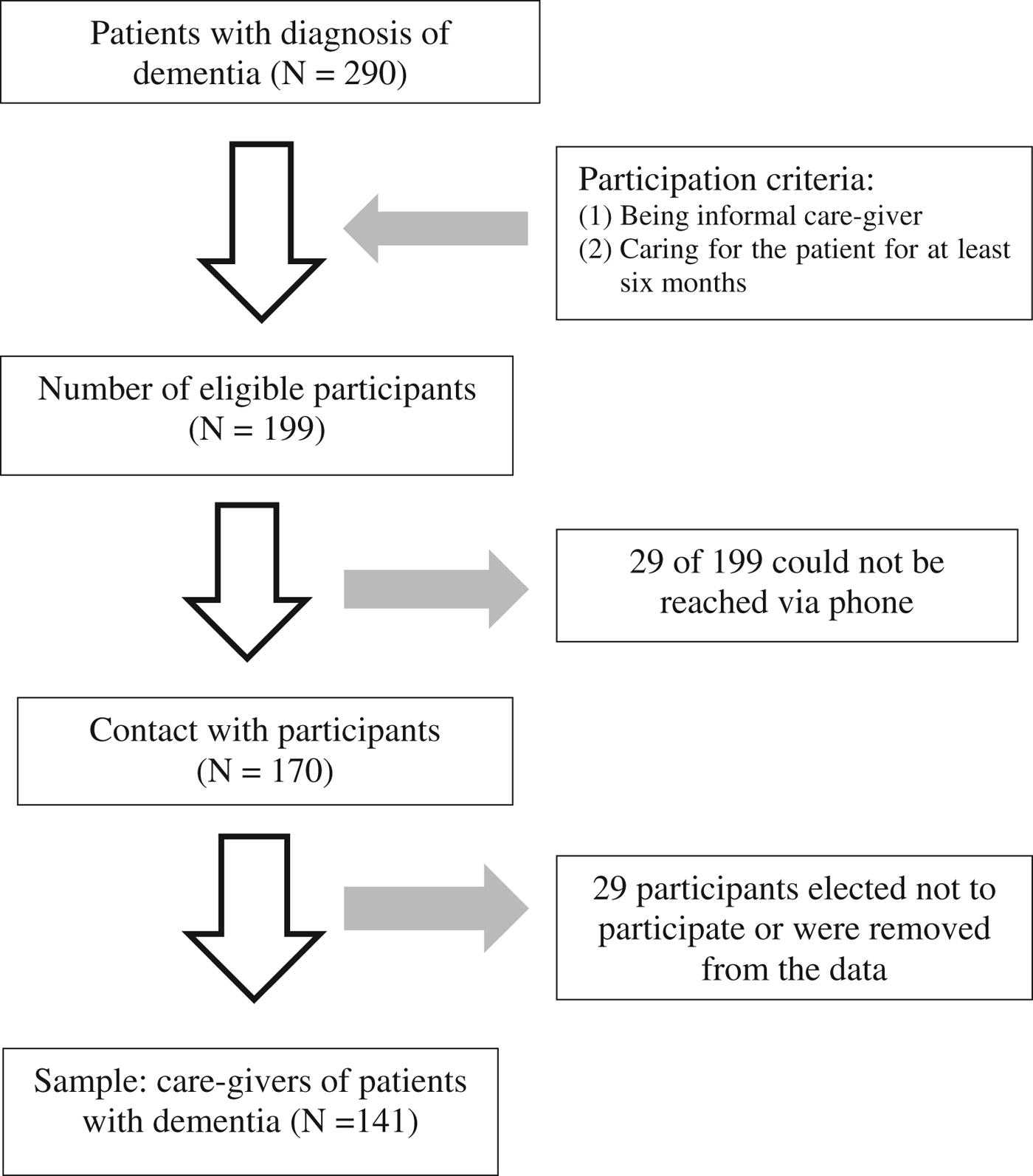
Our data were obtained from the Turkuaz Alzheimer Working Group (TAC) database, which includes the neurology department of Mersin University hospital. All participants were care-givers of patients with dementia living in Mersin, Turkey, and were native Turkish speakers. At the time of data collection there were 290 patients recorded in the Mersin database, however, we used a purposive sampling technique to select participants. Participants were recruited on the basis of two criteria: (a) that they were informal care-givers (a relative of the patient) and were co-habiting with the patient, and (b) they had been caring for the patient for at least six months. After these criteria were applied, the number of eligible participants was 199. Of this number, 29 could not be contacted for various reasons (such as an incorrect phone number or the phone was not answered) and 14 elected not to participate in the study. Of the 156 remaining, 15 participants were removed from the study as they only partially completed the questionnaires. Therefore, a total of 141 participants (71% response rate) submitted complete data for statistical analysis (see Figure 1).
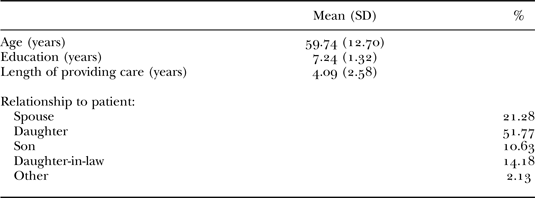
Participants consisted of 108 (77%) women and 33 (23%) men. The mean age of the sample was 59.74 years old (standard deviation (SD) = 12.70). Key demographic features are shown in Table 1.
Procedure for selection of the sample.

Characteristics of care-givers

Notes: N = 141. SD: standard deviation.
Materials
Cognitive Emotion Regulation Questionnaire
The CERQ was used to assess which specific cognitive coping strategies participants used in response to stress arising from care-giving demands (Garnefski, Kraaij and Spinhoven Reference Garnefski, Kraaij and Spinhoven2002). The CERQ is a 36-item questionnaire consisting of nine conceptually distinct scales. These sub-scales each consist of four items referring to what a person thinks after experiencing a threatening or stressful event. Items are scored on a five-point Likert scale ranging from 1 (almost never) to 5 (almost always).
The CERQ tests for nine distinct cognitive emotion regulation strategies: self-blame – blaming yourself for what you have experienced; other-blame – blaming what you have experienced on the environment or another person; acceptance – accepting what you have experienced and resigning yourself to what has happened; positive refocusing – thinking about joyful and pleasant issues instead of thinking about actual events; refocus on planning – thinking about what steps to take and how to handle the negative event; rumination – dwelling on the feelings and thoughts associated with the negative event; positive reappraisal – trying to frame the event in terms of personal growth; putting into perspective – brushing aside the seriousness of the event and emphasising its relatively unimportant or important nature when comparing it to other events; and catastrophising – explicitly emphasising the terror of what you have experienced (Garnefski and Kraaij Reference Garnefski and Kraaij2006).
A Turkish version of the measure was created by Öngen (Reference Öngen2010), who reported Cronbach's alpha reliability coefficients ranging from 0.66 to 0.84 for each sub-scale. In our study, we found the following alpha coefficients: self-blame, 0.69; acceptance, 0.72; rumination, 0.68; positive refocusing, 0.82; refocus on planning, 0.74; positive reappraisal, 0.75; putting into perspective, 0.62; catastrophising, 0.77; blaming others, 0.84.
Multidimensional Scale of Perceived Social Support (MSPSS)
The MSPSS is a self-report measure of perceived social support originally developed by Zimet et al. (Reference Zimet, Dahlem, Zimet and Farley1988). The scale consists of 12 items and assesses three sources of support: family, friends and significant others. Items are scored on a five-point Likert scale ranging from 1 (strongly disagree) to 5 (strongly agree). We used only the total scores, obtained by adding the three sub-scale scores, for data analysis. The Turkish version was created by Eker and Arkar (Reference Eker and Arkar1995). The Cronbach's alpha reliability coefficient of the total score was found to be 0.89 in the current study. Previous studies have shown that MSPSS is an appropriate scale to measure perceived social support of dementia care-givers. For example, Skarupski et al. (Reference Skarupski, McCann, Bienias and Evans2009) showed that co-resident care-givers reported lower MSPSS scores when compared to non-co-resident care-givers.
Beck Depression Inventory (BDI)
The BDI (Beck Reference Beck1961) is a self-report inventory that consists of 21 questions assessing an individual's level of depression. Each of the 21 items has four response options on a scale from 0 to 3, with greater scores indicating higher levels of depression. Hisli (Reference Hisli1989) created a Turkish version of the inventory. In our study, the Cronbach's alpha for the scale was found to be acceptable (α = 0.84). BDI has been used in many studies to assess care-givers’ level of depression (Truzzi et al. Reference Truzzi, Valente, Ulstein, Engelhardt, Laks and Engedal2012; Watson et al. Reference Watson, Lewis, Moore and Jeste2011).
Procedure
We screened for participants by searching the TAC database, a Turkish national database for Alzheimer's disease and other types of dementia. Several hospitals which are included in the system record patient information in the database, so clinicians can easily track changes in their patients. Moreover, contact information, such as phone numbers and e-mail addresses of patient care-givers, are also recorded. We first contacted care-givers by telephone to inform them of the current study and to ask them if they were interested in participating. We visited care-givers who accepted our invitations to participate in their homes. During the visit, the questionnaires and study procedures were explained to the participants. Participants were instructed not to provide any identifying information and were reassured that their answers would only be used for research purposes. All participants were given an informed consent form approved by Mersin University's Departments of Psychology and Neurology. This consent form presented information about the objectives of the study and each care-giver had to return a signed copy in order to participate.
For the purposes of data collection, all participants were given a demographic information form, five questionnaires, an envelope and a phone number with which to contact researchers if needed. Participants were given one week to complete the questionnaires. At the end of the week, we visited the participants, collected completed forms and questionnaires in the closed envelope, and gave them thank you letters.
Data analysis procedure
Multiple hierarchical regression analysis is the preferred method to examine the effect of a moderating variable on the relationship between a predictor and outcome variable, especially when the predictor or moderating variable (or both) is measured on a continuous scale (Aguinis Reference Aguinis1995; Champoux and Peters Reference Champoux and Peters1987). On the other hand, dichotomising continuous variables and using other analytic methods (such as analysis of variance) may cause a loss in statistical power (Frazier, Tix and Barron Reference Frazier, Tix and Barron2004). In order to preserve statistical power, centring or standardising both the predictor and moderator before the interaction term is computed is recommended. Through the adoption of this method, multicollinearity can be prevented thereby reducing Type I error (Aiken and West Reference Aiken and West1991: 44).
Based on the recommendations of previous studies (above), hierarchical multiple regression analysis was used as the primary analysis to address our research questions. In order to prevent multicollinearity and thereby reduce Type I error, we mean-centred all continuous variables (except the dependent variables) before computing the interaction terms. Our hierarchical multiple regression analysis consisted of three blocks. For this analysis, gender, age and length of care provision were entered in Step 1 to control for the effects of demographic characteristics. As we had unequal numbers of men and women in our sample, we recoded gender (a categorical variable) as +0.23 = women and −0.77 = men (Frazier, Tix and Barron Reference Frazier, Tix and Barron2004).
In Step 2, cognitive emotion regulation strategies (predictors), as well as social support (moderator), were entered. Two-way interaction terms were created through the multiplication of cognitive coping strategies and social support (such as rumination × social support or catastrophising × social support). Two-way interactions were entered in Step 3. We also used descriptive analysis and Pearson correlation analysis. Data were analysed using SPSS 15.0 software (SPSS, Chicago, Illinois).
Results
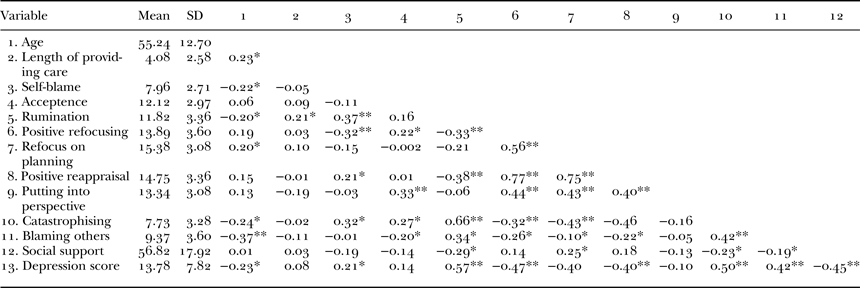
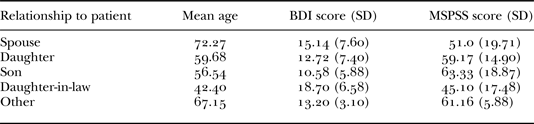
The majority of participants were female (77%) and married (79%). Most care-givers were daughters (51.77%), followed by spouses (21.28%), daughters-in-law (14.18%), sons (10.63%) and others (2.13%). The mean care-giving duration was 4.08 years (SD = 2.58). Means, standard deviations and correlations between all study variables are presented in Table 2. There was a significant and negative association between age and BDI score, r(139) = −0.23, p < 0.05. BDI and MSPSS were also calculated for all relationship types (Table 3). There was a significant difference between groups on the BDI, H(4) = 14.46, p < 0.05. Daughters-in-law reported significantly higher scores (18.70, SD = 6.58) than daughters (12.72, SD = 7.40), U = 136.5, p < 0.01. As seen in Table 3, daughters-in-law reported the lowest MSPSS score (45.10, SD = 17.48), but there was no significant difference between groups.
Mean, standard deviations (SD) and intercorrelations among study variables

Note : SD: standard deviation.
Significance levels : ** p < 0.01, *** p < 0.001.
Mean of the Beck Depression Inventory (BDI) and Multidimensional Scale of Perceived Social Support (MSPSS) for all relationship types

Note : SD: standard deviation.
Main effects
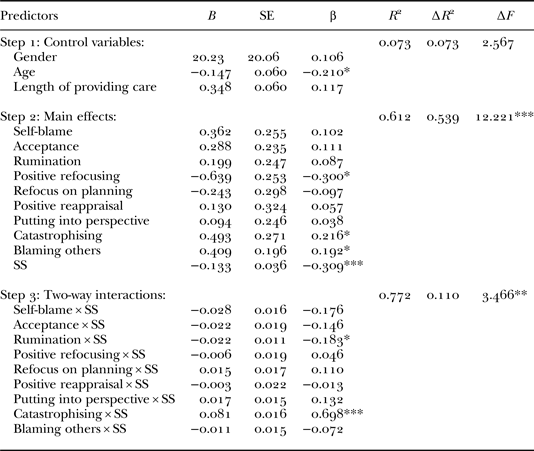
According to the results of the analysis in Step 1, the age of participants was significantly related to depression (β = −0.210, p < 0.05) so that increased age was related to lower levels of depression. However, gender and length of care provision were not found to be significant.
Table 4 (see Step 2) shows the direct relationship between independent variables and depression. After controlling for gender, age and length of care provision, we found a negative and significant relationship between positive refocusing and depression (β = −0.300, p < 0.05), and a positive and significant relationship between catastrophising and depression (β = 0.216, p < 0.05). Blaming others also predicted depression among dementia care-givers (β = 0.192, p < 0.05) and social support was significantly associated with depression (β = −0.309, p < 0.01). In sum, after controlling for demographic variables, results indicated that the model in Step 2 accounted for 61 per cent of the variance in depression (R 2 = 0.612, F(13, 88) = 10.672, p < 0.01).
Hierarchical multiple regression analysis predicting depression

Notes: N = 141. SE: standard error. SS: social support.
Significance levels: * p < 0.05, ** p < 0.01, *** p < 0.001.
Two-way interactions
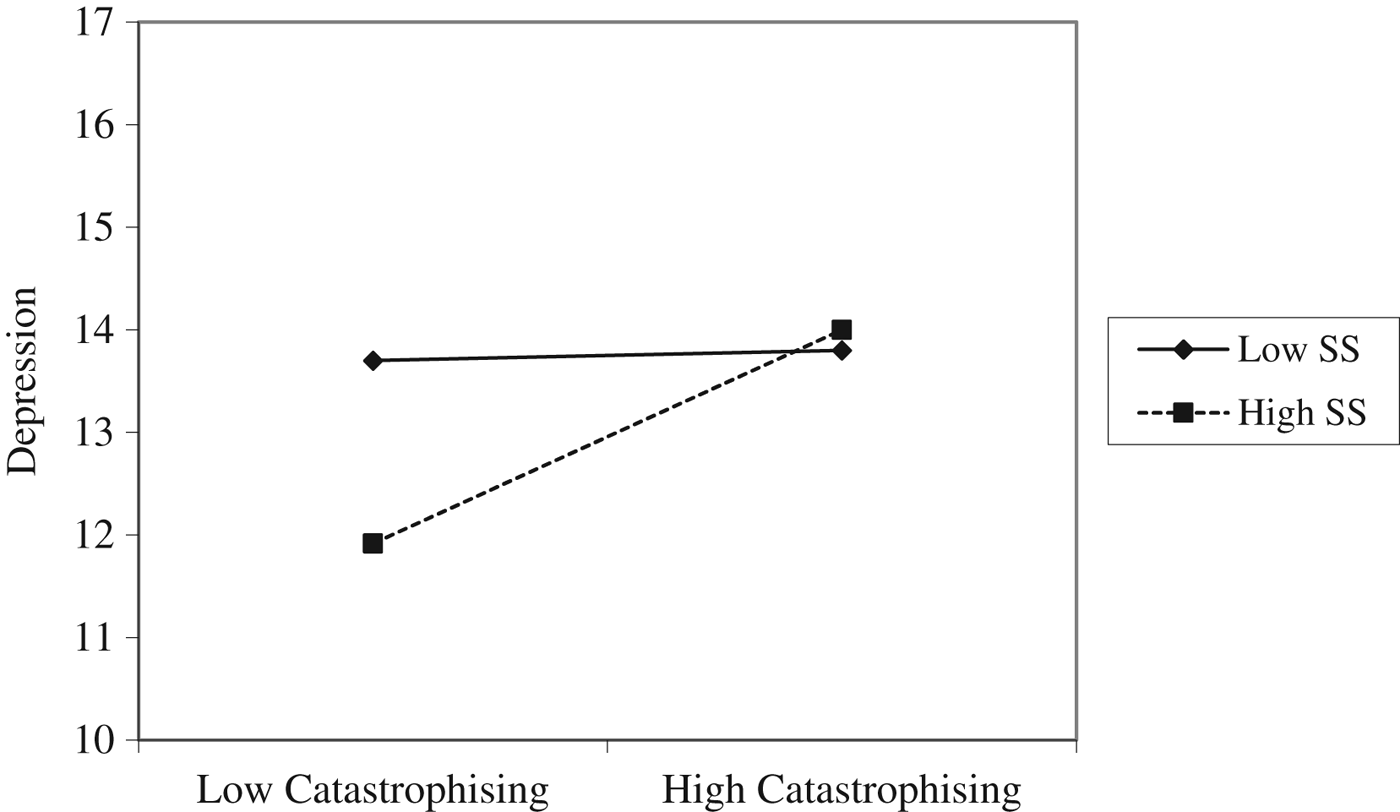
Table 4 shows the results of multiple regression analysis. Two-way interaction results (see Step 3) showed a significant interaction between catastrophising and social support on depression (β = 0.698, p < 0.001). To explain this two-way interaction further, we plotted the results of these two variables, with the moderating variable at both one standard deviation below and above the mean. We also tested the statistical significance of each of these two slopes, showing the simple effect of the predictor (coping strategy) at two levels of moderation (Cohen et al. Reference Cohen, Cohen, West and Aiken2003: 267). Simple slope analysis showed that the positive relationship between catastrophising and depression was significant only at high levels of social support (B = 1.602, β = 0.701, p < 0.001). This significant slope difference (represented in Figure 2) indicates that having higher social support served to soften emotional blows in participants who reported less frequent use of catastrophising strategies. In other words, reporting more frequent use of catastrophising made participants more vulnerable to depression regardless of support.
Interaction of catastrophising and social support. Note : SS: social support.

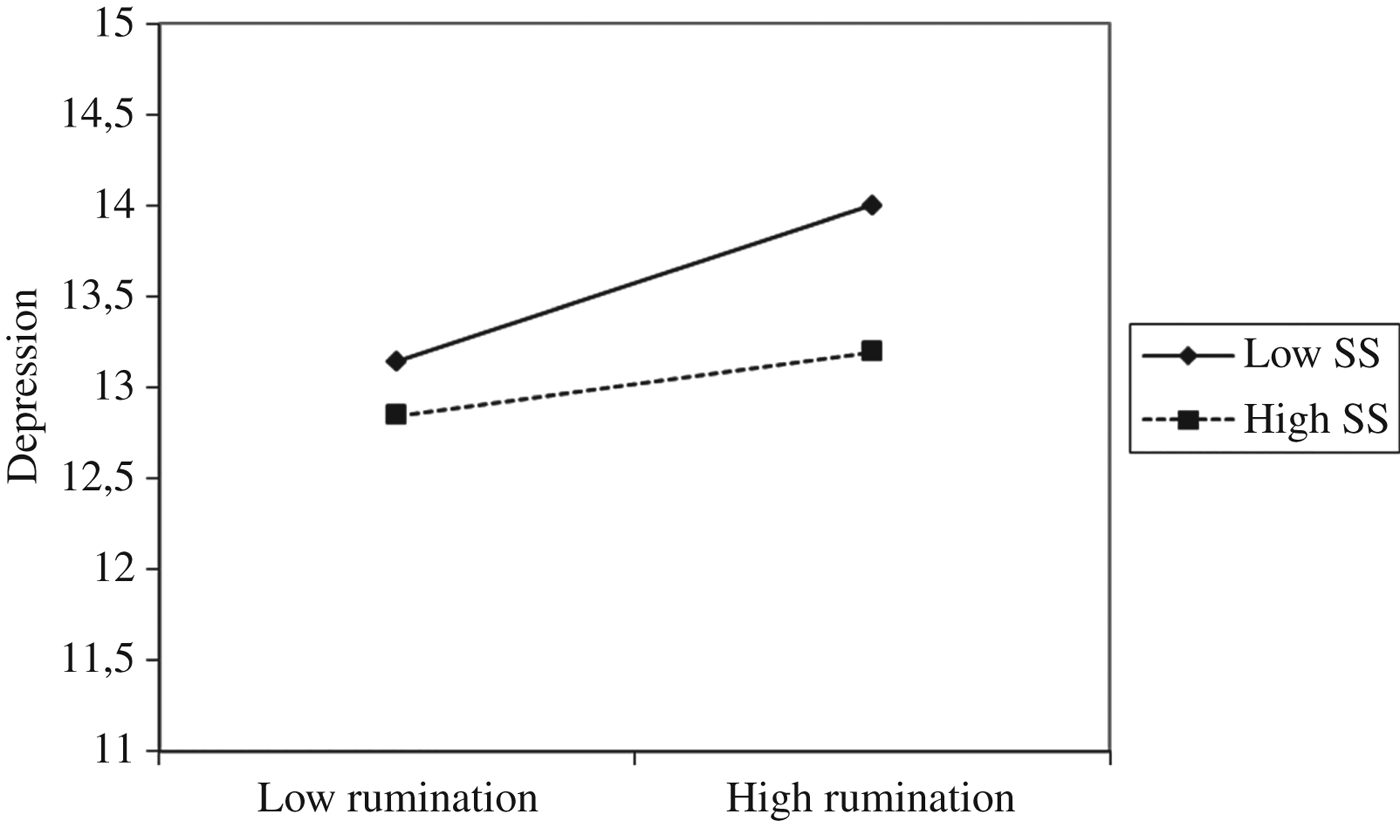
The interaction between rumination and social support was also significant (β = −0.183, p < 0.05). The same simple slope procedure described earlier was carried out for this interaction and a significant slope difference was found for lower levels of social support (B = 0.398, β = 0.187, p = 0.05; represented in Figure 3). This indicates that more frequent use of a rumination strategy resulted in higher levels of depression for participants with lower levels of social support.
Interaction of rumination and social support. Note : SS: social support.

In sum, the interactions in Step 3 accounted for a significant amount of additional variance in depression symptoms (∆R 2 = 0.115, ∆F(9, 79) = 3.466, p < 0.01). As a whole, our model was significant and explained 72 per cent of the variance (R 2 = 0.722, F(22, 79) = 9.315, p < 0.001).
Discussion
In this study, we examined how cognitive emotion regulation strategies and perceived social support influences depression among care-givers for patients with dementia. First of all, care-giver characteristics revealed that daughters-in-law reported the highest depression and lowest perceived social support levels. This result is consistent with previous studies in which daughters-in-law reported more burden when caring for patients with dementia compared to other care-givers (Arai et al. Reference Arai, Zarit, Sugiura and Washio2002; Lee and Sung Reference Lee and Sung1997). One reason for this could be that daughters-in-law tend to perceive looking after their parents-in-law as a filial obligation (Hong and Kim Reference Hong and Kim2008). Moreover, Arai et al. (Reference Arai, Zarit, Sugiura and Washio2002) showed that over a long-term period, these care-givers were more likely to experience unsuccessful outcomes as compared to their spouses. Additional studies support this finding. De Labra et al. (Reference De Labra, Millán-Calenti, Buján, Núñez-Naveira, Jensen, Peersen, Mojs, Samorski and Maseda2015) reported that having a consanguinity relationship contributes to care-giver satisfaction. Conversely, weaving the caregiving process as a role that stems from others’ expectations could increase depression among daughters-in-law. Daughters-in-law were also the youngest care-giver group assessed in the present study, and there was a significant and negative relationship between age and depression scores. This association could be explained by another result showing that there was a positive and significant association between age and length of providing care (Table 2). Thus, with daughters-in-law being the youngest group, they had been care-givers for a relatively shorter period of time. There is research suggesting that providing care over a longer period of time influences role adaptation (De Labra et al. Reference De Labra, Millán-Calenti, Buján, Núñez-Naveira, Jensen, Peersen, Mojs, Samorski and Maseda2015). Additionally, Fauth et al. (Reference Fauth, Hess, Piercy, Norton, Corcoran, Rabins, Lyketsos and Tschanz2012) revealed an association between relationship closeness and care-giver depression. Moreover, higher baseline relationship closeness is an important predictor for lowered depression. Since older care-givers (spouses/daughters/sons) tend to have a closer baseline relationship with a patient when compared to daughters-in-law, this could help explain the diminished depression levels observed in the other care-giver groups.
Sons reported the lowest levels of depression and highest levels of social support. This could suggest that sons receive support or assistance from their wives. Moreover, they may regard care-giving as a duty by providing instrumental support (e.g. buying and transporting goods; Hong and Kim Reference Hong and Kim2008).
The research questions explored whether different cognitive coping strategies related to levels of depression, as well as whether perceived social support moderated this relationship. The results showed that, in terms of main effects, use of positive refocusing and catastrophising significantly predicted depression. Specifically, results indicated that participants who tended to use catastrophising reported higher levels of depression. As Beck's (Reference Beck1976: 49) cognitive model suggests, cognitive distortions are responsible for the development and maintenance of depression, and the more depressed patients are, the more likely they are to predict catastrophic outcomes for the future. The cognitive distortion of catastrophising may cause patients to ignore plausible and beneficial outcomes, thereby maintaining existing levels of depression (Moore and Garland Reference Moore and Garland2003: 24). On the other hand, the negative relationship between positive refocusing and depression showed that, in contrast to catastrophising, thinking about possible positive outcomes may alleviate depression.
Blaming others also predicted depression. This may be explained by the reality of care-giving for those with dementia. Dementia patients generally receive assistance from family members (typically a spouse, daughter or daughter-in-law), with responsibility for care often taken on by one individual. Disagreement about the division of responsibility for care can cause conflicts between the primary care-giver and other family members, which we assume to be a secondary source of care-giver distress (Schulz and Martire Reference Schulz and Martire2004). Thus, participants might focus their attention on blaming other family members and holding them responsible for their current problems. With this finding, it is important to remember that dementia is not only a clinical disease, but also a community problem that negatively affects interpersonal relationships.
We also found a significant relationship between social support and depression, consistent with the results of previous studies (Kim Reference Kim2013). The main reason why social support is closely related to depression in dementia care-givers may be due to the high demands of care-giving, which may result in changes in the social networks of care-givers. These changes often result in greater social isolation, less opportunity to engage with others, feelings of helplessness and even cognitive decline (Beeson Reference Beeson2003; Vitaliano et al. Reference Vitaliano, Murphy, Young, Echeverria and Borson2011).
The buffering hypothesis of social support suggests that under some conditions social support protects individuals from negative influences of stress, such as depression (Cohen and Wills Reference Cohen and Wills1985). According to this hypothesis, being able to rely on social support prevents individuals from feeling helpless and provides a sense of stability in life situations. Thus, it is not surprising that people tend to seek social support when they encounter stressful life events (Cohen, Sherrod and Clark Reference Cohen, Sherrod and Clark1986). From a more theoretical perspective, this hypothesis suggests that social support operates as a moderating variable that influences the appraisal process of a stressful event (Cohen Reference Cohen, Veiel and Baumann1992: 113; Wheaton Reference Wheaton1985), so individuals’ subsequent cognitive appraisal influences their coping skills (Lazarus and Folkman Reference Lazarus and Folkman1984: 150). Consistent with the theoretical background, in terms of two-way interactions, social support showed a significant moderating effect on depression. This effect was found at high levels of social support. Moreover, participants who perceived higher levels of social support and tended to use less catastrophising reported lower levels of depression. However, this relationship also showed that having higher social support alone is not a guarantee for lower levels of depression, as participants that reported higher social support reported almost the same score as participants who had lower social support but frequent use of catastrophising. This finding once again demonstrates that catastrophising is a strongly maladaptive coping strategy and that it is related to negative emotion (Martin and Dahlen Reference Martin and Dahlen2005). Thus, the worsening effect of this strategy on depression can be alleviated through both providing high social support and guiding care-givers to make less use of catastrophising strategies (see Figure 2).
The moderating effect of social support on the relationship between rumination and depression was also significant. Simple slope difference was significant for lower and higher levels of moderator. This means that participants who had lower social support reported higher depression scores than those who had higher social support. This difference was most evident where there was frequent use of a rumination coping strategy and was consistent with the literature. Nolen-Hoeksema and Davis (Reference Nolen-Hoeksema and Davis1999) indicated that individuals who exhibit a greater tendency towards rumination are more likely to seek social support and that individuals that are unable to obtain enough social support are likely to keep searching for it. This persistence in social support seeking may cause conflicts with others in their social networks and thus might increase levels of depression (Flynn, Kecmanovic and Alloy Reference Flynn, Kecmanovic and Alloy2010).
In this study, we examined the relationship between social support, cognitive emotion regulation strategies and depression among Turkish dementia care-givers. Overall, our model explained the majority of the variance. Despite the strengths of this study, there are a number of limitations that should be considered before interpreting the results. The study was carried out using only participants from a small area of Turkey. Due to the cultural differences in family structure and social networks (Kagitcibasi Reference Kagitcibasi1996: 74), generalising these results to other cultures should be done with caution. For example, in Turkey, family relationships are closer and are based on kinship (Nuck and Suckow Reference Nuck and Suckow2006) to a greater degree than Western cultures (Razi Reference Razi1993). Thus, participants might tend to blame other family members instead of focusing on their own depressive feelings. Second, the most important methodological limitation is the number of participants. Due to the large number of independent variables in the model, the sample size may not have been sufficient for a detailed analysis. However, because this was one of the first studies to investigate adaptive cognitive emotion regulation strategies among dementia care-givers, we believe that our results are still valuable. Another limitation was how social support was quantified and measured. Due to methodological limitations, we used only the total score for the MSPSS. However, social support is not a unitary concept. It is important to know the source of social support to make more detailed interpretation. Care-givers usually seek different kinds of support, including information and education, assistance support, emotional support, care-giver support and payment (Grootegoed, Knijn and Da Roit Reference Grootegoed, Knijn and Da Roit2010; Salfi, Ploeg and Black Reference Salfi, Ploeg and Black2005). Moreover, care-givers tend to seek community services for support and help (Au et al. Reference Au, Shardlow, Teng, Tsien and Chan2013) and thus future research should assess the role of different kinds and sources of support to understand further how care-giver depression can be reduced.
In conclusion, caring for a patient with dementia is a highly negative and stressful life event. As a result, it is important to understand how care-givers cope and adapt. Examining the coping strategies adopted by care-givers should prove helpful in developing effective interventions or therapy programmes to assist care-givers overcome the negative effects associated with their role. However, many factors such as patients’ behavioural problems, cognitive functions, independence in daily activities, care-givers’ health, family conflicts and economical problems may contribute to the demands placed on the care-giver. Thus, care-givers tend to seek other sources of support and so, rather than examining the direct relationship between coping skills and distress, broader models that include other variables that may influence this relationship are needed. In this study, we examined the relationship between coping skills and care-giver depression whilst incorporating social support in our model. Our results show that cognitive emotion regulation strategies and social support can play significant roles in alleviating care-giver depression. In the light of these results, it can be suggested that interventions or therapy programmes focusing on the effects of positive refocusing, catastrophising and blaming others, as well as providing social support programmes, may be helpful in alleviating depression in dementia care-givers.