





Introduction
The broiler chicken industry is one of the fastest-growing industrial sectors worldwide (Kleyn and Ciacciariello, Reference Kleyn and Ciacciariello2021). The high demand for chicken meat and intensive broiler chicken farming systems have led to a massive increase in the broiler chicken population (Oke et al., Reference Oke, Akosile, Uyanga, Oke, Oni, Tona and Onagbesan2024). However, owing to the growth of the broiler chicken industry, there are problems related to the availability of feed, especially protein feed ingredients (Oke et al., Reference Oke, Akosile, Uyanga, Oke, Oni, Tona and Onagbesan2024). Currently, soybean meal is the main source of protein for broiler chicken feed (Oke et al., Reference Oke, Akosile, Uyanga, Oke, Oni, Tona and Onagbesan2024). Owing to competition with human needs, several countries must import soybean meal from other countries (Oke et al., Reference Oke, Akosile, Uyanga, Oke, Oni, Tona and Onagbesan2024). This makes the price of soybean meal fluctuate so that it can have a negative effect on the sustainability of the broiler chicken industry (Al-Nasser et al., Reference Al-Nasser, Al-Khalaifah, Khalil and Al-Mansour2020). Several farmers have tried to use alternative protein sources in broiler chicken feed; one example of an alternative protein source is whey (Al-Nasser et al., Reference Al-Nasser, Al-Khalaifah, Khalil and Al-Mansour2020).
A nutrient-rich by-product of cheese-making, whey is an excellent protein source (Rackerby et al., Reference Rackerby, Le, Haymowicz, Dallas and Park2024), which is needed by chickens in sufficient quantities for growth and development. Notably, protein is essential for broiler chickens when rapid weight gain is desired (Yiğit et al., Reference Yiğit, Bielska, Cais-Sokolińska and Samur2023). For this reason, starter feeds for broiler chickens often contain high levels of protein, which is one of the most expensive ingredients in feed (Tsiouris et al., Reference Tsiouris, Economou, Lazou, Georgopoulou and Sossidou2019, Reference Tsiouris, Kontominas, Filioussis, Chalvatzi, Giannenas, Papadopoulos, Koutoulis, Fortomaris and Georgopoulou2020). If broiler chicken producers can use whey as a source of protein in feed, broiler producers can reduce feed costs so that broiler chicken farming becomes more economically profitable (Tsiouris et al., Reference Tsiouris, Kontominas, Filioussis, Chalvatzi, Giannenas, Papadopoulos, Koutoulis, Fortomaris and Georgopoulou2020). However, because whey contains high levels of lactose and minerals (sodium), the use of whey in broiler chicken feed is limited. This is because poultry cannot produce lactase, an enzyme needed to hydrolyse lactose into glucose and galactose (Tsiouris et al., Reference Tsiouris, Economou, Lazou, Georgopoulou and Sossidou2019, Reference Tsiouris, Kontominas, Filioussis, Chalvatzi, Giannenas, Papadopoulos, Koutoulis, Fortomaris and Georgopoulou2020). In addition to having a high protein content, whey protein also has antioxidant and anti-inflammatory effects and is rich in essential amino acids and bioactive peptides (Yiğit et al., Reference Yiğit, Bielska, Cais-Sokolińska and Samur2023).
Owing to these properties, whey protein is now widely utilized by broiler chicken producers as a feed additive to improve the physiological condition and overall health of broiler chickens. Palamidi et al. (Reference Palamidi, Paraskeuas, Griela, Politis and Mountzouris2024) reported that the inclusion of whey protein in broiler diets had no significant effect on daily feed intake (DFI), average daily gain (ADG) or the feed conversion ratio (FCR) throughout the experimental period. However, it contributed to a reduction in total bacterial counts and Escherichia coli in the colon while promoting the growth of Lactobacillus spp. Similarly, Sanchez-Roque et al. (Reference Sanchez-Roque, Perez-Luna, Perez-Luna, Berrones-Hernandez and Saldana-Trinidad2017) reported a decreasing trend in Escherichia coli populations.
Consistent with the findings of Paraskeuas et al. (Reference Paraskeuas, Papadomichelakis, Brouklogiannis, Anagnostopoulos, Pappas, Simitzis, Theodorou, Politis and Mountzouris2023) and Sugiharto et al. (Reference Sugiharto, Agusetyaningsih, Widiastuti, Wahyuni, Yudiarti and Sartono2023), the graded inclusion levels of whey protein did not positively affect the different growth phases of broiler chickens. However, Szczurek et al. (Reference Szczurek, Alloui and Józefiak2018) reported that whey protein supplementation tended to increase feed intake and reduce the FCR and mortality in broiler chickens, although it did not lower the presence of harmful bacteria. Moreover, body weight (BW) was significantly higher on day 13 of age in birds fed a diet supplemented with 1% whey compared to the control group, prior to the inclusion of whey protein in the poultry diet. Furthermore, BW remained consistently higher in the whey-supplemented group than in the control group by day 43 of age (Tsiouris et al., Reference Tsiouris, Economou, Lazou, Georgopoulou and Sossidou2019).
Meta-analysis plays a crucial role in integrating various research findings, particularly when studies yield inconsistent results, as observed in research on the use of whey protein in broiler chicken feed. By synthesising data from multiple studies, a meta-analysis can provide stronger, evidence-based conclusions regarding the effectiveness of whey protein as a feed additive in enhancing growth performance and maintaining gut health in broiler chickens (Marín-Martínez and Sánchez-Meca, Reference Marín-Martínez and Sánchez-Meca1999; Moher et al., Reference Moher, Shamseer, Clarke, Ghersi, Liberati, Petticrew, Shekelle and Stewart2015). Therefore, this meta-analysis was conducted to evaluate the potential of whey protein as a feed additive to increase the physiological condition, health and growth performance of broiler chickens.
Materials and methods
Searching, evaluating and selecting articles
The identification, search, evaluation and selection of articles were conducted in accordance with the PRISMA-P guidelines, as applied in previous research (Adli et al., Reference Adli, Sholikin, Ujilestari, Ahmed, Sadiqqua, Harahap, Sofyan and Sugiharto2024b). The research topic on whey protein in broiler chickens was structured via the PICO framework, which includes the following elements: population = broiler chickens; intervention = various whey products (types of whey, inclusion methods and different levels of inclusion); comparison = control versus treatment; and outcome = growth performance, nutrient digestibility, carcase traits, humoral immunity, antioxidant properties, intestinal morphology and the microbiota environment.
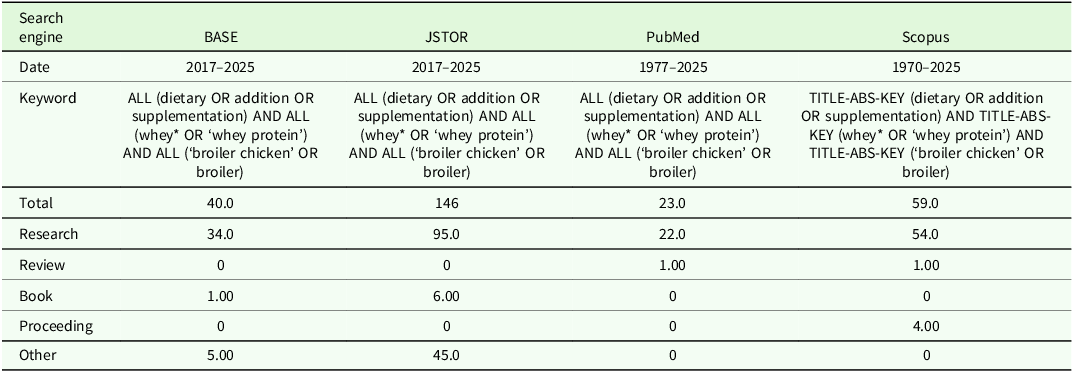
Relevant keywords were formulated on the basis of the PICO framework, following prior studies (Adli et al., Reference Adli, Sugiharto, Irawan, Tribudi, Wibowo, Azmi, Sjofjan, Jayanegara, Tistiana, Wahyono, Aditya, Sholikin and Sadarman2024a; Budiarto et al., Reference Budiarto, Adli, Wahyono, Ujilestari, Sholikin, Mubarok, Sari, Khalisha, Sari and Abdullakasim2024), as detailed in Table 1. The intervention component was represented by keywords (whey* OR whey protein* OR ‘whey concentrate’), while the research subject was specified as ‘broiler chicken’. Articles were selected on the basis of comparisons between the control and treatment groups. However, for single-group meta-analyses, a specific control was not assigned to each treatment; instead, comparisons were made against a default control.
Research trends in whey protein supplementation for broiler chickens

ALL, keyword indexing is applied to all sections of the article; TITLE-ABS-KEY, keyword indexing is applied to the title, abstract and keyword sections of the article; *, indicates a search that includes all terms beginning with the specified keyword; ‘’, words enclosed in quotation marks are treated as a single, inseparable phrase when executing a search query.
The intervention was represented by keywords such as (whey OR whey protein OR dietary* OR supplementation*), while the research subjects were specified as ‘broiler chickens*’. Articles were reviewed to compare the control and treatment groups. However, in single-group meta-analyses, a specific control was not assigned to each treatment; instead, comparisons were made against a default control.
A total of 268 relevant articles were successfully retrieved via the search algorithm. Article management and deduplication were performed via Mendeley (Mendeley Desktop ver. 1.19.8). Among these, 99 articles were shortlisted for evaluation on the basis of the following criteria: inclusion of treatment groups involving processing factors that influence whey protein levels, use of broiler chickens as research subjects, availability of continuous data, provision of standard deviations (or other statistical dispersion measures such as standard error and coefficient of variation), presence of replicates and an experimental design incorporating randomization (Figure 1).
Selection process for articles on whey feeding to broiler chickens, modified from Page et al. (2021a, 2021b).

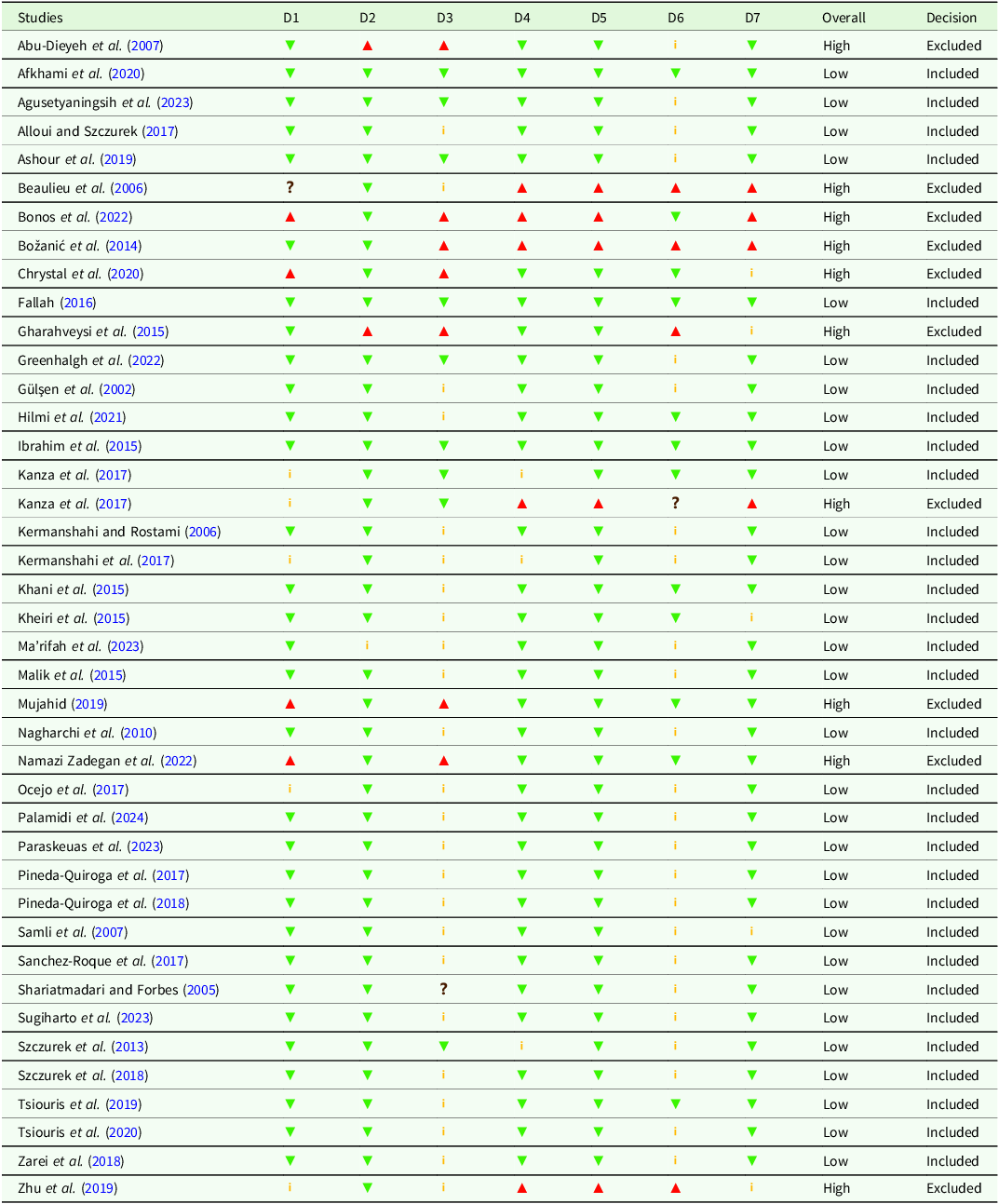
Following this selection, 41 articles were further assessed for potential bias via the risk of bias (ROB) framework (Sterne et al., Reference Sterne, Savović, Page, Elbers, Blencowe, Boutron, Cates, Cheng, Corbett, Eldridge, Emberson, Hernán, Hopewell, Hróbjartsson, Junqueira, Jüni, Kirkham, Lasserson, Li, McAleenan, Reeves, Shepperd, Shrier, Stewart, Tilling, White, Whiting and Higgins2019). Seven specific bias domains were evaluated: (D1) confounding variables, (D2) selection bias in sample recruitment, (D3) misclassification of interventions, (D4) deviations from intended interventions, (D5) bias due to missing outcome data, (D6) measurement errors and (D7) bias resulting from selective outcome reporting. These biases were categorized according to the following criteria: low (no bias detected), medium (minor ROB), high (confirmed potential bias) and uncertain (source of bias could not be determined). A study was considered ‘low risk’ if all domains were judged as low; ‘high risk’ if one or more domains were judged high; and ‘unclear’ if insufficient information was provided. Ultimately, 31 articles met the eligibility criteria and passed the bias assessment, making them suitable for data extraction (Table 2).
The assessment of publication bias in 31 selected articles was based on the risk of bias criteria defined in previous studies (Higgins et al., Reference Higgins, Altman, Gotzsche, Juni, Moher, Oxman, Savovic, Schulz, Weeks and Sterne2011; Sterne et al., Reference Sterne, Savović, Page, Elbers, Blencowe, Boutron, Cates, Cheng, Corbett, Eldridge, Emberson, Hernán, Hopewell, Hróbjartsson, Junqueira, Jüni, Kirkham, Lasserson, Li, McAleenan, Reeves, Shepperd, Shrier, Stewart, Tilling, White, Whiting and Higgins2019; Priyatno et al., Reference Priyatno, Adli and Sholikin2025)

D1, the identified risks of bias include confounding variables; D2, selection bias in sample recruitment; D3, misclassification of interventions; D4, deviations from intended interventions; D5, bias due to missing outcome data; D6, measurement errors; D7, bias resulting from selective outcome reporting; ▼, low bias; ℹ, moderate bias; ▲, high bias; ❓, uncertain bias.
General information
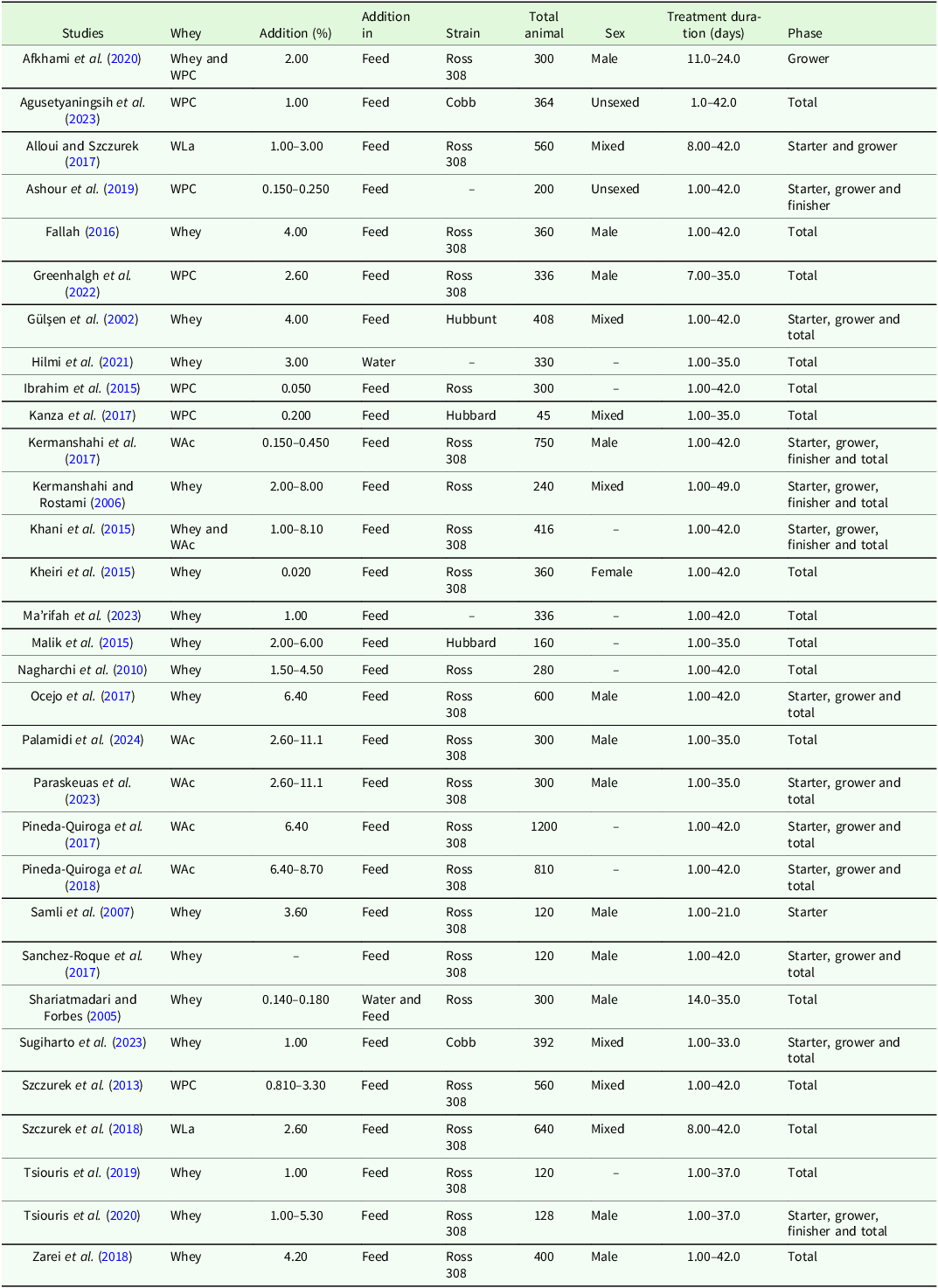
The key information extracted from the 31 selected articles included details such as whey protein types, inclusion levels, broiler chicken strains, number of replications, total bird count, sex, treatment groups, study duration and investigated phases (Table 3). The whey protein types examined were whey labneh, whey acid (WAc), whey lactose (WLa) and whey protein concentrate (WPC). The broiler chicken strains studied included the Cobb, Hubbard, Hubbunt, Lohmann, Ross and Ross 308 strains. The research phases included starter, grower, finisher and overall (total) periods, with inclusion levels ranging from 0% to 11.1% in feed and 0.140% to 0.180% in water. The recorded sex data included male, female or mixed groups, although some studies did not specify this information.
Compilation of studies on whey product use in broiler chickens

WPC, whey protein concentrate; WAc, whey acid; WLa, whey lactose; *, indicates the percentage of labneh added to drinking water, –, not available.
Growth performance was evaluated on the basis of ADG (g/h/d), DFI (g/h/d), the feed conversion ratio (FCR) and the mortality rate (MOR, %). Digestibility was assessed through apparent metabolizable energy (AME, kcal/kg DM) and crude protein digestibility (CPD, %). Carcase traits were analysed in terms of dressing percentage (DP, %), breast percentage (BP, %), thigh percentage (TP, %), water-holding capacity (WHC, %) and cooking loss percentage (CLP, %). Humoral immunity was measured on the basis of immunoglobulin Y (IgY, log2) and immunoglobulin M (IgM, log2) levels. Intestinal morphology was evaluated by measuring the villus height (VH, μm), villus width (VW, μm), crypt depth (CD, μm) and VH:CD ratio. Additionally, the intestinal pH was considered. Antioxidant properties were determined through the levels of glutathione (GSH, mg/l), glutathione peroxidase (GPx, U/mg protein), catalase (CAT, U/mg protein), superoxide dismutase (SOD, U/mg protein) and malondialdehyde (MDA, mmol/mg protein). The microbiota environment was analysed by quantifying coliform bacteria (COL, nmol/mg protein), lactose-negative bacteria (LNB, mg/ml) and lactic acid bacteria (LAB, log CFU/mg).
Analysing and validating
A comprehensive meta-analysis, including both overall and subgroup analyses, was conducted using effect sizes calculated on the basis of Hedge’s (g’), which were adjusted for variations in sample size, ranging from 3 to 10 replications. This method compared the treatment groups with the control group, which served as the baseline value (m control). For this analysis, the baseline whey protein level was set at 0%. The baseline values included the number of replications (n), mean (m) and standard deviation (sd) of the treatment groups. The treatment effect was assessed via a random-effects model, where the random factor accounted for variations across studies. For details on the calculation and validation of g’, refer to Equations (1–10).
Hedge’s
 $$s{d_{pooled}} = \sqrt {{{\mathop \sum \nolimits_{i = 1}^k \left( {{n_i} - 1} \right).sd_i^2} \over {\mathop \sum \nolimits_{i = 1}^k \left( {{n_i} - 1} \right)}}} $$
 $$g = {{{m_{treatment}} - {m_{control}}} \over {S{D_{pooled}}}}$$
 $$SE = S{E_{random}} = \sqrt {{1 \over {\sum {w_i}}} + {\tau ^2}} $$
 $$p = 2 \times \left( {1 - \Phi \left( {\left| Z \right|} \right)} \right)$$
Q statistics
 $$Qs = \mathop \sum \nolimits_{i = 1}^k {{{{\left( {{y_i} - \bar y} \right)}^2}} \over {vi}}$$
 $$P(X_{k - 1}^2 \gt Qs)$$
Begg’s test
 $$\tau = {{P - Q} \over {\sqrt {\left( {P + Q + T} \right) \cdot \left( {P + Q + T} \right)} }}$$
 $$Z = {{\tau \sqrt {n\left( {n - 1} \right)} } \over {\sqrt {1 - {\tau ^2}} }}$$
Equations (1–4) were used to calculate g, SE and the P value. Equations (5–6) were applied to evaluate heterogeneity in the meta-analysis model via the use of Q statistics, whereas Equations (7) and (8) were used to assess publication bias via Begg’s test. The relevant details are as follows: sd pooled refers to the pooled standard deviation across all treatment groups; k represents the total number of studies and denotes the standard deviation of the i-th study; ni indicates the sample size of the i-th study; m treatment refers to the mean of the treatment group; m control is the mean of the control group; SE random denotes the standard error of the effect size estimate in the random-effects model; wi represents the weight assigned to the i-th effect size (calculated as 1/variance); τ indicates the between-study variation (Kendall’s Tau); P is the p value obtained from the Z statistical test; Φ represents the cumulative standard normal distribution; Z is the computed test statistic; Qs denotes the heterogeneity statistic; y i represents the effect size estimate for the i-th study; ȳ is the mean effect size estimate; v i detonates the variance of the i-th effect size estimate; and
 $X_{k - 1}^2$
represents the random variation of the chi-square distribution. Symbols that appear consistently across formulas retain the same definitions, whereas any unique terms have been defined separately.
The significance of the Q statistics (Qs; P < 0.050) confirmed the presence of random factors due to variability across studies, justifying the use of a random-effects model instead of a fixed-effects model. The Z value from Begg’s test, which was calculated via Equation (8), was assessed for significance via Equation (6). The effect size (g’) was classified as follows: g’ > 0.200 (small effect), g’ > 0.500 (medium effect) and g’ > 0.800 (large effect) (Lin, Reference Lin2018; Lin and Aloe, Reference Lin and Aloe2021). The meta-analysis was performed via the ‘metafor’ package (in R version 4.3.2). A significance level of P < 0.05 was applied for model significance, Begg’s test was validated, and the Q statistics were analysed (Viechtbauer, Reference Viechtbauer2010; R Core Team, 2023).
The optimal dosage was determined via a second-order multivariate response surface model (SOM-RSM) (Sholikin et al., Reference Sholikin, Alifian and Jayanegara2019; Adli et al., Reference Adli, Sholikin, Ujilestari, Ahmed, Sadiqqua, Harahap, Sofyan and Sugiharto2024b). The performance indicators (ADG, DFI and FCR) served as the predicted variables, whereas the whey dosage acted as the predictor. The analysis referred to the following mathematical model (Equation 9).
SOM-RSM
 $$\left[ {\matrix{ {ADG} \cr {FCR} \cr {DFI} \cr } } \right] = \left[ {\matrix{ {{\beta _0}^{\left( 1 \right)}} \cr {{\beta _0}^{\left( 2 \right)}} \cr {{\beta _0}^{\left( 3 \right)}} \cr } } \right] + \left[ {\matrix{ {{\beta _1}^{\left( 1 \right)}} \cr {{\beta _1}^{\left( 2 \right)}} \cr {{\beta _1}^{\left( 3 \right)}} \cr } } \right]{x_1} + \left[ {\matrix{ {{\beta _{11}}^{\left( 1 \right)}} \cr {{\beta _{11}}^{\left( 2 \right)}} \cr {{\beta _{11}}^{\left( 3 \right)}} \cr } } \right]{x_1}^2 + \left[ {\matrix{ {{\varepsilon ^{\left( 1 \right)}}} \cr {{\varepsilon ^{\left( 2 \right)}}} \cr {{\varepsilon ^{\left( 3 \right)}}} \cr } } \right]$$
RSM Validation
 $$Ds = {\left( {{d_1} \times {d_2} \times \cdots \times {d_n}{\rm{\;}}} \right)^{1/n}}$$
 $$UF = \mathop \sum \nolimits_{i = 1}^n {w_i} \cdot {d_i}$$
 $$WS = \mathop \sum \nolimits_{i = 1}^n {w_i} \cdot {Y_i}$$
The response vector [ADG FCR DFI] ⊤ represents the outcomes of interest. β0, β₁ and β₁₁ denote the vectors of coefficients for the linear and quadratic constants of each response. x₁ refers to the predictor variable in the model (whey protein), whereas ε represents the error vector associated with each model.
The validation of the RSM model uses the desirability score (Ds, Equation 1), utility function (UF, Equation 11) and weighted score (WS, Equation 12). A value close to 1 indicates an optimal result (Islam et al., Reference Islam, Do and Kim2018; Badache and Aidoun, Reference Badache and Aidoun2023). The equations are defined as follows: di refers to the individual desirability for the i-th response, n represents the total number of responses, wi denotes the weight assigned to the i-th response, di is the desirability value of each i-th response and Yi indicates the normalized value of the i-th response.
Results
Overall effect size
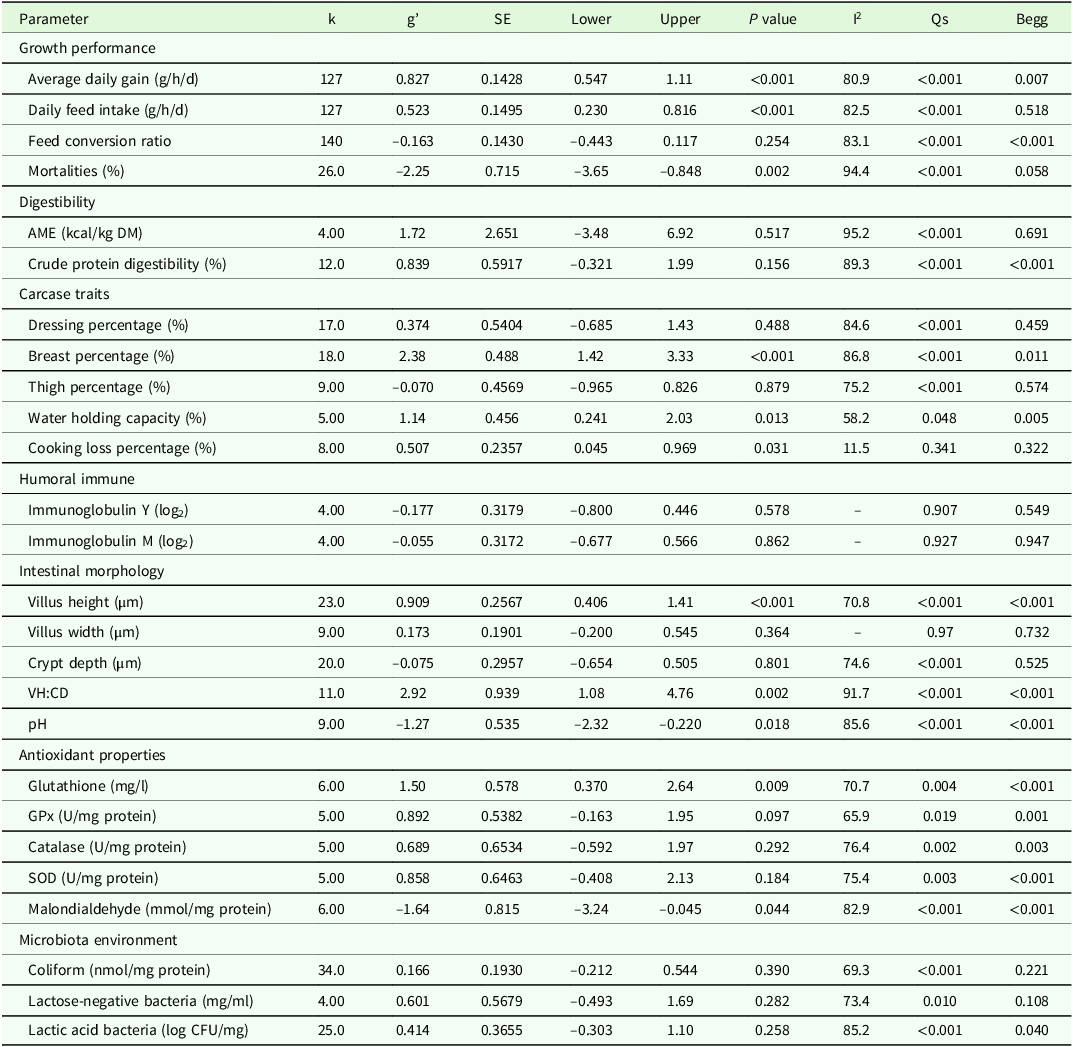
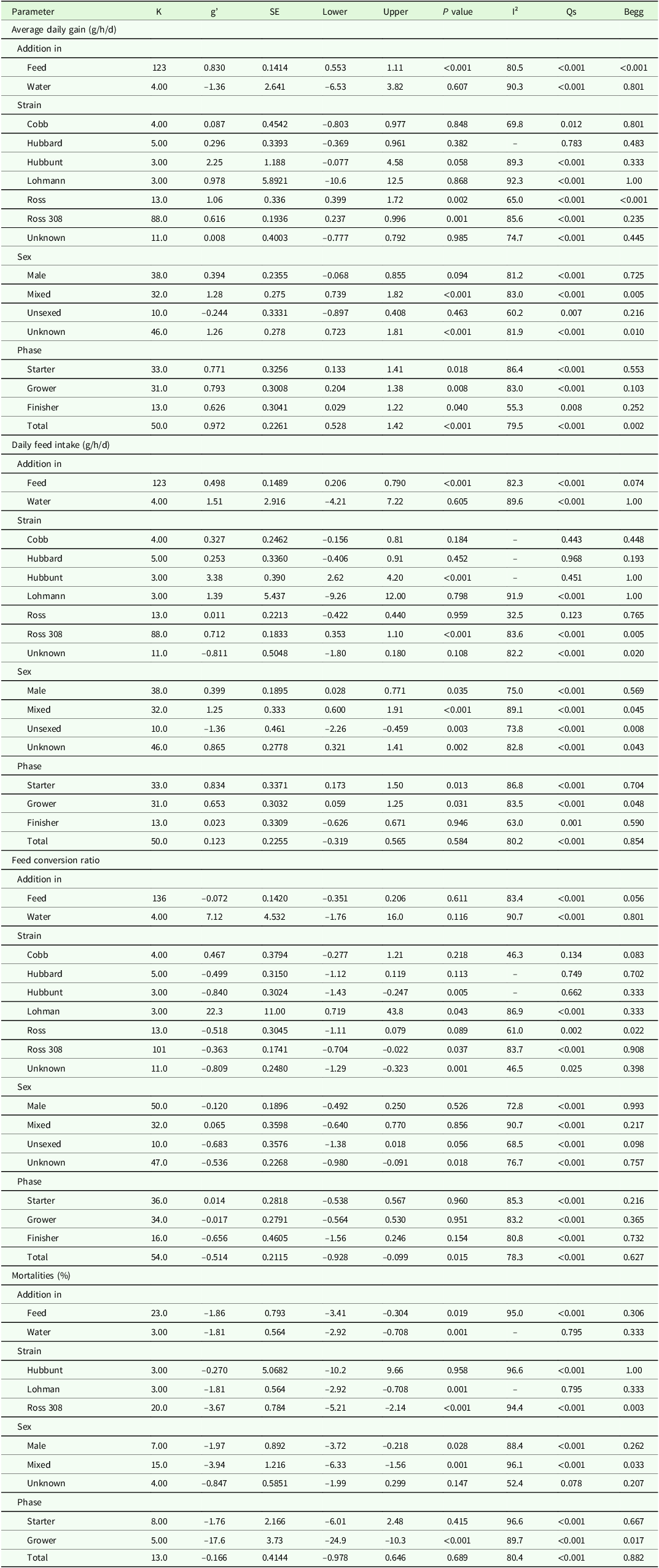
The inclusion of whey protein in broiler diets significantly improved the ADG, with a large effect size (g’ ± SE = 0.827 ± 0.1428; P < 0.001), and had a moderate effect on the DFI (0.523 ± 0.1495; P < 0.001). Moreover, a significant reduction in mortality was observed, with a large effect size (–2.25 ± 0.715; P = 0.002). Although the FCR showed a decreasing trend (–0.163 ± 0.1430; P = 0.254; Table 4), the effect was not statistically significant. While the P-values for ADG and FCR in Table 4 are statistically significant (P < 0.001), the corresponding effect sizes (Hedges’ g) for some comparisons fall below 0.2, indicating a small effect. Similarly, AME and CPD were not responsive to whey protein supplementation.
Overall effects of dietary whey protein on growth performance in broiler chickens

AME, apparent metabolizable energy; Begg, significance value from Begg’s test; CD, crypt depth; CFU, colony-forming unit; DM, dry matter; GPx, glutathione peroxidase; I², heterogeneity; k, number of studies; Qs, significance value from the Q statistic; SE, standard error from the random-effects model; SOD, super dioxide dismutase; VH, villus height.
With respect to carcase traits, a significant improvement was observed in BP, with a notable effect size (2.38 ± 0.488; P < 0.001). Additionally, the WHC increased significantly, with a large effect (1.14 ± 0.457; P = 0.010), whereas the CLP had a moderate effect (0.507 ± 0.2357; P = 0.010). However, neither the DP nor the TP significantly changed. Furthermore, dietary whey protein supplementation enhanced intestinal morphology, as indicated by a substantial increase in VH, with a large effect size (0.909 ± 0.2569; P < 0.001), and a significant increase in the VH:CD ratio (2.92 ± 0.939; P = 0.002). Additionally, the intestinal pH was significantly reduced, with a large effect size (–1.27 ± 0.535; P = 0.018). However, VW and CD were not significantly affected. In terms of antioxidant properties, whey protein supplementation had a strong effect on increasing GSH levels (1.50 ± 0.578; P = 0.009) and GPx activity (0.892 ± 0.5382; P = 0.097). Moreover, the MDA level significantly decreased, with a large effect (–1.64 ± 0.815; P = 0.044). However, the activities of CAT and SOD were not significantly affected. Finally, the microbial groups, including COL, LNB and LAB, did not significantly change in response to whey protein addition.
Subgroup effect size
A subgroup analysis further revealed that the beneficial effects of whey protein were more pronounced when whey protein was directly incorporated into the feed, particularly in terms of improving ADG (0.830 ± 0.1414; P < 0.001; Table 5). Among the broiler strains, Ross (1.06 ± 0.336; P = 0.002) and Ross 308 (0.616 ± 0.1936; P = 0.001) chickens presented the most significant positive response compared with the other strains, such as Lohmann, Cobb, Hubbard and Hubbunt chickens (Table 5). Additionally, whey protein addition was more effective in the mixed-sex groups (1.28 ± 0.275; P < 0.001). Notably, all broiler chicken growth stages significantly improved (g’ > 0.500; P < 0.050).
Growth response of broiler chickens to whey protein-enriched diets

Begg, significance value from Begg’s test; I², heterogeneity k, number of studies; Qs, significance value from the Q statistic; SE, standard error from the random-effects model.
The inclusion of whey protein in feed significantly increased the DFI (0.498 ± 0.1489; P < 0.001; Table 5), with the Hubbunt strain showing the most notable positive response (3.38 ± 0.390; P < 0.001), followed by the Ross 308 strain (0.712 ± 0.183; P < 0.001). Moreover, its effects were more pronounced in the male, mixed-sex and unsex broiler chicken groups (g’ > 0.200; P < 0.010). Whey protein supplementation significantly improves performance during both the starter and grower phases (g’ > 0.500; P < 0.001).
Whey protein tended to reduce the FCR more effectively when it was administered through feed rather than water (–0.072 ± 0.1420; P = 0.611; Table 5). Compared with the other strains, the Hubbunt, Lohmann and Ross 308 strains presented greater reductions in FCR (g’ > 0.200; P < 0.050). A significant reduction in FCR was also observed in unsexed broiler chickens (–0.683 ± 0.3576; P = 0.050) and across all growth phases (–0.514 ± 0.2115; P = 0.015).
In terms of mortality rates, whey protein addition significantly reduced mortality in both the feed and water treatments (g’ > 0.800; P < 0.050). The Lohmann and Ross 308 strains presented a significant reduction in mortality (g’ > 0.800; P < 0.001). Similarly, male and mixed-sex broilers presented notable decreases in mortality rates (g’ > 0.800; P < 0.050). Finally, during the grower phase, whey protein supplementation significantly contributed to reduced mortality (–1.76 ± 2.166; P < 0.001).
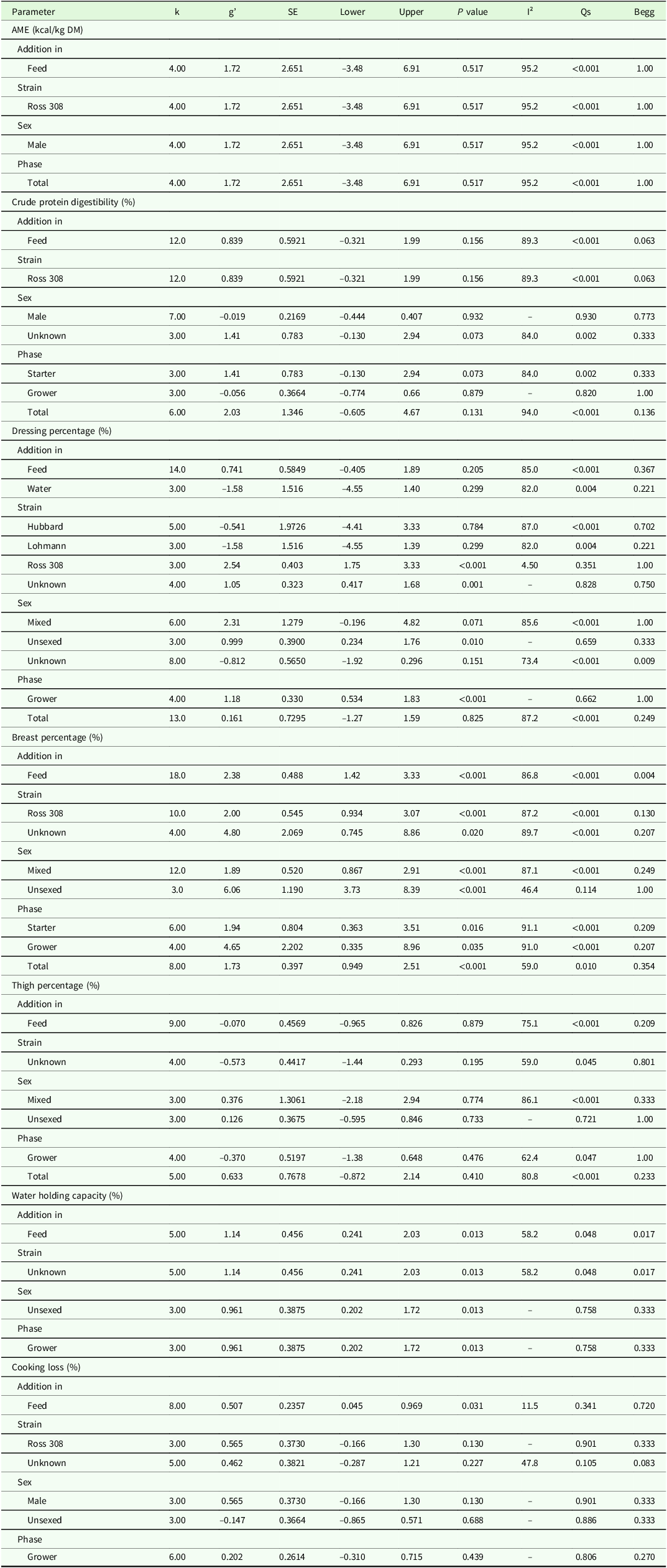
The digestibility response, including AME and CPD, remained largely unchanged across various categories following whey protein supplementation (Table 6). However, CPD during the starter phase had a beneficial effect (1.41 ± 0.783; P = 0.073). Carcase quality was evaluated across multiple categories. The addition of whey protein to both feed and water did not affect the DP. However, the Ross 308 strain had a significant positive effect on DP (2.54 ± 0.403; P < 0.001). Furthermore, unsexed broiler chickens exhibited significant improvements in response to whey protein addition (0.999 ± 0.3900; P = 0.010). This effect was also significant during the grower phase (1.18 ± 0.330; P < 0.001). Notably, the inclusion of whey protein in feed significantly increased BP (2.38 ± 0.488; P < 0.001). Subgroup analyses revealed a significant increase in BP for the Ross 308 strain (2.00 ± 0.545; P < 0.001), with mixed-sex broiler chickens following a similar trend (1.89 ± 0.520; P < 0.001). Among all the groups, unsexed broiler chickens presented the greatest improvement (6.06 ± 1.190; P < 0.001). However, BP remained largely unchanged in subgroup analyses, as did CLP. In contrast, the WHC significantly increased following whey protein addition, despite the limited data availability (g’ > 0.800; P = 0.013).
Digestibility and carcase traits of broiler chickens receiving whey protein diets

AME, apparent metabolizable energy; Begg, significance value from Begg’s test; DM, dry matter; I², heterogeneity k, number of studies; Qs, significance value from the Q statistic; SE, standard error from the random-effects model.
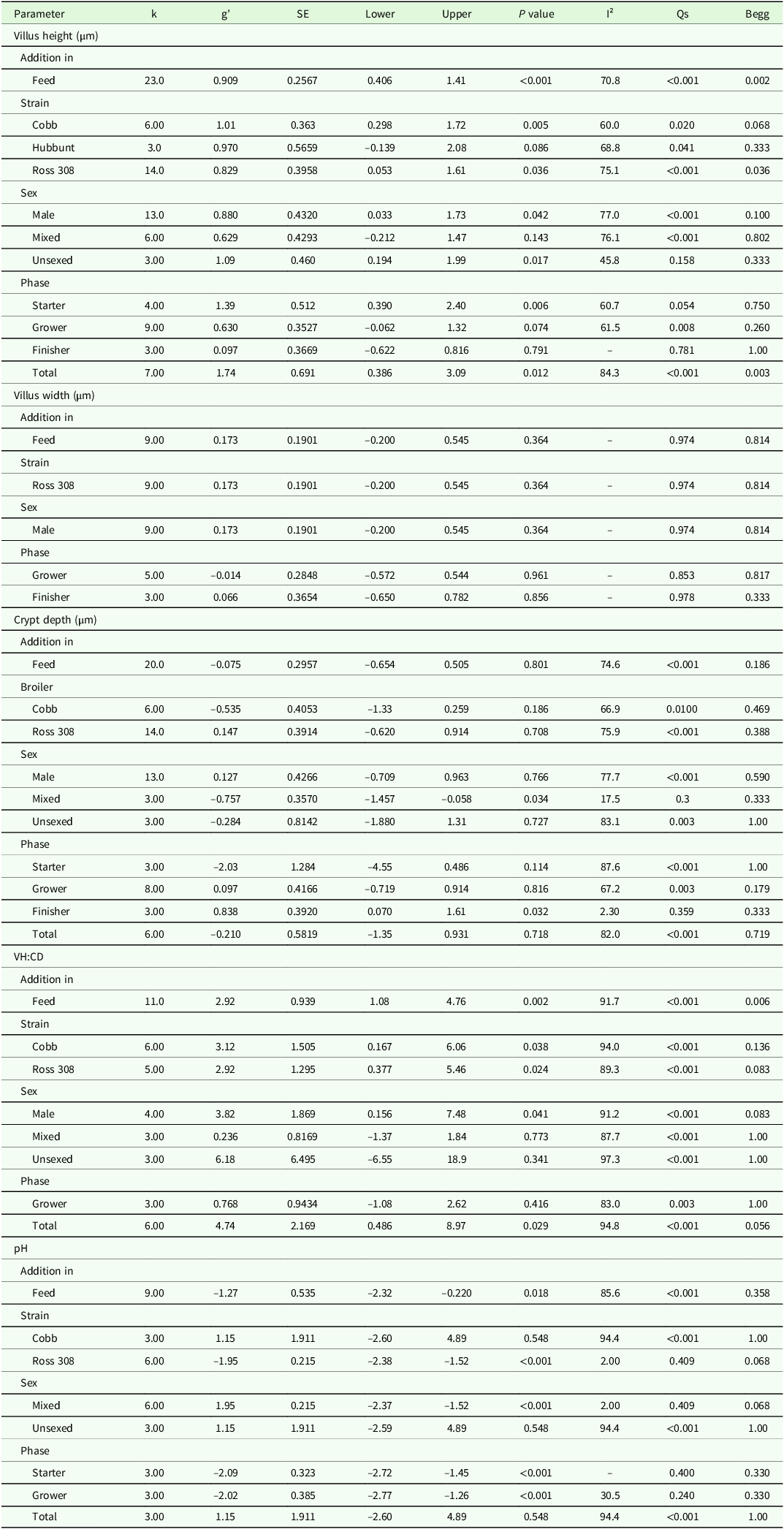
The inclusion of whey protein in feed resulted in a significant increase in VH (0.909 ± 0.2567; P < 0.001; Table 7). A similar significant effect was observed for both the Cobb and Ross 308 strains (g’ > 0.800; P < 0.050). Sex-based analysis indicated a significant response in male and unsexed broiler chickens, particularly during the starter phase and throughout the entire study period (g’ > 0.500; P < 0.050). However, VW did not significantly differ across the analysed categories. In mixed-sex broiler chickens during the finisher period, whey protein supplementation significantly influenced CD (g’ > 0.500; P < 0.050). The VH:CD ratio also significantly improved following whey protein addition, with both the Cobb and Ross 308 strains showing a positive effect (g’ > 0.800; P < 0.050). This effect was consistent across the entire study period and in male broiler chickens (g’ > 0.800; P < 0.050). A decrease in pH was observed following the addition of whey protein to the feed (–1.27 ± 0.535; P = 0.018). This effect was even more pronounced in the Ross 308 strain (–1.95 ± 0.215; P < 0.001). Similarly, mixed-sex broilers and those in the starter and grower phases exhibited the same trend (g’ > 0.800; P < 0.001).
Effects of whey protein supplementation on the intestinal properties of broiler chickens

Begg, significance value from Begg’s test; CD, crypt depth; I², heterogeneity, k, number of studies; Qs, significance value from the Q statistic; SE, standard error from the random-effects model; VH, villus height.
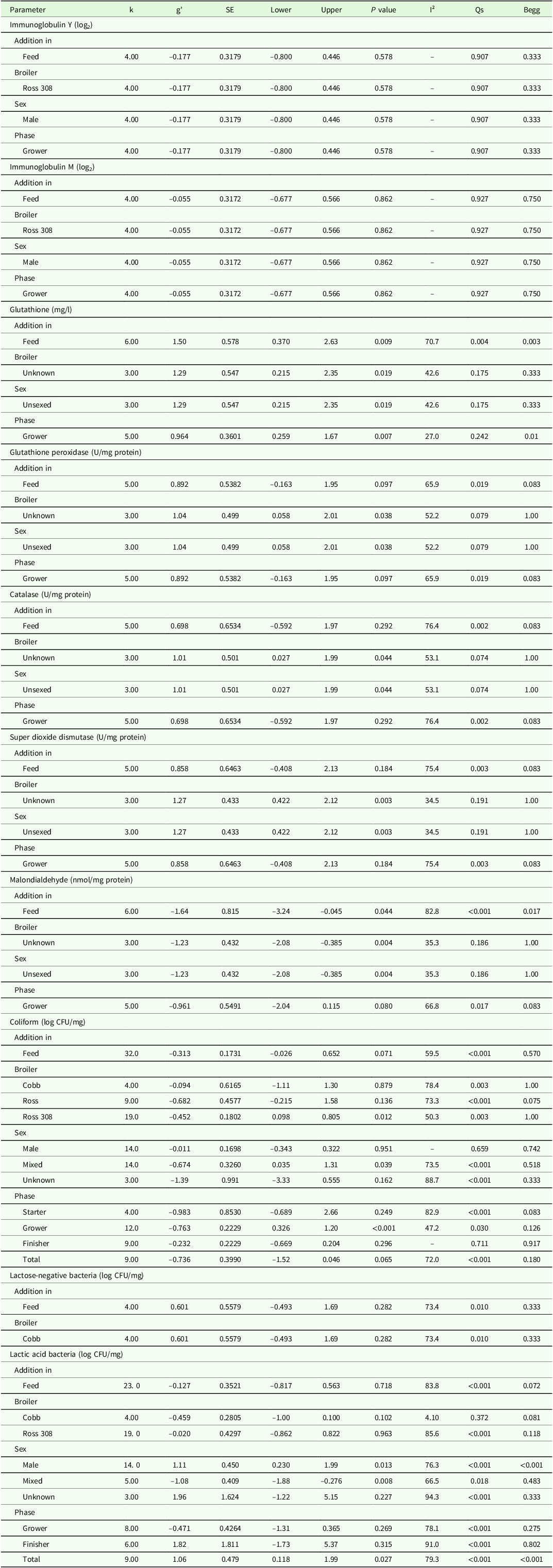
The addition of whey protein to the feed did not generate a substantial positive response in terms of the antioxidant parameters (Table 8). A minor positive effect was observed for CAT (unsexed), GPx (unsexed), GSH (grower phase and unsexed) and SOD (unsexed), all of which were significantly different (g’ > 0.800; P < 0.050). However, the MDA levels significantly decreased (g’ > 0.800; P < 0.050). Nevertheless, the immune responses of IgY and IgM remained unaffected by whey protein supplementation. The inclusion of whey protein reduced total coliform levels in the intestines of Ross 308 broiler chickens (0.452 ± 0.1802; P = 0.012) during the grower phase (0.763 ± 0.2229; P < 0.001). Moreover, LAB significantly increased in male broiler chickens throughout the entire rearing period (g’ > 0.800; P < 0.050). However, LNB exhibited no positive effects in response to whey protein supplementation.
Humoral immunity, antioxidant properties and the microbiota environment associated with the application of whey protein in broiler chicken diets

Begg, significance value from Begg’s test; CFU, colony-forming unit; I², heterogeneity, k, number of studies; Qs, significance value from the Q statistic; SE, standard error from the random-effects model.
Optimization of whey protein addition levels
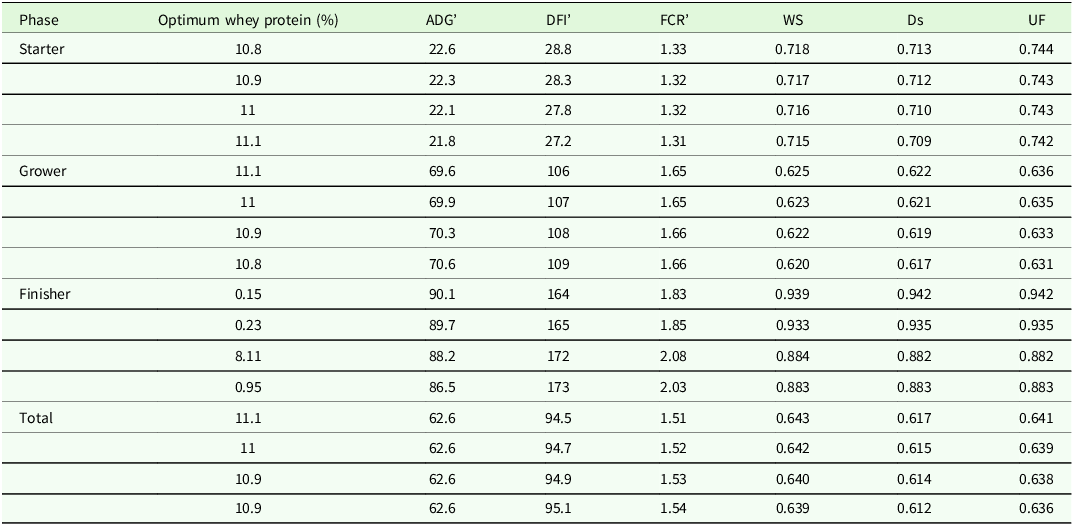
Based on the SOM-RSM model, the optimal levels of whey protein inclusion were determined by evaluating multiple combinations of performance indicators – ADG, DFI and FCR to obtain the highest overall desirability score. The optimal inclusion levels for each growth phase were 11.1% for the starter phase, 10.8% for the grower phase, 0.15% for the finisher phase and 11.1% for the overall rearing period (as shown in Table 9).
Optimization of whey protein addition to broiler chicken feed via a second-order multivariate response surface model (SOM-RSM)

ADG’, predicted average daily gain; Ds, desirability score; DFI’, predicted daily feed intake; FCR’, predicted feed conversion ratio; UF, utility function; WS, weighted score.
Discussion
Effects of whey protein on growth performance
An improvement in the growth performance of broiler chickens given whey protein as an alternative protein source in feed is generally associated with increased nutrient digestibility in broiler chickens (Ashour et al., Reference Ashour, Abd El-Hack, Alagawany, Swelum, Osman, Saadeldin, Abdel-Hamid and Hussein2019). Protein is a crucial nutritional component that serves as a building block for body tissue formation and plays a significant role in the growth of broiler chickens (Gorissen et al., Reference Gorissen, Crombag, Senden, Waterval, Bierau, Verdijk and van Loon2018). Owing to its high protein content, whey protein shows great promise as an alternative feed ingredient for broiler chickens. Numerous studies have been conducted to assess the potential of various whey products as alternative protein sources for broiler chickens and their impact on growth performance (Tsiouris et al., Reference Tsiouris, Economou, Lazou, Georgopoulou and Sossidou2019, Reference Tsiouris, Kontominas, Filioussis, Chalvatzi, Giannenas, Papadopoulos, Koutoulis, Fortomaris and Georgopoulou2020). Whey protein can also increase mineral availability so that it positively affects the growth of broilers (Tsiouris et al., Reference Tsiouris, Kontominas, Filioussis, Chalvatzi, Giannenas, Papadopoulos, Koutoulis, Fortomaris and Georgopoulou2020). Another factor that can encourage the growth of chickens given whey protein is the high and complete content of essential amino acids in whey protein (Gorissen et al., Reference Gorissen, Crombag, Senden, Waterval, Bierau, Verdijk and van Loon2018).
Although whey has growth-promoting properties, its inclusion at high levels may adversely affect growth performance Gharahveysi et al. (Reference Gharahveysi, Bahari, Taheri, Asadzadeh and Vatandour2015) as the use of whey powder as a protein source in broiler diets had a negative impact when the inclusion level exceeded 4%. In agreement with the above study, Tsiouris et al. (Reference Tsiouris, Kontominas, Filioussis, Chalvatzi, Giannenas, Papadopoulos, Koutoulis, Fortomaris and Georgopoulou2020) reported a decrease in broiler chicken body weight following the administration of commercial whey powder products at a level of 5% of the feed. This is very different from the use of commercial whey powder products at levels of 1 and 2%, which actually increases the final weight and FCR of broiler chickens. Notably, dry whey powder and whey protein concentrate contain high lactose contents, so their use as feed ingredients should not be excessive. Notably, poultry have very minimal lactase activity in the intestines; hence, poultry are unable to optimally utilize lactose in dry whey powder and whey protein concentrate (Pineda-Quiroga et al., Reference Pineda-Quiroga, Camarinha-Silva, Borda-Molina, Atxaerandio, Ruiz and García-Rodríguez2018).
In addition to the impact of lactose intolerance in poultry, high concentrations of whey may increase osmolarity due to its sugar and mineral contents. In this case, viscosity or osmolarity is related to the main absorption sites, as high osmolarity values lead to lower absorption rates (Tsiouris et al., Reference Tsiouris, Kontominas, Filioussis, Chalvatzi, Giannenas, Papadopoulos, Koutoulis, Fortomaris and Georgopoulou2020). Another concern related to the use of whey as an alternative protein source in feed is that whey protein may induce kidney disorders when it is used at high levels (Sugiharto et al., Reference Sugiharto, Agusetyaningsih, Widiastuti, Wahyuni, Yudiarti and Sartono2023). Undigested lactose can cause osmotic diarrhoea and interfere with nutrient absorption (Sugiharto et al., Reference Sugiharto, Agusetyaningsih, Widiastuti, Wahyuni, Yudiarti and Sartono2023).
Effects of whey protein on digestibility and nutrient utilization
Optimal nutrient digestibility is one of the conditions for the maximal conversion of feed into broiler meat. Nutritionists have tried a number of methods to increase the digestibility of feed in broiler chickens, such as the administration of feed additives or supplements to feed or drinking water. Whey and its derivative products have been recognized for their potential to increase nutrient digestibility (Nagharchi et al., Reference Nagharchi, Jouybari, Rezaeipour and Dehpanah2010; Pineda-Quiroga et al., Reference Pineda-Quiroga, Camarinha-Silva, Borda-Molina, Atxaerandio, Ruiz and García-Rodríguez2018). Several studies have evaluated the effects of whey on improving the digestibility of protein, fat and minerals in broiler chickens, as reflected in Table 4. Whey protein also has prebiotic properties, supporting beneficial microbial populations such as Bifidobacterium and LAB in the digestive tract (Rackerby et al., Reference Rackerby, Le, Haymowicz, Dallas and Park2024). This microbial shift can reduce intestinal pH, increase digestive enzyme activity and ultimately improve nutrient absorption (Nagharchi et al., Reference Nagharchi, Jouybari, Rezaeipour and Dehpanah2010).
Effects of whey protein on intestinal health and morphology
Whey has been shown to positively influence intestinal morphology, which further supports nutrient digestion and uptake (Zarei et al., Reference Zarei, Lavvaf and Motamedi Motlagh2018). One mechanism contributing to improved nutrient absorption is the reduction in digesta viscosity. However, at relatively high inclusion levels (e.g. 5%), whey can increase digesta viscosity, thereby hindering nutrient absorption and growth, as demonstrated by Tsiouris et al. (Reference Tsiouris, Kontominas, Filioussis, Chalvatzi, Giannenas, Papadopoulos, Koutoulis, Fortomaris and Georgopoulou2020). Conversely, whey inclusion at levels 1 and 2% does not result in increased viscosity and is associated with improved growth and digestibility.
In contrast to the studies above, a study conducted by Paraskeuas et al. (Reference Paraskeuas, Papadomichelakis, Brouklogiannis, Anagnostopoulos, Pappas, Simitzis, Theodorou, Politis and Mountzouris2023) did not show improvements in the total tract apparent digestibility of dry matter, ash, organic matter, aether extracts and crude protein in broiler chickens with the administration of whey products. The reason for the difference in data is not known, but it is very possible that differences in lactose content in whey products can affect digestibility values in broiler chickens (Paraskeuas et al., Reference Paraskeuas, Papadomichelakis, Brouklogiannis, Anagnostopoulos, Pappas, Simitzis, Theodorou, Politis and Mountzouris2023). Whey protein is also able to create ecological and environmental conditions that can support the development of beneficial microorganisms in the digestive tract, especially the intestines of broiler chickens (Gorissen et al., Reference Gorissen, Crombag, Senden, Waterval, Bierau, Verdijk and van Loon2018).
According to Paul et al. (Reference Paul, Pophal, Borwornpinyo and Petitte2003), broiler chickens lack the ability to digest and hydrolyse lactose into glucose and galactose. However, an ex vivo study by Paul et al. (Reference Paul, Pophal, Borwornpinyo and Petitte2003) revealed that the intestine of broiler chickens contains the enzyme β-galactosidase, which can be expressed and has the potential to increase lactose utilization as an energy source in the intestinal mucosa. According to a previous study by Hume et al. (Reference Hume, Kubena, Beier, Hinton, Corrier and Deloach1992), lactose is not significantly converted into short-chain fatty acids until it reaches the caeca. The caeca appear to be more capable of converting lactose than the upper intestinal tract of broiler chickens. In the digestive tract, the microflora is more likely to hydrolyse other substrates in addition to lactose, such as amino acids, LAB and various sugar groups (Hume et al., Reference Hume, Kubena, Beier, Hinton, Corrier and Deloach1992). Lactose is not absorbed in its intact form; therefore, the metabolizable energy obtained from lactose arises from its fermentation by the microflora within the digestive tract of broiler chickens (Hume et al., Reference Hume, Kubena, Beier, Hinton, Corrier and Deloach1992).
An improvement in the ecological conditions of the intestines consequently improves intestinal morphology, as indicated by an increase in intestinal villi, which can improve the capacity for nutrient absorption by the intestines (Ashour et al., Reference Ashour, Abd El-Hack, Alagawany, Swelum, Osman, Saadeldin, Abdel-Hamid and Hussein2019). In addition to improving intestinal function and health, the increased growth performance of broiler chickens receiving whey protein can also be associated with improved physiological conditions (Ashour et al., Reference Ashour, Abd El-Hack, Alagawany, Swelum, Osman, Saadeldin, Abdel-Hamid and Hussein2019), antioxidant status (Afkhami et al., Reference Afkhami, Kermanshahi and Majidzadeh Heravi2020) and immune defence (Kanza et al., Reference Kanza, Sameen, Usman Khan, Ali Shariati and Karapetkovska - Hristova2017). Maintained physiological and health conditions have a positive impact on the efficiency of energy allocation for the maintenance and recovery of chickens from pathophysiological conditions, thus having an impact on the greater allocation of energy for growth.
In general, the use of whey protein as a feed ingredient or additive has positive effects on the intestinal health of broiler chickens. An increase in the population of beneficial bacteria (e.g. LAB) and a decrease in the population of pathogenic bacteria (e.g. E. coli) in the intestine are examples of improvements in intestinal health in broiler chickens due to the administration of whey protein. In general, it can be inferred that the prebiotic and antimicrobial activities of whey protein (Rackerby et al., Reference Rackerby, Le, Haymowicz, Dallas and Park2024) are responsible for improving the population of microorganisms in the intestines of broilers. The prebiotic properties of whey protein can also increase the production of several short-chain fatty acids that are very much needed by enterocytes and can also decrease the pH in the intestines, thus supporting the development of LAB (Ocejo et al., Reference Ocejo, Oporto, Juste and Hurtado2017; Szczurek et al., Reference Szczurek, Alloui and Józefiak2018). The condition of the intestinal ecosystem may be improved by increasing the number of LAB, which could therefore improve intestinal morphology, including increasing the villus height, decreasing the crypt depth and increasing the VH-to-crypt depth ratio (Zarei et al., Reference Zarei, Lavvaf and Motamedi Motlagh2018). Increased intestinal integrity is also positively impacted by the ecosystem conditions and microbiota balance in the intestine, as demonstrated by the serosa, muscle layer and greater mucosa (Kheiri et al., Reference Kheiri, Rahimian and Nasr2015). Whey is an ingredient with various bioactive components that are very beneficial for intestinal health (Sugiharto et al., Reference Sugiharto, Jensen, Jensen and Lauridsen2016). A study conducted by Agusetyaningsih et al. (Reference Agusetyaningsih, Marifah, Widiastuti, Wahyuni, Yudiarti, Sartono and Sugiharto2023) reported that cysteine-rich protein in whey can improve the integrity of the gut cell wall so that it can prevent gut lesions. Furthermore, Ashour et al. (Reference Ashour, Abd El-Hack, Alagawany, Swelum, Osman, Saadeldin, Abdel-Hamid and Hussein2019) reported that the synergistic effect of bioactive components in whey, such as lactalbumin and lactoglobulin, can increase the number of intestinal villi in broiler chickens.
Effects of whey protein on carcase traits and meat quality
The edible portion of a broiler chicken, or carcase, is the portion of the body devoid of feathers, blood, head, feet and internal organs. Typically, the higher the proportion of chicken carcases is, the greater the profit for broiler chicken farmers. There are several explanations for why the use of whey and its derivatives can increase the carcase weight relative to the live weight of broiler chickens. Whey administration can increase muscle protein synthesis and reduce abdominal fat deposition (Ibrahim et al., Reference Ibrahim, Metwally and Khater2015). Increased muscle protein synthesis is closely related to increased nutrient digestibility, especially protein and the very complete essential amino acid content in whey protein. According to (Kanza et al., Reference Kanza, Sameen, Usman Khan, Ali Shariati and Karapetkovska - Hristova2017), the amino acid profile of whey proteins is similar to that of skeletal muscles, so they are directly involved in muscle biosynthesis. The use of whey protein can also balance blood sugar levels with energy sources, thereby helping the body burn fat (Ibrahim et al., Reference Ibrahim, Metwally and Khater2015).
Currently, consumers are increasingly aware of the importance of the quality of broiler chicken meat that they consume. Meat with low fat, cholesterol and low-density lipoprotein (LDL) contents is generally preferred by consumers over high fat, cholesterol and LDL contents in broiler chicken meat. Consumers believe that cholesterol and LDL in meat can have negative impacts on health related to atherosclerosis. In response, farmers must strive to improve the quality of meat produced to meet consumer demand. The quality of broiler chicken meat generally includes physical, chemical and biological qualities as well as sensory quality. Indeed, increasing the protein content and reducing the fat content in meat can increase the water-holding capacity, water content and redness of broiler chicken meat containing whey protein (Ma’rifah et al., Reference Ma’rifah, Agusetyaningsih, Sarjana, Kismiati and Sugiharto2023). With respect to the effect of whey protein on fat reduction, Hilmi et al. (Reference Hilmi, Khirzin, Yannuarista, Prastujati and Khusna2021) linked this effect to the capacity of whey protein, a prebiotic that can increase the population of LAB in the digestive tract of broiler chickens. An increase in LAB count can prevent fat biosynthesis in the liver through the development of lipase enzymes so that fat and cholesterol do not accumulate in the meat (Sugiharto et al., Reference Sugiharto, Jensen, Jensen and Lauridsen2016). LAB can also produce cholesterol reductase enzymes, which convert cholesterol into coprostanol, a type of sterol that cannot be absorbed by the small intestine (Sugiharto et al., Reference Sugiharto, Jensen, Jensen and Lauridsen2016). Furthermore, LAB can increase the process of cholesterol catabolism into primary bile acids into various secondary bile acids with deconjugation capabilities (Paraskeuas et al., Reference Paraskeuas, Papadomichelakis, Brouklogiannis, Anagnostopoulos, Pappas, Simitzis, Theodorou, Politis and Mountzouris2023). This effect causes a decrease in bile acid levels in the intestine so that the digestion and absorption of fatty acids are reduced. The use of whey protein has also been reported to improve the antioxidative stability of broiler chicken meat (Sugiharto et al., Reference Sugiharto, Jensen, Jensen and Lauridsen2016). In this case, certain proteins and peptides in whey protein (especially hydrophobic and aromatic amino acids) can function as antioxidants, thus having a positive effect on the antioxidative stability of broiler chicken meat (Sugiharto et al., Reference Sugiharto, Jensen, Jensen and Lauridsen2016; Paraskeuas et al., Reference Paraskeuas, Papadomichelakis, Brouklogiannis, Anagnostopoulos, Pappas, Simitzis, Theodorou, Politis and Mountzouris2023).
Effects of whey protein on humoral immunity and antioxidant properties
The intestine is an organ that has dual roles as both a digestive organ and an immune organ (Sugiharto et al., Reference Sugiharto, Jensen, Jensen and Lauridsen2016). To function properly, intestinal health must be maintained by broiler chickens. Various factors can affect intestinal health, one of which is the balance of microorganisms in the intestine (Sugiharto et al., Reference Sugiharto, Jensen, Jensen and Lauridsen2016). Maintaining the balance of microorganisms in the gut can guarantee the preservation of its morphology and integrity, thereby promoting optimal intestinal function (Sugiharto et al., Reference Sugiharto, Jensen, Jensen and Lauridsen2016). Notably, the development of lymphoid tissue and organs in the intestine is significantly influenced by the balance of microorganisms in the intestine, which has a significant effect on the immune system and general health of broiler chickens (Sugiharto et al., Reference Sugiharto, Jensen, Jensen and Lauridsen2016). After the ban on the use of antibiotic growth promoters in broiler chickens, various methods have been used by broiler farmers to maintain the balance of microorganisms in the intestine, one of which involves providing whey and its derivatives as feed ingredients, feed additives or feed supplements (Sugiharto et al., Reference Sugiharto, Jensen, Jensen and Lauridsen2016). Studies have been conducted by several researchers to determine the effects of the use of whey and its derivatives on the ecosystem conditions and morphology of the intestines of broiler chickens (Sugiharto et al., Reference Sugiharto, Jensen, Jensen and Lauridsen2016).
The immune system protects broiler chickens from pathogen infections that can cause pathophysiological conditions (Sugiharto et al., Reference Sugiharto, Jensen, Jensen and Lauridsen2016). Various methods can be used by farmers to improve the immune system in broiler chickens, one of which is through dietary intervention (Kanza et al., Reference Kanza, Sameen, Usman Khan, Ali Shariati and Karapetkovska - Hristova2017). This effort is very important, along with the prohibition of the use of antibiotic growth promoters in broiler chicken production (Kanza et al., Reference Kanza, Sameen, Usman Khan, Ali Shariati and Karapetkovska - Hristova2017). One dietary intervention that can be performed is the administration of whey protein to broiler chickens. Several studies have been conducted, including the use of whey protein concentrate as a feed additive (0.2% feed) Kanza et al. (Reference Kanza, Sameen, Usman Khan, Ali Shariati and Karapetkovska - Hristova2017). They reported that supplementation with whey protein concentrate increased the levels of leukocytes and platelets in broiler chickens. Previous research by Gülşen et al. (Reference Gülşen, Coşkun, Umucalilar, İnal and Boydak2002) using dried whey powder as a feed ingredient (3.85% feed) also revealed an increase in the plasma cell counts of broilers. Plasma cells are differentiated B lymphocyte white blood cells that secrete immunoglobulins. Therefore, increasing plasma cell counts has a positive effect on the body defences of broilers. In line with the above study, Szczurek et al. (Reference Szczurek, Szymczyk, Arczewska-Włosek, Józefiak and Alloui2013) reported that the use of 32 g/kg whey protein concentrate can increase the number of lymphocytes in broiler chickens. In addition, whey protein is associated with increased weight of the spleen, which reflects the improved immune properties of broiler chickens (Szczurek et al., Reference Szczurek, Szymczyk, Arczewska-Włosek, Józefiak and Alloui2013). Furthermore, the administration of 0.02% dry whey powder increased the relative weight of the spleen and the titre of antibodies against Newcastle vaccine disease (Kheiri et al., Reference Kheiri, Rahimian and Nasr2015). Unlike the above study, a study on laying hens by Bouassi et al. (Reference Bouassi, Libanio, Mesa, Gil, Tona and Ameyapoh2020) reported that the administration of 250 or 500 ml of liquid whey per litre of drinking water decreased the number of white blood cells and lymphocytes and decreased the concentration of immunoglobulin, especially IgA and IgG. These authors confirmed that the decrease in immune cells does not mean that the animals experienced health conditions but is an indication of a lower pathogen load due to the administration of whey protein to laying hens.
To date, few studies have investigated the effects of whey protein administration on the immune system in broiler chickens. However, in general, several proteins, such as alpha-lactalbumin and beta-lactoglobulin, play very important roles in boosting the immune system of animals (Sugiharto et al., Reference Sugiharto, Jensen, Jensen and Lauridsen2016). Furthermore, Ma et al. (Reference Ma, Zhang, Ma, Chen, Yang, Yang, Yang, Tian, Yu, Ma and Zhou2021) reported that the three main proteins in whey protein (i.e. alpha-lactalbumin, beta-lactoglobulin and serum albumin) can improve the development of immune tissues and organs so that they can function optimally in producing immune cells. Similarly, Szczurek et al. (Reference Szczurek, Szymczyk, Arczewska-Włosek, Józefiak and Alloui2013) reported that beta-lactoglobulin was capable of increasing the proliferation of spleen lymph nodes and stimulating the cellular glutathione concentration in spleen cells. In addition to the proteins above, Beaulieu et al. (Reference Beaulieu, Dupont and Lemieux2006) noted that lactoferrin and Ig are also abundant in whey protein and play a very important role in stimulating the immune system in animals. Beaulieu et al. (Reference Beaulieu, Dupont and Lemieux2006) conducted a comprehensive review of the mechanisms by which each active ingredient in whey protein enhances the immune system in animals. Indeed, whey protein generally boosts innate immunity by increasing macrophage activity and interleukin-8 production, which strengthens the immune system (Beaulieu et al., Reference Beaulieu, Dupont and Lemieux2006). The ability of whey protein to increase the relative abundance of beneficial bacteria (such as LAB) and inhibit the growth of harmful bacteria is also closely related to the ability of whey protein to maintain the intestinal ecology, thus having a positive impact on the development of immune tissue and organs in the intestine (Ma et al., Reference Ma, Zhang, Ma, Chen, Yang, Yang, Yang, Tian, Yu, Ma and Zhou2021).
Physiological conditions are the main requirements for the optimal growth of broiler chickens. Notably, triglycerides, cholesterol and LDL in the blood decrease with the administration of whey protein to broiler chickens (Kheiri et al., Reference Kheiri, Rahimian and Nasr2015). LDL is considered bad cholesterol and can lead to atherosclerosis or the build-up of plaque (fatty deposits) in the arteries of chickens. In general, atherosclerosis can reduce blood flow so that the transport of various important nutrients and respiratory gases for metabolic processes is hampered. The effect of reducing triglycerides, cholesterol and LDL by whey protein is likely caused by reduced lipid absorption through the intestine by binding bile acids, which causes increased cholesterol elimination and the synthesis of new bile acids from the hepatic liver (Ashour et al., Reference Ashour, Abd El-Hack, Alagawany, Swelum, Osman, Saadeldin, Abdel-Hamid and Hussein2019). The high level of calcium in whey protein is also likely to play a role in reducing triglycerides, cholesterol and LDL in the blood of broiler chickens. In this case, the production of calcium-fatty acid soap in the gut has been linked to whey protein consumption, which lowers the absorption of fat (Ashour et al., Reference Ashour, Abd El-Hack, Alagawany, Swelum, Osman, Saadeldin, Abdel-Hamid and Hussein2019). Furthermore, whey protein can affect lipid metabolism by inhibiting cholesterol absorption in the intestine through the action of its components, such as sphingolipids and beta-lactoglobulin (Ashour et al., Reference Ashour, Abd El-Hack, Alagawany, Swelum, Osman, Saadeldin, Abdel-Hamid and Hussein2019). In addition, the content of branched-chain amino acids in whey protein is often associated with additional lipid-lowering processes, such as stimulation of lipoprotein lipase and downregulation of genes that are important for cholesterol absorption and fatty acid transport (Amirani et al., Reference Amirani, Milajerdi, Reiner, Mirzaei, Mansournia and Asemi2020). With respect to the ability of whey protein to lower blood glucose levels in particular, it is possible that whey protein increases postprandial serum insulin levels (Salehi et al., Reference Salehi, Gunnerud, Muhammed, Östman, Holst, Björck and Rorsman2012). Such conditions decrease postprandial hyperglycaemia and could improve the insulin response, which in turn lowers blood glucose levels (Amirani et al., Reference Amirani, Milajerdi, Reiner, Mirzaei, Mansournia and Asemi2020). In line with this study, Salehi et al. (Reference Salehi, Gunnerud, Muhammed, Östman, Holst, Björck and Rorsman2012) confirmed that whey protein exerts its insulinogenic effect by preferentially increasing the plasma concentrations of certain amino acids (branched-chain amino acids), glucose-dependent insulinotropic polypeptide and glucagon-like peptide 1.
Increasing the activity of antioxidant enzymes such as CAT, SOD and GPx, which constitute the first-line antioxidant defence system, is very useful in offsetting oxidative stress and protecting cells from DNA damage (Ashour et al., Reference Ashour, Abd El-Hack, Alagawany, Swelum, Osman, Saadeldin, Abdel-Hamid and Hussein2019). Furthermore, because of its antioxidant capacity, the lactoferrin contained in whey protein is capable of binding metal ions and thus blocking their catalytic participation in membrane damage (Szczurek et al., Reference Szczurek, Szymczyk, Arczewska-Włosek, Józefiak and Alloui2013). MDA is an end product of the chain reaction of lipid peroxidation and a marker of oxidative stress. The administration of whey protein has been reported to reduce MDA production in the liver and serum of broilers (Ashour et al., Reference Ashour, Abd El-Hack, Alagawany, Swelum, Osman, Saadeldin, Abdel-Hamid and Hussein2019; Afkhami et al., Reference Afkhami, Kermanshahi and Majidzadeh Heravi2020). This decrease in MDA is a consequence of the improvement in antioxidant status in the body of broiler chickens and thus decreases propagation of the radical-mediated peroxidation reaction and therefore reduces MDA formation (Szczurek et al., Reference Szczurek, Szymczyk, Arczewska-Włosek, Józefiak and Alloui2013). In addition to lactoferrin, other protein components in whey also show antioxidant activity, namely, beta-lactoglobulin and alpha-lactalbumin. However, the antioxidant capacity of both is not as high as that of lactoferrin (Hernández-Ledesma et al., Reference Hernández-Ledesma, Dávalos, Bartolomé and Amigo2005).
ALT is an enzyme that is abundantly produced in the liver, and increased ALT levels are an indication of liver damage (Tomovska et al., Reference Tomovska, Dimitrovska, Presilski and Velkova2016). Whey protein supplementation has been reported to reduce ALT levels in the liver (Afkhami et al., Reference Afkhami, Kermanshahi and Majidzadeh Heravi2020). In addition to acting as an antioxidant, whey has detoxification properties because of its role in the synthesis of GSH, an intracellular antioxidant. Whey contains cysteine, which, when combined with glutamate and glycine, forms GSH. Indeed, GSH contains thiol (sulfhydryl) groups, which act as active reducing agents to prevent oxidation and damage to liver tissue (Tomovska et al., Reference Tomovska, Dimitrovska, Presilski and Velkova2016).
Conclusion
The meta-analysis confirmed that whey has strong potential as an alternative protein source in broiler chicken feed with the optimal percentage of whey protein for each growth phase of broiler chickens as follows: 11.1% for the starter phase, 10.8% for the grower phase and 0.15% for the finisher phase. Bioactive components such as Lactoferrin can enhance broiler chicken health and performance, particularly by supporting gut health and immune function. Additionally, whey proteins contribute to efficient muscle biosynthesis and improved antioxidant status. However, its high lactose content may limit its application, as broilers have low lactase activity and cannot effectively digest lactose.
Acknowledgements
The authors sincerely appreciate Brawijaya University and Diponegoro University for their unwavering support and valuable contributions throughout this study. Their deepest gratitude also goes to the Research Center for Animal Husbandry, National Research and Innovation Agency (BRIN), for their invaluable guidance in shaping the concept and design of this research.
Author contributions
SS contributed to conceptualization, supervision, investigation, writing the original draft and reviewing and editing the manuscript. DNA and JAI were responsible for project administration, methodology, investigation, visualization, writing the original draft and reviewing and editing the manuscript. TU and MMS handled data curation, methodology, formal analysis, visualization and illustration, writing the original draft and reviewing and editing the manuscript.
Funding statement
The funding follows the 2025 grant financing scheme of Universitas Brawijaya.
Competing interests
The authors declare the absence of conflicts of interest.
Ethical standards
This study did not involve experimental subjects from animals or people; hence, ethical issues were unnecessary. Consequently, this study adhered to the protocols for performing a meta-analysis.


 Open access

