INTRODUCTION
Research on the decision-making process is still concentrated in the United States, Canada, and Europe, with few analyses arising from Latin America (Reference BergmanBergman, 2018; Reference Rengifo, Ávila, Gélvez, Ramírez and MoraRengifo et al., 2019). These studies are of utmost importance for the region, as many Latin American countries have been implementing major reforms in order to make their criminal justice system more accusatorial (Reference PrillamanPrillaman, 2000). These reforms started some decades ago, when the region left behind authoritarian regimes to embrace democracy. As the rule of law requires a greatly strengthened judicial system (Reference DodsonDodson, 2002, p. 201), research on this topic is needed to assess how countries are guaranteeing a functioning democratic criminal justice system. In Brazil, these reforms came into force in the last decade, among which the Custody Hearings stand out.
Custody Hearings could be described as the initial appearance hearings, created to assess the legality of the arrest and the cautionary measures that ought to be imposed on a suspect. Implemented in 2015 by the Brazilian National Council of Justice (CNJ, with the Portuguese initials), these hearings require that those caught committing a crime to be brought before a judge, a prosecutor, and a defender within 24 h to assess the need for pretrial detention (Reference Jesus FilhoJesus Filho, 2017). The purpose is to reduce provisional detentions (Reference Azevedo, Sinhoretto and LimaAzevedo et al., 2017), offer prompt responses to police violence (Institute for Defense of the Right to Defense [IDDD] 2017, 2019), and turn a traditionally inquisitorial phase into an accusatorial one (Reference Lages and RibeiroLages & Ribeiro, 2019).
To understand how decision-making works at the Custody Hearing, we use Donald Black's theory as a departing point. Reference BlackBlack (1976) conceptualizes law as a quantitative variable that could be explained by five dimensions (stratification, morphology, culture, organization, and social control). As this theory remains a vital reference in the United States (Reference Ylang and HoltfreterYlang & Holtfreter, 2019) and Latin American (Reference Ribeiro and DinizRibeiro & Diniz, 2020), our first goal is to test this approach with data gathered in Brazil.
Nevertheless, given the idiosyncrasies of the Brazilian Criminal Justice System, we argue that adaptations of Donald Black's theory are necessary. Reference BlackBlack's (1976) framework was created for adversarial systems while in Brazil the judicial system remains essentially inquisitorial (Reference KhaledKhaled Jr, 2010). Despite the latest attempts to make it more accusatorial (Reference Ballesteros, Álvaro Roberto Antanavicius, André Machado, Andréa De Boni, Antonio Pedro, Lopes, Caíque Ribeiro and CamilinBallesteros et al., 2019), the criminal proceeding places heavy emphasis on the discovery of the truth about offenses and offenders, a major characteristic of inquisitorial systems (Reference Kant de Lima and MouzinhoKant de Lima & Mouzinho, 2017).
In addition, we believe that Reference BlackBlack (1976) neglected a vital aspect of the decision-making process: the notion that courtrooms behave as “inhabited institutions” (Reference UlmerUlmer, 2019). Despite Reference BlackBlack's (1976) recognition that the law varies within the internal structure of groups, this argument is devoted to understanding how defendants create collectives to commit crimes. He only mentions that the degree of bureaucratization and centralization interferes with the quantity of law that a case receives, without detailing how and why the relationship between courtroom members predicts the outcomes of a hearing or a trial.
When managing a case, defenders, judges, and prosecutors need to consider the law (Reference BlackBlack, 1976), the bureaucratic settings (Reference Ulmer and KramerUlmer & Kramer, 1996), their stock of knowledge of what constitutes a normal crime (Reference SudnowSudnow, 1965), and their friendship with one another (Reference MetcalfeMetcalfe, 2016). Since these variables are likely to change from case to case, the court becomes an inhabited institution, where people and rules interact to transform the inputs (crimes) into outputs (sentences) (Reference UlmerUlmer, 2019). Playing a fair game, judges, defenders, and prosecutors can achieve a particular decision that “may rest upon legally impeccable rationale, at the same time, it may be rendered nugatory or self-defeating by contingencies imposed by aspects of the social reality of which lawmakers are themselves unaware” (Reference BlumbergBlumberg, 1966, p. 17). In sum, inhabited institutions imply seeing courtrooms as places where fair games are played (Reference UlmerUlmer, 2019).
Brazilian courtrooms should be considered inhabited institutions, as the actors working therein are embodied with routines and interests that are often incompatible with the rules prescribed by the Criminal Procedural Code or even with the idea of fair justice (Reference SaporiSapori, 1995). Prosecutors and judges are not elected or held accountable by mechanisms of civilian oversight (Reference KercheKerche, 2018). They are civil servants, recruited from the elite segments, working alongside each other for multiple years, given how their careers are organized and managed (Reference de Almeidade Almeida, 2014). Given these features, the second goal of this paper is to combine Reference BlackBlack's (1976) original framework with Reference UlmerUlmer's (2019) idea of courtrooms as inhabited institutions to understand how decision-making works in the Brazilian criminal justice system.
To test the validity of this new approach, we use primary data gathered on initial appearance hearings (Custody Hearings) in 13 cities distributed across nine Brazilian states in 2018. The initial appearance hearing is an important point in the flow of the criminal justice system, since pretrial detention decisions increase the likelihood of charges, convictions, and longer imprisonments, anticipating the final judicial outcome (Reference Bechtel, Holsinger, Lowenkamp and WarrenBechtel et al., 2017).
THE BEHAVIOR OF LAW
Reference BlackBlack's (1976) theory relies on the assumption that the quantity of law varies in time and space, according to the social geometry of the citizens involved in a given conflict. Consequently, each decision taken throughout the criminal justice system (arrest, pretrial detention, clearance, and conviction) represents the behavior of law (Reference Ribeiro and DinizRibeiro & Diniz, 2020), that ought to be measured and explained by five quantitative dimensions, namely: stratification, morphology, culture, organization, and social control.
Stratification represents the “vertical aspect of social life” verified by the “unequal distribution of material conditions of existence” (Reference BlackBlack, 1976, p. 11). This dimension is measured by the characteristics of those involved in a given conflict, such as race, gender, age, income, and neighborhood disadvantage levels (Reference Baumer, Messner and FelsonBaumer et al., 2000). Studies testing this dimension display mixed results, depending on the decision in focus—police report, pretrial detention, charge, and conviction (Reference Kurlychek and JohnsonKurlychek & Johnson, 2019). Crimes committed in wealthier neighborhoods show higher chances of an effective response from the criminal justice system (Reference Colon, Kavanaugh, Hummer and AhlinColon et al., 2018).
In Brazil, Reference Graham, Borg and MillerGraham et al. (2013) found that nonwhite and low-income individuals are less likely to mobilize police forces and courts to manage their criminal problems than wealthier citizens. In criminal trials, race is correlated with the presence of private attorneys (Reference AdornoAdorno, 1995). Since they would be mostly available to white defendants (Reference Costa RibeiroCosta Ribeiro, 1999), black defendants have greater odds of being convicted (Reference AdornoAdorno, 1995; Reference Costa RibeiroCosta Ribeiro, 1999). Reference Lages and RibeiroLages and Ribeiro (2019) found that young, black, males are more likely to receive pretrial detention, even when controlling for crime attributes.
Morphology indicates “the horizontal aspect of how individuals are distributed in relation to each other” (Reference BlackBlack, 1976, p. 1). “The accusatory system varies directly in accordance with distance,” since “strangers are more prone to opposing each other as adversaries” (p. 42). The closer the relationship between offenders and victims, the less likely the case is to receive attention from the criminal justice system (Ylang & Holtfreter, 2019). Evidence to this proposition is mixed. While homicides involving acquaintances show a much higher likelihood of clearance and conviction (Reference RegoecziRegoeczi, 2018), sexual aggressions perpetrated by family members have the same odds of being recorded as those involving strangers (Reference Felson and ParéFelson & Paré, 2005). In Brazil, Reference VargasVargas (2007) found that rapes between acquaintances are more likely to be cleared, although being less likely to be convicted. Reference Ribeiro and DinizRibeiro and Diniz (2020) also claimed that homicides between acquaintances are more likely to be cleared in a shorter length of time, although this variable does not interfere with the conviction rates.
Culture captures the symbolic aspect; the “ideas about reality, conceptions on what should be done, on right and wrong” (Reference BlackBlack, 1976, p. 61). According to Black, there are two types of culture. The first is related to the individual's formal education (level of schooling) and the other is more associated with sophistication or social capital. The author predicts that the more educated the offender, the lesser the perceived gravity of their offense. This statement would explain the milder punishments applied to college degree holders in economic crimes (Reference Will, Handelman and BrothertonWill et al., 2013).
In Brazil, few studies have tested this dimension, given the scarcity of data on the educational attainment of criminals (Reference VargasVargas, 2014). Reference Graham, Borg and MillerGraham et al. (2013, p. 50) reported that citizens “with higher educational attainment (cultural sophistication) have greater odds of reporting victimizations” for all crimes. Reference LagesLages (2019) found that offenders with more than 9 years of schooling are less prone to receive pretrial detention, as they are able to understand the judicial questions and to respond to them properly.
Organization entails the “capacity for collective action” (Reference BlackBlack, 1976, p. 85). The author foresees that law enforcement varies according to the nature of the institutions involved (whether public or private) and the associations supporting the practice of crime (whether formal or informal). Contesting this view, Reference Gottfredson and HindelangGottfredson and Hindelang (1979) argue that the number of offenders does not interfere in the likelihood of a police record. The severity of the offense would instead be the best predictor of a response from the criminal justice system. Thus, crimes against persons are more likely to result in conviction than those against the property.
This explanation remains valid for understanding the factors influencing the likelihood of police response (Reference Xie and BaumerXie & Baumer, 2019). According to Ylang and Holtfreter (2019), a crime with several victims is more likely to result in a police record and to achieve a conviction. In addition, the higher the number of violators involved in a given offense, the lower the likelihood of clearance and conviction. In Brazil, this hypothesis was verified by Reference Graham, Borg and MillerGraham et al. (2013), who found no relationship between political group membership and odds of the crime report. On the other hand, Reference OliveiraOliveira (2018) claims that serious crimes are more likely to result in imprisonment.
Social control constitutes the “normative aspect of social life, which defines and responds to deviant behavior” (Reference BlackBlack, 1976, p. 105). It is synonymous with respectability, “a measure of how a person is recognized by society” (p. 111). The author expects individuals with criminal records to be more vulnerable to the law than those without. Recent studies confirm this prediction, as those with criminal records are more likely to be arrested, held in pretrial detention, and convicted (Reference Kurlychek and JohnsonKurlychek & Johnson, 2019; Reference Kutateladze and LawsonKutateladze & Lawson, 2017). In Brazil, defendants with previous criminal records have greater odds of surviving throughout the flow of the criminal justice system (Reference VargasVargas, 2014), being more prone to pretrial detention (Reference Jesus FilhoJesus Filho, 2017), charges (Reference Ribeiro and LimaRibeiro & Lima, 2020), and convictions (Reference RibeiroRibeiro, 2010) for all types of offenses (Reference Costa and de Oliveira JúniorCosta & de Oliveira Júnior, 2016).
Reference Gottfredson and HindelangGottfredson and Hindelang (1979) understand that social control exercised in the subjects' private life could also be measured by the place and time where crimes happen. Offenses perpetrated in public spaces and at night—when informal social control mechanisms are weakened—are less likely to be recorded by the police, since it is easier for the perpetrator to rob and run. Recent studies confirm that crimes happening late at night are less likely to result in arrests and convictions due to the absence of witnesses, although electronic surveillance (such as closed-circuit television) improves these rates (Reference Dowling and MorganDowling & Morgan, 2019). There are few studies in Brazil testing the effect of these variables on the criminal justice decision-making process. Reference Ribeiro and LimaRibeiro and Lima (2020) found that homicides committed in public spaces or late at night are less likely to be cleared than those taking place in private spaces and during the day.
There is a general agreement upon the reputation of Reference BlackBlack's (1976) theory for understanding the decision-making process in the criminal justice system (Reference Ylang and HoltfreterYlang & Holtfreter, 2019). This framework has encouraged empirical tests, debates, and discussions regarding the role of legal and extralegal variables, although its validation remains controversial for certain crimes (such as homicide), outcomes (such as conviction), and organizational settings (such as juvenile justice) (Reference Chappell and MaggardChappell & Maggard, 2020). In Brazil, only a few studies have sought to understand the behavior of law through Donald Black's lenses (Reference Graham, Borg and MillerGraham et al., 2013; Reference OliveiraOliveira, 2018; Reference Ribeiro and DinizRibeiro & Diniz, 2020). Notwithstanding, we argue herein that this theory has an important (although limited) explanatory power given the inquisitorial characteristics of the Brazilian Criminal Justice System.
DECISION-MAKING IN AN INQUISITORIAL SYSTEM
Adversarial and inquisitorial models differ in terms of how the truth is ascertained, the role played by judges, and the expected outcome (Reference Ballesteros, Álvaro Roberto Antanavicius, André Machado, Andréa De Boni, Antonio Pedro, Lopes, Caíque Ribeiro and CamilinBallesteros et al., 2019). In the adversarial system, there is no single truth to be found and proven. Defense and prosecution alike participate in the inquiry and agree on the validity of evidence to be submitted before the judge or jury for a decision (Reference MoohrMoohr, 2004). The judge ought to counterbalance the powers between the prosecution and the defense (Reference Gunn and MevisGunn & Mevis, 2018). Since it is assumed to be impossible to have a verdict proving the “truth” (Reference NewmanNewman, 2019), the adversarial system searches for “proofs” (Reference Sanders and YoungSanders & Young, 2012). The trial is intended to produce evidence proving the suspect's responsibility “beyond a reasonable doubt” throughout the cross-examination (Reference TsurTsur, 2017).
Inversely, the inquisitorial system searches for the “truth” throughout a secretive investigation (Reference Kant de LimaKant de Lima, 2010). The judge plays a preponderant role, deciding on what evidence will be presented at the trial (Reference Sanders and YoungSanders & Young, 2012), and directly examining defendants, witnesses, and experts (Reference Gunn and MevisGunn & Mevis, 2018). The trial is a test (conducted by the judge) of the precision of the prosecutors' requests, and it is the judges' responsibility to arrive at the “truth” and announce the “correct” result (Reference MoohrMoohr, 2004).
In both systems, prosecutors and judges are state officials. In the adversarial system, they are limited “by the equality granted to the parties, by the jury and, subsequently, by the defendants' constitutional rights” (Reference MoohrMoohr, 2004, p. 193). Instead, the inquisitorial system is characterized by partiality in favor of the State (Reference Gunn and MevisGunn & Mevis, 2018). The judges' role is not to ensure equal conditions to defense and prosecution. They have unlimited powers to investigate and decide what is in the best “interest of the State,” even if it means ignoring the defense's pleas (Reference Marrona, Kerche, Kerche, Júnior and SãoMarrona & Kerche, 2018). The defender's role is to challenge the prosecution's case, without much hope of convincing the judge to decide in an opposite direction (Reference GodoiGodoi, 2019).
The inquisitorial system in Brazil
The institutionalization of the Brazilian Criminal Justice dates back to the 1941 Code of Criminal Procedure, which created the police structure and the judicial organizations and duties. According to this law, after the crime is recorded (usually, registered by the Military Police), the judicial police (nowadays, the Civil Police) carry out a series of investigatory procedures which should lead to the discovery of the “truth about the offender and the offense” (Reference Kant de LimaKant de Lima, 2004). To do so, the police deploy several secretive activities, such as interviewing police officers in charge of the area where the crime was committed; questioning character witnesses (who will offer their perceptions about offenders and victims); and interrogating eyewitnesses (Reference Kant de LimaKant de Lima, 2010). These police activities are codified by an administrative procedure known as police inquiry (Inquérito Policial), managed by police officers with a law degree, referred to as Delegados (Reference Kant de Lima and MouzinhoKant de Lima & Mouzinho, 2017). They are a remnant of colonial times, when local judges were not widely available, enduring to this date the chief responsible for criminal indictments (Reference FloryFlory, 2015).
In sum, judges, prosecutors, and defenders are excluded from police inquiries (Reference Kant de Lima and MouzinhoKant de Lima & Mouzinho, 2017), playing a passive role in waiting for police indictments to be presented (Reference Kant de LimaKant de Lima, 2004). Trials start once the prosecutor presents charges against the suspect based on the final police report (Reference FloryFlory, 2015). In this stage, all the information embedded in the police inquiry must be reproduced to guarantee the accusatorial principles (Reference Kant de LimaKant de Lima, 2010). Judges seek the judicial truth and to do so they interview suspects, witnesses, and experts, essentially reproducing the work previously carried out by the delegados.
During trials, prosecutors, and defenders cannot interrogate witnesses, suspects, and experts directly, as judges have the right to filter the questions, which in their perspective best suit the “discovery of truth” (Reference Kant de Lima and MouzinhoKant de Lima & Mouzinho, 2017). As a result, judges are the driving force behind the trial, instead of balancing out defense and prosecution, a characteristic inherent to inquisitorial procedures (Reference KhaledKhaled Jr, 2010). The criminal proceeding only seeks to provide a degree of accusatorial features to a procedure that is in nature inquisitorial (Reference Ballesteros, Álvaro Roberto Antanavicius, André Machado, Andréa De Boni, Antonio Pedro, Lopes, Caíque Ribeiro and CamilinBallesteros et al., 2019; Reference Kant de LimaKant de Lima, 2004).
Since the inception of the 1941 Code of Criminal Procedure, there have been attempts to make it more accusatorial. The Custody Hearings, analyzed in this paper, are part of this renovation (Reference Ballesteros, Álvaro Roberto Antanavicius, André Machado, Andréa De Boni, Antonio Pedro, Lopes, Caíque Ribeiro and CamilinBallesteros et al., 2019). Before they were introduced, arrestees waited for days or even months until the first hearing with a judge would happen. This procedure was carried out mostly after the indictment followed by the charges (IDDD, 2017, 2019). However, we argue that this renovation, although formally guided by accusatorial principles, remains essentially inquisitorial, because the judges, defenders, and prosecutors use their stock of knowledge from previous experiences to handle the Custody Hearing decision-making.
As highlighted in the introduction, an utmost variable overlooked in “The Behavior of Law” is the organizational setting of the courtroom (Reference UlmerUlmer, 2019), since it pushes judges, prosecutors, and defenders toward the development of a routine of thought to make their workflow smoother. When they have to manage the law, they combine institutional myths (such as the idea of a fair trial) with specific interests (such as the impression that the defendant is guilty) and the rules prescribed to the case (Reference Meyer and RowanMeyer & Rowan, 1977). By accommodating these pressures, they “adhere to institutional macro myths and mandates while adapting practices to fit local contingencies and interests” (Reference UlmerUlmer, 2019, p. 489).
In sum, when managing daily situations, judges, prosecutors, and defenders consider their practical solutions for the problem (Reference Meyer and RowanMeyer & Rowan, 1977). For example, if the offense fits under the normal crimes' category, “those occurrences whose typical features, for example, the ways they usually occur and the characteristics of persons who commit them (as well as the typical victims and typical scenes)” (Reference SudnowSudnow, 1965, p. 260), they will impose a “normal solution.” In these situations, the actors do not even have to think about the event: they know in advance which outcome will be produced.
Some defenders, prosecutors, and judges might have attended the same law schools, framing specific situations in the same manner (Reference MetcalfeMetcalfe, 2016). Others might have been working together for years and may have developed strong friendships (Reference UlmerUlmer, 2019). Given their shared history inside and outside the courtroom, they create tight environments (Reference UlmerUlmer, 1995), being more prone to interpret cases similarly (Reference MetcalfeMetcalfe, 2016). When they lack such background, it is possible to disagree about the measures that ought to be adopted for a specific crime or defendant. As a result, “the more robust the shared past, the easier and quicker actors can place one another in congruent interpersonal identities and construct actions strategies such as cooperation, negotiation, and conflict” (Reference UlmerUlmer, 1995, p. 588).
In Brazil, this organizational perspective was built based on Reference BlumbergBlumberg's (1966) concept of law as a confidence game. According to the author (p. 20) “accused persons come and go in the court system schema, but structure and occupational incumbents remain to carry on their respective career, occupational and organizational enterprises.” This is why judges, prosecutors, and defenders are inclined to develop routines in order to curtain the length of time of criminal trials and to guarantee certain outcomes, such as pretrial detention and conviction (Sapori, 1995). In doing so, court actors put more effort into strengthening their bonds than applying all details of the law to a specific case.
We argue that the institutional features of the Brazilian bureaucracy make the bonds among actors even stronger than in the United States. Judges and prosecutors are all civil servants holding irremovable positions, tremendous power, and the highest salaries in the country (Reference KercheKerche, 2018; Reference Lemgruber, Ribeiro, Musumeci and DuarteLemgruber et al., 2016). To achieve such noble conditions, the lawyer tends to come from families with high socioeconomic status and social capital, a category that shall be understood as “the aggregate of effective or potential resources associated with the possession of an enduring, more or less institutionalized network of acquaintances or mutual recognition” (Reference BourdieuBourdieu et al., 1974, p. 248). To become prosecutors or judges, these lawyers must be approved in highly competitive exams, for those “it is necessary to have access to particularized knowledge not available in the academic market” (Reference Kant de LimaKant de Lima, 2010, p. 43), since it circulates solely through extra-classroom learning networks (Reference AdornoAdorno, 1988). Therefore, successful candidates see themselves as part of an elite group, which holds hidden knowledge and the power to take decisions quite freely, without being held accountable (Reference Kant de LimaKant de Lima, 2010, p. 43).
The organizational setting developed by Brazilian judges and prosecutors institutionalizes a habitus, a set of rules and resources that guide their behavior inside and outside of professional fields (Reference BourdieuBourdieu et al., 1974). An outcome of shared experiences, as they originate from the same families and social circles (Reference Lemgruber, Ribeiro, Musumeci and DuarteLemgruber et al., 2016), having attended the same schools and being socialized therein (Reference de Almeidade Almeida, 2014). Since the defense (either public or private) do not share that same habitus, their requests are swiftly taken as “wrong” and ignored in court decisions. Consequently, we predict that requests made by prosecutors will be perceived by judges as “must be” reflecting the best decision.
In terms of organizational settings, it is a common practice in Brazil that judges and prosecutors start their careers working in noncapital cities, where they remain for several years before being transferred to a major city (Reference SilvaSilva, 2001). This format leads not only to the development of a labor partnership among them but also an extremely tight personal bond. In addition to that, only capital cities can rely on public defenders, as elsewhere they are scarce (Reference Gonçalves, Brito and FilgueiraGonçalves et al., 2015, p. 49).Footnote 1 In cases held in noncapital cities, the defender is often seen as an alien, frequently disregarded in their routine activities, having a higher chance of affecting the outcome. In capital cities, the number of judges and prosecutors, as well as the regular presence of public defenders, make the bonding between law operators less tight than in noncapital cities (Reference Lemgruber, Ribeiro, Musumeci and DuarteLemgruber et al., 2016). As a result, we predict that in cases held in capital cities, where the level of cooperation between judges, public defenders, and prosecutors is lower, the likelihood of these actors agreeing on the same measure is smaller than in noncapital cities.
A higher presence of different defenders creates blockages to cooperative arrangements among court actors. They did not attend the same colleges, most of them do not belong to the judicial elite, and they do not share the same routine (Reference de Almeidade Almeida, 2014). These variables make negotiation far more difficult (Reference BlumbergBlumberg, 1966), since “attorneys who are regular participants in the court community are more likely to secure more favorable outcomes for their clients” (Reference UlmerUlmer, 2019, p. 499). In addition, private defenders are hired by a specific client to deal with a case. Subsequently, they do not feel obligated to fulfill the interest of the prosecutors and judges, as they lack strong bonds with them. They are freer to push toward a different disposition. To do so, private defenders use all resources available to increase trial time making the case run into statute of limitation, a result far more interesting for their client than being convicted in a fast trial (Reference GeisGeis, 2012). Therefore, we predict that cases assisted by private defenders are more likely to have higher levels of disagreements with prosecutors' requests and judges' decisions to avoid harsher dispositions.
Since the Brazilian Criminal Justice System still functions in an inquisitorial fashion, we decided to include the police officers in the judicial decision-making. The police perform their duties without any civilian oversight, aiming to discover the truth about the offense and the offender, based on secret testimonials made by witnesses, experts, and even the police officers responsible for the arrest, without the participation of defenders, prosecutors or judges (Reference Kant de LimaKant de Lima, 2010). When police investigations are completed, the documents produced by the inquiry are forwarded to prosecutors, judges, and defenders involved in the case, who ought to present their arguments based solely on the police narrative (Reference Kant de LimaKant de Lima, 2004). Even when police inquiries include the testimony of witnesses, this account is filtered by the perception of the police officer in charge of the investigation (Reference Kant de Lima and MouzinhoKant de Lima & Mouzinho, 2017). Given these circumstances, it is central to consider the police officers as a part of the inhabited institutions in Brazil (Reference UlmerUlmer, 2019). Hence, we predict that harsh measures are more likely in cases where the policeman's word is the only source of information available on the offense and the offender (Reference JesusJesus, 2020).
DATA AND METHODS
In Brazil, since 2015, all persons arrested by felonies in flagrante delicto shall be presented up to 24 hours in the Custody Hearings. As previously mentioned, these hearings were implemented to make an inquisitorial phase more accusatorial, reducing the rate of pretrial detentions in the country.
According to the Brazilian Code of Criminal Procedure,Footnote 2 pretrial detention is possible if the suspect is likely to threaten the criminal investigation or to recidivate, which is measured by the arrestee's previous criminal record (Reference Ballesteros, Álvaro Roberto Antanavicius, André Machado, Andréa De Boni, Antonio Pedro, Lopes, Caíque Ribeiro and CamilinBallesteros et al., 2019). It is also possible if the suspects have chances of escaping, such as when they do not have a formal job or fixed residence (Reference Lages and RibeiroLages & Ribeiro, 2019). Likewise, pretrial detention is allowed when the arrestee is likely to financially harm someone (Reference Azevedo, Sinhoretto and LimaAzevedo et al., 2017), and to guarantee the public order, a broader category that accounts for almost all justifications for pretrial detention (Reference Jesus FilhoJesus Filho, 2017). The crime's seriousness per se cannot be used as a justification for pretrial detention, even though crimes with less than 4 years of imprisonment should not be subject to this measure (DPRJ, 2016).
In the Custody Hearings, upon the arrestees' arrival at the courthouse, they are referred to a defender (public or private) for a discussion of the crime circumstances and the precautionary measures more suitable to their living conditions. Next, the defender and the arrestee enter the hearing room, wherein both (judge and prosecutor) have already met and have often previously discussed a decision for the case. The judge shall initiate the hearing explaining its purpose and addressing further issues, such as the arrestee's occupation, income, and residence (IDDD, 2019). These questions ought to be asked to verify if the arrestee shows any risk of breaking a criminal law or recidivate, situations in which the Brazilian Code of Criminal Procedure allows pretrial detention (IDDD, 2017). Subsequently, the prosecutor and the defender shall request the most appropriate measure and, then, the judge ought to reach a decision related to pretrial detention, precautionary measures, or provisional liberty. The judges shall read the decision aloud, but sometimes they simply inform that it will be released at a later date, or that it will be communicated by the defender, without apprising the arrestees about their release, submission to some measure, or pretrial detention.
Data
Since the implementation of Custody Hearings, several institutions have been compiling data (quantitative and qualitative) about how these proceedings work (Reference Azevedo, Sinhoretto and LimaAzevedo et al., 2017; Reference BallesterosBallesteros, 2016; DPRJ, 2016; IDDD, 2017, 2019). From April to December 2018, the team put together by the IDDD followed 2774 hearings in 13 cities of nine Brazilian states.Footnote 3 Among the surveyed cities, eight were capitals of Brazilian states,Footnote 4 while five were noncapital cities.Footnote 5 The cities were selected based on the high number of pretrial detainees held in each state and the availability of researchers to carry out the activities (IDDD, 2019). It is worth noting that the seven states from northern Brazil were not included in the sample. Hereafter, the results should be taken as an approximation of the national reality, as data do not cover the entire Brazilian territory.
To ensure representativeness, at least 10% of the hearings held in a given month in each city were followed. Quantitative information was gathered using two questionnaires. One was filled out during the hearing, including questions about the judges' posture and the requests made by the defense and prosecution. The other was completed with information collected from the documentation included in each case file. All data gathered were then inserted in a survey form and exported to SPSS in order to generate the analysis presented in this paper.
Since hearings are public, it was easier to have access to them than to documents, such as arrest reports, witnesses' statements made in police stations, and judge's decisions; whose consultation was even denied on certain occasions (IDDD, 2019). The “secrecy” of these files resulted in a loss of information of interest, like the characteristics of suspects, which are available in police documents but are seldomly inquired by the judge during the hearings. Given this loss, we decided to exclusively analyze the cases in which decisions were issued in an oral statement at the Custody Hearing. Consequently, from the 2774 hearings followed, 2584 had the outcome recorded, which means that 190 cases were discarded from our analysis.
Independent variables
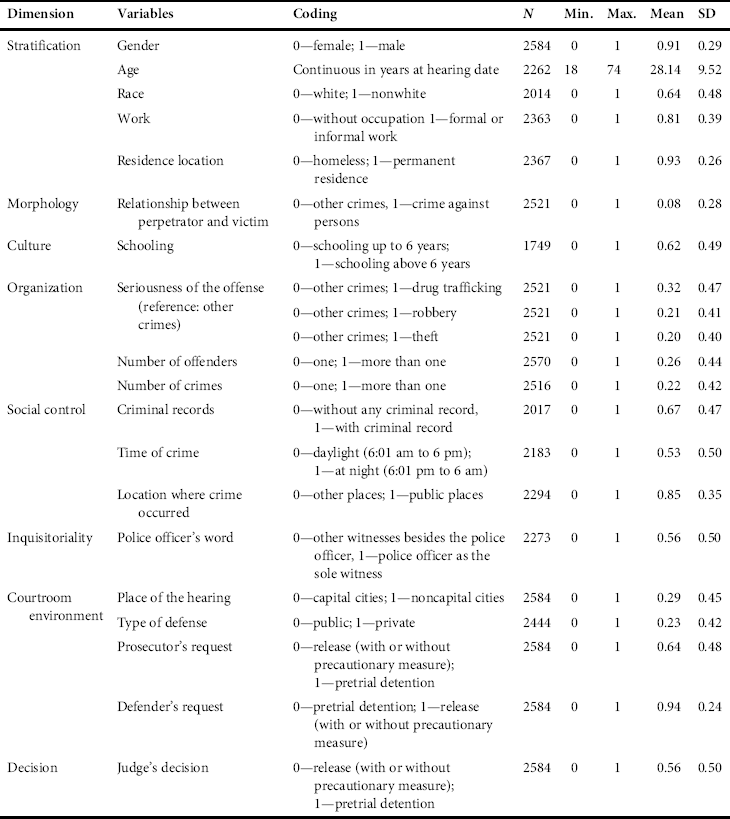
Table 1 presents the descriptive statistics for independent and dependent variables. It is noteworthy that the number of missing cases is different among the variables, being more visible in stratification and culture dimensions. As previously mentioned, information related to the offenders' profile, especially their race and years of schooling are not always available in the police records. Similarly, in some courts, the IDDD team could only follow the hearing and not consult the dockets, which mean that we could not have access to these measures.
Descriptive statistics for dependent and independent variables included in the binomial logistic regression models (Custody Hearings—Brazil, 2018)

Based on Reference BlackBlack's (1976) original theory, stratification was measured by the suspects' characteristics. The arrestees were, on average, 28 years old. Most were males (91%), dark-skinned (blacks and browns accounted for 64%), and informed of having a permanent residence (93%). Only 14% had formal jobs, while 67% had informal work (which means that 81% held some sort of occupation). Since Morphology presupposes proximity between victim and aggressor, we used crimes against persons (8%) as indicators. Culture refers to the level of schooling of arrestees, with 62% of suspects having attended elementary school (up to 6 years of schooling).
For organization, we initially created variables that identified crimes whose practice required some degree of association, such as drug trafficking (which accounts for 32% of arrests), robbery (21%), and theft (20%).Footnote 6 Next, we constructed variables identifying crimes that were committed by more than one suspect (26%); and criminal records that contained more than one offense (22%).Footnote 7 Social control was measured by reference to the arrestees' previous criminal records (67%). We also included the variables suggested by Reference Gottfredson and HindelangGottfredson and Hindelang (1979), as 53% of offenses were committed between 6 p.m. and 6 a.m. while 85% occurred in public spaces.
The following methodological step led to the creation of the measures necessary to test the validity of the proposed framework. To address the inquisitoriality, we measure to what extent the policeman's word is taken as the “truth” about the crime (Reference JesusJesus, 2020). To do so, we created a dummy variable identifying the cases where the only proof of wrongdoing was the word of the police officer responsible for the arrest (56% of the arrests).
To address the courtroom environment, we took into consideration the distinction between capital and noncapital cities, as the judicial organization does not differ among states (Reference SilvaSilva, 2001). In 29% of cases, Custody Hearings were carried out in noncapital cities, where the justice revolves mainly around prosecutors and judges, without the active participation of defenders (Reference Gonçalves, Brito and FilgueiraGonçalves et al., 2015). To measure the distance between the judicial actors, we took into account the nature of the defender. As previously noted, public defenders are more likely to work closely with the same judges and prosecutors, being more prone to share the same understanding about the offender and the offense (Sapori, 1995). Therefore, we assume that private attorneys, presented in 23% of the cases, are expected to have more divergences with the prosecutor and judge, being more successful in assuring measures other than pretrial detention.
The other two measures adopted to understand courtrooms as inhabited intuitions (Reference UlmerUlmer, 2019) were appraised by the requests made by prosecutors and defenders. In the inquisitorial systems, judges are more likely to consider the prosecutors' request as what ought to be decided in the hearing (Gunn & Mevis, 2018). In addition, in Brazil, the distribution of judges and prosecutors in noncapital cities at the beginning of their career (something that until today is not the rule among public defenders) creates strong bonds between these two actors. They also tend to be promoted and transfered to capital cities at the same time, serving in similar spaces. As a result of this socialization in the function together, they are prone to share their understanding about the normal crimes and normal criminals (Reference SudnowSudnow, 1965). Consequently, they ought to agree on cases that deserve pretrial detention instead of other measures.
Public and private defenders are not permanent figures of the judicial settings. Public defense is a new institution in the Brazilian Criminal Justice System, and most noncapital cities are still lacking them (Reference Gonçalves, Brito and FilgueiraGonçalves et al., 2015). Private defenders are usually hired for specific cases, being diverse, especially in terms of what they charge for a specific case (Reference AdornoAdorno, 1995). Also, it is worth noting that Brazil has one the highest rates of lawyers per capita in the Americas (Reference VargasVargas, 2010), allowing a high degree of differentiation among these professionals. As a result, they are more likely to be seen as aliens in the courtroom environment.
Dependent variables
The prevailing outcome in the Custody Hearings was pretrial detention (56%). In 1% of hearings, the judge decided for pretrial release without imposing any precautionary measure. In all other situations (43%), the arrestee was released under the State's supervision. Since judges released the suspect without measures in 1% of the cases, we decided to combine the release with or without precautionary measures in the same category.
Prosecutors requested pretrial detention (64%) more often than pretrial release conditioned to a precautionary measure (36%). None of the prosecutors requested provisional liberty. Defenders (public and private) mostly demanded release with or without conditionality (94% of cases). In 6% of hearings, the defense requested pretrial detention. Public defenders were slightly more prone than private lawyers to demand release with or without precautionary measures instead of pretrial detention (94% vs. 91%, respectively) and this difference is statistically significant (χ 2 = 8.56, df = 1, p < 0.010).
In almost a quarter of hearings (23%), defense and prosecution requested exactly the same precautionary measures, as defense attorneys confined themselves to the wording: “in agreement with the prosecutor's request.” In 21% of cases, there was equality regarding pretrial release with cautionary measures, while in 2% both sides agreed on pretrial detention. In all these situations, the judges' decisions concurred with the parties' requests. Both public and private defenders had the same chance of agreeing with the prosecutors (χ 2 = 0.85, df = 1, p > 0.050).
In 83% of cases, the judges' decisions were expressed exactly in the terms of the demand made by the prosecutor (for release or incarceration). The judge fully accepted the request from the defense only when it was similar to the demand presented by the prosecutor. In all other situations, the judges disagreed with the defender, arguing mostly that the presence of criminal records or the violent nature of the felony did not permit any measure other than pretrial detention.
These results were anticipated by our theory. Both the inquisitorial features and the courtroom characteristics in Brazil push toward a high level of agreement between judges and prosecutors. To understand if these two actors share the idea about what constitutes a normal crime and a normal offender, the ones more likely to receive pretrial detention, we decided to take the prosecutors' requests for pretrial detention as our second dependent variable.
Modeling
We predicted that Donald Black's original theory will explain the odds ratio of the judges' decisions and prosecutors' requests for pretrial detention. However, we also predicted that the judge's decision will operate in accordance with the prosecutor's request even when controlling for the variables that ought to explain the behavior of law in an inquisitorial setting. In sum, once we include the variables pertaining to the proposed framework, we will achieve a better understanding of the decision-making process in Brazil, than by exclusively using the variables derived from Black's original theory.
To assess the elements affecting the judges' decisions for pretrial detention, we estimated three binary logistic regression models. The variables included in the first model as predictors were inspired by Black's theory (1976), whereas the second model exclusively included the measures pertaining to the proposed framework. The third model combines all variables. The same three sets of independent variables were used to estimate binary logistic regression models to assess the determinants of the prosecutors' requests. Doing so, we intend to assess if there is a homology of factors determining the odds ratio of the judges' decisions and the prosecutors' requests for a pretrial decision.
DETERMINANTS OF JUDGES' DECISIONS FOR PRETRIAL DETENTION
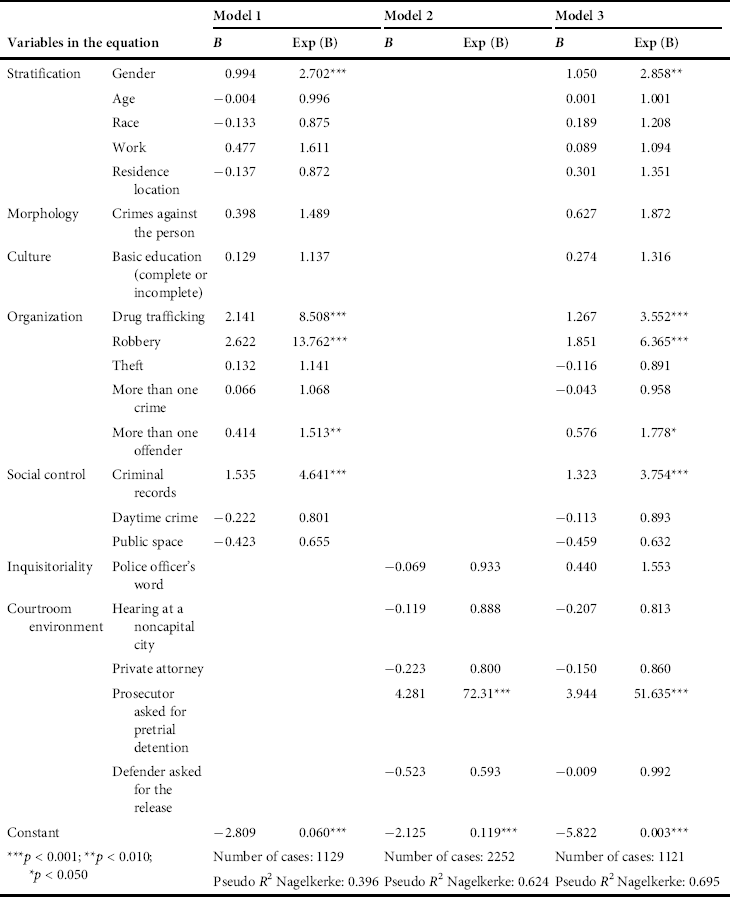
We started this exercise by identifying if Black's predictions explain the judges' decisions at the Custody Hearings (Table 2). When only these variables are considered, if the arrestee is male the odds of pretrial detention are increased by 170%. If the person was arrested due to drug trafficking, the odds ratio is increased by 8.5 times. Likewise, if the arrest was due to robbery, the odds ratio is increased by 13.8 times. The odds ratio of pretrial detention is also increased by the arrestee's previous criminal record (+4.64 times), and if the suspect has committed the crime with the help of other persons (+1.51 times).
Results from the binomial logistic regression model estimating the odds of judges' deciding for pretrial detention (Custody Hearings—Brazil, 2018)a

a The number of cases varies between the models due to the missing cases in the suspects' characteristics, as explained in the methodological section.
Based on this logistic regression model, it is possible to state that the behavior of law is related to stratification, organization, and social control, variables that increase the odds ratio of pretrial detention at Custody Hearings. These results are similar to the ones obtained by Reference Jesus FilhoJesus Filho (2017) and Reference Lages and RibeiroLages and Ribeiro (2019) in Brazil, although these analyses have not used Black's theory to assess how the decision-making is produced on this stage. In our perspective, the outcomes of this binary logistic regression model show how Reference BlackBlack's (1976) framework is useful to increase the knowledge regarding how law behaves at initial appearance hearings.
When the variables of the proposed framework are considered, only the requests made by the prosecutor are statistically significant. The variables related to the place of the hearing, the presence of a private defender, and the police officer as the only witness of the crime did not reach the statistical significance at p < 0.050. However, if the prosecutor requests pretrial detention, the judge is 72.3 times more likely to issue this outcome. There is no doubt that the prosecutor's understanding of which measure ought to be applied to the case has an important influence on the Custody Hearing outcome.
In the final model, the variables from both theories (old and new) are included. None of the variables from the previous models lost statistical significance, although the slopes of the coefficients had a slight change.Footnote 8 The odds ratio of pretrial detention decisions is still determined by stratification, organization, and social control. This outcome is more likely when the arrestee is male (190%), has a criminal record (280%), committed offenses such as drug trafficking (260%) or robbery (540%), and had perpetrated the crime with the help of someone else (80%). Since these are the features of what comprises a normal criminal and a normal crime, we could see this result as a form of perceptual shorthand, used by the judge to substantially curtail the thinking or the length of time of the hearing (Reference UlmerUlmer, 2019).
Nevertheless, the odds ratio of the judge imposing pretrial detention increased by 51 times when prosecutors' requested this measure. This is the utmost determinant of the judges' decisions, even when controlling for suspects' characteristics and crimes' attributes. Defenses requests for pretrial release did not reach statistical significance, which suggests that such solicitations are not even considered by judges when imposing pretrial detention.
In summary, binary logistic regression models indicate that the proposed approach is instrumental for understanding the behavior of law in Brazil. Reference BlackBlack's (1976) theory partially explained the judges' decisions for pretrial detention, since culture and morphology dimensions did not reach statistical significance. On the other hand, judges' decisions were largely determined by prosecutors' requests, even when controlling for the arrestees' characteristics and crimes' attributes. Similar results were reached by Reference PhillipsPhillips (2012), who found a statistical association between prosecutors' requests and judges' decisions for pretrial detention, even after controlling for the effects of other variables, such as the arrestees' characteristics and the crimes' attributes. This suggests that this collaborative work among judges and prosecutors might be a feature of criminal courts in general (Reference MetcalfeMetcalfe, 2016).
DETERMINANTS OF THE PROSECUTORS' REQUESTS FOR PRETRIAL DETENTION
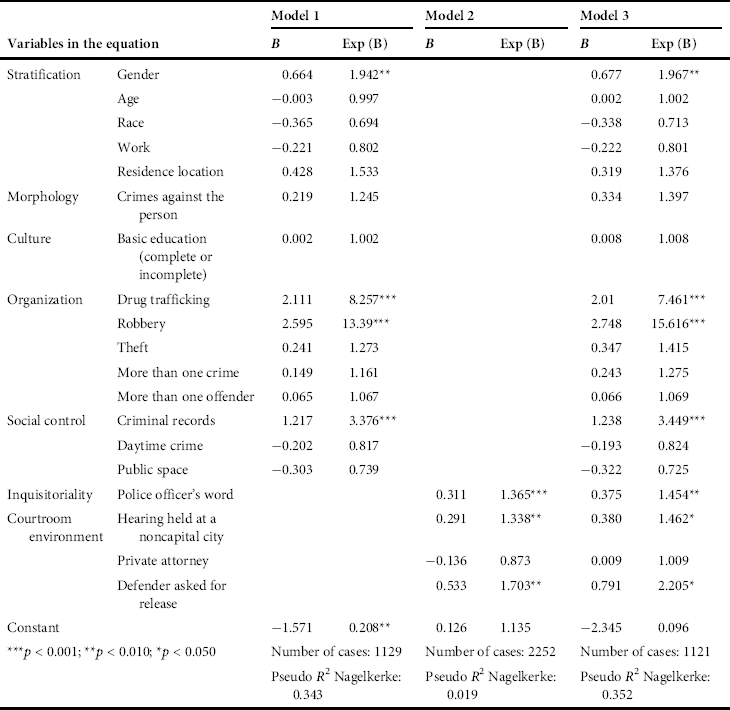
Considering that the prosecutor's request is the utmost variable influencing the judges' pretrial detention decisions, and the expectation that the variables predicting the final outcome of Custody Hearings also determine the prosecutors' requests, three logistic regression models were developed to assess these relationships (Table 3).
Results from the binomial logistic regression model estimating the odds of prosecutors' request for pretrial detention (Custody Hearings—Brazil, 2018)a

a The number of cases varies between the models due to the missing cases in the suspects' characteristics, as explained in the methodological section.
When the variables derived from Black's original theory (1976) are considered, being male increases the odds of the prosecutor asking for pretrial detention by 94%, rather than for release, with or without precautionary measures. If the subject has been arrested for drug trafficking or robbery, the odds ratio of a request for pretrial detention by the prosecutor are increased by 8.3 times and 13.4 times, respectively. If the arrestee has a previous criminal record, the prosecutor is 3.4 times more prone to request pretrial detention.
In summary, variables related to stratification, organization, and social control increase the odds ratio of pretrial detention requests by the prosecutor. These are also the variables that affect the odds ratio of judges imposing pretrial detention. So, they could be seen as indicators of what constitutes a normal offender and offense (Reference SudnowSudnow, 1965) routinely in the Custody Hearings. When cases have these characteristics, the decision-making process is speeder, since prosecutors and judges do not doubt what measures shall be imposed.
The second model included the variables connected with the proposed framework. The defense type (public or private) did not reach statistical significance. When the report of flagrante delicto relies solely on the police officer as a witness, the odds of the prosecutor's request for pretrial detention is 37% higher than in cases where other witnesses are present. Among the cases where the defense lawyer requires pretrial release, the odds of the prosecutor's request for provisional incarceration are 70% higher. Finally, the odds of the prosecutor's request for pretrial detention measures are 34% higher if the hearing has taken place in a noncapital city.
In the third binary logistic regression model, the odds of the prosecutor requesting pretrial detention are affected by the suspects' characteristics. Being male increases the odds of this request by 97%, while having previous criminal records increase these odds by 245%. If the arrestee was caught in the act of robbery or drug trafficking, the odds ratio of the prosecutor's request for pretrial detention are increased by 7.5 and 15.6 times, respectively. If the arrest was grounded exclusively on the police officer's testimonials, the odds are increased by 46%. If the hearing took place in a noncapital city, the prosecutors are 46% more prone to demand for pretrial detention. Lastly, if the defender demanded pretrial release the odds are 121% higher for a call for pretrial detention.
The three binomial logistic regression models indicate that Black's theory (1976) offers elements of crucial importance for understanding the behavior of law in Brazil. The variables extracted from it explain the odds of prosecutors' requests for this measure. But, the variables associated with the proposed framework are also important for understanding the prosecutors' decisions, as the police truth and the defenders' requests for pretrial release increased the chance of pretrial detention demands. All results point toward an understanding that the outcomes in Custody Hearings are not simply a consequence of an individual decision made by “judges and prosecutors but also from interactions between judges and prosecutors” (Reference Kim, Spohn and HedbergKim et al., 2015, p. 617).
DISCUSSION
This paper has two major goals. First, we aim to test the Behavior of Law approach, assessing which factors from the original theory predict the outcomes observed in the Custody Hearings. Second, we intend to understand to what extent Donald Black's theory could be adapted for comprehending the decision-making process in an inquisitorial setting, such as the Brazilian Criminal Justice System.
Following the example of other Latin American countries, over the last decades, there have been attempts to make the Brazilian system more accusatorial (Reference Ballesteros, Álvaro Roberto Antanavicius, André Machado, Andréa De Boni, Antonio Pedro, Lopes, Caíque Ribeiro and CamilinBallesteros et al., 2019). Among them are the Custody Hearings, which aim to introduce an accusatorial dynamic to a phase that is inherently inquisitorial (Reference Lages and RibeiroLages & Ribeiro, 2019), hoping that the outcomes would be reached based on the arguments presented by defenders and prosecutors. By introducing this change, the aim was to ensure that pretrial detentions would not remain dependent solely on police records (Reference Azevedo, Sinhoretto and LimaAzevedo et al., 2017). Nevertheless, we argue that these changes had little impact, as Brazilian courts work as inhabited institutions (Reference UlmerUlmer, 2019).
Inspired by Reference BlackBlack (1976), we understand that the behavior of law would be explained by the characteristics of offenses and offenders, as well as by certain legal factors. Using the knowledge about these issues, prosecutors, judges, and even defenders develope a routine that allow them to categorize the situations presented in the courtroom as “normal” (typical crimes and criminals) and “exceptional” criminal cases (Reference SudnowSudnow, 1965). Normal cases are dealt with in court in a matter of minutes, without any debates over the more appropriate outcomes (Sapori, 1995). On the other hand, exceptional cases demand thought and deliberation, increasing court times and raising expectations regarding the final decision.
These results are an indicator that, besides the legal and extralegal features of the case, it is also necessary to consider the institutional settings in which these cases are managed (Reference UlmerUlmer, 1995, Reference Ulmer2019). When judges, prosecutors, and defenders have been working together for years, they know in advance who will argue what, making the management of law “a confidence game” (Reference BlumbergBlumberg, 1966). In this scenario, the decision-making is not a process of applying the law to an offender and an offense, but a negotiation based on social bonds and expectations regarding each other (Reference MetcalfeMetcalfe, 2016). Based on this framework, we argue that the behavior of law theory (Reference BlackBlack, 1976) could not explain the decision-making in the Brazilian Custody Hearings. Besides the intention of making this an accusatorial setting, prosecutors, judges, and defenders have been managing the system in an inquisitorial perspective since they have started their careers. Their practical routines are enmeshed in this way of thinking.
In addition, the bureaucratic characteristics of public service in Brazil would push them toward more collaborative work. They became part of the public service after a highly competitive exam, in which the subjects are not of public knowledge (Reference Kant de LimaKant de Lima, 2010). As a result, they are recruited from the same social groups, being part of the Brazilian elite and having attended the same schools and colleges (Reference AdornoAdorno, 1988). Finally, their careers are organized in the same perspective, as they first work together in noncapital cities and after many years of public service being promoted, at the same time, to move to capital cities (Reference Lemgruber, Ribeiro, Musumeci and DuarteLemgruber et al., 2016). The homology between judges and prosecutors would imply ignoring the defenders' requests, a pattern that reinforces the inquisitorial characteristic of this criminal justice system.
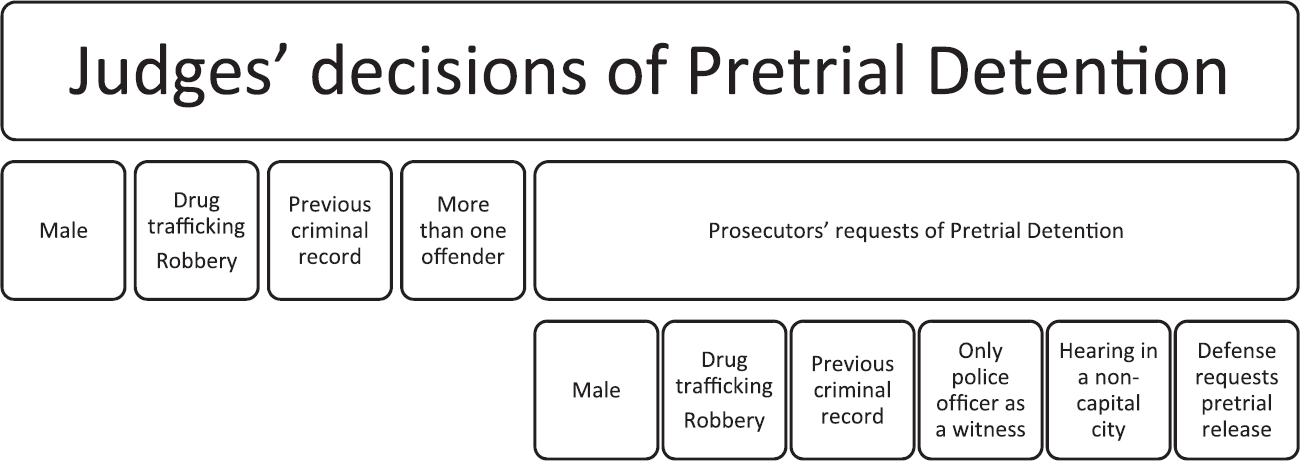
Therefore, we hypothesized that the behavior of law ought to be explained by legal and extralegal characteristics (as proposed by Reference BlackBlack, 1976), by inquisitorial features (as proposed by Gunn & Mevis, 2010), and by the environmental characteristics (as proposed by Reference UlmerUlmer, 2019). To test these hypotheses, we used data collected at Custody Hearings held in 2018 in various Brazilian states. The results obtained from the six binary logistic regression models are summarized in Figure 1.
Causal model for pretrial decision-making process at Custody Hearings in Brazil (2018)

Of the five dimensions extracted from the behavior of law theory, three worked as predicted. Stratification, organization, and social control were variables that explained the odds ratio of judges' decisions and prosecutors' requests for pretrial detention. Morphology and culture did not reach statistical significance, but they were central control variables addressing social differences among arrestees.
Pretrial detention is more likely to be applied for cases of robbery and drug trafficking when committed by male offenders with previous criminal records. These results are similar to the ones obtained in previous studies carried out in the United States (Reference Bechtel, Holsinger, Lowenkamp and WarrenBechtel et al., 2017; Reference Kurlychek and JohnsonKurlychek & Johnson, 2019), Colombia (Reference Rengifo, Ávila, Gélvez, Ramírez and MoraRengifo et al., 2019), and Brazil (Reference Lages and RibeiroLages & Ribeiro, 2019). Pretrial detention is also more prone to be requested by prosecutors when the arrestee is male, has a previous criminal record, and has perpetrated a robbery of a drug trafficking offense. There are few studies about the determinants of prosecutors' requests at initial appearance hearings, but Phillip (2012, p. 68) observed in New York that prosecutors' bail requests are more likely due to “charge severity, along with other offense characteristics and the defendant's criminal history.”
As presented in Figure 1, judges and prosecutors are likely to see males as more dangerous than females (Reference Azevedo and SinhorettoAzevedo & Sinhoretto, 2018); individuals having criminal records as public enemies (Reference VargasVargas, 2014); and drug trafficking and robbery as offenses that seal a criminal career (Reference Jesus FilhoJesus Filho, 2017). These are the suspects who generally receive pretrial detention. Judges and prosecutors take for granted that there is a threat against public order whenever they are faced with these normal crimes and offenders (Reference SudnowSudnow, 1965).
In addition, Figure 1 shows that the prosecutors' requests raise the odds ratio of judges imposing pretrial detention, even when controlling for the arrestees' characteristics and crimes' attributes. These results mimic those found in Colombia (Reference Rengifo, Ávila, Gélvez, Ramírez and MoraRengifo et al., 2019), the United States (Philip, 2012), and Brazil (Reference Lages and RibeiroLages & Ribeiro, 2019). Prosecutors are more prone to request pretrial detention if the hearing is carried out in noncapital cities, where their bonds with judges are stronger, indicating firmly their vision about the offender and the offense. The prosecutors' requests are also determined by the police officers' word, seen as the “truth” about the crime (Reference JesusJesus, 2020), which also reinforces the inquisitorial characteristics of the system (Reference Kant de Lima and MouzinhoKant de Lima & Mouzinho, 2017), isolating the defense (Reference Marrona, Kerche, Kerche, Júnior and SãoMarrona & Kerche, 2018).
The defenders' claims (when effectively opposed to pretrial detention) increase the odds of the prosecutors reinforcing the need for it. However, the defenders' demands for measures other than pretrial detention do not affect the judges' decisions. These results demonstrate how defense (either public or private) are perceived as aliens in the Custody Hearings institutional setting. The prosecutors know in advance that they are the ones that would be able to push judges toward the opposition against the defense based on the word of the police about the truth. In this inhabited institution (Reference UlmerUlmer, 2019), it is difficult for defenders to challenge the homology between judges' decisions and prosecutors' requests of pretrial detention, especially the private ones who do share the court routine on a daily basis (Reference GodoiGodoi, 2019).
In summary, taking the Custody Hearings settings as inhabited institutions means assuming that the rules from the Code of Criminal Procedure might interfere in the final disposition, although the stocks of knowledge of the prosecutors and judges regarding what constitutes a normal offense and offender, and which role is played by which actor would be the main determinants of the final outcome. Once the arrestee is brought to the Custody Hearing, the judges know in advance what the prosecutor would argue, based on what source, and what they aim to achieve with their request. In this setting, judges would be more prone to fulfill the prosecutors' expectations in order to make the social bond among them even stronger. Judges do not act as mediators, as they lean toward the prosecutors' side, ignoring defenses' requests. The prosecutors' demands are what best represents the interest of the State, and what ought to be taken as the right thing to do, the right decision to be issued, the truth about the offense and the offender.
This new perspective of understanding the decision-making process inside the Custody Hearings also explains why judges' decisions and prosecutors' requests are different in terms of the role played by institutional variables. In this courtroom, all actors are able to place themselves in congruent categorical identities, predicting each other's arguments and the final outcome (Reference UlmerUlmer, 1995). As a result, the changes carried out to make the Brazilian Criminal Justice System more accusatorial could have exactly the opposite effect, reinforcing its inquisitorial system characteristics.
FINAL CONSIDERATION
Based on Custody Hearings data collected in Brazil, we confirmed that the judges' decisions are a result of the prosecutors' requests, and that these two outcomes are determined by the same variables derived from Donald Black's theory. We also revealed how the decision-making process at Custody Hearings is oriented by parameters strange to adversarial standards. The defender's requests do not interfere with the odds of the judge imposing pretrial detention, even when controlling for the variables that ought to explain the behavior of law. Thus, despite the recent reforms introduced in Brazil's Criminal Procedure Code designed to promote a shift toward a model with accusatorial characteristics (Reference Ballesteros, Álvaro Roberto Antanavicius, André Machado, Andréa De Boni, Antonio Pedro, Lopes, Caíque Ribeiro and CamilinBallesteros et al., 2019), our results indicate that the decision-making process at Custody Hearings remains essentially inquisitorial. This study represents an attempt to expand our understanding about how decision-making is produced in Brazil combining two approaches that have been extensively deployed in the United States of America. Among its contributions, this paper offers a reference for other comparative studies using theories created in North America to assess how legal institutions behave in South America.
Notice that the database used in the analyses is exclusively restricted to the Custody Hearings and to a certain number of Brazilian cities, failing overlooking resenting including all the diversity of situations faced by judges and prosecutors. It would be extremely important to test the validity of the predictions, combining Black's original theory and the other frameworks, for further decisions throughout the flow of the Brazilian criminal justice system, such as charges, convictions, and length of time of imprisonment.
Still, the alternative framework proposed and tested here may be useful in fostering further debates and stimulating new discussions regarding how the criminal justice system works in Brazil and how the country is far from abandoning its inquisitorial features through only legal reforms. We expect to be opening this new research agenda.
ACKNOWLEDGMENTS
We thank the CNPq, the Brazilian National Council for Scientific and Technological Development, for its generous financial assistance (grants #406464/2018-9 and #303733/2019-5). We are also grateful to the Institute for Defense of the Right to Defense (IDDD, acronym in Portuguese) for allowing our participation in the network dedicated to collecting and analyzing data on Custody Hearings in Brazil, since their implementation in 2015. In addition, we would like to praise Andrés Rengifo for organizing the Southern Criminology Seminar at Rutgers University in March 2020, when we first presented the main ideas of this article. Last but not least, we acknowledge the suggestions given by the anonymous reviewers that have helped to close the gaps and to present an improved description of how decision-making works in the Brazilian Criminal Justice System.
Funding information
Conselho Nacional de Desenvolvimento Científico e Tecnológico, Grant/Award Number: 406464/2018-9 and 303733/2019-5; Brazilian National Council for Scientific and Technological Development, Grant/Award Number: #406464/2018-9 and #303733/2019-5