Introduction
Comparative politics chronically confronts a methodological conundrum. Every country contains a set of similarities and differences with other countries, making comparison at once alluring and elusive. The similarities offer hope that controlled comparisons can be constructed, and causal inferences thereby drawn. Yet the differences make it devilishly difficult to control for all plausible alternative explanations. Gaining variation on the dependent variable (by expanding the “n”) inevitably risks losing control, while eschewing such variation (by maintaining a very small “n”) runs smack into the “degrees of freedom” problem.
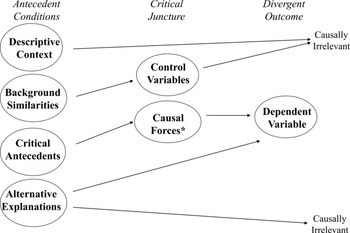
This article does not promise to cure this chronic disease. But it offers and employs a technique that we believe helps manage its nastiest symptoms. The concept we employ is “critical antecedents” (Slater Reference Slater2010). Rather than considering cases noncomparable because of deep historical differences, we argue that such differences should be incorporated into our comparative explanations. Critical antecedents can best be defined as factors or conditions preceding a critical juncture that—unlike other types of antecedent conditions—combine in a causal sequence with forces operating during the critical juncture to produce divergent outcomes (ibid.; see figure 1).Footnote 1 Bringing critical antecedents into our comparative arguments in a systematic and transparent way promises to shed new insights into how and why countries have come to look so different, and yet in other ways alike, over the longue durée.
Four types of antecedent conditions (Slater and Simmons Reference Slater and Simmons2010).

The empirical puzzle we consider is a fundamental one in comparative politics and sociology: Why are some states so much more capable than others? This puzzle takes vivid form in Latin America and Southeast Asia. Scholars of each region have elaborated explanations for when and why states diverged in their capacity to govern their territories and extract resources from their populations. Soifer (Reference Soifer2015) shows that the Peruvian state fell behind many of its neighbors in terms of infrastructural power in the mid-nineteenth century, when rulers delegated authority to existing local elites rather than deploying bureaucrats to the provinces. Slater (Reference Slater2010) finds that the Malaysian state diverged from most of its regional counterparts in the wake of World War II, when the eruption of endemic and unmanageable forms of contentious politics pressed state leaders to extract more resources from socieoeconomic elites and to reorganize their ruling institutions.Footnote 2
At a surface level, these arguments appear unrelated or even incompatible. The best-case scenario for knowledge accumulation would appear to be that Latin American states were built in one way, and Southeast Asian states built in quite another. To some degree this tale of equifinality is true. Yet there are also fascinating commonalities that lurk beneath this seemingly mismatched surface, which we aim to unearth in this article. Appreciating both the differences and commonalities in state-building processes and outcomes in Latin America and Southeast Asia demands that we escape the strictures of the existing “critical juncture” framework, and consider both the critical antecedents that preceded and the causal mechanisms that grew out of each region’s critical juncture period.
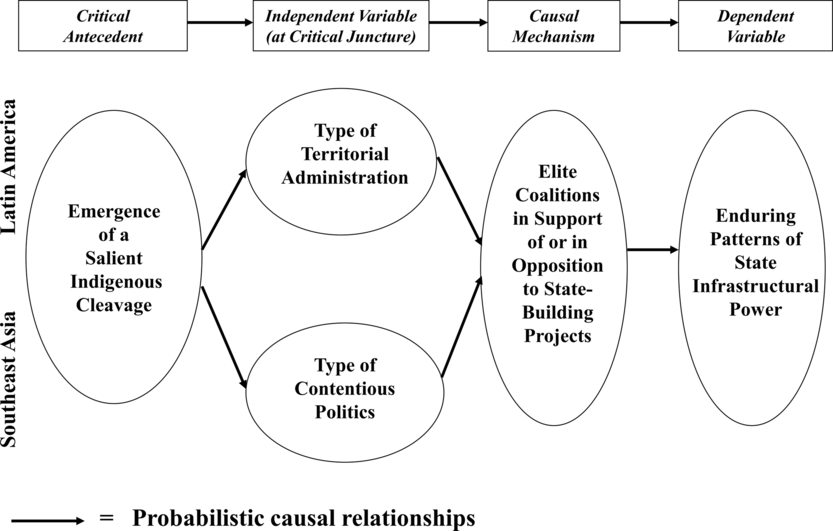
In short, states in these two regions diverged in strength during two temporally separate critical junctures, through the divergent effects of regionally distinctive independent variables (see figure 2). Types of contentious politics shaped state power in Southeast Asia during its era of decolonization, while types of territorial administration shaped state power in decolonizing Latin America during its first decades of independence.
Indigenous politics and infrastructural power.

Yet state building in both regions was causally shaped in powerful ways by a shared critical antecedent: the inheritance of a salient indigenous cleavage at the time of national independence. The indigenous cleavage was salient wherever indigenous populations emerged from colonialism as demographically sizable, culturally distinctive, and geographically central. Or, to invert these markers of salience, postcolonial countries lacked an “indigenous inheritance” wherever indigenous populations were significantly eliminated or assimilated under colonial rule, or where colonial settlement produced a new political and economic center far removed from significant concentrations of indigenes. Even as this indigenous inheritance helped produce opposite causal effects in the two regions, it did so through a similar causal mechanism: the emergence of coalitions linking state and societal elites. How these coalitions approached state-building projects depended fundamentally on whether the critical juncture unfolded against the backdrop of a perceived endemic threat across lines of indigenous cleavage.
Under the existing critical juncture approach, scholars would be inclined to argue that Peru and Malaysia cannot be compared to neighbors like Chile and the Philippines, where no indigenous cleavage shaped state-building outcomes. Normally, this would be a scope condition, forestalling comparison. By bringing the indigenous inheritance into both of our arguments as a critical antecedent, we facilitate comparison among the cases within each region, with the ultimate aim of suggesting some broad cross-regional commonalities in the causes of postcolonial state-building outcomes. Because the most fundamental features of societies (e.g., the importance of indigeneity) are among the most fascinating foci of comparative social science, we aim to help construct a comparative method that includes such factors as causally significant rather than excluding them as causally irrelevant scope conditions.
By no means does our approach reveal that Latin America and Southeast Asia saw their states diverge in their infrastructural power through an identical causal process. Postcolonial state strength in Latin America depended on initial nineteenth-century successes at extending territorial administration. In post–World War II Southeast Asia, divergence emerged from differential initial successes at constructing coercive monopolies and extractive civilian administrations. Intriguingly, an inherited indigenous cleavage hindered (but did not preclude) such state-building processes in Latin America and fostered (but did not predestine) them in Southeast Asia. The causal influence of the indigenous inheritance is powerful in both regions, and for much the same reason: because it helped shape the threat perceptions and resultant state-society coalitions that emerged during the “critical juncture” of state building.
Yet the indigenous inheritance worked in opposite directions in the two regions. In the empirical sections that follow, we lay out these claims in our four comparative cases, placing special emphasis on the “indigenous effect” on state building in the “negative” case of Peru and the “positive” case of Malaysia. In the conclusion, we consider the methodological and theoretical implications of our analysis more broadly.
Indigenous Politics and Infrastructural Power in Latin America
The gap between strong and weak states in Latin America began to emerge during the Liberal era of the second half of the nineteenth century and has endured thereafter. By 1900, vast gaps already existed between the region’s stronger and weaker states, and Peru had fallen far behind most of its neighbors in terms of state power. This can be seen, as described in the following text, in the development of primary public schooling: Peru had the second-lowest literacy rate of any South American country and lacked schools in many parts of the national periphery. The state was also weak in coercive terms: it struggled to contain banditry and enjoyed nothing resembling a domestic monopoly of force. When it fell into wars with its neighbors, as described in the following text, the Peruvian state struggled to mobilize troops, train them, and get them to the battlefield. It also lagged in terms of infrastructure development: despite devoting about one-fourth of guano revenues to railroad building, much of its territory and population remained isolated from Lima and other urban centers, as efforts to build roads and railroads foundered (Hunt Reference Hunt, Conde and Hunt1985). This severe weakness has persisted to the present, as the Peruvian state continues to be ranked among the weakest states in Latin America.
With economic recovery and emergent political stability in the mid-nineteenth century, state leaders in most, but not all, countries in the region pursued “order” and “progress” by seeking to extend the reach of the state across their national territories. The success and failure of these initial state-building efforts rested on the institutions they designed to administer their territories and implement state policies. Institutional choice represented a critical juncture for the success and failure of Latin American state building, setting countries on distinct and durable trajectories of state capacity. The salience of the indigenous cleavage structured (but did not determine) institutional choice; thus, it operated as a critical antecedent in producing state-building outcomes in Latin America.
This section shows the effect of the salience of the indigenous cleavage on state building in Peru.Footnote 3 It begins by elaborating the logic of the critical juncture argument, linking variation in the initial design of administrative institutions to eventual state-building outcomes, and showing that variation in local administration was crucial to the failure of postindependence state-building efforts in Peru, leaving it with a weaker state than many of its neighbors by the end of the nineteenth century. It then shows that Peru was different from other Latin American cases (such as Chile) in terms of identity cleavages before it diverged in terms of state building. The indigenous inheritance in Peru, actualized in the form of a chronic specter of subaltern revolt, structured the choice of administrative institutions. Leaders who pursued state-building efforts faced a tradeoff they did not confront in countries where the cleavage was less salient.
From Institutions to Outcomes: Local Administrative Design and State Development
As stability returned to postindependence Latin America, modernizing elites in many countries came to believe that economic development and political stability could best be pursued by extending the reach of the state across the national territory.Footnote 4 The state would, in their view, make markets by promoting agricultural and mining exports through transport improvements and increased security. It would make societies by spreading and systematizing education and promoting homogeneous national identities. And it would make political communities by tying the country together to tamp down regional and ethnic divisions.Footnote 5 In all, political leaders believed that the state needed to develop its coercive, regulatory, and extractive power over society and territory, or infrastructural power, to bring “modernity” to the newly independent countries.Footnote 6
To do so, leaders needed to rely on representatives in the national periphery to administer on their behalf and to report back to the capital on local conditions. This entailed new institutions of local and regional rule: a territorial grid of administration. The choices made in designing these institutions would turn out to be crucial. State leaders could opt for one of two models in local administration. First, they could rely for administration on local elites—mainly large landowners who claimed Spanish descent—in a pattern of delegated rule. Alternatively, the state could fill its ranks with bureaucrats deployed from outside the community in a pattern of deployed rule. Though these models were similar on other dimensions, including the limited extent of reliance on customary law, the limited professionalization of the bureaucracy, and the extent of overlapping networks of control and oversight, deployed rule produced successful state-building efforts, while delegated rule doomed those efforts to failure. Thus, within the critical juncture when state building was pursued, the choice of rule accounts for state-building outcomes.
There are two reasons why deployed rule was necessary for state-building efforts to succeed. First, deployed rule facilitated the sanctioning of local administrators by the central state. Deployed bureaucrats generated their income from their office—whether from salary or from access to a share of revenues. This made them responsive to policies emanating from the center because they were vulnerable to removal from their posts. Under deployed rule, then, state-building initiatives of the central government were more likely be implemented at the local level by state administrators. Under delegated rule, by contrast, officials continued to generate income from landowning, which made them less vulnerable to sanction by their administrative superiors. State-building initiatives of the national government were thus more likely to founder and erode at the local level under delegated rule than under deployed rule.
A second reason derived from the independent interest bureaucrats had in increasing state power in their communities. To the extent that local state agents could rely on authority deriving from their own status in the community, they had little need for the penetration of the state into their communities. But if they relied instead on the formal authority that derives from their postings, they drew on the legal/rational legitimacy of their title, and on the power of the state backing up their commands. Local elites, who represented the state under delegated rule, had more access to status-based authority than those deployed from outside because they could draw on a legacy of local power. Thus, deployed bureaucrats, more than their delegated counterparts, had an interest in the increasing and ongoing penetration of the state into their communities. This increased penetration could take the form of coercive power to facilitate enforcement, or of public good provision to win support from the community. In a longer-run manifestation of this mechanism, deployed officials sought to increase state power to shape individuals and communities in ways that increase state legitimacy. The independent interest of local officials in increased state power led them to champion its development, going beyond compliance with orders from the capital to active pursuit of this goal through independent initiatives.
Where it was chosen, deployed rule increased compliance by local officials, and also led them to press the central state to increase its presence. In cases like mid-century Peru, by contrast, opting for delegated rule meant that the central state could not sanction the local elites on whom it relied, and these elites remained indifferent or resistant to state building. These factors led to sharply divergent outcomes of state development in Latin America; they explain why the choice of administrative institutions was a critical juncture, and why some other countries developed strong states by the late nineteenth century while Peru’s state-building efforts failed.
Administrative Design and Educational Development
The role of local administrators in pushing for state development can be clearly seen in a comparison of educational development. Across nineteenth-century Latin America, state-building projects involved efforts to extend and systematize primary schooling in an effort to “civilize” the population in pursuit of social peace and economic development. Yet these projects met very different fates as they were implemented. Because it served as the linchpin of educational systematization, arguably the most important difference in the educational realm was in the inspection and oversight of the day-to-day operation of primary schools. Here Peru lagged far behind countries like Chile, which had by the 1890s a fully regimented inspection system that regularly visited essentially every public school in the country and reported back to Santiago. Peru, by contrast, saw limited inspection capacity during the nineteenth century, and what did exist relied heavily on self-reporting by teachers. The absence of systematic inspection tracks a broader trend: Peru lagged far behind other Latin American countries in educational development, as seen both in its low literacy rate and the low rate of school enrollment.Footnote 7
Delegated Rule and the Failure of Educational Development in Peru
During the state-building efforts of the guano era and its aftermath, a period lasting from 1845 through the 1890s, Peru relied heavily on local elites in a system of delegated rule. Despite the central state’s efforts to build education, and high levels of spending, school provision outside Lima declined by more than 50 percent over the late nineteenth century when assessed on a per capita basis. Systematization was so lacking even in the capital city that an 1872 government report described the “disorder” of schools as “complete,” writing that “each teacher teaches what they want, and to whom they want, the school year ends when they see fit, and the length of vacation is only measured by the teacher’s will or love for their job.”Footnote 8
Under delegated rule, Peruvian provincial and local authorities displayed little inclination to contribute to school building.Footnote 9 Many failed to enforce the policies emanating from Lima (Muecke Reference Muecke2004: 180–83). Some even did their best to “actively thwart education.”Footnote 10 Many local officials with oversight over education policy held the view that the indigenous population under their purview could not be educated, and others held that indigenous education was a threat (Hazen Reference Hazen1978: 427; Muecke Reference Muecke2004: 181). Yet as Dan Hazen (Reference Hazen1978: 427) writes, “more and more limeños felt that Spanish-language literacy and the inculcation of patriotic values would mold the conscious citizenry required in an industrial, capitalist society.” Despite the initiative taken in Lima, without the collaboration of local officials educational development foundered. Whereas local officials elsewhere filed litanies of criticisms of the shortcomings of education, their Peruvian counterparts rarely complained, for example, about the quality of teachers they oversaw, and did not pressure the national government to develop the school system.Footnote 11 Also telling are the many instances when the national government had to pressure local authorities to account for education funding it had provided, and to explain why they had not met the goals put forward in Lima. Local officials rarely spent even the allocated funds and did as little as possible to facilitate schooling. The result was that the intentions of the national government to spread quality schooling through the country were diluted in bureaucratic struggle and limited funding, and educational development languished.
Administrative Design and Military Development
The same dynamics underlying educational development can also be observed in the military context. Deployed officials were likelier than their delegated counterparts to comply with edicts emanating from the capital, and more invested in state building more generally. In Chile, for example, local officials under deployed rule complied with orders to conscript despite their unpopular nature (Resende Santos Reference Resende Santos2007: 135). The result was systematized military building, and a more effective and loyal army, which overwhelmed Peru’s forces when war broke out in 1879. The inability of the Peruvian state to compel similar compliance, as described in the following text, sowed the seeds for military collapse, leading to defeat in the War of the Pacific against Chile, and state crisis. This failure, once again, resulted directly from the reliance on delegation of administration to local and regional elites.
Conscription under Delegated Rule
Conscription in nineteenth-century Peru was overseen by local elites appointed as subprefects. Subprefects gained nothing from conscription, while it inflicted several kinds of costs on them. It created a national army that loomed as a threat to their local power. It removed economically vital Indian labor from their estates.Footnote 12 Finally, conscription was an unpopular imposition on the population, which often resulted in reprisals against officials (Muecke Reference Muecke2004: 175).
As a result of these incentives, local officials in Peru often shirked their assigned duties in conscription and military recruitment. For example, the military service law of 1872 set a quota of recruits for each province based on population; not a single province met its quota. Because local officials were reluctant to participate in conscription, military units had to fill their own ranks from the populations of the regions where they were stationed (1845 Memoria of the Ministry of War, p. 4). Conscription by military units operated by force, and thus lacked the legality of soldier recruitment elsewhere. It also led to a concentration of recruiting in the heavily indigenous southern highlands region where units were overwhelmingly stationed due to persistent unrest (Jacobsen Reference Jacobsen1993: 132–33). Desertion by soldiers recruited in this forcible manner was consistently high, and this demanded much policing by officers (Contreras and Cueto Reference Contreras and Cueto1999: 137). Forceful recruitment by individual units also limited the army’s role in nation building. Unlike the regional heterogeneity of other Latin American armies, the Peruvian army was not a place where recruits came into contact with a cross-section of the nation. Instead they encountered their fellow poor from the province where the unit was most recently based.Footnote 13
Thus, the reluctance of local state agents to participate in conscription affected many aspects of the Peruvian army. The Peruvian army was far from the ideal of a “nation under arms,” had many discipline problems including high rates of desertion, and was relatively ineffective on the battlefield, leading directly to Peru’s defeat in the 1879–83 War of the Pacific. As a result of its defeat, Peru lost substantial territory and entered a period of state crisis for the next two decades. It would thereafter remain one of the weakest states in Latin America.
The Indigenous Cleavage and the Tradeoffs of Administrative Design
A complete critical juncture account of state development in Latin America must take into account how national contexts varied at mid-century when state building began.Footnote 14 A crucial difference across countries shaped the institutional choices that set the countries on the paths to state-building success and failure. To understand why nineteenth-century Peruvian state-building efforts failed while contemporaneous efforts elsewhere succeeded, we must consider the presence of a salient and significant ethnic cleavage.Footnote 15 Yet this factor had only an indirect causal effect on state building. As we have just seen, state-building outcomes were directly determined by the nature of local administrative institutions. The salience of the indigenous cleavage mattered because it structured the calculus of institutional design. Where state leaders perceived that indigenous uprisings could pose an endemic underlying threat to regional and national stability, they felt pressed to use administrative offices to fortify alliances with local elites and thus lower the risk of revolt. This institutional design sacrificed effective administration because local elites serving as administrators were both hard to sanction and had no independent interest in state power. Where the salience of the indigenous cleavage was low, state leaders faced much lower risks in deploying administrators from outside the communities in which they served. The result was not only more effective administration, but the creation of a bureaucratic corps that had independent interest in increasing state power because they could gain leverage over the communities they administered by doing so.
Thus, the salience of the indigenous cleavage operated as a critical antecedent, distinguishing the constraints confronted by modernizing state leaders in Peru and Chile. In Peru, state leaders were faced with a choice between near-term stability and long-term administrative effectiveness, while their analogues in cases such as Chile faced no such dilemma. The cases were different, then, before their levels of state power diverged. This difference led to distinct institutional choices as state leaders designed the territorial grid of administration to increase the state’s power, and those institutional choices created the divergent outcomes of state power in Latin America. By tracing the logic of delegation in Peru, this section shows that state leaders were influenced in their institutional choices by the salient indigenous cleavage and their attendant concerns about stability. The result was delegated rule and a weak state.
Peru: Looming Unrest and Delegation to Local Elites
Even as stability emerged with the onset of the guano boom in the mid-1840s, mid-century Peruvian state officials saw a fundamental threat to regional and national stability and centered its origin in the “Indian masses” of the highland interior. The Túpac Amaru revolt of the 1780s, after which the Spanish lost control of the highland regions around Cuzco for decades, was seen as “an example of what could happen” (Davies Reference Davies1970: 4; also see Walker Reference Walker1999: 13). The independence period also saw a wave of highland revolts after 1808 (highlighted by the 1814 Pumacahua rebellion in Cuzco), which made state leaders wary of the risks of social upheaval that seemed to arise whenever elites were divided, as they often had been in the initial decades after independence (Bonilla and Spalding Reference Bonilla and Spalding2001 [1972]). As O’Phelan Godoy (Reference O’Phelan Godoy2005: 136) notes, the “image of a hostile and rampant plebe would remain in force during the 19th century and the fear that it would overrun the social control of the system would not easily be erased from the minds of republican authorities.” Similarly, Ragas Rojas (Reference Ragas Rojas2005: 246) argues that “the return to anarchy was a spectre that weighed on the country.” Rénique (Reference Rénique2004: 15–16) is bold enough to highlight the “campesino challenge” as the master cleavage of republican Peru, writing that whether they were labeled Indian revolts or campesino movements, rural subaltern mobilization drew significant concern and policy response from state officials. Similarly, Thurner (Reference Thurner1997: 3) builds on Benedict Anderson and John Lynch to describe the “predicament” of Peruvian elites as shaped in part by “the explosive discontent of the native masses.”
Any violence in the highlands observed by state officials was seen through the lens of “caste wars,” “Indian massacres,” and “racial terror.” This can be seen in the annual reports by prefects and subprefects, which regularly include references to ethnic threats, such as indigenous “assaults” as in Jaén and “savage indigenous tribes” as in Paucartambo Memoria of the Ministerio de Gobierno (1874, pp. 147 and 293), and “continuous invasions by the savages” in Loreto (Memoria of the Ministerio de Gobierno 1878, p. 135). As McEvoy’s evocation (Reference McEvoy2013: 193) of the emergence of concern about indigenous revolt in the 1850s indicates, this ethnically tinged threat perception persisted even during the period of “remarkable indigenous quiescence” (Gootenberg Reference Gootenberg1993: 199) that lasted from the unrest in the aftermath of the independence struggle to the Huancané rebellion of 1866. Thus, the perceived threat remained salient even when no indigenous rebellion had erupted in several decades.
National leaders saw state building as the most important way to defuse the indigenous challenge to national stability, though they knew that this would take decades to bear fruit. In the meantime, it tried various strategies of control over the indigenous population, including the surveillance of popular participation in festivals in Cuzco (Walker Reference Walker1999: 179ff) and the requirement of passports for domestic travel by the indigenous population (Davies Reference Davies1970: 28).
But these would not suffice to alleviate the concern: the nineteenth-century Peruvian state was too weak to construct an effective coercive apparatus that could stem the threat of revolt. Instead, much of the state’s response took the form of efforts to placate the indigenous population through negotiation and compromise, as seen for example in Méndez’s (Reference Méndez2005) study of Huanta.Footnote 16 Importantly for our purposes, the state also responded to the threat of indigenous revolt by fortifying its alliances with highland elites through the delegation of authority at the regional level; what Rénique (Reference Rénique2004: 25) calls the “ennoblement” of the locally powerful. These local elites in Peru’s heavily indigenous highlands were not the indigenous authorities through which the colonial state had ruled. Instead, Peru was administered at the local level through non-Indian officials (Thurner Reference Thurner1997). This alliance was mutually beneficial: regional and local elites at this time, and until the export booms of the 1890s, were relatively poor and relatively weak vis-à-vis the local population (Nugent Reference Nugent1997: 34–35). Highland landowners, like state elites, “constantly feared attacks” and were wary of any mobilization by indigenous communities (Jacobsen Reference Jacobsen1993: 327). Positions in regional administration were useful to these elites in consolidating their positions in local society, in giving them an opportunity to extract wealth from the population, and in power struggles at the local or regional level.Footnote 17 The state, in turn, benefitted from this alliance by gaining an ally at the local level, who could be counted upon to help suppress indigenous revolt when it erupted, and to limit their rebellions that left space for indigenous mobilization.
Our argument is a more general version of that advanced by McEvoy (Reference McEvoy2013) in her discussion of the Huancané rebellion of 1866–68. McEvoy paints this indigenous rebellion as emerging in the context of a split between the state and local elites that created space for indigenous actors to “articulate their own projects” (172), and argues that the state was able to defeat this revolt through a “tactical pact” (200) between local authorities and the national government. Our argument is that this tactical pact existed more broadly, and served to stem revolt, not only to defeat it.
Positions in the local and regional administration, such as subprefectships that came with responsibility for taxation and conscription, were given to local elites, who were in turn given “free rein” in the districts they dominated Muecke (Reference Muecke2004: 38). Tax officials, school inspectors, teachers, district governors, and other government officials were filled in this manner. Few Limeños would have been willing to bear the harsh climate and poor living conditions of interior Peru, and the state only rarely called on them to do so. Instead, local administration was quite “open to the provincial and local elite” (Jacobsen Reference Jacobsen1993: 147).
Where the indigenous threat had more limited salience, state leaders had no reason to sacrifice administrative effectiveness for stability. In these cases, such as Chile, deployed rule was an easy choice—and the result was the emergence of a much more effective state. Though Chile did have a significant indigenous population, and one that was never subdued by the Spanish despite three centuries of colonization, it was isolated in a remote region beyond the country’s de facto southern frontier. Even when conflict did break out in that region, state leaders never saw it as a threat to their hold on power. Because conflicts along the indigenous cleavage were never a threat to the social order in the territorial heart of Chile, governments did not see the need to strengthen the hand of rural elites vis-à-vis the rural subalterns by assigning government positions to those elites. Bureaucratic appointments were made with effectiveness in mind, and Santiago residents were commonly deployed to the provinces. The absence of an indigenous cleavage made the choice of deployed rule less risky and laid the grounds for the emergence of a much more effective state in Chile than in Peru, one with a centralized public primary education system, regimented conscription, and effective tax collection.
Critical Antecedent and Critical Juncture in Latin American State Building
Thus, the striking salience of the indigenous cleavage and threat of indigenous revolt in Peru was central in shaping the choice of delegated rule. The salient threat of indigenous revolt confronted state leaders with a difficult choice between the administrative efficiency of deployed rule, and the continued stability of state-society coalitions that delegated rule would facilitate. Pre-1895 Peruvian state leaders chose delegated rule, and state-building efforts foundered. The result was that the Peruvian state lagged far behind many of its counterparts, ranking by 1900 as one of the weakest states in Latin America. Thus, though the political salience of the indigenous cleavage did not doom Peru to state failure, it did shape the institutional strategies of state-building elites.
That the outcome was not, however, predetermined can be seen by looking to a later period in Peru’s historical development. After the collapse of the guano-era state in Peru and defeat and occupation by Chile, the so-called Aristocratic Republic that lasted from 1895 to 1919 saw state leaders undertake a renewed state-building project. They were once again confronted by a renewed threat of indigenous revolt after a decade of internal conflict, heightened by the 1885 Atusparia rebellion that “left an indelible mark of dread on elite consciousness” (Thurner Reference Thurner1997: 103). Yet the preceding decades had led political elites to see the local strongmen with whom delegated rule had allied as a fundamental obstacle to the sort of progress they believed the country needed. As a result, despite the salient threat they perceived, state leaders opted for deploying bureaucrats, most notably in the realm of education. The results were striking. School provision increased sharply even in remote rural areas, textbook and curriculum became more standardized, and free texts were distributed nationwide in huge numbers. Most importantly, a school inspection system was implemented nationwide, bringing standardized and detailed reports to Lima about the quality of schools every 15 days. Yet these initial gains were short-lived and quickly eroded: when indigenous unrest escalated again after 1915, state leaders were driven back into alliance with highland elites, leading them to dismantle the newly constructed independent administrative apparatus, with the effect of undermining the gains in schooling achieved during the preceding two decades.Footnote 18
The shift to deployed rule in education during the two decades after 1895, then, reveals its crucial role in explaining state building. More importantly for our purposes, it shows that even when holding similar perceptions of indigenous threat, state leaders sometimes chose not to build alliances with local elites: though this crucial causal factor tended to produce delegated rule, this was not always the case. The choice of deployed rule, which risked revolt by the indigenous population—and may have even heightened that risk, allowed state building to succeed in the long run. Thus, the indigenous cleavage causally influenced, but did not causally predetermine, the choices of state builders.
Indigenous Politics and Infrastructural Power in Southeast Asia
Slater (Reference Slater2010) offers a very different historical explanation for divergence in state infrastructural power in Southeast Asia than Soifer offers in Latin America. As in Latin America, states in Southeast Asia were built in highly path-dependent ways during the “critical juncture” surrounding processes of securing and consolidating national independence. These processes occurred more than a century apart, however—in the wake of the Napoleonic Wars in Latin America and World War II in Southeast Asia. The key to state power in this later period was not simply deploying bureaucrats to the provinces. In the face of swelling social tumult and fiscal demands, state infrastructural power in postwar Southeast Asia would be a matter of establishing an effective monopoly on the use of violence and extracting tax revenues from the elite groups possessing the bulk of private wealth. In the region’s domination cases (e.g., Malaysia and Singapore), state building restored political order and brought Leviathan unprecedented fiscal powers; but in its fragmentation cases (e.g., the Philippines and South Vietnam), states buckled under the pressures of decolonization and independence, leaving much less infrastructurally capable states in place for the foreseeable future.
Slater argues that subtle variation in the type and timing of contentious politics after World War II explains the significant variation in state power we continue to see throughout the region today. Where revolutionary leftist movements penetrated urban areas and exacerbated communal tensions during the critical juncture of postwar state consolidation, highly cohesive elite coalitions emerged in support of a stronger and more extractive state. Where mass mobilization either failed to have these threatening effects or failed to arise until after the critical juncture had passed, much looser ruling coalitions and much weaker state institutions were the result. In short, “war made states” in Southeast Asia’s domination cases, but not its fragmentation cases.
As we detail in the following text, divergent inheritances of indigenous politics shaped divergence in state infrastructural power in ways that were as profound as they were indirect. In cases in which no sharp and salient indigenous political cleavage was inherited, such as the Philippines, postwar contentious politics was broadly perceived as episodic and manageable by political and economic elites, leaving them with little incentive to support a concerted state-building project. Where the indigenous cleavage was far more ominous, as in Malaysia, the postwar leftist upsurge worsened communal tensions, and was perceived as endemic and unmanageable under existing political arrangements. Only where an inherited indigenous cleavage exacerbated the threat of the radical Left did “protection pacts” emerge in support of a stronger infrastructural state.
The Indigenous Inheritance in Southeast Asia
None of the Southeast Asia cases had infrastructurally powerful colonial states before World War II. Where prewar colonial practices differed most consequentially was not in state building, but in nation building. As in this article’s previous section, the critical question was this: Would decolonization and initial state-building efforts occur against the backdrop of a highly salient indigenous cleavage, or not? In British Malaya, the answer was a resounding yes. Prewar British colonial authorities fostered the rise of an ethnically plural society without undertaking the hard political work of bridging “indigenous” Malays with “immigrant” Chinese and Indians.Footnote 19 The sharpness of the indigenous cleavage would make postwar contentious politics much more threatening and difficult to manage than outbreaks of conflict in neighboring countries, notably the Philippines.
Far more than their colonial counterparts elsewhere in Southeast Asia, British authorities in Malaya relied on imported manpower—primarily Chinese, and secondarily Indian—for cheap labor in the colonies’ lucrative tin mines, rubber estates, and urban ports and enterprises. The British also encouraged the in-migration of Chinese capitalists to manage tax farms and export ventures, as well as Indian professionals and civil servants to staff the colonial state. Malaya’s indigenous majority group, ethnic Malay Muslims, remained somewhat of a collective bystander to these demographic and economic shifts. With the Malay masses concentrated in peasant production, and Malay elites predominantly employed in aristocratic service, relatively little social interchange took place among the colony’s sizable Malay, Chinese, and Indian communities before World War II. Because the British did nothing whatsoever to foster new political associations transcending communal lines, colonial Malaya became a paradigmatic plural society lacking institutions to manage interethnic relations. As in Peru, indigenous populations in Malaya remained demographically substantial and geographically proximate to the nonindigenous groups that had arrived under colonialism, producing a sharply salient indigenous cleavage as national independence approached.
In institutional terms, communal fragmentation was most importantly expressed in the field of education. Whereas prewar national language policies fostered the integration of Chinese minorities in Thailand and the Philippines, British authorities made little effort to use English as an integrator of Malaya’s diverse communities. “The Chinese community continued to enjoy considerable autonomy in educational affairs despite attempts by the government to regulate the proliferation of Sino-centric activities in Chinese schools by requiring them to register with the Education Department after 1920,” Heng Pek Koon has written. “However, the government was unsuccessful in this effort” because “the colonial government did not have the necessary Chinese-speaking administrators to effectively supervise the activities of the Chinese schools” (Heng Reference Heng1988: 22).Footnote 20
The most striking contrast with Malaya is the Philippine case, where colonialism spawned no such indigenous cleavage. Linguistic and religious unification commenced under Spanish rule (1565–1898), which was largely conducted through religious authorities, under whose watch “a vast proselytization was launched which has resulted in the contemporary Philippines being 90 per cent Christian” (Anderson Reference Anderson and Anderson1998 [1988]: 194–95). Furthermore, many unconverted Chinese immigrants were expelled in the mid-eighteenth century, and Spanish authorities subsequently kept a much tighter lid on new Chinese arrivals. Chinese-indigenous mestizos converted to Christianity en masse and became the backbone of the Philippines’ new landed elite.
Long before the American takeover at the turn of the twentieth century, therefore, the Philippines’ geographic center had largely rid itself of deep ethnic and religious cleavages. As in Chile, indigenous populations that had not been integrated into the predominant linguistic and religious community were relegated to the geographic margins, and hence the political margins. The American imperium did nothing to reverse these Spanish legacies, while doing much to overcome the archipelago’s linguistic fragmentation: first by introducing widespread primary education in English in the 1900s, and later by permitting Philippine elites to propagate Tagalog as a lingua franca in the 1930s. American colonial practice thus helped in some ways to consolidate the very Philippine nation that would later chafe under America’s postcolonial domination.
Hence when Japanese forces rampaged through Southeast Asia in 1942, they confronted a deeply divided society in Malaya and a relatively “homogenized” society in cases like the Philippines. Anti-Japanese resistance movements regionwide flourished into armed and dangerous leftist movements after Japan’s defeat. But in Malaya this communist insurgency would exacerbate communal tensions, given the colony’s antecedent ethnic and religious divisions. Leftist rebellion elsewhere unfolded intracommunally, making it less existentially threatening to societal elites and less difficult for such elites to control without stronger state institutions. The nearly simultaneous periods of communist insurgency produced strong elite support in Malaya for the construction of stronger state institutions, but little such effect in most of Southeast Asia.
Communalized Class Conflict and State Building in Decolonizing Malaya
For most residents of Southeast Asia, Japan’s surrender in August 1945 marked a welcome end to a period of tyranny and state terror. But for most residents of Malaya, the sudden Japanese withdrawal meant being cast from the frying pan of brutal wartime occupation into the hellish fires of political anarchy and communal chaos. For 19 frightful days (August 15–September 3), British authorities remained absent from the scene, and the heavily armed Malayan Communist Party (MCP)—having enjoyed direct wartime British support in its guise as the Malayan People’s Anti-Japanese Army (MPAJA)—essentially had the field to itself. Armed Chinese communists exacted revenge upon the majority Malay population throughout late 1945 and early 1946, repaying their rivals for their general attitude of accommodation toward Japan’s occupying forces. While this period of MCP domination and quasistatelessness was brief, its effects were anything but. “Their short administration left an indelible impression on the minds of most people of how frightening communist rule might be,” writes Cheah Boon Kheng. “For Malays especially, distrust of Chinese and distrust of communism intertwined” (Cheah Reference Cheah1983: 295).
In an effort to weaken popular Chinese resistance and replace “the ramshackle administrative structures of prewar days” (Heussler Reference Heussler1983: 92) with “a new single, unified, centralized structure” (Muzaffar Reference Muzaffar1979: 53), British authorities pressured the colony’s Malay sultans to accept a new constitution in late 1945. “The Malay rulers were to be stripped of even the symbolic and ceremonial political powers they had hitherto enjoyed and reduced to the status of priest-kings with some control over religious affairs,” writes Chandra Muzaffar. “The recently-domiciled non-Malay communities were to be granted citizenship on very liberal terms” (ibid.: 53–54).
Against the backdrop of mass mobilization among the armed forces of Chinese communism, these proposals hit the Malay population like political dynamite. Only a concerted Malay response could possibly force the British to rescind their plan once it had received official consent. Yet the Malay population lacked mass organizations of any kind, and the Malay aristocratic and administrative elite remained splintered along provincial lines. What emerged in response to this threat from below was UMNO: the organization that would become Malaysia’s ruling party.
The mobilization of UMNO represented a clarion call for reinforced British protection from a dreaded Chinese bid for power. When British and Malay leaders hammered out the compromise Federation Agreement in 1947, it continued to contain the Malayan Union’s provisions regarding the centralization of state power; but the proposed liberalization of prewar restrictions on Chinese citizenship had been thrown by the wayside. So long as the British did not use their powers to favor the Chinese, the Malay leadership was willing to see the British accrue the added political powers they desired. The 1945–57 period consistently shows Malay leaders welcoming, even inviting the expansion of the colonial state’s powers in response Chinese mass mobilization.
By mobilizing hundreds of thousands of Malays in opposition to the Malayan Union plan, however, Malay elites produced parallel trepidation and dread among the Chinese. Just as Malays mobilized across class lines to limit Chinese citizenship, Chinese initially did likewise to expand it. This took the form of a nationwide work stoppage in October 1947 to oppose the constitutional proposals. For a brief moment in late 1947, therefore, it appeared that Malayan politics might be defined by collective action within communal groups, while failing to generate elite collective action across communal boundaries. This is a recipe for strife, not stability. But Malay and Chinese elites alike were pressed to find common cause by the persistence of class-based mobilization throughout the mid- to late 1940s. In a direct spillover from the chaotic postwar interregnum, a powerful, communist-led labor movement mushroomed throughout Malaya between late 1945 and 1948: the Pan-Malayan General Labor Unions (PMGLU) federation.
This continuation of class conflict did not so much overshadow communal frictions as it exacerbated them: “labor unrest had also a peculiar communal flavor” (Gamba Reference Gamba1962: 225). The PMGLU was dominated by non-Malays, especially Chinese. In the wake of the bloody communalism of the postwar interregnum, any Chinese-led labor movement was bound to be perceived as a renewed threat to the Malay community. Most Malays were unconvinced that “socialist equality provided an adequate safeguard against racial extinction” (Funston Reference Funston1980: 36).
The ethnic composition of the labor movement not only made it especially threatening to the Malay population but it also made it exceptionally difficult for British authorities and their Malay collaborators to manage. Labor militancy thus sparked new state-building efforts by the British. This initially took the form of reorganizing the coercive apparatus. British authorities patently lacked the capacity to police the labor movement as it emerged, emboldened, from the ashes of Japanese occupation. British officials reorganized Malaya’s seven prewar police forces into a single national force, but the PMGLU was too strong of an organization to coerce into submission. Hopes for bridling the PMGLU rested upon a vigorous effort to register its member unions, as a prelude to tighter state supervision and control. Effective labor registration and control required heightened efforts to recruit and train non-Malay (particularly Chinese) locals to serve on the front lines of the state apparatus. The Trade Union Adviser took the lead, as he “built up a staff of local officials to tour the country persuading managers of the advantages of non-militant unions.” Such meetings provided a venue in which “the laborers discussed their own grievances with sympathetic officials who were of their own community and could speak their own language” (Gamba Reference Gamba1962: 191). By early 1948, state efforts to register and deradicalize the labor force had proven a considerable success.
This administrative success would have been unthinkable were it not for growing perceptions of the need for elite collective action both within the colonial state and between the state and economic elites. Economic elites urged state officials to restore labor control with an iron fist rather than a velvet glove. Yet the business community’s growing pleas for protection provided the state with growing leverage to deal with labor as it saw fit. State officials doggedly resisted pressures to deny official recognition to radical unions, recognizing that registration would give the state more capacity to monitor labor over time.
State elites were thus acting collectively with economic elites to manage labor unrest—but essentially on the state’s terms. The vulnerability of the business community to state demands became starkly evident during the colonial government’s push to impose direct, progressive income and corporate taxes in late 1947. When business representatives on the Advisory Council outvoted labor representatives 13-2 in rejecting the tax proposals, British officials vetoed the decision, imposing direct taxation by fiat in December 1947. The shift would prove to be among the most significant in Malaya’s economic history, as “the introduction of income taxation underlined a fundamental change in colonial Malayan fiscal objectives,” notes Martin Rudner. “Henceforth the government would pursue increased progressivity in revenue collection” by “placing the burden squarely on the broadest shoulders” (Rudner Reference Rudner and Rudner1994 [1975]: 26).
By early 1948, then, the colonial government had responded to the postwar outbreak in worker militancy with considerable state-building efforts, placing itself in a much stronger position to confront radicalism of the Pan-Malayan Federation of Trade Unions or PMFTU (as the PMGLU had been renamed). After the assassination of three British planters in the state of Perak in June, the British declared a colony-wide state of emergency and banned the MCP and PMFTU outright. With its coercive power firmly reestablished in all Malaya’s major towns, the state quickly succeeded in uprooting communist elements from their familiar urban nests. “The whole of the trade union structure had now collapsed and the Party, being isolated in the jungle, had lost touch with the majority of the working class” (Gamba Reference Gamba1962: 373).
This would present British and Malayan elites with a whole new set of challenges in the years to come. Denied a mass base in both the peasantry and the urban workforce, the MCP mobilized most of its support among Malaya’s enormous population of ethnic Chinese squatters. This population had ballooned to 500,000 by 1945, as urban Chinese fled Japanese massacres. Although many squatters returned to urban settings after Japan’s defeat, most did not. At the time emergency was declared in June 1948, the squatter population was still estimated at more than 300,000 (Sandhu Reference Sandhu and Nyce1973: xxxii).
That these demographic statistics are only rough estimates helps explain why the squatter problem was so difficult for the British and their local allies to manage. Unlike workers on estates or plantations, squatters in Malaya were almost completely ungoverned and highly “illegible” to state authorities. “During the immediate post-war years,” Heng writes, “squatters had opened up huge tracts of land miles away from government administrative centers, and the Malayan Union Government found it lacked manpower in the District Offices and Agricultural Department to control and administer them” (Heng Reference Heng1988: 102).
The MCP could only be wiped out after the British and their local allies mustered the elite collective action necessary to counter the communists’ edge in Malaya’s squatter settlements. This was primarily expressed through the continued strengthening of the colonial state. Extending even basic police and intelligence capacity into Chinese squatter settlements presented an enormous task. Intelligence-gathering authority was entrusted to the police’s Special Branch, but the unit got off to a “meager 1948 start,” as it still only employed a paltry staff of “12 officers and 44 inspectors (few of them speaking Chinese)” (Hack Reference Hack1999: 7). The Special Branch was thus described as “chronically understaffed” and “failed to generate enough intelligence—in some areas virtually any intelligence—to make army action effective” (ibid.: 5) Nor did British authorities initially make headway in coordinating the colony’s multiple coercive agencies.
By February 1950, “it was becoming evident that the Government was losing ground to the MCP,” prompting British High Commissioner Henry Gurney to recommend the creation of a new post of Director of Operations. Upon his arrival in Malaya the following month, Lieutenant General Harold Briggs’s first task was “to co-ordinate the activities of the police and the military” for the first time (Stubbs Reference Stubbs1989: 98). Given the failure of coercive tactics at reducing the insurgent threat, such concentration of authority was insufficient (if clearly necessary) for the tide to be turned.
Briggs was convinced that victory over Malayan communism required stronger institutions as much as strong-armed repression. More importantly, he found considerable elite support both locally and among his Western backers for his efforts to elaborate a more administrative approach to counterinsurgency. The core of the new approach was squatter resettlement. Whereas in 1948 such a “perceived intrusion into what was considered to be state jurisdiction was hotly contested as a matter of principle” (ibid.: 79), by 1950, the worsening conflict had broken Malay resistance. Briggs “encountered little of the initial recalcitrance shown by the state governments on the subject of resettlement. He was therefore able to concentrate the resources of both federal and state governments on the comprehensive New Village resettlement scheme known as the Briggs Plan. Two years after Briggs’s arrival in Malaya, the plan had largely been implemented: 470,509 squatters were now resettled in 440 “New Villages” (ibid.: 104).
Even this did not suffice to take the wind out of the insurgency. Most “New Villages” did not receive their promised public services between 1950–52, as colonial officials hesitated to post civil servants to rural bailiwicks that Malay officials still considered their own. Forced resettlement thus worsened rather than alleviated squatters’ antagonism toward the state. The nadir was reached in October 1951, when High Commissioner Gurney was assassinated in an ambush on his motorcade by MCP guerrillas. Further attacks made the subsequent six weeks the bloodiest since the beginning of the emergency. Worsening conditions inspired the appointment in February 1952 of Gerald Templer to serve simultaneously as Director of Operations for the Emergency and as High Commissioner of Malaya. Hence, “from the beginning, Templer was armed with some of the most comprehensive powers ever given a British colonial official” (Stubbs Reference Stubbs1989: 140). Given the growing unmanageability of MCP rebellion, elites from all groups welcomed the concentration of power in the hands of this new “civil-military supremo” (White Reference White1996: 123).
This broad elite support helped Templer erase the manifold institutional divisions between military and civilian policing and intelligence functions. Meanwhile, aggressive recruitment—notably of Chinese to serve in the Special Branch—made the Malayan police grow “from around 11,000 (1948) to over 73,000 (1952 peak)” (Hack Reference Hack1999: 8), or “easily larger than the rest of the British colonial police force combined” (Zakaria Reference Zakaria1977: 79). Such growth was not permitted to compromise either capacity or coordination: “At the same time that there was expansion, training was not curtailed” (ibid.: 73). It was the persistence of a highly threatening and challenging threat from below that helped the Malayan police overcome the factional tensions that had divided the forces since World War II. As Zakaria Haji Ahmad states the counterfactual: “for all the bitterness and schisms that existed, the exigencies of the Emergency situation evaporated those conflicts that otherwise would have led to an enduring lack of cohesion in the officer corps as a whole” (ibid.: 71).
Contentious politics was thus the primary shaper of state infrastructural power in decolonizing Malaya. Yet it was not merely the severity of the leftist insurgency, but its type that made it so difficult for state builders to manage without root-and-branch reform of coercive and administrative institutions. Of particular importance was the role of the indigenous cleavage in heightening felt elite needs for a stronger state to bridle contentious politics. The contrasting case of the Philippines helps make this point especially clear.
After the end of World War II, insurgency broke out across Southeast Asia. But it was less complicated in cases in which the indigenous cleavage had been resolved. In the Philippines, for example, elites faced a leftist insurgency that emerged from within their own ethnic and religious community. They combatted it with preexisting forms of social control and a brief increase in state coercion, rather than needing to undertake a transformation of state infrastructure as in Malaya. Revolt led to a degree of military development, but not to the assertion of state authority: the Philippine state failed to impose new fiscal demands on the very economic elites it was helping to protect from rural unrest. Thus the absence of an indigenous cleavage in the Philippines meant that leftist mobilization did not press its caciques to “crawl together under the apron of the military” or to support the building of stronger national-level institutions more generally (Anderson Reference Anderson and Anderson1998: 225). The self-confidence of elites was largely a consequence of the absence of any communal implications in the unrest they faced. Contentious class politics is more likely to spur state building when it exacerbates ethnoreligious divisions because elites tend to perceive such conflicts as more endemic than episodic. The emergence of politicized, mobilized communal cleavages, as in Malaya, gives economic elites a particularly acute need for long-term state protection, setting its trajectory of state development apart from its neighbors.
Conclusion and Implications
In this article we have shown that the salience of the indigenous cleavage plays a crucial but complex causal role in the emergence of variation in state power. In so doing, we have demonstrated that the concept of the critical antecedent facilitates historical comparison across broader ranges of cases than is possible in the standard critical juncture framework. In a standard critical juncture framework, it would be impossible to study Peruvian state building in comparison to Latin American countries where the indigenous cleavage had limited salience in the decades after independence. Similarly, a comparison of Malaysia to other countries in its region such as the Philippines would be vulnerable to criticism of an omitted variable. Yet we currently lack a framework that would allow comparative scholars to consider the indigenous cleavage a variable at all.
The presence of a salient indigenous cleavage in Malaysia made contentious politics there more menacing and challenging to elites than the contemporaneous outburst of contention in cases like the Philippines; the result was the emergence of a more tightly knit elite coalition and more capable state institutions. The presence of a salient indigenous cleavage in Peru forced state leaders to consider building suboptimal alliances with regional elites; these were cemented through administrative patronage, with the result of undermining efforts at state building. State leaders in other Latin American countries like Chile did not see indigenous revolt as a similarly dire threat and opted for more effective strategies of administrative extension.
Because Peru and Malaysia had relatively salient indigenous cleavages before state building commenced, a traditional application of the critical juncture framework would have concluded that they could not be directly compared to their neighbors. The indigenous inheritance did much more than “define the range of institutional alternatives available to decision makers” during the critical juncture (Capoccia Reference Capoccia, Thelen and Mahoney2015: 151). Instead, each regional study showed that the indigenous cleavage affected the “value” taken by the independent variable that would produce state-building outcomes, and thus it must be integrated into explanations of the origins of state building. Adding the critical antecedent to our analytic toolkit allows us to remove the overly restrictive scope conditions of perfectly controlled comparison, and to see that similar causal chains drive state building in countries that are different in important ways.
Though the region-specific arguments we have explored are distinct, these studies of Southeast Asia and Latin America coincide in finding that variation in state power has deep, if indirect, colonial roots. The arguments coincide in the view that the salience of ethnic cleavages at the end of colonial rule shape postindependence state-building trajectories. They also coincide in rejecting direct links between demography or ethnic diversity and state building, showing instead that the indigenous cleavage mattered only because it shaped state-building coalitions and the institutions they constructed. Indeed, though the effect of the indigenous cleavage on state building was distinct in each region, the two accounts coincide yet one step further: in both regions, as the salience of the cleavage increased, elites were driven to rely on one another for protection against the looming instability it portended.
In our view, treating the critical antecedent of the indigenous inheritance as an indirect cause of postcolonial outcomes offers a new way to navigate between two contradictory perspectives on “the diversity-development hypothesis” (Singh and vom Hau Reference Singh and vom Hau2016): either that diversity directly undermines development or that the correlation between diversity and underdevelopment is spurious (Wimmer Reference Wimmer2016).Footnote 21 Scholars in the Latin American context have often proposed an inverse causal relationship between diversity and development. For example, statistical evidence from a cross-national study of the Americas (Mariscal and Sokoloff Reference Mariscal, Sokoloff and Haber2000) shows a negative correlation between the indigenous composition of the population and the provision of education. Similarly, Mahoney’s (Reference Mahoney2010) masterful analysis of colonial legacies finds that size of indigenous population rather efficiently predicts levels of social development across the Americas. While this claim is consistent with the critical antecedent explanation here, our process-tracing evidence shows that this proposed direct relationship cannot be sustained, leading us to favor instead the indirect account we have developed. Meanwhile, bringing Southeast Asian cases into the analysis shows that other causal mechanisms exist through which inherited ethnic diversity can commence a long historical chain toward positive state building and economic development outcomes: though also, less fortuitously, toward durable authoritarianism (Slater Reference Slater2010).
Our analysis thus counsels keen attentiveness to temporal and regional heterogeneity in causal mechanisms as well as to deeply historical indirect causal effects. We do not and cannot propose a unified theory of postcolonial state building because there is no unified outcome to be studied. State building is an umbrella concept that describes various efforts by elites to increase the state’s power, but that power can take various forms. In each of our regions, state building took a distinct form. Southeast Asian state building after World War II was a response to contentious politics that led elites to construct protection pacts: arrangements that centered on effective extraction of elite wealth. By contrast, state building in nineteenth-century Latin America centered on the territorial extension of state administration. State leaders, in other words, were making choices about distinct kinds of institutions in each regional and historical context. Because the content of state building was different, it is no surprise that the salience of the indigenous cleavage shaped elite thinking in distinct ways in each region.
Yet the fact that state builders responded so strongly to the salience of the indigenous cleavage in both regions, and that they did so by fortifying their relationship with elites, suggests something fundamentally common was at stake. The threats state leaders face shape choices about institutional development, and these choices have dramatic long-term consequences. But the roots of those perceived threats typically have a very long vintage. Any treatment of critical junctures as brief bursts of strategic choice must thus be complemented with careful and prior attention to the indirect yet profound causal role of critical antecedents.