1 Introduction
Recent research on loanword adaptations can be divided into three positions: perceptual factors are the primary, and perhaps the only, influence determining the form of loanwords in a borrowing language (Peperkamp & Dupoux Reference Peperkamp, Dupoux, Solé, Recasens and Romero2003, Peperkamp Reference Peperkamp2005); a combination of perceptual and phonological factors affect how words are borrowed (Silverman Reference Silverman1992, Yip Reference Yip1993, Rose Reference Rose1999, Kim & Curtis Reference Kim, Curtis, Akatsuka and Strauss2000, Kang Reference Kang2003, Broselow Reference Broselow2004, Kenstowicz & Suchato Reference Kenstowicz and Suchato2006, Rose & Demuth Reference Rose and Demuth2006, Shinohara Reference Shinohara2006, Smith 2006, Yip Reference Yip2006); and perception plays only a negligible role (Paradis & LaCharité Reference Paradis and LaCharité1997, Jacobs & Gussenhoven Reference Jacobs, Gussenhoven, Dekkers, Leeuw and Weijer2000, LaCharité & Paradis Reference LaCharité and Paradis2005, Uffmann Reference Uffmann2006). One example of the combined position is presented in Kang (Reference Kang2003), who discusses vowel insertion after word-final stops by Korean borrowers of English as a case that requires both perceptual and phonological explanations. Vowel insertion is motivated by perceived similarity between the inserted vowel and the acoustic release and voicing distinction in English word-final stops. However, whether or not a vowel is actually inserted competes with a language-specific morphophonemic alternation, indicating that the phonology of the native language also affects the form of the adaptation.
While the preceding references maintain distinct viewpoints on the roles of phonetics and phonology in loanword adaptation, even researchers who argue for the primacy of perceptual influences must agree that the native (borrowing) language phonology plays some role, in that the phonological categories and phonotactics of the borrowing language affect how speaker-hearers perceive and ultimately produce inputs with non-native characteristics (e.g. Best Reference Best1995, Flege Reference Flege1995). Perhaps the more accurate distinction between the camps is whether the hearers posit underlying representations that are identical to those of the source language, or whether loans are modified by a perception grammar before they are established as underlying representations (cf. Broselow Reference Broselow2004).
While this paper does not attempt to define the correct division between phonological and perceptual factors in the process of borrowing, it does use laboratory techniques to better understand which types of perceptual factors might affect how underlying representations are established for loanwords (Ohala Reference Ohala and Jones1993, Peperkamp & Dupoux Reference Peperkamp, Dupoux, Solé, Recasens and Romero2003). The experiments discussed in this paper bear on the question of loanword adaptation from a slightly different perspective. Specifically, we examine transmission between the first group of speakers of a borrowing language who are akin to the initial borrowers (‘disseminators’) and the larger monolingual community (‘recipients’) to whom the disseminators spread the newly borrowed words. That is, we use the term ‘disseminators’ to refer to the speaker-hearers who first acquire and introduce loanwords into their native language. Recipients are those who first encounter a loanword via a disseminator. This is similar to stage 1 of community bilingualism as described by Haugen (Reference Haugen1950), in which loanwords are borrowed by a small group of bilinguals and then spread among monolinguals in the society.
One reason the laboratory study of the perception of non-native items is important is that the information about how loans were borrowed into a language is not always complete. That is, it is difficult to know how listeners incorporate perceptual factors, because it is not necessarily the case that words are borrowed from source-language speakers or disseminators. For example, Smith (Reference Smith, Vance and Jones2006) discusses distinctions in how Japanese loans are repaired depending on whether they were borrowed auditorily or through writing (see also Miura Reference Miura1993, Vendelin & Peperkamp Reference Vendelin and Peperkamp2006). Likewise, in some languages, words are borrowed as a result of the population becoming increasingly bilingual (e.g. Fula and Kinyarwanda; Paradis & LaCharité Reference Paradis and LaCharité1997, Rose Reference Rose1999) whereas other languages – again, like Japanese – borrow a large number of words from other languages, but the borrowers are largely not bilingual. Because it is often not known which of these situations is present at any given stage of borrowing, we cannot simply look at the stable forms of loanwords and infer from that how they must have been perceived.
The studies presented below are most analogous to a borrowing situation in which the disseminators introducing a word into their native language (here, English) are not ‘perfect’ bilinguals, and presumably would not produce the loanwords with phonological and phonetic characteristics identical to those of the source language. Consequently, when the disseminators pass a repaired loanword on to the recipients, how do the recipients treat the articulatorily imperfect rendition of the words in question? Do they simply match the repair item as it was produced by disseminators? Do they assign it to a native phonological category? Or, is it possible that there are acoustic cues in the repair that allow the recipients to reconstruct the speaker's intent to produce something that is not possible in the borrowing language, which could eventually lead to widespread phonological change?
The specific case under investigation here pertains to the acoustic analogues of articulatory coordination, and how they are propagated and perhaps reanalysed by recipients. Previous results have shown that English speakers often repair non-native word-initial consonant sequences by inserting vocalic material between the consonants (e.g. Broselow & Finer Reference Broselow and Finer1991, Eckman & Iverson Reference Eckman and Iverson1993, Davidson Reference Davidson2006). However, Davidson (Reference Davidson2006) demonstrates that the acoustic characteristics of the vocalic material inserted to repair a phonotactically non-native sequence (e.g. /zgɑmo/→[zəgɑmo]) differed from lexical schwa (e.g. /zəgɑmo/→[zəgɑmo]) in both first and second formant values and in duration. The inserted schwa was consistently shorter, and had a lower F1, indicating that speakers were moving from one constriction to another without producing a vocal tract opening wide enough to correspond to a lexical schwa. In addition to these acoustic results, an ultrasound study of consonant-cluster production indicated that the tongue-shape trajectory for a sequence like [zəg] was more similar to the production of [sk], which does not have a lexical vowel, than [sək], which does (Davidson Reference Davidson2005). These data suggest that speakers are not repairing phonotactically illegal sequences by epenthesising a schwa between the consonants, but rather that they are unable to adequately coordinate the two consonant gestures. If the consonants are not sufficiently overlapped in production, there may be a period in which the vocal tract is relatively open, and a transitional vocoid appears on the acoustic record (Browman & Goldstein Reference Browman, Goldstein, Docherty and Ladd1992, Gafos Reference Gafos2002).
The goal of the current study is to examine how the acoustic manifestation of anomalies in articulatory coordination might be passed on from disseminators to recipients. We ask whether recipients reinterpret the transitional schwa as an instance of a lexical vowel, or whether they are able to recognise that the transitional schwa is acoustically different from lexical schwa. In the following experiments, this question is tested in two ways: a transcription task and a discrimination task. In the transcription task, participants are given auditory examples of CC, CəC and CəC words (e.g. [zgɑmo], [zəgɑmo], [zəgɑmo]), produced by an English speaker (§2.2), and asked to write them down. In the discrimination task, participants are given two of the three types of words in pairs and are asked to determine whether the members of the pair are exactly the same or have some noticeable acoustic differences. Note that it is not the point of these studies to determine whether listeners can learn or distinguish three different categories. While that is an interesting question, the main purpose of these two experiments is to ascertain which of the two existing phonotactic categories – consonant clusters or consonant–vowel–consonant sequences – listeners will assign to productions containing a transitional schwa.
The hypothesis for the transcription task is that if hearers are sensitive to the differences between the two types of schwas, they will transcribe these words differently. More concretely, if the participants can recover the speaker's intention in his production of words like [zəgɑmo], then they will be more likely to transcribe them with an initial consonant cluster. The hypotheses for the discrimination task are addressed in detail in §2.6.
2 Experiment 1
2.1 Participants
The participants were 20 New York University undergraduates, who received payment for their participation. All of them were native speakers of English who had no experience with Slavic languages, Hebrew or any other language that has the initial clusters used in the experiment. No participants were phonetically trained. None reported any history of speech or hearing impairments.
2.2 Materials
The stimulus items originate from a participant in a previous experiment (Davidson Reference Davidson2006) in which English speakers were presented with pseudo-Slavic words beginning with /s f z v/-initial CC clusters (e.g. [fnɑdɑ], [zvɑbɑ], [vbɑno]) and with corresponding /s f z v/-initial CəC sequences (e.g. [fənɑdɑ], [zəvɑbɑ], [vəbɑno]). The second consonant of the CC clusters and CəC sequences was /p t k s m n/ for /f/-initial sequences, /b d g v m n/ for /z/-initial sequences, and /b d g z m n/ for /v/-initial sequences. For each C1C2 combination, four pseudo-words were created for a total of 96 stimuli for CC clusters and 96 for CəC lexical schwa sequences. In Davidson (Reference Davidson2006), the stimuli were recorded by a native Slovak speaker and were simultaneously presented to English speakers both orthographically and aurally. The English speakers then repeated the stimulus.
The stimuli for the present experiment consist of four types of pseudo-words: CəCɑCV (Lexical schwa condition), CəCɑCV (Transitional schwa condition), CCɑCV (Cluster condition) and CɑVC (Singleton condition). The materials are shown in the appendix. The stimuli come from one speaker (Speaker 8) in Davidson (Reference Davidson2006), who inserted schwa-like material between the two consonants in 57% of his utterances of /f z v/-initial CC clusters. Speaker 8's productions were chosen as the stimuli for this study because he produced at least one of the four pseudo-words for each CC type with a transitional schwa. Acoustic measurements confirm that schwa duration and first formant midpoint frequency are significantly different for inserted schwas as compared to lexical schwas, following the patterns reported in Davidson (Reference Davidson2006). This information is given in Table I.
Acoustic characteristics of Speaker 8's Lexical and Transitional schwas. Standard deviation is in parentheses. The degrees of freedom for these categories differ, because there were a few cases in which F1 could not be measured.

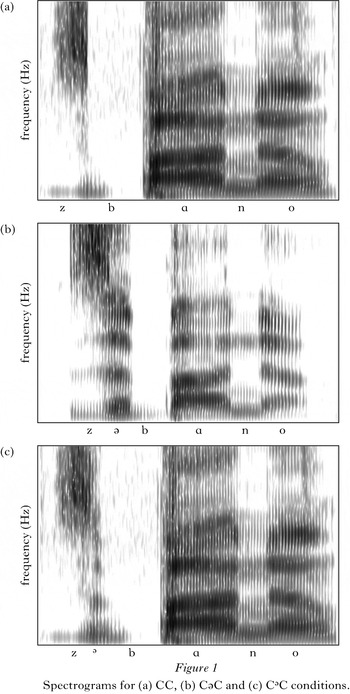
The stimulus categories are as follows. Example spectrograms for Lexical schwa, Transitional schwa and Cluster are given in Fig. 1.
- (1)
a. Lexical schwa (CəC)
These stimuli are composed of the /s f z v/-initial CəC sequences as produced by Speaker 8. All of these were produced with a vocalic period between the two consonants. There were a total of 96 CəC stimuli (24 for each initial fricative).
b. Transitional schwa (CəC)
These stimuli are based on the /f z v/-initial CC sequences that Speaker 8 produced with schwa-like material between the two consonants. There are no /s/-initial words in the CəC category, because /s/-clusters are legal in English, and were pronounced correctly by the speaker in all cases. In tokens where Speaker 8 accurately produced the intended cluster (e.g. [fmɑsɑ]), a transitional schwa from an inaccurately produced token of the same cluster was excised and spliced between the two consonants. Excised schwas were always cut from and inserted at zero crossings to avoid acoustic artifacts. In the very rare tokens where Speaker 8 deleted or changed the initial fricative (n=4), the entire CəC sequence from another pseudo-word was excised onto the remaining [-ɑCV] word form. Each C1C2 combination had four tokens, except for /fp/ which had three, due to poor recording quality. There were a total of 71 CəC stimuli.
c. Cluster (CC)
These stimuli were created with Speaker 8's correctly produced CC sequences, and by excising any vocalic material he had inserted into the /f z v/-initial CC sequences. The /s/-initial clusters from Davidson (2006) were included in the Cluster condition since Speaker 8 always produced them correctly. Deletion of a consonant and segment change were treated the same way as described for the CəC condition. Again, one /fp/ token was discarded, for a total of 95 CC stimuli.
d. Singleton (CV)
The Singleton category was included to alert listeners to the presence of CaCV tokens in the stimuli set, which might affect their perception of CC words as well. Specifically, it might lead to more production of CC stimuli with only a single onset consonant.The Singleton tokens were created by splicing the initial /s f z v/ and any vocalic material out of the tokens in the CC (for /s/-initial words) and CəC (for /f z v/-initial words) conditions. This left 91 words beginning with /p t k s f v z m n/. These words are treated as fillers, and are not analysed further in the results in §2.5.
In addition to the experimental stimuli, ten non-word tokens of similar form were recorded by a female English speaker who is a proficient second-language Russian speaker, to be used for practice before the experiment. Practice tokens included CC, CəC and CV items. These items were investigated with a spectrogram to ensure that no vocalic interval appeared in the CC tokens, and no such tokens were found. CəC stimuli were not included in the practice with feedback, since we did not want to bias the speakers' responses for these tokens.
Spectrograms for (a) CC, (b) CəC and (c) CəC conditions.

2.3 Procedure
The experiment was implemented in Microsoft PowerPoint 2003. Participants were told the following: ‘In this experiment, you will hear words that are originally from a foreign language. Some of these words are possible English words, and others are less like English words. After the word has been repeated twice, you should write out what you've just heard on the answer sheet using English letters.’ The stimuli were played through headphones. There was no text on the screen other than a number which corresponded to numbered lines on an answer sheet. Participants were first given ten practice tokens. After the presentation of each audio stimulus, they received feedback that showed them one possible way of writing down the word they had just heard. They were also informed that there were other possible ways of writing the token. They were then presented with the stimuli in one of four random orders. Participants were given five seconds to listen and write their response to each token before the slide automatically advanced. They were given a break halfway though the experiment.
2.4 Coding
The categories in (2) were used in coding the answers for the Lexical schwa, Transitional schwa and Cluster sequences. Only the written material preceding [-ɑCV] was considered in coding the responses.
- (2)
a. Transcribed with or without vowel
Words from all three sequences were coded as to whether or not they were written with a vowel. The particular choice of written vowel between C1 and C2 was considered irrelevant.
b. C1 and C2 change
If C1 was written as anything other than the intended consonant, the response was coded as C1 change. Across all conditions, sequences of ‘sh’, ‘ts’, ‘tz’, ‘ds’ and ‘dz’ were interpreted as single consonants. Therefore, a response of ‘tsnalay’ to the stimulus [snAle] would be marked as C1 change rather than treated as a word-initial consonant insertion.
If C2 was written as anything other than the intended consonant, the response was coded as C2 change.
Note that a small number of tokens (fewer than 5%) were coded for both C1 change and whether or not they were correctly transcribed with a vowel (e.g. [vgɑso]→‘fugaso’), so totals may add up to more than 100%.
c. C1 and C2 deletion
If C1 was not written, this was coded as C1 deletion. If C2 was not written, the response was coded as C2 deletion.
d. Metathesis
If C1 and C2 were switched in any condition, the response was coded as Metathesis.
e. Prothesis
If a vowel was inserted before C1 in any condition, the response was coded as Prothesis.
f. Other
Any other kind of change, such as consonant insertion or no response, was coded as ‘other’.
2.5 Results
The primary analyses with respect to the sequence types in this study are those comparing performance in the Lexical schwa, Transitional schwa and Cluster conditions. Analyses of response types are limited to those which are used at least 10% of the time. C1 deletion, C2 deletion, C2 change, metathesis, prothesis and consonant insertions together account for less than 4% of the responses overall. These types of transcription changes are not analysed below.
2.5.1 Transcribed with or without a vowel
The first repeated measures ANOVA examined the differences between the proportions of words written with a vowel as compared to those that were not. The independent variables were the sequence type (Lexical schwa, Transitional schwa and Cluster), the first consonant of the sequence (/f v z/) and the vowel status of the transcription (CVC, CC). /s/-initial sequences were left out of this ANOVA since there are none in the Transitional schwa condition. The dependent variable was the proportion of each transcription response type for each participant, which was arcsine transformed (as are all other proportional dependent variables in the remainder of the statistical tests). The arcsine transformation is a standard normalisation technique which makes proportional data conform to the assumption of an ANOVA that the dependent variable is continuous.
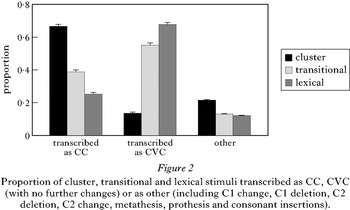
Results show that there is a main effect of sequence type (F(2, 38)=114·77, p<0·001), but no main effect of C1 (F(2, 38)=1·50, p=0·24) or vowel status (F<1). Neither the interaction of C1 and sequence type (F(4, 76)=2·75, p=0·07) nor the interaction between C1 and vowel status (F<1) was significant. However, the interaction between sequence type and vowel status was significant (F(2, 38)=67·52, p<0·001). The three-way interaction was not significant. These results indicate that the place of the first consonant did not affect the responses. The proportion of CC and CVC responses for each sequence type is shown in Fig. 2. All responses other than transcription as CC or CVC are also shown in the figure.
Proportion of cluster, transitional and lexical stimuli transcribed as CC, CVC (with no further changes) or as other (including C1 change, C1 deletion, C2 deletion, C2 change, metathesis, prothesis and consonant insertions).

Subsequent comparisons were carried out to investigate the source of the significant effects for sequence type and the interaction of sequence type and vowel status. Separate univariate ANOVAs for the CVC and CC responses with sequence type (Lexical schwa, Transitional schwa and Cluster) as an independent variable were run. For the CC responses (the leftmost set of data in Fig. 2), there was a significant main effect of sequence type (F(2, 38)=17·46, p<0·001). Pairwise comparisons showed that all three pairings of sequence types were significantly different from one another (p<0·001). For the CVC responses (middle set of data in Fig. 2), there was also a significant main effect of stimulus type (F(2, 38)=200·36, p<0·001). Again, all three sequence types were significantly different from one another (p<0·001). These findings indicate that participants transcribed a Cluster as ‘CC’ more often than either the Lexical or Transitional schwa, and Lexical schwas were transcribed as ‘CVC’ significantly more often than either Clusters or Transitional schwas. Transitional schwas were different from the other two sequences for both response types, indicating that participants do not categorically treat them either as schwas or as the absence of vocalic material.
2.5.2 C1 change
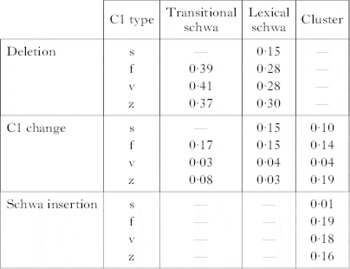
C1 Change was analysed with a repeated measures ANOVA including the independent variables of sequence type (Lexical, Transitional and Cluster) and the first consonant of the sequence (/f v z/). The dependent variable is the proportion of responses transcribed with a change in C1. There is a significant main effect of sequence type (F(2, 38)=6·20, p<0·005) and C1 type (F(2, 38)=13·11, p<0·001), and the interaction is also significant (F(4, 76)=23·16, p<0·001). The C1 responses are shown in Table II (which also includes information for /s/-initial sequences). Post hoc comparisons indicate that the main effect of sequence type arises because /f/-initial sequences have significantly more C1 change than both /v/-initial sequences (t(19)=6·12, p<0·001) and /z/-initial sequences (t(19)=2·39, p<0·03). Similarly, post hoc tests show that within C1 type there are only significant differences within sequence types for /z/ (F(2, 38)=49·95, p<0·001). T-tests confirm that the comparisons for all three sequence types are significantly different for /z/-initial sequences (Transitional vs. Lexical: t(19)=3·87, p<0·001, Lexical vs. Cluster: t(19)=−9·66, p<0·001, Transitional vs. Cluster: t(19)=−6·31, p<0·001).
Repair proportions for inserted, lexical and cluster stimuli. When a repair is not applicable to a sequence type, ‘—’ appears in the cell.

2.6 Discussion
An important finding from this study is the CəC items are significantly more likely to be transcribed as CC than are CəC items. This is shown succinctly in Fig. 2. This result suggests that listeners seem to be sensitive to the fine-grained acoustic differences between [ə] and [ə]. Yet, while CəC items cannot simply be equated with CəC tokens, the results also reveal that listeners wrote CəC tokens with a vowel just over 50% of the time and as a cluster nearly 40% of the time.Footnote 1 This finding suggests that listeners perceive the transitional schwa as an acoustic event that is intermediate between a cluster and a full schwa. Since listeners are encouraged by the task to assign these tokens either a CC or a CəC representation (broadly speaking, the two possible phonotactic categories for English), the similarity of the transitional schwa to both of these categories leads listeners to choose between them with similar frequency. Further ramifications of this finding for loanword adaptation and sound change are considered in the general discussion.
Overall, the listeners transcribed both the lexical CəC sequence and the non-native consonant clusters with approximately 60%–70% accuracy. When they produced errors, listeners were most likely to write CəC stimuli without a vowel and CC stimuli with one. There are several reasons for these findings. First, previous studies have shown that listeners may exhibit perceptual epenthesis when faced with phonotactically illegal CC sequences (Dupoux et al. Reference Dupoux, Kakehi, Hirose, Pallier and Mehler1999, Dupoux et al. Reference Dupoux, Pallier, Kakehi and Mehler2001, Kabak Reference Kabak and Idsardi2003). Although perceptual epenthesis was not widespread in this experiment (14%) it is possible that this phenomenon occurs occasionally, especially considering that in the practice session, listeners were made aware that both CC and CəC words are in the stimuli. Likewise, listeners appear to confuse lexical CəC words with CC at times. It is possible that participants may be overcompensating; that is, some listeners may have written CC more often than necessary to indicate that they recognised that the stimuli contained CC sequences as a strategy to perform the task. Again, because the feedback explicitly informed listeners that the words that are not English-like contained illegal initial consonant clusters, they may have been prompted to overcompensate.
Most of the results did not show a significant effect of C1. Listeners were equally likely to transcribe CəC and CəC sequences with a vowel, and CC sequences without one, regardless of C1. However, among tokens that were written with a change in C1, /f/-initial sequences were more likely to be written with a different consonant than either /v/ or /z/. When transcribed as something other than /f/, participants tended to write /f/ as /v/. This may be due to the fact that Speaker 8 from the original study sometimes produced /f/ with rather low intensity and short duration, which may have led participants to confuse it with a /v/, especially since they were aware that /v/ was also in the data set. In the case of the spike in C1 change for /z/-initial clusters, it should be noted that speakers tended to write /sC/ in these cases. This is likely attributable to the fact that (a) /s/-initial sequences were also in the stimuli, and (b) changing /z/ to /s/ creates an acceptable and frequent orthographic string in English.
It is interesting to note that even though the Singleton condition was added to alert speakers to the presence of CV stimuli and to ‘encourage’ them to transcribe CC tokens without two consonants, C1 deletion was almost never evidenced by the transcribers. This finding indicates that listeners do not have difficulty perceiving a fricative when followed by either a consonant or a vowel (e.g. Wright Reference Wright1996), at least when the sequence is produced by another native English speaker. It may be that the acoustic properties of fricatives produced by speakers of other languages would be difficult for English speakers to perceive in CC sequences, but this is a matter for future study.
The finding that CəC is transcribed as CC significantly more often than CəC is suggests that listeners are aware of differences between CəC and CəC. That is, they may realise that CəC is not categorically a lexical vowel, even though when forced to transcribe the words, they write it with a vowel about half the time. One possibility is that the listeners are aware of the acoustic differences between [ə], [ə] and  (as in the CC case), but the transcription task forces them to choose either a lexical vowel or a cluster. In this case, speakers should be able to distinguish between tokens like [vəbɑzɑ] and [vəbɑzɑ] or [vbɑzɑ] with greater than chance accuracy in a discrimination task. On the other hand, the proportion of the instances in which transcribers wrote CəC with a cluster vs. with a vowel was similar. Thus, another possibility for a discrimination task is that the transitional schwa, which is acoustically intermediate between the cluster and the lexical schwa, is not perceptually distinguishable from either of these phonotactic patterns by an English speaker.
The second experiment is an AX discrimination task designed to determine whether speakers can acoustically distinguish between lexical schwas, transitional schwas and clusters. If listeners can focus on the acoustic properties only, then they should be able to distinguish among all three types of stimuli with greater than chance accuracy. But if the transitional schwa is part of a gradient scale from cluster to lexical schwa, then listeners might be equally willing to equate a CəC token with CC as with CəC. In this case, it is expected that there would be poor discrimination for both CəC/CəC and CəC/CC trials, and that performance on the CC/ CəC should be significantly better.
3 Experiment 2
3.1 Participants
The participants were 31 New York University graduates and undergraduates, who received payment for their participation. All of them were native speakers of English who had no experience with Slavic languages, Hebrew or any other language with the initial obstruent clusters used in the study. No participants were phonetically trained. None reported any history of speech or hearing impairments, and none of the participants was left-handed. None of the listeners in Experiment 2 had participated in Experiment 1.
3.2 Materials
The materials for this experiment are very similar to those for Experiment 1, with one important change. The stimuli are the same ones taken from Subject 8 from Davidson (Reference Davidson2006), but in this experiment, it was crucial that the only difference between each pair in the discrimination task be the vocalic interval between the initial CC sequence. The Transitional productions (those in which Subject 8 attempted to produce CC, but uttered CəC instead) were chosen as the ‘base’ stimulus. To create the CC set, any vocalic material was excised (following the procedure used in Experiment 1). To create the CəC set, any vocalic material was first removed, and then the /ə/ from Subject 8's production of the same Lexical item was spliced into the base at zero crossings (e.g. Subject 8 attempted /vgɑno/ and produced [vəgɑno]; the [ə] was excised, and the [ə] from his accurate production of /vəgɑno/ was spliced in). To create Transitional items in cases where Subject 8 accurately produced the CC target, the [ə] from another stimulus with the same surrounding cluster was spliced between the CC (e.g. Subject 8 attempted /vgɑbɑ/ and produced [vgɑbɑ]; the [ə] was excised from [vəgɑno] and spliced into [vgɑbɑ] to make [vəgɑbɑ]).
The discrimination experiment was an AX task, so listeners were asked to determine whether the second word was the same as the first or different (i.e. as opposed to AXB, in which listeners are asked to determine whether the middle stimulus is the same as the first or the last). Pairs to be discriminated by the hearer were formed by creating all combinations of Transitional, Lexical and Cluster pairs (e.g. [vgɑno]/[vəgɑno], [vgɑno]/[vəgɑno], [vəgɑno]/[vəgɑno]). Each type of word was also paired with itself for the ‘same’ trials. There were 24 Transitional-Lexical-Cluster triplets each for /f z v/-initial stimuli, for a total of 72 pairs for each of the following categories: Lexical-Transitional (CəC-CəC), Lexical-Cluster (CəC-CC), Cluster-Transitional (CC-CəC), Lexical-Lexical (CəC-CəC), Transitional-Transitional (CəC-CəC) and Cluster-Cluster (CC-CC). Thus there were 216 ‘different’ trials and 216 ‘same’ trials. The order of the stimuli in different trials was counterbalanced (e.g. 36 CəC-CəC and 36 CəC-CəC). There were no /s/-initial tokens, since there were no /s/-initial Transitional stimuli. The Singleton category was also not used.
There were also twelve practice trials, with six counterbalanced Lexical-Cluster pairs, three Cluster-Cluster pairs and three Lexical- Lexical pairs. Participants did not hear any Transitional stimuli in the practice session.
3.3 Procedure
The experiment was implemented in E-Prime, commercial software for designing and running experiments. Participants were given the following instructions: ‘In the following task, you will hear sound files presented as pairs of words. These words may or may not be likely words of English. In some of the pairs, the sound files that you hear will be slightly different from one another, and others will be the same. Your task is to decide whether or not the sound files that are played to you are exactly the same. After hearing the second word, decide whether the two sound files are the same or different.’ Using the E-Prime button box, participants pressed a button labelled ‘S’ with the index finger if they thought the sound files were the same, and ‘D’ with the middle finger if they thought the sound files were different. Participants were encouraged to answer quickly, and were told to choose either ‘S’ or ‘D’ even if they were not sure of the answer.
The procedure for each trial was as follows. A ‘+’ appeared on the screen to alert the participant to the start of the trial, accompanied by the simultaneous presentation of the first sound file of the trial. At the end of the inherent duration of each sound file (i.e. the length of each word), there was a 250 ms pause, and then another fixation cross along with the second sound file. Participants could make a response any time after the start of the second sound file. As soon as the participant made a response, there was a 500 ms pause and the next trial started. The AX task itself and the interstimulus interval (ISI) of 250 ms were chosen to maximise the likelihood that listeners would make a response based on the acoustic similarity of the two items, rather than making a decision as to whether the two stimuli are possible members for the same phonetic or lexical category (Pisoni Reference Pisoni1973, Werker & Logan Reference Werker and Logan1985).
The experiment was conducted in a quiet room using Dell PC computers. Sounds were played over Sennheiser HD-500 headphones. Participants were first given twelve practice trials to familiarise themselves with the task; there was no feedback in the practice. In the experimental session, there was a break after the first 216 trials, at which time the participant could get up from the computer.
E-Prime kept track of the intended response (‘same’ or ‘different’), and the participant's actual response.
3.4 Results
Before any analysis was undertaken, each participant's patterns were examined to determine whether anyone responded ‘same’ or ‘different’ to 100% of the trials. Two such respondents were found. Because it could not be determined whether these participants were adequately performing the task or simply pressing ‘same’ to all trials, these participants were removed from further analyses.
3.4.1 Hits and correct rejections
The first analysis is an omnibus repeated measures ANOVA conducted to determine participants' accuracy in each condition. The independent variable was the stimulus pair type (Lexical-Transitional, Lexical-Cluster, Cluster-Transitional, Lexical-Lexical, Transitional-Transitional, Cluster-Cluster), and the dependent variable was the proportion of hits and correct rejections. Hits refer to the choice of ‘S’ for same trials, and correct rejections to the choice of ‘D’ for different trials. Since the dependent variable was a proportion, it was again arcsin transformed.
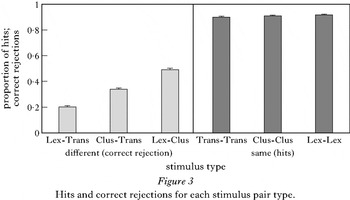
Results show that there is a significant main effect for stimulus pair type (F(5, 140)=124·29, p<0·001). The proportions of hits and correct rejections for each category are shown in Fig. 3. Pairwise comparisons adjusted with a Bonferroni correction indicate that there are no significant differences among the ‘same’ trial stimulus pairs, but that all of the ‘different’ pairs are significantly different from one another and from the ‘same’ trials (p<0·001).
Hits and correct rejections for each stimulus pair type.

3.4.2 D-prime analysis of stimulus pair types
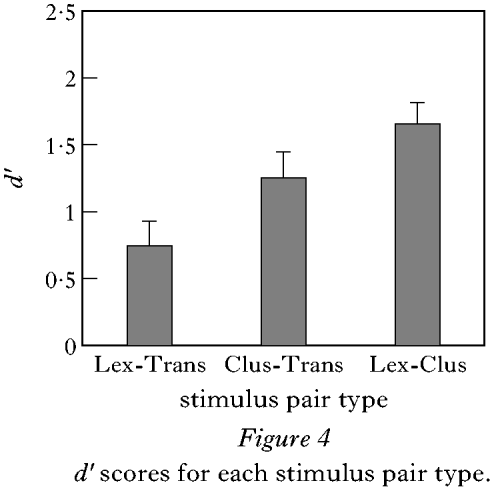
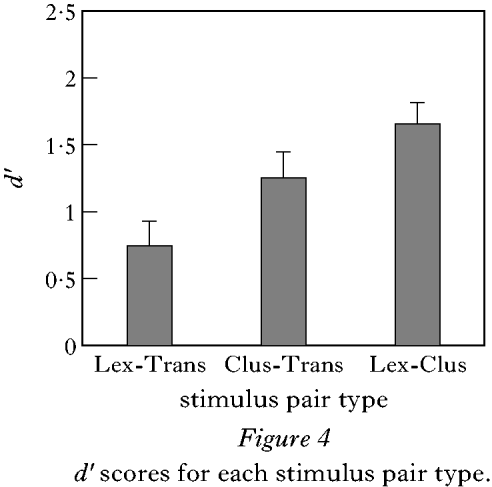
In addition to the preceding analysis of hits/correct rejections, analyses using d-prime (d′) have been carried out for the remainder of the comparisons (Green & Swets Reference Green and Swets1966, Macmillan & Creelman Reference Macmillan and Creelman1991). d′ measures how sensitive the hearer is to the presence of a signal (the different trials) when presented along with non-signals (the same trials). Many studies have shown that d′ is a more accurate measure of behaviour in discrimination tasks (Swets Reference Swets1986, Macmillan et al. Reference Macmillan, Goldberg and Braida1988, Macmillan & Creelman Reference Macmillan and Creelman1991), and it has been used in many types of psycholinguistic studies (e.g. Best et al. Reference Best, Morrongiello and Robson1981, van Hessen & Schouten Reference Hessen and Schouten1992, Francis & Ciocca Reference Francis and Ciocca2003). d′ scores for each speaker for the Lexical-Cluster, Cluster-Transitional and Lexical-Transitional categories were determined by comparing the false alarms for each ‘different’ trial category (e.g. Lexical-Cluster) to the mean hits for the relevant ‘same’ trials (e.g. Lexical-Lexical and Cluster-Cluster). The d′ scores were submitted to a repeated measures ANOVA with the independent variable of stimulus pair type. There was a significant main effect of stimulus pair type (F(2, 56)=12·49, p<0·001), which is similar to the result for the analysis of hits and correct rejections. The d′ scores are shown in Fig. 4. Planned comparisons show a significant difference between Cluster-Transitional and Lexical-Transitional (p<0·012), and between Lexical-Cluster and Lexical-Transitional (p<0·001), but no significant difference between Cluster-Transitional and Lexical-Cluster.
d' scores for each stimulus pair type.
3.4.3 Order effects
Since previous research has shown that the order of the stimuli sometimes has an effect on same/different judgments by listeners (e.g. Cowan & Morse Reference Cowan and Morse1986, Repp & Crowder Reference Repp and Crowder1990, Best et al. Reference Best, McRoberts and Goodell2001, Francis & Ciocca Reference Francis and Ciocca2003), we examined whether listeners' responses are affected by which stimulus comes first in the pair (e.g. Lexical-Transitional or Transitional-Lexical). An ANOVA is not appropriate, since the stimulus that is first or second in each pair is not the same across all pair types, so paired samples t-tests were carried out for the d′ score. Results show that there are no significant differences for order for any pair type (Cluster-Transitional: t(28)=−0·84, p=0·4; Lexical-Cluster: t(28)=0·33, p=0·7; Lexical-Transitional: t(28)=−1·69, p=0·1).
3.4.4 Effect of C1
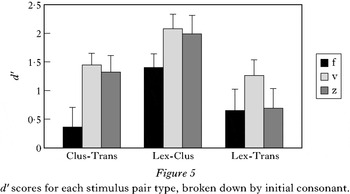
A repeated measures ANOVA to examine whether the different fricatives in C1 position affected the discrimination was also carried out. The independent variables were stimulus pair type (Lexical-Transitional, Lexical-Cluster, Cluster-Transitional) and C1 (/f v z/). Results showed that there were significant main effects for both stimulus pair type (F(2, 56)=14·02, p<0·001) and C1 (F(2, 56)=6·18, p<0·004), but no significant interaction (F(4, 112)=1·125, p=0·35). Pairwise comparisons of different C1 types within each stimulus pair type category show that for the Lexical-Cluster pair, listeners were significantly better at discriminating between the stimuli for the /v/ and /z/-initial words than they were for /f/-initial words (p<0·02), but /v/ and /z/-initial words were not significantly different. The same pattern held for Cluster-Transitional words (/z/ vs. /f/: p<0·02; /v/ vs. /f/: p<0·01). There were no significant differences for C1 among Lexical-Transitional pairs. These results are shown in Fig. 5.
d' scores for each stimulus pair type, broken down by initial consonant.

3.5 Discussion
The results of the discrimination task demonstrate that participants are at chance in the Lexical-Cluster condition, and are even more likely to treat Cluster-Transitional pairs and Lexical-Transitional pairs as if they were ‘same’ trials. d′ scores indicate that the sensitivity for the Lexical-Cluster condition is significantly higher than the sensitivity to Lexical-Transitional, but similar to the sensitivity to Cluster-Transitional. Both the accuracy and the sensitivity results suggest that speakers should be slightly more likely to represent Transitional schwas as Lexical schwas, which converges with the findings from Experiment 1 (cf. Fig. 2). Likewise, the AX discrimination findings are also consistent with the second hypothesis give in §2.6: the relatively poor discrimination of both Lexical-Transitional and Cluster-Transitional tokens indicates that the Transitional tokens are acoustically intermediate between the Lexical and Cluster tokens, and thus are difficult for the listeners to distinguish from either endpoint in a discrimination task.
While the findings are consistent with the hypothesis that Transitional schwas are on a gradient between the presence and absence of a schwa, it should also be noted that another possible reason that listeners have so much difficulty discriminating the ‘different’ trials may be the duration between the acoustic events being compared. Although the ISI between the two stimuli was set at 250 ms to encourage an acoustically based response, the actual ISI for the relevant part of the words (e.g. [CəC] and [CəC]) was effectively between 700 and 800 ms, since the remainder of the word (e.g. [ɑno] of [vbɑno]) varied between 500 and 600 ms, which was combined with the ISI. Previous research has shown that as ISI increases, listeners are less likely to attend to acoustic characteristics, and may only have access to a phonetic or phonological level of representation (Pisoni Reference Pisoni1973, Werker & Logan Reference Werker and Logan1985). Thus, an alternative interpretation of the consistently poor level of discrimination for the ‘different’ trials is that listeners may have lost access to the fine acoustic details and thus were forced to make phonetic or even phonological decisions between two possible categories, Lexical or Cluster.
Listeners may have been further influenced by the fact that the remainder of the word was acoustically identical in both members of the pair. This may have led to an increased proportion of ‘same’ responses if listeners were influenced by a recency effect when making the same/different judgment. It is probable the listeners would be better at discriminating the stimuli if each item were shorter in duration (e.g. [vbɑ] vs. [vəbɑ]). However, this study was intended to provide insight into how loanword adaptations are determined, and it was decided that bi- and trisyllabic words better reflected that situation. Along similar lines, the poor discrimination in the face of these more realistic, longer words may indicate that listeners are more willing to accept small differences in acoustic information as variants of the same form in loanword adaptation. Knowing that there is likely to be variability in how non-native words, are produced, listeners may disregard even potentially meaningful acoustic variation unless they are forced to pay attention to it (e.g. [zbɑno] and [zəbɑno] are borrowed at the same time and are lexically contrastive). This may be one factor that accounts for why the discrimination in the Lexical-Cluster condition is not better than chance.
This experiment differs from many other speech-perception studies using discrimination tasks in that the focus is on the perception of phonotactics, or sequences, not just individual phonemes. Whereas other studies have found that speakers are either at chance on the discrimination of non-native phonemes (e.g. Hindi retroflex vs. dental stops; Werker & Tees Reference Werker and Tees1984) or perform significantly better than chance (various contrasts in Zulu; Best et al. Reference Best, McRoberts and Goodell2001), the results of the current discrimination task indicate that speakers are worse than chance when comparing CəC to CC and CəC sequences, and at chance for the CC-CəC comparison. As the preceding paragraph implies, once acoustic strings longer than one or two phonemes are presented to listeners, it becomes difficult to ignore the role of phonological processing and lexical representation on how words are perceived.
Previous research on the perception of sequences has shown that the phonotactic restrictions of a listener's phonological system constrain how they perceive non-native sequences. For example, if consonant clusters vary along a native/non-native continuum (e.g. /tr/∼/tl/), speakers generally assimilate the contrast to the native category (Massaro & Cohen 1983, Hallé et al. Reference Hallé, Segui, Frauenfelder and Meunier1998, Pitt Reference Pitt1998, Moreton Reference Moreton2002). A series of studies by Dupoux and colleagues (Dupoux et al. Reference Dupoux, Kakehi, Hirose, Pallier and Mehler1999, Dehaene-Lambertz et al. Reference Dehaene-Lambertz, Dupoux and Gout2000, Dupoux et al. Reference Dupoux, Pallier, Kakehi and Mehler2001) and a follow-up by Kabak & Idsardi (Reference Kabak and Idsardi2007) using both identification and discrimination tasks demonstrate similar effects when non-native CC sequences are compared to phonotactically permissible CVC sequences: Japanese and Korean listeners categorise items like [ebzo] as [ebuzo] more often than chance. These authors have claimed that perceptual epenthesis arises because listeners' phonotactic constraints must interact with their perceptual systems at a very early stage, even prior to lexical access.Footnote 2 Both Dupoux et al. and Kabak & Idsardi argue that the syllable plays an important role in determining what kind of perceptual repair is going to be made by the speaker; thus, if a Japanese speaker cannot map a [bz] sequence to an existing syllable type in any way, he will perceive the sequence such that an acceptable syllable type is formed and the appropriate representations can be activated.
In the current experiments, English listeners were less likely than Japanese or Korean listeners to perceptually epenthesise a schwa into the consonant cluster, as evidenced by the overall low rate of CVC transcriptions for CC targets in Experiment 1 (14% for the English speakers in Experiment 1vs. 60–70% identification of CC as CVC for Japanese speakers in various tasks in Dupoux et al. Reference Dupoux, Kakehi, Hirose, Pallier and Mehler1999). Nevertheless, another explanation for the performance in the discrimination of Cluster-Lexical pairs may be that English listeners are occasionally perceptually epenthesising a vowel in the Cluster tokens, which would lead to a greater number of ‘same’ responses than might otherwise be expected in that condition. Still, the difference in the amount of perceptual epenthesis for English vs. Japanese speakers is considerable. While the particular /f v z/-initial clusters used in these experiments are not permitted in English, the fact that initial clusters exist in the phonotactic inventory, and that most of these particular clusters are allowed in medial and/or final position, may help English speakers to accurately perceive such sequences in most cases. These factors make the English situation very different than the Japanese case, where clusters are not found in any position. Thus, while perceptual epenthesis may occasionally occur for English listeners in these studies, it is no surprise that it is significantly less prevalent than for Japanese or even Korean listeners.
In the next section, the ramifications of the transcription and discrimination task results for loanword adaptation and phonological contrast are considered.
4 General discussion
Perception has been shown to have an effect on loanword adaptation for several types of segmental and phonotactic phenomena, such as the adaptation of tense and lax vowels from English as long and short vowels in Japanese (Takagi & Mann Reference Takagi and Mann1994), and the assignment of English voiceless stops to the aspirated category in Thai (Kenstowicz & Suchato Reference Kenstowicz and Suchato2006). The current study uses laboratory techniques to take this line of research one step further by exploring whether perceptual effects continue to influence adaptation as loanwords are passed from one speaker of the borrowing language to another.
The specific case under examination involves the acoustic properties of transitional schwa. As shown in previous research (Davidson Reference Davidson2005, Reference Davidson2006), the transitional schwas that English speakers produce between non-native consonant sequences have different acoustic properties than lexical schwas. In the previous work, it was hypothesised that the acoustic differences result because speakers do not sufficiently overlap the consonant sequences, giving rise to the production of a transitional vocoid between the constrictions. The results of the transcription task show that even with minimal exposure, English listeners do not categorically interpret transitional schwas as if they were lexical schwas. These findings are compatible with the possibility that that recipients may sometimes determine that the presence of a transitional vowel indicates that monolingual (or imperfectly bilingual) disseminators are attempting to produce a non-native consonant sequence, especially if they know that such sequences exist in the loans. Such an inference would affect whether the recipients posit, for example, /zgɑmo/ or /zəgɑmo/ for the input [zəgɑmo]. To go one step further, it is possible that in a borrowing situation, which would require listeners to provide underlying representations to words becoming part of the language, their sensitivity to the fine acoustic details differentiating the experimental stimuli would be accentuated.
The situation simulated in this study is one in which the disseminators are not bilingual, and as a result may produce the items being borrowed with some amount of variability. Such variability is consistent with the experimental findings in Davidson (Reference Davidson2006), where the English speakers who were given both orthographic and auditory information about the non-native consonant sequences generally produced some proportion of the trials accurately, and others with a transitional schwa. In this study, the monolingual recipients are presented with accurate CC sequences, which alerts them to the presence of that phonotactic structure in the words being adapted, with CəC sequences, and with phonotactically permissible CəC sequences. While Experiment 1 encouraged listeners to categorise the stimuli as either CC or CəC, the results of the discrimination task suggest that in any case participants may not have entertained the possibility that the gestural coordination necessary to produce CəC sequences could be a phonological category separate from CC or CəC. That is, the especially poor discrimination of the Lexical-Transitional and Cluster-Transitional categories indicates that Transitional tokens were often equated with either Lexical or Cluster categories. This was expected under the second hypothesis presented in §2.6: acoustically, CəC tokens are intermediate between the accepted phonotactic categories of CC and CəC, and thus listeners are willing to attribute CəC tokens to either of the established phonotactic possibilities, and not just to consider them an instantiation of CəC.
Since the recipients are similarly monolingual, even those who posit a CC representation for CC inputs or sometimes for CəC would not be the speakers who consistently begin producing either of these sequences a well-formed consonant cluster. Like the experimental participants in Davidson (Reference Davidson2006), if the situation demonstrated in the current studies were played out in a real borrowing situation, then these recipients should also produce a combination of CC and CəC surface forms. The interesting question that follows from this path of transmission is how the ‘second generation’ of children learning from their parents' variable production will both represent and produce these words. This situation is similar to the choice mechanism of sound change in Evolutionary Phonology (Blevins Reference Blevins2004), whereby a listener perceives multiple variants of a single form, which allows her to ultimately decide on a different underlying representation than the one the speaker has. If CC and CəC surface forms are treated as being in free variation, then one possibility is that the infant will represent such words underlyingly as CC, which would ultimately cause phonological change in the language such that sequences like [zb] or [vz] – never before allowed in the language – are now acceptable phonotactic structures. Phonological change has been seen in both languages like Japanese (e.g. Itô & Mester Reference Itô, Mester and Goldsmith1995, Fukazawa et al. Reference Fukazawa, Kitahara and Ota1998), which does not have massive bilingualism among current speakers, and Huave, which may have significantly more bilingualism (Davidson & Noyer Reference Davidson and Noyer1997). Another logical possibility is that the children will in fact incorporate the gestural timing produced by the adults into their grammars (cf. Gafos Reference Gafos2002 for timing in grammars), such that obstruent–obstruent and obstruent–nasal clusters (other than /s/-clusters) are produced with transitional vocoids, while the clusters that are phonotactically legal for the current generation will continue to be produced with close transition (i.e. no vocoid produced). Both of these outcomes are consistent with the idea that true phonological contrast promoted by borrowing only arises when a new (infant) generation of speakers acquires loanwords that are borrowed by adult speakers (Lahiri et al., forthcoming).
Another implication of the present results is that for any given CəC sequence produced by a first generation speaker, there may be variation as to whether second generation speakers adapt it as an underlying CC or CəC sequence. As shown in Fig. 2, about 40% of CəC stimuli are transcribed as CC, and just over 50% as CəC. With this kind of variation in responses, it should be expected that, for example, some [zəb]-initial words as produced by disseminators will be represented as /zb/ (and produced as either [zb] or [zəb] by the recipients) and other [zəb]-initial words will be represented as /zəb/. This type of situation has been hypothesised for Cook Islands Maori, where vowels present after certain final consonants in loanwords fluctuate between [i] and [e] (Hall Reference Hall2003). Hall argues that the vowel now represented as /e/ was initially produced as a result of a gestural reinterpretation of the original source word, but not all listeners perceived the final [e] as a lexical vowel. For words that were not perceived as having a final [e], a default, lexical [i] was subsequently epenthesised to satisfy independent syllable restrictions in Maori.
5 Conclusions
Because loanword adaptation is not often observable ‘in the wild’, laboratory studies of language transmission can shed light on the types of processing that affect the form of adaptations (e.g. both phonological and perceptual). The two experiments presented above are analogous to a borrowing situation in which a small group of monolingual or imperfectly bilingual borrowers spread the loanwords to the larger monolingual community. The results of these studies, in conjunction with previous production studies, show that disseminators often produce non-native consonant sequences with a transitional schwa between the consonants, and that subsequent recipient listeners can variably distinguish between CVC sequences and the corresponding CC sequences that the disseminators intended to produce. Because listeners do not categorically distinguish between transitional schwas, lexical schwas and consonant clusters, it is predicted that loanword adaptation will also reflect variability in how underlying representations are assigned to the disseminators' output.
The present experiments shed light on the role that perceptual information may play in the development of a new phonological contrast due to loanword adaptation. This does not mean that all adaptation has perceptual origins, but does support previous claims in the literature that perception is active in adaptation. Furthermore, the present studies also show that perceptual differences between the source and borrowing language do not always lead to subsequent nativisation of a non-native structure. On the contrary, this study demonstrates that perceptual information may contribute to the eventual development of a new phonological contrast in the borrowing language.
5.1 Appendix: Stimuli
Stimuli are given in IPA. Both experiments included these words in the CC condition, and the same words produced with a schwa between the initial consonants for the CəC condition and with a transitional schwa in the CəC condition.
1 CC, CəC and CəC conditions

2 Singleton condition