Pheochromocytomas are extremely rare tumours in the paediatric age. Usually, the initial clinical setting includes arterial hypertension associated with paroxysmal headaches, weight loss, and sweating. We report the case of a child with a rare collagen disease and evidence of an acquired long QT syndrome that later developed a Torsades de Pointes.Reference Brugada 1
Case presentation
A 12-year-old boy diagnosed with an Ullrich congenital muscular dystrophy, confirmed by COL6A1 mutation in a muscular biopsy, was being followed up in our cardiology clinic annually to rule out a cardiac compromise from his rare collagen disease. The initial cardiology evaluation had been in 2005, at age 5 when his disease was first diagnosed. During the first 7 years of cardiac follow-up, his evaluations including echocardiograms and electrocardiograms were normal. Specifically, there was no echographic evidence on cardiac hypertrophy or dilation and he had a normal left ventricular systolic and diastolic function: end-diastolic left ventricular volume of 3.7 cm=−1.0 standard deviation for age and body surface and ejection fraction of 67%. Other findings included a trivial aortic, tricuspid, and pulmonary regurgitation. There was normal pulmonary pressure as measured by the systolic tricuspid regurgitation jet (20 mmHg).
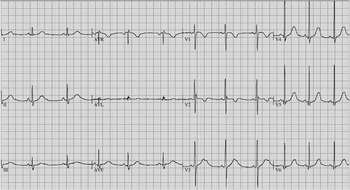
During these years, he progressively developed mild skeletal muscle weakness and difficulties in gaining weight. On a cardiology clinical visit on September, 2012, we first identified a prolonged QT interval with otherwise normal cardiac function, normal blood chemistry, and no history of any medications (Fig 1). Interestingly, in this visit, his clinical exam including blood pressure was normal. On consultation with a pediatric electrophysiologist, an initial plan of action was set: a blood biochemistry panel resulted normal, we started the patient on β-blockers, informed the family to avoid all QT-prolonging drugs, and screened both parents with normal electrocardiograms. It is noteworthy that there was no family history of unexpected sudden death or fatal accidents. Although we could not exclude a genetic contribution to the patient’s phenotype, given the patient’s history of previously normal ECGs and no family history of Long QT syndrome, we elected not to pursue genetic testing and follow him clinically with an ECG in a month. It is important to mention that the patient did not come to his follow-up appointment.
Follow-up ECG with first abnormal findings of a long QT interval on 9/2012. Sinus Rhythm at 73bpm, PR interval 122ms, QRS duration 88ms, QT interval 480ms, QTc 490ms. Note as well a change in the T wave morphology with a slurred termination of the wave.

Two months later, the patient consulted the emergency department for severe headaches and was found to be hypertensive (non-invasive blood pressure 180/90 mmHg) with a mild sinus bradycardia of 50–60 beats/minute. A head computed tomography scan at this point resulted normal and ruled out intracranial hypertension.
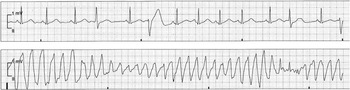
In the first hour after admission, the patient presented with severe vomiting followed by a brief episode of syncope and was transferred to the paediatric intensive care unit. Shortly after, he developed a polymorphic ventricular tachycardia as evidenced in the monitors (Fig 2).
Monitor tracings as registered on admission in the PICU. The upper tracing shows a normal sinus rhythm at a baseline rate of 75 bpm with periodic long QRS beats of different morphology, representing ventricular premature beats with variable degree of fusion (beats 4, 6, and 12). Note the prolonged QT interval (even if it is not proper to measure an accurate QT interval by means of a monitor tracing). At the end of the upper tracing, there is a short–long–short phenomenon that precedes a polymorphic ventricular tachycardia with the unique characteristic illusion of a twisting of the QRS complex around the isoelectric baseline, most commonly known by the french name “Torsades de Pointes”. This characteristic sequence of a long RR interval (between beats 12 and 13) followed by a short extra-systolic interval with the premature depolarisation interrupting the preceding repolarisation is the usual pattern that triggers this arrhythmia.

Cardio pulmonary resuscitation was performed and the patient was shocked (asynchronous defibrillation). The arrhythmia terminated into a normal sinus rhythm episodically overtaken by brief salves of polymorphic ventricular tachycardia that self-resolved.
A central line was placed and the patient was intubated and ventilated. Intravenous treatment with Magnesium Sulphate (0.25 mmol/kg/day) and Esmolol (bolus of 12 mg followed by an infusion of 50 µg/kg/minute) was started that stabilised the patient in a sinus rhythm. A blood chemistry panel at this point showed a hypokalemia (K of 3.15 mmol/dl) and a potassium drip was started to keep the ion above 4 mmol/dl. A cardiac echocardiogram at the bedside showed normal anatomy and preserved left ventricle function (ejection fraction of 65%), with no evidence of aortic pathology. Despite this treatment, the patient continued to show severe arterial hypertension, requiring the addition of Sodium Nitroprusside (max 2 µg/kg/minute) and Prazosin (0.03 mg/kg orally every 8 hours) to lower his blood pressure.
Once the patient was stabilised, an abdominal ultrasonography showed a left adrenal mass and ruled out compromise of the renal perfusion. Urgent urinary catecholamines were shown to be increased.
Emergency laparotomy and resection of the left adrenal gland was performed within the next 6 hours. On postoperative follow-up, the blood pressure completely normalised and treatment could be completely discontinued. Daily follow-up electrocardiograms showed a progressive shortening of the QT interval. The patient had an uneventful postoperative period and was eventually discharged from hospital on day 8 post surgery with a QT interval measured at 444 ms, on β-blocker therapy (Nadolol 2 mg/kg/j).
The histopathologic examination of the mass confirmed complete resection of a pheochromocytoma with S-100 protein-positive sustentacular cells and tumoral expression of tyrosine hydroxylase on immunohistochemical examination.
The patient was kept on β-blocker therapy for a month and the treatment was stopped with evidence of normal QT interval in several electrocardiograms. Given the finding of an acquired secondary long QT, decision was made not to send genetic testing for congenital LQT mutations; however, instead, he was screened for MEN II-A and II-B multiple endocrine neoplasia.
Discussion
This case illustrates a rare constellation of pheochromocytoma with prolongation of the QT interval, and underscores the challenge of early diagnoses of a pheochromocytoma in children, even with a regular medical follow-up. Prolongation of a previously normal QT interval can be a clue for the diagnosis, particularly if there is an association with some of the other clinical signs (arterial hypertension) or symptoms (headaches, profuse sweating, palpitations). We cannot but emphasise the relevance of the measurement of the non-invasive blood pressure in the paediatric age during the regular medical visit.
There are a few case reportsReference Kihara, Terai and Kihara 2 – Reference Kinge van der, de Haes, Wietash, Wiesfeld and Hendriks 7 of pheocromocytomas presenting with polymorphic ventricular arrhythmias in the adult literature. However, we could not find any literature on paediatric cases.
What is the specific cause of Torsades de pointes in patients with pheochromocytomas? What makes those patients prone to this arrhythmia? The theory underlying the mechanism remains unclear. There is obviously a link with the increased circulating catecholamines, but the exact site of impairment in myocardial repolarisation is unknown. Previous articles proposed the underlying cardiac hypertrophy as a cause of the increase QT dispersion with correlation with systolic blood pressure and left ventricular mass index. This has been initially ruled out as a cause of QT prolongation in our patient as the changes in the QT interval manifested before he developed increased blood pressure, but mainly because he did not present with left ventricular hypertrophy either by echocardiography or voltage criteria. Clearly, the underlying muscular disease and its related malnutrition worsened with the vomiting that played a crucial role in aggravating the hypokalemia in an already chronically potassium depleted patient, culminating in an ideal setting for the arrhythmia even on a standard dose of β-blocker.
Financial Support
This research received no specific grant from any funding agency, commercial, or not-for-profit sectors.
Conflicts of Interest
None.