INTRODUCTION
In an accompanying paper we have shown that of the 2 main hosts for the tick Ixodes uriae on the Isle of May, Scotland, the common guillemot (Uria aalge, Pontoppidan, 1763) rather than black-legged kittiwake (Rissa tridactyla, Linnaeus, 1768) supports the transmission of tick-borne Great Island Virus (GIV). In this paper we identify the key factors that affect virus transmission between ticks and guillemots and highlight the need to measure host age-related acquired immune responses to obtain a quantitative understanding of tick-borne pathogen transmission.
Vector-borne pathogen transmission depends on an infective vector biting a susceptible host (but see Gilbert et al. 2004). The transmission rate is largely dependent upon the number of vectors biting each host per unit time (Dye and Williams, 1995) and is relatively independent of host density (because most vectors make a fixed number of bites during their life-cycle). This contrasts with direct pathogen transmission where the number and density of susceptible individuals in a population is of paramount importance. Simple models of tick-borne pathogen transmission have been developed (O'Callaghan et al. 1998; Norman et al. 2004) and the inherent differences between tick- and insect-borne transmission discussed (Randolph, 1998). The life-cycle of tick vectors is measured in years rather than weeks, questing ticks are sedentary compared to flying insects and typically require 5–7 days of continuous feeding to obtain a single bloodmeal. A consequence of the relatively low mortality rates and feeding behaviour of ticks is that, in theory, tick-borne pathogens can persist at low transmission rates compared to insect-borne pathogens. Furthermore, the limited ability of ticks to seek hosts means that their biting rate is not entirely independent of host density since if tick numbers are stable but host numbers decrease the probability that a tick will bite any one host increases.
GIV is horizontally transmitted from infected I. uriae (White, 1852) ticks to uninfected seabirds or vice versa when ticks feed (Nuttall et al. 1981, 1984a). Horizontal transmission to an uninfected tick requires that it feeds on a viraemic host, or co-feeds with 1 or more infected ticks on a non-viraemic host (Jones et al. 1997; Gern and Rais, 1996). Vertical transmission from one vector or host generation to the next or direct transmission between individuals (vector to vector or host to host) has not been reported in orbiviruses (Nunamaker et al. 1990). The rate of GIV transmission to successive generations of ticks therefore depends upon (1) the number and distribution of infected and uninfected ticks of different stages on susceptible hosts; (2) the duration of tick feeding; (3) the latent period between hosts being bitten and becoming infective; (4) the duration of virus infection; (5) transmission coefficients from tick to host and host to tick; (6) transmission coefficients between developmental stages (termed trans-stadial transmission) and (7) tick and host survival or mortality rates. These parameters first highlighted by Randolph and Craine (1995) are dependent on intrinsic properties of the tick and virus and may also be affected by age-related changes in the susceptibility of individual hosts to parasitic infection arising from behaviour and acquired immunity (see reviews in Toft, Aeschilmann and Bolis, 1991; Hart, 1997).
I. uriae and guillemots exhibit a number of spatial and temporal characteristics that are likely to affect GIV transmission. Guillemots are cliff nesting seabirds that typically breed in large colonies at high densities (an average of 20 pairs per m2 in flat areas; Harris and Birkhead, 1985). I. uriae inhabiting such colonies has no alternative hosts and all 3 tick stages (larvae, nymphs and adult females) feed on guillemots. Almost all the ticks feed once a year during the seabird breeding season (April–June) and tick feeding peaks during incubation (Danchin, 1992; Barton et al. 1996). Breeding guillemots typically 5–19+years old are highly territorial and pre-breeders (mainly 3–7 years old) trying to recruit to the colony tend to lose-out in fights with the older birds. Pre-breeders therefore spend the majority of their time at the colony on ledges landward to the pre-breeding birds (Halley and Harris, 1994; Halley, Harris and Wanless, 1995). Thus spatial separation by breeding status is coupled with segregation by age. Within the breeding areas there is a high degree of spatial stability that is brought about by high survival rates in adults and high levels of site and mate retention (Harris et al. 1997). Breeding pairs have a single offspring each year, which constrains the rate of population change. These characteristics increase the stability and reduce the complexity of the GIV transmission system compared to other tick-borne pathogen transmission systems. For example louping ill (Norman et al. 1999) and sylvatic Lyme disease (Kurtenbach et al. 1994, 1995) that both feature multiple hosts, less predictable patterns of tick feeding, and marked spatial and temporal variation in host abundance. These biological attributes, together with our ability to repeatedly sample and estimate the age of individual marked birds, make the guillemot study system highly suitable for studying endemic pathogen transmission.
To establish the most important parameters affecting GIV transmission between ticks and guillemots, including the consequences of the age structured host population, we examined mean annual and monthly tick burdens and tick weights, virus infection prevalence in ticks, and virus specific antibodies. We asked 4 questions. First, does the percentage of ticks infected with virus depend on the status (breeding adult, pre-breeding adult or chick) and/or age of the guillemot they have fed on? Second, do tick feeding patterns and success (measured by the number, distribution and weight of tick) depend on guillemot status? Third, do levels of acquired immunity to GIV reflect duration of exposure to parasitism? Fourth, which factors (tick numbers and distribution or acquired immunity) best explain virus prevalence in ticks?
MATERIALS AND METHODS
Study site
The study was carried out on the Isle of May, Scotland (56 °11′N, 2 °33′W) between 1993 and 1996.
Natural history
During the study the breeding population of guillemots on the Isle of May was estimated to be about 12000 pairs. Birds are present in the colony mainly between late-March and mid-July. Guillemots remain at sea during the first year of life but in the subsequent 2–5 years spend increasing time at the colony establishing a breeding site and obtaining a mate (Harris, Halley and Swann, 1994). Perhaps 5% of birds designated as pre-breeders by their plumage characteristics may have bred in the past (Harris and Wanless, 1995).
The ixodid tick, I. uriae (subfamily Ixodina) is a common parasite at seabird colonies from polar to temperate regions (McCoy and Tirard, 2002). After hatching, there are 3 developmental stages: larva, nymph and adult. Each stage takes a bloodmeal from an avian host. Only adults are sexually dimorphic, thus ticks referred to as male or female are adults. Male I. uriae cannot feed and are not found on hosts. Nymphs and females take 4–12 days to engorge (Finney, Wanless and Elston, 1999). After feeding, ticks move to crevices in the cliff face where they moult, or if a mated female, lay eggs and die. Moulting takes 50–145 days, oviposition and hatching 98–271 days (Eveleigh and Threlfall, 1974).
Sampling of ticks and birds
Ticks were collected off-host from cracks in cliffs occupied by guillemots. Cracks were levered open and soil scraped into sealable plastic bags. Ticks were extracted using a modified Bergen-Fulgren funnel (Barton, 1995) and stored live at 4 °C for less than 2 weeks before being stored at −70 °C. Off-host ticks were collected from 33 sampling areas, typically 5×10 m in size and between 10 and 400 m apart. The majority of the sampling areas were on the western side of the island. All study colonies containing colour-ringed birds with known breeding histories are in this area. Two isolated areas (Maidens and Tarbert 2) located at the southern and northern ends of the island, respectively, were also sampled. On 18 April 1996, ticks were collected specifically from 3 cracks in the landward ledges occupied by pre-breeders and 5 cracks in the centre of area (NC4) occupied by breeders. The distance between these 2 sampling sites was about 10 m.
Guillemots were captured between March and July, were ringed, searched for ticks and blood sampled as described in the accompanying paper (Nunn et al. 2006). One of us (T.R.B.) examined adult birds for ticks for 3 min and chicks for 1 min. We did not analyse the numbers of larval ticks because they were difficult to detect; only 30 guillemots with larvae were observed during the entire study. One-third of the captured breeding birds had previously been ringed as adults. The age of such birds was estimated as the number of years since ringing, plus an average age of recruitment of 5 years.
Virus prevalence in ticks
Ticks were defrosted at room temperature, blotted on tissue paper to remove surface moisture and then weighed using a Sartorius balance accurate to ±0·1 mg. Virus was isolated and plaque-purified from single adult ticks or pools of 5 nymphal or 100 larval ticks using the method of Nuttall et al. (1984b). Material containing infectious virus was stored at −70 °C. GIV genomic dSRNA was confirmed as described in the accompanying paper (Nunn et al. 2006). The proportion of infected nymphs was estimated from pools of 5 ticks, assuming a Poisson distribution of infection. Thus the probability of choosing 5 uninfected ticks=(1−p)5, where p is the proportion infected.
Detection of virus-specific neutralizing antibodies
Four serologically distinct low passage GIV strains named Broadhaven virus (BRDV), Colony B North virus (CBNV), Above Maiden virus (AMDV) and Colony Virus (COYV) were used. The origins of the 4 isolates and the method used to detect neutralizing antibodies are described in the accompanying paper (Nunn et al. 2006).
Statistical analysis
All data sets comprised unique individuals. Statistical analyses were performed using generalised linear modelling techniques (GLM; McCullagh and Nelder, 1989) described by Nunn et al., (2006). Binomial standard errors (S.E.s) for pooled ticks were calculated using the formula: S.E. of a proportion=√(p(1−p)/n) where p is the proportion infected, and n is the number of observations. For on-host ticks the parameter k of the negative binomial was calculated by the maximum likelihood technique, and a χ2 test for goodness of fit of the tick data with the expected frequencies of the negative binomial distribution was performed manually (Elliott, 1983). Confidence limits for the mean numbers of on-host ticks were derived from the variance of the log transformed counts.
RESULTS
Seasonal patterns of tick infestation
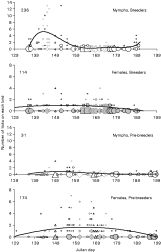
There were highly significant interannually consistent peaks in the timing of feeding of nymphs and females on guillemots (Fig. 1: Julian day2 female F1,2053=34·2, P<0·001; Julian day3 nymph F1,2050=30·6, P<0·001). Peak nymphal feeding occurred between days 138 and 155 (mid-May to early June). Adults exhibited a broader peak of activity between days 139 and 172 (mid-May to mid-June). More than 90% of females and nymphs fed during these periods. Chicks hatched after the peak tick feeding and less than 2% of all ticks were found on them (see black triangles Fig. 2B).

Fig. 1. Number of nymphal (open symbols) and female ticks (shaded symbols) on breeding and pre-breeding guillemots, May–July 1993, 1994 and 1995 (squares, circles and diamonds respectively). Data point sizes indicate frequency of observations, smallest=1; largest=20–40. The total numbers of ticks is shown at the top left of each graph. Number of ticks per bird depended upon date (P=<0·001) and host status (P=<0·001). Solid lines are least squares polynomial root 3 regression functions.

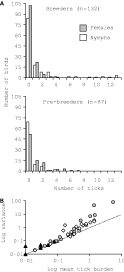
Fig. 2. The distribution of ticks feeding on guillemots. (A) Frequency distribution of nymphs and females on adult birds 16 May–31 June 1994. (B) Relationship between mean tick burden and variance of nymphs and adults (combined) 16 May–9 July 1993–1995 on chicks (black triangles, n=1252), breeders (filled circles, n =474) and pre-breeders (open diamonds, n=336). Mean and variance were calculated for hosts (n>30 for each age group) sampled over 7–10 day periods. The dotted line is the relationship predicted for a 1[ratio ]1 variance:mean ratio.
There were no substantial differences in the timing of tick feeding on breeders and pre-breeders however, as apparent in Fig. 1, nymphs were more numerous on breeders (F2,2050=13·5, P<0·001) and female ticks more numerous on pre-breeders (F2,2053=42·1, P<0·001). After allowing for seasonal effects, the mean number of nymphs on guillemots in 1995 was higher than in 1993 or 1994 (F2,2050=7·1, P=0·001), perhaps indicating interannual variation in nymphal activity, but there was no difference in the mean number of adult females found over the same period (F3,2051=0·66, P=0·52).
The incidence of ticks, both females and nymphs, was spatially heterogeneous across the 33 sampling areas (female ticks, F32,2053=1·93, P=0·003; nymphal ticks, F32,2050=3·73, P<0·001). Five sampling areas had relatively high or low numbers of ticks (data not shown). None of these sampling areas were in the main study colonies that are the focus of further analyses and have a representative range of tick densities.
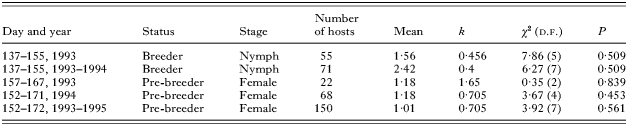
The physical distribution of ticks between guillemot hosts was typical of a macroparasite (Fig 2A). There was a strong positive linear relationship between log mean tick burden and log variance (Fig. 2B). Most variance to mean ratios were >1, and in the 5 cases that can be examined statistically (i.e. mean >1, during a 10-day period), the distribution of both adult and nymphal I. uriae on breeding and pre-breeding guillemots did not differ significantly from the maximum likelihood estimate of the negative binomial distribution (Table 1). The small values of parameter k indicate a high degree of aggregation with a few hosts being fed on by the majority of the ticks (Table 1). Frequency distribution plots (data not shown) revealed that 19% of the pre-breeders fed both 100% of the nymphs and 28% of the female ticks, and 37% of the breeders fed both 100% of the nymphs (16% fed 80% of nymphs) and 60% of the female ticks.
Table 1. Parameter k and χ2 test for goodness of fit to negative binomial distribution (for samples where mean number of ticks over period of <10 days is >1 and sample size is >20) (Data shown for individual years and also pooled across years to increase sample size.)

Calculation of mean number of infected ticks produced by a single infective host
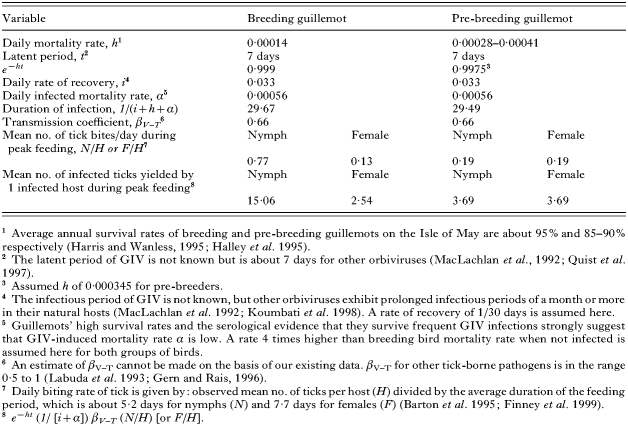
The approach of Randolph and Craine (1995) was used to estimate the mean number of infected ticks yielded by one infective host (Table 2). The bases for the estimates of the parameters involved in GIV transmission are described in footnotes accompanying the table. The calculation predicts the mean number of infected nymphs from one infective breeding guillemot should be 4·1 times higher than the mean number of infected nymphs from 1 infective pre-breeder (Table 2). The calculation predicts the opposite for female ticks, but 1 infective pre-breeding guillemot is expected to yield only 1·4 times more infected female ticks than 1 infective breeding guillemot (Table 2).

Weights of ticks collected on- and off-host
We looked for differences in the weight of ticks that had fed on breeders and pre-breeders that might indicate development of tick resistance in the older age class of birds. The mean weight of unfed male and female I. uriae collected off-host was 67 mg (range 25–107, S.E. 4·13, n=144) and 43 mg (range 24–69, S.E. 3·15, n=154) respectively. The mean weights of female ticks removed from pre-breeders, breeders and chicks were 306 mg, range 33–816 mg, (n=67 ticks); 300 mg, range 39–667 mg (n=49 ticks); and 226 mg, range 31–618 mg (n=33 ticks). There was no significant difference in the weight of these ticks according to bird status or virus infection. However, the large range in the weights of feeding ticks reduces the likelihood of detecting mean differences associated with status and/or infection. To circumvent this problem, and also any seasonal effects, we compared the mean weights of unfed females collected 18 April 1996 in areas of colony NC4 occupied either by breeders or by pre-breeders. There was no significant difference (F2,98=1·97, P=0·145) between the 2 groups (breeding fed ticks, 42·5 mg, range 27–60, S.E. 4·21, n=37; pre-breeding fed ticks, 44·3 mg, range 24–69, S.E. 4·62, n=63). Virus infection also had no significant effect (F1,192=0·126, P=0·723) on the weight of these ticks (female infected, 46 mg, range 30–60, n=17; female uninfected 43 mg, range 24–69, n=83; male infected, 64 mg, range 25–84, n=10; male uninfected, 69 mg, range 27–107, n=85).
Virus prevalence in ticks collected on- and off-host
Virus isolation was undertaken from 4307 ticks (3100 larvae, 321 engorged larvae, 205 unfed nymphs, 186 engorged nymphs, 175 males, 260 females and 60 engorged females) collected from cracks in the cliff-face of areas occupied by guillemots. We also examined virus prevalence in 177 female ticks removed from 134 guillemots. The virus prevalence in feeding ticks and off-host unfed and fully engorged ticks was compared to estimate whether the proportion of ticks exposed to virus during feeding (though viraemia or cofeeding) is similar to the proportion infected after moulting. All virus isolates were identified as GIV on the basis of their characteristic genomic RNA profiles (data not shown). Virus species was confirmed by RT-PCR and sequencing (M.A.N., unpublished data).
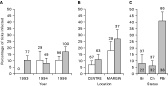
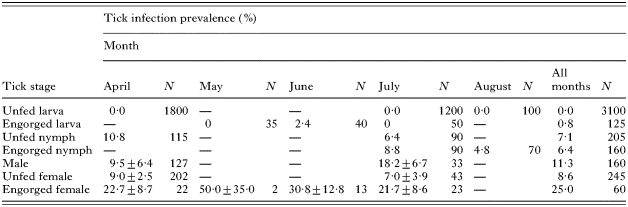
The mean infection prevalence of virus in ticks collected off-host between 1993 and 1996 is shown in Table 3. There was no difference in the mean percentage of infected male and unfed female ticks (Fig. 3A; χ12≈0·04, P=0·841). Therefore the 2 groups were pooled and are referred to as unfed adults (n=435). The infection prevalence of virus in adult ticks was similar throughout each breeding season for 1993 – 1996 (χ32≈0·225, P=0·637; Fig. 3A and Table 2). No difference was detected in adult tick infection prevalence between any of the sampling areas except Tarbert 2 (χ12≈6·9, P=0·009), where no virus was isolated from any ticks (30 adults, 25 engorged nymphs and 195 engorged larvae) collected in July 1993.

Fig. 3. The effect of year, sex (male, white bars; female, grey bars), location within colony and host status on prevalence of GIV infection of ticks. (A) Percentage off-host ticks infected in April. Tick sex P=0·841, year P=0·637. (B) Prevalence of virus in off-host ticks collected at colony NC4 on 18 April 1996. Location within colony P=0·011. (C) Prevalence of virus infection in female ticks removed from breeders (Br), chicks (Ch) and pre-breeders. Status P=0·007. The numbers above bars and within bars give sample size of ticks and birds respectively.
Table 3. Monthly mean virus infection prevalence (±S.E. for adult ticks) in off-host ticks during breeding season for all study colonies (1993–1996) combined (excluding Tarbert 2) (Nymphs and engorged larvae were processed in pools of 5 ticks and unfed larvae in pools of 100 ticks. Number (N) of ticks examined shown in each column. Few ticks were collected during May and June to minimize disturbance of breeding colonies. Dashes (—) indicate that no ticks were collected.)

Virus prevalence in unfed adult ticks (n=131) collected at the margin of colony NC4, in an area used exclusively by pre-breeders, was significantly greater than virus prevalence in unfed adults (n=65) collected from the centre of the same colony used exclusively by breeders (Fig. 3B; χ12≈6·5, P=0·011). The mean infection prevalence of virus in female ticks was also significantly higher (χ12≈7·3, P=0·007) in those removed from pre-breeding adult guillemots than breeding birds or their chicks (Fig. 3C). Annual variation in virus prevalence in female ticks removed from birds was insignificant (χ12≈0·91, P=0·34).
Overall, virus infection prevalence in on-host female ticks was similar to the prevalence of virus infection in off-host engorged female ticks: 25%±4% (n=177) and 25%±6% (n=60) respectively. The comparison made was between off-host engorged female ticks (whose exact location within each colony was not always recorded) and all female ticks removed from guillemots (pooling breeders, pre-breeders and chicks). The prevalence values were expected to be similar because the mean weights of infected and uninfected female ticks removed from the host were not significantly different (see above).
For off-host collected nymphs there was no significant association between date, colony or feeding stage (engorged nymph versus unfed nymph, χ12≈2·1, P=0·147). To assess the accuracy of estimating nymphal infection prevalence from pooled samples, 6 pools of 5 ticks were randomly selected from 127 unfed female ticks whose infection status had been determined; no tick was selected more than once. The process was repeated 40 times and on each occasion 1–3 of the 6 pools contained a positive tick. The calculated infection prevalence (see Materials and Methods section) of 4–12% (average 7·6%) was similar to the actual infection prevalence of 9·4% in the female ticks processed individually.
Because the infection prevalence of the first two feeding stages was estimated from pools of ticks the prevalence of virus in larvae, nymphs and adults could not be compared directly. However, comparison of virus prevalence in different tick feeding stages indicates that virus acquisition by ticks feeding on guillemots mainly occurred during larval and adult feeding (Table 3); virus prevalence increased from 0 to 7·1% during larval feeding; 7·1 to 8·6% during nymphal feeding and 8·6 to 25% during female feeding. All the unfed larvae examined were uninfected whereas unfed nymphs, engorged nymphs and unfed adults had a similar prevalence of virus infection (6–10%) that is significantly lower than that of engorged females (Table 3; χ12≈12·8, P<0·001). The detection efficiency of virus in engorged larvae is obviously poor because only 0·8% of engorged larval ticks yielded virus in June whereas 7·1% of unfed nymphs were infected (Table 3).
Virus-specific neutralizing antibody levels in breeders and pre-breeders
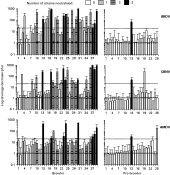
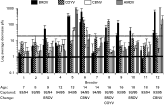
Breeding guillemots had significantly higher levels of neutralizing antibody than pre-breeding guillemots (BRDV F2,63=32·8, P<0·001; CBNV F2,63=20·94, P<0·001; AMDV F2,63=15·63, P<0·001) (Fig. 4). There was no difference in the neutralizing antibody levels of breeding male (n=19) and female (n=14) guillemots (BRDV F1,32=2·98, P=0·094; CBNV F1,32=0·77, P=0·387; AMDV F1,32=0·07, P=0·788). Data for COYV are not shown in Fig. 4 because no pre-breeding guillemot blood samples were tested for neutralization of the strain.

Fig. 4. Neutralization of three GIV strains by blood from breeding and pre-breeding guillemots. Birds were captured in June 1993–1995. Solid line indicates no change in virus titre. Dotted line indicates cut-off point for seropositivity.
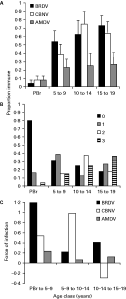
As described in the accompanying paper (Nunn et al. 2006) birds were considered to possess significant neutralizing antibody if their c.1[ratio ]30 diluted blood sample reduced virus titre 20-fold (i.e. 95%) or more. Far more breeding (74%) than pre-breeding (12%) guillemots had antibodies that neutralized one or more GIV strains (Fig. 4). Some birds had antibodies that only neutralized a single virus isolate (Fig. 4, light grey filled bars), however, there were significant positive associations between neutralizing antibody levels of breeders against BRDV and neutralization of AMDV (F1,28=4·70, P=0·039), CBNV (F1,28=5·84, P=0·022), and COYV (F1,19=9·19, P=0·005). Thus, breeding guillemots that neutralized one virus strain were also likely to neutralize other strains. For example, all blood samples from breeding guillemots (birds 13, 17, 23, 24, 30, 37, 38, 39) that neutralized AMDV also neutralized BRDV and CBNV (Fig. 4). The apparently cross-reactive antibodies of these breeders did not neutralize all virus strains however, since COYV was only neutralized by 5 of 10 AMDV neutralizing blood samples (data not shown but see birds 5 and 12 in Fig. 6 which neutralized AMDV but not COYV). The percentage of hosts with immunity to each strain tended to increase with estimated age (Fig. 5A) with a particularly notable increase between pre-breeders and breeding age class 5–9. In addition, while there were marked differences in the proportion of hosts immune to each strain (Fig. 5A) overall there was a significant positive association between age and the proportion of birds that neutralized 0–3 virus strains (Fig. 5B; F1,28=3·42, P=0·028). Guillemot sample sizes are not large enough to permit calculation of age-specific per capita rates or force of infection (λ) by maximum likelihood techniques (Grenfell and Anderson, 1985), but crude estimates indicate that λ of BRDV and AMDV is higher in pre-breeders than in breeders (Fig. 5C). Interestingly, λ of CBNV in 5 to 9-year-old breeders is greater than that in pre-breeders and is actually negative, i.e. the proportion seropositive decreased, in 10 to 14-year-old birds.

Fig. 5. Association between guillemot age and number of GIV strains neutralized more than 20-fold. (A) Proportion of breeding guillemots immune to three GIV strains. Sample sizes in each age class: pre-breeders (PBr), n=25; breeders 5–9, n=15; 10–14, n=8; 15–19, n=12. (B) Proportion of breeding guillemots immune to 0-3 of the GIV strains tested. (C) Estimates of force of infection (λ) per 5 years for the virus strains shown in panel (A). λ=-ln(proportion susceptible in age class x+1/proportion susceptible in age class x). λ was multiplied by 1·7 for the transition from the PBr class to the 5 to 9-year-old breeding class because the PBr class generally encompasses 3 years whereas the other age classes were each 5 years.
Twelve guillemots with known breeding histories were caught in more than one year. The neutralizing antibody levels of 7 of the birds (58%) showed relatively little change and none decreased more than 5-fold in the 1–2 year period between captures (Fig. 6). Neutralizing antibody levels of 5 birds (42%) increased more than 10-fold and exceeded the 20-fold cut off point for seropositivity. The new antibodies appeared to be specific for 1 (birds 3, 6 and 10) or at most 2 (birds 8 and 12) virus strains (Fig. 6).

Fig. 6. Neutralization of GIV strains by blood from guillemot with known breeding histories captured more than once. Also shown are age when last captured, year of capture, and acquisition of immunity to specific GIVs (defined by >10-fold change and exceeding cut-off point for seropositivity). Average interval between captures was 12 birds/16 years=1·3 years, therefore estimates of λ per year are: AMDV (-ln(1/1))/1·3=0; BRDV, (-ln(0·42/0·67))/1·3=0·36; COYV, (-ln(0·83/0·92))/1·3=0·08; CBNV, (-ln(0·75/0·92))/1·3=0·15.
DISCUSSION
The Isle of May is a persistent focus of GIV infections and the percentage of infected ticks is remarkably constant. There was an insignificant difference between years and main study colonies, and the overall infection prevalence in unfed adult ticks (n=405) of 9·6% in 1993–96 is similar to the 14% infection prevalence in unfed adults (n=114) recently estimated in 2003–2004 (M.A.N., unpublished data) and 9·0% infection prevalence (n=35) estimated in 1981 (P.A.N., unpublished observation). In the following discussion we consider the factors that generate the observed infection prevalence.
Tick number and distribution does not entirely explain virus prevalence
Evidence from both off- and on-host collected ticks shows that virus prevalence is significantly higher in unfed adult ticks that have fed on pre-breeding guillemots than on breeding guillemots. Whereas, estimates of virus infection prevalence calculated from tick number per host using the framework of Randolph and Craine (1995) predict the mean number of infected nymphs (and therefore unfed adults) produced from one infective breeder should be substantially higher than the mean number of infected nymphs produced by one infective pre-breeder. A different conclusion could be reached if pre-breeding guillemot's latent period was shorter, recovery and duration of infection longer, mortality rate due to infection lower and transmission coefficient higher than that of breeders. However, such assumptions are unwarranted at present. Non-viraemic or co-feeding transmission, which may be important in GIV transmission (Nunn et al. 2006), would also be expected to result in a higher proportion of infected ticks from breeders than pre-breeders due the much greater numbers of nymphs co-feeding on the older birds. Thus 23% of breeders had 2 or more (range 2–34) nymphs feeding on them, whereas only 9% of pre-breeders had 2 or more (range 2–4) nymphs feeding on them.
The framework we applied (Randolph and Craine, 1995) predicts actual virus prevalence poorly because it does not take into account normal sources of heterogeneity that effect transmission. These include physical and temporal tick distributions, and host acquired immunity and behaviour. Our data show that the calculation does not fail because of intrinsic differences in the distribution or timing of tick feeding on breeders compared with pre-breeders since we have shown that they are broadly equivalent. In particular the physical distribution of ticks on both age classes of birds is highly aggregated, conforms with the 20/80 rule (Woolhouse et al. 1997), and is typical of a macroparasite (Shaw, Grenfell and Dobson, 1998). Furthermore, 70% of nymphal and female ticks are clustered on the head and neck regions of both breeders and pre-breeders (T.R.B., unpublished data) thus co-feeding transmission, which is most efficient between ticks feeding in close proximity (Labuda et al. 1997), may be equally likely on both groups of birds.
Acquired immunity to GIV is related to the observed virus prevalence
As the lower prevalence of virus in ticks feeding on breeders compared with pre-breeders is not explained by either tick number or spatial and temporal distribution, age-related changes in host susceptibility to parasitism by ticks and viruses were examined. Two factors were considered: acquired immunity to tick infestation and acquired immunity to GIV infection.
Acquired anti-tick immunity can decrease feeding success and interstadial survival of ticks by deterring ticks from feeding, lengthening feeding duration, reducing final engorged weight, and increasing tick mortality rates (Wikel, 1996). All these effects decrease virus transmission rates (Jones and Nuttall, 1989; Kurtenbach et al. 1994). However, indirect evidence suggests that like other natural tick hosts (Randolph, 1994; Du Toit, Fourie and Horak, 1994) guillemots do not become immune to I. uriae, since more nymphs were found on the older age class of guillemot (i.e. breeders) and there was no difference in the average weight or weight distribution of off-host collected female ticks moulted from nymphs that had fed on breeders or pre-breeders.
Breeding guillemots had significantly higher levels of strain-specific neutralizing antibody than pre-breeding birds. We do not presently know what level of neutralizing antibody (measured in vitro) protects against reinfection but work is underway to establish this information. Data from marked and recaptured birds indicates neutralizing antibodies are long lasting (years). Thus the significant association between the age of breeding guillemots and number of strains neutralized is unsurprising and the probability of a guillemot being immune to a given GIV strain may be a function of duration of exposure to virus i.e. total number of infected tick bites received during total attendance at the breeding colony. Individual virus- specific antibody-mediated immunity may prevent or decrease the chance of infection, decrease orbivirus-induced mortality (Roy et al. 1990; Stone-Marschat et al. 1996) and shorten the duration of infectivity (1/[i+α]) in the host. Immunity may also increase the latent period t, and decrease or prevent transmission, including co-feeding transmission, between tick and host and vice versa (Labuda et al. 1997; Levin and Fish, 2000). All (except decreased mortality, which, as noted in Table 1, is probably small) act to reduce virus transmission rates in ticks that feed on breeders. Other studies of endemic infections supported by long-lived hosts also emphasize the importance of age-related acquired immunity, e.g. holoendemic malaria in man (Anderson and May, 1991; Nielsen et al. 2002) and bovine tuberculosis in badgers (Anderson and Trehwella, 1985).
The rate of GIV transmission from host to tick seems to depend upon tick feeding stage. The percentage of ticks that are infected with GIVs increases markedly during larval and adult but not nymphal feeding. There may be innate differences in transmission efficiency of the pathogen to nymphs, larvae and adults (Randolph, 1994; Ogden et al. 1998). However, the pattern may simply be a direct consequence of the remarkable and inter-annually consistent differential distribution of the two tick stages on guillemot. Nymphs feeding chiefly on virus immune breeders may be exposed to infection less often than females that feed more often on pre-breeders. The most plausible explanation for breeding guillemot supporting more nymphs is that (unlike pre-breeding guillemots) they are present overnight, facilitating tick attachment and detachment, during peak nymphal feeding which coincides with egg incubation. The reason why pre-breeding guillemots have higher burdens of adult female ticks than breeding guillemots is less clear, although one possibility is more efficient removal of female ticks by breeders preening themselves and their partner.
Serosurvey supports tick infection prevalence data
In agreement with virus infection prevalence of ticks, the serological evidence supports the conclusion that virus transmission rates are higher in pre-breeders than in breeders. The force of infection (λ) of particular strains varies but in general (BRDV and AMDV) is greater in the pre-breeding age class than in the breeding age classes. The relatively high λ for CBNV in 5 to 14-year-old breeders is unlikely to be a genuine measure of the rate of transmission between breeders, or it would probably also have been seen in the 15 to 19-year-old birds which would in most cases have been present in the colonies at the same time. It is more likely that the values of λ for CBNV in breeders are related to changes in λ experienced by different cohorts whilst they were pre-breeders. The negative value of λ for CBNV in 10 to 19-year-old breeders would then be due to a greater proportion of birds in the 10 to 14-year-old age class than the 15 to 19-year-old age class being infected by CBNV as pre-breeders. This suggestion implies that GIV strains may differ in abundance over time while the transmission rate of the virus population (and thus prevalence observed in ticks) remains stable. Theoretical studies (Gupta, Ferguson and Anderson, 1998) predict pathogens can exhibit cyclical changes in abundance. Long-term studies in this GIV transmission system might provide empirical verification. Temporal changes in strain abundance will confound the estimates of λ in breeders. Better estimates of λ could be established by repeated sampling of cohorts recording changes in antibody levels. Our present limited data from 12 recaptured guillemots showed that birds were infected by GIVs while breeding and the estimates of λ for BRDV and CBNV were high compared to the estimates derived from the horizontal surveys. The reason why is presently unclear, although our proxy for age will systematically underestimate the true age of breeding guillemots since not all birds will be captured and ringed in the first year that they breed and may therefore skew the horizontal serosurvey data for breeders towards lower estimates of λ. Comparable direct estimates of λ for pre-breeders would be useful but were not possible because no individual pre-breeding adult was caught more than once.
Conclusion
Age-related acquired immunity to virus, rather than tick distribution, appears to be the key factor governing GIV transmission between ticks and their long-lived guillemot host. The finding emphasizes the need to divide host populations along biologically meaningful lines and consider age-related effects and host immunity in quantitative studies of tick-borne pathogen transmission. We have developed an empirical framework to understand GIV transmission and are presently using the system to test fundamental theoretical predictions about pathogen transmission and population structure by undertaking manipulative field experiments against a background of long-term host population studies on the Isle of May.
We would like to thank Chris Wernham for assistance in the field and Scottish Natural Heritage for permission to work on the Isle of May National Nature Reserve. This work was funded by the Natural Environment Research Council.