Introduction
Adults with schizophrenia have the highest mortality risk compared with other patients suffering from psychiatric disorders (Walker et al. Reference Walker, McGee and Druss2015). Compared with the general population, their life expectancy is about 20–25 years shorter (Saha et al. Reference Saha, Chant and McGrath2007). Somatic disease contributes most to this high mortality risk (Olfson et al. Reference Olfson, Gerhard, Huang, Crystal and Stroup2015). Recent publication of a large cohort of patients with schizophrenia mentioned that cardiovascular disease was the most common cause of death (403.2/100,000 person years); the all-cause mortality for the total sample was 1539.5 per 100,000 person years (Olfson et al. Reference Olfson, Gerhard, Huang, Crystal and Stroup2015). Patients with schizophrenia tend to make little use of health care resources while they are known to have a bad physical health, reflecting a multifactorial etiology (Leucht et al. Reference Leucht, Burkard, Henderson, Maj and Sartorius2007; Copeland et al. Reference Copeland, Zeber, Wang, Parchman, Lawrence, Valenstein and Miller2009). The role of antipsychotic medication and its potential influence on premature mortality is highly debated. Antipsychotic medication reduces the severity of psychotic symptoms and the incidence of psychotic relapse in most patients (Haukka et al. Reference Haukka, Tiihonen, Harkanen and Lonnqvist2008). On the other hand, antipsychotics may increase cardiovascular mortality risk by induction of weight gain, diabetes mellitus and dyslipidemia (De Hert et al. Reference De Hert, Detraux, van Winkel, Yu and Correll2012; Correll et al. Reference Correll, Detraux, De Lepeleire and De Hert2015). It is not clear, however, whether exposure to antipsychotics is associated with a shortened life expectancy for patients with schizophrenia.
Short-term trials and safety extension studies reported lower mortality in patients exposed to antipsychotics compared with patients receiving placebo (Khan et al. Reference Khan, Schwartz, Stern, Redding, Kolts, Brown and Robinson2007, Reference Khan, Faucett, Morrison and Brown2013). The most common cause of death in these trials was suicide. Though, when deaths related to suicide were excluded, natural cause mortality rates still exceeded those of the general population (Khan et al. Reference Khan, Faucett, Morrison and Brown2013). A synthesis of the literature specifically on the long-term effects of antipsychotics on mortality risk was published in 2009 (Weinmann et al. Reference Weinmann, Read and Aderhold2009). The authors concluded that there was some evidence that long-term exposure to antipsychotics increases mortality. However, they acknowledged that this conclusion was based on observational studies reporting doubtful results regarding mortality trends. While some reviewed studies reported higher cardiovascular mortality in patients using antipsychotic medication, other studies found lower all-cause mortality (Tiihonen et al. Reference Tiihonen, Wahlbeck, Lonnqvist, Klaukka, Ioannidis, Volavka and Haukka2006; Osborn et al. Reference Osborn, Levy, Nazareth, Petersen, Islam and King2007). After publication of this review, the largest follow-up study so far was published (Tiihonen et al. Reference Tiihonen, Lonnqvist, Wahlbeck, Klaukka, Niskanen, Tanskanen and Haukka2009). In this cohort study the authors made use of a Finnish nationwide database and their results contradicted the conclusion of Weinmann et al. (Reference Weinmann, Read and Aderhold2009) by showing that long-term exposure significantly lowered the risk of death compared with no antipsychotic medication (Tiihonen et al. Reference Tiihonen, Lonnqvist, Wahlbeck, Klaukka, Niskanen, Tanskanen and Haukka2009). However, some of these Finnish results were eventually appraised by other authors as ‘problematic’ to interpret (De Hert et al. Reference De Hert, Correll and Cohen2010). Several methodological limitations were underlined and discrepancies of results stated by Tiihonen et al. compared with those from other Finnish registry studies were found (De Hert et al. Reference De Hert, Correll and Cohen2010).
In summary, the high mortality rate in patients with schizophrenia is argued to be partly related to increased risk of somatic disease associated with antipsychotic medication. However, current evidence is equivocal with respect to the association between long-term use of antipsychotics and mortality. A systematic review of long-term studies is therefore needed to shine light on this topic. Therefore we aimed to (i) determine long-term mortality rates in patients with schizophrenia using any antipsychotics; (ii) compare these with mortality rates of patients who did not use antipsychotic medication during follow-up; (iii) explore the relationship between cumulative exposure of antipsychotic medication and mortality; and (iv) assess the most common causes of death.
Methods
This review was conducted following the guidelines of the PRISMA statement (Moher et al. Reference Moher, Liberati, Tetzlaff and Altman2009). A protocol was published in the PROSPERO database under registration number CRD42016043452. We searched EMBASE, MEDLINE and PsycINFO from inception through 29 February 2016. The search strategy was developed by a clinical librarian together with the first author (JV) (presented as online supplement 1). This strategy included terms for schizophrenia, antipsychotic medication (with additional description of 15 frequently prescribed antipsychotics in general names, trade names and numbers), mortality (e.g. death, years of life lost) and most frequent causes of death (e.g. suicide, myocardial infarction). Reference lists of eligible articles were hand searched to identify eligible studies not previously identified through the database search (forward- and backward tracking of literature).
Study selection
Two reviewers (JV and EN) independently screened titles and abstracts of retrieved citations on following inclusion criteria: The study (1) included patients older than 18 years diagnosed with schizophrenia and related disorders; (2) used antipsychotic medication as an outcome measure or this was likely to be reported in full text; (3) used mortality as outcome measure or this was likely to be reported in full text; (4) was an original research paper that used a follow-up design; and (5) was written in English. Conflicts in study inclusion were resolved in consensus meetings. If a clear decision concerning inclusion criteria could not be made during abstract screening, the full text was consulted. Subsequently, articles that met the following exclusion criteria were excluded during full-text reading: The study (1) did not use one of the following designs: a cohort study, case-control or controlled clinical trial with or without randomization or blinding; (2) had a follow-up of 52 weeks or less; (3) did not describe number or any other measure of death rate from all causes; (4) did not describe use of antipsychotic medication; (5) did not compare patients with schizophrenia receiving antipsychotic treatment to an adequate control group (patients without antipsychotics or other antipsychotic medication); and (6) was published before 1990. We argued that from the year 1990 both atypical antipsychotics and clozapine had entered the international markets and were available to the majority of schizophrenia patients (Tandon et al. Reference Tandon, Nasrallah and Keshavan2010). The first 100 articles selected were reviewed in full text by two reviewers independently and conflicts were settled through discussion. In view of the fact that overlap was high, other articles were reviewed by the first author (JV).
Data extraction
Data were extracted by two researchers independently (JV and GvR) and accuracy was discussed in regular meetings. The following data were extracted: first author's name, year of publication, country, years of data collection, years of follow-up or patient years (follow-up multiplied by sample size), sample source, specific diagnoses, population (e.g. inpatient, outpatient or subgroup), method of diagnosis of schizophrenia, primary outcome(s), sample size, number of deaths and total number of control or comparison group, number of lost to follow-up, cause(s) of death if available, source of mortality-data, source of information on antipsychotic medication (such as dose, length of exposure and concomitant use) and (if reported) confounders.
We aimed to include studies that reported on antipsychotic medication, dose and length of exposure. Corresponding authors were contacted to ensure accuracy and completeness of data when studies lacked sufficient information about the number of patients who did not use antipsychotic medication. All-cause mortality numbers were extracted and if possible categorized cause-specific into natural (e.g. cardiovascular) and unnatural causes (e.g. suicide). Quality of the studies was assessed with the Cochrane risk of bias tool for randomized trials or the Newcastle Ottawa scale for observational studies by the first author (Higgins et al. Reference Higgins, Altman, Gotzsche, Juni, Moher, Oxman, Savovic, Schulz, Weeks and Sterne2011; Reference Wells, Shea, O'Connell, Peterson, Welch and LososWells et al. ). In case of overlapping samples, the largest was included in the main analysis.
Statistical analysis
To answer the first question, we calculated unadjusted all-cause mortality rates per 1000 patient years for unique patients receiving any type of antipsychotic medication during follow-up. The following formula was used to estimate patient years if not provided by authors:
 $$\eqalign{{\rm Patient}\;{\rm years} = & \left[ {\displaystyle{{{\rm number}\;{\rm of}\;{\rm people}\;{\rm at}\;{\rm risk}\;{\rm at}\;{\rm the}\;{\rm beginning} + {\rm number}\;{\rm of}\;{\rm people}\;{\rm at}\;{\rm risk}\;{\rm at}\;{\rm the}\;{\rm end}\;{\rm of}\;{\rm the}\;{\rm time}\;{\rm interval}} \over 2}} \right] \cr & \quad \times [{\rm number}\;{\rm of}\;{\rm years}\;{\rm in}\;{\rm the}\;{\rm time}\;{\rm interval}]} $$
If studies consisted of subgroups using various antipsychotics or with different duration of illness, we calculated a composite rate for each study. Furthermore, we aimed to conduct a sub-analysis on studies that described data for patients that used any type of antipsychotics versus no antipsychotic medication during follow-up. Crude risk ratios from mortality rates per person years were calculated, pooled and are presented in a forest plot using a DerSimonian-Laird random-effects model (Borenstein et al. Reference Borenstein, Hedges, Higgins and Rothstein2009). Variance was assessed using eyeballing, Q- and I 2 -statistics (Higgins et al. Reference Higgins, Thompson, Deeks and Altman2003). Publication bias was tested by means of a funnel plot and Egger's test if applicable. All analyses were conducted in software named Comprehensive Meta-Analysis, version 2.0.
Results
Study selection
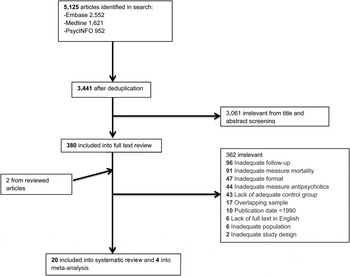
The initial search yielded 5,125 articles, of which 382 remained after screening of titles and abstracts (Fig. 1). Most of the 362 studies that we excluded after full text review, had a short duration of follow-up (52 weeks or less) or no assessment of mortality. Seventeen overlapping samples were removed, resulting in 20 original samples subjected to quantitative synthesis and four to meta-analysis.
Flowchart of study selection.

Study characteristics
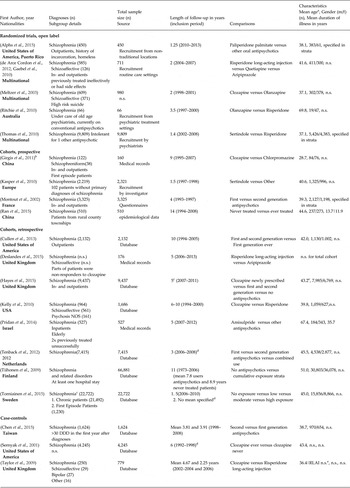
Clinical data per study are presented by type of study design (Table 1). The included randomized open label trials, cohorts and case-control studies originate from over ten different, mostly western countries. Clinical and methodological characteristics of the studies were heterogeneous. Although all samples matched the inclusion criterion of schizophrenia and related disorders, some also included few patients with bipolar diagnoses or unspecified diagnoses. Various clinical subgroups and a wide range of antipsychotics were studied (Table 1). Follow-up time ranged from 1.25 to 14 years. Two studies were prematurely terminated after completion of 1 year follow-up of the last patient because the predetermined difference in effectiveness was achieved or the drug in question, sertindole, was taken from the market (Gaebel et al. Reference Gaebel, Bergmans, De Arce, Rouillon, Cordes, Eriksson, Schreiner and Smeraldi2010; Kasper et al. Reference Kasper, Moller and Hale2010). A descriptive arm of a randomized trial was published in a separate paper and we combined data from both papers in question into a single composite rate (Gaebel et al. Reference Gaebel, Bergmans, De Arce, Rouillon, Cordes, Eriksson, Schreiner and Smeraldi2010; de Arce Cordon et al. Reference de Arce Cordon, Eding, Marques-Teixeira, Milanova, Rancans and Schreiner2012). Quality of the studies was variable but in most cases scored as moderate (see online supplement 2–4).
Study characteristics of all studies included in the forest plot

a Mean age is reported for the whole study population if available.
b First 2 years of the study were designed as a double blind randomized controlled trial with a cohort of the last 7 years.
c Study design was selected based on the two cohorts (chronic patients and first episode patients) disregarding the case-control data with the general population. A composite rate of all patients was used in our meta-analysis.
d Dynamic cohort.
e These numbers reflect the total population including patients diagnosed with bipolar disorder.
n.s. = not specified
Mortality rates for patients using antipsychotic medication
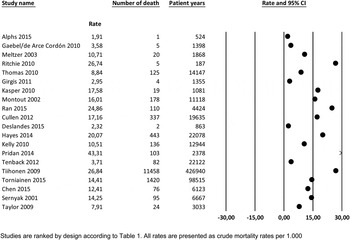
A number of 14,643 deaths during 657,400 patient years was reported for unique patients with schizophrenia and related disorders using any antipsychotic medication. Unadjusted mortality rates per 1,000 patient years for patients taking antipsychotic medication are presented per study (Fig. 2). Because of the great diversity in study designs and clinical characteristics, we refrained from pooling these results into a meta-analysis.
Mortality rates for patients using any antipsychotic medication.

Comparison of patients with any antipsychotic use versus no use
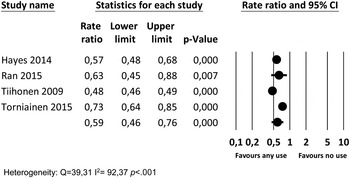
A total of 22,141 deaths in 715,904 patient years were identified in four cohort studies comparing patients with any antipsychotic use to patients who did not use antipsychotic medication during follow-up. The corresponding author of one of these retrospective cohort studies, which combined medical record data with natural language processing tools, provided additional data (Hayes et al. Reference Hayes, Downs, Chang, Jackson, Shetty, Broadbent, Hotopf and Stewart2015). All the four studies showed that mortality rates of patients with any use of antipsychotic medication are lower than no antipsychotic treatment during long-term follow-up (Fig. 3). The pooled risk ratio was 0.57 (LL:0.46 UL:0.76 p value <.001). Statiscal heterogeneity was found to be high (Q = 39.31, I 2 = 92.37%, p value <.001). Publication bias was difficult to interpret from the few included studies but was not suggested from a funnel plot (not shown, available on request) or Egger's test (β = 3.57 s.e. = 1.77 and (1-tailed) p value 0.090).
Mortality rate ratios of no antipsychotic use versus any antipsychotic use.

The relationship between cumulative exposure and mortality
Torniainen et al. (Reference Torniainen, Mittendorfer-Rutz, Tanskanen, Bjorkenstam, Suvisaari, Alexanderson and Tiihonen2015) showed that both no and very high exposure to antipsychotic medication (expressed as defined daily dose per day) is related to high mortality rates. This U-shaped mortality curve was found in chronic schizophrenia patients compared with the general population. Authors of the largest cohort study observed an inverse relationship between mortality and duration of cumulative exposure (up to 11 years) for patients with at least one filled prescription (Tiihonen et al. Reference Tiihonen, Lonnqvist, Wahlbeck, Klaukka, Niskanen, Tanskanen and Haukka2009). The lowest adjusted hazard ratio concerned patients using antipsychotic medication from 0 to 0.5 years [aHR 0.49 (95% CI 0.46–0.52)] compared with no antipsychotic medication. Since details about antipsychotic dose and length of exposure were missing in many articles or reported in substantively inconvertible measures, we were unable to perform a meta-analysis. Units of measurement that we encountered were for example any use over time, use at baseline, proportion of doses (defined daily dose per day) or mean chlorpromazine equivalents per treatment arm. Therefore, we merely describe the results of latter Scandinavian studies that specifically presented results on cumulative exposure and (adjusted) hazard rates.
Causes of death
Thirteen of all 20 studies reported data, to a varying extent, on the causes of death. Cardiovascular disease was reported to be the cause of death in 15.7% of 14,818 deaths, and suicide in 6.7%. The remaining causes were described as other natural, unnatural or were undetermined. For patients without use of antipsychotic medication, causes of death were reported in two studies representing 173 out of 8,710 deceased patients. Cardiovascular disease was reported for 59 (0.7%) and suicide for 22 (0.3%) patients. Since data were found to be scarce, we dropped presenting results in a table or figure.
Discussion
Summary
To our knowledge, current study is the first quantitative synthesis that used meta-analysis to explore the association between long-term mortality and antipsychotic use in schizophrenia patients.
This review aimed to assess this association by answering four subquestions. Our primary aim was to assess unadjusted mortality rates for schizophrenia patients using any antipsychotic medication. It appeared that these vary widely per study. Furthermore, our aims were to compare mortality rates of patients with any antipsychotic exposure to patients who did not use antipsychotic medication. Additionally, exploration of the association of cumulative exposure to antipsychotic medication with mortality was performed. Lastly, we aimed to assess causes of death in exposed and non-exposed patients.
Mortality rates and methodological limitations of included studies
Large differences in unadjusted mortality rates were found for patients using any antipsychotic medication, ranging from 1.91 to 43.31 per 1,000 patient years. Interpretation and evaluation of these mortality figures was difficult in view of the substantial methodological limitations, as also reported in the previous review (Weinmann et al. Reference Weinmann, Read and Aderhold2009). A recently published retrospective cohort study that did not report any measures for antipsychotic exposure, found a crude all-cause mortality rate of 15.39 per 1.000 patient years (Olfson et al. Reference Olfson, Gerhard, Huang, Crystal and Stroup2015). This cohort was at least ten times as large as the largest retrospective cohorts that we included, which found deviating unadjusted mortality rates for patients exposed to antipsychotics (14.41 and 26.84 per 1,000 patient years) (Tiihonen et al. Reference Tiihonen, Lonnqvist, Wahlbeck, Klaukka, Niskanen, Tanskanen and Haukka2009; Torniainen et al. Reference Torniainen, Mittendorfer-Rutz, Tanskanen, Bjorkenstam, Suvisaari, Alexanderson and Tiihonen2015). The latter cohort studies were national record linkage studies in which administrative data from different sources was matched. Several forms of bias may have been introduced that tend to make interpretation of the observed rates difficult. This pertains, for example, to database studies that often provided little information on lifestyle factors such as smoking, diet and substance use, which limits adjustment for influential confounders. For other studies, flaws were also noticed in measurement of decisive factors such as duration of illness or somatic comorbidity. Included randomized trials tended to study very specific clinical subgroups such as high suicide risk patients. Generalizability of these mortality rates is therefore limited. The highest mortality rate [43.31 per 1,000 patient years (Pridan et al. Reference Pridan, Baruch, Swartz and Barak2014)] could be explained by an older aged sample and may not be representative for adult populations. Some studies used medication prescriptions as a reflection of exposure and thereby disregarded possible non-compliance with therapy. This systematic measurement error is important, in particular since earlier clinical trials showed low compliance rates in patients with schizophrenia (Lieberman et al. Reference Lieberman, Stroup, McEvoy, Swartz, Rosenheck, Perkins, Keefe, Davis, Davis, Lebowitz, Severe and Hsiao2005). Furthermore, type of antipsychotic medication that patients were assigned to within studies was often a misrepresentation of the whole follow-up period. Two studies surpassed this problem by calculating defined daily doses and testing associations for current and cumulative use or on average low, medium or high exposure (Tiihonen et al. Reference Tiihonen, Lonnqvist, Wahlbeck, Klaukka, Niskanen, Tanskanen and Haukka2009; Torniainen et al. Reference Torniainen, Mittendorfer-Rutz, Tanskanen, Bjorkenstam, Suvisaari, Alexanderson and Tiihonen2015). Also, a couple of studies did not address limitations such as immortal time bias when comparing exposed and non-exposed individuals. Immortal time refers to a period during follow-up when patients are not assigned to any treatment group while death could occur (Levesque et al. Reference Levesque, Hanley, Kezouh and Suissa2010). Hereby, underestimation of death rates could be introduced since patients who end up in the exposed group have survived until antipsychotic treatment is started. Lastly, others did not account for survival bias and selected only a group of chronic patients and thereby possibly underestimated mortality rates. Taking everything into consideration, the need for high-quality, long-term, studies researching standardized outcomes of antipsychotic exposure and mortality is undisputable. The cornerstone design to monitor drug toxicity is a prospective cohort study and one may even resort to ‘restrictive cohorts’ to review the effect of antipsychotic medication on long-term mortality (Horwitz et al. Reference Horwitz, Viscoli, Clemens and Sadock1990; Pocock & Elbourne, Reference Pocock and Elbourne2000). Girgis et al. (Reference Girgis, Phillips, Li, Li, Jiang, Wu, Duan, Niu and Lieberman2011) showed another valid design of converting a randomized trial after 2 years into a prospective cohort following the patients for 7 extra years. Overall, our findings did not allow to present a summary estimate rate of long-term mortality for patients using any antipsychotic medication. Therefore, firm conclusions about the association between antipsychotic use and long-term mortality were not drawn.
Comparison of patients with any antipsychotic use versus no use
A striking result was found by meta-analysis that showed lower risk of all-cause mortality for patients with any antipsychotic exposure compared with patients who did not use any antipsychotic medication. This association was determined using four large retrospective cohort studies with moderate to high quality. Since we found consistent evidence for a higher all-cause mortality risk in patients who did not use antipsychotic medication during follow-up, we are keen to elaborate on many factors that could explain this. It has been hypothesized that patients without antipsychotic medication make little use of both mental and somatic health care and therefore do not use antipsychotics (Copeland et al. Reference Copeland, Zeber, Wang, Parchman, Lawrence, Valenstein and Miller2009). These schizophrenia patients could represent the most severely ill group whose social deprivation and lack of illness insight could impose a relevant threshold to access health care, with undertreatment as a result. Consequently, these patients could have a higher mortality risk as a result of somatic risk factors on the one hand and on the other hand have severe psychiatric symptoms that may lead to psychiatric events such as suicide or violence. Thus, increased attention for patients who do not use antipsychotic medication is commendable. Besides, differentiating between natural and unnatural reasons of death could further clarify this association.
The relationship between cumulative exposure and mortality
Remarkably, most studies lacked an adequate measurement of cumulative exposure. Short-term trials express cumulative time of exposure to antipsychotics in units of patient exposure years (Khan et al. Reference Khan, Schwartz, Stern, Redding, Kolts, Brown and Robinson2007, Reference Khan, Faucett, Morrison and Brown2013). Long-term retrospective observations, for example, in a Swedish cohort study were grouped as no, low, moderate or high exposure in windows of average defined daily dose per day. Contrary to patient exposure years, this unit of measurement allows not only length of exposure but also doses and polypharmacy to play a role. In this study, low and moderately dosed antipsychotic treatment was associated with lower mortality than no or high dose antipsychotic treatment (Torniainen et al. Reference Torniainen, Mittendorfer-Rutz, Tanskanen, Bjorkenstam, Suvisaari, Alexanderson and Tiihonen2015). This is partly underlined by Tiihonen et al. (Reference Tiihonen, Lonnqvist, Wahlbeck, Klaukka, Niskanen, Tanskanen and Haukka2009) however cumulative exposure was presented slightly different namely in strata of years of cumulative exposure. These authors pointed out that the lowest risk for death is found in patients with short-term exposure (0–0.5 years) followed by long term exposure (5-7 years ). Overall, we found some evidence that on average low and medium cumulative exposure, or long-term treatment is associated with a lower risk of death.
Causes of death
Due to a paucity of results we could not meaningfully report on most common causes of death in patients not using or using any antipsychotic medication. Tiihonen et al. (Reference Tiihonen, Lonnqvist, Wahlbeck, Klaukka, Niskanen, Tanskanen and Haukka2009) stated that no increased risk for mortality due to ischaemic heart disease was found after 7–11 years of cumulative exposure to antipsychotics. Osborn et al. (Reference Osborn, Levy, Nazareth, Petersen, Islam and King2007) studied death because of heart disease specifically and observed that patients receiving high doses of antipsychotic treatment are more likely to die from heart disease than patients receiving lower doses, no medication or than the general population. Torniainen et al. (Reference Torniainen, Mittendorfer-Rutz, Tanskanen, Bjorkenstam, Suvisaari, Alexanderson and Tiihonen2015). stated that the excess of overall and specifically cardiovascular mortality in schizophrenia is not related to antipsychotics when used in low or moderate doses based on a U-shaped morality curve. Reasons of death could clarify clinical implications of an increased risk of death and therefore future research is required.
Strengths and limitations
By providing an overview of evidence regarding antipsychotic use and long-term mortality in schizophrenia, we could add new insights. Recently published studies that used substantial sample sizes were compared with other unadjusted mortality rates and we demonstrated large differences. To our knowledge, we performed the first meta-analysis looking into the association between mortality and antipsychotic exposure in schizophrenia patients so far. The pooled estimate rate showed an increased risk for death for patients who did not use antipsychotic medication. This patient group requires further research into the reasons and risk factors for mortality. Despite these strengths, limitations of current study need to be acknowledged. First, heterogeneity was a complication factor for all outcomes of interest. Apart from the impossibility to compare and pool all data due to the large variation in clinical and statistical characteristics, insufficient data provided by studies such as cause of death obstructed answering our subquestions. Second, we did report clinical subgroups of patients with schizophrenia (Table 1) though we were unable to correct for any of these characteristics. Due to methodological inequalities and substantial difference in the use of confounding factors for observational studies, we regarded presenting (incomparable) adjusted rates unwise. Third, we did not compare mortality rates of included patients to those in the general population and could therefore not correct for geographical differences. Lastly, we chose all-cause mortality per patient years as it is a robust outcome that is less likely to be affected by lack of blinding. One might argue that patient reported or other clinical outcomes such as quality-adjusted life-years more adequately cover the perspective of patients (Bushe et al. Reference Bushe, Taylor and Haukka2010).
Conclusions
To our knowledge, this is the first quantitative synthesis of the risk of long-term mortality for patients with schizophrenia who use antipsychotic medication. The long-term unadjusted mortality rates varied widely between studies. Heterogeneity in clinical and statistical characteristics was high. The true relationship between the adverse effects of antipsychotic medication and the consequence of this for long-term mortality risk in patients with schizophrenia remained unrevealed. Aggregate findings of four studies suggested a noteworthy association between patients who did not use antipsychotic medication and an increased long-term mortality risk. Validation of our results and reasons for these patients to be prone for premature mortality need further research. Uniform units of cumulative exposure measurement and reporting causes of death are required to understand clinical implications.
Supplementary material
The supplementary material for this article can be found at https://doi.org/10.1017/S0033291717000873.
Acknowledgements
We thank J. G. Daams, clinical librarian of the Academic Medical Center, for help with the literature search. We also thank Richard Hayes who kindly supplied extra data. Jentien Vermeulen received a Ph.D.-Scholarship in 2015 from the Academic Medical Center of Amsterdam.
Declaration of interest
Lieuwe de Haan received an investigator initiated grant from E. Lilly in 2003. Other authors have declared that there are no conflicts of interest in relation to the subject of this study.