

Mentoring research and theory suggest that the effect of mentoring programs on social, emotional, and academic outcomes are mediated by the quality of the mentor–mentee relationship, which is influenced in turn by a number of contextual, interpersonal, and intrapersonal factors (DuBois, Portillo, Rhodes, Silverthorn, & Valentine, Reference DuBois, Portillo, Rhodes, Silverthorn and Valentine2011; Rhodes, Reference Rhodes, DuBois and Karcher2005). In this article we focus on a specific intrapersonal factor that has recently received attention from mentoring researchers (Poteat, Shockley, & Allen, Reference Poteat, Shockley and Allen2015; Zilberstein & Spencer, Reference Zilberstein and Spencer2014) but for which empirical evidence is lacking: the attachment dispositions of mentors and mentees. Our goal was to revisit the general assumption that attachment insecurity limits the development of a high-quality mentoring relationship (Gormley, Reference Gormley2008). Based on certain premises of attachment theory (Bowlby, Reference Bowlby1969), we explore the hypothesis that the specific nature of the supportive exchanges that prevail during the mentoring experience plays a key role in the attachment–mentoring association.
Theoretical and Empirical Background
Developed in the 20th century, attachment theory offers one of the most compelling explanations for understanding the social and emotional development of children and adolescents (Bowlby, Reference Bowlby1969, Reference Bowlby1982). The theory centres on the critical need for the child to develop a secure attachment to a caregiver, a need that is at least equal in importance to that for nutrition. When the child is distressed, attachment-system behaviours are activated to ensure proximity and contact with the attachment figure who provides a safe haven for the child and helps them regulate distress. Exploratory behaviour is reduced in such circumstances. When the child's needs are adequately met — when the attachment figure is predictably warm and supportive of the child — he/she experiences attachment security. When such experiences are repeated and serve as a foundation upon which parental responses are made in different interactive circumstances, the child develops a positive internal working model, which serves as a cognitive framework of mental representations for understanding the world, self, and others (Bartholomew & Horowitz, Reference Bartholomew and Horowitz1991). However, when such basic attachment needs are not met, the child feels insecure and resorts to secondary coping strategies such as avoidance or ambivalence to cope with this insecurity. In this way, the child develops negative working models of the self and/or others (Bartholomew & Horowitz, Reference Bartholomew and Horowitz1991).
Some attachment theorists have further described attachment styles over the course of individual development in terms of the degree of positivity or negativity in representations of the self and others. More specifically, attachment style has been defined as a chronic pattern of relational expectations, emotions, and behaviours that results from the internalisation of a particular history of attachment experiences (Shaver & Mikulincer, Reference Shaver, Mikulincer and Gross2013). Individual differences in attachment style may be viewed along two major dimensions: avoidance and anxiety/ambivalence (Roisman et al., Reference Roisman, Holland, Fortuna, Fraley, Clausell and Clarke2007). People situated at the high end of the avoidant dimension are more likely to distrust others and to use deactivating strategies to cope with attachment insecurities, such as emotional distancing or extreme independence and self-reliance. People at the high end of the ambivalent dimension are more likely to worry that relationship partners will be unavailable in times of stress. They tend to use hyperactivating strategies, such as focusing on negative emotions, appraising potential threats as extremely stressful, and seeking support somewhat compulsively (Shaver & Mikulincer, Reference Shaver, Mikulincer and Gross2013). People at the low end of both dimensions feel more secure and would effectively use the attachment figure as a safe haven and secure base in times of need.
There is considerable evidence to support the argument that avoidance and anxious/ambivalence dispositions in youth are linked to how they develop personal goals, strategies, and motivations (Gillath & Shaver, Reference Gillath and Shaver2007; Rom & Mikulincer, Reference Rom and Mikulincer2003; Snapp, Lento, Ryu, & Rosen, Reference Snapp, Lento, Ryu and Rosen2014). This association has been demonstrated in a variety of close relationships, including those with parents and siblings (Betts et al., 2013), romantic partners (Randall & Butler, Reference Randall and Butler2013; Schindler, Fagundes, & Murdock, Reference Schindler, Fagundes and Murdock2010), adults other than parents (Larose, Bernier, Soucy, & Duchesne, Reference Larose, Bernier, Soucy and Duchesne1999), and physician (McWilliams, Reference McWilliams2018). Recent studies suggest that attachment insecurity in youth is also related to their attitudes, behaviours, and judgments in mentoring situations (Gormley, Reference Gormley2008; Poteat et al., Reference Poteat, Shockley and Allen2015; Zilberstein & Spencer, Reference Zilberstein and Spencer2014). Since mentoring relationships are typically characterised by a search for proximity, security and support, some scholars have proposed that attachment insecurity, whether on the part of the mentor or mentee, would hinder the establishment, development, and quality of the mentoring relationship (Larose & Tarabulsy, Reference Larose, Tarabulsy, DuBois and Karcher2014).
There is some support for this hypothesis. For instance, Georgiou, Demetriou, and Stavrinides (Reference Georgiou, Demetriou and Stavrinides2008) demonstrated that high-school students with insecure attachment were less likely to identify natural mentors in their lives than more secure youths. This study also showed that when a mentor was named by insecurely attached youths, an inverse association emerged between insecurity and the perceived impact of the mentoring experience. Other studies conducted with college students showed that mentee attachment insecurity, whether assessed with interviews or questionnaires, was negatively associated with various indicators of the quality of the mentoring relationship, including mentors’ sensitivity to mentee distress, mentee support-seeking behaviour, and mentee perceptions of support and satisfaction with the mentoring (Larose, Bernier, & Soucy, Reference Larose, Bernier and Soucy2005; Larose, Boivin, & Doyle, Reference Larose, Boivin and Doyle2001). Other studies of professional and academic mentoring programs have found that more insecure adolescents and young adults were less amenable to joining a mentoring program (Shepard, Reference Shepard2004), and if they did join one, were less inclined to act as mentors in future (Wang, Noe, Wang, & Greenberger, Reference Wang, Noe, Wang and Greenberger2009). In addition, mentee anxious/ambivalent attachment was associated with less feedback seeking and lower feedback acceptance in these same mentoring contexts (Allen, Shockley, & Poteat, Reference Allen, Shockley and Poteat2010).
Although these studies support the hypothesised associations between attachment and the quality of the mentoring experience, a finer analysis of results, conducted in some of this research, serves to temper this conclusion. In general, the significant relationships found in these studies explain only a small portion of the variance in the mentoring indicators. For example, in the studies by Larose and collaborators (Larose et al., Reference Larose, Boivin and Doyle2001; Larose et al, Reference Larose, Bernier and Soucy2005), less than 5% of mentoring quality variance was directly explained by attachment insecurity dimensions. Similar low percentages have been found in studies of professional mentoring (Allen et al., Reference Allen, Shockley and Poteat2010).
The hypothesised associations between attachment insecurity and the quality of the mentoring relationship have also been challenged in certain studies. Studies of the Perach mentoring program in Israel (see Goldner, Reference Goldner2015; Goldner & Scharf, Reference Goldner and Scharf2014) found no association between mentor (i.e., childhood negative experiences and states of mind) and mentee (i.e., perceptions of insecurity in mother–child relationships) attachment dispositions and mentoring relationship quality (i.e., mentees’ perceptions of mentor warmth and autonomy support). The Perach program paired university student mentors with mentees in elementary schools located in disadvantaged neighbourhoods. In a mentoring program in which college students mentored aggressive, high-risk elementary school children across three academic semesters, Faith, Fiala, Cavell, and Hughes (2011) found no significant associations between mentor attachment dispositions (i.e., avoidance or ambivalence) assessed before the mentorship and mentor and child perceptions of relationship support assessed during the mentoring experience. In a professional mentoring program involving college and university faculty as mentors and mentees, Fleming (Reference Fleming1996) found no significant association between mentee attachment styles (i.e., avoidant or ambivalent) and their perceptions of effective mentoring.
Explanations for the absence of clear or strong associations between attachment dispositions and mentoring quality may be revealed by testing two possible hypotheses. The first is that mentoring relationships, due to their relatively short duration within overall development, and their often instrumental function, are not necessarily conducive to activating the attachment system and attachment-relevant relationship characteristics, thereby limiting the strength of the relationships between insecurity and mentoring quality. Second, it is possible that other factors linked to the mentoring context intervene to moderate the effects of insecurity on mentoring quality indicators. For example, the effects of mentor and mentee attachment may be meaningful in circumstances that address specific aspects of mentee distress (e.g., the mentee talks about personal conflicts with the mentor, or the mentor asks how the mentee feels about a stressful event). This moderation hypothesis is consistent with attachment theory, which posits that personally distressful situations activate the attachment system, thereby accentuating the effects of attachment dispositions on perceptions of support and support behaviours (Bowlby, Reference Bowlby1982). It is also consistent with the results of certain studies conducted with college students. For example, a recent meta-analysis by Mattanah, Lopez, and Govern (Reference Mattanah, Lopez and Govern2011) found stronger relationships between attachment and adjustment during the college transition for students who lived away from their parents (a more stressful context in which to experience this transition) compared to students who lived at home. Moreover, experimental studies have shown that college students who were exposed to hypothetical scenarios involving conflict, negative emotions, and stress were more inclined to use insecure strategies in their subsequent relationships, but mainly if they had a previous avoidant or ambivalent style (Gillath & Shaver, Reference Gillath and Shaver2007; Gillath et al., Reference Gillath, Mikulincer, Fitzsimons, Shaver, Schachner and Bargh2006). Therefore, mentoring situations that focus more on managing stressful personal or interpersonal events may be more liable to capture associations between attachment insecurity and mentoring relationship quality.
The Present Study
The overall objective of this study was to explore the effects of mentor and mentee insecure attachment dispositions on the mentoring relationship quality while considering the specific nature of the interactive mentoring context. Based on mentors’ logbooks completed nine times during the mentoring process, two types of interactive contexts were addressed: (1) situations that focused on mentee academic issues and mentor proactive academic support (academically oriented); and (2) situations that focused on mentee personal issues and mentor emotional support and caring (emotionally oriented). We predicted that when the mentoring focused on emotional issues, the attachment system would be activated, consequently amplifying the potential negative effect of attachment insecurity on the quality of the mentoring relationship. By contrast, we predicted that a high focus on academic issues or a low focus on emotional issues would be more normative and less threatening for students, which would consequently alter the effect of their attachment dispositions on the mentoring relationship quality. We explored these hypotheses while accounting for two factors that have been neglected in previous studies: (1) the potential interaction between the mentee and mentor attachment in predicting mentoring relationship quality, and (2) assessment of the mentoring relationship quality from the perspective of both the mentee and mentor.
Method
The MIRES Program
Data for this study were obtained from a large-scale study of the effects and mechanisms of the MIRES program (Mentorat pour l'Intégration et la Réussite des Étudiants de Sciences [Mentoring for the integration and success of science students]). A detailed description of the program and the effects of the first edition have been published elsewhere (see Larose et al., Reference Larose, Cyrenne, Garceau, Harvey, Guay, Godin, Tarabulsy and Deschênes2011; Larose et al., Reference Larose, Tarabulsy, Harvey, Guay, Deschênes, Cyrenne and Garceau2012). Briefly, the program is designed to facilitate the transition of new students to a college science program (under the Québec education system). It aims to help students integrate academically and socially, clarify their career choices, and develop a scientific culture. Mentors are selected from outstanding members of the Québec university community who are passionate about science. Mentors are invited to take two-day training sessions on best mentoring practices and science dropout-prevention strategies. They are then matched with college students according to academic discipline. As far as possible, same-sex dyads are arranged. Each mentor commits to 16 individual one-hour mentoring meetings every two weeks starting at the beginning of the academic year in September and ending in the final week in April. During the program, all mentors attend two individual supervision sessions by the program managers and three small-group sessions (groups of 8). Mentors and mentees are invited to take part in educational visits to industries and research centres and to attend public conferences given by scientific notables. In view of the importance of their role, mentors receive a modest compensation for their efforts.
Participants and Procedure
The mentors and mentees in the present study participated in one of the first four editions of the MIRES program (from 2006–2007 to 2009–2010; N = 252 matches). All mentors were university students who had completed an undergraduate degree (67%), a master's degree (29%), or a doctoral degree (4%) in science. Their average age was 23 years (SD = 2.67, range = 20–31), and 55% were women. Fifty-four percent of mentors had previous mentoring experience in another program. All mentees were students who were entering a college science program and who agreed to have a mentor throughout their first year of studies. Their average age was 16.6 years (SD = 0.85), and 52% were women. They came from relatively advantaged socioeconomic backgrounds (average household income = CND 63,000) and had educated parents (77% of fathers and 75% of mothers had begun or completed postsecondary education). Only 4% of the mentees had previous experience of a mentoring program.
All participants in the first four MIRES program editions agreed to complete a sociodemographic questionnaire and an attachment assessment before participating in the program, and hence prior to matching (August). In addition, all mentors completed a logbook during the mentorship (from September to April) in which they responded to questions concerning the types of interactions with the mentees (see the section on instruments). Both mentors and mentees assessed the quality of their relationship at four different times during the mentorship (October, December, February, and April). In the MIRES program, a mentor may be matched with more than one mentee (as many as five mentees). In such cases, for the purposes of this study, we randomly selected one of the mentor's students in order to examine a specific relationship. The study sample therefore included 252 mentors and 252 mentees.
Instruments
Insecure attachment dispositions of mentors
Mentors’ insecure attachment dispositions were assessed using the Attachment Style Questionnaire (ASQ; Feeney, Noller, & Hanrahan, 1994). The ASQ was developed to assess the central dimensions of adult attachment and designed to be suitable for adolescent and young adult populations, especially those with little or no experience of romantic relationships. In keeping with Hazan and Shaver's (Reference Hazan and Shaver1987) conceptualisation of attachment styles, this 40-item questionnaire measures five attachment dimensions that cover the major features described in the three-group model of adult attachment. Specifically, the ASQ assesses Confidence in Self and Others (eight items), Need for Approval (seven items), Preoccupation with Relationships (eight items), Discomfort with Closeness (ten items), and Relationships as Secondary (seven items). Questions were answered on a 6-point Likert-type scale (1 = totally disagree; 6 = totally agree). According to Feeney et al. (Reference Feeney, Noller, Hanrahan, Sperling and Berman1994), high scores on the Preoccupation with Relationships and Need for Approval scales indicate a tendency for ambivalence (anxiety about relationships), whereas high scores on the Discomfort with Closeness and Relationships as Secondary scales indicate a tendency for avoidance (discomfort with relationships). In this perspective, we averaged the Preoccupation with Relationships and Need for Approval scores to create an ambivalent dimension score and the Discomfort with Closeness and Relationships as Secondary scores to create an avoidant dimension score. Low scores on both the ambivalent and avoidant dimensions indicated prototypical secure attachment. The Confidence scale was not used in this study.
The reliability and construct validity of the ASQ have been well established (Feeney et al., Reference Feeney, Noller, Hanrahan, Sperling and Berman1994). High test–retest reliability has been reported for a 10-week period (rs varying from .67 to .80), as well as high internal consistency (alpha coefficients varying from .76 to .84). The ASQ scores were associated with previous attachment style measures and with family functioning and personality measures. The internal consistencies for the Need for Approval, Preoccupation with Relationships, Discomfort with Closeness, and Relationships as Secondary scales were .77, .82, .72, and .67 respectively.
Insecure attachment dispositions of mentees
Mentees’ insecure attachment dispositions were assessed using the mother and father versions of the Inventory of Parent and Peer Attachment (IPPA, Armsden & Greenberg, 1987). The questionnaire includes 25 items to assess the degree of mutual trust (ten items; e.g., ‘I trust my mother/father’), quality of communication (nine items; e.g., ‘When we discuss things, my mother/father considers my point of view’), and prevalence of anger toward and alienation from mother and father (six items; e.g., ‘I feel angry with my mother/father’). Questions were answered on a 5-point scale ranging from 1 (never true or almost never true) to 5 (always true or almost always true). The reliability and construct validity of the IPPA are well established (Armsden & Greenberg, Reference Armsden and Greenberg1987). High test–retest reliability has been reported (r = .93) over a 3-week period (Armsden & Greenberg, Reference Armsden and Greenberg1987, as cited in de Jong Reference De Jong1992). In our study, alpha coefficients were .80 and .75 for attachment to mother and father respectively.
Although the IPPA contains a number of items assessing insecurity attitudes and behaviours in relationships with parents, it was not originally designed to assess attachment insecurity dispositions (i.e., avoidance and ambivalence). To offset this issue, and to help make the IPPA coherent with the ASQ assessments of attachment insecurity dimensions, we asked three independent judges (two master's students and one doctoral student) to select from the 25 questionnaire items those that better reflected avoidance and ambivalent styles in relationships with parents. Before doing so, the judges determined their own attachment styles using the ASQ, based on the three-group model of adult attachment, in order to familiarise themselves with the insecure style types. They then decided which items to retain: judges 1 and 2 retained the same eight items, and judge 3 retained the same eight items plus one extra item. The ninth item retained by judge 3 alone was rejected. Of the eight items, four were associated with avoidance by all three judges (‘My mother/father has his/her own problems, so I don't bother him/her with mine’; ‘I feel it's no use letting my feelings show around my mother/father’; ‘I wish I had a different mother/father’; ‘My mother/father doesn't understand what I am going through these days’) and four were associated with ambivalence, again by all three judges (i.e., ‘I get upset easily around my mother/father’; ‘I feel angry with my mother/father’; ‘Talking over my problems with my mother/father makes me feel ashamed or foolish’; ‘I get upset a lot more than my mother/father knows about’). The eight items were then subjected to an exploratory factor analysis, showing a two-dimensional structure (eigenvalue > 1) for both mother (explained variance = 53%) and father (explained variance = 54%). For mother, the factor weight after varimax rotation varied from 0.64 to 0.83 for the dimension to which it theoretically belonged (avoidance or ambivalence) and from 0.09 to 0.33 for the cross-loaded dimension. For father, the factor weight varied from 0.60 to 0.82 for the theoretical dimension and from 0.11 to 0.30 for the cross-loaded dimension. From these results, we created two parental attachment scores (avoidance and ambivalence) by summing the items for mother and father that belonged to the same dimension (i.e., eight items for avoidance and eight items for ambivalence). Alpha coefficients were .86 and .84 for the avoidant and ambivalent dimensions respectively.
Emotionally and academically oriented mentoring
Supportive conditions during the mentoring experience were assessed by the mentor, using five descriptions provided in the logbook. The descriptions were designed by the research team to capture the type of support that was provided to the mentee during the meetings. Mentors rated the descriptions using a 5-point degree of correspondence scale (1 = not at all; 5 = a lot). The five following descriptions were used: (a) During this meeting, we worked on academic issues; (b) During this meeting, I spent time helping my mentee solve academic problems, do his/her schoolwork, prepare for an academic examination; (c) During this meeting, we worked on personal and emotional issues; (d) During this meeting, I spent time asking my mentee how he/she was feeling about a situation; (e) During this meeting, I spent time providing him/her with encouragement and caring. The mentors rated the five descriptions on nine separate occasions: 5 times during the first semester and 4 times during the second semester. An exploratory factor analysis was performed on the responses for the second meeting, revealing two factors: descriptions (a) and (b) were grouped into a first factor (academic support: 34.8% of the explained variance, eigenvalue = 1.93) and descriptions (c), (d), and (e) were grouped into a second factor (emotional support: 33.4% of the explained variance, eigenvalue = 1.49). The factor weights after varimax rotation varied from 0.55 to 0.92 for the theoretical dimension (academic or emotional) and from 0.00 to 0.25 for the cross-loaded dimension. The factor structure was relatively similar across measurement times. Based on these results, we summed the responses to descriptions (a) and (b) to create an academic support score (Cronbach's alpha = .81) and descriptions (c), (d), and (e) to create an emotional support score (Cronbach's alpha = .71). We then used the average scores for the nine meetings as a global indicator of the academic or emotional support that prevailed in the mentoring interactions.
Mentoring relationship quality
The quality of the mentoring relationship was assessed using the Bonding scale of the Short version of the Working Alliance Inventory (WAI; Horvath & Greenberg, Reference Horvath and Greenberg1989). This 12-item questionnaire, which can be administered to both mentors and mentees, captures three dimensions: (a) agreement on the goals pursued in the relationship (i.e., the Goal dimension); (b) agreement on tasks to be accomplished to achieve these goals (i.e., the Task dimension); and (c) the development of a personal bond between mentors and mentees (i.e., the Bonding dimension). In Tracey and Kokotovic's (Reference Tracey and Kokotovic1989) study, Cronbach's alphas for the Bonding subscale were .90 and .88 for clients and therapists respectively. In the present study, the Bonding scale was completed by both mentors and mentees four times throughout the mentoring experience (i.e., October, December, February, and April). Adequate reliability coefficients were obtained at each data collection time: mentors: .69 (October), .72 (December), .74 (February), and .72 (April); mentees: .85 (October), .82 (December), .83 (February), and .86 (April). For each participant category (mentors and mentees), we averaged scores across times to create a global indicator of mentoring relationship quality.
Data Analysis
To respond to our research question, we conducted two hierarchical linear regression analyses. The first was to predict the quality of the mentoring relationship as perceived by the mentors, and the second the quality as perceived by the mentees. Each regression included four steps. In the first step, we entered the attachment dimensions (avoidance and ambivalence) for both partners of the mentoring dyads (4 scores). The emotional and academic support scores computed from the mentor's logbook were entered in the second step (2 scores). The third step included all potential two-way interactions involving the presence of an attachment dimension per participant (12 scores). The fourth step involved all potential three-way interactions that included the presence of one attachment dimension per participant (8 scores). All statistically significant interaction effects were decomposed to interpret their direction. Thus, the scores used in the equation were tested at different levels: the mean and two standard deviations above and below the mean (Cohen, Cohen, West, & Aiken, Reference Cohen, Cohen, West and Aiken2003). These decompositions are illustrated in the graphs. The simple slopes for each curve were then measured to determine whether they differed significantly from zero (Aiken & West, Reference Aiken and West1991).
Results
The first regression model (Table 1) addresses mentor perceptions of relationship quality in terms of the bond built with their mentees. The full model (at Step 4) explained 27% of the variability in mentoring relationship quality. The combined main effects of mentor and mentee attachment styles and the two mentoring interactive contexts (12%) accounted for less than half of the total variance, suggesting that the majority of the model's explanatory power is found in the higher order interactions.
Regression Predicting the Mentoring Relationship Quality as Perceived by Mentors

Note: Avdm = Avoidance-mentee, AvdM = Avoidance-Mentor, Ambm = Ambivalence-mentee, AmbM = Ambivalence-Mentor.
*p < .05. **p < .01. ***p < .001.
In terms of main effects, the first regression step revealed that mentor avoidance was negatively related to mentor perceptions of relationship quality or their bond with their mentees (β = −.16, p < .05). Mentor avoidance was the only attachment style to have a main effect on mentor perceptions of relationship quality. After accounting for the contribution of mentor and mentee attachment avoidance and ambivalence (step 2), the results show that the amount of both academic and emotional support provided in the match were statistically significant positive predictors of mentoring relationship quality (βs = .14, .21; p < .05).
As shown at Step 3 of the regression model, the association between mentor avoidance and relationship quality reports varied as a function of the interactive context (Academic: β = −.16; Emotional: β = .19). Figure 1a shows the decomposition of the interaction effect between mentor avoidance and time spent providing academic support (see AdvMXacademic in Table 1). Mentor avoidance was only associated with lower ratings of mentoring relationship quality in matches in which they provided the mentees low levels of academic support; wherein reports of relationship quality among the most avoidant mentors were significantly lower (β = −.54, p < .001). When the frequency of academic support provided was high, the relationship between mentor avoidance and perceptions of relationship quality was no longer statistically significant (β = −.14, p = .23).
Relationship quality in mentoring reported by weakly and highly avoidant mentors in the least and most academically focused matches.

Relationship quality in mentoring reported by weakly and highly avoidant mentors in more and less emotionally focused matches as moderated by their mentees’ ambivalence.

The two-way interaction at Step 3 between emotional support provided and mentor avoidance on mentor perceptions of relationship quality was also statistically significant (β = .19, p < .05), but was further moderated by mentee attachment style (see Step 4: β = .45). Figure 1b shows the interaction between mentor avoidance and mentor ambivalence in highly and least emotionally supportive relationships. The two solid lines reveal independent main effects of mentor avoidance and of mentee ambivalence on mentor reports of relationship quality in relationships with high levels of emotional support. Relationship quality is especially low for highly ambivalent mentees matched with highly avoidant mentors but, as indicated by the slopes, the effects of mentor avoidance among more and less ambivalent mentees are roughly the same (βs = −.62 and −.67, p < .001).
The dashed lines, however, illustrate a different pattern: when the mentoring included minimal emotional support, there was no negative effect of mentor avoidance on mentoring relationship quality if the mentee reported low levels of ambivalence. In contrast, there was a positive effect of mentor avoidance on mentoring relationship quality in relationships low in emotional support when mentors were matched with the more ambivalent mentees (β = .34, p < .01). By comparison, avoidant mentors who did not have to provide emotional support to their highly ambivalent mentees rate the quality of the relationship almost as highly as in matches in which the least avoidant (i.e., most secure) mentors provided high levels of emotional support to mentees lowest in ambivalence (i.e., who also were most secure or had the strongest bonds with their parents).
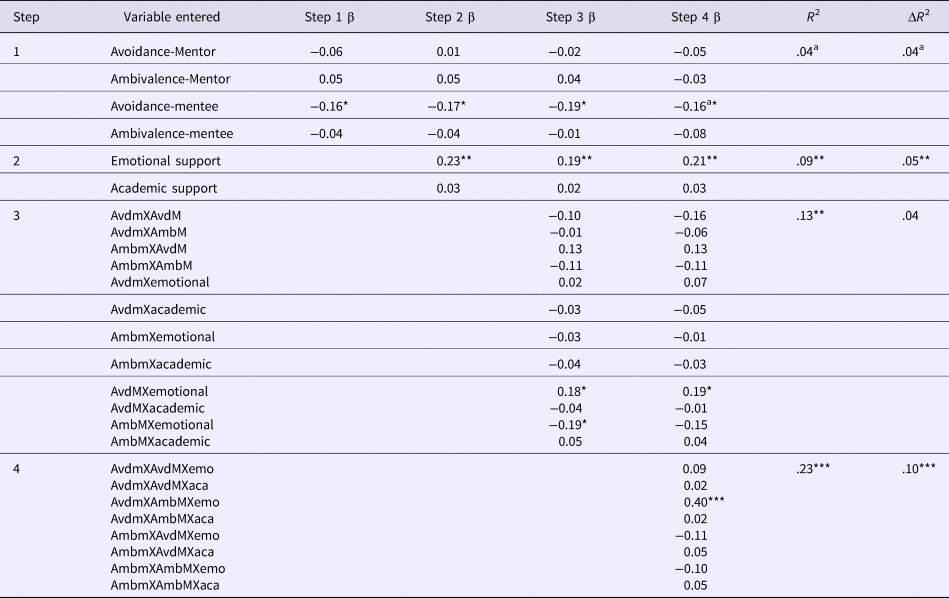
Table 2 presents the results of the regression analysis predicting the quality of the mentoring relationship (bonding) as perceived by mentees. The total model explained 23% of the variation in mentoring relationship quality. Mentee avoidance was negatively related to mentees’ perceptions of mentoring relationship quality (β = −.16, p < .05). Step 2 reveals that among mentees and mentors with the same attachment dispositions (i.e., holding these constant), emotional support was a positive and significantly significant predictor of mentees’ perceptions of mentoring relationship quality. Adding the two support conditions in Step 2 more than doubled the variance in relationship quality the model explained. Including two-way interaction between attachment dispositions and support conditions in Step 3 further increased the R 2 by 4%. The addition of three-way interactions between mentor attachment, mentee attachment and support condition led to an additional and highly statistically significant increase of 10% in the variability in mentee reports of mentoring relationship quality.
Regression Predicting the Mentoring Relationship Quality as Perceived by Mentees

Note: Avdm = Avoidance-mentee, AvdM = Avoidance-Mentor, Ambm = Ambivalence-mentee, AmbM = Ambivalence-Mentor.
*p < .05. **p < .01. ***p < .001.
At Step 3, a pair of two-way interactions accounted for the increased variability. Both indicated that the relationship between mentor attachment disposition and mentee-reported relationship quality varied as a function of the degree of emotional issues in the match. Figure 2a shows the decomposition of the first of these two-way interactions between mentor avoidance under differing conditions of emotional support (β = .18, p < .05). We found that mentor avoidance predicted lower relationship quality, but only when mentors rated the emotional context as high (β = −.42, p < .001). When the emotional context was rated as low, mentor avoidance was not associated with mentees’ perceptions of mentoring relationship quality (β = .21, p = .16). This may mean that focusing on mentees’ emotional issues in matches by highly avoidant mentors may contribute to a lower quality relationship.
Relationship quality in mentoring reported by mentees matched with weakly and highly avoidant mentors in the least and most emotionally focused matches.

Relationship quality in mentoring reported by mentees matched with weakly and highly ambivalent mentors in more and less emotionally focused matches as moderated by their mentees’ avoidance.

The second two-way interaction between emotional support provided and mentor ambivalence on relationship quality was further moderated by mentee avoidance (see Step 4: β = .40, p < .001). We then decomposed the three-way interaction in Figure 2b for the purpose of interpretation. The two solid lines reveal the negative effect of mentors’ ambivalence in those matches focused most highly on emotional issues. This negative relationship was roughly the same for the least and the most avoidant mentees (βs = −.31 vs. −.24, p < .01). The lowest rated relationship quality was reported by highly avoidant mentees with highly ambivalent mentors who focused most heavily on emotional issues (solid gray line above ‘most ambivalent mentors’). The group who reported far and away the highest levels of relationship quality were the least avoidant mentees matched with the least ambivalent mentors but when the matches were highly focused on emotional issues.
In matches that focused least on emotional issues (represented by dashed lines), the most avoidant mentees reported the lowest relationship quality but only when matched with the least ambivalent mentors. Conversely, the most avoidant mentees reported the highest relationship quality when matched with the most ambivalent mentors. Therefore, in the least emotionally focused matches, mentor ambivalence was not negatively or directly related to mentoring relationship quality. Rather, there was no association between mentor ambivalence and relationship quality for least avoidant mentees (β = .08, p = .57) but a positive relationship for the most avoidant mentees (β = .42, p < .001). That is, mentor ambivalence predicted higher reports of perceived quality by the most avoidant mentees in the least emotionally focused matches.
In sum, the results of the two regression analyses reveal that the relationship between both mentor and mentee insecure attachment styles and their perceptions of relationship match quality varies as a function of their partner's attachment style. Furthermore, the way in which mentor and mentee attachment styles interact to explain relationship quality varies as a function of how emotionally or academically focused the relationship was. The pattern of results generally supports the hypothesised moderating effect of the mentoring interactive context and the joint contributions of each partner's attachment style to their perceptions of the bond with their mentoring partner.
Discussion
In this article, we examined the premise that attachment insecurity would constrain the development of high-quality relationships in a formal mentoring program (Gormley, Reference Gormley2008; Poteat et al., Reference Poteat, Shockley and Allen2015; Zilberstein & Spencer, Reference Zilberstein and Spencer2014). Using data from a study of the effects and relational processes that occur in an academic, professional mentoring program offered to young college students, we explored the associations between the attachment dispositions of mentors and mentees (measured before matching) and the quality of their mentoring relationship (taking the average of relationship quality measured at four times during the academic year). Additionally, we considered the nature of the predominant type of support provided in interactions during their meetings (either emotional or academic support). We predicted that when the mentoring focuses on emotional issues, the attachment system would be activated, consequently amplifying the potential negative effect of attachment insecurity on the quality of the mentoring relationship. In contrast, we predicted that high focus on academic issues or low focus on emotional issues would be more normative and less threatening for students, which would consequently alter the effect of their attachment dispositions on the mentoring relationship quality.
An important first finding that emerged from our study and that supports our two hypotheses is that accounting for interactions between attachment dispositions and the type of interactive context in mentoring explained a substantial portion of the variance in the perceived quality of the mentoring relationship. Notably, over one-third of the explained variance in quality was attributed to the three-way interactions (9%/27% for mentor perceptions and 10%/23% for mentee perceptions). This result, which is unprecedented in the mentoring literature, suggests that the effect of the attachment insecurity of one dyad partner on the mentoring relationship depends largely on the attachment insecurity of the other partner, as well as the specific nature of the mentor–mentee interactions. In addition to being guided by their respective attachment styles, which were more strongly activated in predominantly emotionally supportive situations, both mentors and mentees adjusted their behaviours according to the degree of the other's attachment security. This result is fully consistent with one of the premises of attachment theory (Bowlby, Reference Bowlby1982), whereby representational attachment models serve as guides for the expression of support and help-seeking behaviours in new relationships. It is also consistent with the premises of developmental theories concerning social support, whereby the quality of a new relationship depends on the cognitive schemas brought by each of the actors and on the types of transactions that take place in their relationship (Pierce, Sarason, & Sarason, Reference Pierce, Sarason and Sarason1996).
More specifically, we found that the tendency of the two partners (mentor and mentee) to express avoidant attachment behaviours was prospectively and negatively related to their perceptions of the mentoring relationship quality. Consistent with our first hypothesis, the predictive power was stronger when mentoring interactions were more strongly focused on emotional support (for mentoring relationship quality as perceived by either mentor or mentee) or more weakly focused on academic support (for mentoring relationship quality as perceived by mentor only). In addition, the mentor's tendency to express ambivalent attachment led mentees to negatively perceive the mentoring relationship quality, but only when the mentor's behaviour was strongly focused on emotional support.
These results add to the knowledge of mentoring processes (Gormley, Reference Gormley2008; Poteat et al., Reference Poteat, Shockley and Allen2015; Zilberstein & Spencer, Reference Zilberstein and Spencer2014). In line with our first hypothesis, attachment insecurity, and more markedly attachment avoidance, appeared to negatively affect the quality of the mentoring relationship, but only when mentor support behaviours were perceived as addressing the mentee's emotional life. When the mentor's support behaviours showed a different trend (i.e., they were not strongly focused on emotional issues, or else they were highly focused on academic issues), we found no evidence of the negative effects of an insecure attachment style. These results suggest that the effects of insecure attachment on the mentoring relationship are more conditional than universal. Thus, attachment insecurity may limit the development and quality of mentoring relationships, but primarily when the mentoring process involves more emotionally supportive interventions, such as providing assistance, listening to personal information, and managing personal conflicts. When the mentoring process addresses more instrumental interventions, such as providing support for school or practical activities, attachment insecurity does not pose as much of a threat to the relationship quality. Consequently, raising mentors’ awareness of the nature, determinants, and effects of attachment styles would be a useful strategy to include in mentorship training programs, but only as long as mentors are expected to explore emotional experiences with their mentees. Otherwise, nothing indicates that these training objectives would help promote effective mentoring relationships.
In contrast to the previous finding, we found that under conditions when the mentor was not focusing on emotional issues, attachment insecurity positively influenced or predicted perceptions of the mentoring relationship, notably when the dyad partners exhibited opposing attachment styles. This was a somewhat unexpected pattern of results. We had predicted instead, as a second hypothesis, that high focus on academic issues or low focus on emotional issues in the mentorship would diminish the potentially negative effects of mentees’ and mentors’ avoidance and ambivalence dispositions on the mentoring relationship. However, the results suggest that these contexts do more than diminish the negative effects of insecurity: they reverse them. In fact, we found a positive effect of mentor avoidance on their perceptions of the mentoring relationship quality when they were matched with highly ambivalent mentees in a context of low emotionality (Figure 1b). We also found a positive effect of mentor ambivalence on mentee perceptions of the relationship in a low emotionality context when mentors were matched with highly avoidant mentees (Figure 2b).
Although these last findings may seem counterintuitive at first, they corroborate and supplement findings from prior mentoring research by Bernier, Larose, and Soucy (Reference Bernier, Larose and Soucy2005). In a study in college students mentored by professors under an instrumentally oriented program (i.e., aimed at helping more students succeed), these researchers found that student mentees displayed more adaptive behaviours and perceptions in the mentoring experience when their attachment orientation (i.e., dismissing or preoccupied attachment) contrasted with their mentor's relational style (i.e., valuing autonomy or relatedness). One possible explanation for their findings, and consistent with the present study, is that in the context of more instrumental support relationships, avoidant mentors may model independence that reinforces their mentees’ autonomy. This could help their more ambivalently attached mentees set aside their relational anxieties and concerns, in a context of minimal relational demands, and practise independence. Similarly, the more ambivalent mentors may have found it easier to consistently support more avoidant mentees through an instrumental challenge (with minimal relational demands and emotional concerns), thereby reinforcing the benefits of autonomy and the possibility of relational stability and confidence. As a result, the more avoidant mentees could have perceived the mentoring relationship as positive. These positive effects must be interpreted with caution, however, because they cannot be generalised to both dyad partners.
Although there is little empirical evidence to enable accurate prediction of how each insecure attachment style (avoidance or ambivalence) would affect the mentoring relationship, we drew on Gormley's (2008) theoretical proposals to speculate on these relationships. Thus, more ambivalent mentees would fail to build a satisfactory mentoring relationship. This incapacity could be due to several processes, including compulsive help-seeking, expectations of support in situations that call for autonomy, inappropriate manner of communicating distress, and difficulty receiving and accepting mentor feedback. Ambivalent mentors, for their part, may seek gratification through mentee dependence, and hence find it difficult to watch their mentees grow and gain autonomy (Gormley, Reference Gormley2008). They could become intrusive and controlling with their mentees, which would negatively affect the mentoring relationship (Gormley, Reference Gormley2008).
Mentees with more avoidant dispositions would also have problems building a positive mentoring relationship, but for different reasons. They would not wish to be dependent on their mentor, and they would feel threatened when their mentor inquired about their wellbeing or wanted to help them solve their problems. They would resist changing their ways of being and thinking, even when situations made it necessary (Gormley, Reference Gormley2008). On the other hand, avoidant mentors would be disinclined to offer psychological support or to support mentee autonomy. They might be distant, controlling, and insensitive to the mentee's concerns (Gormley, Reference Gormley2008). The results of our study partly support these hypotheses, while revealing more negative associations between mentor's insecure attachment and mentorship quality, and mainly in mentorships that were geared towards emotional support.
Strengths, Limitations, and Implications for Future Research
This study includes several strengths that distinguish it from the research to date on attachment and formal mentoring. It is one of the rare studies to use a longitudinal design combined with an assessment of attachment prior to the mentoring experience. This enabled capturing the predictive power of attachment for the development of a new relationship. It is also one of the rare studies to account for the respective and interactive contributions of mentor and mentee attachment dispositions to predict the quality of the mentoring relationship. Our results clearly demonstrate the relevance of this approach for future research. Finally, this study makes an original contribution by considering the perspective of both partners to assess mentoring relationship quality.
Notwithstanding these strengths, there are also certain limitations. First, the use of mentor self-reports to assess the nature of the interactive mentoring context did not allow us to capture the complexities of the support transactions or the mentees’ emotional experience. Adding observational measures of mentoring would be useful for future work in this area, and for mentoring research in general. A second limitation concerns the use of different questionnaires to assess mentor and mentee attachment dispositions. The different assessments may account for the differences in the relationships between mentor and mentee attachment and mentoring quality. In youth, this suggests that representations of parental attachment (measured by the IPPA) would have less influence on a mentoring relationship developed with an older peer compared to representations of significant partners in general (measured by the ASQ). Finally, our results are derived from a specific mentoring program, the goals of which are clearly academic and vocational. It would be important to replicate the current findings in community-based mentoring programs and in younger populations, for instance, before generalisation to youth mentoring programs and research.
Implications for Mentoring Practice
The main objective of many mentoring programs is to promote the development of high-quality mentoring relationships. Our study suggests that providing mentors, mentoring program staff, and even parents with a better understanding of the interactive effects of mentor and mentee attachment dispositions, and of the specific benefits and risks inherent in the demands of instrumental versus emotionally supportive mentoring, could aid in the achievement of this objective. Notably, it could facilitate more effective matches, given specific program contexts and goals, and help all participants better understand the challenges each match may encounter. The results are particularly clear on one point: the attachment insecurity of the two partners constitutes a significant issue in the mentoring relationship, particularly if the mentor is asked to explore the mentee's emotional experience. Consequently, when mentoring programs are structured so that mentors are expected to engage emotionally with their mentees, it would be important to select the most stable mentors: those who can demonstrate relational autonomy, but are also very comfortable with proximity, dependence, and caring. It would also be advisable to raise mentors’ awareness of the nature, determinants, and effects of attachment styles, and to better equip them to acknowledge and deal with mentees’ distress (e.g., relational intervention techniques).
The results of this study are also clear on one other point: attachment insecurity does not harm all types of mentoring relationships or all types of mentoring interventions. If the program's expectations for its mentors are more instrumental in nature (e.g., doing activities, providing academic support), there is little evidence that attachment insecurity will harm the quality of the relationship. On the contrary, our results suggest that attachment insecurity can predict a very good relationship. Considering the diversity of mentors’ relational profiles, it would therefore be important to encourage them to use different support strategies that might sometimes depart from emotional exploration.
Author ORCIDs
Simon Larose, 0000-0001-8872-086X