INTRODUCTION
Young children frequently produce messages with unclear reference. Experimentally, this is observed in referential communication tasks in which the child describes a target so that a listener can distinguish it from surrounding items. These tasks are typically constructed with items that require reference to physical attributes such as colour and size in order to disambiguate the target. In the preschool years, children often provide ambiguous descriptions that fail to mention the distinguishing feature(s) of the target (Deutsch & Pechmann, Reference Deutsch and Pechmann1982; Surian, Reference Surian1995; Whitehurst, Reference Whitehurst1976; Whitehurst & Sonnenschein, Reference Whitehurst and Sonnenschein1978; Whitehurst, Sonnenschein, & Ianfolla, Reference Whitehurst, Sonnenschein and Ianfolla1981; but cf. Ford & Olson, Reference Ford and Olson1975). For example, given a target of a boat in an array that includes another, smaller boat, they might tell the listener to pick up or point to the boat without including the disambiguating adjective big. In these tasks, children also produce messages that are referentially adequate, but also contain redundant mention or over-specification of non-distinguishing features. For example, a child might tell a listener to pick up the small red boat even though the non-target, large boat is also red. These two patterns demonstrate opposite trends in childhood: With age, ambiguous messages decrease and over-specification becomes more frequent (Deutsch & Pechmann, Reference Deutsch and Pechmann1982; Surian, Reference Surian1995; Whitehurst, Reference Whitehurst1976; Whitehurst & Merkur, Reference Whitehurst and Merkur1977).
Considerable attention has been given to the pragmatic skills that might determine outcomes in these tasks, most notably children's awareness of the perspective and information needs of the listener (Whitehurst & Sonnenschein, Reference Whitehurst, Sonnenschein and Whitehurst1985; see also Nilsen & Graham, Reference Nilsen and Graham2009, for a recent discussion). However, referential outcomes, and children's apparent pragmatic understanding, also depend on a host of other factors. Referential communication tasks typically require the ability to complete a series of comparisons (Whitehurst, Reference Whitehurst1976), and identify similarities and differences among the attributes of the targets. Performance on these tasks requires knowledge of appropriate lexical and syntactic forms, and the ability to deploy the necessary cognitive and linguistic processes within the moment to analyze the targets, form a communicative intent, and produce a description. Researchers have also noted that performance likely engages working memory and cognitive control processes to hold in mind the relevant target features and inhibit irrelevant information or perspectives, although efforts to date have failed to identify correlations between measures of these skills and children's referential outcomes (Nilsen & Graham, Reference Nilsen and Graham2009; Surian, Reference Surian1995).
It has long been acknowledged that challenges related to these different task demands may influence outcomes. Young children produce a greater number of ambiguous descriptions, for example, when the size of the array increases, when the relevant dimension changes from trial to trial, or when the attributes of the context items vary across trials (Whitehurst, Reference Whitehurst1976; Whitehurst & Sonnenschein, Reference Whitehurst and Sonnenschein1978). Beyond these early observations, however, there has been little systematic investigation into the task demands or process considerations that influence children's referential patterns. In particular, we note that although these tasks have tended to rely on conceptually important physical attributes, there has been little systematic attention to the ways in which these attributes might determine children's communication patterns.
As noted above, referential communication tasks often require judgements of physical attributes such as size and colour. Such judgements should be possible for many preschool-aged children. However, although preschool-aged children are noted to be able to represent and compare objects in terms of their component attributes, such reasoning is argued to be cognitively demanding for them (Smith, Reference Smith1984). More importantly, the identification of relational attributes such as size is noted to bring inherently different and more complex analysis demands than the identification of nominal attributes such as colour. Relational attributes are organized along a continuum, whereas nominal attributes are not. Determining placement along a relational continuum requires comparison (Gentner & Ratterman, Reference Gentner, Ratterman, Gelman and Byrnes1991; Johnston & Smith, Reference Johnston and Smith1989; Johnston, Smith, & Box, Reference Johnston, Smith and Box1997). Johnston and Smith (Reference Johnston and Smith1989), for example, noted that in order to reason about size, one must possess not only an understanding of attributes and dimensions, but also knowledge of “relative magnitude or directionality” (p. 33). And, in the moment of reasoning, for example, one must make judgements of same/more/less in order to make decisions about size distinctions, compared to judgements of same/different required for decisions about colour distinctions (Johnston & Smith, Reference Johnston and Smith1989). Consistent with these expectations, analyses of adults' eye-movement patterns and reaction times during visual discrimination tasks reveal that colour features are identified more quickly than size features, and that identification of size features entails more complex looking patterns (Belke & Meyer, Reference Belke and Meyer2002). That is, colour features are inherently easier to analyze and identify visually than size features.
These inherent differences between attribute types in ease or priority of analysis have consequences for adults' referential patterns: in object description tasks that vary colour and size attributes, adults very frequently over-specify colour features, but rarely over-specify size features (Belke & Meyer, Reference Belke and Meyer2002; Pechmann, Reference Pechmann1989; Viethen, Goudbeek, & Krahmer, Reference Viethen, Goudbeek, Krahmer, Miyake, Peebles and Cooper2012). Thus, an adult is likely to describe a target as the red circle even when the colour descriptor is redundant within the visual context. These referential patterns are understood to follow directly from the differences between attribute types in perceptual availability. Colour, as an early identified feature, may frequently find its way into object representations, developing messages, and utterances, and may simply not be edited out even if colour reference is not necessary for communicative success (Belke & Meyer, Reference Belke and Meyer2002; see also Pechmann, Reference Pechmann1989). In contrast to the relatively automatic entry of colour into a message, production plans might only be updated to include size information after further analysis of its relevance (Belke & Meyer, Reference Belke and Meyer2002). This expectation is validated by evidence that adults are much more likely to include size features in their object descriptions when size is necessitated by the context and the speaker has looked at the context items (Brown-Schmidt & Tanenhaus, Reference Brown-Schmidt and Tanenhaus2006).
The relational–nominal distinction has been demonstrated to affect children's communication outcomes, too, although the observed pattern is different from that observed in the adult literature. In a study by Johnston et al. (Reference Johnston, Smith and Box1997), preschool-aged children with typical language and specific language impairment described two toys from a set of three to a blindfolded puppet who acted as the ‘listener’. The targets were designated by the experimenter and formed a set on the basis of their complete identity, their size (differing in colour), or their colour (differing in size). The task thus required children to infer the relevant relationship, and referential adequacy required them to describe the attribute that was common between the targets and different from the foil (e.g., red flowers, big sticks). Although communicative success in this task was generally high, the children failed more often to provide the requisite size than identity or colour descriptors. Deutsch and Pechmann (Reference Deutsch and Pechmann1982) also described a similar pattern of challenges with size descriptions, although they did not report statistics related to this observation.
The children in the Johnston et al. (Reference Johnston, Smith and Box1997) study all produced some selective, contextually relevant descriptions of colour and size attributes. Based on this observation, Johnston et al., argued that the challenges with size were unlikely to reflect specific gaps in linguistic, conceptual, or pragmatic knowledge, and were more likely to reflect challenges with cognitive processing and managing the unique demands inherent in reasoning about size. Logically, one might expect that the greater complexity of visual analysis needed to identify size features might sometimes lead to analysis failures and downline communication failure in young children who may still be developing their ability to efficiently identify and compare component attributes. The study was not designed to speak further to the specific reasons for children's difficulty with size trials, and other explanations are certainly possible, including accounts focused on challenges with the language requirements of size reference. On that point, it is interesting to note that in non-verbal tasks using very similar materials and requiring similar comparisons, preschool-aged children did not demonstrate greater difficulty identifying size-based than colour-based relationships (Johnston & Smith, Reference Johnston and Smith1989; Smith, Reference Smith1984). That is, even though analysis of size targets arguably required more time and complexity than analysis of colour targets (as happens with adults), the children were not less likely to ultimately succeed. These results invite further consideration of whether or not size-based analyses might be particularly challenging for children, and whether size-based analyses are challenging within communicative contexts in particular.
In this study, we further investigated the differential effects of size versus colour attributes on children's descriptive outcomes in a referential communication task. We sought to replicate the pattern of referential ambiguity related to size features reported by Johnston et al. (Reference Johnston, Smith and Box1997), and extended the method to gain further insight into the potential mechanisms involved. We included an additional condition that presented less complexity within the stimulus set. This condition allowed insight into children's general understanding of the requirements of the task and provided further evidence of how children's referential successes vary with stimulus complexity. We established a priori that the participants had knowledge of the necessary attribute vocabulary for communicative success, in order to be able to rule out gaps in lexical knowledge as the likely basis for any communication failures. We also included a non-verbal reasoning task that shared many of the analysis requirements of the communication task, in order to further document children's abilities with the requisite analysis schemes and examine whether challenges related to size were common to both tasks or more pronounced when a spoken response was required.
In addition to examining referential ambiguities, we asked whether the attribute-dependent pattern of over-specification that is observed in adults' descriptions would also be observed in young children's descriptions. One potential interpretation of the well-documented increase in over-specification with age is that there is a progression from a general pattern of under-specification in very young children to a general pattern of exhaustive description in older children (e.g., Whitehurst, Reference Whitehurst1976). Nadig and Sedivy (Reference Nadig and Sedivy2002, footnote 1), however, anecdotally described a high rate of colour over-specification in the descriptions of children aged 5;6 to 6;10 in a referential communication task. This suggests that attribute type may also be an important determinant of instances of referential over-specification in children's speech. If so, parallels with the adult literature may provide a direction for future investigation into the determinants of under- and over-specification in development.
Following Johnston et al. (Reference Johnston, Smith and Box1997), the referential communication task required children to describe two target objects from a set of three to a listener. The targets shared the same size or colour. They were indicated by the experimenter, and the child had to infer the relevant relationship and craft an appropriate description. The non-verbal reasoning task was adapted from Smith (Reference Smith1984) and Johnston and Smith (Reference Johnston and Smith1989). The child watched the experimenter choose two toys from a set of three, and then chose two toys from their own set of three according to the same rule. The targets shared the same size or colour, and the rule was not provided; children had to infer it on their own. The non-verbal task shared many of the analysis requirements of the communication task, namely, the ability to categorize an object according to its physical attributes, to classify sets of objects as being the same or different within an attribute or dimension, to infer a relationship based on the experimenter's choice, and to shift the basis of comparison as needed based on the items indicated by the experimenter (Johnston et al., Reference Johnston, Smith and Box1997). By necessity, some task requirements were not analogous between the tasks. Namely, the communication task, but not the non-verbal task, required the child to consider the listener's information requirements, form a communicative intent, and process the stimuli sufficiently to access the appropriate linguistic content.
The referential communication and the non-verbal reasoning task included conditions that differed in the variability of the features of the stimulus objects and thus the anticipated complexity of reasoning required to identify the target attribute. The complex condition was similar to that reported to produce challenges with size description in the work by Johnston et al. (Reference Johnston, Smith and Box1997). In this condition, the targets were identical on the target dimension but differed on the non-target dimension. The children thus had to identify the feature in common between two dissimilar items. The foil matched one of the targets on the non-target dimension. In the simple condition, the targets were identical to each other and only the target dimension varied between the targets and the foil. In all cases, the number of items in the array and the number of targets to be selected or described was held constant. Moreover, in the referential communication task, the language output requirements for a successful description did not vary between the two conditions.
Our immediate goal was to document whether referential failures in the communication task would be more common with size than colour targets, and whether referential over-specification would be more common with colour than with size. We further asked how variations in perceptual complexity of the stimulus objects influenced outcomes, and whether or not challenges related to size would be common to the two tasks or a unique feature of the communicative context.
Questions and hypotheses
To summarize, this study addressed the following questions:
1. Does the target attribute reliably influence the rate of descriptive success in a referential communication task? Do children fail to provide necessary size information more often than colour? Following Johnston et al. (1997; see also Deutsch & Pechmann, Reference Deutsch and Pechmann1982), we expected young children to produce a greater number of referentially ambiguous descriptions when size, rather than colour, was the target.
2. Does the perceptual complexity of the stimulus array influence referential success? We anticipated that the perceptually complex condition would make analysis more challenging, and that the result of this challenge would be fewer successful descriptions in the communication task.
3. Does the target attribute influence the rate of referential over-specification in preschool children's descriptions? Following from the adult literature (Belke & Meyer, Reference Belke and Meyer2002; Pechmann, Reference Pechmann1989) and report on the performance of five- and six-year-old children (Nadig & Sedivy, Reference Nadig and Sedivy2002), we expected children to redundantly mention colour terms more often than size.
4. Does attribute type influence children's outcomes in a non-verbal reasoning task in a similar way? We were less certain that success would differ by attribute type in the non-verbal reasoning task (Johnston & Smith, Reference Johnston and Smith1989; Smith, Reference Smith1984), but hypothesized that if a difference was observed, it would indicate that size items proved more difficult than colour. If analysis failures were more common for size in both the non-verbal and verbal tasks, this would provide support for a view of children's communication failures as a relatively straightforward ‘downline’ effect of difficulty with the requisite reasoning schemes. If, however, challenges related to size appeared only in the communication task, this would invite further consideration of whether and how unique challenges related to size might arise in a communicative context.
METHOD
Participants
The participants were thirty typically developing, monolingual English children. They ranged in age from 3;9 to 5;3 (M = 4;5, SD = 6 months), and included nineteen boys and eleven girls. The children were recruited from childcare centers in a major Canadian urban centre. Typical language development was confirmed by parent report.
An additional four children participated, but were not included in the analysis. Of these, one chose not to complete the referential communication task, and another was unable to complete the task due to multiple disruptions. One child never achieved the criterion of naming or describing two targets in the referential communication task. The final child was excluded because absences from daycare resulted in an exceptionally long delay between the experimental tasks.
Materials
Referential communication and follow-the-leader tasks
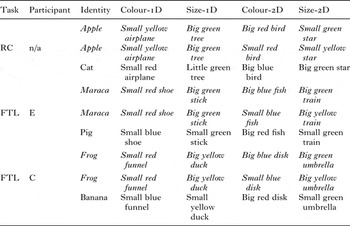
The materials for the experimental tasks consisted of small toys arranged into seventy-two sets of three, twenty-four sets in the referential communication task, and forty-eight in the follow-the-leader task (24 Experimenter sets, 24 Child sets). Each set was constructed with a target match of identity, size, or colour. Table 1 provides examples of the stimuli used in the tasks. In identity sets, the targets were identical to each other and differed from the foil in all respects (i.e., shape, colour, and size). Colour and size sets varied either a single colour/size attribute (1-D) or both (2-D). In the colour and size 1-D sets, the targets and foils shared the same shape and were identical to each other and to the foil on the non-target attribute dimension. For example, a colour(red) set might contain two red shoes and one blue, all three shoes identical in all other respects. In colour and size 2-D sets, the targets and foils shared the same shape, but the targets differed from each other on the non-target attribute. The identity trials relied on a cognitively simpler basis for matching. These trials served as a control to indicate that the children understood the tasks, including the requirement to select toys following the experimenter's criterion in the follow-the-leader task, and to talk about both targets in the referential communication task. The toys used in the communication task were objects whose labels are acquired before three years of age according to the MacArthur-Bates Communicative Development Inventory (Dale & Fenson, Reference Dale and Fenson1996). No stimulus items were repeated between sets. The target colours were red, blue, yellow, and green, and the average size ratio of big to little items within a set, along their longest edge, was 1·6 to 1. In the non-verbal reasoning task, the experimenter's toys and child's toys differed from each other in size. That is, in a size(big) trial, for example, the actual dimensions of the big and little toys differed between the sets. Table 1 presents examples of stimuli in each condition of the two experimental tasks.
Examples of stimuli used in the experimental tasks (target items in italics)

notes: RC = Referential Communication; FTL = Follow-the-leader; E = Experimenter; C = Child.
Attribute vocabulary screen
The stimuli for the attribute vocabulary screen consisted of a series of circles presented one at a time on a computer monitor. The coloured circles were red, blue, green, or yellow, 4 cm in diameter, and, for size trials, appeared as a 14 cm diameter (big) or 1 cm diameter (small) black circle outline with a transparent fill.
Procedure
The children were seen individually in their childcare centre, and completed the two experimental tasks on different days (M interval = 9 days). We expected that exposure to the non-verbal task was less likely to influence performance on the speaking tasks than vice versa, and so the follow-the-leader task was completed first. The attribute vocabulary screen was completed at the end of the first session. Due to scheduling constraints, two children completed the vocabulary screen on a separate day and one completed it at the end of the second session.
Attribute vocabulary screen
For this task, the children were instructed to say what the circle ‘looks like’. The task began with a familiarization phase in which a cloze phrase was used to guide children towards naming the colour and then size of the stimuli, rather than labeling ‘circle’. Circles representing the attributes red, green, blue, yellow, big, and little appeared one at a time on the computer screen. Once the child understood the task, each attribute appeared three times, in one of two random orders. The children's responses were recorded on-line and audiotaped for later verification.
Experimental tasks
In both tasks, 1-D and 2-D items were completed in separate blocks, each containing four identity, four size, and four colour trials. The order of blocks (1-D or 2-D first) was counterbalanced. The stimuli were presented in one of two pseudo-random orders, constructed with the constraint that the same trial type (identity/size/colour) could not occur on more than two consecutive trials. A short play break occurred between the two blocks. In addition, in order to reduce the potential for particular items to influence performance in one direction or another, the designation of a particular 2-D stimulus set as either a size trial or a colour trial was counterbalanced among children. The construction of the 1-D sets did not allow this flexible alternation in target designation, so the designation of 1-D targets as either size- or colour-relevant was constant across children.
Follow-the-leader task
The first experimenter (E1) and the child sat opposite each other. The child was informed that they would play a ‘follow-the-leader’ game. The E1 placed the three toys in the first set on the table, stating, “Here are my toys”. The second experimenter (E2) placed the three toys in the child's first set on the table stating, “Here are your toys”. The toys were placed in varying orders and differed from the order of the E1's toys. On the first trial, the E1 instructed the child that she would choose two toys from her set, and that the child should watch which toys she chose and try to do the same thing. The E1 then picked up the first two targets and advanced them by several inches to a mat in the middle of the table, stating “I choose these”. The child then made his or her choice of two targets and placed them on the mat. If the child chose only one toy, he or she was reminded to ‘do like’ the E1 and choose two. If the child chose two, the task continued. The children often touched or picked up several toys before making a final choice. They were credited with a correct response if their final choice followed the target criterion. The children's responses were scored on-line by the E2 and videotaped for later verification by the E1. Seven (23%) of the video records were re-scored for reliability by a graduate student who was not informed of the goals of the study. Reliability for the child's choice was 100%.
Referential communication task
The E1 and the child again sat across from each other, and the E2 sat next to the child, wearing a blindfold. The child was informed that they would play a talking game with toys in which the child would help the E2 identify toys to play with later. On each trial, the E1 placed the three toys in the set onto the table and then without speaking indicated the two targets, and advanced them several inches onto a mat. The E1 then instructed the child, “OK, you tell E2 which ones”. After the child had responded, the E1 advanced the foil to the mat to remove the visual cue to the targets, and the second experimenter removed the blindfold. If the child had provided a referentially adequate response, the E2 chose the targets. If the child had failed to provide a clear identifying response, the E2 acted unsure and the child was asked to try again. The E2 replaced the blindfold and the trial was run a second time. If the child again failed to give a referentially adequate response, the E2 again acted confused and asked the child to give her the target toys. On average, additional attempts were made for 10% of Identity trials and 53% of Attribute trials. After each trial, the child was allowed to collect the target toys and put them in a bag. The task began with a practice identity trial that was repeated until the child understood the requirement to describe both targets and to provide a verbal rather than a deictic response. The children were allowed up to two attempts on experimental trials if the first response was referentially inadequate; if the child provided a deictic response, the child was reminded to “tell her with words” and given another opportunity to respond. The sessions were audio-recorded for later transcription and scoring.
Scoring procedure
Responses were initially scored as referentially adequate or inadequate, or unscorable (n = 1). Children were credited with providing a referentially adequate response if it allowed the listener to unambiguously identify the targets. In identity trials, it was sufficient to name the targets (e.g., hats). For colour and size trials, a successful response required that the child make reference to the target attribute (e.g., big, yellow). In the vast majority of responses referring to the target attributes, the children used the labels red, blue, green, yellow, big, little, and small. A small number (n = 5 trials) of non-canonical labels for size attributes were noted and accepted. These included Mom and Dad and long for big, and baby for little.
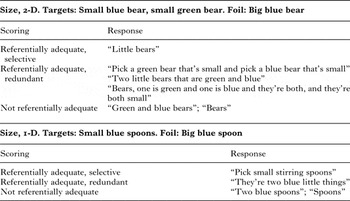
For size and colour trials, referentially adequate responses were further categorized according to whether or not the child additionally described the non-differentiating dimension (i.e., inclusion of a colour term in size trials and vice versa). The responses varied in their structure; they were coded on the basis of descriptive content. Table 2 provides examples of responses coded for referential adequacy and redundancy.
Examples of responses scored for referential adequacy and redundancy

Reliability
Ten (33%) transcripts were randomly selected for transcription and reliability scoring by a graduate student who was trained in the scoring criteria but was unfamiliar with the goals of the study. Agreement was 100% for referential adequacy and 99% for redundancy.
RESULTS
We first describe the results for the attribute vocabulary screen and the identity trials of the referential communication and non-verbal reasoning tasks, as indices of children's knowledge of the relevant lexical forms and understanding of the basic task requirements. Then, turning to the experimental variables, the discussion of outcomes follows from the research questions rather than the order in which the children received the experimental tasks. We first describe results of the referential communication task as the primary focus of the study (research questions 1–3), before turning to consider the results of the follow-the-leader task (research question 4).
Attribute vocabulary screen
The children provided correct responses to 95% (SD = 11) of colour trials and 94% (SD = 11) of size trials in the attribute screening task, indicating that they had productive knowledge of the attribute vocabulary necessary for success in the referential communication task.
Identity trials
In both tasks, the identity targets were identical in all respects. These trials were included as a control to indicate that the children understood the task requirements, and performance was high. Performance on identity trials in the referential communication task was essentially at ceiling, with a mean success rate of 97% (SD = 9%). The mean proportion of successful choices for identity trials in the follow-the-leader task was also very high at 88% (SD = 17). The analyses reported below focus on colour and size trials. Effect sizes for main effects are reported as η p2 and as d for simple main effects follow-ups of interactions. For η p2, the values ·01, ·06, and ·14 are interpreted as cut-offs for small, medium, and large effects respectively. For d, the corresponding values are ·2, ·5, and ·8 (Cohen, Reference Cohen1988).
Referential communication task
Success
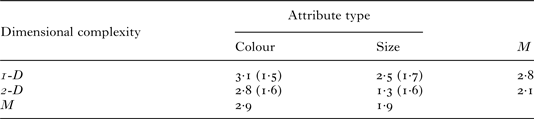
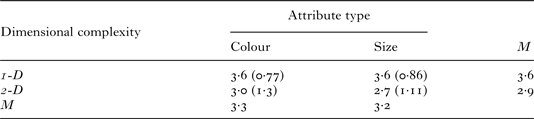
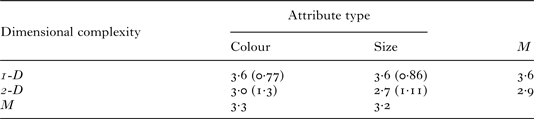
The first analyses for the referential communication task examined the extent to which children conveyed the necessary identifying information in their target descriptions. Table 3 presents the mean number of referentially adequate responses as a function of attribute type and dimensional complexity. The values in Table 3 suggest that both dimensional complexity and attribute type affected the success of the children's spoken messages. Success was lower in 2-D than 1-D trials, and lower in size than colour trials.
Mean number (SD) of referentially adequate descriptions, referential communication task
note: Maximum value per cell = 4.
We conducted a (2) dimensional complexity × (2) attribute type repeated measures ANOVA to determine the reliability of these patterns. The results revealed a significant interaction between attribute type and dimensional complexity (F(1,29) = 5·86, p = ·02, η p2 = ·17). Simple main effects analyses revealed that the children were more successful on colour than size items for both 1-D (t(29) = 2·54, p = ·02, d = ·37), and 2-D blocks (t(29) = 4·0, p < ·001, d = ·94). However, the influence of attribute type on outcomes was greater for the 2-D blocks than 1-D, with more than twice as large an effect size. Simple main effects analyses were also conducted to examine the effect of complexity of the stimulus set on referential adequacy within each attribute type. For size trials, the children were more successful in the 1-D block than the 2-D block (t(29) = 3·9, p = ·001, d = ·73). For colour trials, however, there was no significant difference in referential success between the 1-D and 2-D blocks (t(29) = 1·3, p = ·204, d = ·19). The ANOVA also revealed statistically significant main effects of both item type (F(1,29) = 17·94, p < ·001, η p2 = ·38) and dimensional complexity (F(1,29) = 13·61, p < ·001, η p2 = ·32).
We also asked how many individual children demonstrated referential outcomes consistent with the patterns based on group means. Of the thirty participants, nine were equally successful in size and colour trials. Three of these children produced no successful descriptions of either size or colour targets and five of these children performed at ceiling for both attribute types. Eighteen children produced a greater number of successful colour than size descriptions, whereas only three demonstrated the opposite pattern of a greater number of successful size than colour descriptions. Thus, at the individual level as well as the group level, the results of the referential communication task point to a particular difficulty with size attributes.
Referential over-specification
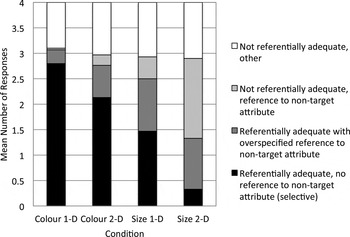
We next examined the content of the children's responses in greater detail. We asked how often the children's descriptions also redundantly made mention of the non-differentiating dimension. Figure 1 presents a stacked chart showing the distribution of children's response patterns by referential success and mention of the non-target attribute. The category labeled ‘Not referentially adequate, other’, reveals that in all conditions, approximately 25% of all trials were in error because the child simply named the item without reference to size or colour, or (rarely) persisted in a deictic response. Beyond those similarities, the conditions show decreasing referential success and increasing reference to the non-target dimension, reading across the figure from colour to size trials.
Stacked chart showing the distribution of children's response patterns by referential success and mention of the non-target attribute.

We first examined the number of scored responses that contained reference to the non-target dimension, collapsed across referentially adequate and ambiguous trials. The results of a (2) dimensional complexity × (2) attribute type ANOVA revealed significant main effects of both dimensional complexity (F(1,29) = 16·10, p < ·001, η p2 = ·36) and attribute type (F(1,29) = 42·37, p < ·001, η p2 = ·59) on the mention of non-target features. The interaction was not significant (F(1,29) = 2·81, p = ·104, η p2 = ·09). Colour labels were mentioned in size trials (M = 4·0 out of 8 trials, SD = 2·3) more often than the reverse, mention of size in colour trials (M = 1·1, SD = 1·7). And, non-target attributes were mentioned more often in the 2-D condition (M = 3·4, SD = 2·3) than the 1-D condition (M = 1·8, SD = 1·5).
We next examined whether the rate of non-target attribute mentions also varied systematically in children's successful responses. This analysis was based on the proportion of each child's successful descriptions that were redundant, and was limited to children (n = 14) who provided at least one successful response in each of the four Dimensional Complexity × Attribute Type conditions. A (2) dimensional complexity × (2) attribute repeated measures ANOVA revealed statistically significant main effects of dimensional complexity (F(1,13) = 9·25, p = ·009, η p2 = ·42) and attribute (F(1,13) = 47·26, p < ·001, η p2 = ·78). The children redundantly mentioned the non-target dimension on a greater proportion of successful size trials (M = 63%) than colour trials (M = 24%), and a greater proportion of successful 2-D trials (M = 55%) than 1-D trials (M = 31%). The difference in response strategy between size and colour trials was particularly pronounced, producing an effect size that is almost twice as large as that observed for the effect of dimensional complexity. The interaction was not statistically significant (F(1,13) = 1·82, p = ·2, η p2 = ·12). Thus, the pattern of over-specification in successful responses was very similar to the pattern of non-target mentions overall.
Follow-the-leader task
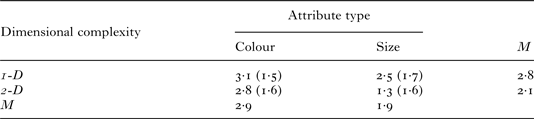
Our final analyses examined performance on the follow-the-leader task. Table 4 presents the mean number of successful choices in the follow-the-leader task as a function of item type and dimensional complexity. In contrast to the outcomes for the communication task, these values point to dimensional complexity, rather than attribute type, as the more important determinant of success. As can be seen, success was lower in 2-D trials than 1-D trials for both attribute types. With regard to attribute type, the mean success rate was numerically lower for size than colour trials in the 2-D condition. We conducted a (2) dimensional complexity × (2) attribute type repeated measures ANOVA to examine the reliability of these patterns. The results revealed a statistically significant effect of dimensional complexity only with a large effect size (F(1,29) = 12·83, p = ·001, η p2 = ·31). The effect of attribute type was not significant (F(1,29) = 1·45, p = ·24, η p2 = ·05), nor was the interaction between attribute type and dimensional complexity F(1,29) = 0·66, p = ·42, η p2 = ·02).
Mean number (SD) of successful selections, follow-the-leader task
note: Maximum value per cell = 4.
The group outcome indicated that it was more difficult to identify the pertinent relationships in the 2-D trials than 1-D trials, but that it was not reliably more difficult to identify size than colour relationships. Notably, this pattern was maintained at the individual level: given a 1 in 3 chance of success for a single trial, we set 6/8 successful trials as the criterion for ‘passing’ in each of the size and colour domains (i.e., collapsed across dimensional complexity), as well as 6/8 successful trials in each of the 1-D and 2-D blocks (i.e., collapsed across attribute type). The probability of producing 6/8 correct selections by chance, based on the binomial distribution, was ·1. Eighteen, or 60%, of the children met the 6/8 criterion in all four domains. Among the children who failed the 6/8 criterion in at least one domain, eight children met the passing criterion in the 1-D block but not in the more complex 2-D block, whereas only two children demonstrated the opposite, unexpected pattern of passing the 2-D block but not the 1-D block. Turning to attribute type, however, the individual outcomes were evenly divided between size and colour. Five children met the passing criterion for colour but not size, and five children met the passing criterion for size but not colour. Thus, individual patterns were in line with the group-based results.
Finally, we had anticipated that the relevant analysis schemes would be challenging but achievable for the children in the age range studied. However, the fact that only eighteen of the thirty children met our criterion for passing for each attribute and each level of perceptual complexity suggests that, for some children, this expectation may not have been met. We thus repeated the analysis of referential adequacy from the communication task for only those eighteen children who passed the non-verbal task. We reasoned that the children who did not reach the 6/8 criterion in the non-verbal task may have failed to do so for various reasons, including knowledge of the reasoning schemes, processing overload, inattention, or failure to grasp the goal of the task. In contrast, we assumed that the children who met the 6/8 criterion were in command of the relevant knowledge and able to manage the relevant reasoning demands.
Looking only at these children, the results for referential success again revealed a statistically reliable interaction between item type and dimensional complexity (F(1,17) = 4·71, p = ·045, η p2 = ·22), as well as statistically reliable main effects of both item type (F(1,17) = 10·17, p = ·005, η p2 = ·38) and dimensional complexity (F(1,17) = 19·10, p < ·001, η p2 = ·53). In the 1-D block, performance for size items (M = 3·1, SD = 1·51) was numerically lower than colour (M = 3·3, SD = 1·24). The difference, however, was small and did not reach statistical significance (t(17) = 1·1, p = ·29, d = ·15). In the 2-D block, the difference between colour and size items was statistically significant with a medium to large effect size (t(17) = 3·0, p = ·008, d = ·72). The children were less successful on size trials (M = 1·3, SD = 1·57) than colour trials (M = 2·8, SD = 2·50), and indeed, mean referential success rates were the same as observed for the entire group of children.
To summarize, in the communication task, we observed greater challenges describing size features than colour features, and we also observed a tendency to over-specify colour features much more often than size features. Over-specification of colour occurred in both referentially adequate and inadequate (ambiguous) descriptions of size targets. We also observed greater challenges describing the target attribute in the 2-D condition than the 1-D condition, although this effect was confined to size and not colour targets. Finally, differential effects of attribute type on performance did not materialize in the follow-the-leader task: The children were equally successful with size and colour targets, but had more difficulty in the 2-D than the 1-D condition.
DISCUSSION
Consistent with prior reports of children's performance in referential communication tasks (Ford & Olson, Reference Ford and Olson1975; Surian, Reference Surian1995; Whitehurst, Reference Whitehurst1976; Whitehurst & Sonnenschein, Reference Whitehurst and Sonnenschein1978), the children in this study often failed to describe the appropriate attribute, and also produced successful, redundant descriptions. The most important finding in the current study is the observation that referentially inadequate and redundant messages were not evenly distributed across item types. The children adopted different strategies to talk about size versus colour attributes, and also achieved different levels of success. The results of the referential communication task are consistent with our hypotheses and lend weight to the conclusion that children's referential under- and over-specifications are influenced by attribute features in a more systematic manner than has previously been acknowledged.
The children in this study all demonstrated knowledge of and ability to appropriately produce size terms in the attribute screen, a simple naming task that treated size in more of an absolute sense than a relative sense. In the referential communication task, they produced a convincing number of successful colour references. Yet, as anticipated, it proved much more difficult for them to produce referentially adequate size descriptions. This finding is consistent with and extends the results previously reported by Johnston et al. (Reference Johnston, Smith and Box1997). For the group of children taken as a whole, size reference posed a challenge in both the 1-D and 2-D conditions. For the children with relatively strong perceptual/conceptual reasoning ability, size reference was only vulnerable to breakdown in the more complex 2-D condition. These results support the conclusion that the different requirements inherent in making judgements about size versus colour have consequences for children's referential success.
One of the purposes of our study was to explore whether challenges describing size features might be best understood as a relatively straightforward outcome of a general challenge or inability to perceive size-based relationships, or whether there are particular challenges that arise when children attempt to talk about size. The results of this study would suggest the latter. Consistent with prior studies (Johnston & Smith, Reference Johnston and Smith1989; Smith, Reference Smith1984), the demands of relational analysis did not contribute to reasoning failures when no spoken response was required. If the children in this study had particular, generalized difficulties perceiving or conceiving of size relationships, we would expect to see similar effects of the independent variables on success rates in both the follow-the-leader and the communication task. Yet the primary determinant of outcomes for the follow-the-leader task was dimensional complexity, not attribute type. Clearly, analysis of perceptually dissimilar target objects was challenging for the children, and there is a hint (albeit not significant) that this was somewhat more challenging for size targets even in the non-verbal task (see Table 4). But, the notable decrement in performance for the size, 2-D condition in the communication task suggests that some aspect of the additional work of formulating and producing descriptions made this process just too difficult for some.
How might particular challenges for size arise in the speaking context? We note several possibilities. For one, the communication task, by its requirements, may have required more extensive or explicit analysis than the follow-the-leader task. The descriptive aspect would have required the children to analyze the stimuli sufficiently to access the appropriate verbal labels, and this difference between the tasks may have amplified any inherent differences in analysis difficulty that exists between relational and nominal attributes. We also note that the follow-the-leader and referential communication tasks differed not only in the requirement to talk, but also in the requirement to consider someone else's perspective and form a communicative intent and message. While analyzing physical features of the targets, children might also need to be asking themselves, “What does the listener need to know?” This additional, more explicit requirement may also have amplified any differences in difficulty.
A third potential explanation, and the one that we favour, attempts to unite the observed patterns of referential over-specification and under-specification within a common process. As with referential ambiguities, the analysis of referential over-specification showed an important effect of the target attribute. Redundant description of colour features occurred much more frequently than redundant mention of size features. This pattern is consistent with previous reports of colour over-specification in slightly older children (Nadig & Sedivy, Reference Nadig and Sedivy2002, footnote 1) and adults. Recall that, in adults, this pattern is explained as the outcome of the close relationship between visual analysis and linguistic formulation processes: colour features are identified more quickly and with less complex analysis than size (Belke & Meyer, Reference Belke and Meyer2002). This priority of analysis and identification may subsequently affect the initial conceptualization of a target(s), the developing message and utterance plan (Belke, Reference Belke2006; Belke & Meyer, Reference Belke and Meyer2002; Pechmann, Reference Pechmann1989). Given the similar effects of attribute type reported for adults, young school-age children (Nadig & Sedivy, Reference Nadig and Sedivy2002), and the preschool-aged children in the current study, relative ease of colour analysis and identification seems a good candidate to describe the basis for children's patterns of redundant descriptions from a very young age.
Turning to consider children's referentially ambiguous descriptions, we propose that the early priority of colour identification may also be able to account for challenges talking about size. Recall that researchers have proposed that when colour and size features are present in stimuli, the early conceptualization of a target object will include colour, and size will only be added to the conceptualization following further processing if it is determined that colour is not sufficient (Belke, Reference Belke2006; Belke & Meyer, Reference Belke and Meyer2002). Current models of language production emphasize incremental processing of information as it becomes available (Bock & Levelt, Reference Bock, Levelt and Gernsbacher1994; Ferreira & Slevc, Reference Ferreira, Slevc and Gaskell2007; Levelt, Reference Levelt1989). Within an incremental system, colour information might be expected to feed into the language planning process as it becomes available (Pechmann, Reference Pechmann1989). A speaker may then need to complete the identification of relevant size features while the initial formulation of the verbal response is already underway. Thus, description of size features might require a greater amount of coordinated processing between analysis and linguistic formulation processes. To the extent that data are available, children appear to operate with a similar process-based machinery as adults when speaking, but may have more difficulty managing the concurrent processing that is often required, and may operate closer to cognitive processing limits (McDaniel, McKee, & Garrett, Reference McDaniel, McKee and Garrett2010). If size analysis and description requires more coordination or concurrent processing between initial formulation processes and ongoing analysis, then this demand may be too much for some children. By this view, referential failures and referentially adequate but over-specified responses may potentially be united as different endpoints of the same process or same descriptive goal. A child who is unable to coordinate analysis and formulation processes might be unable to complete the requisite analyses to arrive at an adequate description of size targets.
The notion that processing challenges influence children's referential communication outcomes is of course not new (Asher, Reference Asher, Whitehurst and Zimmerman1979; Surian, Reference Surian1995). Indeed, Pechmann (Reference Pechmann1989) anticipated the current argument to some degree. Noting the unexpected finding that adults produce a greater number of redundant descriptions than children, he suggested that the difference may lie in the tendency to formulate a response concurrent with the non-verbal analysis. Specifically, Pechmann (Reference Pechmann1989, p. 107) suggested that “adults tend to produce their utterances incrementally, whereas children are more restricted in their simultaneous cognitive processing of nonlinguistic information and speech formulation”. Where this proposal seemed to fall short was in the suggestion that children, unlike adults, produce fewer redundant descriptions because they “begin their articulation of an utterance only after they have fully determined the information which has to be incorporated into an utterance” (p. 107). We would argue that it may be more fruitful to consider whether children also attempt to coordinate analysis with language planning and production, but fail more often than older speakers.
Future directions
While the results of this study provide convincing evidence that target attributes affect children's referential patterns, our proposed explanation for these effects is admittedly speculative. Several directions of investigation may allow for more confident identification of the mechanisms supporting children's referential patterns in general, and the observed differences between target attributes in particular. In particular, it would be fruitful to examine children's eye-gaze patterns as they plan utterances in a referential context. Eye-gaze can provide important insights into the planning process, and the temporal relationship between visual analysis and linguistic planning (Brown-Schmidt & Tanenhaus, Reference Brown-Schmidt and Tanenhaus2006). As such, eye-gaze analyses may provide insight into where children put their cognitive energies when planning size versus colour descriptions, and the extent to which children operate similarly to or differently from adults. We have suggested that children may attempt to analyze and describe size features, but fail due to the challenges of coordinating this analysis with other task components. If so, we might expect to see qualitatively different looking patterns during utterance planning when size, rather than colour, is the target. It would be interesting to examine whether young children spend more time examining the comparison items when size is the relevant target – as would be needed to arrive at a successful relational size analysis – in the context of ultimately successful and unsuccessful descriptions. Consider, for example, a child who produces a colour descriptor in both a colour-target trial (referentially successful) and a size-target trial (referentially unsuccessful). If gaze patterns reveal reliably different looking patterns for these trials, with more attempts at comparison in the size condition, then this would suggest that they are in fact trying to respond differently to the size features, but are failing. Interestingly, Deutsch and Pechmann pointed to the need for gaze data as far back as 1982. To our knowledge, research to date has paired eye-gaze analyses with children's listening in referential communication tasks (Nadig & Sedivy, Reference Nadig and Sedivy2002; Nilsen & Graham, Reference Nilsen and Graham2009). But we do not know of studies that have recorded eye-gaze while children plan and produce utterances in a referential communication task.
It would also be worthwhile to pursue further investigations aimed at identifying relationships between referential outcomes and specific cognitive processes or executive functions. To date, Surian (Reference Surian1995) found no correlation between referential communication task performance and a measure of visual working memory, after controlling for age in a sample of five- to nine-year-old children. Nilsen and Graham (Reference Nilsen and Graham2009) reported a correlation between children's perspective-taking ability during comprehension and their scores on a measure of inhibitory control. In contrast, they did not observe correlations between referential adequacy in production (measured as whether or not the required disambiguating attribute was referenced) and measures of children's working memory or inhibition, after controlling for age and receptive vocabulary. In their discussion, Nilsen and Graham noted that perhaps such skills are not involved in referential production, or that perhaps their measures of referential ability lacked sensitivity. The results of this study, and the perspective on them that we have presented, would suggest that some referential contexts might draw on cognitive control or working memory processes more than others, such as when relational attributes need to be described. Thus, it may be fruitful to consider whether working memory or other control processes correlate more specifically with abilities for certain targets than others.
A final interesting direction for future research would be to examine developmental trends in referential success and referential content from the perspective of attribute differences. Although this study was not designed to examine performance across different age groups, in a developmental study we might expect to see an age-related shift in response strategy (redundancy) and referential success that was specific to attribute type. With age, we might expect the high rate of referential failures for size targets to shift to a predominance of successful responses in older children that also redundantly mention colour. In contrast, we might expect to see a relatively steady rate of successful descriptions of colour targets that do not over-specify size. Such a possibility is hinted at in data reported by Surian (Reference Surian1995) for a referential communication task. In this task, ambiguous descriptions decreased with development from five to nine years, over-specified descriptions increased, and contrastive utterances – referentially adequate and not over-specified – showed little change. Such patterns were not further described according to attribute type, but would fit with the expectations outlined here.
Conclusion
In summary, this study demonstrated that preschool-aged children's descriptive strategies and successes in a referential communication task were determined in an important way by the attributes of the target items: children were much more successful with colour targets than size, and also tended to over-specify colour in referentially successful descriptions of size targets. We have proposed that, given parallels with attribute effects in the literature on adults' over-specifications, it may be fruitful to explore the extent to which the mechanisms that have accounted for adults' referential patterns may also account for variations in children's referential patterns. For children, we may have to additionally consider challenges managing concurrent processing demands that might arise for relational attributes. In contrast to some accounts, the current study emphasizes processing considerations over pragmatic understanding as a source of variations in children's referential adequacy. We note, however, that the current study cannot rule out pragmatic challenges or limitations in pragmatic understanding, as process-related considerations can be overlaid on descriptions that begin with or without a mature pragmatic intent. Nor, would we argue, is it necessary to view pragmatic and process-based considerations as mutually exclusive perspectives on children's communication. Clearly, children demonstrate important changes across domains in the preschool years, and those changes include social–pragmatic understanding. The arguments presented in this paper are not meant to deny that pragmatic, conceptual, or language knowledge gaps have an important influence on children's communication patterns. However, we suggest that we can also further our understanding of communicative development by asking how the process of language unfolding on-line contributes to communication patterns in the developing language user.