Decades of research have provided ample evidence of various negative consequences of parental divorce for adult children, including insecure attachment, lower romantic relationship quality, and higher risk of getting divorced in their own marriages (Amato, Reference Amato2001; Crowell et al., Reference Crowell, Treboux and Brockmeyer2009; Cui & Fincham, Reference Cui and Fincham2010). In Spain divorce was legally acknowledged in 1981. This has led to the study of the effects of this phenomenon not only on Spanish divorcing couples, but also on their children during their childhood and adolescence (e.g., Cantón et al., Reference Cantón, Cortés and Justicia2002; Martínez-Pampliega et al., Reference Martínez-Pampliega, Sanz, Iraurgi and Iriarte2009; Pons-Salvador & Del Barrio, Reference Pons-Salvador and Del Barrio1995). However, in comparison to other countries, less attention has been given to the study of the effects of parental divorce on Spanish young adult children. Likewise, continued exposure to parental conflict has been associated with negative outcomes in young adults’ intimate relationships, such as higher levels of conflict and more insecure attachment styles (Cui & Fincham, Reference Cui and Fincham2010; Cusimano & Riggs, Reference Cusimano and Riggs2013). When comparing the effects of parental divorce and interparental conflict, a few studies have concluded that, in the long-term, parental conflict has more detrimental effects (e.g., Riggio, Reference Riggio2004). The purpose of our study is to examine how current attachment anxiety and avoidance and romantic relationship expectations are associated with parental divorce and interparental conflict. In the study of the effects of these family experiences it is necessary to take into consideration risk and protective factors (Leon, Reference Leon2003). As the attachment bond established in infancy with the primary caregiver has often been considered a protective factor, it will be analyzed as a moderator. In addition, given that constructive conflict behaviors between parents have been associated with positive outcomes in children (McCoy et al., Reference McCoy, George, Cummings and Davies2013), the effects of resolved and unresolved parental conflict will also be analyzed.
Parental Divorce
Although early attachment interactions contribute to the development of working models about adult attachment relationships (Zeifman & Hazan, Reference Zeifman, Hazan, Cassidy and Shaver2016), parents’ marital relationship quality and dissolution may also help explain both adult children’s current attachment representations and their subsequent relationships quality (Crowell et al., Reference Crowell, Treboux and Brockmeyer2009; Henry & Holmes, Reference Henry, Holmes, Rholes and Simpson1997). In fact, attachment theory (Bowlby, Reference Bowlby1969/1982) posits that interpersonal loss may be associated with attachment insecurity and that fear of abandonment by one´s primary caregiver may lead to subsequent problems in interpersonal relationships. Given that the parental couple relationship is a primary model of a symmetric interaction for children, witnessing the dissolution or the deterioration of love and trust in parents’ marital relationship could damage young adults’ internal working models and security in their attachment bonds (Henry & Holmes, Reference Henry, Holmes, Rholes and Simpson1997). Several studies have investigated the impact of parental divorce on adult children’s romantic attachment, theoretically as a function of changes to the parent-child attachment relationship following divorce (e.g., Waters et al., Reference Waters, Merrick, Treboux, Crowell and Albersheim2000). Some have concluded that children from divorced families are more insecurely attached than those from non-divorced families (Braithwaite et al., Reference Braithwaite, Doxey, Dowdle and Fincham2016; Crowell et al., Reference Crowell, Treboux and Brockmeyer2009; Fraley & Heffernan, Reference Fraley and Heffernan2013). However, other studies have failed to replicate these results, and have not found significant results in the associations between parental divorce and adult children’s attachment strategies or representations (Brennan & Shaver, Reference Brennan and Shaver1993; Hayashi & Strickland, Reference Hayashi and Strickland1998; Washington & Hans, Reference Washington and Hans2013). In fact, Riggio (Reference Riggio2004) posited that adults with divorced parents tend to have less anxiety in romantic relationships because they may be more accepting of relationship dissolution. This investigation aims to shed further light on these discrepancies.
Another purpose of this study is to analyze the association between parental divorce and young adult children’s romantic relationship expectations, in terms of stability, care, conflict behaviors and relationship strength. One of the developmental tasks of young adulthood is to establish and maintain stable romantic relationships along with the separation and individuation from the family of origin (Arnett, Reference Arnett2015; Conger et al., Reference Conger, Cui, Bryant and Elder2000; Fincham & Cui, Reference Fincham, Cui, Fincham and Cui2011; Regalia et al., Reference Regalia, Lanz, Tagliabue, Manzi, Fincham and Cui2011). Of all the factors that could explain or predict wellbeing and stability in young adults’ romantic relationships, some specific features of the family of origin have been considered very important (Conger et al., Reference Conger, Cui, Bryant and Elder2000). Specifically, the experience of parental divorce has an impact on the quality of children’s romantic relationships, such as on the breakup or satisfaction of romantic relationships (Bartell, Reference Bartell, Fine and Harvey2006). That is, the family and more specifically, the parental couple relationship is one of the environments in which people develop relational schemas or representations about the functioning of romantic relationships. Thus, it is likely that parental divorce is a significant event that has a direct impact on the formation of these schemas and the quality and satisfaction of subsequent romantic relationships. The cognitive-developmental perspective (Bartell, Reference Bartell, Fine and Harvey2006) suggests that cognitive representations of romantic relationships are organized knowledge structures about relationships based on prior experiences (e.g., parental divorce), as well as beliefs, attitudes, and expectations about the self and others in relationships. Although new intimate experiences reinforce or change already existing beliefs, when individuals have scarce experience on intimate relationships, the information they receive from the observation of others intimate relationships (e.g., parental couple relationship) might be more influential. However, early family experiences form the basis of all cognitive representations of intimate relationships, so they should continue to exert influence even after large experience in intimate relationships (Bartell, Reference Bartell, Fine and Harvey2006; p. 347). Therefore, it is likely that parental divorce might influence the development of these expectations among adult children involved and not involved in romantic relationships. Research confirms that adult children of divorce, on average, show lower levels of intimacy, less trust and optimism towards the future of their own couple relationships, lower relationship quality and satisfaction, more negative attitudes towards marriage and more positive attitudes towards divorce than those from non-divorced families (Amato & DeBoer, Reference Amato and DeBoer2001; Cui & Fincham, Reference Cui and Fincham2010). Nevertheless, this association has not been tested with a sample from a country where divorce is a relatively new family experience.
Interparental Conflict
Another way through which adult children’s internal working models can be shaped is through conflictive interactions between parents. The spillover hypothesis in the family systems theory suggests that marital conflict might spill over affecting parent-child relationships negatively, as parents might reproduce the marital hostility and aggressiveness in the relationships with their children (Sturge-Apple et al., Reference Sturge-Apple, Davies and Cummings2006). In addition, given that parental stress related to conflict might hinder parents’ ability to be sensitive, warm and responsive to their children needs, marital conflict would also explain offspring’s attachment insecurity. A few studies have confirmed that high levels of interparental conflict are negatively associated with positive internal working models of self and others (Steinberg et al., Reference Steinberg, Davila and Fincham2006), and positively with attachment-related anxiety and avoidance in adulthood (Cusimano & Riggs, Reference Cusimano and Riggs2013). According to Cusimano and Riggs (Reference Cusimano and Riggs2013) children’s negative evaluations of interparental conflict lead to a negative evaluation of interparental relationships, which might influence the development of negative mental representations in intimate relationships (Mikulincer & Shaver, Reference Mikulincer and Shaver2016).
Regarding relationship expectations, based on the cognitive-developmental perspective (Bartell, Reference Bartell, Fine and Harvey2006) and the social learning theory (Bandura, Reference Bandura1977) which posits that children learn social interaction patterns observing their parents, observation of parental interactions would also provide information about both how to relate to a romantic partner and what to expect in romantic relationships. A number of studies suggest interparental conflict is positively associated with adult children’s fear of intimacy and abandonment, dysfunctional relationship beliefs and more conflict behaviors in intimate relationships (Hayashi & Strickland, Reference Hayashi and Strickland1998; Henry & Holmes, Reference Henry, Holmes, Rholes and Simpson1997).
Some investigations also have compared the effects of parental divorce with those of interparental conflict. Regarding attachment, several studies have shown that parents’ negative marital interactions have more detrimental effects than parental divorce on adult children’s attachment representations (Brennan & Shaver, Reference Brennan and Shaver1993; Hayashi & Strickland, Reference Hayashi and Strickland1998). In regards to adult children’s romantic relationships quality, differential but negative effects of each family experience have been found. Specifically, interparental conflict is associated with lower levels of satisfaction and higher levels of conflict in romantic relationships, whereas parental divorce is associated with more positive attitudes and expectations towards divorce and more negative views towards marriage (Amato & DeBoer, Reference Amato and DeBoer2001; Braithwaite et al., Reference Braithwaite, Doxey, Dowdle and Fincham2016; Cui & Fincham, Reference Cui and Fincham2010). In this study, we compare the effects of parental divorce with those of interparental conflict. Beyond comparing the relative effects of interparental conflict and divorce on adult children’s later relationships, several longitudinal studies have examined their interactive relationship (e.g., Amato, Loomis & Booth, Reference Amato, Loomis and Booth1995). Evidence suggests that the negative effects of interparental conflict on children can be mitigated when parents divorce, and that high conflict may lead to even poorer outcomes for children when their parents do not divorce (e.g., Gager et al., Reference Gager, Yabiku and Linver2016). In other words, consistent with the stress-relief hypothesis, (Wheaton, Reference Wheaton1990), which suggests that parental divorce might relieve the stress derived from continued exposure to high levels of conflict, young adults’ relationships fare better when high interparental conflict precedes divorce and worse when low conflict precedes divorce (Booth & Amato, Reference Booth and Amato2001). However, these previous studies failed to differentiate between destructive interparental conflict and constructive conflict behaviors between parents characterized by cooperation, resolution, problem solving, and support, which have been associated with more positive parenting practices and in turn lead to a better adjustment in children (McCoy et al., Reference McCoy, George, Cummings and Davies2013). Moreover, Davies and Cummings (Reference Davies, Cummings, Cicchetti and Cohen2006), in their Emotional Security Theory, suggest that children exposed to non-frequent and adequately resolved conflicts between parents might be benefited, as it shows them how to face and resolve conflicts in their own lives. In the current study, we examine the interaction between divorce and low and high interparental conflict, yet we distinguish between that which was unresolved and resolved.
The Role of History of Attachment
As mentioned above, another aim of this investigation is to analyze the buffering effect of attachment history. Despite the important role early secure attachment plays on both later development and adult romantic attachment (López, Reference López2006), longitudinal studies have found that stressful life events, such as parental divorce, may lead to parent-child attachment changes in early adulthood (Waters et al., Reference Waters, Merrick, Treboux, Crowell and Albersheim2000). That is, prior to and following divorce, children usually suffer from the deterioration in parenting of both custodial and nonresident parents, because of the stressors associated with divorce. During the first years after divorce, parents are usually preoccupied with their own emotional responses to divorce. This can lead to a diminished parenting of the custodial parent, who is usually the mother. Consequently, children can experience less positive involvement from their custodial parent, such as less sensitivity, which might lead children to be less socially competent and have more negative views of relationships (Bartell, Reference Bartell, Fine and Harvey2006). In addition, after divorce, children usually suffer from the loss or diminished contact with their noncustodial parent, who is usually the father. This might lead children to have a diminished view of their fathers as an important figure in their lives and to a decrease in closeness in the relationship with their father, which might be associated with young adults’ lower wellbeing and more negative relationship attitudes (Bartell, Reference Bartell, Fine and Harvey2006).
In spite of these changes in parent-child relationships after divorce, some attachment theorists posit that secure attachments promote resiliency in children that have gone through difficult experiences, such as parental divorce (Faber & Wittenborn, Reference Faber and Wittenborn2010). Therefore, a more secure attachment history could also be a protective factor in risk contexts (e.g., Leon, Reference Leon2003). Parents of secure children promote competent coping strategies and provide emotional support. That is, the negative effects of parental divorce on romantic attachment and relationship expectations might be improved if the parent-child attachment relationship is protected during the divorce process (Bartell, Reference Bartell, Fine and Harvey2006). It is also likely that securely attached children cope better with different life challenges, due to the trust they show in the attachment figure, others and themselves. That is, when children perceive their parents as a secure base they show better adjustment, even when they experience negative life events, such as parental divorce or continued exposure to high levels of inteparental conflict (e.g., DeBoard-Lucas et al., Reference DeBoard-Lucas, Fosco, Raynor and Grych2010).
Current Study
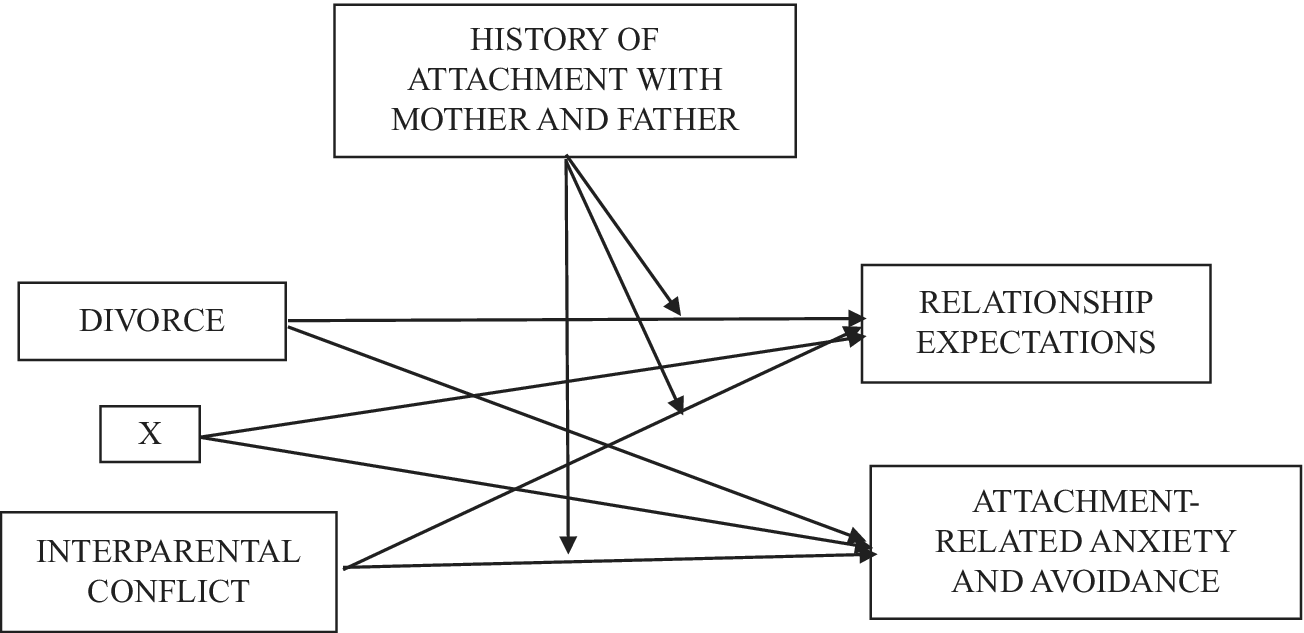
By examining the role of parental divorce and interparental conflict on young adult children’s attachment and expectations about romantic relationships, we attempt to contribute to the literature in several ways. First, to our knowledge, limited attention has been given to the associations between parental divorce and conflict and their interactive effect on both attachment-related anxiety and avoidance and expectations towards romantic relationships. Next, although the literature review suggests early attachment relationships might influence the way in which parental divorce and conflict are handled (Leon, Reference Leon2003), this link has not been widely empirically tested. Thus, the moderating effect of attachment history with both mother and father is also tested in this study (see Figure 1). Finally, limited attention has been given to the study of these effects in Spain.
Conceptual Model of the Study.
Note. Associations between parental divorce and conflict with young adult children’s relationship expectations and attachment–related anxiety and avoidance.

The following hypotheses are tested:
-
1. Parental divorce will be associated with higher attachment anxiety and avoidance and poorer relationship expectations.
-
2. High-unresolved interparental conflict will be associated with higher attachment anxiety and avoidance and poorer relationship expectations than high-resolved and low parental conflict.
-
3. High-unresolved interparental conflict will be more strongly associated with high attachment-related anxiety and avoidance and poor relationship expectations than parental divorce. Further, high-unresolved interparental conflict and parental divorce will interact to explain attachment anxiety and avoidance and relationship expectations, such that for young adults from non-divorced families, high-unresolved interparental conflict will be positively associated with attachment anxiety and avoidance and negatively with relationship expectations to a greater degree than for young adults whose parents divorced.
-
4. High resolved interparental conflict will be associated with lower attachment-related anxiety and avoidance and more positive relationship expectations.
-
5. Attachment history with both parents will moderate the effects of parental divorce and conflict on attachment-related anxiety and avoidance and relationship expectations, such that those who recall more secure attachment interactions will show lower attachment anxiety and avoidance, and more positive relationship expectations.
Method
Participants and Procedure
Participants included undergraduate and vocational training school students from the Autonomous Community of the Basque Country in Spain. 48.5% (n = 523) of respondents were undergraduate students (Psychology: 15.7%; Education: 11.3%; Criminology: 3.9%; Engineering: 15.9%; Business administration: 1.7%), whereas 51.5% (n = 555) of respondents were vocational training school students. Respondents were informed in class about the main goals of the study, and participated voluntarily after signing a consent form. All data were collected in person and in group. Data collection took approximately 60 minutes. All utilized measures were administered in Spanish. This study was approved by the Ethics Committee in Human Research at the University of the Basque Country. Of the 1,106 students in the original sample, 1,078 reported on the variables of interest and had parents who were either living together or were divorced. 28 cases from the original sample were dropped for both not completing all measures and not meeting the requirement of being young adults (between 18 and 30 years). Among the 1,078 participants 16 % (n = 173) experienced parental divorce. Mean age at time of divorce was 10.83 years. 72.8% mothers were the custodial parent. The average age of respondents was 21.4 years (SD = 3), 50.5% (n = 544) were women. 48.1% (n = 518) of respondents were in a committed romantic relationship (M relationship duration = 27.66 months), of which 6.8% cohabited with their partner (M relationship duration = 50.21 months). Comparisons were made between those who were in a committed romantic relationship (n = 518) with those who were not in a committed relationship (n = 560). These comparisons were also made among those who experienced parental divorce. Specifically, independent samples t tests were performed on each dependent variable (Attachment-related avoidance and anxiety, and relationship expectations). In both the whole sample and the parental divorce subsample, no significant differences were found between those involved and not involved in a committed romantic relationship.
Measures
Independent variables. Perceived interparental conflict was assessed with the adapted and validated version to Spanish (Iraurgi et al., Reference Iraurgi, Martínez-Pampliega, Sanz, Cosgaya, Galíndez and Muñoz2008) of the Children’s Perception of Interparental Conflict Scale (Grych et al., Reference Grych, Seid and Fincham1992). All participants were asked to assess the level of conflict between their parents, and those who had experienced parental divorce were asked to report on parental conflict before divorce. The measure used included 12 items assessing the following sub-scales of interparental conflict: Perceived Frequency (Four items; e.g., ‘My parents hardly ever argued or disagreed’), Intensity (Four items; e.g., ‘My parents tended to get really angry when they argued or disagreed’) and Resolution (Four items; e.g., ‘When my parents argued, they usually worked things out’). Each item had three possible responses: 0 = true, 1 = sort of true, and 2 = false. In this sample Cronbach´s alfa for each subscale were .84, .70, and .78, respectively. A Confirmatory Factor Analysis (CFA) also confirmed that our data fit with the factor structure proposed by this scale’s authors. Fit indices for the CFA were χ2(49) = 387.27; p < .001, RMSEA = .083; NNFI = .97; CFI = .97; and SRMR = .051. For analysis purposes, three conflict groups were formed through a cluster analysis: A group of people reporting frequent, intense and unresolved parental conflict (high unresolved; n = 265); another group with frequent and intense, but resolved conflict (high resolved; n = 393); and another one reporting non-frequent, non-intense and resolved parental conflict (low; n = 380). Parental divorce was assessed by asking participants whether their parents were separated or divorced (1 = divorced, 0 = not divorced).
History of attachment with mother and father was assessed through the Care dimension (12 items) of the Parental Bonding Instrument (Parker et al., Reference Parker, Tupling and Brown1979) and five items from the Secure Attachment Base dimension of the Attachment History Questionnaire (Pottharst, Reference Pottharst1990). Summing items from both scales, a monofactorial structure of 17 items was confirmed through an Exploratory Factor Analysis (EFA) and a subsequent CFA. Also, prior to this study a pilot study was conducted with 241 undergraduate students, in which the psychometric properties of this scale were tested and guaranteed. In the present study, participants were asked to respond to items regarding the interactions they recalled with each parent during childhood. Responses to each item ranged from 1 (Totally false) to 4 (Totally true). Higher scores indicated more secure attachments. Sample items included ‘My mother/father made me feel loved or cared for’, ‘My mother/father was affectionate to me’. Fit indices for the CFA were χ2(119) = 832.01; p < .001, RMSEA = .081; NNFI = .97; CFI = .97; SRMR = .043 for the mother subscale (α = .92), and χ2 (119) = 1,132.31; p < .001, RMSEA = .098; NNFI = .96; CFI = .97; SRMR = .049 for the father subscale (α = .93).
Dependent variables. Attachment-related anxiety and avoidance were assessed with the Experiences in Close Relationships scale (ECR; Brennan et al., Reference Brennan, Clark, Shaver, Simpson and Rholes1998). Following Mikulincer and Shaver’s (Reference Mikulincer and Shaver2016; p. 84) suggestions, the wording of this scale’s items and the instructions can be altered to apply to one’s general orientation in romantic relationships, or to one’s global “attachment style” (Mikulincer & Shaver, Reference Mikulincer and Shaver2016; p. 84). Thus, we modified some items and the instructions provided to participants, so that it could be applicable to both those involved and not involved in a romantic relationship. In this sample Cronbach´s alfa for Avoidance was .89 (18 items; e.g., ‘I prefer not to show a partner (significant other) how I feel deep down’) and for Anxiety .87 (18 items; e.g., ‘I worry that romantic partners (others) won’t care about me as much as I care about them’). Responses to each item range from 1 (Disagree strongly) to 7 (Agree strongly).
Finally, participants’ relationship expectations were assessed using the Expectations toward Romantic Relationships scale (ETRR; designed for this study). Prior to this study, we conducted a pilot study to test the psychometric properties (e.g., EFA, CFA) of the scale. After rewording some items and deleting others based on psychometric and theoretical criteria, we designed a definite measure for this study. In this study, an EFA and subsequent CFA confirmed a four-factor structure. The measure includes 17 items assessing four distinct dimensions of respondents’ romantic relationship expectations. These include stability (seven items; e.g., ‘I think my couple relationship will be very stable’), care (five items; e.g., ‘I think that in my couple relationship both of us will be sensitive to each other’s feelings and needs’), conflict (three items; e.g., ‘I think conflicts or disagreements will be usual in my relationship’) and relationship strength (two items; e.g., ‘I think my couple relationship won’t hold up through important difficulties’). Each item ranged from 1 (Totally disagree) to 6 (Totally agree). For analysis purposes, we used the full scale, as these four dimensions also reflected a single construct of relationship expectations. Higher scores in the full scale indicated more positive expectations. Internal consistency for the full scale was good (α = .89). Fit indices of the CFA were χ2(113) = 687.50; p < .001, RMSEA = .07; NNFI = .97; CFI= .97 and SRMR = .049.
Covariates. Gender (Male = 1; Female = 0), age, relationship status (relationship = 1; single = 0) and both parents’ economic status (SES) as measured by their current occupation, Entrepreneurs or managers (High SES), professionals (Medium-high SES), middle managers or technicians (Medium SES), factory workers (Medium-low SES), housework (Low SES), were included as covariates in the regression models.
Data Analysis Plan
Statistical analyses were conducted using IBM SPSS 24. To analyze the predictive ability of parental divorce and interparental conflict, and to test whether attachment history moderates the effects of these family experiences, a set of hierarchical multiple regressions were run on each outcome variable: attachment avoidance, attachment anxiety and romantic relationship expectations, accounting for covariates. Initially, 6-model hierarchical multiple regressions were conducted to test our hypotheses. Given that we found limited differences between models, in this study we only include hierarchical multiple regressions with 3 models. However, the details on these regressions are available from the first author, upon request. Control variables and parental divorce were entered in Model 1, in order to compare those from divorced families with those from non-divorced families. Model 2 also included interparental conflict and attachment history. To reduce multicollinearity problems and to facilitate the interpretation of interactions, attachment history with each parent was centered. In Model 3, two-way interactions between the predictor and moderator variables were added. Significant interactions were plotted using the worksheets developed by Dawson (Reference Dawson2014). +1SD and –1SD levels of the moderator and independent variables were used. Simple slope t-tests for two-way interactions were also calculated (Dawson, Reference Dawson2014).
Results
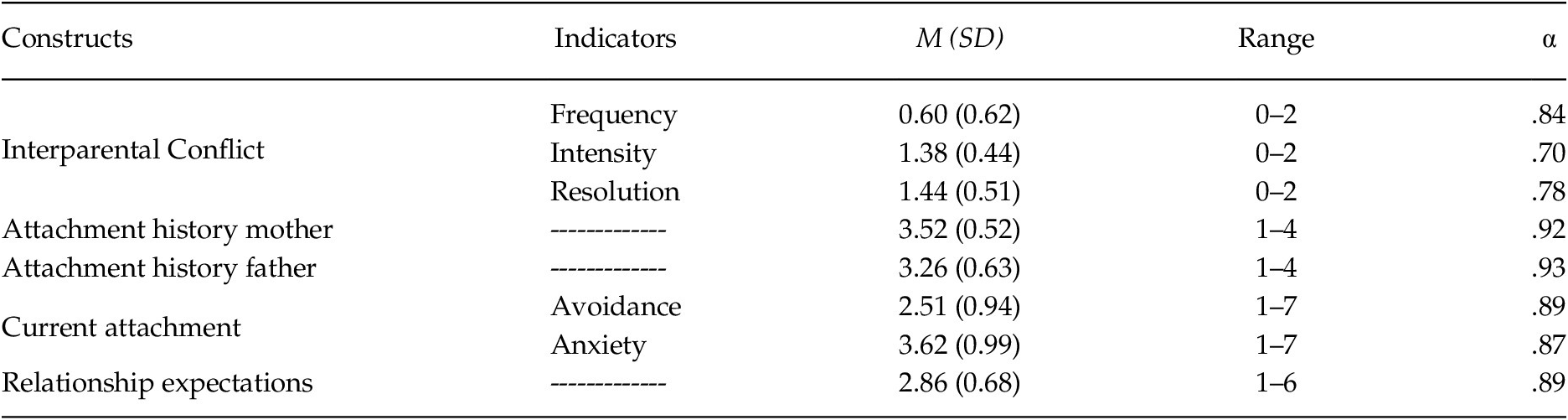
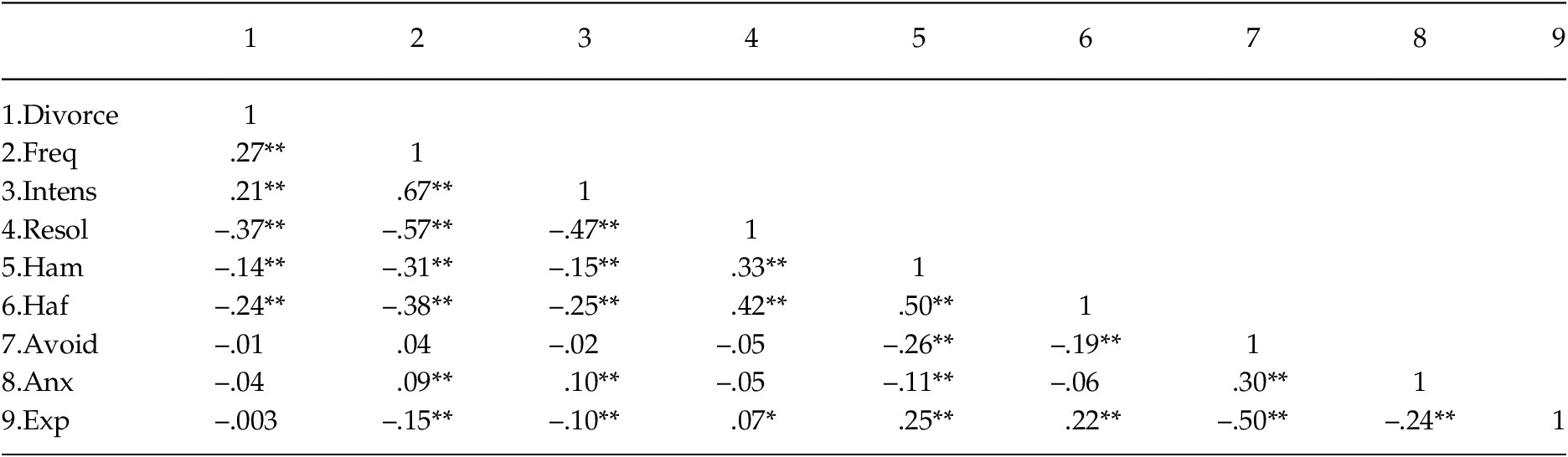
Table 1 provides descriptive information about the study variables, using the average score of each indicator. In Table 2, we present bivariate correlations, using the variables as continuous. Parental divorce was not associated with our outcome variables. Perceived frequency and intensity of interparental conflict were associated with higher attachment anxiety and with poorer relationship expectations (r = .09, p < .01 and r = .10, p < .01, as follows). Perceived resolution in interparental conflict correlated positively with relationship expectations (r = .07, p < .05). Regarding attachment history, a more secure attachment with mother was associated with lower attachment-related avoidance (r = –.26, p < .01) and anxiety (r = –.11, p <. 05) and with better expectations (r = .25, p < .01). A more secure attachment history with father, in turn, was associated with lower attachment-related avoidance (r = –.19, p < .01) and with better expectations (r = .22, p < .01).
Descriptive Information for Study Variables

Correlations among The Study Variables

Note. Divorce = Parental divorce; Freq = Perceived frequency of parental conflict; Intens = Perceived intensity of interparental conflict; Resol = Perceived resolution of interparental conflict; Ham = History of attachment with mother; Haf = History of attachment with father; Avoid = Attachment Avoidance; Anx = Attachment Anxiety; Exp = Relationship Expectations.
*p < .05. **p < .01.
Hierarchical Multiple Regressions
Attachment-related Avoidance in Relationships
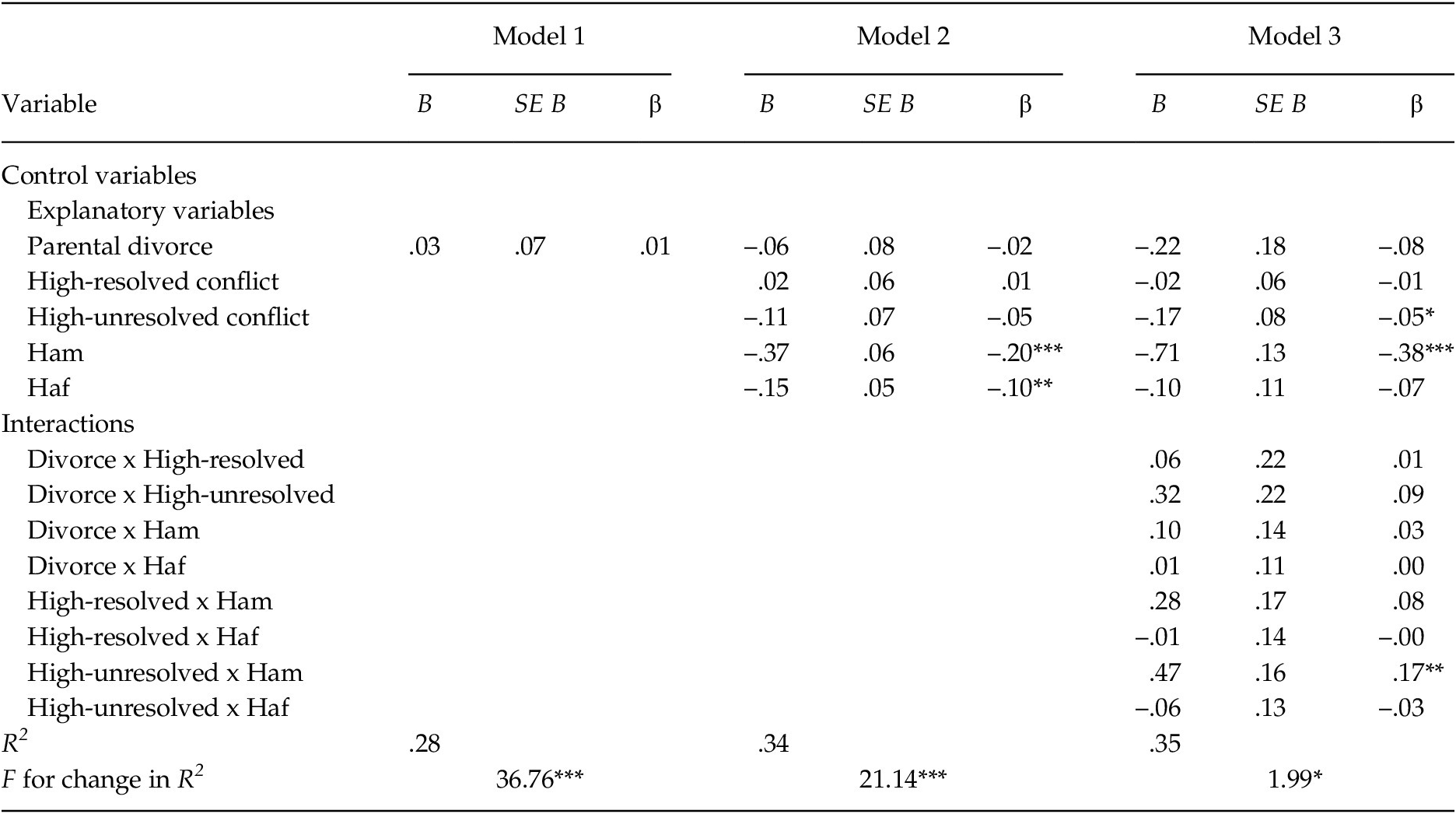
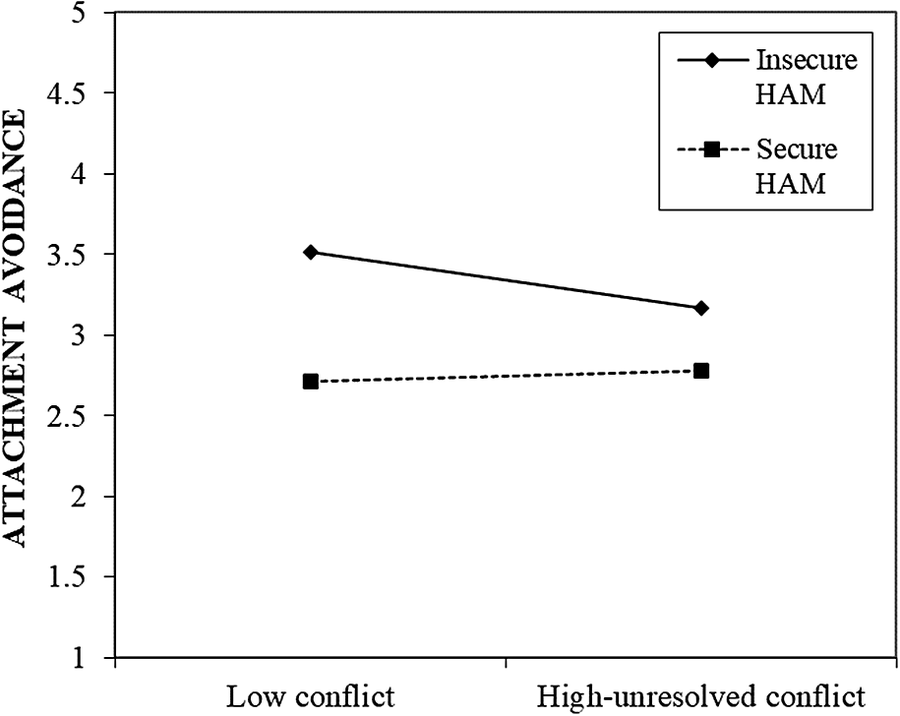
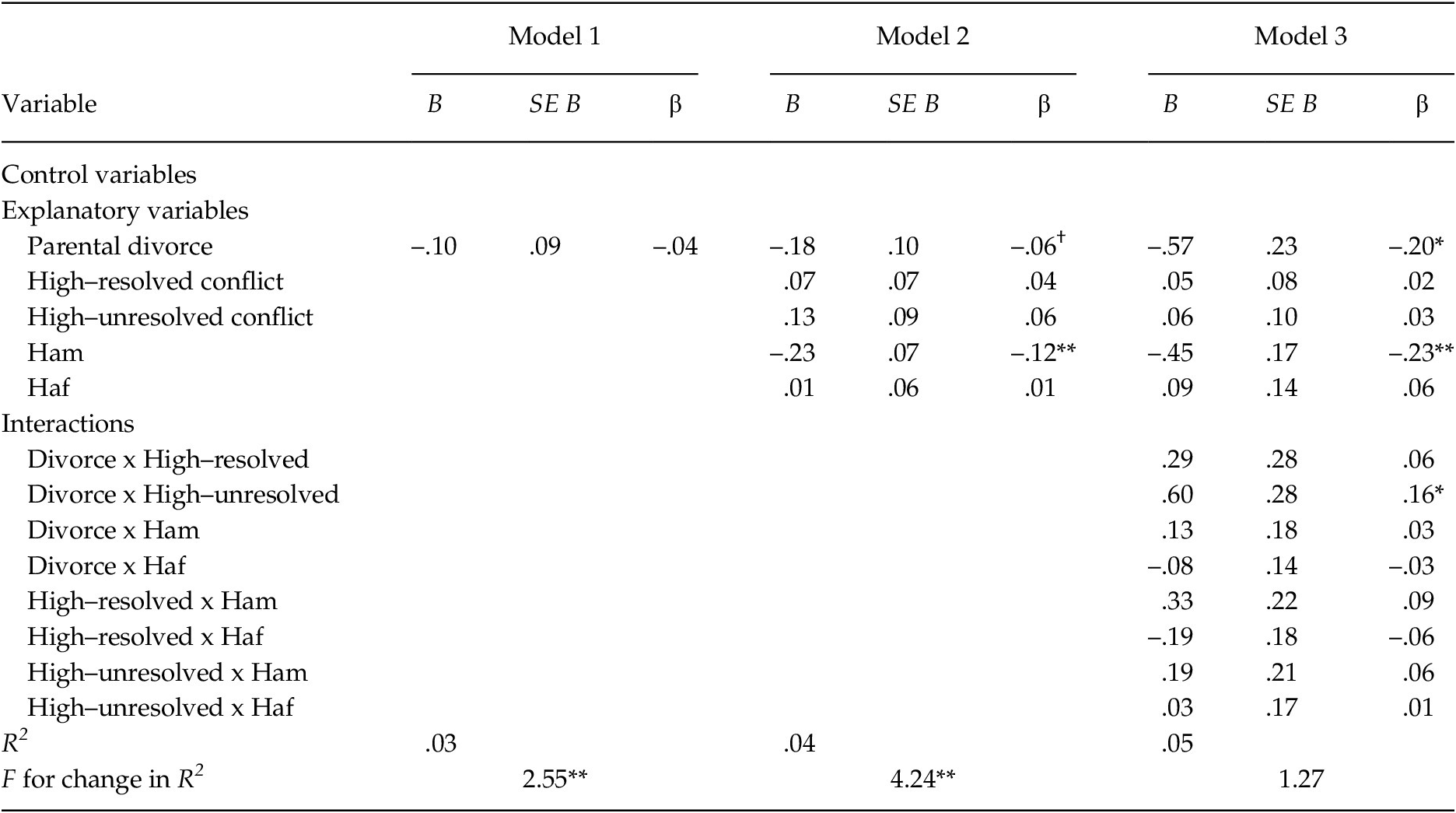
Results are shown in Table 3. Contrary to expectations, parental divorce (Hypothesis 1) was not associated withattachment-related avoidance (Model 1). When interparental conflict and attachment history were added (Model 2), only attachment history with both, mother and father, contributed to the explained variance. With the inclusion of two-way interactions, only the history of attachment x high-unresolved conflict interaction was significant (β = .17, p < .001). An examination of simple slopes indicated significant differences in the relationship between low and high-unresolved conflict and attachment avoidance among those with a more insecure attachment history (t = –3.47, p < .001). That is, among young adults with a more insecure attachment history with their mother those with lower parental conflict score higher on attachment avoidance than those with high-unresolved parental conflict. However, as expected (Hypothesis 5), when attachment history with mother is more secure, no significant differences were found between high-unresolved and low levels of conflict on attachment avoidance (Figure 2). This suggests that early secure mother-child interactions mitigate the effects of interparental conflict. Taken together, variables in this model explained 35% of the variance in attachment-related avoidance.
Summary of Hierarchical Multiple Regression for Variables Predicting Attachment-related Avoidance

Note. Ham = History of attachment with mother; Haf = History of attachment with father.
†p < .10. *p < .05. **p < .01. ***p < .001.
Interaction Plot for the Significant Two–way Interaction between High–unresolved Interparental Conflict and History of Attachment with Mother on Attachment–related Avoidance.
Note. Ham = History of attachment with mother.

Attachment-related Anxiety in Relationships
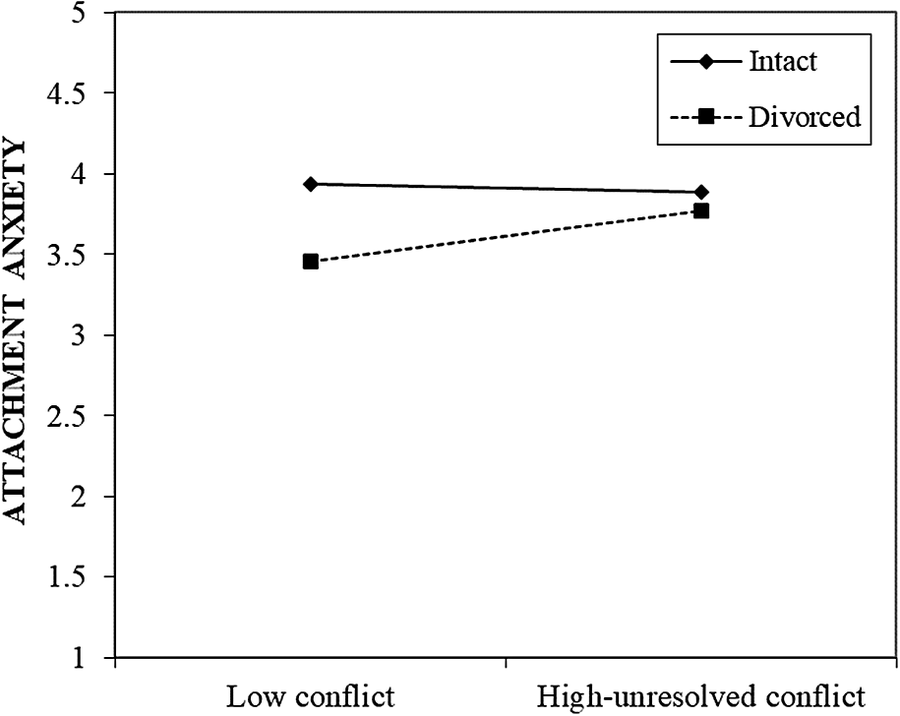
Again, contrary to our predictions (Hypothesis 1), parental divorce was not significantly associated with attachment-related anxiety (Table 4; Model 1). Model 2 showed that a more secure attachment history with mother predicts lower attachment-related anxiety. With the addition of two-way interactions (Model 3), a significant interaction was found for parental divorce x high-unresolved conflict (β = .16, p < .05), after controlling for all other variables in the model.
Summary of Hierarchical Multiple Regression for Variables Predicting Attachment–related Anxiety

Note. Ham = History of attachment with mother; Haf = History of attachment with father.
†p < .10. *p < .05. **p < .01. ***p < .001.
Results from the slope difference tests (see Figure 3) showed that those from divorced families score lower on attachment anxiety than those from non-divorced families when the level of conflict between parents is low (t = 2.6, p < .01).
Interaction Plot for the Significant Two–way Interaction between Parental Divorce and High–unresolved Interparental Conflict on Attachment–related Anxiety.
Note. Haf = History of attachment with father.

Romantic Relationship Expectations
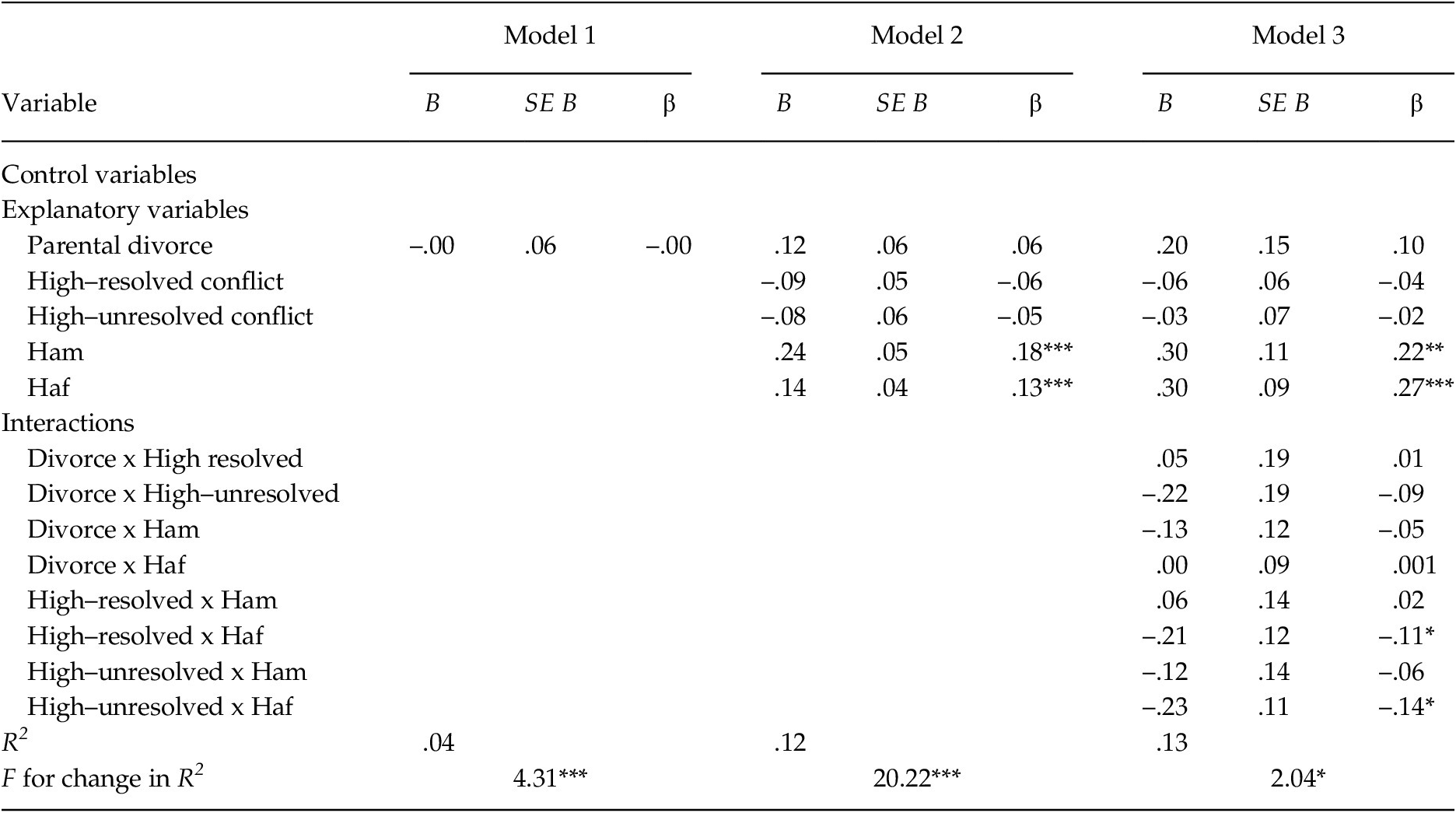
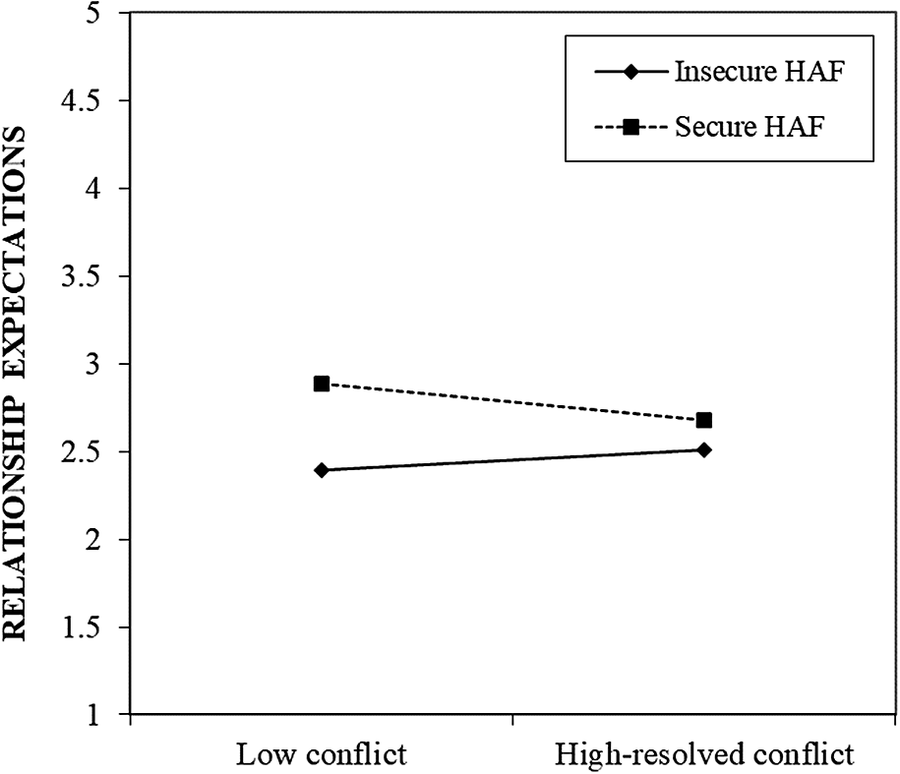
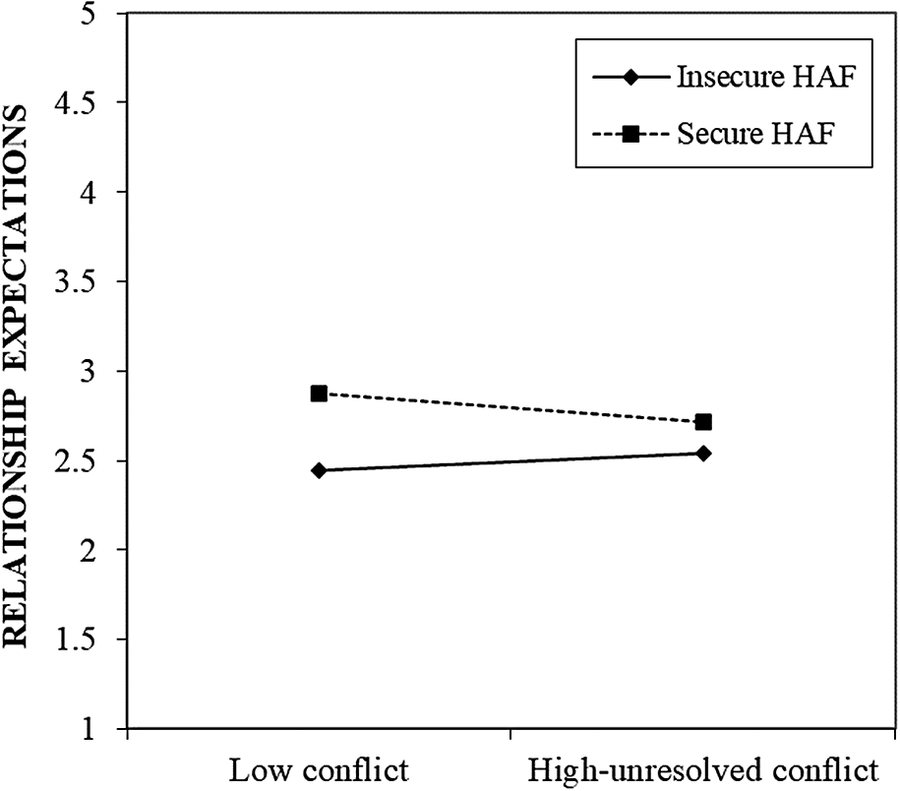
Contrary to Hypothesis 1, parental divorce was not associated with romantic relationship expectations (Table 5; Model 1). With the inclusion of history of attachment and interparental conflict (Model 2), onlyhistory of attachment with both, mother (β = .18, p < .001) and father (β = .13, p < .001) predicted positive expectations. By adding two-way (Model 3) interactions between the explanatory variables two significant interactions were found: High-unresolved conflict x history of attachment with father (β = –.14, p < .05) and high-resolved conflict x history of attachment with father (β = –.11, p <. 05).
Summary of Hierarchical Multiple Regression for Variables Predicting Romantic Relationship Expectations

Note. Ham = History of attachment with mother; Haf = History of attachment with father.
†p < .10. *p < .05. **p < .01. ***p < .001.
In both Figure 4 and Figure 5, the slope difference tests indicate significant differences among individuals with a more secure attachment history with father in interaction with both high-resolved conflict (t = –2.46, p < .01) and high-unresolved conflict (t = –1.8, p < .05), such that those belonging to the low-conflict group score higher in positive relationship expectations than those belonging to both high conflict groups, resolved and unresolved. There are no significant differences in the insecure attachment history group, such that those more insecurely attached score low in expectations regardless of parental conflict. Thus, as expected, high levels of parental conflict are associated with more negative romantic relationship expectations, yet contrary to expectations this relationship remains regardless of attachment history.
Interaction Plot for the Significant Two–way Interaction between High–resolved Interparental Conflict and History of Attachment with Father on Romantic Relationship Expectations.
Note. Haf = History of attachment with father.

Interaction Plot for the Two–way Significant Interaction between High–unresolved Interparental Conflict and History of Attachment with Father on Romantic Relationship Expectations.
Note. Haf = History of attachment with father.

Discussion
The present study analyzed how parental divorce and interparental conflict are associated with young adult children’s attachment-related anxiety and avoidance and relationship expectations in a Spanish sample. In addition, the moderating effect of attachment history with both parents was also analyzed. Three main conclusions emerge from our findings, which include both expected and unexpected results.
First, contrary to what we expected, parental divorce is not associated with young adult children’s higher attachment anxiety and avoidance nor poorer romantic relationship expectations. Indeed, parental divorce is associated with lower attachment anxiety when young adults report low levels of parental conflict. A second conclusion is that interparental conflict is more strongly associated with attachment-related avoidance and romantic relationship expectations than parental divorce, yet depending on attachment history. Third, a more secure attachment history with mother has a buffering effect on the association between high-unresolved interparental conflict and attachment avoidance, but not on attachment-related anxiety nor on romantic relationship expectations. There are two elaborations for this conclusion. First, although attachment history with mother does not moderate the association between parental divorce and attachment anxiety nor between interparental conflict and attachment anxiety, a more secure attachment history with mother is associated with lower attachment anxiety. Second, although attachment history with father moderates the association between parental conflict and relationship expectations, it does not protect from the effects of both high-resolved and high-unresolved parental conflict. Even though attachment history with mother does not moderate on this association, a more secure attachment history with mother is associated with more positive relationship expectations.
Below, we discuss in detail these main conclusions.
Parental Divorce
Although many studies have found significant associations between parental divorce and adult children’s attachment anxiety and avoidance (e.g., Braithwaite et al., Reference Braithwaite, Doxey, Dowdle and Fincham2016; Fraley & Heffernan, Reference Fraley and Heffernan2013), our findings regarding hypothesis 1 are in agreement with others that have not found such associations (Brennan & Shaver, Reference Brennan and Shaver1993; Washington & Hans, Reference Washington and Hans2013). In fact, our findings on the associations between parental divorce and attachment related-anxiety indicate that in our sample those from divorced families report lower attachment anxiety than those from non-divorced families, when the level of interparental conflict is low. This result is similar to the one obtained by Riggio (Reference Riggio2004), who found that adult children with divorced parents report lower anxiety in romantic relationships than those from non-divorced families. According to Riggio, lower anxiety could reflect their greater perceived ability to end a dissatisfying relationship or less fear of separation and abandonment, as they have observed that their parents are better off after divorce. However, our result indicates that when young adult children from divorced families report low levels of parental conflict, they show lower attachment anxiety than when they report high and unresolved levels of parental conflict. Thus, our study suggests that more positive parental interactions explain lower attachment anxiety on young adults of divorce, whereas those exposed to higher levels of interparental conflict have higher attachment anxiety. This result might in part be consistent with some of the results obtained by Amato (Reference Amato1996). He found that when adult children from divorced families are exposed to poor marital interactions, they might not learn adequate marital roles. According to him these learned interpersonal problematic behaviors might explain adult children’s risk of divorce. Therefore, children’s lower anxiety in intimate relationships could also reflect their willingness to end a dissatisfying relationship. This would not confirm our third hypothesis regarding the direction of the interaction between parental divorce and conflict, and would be inconsistent with the stress-relief hypothesis (Wheaton, Reference Wheaton1990), which suggests that parental divorce might relieve the stress derived from continued exposure to high levels of parental conflict.
As mentioned above, in this study parental divorce is not associated with poorer relationship expectations either. This is inconsistent with other studies that have found negative outcomes on adult children’s romantic relationships derived from parental divorce (e.g., Cui & Fincham, Reference Cui and Fincham2010). This might be due to the fact that our measure of expectations did not directly assess young adults’ expectations of breaking up their own relationships, but expectations of care, stability, conflict and relationship strength in romantic relationships.
Regarding Hypothesis 5, even though attachment history did not moderate the associations between parental divorce and attachment anxiety and avoidance, and relationship expectations, results indicate that recollections of more secure attachment relationships in childhood are associated with lower attachment anxiety and avoidance and more positive relationship expectations. Further, a more secure attachment history, especially with mother, was more strongly associated with our outcomes than parental divorce. Thus, consistent with previous studies, mother-child relationships seem to be crucial in children’s romantic relationships, regardless of family structure (Lee, Reference Lee2018). This finding is also in agreement with the views of some attachment theorists, which suggest that more secure early mother-child attachment relationships contribute to explain young adults’ current romantic attachment (e.g., Zeifman & Hazan, Reference Zeifman, Hazan, Cassidy and Shaver2016), beyond other significant family experiences, such as parental divorce.
Interparental Conflict
Research on the association between interparental conflict and offspring’s romantic attachment indicates positive and significant associations between interparental conflict and attachment-related anxiety and avoidance (e.g., Cusimano & Riggs, Reference Cusimano and Riggs2013). In our study, interparental conflict is associated with attachment-related avoidance, yet depending on the level of recalled security in the interactions with mother during childhood. Specifically, our finding suggested that young adults who recall more insecure attachment interactions with their mother report higher attachment avoidance when they report lower levels of interparental conflict. This finding could reflect the nature of a family-type characterized by insecure mother-child interactions alongside parents with an avoidant and an apparently non-conflictive marital relationship, where either parents or one of them might use deactivating strategies of the attachment system in their marital interactions (Mikulincer & Shaver, Reference Mikulincer and Shaver2016; p. 279). Thus, contrary to our second hypothesis, high-unresolved interparental conflict is not associated with higher attachment avoidance. However, in support of our fifth hypothesis regarding the moderating effect of attachment history, our results suggest that recollections of more secure early mother-child attachment interactions protect from the effects of parental conflict on attachment avoidance.
Regarding the association between interparental conflict and relationship expectations, again in support of our second hypothesis, high-unresolved interparental conflict is associated with poorer relationship expectation, but depending on security of attachment history with father. Specifically, this result suggests that when young adults recall more insecure attachment relationships with their father, they report poorer relationship expectations, regardless of whether the level of interparental conflict is high or low. However, contrary to our fifth prediction regarding the buffering effect of attachment history, our findings suggest that among young adults who recall more secure father-child interactions, those who report high levels of parental conflict have poorer relationship expectations than those who report low levels of parental conflict. That is, a more secure attachment history with father does not protect from the adverse effects of high levels of parental conflict on adult children’s relationship expectations. This could be explained from the social learning theory (Bandura, Reference Bandura1977), which suggests children learn relational patterns with intimate others through the observation of interaction patterns in the family of origin, such as the parental marital relationship (Bartell, Reference Bartell, Fine and Harvey2006).
This result was also confirmed in relation to high-resolved parental conflict. That is, contrary to our fourth hypothesis regarding the positive effects of high but resolved conflicts between parents, our findings suggest that when children observe frequent, intense and both resolved and unresolved conflicts between parents, early secure father-child attachment relationships exert a lower influence on children’s romantic relationship expectations. Since the parental couple relationship typically represents a symmetric model of couple relationships, this finding might be due to the unalike qualities parent-child interactions and couple interactions usually share. Thus, conflictive interactions between parents, regardless of being resolved or not, would be more influential than early father-child attachment relationships in the development of adult children’s romantic relationship expectations (Bartell, Reference Bartell, Fine and Harvey2006). This finding would also be consistent with other studies that have confirmed that parental conflict is associated with more conflict behaviors and poorer expectations on young adults’ romantic relationships (e.g., Cui & Fincham, Reference Cui and Fincham2010).
Despite this finding, even though attachment history with mother did not moderate the association between high levels of parental conflict and relationship expectations, recollections of more secure mother-child interactions during childhood were associated with more positive romantic relationship expectations. This result confirms previous research, as some studies have found that mother-child relationship qualities are more significant than father-child relationship qualities in children’s romantic relationships (e.g., King, Reference King2002). This finding would also confirm the views of some attachment theorists and the cognitive-developmental perspective, which suggest that early experiences in parent-child relationships (e.g., mother-child relationships) form the basis for cognitive representations of romantic relationships (e.g., Bartell, Reference Bartell, Fine and Harvey2006).
Inevitably, our study is limited in a several ways. First, the retrospective and cross-sectional nature of this study is a limitation as it makes it difficult to draw clear causal conclusions. The way of responding to the attachment history scale is probably biased or influenced by the way young adults currently feel in their close relationships. Importantly, all data were collected from participants as young adults. This is a limitation when assessing their attachment to parents and presents a measurement concern, as both retrospective reports of attachment to parents and current romantic attachment were measured concurrently. Thus, the association between these two variables may be inflated. Theorists propose that attachment security is stable over time, yet experiencing negative life events, such as parental divorce, may lead to a change in attachment security (e.g., Waters et al., Reference Waters, Merrick, Treboux, Crowell and Albersheim2000). In this study, since attachment history was not measured prior to divorce, it is not possible to determine whether our measure of childhood attachment to parents represents the same attachment relationship that existed pre-divorce or an altered attachment relationship that resulted from parental divorce. In addition, adult children of divorce were asked to report on parental conflict prior to divorce. As such, reports of interparental conflict provided by adult children of divorce might be influenced by retrospective biases. Therefore, future studies should replicate this study with a longitudinal follow-up design, in order to control both the actual attachment history and the actual predivorce parental conflict level. Moreover, participants who had experienced parental divorce were not asked to report on parental conflict after divorce. Divorce is not a uniform experience for children, and several circumstances surrounding the divorce process, such as continuous parental conflict during the postdivorce period might explain the diversity of children’s reactions and the effects on children than divorce per se. Furthermore, the higher attachment anxiety levels found among those from divorced families with high levels of interparental conflict could be explained by the fact that they might have been exposed to high levels of parental conflict in the post-divorce period. Thus, future studies should take into account the effects of the level of conflict not only during the predivorce period but also in the post-divorce period. In addition, given the age range of our participants, we think that exclusively using college and vocational training school students is limited. Thus, more research needs to be done with a broader and more heterogeneous sample. Another limitation has to do with the measure of parental divorce, which was a unique dichotomous variable asking participants whether their parents were divorced or separated. Therefore, further research is needed to examine other variables related to the divorce process and to the family status in the postdivorce period (e.g. parents’ remarriage), in order to detect factors that might explain variations in the effects of parental divorce. Likewise, given that we did not find a moderating effect for attachment history on attachment anxiety, more research is needed regarding the interactions between parental divorce, conflict and attachment history to provide a clearer picture of these results. A final limitation has to do with not distinguishing young adults involved and not involved in romantic relationships. Thus, future studies should also seek to analyze differential effects by whether young adults are involved or not in a romantic relationship, especially on relationship expectations.
Aside from the limitations of our study, it makes important contributions. First, the most notable one refers to the study of the associations between parental divorce and interparental conflict with young adults’ current attachment-related anxiety and avoidance, and relationship expectations, in a sample where divorce is a relatively new social and family experience. Another important contribution refers to the study of attachment history with both parents as a possible protective factor. Overall, our findings add to the existing literature suggesting that interparental conflict is more strongly associated than parental divorce with young adults’ attachment anxiety and avoidance and romantic relationship expectations, especially when early secure attachment interactions are considered. Thus, this study makes important contributions for clinical implications, as it gathers important information that can be used to make preventive intervention efforts to reduce the adverse effects of parental conflict, in both divorced and non-divorced families, on young adults’ current romantic attachment and relationship expectations. Attachment history has a buffering effect on attachment related-avoidance, but not on expectations nor on attachment anxiety. However, in support of some attachment theorists and the cognitive-developmental perspective, a more secure attachment history is strongly associated with lower attachment anxiety and avoidance and higher relationship expectations. Thus, in trying to analyze the effects of some negative family of origin experiences, exclusively focusing on parental divorce or conflict, without considering risk or protective factors, might lead to miss important information.