1. Introduction
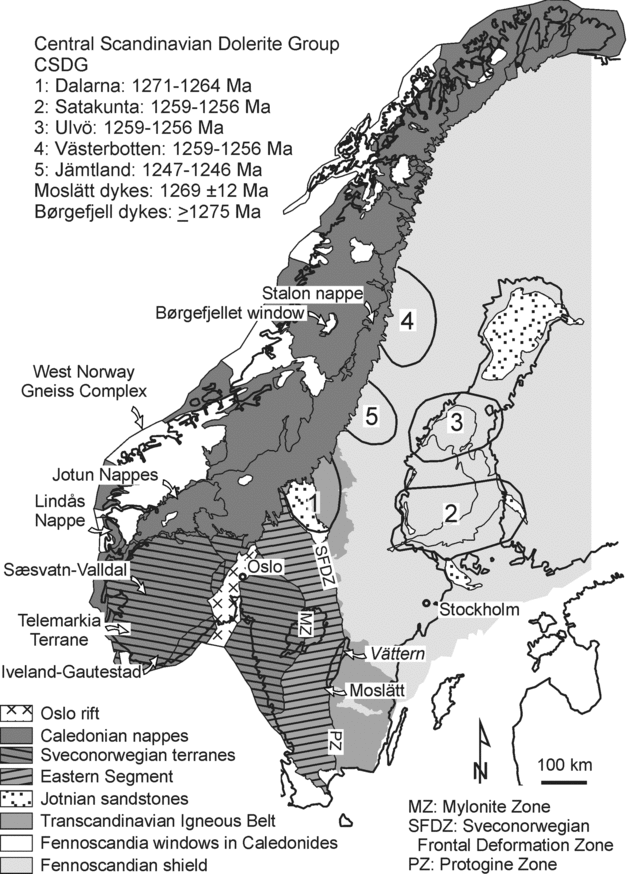
The 1271–1246 Ma (Söderlund et al. Reference Söderlund, Elming, Ernst and Schissel2006) Central Scandinavian Dolerite Group represents a distinct large-scale Mesoproterozoic mafic magmatic event in the Fennoscandian Shield. Dykes and sills of this generation are organized around five major centres or magmatic complexes in central Sweden and western Finland: the Dalarna, Västerbotten, Satakunta, Ulvö and Jämtland complexes (Gorbatschev, Solyom & Johansson, Reference Gorbatschev, Solyom and Johansson1979; Gorbatschev et al. Reference Gorbatschev, Lindh, Solyom, Laitakari, Aro, Lobach-Zhuchenko, Markov, Ivliev, Bryhni, Halls and Fahrig1987; Fig. 1). Three of these, the Dalarna, Jämtland and Västerbotten complexes, are apparently truncated by the Caledonian nappe front (Fig. 1), suggesting that they continue westwards beneath Caledonian thrust sheets (Gorbatschev, Solyom & Johansson, Reference Gorbatschev, Solyom and Johansson1979; Greiling et al. Reference Greiling, Grimmer, De Wall and Björk2007). Rocks possibly related to the Central Scandinavian Dolerite Group have been described to the west in basement windows and the Lower to Middle Allochthons in the Caledonian orogen (Austrheim et al. Reference Austrheim, Corfu, Bryhni and Andersen2003; Greiling et al. Reference Greiling, Grimmer, De Wall and Björk2007; Lundmark et al. Reference Lundmark, Corfu, Spürgin and Selbekk2007), but also in the southwestern part of the Sveconorwegian orogen, in S Norway (Bingen et al. Reference Bingen, Mansfeld, Sigmond and Stein2002; Pedersen et al. Reference Pedersen, Andersen, Konnerup-Madsen and Griffin2009).
Map of the Fennoscandian Shield showing the distribution of the different complexes of the Central Scandinavian Dolerite Group, and locations were coeval rocks have been identified.

Evaluating and mapping the full extent of the 1271–1246 Ma magmatic and related rocks will eventually contribute to a large-scale genetic model for this magmatism and to a geotectonic reconstruction (cf. Söderlund et al. Reference Söderlund, Elming, Ernst and Schissel2006). This evaluation includes exploring dolerites outside of known exposures in areas showing several generations of mafic rocks and studying metadolerites in crustal domains affected by younger orogenic events, namely Sveconorwegian and Caledonian.
In this paper, we report baddeleyite U–Pb ages from two dyke occurrences possibly linked to the Central Scandinavian Dolerite Group. One of these is located in the Jönköping area, S Sweden, within the Protogine Zone bounding the Sveconorwegian belt. Along this zone, at least four generations of mafic rocks are reported (Lundqvist, Reference Lundqvist1996; Larsson & Söderlund, Reference Larsson and Söderlund2005; Söderlund et al. Reference Söderlund, Söderlund, Möller, Gorbatschev and Rodhe2004b, Reference Söderlund, Isachsen, Bylund, Heaman, Patchett, Vervoort and Andersson2005, Reference Söderlund, Elming, Ernst and Schissel2006; Brander & Söderlund, Reference Brander and Söderlund2009; Brander et al. in press). The other occurrence corresponds to nappe-transported and tilted dykes well known in the Børgefjell basement window in the Mid-Scandinavian Caledonides (de Wall & Greiling, Reference De Wall and Greiling2000; Greiling et al. Reference Greiling, Grimmer, De Wall and Björk2007). We also report Hf isotopic data on baddeleyite from these two occurrences, as well as on three other dated occurrences. Collectively, these data contribute to an improved understanding of the distribution and isotopic signature of the 1271–1246 Ma mafic magmatism in Fennoscandia and its Mesoproterozoic geological context.
2. Geology and sampling
2.a. Central Scandinavian Dolerite Group
The Central Scandinavian Dolerite Group represents the only known magmatism of this generation in the Palaeoproterozoic cratonic part of Fennoscandia (Fennoscandian Shield). Baddeleyite U–Pb geochronological data are reported for 15 occurrences (Suominen, Reference Suominen1991; Söderlund et al. Reference Söderlund, Isachsen, Bylund, Heaman, Patchett, Vervoort and Andersson2005, Reference Söderlund, Elming, Ernst and Schissel2006; Hogmalm et al. Reference Hogmalm, Söderlund, Larson, Meurer, Hellström and Claeson2006). They show that the Central Scandinavian Dolerite Group intruded during three separate pulses at 1271–1264 Ma for the Dalarna Complex (n = 2), 1259–1256 Ma for the Västerbotten, Satakunta and Ulvö complexes (n = 11), and 1247–1246 Ma for the Jämtland Complex (n = 2) (Fig. 1). Nd- and Hf isotopic data are reported in Söderlund et al. (Reference Söderlund, Isachsen, Bylund, Heaman, Patchett, Vervoort and Andersson2005, Reference Söderlund, Elming, Ernst and Schissel2006 and references therein). The initial ɛHf values at c. 1260 Ma range from +4.7 to +10.3 (16 analyses).
Typically, Central Scandinavian Dolerite Group intrusions are 10–300 m wide, but members up to 1000 m thick exist (e.g. Hogmalm et al. Reference Hogmalm, Söderlund, Larson, Meurer, Hellström and Claeson2006). The intrusions generally consist of aphyric, medium-grained sills and dykes of olivine dolerite. Plagioclase, olivine, clinopyroxene and opaque phases dominate, whereas K-feldspar, biotite, apatite, sulphides and carbonates are accessory phases (e.g. Gorbatschev, Solyom & Johansson, Reference Gorbatschev, Solyom and Johansson1979; Hämäläinen, Reference Hämäläinen, Aro and Laitakari1987; Solyom, Lindqvist & Johansson, Reference Solyom, Lindqvist and Johansson1992; Patchett et al. Reference Patchett, Lehnert, Rehkämper and Sieber1994; Elming & Mattson, Reference Elming and Mattsson2001; Hogmalm et al. Reference Hogmalm, Söderlund, Larson, Meurer, Hellström and Claeson2006).
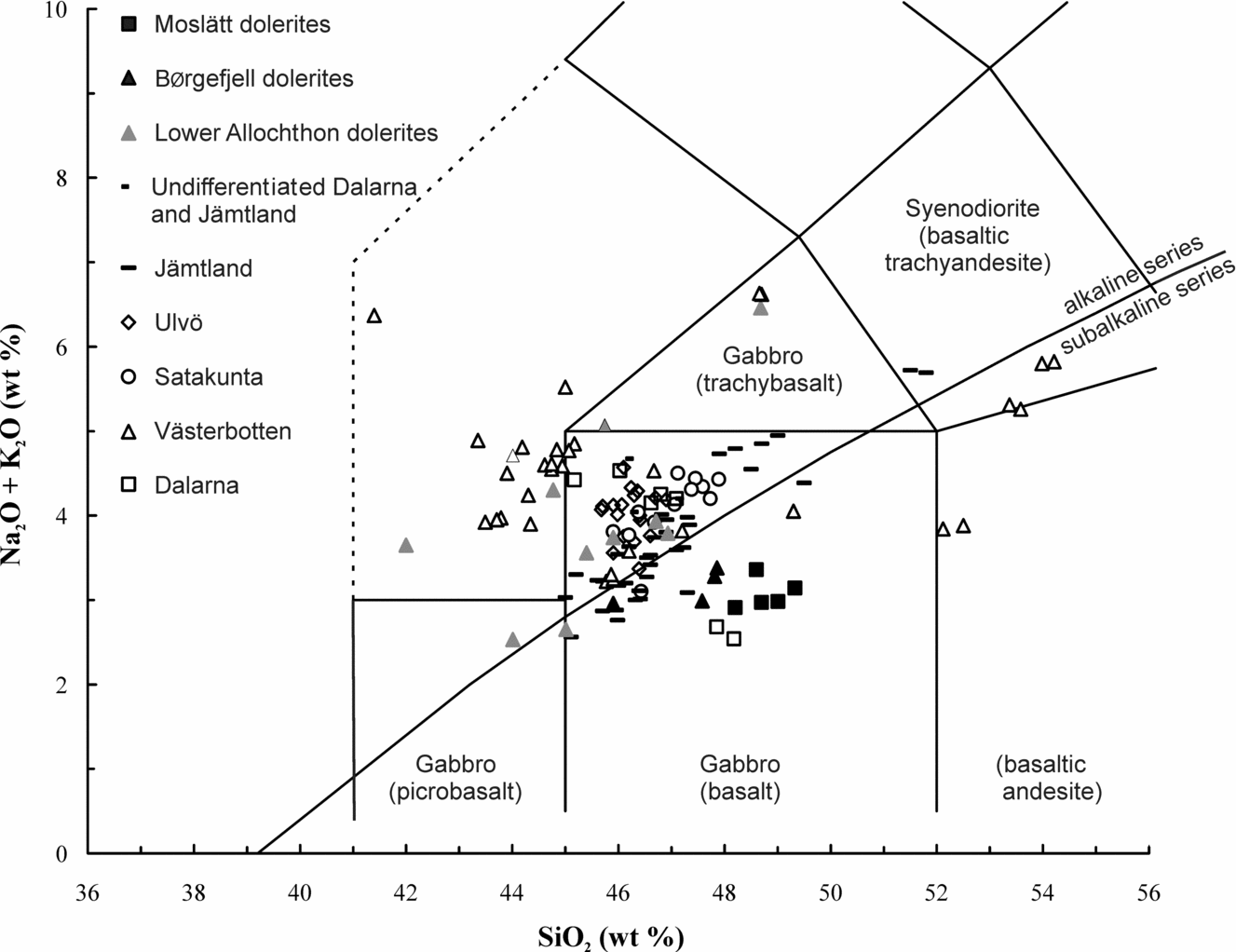
Geochemically, the Central Scandinavian Dolerite Group are mildly alkaline (Fig. 2) (e.g. Gorbatschev, Solyom & Johansson, Reference Gorbatschev, Solyom and Johansson1979; Hämäläinen, Reference Hämäläinen, Aro and Laitakari1987; Patchett et al. Reference Patchett, Lehnert, Rehkämper and Sieber1994; Larson, Hogmalm & Meurer, Reference Larson, Hogmalm and Meurer2008), with a distinct less alkaline composition in the westernmost sills of the Dalarna and Jämtland complexes (Patchett et al. Reference Patchett, Lehnert, Rehkämper and Sieber1994).
Part of the total alkalis versus silica (TAS) diagram for volcanic rocks of Le Maitre et al. (Reference Le Maitre, Bateman, Dudek, Keller, Lameyre Le Bas, Sabine, Schmid, Sorensen, Streckeisen, Woolley and Zanettin1989). All available Central Scandinavian Dolerite Group data plot within the given x–y range. Moslätt dolerite data from Brander et al. (in press) and Lundqvist (Reference Lundqvist1996), and Børgefjell and Middle Allochthon (Stalon nappe) dolerite data from Greiling et al. (Reference Greiling, Grimmer, De Wall and Björk2007) are compared with samples from other Central Scandinavian Dolerite Group complexes (Lundqvist & Samuelsson, Reference Lundqvist and Samuelsson1973; Gorbatschev, Solyom & Johansson, Reference Gorbatschev, Solyom and Johansson1979; Aro, Reference Aro, Aro and Laitakari1987; Hämäläinen, Reference Hämäläinen, Aro and Laitakari1987; Solyom, Lindqvist & Johansson, Reference Solyom, Lindqvist and Johansson1992; Patchett et al. Reference Patchett, Lehnert, Rehkämper and Sieber1994; Elming & Mattson, Reference Elming and Mattsson2001; Greiling et al. Reference Greiling, Grimmer, De Wall and Björk2007; Larson, Hogmalm & Meurer, Reference Larson, Hogmalm and Meurer2008). Diagram modified from the compilation of Hogmalm et al. (Reference Hogmalm, Söderlund, Larson, Meurer, Hellström and Claeson2006). The boundary between alkaline and subalkaline series is from Irvine & Baragar (Reference Irvine and Baragar1971).

In this study, we revisited the Svall dolerite, representing the Ulvö Complex in western Finland. One sample, originally dated by Suominen (Reference Suominen1991) at 1268 ± 13 Ma (sample A731), was re-dated by Söderlund et al. (Reference Söderlund, Elming, Ernst and Schissel2006) at 1259 ± 2 Ma. The latter result is in better agreement with ages typical for this complex (1259–1256 Ma). New Hf isotopic data are reported on baddeleyite from this sample to complement the isotopic database.
2.b. The Moslätt Dolerites, Jönköping area
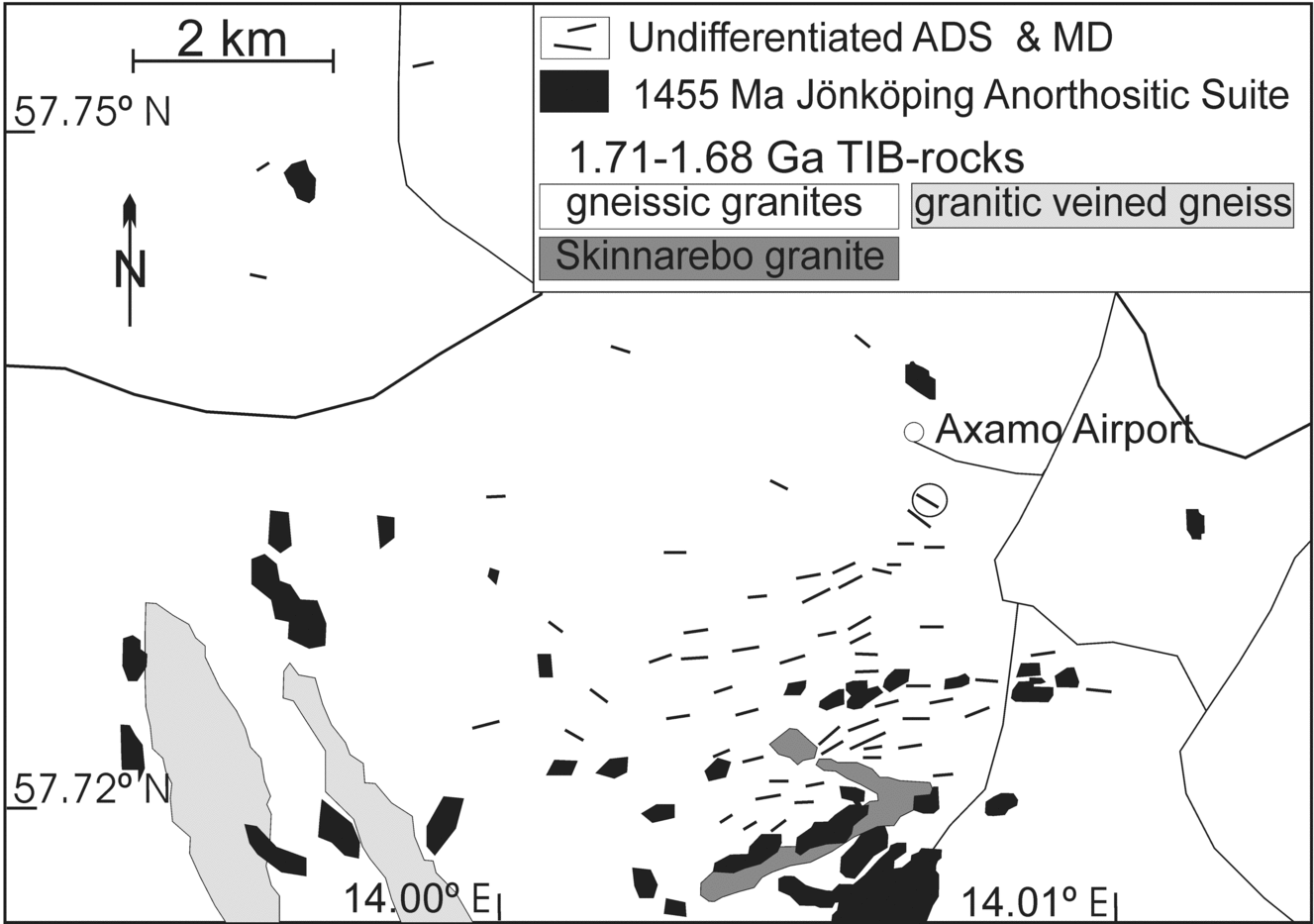
The Jönköping area is situated in the Protogine Zone in the easternmost marginal zone of the Sveconorwegian belt. There, Sveconorwegian overprint is focused along discrete shear zones. The area is underlain by c. 1710–1680 Ma (Brander et al. in press) variably deformed granitoids of the Transcandinavian Igneous Belt (e.g. Högdahl, Andersson & Eklund, Reference Högdahl, Andersson and Eklund2004). Along the Protogine Zone, several generations of mafic rocks intrude the Transcandinavian Igneous Belt. These include the c. 1560 Ma Åker metabasite (Söderlund et al. Reference Söderlund, Söderlund, Möller, Gorbatschev and Rodhe2004b), the c. 1455 Ma Jönköping Anorthositic Suite and near coeval E–W-trending 1422 ± 6 Ma Axamo Dyke Swarm (Lundqvist, Reference Lundqvist1996; Brander & Söderlund, Reference Brander and Söderlund2009; Brander et al. in press), the c. 1215 Ma Protogine Zone dolerites (Söderlund et al. Reference Söderlund, Isachsen, Bylund, Heaman, Patchett, Vervoort and Andersson2005), the c. 1205 Ma Taberg intrusion (Larsson & Söderlund, Reference Larsson and Söderlund2005) and the N–S-trending, 978–946 Ma Blekinge–Dalarna Dolerites (Söderlund et al. Reference Söderlund, Isachsen, Bylund, Heaman, Patchett, Vervoort and Andersson2005). Near the southern end of Lake Vättern (Fig. 1), Lundqvist (Reference Lundqvist1996) described the E–W-trending ‘Younger Dolerites’ that are roughly parallel to dykes of the Axamo Dyke Swarm and cover an overlapping area (Fig. 3). In this article, we rename these dolerites the Moslätt Dolerites in order to follow geographically based lithostratigraphic nomenclature.
Map showing the Axamo area. The sampled Moslätt dolerite is encircled. ADS – 1420 Ma Axamo Dyke Swarm; MD –1270 Ma Moslätt Dolerites.

The Moslätt Dolerites have a fine- to medium-grained ophitic texture, and a primary mineralogy dominated by plagioclase and normally zoned augite. Overall, they display a relatively fresh magmatic mineralogy that is better preserved than the mineralogy of dykes of the Axamo Dyke Swarm. No deformational fabrics have been documented in the Moslätt Dolerites (cf. Lundqvist, Reference Lundqvist1996).
One dyke of the Moslätt Dolerites was sampled (Fig. 3) for U–Pb geochronology and Hf isotopes. The sample comes from a small hill directly to the south of Axamo Airport, west of the city of Jönköping (57.74572°N, 14.06378°E). The contacts with the host granite are not exposed, but the strike of the dyke is estimated at NW–SE, roughly parallel to the gneiss fabric in the granite host rocks. The sample is dark grey with a brownish tint, equigranular, finely medium-grained and non-foliated. Minerals are plagioclase (An67–35), orthopyroxene (En70–60), augite (En73–47), biotite and magnetite with ilmenite exsolution lamellae. Plagioclase and both pyroxenes are normally zoned. The pyroxenes are present in equal amounts, so the rock is a gabbronorite.
To complement available data on Mesoproterozoic mafic rocks in the Jönköping area, Hf isotopic data were collected in this study on baddeleyite from two samples of the Skinnarebo leuconorite and the Olsbo anorthosite, both belonging to the Jönköping Anorthositic Suite. The baddeleyite of these two samples gave an upper intercept age of 1455 ± 6 Ma dating the intrusion of the Jönköping Anorthositic Suite (Brander & Söderlund, Reference Brander and Söderlund2009).
2.c. The Børgefjell metadolerites, Børgefjell window
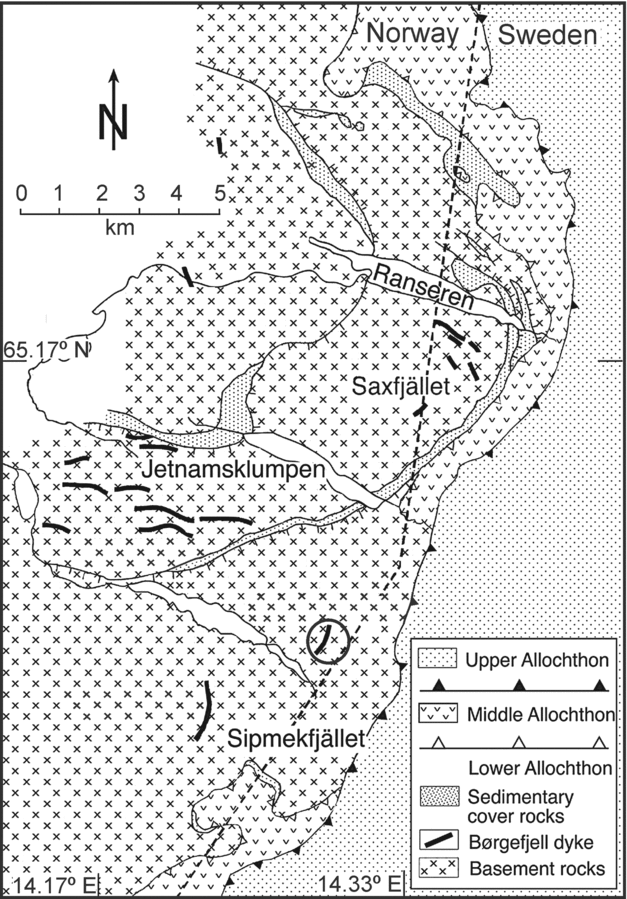
The Børgefjell window is a c. 20 km wide window in the central Scandinavian Caledonides situated along the Norwegian–Swedish border and exposing crystalline rocks of Fennoscandian ancestry under Caledonian nappes (Figs 1, 4). It consists mainly of Palaeoproterozoic felsic orthogneiss and mica gneiss interpreted as metasediments (Gustavson & Grønhaug, Reference Gustavson and Grønhaug1960). The lithologies were transposed during the Caledonian orogeny. On geological maps (e.g. Koistinen et al. Reference Koistinen, Stephens, Bogatchev, Nordgulen, Wennerström and Korhonen2001), the Børgefjell window is generally attributed to the parautochthonous tectonostratigraphic level of the Caledonides. In some publications, nevertheless, it is regarded as part of the Lower Allochthon that has been transported for some 200 km from WNW to ESE during Caledonian convergence (Greiling, Garfunkel & Zachrisson, Reference Greiling, Garfunkel and Zachrisson1998; Greiling et al. Reference Greiling, Grimmer, De Wall and Björk2007). The western boundary of the Børgefjell window corresponds to an oblique extensional (normal) shear zone, implying a late-Caledonian exhumation and tilting of the window (Osmundsen et al. Reference Osmundsen, Braathen, Nordgulen, Roberts, Meyer and Eide2003).
Map showing the Børgefjell window. The sampled dyke is encircled.

Mafic dykes are abundant in the Børgefjell window and in other tectonic slices of the Lower and Middle Allochthon in the Central Scandinavian Caledonides (e.g. Stalon Nappe, Fig. 1) (Greiling et al. Reference Greiling, Grimmer, De Wall and Björk2007). They have not been observed within the Neoproterozoic sedimentary cover rocks implying they are Mesoproterozoic or older (Greiling et al. Reference Greiling, Grimmer, De Wall and Björk2007). The dykes are transposed by nappe movements and converted to metadolerites. From palaeomagnetic investigations, de Wall & Greiling (Reference De Wall and Greiling2000) concluded that most of the metadolerites in Caledonian nappes changed their geometry from horizontal to near-vertical dips during eastward nappe transport. The dykes share a chemical affinity with the subalkaline (westernmost) members of the Västerbotten, Dalarna and Jämtland complexes of the Central Scandinavian Dolerite Group (Fig. 2).
The petrography of a 30 m wide member of the Børgefjell dolerites was described by Greiling et al. (Reference Greiling, Grimmer, De Wall and Björk2007), and was sampled for this study in order to extract baddeleyite for U–Pb geochronology and Hf isotopes. The meta-dolerite is located on the eastern part of the Børgefjell window and hosted in mica gneiss (Fig. 4). The sample is from the interior of the dyke, where pyroxene, plagioclase and opaque phases display a well-preserved ophitic texture. Minor alteration is seen as sericite and biotite growing on plagioclase and pyroxene edges, respectively. Total alteration into a greenschist-facies assemblage is evident in the dyke margins, where a weak ophitic texture has been blurred by the alignment of secondary phases.
3. Analytical procedures
3.a. U–Pb baddeleyite geochronology
U–Pb chemistry and thermal ion mass spectrometry (TIMS) were performed at the Swedish Museum of Natural History and followed the procedures described in Brander & Söderlund (Reference Brander and Söderlund2009). About 1 and 4 kg of samples of the Moslätt and Børgefjell dolerites were processed, respectively, using the separation technique of Söderlund & Johansson (Reference Söderlund and Johansson2002). The separation yielded about 120 and 45 minute baddeleyite grains, respectively (typically 20–30 μm in width). The separated portion from each sample was split into four fractions for isotopic analysis.
Procedural blanks were 2 pg Pb and < 1 pg U. Mass fractionation is 0.1% per mass unit for Pb, determined by replicate analyses of NBS standards of SRM 981 and SRM 983. U fractionation was determined directly from the measured 233U/236U isotopic ratio. Initial Pb compositions were taken from the model of Stacey & Kramers (Reference Stacey and Kramers1975) at the age in question. Pb blank composition was 206Pb/204Pb 18.5, 207Pb/204Pb 15.6 and 208Pb/204Pb 38.5. Plotting and calculation of age and uncertainties was done using Isoplot/Ex 3.00 (Ludwig, Reference Ludwig2003) and the decay constants of Steiger & Jäger (Reference Steiger and Jäger1977). The listed uncertainties in Pb/U ratios were calculated by propagating the within-run error for measured isotopic ratios, the uncertainty in fractionation (± 0.04 absolute uncertainty for Pb), the uncertainty in Pb and U blank concentration (± 50%), and in the Pb blank composition (2% for 206Pb/204Pb and 0.2% for 207Pb/204Pb).
Because spike and baddeleyite samples were not weighed, the U, Th and Pb concentrations are not reported. Th/U calculated from the measured 206Pb/208Pb ratios in baddeleyite is 0.03–0.14, which testifies to a low affinity of Th relative to U for baddeleyite.
3.b. Hafnium isotopes
Hafnium isotopic compositions were measured from the solutions used for U–Pb geochronology. Because the present-day 176Hf/177Hf of baddeleyite can generally be assumed to equal its initial 176Hf/177Hf, neither isotopic dilution nor separation of Lu from Hf is necessary (cf. Söderlund et al. Reference Söderlund, Isachsen, Bylund, Heaman, Patchett, Vervoort and Andersson2005). Only a single clean-up step was performed to reduce mass interference on mass 176 by natural Yb and Lu. The collected Zr–Hf–REE wash from the U–Pb chemistry was dried down and dissolved in 1 ml 1.0 M HCl/0.1 M HF. Hf was purified from rare earth elements (REEs) on a column with ~ 1 cm3 of cation resin AG50W-X12. Hf was eluted by 2 resin volumes of 1.0 M HCl/0.1 M HF and evaporated to dryness. Total procedural blank was estimated at 10 pg Hf, corresponding to < 0.1% of all Hf in a sample, i.e. the samples do not need blank correction.
Hf isotope analysis was conducted in static mode on a Micromass Isoprobe multiple-collector inductively coupled plasma mass spectrometer (MC-ICPMS) at the Swedish Museum of Natural History in Stockholm. A desolvating nebulizer (MCN6000) was used for increasing yield. Samples were dissolved in 1 ml 3% HNO3 before mass spectrometric analysis, and this amount of solution yielded around 60 Hf isotope ratios.
Possible isobaric interferences on 176Hf were evaluated by monitoring 175Lu and 172Yb. The amounts of Yb in the Hf runs were small and only minor corrections for Yb interference were necessary. No correction for Lu interference was necessary. The 176Hf/177Hf ratio was normalized for mass fractionation to 179Hf/177Hf = 0.7325 using an exponential correction. Cup efficiencies were set to unity before sample analysis. A 75 ppb solution of JMC-475 was analysed as a control of instrument stability, i.e. until no differences in Hf isotopic ratios between block mean values were registered. The cup efficiencies were thereafter adjusted to match the recommended values of the JMC-475 standard solution; 176Hf/177Hf = 0.282160, 178Hf/177Hf = 1.467170, 179Hf/177Hf = 0.7325 and 180Hf/177Hf = 1.88666 (Vervoort et al. Reference Vervoort, Patchett, Söderlund and Baker2004). The mean of 13 measurements of JMC-475 during this analytical session was 0.282182 ± 0.000022 (2 standard deviations). The 176Hf/177Hf of unknowns was corrected for the difference relative to the value of JMC-475.
4. Results
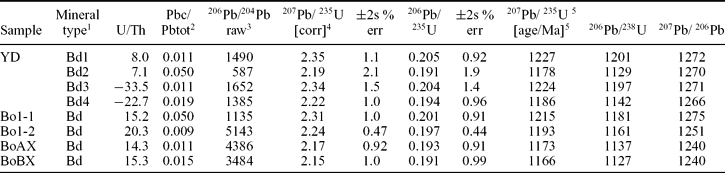
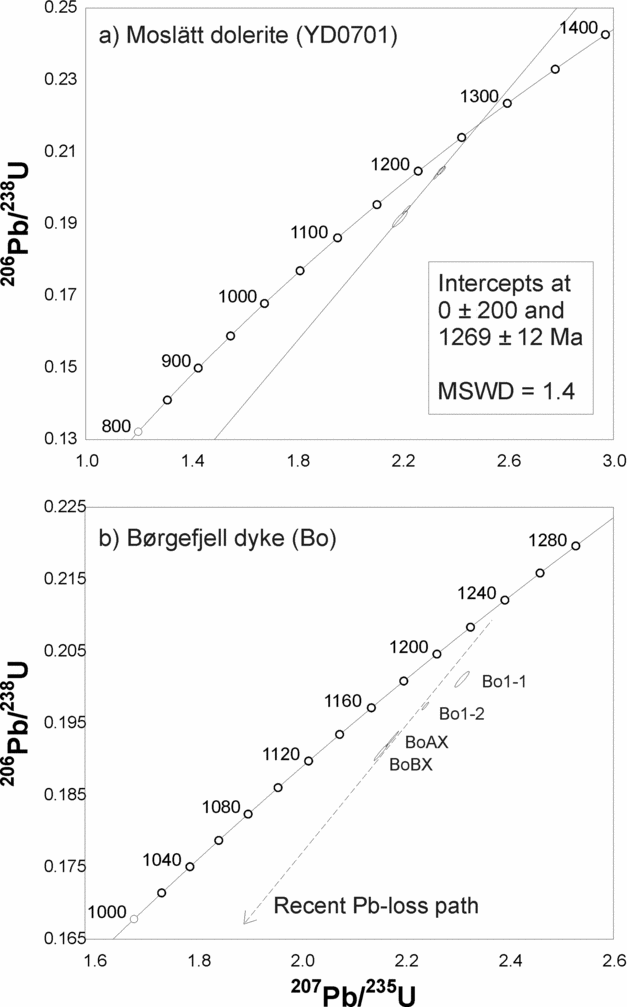
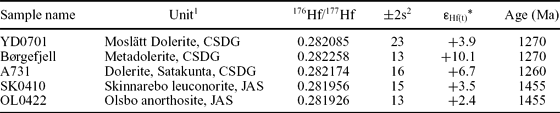
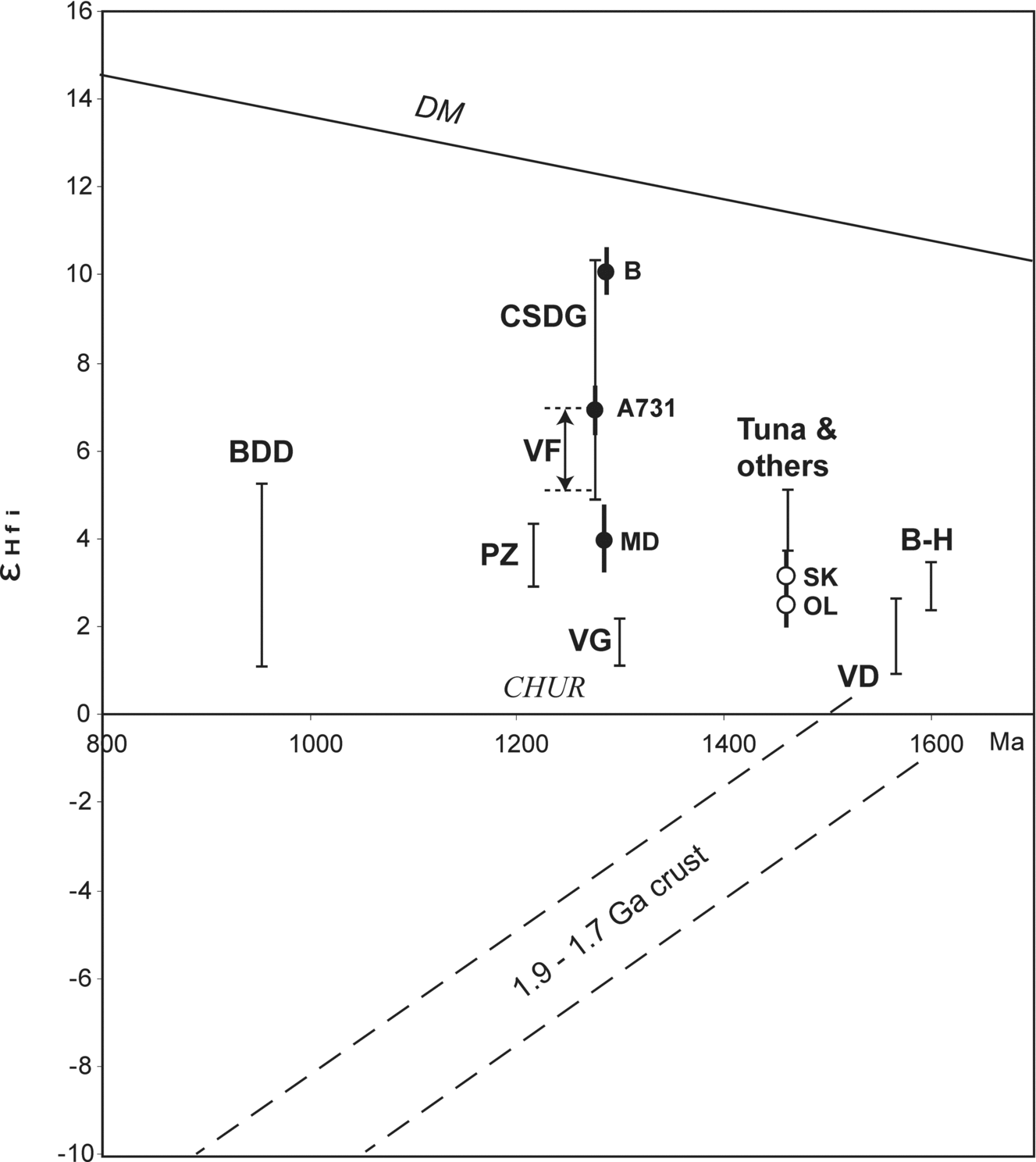
The U–Pb age data are summarized in Table 1 and plotted in concordia diagrams in Figure 5. Hf isotope data are given in Table 2 and are shown in a ɛHf versus age diagram in Figure 6.
U–Pb TIMS data

1Bd – baddeleyite; about 20–35 grains/fragments were combined in each analysis.
2Pbc – common Pb; Pbtot – total Pb (radiogenic + blank + initial).
3measured ratio, corrected for fractionation and spike.
4isotopic ratios corrected for fractionation (0.1% per amu for Pb), spike contribution, blank (1–2 pg Pb and < 1 pg U), and initial common Pb. Initial common Pb corrected with isotopic compositions from the model of Stacey & Kramers (Reference Stacey and Kramers1975) at 1270 Ma.
5All ages are calculated with the 235U and 238U decay constants of Steiger & Jäger (Reference Steiger and Jäger1977).
Concordia diagrams showing results from U–Pb baddeleyite. Analysed spots are shown with 2σ error ellipses. (a) Regression of the Moslätt dolerite sample. The reported age is at the 95% confidence level. (b) U–Pb results from the Børgefjell metadolerite sample.

Hafnium isotope data of baddeleyite

*176Lu = 1.867 × 10⁻¹¹ year−1 (Scherer, Munker & Mezger, Reference Scherer, Munker and Mezger2001; Söderlund et al. Reference Söderlund, Patchett, Vervoort and Isachsen2004a), CHUR parameters from Bouvier, Vervoort & Patchett (Reference Bouvier, Vervoort and Patchett2008).
1CSDG – Central Scandinavian Dolerite Group; JAS – Jönköping Anorthosite Suite
2uncertainties shown for isotopic composition are two standard errors of the mean for mass spectrometer runs.
Initial ɛHf versus age diagram. Lines define age and ɛHf ranges of different generations of late Palaeoproterozoic and Mesoproterozoic mafic intrusions in Fennoscandia (cf. Söderlund et al. Reference Söderlund, Isachsen, Bylund, Heaman, Patchett, Vervoort and Andersson2005, Reference Söderlund, Elming, Ernst and Schissel2006 and references therein). Filled circles represent ɛHf values at the time of emplacement of the c. 1.26 Ga Moslätt dolerite (MD), the Børgefjell dyke (B) and the dolerite of the Satakunta complex (A731) whereas unfilled circles depict values for the c. 1.45 Ga Skinnarebo (SK) and Olsbo (OL) anorthositic intrusions. Vertical bar depicts 2σ internal errors in ɛHf for respective sample. VF denotes the ɛHf range at 1260 Ma for the Valldal Formation metaryoliths (zircon) and metabasalts (whole-rock), respectively (Brewer et al. Reference Brewer, Åhäll, Menuge, Storey and Parrish2004). Hf depleted mantle curve is derived from using present-day ɛHf of 18, and 6.5 for the depleted mantle at 2.7 Ga (Vervoort & Blichert-Toft, Reference Vervoort and Blichert-Toft1999) and using λ176Lu = 1.867 × 10⁻¹¹ year−1 (Scherer, Munker & Mezger, Reference Scherer, Munker and Mezger2001; Söderlund et al. Reference Söderlund, Patchett, Vervoort and Isachsen2004a). The Hf evolution lines are shown for 1.9–1.7 Ga. BDD – Blekinge Dalarna dolerites; PZ – Protogine Zone dolerites; CSDG – Central Scandinavian Dolerite Group; VD – Värmland dolerites and others; VG – Västergötland dolerites; B-H – Breven-Hällefors dykes.

Baddeleyite grains in the Moslätt dolerite sample are brown to pale brown and relatively fresh. The four fractions do not define a valid four-point isochron as two analyses basically overlap the other two. Using a forced lower intercept of 0 ± 200 Ma in the regression, the four analyses yield an upper intercept age of 1269 ± 12 Ma with an acceptable mean square weighted deviation (MSWD) value of 1.4 (Fig. 5). This age is interpreted as the crystallization age of the sample. The initial ɛHf at c. 1260 Ma for the gabbronorite is +3.9, while at c. 1450 Ma, the initial ɛHf of the nearby Skinnarebo leuconorite and the Olsbo anorthosite are lower with values of +3.5 and +2.4.
The grains recovered from the Børgefjell metadolerite range from pale brown to yellow, many with a distinct thin frosty surface of polycrystalline zircon. The analyses show significant scatter and are as much as 8.0 to 10.2% discordant. The discordance and scatter of analyses presumably result from complex Pb-loss and reaction of baddeleyite into a polycrystalline zircon rim after magmatic crystallization. The pattern presumably incorporates additional isotopic disturbance during the Caledonian orogeny. A minimum age of emplacement is constrained at 1275 ± 4 Ma, derived from the 207Pb/206Pb age of the least discordant analysis. The initial ɛHf for the Børgefjell metadolerites is +10.1.
The initial ɛHf at c. 1.26 Ga for the sample of the Svall dolerite, from the Finnish part of the Ulvö Complex, is +6.7, which falls close to the mean of the range previously reported for the Central Scandinavian Dolerite Group (Fig. 6; Söderlund et al. Reference Söderlund, Isachsen, Bylund, Heaman, Patchett, Vervoort and Andersson2005, Reference Söderlund, Elming, Ernst and Schissel2006).
5. Discussion
The Central Scandinavian Dolerite Group records an intraplate tensional tectonic regime in the Fennoscandian Shield during the Mesoproterozoic. The exact nature of the stress is not well defined today. Söderlund et al. (Reference Söderlund, Elming, Ernst and Schissel2006) discussed two alternative models for the petrogenesis of these intrusions: either the magmas were generated from a hotspot mantle source beneath the Fennoscandian Shield or they represent farfield manifestations behind an active margin in the west that involved discrete events of extension-related magmatism. The long-lived and episodic character of this magmatism (1271–1245 Ma) led Söderlund et al. (Reference Söderlund, Elming, Ernst and Schissel2006) to favour the second interpretation.
Tracing the Central Scandinavian Dolerite Group event in areas showing several generations of mafic rocks or outside the Palaeoproterozoic cratonic part of Fennoscandia in crustal domains affected by younger Sveconorwegian and Caledonian orogenic events is an exercise of trial and error. The geometry, magmatic mineralogy, geochemistry, isotope geochemistry, palaeomagnetic signatures and intrusion age are all important parameters to correlate dolerite events (Ernst, Buchan & Campbell, Reference Ernst, Buchan and Campbell2005; Buchan et al. Reference Buchan, Goutier, Hamilton, Ernst and Matthews2007), though the intrusion age is often the most diagnostic parameter. However, the challenge is that in reworked areas, most of these characters are largely obliterated. Baddeleyite, the key mineral for dating dolerite intrusions with the U–Pb method, is usually transformed into zircon during metamorphism even at a relatively low grade (Davidson & vanBreemen, Reference Davidson and van Breemen1988; Söderlund, Hellström & Kamo, Reference Söderlund, Hellström and Kamo2008).
In this paper, we obtained an age of 1269 ± 12 Ma for the Moslätt Dolerites in the Protogine Zone area (Jönköping) and a minimum age of 1275 ± 4 Ma for a metadolerite in the Børgefjell window characterized by baddeleyite partly reacted to zircon. Both dates fall inside or are close to the 1271–1246 Ma interval, the typical age range for dolerites of the Central Scandinavian Dolerite Group (Söderlund et al. Reference Söderlund, Isachsen, Bylund, Heaman, Patchett, Vervoort and Andersson2005, Reference Söderlund, Elming, Ernst and Schissel2006; Hogmalm et al. Reference Hogmalm, Söderlund, Larson, Meurer, Hellström and Claeson2006). More specifically they match the age of the oldest complex, the Dalarna Complex, which is constrained by two dates at 1271 ± 1 Ma (Ämån dyke) and 1264 ± 1 Ma (Älvdalsåsen dyke).
The initial ɛHf for the Børgefjell metadolerites is +10.1. It is situated at the upper end of the interval defined by the Central Scandinavian Dolerite Group (+4.7 to +10.3; Fig. 6), emphasizing a distinct depleted mantle source for these rocks. In fact, the Central Scandinavian Dolerite Group has a range of ɛHf values higher than all other Mesoproterozoic dolerites in Fennoscandia (Fig. 6). Their highly positive values, especially the one for the Børgefjell metadolerite, point to a dominant depleted mantle component in the source of the parental magmas of the dolerites. The initial ɛHf for the gabbronorite of the Moslätt Dolerites is +3.9, and plots just below the range for the Central Scandinavian Dolerite Group (+4.7 to +10.3). It is similar to the value of the leuconorite and anorthosite of the nearby c. 1455 Ma Jönköping Anorthositic Suite (Fig. 6) (Brander & Söderlund, Reference Brander and Söderlund2009).
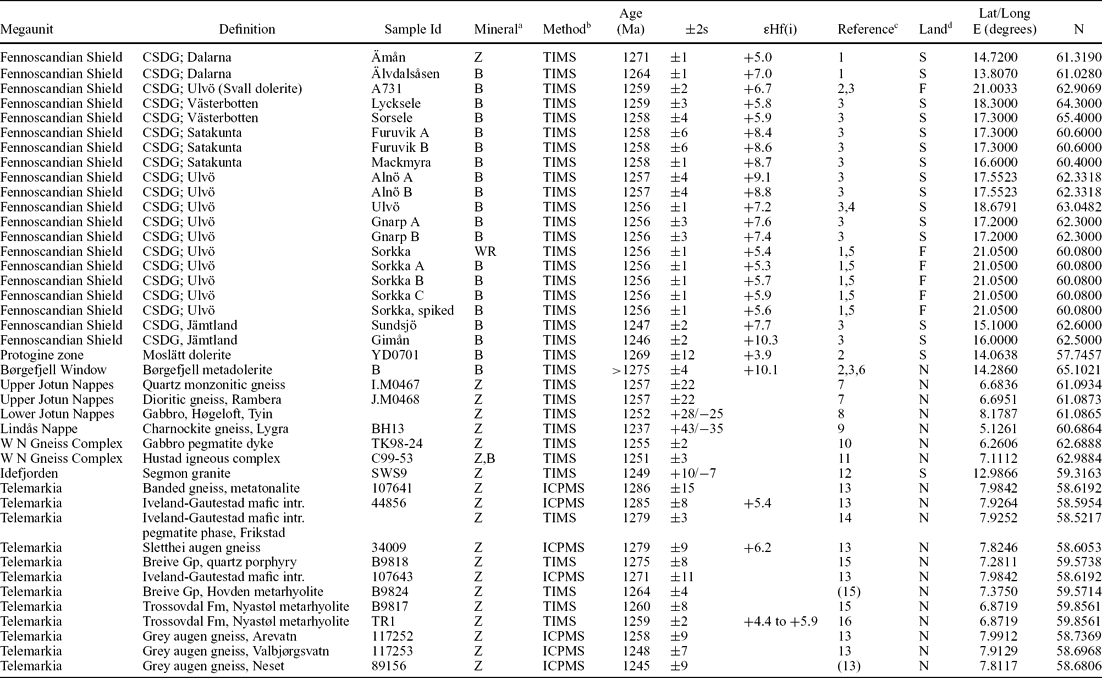
Rocks coeval and probably connected with the Central Scandinavian Dolerite Group have been traced westward into the Caledonides, in Palaeo- to Mesoproterozoic crystalline rocks of Fennoscandian ancestry situated in basement windows and Lower to Middle Allochthon nappes (see compilation of age and Hf data in Table 3). As mentioned earlier, in Mid-Scandinavia, they include the > 1275 ± 4 Ma metadolerites in the Børgefjell window (Greiling et al. Reference Greiling, Grimmer, De Wall and Björk2007; this work) and undated but geochemically similar metadolerites in the Middle Allochthon Stalon nappe (Greiling et al. Reference Greiling, Grimmer, De Wall and Björk2007). The West Norway Gneiss Complex is the large basement window in western Norway (Fig. 1). There, minor gabbro and dolerite sills and dykes are common and they are commonly partly metamorphosed to eclogite facies (Mørk & Mearns, Reference Mørk and Mearns1986). A well-preserved dyke in a low strain domain (Hustad Complex) yields a zircon + baddeleyite intrusion age of 1251 ± 3 Ma while a partially eclogitized gabbro (Flem gabbro) has a crystallization age of 1255 ± 2 Ma (Krogh in Robinson, Roberts & Gee, Reference Robinson, Roberts and Gee2008).
Compilation of 1290–1240 Ma age and Hf data in the Fennoscandian Shield

aZ – zircon; B – baddeleyite; WR – whole-rock.
bMethod used for dating: TIMS – Thermal Ion Mass Spectrometry; ICPMS – Inductively Coupled Plasma Mass Spectrometry.
c(1) Söderlund et al. Reference Söderlund, Isachsen, Bylund, Heaman, Patchett, Vervoort and Andersson2005; (2) This work; (3) Söderlund et al. Reference Söderlund, Elming, Ernst and Schissel2006; (4) Hogmalm et al. Reference Hogmalm, Söderlund, Larson, Meurer, Hellström and Claeson2006; (5) Söderlund et al. Reference Söderlund, Patchett, Vervoort and Isachsen2004a; (6) Greiling et al. Reference Greiling, Grimmer, De Wall and Björk2007; (7) Lundmark et al. Reference Lundmark, Corfu, Spürgin and Selbekk2007; (8) Schärer, Reference Schärer1980; (9) Bingen, Davis & Austrheim, Reference Bingen, Davis and Austrheim2001; (10) Krogh in Robinson, Roberts & Gee, Reference Robinson, Roberts and Gee2008; (11) Austrheim et al. Reference Austrheim, Corfu, Bryhni and Andersen2003; (12) Persson, Wahlgren & Hansen, Reference Persson, Wahlgren and Hansen1983; (13) Pedersen et al. Reference Pedersen, Andersen, Konnerup-Madsen and Griffin2009; (14) Lightfoot in Pedersen et al. Reference Pedersen, Andersen, Konnerup-Madsen and Griffin2009; (15) Bingen et al. Reference Bingen, Mansfeld, Sigmond and Stein2002; (16) Brewer et al. Reference Brewer, Åhäll, Menuge, Storey and Parrish2004.
dS – Sweden; F – Finland; N – Norway.
In the Sveconorwegian orogen, Mesoproterozoic metaplutonic, metavolcanic and metasedimentary rocks are voluminous to the west of the Mylonite Zone, especially in the southwesternmost Telemarkia Terrane (Fig. 1), as defined in Bingen et al. (Reference Bingen, Skår, Marker, Sigmond, Nordgulen, Ragnhildstveit, Mansfeld, Tucker and Liégeois2005). In this terrane, bimodal volcanic to plutonic rocks of the Sæsvatn–Valldal sequence are bracketed between 1275 ± 8 and 1259 ± 2 Ma (Bingen et al. Reference Bingen, Mansfeld, Sigmond and Stein2002; Brewer et al. Reference Brewer, Åhäll, Menuge, Storey and Parrish2004) and they are interlayered with sediments. The large 1285 ± 8 to 1271 ± 11 Ma Iveland–Gautestad mafic intrusion is associated with felsic plutonic rocks (Pedersen et al. Reference Pedersen, Andersen, Konnerup-Madsen and Griffin2009). Zircon in a rhyolite flow in the Sæsvatn–Valldal sequence has an average initial ɛHf of +5.4 (n = 4; Brewer et al. Reference Brewer, Åhäll, Menuge, Storey and Parrish2004). Zircon in one sample of the Iveland–Gautestad intrusion and one sample of the associated felsic rocks has average initial ɛHf of +5.4 (n = 23) and +6.2 (n = 19), respectively (Pedersen et al. Reference Pedersen, Andersen, Konnerup-Madsen and Griffin2009). These rocks are coeval with the Central Scandinavian Dolerite Group and the three ɛHf values encompass the range of available values for the Central Scandinavian Dolerite Group. Bingen et al. (Reference Bingen, Mansfeld, Sigmond and Stein2002) and Brewer et al. (Reference Brewer, Åhäll, Menuge, Storey and Parrish2004) attributed the emplacement of the bimodal magmatism in the Telemarkia Terrane to back-arc or arc basin development linked to a westward retreating subduction boundary at that time, located along the Fennoscandia margin to the west of the Telemarkia Terrane. The palaeogeographic reconstruction of the Telemarkia Terrane relative to Fennoscandia is a matter of discussion (Bingen, Nordgulen & Viola, Reference Bingen, Nordgulen and Viola2008). This terrane was possibly exotic to Fennoscandia and accreted only to this plate during the Sveconorwegian orogeny (i.e. after 1140 Ma; Bingen et al. Reference Bingen, Skår, Marker, Sigmond, Nordgulen, Ragnhildstveit, Mansfeld, Tucker and Liégeois2005; Corfu & Laajoki, Reference Corfu and Laajoki2008). Alternatively, it was peripheral to Fennoscandia during its whole Mesoproterozoic history (Andersen, Griffin & Pearson, Reference Andersen, Griffin and Pearson2002; Pedersen et al. Reference Pedersen, Andersen, Konnerup-Madsen and Griffin2009). In this latter eventuality, both the bimodal magmatism in the Telemarkia Terrane and the mafic magmatism of the Central Scandinavian Dolerite Group may reflect a tensional tectonic regime inboard of a subduction zone located to the west of Fennoscandia.
In SW Norway, the Caledonian Jotun and Lindås nappes (Fig. 1) contain quartz monzonitic and dioritic gneisses dated at 1257 ± 22 Ma (Lundmark et al. Reference Lundmark, Corfu, Spürgin and Selbekk2007) and a charnockitic gneiss dated c. 1237 Ma (Bingen, Davis & Austrheim, Reference Bingen, Davis and Austrheim2001). These rocks overlap with intrusion of the Central Scandinavian Dolerite Group. Nevertheless, these Middle Allochthon nappes display both Sveconorwegian and Caledonian metamorphic reworking (Bingen, Davis & Austrheim, Reference Bingen, Davis and Austrheim2001; Lundmark et al. Reference Lundmark, Corfu, Spürgin and Selbekk2007) and both Sveconorwegian and Caledonian unknown transport. Consequently, the link between this Mesoproterozoic magmatism and the Central Scandinavian Dolerite Group may be tenuous.
6. Conclusions
The Moslätt Dolerites in the Protogine Zone area intruded at 1269 ± 12 Ma with an initial ɛHf value of +3.9. Metadolerites in the Børgefjell window in the Mid-Scandinavian Caledonides have a minimum intrusion age of 1275 ± 4 Ma with an initial ɛHf value of +10.1.
These results support a link with the Central Scandinavian Dolerite Group. They suggest that the Central Scandinavian Dolerite Group is more widespread than previously estimated and extends westwards in the Fennoscandia basement, reworked in the Caledonides, and southwards. The obtained dates are among the oldest reported for the Central Scandinavian Dolerite Group, and consequently provide supporting evidence that this magmatic event began at around 1275 Ma. The Central Scandinavian Dolerite Group, including the two studied occurrences, is characterized by initial ɛHf values ranging from +3.9 to +10.3, more positive than older and younger Mesoproterozoic events of mafic magmatism in Fennoscandia. The spread of initial isotopic composition is consistent with the interpretation that the Central Scandinavian Dolerite Group consists of several batches of magma with distinct source or contamination histories.
A genetic link between the Central Scandinavian Dolerite Group and bimodal magmatism in the Telemarkia Terrane of the Sveconorwegian orogen is possible. In a model reconstructing the Telemarkia Terrane at the periphery of Fennoscandia at c. 1270 Ma, both the Central Scandinavian Dolerite Group and bimodal magmatism in the Telemarkia Terrane may represent farfield manifestations behind an active margin in the west of the Fennoscandia plate, which involved discrete events of extension-related magmatism.
Acknowledgements
This study was supported via grants from the Lars Hierta Memorial Foundation, the Sven Lindqvist Research Foundation, the Royal Swedish Academy of Sciences, the Royal Society of Sciences and Letters in Gothenburg and the Nordic Mineralogical Network to LB, and the Swedish Research Council to US. Lena Lundqvist (SGU) is thanked for showing LB the Moslätt dyke, and Per-Olof Persson and Kjell Billqvist at the Laboratory for Isotope Geology (at the Swedish Natural Museum, Stockholm) assisted during Hf isotope analysis. RO Greiling provided the Børgefjell metadolerite sample. Jon Patchett and an anonymous reviewer are thanked for constructive critical reading.