Introduction
In recent decades, governments around the world have sought to increase the amount of choice users have over who provides their public services. In the UK, this ‘choice agenda’ is associated with the work of thinkers like Julian Le Grand, who achieved particular influence within the New Labour Government of the 2000s arguing that empowering public service ‘consumers’ in ‘quasi-markets’ would lead to more effective and responsive public services (Le Grand, Reference Le Grand2010). In recent years, the political salience of the topic seems to have declined, though there seems to be little appetite to reverse the reforms of that period and earlier (Bhattacharya, Reference Bhattacharya2020).
As in other countries (Musset, Reference Musset2012), in England, school choice (giving parents greater say over which school their child attends) was at the heart of such reforms. Its proponents expect it to improve outcomes in several ways: by better allocating students to well-suited or high performing schools; by strengthening incentives for schools to attract or retain students; and by encouraging the closure of ineffective schools (Sahlgren, Reference Sahlgren2013).
Such hopes have largely been disappointed. An OECD review of the international evidence concludes that “only a few studies find a link between increased choice and enhanced student outcomes, and when they do exist, the effects are quite small and not always statistically significant” (Musset, Reference Musset2012, p. 30). Other reviews have reached similar judgements (Allen and Burgess, Reference Allen and Burgess2010; Sahlgren, Reference Sahlgren2013). Moreover, school choice has been found to worsen inter-school segregation by ethnicity, socio-economic status and ability (Musset, Reference Musset2012).
However, improving outcomes has only ever been part of the case for school choice, or indeed choice in public services more generally. Many proponents of school choice have suggested that it has intrinsic value – that the process of choosing or the mere fact of having choice is valuable, regardless of its consequences (Dowding and John, Reference Dowding and John2009; Goodwin, Reference Goodwin2009; Klein and Millar, Reference Klein and Millar1995; Le Grand, Reference Le Grand2010). For example, Gintis (Reference Gintis1995, p. 493) claims that “it is a mistake to evaluate the competitive delivery of educational services on the basis of traditional educational performance measures alone, since consumers value the ability to choose, independent from any measurable effects of such choice on standard measures of educational performance”.
The term ‘intrinsic value’ is the one standardly used in the literature, though it may cause some confusion. To be clear, it refers to the intrinsic value of choice, rather than of education (so I do not, for example, mean the value of learning for learning’s sake).
Why, precisely, school choice might have value even if it does not lead to better outcomes is a philosophically complex question (see Bhattacharya, Reference Bhattacharya2021 for a detailed discussion). Moreover, it can be conceptually tricky to disentangle intrinsic from instrumental reasons – for example, it might be hard for a parent to distinguish their desire for control over the process of school (an intrinsic reason) from the belief that only their action can ensure their child gets a suitable school (an instrumental reason).
In this article, I examine the extent to which school choice policy in England and Scotland promotes intrinsic value. To make the question tractable and comprehensible to those without the appetite to engage in philosophy (most notably the parents in question) I focus on the two most promising sources of intrinsic value (Bhattacharya, Reference Bhattacharya2021):
-
i) Do parents want a choice of schools, independent of the outcome?
-
ii) Does giving parents choice support their wellbeing and autonomy by empowering them?
The comparison between England and Scotland is interesting because the two countries have taken rather different approaches to school choice. Whereas English policymakers have made great efforts to encourage and facilitate choice, policymakers north of the border have tended to play it down.
The article is structured as follows. I begin by outlining the differences in institutions and approach to secondary school choice between Scotland and England, and what we might learn by comparing them. I then review previous evidence on parents’ desire for, and satisfaction with, school choice in each country. I go on to describe the survey and interview programme used to collect the data for this article. In presenting the results, I start by addressing whether and why parents want to have a choice of school, and the extent to which this desire is intrinsic. I then explore how satisfied and empowered parents feel with secondary school choice as it currently operates. I find that despite being offered less formal choice, Scottish parents are no less satisfied and in fact English parents seem more disempowered. I end by considering some possible explanations as to why this might be, and the policy implications of these findings.
Secondary school choice in Scotland and England and the rationale for comparing them
Secondary schools in England operate under a system of ‘open enrolment’, with no presumption that students will attend a pre-assigned catchment school or even a school in their local authority. Parents submit a single application, ranking at least three, and as many as six, schools (the maximum varies by local authority). They receive a single offer of a place at one school.
In 2020, 82% of pupils were offered a place at their first preference school, and 96% received one of their preferences (Gov.uk, 2020) – figures that have remained broadly stable over recent years (Department for Education, 2019a).
If a school is undersubscribed, any application to that school must be accepted. Oversubscription criteria are set by the governing body that runs the school, though its discretion is strictly limited by the national admissions code. Selection on the basis of academic ability is only permitted for the 5% of schools that have historic selective status. It is common to give priority to children with siblings already at the school, looked-after children, children with social or medical needs or those that attend linked ‘feeder’ schools. Religious schools may use evidence of faith as an oversubscription criterion. Some local authorities and schools operate a system of ‘banding’, taking applicants’ academic ability into consideration to ensure an intake reflective of the national or local ability range. Specialist schools are also permitted to allocate 10% of their places on the basis of aptitude in sport, arts, languages or technology (Department for Education, 2014).
In most cases, the dominant oversubscription criteria are geographical. Some schools offer places to the applicants nearest the school, creating a de facto catchment area, while others operate formal catchment areas. Nevertheless, school choice does have a meaningful effect on the distribution of pupils in England: only 39% of English pupils put their nearest secondary school as their first choice (Burgess et al., Reference Burgess, Greaves and Vignoles2019), and around half end up attending it (Allen, Reference Allen2007).
As well as limiting local authorities and schools’ ability to reject parent applications, policymakers in England have sought to reduce some of the practical barriers to choice. Successive governments have made it easier to compare schools through standardised testing and by publicising league tables (Leckie and Goldstein, Reference Leckie and Goldstein2017). Low income families are entitled to free transport to their three nearest schools. Schools have been incentivised to compete for students by having their funding tied to student numbers (Institute for Government, 2012).
The Scottish Government, by contrast, permits but does not particularly encourage school choice (Education Scotland, 2013). It has stated, for example, that “No one in Scotland should be required to select a school to get the first rate education they deserve and are entitled to” (Cope and l’Anson, Reference Cope and l’Anson2009, p. 83). The default assumption is that children will attend the school that they are zoned for – usually, but not always, their nearest school. Those that would prefer a non-zoned school must ‘opt in’ to choice, by making a separate ‘placing request’ for each alternative.
Around 13% of Scottish families make a placing request.Footnote 1 Thus, in contrast to England, where every family is required to formally register a choice, in Scotland the vast majority – 87% – do not make any formal choice at all. For oversubscribed schools, local authorities have discretion over how to prioritise placing requests, but may favour children with special needs, siblings already at the school and whose family circumstances make the school more convenient (e.g. parents working or relatives living in the area). Ultimately, though, as in England, distance from the school is the usual tiebreaker. Around 80% of placing requests are granted.Footnote 2
In this paper, I engage in a ‘controlled comparison’ of parental attitudes to, and experiences of, secondary school choice between England and Scotland (Slater and Ziblatt, Reference Slater and Ziblatt2013). The underlying logic is that of a ‘most-similar systems’ approach – taking cases that share many common characteristics to identify salient differences (Della Porta, Reference Della Porta, Della Porta and Keating2008). England and Scotland are, fundamentally, very similar countries. They share a language, media and political institutions. They are closely economically integrated, have strong migratory links and substantial cultural overlap. Indeed, Raffe et al. (Reference Raffe, Brannen, Croxford and Martin1999) have argued that these basic similarities make the two countries well-suited to comparative educational studies and policy learning.
Of course, England and Scotland also have many differences, some of which might affect attitudes to and experiences of school choice. They have separate education systems and policies – most notably, English schools are more diverse, with a wider range of management structures, selective, religious and specialist schools. Scotland is less densely populated, so families tend to have fewer proximate schools to choose between, but those schools are more likely to have available spaces. There may also be differences in political attitudes. Scotland is often regarded as more egalitarian and social democratic, though surveys suggest Scots are only slightly to the left politically of the English (Curtice, Reference Curtice2013). However, there may be more subtle cultural differences: Scottish policymakers are perceived as more committed to comprehensive education, deferential to the teaching profession – which could feed through to greater public trust in local schools (Cope and l’Anson, Reference Cope and l’Anson2009).
With these caveats in mind, the underlying similarities between England and Scotland, combined with their contrasting approaches to school choice, make it at least prima facie plausible to attribute differences in parental attitudes and experience to the impact of policy. It is certainly not enough to make robust causal claims, but can at least offer suggestive insights.
This paper attempts to shed light on the extent to which school choice policies in England and Scotland create intrinsic value for parents in those countries. Specifically, I address the following research questions:
-
Do parents in England and Scotland want secondary school choice (for intrinsic reasons)?
-
Do they feel satisfied with and empowered by the level of choice that they have?
-
If there are differences between the two countries, why do they occur?
Previous research
Do parents want choice, and why?
National surveys suggest widespread support for school choice among the general public, and parents in particular. In the 2007 British Social Attitudes survey, 81% of respondents said parents should have ‘Quite a lot’ or ‘A great deal’ of choice over the state secondary school their child attends (Curtice and Heath, Reference Curtice, Heath, Park, Curtice, Thomson, Phillips and Clery2009). Support for choice was even stronger among parents with children in state schools: 40% believed they should have a great deal of choice, compared to 28% for the rest of the population. In the 2010 edition of the survey, 72% of parents with children under 16 living at home expressed the view that parental school choice is a ‘basic right’ (Exley, Reference Exley, Park, Clery, Curtice, Phillips and Utting2012).
Scottish public opinion seems to be slightly less favourable to school choice. In the 2007 BSA, 76% of Scots said parents should have quite a lot or a great deal of choice. In 2010, Scotland was the only part of the UK where people believing school choice is a basic right were in the minority (49% agreeing, compared to 71% in England) (Exley, Reference Exley, Park, Clery, Curtice, Phillips and Utting2012). However, these figures indicate that even in Scotland a large proportion – likely a majority – back school choice.
It is less clear from existing surveys why parents want choice. Those expressing favourable views towards school choice may do so for instrumental reasons: for example, because they believe that choice allows them to get their children into better schools or that it will improve overall attainment.
Despite their apparent approval of the principle of school choice, 63% of people believe that “parents in general should send their children to the nearest state school”. A further 22% say they would agree with the statement if the quality and social mixes of schools were more equal (Exley, Reference Exley, Park, Clery, Curtice, Phillips and Utting2012).
This suggests that most parents want a choice of schools, but simultaneously believe that this choice should not be widely exercised. One explanation is that what is desired is the ability to affirm or ‘rubber stamp’ their child’s allocation to a school. Conversely, Exley (Reference Exley2014) suggests that what is valued is the ‘right to escape’ undesirable schools, a motive Adler et al. (Reference Adler, Petch and Tweedie1989) suggest is particularly strong in Scotland. Notice that if these interpretations are correct, the Scottish system, with placing requests offering an ‘opt out’ from the catchment school may be more in keeping with parents’ preferences than the English system emphasising active choice.
Qualitative researchers have found more ambivalence among parents towards school choice. As in the surveys, some studies report positive sentiment towards the principle (Boulton and Coldron, Reference Boulton and Coldron1996; Thomas and Dennison, Reference Thomas and Dennison1991). Consistent with Exley’s ‘right to escape’ thesis, Stiell et al. (Reference Stiell, Shipton, Coldron and Coldwell2008, p. 63) report that most parents accessing choice advice services “were very pleased at not being limited to choosing their catchment school”. At the same time, some studies have found hostility towards choice or outright rejection of the principle among some groups (Reay and Ball, Reference Reay and Ball1997; Stiell et al., Reference Stiell, Shipton, Coldron and Coldwell2008). For example, Carroll and Walford (Reference Carroll and Walford1997, p. 12) report that “Some parents, whilst being aware of the right to express preferences for non-local schools, saw little value in choice”.
Are parents satisfied and empowered by choice?
I have found no previous evidence on whether parents in Scotland feel satisfied or empowered by the level of school choice that they have – reflecting a notable lack of research on the topic, reflecting the relative lack of political salience of school choice north of the border. In England, the evidence is mixed. Qualitative studies describe many parents who see choice as an illusion, in some sense not genuine, because they do not feel they can get a place at a school they want (Butler and Hamnett, Reference Butler and Hamnett2010; Byrne and De Tona, Reference Byrne and De Tona2012; Stiell et al., Reference Stiell, Shipton, Coldron and Coldwell2008). Reay and Lucey (Reference Reay and Lucey2000) present their participants as disempowered: “buffeted and demeaned by market processes, which were controlling, rather than being controlled by, them”.
Surveys, however, seem to tell a different story. In a 2014/15 online survey of both primary and secondary parents in England, 72% agreed that they had a genuine choice in deciding which school their child attended, with 18% disagreeing (Wespieser et al., Reference Wespieser, Durbin and Sims2015). Coldron et al.’s (Reference Coldron, Tanner, Finch, Shipton, Wolstenholme, Willis, Demack and Stiell2008, p. 155) official government evaluation of secondary school admissions found 81% of parents in England were satisfied with the choice of schools in their area, with only 12% dissatisfied.
Methods
Overall, then, previous research suggests widespread desire for school choice among parents in England and Scotland, but is less clear as to whether this desire is intrinsic or instrumental. The evidence is ambiguous in England and non-existent in Scotland as to whether they feel satisfied and empowered by the level of choice they have.
In this paper, I address these gaps in the evidence base, drawing on a mixed-methods study of attitudes to, and experiences of, secondary school choice.Footnote 3 I carried out interviews with 66 parents from 57 families in five local authorities. Two were in England: Camden and Ipswich. Three were in Scotland: Edinburgh, Dundee and ‘Scotstown’ (whose local authority requested anonymity). These locations were selected to combine densely populated large cities (where families have a greater number of accessible schools) and less dense smaller towns and cities (where there are fewer available school options).
45 of the families were recruited through primary schools and school information events, with a further six through social media and snowball sampling. 30 families were in Scotland, and 27 in England. There were a comparable number (8-11) of participants in each location, except for Camden, where recruitment was more successful, and 19 families signed up. The vast majority of parents had children in the final year of primary school at the time of the interview, bar five whose children had already started the first year of secondary and one whose child was in their penultimate year of primary school (all in England). Families that were only considering private schools were ineligible, but families that had chosen or were likely to choose a private school were included if they had at least considered state schools. Recognising the risk that parents with particular strongly-held grievances may have been more motivated to participate, and so could bias the sample, the initial information sheet did not disclose the precise subject of the interviews and only explained that they would cover the transition to secondary school.
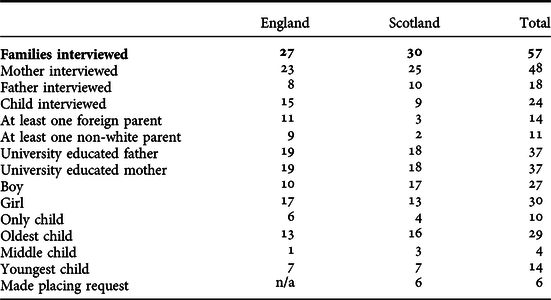
Table 1 provides background details on the interview sample. It shows that participants were demographically mixed, including a substantial number of foreign-born and ethnic minority parents. However, a major issue was the over-representation of university-educated parents, who were in the majority. Once this discrepancy was clear, I made conscious efforts to target non-graduate parents through snowball sampling, with modest success.
Background of interview participants

More generally, a concern is that these recruitment methods are likely to have produced a sample of more ‘engaged’ parents that are more participative in their school community. This is a common issue with studies of this sort, and is not easy to mitigate (Byrne and De Tona, Reference Byrne and De Tona2012; David et al., Reference David, West and Ribbens1994).
Most of the interviews took place in 2018 and 2019, except for the Scotstown interviews, which were in 2017. The English interviews were deliberately scheduled for the months of October and November, falling either side of the national application deadline of October 31st. The intention was to speak to families in the process of finalising their choices, or soon after, but before they knew whether their applications had been successful.
Interviews were semi-structured, and asked parents (among other things) to reflect on how important or not it is to have a choice of schools, why they might want a choice of schools, and how satisfied or otherwise they were with the choice that they have. Responses were coded and analysed thematically.
The interviews generated rich, deep data. However, in light of the limitations on the number and type of people I could speak to and places I recruited from, I decided to complement the interviews with a national online survey. The survey was distributed through Panelbase, a commercial survey company which maintains a large panel of research participants. Recruitment to the panel is designed to ensure that it is broadly nationally representative. Participants did not know the topic of the survey prior to opening it. Because of the very specific population of interest – and, in particular, the need to over-sample Scotland – I had to be somewhat pragmatic in setting eligibility criteria. Focusing only on parents with final year primary school children would have limited the sample too much, so I opened the survey to families with children in the first three years of secondary school, in the expectation that this group should still have relative clear memories of choosing a school. Parents on their panel recorded as having children aged between 10 and 13 years old were invited to complete the survey, but no demographic quotas were applied. The survey respondents in England and Scotland therefore represent a ‘natural fallout’ sample. In other words, respondents are drawn from a sampling frame designed to be broadly reflective of the UK population, but the representativeness of the ultimate sample depends on the propensity of different groups to complete the survey.
The survey was in the field from 21-23 October 2019. It produced 987 valid survey responses – 801 from England and 186 from Scotland. Far fewer of the survey respondents were university educated compared to the interview sample – around a third in total. 48% of survey respondents had a post-school qualification: broadly similar to the 44% registered among 25-50 year olds in the Annual Population Survey. Ethnic minorities were somewhat under-represented in the survey. Whereas 27% of English secondary school students are ethnic minorities, only 8% of parents responding to the survey were minorities (Department for Education 2019b). Similarly, 10% of Scottish school students are ethnic minorities, compared to 4% of parents responding to the survey (Anthony Reference Anthony2019). The survey sample is broadly comparable to the student population in terms of its rurality.
However, the biggest discrepancy was in the proportion of parents in Scotland reporting making a placing request: 29% of survey respondents reported having done so, compared to 13% overall. Accordingly, the survey results described below have been reweighted, with respondents that said they have or will make a placing request given weights of 0.5 responses, those that have not or will not weighted at 1.2, and those that do yet not know weighted 0.9. 13% of this reweighted sample has or will make a placing request, in line with the population average.
Separate sections of the survey questionnaire probed parents’ desire for and attitudes to choice, their approach to choice and their experiences of choice. Many of these questions were taken directly from the interview topic guide, while others were shaped by interview findings.
Unless otherwise stated, where I draw attention to the differences between different groups in the survey, results are statistically significant at the 5% level using a chi-square test.
The project was approved by the LSE Research Ethics Committee (see Bhattacharya, Reference Bhattacharya2021 for more details).
Do parents want secondary school choice (for intrinsic reasons)?
In line with previous research, attitudes to choice in both England and Scotland were overwhelmingly positive, at least at first blush. When asked how important it is to have a choice of schools, parents on each side of the border described it as “essential”, “really really important” or “hugely important”. The survey confirms that the desire for school choice is almost universal. 99% of English parents, and 94% of Scottish parents described it is at least somewhat important (figure 1).
“How important is it to you to have a choice over which secondary school your child attends?”

At the same time, as in previous surveys, the desire for choice seems to be stronger in England than in Scotland: 82% of English parents said that school choice was ‘very important’ to them, compared to 56% of Scottish parents.
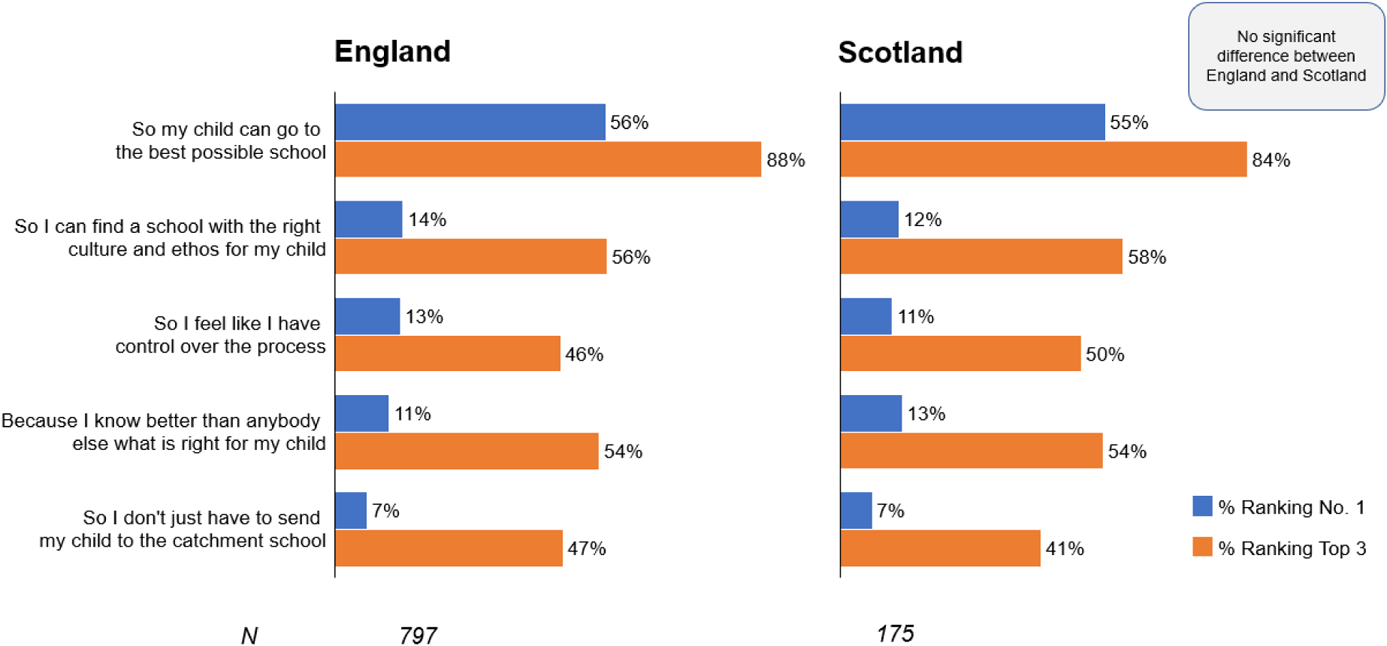
Is this desire for choice intrinsic? In the survey, parents who said that they think choice is important were asked to rank five different reasons for wanting it, drawn from factors listed in previous qualitative research (figure 2). The clear dominant reason, endorsed by a majority of parents, was to ensure that their child could go to the best possible school (an instrumental reason) – a finding consistent with interviews.
“Why do you feel it is important to have a choice of secondary schools?”

At the same time, 13% of parents in the survey said that having control over the process (the only option not to refer to the outcome of choice) is their main reason for wanting school choice, more important than the consequences in terms of the school it allows them to choose. Thus, for a small minority, the desire for school choice appears to be primarily motivated by intrinsic reasons. Moreover, just under half of parents in both countries put the desire for control in their top three reasons. 95% ranked it in their top five, though the survey instructions explicitly stated they should not “rank answers that do not apply”. Even allowing for the possibility that some respondents may have misunderstood these instructions, these results suggest a desire for control is part of many parents’ reasons for wanting choice, even if it is not as prominent a consideration as getting into a better school.
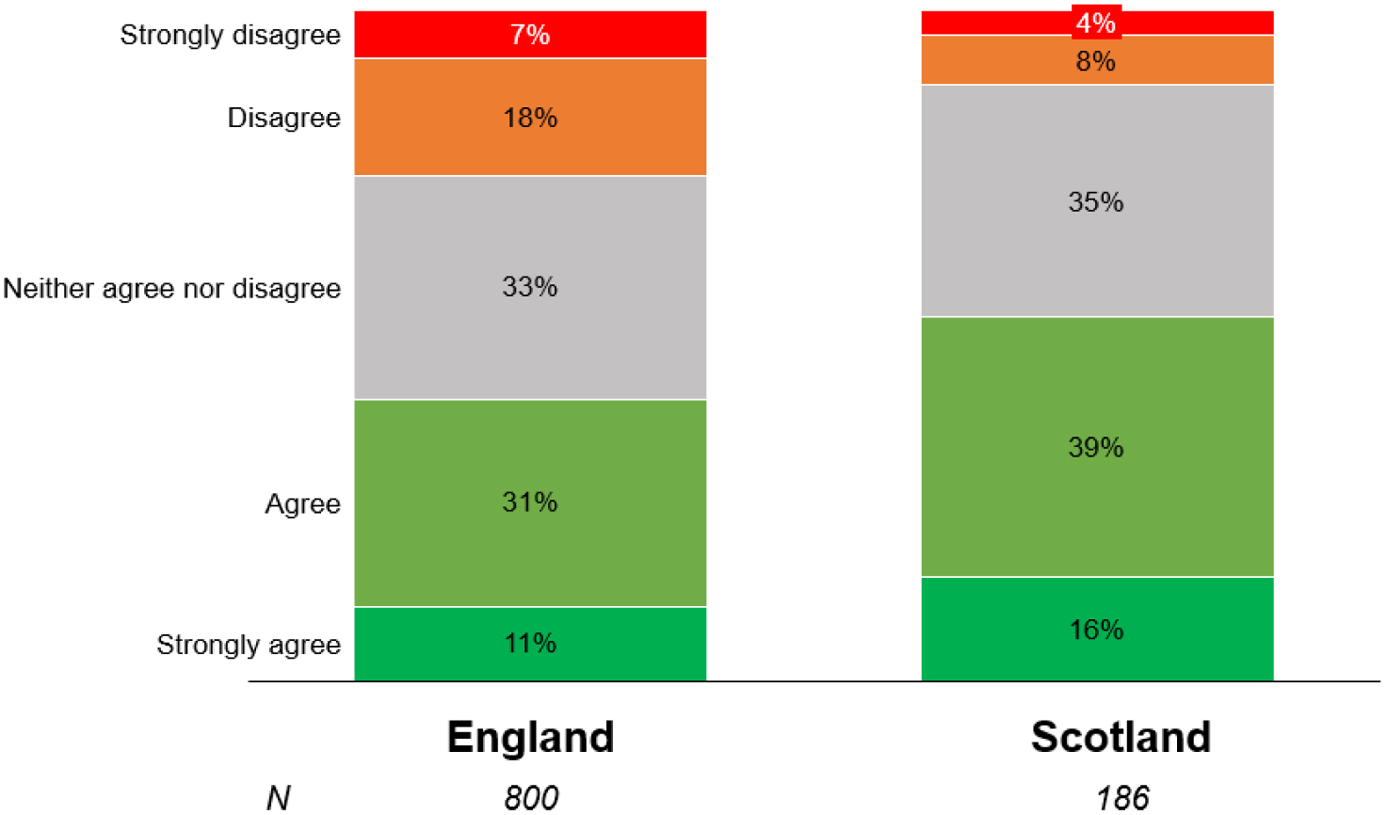
Another relevant survey question asked whether parents would still care about having choice even if they were guaranteed to get into a “reasonably good school” (note: not necessarily the best possible school). In other words, if they were guaranteed a positive (though not ideal) outcome, would they still care about the process by which that outcome was reached? Under such circumstances, 25% of English parents and 12% of Scottish parents insisted they still would want to choose (figure 3). There is reason to think that at least some of these parents are motivated by intrinsic reasons. In interviews some described the value of choice as an opportunity to ‘rubber stamp’ their allocated school – to feel like they have some influence or responsibility, even if they do not alter the final outcome.
“If I knew my child would get into a reasonably good school anyway, I wouldn’t care about having a choice”

More typical, though, are views like Amy’sFootnote 4 from Ipswich: “if I was happy for [daughter] to go to my catchment school I wouldn’t really care if I had a choice or not”. Particularly in England, parents tend to see school choice as a chore, a necessary evil in order to protect their child’s interests: “It is what it is, has to be done. You can’t ignore it, because if you ignore it then you will just get what you’re given” (Sandra, Ipswich).
Indeed, many parents counterposed the mundane necessity of having to choose against their longing for a society and system where choice would be unnecessary. Such views were strongest among foreign-born parents, contrasting England’s choice-based system unfavourably with the ones they had grown up with: “In France people don’t worry…All schools teach the same things at the same level.” (Brigitte, Camden).
Recall that previous studies have suggested that choice is desired mainly as a ‘right to escape’ undesirable schools. Such claims were broadly consistent with my interview evidence, but less so with the survey responses. A number of parents I interviewed in both England and Scotland did indeed present choice more as a defensive tool to avoid one’s fears more than realise one’s hopes:
“If I wasn’t happy with [catchment school] it would be good to have the freedom to look elsewhere.” (Wendy, mother, Dundee)
“Choice is really important. I’d be really furious if we had to just go to the local school” (Jill, mother, Ipswich)
However, as figure 2 shows, only 7% of parents (with no difference between England and Scotland) said that their main reason for wanting choice was to avoid having to send their children to the catchment school – the least popular of any of the options. While it is possible such responses could reflect social desirability bias, with parents reluctant to be seen as criticising their local school, it is worth emphasising that the surveys were online and anonymous and that I encountered no such hesitance in interviews. Combined with the fact that the positive desire to secure a place at the best possible school was the dominant response to that question, this indicates that the wish merely to escape unwanted schools is not in most cases the primary motivation for school choice.
Overall, these results produce a picture that suggests a minority (perhaps between a fifth and a third in England, and somewhat lower in Scotland) of parents care strongly about the intrinsic value of school choice. For the rest, their desire for choice is mostly instrumental, though they may see some small intrinsic value in choosing a school.
Do parents feel satisfied with and empowered by the level of choice that they have?
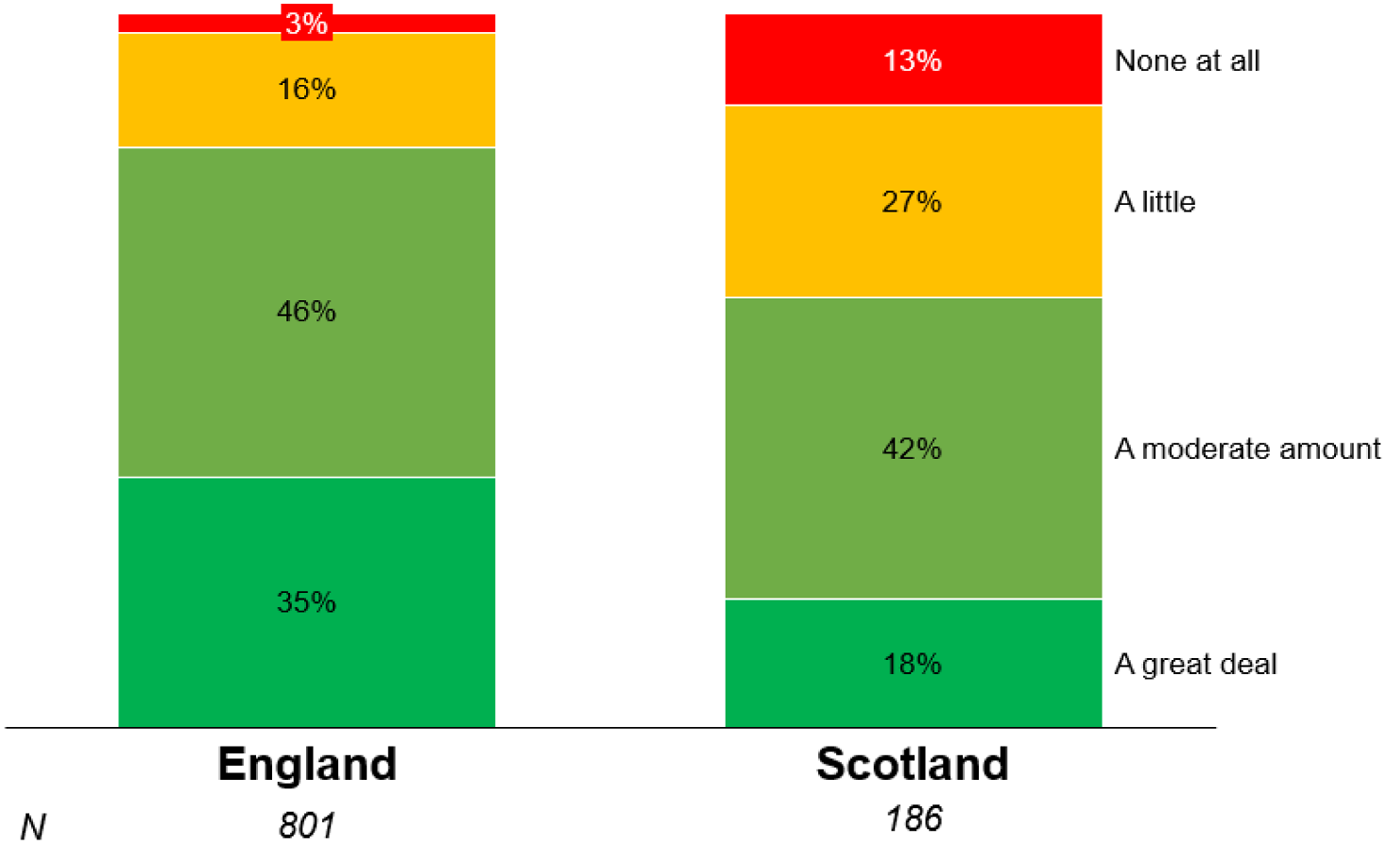
The vast majority of parents – 97% in England and 88% in Scotland – say that they had at least some choice of secondary schools. However, as figure 4 shows, parents in England are more likely to say they had a great deal of choice (35% vs 18% in Scotland) or at least a moderate amount (81% vs 60%).
“How much choice do you think you had over your child’s secondary school?”

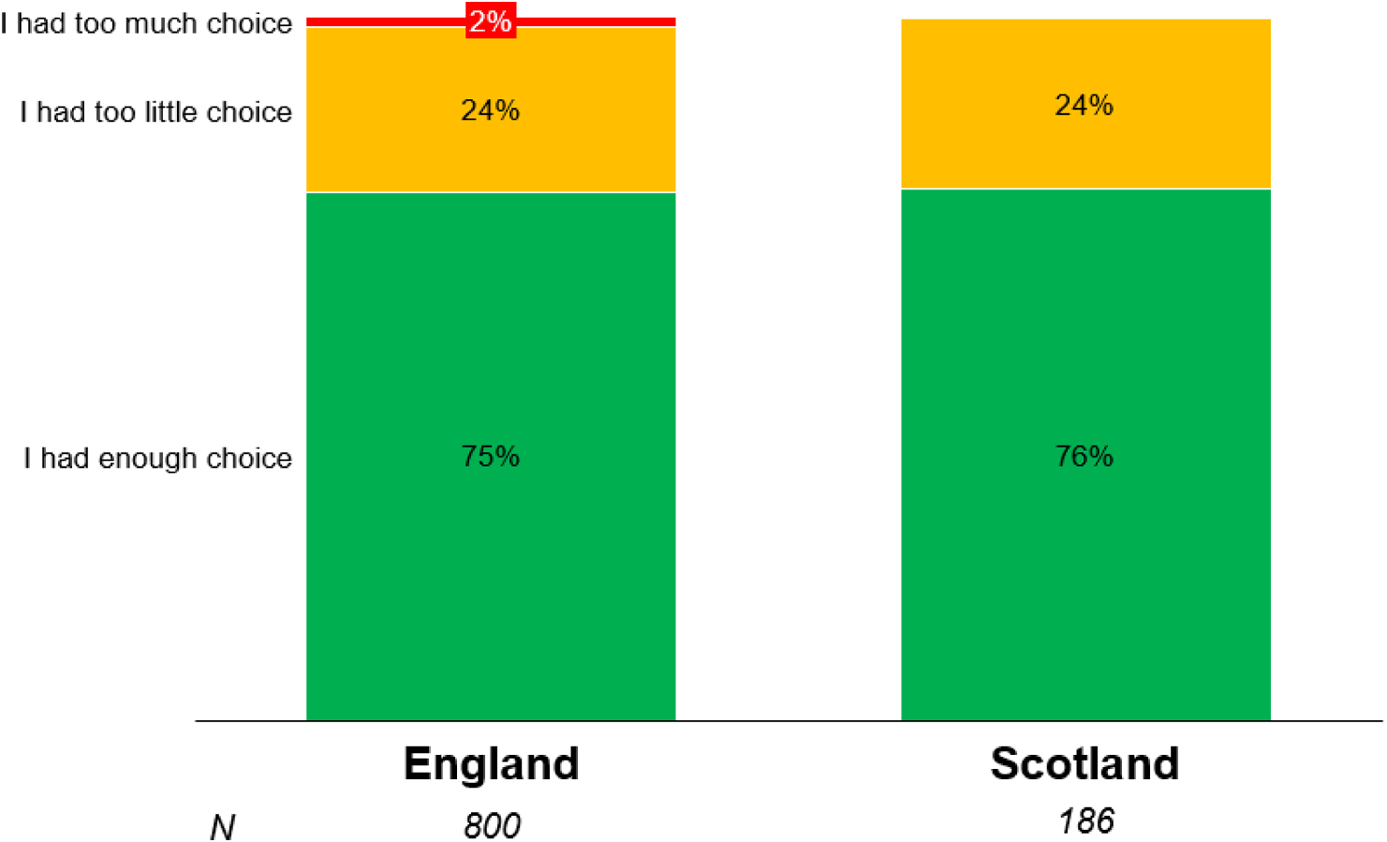
Yet even though English parents perceive a greater level of choice than their Scottish counterparts, parents in both countries are equally satisfied with the amount of choice that they have. The proportion of parents that say they have enough choice is near identical: 75% in England and 76% in Scotland, as figure 5 illustrates.
“How satisfied are you with the amount of choice you had?”

As in the survey, most interview participants were positive about the level of choice they have. Yet the interview format allowed them to develop and explore these thoughts in greater depth. Given this space, English parents that initially claimed to be satisfied expressed greater ambivalence and uncertainty, and those English parents that were explicitly dissatisfied displayed greater frustration.
While most parents I interviewed – on both sides of the border – felt they had some choice over their children’s schooling, they were hardly effusive about the sense of empowerment this brought. In general, they had to be prompted to consider the notion of empowerment rather than raising it spontaneously:
“Empowering? I suppose it is a bit.” (Ingrid, mother, Scotstown)
“There was something empowering about it I suppose. I suppose when you’re making the decision you’re empowered with that decision.” (Charlotte, mother, Camden)
On the other hand, those that found school choice disempowering laid out their frustration in the strongest terms. Contrary to the best hopes of policymakers seeking to empower parents, their remarks reflected fatalism and despondency:
“it doesn’t feel like choice, I don’t feel like we got a choice, we’ll get what we’re given, however much we want something else.” (Ruth, mother, Camden)
“I don’t really feel you’re in control of much at all.” (Graeme, father, Camden)
Among English parents in particular, there was a widespread sense that choice is not meaningful or genuine because their applications may be rejected. A common trope is that school choice is fundamentally about impression management, an attempt by the authorities to ‘trick’ people into believing they have a say. Jane, in Ipswich, believes that “Ostensibly you have a choice, but really when you weigh everything up you don’t”. Multiple participants described choice as an “illusion”.
Some Scottish families expressed a similar sense of disempowerment, but such sentiments were almost exclusively limited to those that made placing requests. Daphne in Scotstown described herself as “helpless, basically”. Lizzie in Edinburgh said “it’s completely out of our hands. We are powerless to those decisions”.
While the survey results paint a fairly positive picture of school choice in Scotland and England, telling us most parents are satisfied with the level of choice that they have, the interviews findings are less rosy. They indicate that satisfaction tends to be experienced as the absence of frustration, rather than an active sense of empowerment. Moreover, for those families dissatisfied with their level of perceived choice, the process is experienced as deeply disempowering. In sum, choice is only felt to be moderately good for those that are satisfied with the status quo, and extremely bad for those who are not.
The survey also indicates that while English parents feel they have more choice, Scottish parents are no less satisfied with the level of choice that they have. The interview findings go further and indicate a deeper level of frustration and disempowerment in England than Scotland.
Why are Scottish parents equally satisfied with less perceived choice?
There are several possible explanations for these findings that Scottish parents feel equally, if not more satisfied and empowered, despite having ostensibly less choice.
First, Scottish parents may value choice less than English parents. As we saw in figure 1, English parents are more likely to say that having a choice of schools is ‘very’ important to them. In interviews, choice seemed to be less salient as an issue to parents in Scotland. Figure 6 offers some support for that theory, showing that those who say school choice is only ‘somewhat important’ (of whom there are more in Scotland) are slightly more likely to say that they are satisfied with their level of choice than those who say it is ‘very important’.Footnote 5
“How satisfied are you with the amount of choice you had?” by strength of desire for choice

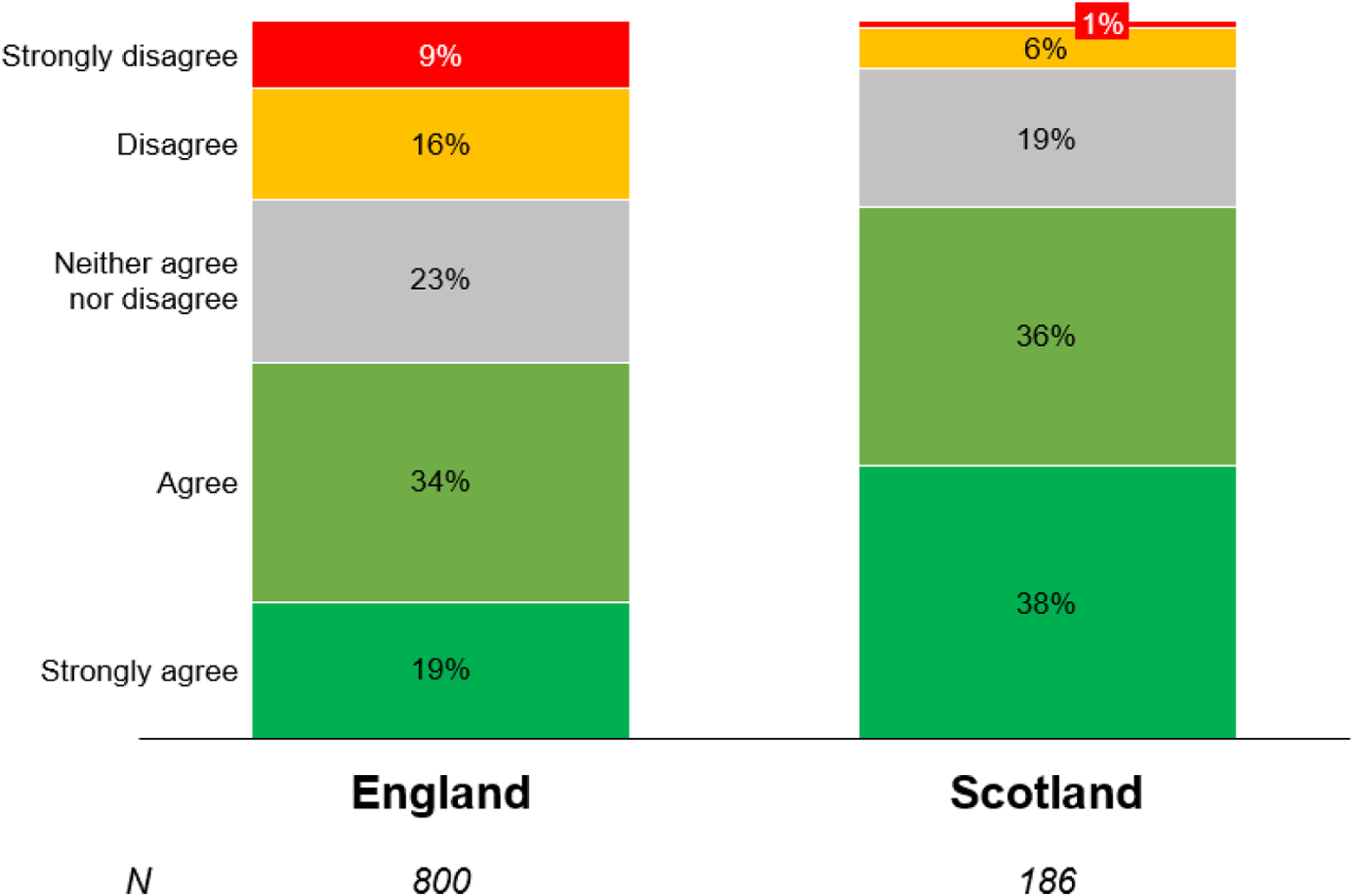
Second, relatedly (this may be one reason why Scottish parents care less about choice), Scottish parents are more content with their catchment schools. Figure 7 shows that 73% of Scottish parents say they are happy for their child to attend their catchment school, and only 8% say they are not. By contrast, though a majority of English parents say they are happy for their child to attend their ‘nearest/catchment’ school (I left it to parents to interpret for themselves what this means since English children are not officially zoned for a particular school), this endorsement was less full throated (19% vs 33% strongly agree). Moreover, a quarter of English parents would not want their child to attend their nearest or catchment school.
“I would be happy for my child to attend the nearest/catchment secondary school”

However, the survey does not support the claim that parental satisfaction with their catchment school explains satisfaction with school choice. Figure 8 plots the two against one another, and while there does appear to be a positive relationship, it falls well short of statistical significance.
Proportion of parents that say they had enough choice by agreement with the statement “I would be happy for my child to attend the nearest/catchment secondary school”

Third, it could be that the level of formal choice in Scotland reaches an adequate threshold that is high enough for most families. Conversely, this would imply that the level of formal choice in England goes above and beyond what families want. Indeed, many of my Scottish participants made just such an argument – that the balance in Scotland is just right, with most students expected to attend their catchment school, but with the option to make a more active choice available for those who want it:
“I think it’s good that we get a school. You know that the option’s always there, if for some reason you really didn’t want your child to go to that school, you could put in a request for them to go elsewhere.” (Sarah, mother, Dundee)
As we have seen, there were parents in England, too, that expressed doubt over whether so much choice is necessary. When I described the Scottish system to them, a number of parents in England preferred it. For example, James in Camden described the English system as “bonkers” and saw the Scottish approach as more rational: “There is a default assumption that you go to your local school? That makes so much more sense, right?”
Fourth, the efficacy of choice. English families are more likely to have an unsuccessful school application. Recall that in Scotland, 13% of families make a placing request each year and that around 80% of these placing requests are granted. That implies that nationally only 3% of Scottish families apply for a school place and do not receive it. By contrast, in the whole of England, 17% of students fail to get a place at their first choice secondary, implying six times as many families endure an unsuccessful application as in Scotland (Department for Education, 2019a).
Understandably, the less likely families are to get into the school of their preference, the less meaningful they feel their choice is. Being invited to make a choice and then receiving something altogether different is a recipe for frustration and disempowerment. As Michael in Camden puts it, “in times of stress I was really annoyed by how as soon as you were presented by a choice you might not get into I really suddenly started to care”.
Fifth, uncertainty. The vast majority of parents in Scotland do not make an application and so know well in advance exactly which school their child will attend. By contrast, since every parent in England has to make an application, every parent potentially faces rejection. Moreover, since the English system involves applications to multiple schools, there are many more potential possible outcomes.
This uncertainty contributes to a lack of perceived control. A number of interview participants compared school choice to a ‘gamble’ or ‘lottery’, characterising it as a matter of chance rather than something they control:
“the lottery part of it is that you put your choices down and then the authorities would choose according to their criteria.” (Harry, father, Ipswich)
“I wouldn’t say we’re spoilt for choice because it is a bit of a lottery.” (Francesca, mother, Camden)
Sixth, the gap between the rhetoric and reality of school choice. In England, choice is valorised and encouraged by the central government, local authorities and schools, whereas Scottish institutions tend to play it down. That may heighten frustrations when families feel they cannot get a place at the school they want. Yvonne in Camden makes exactly such a claim, signalling her irritation at the apparent false promises:
“I find it really annoying when schools and government talk about choice because one thing I’ve learnt from this is that there is virtually no choice at all.”
Similarly, Jack in Ipswich makes a point of stressing how far his experiences are from the “freedom of choice” he is meant to be entitled to:
“you’re supposed to be getting this freedom of choice, but have we really? And that’s the tricky thing about it really is like you can choose one of these three. ‘OK, I want that one’. ‘You can’t have that one’.”
Conclusion
The case for school choice policies has never been solely about improving educational outcomes, but also empowering parents and giving them what they want. Yet until now, such arguments have received minimal empirical scrutiny. In this paper, I have compared the attitudes and experiences of parents in England (which has actively promoted school choice) and Scotland (which has tended to play it down). In both countries I found that the overwhelming majority of parents do want to choose their schools. Typically, this desire is mostly instrumental: parents want choice because they think it will lead to better outcomes for their children. For a significant minority, though, it does appear to be intrinsic, motivated by a desire to have control over their child’s school allocation.
I have found little evidence to suggest that the school choice policies pursued in England have had much success in engendering this sense of control. In fact, in my interviews English parents were more cynical, fatalistic and disempowered than their Scottish counterparts. I have suggested six possible reasons why greater formal choice in England has not led to higher satisfaction. Two of these relate to differences in attitude: Scottish families place less value on choice and are more likely to be contented with their local catchment school. It should be noted, however, that such attitudes may be shaped or influenced by policy, responding to signals from government about how families ought to behave in the educational market. The other four explanations relate directly to policy: the level of choice offered in England goes ‘above and beyond’ what many families want or expect, whereas Scottish system offers just enough choice for most; the ‘efficacy’ of choice (the expected success of applications) is lower in England; choice carries greater uncertainty for English families; and the rhetoric in England seems to raise expectations above what is delivered.
This evidence that school choice policies in England have done little to create intrinsic value, combined with the existing evidence of their limited impact on educational outcomes, casts doubt on the idea that governments should seek to increase school choice as a policy objective. In that sense, these findings are an endorsement of the Scottish approach. It does not necessarily follow, however, that English policymakers should try to ‘roll back’ school choice. Having created such high expectations, it may be that families resent anything that feels like choice being ‘taken away’ from them.
A more pragmatic approach would be to address the causes of frustration with school choice. Policymakers could take steps to try and increase the efficacy of school choice, reducing the number of unsuccessful applications, for example, creating more school places, particularly at the most popular schools. They could also do more to reduce the uncertainty around school choice. For example, they could explicitly guarantee children a place in at least one secondary school, most likely their catchment school, even while keeping the requirement to express a formal preference.
Either way, it seems clear that school choice has failed to bring the benefits its most optimistic supporters promised. A new approach may be necessary to help those families left to navigate the system that remains.
Acknowledgements
This research was supported by an Economic and Social Research Council studentship. I am grateful to all the parents who gave up their time to participate in the research. Thanks to everybody I discussed this research with at various points, and, in particular, to Tania Burchardt and Julian Le Grand for their advice and guidance.
Competing interests
The author declares none.