WHY ARE NICHE PARTIES LESS RESPONSIVE TO PUBLIC OPINION SHIFTS?
A landmark finding in recent research on party competition is that parties differ in how they react to public opinion shifts.Footnote 1 In their influential study, Adams et al.Footnote 2 find that niche parties – which they define as communist, green and radical-right parties – fail to track changes in the median voter position, while other (mainstream) parties do respond to such changes. They do not argue that something inherent to these three party families makes them less likely to follow changes in the median voter position. Instead, they suggest that these party families tend to prioritize policy over office and tend to be activist led, which explains why they do not track the median voter. In this research note, we replicate and extend their analysis but replace their simple dichotomy based on party families with the party differences that they argue drive the pattern they find: party goals and party organization. We also add a third aspect of niche parties not alluded to by Adams et al.,Footnote 3 party ideology, specifically the extent to which parties focus on niche issues. All three of these mechanisms may contribute to the pattern they found. Our analysis examines how these three aspects of parties act as mechanisms connecting median voter change to party policy change and thereby contributes to the ongoing scholarly debate over which party characteristics drive party responsiveness to voters.
Following Adams et al.,Footnote 4 the first mechanism that explains why some parties fail to track the median voter is that they are more policy seeking than others: they prioritize their policy objectives over winning votes or gaining office. Adams et al.Footnote 5 suggest that this mechanism represents an underlying difference between niche parties and other parties. They also argue that niche parties have a longer time horizon concerning the goals they wish to achieve, as their aim is to build the party up over the long term rather than maximize support in the next election. The policy focus of some parties explains why they do not respond to voter shifts, since their aim is not to increase support per se, but to increase support for implementing their policy goals. Prioritizing electoral gains over policy aims would challenge their raison d’être. Hence, we would expect policy-seeking parties to be less likely to track shifts in median voter positions than vote- and office-seeking parties (Hypothesis 1: policy seeking).
The second mechanism is that some parties are more hamstrung by their activists. Adams et al.Footnote 6 cite KitscheltFootnote 7 and D’AlimonteFootnote 8 to claim that ‘niche parties’ activists are strongly policy oriented and are therefore highly resistant to ideological “compromises” in their party’s policies’. According to this view, niche party elites stick with their policy proposals in order to avoid demobilizing activists and damaging the party’s reputation for competence and reliability. In other words, activists in niche parties have a strong influence on party policy, which limits party elites’ ability to shift positions in line with the median voter. Related research shows that parties whose leaders are chosen by rank-and-file members or whose activists have greater influence are less likely to follow the median voter position and more likely to track their own supporters’ views.Footnote 9 Our second hypothesis is thus that parties with a strong activist base are less likely to track shifts in median voter positions than parties with a strong leadership (Hypothesis 2: activist influence).
Finally, and going beyond the arguments made by Adams et al.,Footnote 10 parties differ in their programmatic profiles, specifically in the distribution of emphasis in their policy programmes. Thus building on Meguid,Footnote 11 scholars suggest that some parties have narrower issue appeals than others;Footnote 12 these parties have also been termed niche parties, though the definition differs from that put forward by Adams et al.Footnote 13 While mainstream parties tend to address various issues and topics, niche parties focus on one or two key areas, such as immigration, decentralization or the environment, and additional issues are clearly considered secondary. A niche issue focus should also make parties less likely to follow the median voter on a general left–right dimension. For one, such parties will mostly be interested in their core issue and will therefore pay less attention to public opinion change on the broader left–right dimension. Moreover, ignoring median voter change is unlikely to be costly for these parties, as their reputations are built on their distinctive emphasis and clear position on otherwise secondary issues. Since their electoral success is not built on proximity to the median voter, they have little incentive to follow public opinion, especially on a general left–right dimension. Overall, we expect that parties with a niche issue focus are less likely to track shifts in median voter positions than parties with a broader issue focus (Hypothesis 3: ideological nicheness).
We therefore identify three reasons why niche parties may fail to update their policy programmes in line with changes in median voter preferences. Adams et al.Footnote 14 used a simple binary indicator based on party families in their analysis, and an empirical correlation between the mechanisms we identify could provide some justification for this decision. However, this empirical correlation remains debated, and the assumption that a dichotomous indicator sufficiently captures party differences is a strong one. Moreover, while LehrerFootnote 15 shows that communist, green and radical-right parties all give activists key internal power, Schumacher, Vries and VisFootnote 16 argue that many radical-right parties, for instance the Front National, are leadership dominated. We provide evidence on the empirical correlation between our mechanisms below.
Even if there are empirical correlations between the mechanisms, it is important that these three party characteristics can vary independently of each other at least in principle. For example, activists are not necessarily opposed to tracking changes in the preferences of the median voter. Adams et al.Footnote 17 argue that activist influence is only a hindrance to vote-seeking strategies if party activists are particularly focused on policy seeking. Parties with a strong activist influence could still track the median voter if activists also endorse vote-seeking strategies. As KitscheltFootnote 18 points out, it is actually quite common for activists to be vote seeking.Footnote 19 He cautions against assuming that activists and leaders must have opposing goals, and argues that leaders can sometimes be stubborn policy seekers, while activists can sometimes support vote-seeking compromises. Hence, activist influence might not be a likely mechanism underlying the pattern found in Adams et al.Footnote 20 To take a second example, parties with a narrow issue focus need not necessarily be more policy seeking than other parties. In fact, in the past catch-all parties such as social democratic parties were characterized by high policy stability.Footnote 21 Hence, our aim is to establish the distinct influence of each mechanism – policy seeking, activist influence and narrow issue focus – on the phenomenon uncovered by Adams et al.;Footnote 22 in doing so, we go beyond existing research on some of these mechanisms.Footnote 23 We begin by describing how we measure each mechanism.
MEASURING THE MECHANISMS
We measure policy seeking and activist influence using the expert survey data collected by Laver and Hunt.Footnote 24 This data were collected in 1989 and asked experts from each country to assess party positions and party characteristics. To assess policy seeking, experts were asked to rate the extent to which each party prioritizes policy over office. The precise question posed to experts was: ‘Forced to make a choice, would party leaders give up policy objectives in order to get into government or would they sacrifice a place in government in order to maintain policy objectives?’ The original scale ran from 1 to 20; we reverse the scale so that ‘1’ indicates maximum willingness to prioritize office and ‘20’ maximum willingness to prioritize policy. This scale has also been used in recent research by Pedersen.Footnote 25
To assess activist influence, the same experts were asked to rate the influence of activists and the leadership on party policy, using two scales again ranging from 1 to 20. The first scale asked experts to assess the power of the party leadership, the second that of party activists, with 1 indicating ‘no influence at all’ and 20 ‘great influence’. We create a scale by subtracting leadership influence from activist influence, in line with recent research by Schumacher, Vries and Vis,Footnote 26 Wagner and Meyer,Footnote 27 and Schumacher.Footnote 28 The combined scale ranges from −15 to 7.3, with higher scores indicating greater activist influence and a score of 0 indicating equal influence.Footnote 29
Unfortunately, the Laver-Hunt measures are only available for one timepoint, while the Adams et al. data cover the period until 1998. Thus changes in party organization might have occurred that are not reflected in the Laver-Hunt measures. However, the measures are arguably still far more nuanced than the basic binary niche–mainstream dichotomy employed by Adams et al.Footnote 30 Moreover, it has been noted that party organization is relatively stable over time.Footnote 31 While later measures of activist influence have been developed,Footnote 32 these assessments refer to time periods well after 1998, when the Adams et al. dataset of median voter positions ends. LehrerFootnote 33 provides evidence on the influence of activists using leadership selection mechanisms, but our measure provides a broader assessment of activist influence;Footnote 34 moreover, Lehrer argues that his measure is intrinsically related to policy-seeking party motivations. Like Schumacher, Vries and Vis,Footnote 35 we therefore believe that these two measures provide the best information we have on party goals and party organization for the period studied by Adams et al. (1976–98).Footnote 36
To measure a party’s niche issue focus, we use Bischof’s measure.Footnote 37 Bischof suggests that niche parties are best understood as (a) predominantly competing on market segments neglected by their competitors and (b) addressing only a narrow range of these segments. His measure builds on Wagner’sFootnote 38 and Meyer and Miller’sFootnote 39 work but introduces an explicit measure of the narrowness of party platforms and derives specific niche segments measured based on manifesto project data.Footnote 40 One key difference compared to the measure suggested by Meyer and MillerFootnote 41 is that, like Wagner,Footnote 42 Bischof argues that niche parties by definition do not compete on economic issues. We use his methodological approach to estimate the nicheness of all parties included in Adams et al.’s study, hence using the same manifesto data Adams et al. use to estimate left–right positions. Bischof derives two measures to empirically assess the nicheness of parties. First, based on standard deviations of issue salience, he measures how neglected a party’s issue profile is by its competitors.Footnote 43 Secondly, building on Shannon’s entropy, he measures how narrow a party’s issue profile is.Footnote 44 Finally, he combines these two measures in an additive index, with higher values indicating a higher ‘nicheness’ party profile. Because his measure allows parties to change over time, it is more useful than approaches that simply code party families as either having niche issue emphases or not.Footnote 45 For example, communist parties mainly compete on economic issues, albeit often by placing themselves on the extreme left. In contrast to Adams et al., Bischof therefore suggests that communist parties should in most instances be understood as mainstream parties rather than niche parties.Footnote 46 Figure 1 shows a boxplot of nicheness values across party families for the sample used in Adams et al.Footnote 47 Note that, using Bischof’s measure, communist parties’ nicheness tends to be comparable to traditional mainstream party platforms (for example, liberal and conservative parties). A t-test reveals that there is no statistically significant difference in the mean levels of Bischof’s nicheness measure for Adams et al.’s niche and mainstream parties.Footnote 48 In addition, there is only a very weak correlation between Bischof’s nicheness measure and the party goals and organization measures derived from the Laver and Hunt studies.Footnote 49 These weak correlations suggest that Bischof’s measure is not only conceptually distinct from Adams’ measure, but also appears to empirically measure distinct party characteristics that are not directly captured by any of the other measures we employ.Footnote 50
Boxplot of nicheness (Bischof) by party family, 1976–1998 Source: Manifesto Project (Budge et al Reference Budge, Klingemann, Volkens, Bara and Tanenbaum2001; Klingemann et al. Reference Klingemann, Volkens, Bara, Budge and McDonald2006).

MODELS AND RESULTS
Our analyses use the data presented in Adams et al.Footnote 51 and subsequently also extend their analysis up until 2015. The data are mostly derived from manifesto project dataFootnote 52 and include parties in eight Western European countries across approximately twenty years (1976–98).Footnote 53
To measure party positions, Adams et al. use the general left–right scale (rile) provided in the manifesto project data; for voter positions, they use average left–right placements as reported in the Eurobarometer surveys. They control for parties’ policy shifts in the previous election (the lagged dependent variable), parties’ previous vote share change, as well as the interaction between the two variables. We specify the same model as outlined in Adams et al.:Footnote 54
 $$\eqalignno{ \Delta p_{{jt}} \, &{\equals}\,b_{0} {\plus}b_{1} \left( {\Delta v_{t} } \right){\plus}b_{2} \left( {{\rm Niche}} \right){\plus}b_{3} \left( {\Delta v_{t} {\times}{\rm Niche}} \right) \cr & \quad{\plus}b_{4} \left( {\Delta p_{{jt{\minus}1}} } \right){\plus}b_{5} \left( {vs_{{jt{\minus}1}} } \right){\plus}b_{6} \left( {\Delta p_{{jt{\minus}1}} {\times}vs_{{jt{\minus}1}} } \right){\plus}{\rm CountryFE{\plus}}{\varepsilon}_{{jt}} , $$
where p is the position of the party, v is the median voter position, Niche is a dummy capturing a party’s niche–mainstream status, vs is the party’s vote share, j is the party and t is the election. In the subsequent models, Niche is replaced by the three measures outlined above to test the three mechanisms we proposed in the previous section.Footnote 55 To account for the specific panel structure of the data, we follow Adams et al. and rely (as noted above) on a lagged dependent variable (∆p jt−1), introduce country fixed effects and cluster standard errors by election to control for autocorrelation, country-specific factors and contemporaneous correlation, respectively.
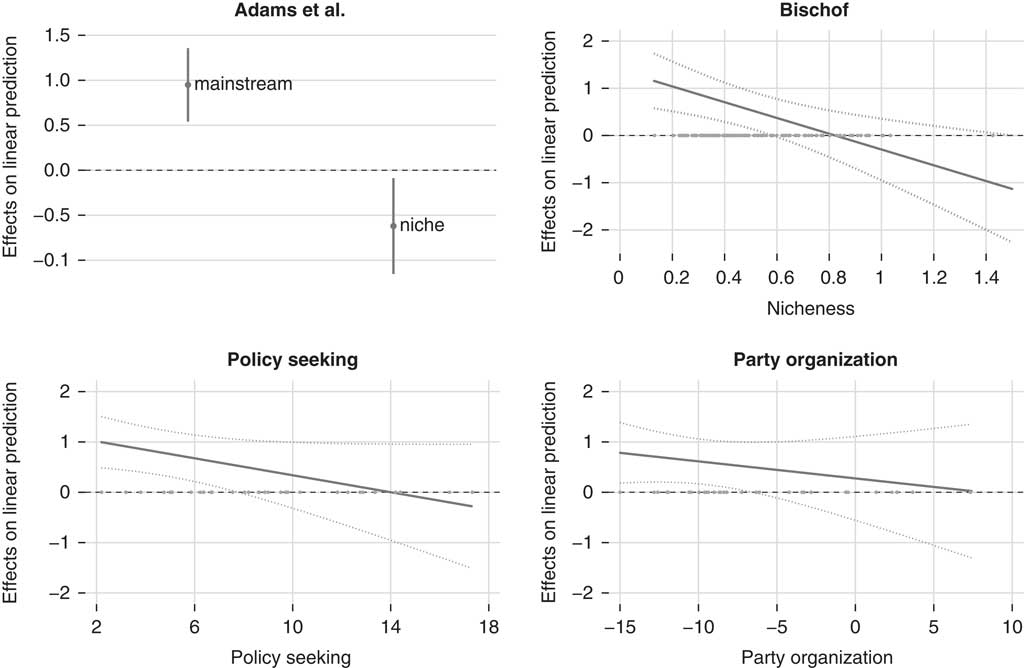
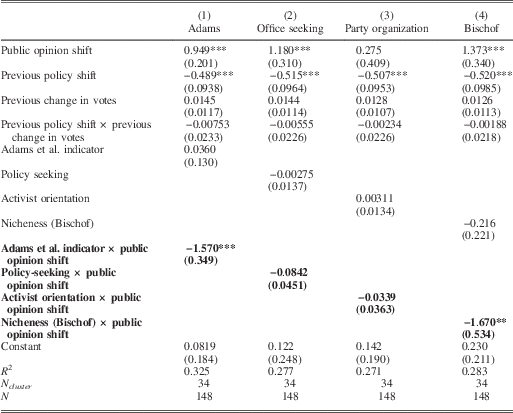
We present the full results of each model in Table 1 (Columns 1–4). To ease interpretation of the interaction terms, we present the marginal effects of each interaction to correctly interpret the fully specified effect of our interactions in Figure 2.Footnote 56 The figure shows that the various measures all have similar substantive effects: mainstream parties, office-seeking parties and parties with a broad issue focus are more likely to follow the median voter, while niche parties, policy-seeking parties and those with a narrow issue focus fail to respond to the median voter. At the same time, we only find statistically significant effects at the 0.05 level for the Adams et al. and Bischof models, though the interaction effect for the policy-seeking model is significant at the 0.1 level as well.Footnote 57 The marginal effects plots reveal that the slopes of the interaction between the activist and policy-seeking variables are flatter than for the Bischof model. Furthermore, both interactions are not significant for most empirically observed values of the policy-seeking and party organization measures, respectively. Thus we find some evidence supporting the policy-seeking hypothesis and very weak evidence for the activist influence hypothesis, while we find clear evidence for the ideological nicheness hypothesis.Footnote 58
Marginal effects of interactions Note: estimates based on Table 1. Reported are marginal effects with 95 per cent confidence intervals (whiskers/dotted lines).

Party Characteristics and Positional Shifts

Note: clustered standard errors by election. All models include country fixed effects omitted from table. *p < 0.05, **p < 0.01, ***p < 0.001
Since Bischof’s measure is also two dimensional – measuring issue nicheness and issue specialization in a single index – we conducted further analyses, reported in Appendix Table A.5. In this analysis, we split Bischof’s measure and estimate the effect of both nicheness and specialization on parties’ responsiveness to public opinion shifts. Both measures report a negative interaction with public opinion shifts. However, only the interaction between parties’ nicheness and public opinion shifts is statistically significant at conventional levels. Thus it appears to be more important that a party occupies an ideological niche than that it is ideologically specialized; focusing on non-economic issues neglected by competitors more strongly conditions party left–right responsiveness to the median voter than specializing on a small set of these issues. In sum, employing Bischof’s measure lends support for our theoretical suggestion that parties with a niche issue focus are less responsive to the median voter. As suggested in our theoretical discussion, parties with a strong focus on niche issues might feel less obligated to adapt to mean voter preferences on the general left–right scale as a means of ensuring electoral success.
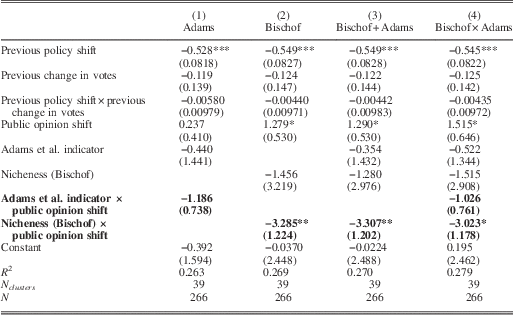
Finally, Table 2 reports the findings for an extended time series (1976–2015), almost doubling the period and cases covered. We do not include the Laver-Hunt expert survey measures in these models since extrapolating from 1989 assessments to today is questionable. In these models, the simple niche party dichotomous variable used by Adams et al. no longer shows a conventionally significant interaction with public opinion shifts, though the effect continues to be in the right direction. There is a moderating effect for nicheness as measured by Bischof even when we also control for the Adams et al. niche party indicator as well as its interaction with public opinion shifts. Further analysis reveals that the difference in nicheness (as measured using Bischof’s approach) between Adams et al.’s mainstream and niche parties increased substantially in the extended period, a development which is not captured in the categorization based on party families.
Nicheness Models Extended, 1976–2015

Note: clustered standard errors by election. All models include country fixed effects omitted from table. *p < 0.05, **p < 0.01, ***p < 0.001
The Substantive Effect of Party Characteristics
To enhance our understanding of the substantive effect of our results, we estimate simulations of counterfactual scenarios.Footnote 59 The regression results (specifically the coefficients and standard errors) reported in the last section rely on the number of observations included in our analysis. Yet, reporting regression results as point estimates (as in Table 1) or calculating derivatives (as in Figure 2) ignores the estimation uncertainty stemming from the fact that we observe fewer than an infinite number of observations.Footnote 60 In contrast, simulations allow us to estimate, report and investigate more carefully the uncertainties associated with our regression estimates.Footnote 61
The Front National in 1993 is a useful example to base our simulations on, since the data report it to be a policy-seeking party with a narrow issue appeal. Furthermore, by choosing an election that is close in time (1993) to Laver and Hunt’s expert survey (1989), we ensure that the policy-seeking variable is closely related to the party’s actual policy-seeking ambitions in 1993.
We simulate several scenarios in which we change the factual characteristics of the Front National to relevant counterfactual scenarios.Footnote 62 To do so we first took 1,000 random draws from a multivariate normal distribution defined by the coefficients and covariance matrix from the regression models reported in Table 1. Secondly, we calculated linear predictions of our dependent variable (party position shift) based on the actual characteristics of the Front National. Thirdly, we changed the party characteristics of the Front National in the various models to reflect three counterfactual scenarios. We varied all three party characteristics to take on the values at the 10th percentile, the median and the 90th percentile.
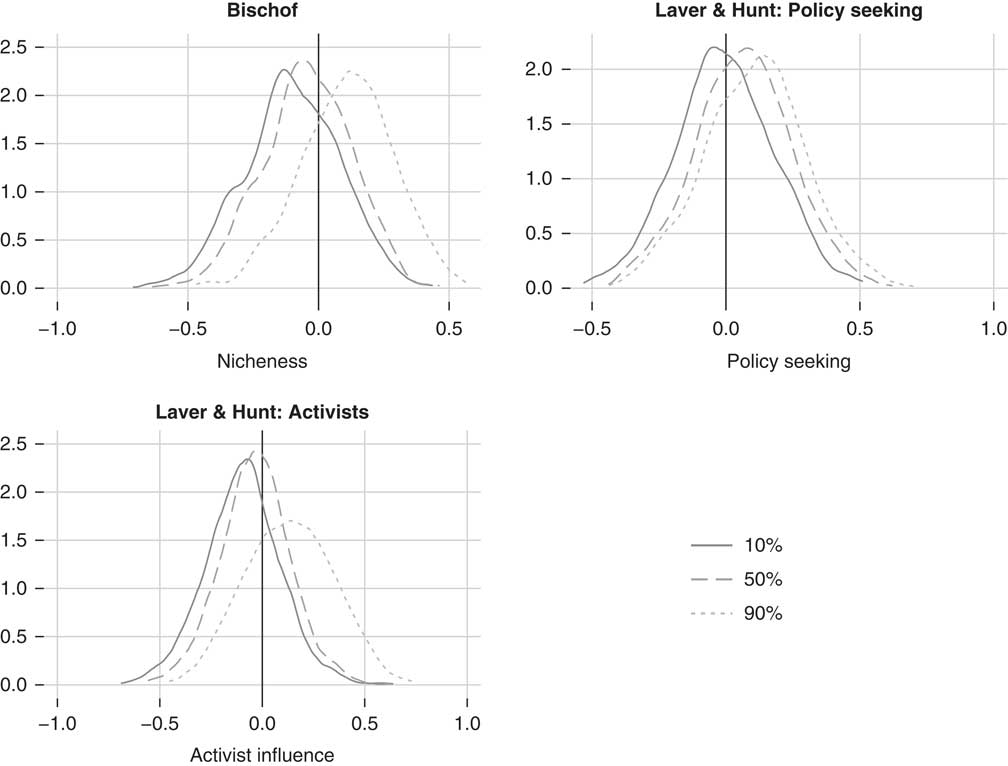
Figure 3 reports the results of these simulations. Public opinion shifted towards the left in France in 1993. Thus a negative prediction in Figure 3 can be interpreted as a responsive shift towards public opinion. In contrast, a positive value on the x-axis in Figure 3 suggests that the Front National shifted away from the public sentiment in France. In the actual data, the Front National shifted away from the median voter and towards the extreme right.
Distributions of simulations for factual & counterfactual nicheness Note: simulations based on 1,000 draws from a multivariate normal distribution defined by the coefficients and covariance matrix reported in Table 1.

The simulations underline the previous result that all three mechanisms affect party position shifts in the theorized direction. Yet it becomes apparent that the magnitude of the effects differs. Changing the variable from the 10th percentile to the 90th percentile has a clear effect for party nicheness, while the differences are much smaller for party goals and activist influence. The distributions for these two variables at the 10th percentile and the 90th percentile largely overlap. A second implication of these simulations is that high levels of nicheness mean that parties move in the opposite direction to the median voter, while policy-seeking and activist-oriented parties are more likely to stay put. This is visible when comparing the positions of the distributions at the 10th percentile, which for party goals and organization more often include 0, which indicates that a party stays put and does not move to the left or the right. Finally, both policy seeking and party organization show somewhat greater levels of uncertainty than Bischof’s nicheness measure. Overall, the simulations again show that nicheness has the clearest moderating effect, while evidence for party goals and organization is consistent with expectations, if weaker.
CONCLUSION
Overall, our results are partly in line with one of the mechanisms proposed by Adams et al.:Footnote 63 there is some evidence that parties that are more policy seeking are less likely to track changes in the median voter position. We also add to their finding by showing that parties focusing on issues neglected by competitors, which is how many researchers now define niche parties, are also less likely to follow changes in the preferences of the left–right median voter. However, we do not find that parties with a stronger activist influence are less likely to track the median voter, though this may partly depend on how accepting of vote seeking this activist base is.Footnote 64
Our findings have implications for the study of party competition. For one, it is useful to see that the simple binary coding by Adams et al.Footnote 65 does to a certain extent capture essential patterns in how parties compete. When replacing their measure with more nuanced ones, we find that all three mechanisms produce similar results in terms of the direction of association, though the findings are strongest and clearest for policy seeking and niche issue focus. At the same time, the empirical and theoretical linkages between party organization and party goals also make it difficult to conclusively isolate the one feature of parties that most strongly drives responses to median voter positions. In a similar vein, LehrerFootnote 66 suggests that the electoral strategies of niche parties differ from those of mainstream parties as they have more inclusive membership structures, which in turn reflect greater policy-seeking orientation. One interpretation of our results is that his findings are driven more by institutionally enshrined policy seeking than by actual activist influence. Since current data availability, especially for measures of party organization, is limited, we would urge future data collection and research that applies the different measures to a broader set of cases.Footnote 67
Even though our results show that binary distinctions between types of parties do capture some aspects of party competition, we should instead strive to include the relevant mechanisms directly rather than rely on simpler measures. Access to relevant data and measures is becoming ever easier; the nicheness measures employed in this article can be easily accessed in statistical software such as RFootnote 68 , while new or extended measures of party organization are available in Schumacher and GigerFootnote 69 and Rohrschneider and Whitefield.Footnote 70 If researchers’ hypotheses suggest that a specific party characteristic underlies strategies, they should try to measure and include that characteristic. Future data collection efforts should do more in this regard, even if doing so is challenging.