Introduction
During the course of Alzheimer's disease (AD), cognitive processes become increasingly impaired, with memory loss a characteristic and early sign of the disorder (Lovestone and Gauthier, Reference Lovestone and Gauthier2001). However, cognitive impairment affects more than memory function, and produces a wide range of other disabling effects, such as language and communication deficits, and problems with concentration, orientation, and praxis. Poor communication can have a particularly profound effect on the lives of persons with AD, as it affects their ability to interact socially, maintain relationships, plan daily activities, and express basic needs and thoughts to those around them. In turn, these deficits progressively limit patient independence.
The inability to convey meaning due to impaired verbal expression and the misinterpretation of non-verbal signs (gestures, expressions, etc) can be frustrating for all parties involved, and can add significantly to the stress and burden of care in AD (Hendryx-Bedalov, Reference Hendryx-Bedalov2000; Savundranayagam et al., Reference Savundranayagam, Hummert and Montgomery2005; Schiaratura, Reference Schiaratura2008; Williams, Reference Williams2011). In the 2005–2006 European Dementia Carer's survey, over one-third of carers cited communication symptoms – including following conversation, comprehension of language, speaking, and reading/writing – as the most troublesome aspect of AD (Georges et al., Reference Georges, Jansen, Jackson, Meyrieux, Sadowska and Selmes2008). Overall, communication problems were reported by 88% of carers, with 74% of patients experiencing difficulties following conversation, 70% having impaired reading and writing, and almost half having problems in speaking and understanding language (Georges et al., Reference Georges, Jansen, Jackson, Meyrieux, Sadowska and Selmes2008).
Here we discuss the issues surrounding an under-appreciated and under-studied domain of dementia – functional communication and language. In particular, we consider the occurrence, presentation, and impact of dysfunction in these areas, as well as the available management options according to the published literature. The well-recognized language-onset variant of AD (“logopenic aphasia”) is beyond the scope of this review, which focuses on language and communication changes in patients with the most common forms of AD. The distribution of pathology in patients with logopenic aphasia may overlap with that seen in patients with AD and functional communication deficits, as it may in other AD subtypes, such as those with excessive clinical frontal features (Woodward et al., Reference Woodward2010). Therefore, therapies that improve language and communication in those with AD may also improve these features in patients with logopenic aphasia, but at present this is purely speculative.
Communication in the progression of disease
In most patients with AD, cognitive symptoms, such as memory loss and language deficits, appear early and continue to worsen over time. These are followed by functional and behavioral symptoms (Lovestone and Gauthier, Reference Lovestone and Gauthier2001).
Language disturbances experienced by patients with AD include word recall and word-finding difficulties, and revisions and repetition during speech (Bayles et al., Reference Bayles, Tomoeda and Trosset1992; Weiner et al., Reference Weiner, Neubecker, Bret and Hynan2008; de Lira et al., Reference de Lira, Ortiz, Campanha, Bertolucci and Minett2011). In addition to loss of verbal fluency, reading and writing skills deteriorate, and comprehension and concentration (and, of course, memory) are also affected, which leads to problems with maintaining and following conversation (Bayles et al., Reference Bayles, Tomoeda and Trosset1992; Powell et al., Reference Powell, Hale and Bayer1995; Orange and Ryan, Reference Orange and Ryan2000). Persons with AD also demonstrate decline in non-verbal communication (Glosser et al., Reference Glosser, Wiley and Barnoski1998). Behavior and gestures such as head and hand movements, facial expression, and body posture form a significant part of everyday communication, and impairments in gestural clarity have been shown to correlate with linguistic decline in patients with AD (Glosser et al., Reference Glosser, Wiley and Barnoski1998). Together with the selection of words and phrasing, non-verbal signs help to indicate a person's attitude and emotions, and play an important role in personal interactions (Schiaratura, Reference Schiaratura2008).
As AD progresses, the gradual emergence of language and communication issues is usually associated with global cognitive deficits (Blair et al., Reference Blair, Marczinski, Davis-Faroque and Kertesz2007; Weiner et al., Reference Weiner, Neubecker, Bret and Hynan2008). Language problems have been detected in the earliest stages of AD, and appear to correlate with disease severity (Forbes-McKay and Venneri, Reference Forbes-McKay and Venneri2005; Blair et al., Reference Blair, Marczinski, Davis-Faroque and Kertesz2007). These observations have led to language decline being suggested as both an early sign to be used in the differential diagnosis of AD (from mild cognitive impairment) and as a means of measuring disease progression (Forbes-McKay and Venneri, Reference Forbes-McKay and Venneri2005). A high level of verbal impairment in early-stage AD has even been shown to predict mortality (Cosentino et al., Reference Cosentino, Scarmeas, Albert and Stern2006).
In early AD, communication issues center on problems with word finding/naming and subtle conversational skills, including descriptive ability (Bayles et al., Reference Bayles, Tomoeda and Trosset1992; Frank, Reference Frank1994). At this stage, reading, writing, and comprehension remain relatively undisturbed in comparison with healthy elderly individuals (Bayles et al., Reference Bayles, Tomoeda and Trosset1992). As the disease progresses, communication skills decline and extend to include difficulties with functional language use, concept formation, comprehension, and writing, with reliance on syntactic ability (Fromm and Holland, Reference Fromm and Holland1989; Bayles et al., Reference Bayles, Tomoeda and Trosset1992; Frank, Reference Frank1994). The capacity for oral reading appears to remain intact for the longest period, declining only in mid/late dementia (Bayles et al., Reference Bayles, Tomoeda and Trosset1992). In advanced disease, communication problems become even more significant, and are compounded by severe memory and intellectual deficits (Frank, Reference Frank1994). In these later stages, articulation may also be affected, and patients eventually exhibit almost no sensible verbal output – they may be silent, exhibit speech patterns such as echolalia, or utter words/phrases without meaning (Fromm and Holland, Reference Fromm and Holland1989; Bayles et al., Reference Bayles, Tomoeda and Trosset1992; Weiner et al., Reference Weiner, Neubecker, Bret and Hynan2008). In some cases, certain aspects of non-verbal signaling, such as bodily gestures, may be retained in advanced AD, making it possible for patients to retain an element of very basic communication for as long as their signals can be meaningfully interpreted (Schiaratura, Reference Schiaratura2008).
As may be expected, these wide-ranging and increasingly severe communication deficits have a profound impact on the lives of patients with AD, as well as their carers and families. Difficulties with language can produce frustration, as the patients are unable to express themselves adequately, and dysfunction both in expression and reception of language can result in distressing misinterpretation (Potkins et al., Reference Potkins2003). Problems with word finding, repeating questions, and following and maintaining conversation are also common (Powell et al., Reference Powell, Hale and Bayer1995), and affect both domestic and social contact. Consequently, the failure to communicate has a progressive negative impact on the maintenance of close relationships, social and personal interactions, and autonomy in daily life (Orange and Ryan, Reference Orange and Ryan2000; Potkins et al., Reference Potkins2003; Schiaratura, Reference Schiaratura2008; Williams, Reference Williams2011). The patient may feel isolated, and suffer from the lack of close support. Indeed, language impairment in AD has been associated with the development of significant behavioral problems and psychological symptoms (Potkins et al., Reference Potkins2003). A UK-based study of 315 elderly patients with dementia in care facilities found that difficulties in language expression and reception were correlated with delusions, aberrant motor behavior, and, to some extent, depression, even when controlling for severity of disease (Potkins et al., Reference Potkins2003). Language deficits were also associated with decreased participation in social activities and social withdrawal in this population (Potkins et al., Reference Potkins2003). A breakdown in communication can also be a psychological burden to caregivers, as well as a distressing personal and practical issue (Hendryx-Bedalov, Reference Hendryx-Bedalov2000; Savundranayagam et al., Reference Savundranayagam, Hummert and Montgomery2005). A study of family caregivers in dementia found that communication issues predicted behavioral problems in patients with AD, which was a causative factor for all forms of caregiver burden (demand, stress, and objective; Savundranayagam et al., Reference Savundranayagam, Hummert and Montgomery2005).
From a physician's perspective, maintenance of communication channels with a patient with AD is of great value in terms of understanding disease progression and supplying appropriate caregiving and medical treatment (Hendryx-Bedalov, Reference Hendryx-Bedalov2000). Tailoring medical communication needs to an individual patient is also acknowledged as important for maintaining a patient's self-identity and promoting respect between patient and physician (Orange and Ryan, Reference Orange and Ryan2000).
Unmet needs
Identification of a treatment approach to directly target communication problems is an unmet need in AD. Improvements in language, speech, and overall communication would represent a meaningful treatment outcome, bringing benefits to patients and caregivers. Effective treatment could improve patients’ quality of life by helping them to retain personal expression, communicate with their family and friends, and to continue their social routines for a longer period. In turn, this prolonged activity and social stimulation could reduce the occurrence of behavioral problems (Potkins et al., Reference Potkins2003) and may even have positive effects in terms of maintaining communication abilities (Arkin, Reference Arkin2007). Indirectly, optimizing communication would also help to relieve domestic stress, and potentially improve the quality of care received – both within the home and via medical support.
Identifying communication deficits early in the disease course, and then being able to offer effective treatment, management, and support would bring benefits in relieving the burden of disease at all stages. However, the current medical literature provides little information on the best ways to address communication needs in AD. Until now, studies of pharmacological treatment effects have tended to center on overall domain measures of cognition, function, behavior, and global outcome. Although this provides an essential guide to general treatment effectiveness, further detailed investigations are needed to highlight the effect of treatment on more specific aspects of AD, such as communication. Once available, such information would help the physician to make better informed treatment recommendations for individual patients.
At present, the NMDA receptor antagonist, memantine, and the cholinesterase inhibitors (ChEIs; donepezil, rivastigmine, and galantamine), are indicated for the treatment of AD. Extensively studied in the clinical setting, both treatment types have shown statistically significant efficacy (vs. placebo) in treating cognition as a whole, with comparable effect sizes (Winblad et al., Reference Winblad, Jones, Wirth, Stöffler and Möbius2007; Birks, Reference Birks2009; Mecocci et al., Reference Mecocci, Bladstrom and Stender2009). Cognitive benefits with these medications have been charted using the Alzheimer's Disease Assessment Scale – cognitive subscale (ADAS-Cog), the Severe Impairment Battery (SIB), the Mini-Mental State Examination (MMSE), and the Cambridge Cognitive Examination (CAMCOG). The application of individual subscales and items from these scales, as well as tools designed purely to measure language/communication (see following section) will be valuable in assessing the more specific influences of AD treatments in the future. In terms of use in clinical practice, the relevant subscales of ADAS-Cog and SIB could be serially monitored to assess patient response, but this may be an impractical effort outside clinical research. Further work is required to consider the suitability/benefit of routinely assessing these problems in the clinic.
In addition to pharmacological treatments, non-pharmacological speech–language therapies and social programs should be considered as part of disease management in AD. Due to progressive neurodegeneration in AD, patients have, historically, been deemed unsuitable for rehabilitation therapies (Glickstein and Neustadt, Reference Glickstein and Neustadt1993; Bayles and Kim, Reference Bayles and Kim2003). However, exploratory studies on the effects of cognitive, behavioral, and social therapies in AD have been performed, and their preliminary findings challenge this traditional view. The theory behind the use of these techniques is that focusing on spared neuropsychological abilities can maximize the patient's capacity for communication (Mahendra, Reference Mahendra2001; Bayles and Kim, Reference Bayles and Kim2003; Mahendra and Arkin, Reference Mahendra and Arkin2003), and may even slow the rate of verbal and functional decline (Chapman et al., Reference Chapman, Weiner, Rackley, Hynan and Zientz2004). For example, conversation, storytelling, socialization, and music therapies have all shown some positive effects on measures of language and communication in patients with AD (Brotons and Koger, Reference Brotons and Koger2000; Tappen et al., Reference Tappen, Williams, Barry and Disesa2002; Mahendra and Arkin, Reference Mahendra and Arkin2003; Arkin, Reference Arkin2007; Phillips et al., Reference Phillips, Reid-Arndt and Pak2010). From a management perspective, indirect interventions, such as caregiver training and environmental modification, may also be helpful in prolonging communication through improved interpretation (Hopper, Reference Hopper2001; Schiaratura, Reference Schiaratura2008; Egan et al., Reference Egan, Bérubé, Racine, Leonard and Rochon2010).
Pharmacological management of language and functional communication
As stated above, the pharmacological treatment of communication problems in AD has not been extensively studied. As a basis for this section, published literature (2000–2012, PubMed) was searched for controlled clinical studies (non-review articles in English) that have assessed the effects of AD treatments (memantine or ChEIs) on communication and/or language deficits, or studies for which communication/language assessment was a prospective, primary measure. Despite the large pool of literature searched, only one randomized, double-blind, controlled trial was identified, with the majority of other investigations being pooled/post-hoc analyses of randomized, controlled studies. One observational study, one prospective open-label study, one prospective study of memantine extended release (ER), and two studies of combined pharmacological/non-pharmacological treatment were also identified. For purposes of expanded discussion, selected relevant unpublished data that have been presented at scientific congresses are also included here.
Treatment effects on language
We have already considered how deterioration in language affects patients with AD, impairing their ability to communicate with others, and increasing disease burden. In search of potential treatment effects on language in AD, data from six 6-month, double-blind, randomized, controlled clinical studies of memantine (20 mg/day) have been extensively analyzed post-hoc. In a pooled analysis of 1,826 patients with moderate to severe AD (MMSE < 20) from all six studies (Emre et al., Reference Emre, Mecocci and Stender2008), memantine monotherapy (four studies) or memantine given on top of stable donepezil treatment (two studies) produced a significant treatment effect versus placebo in the combined ADAS-Cog/SIB cluster of language items (comprehension, word finding, and naming). At 24 weeks, significantly more memantine-treated patients showed language improvement, and significantly fewer patients showed “any worsening” in language (p < 0.05 vs. placebo; Emre et al., Reference Emre, Mecocci and Stender2008). Pooling data from those studies that used the SIB measure produced similar findings, with memantine having a significant effect on the SIB subscale of language (Mecocci et al., Reference Mecocci, Bladstrom and Stender2009), and more specifically the SIB language “naming” subscale (as opposed to the subscales of “reading/writing” and “comprehension/discourse”; Saxton et al., Reference Saxton, Tocco, Hofbauer and Graham2009). Both of these effects were maintained from week 4 in patients with moderate to severe AD (p < 0.05 vs. placebo) (Mecocci et al., Reference Mecocci, Bladstrom and Stender2009; Saxton et al., Reference Saxton, Tocco, Hofbauer and Graham2009). In moderate AD (MMSE = 10–19; pooled data from three studies), memantine showed significant treatment benefits versus placebo in the ADAS-Cog language-related items of commands (p < 0.001) and comprehension (p < 0.05), but not spoken language, word-finding, or naming (Mecocci et al., Reference Mecocci, Bladstrom and Stender2009).
A separate pooled analysis used the newly developed 21-item SIB-Language scale (SIB-L; Ferris et al., Reference Ferris2009a) to assess the effects of memantine on language in four 6-month studies of moderate to severe AD (Ferris et al., Reference Ferris2009b). In this combined database, memantine treatment produced a significant benefit over placebo in the SIB-L score at week 12 (p < 0.0001) and weeks 24/28 (p < 0.05; Ferris et al., Reference Ferris2009b). At weeks 24/28, 25% of memantine-treated patients showed a clinically significant improvement in the SIB-L score compared with 11% of the placebo-treated patients (p < 0.05), and significantly fewer patients showed clinically relevant worsening (33% vs. 60%; p < 0.01; Ferris et al., Reference Ferris2009b).
These pooled findings are consistent with the outcomes of at least two of the component 6-month studies. For example, in a post-hoc analysis of one study of 252 patients with moderate to severe AD (Reisberg et al., Reference Reisberg2003), memantine monotherapy produced a trend toward a treatment effect in the SIB subscale of language (p = 0.052 vs. placebo; Schmitt et al., Reference Schmitt2002). In post-hoc re-analyses of a study of 403 patients with moderate to severe AD (Tariot et al., Reference Tariot2004), memantine and donepezil showed significant benefits over donepezil treatment alone in the SIB item of confrontational naming (p < 0.05), the SIB language “naming” subscale (p < 0.05), the overall SIB subscale of language (with a response maintained from week 8; p < 0.05), and the higher order SIB subscale of language/social interaction (p < 0.01) (Schmitt et al., Reference Schmitt, van Dyck, Wichems and Olin2006; Saxton et al., Reference Saxton, Tariot, Tocco and Hofbauer2008). Another randomized, controlled study of 677 patients with moderate to severe AD prospectively assessed language using the Verbal Fluency Test (VFT) (Bassil et al., Reference Bassil, Thaipisuttikul and Grossberg2010; Tocco and Graham, Reference Tocco and Graham2010). Patients who received combined treatment with memantine ER, 28 mg, and a ChEI showed significant improvement in verbal fluency at weeks 12, 18, and 24 (p < 0.01) compared with patients receiving the ChEI treatment alone (Bassil et al., Reference Bassil, Thaipisuttikul and Grossberg2010; Tocco and Graham, Reference Tocco and Graham2010). In mild to moderate AD, a post-hoc analysis of a 6-month, randomized, controlled, double-blind study showed that patients treated with memantine had significantly less decline in the ADAS-Cog items of language, comprehension and word finding (p < 0.05), and in the aggregated subscale of language (p < 0.01), compared with placebo (Pomara et al., Reference Pomara, Ott, Peskind and Resnick2007).
The effects of ChEI monotherapy on language in AD have also been investigated versus placebo, with data coming predominantly from post-hoc analyses. Pooled data from four 6-month, double-blind, randomized, controlled studies of oral rivastigmine in mild to moderate AD included a total of 2,794 patients (Farlow et al., Reference Farlow, Cummings, Olin and Meng2010). Patients receiving oral rivastigmine 6–12 mg/day (but not the 1–4 mg/day group) performed significantly better than those receiving placebo on the ADAS-Cog language subscale (p ≤ 0.0001 vs. placebo), and in specific ADAS-Cog items of comprehension (p < 0.0001 vs. placebo), spoken language, word finding, and following comments (all p < 0.01 vs. placebo; Farlow et al., Reference Farlow, Cummings, Olin and Meng2010). A factor analysis performed on pooled data from three double-blind, randomized, controlled studies also found that oral rivastigmine produced significant improvements in language (p < 0.0001 vs. placebo; Weintraub et al., Reference Weintraub, Somogyi and Meng2011). In a retrospective analysis of a 6-month study in mild to moderate AD (n = 1,044), the rivastigmine patch (9.5 mg and 17.4 mg/24 h), although not oral rivastigmine (3–12 mg/day), was associated with significant improvements in the ADAS-Cog language subscale items of spoken language ability (p < 0.01 vs. placebo), word finding, and following commands (both p < 0.05 vs. placebo; Grossberg et al., Reference Grossberg, Schmitt, Meng, Tekin and Olin2010). An observational study prospectively examined language using the CAMCOG measure in 83 rivastigmine-treated patients with mild to moderate AD (MMSE = 8–28) compared with 96 historical untreated controls (Frankfort et al., Reference Frankfort2007). From baseline to six months, rivastigmine showed effectiveness on the CAMCOG subscale of language (p = 0.002 vs. historical control – linear regression analysis; Frankfort et al., Reference Frankfort2007). The effects of two doses of donepezil on language were examined in a post-hoc analysis of a 6-month, double-blind, randomized study of 1,467 patients with moderate to severe AD (MMSE < 20; Ferris et al., Reference Ferris2011). Measured using two SIB language scales, language function showed significant improvement in patients treated with donepezil, 23 mg/day, compared with those receiving donepezil 10 mg/day (who showed a decline from baseline in language function; Ferris et al., Reference Ferris2011). Similar results were seen in patients with more severe disease (MMSE < 16; Ferris et al., Reference Ferris2011). Other uncontrolled study findings have suggested that ChEIs may be associated with improvements in oral word skills (Foster et al., Reference Foster2012) and spontaneous speech (Visch Brink et al., Reference Visch Brink, Van Rhee Temme, Rietveld, Krulder, Van Harskamp and Van der Cammen2009).
A proof-of-concept study in six patients with probable AD also suggested that the combination of pharmacological treatment (donepezil) and language training (errorless learning) could produce significant benefits in verbal skills, and warrants further investigation (Gonzalez Rothi et al., Reference Gonzalez Rothi2009).
Treatment effects on functional communication
Functional communication can be defined as the ability to receive or convey a message, regardless of mode, in order to communicate effectively and independently in a given environment (de Carvalho and Mansur, Reference de Carvalho and Mansur2008). Therefore, in comparison to the specific faculty of language, functional communication is a broader, but potentially more informative, measure of an AD patient's overall ability to communicate. Two recent clinical studies have prospectively investigated the effect of memantine on functional communication using the American Speech-Language-Hearing Association Functional Assessment of Communication Skills (ASHA FACS), and the Functional Linguistic Communication Inventory (FLCI). The caregiver-rated ASHA FACS was developed to measure functional communication in adults with speech, language, and cognitive communication disorders (Frattali et al., Reference Frattali, Thompson, Holland, Wohl and Ferketic1995), and has been validated for use in patients with AD (de Carvalho and Mansur, Reference de Carvalho and Mansur2008). It consists of 43 items that assess functional communication in four areas: social communication; communication of basic needs; reading, writing, and number concepts; and daily planning (Frattali et al., Reference Frattali, Thompson, Holland, Wohl and Ferketic1995). The FLCI was specifically designed to test functional communication in patients with moderate and severe dementia (Bayles and Tomoeda, Reference Bayles and Tomoeda1994). Assessment areas include greeting/naming, answering questions, writing, comprehension of signs/pictures, following commands, conversation, reminiscing, gesture/pantomime, and word reading/comprehension (Bayles and Tomoeda, Reference Bayles and Tomoeda1994). Both these scales represent meaningful outcome measures for assessing patients’ communication abilities in clinical studies of AD.
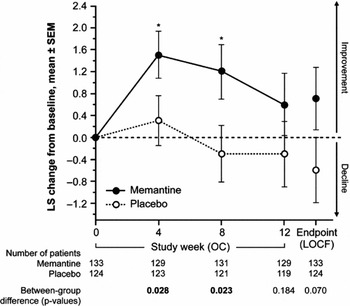
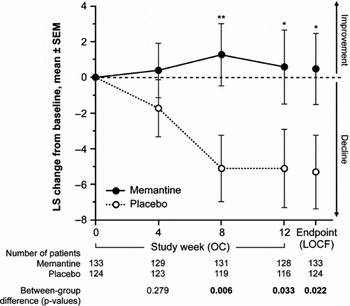
In the only randomized, double-blind, placebo-controlled study to date that has examined the effects of an AD therapy on functional communication, 257 patients with moderate AD (MMSE = 10–19) were assessed using the FLCI as the primary efficacy measure, and two combined subscales of ASHA FACS (social communication and communication of basic needs) as the secondary efficacy measure (Saxton et al., Reference Saxton2012). After 12 weeks, patients treated with memantine showed a nonsignificant improvement in FLCI score (+1.3 points; p = 0.070 vs. placebo; Figure 1), and a significant improvement in the caregiver-rated ASHA FACS score (+5.9 points; p = 0.022 vs. placebo; Figure 2; Saxton et al., Reference Saxton2012). Furthermore, post-hoc analyses of this study indicated that significantly fewer memantine-treated patients experienced any decline from baseline on both the FLCI and ASHA FACS scales compared with placebo-treated patients (Miller et al., Reference Miller, Tocco, Hendrix, Hofbauer, Graham and Perhach2010). Of those patients who did experience decline, the proportion that experienced “greater-than-mild” and “greater-than-moderate” levels of worsening was significantly higher in the placebo group (Hofbauer et al., Reference Hofbauer, Tocco, Hendrix, Graham and Perhach2010).
Patients with moderate AD treated with memantine show a nonsignificant improvement in functional communication after 12 weeks (FLCI total score, ITT population; Saxton et al., Reference Saxton2012). FLCI: Functional Linguistics Communication Inventory; ITT: Intent-to-Treat; LOCF: last observation carried forward; LS: least squares; OC: observed cases; SC: Social Communication subscale; SEM: standard error of the mean. *p < 0.05 versus placebo; bold p-values indicate those attaining statistical significance. Reprinted from Saxton, J. et al. (Reference Saxton2012) with permission from IOS Press.

Patients with moderate AD treated with memantine show a significant improvement in caregiver-rated functional communication after 12 weeks (ASHA FACS; SC + CBN subscales, ITT population; Saxton et al., Reference Saxton2012). ASHA FACS: American Speech-Language-Hearing Association Functional Assessment of Communication Skills for Adults scale; CBN: Communication of Basic Needs subscale; ITT: Intent-to-Treat; LOCF: last observation carried forward; LS: least squares; OC: observed cases; SC: Social Communication subscale; SEM: standard error of the mean. *p < 0.05; **p < 0.01; bold p-values indicate those attaining statistical significance. Reprinted from Saxton, J. et al. (Reference Saxton2012) with permission from IOS Press.

The findings of the 12-week prospective analysis (described above) are supported by results from a 16-week, single-arm, open-label trial of memantine in moderate to severe AD (n = 97; Schulz et al., Reference Schulz2011). A significant improvement from baseline in FLCI score (secondary endpoint) was observed at 4, 8, and 12 weeks after the start of treatment, and persisted after a 4-week washout period (Schulz et al., Reference Schulz2011). Post-hoc and pooled analyses of previous studies are consistent with these results, showing improvements in measures of functional communication versus placebo over a 6-month memantine treatment period (Saxton et al., Reference Saxton, Tariot, Tocco and Hofbauer2008; Saxton et al., Reference Saxton, Tocco, Hofbauer and Graham2009).
In terms of a combined pharmacological/non-pharmacological approach, a small, randomized, open-label study in mild to moderate AD (n = 54) indicated that a cognitive communication program plus donepezil produced some benefits in treating discourse and emotional symptoms that were above those achieved with donepezil alone (Chapman et al., Reference Chapman, Weiner, Rackley, Hynan and Zientz2004).
Conclusions
The cognitive effects of AD are well defined, with issues extending beyond memory loss to a deficit in language and overall functional communication. The decline in communication abilities has a wide-ranging impact on a patient's daily life, negatively affecting their ability to converse, socialize, and maintain relationships, and triggering behavioral and psychological problems. Poor communication has also been shown to raise caregiver strain, and may hinder optimal treatment provision, so addressing communication issues from an early stage would benefit the lives of patients and carers on a daily basis. However, the effective treatment of communication issues is a current unmet need in AD. Addressing the decline in language and functional communication would prolong patient independence, defer/avoid frustration and associated behavioral concerns, and have a profound impact on the burden of care. Delaying the decline in language and conversational ability could, for example, allow patients to retain social skills and contribute to close relationships for longer. This would not only raise their quality of life but the continued personal contact may, in turn, help to stimulate their communication abilities.
At present, prospective clinical study data regarding pharmacological treatment effects (memantine, ChEIs) in language and functional communication are few and far between. Currently, only two studies (both of memantine) have provided randomized, placebo-controlled data on language and functional communication in AD (Bassil et al., Reference Bassil, Thaipisuttikul and Grossberg2010; Tocco and Graham, Reference Tocco and Graham2010; Saxton et al., Reference Saxton2012). The majority of available evidence is derived from pooled studies and post-hoc analyses and should, therefore, be interpreted with caution. Despite these limitations, the available study results may still be viewed as encouraging, and support the need for further prospective, controlled investigations. Preliminary investigations also indicate that non-pharmacological approaches, including speech–language therapies and social programs, could help in this area of AD management. In the future, medication or brain stimulation techniques that specifically target language for disorders, such as aphasia (Altmann and McClung, Reference Altmann and McClung2008; Cotelli et al., Reference Cotelli2011), may prove useful in enhancing communication in AD.
Conflicts of interest
Michael Woodward has received speaker honoraria and payment for Advisory Board activities from H. Lundbeck A/S, Novartis, Pfizer, Nutricia, and Johnson and Johnson (Janssen Cilag). There are no other conflicts of interest relevant to this paper. The sponsor, H. Lundbeck A/S, provided funding for editorial assistance during the writing of this paper.
Acknowledgments
Editorial assistance was provided by Cambridge Medical Communication Ltd.