Reduced or atypical attention to face and eye contact, poor ocular pursuit of moving objects and persons, and over-focused visual attention to static stimuli are among the earliest and most specific signs observed in infants who will later develop an autism spectrum disorder (ASD; Adrien, Lenoir, Martineau, et al., Reference Adrien, Lenoir, Martineau, Hameury, Lamande and Sauvage1993; Mirenda, Donnellan, & Yoder, Reference Mirenda, Donnellan and Yoder1983; Osterling & Dawson, Reference Osterling and Dawson1994). Peculiarities in attention to face and eye contact were observed in almost all of the children described by Kanner (Reference Kanner1943) and Asperger (Reference Asperger1944) in their seminal studies. These early peculiarities in eye contact and attention to face in children with ASD directly result in impairing and impoverishing their experience of reading the faces of others, which in turn may contribute to several impairments in facial processing such as recognizing facial identity and emotional facial expressions and reading the mental states of others, as evidenced in the last four decades (e.g., Tanaka & Sung, Reference Tanaka and Sung2016; but see contradictory results in Sawyer, Williamson, & Young, Reference Sawyer, Williamson and Young2012). Therefore, in the two last decades these peculiar visual behaviors have been generally considered to be strong contributors to the social communication disorders observed in children with ASD (e.g., Baron-Cohen, Reference Baron-Cohen1995; Klin, Jones, Schultz, & Volkmar, Reference Klin, Jones, Schultz and Volkmar2003). Many adults with mild autism (American Psychiatric Association, 2013) or Asperger syndrome (World Health Organization, 1993) also reported difficulties in face-to-face interactions and maintaining eye contact during their childhood or even adulthood, particularly in the context of social interaction (e.g., Trevisan, Roberts, Lin, & Birmingham, Reference Trevisan, Roberts, Lin and Birmingham2017; see other testimonials in Attwood, Reference Attwood1999) and Gepner, Reference Gepner2014). For instance, Daniel Tammet (Reference Tammet2009), an adult with mild autism and exceptional mnemonic abilities, reported that each individual human face was extremely difficult to face due to its instability and constant change, and Grandin (Reference Grandin1995) reported on an adult with autism who could not bear to fixate on the eyes of others because they were never still.
The first historic explanation of these peculiarities considered that some children with autism are in a constant state of behavioral and physiological overarousal when facing social interactions, and consequently, they actively avoid the most prominent social cues: those coming from the face, and particularly, from the eyes of others (Hutt, Hutt, Lee, & Ounsted, Reference Hutt, Hutt, Lee and Ounsted1964). In concert with this overarousal hypothesis, an fMRI study showed that in children with ASD, fixations on the eye region correlated with a greater neural response in brain regions associated with fear processing (amygdala), compared with fixations on other areas of the face (Dalton, Nacewicz, Johnstone, et al., Reference Dalton, Nacewicz, Johnstone, Schaefer, Gernsbacher, Goldsmith and Davidson2005). Overarousal may peak during eye contact in children with ASD, and this heightened emotional response associated with eye contact would result in active avoidance of looking at the eyes of others to reduce the sensory and emotional loads.
Another theory considers that gaze avoidance is used as a cognitive load management strategy by children with ASD to “look inside” when exposed to a cognitive demand, the same strategy being also used by typically developing controls (Doherty-Sneddon, Riby, & Whittle, Reference Doherty-Sneddon, Riby and Whittle2012).
This gaze-aversion hypothesis of eye-contact deficit in ASD is currently disputed, and a recent alternative explanation states that diminished eye-looking in autism is merely consistent with passive insensitivity to the social signals in others’ eyes (Moriuchi, Klin, & Jones, Reference Moriuchi, Klin and Jones2017).
Another alternative and possibly additional explanation for these peculiarities is that the surrounding—biological, social, and physical—world often goes too fast to be faced and/or processed in time by people with ASD. This explanation emerged from two sets of studies. A first set showed a reduced visuo-postural reactivity to rapid optic flows (Gepner, Mestre, Masson, & de Schonen, Reference Gepner, Mestre, Masson and de Schonen1995; Gepner & Mestre, Reference Gepner and Mestre2002a; see Greffou, Bertone, Hahler, et al., Reference Greffou, Bertone, Hahler, Hanssens, Mottron and Faubert2011, for a replication study), and a reduced oculomotor reactivity to rapidly moving random dot kinematograms in participants with ASD compared with typically-developing control ones (Mestre, Castet, Rondan, et al., Reference Mestre, Castet, Rondan, Deruelle, Masson and Gepner2002). A second set of studies showed that children with ASD show similar performance in emotional and nonemotional facial recognition tasks to developmentally matched typical control children when the facial gestures are displayed slowly on video (Gepner, Deruelle, & Grynfeltt, Reference Gepner, Deruelle and Grynfeltt2001) and that children with ASD perform better in emotional and nonemotional facial recognition tasks (Tardif, Lainé, Rodriguez, & Gepner, Reference Tardif, Lainé, Rodriguez and Gepner2007), facial and body imitation tasks (Lainé, Rauzy, Tardif, & Gepner, Reference Lainé, Rauzy, Tardif and Gepner2011), and verbal cognition tasks (Tardif, Latzko, Arciszewki, & Gepner, Reference Tardif, Latzko, Arciszewski and Gepner2017) when audio and/or visual information is displayed slowly than when a real-time speed presentation is used. It was thereby proposed that the surrounding physical, biological, and social world moves and changes too fast to be faced and/or processed in time—in real-time—by numerous children with ASD (Gepner, Reference Gepner2014; Gepner & Féron, Reference Gepner and Féron2009; Gepner & Mestre, Reference Gepner and Mestre2002b). This temporal approach to ASD is the theoretical framework of the present study.
In the last decade, a rapidly increasing number of studies using eye-tracking methods have refined research on the visual exploration of social scenes in children and adults with ASD (see Frazier, Strauss, Klingemier, et al., Reference Frazier, Strauss, Klingemier, Zetzer, Hardan, Eng and Youngstrom2017 and Guillon, Hadjikhani, Baduel, & Rogé, Reference Guillon, Hadjikhani, Baduel and Rogé2014, for reviews). As far as dynamic stimuli are concerned, a shorter time of fixation on the eye region was initially observed in 15 adolescents and young adults with ASD compared with control subjects as well as a longer time of fixation on the mouth, body, and objects (Klin, Jones, Schultz, Volkmar, & Cohen, Reference Klin, Jones, Schultz, Volkmar and Cohen2002). A shorter fixation on the eye region was also observed in teenagers (Bours et al., Reference Bours, Bakker-Huvenaars, Tramper, Bielczyk, Scheepers, Nijhof and Buitelaar2018; Müller, Baumeister, Dziobek, & Poustka, Reference Müller, Baumeister, Dziobek, Banaschewski and Poustka2016; Speer, Cook, McMahon, & Clark, Reference Speer, Cook, McMahon and Clark2007) and young children with ASD (Hosozawa, Tanaka, Shimizu, Nakano, & Kitazawa, Reference Hosozawa, Tanaka, Shimizu, Nakano and Kitazawa2012; see also Guillon et al., Reference Guillon, Hadjikhani, Baduel and Rogé2014, for a review). This gaze avoidance and visual preference for the mouth was also observed in 2-year-old children with ASD compared with typically-developing and developmentally-delayed control ones (Jones, Carr, & Klin, Reference Jones, Carr and Klin2008) and even in 2- to 6-month-old infants later diagnosed with autism (Jones & Klin, Reference Jones and Klin2013). In all of these studies, the level of gaze avoidance was correlated with the degree of social impairment of the participants.
However, other studies found a decreased attention to the mouth but not to the eyes in children with ASD compared with typically-developing ones (Chawarska, Macari, & Shic, Reference Chawarska, Macari and Shic2012) and a correlation between amount of mouth fixation and verbal development in adolescents (Norbury, Brock, Cragg, et al., Reference Norbury, Brock, Cragg, Einav, Griffiths and Nation2009) and toddlers (Chawarska et al., Reference Chawarska, Macari and Shic2012) with ASD as well as in infants at risk for autism (Elsabbagh, Bedford, Senju, et al., Reference Elsabbagh, Bedford, Senju, Charman, Pickles and Johnson2014; Falck-Ytter, Fernell, Gillberg, & Von Hofsten, Reference Falck-Ytter, Fernell, Gillberg and Von Hofsten2010; Young, Merin, Rogers, & Ozonoff, Reference Young, Merin, Rogers and Ozonoff2009). Other studies did not find any difference in attention to the eyes between ASD and control children (e.g., Kwon, Moore, Barnes, Cha, & Pierce, Reference Kwon, Moore, Barnes, Cha and Pierce2019). Finally other studies showed that children with ASD paid significantly less attention to the eyes, the mouth, and the body than typically-developing children did (e.g., Wan, Kung, Sun, et al., Reference Wan, Kung, Sun, Yu, Tu, Park and Kong2019).
Discrepancies between these studies can be explained by the nature of experimental stimuli and the age and the developmental level of the participants (Chita-Tegmark, Reference Chita-Tegmark2016, for a review; see also the Discussion section).
According to the above presented temporal theory of ASD (Gepner & Féron, Reference Gepner and Féron2009; Gepner & Mestre, Reference Gepner and Mestre2002b), if it is true that eye contact and attention to face are impaired in children with ASD at least partly because the faces of others, that is, their eyes, their lips, and the whole facial configuration, are constantly and rapidly moving and changing then reducing the speed of facial dynamics might plausibly reduce their face-to-face interaction impairments. As a result, children with ASD may increase their visual exploration of others’ faces during face-to-face interactions. Therefore, the main purpose of this study is to examine the influence of reducing the speed of facial dynamics on the visual exploration of a face by children with ASD compared with typically-developing control children. Particularly, we hypothesize that reducing the speed of the lip movements of a speaker during speech episodes could increase attention to the mouth region in children with ASD.
Method
Participants
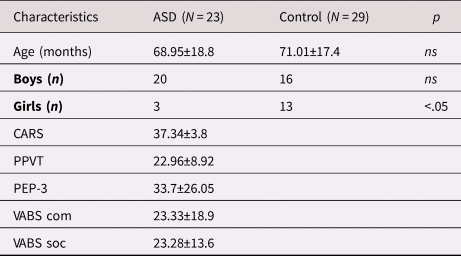
Twenty-three children (3 girls and 20 boys) meeting the ICD-10 (WHO, 1993) criteria for autism or Asperger syndrome and the DSM-5 (APA, 2013) criteria for ASD were recruited in the study through child day-care psychiatric units and schools for children with special needs in Marseille and Aix-en-Provence. All of them were diagnosed by an experienced child psychiatrist. Children's ages ranged from 3 to 8 years (M = 5.8, SD = 1.7). They all scored between 30 and 45 on the Childhood Autism Rating Scale (CARS; Schopler, Reichler, DeVellis, & Daly, Reference Schopler, Reichler, DeVellis and Daly1980). Their verbal mental age was measured with the Peabody Picture Vocabulary Test-Revised (PPVT; Dunn, Theriault-Whalen, & Dunn, Reference Dunn, Theriault-Whalen and Dunn1993). Their communication and socialization levels were assessed with the Vineland Adaptive Behavior Scale (VABS; Sparrow, Balla, & Cichetti, Reference Sparrow, Balla and Cichetti1984) and Psycho Educational Profile 3rd Version (PEP-3; Schopler, Lansing, Reichler, & Marcus, Reference Schopler, Lansing, Reichler and Marcus2010).
Twenty-nine typically-developing (TD) children (13 girls, 16 boys) were also recruited from two primary and elementary schools. Their ages ranged from 3 to 8 years (M = 5.1, SD = 1.5). Based on their medical and school records, the control children had no psychiatric nor learning disorders and were of average academic level. Exclusion criteria in both groups were visual, auditory, or neurological disorders; mood disorders; or intake of a medical treatment affecting the oculomotor system.
Parents of all the participants gave their written informed consent for their child's participation in this study. The research protocol was approved by a local ethical committee (CPP Marseille, France). Demographic and clinical data of the ASD and TD children are detailed in Table 1.
Demographic and clinical data

Note: ASD, autism spectrum disorder; CARS, Childhood Autism Rating Scale; PPVT, Peabody Picture Vocabulary Test-Revised; PEP-3, Psycho Educational Profile–3rd Version; VABS com, Vineland Adaptive Behavior Scale/Communication; VABS soc, Vineland Adaptive Behavior Scale Socialization; ns, not significant; N, number. Values are given as mean±SD.
Given that the task performed in this study was a face processing task, the group of children with ASD was matched with a group of TD children of the same chronological age so that children of both groups had the same potential lifetime exposure to, and experience of, others’ faces.
Materials
Eye-tracking system
The eye movements of all the children in the ASD and TD groups were recorded using video-oculography techniques based on the corneal reflection of infrared light. We used a Tobii T120 Eye Tracker (Tobii Technology, Stockholm, Sweden). This system also allowed us to capture data with appropriate temporal (sampling at 120Hz) and spatial resolution (accuracy of 0.4° of visual angle) at a distance of approximately 50 cm from the screen, corresponding to a visual angle of 30°. Given that this eye tracking system is noninvasive, tolerates some head movements, and looks like a TV or PC-screen, it is well suited to 3-to-8 year-old children. Video sequences of 1024 × 764 pixels resolution were presented using Tobii Pro Studio software (Tobii, Version 3.4.0, Danderyd, Sweden) on a 17-in. LCD screen (Tobii T120 display, 8 bits color, 1280 × 1024 pixels screen resolution, refresh rate of 75Hz). Two speakers were also connected to the PC to amplify the sound of the video sequences (HP Multimedia Speaker 2.0, RMS = 1Watt, S/N. = 70dB).
Stimuli
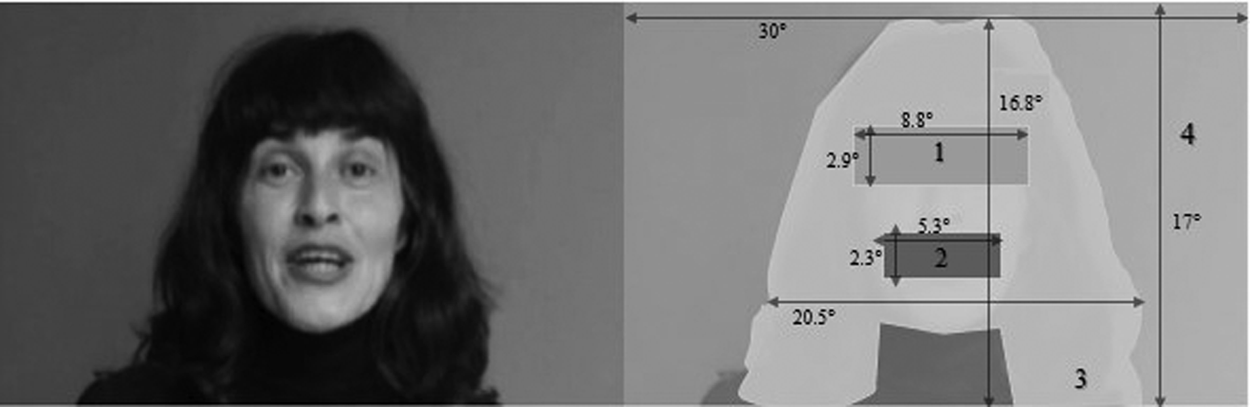
The stimuli consisted of colored videos (avi format) showing a female speaker telling a short version of the story The Three Little Pigs at various velocities, with explicit and pronounced emotional facial expressions that were congruent with the tone variations and prosody. Only the face of the speaker appeared on the screen, with a gray wall background. The face itself measured (at maximum width) 20.5° × 16.8°, at a distance of 50 cm from the screen (see Figure 1).
The visual scene and the four areas of interest with their dimensions: (1) eyes, (2) mouth, (3) face region (including hair and excluding mouth and eyes), and (4) outside the face.

To build these stimuli, we first filmed the actress while she was telling the story at a baseline speed, called real-time speed or RTS. We thus obtained a first film. Then, using an ad hoc online free software called Logiral (Tardif & Gepner, Reference Tardif and Gepner2012), the film was slowed down at two different velocities: (a) at 70% of the real-time speed, called slowed-down-speed-70 (SDS70). At SDS70, the speed of presentation corresponds to 70% of that in RTS, that is, SDS70 = RTS × 70/100 (in other words, RTS is diminished by 30%) and (b) at 50% of the real-time speed, named slowed-down-speed-50 or SDS50. At SDS50, the speed of presentation corresponds to 50% of that in RTS, that is, SDS50 = RTS × 50/100 (in other words, RTS is decreased by 50%).
At these velocities, Logiral (Tardif & Gepner, Reference Tardif and Gepner2012) allows for displaying the visual and auditory signals simultaneously, with perfect synchrony and without any tone distortion. Therefore, speech flow is accurately and consistently understandable and perfectly synchronized with the lip-movements (see online-only Supplemental material).
We thus obtained three films showing the same story at three different speeds: RTS, SDS70, and SDS50. The three films varied in duration: at RTS, the film duration was 102 s; at SDS70, the film duration was 145 s (corresponding to 102 s × 100/70 = 102 s × 1.428); and at SDS50, the film duration was 204 s (corresponding to 102 s × 2). Indeed, given that speed is inversely proportional to time, at SDS70: SDS70 = RTS × 70/100, so time(SDS70) = time(RTS) × 100/70 = time(RTS) × 1.428. Similarly, at SDS50: SDS50 = RTS × 50/100, so time(SDS50) = time(RTS) × 100/50 = time(RTS) × 2.
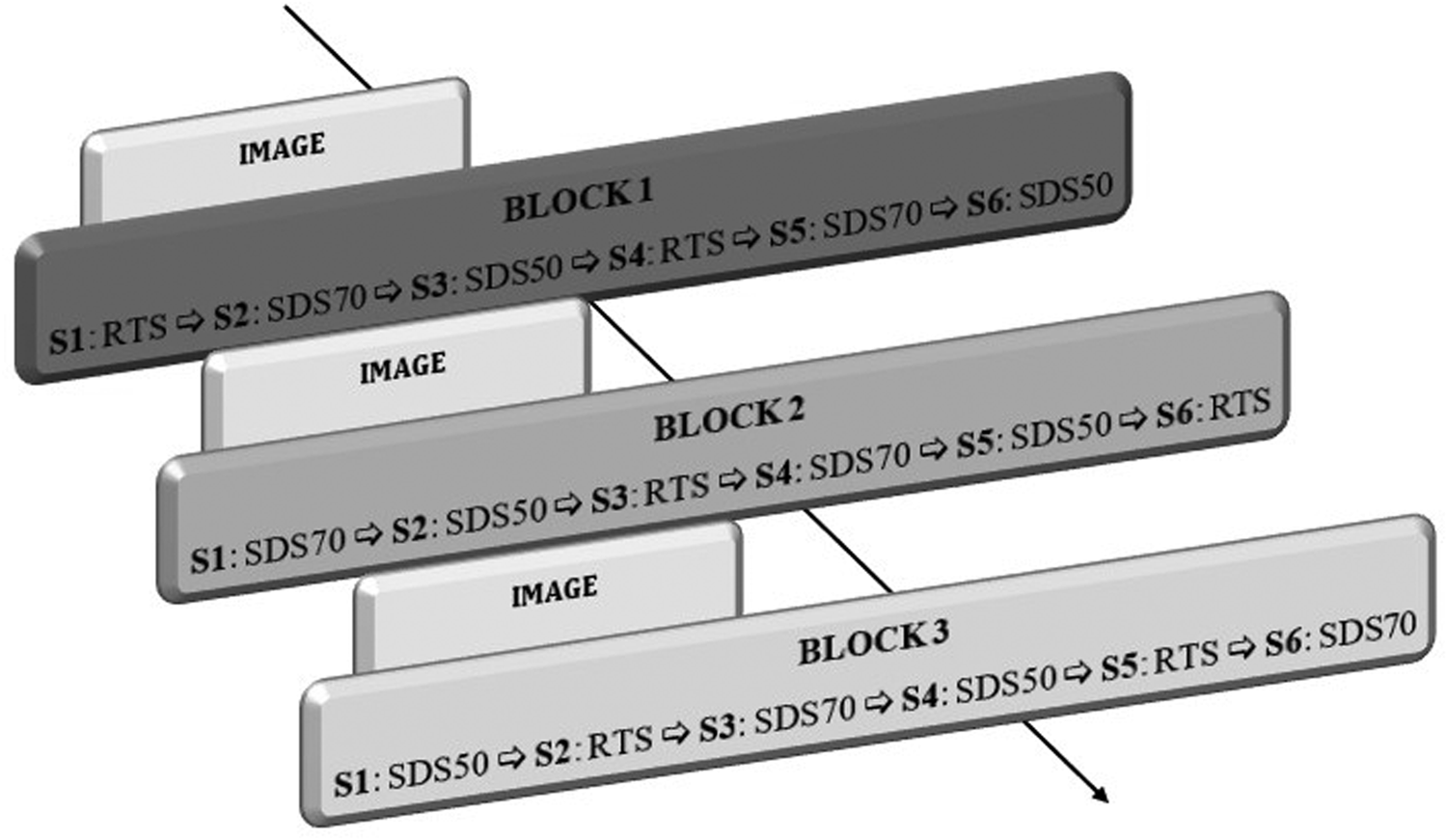
After that, each film was divided into six sequences (S1 to S6). Therefore, we obtained 18 sequences, that is, the six sequences (S1 to S6) at the three different velocities (RTS, SDS70, SDS50). The 18 sequences were finally randomly reorganized into three different full stories (Block 1 to Block 3, see Figure 2).
Experimental design. The story The Three Little Pigs® was divided into six sequences (S1 to S6), which were randomly presented at three different velocities: a real-time speed (RTS), and two slowed-down speeds, SDS70 and SDS50 (corresponding to 70% and 50% of RTS, respectively). The story was displayed three times (Blocks 1 to 3).

Experimental procedure
Children in the ASD group were seated and tested in a quiet experimental room with a lighting of 10 lux, which was a low-light condition but not dark (as recommended by Sasson & Elison, Reference Sasson and Elison2012). The TD control children were tested in their school in a room of about the same surface and lighting that was especially fitted out for the experiment. The device was calibrated for each participant at the beginning of the experimental sessions. We used the standard 5-point calibration of Tobii Software. The experimenter sat on the right side of the participants.
The experiments started with a 4-s presentation of a central picture that was extracted from a cartoon to stabilize the attention of the participants. Then the story was run three times (Block 1 to Block 3), so that the participants had the opportunity to watch each sequence of the story under the three different velocities. The order of sequence presentation in each block was fixed (as shown on Figure 2), but the three Blocks were displayed in a random order to the participants.
Before the second and third Blocks, pictures that were extracted from cartoons were also displayed for 4 s. The experimenter could change the sequence with a click when she judged that participant's level of attention to the screen was sufficient, that is, when their head and eyes were turned towards the screen.
Data analyses
The eye behavior analyses were initially performed using the Tobii Pro Studi software. In our study, eye behavior was considered as a fixation when the eye did not change its position from more than 1 degree of visual angle during at least 100 ms.
The visual scene was divided into four areas of interest (AOI): (a) eye region, (b) mouth region, (c) face region excluding eye and mouth regions, and (d) outside-the-face region (see Figure 1).
Three different measures were computed on the basis of fixation detection criteria: (a) the number of fixations (NF), corresponding to the sum of the visual fixations made on a given AOI; (b) the percentage of total fixation duration per AOI (PFD), corresponding to the proportion of time looking at a given AOI out of the total time of fixation on the whole visual scene; and (c) the mean duration of fixation (MDF), corresponding to the mean of visual fixations’ durations made on a given AOI.
We added the latter measure (MDF) first because it is independent of the total time spent to fixate on a target, which is useful for studying children having attentional processing impairments, as it is often the case in children with ASD (Lai, Lombardo, & Baron-Cohen, Reference Lai, Lombardo and Baron-Cohen2014). Second, MDF has been shown to be a consistent and reliable marker of information processing in typical development. For example, individual differences in MDF during infancy are linked to attentional and behavioral control in childhood; that is, the higher the MDF in infancy, the better the attentional and behavioral control in childhood (Papageorgiou, Smith, Wu, et al., Reference Papageorgiou, Smith, Wu, Johnson, Kirkham and Ronald2014).
Additionally, to ensure that discrepancies in NF measures between the participants were not due to discrepancies in their respective percentage of total fixation duration on the stimuli, NF values were normalized according to the percentage of total fixation duration of the participant (values of NF were divided by the percentage of total fixation duration on the film in each participant). Finally, NF values were normalized according to the real duration of video, that is, in each participant values of NF were divided by 1.428 in SDS70 and divided by 2 in SDS50 (as explained above in the Stimuli paragraph).
Given that PFDs are already proportions of time looking at a given AOI out of the total time of fixation on the visual scene and MDFs are already means, their values were not transformed.
Statistical analyses
Differences between groups were evaluated using mixed-effects analyses of variance, including group (ASD patients vs. TD controls) and video sequence velocities (RTS vs. SDS70 vs. SDS50) for each AOI (mouth, face, eyes, outside the face) as factors. Tukey honestly significant difference post hoc tests were applied when appropriate. The Greenhouse–Geisser correction was used when sphericity was not assumed.
Correlations between visual fixations (PFD, NF, MDF) on the mouth region and scores in verbal measures (PPVT, VABS-communication, and PEP-3-communication) as well as correlations between visual fixations (PFD, NF, and/or MDF) on the eye region and score of socialization measured with VABS-socialization were also performed in the ASD group.
The significance level was fixed at α = 0.05. Effect sizes were measured by partial Eta squared (η2p) with small, medium and large effects defined as 0.01, 0.06, and 0.14 respectively. All computations were performed using Stata Software release 11 (StataCorp, College Station, TX).
Results
The minimum percentage of fixation duration out of the whole film duration was fixed at 30%, that is, children of both groups watched at least 30% of the whole film (the three Blocks), so that they could at least watch practically the equivalent of one full story.
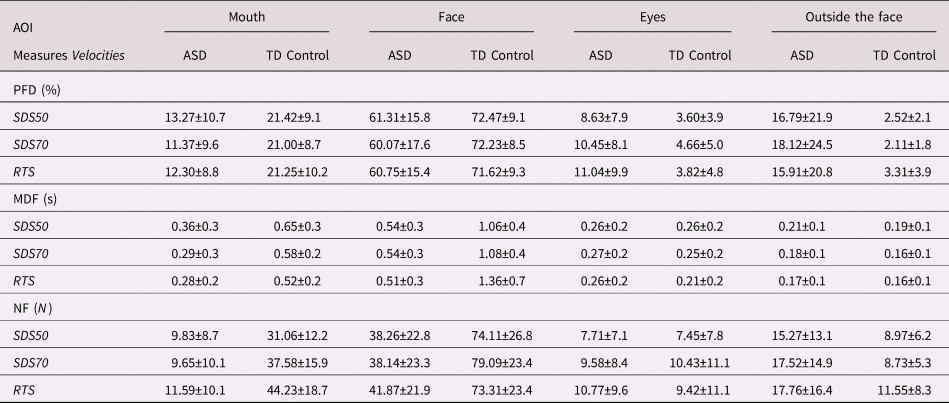
As shown in Table 1, ages of the participants were not statistically different between the two groups. There were significant differences between the two groups with respect to gender, χ2 (3) = 6.08, p < .05. However, the sex ratio difference between the two groups had no significant effect either on PFD, Fs > .41, ps > .05, η2 ps < .01, or on NF, Fs > .04, ps > .05, η2 ps < .01, or on MDF, Fs > .04, ps > .05, η2 ps < .03. Data for the two groups of children across each AOI are presented in Table 2.
Percentage of total fixation duration per AOI, mean duration of fixation, and number of fixations for each video sequence velocity and for the two groups (ASD and TD control)

Note: ASD, autism spectrum disorder; TD control, typically developing control; PFD, percentage of total fixation duration per AOI; MDF, mean duration of fixation; NF, number of fixations; RTS, real-time speed; SDS50, slowed-down speed at 50% of RTS; SDS70, slowed-down speed at 70% of RTS; s, second. Values are given as mean±SD.
Mouth area
Three mixed-effects analyses of variance were conducted with group as the between-subjects factor (ASD and TD control) and video sequence velocity as the within-subjects factor (SDS50, SDS70, RTS), investigating possible main effects and interactions between these factors expressed in each of the three measures: MDF, NF, and PFD per AOI, focusing on data from the mouth area.
The results showed a significant interaction between group and video sequence velocity only for the NF measure, F (2, 100) = 14.97, p < .001, η2p = .23. The participants with ASD had a lower NF than those in the control group did in all of the velocity conditions (SDS50: p < .01; SDS70 and RTS: p < .001). While the TD control group had a lower NF in SDS50 than in SDS70 and RTS (p < .001) and a lower NF in SDS70 than in RTS (p < .001), no significant difference in NF was found between the different velocities within the ASD group. There was no significant interaction between velocity and group on the MDF, F (2, 100) = 0.56, p = .57, η2p = .01, or on the PFD per AOI measure, F (2, 100) = 0.60, p = .55, η2p = .01.
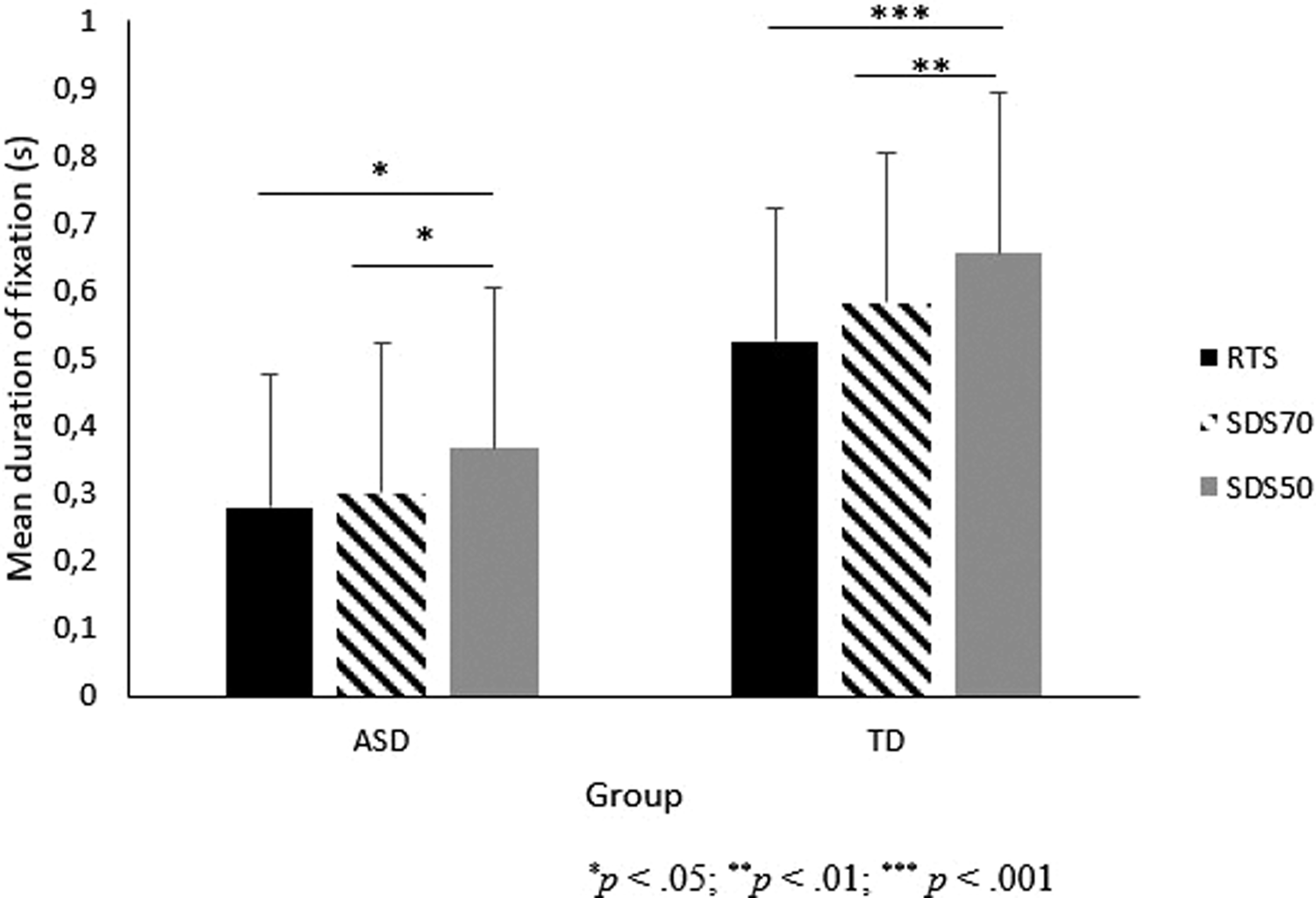
There was a significant main effect of video sequence velocity on MDF, F (2, 100) = 14.14, p < .001, η2p = .22. This was true in both the ASD group, F (2, 44) = 4.19, p < .05; η2p = .15, and the TD one, F (2, 56) = 11.56, p < .001; η2p = .29. Follow-up Tukey honestly significant difference analyses showed that MDF was higher in SDS50 than in SDS70 (p < .05) and higher in SDS50 than in RTS (p < .05) in the ASD group. In the TD group, MDF was higher in SDS50 than in SDS70 (p < .01) and higher in SDS50 than in RTS (p < .001; see Figure 3).
Mean duration of fixation on the mouth area across the three velocities in the ASD and TD groups. For the images of the three different velocities, see the online-only Supplemental Material.

Significant main effects of group on MDF, F (1, 50) = 15.98, p < .001, η2p = .24, and on PFD per AOI, F (1, 50) = 12.36, p < .001, η2p = .20, were also observed, with participants in the ASD group having a significantly lower MDF and PFD on the mouth area than TD controls did (all ps < .001).
There was no significant main effect of velocity on PFD per AOI, F (2, 100) = 1.37, p = .26, η2p = .03.
Face area
The results showed a significant interaction between group and video sequence velocity for the MDF measure, F (2, 100) = 8.97, p < .001, η2p = .15. Children with ASD showed a lower MDF in the RTS condition compared with the control group (p < .001), but there were no significant differences observed between the two groups in the other velocities (SDS50 and SDS70). Although TD controls had higher MDF in the RTS compared with the SDS70 and SDS50 conditions (ps < .001), there were no significant differences in MDF driven by the different video sequence velocities in the ASD group.
There was a significant interaction between group and video sequence velocity for the NF measure, F (2, 100) = 4.14, p < .05, η2p = .08. The ASD group had a lower NF in the SDS50 (p < .05) and SDS70 conditions (p < .01) than the control group did. There was no significant interaction between group and video sequence velocity found in the PFD per AOI measure, F (2, 100) = .45, p = .64, η2p = .01.
There was also a significant main effect of group in PFD per AOI, F (1, 50) = 10.91, p < .001, η2p = .18. Post hoc analyses showed that children with ASD had significantly lower PFD on the face than TD controls did (p < .001).
Eye area
There was no significant interaction between velocity and group found in any of the three measures: MDF F (2, 100) = .77, p = .47, η2p = .02; NF F (2, 100) = 1.13, p = .33, η2p = .02; and PFD per AOI F (2, 100) = 2.37, p = .10, η2p = .05.
However, the results showed a significant main effect of group on the PFD per AOI measure, F (1, 50) = 11.37, p < .001, η2p = .19, with ASD children spending significantly more time fixating on the eyes than TD controls (p < .001).
There was no significant effect of group on MDF, F (1, 50) = .34, p = .56, η2p = .01, or on the NF measure, F (1, 50) = 0.01, p = .92, η2p = .0002.
There was also a significant main effect of video sequence velocity observed in the NF measure, F (2, 100) = 7.54, p < .001, η2p = .13. Post hoc analyses showed that NF was lower in SDS50 than in SDS70 or RTS (p < .01 for all).
There was also a significant main effect of the video sequence velocity found in the PFD per AOI measure, F (2, 100) = 4.91, p < .01, η2p = .09. Participants spent a lower percentage of time on the eye area in the SDS50 than in the SDS70 condition (p < .05). There was no significant main effect of velocity on the MDF measure, F (2, 100) = 1.38, p = .26, η2p = .03.
Outside the face area
No significant interaction between velocity and group manifested in any of the three measures: MDF, F (2, 100) = .17, p = .85, η2p = .003; NF F (2, 100) = 1.12, p = .33, η2p = .02; and PFD per AOI F (2, 100) = 2.42, p = .09, η2p = .05.
There was however a significant main effect of group on the PFD per AOI measure, F (1, 50) = 12.15, p < .001, η2p = .20. There were also significant main effects of video sequence velocity on MDF, F (2, 100) = 3.55, p < .05, η2p = .07, and on NF, F (2, 100) = 4.54, p < .05, η2p = .08). Tukey honestly significant difference analyses showed that MDF was higher in the SDS50 than in the RTS condition (p < .05), while NF was lower in the SDS50 than in the RTS condition (p < .01).
There was no significant main effect of group on MDF, F (1, 50) = .20, p = .67, η2p = .004, or on NF, F (1, 50) = 1.73, p = .19, η2p = .03. There was no significant main effect of velocity in the PFD per AOI measure, F (2, 100) = .26, p = .77, η2p = .01.
Correlations between visual fixations on mouth and verbal communication level
The correlation analyses showed significant positive correlations between PFD for mouth and the scores in the three verbal communication measures (PPVT, VABS-communication, and PEP-3-communication). The correlations are detailed in Table 3.
Correlations between PFD and MDF measures for the mouth region and verbal communication scores in the ASD group

Note: VABS, Vineland Adaptive Behavior Scale; PPVT, Peabody Picture Vocabulary Test-Revised; PEP-3, Psycho Educational Profile 3rd Version; PFD, percentage of total fixation duration per AOI; MDF, mean duration of fixation; RTS, real-time speed; SDS50, slowed-down speed at 50% of RTS; SDS70, slowed-down speed at 70% of RTS. *p < .05. **p < .01. ***p < .001.
Similarly there were also significant positive correlations between MDF on mouth region and scores in VABS-communication and in PEP-3-communication. No significant correlation was found between MDF on mouth and PPVT (p > .05).
No significant correlation was found between NF on mouth and PPVT, VABS communication scores, and PEP-3 communication scores (p > .05 for all).
Correlations between visual fixations on eyes and socialization level
There was no significant correlation between MDF, NF, and PFD on eye region and score in VABS-socialization (p > .05 for all).
Discussion
The main purpose of this study was to examine the effects of reducing the speed of facial dynamics on the visual exploration of a speaker's face while telling a story in a group of children with ASD compared with a group of TD children of the same chronological age, that is, with the same potential lifetime exposure to the faces of others.
The minimum of 30% of total fixation duration spent by the participants on the whole film is relatively low. However, because the whole film was made of three full stories of the Three Little Pigs, all the participants could at least watch practically the equivalent of one full story. Moreover, this percentage seems well suited for a population of low-functioning children with ASD as in our study, given that they are less stable than were control children of the same age (Lai et al., Reference Lai, Lombardo and Baron-Cohen2014). A similar minimum percentage of total fixation duration was used in a similar population of low-functioning children with ASD (Deschamps, Leplain, & Vandromme, Reference Deschamps, Leplain and Vandromme2014). Finally, given that PFD corresponds to the proportion of time looking at a given AOI out of the total time of fixation on the visual scene, and the measure of MDF corresponds to the mean of visual fixation duration made on a given AOI, these measures are independent of the percentage of total fixation duration made on the stimuli by the participants. And as far as NF is concerned, values of NF were normalized according (a) to the percentage of total fixation duration in each participant and (b) to the real-time duration of video. Our data were therefore sufficient for further analyses and interpretations.
First, regardless of the speed of presentation, children with ASD paid overall significantly less attention to the speaker's face and particularly to her mouth than the TD control children did. This was true for the three measures: PFD, NF, and MDF. The same pattern of differences between a group of ASD children and a group of TD control children was found in previous eye-tracking studies. For example, toddlers with autism spent less time looking at a speaker's face and monitoring her lip movements than did those in the control groups (TD and developmentally-delayed) when explicit dyadic cues (i.e., child-directed speech and eye contact) were introduced but not when the actor was quiet and looking sideways (Chawarska et al., Reference Chawarska, Macari and Shic2012). Children with ASD have also been shown to look away from actors prematurely during speech episodes (Hosozawa et al., Reference Hosozawa, Tanaka, Shimizu, Nakano and Kitazawa2012). Similarly, infants later diagnosed with ASD spent less time looking at a face compared with control infants only when the actress was speaking (Shic, Macari, & Chawarska, Reference Shic, Macari and Chawarska2013). In all of these studies, the dynamic nature of the social stimuli, and therefore the quantity and complexity of the stimulations, are likely to result in avoiding the source of the stimulation in children with ASD. In line with these latter studies, and given that our stimuli were made of speech episodes, it is not surprising that children with ASD spent less time attending to the mouth area than TD children did. Moreover, given the correlation between the verbal level of our participants with ASD and their time spent fixating (measured through PFD and MDF) on the mouth region (a correlation also found in several previous studies, e.g., Chawarska et al., Reference Chawarska, Macari and Shic2012; Elsabbagh et al., Reference Elsabbagh, Bedford, Senju, Charman, Pickles and Johnson2014; Falck-Ytter et al., Reference Falck-Ytter, Fernell, Gillberg and Von Hofsten2010; Norbury et al., Reference Norbury, Brock, Cragg, Einav, Griffiths and Nation2009; Young et al., Reference Young, Merin, Rogers and Ozonoff2009) and that the majority (87%) of our participants with ASD were verbally impaired, it is not surprising that they paid overall poor attention to the mouth region and significantly less attention on this region than the TD children did.
The children with ASD also spent significantly more time attending to the region outside the face than the TD control children, which is in line with other previous eye-tracking studies in children with ASD (e.g., Grossman, Steinhart, Mitchell, & McIlvane, Reference Grossman, Steinhart, Mitchell and McIlvane2015; Riby & Hancock, Reference Riby and Hancock2009).
Interestingly, children with ASD spent significantly more time attending to the eye region than did the TD control children, which is inconsistent with other findings showing that infants and children with ASD pay less attention to the eye region (with or without increased attention to the mouth region) than do TD control participants (Bours et al., Reference Bours, Bakker-Huvenaars, Tramper, Bielczyk, Scheepers, Nijhof and Buitelaar2018; Hosozawa et al., Reference Hosozawa, Tanaka, Shimizu, Nakano and Kitazawa2012; Jones et al., Reference Jones, Carr and Klin2008; Jones & Klin, Reference Jones and Klin2013; Klin et al., Reference Klin, Jones, Schultz, Volkmar and Cohen2002; Müller et al., Reference Müller, Baumeister, Dziobek, Banaschewski and Poustka2016). Discrepancies between these latter studies and our own study can be partly explained by the choice of a relatively large size of the eye region (2.9° × 8.8°), which was created a priori. Discrepancies between our study and other studies can also be partly explained by the nature of the experimental stimuli. The strong verbal content of our stimuli and the relatively rapid speech flow of the real-time speed condition in our study (5 syllables/s, as compared with the mean speech rate of 4.3 syllables/s in the French language, Grosjean & Deschamps, Reference Grosjean and Deschamps1973) could explain why TD children merely focused their attention on the mouth region to maximize lip-reading and story understanding and why they proportionally spent less time looking at the eye region. This could in turn explain why TD children spent significantly less time fixating the eye region than children with ASD did.
Second, as far as speed effect is concerned, reducing the speed of facial dynamics resulted in a decrease in the number of fixations on the mouth, on the eyes, and outside the face in both groups, that is, participants exhibited fewer eye-movements onto these regions. In parallel, in both groups, although there was no significant effect of velocity on the PFD on mouth, there was a significant effect of velocity on MDF on the mouth region. In both groups, MDF on the mouth was significantly increased in slow presentation (SDS50) compared with the real-time one. Although MDF on the mouth in the participants with ASD was twice as low as that in TD children, both groups of children showed a parallel increase of MDF on the mouth with speed reduction. Given that MDF seems to be a consistent and reliable marker of information processing in typical development (Papageorgiou et al., Reference Papageorgiou, Smith, Wu, Johnson, Kirkham and Ronald2014), this parallel increase of attention to the mouth of a speaker (reflected by MDF) when the speaker is speaking slowly (compared with a real-time speech flow) in a group of children with ASD and a group of TD control children of the same chronological age seems quite interesting and encouraging and suggests a delayed development of facial processing in children with ASD rather than an absolute impairment, as was suggested previously (Gepner et al., Reference Gepner, Deruelle and Grynfeltt2001). Using MDF as a new component of visual fixations possibly provides more insight into our data than the two other commonly used PFD and NF alone.
Given that PFD and MDF on the mouth area are correlated to the verbal level of children with ASD in our study (as shown previously, e.g., Chawarska et al., Reference Chawarska, Macari and Shic2012; Norbury et al, Reference Norbury, Brock, Cragg, Einav, Griffiths and Nation2009) and that they are good predictors of verbal development in these children (Elsabbagh et al., Reference Elsabbagh, Bedford, Senju, Charman, Pickles and Johnson2014; Falck-Ytter et al., Reference Falck-Ytter, Fernell, Gillberg and Von Hofsten2010; Young et al., Reference Young, Merin, Rogers and Ozonoff2009), we have good reasons to postulate that this increased attention to mouth due to slowness could increase lip-reading and therefore be used to train verbal comprehension and expression in children with ASD (see also below).
Our findings bring the first eye-tracking evidence of an interesting and probably beneficial effect of slowing down facial dynamics on the way that children with ASD explore the mouth region during speech. Indeed, given the crucial role of lip-reading for speech processing and language in typical development (Massaro, Reference Massaro1987) and that lip-reading is impaired in children with ASD (de Gelder, Vroomen, & van der Heide, Reference De Gelder, Vroomen and van der Heide1991; Gepner, de Gelder, & de Schonen, Reference Gepner, de Gelder and de Schonen1996) and precludes the perception and decoding of audiovisual information (Irwin, Tornatore, Brancazio, & Whalen, Reference Irwin, Tornatore, Brancazio and Whalen2011; Righi, Tenenbaum, McCormick, et al., Reference Righi, Tenenbaum, McCormick, Blossom, Amso and Sheinkopf2018; Smith & Bennetto, Reference Smith and Bennetto2007; Stevenson, Siemann, Schneider et al., Reference Stevenson, Siemann, Schneider, Eberly, Woynaroski, Camarata and Wallace2014), it is likely that reducing the speed of facial dynamics while viewing audiovisual scenes has good therapeutic potential for verbal and language rehabilitation in children with ASD. Several studies have already shown a beneficial effect of slowness on comprehensive and possibly expressive verbal performance in some children with ASD (Meiss, Tardif, Arciszewski, Dauvier, & Gepner, Reference Meiss, Tardif, Arciszewski, Dauvier and Gepner2015; Tardif, Thomas, Rey, & Gepner, Reference Tardif, Thomas, Rey and Gepner2002; Tardif et al., Reference Tardif, Latzko, Arciszewski and Gepner2017). Grandin (Reference Grandin1995) also reported that during her childhood her speech therapist used to slow down speech flow, while exaggerating the syllables’ pronunciation, which enabled her to hear the consonants (Grandin & Panek, Reference Grandin and Panek2013).
Our study shows that the temporal factor of facial dynamics (and not only facial dynamics per se) must be taken into account to understand, and potentially remedy, the verbal and social communication impairments in children with ASD.
Finally, given that the majority of our participants with ASD had moderate to severe autism and moderate to severe verbal impairment, they could not perform comprehensive tasks regarding the story itself and could only be tested in a passive viewing task, which limits the scope of our study. Further studies combining eye-tracking measures as well as verbal, social, and behavioral assessments should investigate whether potential enhanced attention to face, mouth, and/or eyes observed in children with ASD while viewing slowed-down audiovisual stimuli would be correlated to behavioral, cognitive, verbal, and/or socioemotional improvements. These studies are necessary to further assess the therapeutic potential of slowness to remedy the verbal, behavioral, and socioemotional difficulties in children with ASD.
Supplementary material
The supplementary material for this article can be found at https://doi.org/10.1017/S0954579420000292.
Acknowledgments
We wish to warmly thank all the children who participated in this study and their parents. We are grateful to Dr. Jamila Touba, Dr. Denis Ledot, and Dr. Christian Dispa for their kind participation in recruiting the ASD participants, to Thierry Legou (Speech and Language Laboratory, Aix-Marseille University) for his technical assistance on the eye-tracking system, and to Dr. Thomas Arciszewski and Dr. Bruno Dauvier (PSYCLE, Aix-Marseille University) for their help in analyzing the data. Warm thanks to Dr. Ruben Gepner and to Clara Gepner (MSc) for their final corrections of the manuscript.
Financial Support
For this study, Dr. Aurore Charrier received a PhD grant from Conseil Régional Provence-Alpes-Côte d'Azur (PACA). The free online software used in this study—Logiral—has been developed thanks to a grant from Fondation de France (15153) awarded to Dr. Bruno Gepner. Grant sponsor: Conseil Régional Provence-Alpes-Côte d'Azur (PACA).