Introduction
Triozidae is a megadiverse, poorly resolved family comprising 70 genera and 1005 described species (Ouvrard, Reference Ouvrard2019). By far the largest genus is the artificial ‘holding' genus Trioza with 423 described species (Ouvrard, Reference Ouvrard2019).
Of the Psylloidea, the family Triozidae feed on by far the greatest number of plant families (see Hollis, Reference Hollis1984; Ouvrard et al., Reference Ouvrard, Chalise and Percy2015; Ouvrard, Reference Ouvrard2019), although certain composite lineages within often show radiations on discrete plant genera and plant families, e.g., Casuarinicola on Casuarina (Taylor et al., Reference Taylor, Austin, Jennings, Purcell and Wheeler2010), Acanthocasuarina on Allocasuarina (Casuarinaceae) (Taylor et al., Reference Taylor, Jennings, Purcell and Austin2011), Myotrioza on Eremophila and Myoporum (Scrophulariaceae) (Taylor et al., Reference Taylor, Fagan-Jeffries and Austin2016) and Pariaconus on Metrosideros (Myrtaceae) (Percy, Reference Percy2017). Based on the land mass, the Australian triozid fauna is considered depauperate, with 59 described species in seven genera from nine plant families of which the genus Trioza comprises just 10 species (Taylor et al., Reference Taylor, Fagan-Jeffries and Austin2016). Contrastingly, the New Zealand triozid fauna comprises 60 species in five putative genera (i.e., two undescribed) from at least 15 plant families of which the genus Trioza comprises 56 putative species (of these 23 taxa are undescribed) (Martoni et al., Reference Martoni, Burckhardt and Armstrong2016, Reference Martoni, Bulman, Pitman, Taylor and Armstrong2018).
There are 11 described species of Trioza recorded from Syzygium distributed from India, Southeast Asia, China, the South Pacific and Australia (Martoni et al., Reference Martoni, Burckhardt and Armstrong2016; Ouvrard, Reference Ouvrard2019). One species, Trioza eugeniae Froggatt, is recorded from Australia and two species, Trioza adventicia Tuthill and T. curta (Ferrris & Klyver), from New Zealand (Dale, Reference Dale1985; Martoni et al., Reference Martoni, Burckhardt and Armstrong2016).
T. eugeniae was described from Syzygium smithii (Poir.) Nied. (as ‘Eugenia smithii’) from eastern New South Wales and Gippsland, Victoria (Froggatt, Reference Froggatt1901). The nymphs were recorded as lying in hollows with their dorsal surface level with the upper leaf surface and a corresponding blister on the lower surface of young leaves, with heavy infestations discolouring foliage and twisting and aborting leaves (Froggatt, Reference Froggatt1901). Whilst not citing the type material in the original description, specimens in ANIC (4 ♂, 5 ♀, card-mounted on two pins) are labelled ‘Blister galls Eugenia smithii, Termeil, 20.ix.[18]99, Froggatt’ and ‘Type 1901 WWF’. In his description of T. eugeniae, Froggatt (Reference Froggatt1901) mentioned some morphological variability between the two series of specimens at hand and commented that there may be two species present. In this paper he commented ‘I have a series of specimens obtained on some undetermined shrub (probably E. Smithii) at Clifton [about 150 km NNE of Termeil] some years ago, in which the cross-nervures between the primary stalk and the costal nervure [veins R and R1] are clouded with black, and the clavus is blotched, markings which I have never found on the typical form. This, however, may be a distinct species, but in the absence of more fresh material, I regard it as a seasonal variety of the typical form’ (Froggatt, Reference Froggatt1901). Nevertheless, his illustration of the fore wing of T. eugeniae clearly shows a dark infuscation adjacent to veins R and R1 (Froggatt, Reference Froggatt1901; Plate xv, fig. 11) indicating he must have used other than the type material, or the Clifton specimens, in his illustrations.
The species attributed to T. eugeniae has since been recorded from Syzygium paniculatum in New South Wales, Queensland, South Australia, Victoria and Western Australia (Morgan, Reference Morgan1984; Hollis, Reference Hollis2004; Zuparko et al., Reference Zuparko, De Queiroz and La Salle2011). Young (Reference Young2003) commented that E. smithii and S. smithii were often used incorrectly in the nursery trade for S. paniculatum Gaertn. so he considered it was possible that Froggatt's specimens may also have been from this latter host. In host specificity testing under laboratory and field conditions in Australia its host range was expanded to include S. australe (H.L.Wendl. ex Link) B.Hyland, S. moorei (F.Muell.) L.A.S.Johnson, S. oleosum (F.Muell.) B.Hyland, Acmena ingens (F.Muell. ex C.Moore) Guymer & B.Hyland and Waterhousea floribunda (F.Muell.) B.Hyland (Young, Reference Young2003). In California it has expanded its host range to include Metrosideros excelsa Sol ex Gaertn. (Percy et al., Reference Percy, Rung and Hoddle2012). T. eugeniae was recorded from Angophora floribunda (Sm.) Sweet (Martoni et al., Reference Martoni, Burckhardt and Armstrong2016; Percy, Reference Percy2017) but this is erroneous (see Discussion). T. eugeniae was first detected in California, USA in 1988, presumably accidentally introduced, and was widely dispersed on ornamental S. paniculatum in the plant nursery industry before becoming the subject of a biological control program (Dahlsten et al., Reference Dahlsten, Kent, Rowney, Copper, Young and Tassan1995).
T. adventicia was described from S. smithii (as ‘Acmena floribunda D. C. [Eugenia floribunda]’) from Nelson, New Zealand (Tuthill, Reference Tuthill1952). The nymphs were recorded as forming small pits on the young leaves and rolling edges and causing leaf discolouration as described for T. eugeniae in Australia (Tuthill, Reference Tuthill1952). He suggested that T. adventicia was accidentally introduced into New Zealand on its host, and that its ‘original home was problematical’ (Tuthill, Reference Tuthill1952). In his diagnosis, Tuthill (Reference Tuthill1952) commented that T. adventicia was readily distinguishable from both closely related species T. eugeniae and T. curta by the presence of one outer and two inner apical metatibial spurs compared to one outer and three inner spurs in the latter. It is here noted that T. curta feeds on M. excelsa (as does ‘T. eugeniae’ in California outside its natural range) and shares the character of three inner apical metatibial spurs. Dale (Reference Dale1985) also considered that T. adventicia was of Australian origin and reiterated the difference between this species and T. eugeniae on the basis of the number of metatibial spurs.
The identities of T. eugeniae and T. adventicia have long been controversial: Froggatt's Clifton series (see Specimens examined under T. adventicia below) contain supplementary labels ‘not Trioza eugenia [sic] Frogg. LD Tuthill’ and ‘not eugeniae KLT[aylor]’, indicating that both taxonomists recognized them as separate species. Further, Percy (Reference Percy2017) showed that specimens of introduced ‘T. eugeniae’ sampled from California were in fact closer to a T. adventicia from New Zealand than to ‘T. eugeniae’ from Australia, and flagged that their taxonomy required further investigation.
Rather oddly, the presumably Australian source (i.e. host and locality details) of T. adventicia has never been sought nor elucidated. Indeed, it has been customary that Syzygium-inhabiting Trioza in Australia has been consistently identified as T. eugeniae, often by non-specialists and probably on the basis that T. eugeniae is the only species in Australia to be recorded from Syzygium, and those from New Zealand as T. adventicia. These observations collectively, and as detailed by Percy (Reference Percy2017), invoke the following two taxonomic scenarios. The first scenario is that T. eugeniae and T. adventicia are conspecific. In this scenario, T. adventicia would be sunk in synonymy with T. eugeniae. The second scenario is that T. eugeniae, type locality Termeil, NSW, is a distinct species and that Froggatt's series from Clifton, NSW, is another species. It would suggest that the latter is indeed T. adventicia, subsequently described from New Zealand and introduced widely on ornamentals in Australia, New Zealand and the USA. If this were so, it would indicate that the nursery industry and the USA biocontrol program against it may be based on a long history of misidentification.
The aims of this study were to re-examine the original descriptions of T. eugeniae and T. adventicia, carry out a morphological examination of Froggatt's type specimens of T. eugeniae and any newer material, and to confirm these observations through DNA barcoding to elucidate either of the two scenarios outlined above.
Materials and methods
To resolve this taxonomic dilemma, Froggatt's type specimens of T. eugeniae were re-examined, and the original descriptions of Froggatt and Tuthill were re-evaluated. Additionally, other historical and contemporary material currently ascribed to T. eugeniae in Australia and USA, and T. adventicia in New Zealand, were examined from collections in Australia (ANIC, MV, NMV, SAM, VAIC, WAM), New Zealand (LUNZ) and USA (FSCA, including samples from California). Finally, barcoding analysis of available specimens of Syzygium-inhabiting Trioza from Australia, New Zealand and USA was performed to establish species-level boundaries and elucidate the identity and origins of the exotic incursions.
In order to assess genetic variation between populations in different countries, DNA extraction was performed from freshly collected specimens from Australia stored in 100% ethanol using the CTAB 2× method (Doyle and Doyle, Reference Doyle and Doyle1987). For these specimens, isolation of the subunit 1 of the Cytochrome Oxidase gene (COI) was performed using the primers C1-J1709 (Simon et al., Reference Simon, Buckley, Frati, Stewart and Beckenbach2006) and HCO2198 (Folmer et al., Reference Folmer, Black, Hoe, Lutz and Vrijenhoek1994). A polymerase chain reaction (PCR) was performed using the following cycle: 5 min at 94°C, 40 cycles of denaturation at 94°C for 30 s, annealing at 48°C for 30 s and 72°C of extension for 1 min, followed by a final 7 min of extension at 72°C.
Furthermore, DNA extraction was attempted from a single pinned psyllid specimen collected in 1960 and preserved at ANIC, after mounting wings and posterior legs on a microscope slide. For this specimen, the E.Z.N.A. Forensic Kit (Omega Bio-Tek, USA) was used following the manufacturer's instructions. DNA could not be amplified using C1-J1709-HCO2198 (probably too fragmented, being 60 years old) therefore a new primer pair targeting a region of ~200 bp of the COI gene was designed using software Primer3 v. 0.4.0 (available online at http://bioinfo.ut.ee/primer3-0.4.0/) and adapted manually. These newly designed primers are TriCOI-F2 (CATTTAGCAGGAATCTCTTCAAT) and TriCOI-R2 (ATATTACGATCTGTTAACAATAT). The PCR cycle above was consequently modified with an elongation time of 45 s and a number of cycles of 45.
The 12 sequences obtained here were virtually translated to amino acids to confirm the absence of pseudogenes, uploaded on GenBank (accession numbers MK716242-MK716253, table S1), and aligned using the software MEGA X (Kumar et al., Reference Kumar, Stecher, Li, Knyaz and Tamura2018) together with additional sequences obtained from GenBank (accession numbers in table S1) of T. curta and T. vitreoradiata, the latter used as outgroup in the analysis. The software MEGA X (Kumar et al., Reference Kumar, Stecher, Li, Knyaz and Tamura2018) was used to generate a genetic distance table and to identify the best model of nucleotide substitution based on the Bayesian information criterion. This reported the Tamura-Nei 93 model (TN93; Tamura and Nei, Reference Tamura and Nei1993) + G model of nucleotide substitution (gamma distribution with four rate categories) as the best models. Additionally, the Kimura-2-parameters (K2P; Kimura, Reference Kimura1980) substitution model was also tested here following previous work on psyllids (Martoni et al., Reference Martoni, Bulman, Pitman, Taylor and Armstrong2018). Both models were applied to a Maximum Likelihood algorithm to generate two COI gene trees each, at 10,000 bootstraps replicates using MEGA X. The first tree included all sequences trimmed to the length of the shortest one (194 bp), while the second tree excluded the shortest sequence, allowing a longer sequence length (398 bp). The software PopART (Leigh and Bryant, Reference Leigh and Bryant2015) was used to perform a Median Joining Network analysis (Bandelt et al., Reference Bandelt, Forster and Röhl1999) with ɛ = 0.
Measurements were made using a dissecting microscope with an eyepiece graticule. Abbreviations for morphological measurements and ratios follow Taylor et al. (Reference Taylor, Jennings, Purcell and Austin2011). Images of point-mounted, dried specimens were prepared using a Canon EOS 7D digital camera on a Visionary Digital BK Imaging System (Visionary Digital, USA) and collated with Zerene automontage software. Images of slide-mounted specimens were prepared using an Olympus BX53 compound microscope with a MicroPublisher 5.0 RTV QImaging Digital Camera and collated with Syncroscopy automontage software.
Abbreviations for collections and institutions in which material is deposited: ANIC, Australian National Insect Collection, Canberra, ACT; ASCU, Agricultural Scientific Collections Unit, Orange, Australia; FSCA, Florida State Collection of Arthropods, Gainesville, Florida, USA; LUNZ, Lincoln University Entomology Research Collection, Lincoln, New Zealand; NMV, National Museum of Victoria, Melbourne, Australia; SAM, South Australian Museum, Adelaide, SA; VAIC, Victoria Agricultural Insect Collection, Bundoora, Australia; WAM, Western Australian Museum, Perth, WA and WINC, Waite Insect and Nematode Collection, University of Adelaide, Adelaide, SA.
Results
Morphology
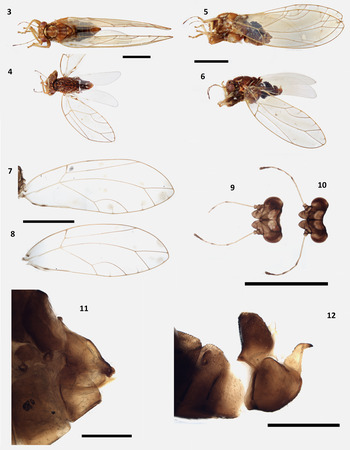
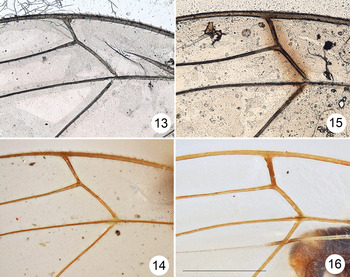
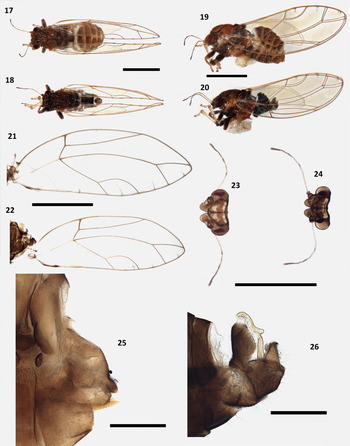
Froggatt's type material is in very poor condition to the extent that most diagnostic characters are difficult to determine. However, Froggatt's (Reference Froggatt1901) series of T. eugeniae indicated subtle differences between the Termeil (NSW) types and other specimens attributed to T. eugeniae from Clifton (NSW) (figs 1 and 2). Subsequent specimens from Pebbly Beach (from 1960, host data unknown) were morphologically consistent with T. eugeniae (figs 3–12). Multiple series from Australia (including Froggatt's specimens from Clifton) and California, USA, with a long history of identification to T. eugeniae were morphologically consistent with T. adventicia, originally described from New Zealand (Tuthill, Reference Tuthill1952) (figs 17–26). Fore wing dimensions and fore wing vein lengths, together with various ratios are presented in table 1. The presence or absence of fore wing infuscation appears diagnostic between the two morphotypes (figs 13–16). The presence or absence of fine, divergent setae along wing veins was identified as a reliable, previously undetermined character (figs 13–16). Determination of the number of metatibial spurs showed that specimens of T. eugeniae morphotype consistently possessed one outer and three inner spurs. The usual configuration for those for T. adventicia morphotype in Australia, New Zealand and California, USA was one outer and two inner spurs, but varied from 1–2 outer to 1–4 inner spurs, with the number of spurs between each of its hind legs of some individuals being inconsistent. It was the number of metatibial spurs that Tuthill (Reference Tuthill1952) used to separate the two species, but which now appears to be a poor diagnostic character.
(1) Froggatt's slide specimens: wing of specimen of T. eugeniae from Termeil, NSW (left); wing of specimen of T. adventicia from Clifton, NSW (right); (2) Froggatt's type specimens (part) of T. eugeniae from Termeil. Scale = 1.0 mm.

T. eugeniae Froggatt [Pebbly Beach, NSW, 1960]: Habitus dorsal view: (3) female, (4) male; habitus lateral view: (5) female, (6) male; wings: (7) female, (8) male; head dorsal view: (9) female, (10) male; terminalia lateral view: (11) female, (10) male. Scale = 1 mm (3–10) and 200 µm (11, 12).

(13, 14): detail of fore wing of T. eugeniae: (13), Froggatt's slide specimen from Termeil, NSW, 1899; (14), more recently collected specimen from Pebbly Beach, NSW, 1960; (15, 16): detail of fore wing of T. adventicia: (15), Froggatt's slide specimen from Clifton, NSW, 1893; (16), more recently collected specimen from Adelaide, SA, 1958. Scale = 1.0 mm.

T. adventicia Tuthill [Adelaide, SA, 2017]. Habitus dorsal view: (17) female, (18) male; habitus lateral view: (19) female, (20) male; [Sydney, NSW, 2011]: wings: (21) female, (22) male; head dorsal view: (23) female, (24) male; terminalia lateral view: (25) female, (26) male. Scale = 1 mm (17–24) and 200 μm (25, 26).

Measurements and ratios for fore wings of T. eugeniae Froggatt and T. adventicia Tuthill

Molecular analysis
The 12 COI sequences obtained here were added to the other eight sequences available on GenBank for a total of 20 COI sequences belonging to T. adventicia and T. eugeniae used to generate a 194 bp and a 398 bp COI gene trees (figs 27a, b). No variation was recorded in the results of the analysis performed using the TN93 + G model (figs 27a, b) and the K2P model (figure not shown), confirming that while K2P is often not identified as the best fitting model, the variation in the results tends to be minimal if not absent for COI barcoding analysis (Collins et al., Reference Collins, Boykin, Cruickshank and Armstrong2012). Here, the 12 samples of T. adventicia from Australia clustered together showing no genetic variation across different states. Similarly, all the four samples from New Zealand and the three samples from the USA clustered together with >99% sequence similarity (based on the genetic distance table). These two groups appeared to be separated by a 1.5% genetic variation (K2P) when using the shortest fragment of COI (fig. 27a) and 2% when using the longest sequence (fig. 27b). Branching at a basal position from these two groups (with a genetic distance ranging between 16.9 and 17.8%) the sequence obtained from the 1960 sample of T. eugeniae appears to belong to a different taxon, more closely related to the New Zealand species T. curta (only 3.3% divergent).
Maximum likelihood mitochondrial COI gene trees based on 194 bp (a) and 398 bp (b). Both COI gene trees include T. adventicia from various localities in Australia, New Zealand and USA; and T. curta from New Zealand used as outgroup and comparison, respectively. (a) also includes T. eugeniae from Australia. The scale bars are 0.05 and 0.02, respectively. The values at the nodes are bootstrap percentages based on 10,000 replicates. The species names represent the updated taxonomical identifications.

The results obtained from the Median Joining Network analysis (fig. 28) show that T. adventicia from Australia is separated from the populations recorded in New Zealand and USA by only three mutations, while both haplotypes are clearly separated from T. eugeniae by 25 and 26 mutations, respectively. Only six mutations separate T. eugeniae from the New Zealand species T. curta, showing the close relationship between these two taxa (fig. 28).
Haplotype network analysis of the samples included in this study showing T. adventicia from New Zealand (pink), USA (dark green) and Australia (light green); T. eugeniae from Australia (purple), T. curta from New Zealand (orange) and T. vitreoradiata from New Zealand (blue). Each mutation is represented by a hatch mark while the size of the circles corresponds to the number of sequences included. Black circles are unsampled or missing intermediates.

Taxonomy
Based on the consistent morphological and molecular differences between the T. eugeniae and T. adventicia morphotypes, we conclude that the two are distinct species. From Froggatt's syntype series from Termeil, a lectotype for T. eugeniae is here designated to stabilize nomenclature according to Article 74 of the International Code of Zoological Nomenclature (1999). Froggatt's specimens from Clifton are not considered as part of the original type series of T. eugeniae because of differences in morphology and doubts about their conspecifity (Froggatt, Reference Froggatt1901). T. eugeniae and T. adventicia are both redescribed.
Family: Triozidae
Genus: Trioza Foerster, 1848: 67, 82; type-species: Chermes urticae Linné, 1758, by subsequent designation of Oshanin (Reference Oshanin1912)
Trioza eugeniae Froggatt Reference Froggatt1901
(figs 1–2; 3–12; table 1)
T. eugeniae Froggatt, Reference Froggatt1901: 282, Plate xv fig. 10, Plate xvi fig 15.
Lectotype, here designated: ♂ (dried), Blister galls E. smithii, Termeil, 20.ix.[18]99, Froggatt (ANIC).
Specimens examined
AUSTRALIA
Type material: New South Wales: Paralectotypes, unless otherwise designated: 2 ♂, 3 ♀ (dried), Blister galls E. smithii, Termeil, 20.ix.[18]99, Froggatt, with additional labels ‘Type 1901 WWF’ [in WW Froggatt's handwriting], ‘1 ♂, 4 ♀’ [in KL Taylor's handwriting] and ‘Lectotype ♂ [here designated, on left in series of ♂♀♀♀♂] 6.vii.2019’ (ANIC); 2 ♂, 2 ♀ (dried), same data, with additional labels ‘Type 1901 WWF’ [in WW Froggatt's handwriting] and ‘2 ♂, 2 ♀’ [in KL Taylor's handwriting] (ANIC); 1 ♂, 1 ♀ (dried), same data, with additional labels ‘2 missing 4 present 9.xi.’ [but with year indeterminate, possibly [19]21, 31 or 51] and ‘1 ♂ (s), 2 ♀’ [in KL Taylor's handwriting] (ANIC); (slide: fore wing only), Termeil, Blister gall on Eugenia smithi, W.W. Froggatt, 20.ix.[18]99, T. eugeniae (ANIC).
Additional material examined: 1 ♂, 1 ♀ (slide), 8 ♂, 9 ♀ (dried), Pebbly Beach, IBF Common & MS Upton, 17.xii.1960 (ANIC); 2 ♂, 2 ♀, 8 nymphs (ethanol), Mt Kembla, El. 338 m, feeding on Backhousia myrtifolia, 16.ix.[20]03, G. Young (WINC).
Redescription. Adult (figs 3–12). Head width: ♂ 0.56, ♀ 0.58 mm; body length, vertex to terminalia: ♂ 1.60, ♀ 1.90 mm; body length, vertex to apex of folded wings: ♂ 3.23, ♀ 3.67 mm (n = 1). Colouration. Male: [specimen dried, point-mounted prior to mounting on slide] general colour brown with pale yellow-brown markings: genal processes pale brown; vertex brown with pale yellow markings anterio-laterally, anterior to fovea and dorso-laterally and dark brown in vicinity of fovea; eyes reddish brown; antennal segments 1–2 brown, 3–7 yellow brown, progressively darker brown at apices, 8–10 progressively dark brown to almost black; pronotum brown; mesopraescutum brown with a pale yellow brown longitudinal medial stripe and pale yellow-brown laterally; mesoscutum with a brown medial longitudinal stripe and two pairs of thick brown almost coalescent submedial markings; mesoscutellum dark brown; fore and hind wings clear; fore wing veins equally pigmented brown; femur brown; tibia and tarsi yellow-brown; abdominal tergites dark brown to black; abdominal tergites dark brown; intersegmental membrane anterior to abdominal tergite 1 and posterior to abdominal tergite 5 white; proctiger dark brown; subgenital plate brown; parameres yellow-brown with tips of apices black. Female: as for male except paler, with markings less distinct; proctiger and subgenital plate yellow-brown with anterior margins and apices with brown infuscation.
Structure. Measurements as in table 1. Body broad, compact (figs 3–6). Head (figs 9 and 10); vertex with weak medial suture, weakly sunk in vicinity of fovea, genal processes moderate in length, conoid, 0.55–0.58 times as long as vertex; antenna moderate in length, 1.56–1.58 times width of head, with a single subapical rhinarium on each of segments 4, 6, 8 and 9; segment 10 with a long pointed seta and short blunt seta. Fore wing (figs 7 and 8, table 1) 2.72–3.17 mm long, 2.72–2.98 times as long as wide, elongate oval with a slightly pointed apex; wing veins bearing fine, divergent setae (figs 13 and 14); vein Rs evenly, shallowly curved, terminating well short of the wing apex, moderately shorter than vein M, RsM: 0.82–0.97, and greater than 0.45 times wing length, RsWL: 0.45–0.51; medial and cubital cells triangular, equal in size; metatibia consistently with one outer and three inner apical spurs. Male terminalia (fig. 12); proctiger conoid, without lateral lobes; subgenital plate broadly rounded; parameres short, narrowly pyriform, with weak dorsolateral lobe and angular incurved sclerotized apices; distal portion of aedeagus very short, broad, moderately sinuate with asymmetrical apical expansion. Female terminalia (fig. 11): proctiger and subgenital plate short, conoid; proctiger in a lateral profile with dorsal margin weakly convex and slightly angled mid-way with apical extension weakly angled upward.
Trioza adventicia Tuthill Reference Tuthill1952
(figs 1, 15–16, 17–26, table 1)
T. adventicia Tuthill, Reference Tuthill1952: 121, fig. 31.
Holotype: ♂, Allotype ♀, numerous Paratypes: New Zealand, Nelson, from Acmena floribunda, various dates (NZAC) [material not examined].
Specimens examined
AUSTRALIA
New South Wales: (slide: fore wing only), Clifton, Crinkled pit leaf, W.W. Froggatt, 4.xi. [18]93, T. eugeniae (ANIC) 3 ♂, 1 ♀ (dried), Clifton, Froggatt, 4.xi. 1893, with additional labels ‘not Trioza eugenia [sic] Frogg., 11.iv.[19]51, LD Tuthill’, ‘3 ♂, 1 ?♀ not eugeniae KLT’ (ANIC); 1 ♂ (dried) same data, with additional label ‘T. eugeniae Froggatt, Syntype m.[ale]’, DH [presumably, and crossed out; perhaps in David Hollis’ handwriting] (ANIC); 3 ♂, 4 ♀ (dried), Roseville, 14.vi.1960, C.E. Chadwick, Attacking leaves lilly pilly (ANIC); 3 ♂, 4 ♀ Engadine, feeding on Syzygium australe cult. ‘Bush Christmas’, 13.iv.[20]03, G. Young (WINC); 3 ♀ (ethanol), Mt Kembla, El. 338 m, feeding on Backhousia myrtifolia, 16.ix.[20]03, G. Young (WINC); 6 ♀ (ethanol) Sublime Pt., Earlwood 34, 150, G. Young, on S. ?paniculatum, 25.ix.[20]03 (WINC); 2 ♂, 10 ♀ (ethanol) Girrahween Park, Earlwood, 33.5573, 151.0767, El. 41 m. G. Young, feeding on S. paniculatum, 25.ix.[20]03 (WINC); 1 ♂, 1 ♀ (slide), 14 ♂, 16 ♀ (ethanol) Baulkham Hills, Woodlands Street, 33.625207, 151.031719, 9.i.2011, coll. D.S. Kent, Ex Syzygium sp. in garden single plant (WINC); 25 ♂, 13 ♀ (ethanol), Cumberland S[tate] F[orest], West Pennant Hills, 33.744576, 151.038235, 12.i.2011, coll. D.S. Kent, Ex Syzygium sp. in pot in advanced area (WINC). South Australia: 2 ♂, 5 ♀ (ethanol), Waite Inst., from leaves of Eugenia on which the nymphs produce pits, 20.x.1958, Specimen index number 192/58 (WINC); 24.x.1958 (ANIC); 10 ♂, 10 ♀ (dried), Waite Institute, H.M. Brookes, 24.x.1958 (ANIC); 1 gall (dried), same data except, Eugenia (ANIC); 1 ♂, 4 ♀ (dried) Adelaide, Botanic Gardens, 31.x.1974, T. Reichstein, on S. paniculatum, specimen index no. 13/74 (WINC); 18 ♂, 19 ♀ (ethanol), Waite Agric. Res. Inst. arboretum, Adelaide, G.S. Taylor, 14.x.1987, on S. paniculatum (WINC); 4 ♂, 15 ♀ (ethanol), same data, except on Waterhousea floribunda, syn Eugenia pentanatii (WINC); 1♂ Adelaide, 17 November 2006, Urrbrae, Waite Campus, G.S. Taylor, S. paniculatum (VAIC); 1 ♂ used for DNA analysis, Adelaide, Veale Gardens, 34°56.162′S 138°35.790′E, M.M. Giannotta, 10.iv.2017, Swept S. paniculatum, 2017 008 (WINC); 6 ♂, 2 ♀ (dried), 1 ♂ used for DNA analysis, Adelaide, Botanic Park, 34°54.055′S 138°36.430′E, G.S. Taylor & M.M. Giannotta, 6.iv.2017, Swept Acmena smithii, 2017 006 (WINC). Victoria: 2♂, 4♀ (dried), reporting only ‘Victoria’ on the label. Of these: 1♀ with 3 + 1 metatibial spurs: at least on a leg, 3♀ with the ‘usual’ morphology showing 2 + 1 metatibial spurs in both the legs, 2♂ not determined (NMV); 8♂, 6♀ Knoxfield, 13 February 1995, M. Malipatil, on Callistemon (VAIC); 2♀ Knoxfield, 3 October 2000, M. Malipatil on Callistemon (VAIC); 2♂, 7♀ Silvan, 28 June 2001, M. Kelly on ‘Zyzygium sp. [sic.]’ (VAIC); 2♂, 1♀ Geelong, 19 March 2003, J. Luck, sweeping Callistemon (VAIC); 2♂, 12♀ and 9 undetermined Kalorama, 26 April 2005, K. Clarke, on S. paniculatum (VAIC).
NEW ZEALAND
North Island: 14 ♂, 7 ♀ (ethanol), 1 ♂ used for DNA analysis, Hastings (LUNZ). South Island: 24 ♂, 23 ♀ (ethanol), 3 ♂, 3 ♀ (dried), 1 ♂, 1 ♀ (slide), 1 ♂, 1 ♀ used for DNA analysis, Christchurch Botanic Gardens, (LUNZ).
UNITED STATES OF AMERICA: 19 specimens labelled ‘Trioza eugeniae’ (slide):
California: two specimens [with 3 + 1 metatibial spurs on both legs and three specimens with the ‘usual’ morphology showing 2 + 1 metatibial spurs on both legs] San Diego, Chula Vista, Elder Ave, 6 October 2008 on Syzygium sp. ID number FSCA # E2009-1333; one specimen [with 2 + 1 metatibial spurs on one leg and 3 + 1 on the other and four samples with 2 + 1 spurs on both legs] California, Contra Costa Co., Richmond, 29 April 2003, FSCA# E2003-1892. Florida: one specimen [with 2 + 1 metatibial spurs on one leg and 3 + 1 on the other] Palm Beach Co., Boynton, 23 April 2004, FSCA# E2004-3020; four specimens [with 2 + 1 metatibial spurs on both legs] Palm Beach Co., Boynton beach, 30 April 2004, FSCA# E2004-3219; one specimen [with 3 + 1 metatibial spurs on one leg and 4 + 1 on the other, and 3 samples with 2 + 1 metatibial spurs on both legs] Miami-Dade Co., Miami, 16 April 2004, FSCA# E2004-2769 (all in FSCA).
Redescription. Adult (figs 17–26). Head width: ♂ 0.54, ♀ 0.58 mm; body length, vertex to terminalia: ♂ 2.11, ♀ 2.14 mm; body length, vertex to apex of folded wings: ♂ 3.20, ♀ 3.57 mm (n = 1). Colouration. Male: [specimen dried, point-mounted] general colour brown: genal processes brown; vertex brown with dark brown in vicinity of fovea; eyes reddish brown; antennal segments 1–2 dark brown, segment 3 yellow brown, segments 4–7 brown, progressively darker brown at apices, 8–10 progressively dark brown to almost black; pronotum, mesopraescutum and mesoscutum brown; mesoscutellum dark brown to black; fore and hind wings clear; fore wing veins R and R1 pigmented dark brown to black, bordered with brown infuscation; femur dark brown; tibia and tarsi brown; abdominal tergites and sternites dark brown to black; intersegmental membrane anterior to abdominal tergite 1 and posterior to abdominal tergite 5 white; proctiger dark brown to black; subgenital plate dark brown; parameres brown with tips of apices black. Female: as for male except paler, with markings less distinct; proctiger and subgenital plate brown with anterior margins with brown infuscation.
Structure. Measurements as in table 1. Body broad, compact (figs 17–20). Head (figs 23 and 24); vertex with weak medial suture, weakly sunk in vicinity of fovea, genal processes moderate in length, conoid, 0.50–0.55 times as long as vertex; antenna moderate in length, 1.49–1.61 times width of head, with a single subapical rhinarium on each of segments 4, 6, 8 and 9; segment 10 with a long pointed seta and short blunt seta. Fore wing (figs 21 and 22, table 1) 2.90–3.41 mm long, 2.54–2.82 times as long as wide, elongate oval with slightly pointed apex; wing veins not bearing fine, divergent setae (figs 15 and 16); vein Rs evenly, moderately curved, terminating well short of wing apex, considerably shorter than vein M, RsM: 0.80–0.86, and less than 0.45 times wing length, RsWL: 0.40–0.44; medial and cubital cells triangular, equal in size; metatibia inconsistently with one (1–2) outer and two (1–4) inner apical spurs. Male terminalia (fig. 26); proctiger conoid, without lateral lobes; subgenital plate broadly rounded; parameres short, pyriform, evenly tapering to incurved sclerotized apices; distal portion of aedeagus very short, broad, moderately sinuate with asymmetrical apical expansion. Female terminalia (fig. 25): proctiger and subgenital plate short, conoid; proctiger in lateral profile with dorsal margin moderately convex and angled mid-way with apical extension angled upward.
Discussion
At least 30 species of Australian Psylloidea are considered to be introduced into New Zealand (Martoni et al., Reference Martoni, Burckhardt and Armstrong2016; Martoni and Armstrong, Reference Martoni and Armstrong2019). These comprise 13 species in nine genera of Aphalaridae: Spondyliaspidinae from Boronia (Rutaceae), Corymbia, Eucalyptus, Lophostemon and Syzygium (all Myrtaceae); two species (one undescribed) of Mycopsylla (Homotomidae) on Ficus (Moraceae); 12 species of Acizzia (Psyllidae: Acizziinae) with nine species from Acacia, one each from Dodonaea (Sapindaceae), Hakea (Proteaceae) and Solanum (Solanaceae) and three species in three genera (one undescribed) of Triozidae from Casuarina (Casuarinaceae) and T. adventicia from Syzygium (Myrtaceae).
The so called, T. eugeniae was first detected in California, USA in 1988, becoming a serious pest of ornamental lilly pilly, S. paniculatum (Downer et al., Reference Downer, Koehler and Paine1991; Dahlsten et al., Reference Dahlsten, Kent, Rowney, Copper, Young and Tassan1995; Zuparko et al., Reference Zuparko, De Queiroz and La Salle2011). It was discovered in Florida in 1993 but was eradicated (Mead, Reference Mead1994). A classical biological control program commenced with foreign exploration in Australia in 1991, resulted in the description of a new species of parasitoid, Tamarixia dahlsteni Zuparko (Zuparko et al., Reference Zuparko, De Queiroz and La Salle2011), and its importation into USA that has achieved subsequent partial biological control (Dahlsten et al., Reference Dahlsten, Kent, Rowney, Copper, Young and Tassan1995; Dreistadt et al., Reference Dreistadt, Flint and Clark2004).
Despite the misidentification, foreign exploration for a natural biological control agent for T. eugeniae was unknowingly made on the correct species. Zuparko et al. (Reference Zuparko, De Queiroz and La Salle2011) referred to collection sites at North Ryde, Sydney (just 60 km N of Froggatt's ‘second’ site at Clifton), the only site collected from within its natural range. Other sites referred within (such as Artherton, Qld and Denmark, WA) and recorded localities in SA and Vic, are well outside the native host plant range, and are obviously from ornamentals distributed early on in the nursery trade.
Froggatt's (Reference Froggatt1901) type specimens of T. eugeniae are in extremely poor condition, decolourized and with collapsed integuments, to the extent that few characters remain for diagnosis (fig. 2). It was only with the serendipitous matching of newer material, the 1960's series from Pebbly Beach (see Specimens examined; Figs 3–6) with Froggatt's type specimens, that consistent differences between T. eugeniae and T. adventicia could be determined. These characters include subtle but consistent relative lengths of fore wing veins and the corresponding morphology of fore wing cells, fore wing setation, number of metatibial spurs and male genitalia. T. eugeniae has smaller fore wings that are slightly more elongate (see WLW ratio in table 1); it lacks infuscation around veins R and R1 (figs 13 and 14); vein Rs is relatively longer, meeting the costa closer to the wing apex (with a corresponding higher RsM ratio: see table 1; Figs 7 and 8); the Cu/Cu1b ratio is generally higher; it appears to have consistently one outer and three inner metatibial spurs (see Tuthill, Reference Tuthill1952); the male parameres appear thin with weakly sclerotized apices; and, the dorsal margin of the female proctiger is weakly convex and slightly angled mid-way with apical extension weakly angled upward in the lateral profile. Most diagnostically certain wing veins bear long, fine divergent setae (figs 13 and 14), a character not described by either Froggatt (Reference Froggatt1901) or Tuthill (Reference Tuthill1952). T. adventicia has larger fore wings that are slightly more ovate (see WLW ratio in table 1); it has dark infuscation around veins R and R1; vein Rs is relatively shorter, meeting the costa further from the wing apex (with a corresponding lower RsM ratio, see table 1; figs 15 and 16); the Cu/Cu1b ratio is generally lower; it appears to have an inconsistent number of metatibial spurs: the usual configuration is one outer and two inner metatibial spurs (see Tuthill, Reference Tuthill1952), but varies from 1–2 outer to 1–4 inner spurs, with some individuals with inconsistences between each of its hind legs. It is noted that specimens of T. adventicia from Australia, New Zealand and the USA show a similar variability in the number of metatibial spurs as opposed to the 1 + 3 configuration that appears consistent in T. eugeniae (and which Tuthill used to separate the two species). It is also evident that the male parameres of T. adventicia appear a little broader with slightly more sclerotized apices; and, the dorsal margin of the female proctiger is moderately convex and angled mid-way with apical extension angled upward in the lateral profile. The wing veins do not bear long, fine divergent setae (figs 15 and 16).
The ~200 bp sequences of T. adventicia from New Zealand and those of the specimens from the USA were genetically identical to each other, with a very low divergence from the Australian specimens (fig. 28). Despite no extensive genetic investigation of the Australian populations, this study included all the COI sequences (publicly available on Genbank) identified as T. adventicia/T. eugeniae worldwide. Therefore, this suggests an early dispersal from Australia (where the host plant is native) to New Zealand, followed by its accidental introduction to California from New Zealand in very recent times (Dahlsten et al., Reference Dahlsten, Kent, Rowney, Copper, Young and Tassan1995; Percy et al., Reference Percy, Rung and Hoddle2012). Based on the origin of its host plant being Australian, T. adventicia is considered to be Australian, too. It is highly probable that its dispersal from outside its native range in Australia, New Zealand and the USA was via transportation of the very common ornamental plants (S. paniculatum and S. smithii) in the early nursery trade.
S. paniculatum is a rainforest tree endemic to NSW, occurring in a narrow, linear coastal strip from Upper Lansdowne to Conjola State Forest in the NSW North Coast) and Sydney Basin IBRA regions. It is listed as Endangered in NSW State legislation under the Biodiversity Conservation Act 2016, and as Vulnerable under the national Environment Protection and Biodiversity Conservation Act 1999. S. smithii occurs in the coastal rainforest from northern Qld to Vic. It is this species that Froggatt attributed as host to T. eugeniae, but this remains to be confirmed in the light of comments by Young (Reference Young2003) and collection records of Zuparko et al. (Reference Zuparko, De Queiroz and La Salle2011). Both species are extensively propagated in the nursery industry.
The host records of T. adventicia from Angophora floribunda (Martoni et al., Reference Martoni, Burckhardt and Armstrong2016; Percy, Reference Percy2017; Ouvrard, Reference Ouvrard2019) are erroneous. This undoubtedly results from a misinterpretation of Tuthill's (Reference Tuthill1952) host record of Acmena floribunda DC. It is noted that Angophora floribunda (Sm.) Sweet is a valid species for which Acmena floribunda (Sm.) DC. is a nomenclatural synonym (Australian Plant Census 2019). It is here considered that Angophora floribunda was incorrectly assigned as a host plant.
The identity of the triozid has consistently been referred to T. eugeniae in the biocontrol program and is firmly entrenched in the nursery and horticultural industry. A Google Scholar search (accessed 4 February 2019) for ‘Trioza eugeniae’ revealed about 100 scholarly articles on regional checklists (e.g., Percy et al., Reference Percy, Rung and Hoddle2012), general biology, host specificity, pest management, ecology, phenology, physiology and predator–prey interactions associated with its extensive biological control program (e.g. Downer et al., Reference Downer, Koehler and Paine1991; Dahlsten et al., Reference Dahlsten, Kent, Rowney, Copper, Young and Tassan1995; Luft and Paine, Reference Luft and Paine1997a, Reference Luft and Paine1997b, Reference Luft and Paine1998; Luft et al., Reference Luft, Paine and Redak2001a, Reference Luft, Paine and Walker2001b), studies on endosymbionts (Thao et al., Reference Thao, Moran, Abbot, Brennan, Burckhardt and Baumann2000; Hall et al., Reference Hall, Morrow, Fromont, Steinbauer, Taylor, Johnson, Cook and Riegler2016; Morrow et al., Reference Morrow, Hall and Riegler2017) and in molecular phylogenetics (Ouvrard et al., Reference Ouvrard, Campbell, Bourgoin and Chan2000; Xie et al., Reference Xie, Tian, Zheng and Bu2008; Percy, Reference Percy2017). A Google search for ‘Eugenia psyllid’ revealed 5860 sites, ‘Trioza eugeniae’ 3350 sites, ‘lilly pilly psyllid’ 384 sites, all with a strong emphasis towards nursery and garden guides indicating just how firmly entrenched the name is recognized by the non-academic community, and that for ‘Trioza adventicia’ just 173 sites. It was noted that the removal of parentheses in these searches yielded 12,500, 13,900, 9780 and 337 sites respectively. Clearly, acceptance of T. adventicia as the valid name for the ‘Eugenia-’ or ‘lilly pilly psyllid’ will be problematic and protracted.
Ultimately, while clarifying the identity and distribution of T. eugeniae and T. adventicia, this work also raises new taxonomical questions on the New Zealand species T. curta. In fact, both morphological examination and genetic comparison indicate strong similarities between the species T. eugeniae and T. curta. The morphology of T. eugeniae is consistent with the descriptions and illustrations of T. curta, especially the male and female genitalia (Ferris and Klyver, Reference Ferris and Klyver1932; Dale, Reference Dale1985) and in the presence of divergent setae on wing veins (Dale, Reference Dale1985). However, a genetic distance of ~3%, especially as extrapolated from a single 200 bp COI sequence, could not clarify if the strong morphological similarities are indicative of conspecificity. Nonetheless, the three lineages analysed here (T. adventicia, T. eugeniae and T. curta) appear to be closely related and possibly in a basal position to the New Zealand triozids (Martoni et al., Reference Martoni, Bulman, Pitman, Taylor and Armstrong2018). Therefore, additional samples of T. curta and new specimens of T. eugeniae will be useful to enable a better understanding of the relationship between these two taxa.
The results presented in this study highlight the profound importance of rigorous morphological identification as the basis of molecular work aiming to identify a species and/or for the study of its ecology and biology. In this time of seemingly continuous technological development, where the duration and cost of sample collection to sequencing are becoming more efficient and feasible, the occurrence and frequency of mistakes within the increasingly large flow of information risk to go unnoticed. In fact, the issue of the diagnostic misidentification of the psyllid in the first instance has been drastically inflated by the attribution of that incorrect species name to DNA sequences available online. Therefore, in order to fully benefit from the advantages of molecular identification and techniques, it is imperative that more attention is given to taxonomical input.
Supplementary material
The supplementary material for this article can be found at https://doi.org/10.1017/S0007485319000695
Acknowledgements
This project was supported by the Australian Biological Resources Study (ABRS) National Taxonomy Research Grant RF216-29. The authors would like to thank Olivia Evangelista (ANIC), Peter Gillespie (ASCU), Susan Halbert (FSCA), Ken Walker and Catriona McPhee (NMV) and John Marris (LUNZ) for access to collections. We thank (the late) Graham Young and Deborah Kent for sending material (to GST), and John Clemens (Christchurch Botanic Gardens), and Madalene Giannotta (University of Adelaide) for the help in collecting new specimens. Many thanks also to Reannon Smith, Mark Blacket, Isabel Valenzuela, Lixin Eow and Lea Rako (Agriculture Victoria), and to Aimee McKinnon (La Trobe University) for helpful discussions, suggestions and comments on methodologies in previous versions of this manuscript. Part of the data published in this article was reported in FM's PhD thesis (Martoni, Reference Martoni2017).