1. Introduction
In Science, Truth, and Democracy, Philip Kitcher challenges what he considers the standard view of science. The primary features of this view are the beliefs (1) that science has a single, context-independent, goal, for example, the elucidation of the laws of nature, the pursuit of which marks a project as scientifically significant, that is, as truly scientific in nature and (2) that one cannot critique on moral grounds the choice of which scientific projects to pursue (as opposed to the means used to pursue these projects).Footnote 1 As exemplars of (1) we may cite, among many others, Kitcher (Reference Kitcher1981) himself, as well as, from a scientist, Weinberg (Reference Weinberg1994, 6). Wilson (Reference Wilson1976) provides a strident defense of (2), one his interlocutors in the sociobiology debate decline to challenge and even explicitly support. (See Gould Reference Gould1977, 258 and Kitcher Reference Kitcher1985, 7.) Regardless of the provenance of these beliefs, however, Kitcher finds the first incoherent and the second both dangerous and false. He therefore proposes a context-dependent measure of scientific significance and argues that science, when thus understood, is subject to moral assessment even in its choice of which projects to pursue. (Throughout this paper I will take the claim that science is subject to moral assessment to refer specifically to this claim, namely, that the choice of which projects to pursue is subject to moral assessment.)
Although I agree with Kitcher that scientific significance is context-dependent and that science is subject to moral scrutiny even as regards its choice of subject matter, his approach to these issues fails to provide the best account of a context-dependent, morally answerable, science. For, his method of assuring science's responsiveness to the demands of morality entails that his account is ultimately given at least partially in explicitly moral terms. There is no reason, even when seeking to subject science to morality, to make science conceptually dependent on morality, as Kitcher does. Therefore, after a brief exposition and critique of his view, I will propose several modifications which yield an account in which science is morally responsible and scientific significance context-dependant, without either being in any way dependent on morality.
2. Kitcher's Account
2.1. Scientific Significance and the Significance Graph
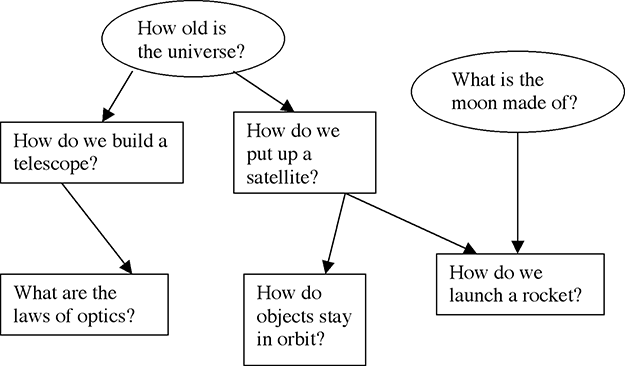
In response to the views that postulate monistic scientific goals, Kitcher proposes a context-dependent pluralism. In his account, a question within science's purview is “scientifically significant.”Footnote 2 Scientifically significant questions derive this significance either intrinsically, by addressing an immediate practical need or being something we are naturally curious about, or extrinsically, by being a necessary adjunct to answering another question which is itself scientifically significant (80–81).Footnote 3 This interdependence of significant questions leads Kitcher to introduce the significance graph (78). This abstract structure is, mathematically, a directed graph. The significance graph represents significant questions as nodes, with arrows pointing to a question's node from the other nodes, if any, whence it derives its significance. Thus, for example, a small graph relating to cosmology (see Figure 1) might have a node representing the question “How old is the universe?” about which we are curious. Since this question has only intrinsic interest, no arrows will point to it. In order to answer it, however, we may have to build a telescope. This need will generate a node for the question “What are the laws of optics?” which will have an arrow leading in from our telescope node, which represents the question that directly provoked our interest in optics. After further thought, we may realize that we must launch our telescope into orbit to serve our current purposes, and that therefore, to determine the universe's age, we must first answer questions of aeronautics, celestial mechanics, etc. These questions will generate new nodes with arrows leading in from our original cosmology node. Finally, building a rocket may also help us answer a second question we are naturally curious about, namely, “What is the moon made of?” Therefore, our aeronautics question will have a second arrow leading in to it from the node representing our interest in the composition of the moon.
A toy significance graph.

A moment's reflection will reveal the dynamic nature of the significance graph. The advance of some projects and abandonment of others will add nodes to and remove nodes from the graph. Not that this feature of the graph should be surprising. The significance graph develops out of our interests; undoubtedly, it will change as our interests do. This dynamism, however, means that for Kitcher science is historically relative, with questions significant at one time possibly lacking significance at another (81). Hence, the significance graph must be indexed to time. When so indexed, however, and fully elaborated with the inclusion of all appropriate questions, the significance graph tells us, for the indexed time, which questions have scientific significance. For example, the graph in Figure 1 must be indexed, to the late twentieth century perhaps. Some questions in that graph, having been already answered, are no longer significant in the twenty-first century, and would thus not appear in the graph indexed to the current time.Footnote 4
Before moving to the second component of Kitcher's program, we must pause to clarify an ambiguity in his presentation of significance graphs. Do significance graphs represent a consensus among the relevant parties, or does each person elaborate his own graph based on the significance relationships as he sees it? The notion of a significance graph is coherent either way, a fact to which we will return. However, although he never says so explicitly, Kitcher is clearly interested primarily in the consensus graph. He introduces significance graphs as structures associated with fields of science, “mak[ing] explicit what workers in the field know” (78; see also note 4 above). Similarly, a graph can show how a question “gains significance for science” (79), not for a scientist. Furthermore, Kitcher makes no reference, at least at this stage, to an individual's graph. Finally, as we shall soon see, Kitcher's project entails a coordinated research effort, one best represented by a coordinated, that is to say consensus, significance graph.
2.2. Moral Constraints and Ideal Deliberation
According to Kitcher, then, the significance graph, by representing a broad consensus, identifies for us the scientifically significant questions. (Time indexing will henceforth be implicit.) Having thus considered the domain of science, Kitcher next asks whether, given the set of scientifically significant questions, there are any constraints on which of these questions scientists can or should pursue. That is, does morality require anything of scientists qua scientists?
Kitcher believes that science must indeed be guided by the Good, and sees implicit in his interest-relative account of science “moral grounds for refraining from [some lines of] inquiry” (105). After all, part of science's goal is to answer questions of practical interest to us. However, some projects, such as, perhaps, nuclear fission, although solving a relatively small practical problem, might ultimately have disastrous results. In such a case, pursuing the project in question contravenes our practical interests and therefore lacks scientific significance. (This judgment assumes that the project has no theoretical interest for us. We will not consider here how to balance theoretical and practical interests.) To the extent then that science fails to take our practical interests into account by considering the broader impact of answering certain questions, it fails to achieve its goal of addressing questions that advance our interests. If we adopt a consequentialist framework, as Kitcher explicitly does in Chapter 8, science is thus subject to moral constraints since, in deciding which questions it will pursue as significant, it must consider the practical impact and potential harm of its investigations, just as consequentialism requires. A science which does not consider how it “impinge[s] on people's values and interests … is not well-ordered” (108).
Science can thus, for Kitcher, be “well-ordered” or not. Science is well-ordered if (or to the extent that) it pursues questions that promote our good, and is not well-ordered when its inquiries conflict with our interests (108). How can a society assure that its science will be well-ordered? There are many schemes. Kitcher provides one in particular, “ideal deliberation,” which is sensitive to his liberal democratic approach to politics and society, although, as we will see, a different political theory might lead to a different scheme. In ideal deliberation all of the people of a society or their representatives come together in a conference, each with their initial preferences about what to investigate. After each constituency educates the others about the epistemic and practical significance they see in their preferred questions, the conferees are ready to reach a consensus (by majority vote, if necessary) on which projects they, as a community, have an interest in pursuing. They will then devote their resources to these projects.
In the end, this deliberative process yields a set of directives for the scientists of the society. If they follow these instructions they can be sure that their activities will serve their society's fully considered interests. In other words, their science will be well-ordered. Of course, this deliberative process is ideal in all senses of the word. First it provides ideal, that is, perfect, outcomes. Ideal deliberation should correctly predict which projects serve the community's interests. Furthermore, a society need not actually undergo this process. A science is well-ordered if it pursues those questions that would have been identified through ideal deliberation, regardless of how the questions were actually chosen.
2.3. Science and Technology
Before leaving this exposition of Kitcher's account, we should note one further position he takes. Kitcher argues at length for the impossibility of distinguishing science from its applications, that is, technology. I mention this claim only because I will follow Kitcher in taking this position, although I will neither review his arguments (found in Chapter 7) nor argue for it myself. The assumption will merely serve to guide and constrain the arguments at certain points, usually implicitly. Those who prefer to maintain the distinction can see my adoption of Kitcher's position here as an attempt to modify his account as little as possible.
3. The Relationship between Scientific Significance and Ideal Deliberation
We have now seen how Kitcher identifies science's conceptual and moral bounds. Conceptually, science investigates questions of context-dependent interest-relative significance, found on the significance graph. Morally, a well-ordered science must pursue only those projects that serve the community's overall best interests. On the surface, these appear to be separate, if related, constraints. But how separate are they? Is there really a broad significance graph, full of questions that interest us, even if only at our peril, within which a well organized society will direct its science to a subset of particularly desirable projects? Kitcher never explicitly connects the significance graph and ideal deliberation. Indeed, he introduces the two in separate parts of the book. This is not to say that Kitcher does not mention significance graphs when discussing ideal deliberation. He does (118, 125). However, these significance graphs are personal ones representing the interests of individual deliberators. What Kitcher does not explicitly connect is the outcome of ideal deliberation with the significance graph that confers scientific, as opposed to personal, significance. We can, however, show that these two concepts are closely tied and that this linkage has a large impact on his argument.
The connection between the significance graph and ideal deliberation was hinted at in the above exposition of well-ordered science. To see it more clearly, let us consider the significance graph again. We have talked about the graph's growth and change, but we have never said how, initially, to identify or construct this graph. Whom shall we survey to determine which questions originally seed the graph? The obvious answer, scientists, those who appear best able to seed the graph with appropriate questions, will not do. Scientists are those who investigate scientifically significant questions, precisely the notion the survey seeks to elucidate.Footnote 5
Perhaps instead we could restrict ourselves to those who know not science as such but the natural world. We may not yet know quite what science is, but surely some part of its essence is that it explores the natural world. Those who understand that world best can best identify the questions about that world we want answered and hence are significant. Understanding breeds discernment.
Surveying the cognoscenti, however, is no more possible than surveying scientists, and for the same reason. These extra-scientific (or pre-scientific) experts do not merely know something about the natural world; every person has knowledge of that. These savants are supposed to have special, significant, knowledge, and it is precisely this significance we are trying to understand. Removing the word “science” gets us nowhere. Ultimately, we are trying to understand what counts as significant knowledge about the world.
Once we see that we cannot use the possession of special knowledge to identify people who have a special role in determining scientific significance, we understand that all people in a society must be consulted in constructing the significance graph. However, we are now able to note a further point as well. Not only must the significance graph represent all people, but it must also represent all sorts of interests. One might have thought that whoever was involved in assessing scientific significance, the interests they use in making this assessment must be somehow objective, “scientific,” and not tied up in their own personal needs, interests and lives. However, giving an account of scientific significance in terms of scientific interests is just as circular as doing so in terms of scientists.
Scientific significance, then, must take into account all people and interests. How shall we combine these views into one consensus graph? Ideal deliberation, designed to solve just this type of problem, would seem to be the answer. Different people, with different notions of which questions are significant, get together and through ideal deliberation reach an agreement on assigning significance. Ideal deliberation thus provides us not only with well-ordered science, as we saw in the last section, but also with the significance graph.
We have thus completed the linkage of the significance graph to ideal deliberation and well-ordered science. The only consensus significance graph we can rest satisfied with under Kitcher's scheme, one which takes into account all relevant interests, is the well-ordered graph ideal deliberation delivers. Ideal deliberation thus does not simply protect us from science run amok; it generates scientific significance. A well-ordered science is not merely extrinsically good; it is the only science pursuing significant questions. Only the significance graph resulting from ideal deliberation reveals scientific significance.
4. A Critique of Kitcher's Account
We have now seen that Kitcher provides science with a coherent goal while at the same time assuring that science will not trample on our interests in the pursuit of that goal. He accomplishes this task, however, by introducing an interest-relative conception of science that goes beyond mere intellectual interest. Through ideal deliberation, Kitcher incorporates morality and the human good directly into his account, allowing these concerns a say in what questions are scientifically significant. Indeed, Kitcher makes no firm distinction between questions of assigning scientific significance and questions of assessing the human good. The former incorporates the latter. It is this feature of Kitcher's account that we shall now consider. First we will see how deeply implicated morality is in Kitcher's account of science and then we shall see why this implication is a problem.
4.1. Moral Theory and Metaethics in Kitcher's Account
The most obvious point at which morality enters science for Kitcher is, as we just noted, in giving prudential interests a direct role in determining scientific significance, but Kitcher incorporates morality into science in other ways too. First, the incorporation of prudential values into science via ideal deliberation introduces not just morality, but a particular class of moral theories, into science. For, in taking the outcome of ideal deliberation, which merely mediates differing views of the deliberators’ best interests, to be a relevant guide to moral behavior, Kitcher assumes that meeting people's prudential interests is the role of moral behavior. This position is plausible, but far from universal. A Kantian, for instance, would deny both that meeting people's interests is morally relevant and that ideal deliberation is appropriately designed to reliably deliver moral guidance. Ideal deliberators could decide that their best interests lie in following the categorical imperative, thus constraining science to act in a Kantianly moral way. However, in this case, the behavior would not be moral because ideal deliberation advised it, but despite that fact. Ideal deliberation itself is morally irrelevant to a Kantian, and potentially dangerous, since it could lead moral agents astray. Kitcher must instead support a moral theory that views prudential interests as at least potentially morally relevant. We saw above that, for other reasons, Kitcher assumes consequentialism. This is certainly one theory that would work here, although there may be others. However, Kitcher is clearly restricted to a limited number of moral philosophies compatible with his account of science.
Beyond its assumption of a particular class of moral theories, Kitcher's account incorporates morality in a second way as well. As we have seen, to generate the significance graph, a society must engage in ideal deliberation. To succeed, any group of ideal deliberators, before they begin to deliberate, must agree how they will combine the various opinions proffered. How will they settle disagreements among viewpoints, and how will they balance competing interests to reach a consensus? These questions—concerning dispute resolution and interest accommodation—are essentially questions of what we owe others and how we ought to interact with them, and as such fall within the domain of morality;Footnote 6 adopting different moral theories can lead to different answers to these questions. Thus, to complete their task, the deliberators must arrive at some sense of their obligations to each other and thereby commit themselves, at least implicitly, to a particular moral theory or at least range of theories. As a result of this dependence on the methods chosen for deliberation, the aims of science may change whenever there is a change in societal mores. For Kitcher, if a society were to change from a liberal democracy to a Platonist republic, its mode of ideal deliberation would change. (No longer would the deliberators regard the opinions of all the members of their society as worthy of equal respect.) This change in deliberative methods, however, would change the significance graph and eo ipso the questions science seeks to answer.
This reliance on moral consensus also introduces into Kitcher's account a substantive metaethical assumption. Kitcher assumes that such consensus is possible, even if only in theory. As he acknowledges, however, moral consensus may not be possible. Certainly history gives little evidence that all moral disputes are resolvable, and some theories of metaethics do not even provide any mechanism for reaching moral consensus. (See the account of naturalism in Hare Reference Hare1997.) Kitcher's account requires that these theories be wrong.
4.2. Problems for Kitcher
Even given this multi-level incorporation of morality into science, why should we think that it is a problem for Kitcher? Is not incorporating morality into science his goal? Although incorporating morality into science via ideal deliberation is his means, Kitcher's goal is to show that science must heed the demands of morality. In choosing the means he does, Kitcher creates substantial problems for himself. The direct incorporation of moral notions into science poses the greatest obstacle to acceptance for Kitcher's account. It will undoubtedly raise the hackles of his opponents, who are disinclined to admit that morality governs science, if, in seeking to counter them, he goes even further and virtually defines science's aim in terms of the Good.
More important than any rhetorical problems, however, are several theoretical problems a value-laden account of science raises. First, the utility of one's account of science should not depend on the outcome of specific debates in moral theory, especially ones that show no sign of being resolved. Consequentialists and deontologists alike should be able to accept the account. Kitcher seems to recognize this desideratum, as he says that the view he disputes denies that “moral appraisal … is properly directed … at science itself,” with no reference to a particular moral theory (9; cf. 3, 94). One would therefore assume that under his account science would be subject to morality however morality is construed. As we saw, however, for Kitcher science is only subject to consequentialist morality or some similar account. This limitation is not surprising, as he explicitly adopts consequentialism while making his argument. It is, however, unfortunate, as it means that many who hold moral theories not compatible with Kitcher's account will immediately judge it as failing in its goal of bringing science under the guidance of morality.
The next problem for Kitcher arises from the requirement that ideal deliberators specify, before beginning their deliberations, which moral theory they are using (without, at this point, being subject to the limitations we noted earlier). As we saw, this requirement implies that there could be a radical change of the significance graph without any change in the questions people are asking; changes in morality result directly in changes in what is scientifically significant. One does not have to share the standard view's account of the relationship between science's choice of projects to pursue and morality—that there is none—to find this dependence of the scientific on the moral troubling. Whether or not science is subject to morality, its domain, that which science seeks to investigate, appears to be dependent on the natural world, not on our thoughts about morality. Science seems to be possible without first settling, even implicitly and ad hoc, on any positions in moral philosophy; indeed, presumably no such agreements exist in the scientific community any more than in the philosophical community or the world at large. Furthermore, it would be odd for a laboratory to halt an experiment not because the problem had been solved or rendered irrelevant by a scientific revolution, but because, as an indirect result of a social revolution, the question was rendered unscientific. Note that the worry is not that the new social values may be ‘wrong’. Rather, the concern is that factors that appear to be extraneous to science are determining its domain. Likewise, I do not mean to imply that changes in social or moral attitudes, such as a newfound concern for the welfare of AIDS patients or for the environmental impact of nuclear testing, cannot prompt or end the pursuit of particular lines of scientific inquiry. Rather, again, the concern is that for Kitcher these moral concerns are understood as determining science's domain as opposed to merely having a practical and external effect on science's conduct.
Kitcher faces a similar problem when we consider the question “Which society?” We saw above that everyone's interests must be represented in ideal deliberation and hence in the significance graph. But to whom does “everyone” refer? Is it the residents of a local state, of a whole country or of the entire world? Kitcher himself (125) settles on an intermediate position: only those citizens whose resources are being used deliberate, but they must consider the preferences of those outsiders who will be affected by the deliberation's outcome. The problem for Kitcher, however, does not lie in his choice of who deliberates. As before, the problem is that different choices yield different significance graphs. Why should practical and moral concerns regarding the appropriate participants in ideal deliberation affect the aim of science? Inasmuch as the choice of who must be represented in ideal deliberation is a moral (to whom do I owe a consideration of their interests) or a prudential (what group of ideal deliberators will maximize science's returns to me) one, the choice seems just as extraneous to science as the choice of moral theory, and hence just as problematic in an account of science.
One might respond that the questions raised in the preceding two paragraphs are not a problem for Kitcher. On his account, moral and social concerns are not extrinsic to science but integral to it. This assertion is true, but does not lessen the force of the objection. The question remains whether this integration is appropriate. Many people have the intuition that science and morality are conceptually, if not practically, independent, and we saw above a prima facie case supporting this intuition. If Kitcher wants to integrate science and morality, he must argue for it, yet he never does. Even after considering Kitcher's account this integration remains counterintuitive and undefended, albeit it helps him accomplish a goal, the subjection of science to morality, whose importance he does argue for. The fact that integrating science and morality is useful for his account, however, is not enough to make that integration plausible, especially if there is an alternative account available.
Kitcher's metaethical assumption creates a problem for him of a different order, one of possibility and not merely plausibility. If moral consensus is indeed impossible, Kitcher risks being left with a science lacking a coherent goal, since the deliberators could fail to reach the agreement necessary to produce any consensus significance graph. It could turn out that for Kitcher, science does not and cannot exist.
5. A Different Account of Scientific Significance and Moral Constraints on Science
The objections raised above show that Kitcher's treatment of morality in science may render his account unpalatable, implausible or even impossible. In light of this problem, we may ask whether we can formulate an approach to the conceptual and moral delimitation of science that captures Kitcher's insights without being open to these criticisms. Can we have a morally bounded science and interest-relative scientific significance without choosing a particular community and building their interests and morals into science, and without committing to a particular type of moral theory? The answer is yes, and in developing it we will arrive at an interest-relative account of scientific significance that does not directly incorporate any moral notions or evaluations. However, in developing such an account, we shall be both more and less radical than Kitcher. More radical in abandoning monism even more definitively than Kitcher does. Less radical in maintaining the traditional conceptual separation between science and morality.
5.1. Scientific Significance
Let us begin by following Kitcher and saying that interest determines scientific significance, and thus the aim of science. However, rather than trying to determine a society-wide sense of this interest, as Kitcher does, we will accept all interests as equal in this regard. If any person or group is interested in a question about the natural world, it is scientifically significant. (As we noted earlier, regardless of how we understand scientific significance, science must address the natural world.) However, we must abandon the notion of significance simpliciter and instead index significance to individual investigators. A question is scientifically significant for an individual if that person is interested in it. Of course, we must not understand this indexing to individuals too restrictively. Group concerns are also relevant. Not all of a person's interests are unique to themselves, and not all scientifically significant questions will be of limited interest. Most of one's interests result from membership in a group, or at least are shared with other members of a group. Thus, an individual American high-energy physicist will be interested not only in her own private questions, but also those of interest to high-energy physicists, physicists in general, women, Americans, humanity as a whole and probably other groups as well. All of these questions will be significant for her.
One upshot of this abandonment of a unitary source of significance is that a question that is significant for one person might not be so for another. Two people could be simultaneously engaged in identical projects, but, if their motives are different, it may be that only one of them is doing science by pursuing a significant project. This claim may seem odd—is the question significant or not?—but we are merely taking the context-sensitivity Kitcher argues for to its logical conclusion. Societies are not the only ones with interests, so they are not the only ones relative to whom scientific significance has meaning. If scientific significance reflects interests, it will be exactly as context-sensitive as interests are; if interests can change from person to person, so can significance.
Our claim here is that personal interest is both necessary and sufficient to generate scientific significance. Each part of this claim raises difficulties. First, necessity. What of the lab technicians and post-docs working on a project in which they are completely uninterested. Do we want to say that they are not engaged in a scientifically significant pursuit, that they are not doing science? In cases like these we can say that the uninterested parties have interest by proxy. Thus, a researcher who carries out a project because she is paid to, but with no interest in the outcome, may be said to share the interests of her employer and therefore be doing science.
A second challenge to the claim of necessity may appear to come from informed but uninterested laypeople. Without having any interest in the answer, I can acknowledge that physicists’ attempts to find the Higgs boson may add to our understanding of the natural world. This acknowledgement appears to be independent of my interest (I have none) and the physicists’ (even were they to abandon the search for some reason I would still acknowledge the scientific nature of the project since it could help explain the natural world). To resolve this problem we must note that we are providing a condition for scientific significance. We want to distinguish questions about the natural world which are significant and hence within the domain of science from those which are not. Merely recognizing that the Higgs boson will tell us something about the world is not enough; so will counting the bricks in my building. The scientific significance of the quest for the Higgs boson comes from the further fact that some group of people is interested in finding it. Were physicists to have no interest in the Higgs boson, non-physicists (or, more specifically, non-physicists who have not developed their own interest in it) would have no way identifying the search for it as a scientifically significant project. Thus, to the extent that this project is significant for anyone, its significance derives from the interests of those who want to find the Higgs boson. Furthermore, if, even after hearing about physicists’ interest in it, someone still has no interest in the project, searching for the Higgs boson is not scientifically significant for that person. Again, significance is indexed to individuals. Were this person to build a supercollider to look for the Higgs boson, he would not be doing science. (We will address below the problem of understanding the actions of one who pursues an apparently significant question without the proper interests and motives.)
If the necessity of personal interest to scientific significance is relatively easy to defend, the claim of sufficiency raises deeper problems. Making every question anyone asks scientifically significant seems to rob scientific significance of all significance. To mitigate this problem, we should remember that we are only talking about questions pertaining to the natural world, the traditional domain of science. Figuring out how dragons produce their fire cannot be scientifically significant no matter how fascinating or important the problem may seem. (At least not for someone who does not believe dragons exist. For one who does, the problem of their fire production could be scientifically significant, albeit, presumably, unresolvable.) Furthermore, the mere fact that someone works at answering a question does not prove that she has an interest in the answer. There are many motives for undertaking an investigation. Seeking answers is just one. Some other result of the process, such as torturing the subjects or impressing others, may be the primary motivation. In order for a question to be scientifically significant for someone, that person must desire the answer itself.Footnote 7 In addition to disqualifying sadistic projects, this condition will also eliminate most trivial projects. While one may embark on a census of the blades of grass in Paris, the motive for doing so is unlikely to be interest in the answer. Some pleasure gained from the task is a more likely, and unscientific, motive.
Motives, then, count. One is not engaged in science if one is investigating a question one is not interested in. Even so, we will have to admit as significant questions, such as those of an obsessed horticulturalist, that, although rooted in interest, are highly eccentric, questions the scientific community, however we conceive it, would certainly discount. Does not granting these questions significance stretch that notion beyond reason? This objection assumes that science must reflect shared interests. We saw above, however, the difficulties inherent in selecting an appropriate class of “scientists” who must share these interests. Even ignoring this problem, history warns us against requiring wide approval of scientific interests. There are many examples of scientists, such as Galileo, Boyle and Semmelweis, who studied questions that, although of interest to few others at the time, ultimately came to be considered of broad and vital importance. (The particular examples depend on one's reading of the historical record.) Any appeal to contemporaneous experts, assuming we could have satisfactorily identified them, would have resulted in a negative judgment of these projects’ significance, despite, and sometimes because of, the investigator's best efforts to educate others about the project's significance, as would occur in ideal deliberation. Only by expanding the province of legitimate scientific inquiry to questions of interest to anyone can we do justice to the intuition that in these cases, which must be considered significant under any understanding of significance, the science was done before the recognition arrived.
What then of the diluting effect of the truly trivial on the stature of science? For every Galileo, are there not hundreds of crackpots whose efforts only make a mockery of science as we know and value it? Although our account will presumably recognize as significant some questions whose appeal never spreads, science, both in practice and in concept, will survive embracing the eccentric. The bulk of its efforts, and certainly of its impact, will still be focused on traditional interests. Expanding science's nominal purview will not change the balance of activity of those interested in examining our world, only the words we use to refer to their investigations. Eccentric questions, precisely by virtue of their eccentricity, will generally be confined to the fringes of science and persist there only briefly. Crackpots will still be crackpots, ignored, or even unseen, by the producers, consumers and funders of more mainstream research, unless and until this mainstream recognizes the value of a particular marginal project. Little violence would be done to the overall picture of science, and what “extraneous” trivial questions are allowed in are more than balanced by the essential questions, such as those of Galileo et al., that are not excluded. Although there is no absolute bar to triviality in this account, it does not distort significance in the way it might first appear, and indeed, on the whole, protects it.
To see how the proposal sketched in the last few paragraphs relates to Kitcher's, let us apply his significance graph structure here. Rather than conceiving of a single unified graph collating a society's overall interests, as Kitcher does, we accept all of the innumerable significance graphs inherent in the basic definition of the graph. Recall that although Kitcher's project uses a single significance graph representing the ideally deliberated consensus of the relevant parties, one could also construct a significance graph for an individual or for any group other than Kitcher's designated ideal deliberators just as well. Thus, rather than identifying a unique correct significance graph, we can countenance individual significance graphs for physicists (however one construes that term), biologists, Americans and humanity as a whole, each of which is presumably different, at least in some respects, from the other graphs. Indeed, every person can generate her own private significance graph. Any group, including a group of one, that reaches a consensus on which questions are significant generates a significance graph containing those questions. Presence on any one of these graphs renders a question significant, at least for members of the group that generates the graph.
In granting scientific significance to everyone's interests, we complete the anti-monist project Kitcher leaves half-finished. The monists who adopt the standard view of science hold that science has a single context-independent goal. Kitcher challenges this diachronic monism and says that the science's goal can change with time. Kitcher's science, however, remains synchronically monistic. At a given time, his significance graph determines science's goal for everyone, at least within a given society. By validating individual interests, we have created synchronic, as well as diachronic, pluralism in science's goal.
We might refer to the account sketched here as a multiple graphs account, to distinguish it from Kitcher's ultimately monistic one. There are multiple perspectives from which we can generate significance graphs, one for each person and group, and from most of these perspectives, there are multiple graphs (interest communities) one has access to. We can reduce this multiplicity somewhat, however, by creating a single graph for each individual investigator. Simply take all of the questions, with all of their connections, from all of the graphs an individual is party to and assemble them into a single, possibly unconnected, graph. This synthetic graph is the only graph one needs in order to understand this investigator's scientific interests, no matter what level of social organization the interests arose from.Footnote 8 However, even with this synthesis, one still cannot speak of the significance graph, as Kitcher would, since each person will have her own synthetic graph.
The graphs in this account of scientific significance, however, differ from Kitcher's not only in quantity but also in quality. For Kitcher, to determine whether a question is scientifically significant, one must refer to the graph, or, what amounts to the same thing, to the ideal deliberation that produced the graph, to see whether the question appears there. Nothing short of repeating ideal deliberation, or accessing its epitome, the graph, can yield a verdict on significance. In addition, the graph also serves to illustrate the significance-bestowing connections between the questions it contains. In our account, the graphs only play this second role. While they do show the web of connections between questions, the graphs are unnecessary, even in the abstract, to ascertain whether a question is significant. To determine significance, one need merely ask the investigator whether he is interested in the answer. The graph does not encode any elaborate process we need to review.
5.2. Moral Constraints on Science
A further difference between Kitcher's significance graph and ours concerns the type of interest a question requires to enter each, and this difference takes us from the purely epistemic realm into the moral. For Kitcher, only those questions whose answers would advance the overall human good are legitimate components of the significance graph. Kitcher injects the concept of the Good directly into his account of science in order to make science responsive and responsible to morality. He wants certain questions, for instance those of early twentieth-century eugenists, to be off-limits to science so that none can justify their pursuit in the name of science. In our account, however, a significance graph consists of questions in which people are interested in the broadest, intellectual or practical, sense. The Good as such has no place.
In removing moral, or at least prudential, concerns from our account of significance, both at the level of the interests involved (overall good vs. general interest) and the level of the collation of these interests (ideal deliberation vs. simple union), we have avoided many of the weaknesses we identified in Kitcher's account. At the same time, however, we have seemingly removed one of its greatest attractions—the assurance that science in its ideal state at least would never pursue projects that harm us and at best, if we hold the proper moral theory, would always be moral in its choice of projects.Footnote 9 If our account of science is to be an adequate substitute for Kitcher's, it must provide some assurance that the science it describes will be as benevolent as the one his describes. It is not difficult to show, however, that a science characterized by our multiple significance graphs is not only guided by morality, but also will, in general, advance our interests.
To guarantee that our science will, in a negative sense, be bound by morality, we have merely to note that morality is pervasive, applying to every act we do and decision we make, including the choice of which scientifically significant projects to pursue. A scientist must therefore be guided by morality when planning scientific actions (carrying out an experiment or establishing a research program) just as she is in disposing of her wealth, considering business opportunities or engaging in any other action which affects other people and is generally considered to fall under the purview of morality. This claim, of course, is precisely what the defenders of science's autonomy, in placing pure intellectual inquiry above moral strictures, deny. Although this is not the place to argue in depth for the pervasiveness of morality,Footnote 10 let us look briefly at the factors that make its denial difficult.
The question, in the current context, is whether the pursuit of a given scientific question is in principle free from moral assessment. To see that science has no such freedom, consider a case that even the most radical defender of scientific sovereignty would concede is open to moral scrutiny. No one would want to support the morality of investigating some scientific question, no matter how fascinating, if the only way to answer this question is by performing an experiment whose direct and predicted outcome would be the immediate vaporization of the Earth. But if the pursuit of this question is immoral it is ipso facto morally assessable, and we thus have at least a prima facie case that scientific investigations in general are morally assessable. To claim otherwise one would seem to have to explain, in morally relevant terms, not why other scientific projects are permissible (say, because they do not harm humans), but why these other projects are not even subject to moral assessment, cannot be said to be either good or bad. No such account has been forthcoming. Furthermore, even were there such an argument, it would not accomplish what defenders of a morality-exempt science need. For, any such argument would have to provide criteria to distinguish those scientific pursuits which are morally assessable from those which are not. Each time we applied these (moral) criteria to a scientific project (how else could we find out whether that project is one of the morally questionable ones?), we would implicitly be admitting that the project under consideration is susceptible to at least some level of moral evaluation.
Given that morality pervades science, what could mislead those who hold the standard view into thinking that science is free from moral bounds? First of all, this belief may be the residue of past circumstances. Those who hold to it may see themselves as Galileo's heirs. It is certainly plausible to maintain that in prior ages conventional morality (usually, the Church) was, wittingly or not, used as a tool of oppression, opposing truth because it threatened, or appeared to threaten, those in power. Science could therefore ill-afford to consider itself bound by the prevailing norms. Supporters of science will find such a position much harder to hold today, however, as the current exponents of the arguments that morality merely implements the power structure apply them equally forcefully to science, denying its claim to being a truth-revealing practice. Clearly, such a Foucaultian approach would be even less congenial than Kitcher's to those who wish to place science above morality precisely because it is truth-producing.
Focusing too much on this truth-producing nature of science by confusing science with the acquisition of knowledge as such may provide a second reason for believing that science transcends morality. For, it may be true that simply acquiring knowledge for storage in one's own brain is indeed always morally permissible (leaving aside the issue of a right to privacy, and, as before, questions of technique, which might disprove even this limited claim). Science, however, is more than the mere internal accumulation of knowledge. As we noted above, an essential part of science is the dissemination of its results, and this dissemination can wreak havoc with many lives. Nuclear weapons can kill millions at a shot,Footnote 11 and even such an “unapplied” truth as evolution could cause such psychic upheaval that one might well ask if the truth was worth the cost. At any rate, science does not take place in an isolated brain and is not morally equivalent to gathering knowledge.Footnote 12
We see then that even without incorporating morality directly into science, the pervasiveness of morality assures that the conduct of science is subject to moral scrutiny, regardless of the moral theory applied. We have thus at least partially answered Kitcher's challenge, establishing a negative moral constraint on science. For Kitcher, this constraint enters at the level of the scientific status of abstract questions. For us, it enters at the level of the permissibility of scientific activity. Note that the claim here is not that Kitcher denies that morality applies to scientific activity. Rather, in introducing a special mechanism to bring morality in at the level of scientific significance, Kitcher implies that the usual tools, specifically, pervasiveness, are not adequate to the task of assuring science's good behavior. The argument here is that pervasiveness is adequate to constrain science, making further efforts to introduce morality at the least redundant, and at the worst, problematic.
5.3. Beneficent Science
Kitcher, of course, goes further than simply protecting us from rogue science. Science for Kitcher is not merely neutral, but is actively beneficial, pursuing projects which contribute to our well-being. Can we too assure that science will not only avoid evil, however it may be defined, but also improve our lot by promoting our prudential interests?
To see that we can indeed assure science's relative beneficence, at least in the same utopian way Kitcher's account does, we must note science's resource dependence. Science, especially in modern times, generally requires an outlay of resources beyond the means individuals. As a result, it is funded by industry, government and, to a lesser degree, private donations. We will ignore industry for the time being, as it is difficult to discern how society contributes to setting industrial priorities. Government, however, ideally implements the will of the society and will disburse its funds to projects in direct proportion to its estimation of how those projects fit in with its overall goals. Insofar as a society itself is well-ordered, the government's priorities will reflect the interests, especially prudential, of its constituents. A private-sector foundation will even more directly reflect society's interests, as those foundations supporting causes and investigations with broad support will receive the most and richest donations. (At least from those with money. Again, we are being utopian.) The problem of well-ordered science thus reduces to that of a well-ordered society. Instead of requiring ideal deliberation in order to assure science's beneficence, we require the perhaps equally ideal entity of a well-ordered society. To the extent that a society is well-ordered, with a government that appropriately considers the needs of all of its citizens and with wealth that is put to good use, its science will be well-ordered too. If a government only provides funding for projects that contribute to the good of its people, science will, perforce, investigate those issues, at least primarily, thus promoting good, and not merely avoiding evil. We may have replaced one hard problem, harnessing science for positive good, with another hard problem, creating a beneficent society, but at least this latter problem is one we are already struggling with. There is no new problem here.
6. Conclusion
Despite the failure of positivistic criteria for the demarcation of science, the need to distinguish science from other endeavors remains. Recent attempts to do so have been based on describing the types of questions science is concerned with. The dominant monistic strain proposes various context-independent criteria for identifying these questions.
A second recent problem in the philosophy of science is the question of science's responsibilities to society and morality. Here there is less agreement, but many, especially, perhaps, those influenced by the monism discussed above, take the position that science, at least as regards its selection of topics for investigation, is not subject to any outside oversight. Only scientific concerns are relevant.
Philip Kitcher takes issue with both of these positions. He shows that the monists’ quest ultimately relies on a chimerical notion of context-independent explanation, and he objects to the independence of science from morality on both practical and theoretical grounds. Unfortunately, Kitcher's responses to these problems do not accomplish all they must. Although his context-dependent account of scientific significance provides science with a coherent goal and guarantees that science, as he construes it, will not run amok, he pays a high price in plausibility. A question's scientific significance depends on moral, as well as epistemic, criteria. Many may find that while Kitcher's diagnosis is cogent, the cure he provides is worse than the disease.
With this concern in mind we have explored a compromise that provides science with a coherent context-dependent goal without straying too far from science's epistemic roots. As Kitcher says, context-dependent interests provide questions with their scientific significance. However, it is enough that one is interested in a question for it to be significant; it need not be further validated by all of society as meeting society's best interests. This extreme pluralism does not, however, mean that there ceases to be anything recognizable as science. The unity of the methods used and of the form of the goals pursued links science into a single practice.
Whereas we have removed moral considerations from the determination of scientific significance, we have not at the same time liberated scientific actions from moral scrutiny. It may be that particular questions are neither good nor evil, but the human pursuit of them surely is one or the other. Scientists do not cease to be people when they do science. Thus, the compromise assures us, just as Kitcher's position does, that, for the most part at least, no evil will come of legitimate science. Science can be both free and responsible, answering to our interests without being subject to them. This approach respects both the monists’ intuition that science is our ultimate epistemic tool as well as Kitcher's insight that a tool must answer to its wielder's needs.