The English lexical verb to have operates with two distinct meanings. It can function in a dynamic sense, roughly equivalent to “receive,” “take,” or “experience,” in which case it occurs with an eventive complement (e.g., have breakfast) (Quirk, Greenbaum, Leech, & Svartvik, Reference Quirk, Greenbaum, Leech and Svartvik1985:132). Alternatively, have can function in a stative sense, where it denotes an ongoing state of possession (e.g., have blue eyes, have an idea). This distinction has important grammatical correlates. Of particular relevance here is that in all varieties of English, dynamic have is invariant. In contrast, when it has stative possession meaning have alternates with two other forms, have got and got. This variation in stative possessive contexts is exemplified in (1) with data from Toronto, Canada.
(1)
a. It has some strength and it's got some character. (I/2/f/54)Footnote 1
b. This weekend uh I've actually got a pretty busy—I have a couple of projects to do and I got a test in math and law coming up. (3/m/m/15)
c. The latest edition of the Reader's Digest has kid's language. […] And I've got one [kid] in my house. (N/T/m/64)
An interesting aspect of the variation in stative possessive contexts is that it operates without conscious awareness on the part of individual speakers, at least in the Canadian community under investigation here. Informal observation reveals that even when the options are pointed out, speakers are generally hard-pressed to decide whether a statement such as I have a cat or I've got a cat is more representative of their own speech. Perhaps unsurprisingly then, the variability between have and have got captured in the informal conversational examples in (1) is also found in more formal registers. For example, an advertisement released by the Canadian Diabetic Association proclaims: “If you have diabetes, we've got a lot to talk about” (emphasis our own). However, I got a cat is unequivocally nonstandard. Empirical evidence from both diachronic and synchronic investigations in British, Antipodean, and North American varieties reports ongoing change in the system (e.g., Biber, Johansson, Leech, Conrad, & Finegan, Reference Biber, Johansson, Leech, Conrad and Finegan1999; Jankowski, Reference Jankowski2005; Kroch, Reference Kroch1989; Lee & Collins, Reference Lee and Collins2004; Nelson, Reference Nelson2004; Noble, Reference Noble1985; Quinn, Reference Quinn, Crisma and Longobardi2009, forthcoming; Tagliamonte, Reference Tagliamonte, Rohdenburg and Mondorf2003) that can be traced to the present over a period of some 500 years.
Due in part to ongoing changes in the possessive system, the use of have in this context is often cited as a feature that distinguishes varieties of English, and British versus North American dialects in particular (e.g., Biber et al., Reference Biber, Johansson, Leech, Conrad and Finegan1999:159–163; Quirk et al., Reference Quirk, Greenbaum, Leech and Svartvik1985:131–132). For example, English English (EngE) and New Zealand English (NZE) are moving toward have got (e.g., Kroch, Reference Kroch1989; Noble, Reference Noble1985; Quinn, Reference Quinn, Crisma and Longobardi2009, forthcoming; Tagliamonte, Reference Tagliamonte, Rohdenburg and Mondorf2003), while in American English (AmE) have is on the rise (e.g., Biber et al., Reference Biber, Johansson, Leech, Conrad and Finegan1999; Jankowski, Reference Jankowski2005); got has traditionally been associated with AmE (Jespersen, Reference Jespersen1961:53).
A further cross-variety observation concerns the status of have as having either auxiliary or main verb-like syntax (see Biber et al., Reference Biber, Johansson, Leech, Conrad and Finegan1999; Denison, Reference Denison and Romaine1998; Nelson, Reference Nelson2004; Quirk et al., Reference Quirk, Greenbaum, Leech and Svartvik1985; Trudgill, Nevalainen, & Wischer, Reference Trudgill, Nevalainen and Wischer2002). In British varieties (English English, Irish English, and Scottish English), have with stative meaning has the ability to pattern like an auxiliary (i.e., it does not always require do-support and may be reduced phonologically; see Nelson, Reference Nelson2004:301). In North American English, the use of have with stative possessive meaning behaves more like a lexicalFootnote 2 verb (i.e., it requires do-support and resists contraction; see Nelson, Reference Nelson2004; Trudgill et al., Reference Trudgill, Nevalainen and Wischer2002:3–5). However, the general view of North American varieties in the literature has been informed by data from AmE only (e.g., Biber et al., Reference Biber, Johansson, Leech, Conrad and Finegan1999; Jankowski, Reference Jankowski2005; Nelson, Reference Nelson2004; Takizawa, Reference Takizawa2004). The other major variety of North American English, General Canadian English (CanE), has not entered into the discussion thus far.
In this paper, we have two broad objectives. The first is to expand our understanding of variable possessive marking by providing the first examination of this function using representative data from a single speech community in North America. In this case, the data come from the vernacular of Canada's largest urban center, Toronto. Our primary point of departure is to perform a quantitative variationist analysis of the forms used for stative possession, allowing for comparative analysis to previous investigations of British English (Tagliamonte, Reference Tagliamonte, Rohdenburg and Mondorf2003) and American English (Jankowski, Reference Jankowski2005). This methodology enables us to contribute to discussions concerning the status of have for stative possessive meaning in urban CanE, of which we consider Toronto English (TorE) to be representative. Our second objective is to extend the relevance of our findings by probing the mechanisms underlying language variation and change more generally. To this end, we first consider the longitudinal effects of language internal constraints known to be operative within this area of grammar. We then focus the discussion on language external factors that are known from the literature to be powerful sociolinguistic correlates. We find these latter considerations to be important heuristics for unraveling the complexity of forces driving variation in stative possessive contexts in Toronto, thereby revealing how “parasitic” social patterning can be upon options in the linguistic system (Labov, Reference Labov2002).
To contextualize our discussion, it is useful to consider the history of the English stative possessive system. In the next section, we provide a brief timeline, outlining the approximate point at which each variant appeared. We then present a review of previous research, because such work makes clear that contextual (linguistic) factors have constrained development within the system from the onset. Finally, before turning to issues of methodology, we briefly focus on the implications of an independent trajectory of development of the verb have from auxiliary-like status to use with do-support.
BACKGROUND
The use of have to encode stative possessive meaning is attested from the late 10th century onward; some examples are given in (2).
(2)
a. Nu we sind hlæane hæbbe we nan þing to etanne buton Manna.
‘Now we are lean, have we no thing to eat except Manna.’
(Ælfric c. 970–1000, Num. 11,9)
b. Bot he haf wit to steir his stede.
‘Unless he has wit to stear his steed.’
(Barbour c. 1375, Bruce VI, 334)
c. He that had lyttle to spende, hath not much to lose.
(Lyly 1580, Euphues and His England 243)
In fact, have was the only form available for encoding stative possessive meaning for many centuries; have got was not used for possession until the Early Modern period (Crowell, Reference Crowell1959:280; Jespersen, Reference Jespersen1961:47–54; Visser, Reference Visser1963–1973:1475, 2202–2204). The earliest attestation in the Oxford English Dictionary is from Shakespeare, exemplified in (3) and dated just prior to the turn of the 16th century.
(3) What a beard hast thou got; thou hast got more haire on they
chin, then Dobbin my philhorse has on his taile.
(1596, Merchant of Venice ii. 99)
The final development was got alone, as in (4), which is attested from the mid-19th century.
(4)
a. They got no principles. They got no platform to stand onto.
(1849, Knickerbocker XXXIV, 12)
b. What you got there, grandma?
(Wilkins 1887, Jumble Romance 370)
c. I got a right to know what she said.
(Booth Tarkington 1913, The Flirt 36)
Jespersen (Reference Jespersen1961:47) observed that have got probably entered the stative possessive system for use with physical, concrete objects that could be acquired. He therefore speculated that it initially occurred with complements such as “shop” in (5a) before gradually generalizing to other complement types, such as abstract qualities, as in (5b, 5c). In this way, have got retained the essence of the original verb to get with active meaning (i.e., “to acquire”), whose past tense is the cognate form got. The historical trajectory of generalization across complement types is evident in the layering of constraints reported in Kroch (Reference Kroch1989:207–209). There have got is favored for concrete rather than abstract complements, a ranking that endured throughout the period from 1750 to 1935 (Kroch, Reference Kroch1989:209; Table 2).
(5)
a. Hodge, what a delicious shop you have got!
(Dekker 1600, Shoemaker's Holiday IV, ii, 51)
b. Ye haue got a humour there Does not become a man.
(Shakespeare 1607, Timon i. ii. 26)
c. I have got such a way of evasion upon the road […].
(Farquhar 1707, The Beaux' Stratagem III, ii, 393)
Jespersen (Reference Jespersen1961:51) also noted that have got is more frequent with nongeneric subjects, making have more likely with generic subjects, as in (6a–6c), than with nongeneric ones, as in (6d, 6e).
(6)
a. Canadians have the inferiority complex. (I/1/m/51)
b. Every kid has it. (2/l/m/10)
c. It's kind of gotten cold and then warm and then you have slush everywhere.
(2/h/m/18)
d. My mom has a thing for Spanish culture, so go figure. (I/7/m/35)
e. We have the other stuff, if you want to. (N/T/m/64)
In later research Tagliamonte (Reference Tagliamonte, Rohdenburg and Mondorf2003:544–545) reported that the nature of the subject also played a role in the distribution of forms. She found that personal pronouns, as in (7), tended to be the most resistant to have.
(7)
a. I've got cream. (N/¥/f/72)
b. He's got some really wonderful stories to tell you. (N/∑/m/66)
c. So now we've got ‘No Frills’. (N/ƒ/f/73)
d. They've got a nice yard next door, eh? (I/®/f/49)
The examples in (7) show contracted have. This is an accurate characterization of the stative possessive system, at least in spoken data where full forms of have with got are extremely rare (an observation to which we return below).Footnote 3 For this reason we will represent the form “have got” as (have) got.
The contextual constraints on variable have are summarized in Table 1. The hierarchies outlined here have been found in every variety in which these linguistic conditions have been tested (e.g., Jankowski, Reference Jankowski2005; Kroch, Reference Kroch1989; Quinn, Reference Quinn, Crisma and Longobardi2009, forthcoming; Tagliamonte, Reference Tagliamonte, Rohdenburg and Mondorf2003).Footnote 4
Summary of linguistic constraints operating on stative possessive have (favoring contexts checked)

As mentioned, concomitant with the development and layering of forms used for the stative possessive, the syntactic patterns in the formation of interrogatives and negatives of possessive have have been shifting. This process is rooted in the longitudinal change towards do-periphrasis in English more generally, from which the verbs be and have are long-term holdouts (Kroch, Reference Kroch1989:218, 241f). However, while be remains unique, have is undergoing change. As touched on earlier, stages in the development of this shift are reflected in British versus North American differences. Indeed, the way have behaves for stative possessive meaning in do-support contexts is said to mark one of “the best-known transatlantic distinctions in syntax” (Denison, Reference Denison and Romaine1998:202; see also Biber et al., Reference Biber, Johansson, Leech, Conrad and Finegan1999:159–163; Quirk et al., Reference Quirk, Greenbaum, Leech and Svartvik1985:131–132).
Do-support first spread to have during the 18th century, but only with dynamic meaning such as “I don't have breakfast every day” (Ellegård, Reference Ellegård1953; Quirk et al., Reference Quirk, Greenbaum, Leech and Svartvik1985:132; Trudgill et al., Reference Trudgill, Nevalainen and Wischer2002:5). A century later, the do construction spread to stative possessive functions—the contexts under investigation here. This timeline has repercussions for differences across the major varieties of English. Nelson (Reference Nelson2004:306, Figure 6) reported that the construction has gained considerable ground in contemporary British English (BrE), comprising 41% of lexical have negation in the ICE-GB (Great Britain) corpus. However, do-support for stative meaning continues to be rare in parts of northern England, as well as in Scotland and Ireland (Trudgill et al., Reference Trudgill, Nevalainen and Wischer2002:6; see also Tagliamonte, Reference Tagliamonte, Rohdenburg and Mondorf2003:541).Footnote 5
The result of these contrasting rates of development can be viewed in dialect differences. In traditional BrE constructions (see Biber et al., Reference Biber, Johansson, Leech, Conrad and Finegan1999:466; Quirk et al., Reference Quirk, Greenbaum, Leech and Svartvik1985:131), illustrated in (8), the use of have for stative possessive meaning continues to invert for questions (8a) and takes not (n't/nae) as a postverbal negator (8b, 8c), though use of these constructions is waning in mainstream BrE.Footnote 6 In contrast, North American dialects use primarily do-support, as in (9), which is why these constructions are sometimes considered to be distinctly North American (see Biber et al., Reference Biber, Johansson, Leech, Conrad and Finegan1999:216; LeSourd, Reference LeSourd1976; Nelson, Reference Nelson2004; Quirk et al., Reference Quirk, Greenbaum, Leech and Svartvik1985; Trudgill et al., Reference Trudgill, Nevalainen and Wischer2002; Visser, Reference Visser1963–1973).
(8)
a. Have you an empty room? (YRK/c)
b. As much as I try. I haven't any strength to do it. (YRK/>)
c. You have nae a wrinkle. (BCK/9)
(9)
a. Do I have the article here? (N/fi/m/37)
b. Don't you have like a sheet or something of questions? (I/¢/m/21)
c. We don't have any driveway. (N/Q/f/72)
Given that the use of have got for stative possessive meaning (see (1), (3), and (5)) is a relatively recent development and that use of have for stative possessive meaning with do-support is a newer expansion, this provides a particularly appropriate test site in which to examine morphosyntactic change. Because we are examining the stative possessive system while it continues to distinguish major varieties of English, we may catch changes as they are happening. Due to the well-known, longitudinal constraints that operate in this trajectory, we can test the tenacity of patterned variation in time and space. Further, because lexical have is simultaneously splitting off from auxiliary have (in the perfect) with respect to do-support, this provides a unique opportunity to track this independent development. Finally, the forms involved in this change are reported to have historical social meanings. In the first half of the 20th century, AmE writers tended to think of (have) got as an error (e.g., Rice, Reference Rice1932), though British usage guides from the same time period do not stigmatize this form (e.g., Fowler, Reference Fowler1927, Reference Fowler and Francis George1931). This means that examination of the forms used for stative possession in a new sociocultural situation may enlighten our understanding of the influence of social embedding on the progress of what is essentially a grammatical development. TorE, as a variety of CanE, thus provides a new context in which to tackle these issues.
METHODOLOGY
CanE in general is considered a conservative dialect (Chambers, Reference Chambers1998:5), due largely to the linguistic inheritance of an Anglo-Canadian prestige that persisted through the first half of the 20th century (Chambers, Reference Chambers and Hickey2004:233). Brinton and Fee (Reference Brinton, Fee and Algeo2001:426) pointed out that CanE, despite being a North American variety, “is often described in terms of its unique combination of American and British features, primarily phonological and lexical, but also a number of features of syntax and usage.” Bearing in mind the historical affiliations of CanE with both BrE and AmE (e.g., Bloomfield, Reference Bloomfield and Chambers1975 [1948]:6; Chambers, Reference Chambers and Hickey2004:224), we consider variable have in TorE with an eye toward both its degree of participation in the transatlantic divide and its preference of form. In what follows, we outline our method, as it highlights important evidence concerning differences between the British and North American systems of stative possession, thus setting the scene for the results of our analysis.
Data
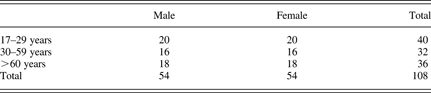
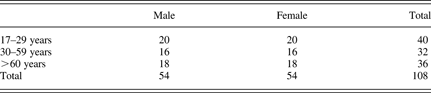
The data for this analysis are drawn from the Toronto English Archive, a collection of synchronic oral corpora that to date comprises over 165 speakers, approximately 350 hours of spontaneous speech, and more than 1.5 million words. Traditional Labovian sociolinguistic interviews were carried out with native Torontonians, and although the topics of conversation vary, much of the materials consist of narratives of personal experience. As a result, the data are highly informal. This, in conjunction with the size of the sample and the age range it captures, provides for a representative model of vernacular TorE. The details of the current sample are provided in Table 2.
The TorE sample
Circumscribing the variable context
Previous research has shown that variation among the forms used for stative possession is restricted to contexts in which they carry present tense morphology (LeSourd, Reference LeSourd1976; Quinn, Reference Quinn, Crisma and Longobardi2009, forthcoming; Tagliamonte, Reference Tagliamonte, Rohdenburg and Mondorf2003). As such, every token of have, (have) got, and got, including the morphological variants has and ’ve/’s got, was extracted from the interview materials when it occurred in the present tense and unambiguously encoded a possessive meaning, as illustrated in the examples given. This method immediately revealed an important contrast between the TorE data and other varieties. Negative contexts were overwhelmingly formulated with have.
The type of negative constructions found in the data can be divided into two categories. On the one hand, there are expressions of the type exemplified in (10). This type of negation, employing the determiner no, can only be used with an indefinite NP complement (Nelson, Reference Nelson2004:301; see also Horn, Reference Horn2001, and Tottie, Reference Tottie1991, on the distinction between no-negation and not-negation).
(10)
a. The young people have no idea about the history of the music. (N/¥/m/72)
b. I'm like, “I have no clue what this kid's saying!” (I/4/f/25)
c. He's like, “I have no money ‘cause I used it on the beer.” (3/R/f/18)
d. Like I have norespect for our media here… (I/8/m/32)
Fully 98% of no-negation (n = 105) in the corpus appears as have no + indefinite NP; only two tokens of got no + indefinite NP preclude categorical use of the have variant in this context. Due to this lack of variability, instances of no-negation were removed from the analysis.Footnote 7
The remaining negative constructions, which employ not-negation, overwhelmingly exhibit do-support, as in (11a, 11b) (94%; n = 223).Footnote 8Haven't got (11c) appears infrequently (6%; n = 223), hasn't got is unattested, and there is only a single instance of haven't alone (11d), from an older female speaker. This provides a key indication that lexical have in TorE no longer has auxiliary-like syntax (see Kroch, Reference Kroch1989:n. 5). The examples in (11) also exemplify the restricted collocation pattern of periphrastic negation in TorE, occurring strictly with have (with or without got); don't got never occurs in these data (cf. Cheshire, Reference Cheshire1982; Feagin, Reference Feagin1979; Weldon, Reference Weldon1994, for other varieties of English) and don't have got, as far as we are aware, is impossible in any variety.
(11)
a. I don't have a curfew so I've never been late. (2/q/m/18)
b. Plus, plus, yeah, he doesn't have curly hair.
He doesn't have messy hair. (I/ ~ /f/29)
c. I haven't got a car. (N/œ/m/62)
d. … today you haven't a clue who's living in— (N/%/f/75)
The other prime context for do-support in contemporary English is the interrogative construction. Like negation, question formation for possessive meanings in TorE is encoded with have, as in (12a, 12b). Unlike negation, the rate does not approach categoricity (73%; n = 40). What is particularly interesting about interrogatives, however, is that where have appears, it is supported by do in all but one instance. This exception is given in (12c).
(12)
a. Why don't you have an opinion about anything? (2/i/f/19)
b. They're like “Oh does she have an accent?” (I/ ≠ /f/32)
c. Have you any idea how many years it took us to quit s— calling us that? (N/ ¥/72/m)
Have therefore almost exclusively employs do-support for both negation and question formation in these data. As have becomes further entrenched as a full verb, part of this process necessarily entails increased dependence on periphrasis in contexts requiring inversion (negative and interrogative clauses), because have can no longer move out of the verbal projection. The exceedingly high rates of periphrasis in these materials thus indicate that have has completely transitioned to full verb status in TorE (cf. Kroch, Reference Kroch1989; Trudgill et al., Reference Trudgill, Nevalainen and Wischer2002).
Trudgill et al. (Reference Trudgill, Nevalainen and Wischer2002:13) proposed that an increased use of stative possessive have with do-support is “part of the broader chronological trend […] for English verbs to acquire, rather than to lose, the characteristic of requiring do-support.” Further, they suggested that for have this transition has “gone to completion” in North America (2002:6). The TorE data support this conclusion. Consequently, the variable context for stative possession is more circumscribed in TorE than has been reported elsewhere in quantitative analyses. Here, it is restricted to present tense, affirmative clauses, rather than simply present tense. Because affirmative interrogatives appear to allow more variation than negative constructions, the former have been retained in the analyses that follow but the latter have been excluded.Footnote 9 We now turn to quantitative analysis of the nearly 2,100 variable stative possessive contexts extracted from the TorE materials.
RESULTS
Distributional results
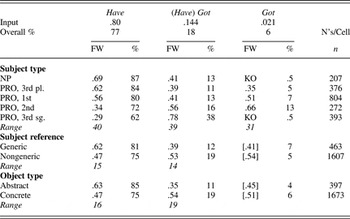
Table 3 reports the overall distribution of forms, where the most frequent variant is shown to be have. Indeed, with a rate of 77%, it accounts for the vast majority of stative possessive contexts. In contrast, the rate of (have) got is low, just 18%, and got, at 6%, is rare. Thus, despite the suggestion of robust variability in (1), TorE has a fairly restricted system, one that leans overwhelmingly toward have for stative possessive meaning.
Overall distribution of forms for the stative possessive in TorE

Where does this place CanE as represented in Toronto vis-à-vis other varieties? To this point, got has generally been considered American (Jespersen, Reference Jespersen1961:53), by which some may infer North American, yet overall in the TorE data it is infrequent. In contrast, in 20th-century American play data, which can be taken to provide a cautious representation of contemporary spoken AmE, got occurs two and a half times more frequently than it does in the Canadian dataset (see Jankowski, Reference Jankowski2005; Table 4, where the rate of got is 20%, n = 1,541).Footnote 10 A better match is found in present-day regional British dialects, where the use of this variant is also low (e.g., Wheatley Hill: 7%; n = 350; York: 4%; n = 511; see Tagliamonte, Reference Tagliamonte, Rohdenburg and Mondorf2003:537). With respect to the overall configuration of forms, however, the TorE data most closely align with the frequencies found in contemporaneous Northern Irish data, where got is similarly infrequent while have is used at high rates (e.g., Portavogie: got 3%, have 93%; n = 150; Cullybackey: got 7%, have 84%; n = 184; see Tagliamonte, forthcoming).
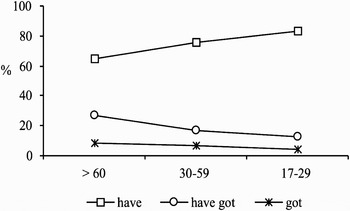
Of course, the TorE sample spans the community, adolescents to nonagenarians. If the stative possessive system is undergoing change in this variety, then the age range should provide insight into its progression. We now consider variable have in apparent time, as in Figure 1. This perspective reveals that even among the oldest speakers in the sample, those over the age of 60, have is considerably more frequent than the other variants (65%; n = 499). This suggests that have has been the majority form in TorE for more than half a century. Within the most senior cohort, layering with (have) got and got is present, but these variants are marginal in the system. In the two subsequent generations, this layering is further reduced as (have) got and got decline in frequency. Thus, the apparent time trajectory suggests that the move toward have may be a change in progress (see also Tagliamonte & D'Arcy, Reference Tagliamonte and D'Arcy2009:93–94).
Stative possessive forms across apparent time in TorE.

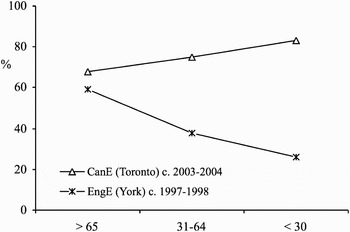
The course of change revealed by Figure 1, where have rises incrementally from one generation to the next, is the antithesis of that found in comparable apparent time trajectories for contemporary urban speakers of EngE (Tagliamonte, Reference Tagliamonte, Rohdenburg and Mondorf2003) and NZE (Quinn, Reference Quinn, Crisma and Longobardi2009, forthcoming) where (have) got is not only the preferred form, but its use has been rising over the past century. Due to similar corpus construction methods, a straightforward comparison of the frequency of have across apparent time in Tagliamonte's (2003) EngE dataset from York and the current CanE dataset from Toronto is possible. This comparison, shown in Figure 2, graphically illustrates the divergent pathways of have in these two varieties of English.
Comparison of have for possession across apparent time (EngE results from Tagliamonte, Reference Tagliamonte, Rohdenburg and Mondorf2003).

It is clear that the apparent time trajectory for TorE does not align with that for EngE, at least as represented by the northern variety of York English. However, the TorE results do dovetail with the trajectory reported for 20th-century American plays where have has the same pattern of increasing use in real time (from 50% in the early 20th century to 70% by the final decades; Jankowski, Reference Jankowski2005). If we assume that the play materials reflect linguistic developments in AmE and that TorE is more or less representative of ongoing trends in urban CanE (see Chambers, Reference Chambers and Cheshire1991:91, forthcoming), it would seem then that have is both robust and increasing in North America's two national varieties of English. This raises an interesting question: Are the mechanisms that underlie the use of have consistent with the historical trajectories mapped in earlier research for the rise of (have) got? In other words, does the variation that remains in the stative possession system of TorE reflect the structured variation reported in the historical literature and in earlier research despite the fact that the dominant form differs? In the next section, we determine whether the same contextual constraints tracked by Noble (Reference Noble1985), Kroch (Reference Kroch1989), and Tagliamonte (Reference Tagliamonte, Rohdenburg and Mondorf2003) can be observed in these materials. To do so we now subject the data to multivariate analysis (Sankoff, Tagliamonte, & Smith, Reference Sankoff, Tagliamonte and Smith2005).
Multivariate analysis
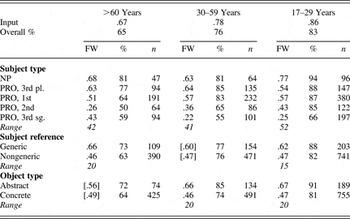
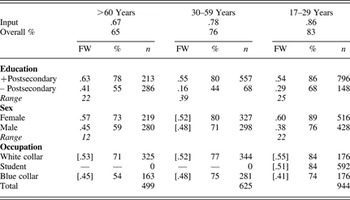
Tables 4a and 4b report the findings of multivariate analysis of the factors contributing to the probability of have, (have) got and got in TorE where the application value is modeled in opposition to all tokens of the variable context. The analysis is configured to test each variant in the system for each of the internal constraints previously reported in the literature: subject type, subject reference, and complement type (Table 4a). To uncover potential nuances within the type of subject constraint, we provide an elaborated test that distinguishes between noun phrases (NP), pronouns (PRO), and number (1st, 2nd, 3rd sg., 3rd pl.).Footnote 11 The analysis is also configured to test the application of key extra-linguistic factors that are typically implicated in linguistic change and that provide a measure of social evaluation in the community (see Labov, Reference Labov1990): speaker age, sex, and occupation (Table 4b). We model this last factor using two different categorization schemas. First, we test an educational parameter, distinguishing between speakers with some degree of postsecondary schooling (+) versus those with none (–). Education is perhaps the best binary measure of the social evaluation of features in a community, with higher levels of education correlating with linguistic features held to have prestige (Labov, Reference Labov2002:60). Second, we categorize speakers according to occupation, whether “blue collar” or “white collar,”Footnote 12 as well as including a separate category for students, who were numerous in the youngest age group. Occupation is highly correlated with conceptions of social class, where higher status jobs tend toward positively valued linguistic features (Labov, Reference Labov2002:60; Wolfram, Reference Wolfram and Coulmas1996:120–122).
Multivariate analyses of the contribution of factors to the probability of have, (have) got, and got for stative possessive in TorE—Linguistic Factors

Multivariate analyses of the contribution of factors to the probability of have, (have) got, and got for stative possessive in TorE—Social Factors

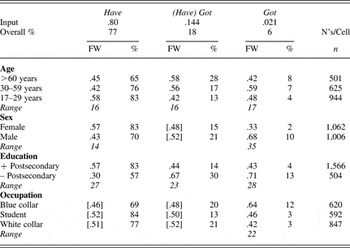
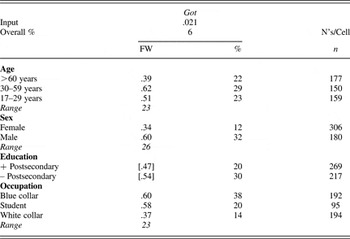
Table 4a reveals that the full set of constraints outlined in Table 1 is well entrenched in the data. Have is favored for subjects with generic reference and with objects that are abstract. It is also favored for certain types of subjects including, most favorably, noun phrases, but also 3rd person plural pronoun they and all 1st persons (I and we). This result shows that the personal pronouns are quite distinct from each other. Yet it is not the result of a singular/plural contrast, nor of a distinction between 3rd person and the other persons. Whatever the reason(s), 2nd (you) and 3rd person singular pronouns (he/she) retain (have) got in these data. Both these contexts disfavor have: compare PRO 3rd sg. at .29 and PRO 2nd at .34. In contrast, (have) got is highly favored with 3rd person singular pronouns in particular at .78, but also with 2nd persons at .56. (Have) got is also favored for nongeneric reference, .53, and concrete objects, .54. Got stands apart. In all cases, it accounts for little of the data, at most 13% (2nd person).Footnote 13 Neither the subject reference constraint nor the complement type constraint is statistically significant, and got is favored with just two types of grammatical subjects, 1st person (marginally so, .51) and 2nd person (.66).
Table 4b displays the contribution of social factors to the probability of have, (have) got and got. In this analysis, have is favored within the youngest age group (.58) and among females (.57). However, note the mismatch between the factor weights and the percentages for speaker age. Although the percentages show a monotonic pattern from oldest to youngest speakers, the factor weights pattern differently, making the two oldest age groups contrast with the younger group.Footnote 14 Further, the correlation of have with speakers with a postsecondary education (.57) (a higher status group) suggests a prestige form, but it shows no significant correlation with occupation. In contrast, (have) got is favored among the two oldest age groups (.58, .56) and with speakers with no postsecondary education (.67) (a lower status group). It is neutral as far as speaker sex is concerned, and occupation is not statistically significant. Education is the strongest external factor affecting have and (have) got. Thus, (have) got appears to be a variant that, although involved in social patterning, is not particularly prestigious. It occupies a rather unique middle-of-the-road position in which, while not carrying overt status, it is not stigmatized either (see Wolfram, Reference Wolfram and Coulmas1996:120–122). The markers of covert prestige are not evident in the multivariate results (i.e., it is not favored for males or for the lower status occupation category). The social patterning of got is notably different.Footnote 15 This form, though infrequent, is strongly favored for men (.68), for speakers with no postsecondary education (.71), and those with nonprofessional occupations (.64). It would seem that in Toronto no one uses got very much, but those who do are more likely to be male, less educated, and have a blue collar job.
The results in Tables 4a and 4b expose a complex picture of intersecting constraints on the use of the different forms used for stative possessive meaning in TorE. Importantly, neither have nor (have) got meets the full expected profile for either a prestige or covert variant. Let us first pursue the major variant in the system, have.
The basic distributional analysis of frequency (Figure 2) showed that TorE appears to be undergoing change toward have. Table 4b corroborated this possibility with a contrast between factor weights for the youngest speakers in the sample versus the two older age groups: have is only favored among the 17–29-year-olds. To test whether this is in fact the result of an incremental change in progress, as we have argued elsewhere (Tagliamonte & D'Arcy, Reference Tagliamonte and D'Arcy2009), we now reconfigure the analysis by partitioning the data into three age groups. The results are again displayed in separate tables; Table 5a displays the linguistic factors and Table 5b displays the social factors.Footnote 16
Multivariate analyses of the contribution of factors to the probability of have for stative possessive in TorE—Linguistic Factors

Multivariate analyses of the contribution of factors to the probability of have for stative possessive in TorE—Social Factors

The overarching finding in Table 5a is the stability of the previously established internal constraints on stative possessive have across apparent time. Each age group mirrors the next, exhibiting virtually the same hierarchy for each linguistic constraint. NPs consistently favor have, as do generic subjects and abstract objects. Though it is true that in some cases one or the other constraint is not selected as statistically significant (subject reference for 30–59-year-olds; object type for >60-year-olds), the variable grammar is remarkably constant. The operation of the underlying linguistic factors constraining variable have not only parallels the findings for present-day EngE dialects (Tagliamonte, Reference Tagliamonte, Rohdenburg and Mondorf2003:547), but the TorE results from the early 21st century also parallel those reported in 18th- and 19th-century EngE (see Kroch, Reference Kroch1989; Noble, Reference Noble1985). The same constraints endure to the most recent generation of speakers, who are approaching near categorical use of have for stative possessive meaning. However, there is more to the story than the internal grammar.
Table 5b reveals stalwart social foundations. First, females in each age cohort exhibit a favoring effect over males, although among the 30–59-year-olds it does not approach statistical significance. Second, have is consistently favored among speakers with postsecondary education and disfavored for those with none. Moreover, this is the strongest constraint in every age group. However, the relative influence of education and sex changes over time. Whereas education is the stronger external predictor of variant choice among the older generations (range = 22) and speaker sex is the weaker (range = 12), within the youngest age cohort the strength of speaker sex has risen to rival that of education (compare the range values of 22 and 25, respectively). This is undoubtedly due to a change in the nature of the system among the youngest generation. Note that in no age group does a person's job type exert a statistically significant effect. We conducted a separate run in which the students in the 17–29-year-old group were grouped with white collar workers. The result was that occupation was selected as significant: white collar .52; blue collar .41. The other effects remained the same. Thus the youngest generation is unique in showing an effect of occupation, but this is the weakest of the statistically significant effects with a range of 11. We will return to further consideration of this situation.
To summarize the findings from Tables 4 and 5, we can first simply highlight the overwhelming constancy of longitudinal linguistic factors across the Toronto speech community. This is all the more noteworthy considering the longitudinal trend toward a system of stative possession that is nearly categorically marked by have among the youngest generation. Given the highly circumscribed syntactic and semantic conditions governing the use of forms, it might then be hypothesized that the shift toward have is an entirely mechanistic change proceeding as an “invisible hand” (Keller, Reference Keller1989, Reference Keller1994). Indeed, in earlier work (Tagliamonte & D'Arcy, Reference Tagliamonte and D'Arcy2009), we argued that possessive have is in fact a change in progress. Such an analysis is all the more compelling in view of the robust and consistent strength of the subject type constraint. When social constraints are factored in, broadly categorized here as +/– postsecondary education and male versus female, we discover that these constraints are strong contenders to the longitudinal internal factors (compare the range values for education and sex vs. subject reference and complement type). Variation among stative possessive forms is not only structured grammatically in this community. The strong correlates of sex and education point to the fact that the possessive system has important social embedding as well. We now return to further scrutinize the minor variants in the stative possessive system, (have) got and got.
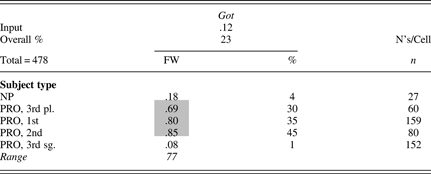
A key observation that arose from Tables 4a and 4b was that marking of stative possession in TorE is a tripartite system in which each variant shows distinct social patterns. Perhaps the most revealing finding was that despite the obvious historical relationship between (have) got and got, they are distinct both linguistically and socially. What is the reason for these differences? Recall that an independent process of contraction of have to ’ve versus ’s operates in this system. Indeed, there is virtually no incidence of full forms of have in the data. This means that phonological reduction is surely playing a role in the variation. Another internal consideration is that the use of got alone in 3rd person singular is blocked (e.g., *he/she got). The effect of these processes can only be viewed by performing an additional analysis of the data such that variation between (have) got and got is analyzed as a subset of the overall variation. Tables 6a and 6b report on the same set of factors in the earlier analyses, but got is modeled in opposition to all tokens of (have) got only; the have data are excluded.
Multivariate analyses of the contribution of factors to the probability of got out of all (have) got for stative possessive in TorE—Linguistic Factors
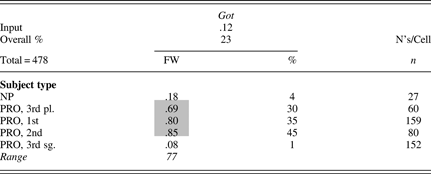
Factors not selected as significant: subject reference; object type.
Multivariate analyses of the contribution of factors to the probability of got out of all (have) got for stative possessive in TorE—Social Factors

Table 6a reveals yet another layer within the stative possessive system. The use of got is heavily conditioned by subject type. All the personal pronouns highly favor got, the exception being 3rd person singular (which resists got because inflection represents a highly nonstandard use across all major varieties of English). We can conclude that from a language-internal perspective, use of got results from phonological reduction in this variety.
Table 6b adds a further perspective to the use of this form. Occupation is strongly correlated with got, indeed even more so than education because in this model of the data education is not significant. This finding gives away the unmistakable nonstandard profile for got in TorE, one that sets it apart from (have) got. The two variants are differentiated by the degree of social stigma they hold in the community. Recall too that in stark contrast to the interpretation of change in progress for have, both (have) got and got are favored among the middle-aged cohort, a pattern that is perplexing. Why would forms that pattern as nonstandard—or at least nonprestigious—increase in use among middle-aged speakers, the population group most likely to use more highly regarded forms?
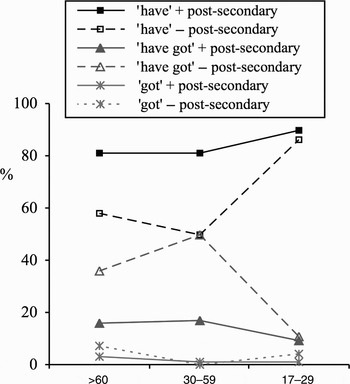
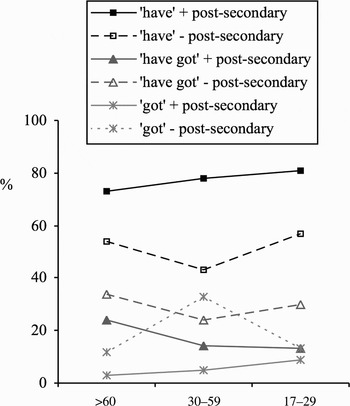
To further understand the mechanisms governing variation among stative possessive forms in TorE, we now consider in more detail the intersection of the social factors with speaker age. The results are shown in Figures 3 and 4, where speakers with postsecondary education are represented with solid lines and symbols and speakers with no postsecondary education are shown with dashed lines and empty symbols. We begin with the women, displayed in Figure 3.
Rates of possessive forms according to education in TorE: Females.

Rate of possessive forms according to education in TorE: Males.

Among women with postsecondary education, the frequency of have is high in the oldest two cohorts with a wide berth from less educated women. However, in the youngest generation the rates merge to nearly the same proportion. This is not unique to have. Among the 17–29-year-olds, education makes no difference in the overall use of any of the variants, a conclusion that is supported by the results of independent chi-square tests (have: p = .763; (have) got: p = .6547; got: p = .1797). In short, the effect of education disappears among the young women in the sample, a fact that was not apparent from either of the multivariate analyses presented (Tables 4b and 5b). (Have) got patterns in opposition to have. It is relatively vigorous among the less educated women in the oldest and middle age cohorts. The form got is too marginal to make comment; the women simply do not use it.
The results for men are presented in Figure 4. As far as have is concerned, the more educated males pattern with their female counterparts, displaying consistently high and increasing rates across age groups. The notable difference is that with men there is no convergence in the youngest generation. Another major disparity concerns the use of got; it has a much higher frequency among the males. It is also notable that (have) got does not show the downward trend so prominent among the women from the middle-aged to the youngest speakers. In fact, both (have) got and got—though minor—not only appear stable across the male sample but they also maintain a contrast between +/– postsecondary education. Although got evidences a rise among the middle-aged speakers, when the oldest and youngest groups with no postsecondary education are compared, there is virtually no divergence in overall rates of use; a chi-square test confirms that they are not significantly differentiated (got: p = .8415).
The results in Figures 3 and 4, in concert with those in Tables 4–6, reveal that (have) got and got together operate as the nonstandard forms of the stative possession system in Toronto. This particularly seems to be the case within the older generations and among men of all ages. Figures 3 and 4 now also expose the fact that the continued rising dominance of have among the youngest generation, though also evident among the educated males, is largely attributable to the female sector of the population, propelled by a leveling of education differences as the less educated young women eschew (have) got. A different pattern is found among men; although both (have) got and got are less frequent than have, in each age group these forms maintain a foothold in the system among the males, and in particular among less educated, blue collar men.
DISCUSSION AND CONCLUSIONS
The analysis of the stative possessive system in TorE has revealed remarkable stability in the operation of the constraints underlying variability while simultaneously highlighting a specifically North American “flavor” in terms of variant choice. Unlike British or Antipodean varieties of English, CanE uses have for stative possessive meaning. When we consider the historical context, it seems plausible that the dominance of have in Canada is rooted in the particular historical timing of Canada's settlement. We began our study by observing that Torontonians do not know which of the “major” variants they use (have or (have) got), yet the third variant (got) is decidedly recognized as nonstandard. The patterns of variation exposed here reflect this in a myriad of ways. Whereas have appears to bear the hallmarks of a socially prestigious form, consistently favored by females and more educated speakers, it does not significantly correlate with occupation. In contrast, (have) got is significantly correlated with less educated speakers, but it exhibits no sex or occupation effect. Although these forms are complementary linguistically, they are not complementary socially, as might be expected in a situation where a standard form is balanced with a single nonstandard form (Labov, Reference Labov2001:196). This is because there is a third variant, got. It is this form that bears the brunt of adverse social affect, evidenced by its contrasting social patterns of use. Got is not only favored among speakers with less education and highly correlated with males (Tables 5b and 6b), but it is also the only form for which occupation is statistically significant. This might explain why the variation between have and (have) got goes unremarked. Got, although infrequent, carries all the stigma. This leads us to wonder why (have) got would be relegated to the less standard area of the system in TorE.
We suggest that it was the foundation of CanE, built on British dialects from a particular point in the development of this system, that is responsible for the differences between the patterns found in CanE and those found in current day EngE, as well as EngE-based NZE. CanE was established by the United Empire Loyalists (Chambers, Reference Chambers and Hickey2004:3), British settlers from the United States who wanted to remain loyal to England following the American Revolution. Both the historical trajectory of stative possessive forms and Noble's (Reference Noble1985) research suggest that have would have been the majority form among British settlers in the early colonization period. Indeed, if the proportions of have in British plays reported by Noble (Reference Noble1985) can be used as a cautious gauge (approximately 80% have in the 1850s shifting to less than 20% by 1935), then the overall frequency in TorE (77%, Table 3; 65%, 76%, 83%, Figure 1) is in fact quite similar to what it was in England in the late 19th and early 20th centuries just prior to the rise of (have) got. Thus, we might extrapolate from this that the Loyalists brought with them a system of stative possession that had a high proportion of have. As CanE developed, it carried forward the most frequent extant form, reflecting the then-contemporary situation in the British donor dialects of the Loyalist founders.Footnote 17 The British norms of the time simply endured in Canada, paving the way for have to become the standard target for Canadians in the 20th century. Thus, the current TorE profile stands as another good example of the power of the “founder effect” (Mufwene, Reference Mufwene1996) in the development of new varieties.
Later migrants to Canada may have had higher frequencies of have got as this variant made inroads in BrE during the 19th century. However, overt prescription of have, not (have) got, in the North American context may well have played a supportive role for the selection of have. By the late 1800s, (have) got had attracted a fair amount of social stigma in North America, as the following excerpts show (cited in Rice, Reference Rice1932:291).
Many persons, who consider themselves well educated, often commit … an error by using the participle got in connection with the verb to have; as, “I have got the book in my library”; “Who has got a pencil?” “I have got one.” This form of speech should never be used to express possession, as the verb to have conveys that idea, in these and similar phrases. (Gwynne, 1855)
The most common misuse of this word is to express simple possession. It is said of a man that he has got this, that, or the other thing, or that he has not got it; what is meant being simply that he has it, or has it not—the use of the word got being not only wrong, but if right, superfluous. (White, [1870] 1927)
Get means to secure; got should not therefore be used unless the intended meaning is secured, nor have got unless the intended meaning is has secured.
Wrong: Have you got a knife with you:
Right: Have you a knife with you? (Wooley, 1907)
In fact, early 20th-century investigations into the misuse of English grammar record that the 14th most frequent error in English is the use of (have) got for stative have (cited in Rice, Reference Rice1932:292). Got was subject to further pejoration, considered “vulgar” and even labeled “the bogey word” (Rice, Reference Rice1932:292). As Labov (Reference Labov2001:60) has argued, “the attitudes that emerge from the speech community almost always reinforce the prestige forms taught in schools and (our emphasis) the older forms of the language”. Thus, it was both the particular timing of Loyalist settlement in Canada as well as the social climate that predisposed the emerging new colonial variety to favor have.
The interesting question is what has kept the “underbelly” of this system from the normal progression of change in progress, where we would expect one form to eventually replace another after a period of competition or layering? We suggest it is the rich sociolinguistic component to the variation. Despite the standard connotations of have, it seems that (have) got and got remain steadfast among certain sectors of the population. Indeed, the intersection of age, sex, and education (Figures 3 and 4) exposes the social niches in which (have) got and, in particular, got are rooted. Less educated speakers use them more frequently, and men retain healthy rates. Moreover, these social distributions have remained relatively stable over the three-quarters of a century that we are able to track in the TorE corpus.
In short, what is a longitudinal grammatical change from have to (have) got in Britain (Kroch, Reference Kroch1989; Noble, Reference Noble1985) was transplanted to North America—apparently Canada and the United States alike—during the early stages in this change when have remained the dominant form. Indeed, evidence from a corpus of personal letters and letters to the editor from Early Canadian English (Dollinger, Reference Dollinger2008) reveals hundreds of tokens of possessive have/has, yet only two or three unambiguous examples of (have) got, as in (13)
(13)
a. Catherine has got the rheumatisms in her legs badly.
(Diary entry, teenage girl, c. 1846)
b. We have got rather a sick house at present.
(Diary entry, teenage girl, c. 1846)
Thus, North Americans must have always used have more often than any other variant in the system, and supported by the prescriptive sanction against (have) got, simply kept using it. At the same time, the (have) got variants remained as low frequency, covert prestige variants engaged in social and stylistic work. The fact that the North American development is quite different from British and Antipodean varieties of English provides a unique example of how sociohistorical timing and sociocultural context plays a hand in language change.
At the same time, the patterned variation in TorE between have and (have) got faithfully adheres to constraints that have been in place for hundreds of years. This long-term maintenance of contextual constraints provides confirmation of the constancy through which underlying mechanisms of change operate in the grammar (Kroch, Reference Kroch1989). Language proceeds down its own path, invisibly perhaps, yet remarkably constrained. At the same time, even the purely mechanistic processes of language change can only evolve, as Labov (Reference Labov, Lehmann and Malkiel1982:84) concluded, while “simultaneously serving to represent information, establish group identification, and accommodate to social situations.” If anything, the steady richness of the TorE vernacular, maintained by particular sectors of a complex speech community, in particular the less educated male sector of the population, a well-known bastion of covert prestige (Trudgill, Reference Trudgill1972, 1983:169–185), provides a good reminder of just how strong social influences can be in the face of ongoing change.